
Choosing a first dance style is easy when both partners dance equally well, and surprisingly tricky when they do not. This guide gives mixed-experience couples a written ability and confidence chart, six pattern-based recommendations, a floor-and-ceiling rule for building one dance for two levels, and a short test that tells you when to simplify.
Rate each partner separately on two scales, dance ability and confidence being watched. Build the dance at the level of the partner who has less of either one (the floor), then let the more experienced partner add optional moments on top (the ceiling). That usually points to a slow sway, a basic box step or a simple waltz rather than a routine. Test the choice with three full run-throughs in the shoes and clothes you will wear. If any run breaks, drop one level before you drop the song.
Picture two people planning a wedding. One took years of studio classes as a teenager and still moves easily to music. The other has never danced in front of anyone and would happily skip the whole thing. Both love the song. Both want a first dance that feels like theirs. The trouble starts at the first conversation: one of them hears “let’s pick a style” as an invitation, and the other hears it as a threat.
Most advice about choosing a first dance style assumes a pair of equals. It lists waltz, foxtrot, swing and slow dance, and tells you to pick the first dance style that matches the song. That works when both partners have the same starting point. It breaks down when the gap between you is wide, because a first dance style that is relaxed for one partner can be a real strain for the other, and the stronger dancer’s comfort is not the number that matters.
This article is built around one decision. How do you choose a first dance style that suits both of you, when your ability, your confidence, or both are not matched? It does not teach steps and it does not rank instructors. It gives you a chart to fill in, a set of patterns to match against, a rule for combining two levels in one routine, a worked example marked clearly as invented, and a list of conditions that tell you to change course.
A note on scope. This is general planning information, not legal, tax or financial advice, and it makes no medical or fitness claims. Studios, venues and accessibility arrangements differ, so confirm the details with the people you hire and with your venue.
Why a mixed-experience first dance style is a different problem
When both partners are beginners, the problem is simple: choose something small. When both are experienced, the problem is also simple: choose something you both enjoy. Mixed experience creates a third kind of problem, and it has three features that make it harder than it looks.
The first feature is that the weaker partner sets the real limit. A dance is performed together. If one person can only keep a steady sway while the other could manage a turning sequence, the performance will look like whatever the less practiced person can do reliably, plus whatever the stronger partner can add without disturbing it. Choosing a first dance style at the stronger dancer’s level does not raise the dance; it exposes the gap.
The second feature is that ability and confidence are different things, and they do not always move together. A person with real training can still freeze when forty guests turn to watch. A person with no training can be perfectly relaxed about swaying and laughing through a slow song. The chart in this guide treats the two scales separately for that reason, and it gives you different advice depending on which one is the issue.
The third feature is social. The more experienced partner often ends up as the unofficial teacher, and the arrangement tends to wear on both people. One feels corrected, the other feels like a tutor. A good first dance style decision plans for that in advance, and that is why a later section of this article covers who leads, who teaches and who should hand the teaching to someone else.
What this article does not cover
A few neighboring topics are handled elsewhere, so this guide stays narrow. If you are still deciding how much music planning your reception needs, the wedding reception music planning guide covers programming the whole evening, including where the first dance sits among the other music moments. If you are thinking about how guests move through the room and where the dance floor goes, the reception guest flow guide covers the layout.
This article does not recommend a particular studio, instructor or online course, and it does not compare lesson formats. It assumes you will decide that separately. It also does not cover cultural dances that follow a tradition with its own rules; in that case, the family or community teacher decides the structure, and this article’s chart can still help you talk about pace and rehearsal time.
What a good outcome looks like
Before the chart, decide what success means, because the answer shapes every choice afterward. For a mixed-experience couple, a good first dance usually has four qualities.
It looks relaxed. A first dance style that is slightly simpler than what you could manage looks more natural than one that is exactly at your limit, because there is no visible effort. Guests respond to that ease far more than to complexity.
It is repeatable. You should be able to perform it in the same way, from beginning to end, on a floor that is not the one you practiced on, in front of people who are not your living room. If it only works when everything goes well, it is a fragile dance.
It is fair. Neither partner should carry the dance, and neither should disappear into it. Both should have something to do, and both should be able to say honestly that they are comfortable.
It leaves room. A song lasts a few minutes, and the dance does not have to fill every second. Standing close, talking, smiling and simply moving together are all legitimate parts of a first dance, and for many couples they are the best part.
If you read those four qualities and thought, “that sounds like a lot to ask of a style,” you are right, and the chart that follows is the tool for it. The first dance style is the container. The qualities are what you test it against.
Reading your own ability and confidence honestly
The chart for your first dance style only works if the inputs are honest, and people are rarely honest about this on the first try. The experienced partner tends to understate how much they are used to, and the beginner tends to understate how much they could pick up. Both of you tend to confuse what you can do in a quiet kitchen with what you can do under lights.
So the first step is to rate yourselves separately, privately, and before you compare. Write your answers on separate pieces of paper or in separate notes. Then swap. The point is to avoid the situation where one partner hears the other’s rating, feels judged, and adjusts upward or downward to compensate.
The ability scale
Ability is about the body’s learned skill at partner dancing, not about whether you enjoy music or have good rhythm. Use four levels, and answer for the style you are considering, not dance in general.
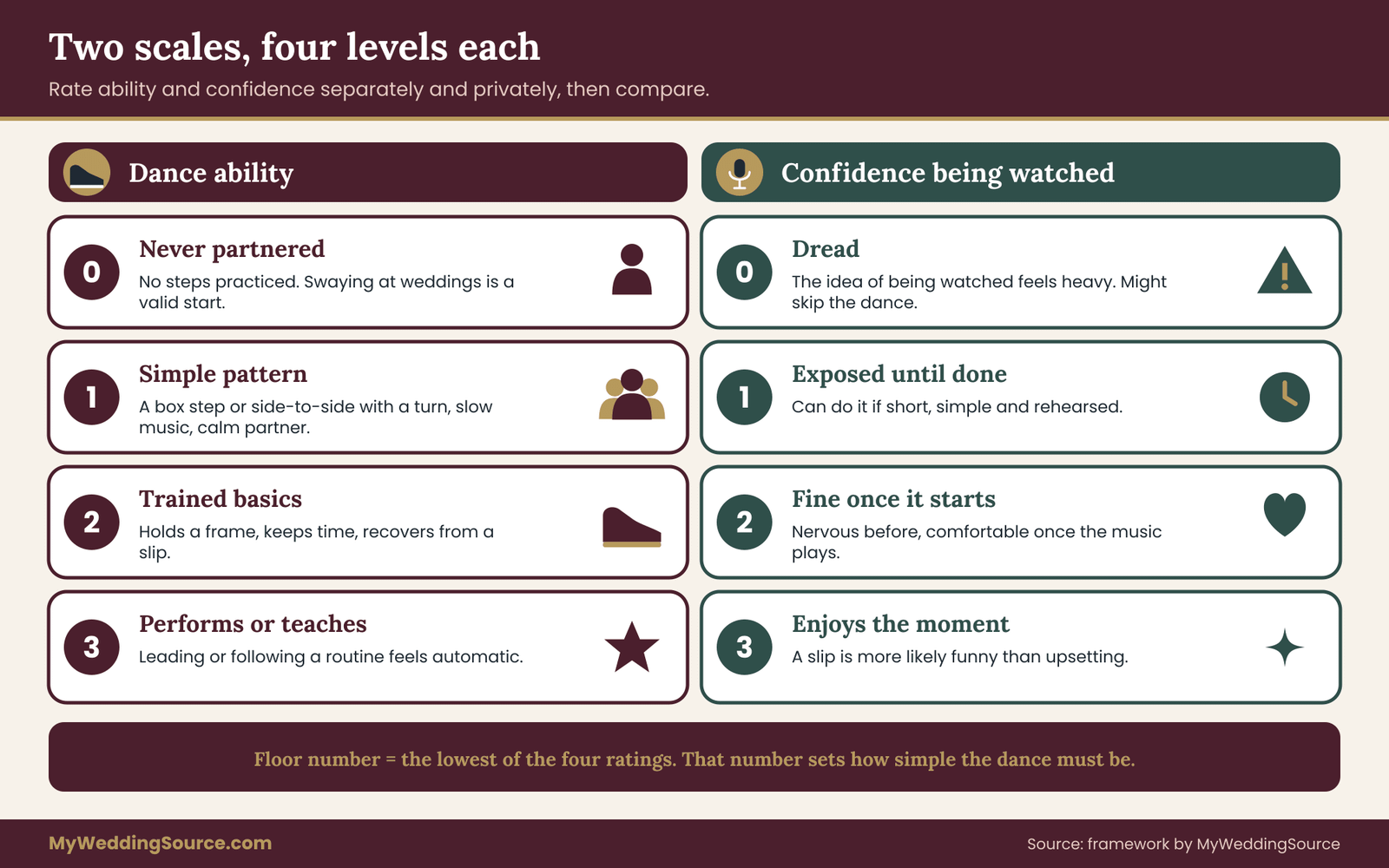
Level zero means you have never done partner dancing and have not practiced any steps. You might sway at weddings, and that is a valid starting point.
Level one means you can follow or lead a very simple pattern, such as a box step or a steady side-to-side with a turn, when the other person is calm and the music is slow. You have done it a few times.
Level two means you have taken lessons or practiced regularly in at least one partner style, and you can hold a frame, keep time and recover from a mistake without stopping.
Level three means you have performed or competed, taught, or danced often enough that leading or following a routine feels automatic.
Be careful with the word “experienced.” Training in a solo style, such as ballet or hip-hop, builds timing and body awareness, but it does not automatically transfer to leading or following a partner. Someone with years of solo training might sit at level one or two for partner dancing. Rate the specific skill the first dance uses.
The confidence scale
Confidence is about how you feel being watched, and it has little to do with skill. Use four levels here too.
Level zero means the idea of dancing in front of the guests causes real dread. You might want to skip the dance altogether.
Level one means you can do it, but you will feel exposed until it is over. You need the dance to be short, simple and well rehearsed.
Level two means you are comfortable once the music starts, though you might feel nervous beforehand. A small slip would not rattle you for long.
Level three means you enjoy being the center of attention for a few minutes, and a slip is more likely to be funny than upsetting.
Notice that nothing on this scale is a moral judgment. Low confidence is a normal and common starting point, and plenty of couples with level-zero confidence have a perfectly good first dance, by choosing a style designed for it.
Why you rate yourselves, not each other
There is a practical reason to rate yourself and not your partner. People tend to read the other person’s hesitation as a skill gap, when it is often a confidence gap, and the remedies are different. A skill gap responds to instruction and practice. A confidence gap responds to shorter, simpler choreography, a smaller audience during rehearsal, and more time with the finished dance.
If you rate each other, the experienced partner will likely score the beginner low on both, and the beginner will likely score the experienced partner high on both. Those ratings feel safe and tell you very little. Self-ratings, given privately and then discussed, tell you what each person actually needs.
When you compare, look for three things. First, how far apart are your ability levels? Second, how far apart are your confidence levels? Third, is the lower score on ability or on confidence for each of you? Those three answers place you on the first dance style chart in the next section, and they matter more than the total of the two numbers.
There is no wrong answer to the exercise, but there is a useful disagreement to watch for. If one partner rates their confidence as level three and the other as level zero, that is the most important finding of all, because it means the two of you picture the moment differently. One of you imagines a fun show. The other imagines a test. Talk about that difference before you talk about any first dance style or steps.
The ability and confidence chart for choosing a first dance style
Now put the four ratings together. The chart has two parts. The first is a single number called the floor. The second is a pattern name that describes how your two profiles relate. Together they point to a lane, which is a family of dances rather than a single choice of first dance style.
Step one: find the floor
Look at your four numbers: each partner’s ability and each partner’s confidence. Take the lowest of the four. That is your floor number. It is deliberately blunt, because it is the weakest link that decides whether the dance holds up.
A floor of zero means someone has no partner dancing skill, or someone dreads being watched, or both. A floor of one means everyone can manage something simple and everyone can get through it with some nerves. A floor of two means both partners are at ease with basics and comfortable on the floor. A floor of three means you both have real training and real stage comfort, and that is rare for mixed-experience couples.
The floor is not a verdict on you, and it is not a ranking of any first dance style. It is the level at which the dance has to be reliable. If your floor is zero and you choose a style that needs a floor of two, you are betting that practice will close the distance, and sometimes it will. The safer plan is to choose a first dance style for the floor you have and let practice build margin.
Step two: name the pattern
The floor tells you how simple the dance must be. The pattern tells you what kind of conversation to have and where the risk sits. Mixed-experience couples fall into six patterns, and most pairs recognize themselves in one quickly.
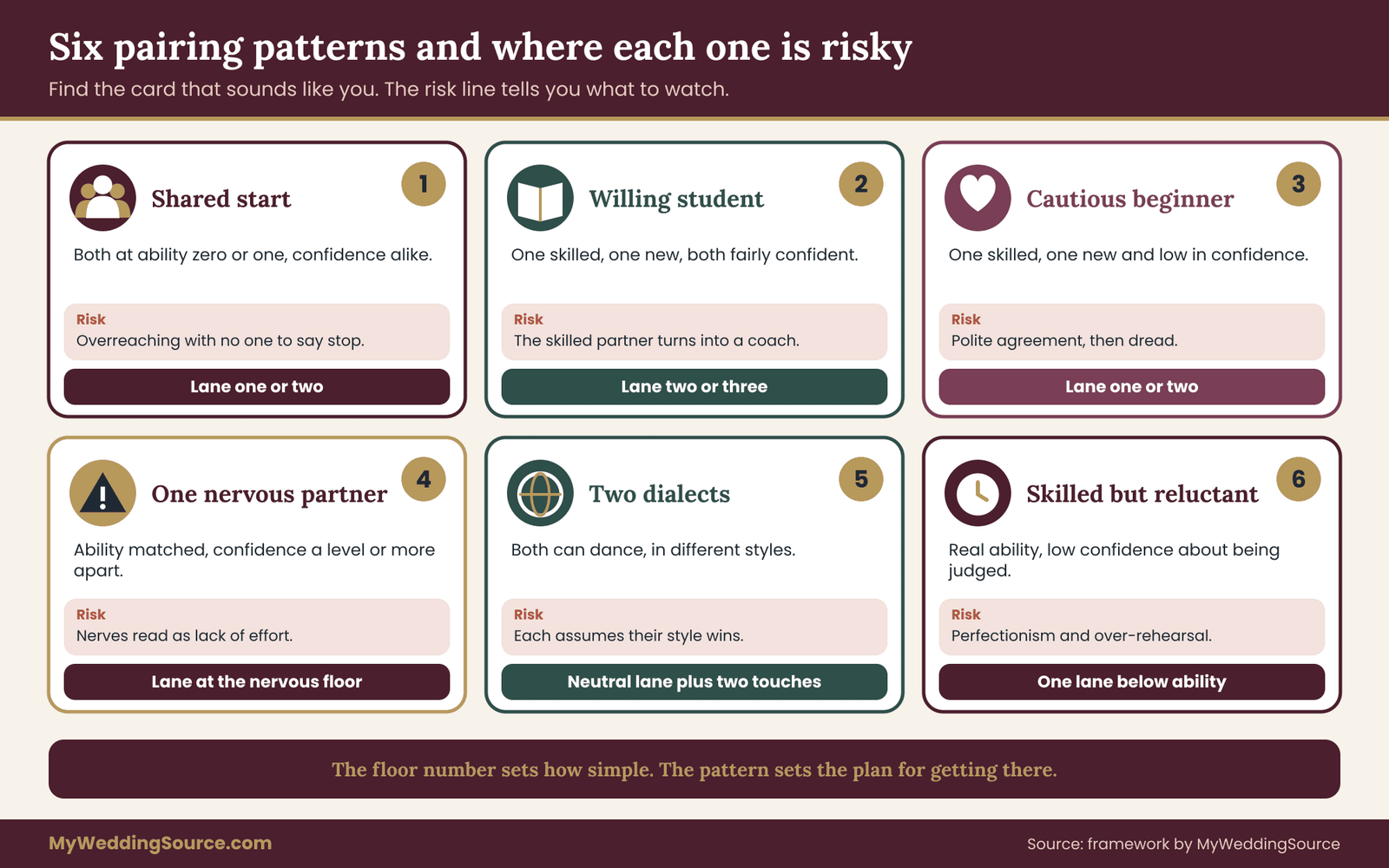
Pattern one: shared start. Both partners sit at ability zero or one, and confidence is similar. This is not really a mixed-experience pair, but many couples who think they are mixed turn out to be here once they rate honestly. The risk is overreaching because nobody is there to say “this is too much.”
Pattern two: willing student. One partner has real skill, the other has little, and both feel fairly confident. The beginner is curious and open to learning. The risk is the experienced partner turning into a coach and the lessons turning into friction.
Pattern three: cautious beginner. One partner has real skill, and the other has little skill and low confidence. This is the pattern that most needs careful handling. The risk is that the experienced partner, wanting a good dance, picks something that the beginner agrees to out of politeness and then dreads.
Pattern four: one nervous partner. Ability is roughly matched, perhaps both at level one or two, but one partner’s confidence is a full level or more below the other’s. The risk is that the confident partner reads the nerves as lack of effort or interest.
Pattern five: two dialects. Both partners can dance, but in different styles. One does salsa, the other swing. Or one has formal ballroom training, the other a social club background. The risk is that each assumes their own first dance style is the obvious choice, and that the result mixes habits that fight each other.
Pattern six: skilled but reluctant. One or both partners have real ability and low confidence, often because they are used to being judged on technique. The risk is perfectionism: the dance gets over-prepared, then falls apart at the first small slip.
Step three: choose a lane
With a floor number and a pattern, you can choose a first dance style lane. Each lane describes a family of dances at a particular level of demand. The next section walks through the six lanes and how each pattern tends to use them.
For now, hold on to the general rule. The floor number sets the lane for your first dance style, and the pattern sets the plan for getting there. A pair at floor zero in pattern three and a pair at floor zero in pattern one both use the simplest lane, but they will rehearse differently, divide the roles differently and have different conversations along the way.
What the chart does not do
It does not predict how good the dance will be, and it cannot pick a first dance style that you dislike. It does not account for the pleasure of learning something new together, which for some couples is the point. A couple at floor one can choose a first dance style designed for floor two, and with a few weeks of practice they may do it well. The chart tells you which choices are safe and which are stretches, so that stretches are deliberate and not accidental.
It also does not replace a conversation with a qualified instructor. A wedding dance instructor can watch both of you move for twenty minutes and tell you things no self-rating will. Use the chart to arrive at that meeting with a clear starting point and specific questions, rather than a vague wish to “learn something.”
Six first dance style lanes, from simplest to most demanding
A lane is a family of first dance styles grouped by how much they ask of the weakest partner. The lanes are not tied to specific songs, and none of them requires special equipment. They differ in how much structure there is to remember, how much leading and following there is, and how much space the dance needs.
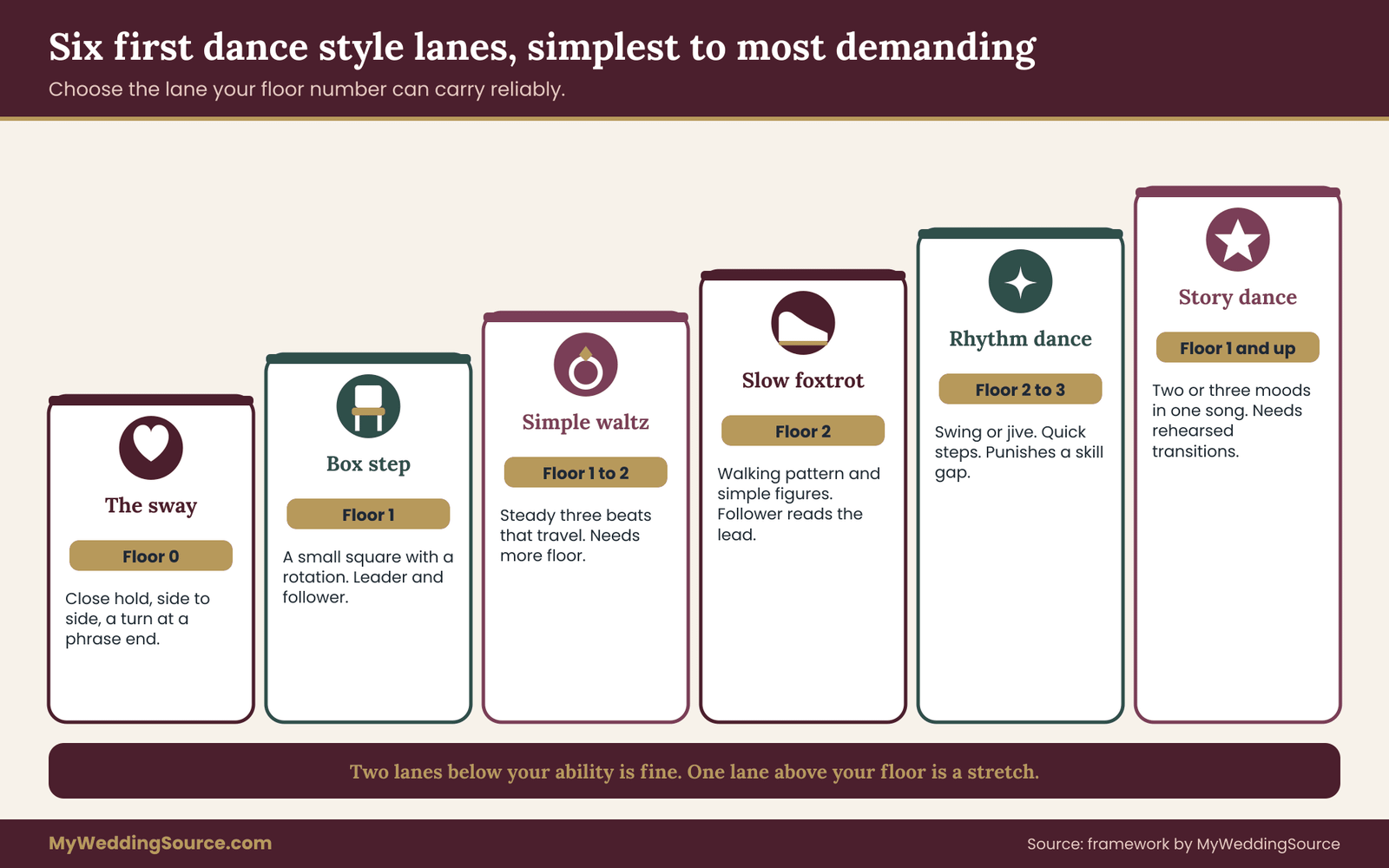
Lane one: the sway
The sway is a slow, side-to-side movement with a close hold, perhaps with a gentle turn or two at phrase endings. There is almost no structure to remember. It suits floor zero and is also a good choice for couples whose emotional goal is closeness rather than display.
A sway is not a failure of ambition, and it is a respectable first dance style. Many couples choose it deliberately, and a well-chosen song, a clear start and a clean finish make it look intentional. Its main risk is that it can feel long if the song is long, so check the length of the version you will play.
Lane two: the box step with a turn
The box step is a basic pattern that takes the couple through a small square, with a rotation or a turn added once or twice. It suits floor one. Most people can learn the pattern in a short lesson, and it gives both partners something specific to do without demanding fast footwork.
The pattern needs a leader and a follower. That is not a problem for most couples, but it does raise the question of who leads, which a later section covers. The box step is a good base first dance style for a floor-and-ceiling plan, because the stronger partner can add embellishments without changing what the weaker partner does.
Lane three: the simple waltz
A simple waltz uses a steady three-beat pattern and travels around the floor. It suits a floor of one or two, depending on the song’s pace. Waltz timing gives the first dance style a flowing look that guests recognize, and the repetition makes it easy to remember. It does need more floor space than a sway or a box step, and it needs the couple to move around each other with confidence.
Lane four: the slow foxtrot or social dance
This lane uses a walking pattern, a hold and a few simple figures set to slow or medium songs. It suits floor two. It looks polished without being fast, which is why it suits many couples, and the structure can be adjusted in length. It asks more of the follower than the earlier lanes do, because reading the leader matters more.
Lane five: the rhythm dance
Swing, jive and similar rhythm styles use a lively, bouncy beat and often include spins and quick steps. They suit floor two or three and upbeat songs. They are enjoyable and look joyful, but they punish a gap in ability more than any other lane, because leading and following at speed is a skill. If your floor is below two, treat this first dance style lane as an optional section at the end of a slower dance rather than the whole routine.
Lane six: the story dance
The story dance is built from two or three different moods in one song or a short medley: perhaps a sway, a short waltz section and a playful finish. It suits couples whose ability levels are uneven, because each section can be built at a different level. It also asks for the most planning, because the transitions need to be rehearsed. It suits floor one and above, with an instructor’s help.
How the lanes relate to each pattern
Pattern one usually chooses lane one or two. Pattern two often chooses lane two or three with the experienced partner supplying a few extra moments. Pattern three stays in lane one or two, and works hard on confidence. Pattern four tends to choose a lane at the floor of the nervous partner and builds confidence through repetition.
Pattern five usually avoids the dialects entirely and chooses a neutral lane, such as the box step or a waltz, then lets each partner add a small signature touch. Pattern six often chooses a lane one step below their ability, in order to reduce the temptation to perfect it.
These are tendencies, not rules, and every first dance style can be simplified. A pair in pattern three with high motivation and a long runway might choose lane three. A pair in pattern two on a short timeline might choose lane one. The chart tells you where the risk is. Your goals, your schedule and your instructor’s advice decide the rest.
Floor and ceiling: building one first dance style for two levels
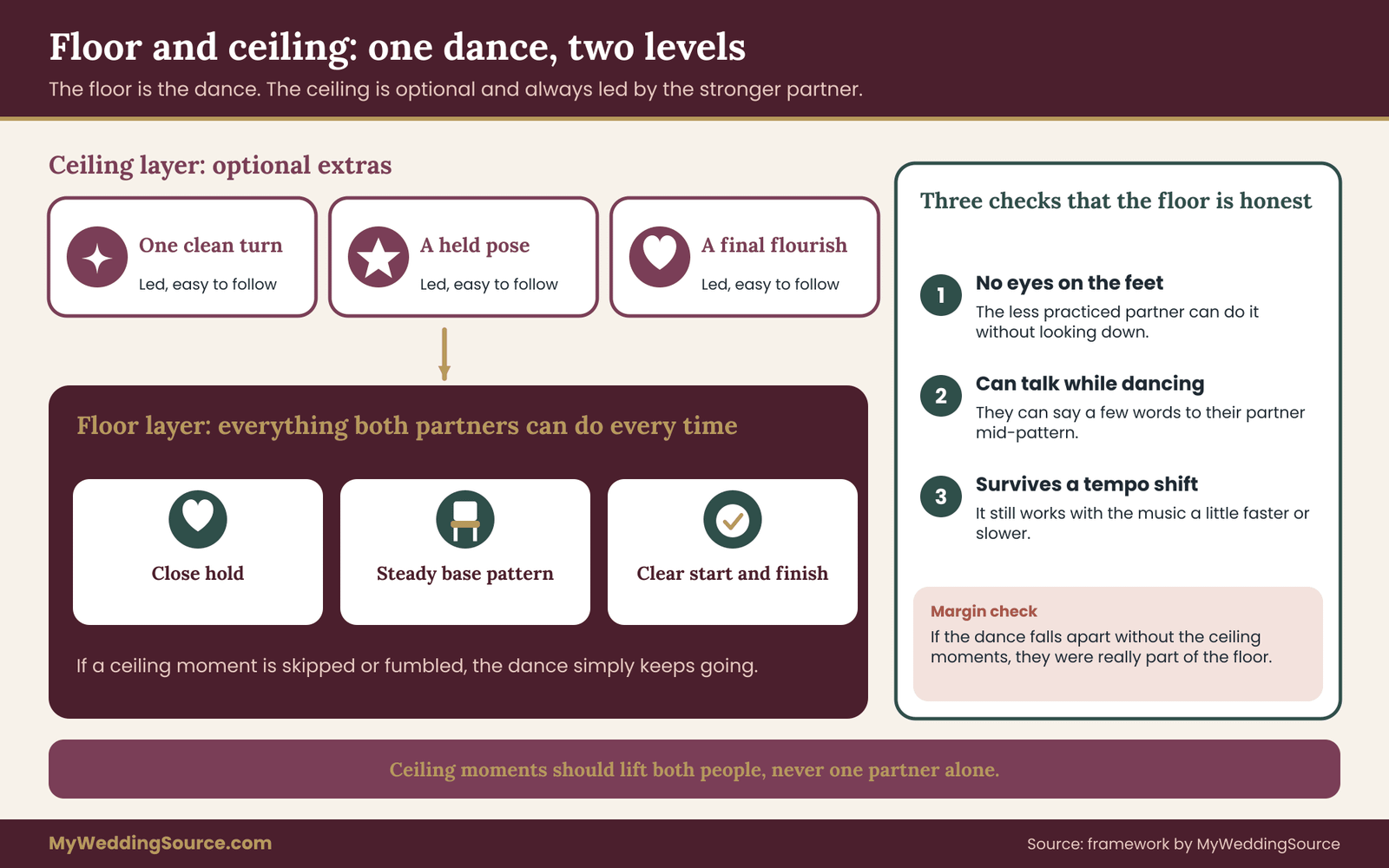
The single most useful idea for choosing a first dance style as a mixed-experience couple is to separate the dance into two layers. The floor layer is everything both partners can do reliably, every time, even when nervous. The ceiling layer is anything extra that the stronger partner can add, which the dance can survive without.
This is a simple structure, but it changes how you rehearse and how you recover. Because the floor layer is complete in itself, the dance still works if a ceiling moment is skipped, shortened or fumbled. Nobody has to stop. The audience does not know what was meant to happen, and the weaker partner never has to depend on something they are not sure of.
The floor layer
The floor layer is built at your floor number. If your floor is zero, it might be a close hold, a steady sway, one slow turn and a finish. If your floor is one, it might be a box step with a rotation. If your floor is two, it might be a simple waltz or a short foxtrot pattern.
Three tests tell you whether the floor layer is honest. First, can the less practiced partner do it without watching their feet? Second, can they do it while having a short conversation, such as saying a few words to their partner? Third, can they do it with the music slightly faster or slower than they practiced? If the answer to any of these is no, simplify the floor layer. Reliability at the floor level is the whole point.
Keep the floor layer continuous. A dance that stops and starts, with long pauses between sections, tends to expose nerves. A steady pattern, even a very simple one, gives both people something to hold onto. Rests are better placed at phrase endings of the song, where they feel like part of the music.
The ceiling layer
The ceiling layer holds the extras. It is where the more experienced partner’s skill lives, and it is optional by design. Good ceiling moments share three properties, whichever first dance style you choose. They are led by the stronger partner, so the weaker partner does not have to learn a new pattern. They are easy to follow, meaning the other partner can respond without preparation. And they happen at the end of a phrase or at a natural break in the song, so they never interrupt the floor pattern.
Examples include a single clean turn for the follower, a dip held for a few seconds, a change of hold, a step that travels a little farther than the floor pattern, or a short flourish at the finish. None of these needs to be dramatic. One or two such moments in a three-minute song are plenty.
One rule keeps this fair: the ceiling moments must never be the partner’s moment alone. Skill that is displayed at the other partner’s expense is hard to watch. A good ceiling moment lifts both people. A turn for the follower, for instance, highlights the follower, not the leader. That makes the more experienced partner generous by design.
Counting the margin
A practical way to check the balance is to count how many seconds of the dance depend on the ceiling. If the dance falls apart when you remove the ceiling moments, they are really part of the floor and you have over-built it. Aim for a dance where the ceiling moments fill perhaps a fifth of the time or less. That is a rough guide, not a formula, but it keeps the stronger partner from taking over.
You can also reverse the test. Remove the floor and ask whether the ceiling would still look good. It would not, because the floor is the dance. That is a reminder that the plain parts carry the weight.
What the rule looks like in each pattern
In pattern two, the willing student, the first dance style is usually lane two or three, and the ceiling is a couple of simple leads from the experienced partner. The beginner learns only the floor. The ceiling is a surprise the beginner can respond to without rehearsal, because it is led.
In pattern three, the cautious beginner, the first dance style is lane one and the ceiling is minimal. One turn and a final pose may be all there is. The effort goes into making the floor feel calm. The experienced partner’s job is to be steady, not impressive.
In pattern four, the nervous partner, the floor can be higher than ability alone would suggest, because ability is not the limit. But the ceiling should be nearly empty, since the nervous partner has no spare capacity for surprises.
In pattern five, two dialects, the first dance style is a neutral lane, and each partner contributes one ceiling moment from their own style. This is a neat solution, because both people have something that is theirs, and neither style dominates.
In pattern six, skilled but reluctant, the floor is deliberately below their ability, and the ceiling is short. A relaxed, slightly under-built dance beats a flawless one that causes dread.
Who leads, who teaches, and who should not
Every partner dance needs a way to decide who initiates movement. In most traditional styles, that is one partner leading and the other following. In a mixed-experience couple, the question has two layers: who leads in the dance, and who teaches in the rehearsal. They are not always the same person, and mixing them up is a common source of trouble.
Choosing the lead
Many couples assume the experienced partner should lead. Often that is wise, because leading carries more responsibility. But it is not a rule, and it deserves a deliberate choice. There are good reasons to choose differently.
If the experienced partner trained as a follower, they may be more comfortable following, and that frees the beginner to lead a very simple pattern. Some couples find that a beginner leading a box step, with an experienced follower quietly guiding the timing, makes for a warm and amused dance. If both partners are comfortable with either role, you can also change roles midway through a story dance.
Gender does not decide this. Same-sex couples, and couples who simply want something other than the traditional arrangement, can assign roles in whatever way suits their skills and their preferences. A good instructor works with the roles you choose and does not insist on a pairing.
Choose the role with these questions, since the role shapes the first dance style: Who has more of a sense of timing? Who is more comfortable being in front of the other person? Who is more likely to stay calm if something goes slightly wrong? The best leader is not the best dancer. It is the person who can be steady.
The teacher trap
The usual pattern in a mixed-experience couple is that the experienced partner offers to teach the other. The offer is generous, and it is usually a mistake. Teaching a partner at home puts two relationships on the same floor: the one in which you are equals, and the one in which one of you is correcting the other. Neither is easy to carry through a long evening of practice.
There are several recurring problems. The teacher knows how the step feels and not how it is learned, so explanations skip the small things a beginner needs. The learner feels watched in a place that should be private, which raises the very nerves the dance is meant to settle. And disagreements about the dance become disagreements about the relationship, because they take place between two people who also share a household and a wedding budget.
Handing the teaching to a third person changes this. An instructor can say the same sentence you have said five times, and it lands differently. The experienced partner can then be a practice partner rather than a coach, which is a much easier role. The beginner gets a clear source of instruction without the baggage.
If you do practice together
Some couples will not hire anyone, and that is a reasonable choice for a very simple dance. If you are in that position, set a few ground rules ahead of time. Agree that the experienced partner does not correct anything during a run-through. Save comments for the end, and limit them to one or two. Agree that the beginner can say “stop” at any time without needing a reason. Agree that each practice session ends on something that went well, even if it is small.
You might also agree on a spoken cue for resetting, such as a single word that means “pause, breathe, restart that phrase.” Having a neutral word takes away the question of whether a pause counts as failure.
Here is a script that works for many couples. The experienced partner says: “I can teach you steps, but I would rather just dance with you. Could we get one lesson from someone else, and then I will be your practice partner?” The beginner then has a graceful way to say yes. If the beginner says no, they might say: “Let’s try it at home for two sessions, and if it gets tense, we book the lesson.” That plan has a built-in exit, and the exit is agreed in advance.
When one partner wants to surprise the guests
Sometimes the experienced partner wants a showpiece, perhaps a routine they have wanted to perform for years. That is a legitimate wish, and it deserves a hearing. The test is whether the other partner wants that first dance style too. A showpiece performed by a reluctant beginner is a poor way to begin a marriage, and it often shows.
If the wish is strong, there are compromises. The experienced partner can perform a short solo moment, such as a few seconds at the start. The couple can dance a simple first dance and then invite a larger group, with the experienced partner leading a more energetic number later in the evening, when the nerves are gone. Or the couple can choose a story dance with a lively final section, as long as the beginner agrees to it with full information.
What matters is that the choice is made together and in the open. A routine that the beginner learns about on the day is a recipe for a bad memory.
Matching the song, the tempo and your first dance style
Couples often choose the song first and the first dance style second, which is natural, since the song is the emotional core. For a mixed-experience pair, though, the song’s tempo and structure can quietly decide the difficulty. A song that is slightly too fast turns a manageable box step into a scramble for the weaker partner. A very long song asks for more memory and stamina than anyone expects.
You do not have to change your song to settle on a first dance style. You do have to look at it with a few practical questions, and sometimes the answers lead to a different version of the same song rather than a different song.
Tempo and the weaker partner
Tempo is the speed of the underlying beat. A rough way to find it is to tap along for fifteen seconds and count the taps, then multiply by four to get beats per minute. Phone apps and online tools do this too. The number matters less than what it asks of the person with the least practice.
A slow tempo gives the beginner time to think about the next step, and that matters more than it seems. At a slow tempo, a mistake is small and recoverable. At a fast tempo, a mistake compounds, because the next step arrives before you have recovered. For this reason, couples with a low floor usually do best with slow songs, and that shapes what they can use, and a floor of two or three opens the door to medium or lively ones.
There is a useful trick. Many dances can be done at half time, meaning you take one step for every two beats of the song. A song that feels fast can sometimes be danced with a sway or a slow box step at half the beat count. That lets a beginner enjoy an upbeat song without having to match its speed. Ask an instructor whether your song and your first dance style suit half-time movement.
The shape of the song
Look at how your song is built. Most songs have an introduction, verses, a chorus, perhaps a bridge, and an ending. For a first dance, those parts are useful landmarks. They are places where the dance can change, where a ceiling moment can happen, and where a rest feels natural.
Listen for the following. How long is the introduction? A long, quiet opening gives you a few seconds to get into position and breathe, which helps nervous couples. Does the song slow down or stop before the end? A clear ending makes a pose or a final turn easier to time. Does the tempo change partway through? If so, you may need two different dance patterns, which raises the difficulty for the beginner.
Length matters as well. A first dance does not have to last the whole song. Many couples dance their first dance style for the first minute or two and then invite others to join. Others ask the DJ or band to edit the song to a shorter version. A shorter dance is easier on a floor-zero couple and does not take away from the moment.
If you plan to cut the song, talk to the person who will play it early, and check that their equipment can handle your edit. The reception music planning guide goes into how to brief a DJ or band on timing and cues.
Song versions you can choose between
The same song often exists in several forms, and each form can suit a different first dance style: the original recording, a live version, an acoustic version, a cover by another artist, and an instrumental. They can differ in tempo by a noticeable amount. A slower acoustic cover of an upbeat song may be exactly what a floor-one couple needs. A live band can often adjust tempo on request, but that is a conversation to have in advance, not at the event.
Do not assume that an alternative version will sound right to you. Play the options and see which one you can both move to comfortably. The goal is a version where the beginner can hear the beat clearly and feel the phrase endings. Songs with a strong, steady pulse are easier to dance to than songs with a floating rhythm, even when both are slow.
A note on music rights and recordings
Playing a recording at a private event is normally handled through the venue’s or the DJ’s arrangements, and a live band deals with its own licensing. You rarely have to do anything yourself. If you plan to commission an edit, a remix or a recorded performance by a friend, ask the person who will play it whether the file is acceptable and whether they need it ahead of time.
The U.S. Copyright Office and the licensing organizations ASCAP and BMI publish general information on how music use is licensed, and they are the right places to read the details. Your DJ or venue can tell you what applies to your event.
When the song and the first dance style disagree
Sometimes the song you love is not suited to any lane that fits your floor. A fast song, a song with an irregular rhythm, or a song with a long instrumental section may all create difficulty. You have four honest options.
You can keep the song and lower the demand, by choosing a sway at half time. You can keep the song and shorten the dance. You can choose a different version of the song. Or you can use the beloved song for a different moment, such as the entrance or the last dance, and choose a simpler piece for the first dance.
None of these is a failure, and none of them forces a different style. Choosing a calmer song for the first dance and saving the favorite for a moment with less pressure is a common and sensible compromise. The song that does the job and the song that carries the most meaning do not have to be the same one.
Room, shoes and access: checks that change a first dance style
A first dance style that works in a living room may not work at the venue. The floor, the space, the shoes and the clothes all affect which first dance style is practical. For a mixed-experience couple, these details matter more than they do for experienced pairs, because the weaker partner has less margin to adapt.
The floor
Ask your venue what the dance floor will be: its surface, its size, and who provides it. Hardwood, tile, carpet, temporary flooring over grass and portable panels all behave differently under shoes. A slick surface calls for a simpler pattern with fewer turns. A sticky or uneven surface needs smaller steps. If a rented floor will be installed, ask the venue or the rental company when it will be ready and whether you can try it beforehand.
Use only floors that the venue has approved for dancing. Do not bring your own wax, powder or coatings unless the venue says so in writing, because some treatments damage finishes or create hazards for other guests. For more on checking the physical space before the event, the venue technical walkthrough guide covers the measurements and questions to bring.
Slip and trip hazards on walking surfaces are a general safety topic, and the Occupational Safety and Health Administration publishes background on it for workplaces. You do not need to study it, but it is a useful reminder that a slick surface deserves a plain, steady pattern. Space matters too. A sway needs very little room.
A waltz that travels needs a larger area, and guests standing close to the floor can restrict it. Ask for the floor dimensions and imagine the dance inside that area. If the space is smaller than you expected, a more stationary dance is the answer.
Shoes and clothes
Rehearse your first dance style in the shoes you will wear. Heel height, sole material and fit change balance and timing. A partner who is comfortable in flat shoes may feel unsteady in heels, and a long dress or a stiff jacket may restrict a movement that was easy in practice clothes. Some couples arrange two pairs of shoes, one for the dance and one for the rest of the evening, and that is a perfectly sensible solution.
Check how the outfit behaves in the hold. A full skirt can catch a foot during a turn. A long train can be stepped on. A tight sleeve can limit the hold. You do not need to alter the outfit, but you do need to know about these things before the day. If a ceiling move turns out to be risky in the dress, drop the move.
Access and adaptation
Some couples need the dance to adapt to a mobility difference, a medical condition, a pregnancy, or a simple preference to sit or to use an assistive device. A first dance style can be adapted in many ways. It can be seated, partly seated, danced with a mobility device, or built around a very small range of movement. The dance does not have to look a particular way to be a first dance.
This is also where accessibility rules and good practice meet. The Americans with Disabilities Act and its guidance, published by the U.S. Department of Justice at ada.gov, set out obligations for many public venues, including how they handle access to their spaces. Venues differ, so ask directly about accessible routes to and across the dance floor, about floor transitions and about any step or threshold. The accessible venue red flags guide lists the questions worth asking before you book.
This article does not make claims about what any person’s body can or should do, and it does not give medical advice. If a health condition affects how you move, ask the person who treats you what is appropriate. Then ask your instructor to adapt the choreography to that guidance. A good wedding dance instructor will plan around what you tell them, and will not need an explanation beyond what you choose to share.
A short venue checklist for the dance
Bring these questions to your venue or planner: What is the floor surface and size? Who supplies and installs any temporary floor, and when? Is there a stage, a step or a threshold at the edge of the floor? Where will guests stand? What lighting will be on the dance, and can it be adjusted? Is there a sound check time with the person who will play the music? Is there a place to change shoes?
The answers might change your first dance style. A small, slick floor with guests close by points toward lane one or two. A large, grippy floor with plenty of space allows a waltz. A change of shoes might permit a more ambitious plan than flats would. Ask early enough to adjust.
A worked case: one first dance style for two different levels
The following example is invented. The couple, the numbers and the outcome are made up to show how the chart is used. Real couples vary, and no result here should be read as a prediction about yours.
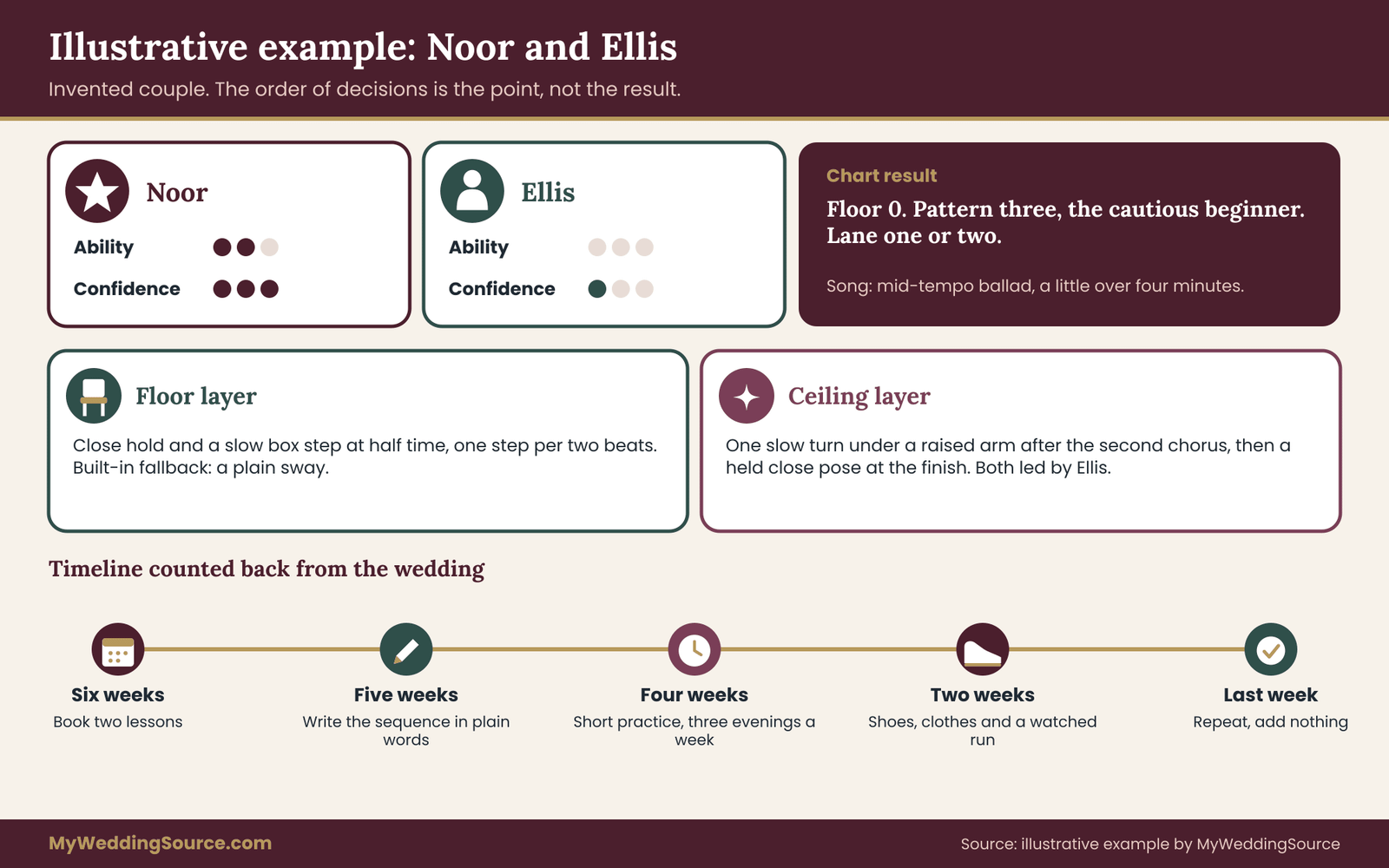
Noor and Ellis are planning a wedding for the following spring, and they need a first dance style that works for both of them. Noor took studio classes in two partner styles for several years as a teenager and later joined a social dance club, so she rates herself at ability two for partner dancing and confidence three. Ellis has never taken a lesson. He rates himself at ability zero, and confidence one: he can get through the dance but expects to feel exposed until it is over.
Filling in the chart
Their lowest of the four numbers is zero, from Ellis’s ability. So the floor is zero. The pattern is the cautious beginner: a skilled partner and a beginner with low confidence. That points to lane one or lane two for their first dance style, and to a plan that spends effort on calm, not on steps.
They also talk about what each of them wants. Noor says she would enjoy something with a little shape and would love one clean turn. Ellis says he would like to do something he can remember without thinking and that has a clear end. Neither of them wants to put on a performance. Both want the song they chose, a mid-tempo ballad that runs a little over four minutes.
Choosing the lane and the layers
The song is long and moderately slow, so it shapes the first dance style. Ellis’s floor of zero suggests a sway. Noor’s skill suggests she could manage a box step, and Ellis, who is willing, says he thinks he can learn a box step if it is explained clearly. They decide on a first dance style with two layers.
The floor layer is a close hold with a slow box step at half time, which means one step for every two beats. They choose half time because it gives Ellis a steady, unhurried rhythm. If the box step fails for any reason, the fallback is a plain sway, which is built into the floor.
The ceiling layer has two moments. At the end of the second chorus, Ellis lifts his arm and Noor takes a single slow turn under it. At the finish, they hold a close pose for a few seconds. Both are led by Ellis, and Noor can do them without rehearsal. If either is skipped, the dance still works.
Handling the length
At four minutes, the song is longer than the plan needs. They ask the DJ to fade the track after the second chorus, at about two minutes and forty seconds, and invite their parents and the wedding party to join. Ellis finds this a relief. The dance becomes a short solo that opens into a shared floor, which means he is not alone out there for long.
Dividing the teaching
Noor offers to teach the steps, and Ellis hesitates. They agree that the first lesson will be with an instructor. After that, Noor becomes the practice partner, and she will not correct anything during a run-through. She will say one thing at the end. Ellis has a word for “stop,” and a second word for “start that phrase again.”
The timeline
They count back from the wedding date. Six weeks before, they book two lessons. Five weeks before, they finish the lessons and write the sequence in plain words. For the next four weeks they practice for a short time, three evenings a week. In the last two weeks they rehearse in the shoes Ellis will wear and, once, in the clothes. A week before the wedding, they stop adding anything and just repeat the dance.
What the example shows
Three things stand out. First, the more experienced partner made the plan simpler than she needed, and in doing so made the dance more reliable. Second, the fallback was built into the floor, so a mistake could shrink the dance but not stop it. Third, the couple made decisions about teaching and shortening the song before they began practicing, so they were not improvising under stress.
None of this is a script to copy. If Ellis had rated his confidence at three, the plan might have used a waltz. If Noor had rated her ability at zero too, the plan would have been a sway, with no ceiling moments at all. The point of the example is the order of the decisions: ratings first, floor second, pattern third, lane fourth, layers fifth, schedule last.
A second quick case: two dialects
Another invented pair shows pattern five. Amara learned salsa socially, and Jonas learned swing in a community class. Each loves a different rhythm and each assumes that theirs is the natural choice. Both rate their ability at two and their confidence at two, so their floor is two, and nothing about the gap is large. The trouble is habit: when they try either style, the follower in each dance is expected to do something the other partner never learned.
Their solution is to use neither style as the base. They choose a simple waltz at a medium pace, which neither has danced much, so both start on level ground. Then each adds a single signature moment. Amara leads a short, clean turn sequence from her background, and Jonas adds a swing-style rock step at the final phrase. Each moment lasts a few seconds and neither depends on the other partner knowing the style.
The lesson is that a neutral base removes the argument over whose style wins. When both partners are skilled, the decision is less about ability and more about fairness, and the floor-and-ceiling rule gives a clean way to be fair.
The three-run test for your first dance style
A plan on paper is a hypothesis, and a first dance style is no exception. The test turns it into evidence. For a mixed-experience couple, the test has to answer one question: does the weaker partner, in realistic conditions, perform the floor layer reliably? Ability to perform the whole dance beautifully comes second.
The test in three runs
The three runs get progressively closer to the real event. Do them in the last two or three weeks, after you have learned the dance.
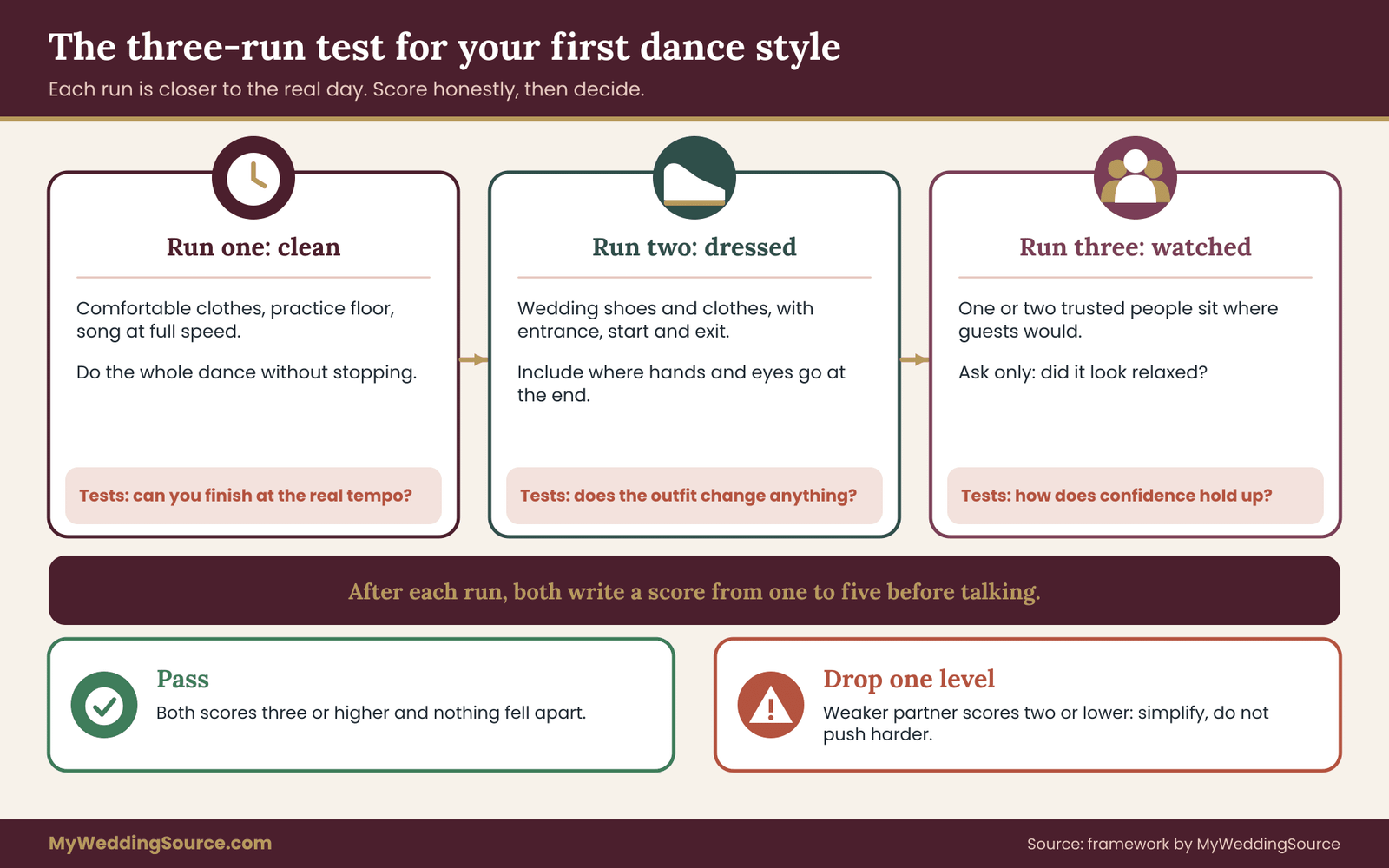
Run one is the clean run. Wear comfortable clothes, use your practice floor, and play the song at full speed. Dance the full routine without stopping, whatever happens. If you make a mistake, keep going. This run tells you whether you can do the dance from beginning to end at the real tempo. If one of you cannot, you may be too ambitious for that first dance style.
Run two is the dressed run. Wear the shoes and, if possible, the clothes. Add the entrance, the walk to the floor and the way you will begin. Include the ending: where you will stand, what you will do with your hands and how you will leave the floor. This run tells you whether the outfit changes anything. It often shows details that no other practice reveals.
Run three is the watched run. Invite one or two people you trust, not a crowd. Ask them to sit where guests would sit and simply watch. Do not ask for critique on technique. Ask only whether it looked relaxed. This run tests confidence, which for many mixed-experience couples is the bigger issue.
Reading the results
After each run, each of you gives a single number from one to five for how comfortable you felt. Do not discuss until both have written it down. Then compare. A pass means both numbers are three or higher, and nothing in the dance fell apart.
If the weaker partner scores two or lower on any run, treat it as a signal to drop one level, not to try harder. Dropping a level might mean replacing a turn with a sway, removing a ceiling moment, shortening the dance or slowing the tempo. A first dance style that passes the test at a lower level is better than one that fails at a higher level.
If the stronger partner scores lower than the weaker one, pay attention. It often means they have been holding back, or that the dance feels too plain to them. A small ceiling moment may fix this. A conversation about expectations may help too.
What to record
Keep a short written note after each run: the date, what you wore, who watched, what went well and one thing to change. Do not write more than that. The notes are useful in two ways. They show your progress, which is encouraging, and they provide a record that you can show an instructor if you want help. They also keep the final week calm, because you can look back and see that the dance has worked on three previous occasions.
What a pass does and does not mean
A pass does not mean your first dance style will be perfect on the day. Nerves, lights and an audience change everything. It does mean you have a dance that works under realistic conditions, with a fallback you know. That is the best preparation available, and it is enough for a dance that lasts a few minutes.
Talking it through: scripts for the hard conversations
Most first dance trouble among mixed-experience couples is conversational. The steps are learnable. What goes wrong is that one person agrees to something they do not want, the other person senses it, and neither says so. The following scripts are not magic words. They are starting points, and they are written to be said out loud by either partner. Change the wording to match how you speak.
Opening the topic
Start with the goal, not the first dance style. A line such as this works: “Before we pick anything, can we each say what we want the dance to feel like, in one sentence?” That question moves the discussion away from steps, where the experienced partner has the advantage, and toward feelings, where both are equals.
If one partner answers with something like “I want it to look amazing” and the other with “I want it to be over quickly,” that is useful. It is the first honest signal of the gap. Resist the urge to solve it right away. Say what you heard: “So one of us wants a showpiece and one of us wants a short, safe dance. Let’s work out what sits between those.”
When the beginner is not sure
A beginner who says “I’ll do whatever you want” is not giving permission. They may be avoiding conflict. A kind way to check is to offer two concrete choices and ask which feels easier: “Would you rather do a slow sway for the whole song, or a box step for the first minute and then a sway?” Concrete options are easier to answer than open ones.
Another useful question is “What would make you feel more comfortable?” Possible answers include fewer people watching during practice, a shorter dance, a hand cue, or a simpler step. Many of these are cheap to grant. Granting them early builds trust, and trust is what the beginner needs most.
When the experienced partner is disappointed
Sometimes the experienced partner has pictured a more impressive dance for years, and a floor of zero feels like a loss. That feeling is real, and brushing it aside does not help. The beginner might say: “I know this is simpler than you wanted. What is the one thing from your idea that matters most to you? Let’s see if we can keep that one thing.”
That question often has a small answer. It might be a single turn, a particular pose or a moment of eye contact. Keeping the one thing gives the experienced partner a stake in the plan, and it costs the beginner little, because it is a single, rehearsed moment.
When parents or friends have opinions
Relatives and friends often offer advice, and some of it is about the dance: “You should do something more lively,” or “My cousin did a choreographed routine and it was wonderful.” These comments are usually kind, and they can create pressure. A short, calm reply is enough: “We chose something that we both feel good about, and we are looking forward to it.” You do not have to defend the decision.
If a family member is a skilled dancer who offers to choreograph, thank them and ask what they have in mind before you agree. Offers like this can be generous, and they can also take the dance out of your hands. Decide first what your floor is, and share it, since the floor sets the first dance style.
If their idea fits the floor, accept. If it does not, you can decline with a clear thank-you. The decision-making guide on this site covers how couples can share input without giving up their own choices, and the same principles apply here.
Agreeing on a stopping rule
One of the most useful conversations to have early is about when you will change the plan. Agree on it before practice begins, when no one is frustrated. For example: “If either of us scores below three on two practice runs in a row, we drop one level.” Setting the rule in advance means that dropping a level is following the plan, not admitting defeat.
Write the rule down, and put it somewhere both of you can see it. When a rough practice night comes, you can point to the paper and say, “This is the situation we prepared for.” That takes the sting out.
Talking with an instructor
If you hire an instructor, bring your ratings and your pattern. Say them plainly: “One of us has two years of partner dance training, and one of us has none. We want a dance that works for the less experienced partner and gives the other a few optional moments.” A good instructor will recognize this brief right away and will ask follow-up questions.
You may also want to check how an instructor describes results. National organizations such as USA Dance and the National Dance Council of America publish information about partner dance styles, and Dance/USA publishes material about dance as a field. None of them can vouch for a particular teacher, so judge a teacher by a short trial lesson and by clear, plain answers.
If a studio promises a particular outcome in a set number of lessons, remember that the Federal Trade Commission publishes consumer guidance about advertising claims, and ask what the promise is based on.
Ask how many sessions the first dance style needs, whether the instructor will write down the sequence, whether the sessions can be recorded for practice, and what the instructor suggests if progress is slower than expected. Ask whether the instructor is comfortable adapting for access needs. Ask what happens if you need to cancel or reschedule. These are normal questions, and any professional will expect them.
When to change your first dance style: failure conditions and fallbacks
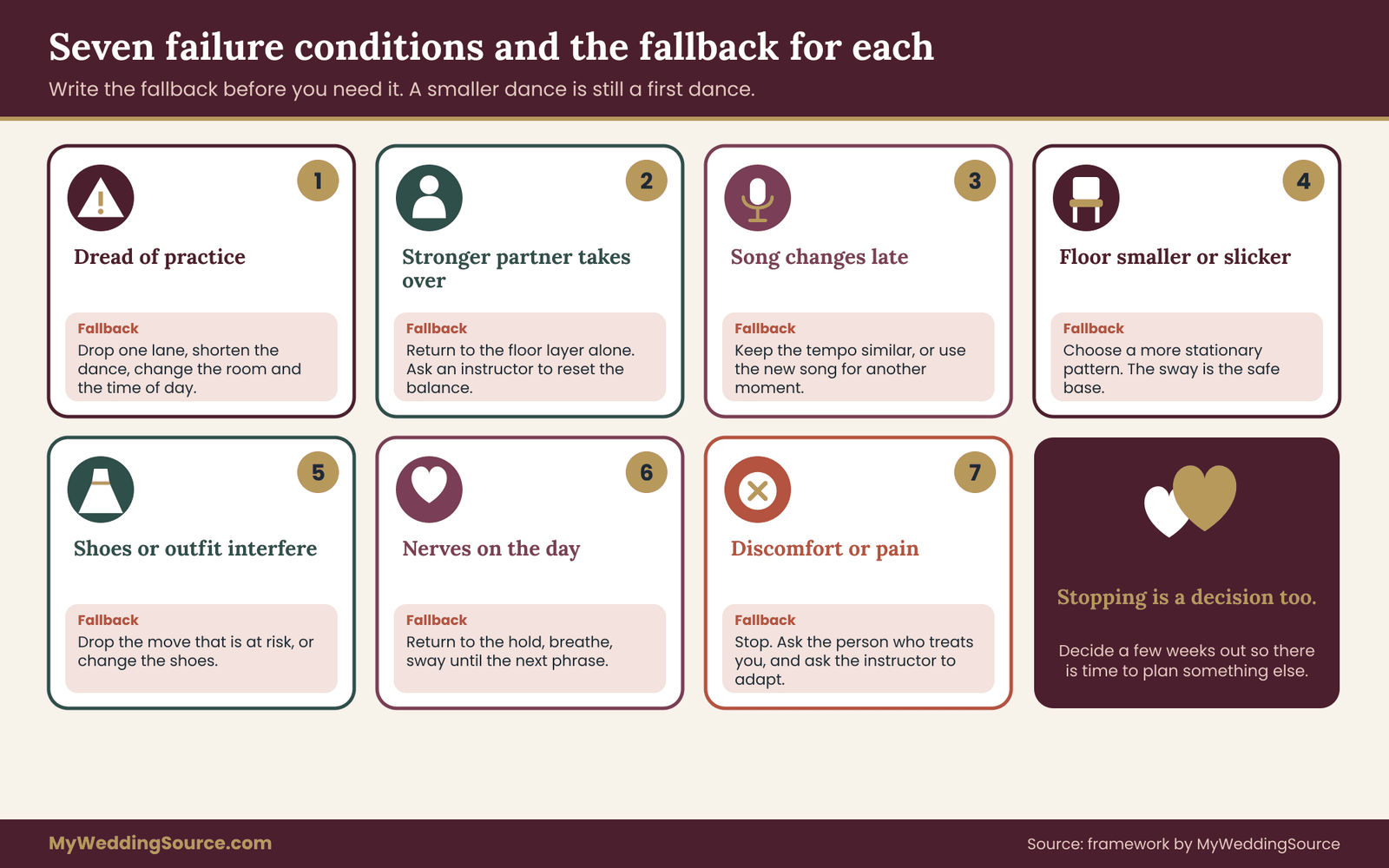
Every first dance style has conditions under which it stops working. Naming them in advance is the surest way to keep a small problem from becoming a crisis. For a mixed-experience couple, there are seven conditions worth writing down, and each has a fallback that is decided in advance.
Condition one: the weaker partner dreads practice
If one partner begins to avoid practice, makes excuses or becomes tense when it is time to rehearse, the plan is too demanding or the setting is wrong. The fallback is to drop one first dance style lane, shorten the dance or move to a different room and a different time of day. If dread persists after a simplification, consider whether a dance is the right choice at all, and see the alternatives below.
Condition two: the stronger partner takes over
If the experienced partner starts correcting, adding moves or speeding the dance up, the dance is drifting toward the ceiling. The fallback is to return to the floor layer and rehearse that alone. A neutral third person, such as an instructor, can reset the balance.
Condition three: the song changes late
A late change of song or version can undo weeks of work, because the timing changes. If you must change, keep the tempo similar and treat the new song as a new project. The fallback is to use the original song for the dance and the new song for another moment.
Condition four: the floor is smaller or slicker than expected
If the venue floor turns out to be smaller, slicker or less even than planned, choose a more stationary first dance style. The fallback is the sway, with a turn only if it fits. A simple dance on a poor floor is safer than an ambitious one.
Condition five: shoes or clothing change the dance
If the outfit restricts or endangers a move, the move goes. The fallback is to keep the floor layer and drop the ceiling. If the shoes are the problem, change the shoes.
Condition six: nerves take over on the day
Nerves are normal, and the floor layer is built to withstand them. If a partner freezes or forgets, the fallback is a recovery cue: return to the basic hold, take a breath and sway until the next phrase begins. A pre-agreed spoken word or a squeeze of the hand can mark the moment. Guests will see closeness, not a mistake, whatever first dance style you chose.
Condition seven: someone is hurt or uncomfortable
If anyone feels pain or discomfort, stop. The dance is optional. Ask the person who treats you for advice, and ask your instructor to adapt the plan. Do not push through. A dance that is stopped early costs nothing, and a dance that causes harm costs a great deal.
Alternatives to a choreographed first dance
If the conditions above keep appearing, consider whether a choreographed first dance style is the right shape for your wedding. There are several alternatives that still honor the tradition.
A short sway dance without choreography, perhaps one minute long, with the DJ inviting others to join. A walk-in dance, where you step onto the floor, hold each other and sway as the song plays, with no pattern to remember. A dance with the wedding party, where you start together and are quickly joined by others. A private first dance, held earlier in the day with only the photographer present, followed by a short public moment.
Or no dance at all: some couples replace the first dance with a toast, a song played during the meal or a shared quiet moment. All of these are legitimate. A wedding is not a performance review, and the guests are there to celebrate you.
Deciding to stop
Dropping a first dance style is also a decision, and sometimes the right one. If you have tried a simplified dance, adjusted the plan and still feel dread, you can cancel the routine with a clear mind. The couples who are happiest with this choice tend to make it early, by a few weeks, so there is time to plan something else. Late decisions can still be made, though, and the fallback is always the sway.
Your next steps
Set aside one evening for the first pass. Rate yourselves separately on the two scales, swap papers and note your floor number and your pattern. Pick a first dance style lane at your floor, then write down one ceiling moment at most. Choose your fallback and your stopping rule before you open any song files. That evening’s work is the whole decision, and everything after it is practice.
Then work outward. Check the song’s tempo and length, and decide whether the first dance style needs a shorter edit. Ask your venue about the floor, and put a rehearsal in the shoes and clothes on your calendar. If you want an instructor, book early enough for the three-run test to fit in the last weeks. The wedding vendor timeline shows where a dance lesson sits among other bookings, and the twelve-month wedding checklist can anchor the schedule.
When your first dance style is settled, the reception guest flow guide helps you place it in the evening. A calm, well-chosen first dance style is mostly a matter of honest ratings and an early start.
FAQ
How do we choose a first dance style when one of us has never danced?
Start with the beginner’s comfort, not the song. Each partner rates ability and confidence privately, and the lowest of those four numbers sets how simple the dance should be. For a complete beginner, that usually means a slow sway or a box step at half time. The more experienced partner can add one or two optional moments on top without changing what the beginner does.
Should the experienced partner teach the other?
It is usually better not to. Teaching at home puts two roles on one floor, and the learner can feel watched and corrected. A single lesson with an instructor, followed by practice together where the experienced partner stays quiet during run-throughs, tends to work more smoothly. If you do practice alone, agree on a word that means stop and on one comment per session.
Is a sway really enough for a first dance?
Yes, if it suits your goal. A sway in a close hold, with a clear start, one turn and a clean finish, looks intentional and relaxed. Many couples choose it on purpose. If you want a bit more shape, a slow box step is the next small step up. Guests tend to respond to ease and warmth more than to complicated steps.
What if our confidence levels are very different?
Treat that as the main finding. A confident partner often reads the other’s nerves as reluctance, when the cause is simply a fear of being watched. Choose a first dance style at the nervous partner’s level, keep the dance short, rehearse with small audiences first and build up gradually. Confidence usually grows with repetition of a dance that works.
How long should a mixed-experience first dance be?
Short enough that the weaker partner stays comfortable. Many couples dance for one to two minutes and then invite others to join, or ask the DJ to fade the song. Check the length of your song and the version you will use. A shorter dance can feel more polished than a full-length song, and nobody needs the entire track.
Can we change the first dance style close to the wedding?
You can, but earlier is easier. If two practice runs in a row score poorly for the weaker partner, drop one lane, shorten the dance or remove the optional moments. Keeping the song while simplifying the movement is usually possible even in the last weeks. Dropping to a sway is always an option and is built into most plans.
Do we need an instructor?
Not always. A very simple dance can be learned at home, and plenty of couples do that. An instructor helps when the gap is wide, when confidence is low, or when you want a sequence written down. Even one or two sessions can set a clear base. Ask about adapting for access needs and about written outlines.
What if a partner has a mobility difference?
A first dance can be adapted in many ways, including seated or partly seated dances, dances with a mobility device or movements with a small range. Tell your instructor what you want to share, and ask the venue about accessible routes and floor transitions. For medical questions, ask the person who treats you. The dance should fit you, not the other way around.
Sources
- ADA.gov, U.S. Department of Justice Civil Rights Division
- U.S. Access Board, accessibility guidelines and standards
- USA Dance, national partner dance organization
- National Dance Council of America
- Dance/USA, national service organization for professional dance
- U.S. Copyright Office, music and copyright information
- ASCAP, music licensing information
- BMI, music licensing information
- Occupational Safety and Health Administration, walking and working surfaces
- Federal Trade Commission, advertising and consumer protection