
Winter Wedding Photography: How to Plan for Low Light and Bad Weather
Winter wedding photography looks effortless in the pictures everyone shares online. Soft grey light, bare trees, a couple wrapped in wool and confidence. Nobody mentions that the sun went down at 4:45, or that the ceremony ran fifteen minutes long and quietly ate the only usable daylight of the day. To ensure great winter wedding photography, careful planning is essential.
Winter wedding photography rewards planning more than any other wedding season. Daylight is short, sometimes under two hours between a mid-afternoon ceremony and full dark. Many ceremony spaces restrict flash entirely for winter wedding photography. Family photos have to move fast before hands go numb and smiles turn forced. Get the plan wrong, and it shows up permanently in the gallery. Flat overhead light on the group shots. A first dance lit only by candles. A couple who look cold instead of joyful in every outdoor frame. Get it right, and few seasons produce winter wedding photography this striking.
Why Winter Wedding Days Need a Different Plan
A June wedding photographer builds a timeline around four or five hours of usable daylight and treats weather as a minor variable. Winter wedding photography flips both assumptions. Daylight becomes the scarcest resource in the schedule, not an afterthought, and weather stops being background noise and starts shaping which shots are even possible for winter wedding photography.
Daylight is the real constraint
Across most of the United States, December and January sunsets fall somewhere between 4:15 and 5:15 p.m. That window barely covers a late-afternoon ceremony, let alone a full portrait session afterward. Every other decision in this guide for winter wedding photography — the first look, the timeline, the indoor backups — exists because of this one fact.
Flash and low light are not the same problem
Couples often assume a flash solves whatever daylight cannot in winter wedding photography. It solves part of it. Many ceremony venues restrict or ban flash outright, and even where it is allowed, flash changes the mood of a moment a photographer would rather capture naturally. Low light calls for a different toolkit, not a brighter flash, especially for winter wedding photography. Faster lenses, off-camera lighting positioned in advance, and a timeline built around the light that actually exists are essential.
The stakes are higher than they feel in October
A missed golden-hour window in summer costs you one kind of photo among many good options. A missed window in winter can mean the difference between a lit portrait session and one shot entirely by flash in a parking lot for winter wedding photography. That is why this guide starts with the first-look decision. It is the single choice with the most influence over how much usable light your photographer actually gets for winter wedding photography.
The First-Look Decision

A first look is a private, planned moment where the couple sees each other before the ceremony, usually with only the photographer present. It is optional, and reasonable couples land on both sides of the decision. In winter, the choice carries more weight than it does in any other season.
What a first look does to your timeline
Scheduling a first look for winter wedding photography moves your couple and wedding-party portraits earlier in the day, often before the ceremony itself. That single shift can save ninety minutes or more of daylight. Otherwise, those minutes get spent on formal photos after a 4:00 p.m. ceremony, when the sun is already low or gone. Those saved minutes become the difference between a lit reception entrance and a dark one in winter wedding photography.
Skipping the first look in winter
Some couples still prefer to save that moment for the aisle, and that preference is entirely valid. It simply means every portrait after the ceremony competes directly with a closing daylight window for winter wedding photography. The schedule needs tighter buffers and a firm plan for indoor backup locations. Discuss this trade-off with your photographer early, not during a walkthrough two weeks before the wedding.
Some couples do a “first touch” instead in their winter wedding photography. They stand on either side of a door or drape, close but not looking at each other. It preserves the aisle reveal, and it still lets wedding-party and family photos happen earlier. It is a reasonable compromise if a full first look feels wrong for your relationship, but you still want the daylight benefit for winter wedding photography.
Some couples do a “first touch” instead. They stand on either side of a door or drape, close but not looking at each other. It preserves the aisle reveal, and it still lets wedding-party and family photos happen earlier. It is a reasonable compromise if a full first look feels wrong for your relationship, but you still want the daylight benefit.
Worth deciding early
Whichever you choose for your winter wedding photography, decide before you set your ceremony time. The first-look decision and the ceremony time depend on each other, and neither should be finalized alone.
Where Sunset Falls, and How to Build the Day Around It
 For winter wedding photography, it’s crucial to know where sunset falls to plan effectively.
Golden hour disappears fast in winter
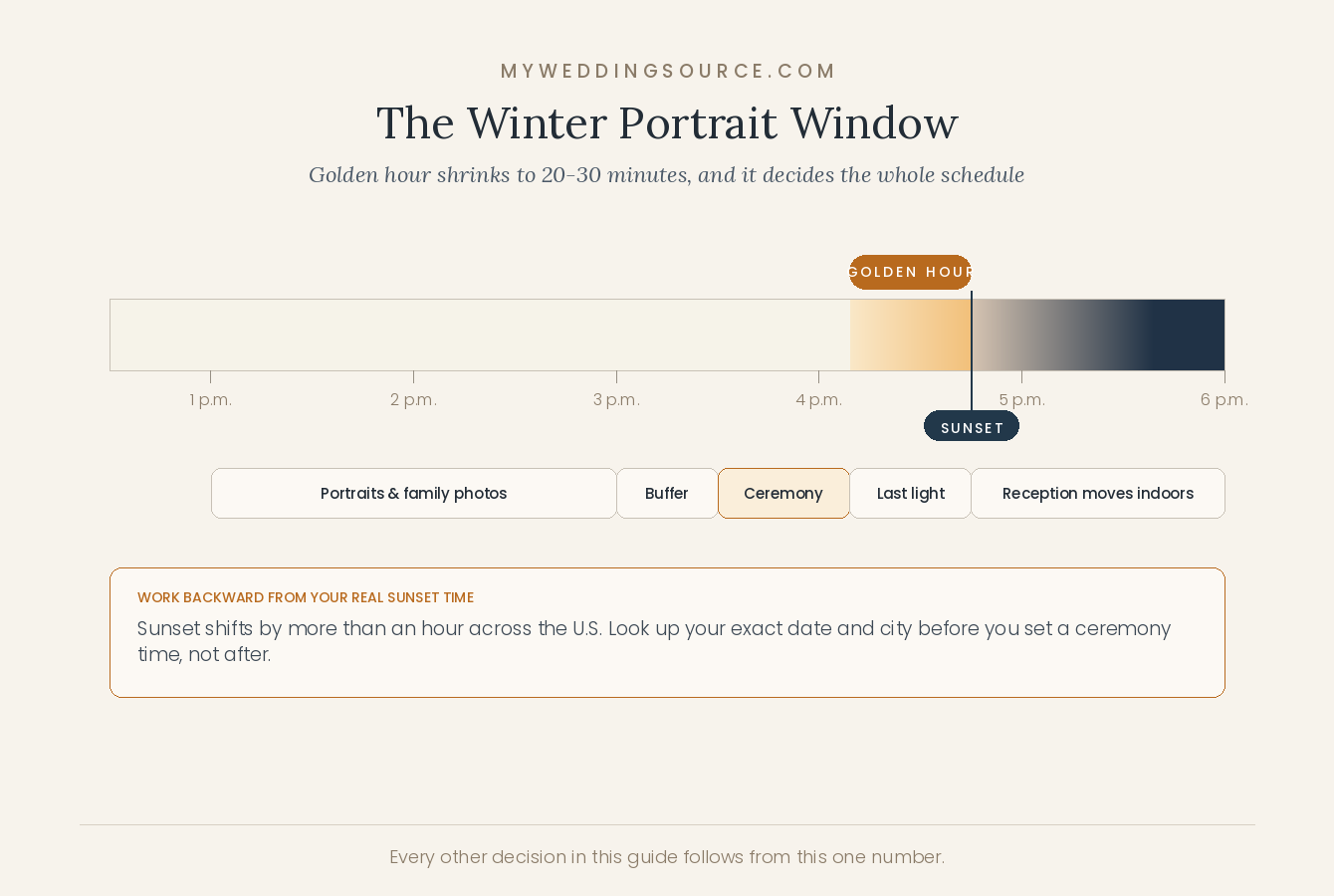
Photographers chase golden hour for winter wedding photography, the warm, low-angle light in the final hour before sunset. It flatters skin and adds depth no artificial source fully replicates. In summer, that window runs close to an hour. In winter, it can shrink to twenty or thirty minutes, and it arrives while your reception may still be getting started.
Work backward from the actual sunset time
Look up the precise sunset time for your wedding date and location before you set a ceremony time, not after. The U.S. Naval Observatory publishes exact sunrise and sunset times for any date and location in the country, and checking it takes under a minute. Once you know the real number, build backward: portraits finish before sunset, the ceremony sits before that, and hair and makeup sits before the ceremony.
What “after dark” actually changes
Once the sun sets, every winter wedding photography photo depends on artificial light. Reception decor and candles help. Flash fills in the rest. That is not a disaster. Some of the most striking winter wedding photography moments happen after dark, lit by string lights, candles, or a dance floor in full swing. Your photographer just needs a plan for that light, rather than hoping the venue’s ambient lighting will be enough on its own.
Sunset shifts fast across the country
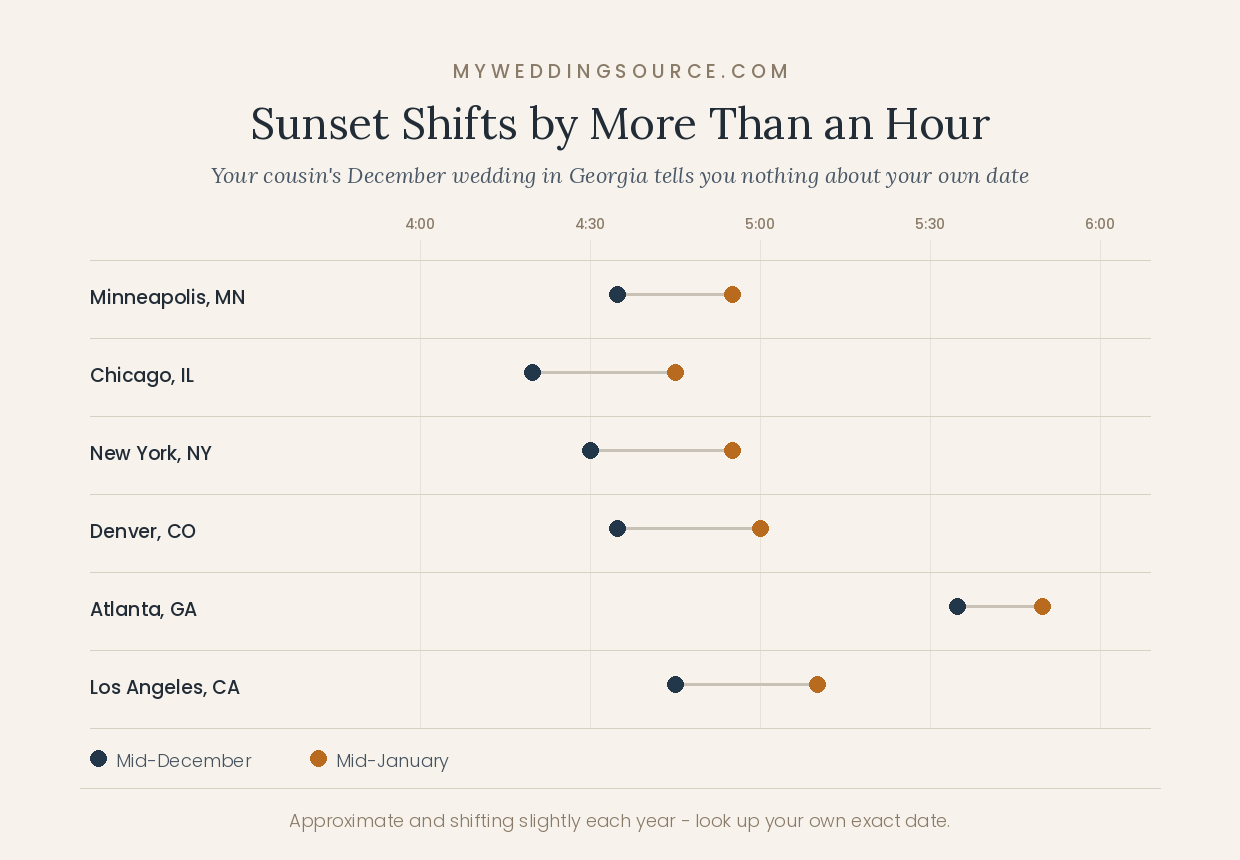
Do not assume your cousin’s December wedding in Georgia tells you anything about your own date in Minnesota. Sunset varies by more than an hour across U.S. time zones and latitudes, even on the same calendar day. The table below shows how much that swing matters.
| City | Mid-December sunset | Mid-January sunset |
|---|---|---|
| Minneapolis, MN | 4:35 p.m. | 4:55 p.m. |
| Chicago, IL | 4:20 p.m. | 4:45 p.m. |
| New York, NY | 4:30 p.m. | 4:55 p.m. |
| Denver, CO | 4:35 p.m. | 5:00 p.m. |
| Atlanta, GA | 5:35 p.m. | 5:50 p.m. |
| Los Angeles, CA | 4:45 p.m. | 5:10 p.m. |
These figures are approximate and change slightly every year. Treat the table as a planning reference only. Look up your own exact date and city before you commit to a ceremony time.
Indoor or Outdoor Ceremony: The Photography Trade-offs
Many winter couples default to an indoor ceremony without weighing what it costs and saves in winter wedding photography. Both options work well for winter wedding photography. They just work differently.
What an outdoor ceremony offers
Bare trees, snow, and open sky give a photographer real depth and natural light to work with for winter wedding photography. An outdoor ceremony, timed well before sunset, often produces the most dramatic images of the entire day. The trade-off is real too: guests get cold, the ceremony has to move quickly, and everyone’s flexibility narrows if the weather turns for winter wedding photography.
What an indoor ceremony offers
An indoor space protects guests from the cold and removes weather as a variable entirely for winter wedding photography. It also introduces the flash and lighting questions covered earlier in this guide, since most indoor ceremony spaces are dimmer than they appear to the eye for winter wedding photography.
A hybrid approach
Some couples hold the ceremony indoors and move outside briefly afterward for portraits in natural light, timed to the day’s remaining daylight. This captures much of the outdoor look without asking guests to sit outside in the cold for the full ceremony. Discuss this option for winter wedding photography with your photographer if you are drawn to both looks but worried about guest comfort.
Sample Wedding-Day Timelines
These two timelines assume a 4:45 p.m. sunset and a two-hour photography block before the ceremony. Adjust every time by your own sunset lookup and your photographer’s pace.
Timeline with a first look
| Time | What happens |
|---|---|
| 11:30 a.m. | Hair, makeup, and detail shots (rings, dress, invitations) |
| 1:15 p.m. | First look, just the couple |
| 1:35 p.m. | Couple portraits |
| 2:10 p.m. | Wedding party portraits |
| 2:40 p.m. | Immediate family portraits |
| 3:15 p.m. | Buffer, touch-ups, guests arrive |
| Ceremony | |
| 4:15 p.m. | Cocktail hour; a few remaining portraits in the day’s last light |
| 4:45 p.m. | Sunset — reception photography moves fully indoors |
| 5:30 p.m. | Reception entrance, toasts, dinner |
Timeline without a first look
| Time | What happens |
|---|---|
| 12:00 p.m. | Hair, makeup, detail shots |
| 1:30 p.m. | Wedding-party portraits, separate sides |
| 2:15 p.m. | Immediate family portraits, separate sides |
| 3:00 p.m. | Buffer and guest arrival |
| 3:30 p.m. | Ceremony |
| 4:00 p.m. | Combined family portraits, fast and prioritized |
| 4:25 p.m. | Couple portraits in the day’s final light |
| 4:45 p.m. | Sunset — cocktail hour and remaining photos move indoors |
| 5:45 p.m. | Reception entrance, toasts, dinner |
Notice how little slack the second timeline has. Skipping the first look is a legitimate choice, but it removes almost all of the schedule’s natural cushion. Add extra buffer anywhere you can if you choose this route.
Winter Wedding Photography: Reception Photography After Dark
For most winter weddings, the entire reception happens after sunset. That includes the entrance, the toasts, dinner, the first dance, and the dance floor. Each of these needs its own lighting approach, not one blanket setting.
The first dance and other formal moments
A first dance usually happens under dim, moody lighting on purpose. That mood looks wonderful in person and can be tricky to capture well. Ask your photographer whether they add a small amount of supplemental light for this moment, positioned to preserve the atmosphere rather than flatten it. Many photographers use a single off-camera flash, bounced softly, so the room still feels intimate in the photos.
Toasts and speeches
Speeches often happen under a single spotlight or minimal lighting, with the rest of the room dark. This creates strong, dramatic images if your photographer anticipates it. Ask where they plan to stand. Find out whether the venue’s lighting setup gives them enough to work with, or whether they will add a discreet light of their own.
The dance floor
Fast movement in low light is the hardest combination in wedding photography. Photographers typically solve it with quick-recycling flash units bounced off the ceiling, timed to freeze motion without a harsh direct blast. Ask specifically how your photographer handles dance floor coverage, since this is where equipment and experience matter most.
Winter Wedding Photography: Cake Cutting and Other Staged Moments
These moments are easier to plan for because they happen in a fixed spot at a known time. Position the cake, if possible, somewhere with decent ambient light or near a source your photographer can supplement easily. A small adjustment in placement, discussed in advance, can noticeably improve this set of photos.
Indoor Portrait Locations and Backup Spaces
Every winter wedding photography event needs at least one indoor location that photographs well, because outdoor time is limited and weather can remove it entirely.
Scout the venue specifically for this
Walk your ceremony and reception spaces with your photographer before the wedding, ideally at the same time of day the real event will happen. Look for large windows, interesting architectural details, staircases, and rooms with warm ambient light. A hotel lobby, a library, a grand staircase, or even a well-lit hallway can produce portraits as strong as any outdoor location.
What makes a good indoor backup
- Real window light, ideally from the side rather than directly overhead, which flatters faces far more than a ceiling fixture.
- Enough space to fit a wedding party or family group without a cluttered background.
- A consistent color temperature, since mixing daylight through a window with warm indoor bulbs can create an odd color cast a photographer has to correct.
- Privacy or a quiet window, so the space is not full of guests or staff during your portrait time.
Indoor locations worth checking
Hotel lobbies and lounges. Grand staircases. Libraries and reading rooms. Conservatories or plant-filled atriums.
Large windows with a view. Wine cellars or bars with warm lighting. Covered porches or sunrooms. Empty ballrooms before setup. Historic hallways with interesting trim.
Coordinate access with your venue
Confirm access in writing with your venue coordinator for the specific times you need these indoor spaces. A beautiful library means nothing if it is locked, in use for setup, or off-limits to photography. Ask this question during your final walkthrough, not on the wedding day itself.
Artificial Lighting for Ceremony and Reception Photos
Continuous light versus flash
Continuous lights, such as LED panels, stay on throughout a scene. Both the photographer and the couple can see exactly how the light falls before the shutter clicks. Flash fires only for an instant and takes more technical judgment to use well. It freezes motion beautifully on a dance floor, and it works in situations continuous light cannot reach. Most experienced winter wedding photographers carry both and choose based on the moment.
Off-camera flash and bounce techniques
Rather than firing a flash directly at your face, many photographers position lights off to the side. Others bounce light off a ceiling or wall for a softer, more natural result. Ask whether your photographer uses this approach for reception portraits and the first dance. Direct on-camera flash is the technique most likely to produce the harsh, flat look people associate with bad wedding photography.
Keep color temperature consistent
A room lit by warm string lights, cool overhead fixtures, and a photographer’s flash all at once can produce photos where skin tones shift awkwardly between frames. Ask your photographer how they plan to balance these sources. Mention any dramatic lighting choices, such as colored uplighting, during your planning conversations rather than as a surprise on the day.
Winter Wedding Photography: Flash Restrictions and Ceremony Rules
Common restrictions by venue type
Many religious venues prohibit flash photography during the ceremony itself, out of respect for the service or to avoid distracting guests and officiants. Some historic venues restrict flash to protect artwork or interior finishes. Museums, certain private estates, and some upscale hotels enforce their own photography policies independent of your photographer’s preferences.
Ask before the wedding, not during it
Confirm your ceremony venue’s flash policy directly, in writing, well before the wedding. Pass that information to your photographer immediately so they can plan lens choices and camera settings around it rather than discovering the restriction mid-ceremony.
What a photographer does instead
Experienced photographers handle flash-free ceremonies with fast lenses that gather more light. Higher camera sensitivity settings help too, along with careful positioning near windows or chandeliers. Ask to see a full gallery from a flash-restricted ceremony your photographer has shot before, not just a handful of highlight images. That is how you learn what typical results actually look like.
Winter Wedding Photography: Snow, Rain, and Equipment Protection
Protecting the gear
Cameras and lenses tolerate light snow reasonably well but suffer in sustained rain or heavy wet snow without protection. Professional photographers typically carry rain covers, lens cloths, and backup bodies for exactly this reason. Ask directly what backup equipment and weather protection your photographer brings, especially if your ceremony includes any outdoor component.
Protecting the couple and the wedding party
Wet fabric shows in photos far more than couples expect. A soaked hem or running eye makeup becomes a permanent part of the memory, not a fixable moment. Keep large umbrellas, a towel, and a change of shoes on hand for any outdoor portrait time. Assign someone specific — not the photographer — to manage umbrellas so your photographer’s hands stay free for the camera.
When precipitation actually helps
Light snow falling during portraits photographs beautifully, especially backlit against a dark background or venue lights. A brief rain shower, timed right, can produce striking reflective photos on wet pavement or glass. Ask your photographer how they would handle a few unplanned minutes of snow or light rain. Many welcome it rather than treat it purely as a problem to avoid.
Cold drains batteries fast
Camera batteries lose charge much faster in freezing temperatures than most people expect. Experienced photographers keep spare batteries warm in an inner pocket, close to the body, and swap them frequently through the day. Ask your photographer directly how many batteries they bring and where they keep them during a cold outdoor session.
Travel Buffers Between Locations
Winter travel takes longer than the map suggests
Icy roads, reduced visibility, and slower traffic all add real time to any drive between your getting-ready location, ceremony, and reception. A route that takes fifteen minutes in July can easily take twenty-five in January, especially after fresh snowfall.
Build the buffer into the timeline itself
Add at least fifteen extra minutes to every scheduled drive during winter months. Add more if your date carries a real chance of snow or ice. This buffer protects your photography time directly: a late arrival at the ceremony site eats straight into the portrait window that already has no slack to spare.
The Family Photo List, Built for Winter
Cold shortens everyone’s patience
A family photo list that works comfortably in June can feel endless in twenty-degree weather. Guests in formal clothing get cold fast, children get cranky faster, and older relatives may need to step inside sooner than younger guests. Trim your list to the combinations that genuinely matter, and move anything optional to an indoor moment later in the day.
A sample structure that moves quickly
- Both sets of parents together with the couple
- Each set of parents separately with the couple
- Siblings with the couple
- Grandparents with the couple
- Extended family groupings, kept to two or three combinations maximum
- The full wedding party with the couple
Six to eight combinations is a realistic winter target. A longer list almost always runs over time, and the last few photos on an overlong list are usually the ones where everyone looks coldest.
Assign a wrangler
Ask an organized family member or your wedding planner to gather each group before their turn arrives. Then your photographer spends the time shooting, not searching for missing relatives. This single role saves more time on a cold day than almost any other planning decision in this section.
Realistic Image Expectations

What low light limits, and what it does not
Low light genuinely limits certain shots. Fast-motion dance floor photos taken without supplemental lighting will show more grain or blur than the same shot in bright daylight. It does not limit portrait quality, ceremony coverage, or reception ambiance, all of which experienced photographers handle well with the right equipment and preparation.
Set expectations with your guests too
If any part of your ceremony happens without flash, let guests know gently that photos may look different from a bright summer wedding they attended before. This small note prevents disappointed comments when the gallery arrives, since winter photography has its own distinct look rather than a lesser version of summer photography.
What your gallery will actually look like
Expect warmer tones from candlelight and string lights, softer overall contrast from an overcast sky, and a more intimate, moody feeling throughout the collection. Many couples find they prefer this look once they see it, even if they entered the day worried about the season. Ask your photographer for a full winter wedding gallery, not just a highlight reel, so you know what to expect before the wedding rather than after.
How Many Coverage Hours to Book
Winter weddings often need more coverage hours than couples first assume, not fewer. The compressed daylight window pushes important moments closer together, and darkness adds its own separate demands later in the night.
Why summer packages do not translate directly
An eight-hour package built for a June wedding usually covers getting ready, a relaxed portrait window, the ceremony, and most of the reception. In winter, that same eight hours has to stretch across an earlier start, a tighter portrait block, and often a longer reception, since low light rarely shortens how long guests want to dance. Ask your photographer to map your actual timeline against their standard package before you assume the hours match.
Where extra hours matter most
- An earlier start, if your ceremony has moved up to protect daylight for portraits beforehand.
- Blue hour coverage, the twenty or so minutes right after sunset, when the sky turns a deep, rich blue that photographs beautifully against venue lights.
- Extended reception coverage, if your dance floor is likely to run later than a typical warm-weather wedding.
- A second shooter’s hours, which often need separate confirmation from the lead photographer’s package.
A simple way to check
Write out your realistic hour-by-hour day, start to finish, before you book a package. Compare that list against the hours included in your contract. If there is a gap, ask about the cost to extend coverage now, while you still have room to adjust the timeline, rather than during the reception itself.
A question worth asking directly
“Given our sunset time and ceremony start, does our winter wedding photography package give us enough coverage for portraits, the ceremony, and the parts of the reception that matter most to us?” A good photographer will answer this honestly, including telling you if it does not.
Questions to Ask Your Photographer
- Can I see a complete gallery from a winter wedding you shot at a similar time of year, not just highlights?
- What is your plan if the ceremony venue restricts flash?
- What backup equipment do you bring for cold, snow, or rain?
- How do you typically balance daylight and reception lighting through the evening?
- Do you recommend a first look for our specific timeline and venue?
- What indoor backup locations have you used successfully at this venue before?
- How many minutes do you typically need for a family photo list of our size?
- What happens to the timeline if weather delays our start time?
- Do you use off-camera flash or bounce lighting for reception portraits?
- What time do you recommend for our ceremony, given our actual sunset time?
Common Mistakes
Setting the ceremony time before checking sunset
This is the single most common and most consequential mistake in winter wedding planning. Check the real sunset time first, then build every other decision around it.
Assuming flash solves every low-light problem
Many venues restrict it, and even where it is allowed, flash cannot recreate the depth and mood available through good natural or continuous lighting. Plan around the light you will actually have.
Skipping the indoor location scout
A gorgeous lobby is only useful if your photographer knows about it in advance and has confirmed access. Walk the venue together before the wedding.
Overloading the family photo list
A list built for a warm June afternoon rarely survives a cold January one. Trim it before the day, not during it.
Forgetting winter travel time
Icy roads and holiday traffic both add real minutes to every drive. Build the buffer in before the day, not after you are already running late.
Not asking about backup equipment
Cold weather is hard on batteries and camera bodies. A photographer without backups risks losing coverage at the worst possible moment.
Leaving guests without warning about flash-free photos
A quick, friendly note prevents confused or disappointed reactions once the gallery arrives looking different from a typical summer wedding.
Not discussing dance floor lighting in advance
This is the single hardest lighting scenario in the entire day. Ask about it during planning, not after the reception has already started.
Photo-Priority Worksheet
Fill this in with your photographer before the wedding, so everyone agrees on what matters most if time runs short.
Must-have shots, ranked in order
- ☐ 1. ____________________
- ☐ 2. ____________________
- ☐ 3. ____________________
- ☐ 4. ____________________
- ☐ 5. ____________________
Logistics to confirm
- ☐ Exact sunset time for our date and venue: ____________
- ☐ Indoor backup location confirmed and access approved: ____________
- ☐ Ceremony flash policy confirmed in writing: ____________
- ☐ Family photo list finalized and shared with a wrangler: ____________
- ☐ Travel buffer added to every drive on the timeline
- ☐ Backup equipment and weather protection confirmed with photographer
Nice-to-have if time allows
- ☐ ____________________
- ☐ ____________________
- ☐ ____________________
Frequently Asked Questions
No, but it helps considerably. A first look moves your couple and group portraits earlier in the day, which protects them from a closing daylight window. Some couples still prefer to save that moment for the aisle, and that choice works fine too. Just build extra buffer into the rest of the timeline, since less daylight will be available afterward. Discuss both options with your photographer before you set a ceremony time.
What time should we schedule our winter ceremony?
Look up the exact sunset time for your date and location first, then work backward. A common approach schedules the ceremony roughly ninety minutes to two hours before sunset, leaving enough daylight afterward for cocktail-hour portraits without rushing. Every venue and photographer moves at a different pace, so confirm the specific timing with your photographer rather than relying on a generic rule alone.
Will our photos look worse if our venue does not allow flash?
Not necessarily. Experienced wedding photographers handle flash-free ceremonies regularly, using fast lenses, higher sensitivity settings, and smart positioning near windows or existing light fixtures. Ask to see a complete gallery from a flash-restricted wedding your photographer has shot before making any assumptions about how your own photos will turn out.
How many family photo combinations should we plan for?
Six to eight combinations is realistic for a winter wedding, noticeably fewer than couples often plan for a warm-weather date. Cold weather shortens everyone’s patience, and a long list frequently runs over time, leaving the final few photos looking rushed or uncomfortable. Trim the list to combinations that genuinely matter, and save anything optional for an indoor moment later in the reception.
What happens if it snows or rains during our photos?
Light snow often photographs beautifully, especially backlit against a dark background. A brief rain shower can even create striking reflective images, if your photographer is prepared for it. Heavier or sustained precipitation calls for protective gear on both the equipment and the wedding party. Rain covers for cameras, umbrellas, and a dry change of shoes all help. Ask your photographer directly how they typically handle unplanned weather so you know the plan before the day arrives.
Should we plan an indoor backup location even if we want outdoor photos?
Yes. Weather, timing, and available daylight can all shift unexpectedly on a winter wedding day. A scouted indoor location protects your portrait time no matter what happens outside. Walk the venue with your photographer in advance, looking for good window light, and confirm access with your venue coordinator in writing well before the wedding.
How much extra time should we add for winter weather delays?
Add at least fifteen extra minutes to every scheduled drive between locations, and more if snow or ice is a realistic possibility on your date. This buffer protects the parts of your timeline with the least flexibility, particularly the portrait window before an early sunset. A late arrival at the ceremony site has a direct, unrecoverable cost in a winter schedule that a summer one can usually absorb.
Do we need to warn our guests about flash restrictions?
It is a thoughtful step, though not strictly required. A brief, friendly note lets guests know that ceremony photos may look different from a bright, flash-lit wedding they have attended before. That small step prevents any confused or disappointed reaction once the gallery arrives. This is especially worth doing if immediate family members are the type to ask why photos “came out dark,” when in fact the mood was intentional.
Can our photographer capture the dance floor well in a dark reception room?
Yes, with the right equipment and preparation. Fast-moving, low-light scenes like a dance floor call for quick-recycling flash units, usually bounced off the ceiling rather than fired directly at guests. Ask your photographer specifically how they handle this part of the evening. It depends more on gear and experience than any other single moment in the day.
Do we need to hire a second photographer for a winter wedding?
Not necessarily, but it is worth discussing. A second shooter can cover a getting-ready room while the lead photographer scouts an indoor backup location. They can also capture candid guest reactions during a tight, low-light timeline where every minute counts. For a compressed winter schedule with a short daylight window, many couples find the extra coverage genuinely useful rather than optional.
Should we choose an indoor or outdoor ceremony for the best photos?
Both can produce excellent results, and the right choice depends on your priorities more than any fixed rule. An outdoor ceremony offers dramatic natural light and scenery but asks more of guests in cold weather, while an indoor ceremony protects everyone’s comfort and shifts the lighting challenge onto your photographer’s equipment and skill. A hybrid approach, with the ceremony indoors and a short outdoor portrait session afterward, gives many couples the best of both without a long outdoor sit for guests.
Plan for the Light You Will Actually Have for Winter Wedding Photography
Winter Wedding Photography: Capturing the Magic of the Season
Winter wedding photography rewards preparation more than any other season, and almost every decision in this guide traces back to one number: your actual sunset time. Once you know it, everything else follows. The first-look decision, the ceremony timing, the indoor backup plan, and the family photo list all fall into place around it.
Start with the sunset lookup, then build backward for your winter wedding photography. Confirm flash policies early, scout indoor locations together, and trim your family list to what genuinely matters. The couples who plan this way consistently get galleries that feel intentional and warm, not apologetic about the season they chose for winter wedding photography.
Your next step
Look up your exact sunset time today, then send it straight to your photographer with one question: does our current ceremony time give us enough usable light? That single message can reshape your entire day for the better, and it costs nothing but five minutes.
Keeping the focus on winter wedding photography ensures that each detail is planned perfectly, creating unforgettable memories.
To capture stunning moments, understanding winter wedding photography is crucial. It is not just about the day itself but also about the preparation that goes into it.
