
Wedding keepsakes are the objects, papers and files that carry a wedding and two family histories forward: the dress, a grandmother’s ring, the guest book, a handwritten letter, a quilt from an aunt. This guide shows two households how to decide who keeps what, how to care for it, and how to write the decision down so it still makes sense in ten years.
Give every item one custody card with five lines: who owns it, who keeps it, how it should be cared for, who comes next, and when you will review the arrangement. Sort the keepsakes first by ownership status (gift, loan, family property, shared, personal), because the status decides who has a say. Divide by use and care, not by fairness arithmetic. Keep the original with whoever can store it properly and give the other household a copy, a photograph or a defined turn. Then put the result in a one-page family memo and review it on your first anniversary.
A wedding produces two kinds of objects. The first kind is easy: things you bought together, such as a framed print or the cake topper you chose. The second kind is harder. It includes objects that arrived with a history attached, such as the ring your partner’s grandmother wore for sixty years, the christening gown that appears in three generations of photographs, or the embroidered cloth your mother brought from another country.
Nobody agrees in advance who owns these things, and nobody thinks to ask until a relative says, with a smile that is not entirely a smile, “I assumed that one would come back to us.”
This article is about that moment, and about preventing it. It is written for couples whose two families are both involved, whether the families are close, distant, blended, far apart or not on speaking terms. It does not try to be a general guide to wedding paperwork. For the contracts, receipts and certificates, see our guide on organizing wedding records after the event. Here the subject is narrower and more personal: sharing wedding keepsakes between two households without damaging either relationship or the objects themselves.
A note on scope. This is general information, not legal, tax or financial advice. Property rules, inheritance rules and insurance terms differ by state and by situation, so where a decision carries real money or legal weight, the article points you toward an attorney, an appraiser or the issuing agency.
What counts as wedding keepsakes and why they cause friction
It helps to start with a wide definition, because the objects that cause arguments are often not the ones couples expect. Wedding keepsakes fall into six rough groups.
Worn items. The dress, veil, shoes, a suit or sherwani or hanbok, cufflinks, a hair comb, a borrowed brooch. These are personal, fragile and easy to damage by storing them wrong.
Carried and displayed items. The bouquet, a ring pillow, a cake topper, a unity candle, a ceremony cord, a framed invitation, the card box. These keepsakes are decorative by nature and often end up in a closet.
Paper items. The invitation suite, programs, a signed guest book, the vows you wrote, letters from parents, a marriage license frame. Paper keepsakes are light and easy to share, which makes them easy to forget.
Family heirlooms. Rings, watches, jewelry, linens, tools, religious objects, a family Bible, silver, a recipe box. These keepsakes carry the strongest feelings and the least paperwork.
Gifts from the families. The quilt, the set of dishes, the artwork a parent commissioned, an heirloom given outright at the wedding. The status of these keepsakes is often unclear because the giving was done in a rush of emotion.
Digital keepsakes. Photos, video, voicemail greetings, scans of old family photographs that surfaced because of the wedding. These can be copied endlessly, which solves some problems and creates others.

Why two households disagree about keepsakes
The friction over keepsakes rarely comes from greed. It comes from three ordinary things.
First, meaning is uneven. An object that is a pleasant antique to one household is the last tangible link to a lost parent for the other. Neither view is wrong, but if the two views are never spoken aloud, each side assumes the other feels the same way.
Second, status is vague. A grandmother who says “this is for you” at a rehearsal dinner might mean a gift, a loan, a custody arrangement or a wish. Years later the family remembers four different versions. Without a note made at the time, the loudest memory wins.
Third, the future arrives unannounced. A move, a baby, a divorce, a death, a fire or a flood changes who needs what. An arrangement that worked while everyone lived in the same city may not survive an overseas posting.
None of these keepsake problems are solved by good intentions. They are solved by a short, specific record and a few honest conversations. That is the whole method in this guide, and the rest of the article breaks it down into steps you can do in a few evenings.
What this guide does not cover
Some adjacent topics belong elsewhere. Registry gifts that the two of you receive from guests are a separate matter; the wedding registry ideas guide covers how to choose and track them. Cash gifts, vendor deposits and receipts are records, not keepsakes. And a formal division of property after a divorce, or the transfer of valuable items through a will, is a legal process that a licensed attorney handles. This guide stays in the middle ground: the sentimental and semi-valuable keepsakes that a family can sort out sensibly if it plans ahead.
Who this method works for
This method for keepsakes works best for couples who expect to keep a lasting relationship with both families, and for families who want to avoid a quarrel they can see coming. It also works for couples who have little contact with one side, because the same logic protects the keepsakes and the couple from pressure.
If your situation involves a family member who is unwell, an item with serious monetary value, or a relative who has already threatened to take something back, read the edge cases near the end of this article first, and consider a conversation with a professional before you talk to relatives.
The two principles that shape everything else
Two principles run through every section that follows, so it is worth stating them now.
The first is that ownership and custody are different things. Owning an item means you decide its future. Keeping it means it lives in your home and you are responsible for its condition. A family can agree that the great-aunt’s brooch belongs to the whole family line while it is kept by the couple who has a safe and a stable home. Separating the two ideas takes much of the heat out of any talk about keepsakes, because “who keeps it for now” is a smaller question than “who gets it.”
The second is that a keepsake is only preserved if someone is actually looking after it. A silk dress in a damp garage is not honored by being kept, and the same goes for most keepsakes. An heirloom handed to the relative who loves it best but cannot store it properly may not last. Good custody means the object’s condition, not only its location, was part of the decision.
With those two ideas in hand, the next section introduces the single tool that holds the method together: the custody card.
The custody card: five questions for every one of the keepsakes
The custody card is a small, plain record for keepsakes, one per item or per set. It can live on an index card, in a spreadsheet row or in a shared note. What matters is that it has the same five lines every time, so that two families reading it independently reach the same understanding. The five lines are owner, keeper, care, next in line and review date.
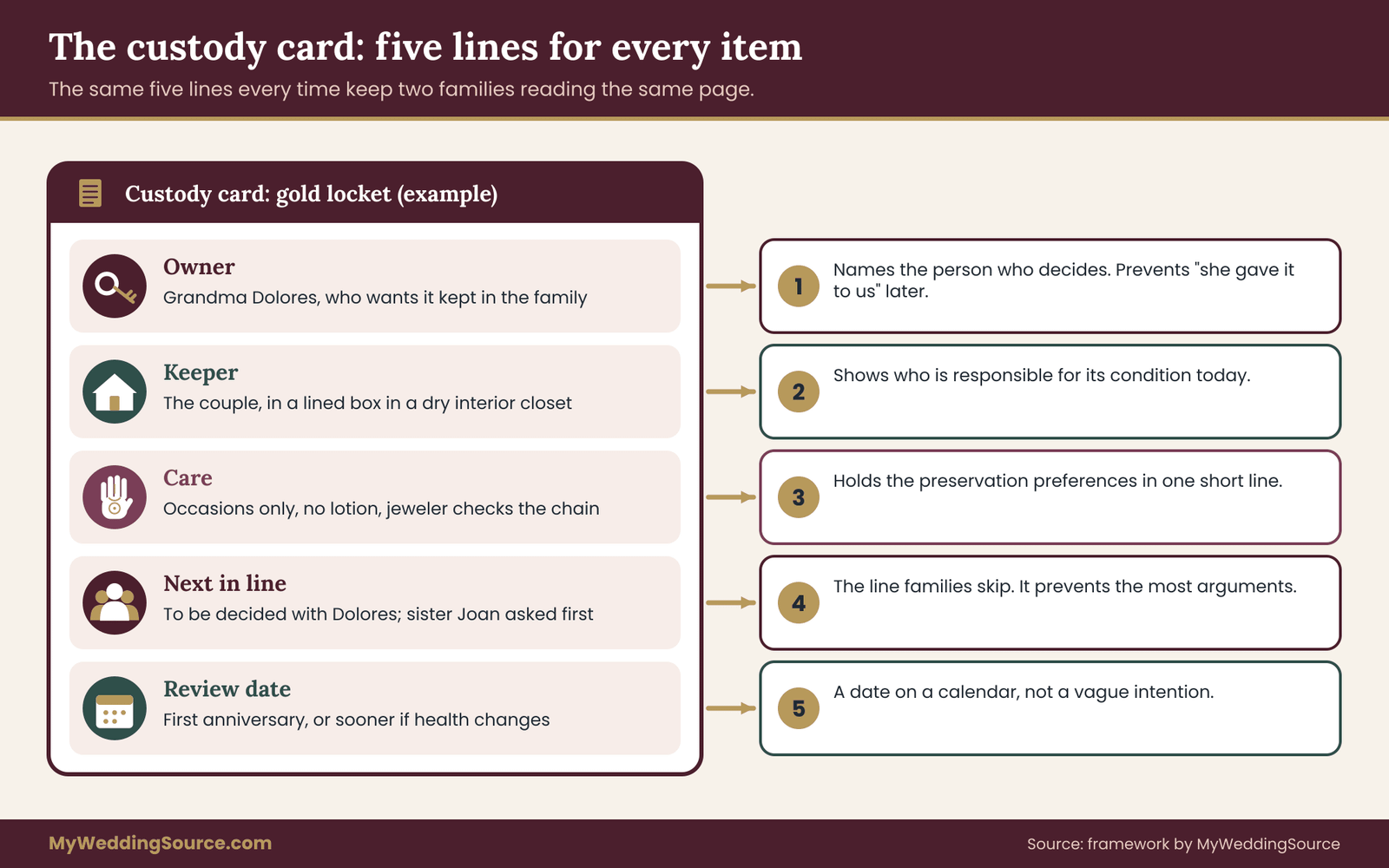
Owner. Who decides what eventually happens to this item? The answer might be one partner, both partners, a named relative who is lending it, or “the family line,” meaning the item is meant to stay in the family and travel to whoever is next. Write the name, not the role. “Grandma Ruth” is clearer than “his side.”
Keeper. Who has it in their home today and is responsible for its condition? This is often different from the owner. A couple may be the keepers of a brooch that is still owned by the grandmother, and she may want it back for a family event. The keeper line makes that arrangement visible.
Care. What does the item need? One short line is enough: “Store flat in a box, away from light. Do not wear in the rain. Have the clasp checked before use.” This line is the preservation preference in miniature, and the later section on the preservation checklist explains how to fill it in with some confidence.
Next in line. Who is expected to receive the item after the current owner or keeper? This is the line families tend to skip, and it is the one that prevents the most arguments. It does not have to be a legal commitment. It can say “to be decided by the two of us, with preference for a child who asks for it.” The point is to name the question so it is not discovered by surprise.
Review date. When will the arrangement be looked at again? A date, not a vague intention. The first anniversary is a good first review, and after that every few years or after a major life change.
A sample card in words
Here is how a filled card might read for a plain, realistic item. The item is a gold locket worn by the groom’s grandmother at her own wedding.
Owner: the groom’s grandmother, who is still living and has said she wants it to stay in the family. Keeper: the couple, in a lined box in a closet that stays dry. Care: wear only at formal events, keep away from perfume and lotion, have the chain checked by a jeweler before each long wear. Next in line: to be decided with the grandmother’s input, with the groom’s sister named as the person to be asked first. Review date: the first anniversary, or sooner if the grandmother’s health changes.
Notice what the card does and does not do. It does not settle ownership forever. It does record that the grandmother is the owner, so no one in the couple’s household will later say “she gave it to us.” It also names a plausible successor, which reassures the sister, and it gives the object a care instruction a relative can follow.
Why five lines and not fifty
Families sometimes want to build elaborate inventories of their keepsakes with photographs, valuations, provenance histories and insurance schedules. Those can be useful for a few items. For most keepsakes they become a project that nobody finishes. A five-line card takes about three minutes per item. That is short enough to complete in one sitting, and because every card has the same shape, two relatives can compare them without a long conversation about format.
If an item needs more, such as an appraisal or a repair history, attach a second page. The five lines stay on top as the summary.
Who fills in the cards
Do not fill them in alone and then present them to the families. That makes the cards look like a decision rather than a proposal, and it invites the very pushback you are trying to avoid. Instead, fill in the lines you know, mark the rest “to confirm,” and bring the draft cards to the relevant relative. The owner line in particular should always be confirmed by the person named, preferably in writing, even if the writing is a short message saying “yes, that is right.”
Inventory and ownership: sorting the keepsakes
You cannot divide keepsakes you have not listed. The inventory is a one-evening task, and the goal is to produce a flat list of every item that might become a source of disagreement, plus a first guess at its ownership status.
Build the list in three passes
Pass one: what is in your own home. Walk through your rooms and list wedding-related objects you can see, and then the ones in closets, drawers and boxes. Include the dress, accessories, cards, programs, gifts that came from relatives, and any other keepsakes with that has a relative’s name attached to it in your memory.
Pass two: what is in relatives’ homes. Ask each family which items from the wedding they are holding. The groom’s mother may be keeping the veil because it was her mother’s. The bride’s father may have the box of cards. Without this pass you will end up with a tidy list that leaves out half the keepsakes.
Pass three: what is promised but not yet delivered. Keepsakes that relatives have said they will give you, items waiting at a framer or cleaner, and things that were mentioned in a toast. Write them down as “promised” with the source of the promise.
Do not argue about anything during the inventory. The list is only a list. If a relative says “that was meant for my daughter,” you write the name and move on.
Assign one of five ownership statuses
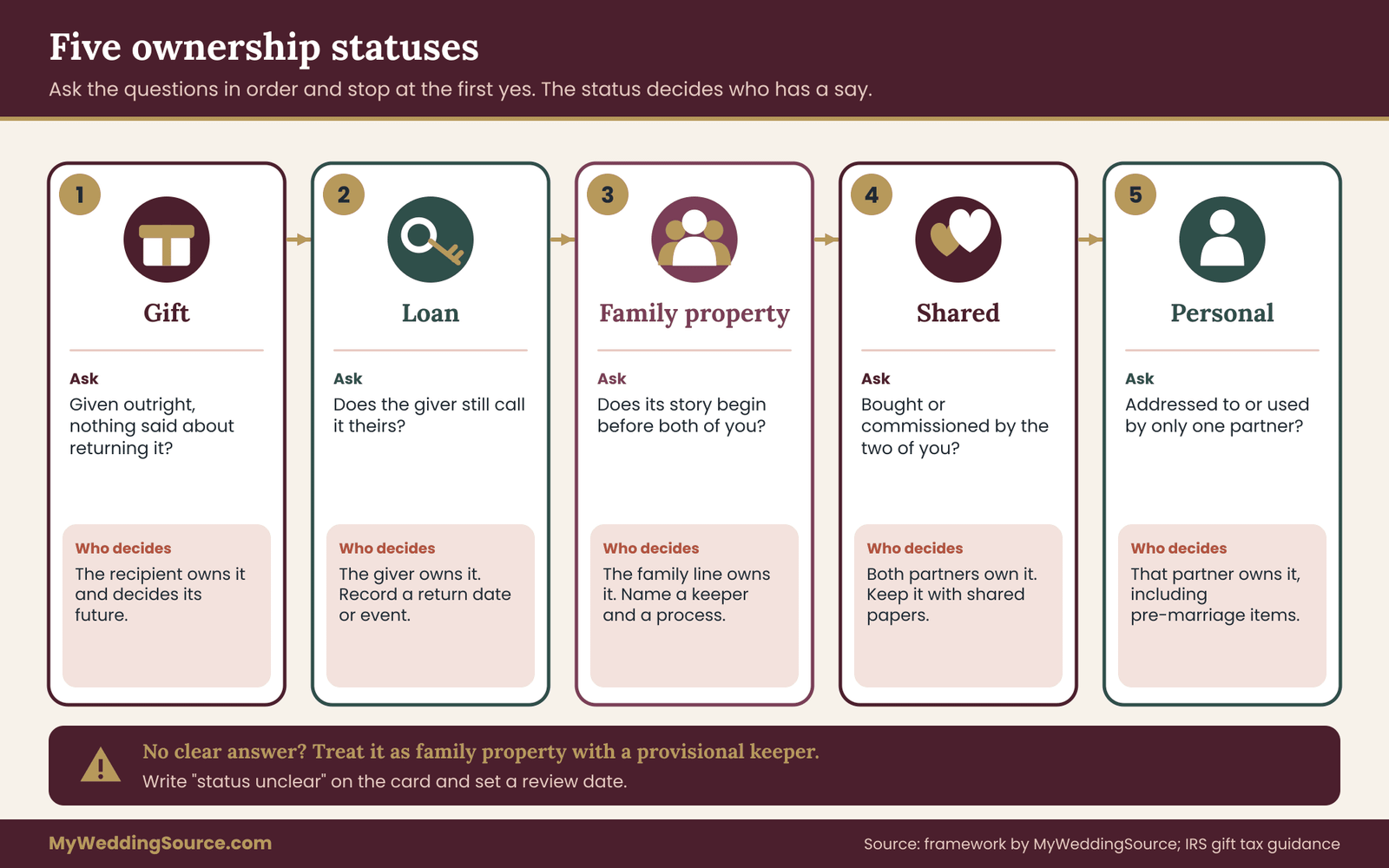
Once an item is on the list, give it one of five statuses. The status is the most important line on the card because it controls who has a say.
Gift. The item was given outright, with no strings, and the giver understood it as a transfer of ownership. Gifts are the cleanest category. The recipient owns the item and can decide what to do with it, though thoughtful recipients still consider the giver’s feelings. The Internal Revenue Service explains that gift tax rules generally fall on the giver rather than the recipient and that most gifts do not produce a tax bill, but a licensed tax adviser can answer questions about a valuable item.
Loan. The item belongs to someone else and was lent for the wedding or for an indefinite period. A loan has an owner, a keeper and, ideally, an end date. Loans are the category most likely to cause hurt feelings, because the keeper may start to feel the item is theirs while the owner still feels it is theirs.
Family property. The item belongs to a family line rather than to any person living today. It is expected to move on to a successor. Family property needs a keeper and a named process for choosing the next one.
Shared couple property. The two of you chose, bought or received the item together. The wedding album, a commissioned painting, the cake topper you picked. These belong to both partners, and a divorce or separation would raise questions that neither family can answer.
Personal property. The item belongs to one partner individually, such as the dress, a ring the partner owned before the marriage, or a gift addressed to one partner by name.
Use a short decision path to assign status
Ask these questions in order, and stop at the first yes.
Was it given to one or both of you, with words like “this is yours,” and no mention of returning it? If yes, call it a gift, and note which of you received it. Is it still described by the giver as theirs, or was a return mentioned? If yes, it is a loan. Does it have a story that begins before either of you and is expected to go on after you?
If yes, treat it as family property, even if it sits in your home. Did the two of you buy or commission it together? If yes, shared. Is it addressed to or used by only one of you? Personal.
When the answers conflict, such as a ring that was “given” but is also described as “the family ring,” pick the status that the people most affected would accept, and write the other half of the story in the notes. A mixed status can be fine if it is written down. A mixed status that nobody has discussed is how a decade-long argument begins.
Why status matters in real life
Consider two couples who receive the same sort of gift: a set of silver spoons from a grandmother. In the first case the grandmother says, “These are yours now, use them.” That is a gift. If the couple later decides to give a few spoons to a niece, they do not need permission. In the second case the grandmother says, “Keep these safe for me until we see who is next.” That is a loan or a custody arrangement. If the couple gives away a spoon, they have overstepped. The objects are identical. The statuses differ, and the statuses lead to different behavior.
The same applies in reverse. If your own parents lend you the dress your mother wore, and you assume it was a gift, you may alter it, which cannot be undone. Asking the status question first costs a minute and avoids irreversible changes.
What to do with an item whose status nobody can establish
Some keepsakes have no clear history. The relative who gave it has died, or the memory is vague. In that case treat the item as family property with a provisional keeper, write “status unclear, treat as family property” in the notes, and agree a review date. Provisional custody is better than a false certainty.
Keep the inventory small enough to finish
If your list of keepsakes passes thirty or forty items, split it. Do the ten that matter most now, which are usually the heirlooms and the items that carry the strongest feelings, and leave the cake topper and the programs for a later pass. A short list of keepsakes that is finished is more useful than a long list that is abandoned.
The preservation preference checklist for keepsakes
Custody decides where one of your keepsakes lives. Preservation preference decides what is allowed to happen to it while it is there. Two families can agree that a christening gown stays with the couple and still disagree sharply about whether it may be worn, washed, altered or displayed in sunlight. Those disagreements are easier to settle when the question is asked early and in concrete terms.
The checklist below has eight preferences for keepsakes. Fill them in for every one of the keepsakes that is worth keeping and sensitive enough to damage. For the cake topper you can skip most of them.
The eight preferences
1. Use level. Choose one: wear or use regularly, use on special occasions only, display but do not use, or store and do not display. Everything else flows from this. A ring that is worn daily wears down. A ring that is stored in a box lasts but is never seen. Neither choice is wrong, but families often hold different unspoken answers.
2. Alteration. May the item be changed? A dress can be taken in, a ring can be resized, a locket can have a photograph replaced. Some changes are reversible and some are not. Ask the owner before any cutting, drilling, resizing or restyling. If the owner agrees to a change, write down what was done and keep any removed parts, such as extra fabric or an original setting.
3. Repair. Who decides when something is repaired, who pays, and who is allowed to touch it? For jewelry, a qualified jeweler. For textiles and paper, a conservator or a specialist, rather than a general dry cleaner or a craft shop. The American Institute for Conservation maintains a directory for finding a conservator, and the National Park Service publishes short preservation notes on caring for museum-type objects at home.
4. Environment. Where will it be kept? Agencies that care for collections, including the National Archives and the Library of Congress, give consistent general advice: keep items away from heat, damp and direct light, and avoid attics, basements and garages where temperature and humidity swing. A closet on an interior wall is usually better than a garage shelf.
5. Handling. Who may handle it, and how? Clean, dry hands, a clean surface, and no jewelry on the handler for fragile textiles. For photographs, hold by the edges. For a very old object, support it from underneath rather than lifting by a handle or a strap.
6. Display. If it is shown, where and for how long? Light is slow and cumulative. A framed invitation on a sunny wall fades even if it looks fine for a year. If something must be displayed, choose a wall without direct sun, consider a copy for the wall and keep the original stored, or rotate items in and out.
7. Insurance and valuation. Does the item need to be insured, and does anyone know what it is worth? We cover this in a later section, but at the checklist stage you only need a yes, no or unknown for each item.
8. Condition record. What state is it in now? A few clear photographs and a two-line note are enough: “Small stain near hem, left side. Clasp loose. Photographed on this date.” This protects everyone later, because a keeper who has not damaged an item can show it, and an owner who worries can see the starting point.
Make the preferences visible in the custody card
The care line on the custody card can hold the short version: “Occasions only; no alterations without asking; store flat, acid-free box; condition photographed.” If the owner has stronger instructions, add a second sheet. The goal is that the person who inherits custody in ten years can follow the instructions without calling anyone.
Preservation by material, in plain terms
Different materials fail in different ways, so keepsakes need different care. The notes below on keepsakes are general principles drawn from the kind of guidance that archives and museums give to the public. They are not a substitute for a conservator’s advice on a valuable or fragile piece, and you should check the current guidance from the Library of Congress, the National Archives and the National Park Service for specifics.
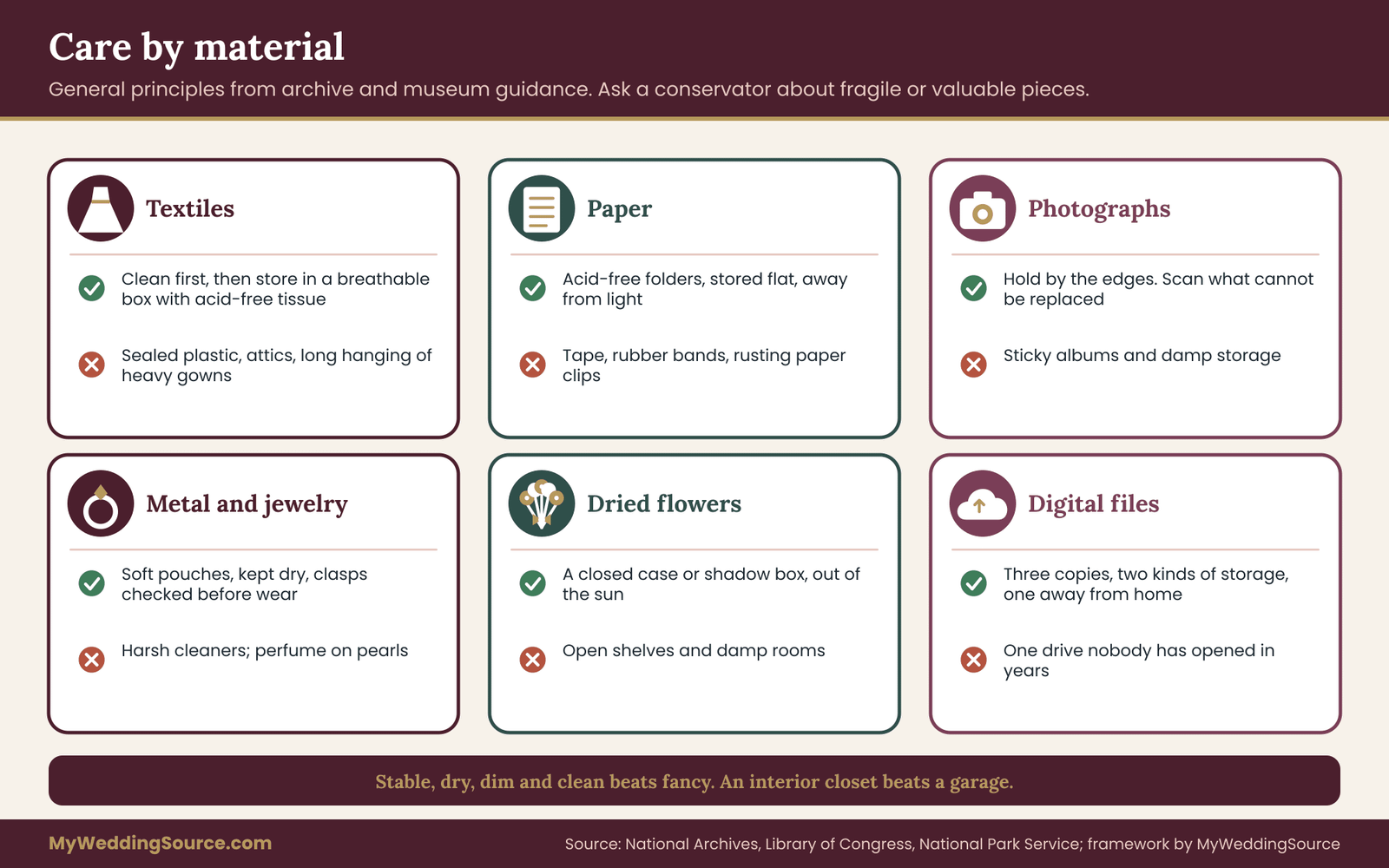
Textiles: dresses, veils, linens, quilts. Dirt, sweat, makeup and food residue stay in fabric and darken over time, sometimes after the dress looks clean. Cleaning before long storage is therefore often recommended, preferably by someone who has experience with wedding gowns or antique textiles. Avoid sealing a dress in a plastic bag or an airtight window box without advice, because trapped moisture and off-gassing from some plastics can harm fabric.
Acid-free tissue and a clean, breathable box are the usual alternatives. Heavy beaded gowns generally do better lying flat in a box than hanging, because the weight strains the shoulders. If you are planning alterations to a dress you hope to keep, read our guide to wedding dress fit and alterations first, because decisions made at the fitting often decide how the dress can be preserved later.
Paper: invitations, letters, guest books, licenses. Paper fades in light and weakens with acid and damp. Store flat in acid-free folders or boxes, away from sunlight. Avoid rubber bands, paper clips that rust, adhesive tape and self-stick photo albums, which are the usual sources of stains years later. A signed guest book is best kept closed and flat, not standing on a shelf where the spine bears weight.
Photographs and film. Handle by the edges. Keep prints out of sticky albums. Scan the ones you cannot replace, and treat the scan as a second copy, not a replacement. The portraits you plan with a wedding family photo list will become keepsakes themselves, so decide early which family holds the prints and which holds the files. For digital files, the Library of Congress personal archiving pages suggest a simple routine: gather the files, organize them, keep several copies in different places and check them from time to time.
Metal and jewelry. Store pieces separately in soft pouches so they do not scratch each other. Keep them dry. Avoid cleaning with harsh chemicals, particularly on pieces with old stones, pearls, enamel or unusual settings. Pearls and some other materials react badly to perfume, lotion and hairspray, so many jewelers recommend putting them on last and taking them off first. Have a jeweler check prongs and clasps before any long wearing session, because heirloom settings can be worn thin.
Dried and pressed flowers. A preserved bouquet is fragile. Keep it in a closed case or shadow box away from sun and damp. Accept that color will change. If the bouquet matters to someone, photographing it well is a reasonable form of preservation.
Digital keepsakes. Name files clearly, include dates, and keep at least three copies on at least two kinds of storage with one copy away from home. Our guide to backing up photo galleries and other files explains the same idea for photo galleries, and it applies equally to scanned letters and recorded toasts.
Use or preserve: a decision rule
Families often argue about whether keepsakes should be used. A simple rule helps. Ask what would be lost if the item were damaged. If the answer is “a nice object we could replace,” use it. If the answer is “the only physical link to a person we loved,” preserve it, and make a copy or a photograph for use. If the answer is somewhere in between, such as a christening gown that every baby in the family has worn, decide the use policy together, write it down and agree that the next wear will begin with a condition check.
This rule has a useful side effect: it gives people with different feelings a shared test instead of a debate. The relative who says “it should be worn” and the relative who says “it should be preserved” are both applying the same test and reaching different answers because the loss they imagine is different. Once that is visible, the conversation becomes about the object, and not about who loved the person more.
When a professional is worth it
A conservator, a jeweler or a textile specialist costs money when you care for keepsakes. It is worth paying when an item is fragile, old, valuable or irreplaceable, when someone intends to alter it, or when a family dispute can be defused by a neutral expert’s written condition note. It is usually not worth paying for a modern program or a mass-produced topper. If budget is a concern, our wedding budget guide explains how to set aside a small after-the-wedding line, since preservation and cleaning costs tend to be overlooked until the week they are needed.
Common preservation mistakes
Most mistakes with keepsakes are small. Keeping the dress in the garment bag the shop provided, which is designed for carrying, not for years of storage. Storing the keepsake box on a basement floor because there is room there. Taping a precious letter to a page. Placing a framed invitation across from a south-facing window. Cleaning a pearl necklace with a household product. Having an antique ring resized without a condition note. Lending one of the keepsakes for an event and not recording the return. None of these is a moral failing, and each is cheap to avoid once you know about it.
Dividing keepsakes between two families
Once the cards exist, the hard question is the allocation. Two families, a handful of keepsakes, and a feeling that whatever you decide will signal how much you value each side. The most common mistake is to treat this as a fairness problem and try to balance the count. Two families rarely care about the same keepsakes, and a tidy five-for-five split can leave both feeling shortchanged because the items that mattered were not the items that got divided evenly.
A better approach is to divide by connection, care and capacity, in that order.
The three tests
Connection. Who has the strongest tie to this specific object? A veil that was made by the groom’s late grandmother has a clear home. A christening gown worn by every baby on the bride’s side belongs with that line. When the tie is obvious and one-sided, that settles it. When both sides claim a tie, move on to the next test.
Care. Who can look after it properly? This means space, stable conditions, a plan for the object when the keeper travels, and a willingness to follow the preservation preferences on the card. A relative with a safe, a dry closet and a long-standing home is often a better keeper than a relative who moves every two years, regardless of who loved the person more.
Capacity. Who will actually use it, display it or pass it on? An heirloom that sits in a drawer forever is kept in a technical sense and ignored in every other. If a relative will wear the necklace to family occasions and the other will leave it in a box, that is a real consideration, provided the relative who would leave it in a box is not disadvantaged unfairly by the way the question is framed.
Run each contested item among the keepsakes through the three tests, write down which test decided it, and move on. The record of the reasoning is more valuable than the result, because it lets people accept an outcome they did not choose.
Five ways to share a single one of the keepsakes
Sometimes the right answer is not “this family gets it.” There are five common structures, and many items fit more than one.
Split by line. Each family keeps what came from its own side. The groom’s family keeps the objects that came down through the groom’s grandparents, the bride’s family keeps the objects from hers. It is simple, easy to explain and easy to defend. Its weakness is that it can leave one family holding more valuable objects than the other, and it does not work for items the couple acquired together.
Original and copy. One household keeps the original, and the other receives a high-quality copy: a framed photograph, a scan, a replica or a printed reproduction. For paper and photographs this works well. For jewelry it can work when a jeweler can make a faithful reproduction, though some families find a replica feels hollow. It is most useful when two families both feel strongly about a single object that cannot be divided.
Rotation. The item moves between households on a schedule: every year, every five years, or at specific milestones such as a baby’s birth or a milestone anniversary. Rotation sounds fair and can be warm when the families are close and live near each other. It has real costs. Every move is a risk of damage or loss, shipping across the country adds expense and insurance questions, and the schedule needs someone to run it. Use rotation for items that travel well and that both families truly want to hold.
Shared display or shared access. The item lives in one place, but the other family has defined access. The couple keeps the family Bible, and the other side may borrow it for a family reunion, with a short written loan record each time. This works when one household is a clear best keeper and the other primarily wants to be able to see and use the item at important moments.
Named succession. The item stays with one keeper now, and the card names who comes next, with a trigger such as “when the keeper turns eighty,” “when the couple has a child who asks,” or “on the death of the current owner.” This gives the other family a clear expectation and a place in line, which often calms disputes more than any immediate sharing would.

Matching the structure to the keepsake
Choose the structure for your keepsakes by asking what happens to the object if it is moved, copied or divided. A set of silver spoons can be split. A single locket cannot. A quilt could be cut, but cutting it destroys the thing both families want. A photograph can be copied without any loss at all. The more the object resists division, the more likely the right answer is original and copy, rotation or named succession.
For keepsakes that come in sets, resist the urge to split purely by count. A set of eight dessert spoons divided four and four may leave neither family able to host a dinner with them. A fair split might keep the set together with one family and give the other family the matching serving spoon, a photograph of the full set and a named place in line for the whole set.
When two items compete for the same person’s heart
Occasionally one of the keepsakes matters in two directions at once. Both grandmothers wore the same style of ring. The couple can only wear one. Here the solution is rarely about the objects. It is about naming what each represents and finding a way to honor both: wearing one at the ceremony and the other on the first anniversary, or displaying both in a shadow box, or asking each family which part of the ritual matters most. Ask first, and you may find that the objects are interchangeable and the acknowledgment is what counts.
Fairness is about process, not tallies
If one family ends up with more keepsakes, that is not automatically unfair. Families can accept an uneven result when they can see that the same process was applied to both sides. That means the same three tests, the same card format, the same chance to be heard and the same written record. It also means that the couple does not quietly favor their own parents. If you are the partner whose parents are most involved, make an extra effort to be generous in tone toward the other family, since they will be watching for signs of imbalance.
For a gentle view of what families commonly expect from one another around weddings, our guide to wedding etiquette covers the social norms that sit under many of these conversations, including how to handle family expectations without escalating them.
What to say to relatives about keepsakes
The cards and the structures for keepsakes are useful only if you can bring them to the people involved. This is where couples stall, because a conversation about keepsakes is also a conversation about love, loss and aging parents. A few scripts and principles make it easier.
Principles before scripts
Ask before assuming. Many family disputes about keepsakes are built on assumptions that were never checked. “We thought it was ours” and “we thought it was on loan” are both common, and both are cured by one clear question.
Talk about the object, not the person. “I want to make sure the brooch is cared for the way you would want” lands differently from “I want to know what you are planning to do with the brooch.”
Meet separately, then together if needed. Begin with each family on its own, because people speak more freely when the other side is not present. Only gather the families together if a joint conversation is necessary, and prepare each side beforehand.
Offer a small, concrete next step. A vague request for “a family conversation” is easy to avoid. “Could we spend twenty minutes on Sunday going through five objects?” is easy to say yes to.
Do not hurry an elderly or grieving relative. If a relative is unwell, newly bereaved or emotional, begin with listening and leave the decisions for a later visit. The cards can wait. A relationship harmed by pushing cannot be fixed with a card.
Scripts you can adapt
To open the subject with a relative who owns an heirloom you have been using:
“We love having Grandma’s locket, and we want to be sure we’re looking after it the way you’d like. Could we write down who it belongs to, who keeps it, and what you’d want us to do if circumstances change?”
To clarify an unclear gift:
“When you gave us the quilt at the rehearsal dinner, we weren’t sure whether you meant it as a gift or as something to look after for the family. Which did you intend? Either answer is fine, we just want to get it right.”
To raise the question of what happens next:
“When the time comes, who would you like to have it? We’re asking because we’d like to put it on a card so that nobody has to guess.”
To respond when a relative asks for an item back:
“Of course. Can we agree on a date, and could we take a photograph of it first? We’d love to keep a copy of it for our wall.”
To decline a request without damaging the relationship:
“We know how much this means to you. We’re not ready to change where it lives, but we’d like to make sure you can see it and hold it whenever you want. Could we set up a regular visit and a written note about where it will go next?”
To propose a copy to a family that is feeling left out:
“We can’t divide the original, but we would love to have a good copy made so that both families have something on display. Would you like to choose the format?”
Handling the answer you did not want
Sometimes a relative’s preference about keepsakes conflicts with yours. The temptation is to argue the merits right away. Instead, thank them for being clear, say you will think about it, and take a day. Compare their preference to the three tests and the five structures. Often the apparent conflict dissolves once you see that the relative cares about one specific thing, such as being able to wear the ring at a grandchild’s wedding, and that other terms are negotiable.
If the conflict does not dissolve, write down what each side wants and why, and consider whether a neutral person could help, such as a trusted aunt, a family friend or, for valuable items, an attorney or a mediator. A neutral person does not need to decide. A neutral person can simply make sure each side hears the other without interruption.
Keep the couple united
Partners sometimes find that their own opinions about keepsakes differ from their parents’. Settle those differences between the two of you first. A couple that arrives with a unified draft is far more persuasive than one that quarrels in front of relatives. If one partner has more at stake emotionally, let that partner lead the conversation with their own family, and let the other partner lead with theirs. People hear difficult messages better from their own child.
Writing the keepsakes agreement
By now you have a list of keepsakes, a set of custody cards and a draft allocation. The last step in the process is to put the result in one place, in words that every family member can read. We will call it the family memo. It is not a contract in the ordinary sense. It is a plain record of what everyone understood on a particular date, signed or acknowledged by the people involved, and kept with the rest of your papers.
What a family memo can and cannot do
Be honest about its limits, because keepsakes sometimes carry real value. A one-page memo about wedding keepsakes is a record of intent and a communication tool. It reduces misunderstanding, gives later generations something to read and shows that the arrangement was made openly. It is not a will, it does not by itself transfer ownership of valuable property, and it may not bind a person who did not sign it or a court that reaches a different conclusion on the facts.
Whether an item counts as one partner’s separate property or as marital property can depend on state law, on how the item was acquired and on what has happened to it since. In many places a gift or an inheritance received by one spouse is treated differently from property bought during the marriage, but the details vary, and an item that has been mixed into shared use, resold or retitled can change status.
Those are questions for a family-law or estate attorney in your state, not for a family memo. If an item has meaningful monetary value, or if you expect a dispute, ask an attorney whether the memo should be backed by a will, a trust, a formal gift document or a loan agreement.
What the memo does well is handle the ordinary middle: keepsakes of sentimental and modest financial value, in families who want to avoid an argument. For that purpose, a clear, signed, dated page is more useful than nothing, and usually more useful than a long document that nobody reads.
The eight parts of a good memo
Keep the memo to one or two pages. Each part can be a short paragraph or a short list.
1. Who and when. The names of the people involved and the date. Include both partners, the relatives who are owners or keepers of the listed items, and the date the memo was written.
2. Purpose. One sentence in plain words, such as “This note records who owns, keeps and cares for certain wedding and family keepsakes, so that the families have the same understanding.”
3. The list. The keepsakes, each with its status (gift, loan, family property, shared, personal), the owner and the keeper. This is the custody card information in short form. You can attach the cards or list items by name.
4. Care instructions. A line or two on how each item is to be kept, used and displayed, drawn from the preservation preferences. If an item must not be altered or worn, say so.
5. Next in line. The expected successor for each item, with any condition. Be clear whether this is a promise or a hope. “Intended to go to” is gentler than “will go to” and is often more honest.
6. Access and loans. How relatives may see, borrow or photograph an item, and how a loan is recorded. A short sentence like “Any loan will be confirmed by message, with a return date” prevents misunderstandings.
7. Changes and disputes. What happens if circumstances change, such as a move, a separation or a death. Include a simple process: “We will talk first, ask a neutral family member to help if needed, and review the memo.” Do not try to write for every possibility.
8. Review. The date of the next review and who will start it.
A short model in plain language
Here is an illustration of the tone, shown as a brief excerpt rather than a complete form. The names are invented.
“This note was written on the date below by Elena Moreno, Sam Whitfield, and Dolores Moreno. The gold locket is owned by Dolores and is kept by Elena and Sam, who will wear it for family occasions and have the chain checked before each wear. If Dolores wishes to have it returned, Elena and Sam will return it within thirty days. The family intends the locket to go next to Sam’s sister, Joan, unless Dolores decides otherwise. We will review this note on our first anniversary.”
The excerpt avoids legal language on purpose. It states the status, the owner, the keeper, the care and the succession, the return arrangement and the review date, and it does so in a few sentences that anyone in the family could understand.
Who signs, and how copies are kept
For a plain family memo, a signature or a short written acknowledgment from each owner is enough. An email or text saying “I have read this and agree” can serve for relatives who live far away, though a signed page is better for an item that matters a great deal. Each family keeps a copy. If you keep the household archive described in our guide on wedding records and retention, file the memo in the same place as your marriage certificate copies and your insurance papers, and note the location in the index so a trusted person can find it.
Avoid asking people to sign under pressure, such as at a family dinner. A signature obtained in an awkward moment can feel like coercion later. Send the draft ahead, let people read it alone and give them time to ask questions.
Memo for a loan versus memo for a gift
A loan needs more detail than a gift. If one of the keepsakes is lent, record the owner, the keeper, the date lent, the expected return date or event, the condition at the time and who pays for any repair or insurance during the loan. A loan record can be a short message exchange, provided it states those points.
A gift is often better acknowledged with a thank-you note that describes the gift plainly: “Thank you for the quilt, which we understand is now ours to keep.” Gentle, specific wording in a thank-you note can serve as a record without feeling formal. Some families add a note about the giver’s wishes for the object’s future, without turning it into a condition.
What the memo should avoid
Do not list values in dollars unless you have a professional appraisal, because a guessed value can start a different argument. Do not include punishments or clawback clauses, which turn a family document into an adversarial one. Do not name a successor for an item that is not yours to decide about. Do not promise something to one child that you may need to reconsider. And do not use the memo to settle a dispute that has not been discussed in person.
Keeping the memo alive
A memo that is signed and forgotten decays, and the keepsakes drift back into confusion. Put the review date on a calendar. After each life event, such as a birth, a move, a death, an illness or a change in who lives where, reread the memo and update it. When an item changes hands, update the card and the memo and give the new version to everyone who has a copy. Mark old versions as replaced rather than deleting them, since the history can matter if a question arises later.
When to bring in an attorney
An attorney is worth consulting about keepsakes when an item is valuable enough that its loss would matter financially, when more than one relative has claimed ownership, when an owner is elderly and wants the item to pass in a specific way, when family members live in different states or countries, or when a marriage is ending.
A licensed attorney can say whether a gift needs a formal document, how a will should refer to the item, and how property rules in your state treat items received before or during the marriage. A basic consultation is often less expensive than a dispute, and the memo you have already written will make the conversation shorter.
For gifts of significant value, the Internal Revenue Service explains the federal gift tax rules, including that they generally apply to the giver and that most gifts do not produce a tax. The thresholds and filing rules are updated by the agency, so ask a tax professional about the current ones rather than relying on a figure in an article.
A last word on tone
A memo about keepsakes should feel like a kindness, not a defense. Read it aloud before you share it. If it sounds like something a family member would say across a kitchen table, it is probably right. If it sounds like something a lawyer would say to another lawyer, simplify it or have a lawyer write the part that needs to be formal and keep the family memo for everything else.
Storage, insurance and travel for keepsakes
A written agreement settles who keeps an item. It does nothing for the item if the closet floods, the box is left in a rental truck or the necklace is sent by regular mail with no tracking. This section covers the practical side of holding keepsakes between two households, including the situations in which they travel.
Choosing a place to keep each item
Aim for a spot that is stable more than perfect. Agencies that care for collections give consistent public advice: avoid the extremes of heat, cold, damp and light, and avoid places with a history of leaks or pests. For a typical home that usually means an interior closet or a dresser, rather than an attic, a basement, a garage or a shelf beside a heating vent or an exterior wall.
Give each of the keepsakes a container that fits it. A dress needs a box large enough that it is not crushed. Letters need a flat acid-free box. Jewelry needs a lined case or soft pouches. Label the outside of each container with the item and a card number, not with a description that would tell a thief what is inside. Keep the label simple: “Keepsake box 3, textiles.”
If the keeper is a relative, ask where the item will actually live, not just who will hold it. A cheerful “we’ll keep it safe” can mean a closet or a garage, and the difference matters.
Keep two lists, in two places
One list is the card set and the memo. The second is a photographic record: clear photographs of each item from several angles, taken in good light, with a ruler or a coin for scale, plus close-ups of any marks, hallmarks, inscriptions, repairs or damage. Store the photographs with the cards, and keep a copy in a second location, such as a cloud account or with a trusted relative. If an item is later damaged, lost or disputed, the photographs establish what it was and what condition it was in.
Insurance: what to ask
Insurance for sentimental keepsakes works differently than people expect, so ask your insurer directly rather than assuming.
Does the policy cover this kind of item? Standard homeowners and renters policies often cover personal property, but they may put a limit on certain categories such as jewelry, silver or collectibles, and they may not cover loss in some circumstances, such as a piece that simply goes missing. Ask whether a separate schedule or rider is available for particular items and what the policy requires, such as an appraisal.
Whose policy covers an item held by someone who does not own it? A keeper’s policy may not cover property that belongs to someone else, or may cover it only up to a limit. If you are holding a relative’s heirloom, ask your insurer and tell the owner honestly what you find. An owner who assumed you were insuring a ring that your policy does not cover is a problem waiting to happen.
What is the value being insured? Insurers generally want a basis for value, and for jewelry or antiques that usually means a written appraisal from a qualified appraiser. Insurance replacement value and resale value are different numbers, and the same item can have both. Ask the appraiser which kind the document states, and plan to update the appraisal from time to time, since values and market conditions change.
What does the policy say about transit? An item that is insured at home may not be covered while shipped or carried abroad. Ask.
Our guide to working with wedding vendors and contracts explains how to read a contract carefully, and the same habit applies to an insurance schedule: read what is excluded, not only what is covered.
Shipping a keepsake
When one of the keepsakes has to move between households, treat it like a delivery that cannot be redone.
Use a carrier that provides tracking, declared value or insurance, and a signature on delivery. Read the carrier’s published rules for the item type, since some carriers limit or exclude jewelry, fragile objects or items above a stated value. The United States Postal Service publishes its own insurance and service rules, and private carriers publish theirs.
Pack more carefully than seems necessary. A box within a box, padding on all sides so the item cannot shift, no loose packing material that settles during transit, and a layer of paper or tissue so that no padding touches the surface directly. Photograph the item and its packaging before sealing, and photograph the receiving end when it is opened.
Send a short message with the tracking details, and ask the recipient to confirm arrival. For an item that cannot be replaced, consider hand delivery, or ask a trusted relative traveling in that direction to carry it.
Carrying keepsakes when you travel
Never pack an irreplaceable keepsake in checked baggage. Carry your keepsakes with you. Carry jewelry, papers and fragile items with you, and keep them in a bag that stays within reach. If you are crossing a border with an heirloom, read the relevant official guidance beforehand. United States Customs and Border Protection publishes information for travelers, and the rules at the destination country matter as much as the rules here.
A particular caution applies to older objects made with ivory, tortoiseshell, certain feathers, coral or other materials from protected species. Their import, export and sale can be restricted by law, even when an object has been in a family for generations. The United States Fish and Wildlife Service explains the rules and the permits that may apply. If an heirloom includes such materials and you plan to move it across a border or sell it, check first with the agency rather than assuming that family history is an exemption.
Moving house with keepsakes
Moves are one of the most common causes of lost and damaged keepsakes. A few habits help. Pack keepsakes yourself, label the boxes with a code, not with their contents, and ride with them or have them travel in your own vehicle. If professional movers are involved, ask in writing how they value items in their coverage and whether special items need to be declared in advance. Keep the cards and photographs with you, not in the truck.
Natural disasters and household emergencies
Fire, flood and theft are the three ways keepsakes are lost without anyone’s fault. You cannot prevent them, but you can reduce the damage. Keep the most irreplaceable and portable items together in one grab-and-go container, so they can be carried out in minutes. Keep scans and photographs in a second location. Keep the cards, the memo and the appraisal documents in more than one place. Read your policy’s rules about notification and documentation after a loss, since insurers usually require prompt notice and evidence.
Setting up the first year
Once the cards and the memo exist, give the year of keepsakes work a shape. People tend to start with enthusiasm and drift. A short schedule keeps the work finite and makes each step small.

First month. Do the inventory, assign statuses and write the first draft of the custody cards. Take photographs of every item that matters, and note the condition.
Months two and three. Hold the family conversations, one household at a time, with the draft cards in hand. Adjust the cards based on what you learn.
Months three to six. Write the family memo and send it for review. Check insurance and storage conditions for the highest-value items, and book an appraisal if one is needed.
Months six to twelve. Move items to proper storage, order archival boxes, arrange any repairs, and send copies of the memo to everyone named in it.
First anniversary. Review the memo and cards. Open the boxes, check the condition against your photographs, confirm with each owner that the arrangement still suits them, and update anything that has changed.
Every few years and after life events. Repeat a short review. After a birth, a move, a death, a serious illness or a separation, repeat it at once.
This schedule is deliberately plain. It fits around other newlywed tasks, such as the name-change process and the tax questions described in our wedding records guide, which are more urgent and have firmer deadlines than keepsakes. The keepsakes work can wait a few weeks, but it should not wait years, because the people who hold the stories are the ones who will not be able to tell them later.
The cost question
Looking after keepsakes costs time more than money. The cards are free. The memo is free. A few archival boxes and tissue cost modest amounts. The larger expenses are professional cleaning for a dress, a conservator’s work on something fragile, an appraisal and a shipping insurance premium. Decide in advance which items justify a paid service and set a limit for the year, so that the cost does not become a source of tension.
A small after-wedding line in your budget, sized to the items that matter, is usually enough. Do not buy expensive display cases for items that are better stored, and do not buy preservation kits whose claims you cannot check.
A worked example and the edge cases for two-family keepsakes
The following example is invented to show how the pieces fit together. Elena Moreno and Sam Whitfield married in the autumn. Elena’s family is close and lives nearby. Sam’s family is spread across three states, and his grandfather and his mother are the two people with the strongest attachment to family objects. Neither family has any legal dispute over the keepsakes, and nobody wants one. The couple still noticed that three relatives had said versions of “that will come to you” without any detail.
Step one: the list
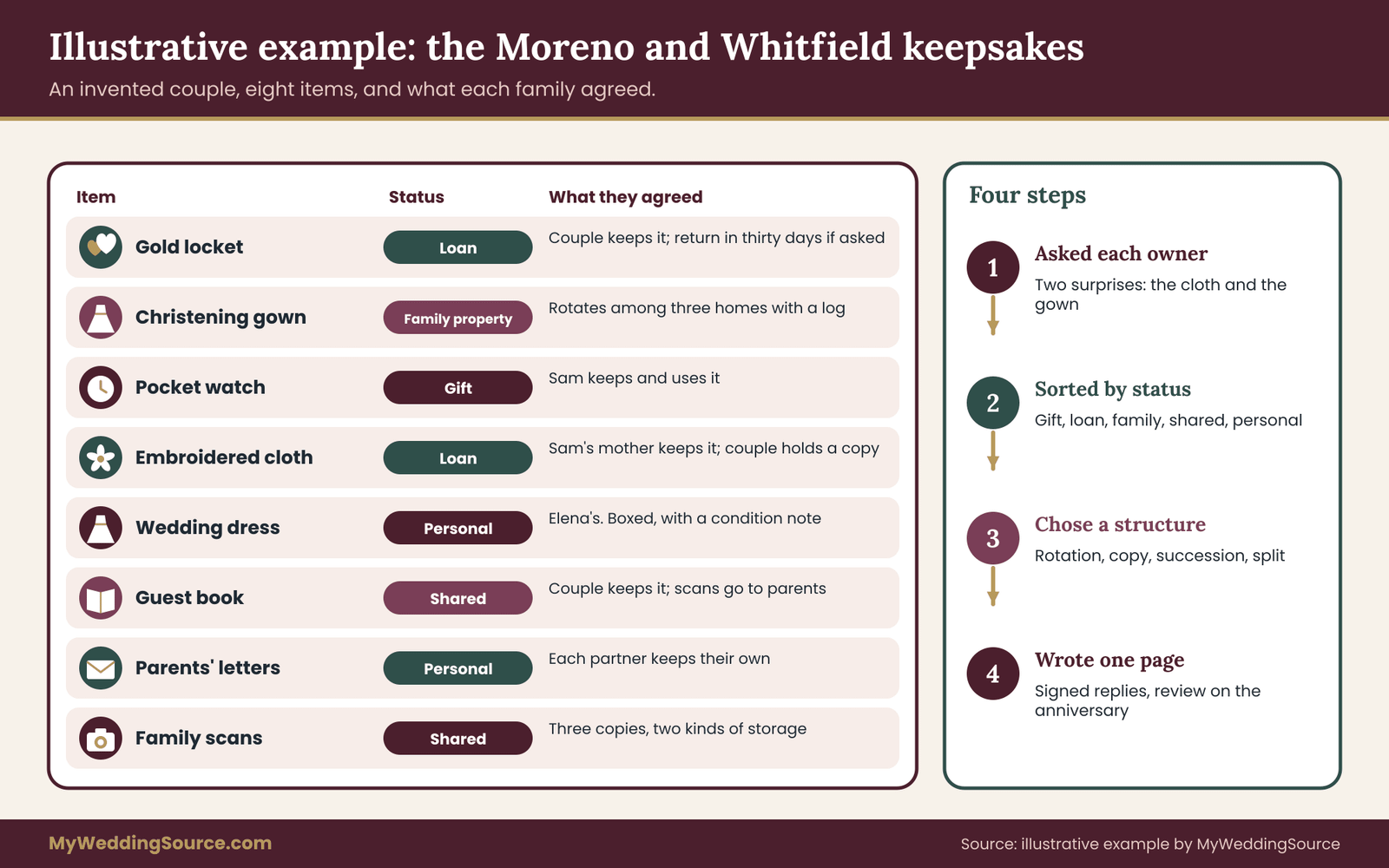
Elena and Sam walked through their home and then called their parents. They listed eight items: a gold locket belonging to Elena’s grandmother Dolores, a christening gown worn by three generations on Elena’s side, a pocket watch given to Sam by his grandfather, an embroidered cloth that Sam’s mother carried from her childhood home, Elena’s wedding dress, the signed guest book, a bundle of letters from both sets of parents, and a folder of scanned old family photographs that surfaced during the wedding.
Step two: the status of each item
They asked each owner what they had meant. The locket turned out to be a loan: Dolores wanted the couple to wear it but expected it to stay in the family. The christening gown was family property, and Elena’s mother wanted it to stay on that side. The pocket watch was a gift, given outright, and Sam’s grandfather said so with a smile.
The embroidered cloth was a family heirloom that Sam’s mother wanted to keep in the family but was happy to lend. The dress was personal property of Elena. The guest book was shared. The letters were personal to each partner. The scans were a shared digital set.
Two surprises came up. Sam had assumed the cloth was his to keep, and his mother had assumed it was on loan. The conversation took five minutes and ended with a laugh, but it would have caused months of quiet resentment if left alone. Elena had believed the christening gown was something she and Sam would use for their own child, and her mother had expected it to rotate among her three siblings’ households. That one took longer.
Step three: the three tests and a structure for each
For the locket, connection and capacity favored Elena and Sam, because Dolores wanted to see it worn, and care favored a dry, stable closet. They agreed a named succession, with Sam’s sister Joan as the first person to be asked, and a promise to return it within thirty days if Dolores asked. For the christening gown, the family agreed on rotation among the three households, with a condition check and a short log at each handover, and with a high-quality photograph set to the couple so they would have a record.
For the pocket watch, status was a gift, and the card simply recorded the care instructions.
The embroidered cloth was split by line and by copy: Sam’s mother kept the original, since she was its keeper and wanted to see it in her home, and a good photograph and a loan note gave the couple permission to borrow it for family occasions. The dress went into a box as a personal item with a note that Elena may alter or pass it on as she chooses.
The guest book stayed with the couple, flat in an archival box, with a scanned copy sent to both sets of parents. The letters stayed with each partner. The scans went into the couple’s digital archive with three copies.
Step four: the memo and the review
Elena wrote a one-page memo in plain language, sent it by email to each owner and asked for a reply saying “I have read this and it matches what we discussed.” Two replied within a day. Dolores asked for a paper copy, which she signed. The couple filed the memo with their marriage certificate copies and put the first anniversary on the calendar. When the anniversary came, they opened the boxes, compared the condition to their photographs, and updated the card for the christening gown after a baby arrived in another household.
What the example shows is that nothing in it was technically difficult. The effort was in asking, writing down and following up. The cards ensured that every conversation was about a specific item, and the memo made sure that what was agreed did not depend on one person’s memory.
Edge cases
Real families do not always cooperate with a clean process for keepsakes. These are the situations that most often complicate keepsakes between two households, with suggested approaches.
A relative who is ill or aging. Slow down. Listen more than you write. If the relative wants to settle things quickly, help them do it, but keep the record simple, and consider asking a family member who is not an interested party to be present. If capacity is a question, do not use the memo to obtain agreement. Speak to an attorney.
A death. If an owner dies, the keepsakes may fall under their will or under state rules for estates, which can override a family memo. Do not remove or redistribute items in the days after a death. Ask the executor, if there is one, how items that the owner had loaned or promised will be treated, and bring the memo and cards to that conversation. A written record of a loan is often what prevents a lent item from being treated as part of the estate by mistake.
A separation or divorce. Heirlooms and gifts that came from one partner’s family are often treated differently from items bought together, but state rules vary and an attorney should decide. Practically, the cards and the memo help by showing who owned and who kept each item. Do not rely on goodwill alone for valuable pieces, and do not take an item out of a shared home without the conversation the law requires.
A blended or step-family. Where a parent has remarried or a couple has children from earlier relationships, be explicit about whether an item belongs to the family line or to the current household. A stepparent may have given a gift in good faith while the biological relatives assume it is family property. Ask each person what they understood, and write the answer down.
Estranged relatives. If a relative with a claim is not in contact, do not make decisions on their behalf, and do not hide the existence of the item. Record the status as undetermined, keep the item safe, and ask an attorney if there is a serious question about ownership. If the relationship is strained but not broken, a brief neutral message offering a visit to see the item may be enough.
Cultural or religious items. Objects with ceremonial or religious significance may have rules about who may hold, display or handle them, or about what happens when the keeper dies. Ask the family or the relevant religious leader what is expected, rather than guessing. When a spouse from a different tradition is involved, name the difference early, because a respectful question prevents a hurt later.
Families in different countries. Add the shipping, customs and legal questions from the earlier section. Consider whether a copy, a photograph or a digital record serves the second household better than moving the original. Check the rules of both countries before sending anything valuable or made from protected materials.
A keepsake you do not want. Sometimes a gift or a loan lands on you and you do not want it, because of space, taste or the memories it carries. You do not have to keep everything. Say so kindly, offer to return it or to pass it to another relative who would care for it, and avoid quietly donating or discarding it, which can wound a giver who later asks after it.
An item that has been damaged or lost. Tell the owner promptly and plainly. Photograph the damage, avoid attempts to fix it yourself and ask whether they would like to arrange a repair. Check the insurance position. Early honesty almost always costs less than late discovery.
A couple without children. Next in line can be a niece, a nephew, a close friend or an institution such as a family historical society or museum. Write the intention down, and revisit it when circumstances change.
Signs that a family conversation needs help
If tempers are rising, if one person keeps changing their story, if people are threatening to withdraw items or relationships, or if an item with real financial value is at stake, stop and bring in help. A neutral relative, a mediator or an attorney can do what the cards cannot: take the emotion out of the room. Walking away from a heated conversation is not a failure, and the objects will be there tomorrow.
Your next steps
Choose one evening this week. List ten keepsakes, starting with the heirlooms and the items that carry the strongest feelings. Write a custody card for each, with the five lines, and mark anything unknown as “to confirm.” Then pick the two items with the most uncertain status and ask the people who know, using one of the scripts above.
Over the following weeks, take photographs of each item, move the fragile ones into proper storage, and write the one-page family memo. Put the first anniversary review on your calendar before you close the document. Done in small steps, sharing wedding keepsakes stops being a source of dread and becomes a quiet way of showing both families that their history has a place in your home.
FAQ
Who should keep family keepsakes after a wedding?
Usually the person who can care for it best, not the person who loves it most. Ask who has stable storage, who will use or display it as the owner wishes, and who is willing to follow written care instructions. Ownership can stay with the giver or the family line while a couple holds the item as keeper, and a card should record both facts.
Is a wedding gift from a relative automatically ours to keep?
Not always. A gift given outright is the recipient’s property, but relatives sometimes mean a loan or a custody arrangement without saying so. Ask what they intended, and record the answer in a thank-you note or a short message. If nobody can say, treat the item as family property with a provisional keeper and agree a date to review it.
Can a family keepsakes memo be legally binding?
A plain family memo is mainly a record of understanding. It may help show intent, but it is not a will, and it may not control how valuable property passes or how a court treats a dispute. For valuable items, an elderly owner or a family conflict, ask an attorney in your state whether a will, trust or gift document is also needed.
How do we divide keepsakes that cannot be split?
Use a structure other than splitting. One family keeps the original and the other receives a copy or a photograph, the item rotates between households on a schedule, the other family gets defined access, or the card names a successor. Choose by asking what each family truly wants: to hold it, to see it, to use it, or to know it is safe.
How should we store a wedding dress as a keepsake?
Many conservators and archives suggest cleaning it before long storage, then keeping it in a clean, breathable box with acid-free tissue, in a stable interior space away from light and damp. Avoid sealed plastic and attics or basements. If the dress is old or fragile, a textile conservator can give advice specific to its fabric and condition.
Do wedding keepsakes need separate insurance?
Often, yes, if they have real value. Standard home policies may limit coverage for jewelry, silver or collectibles, and an item you hold for someone else may not be covered at all. Ask your insurer what is covered, what an appraisal must show and whether coverage applies in transit. Insurance terms vary, so confirm them in writing.
What if a relative wants an item back?
If it was a loan, return it by the agreed date, after photographing it and noting its condition. If you believed it was a gift, ask calmly what the relative remembers, share your own recollection and avoid arguing about who is right. Where the item has real value or the disagreement continues, an attorney or a neutral relative can help.
How often should we review our keepsakes arrangements?
Review on your first anniversary, then every few years, and straight after a major event such as a birth, a move, an illness, a death or a separation. Each review can be short: check the condition against your photographs, confirm each owner is content, and update the cards and the memo if anything changed.
Sources
- How to get a copy of a marriage certificate or a marriage license, USAGov
- Preservation, National Archives and Records Administration
- Personal archiving: preserving your digital memories, Library of Congress
- Caring for your collections, Library of Congress Preservation
- Conserve O Gram preservation notes, National Park Service Museum Management Program
- American Institute for Conservation
- Frequently asked questions on gift taxes, Internal Revenue Service
- U.S. Fish and Wildlife Service
- Travel, U.S. Customs and Border Protection
- United States Postal Service