
How to get a marriage license comes down to one local office, one set of documents, and two clocks: a waiting period before the license works and an expiration date after which it stops working.
Most couples assume the license is a quick errand that happens the week before the wedding, and in some places it nearly is. In others, a three-day wait, a 30-day expiration window, or an appointment calendar that fills up in peak season can turn that errand into a scheduling problem. The good news is that the process has the same basic shape almost everywhere. You apply together, show identification, pay a fee, receive the license, hold the ceremony inside its validity window, and make sure the signed license gets back to the office that issued it. The details inside each of those steps are set locally, which is why a friend’s advice from another state can be confidently wrong for you.
This guide walks the whole path in order, from choosing the issuing office to ordering certified copies, and it uses real examples from official state and county pages to show how far the rules can drift. Those examples are there to show you the range, not to tell you what your own county requires. The U.S. had 2,041,926 marriages in 2023, a rate of 6.1 per 1,000 people, according to the CDC, and every one of them depended on a piece of paper from a local government office. If you want the deeper question of how to double-check what you were told, our marriage license verification guide covers it, and the difference between the license and the document you receive afterward is explained in marriage license vs. marriage certificate.
The shape of the process: seven steps that stay the same everywhere
What every jurisdiction has in common
Why the sequence matters more than any single rule
Think of the license as a relay race with a handoff at every step. You hand your documents to the clerk, the clerk hands you a license, you hand the license to your officiant, and the officiant hands it back to the clerk. A dropped baton at any of those points is what causes real trouble, and it is rarely the fee or the form that goes wrong. It is usually a timing mismatch: a license that was picked up too early and expired, or a signed license that sat in a bag for a month. Knowing the sequence lets you ask the right question at each handoff instead of discovering the rule after the fact.
What a license does and does not do
A license is permission to marry, and a certificate is the record that the marriage happened. USA.gov describes it the same way: the license allows you to wed, and the certificate proves it. A license does not by itself make you married, and a ceremony without a valid license generally does not either. Religious ceremonies, symbolic ceremonies, and celebrations are separate from the legal step, so some couples handle the paperwork at a clerk’s office on a weekday and hold the larger celebration weeks or months later. If you plan to do that, you still need to track the license’s expiration window against the legal ceremony date, not against the party.
What changes from place to place
Who sets the rules
States write the marriage laws, and counties, cities, or towns carry them out. That is why a statute might set a 72-hour waiting period while the county clerk’s website explains which ID you need, what the fee is, and whether you must book an appointment. Venues and officiants can add their own preferences on top, such as asking for a copy of the license before the rehearsal, but those are policies, not law. When you hear a rule, ask which of the three layers it comes from, because only the first two can actually stop a license from being issued.
Why two neighboring offices can still differ
Even inside one state, local practice shows up in the price and the procedure. The Travis County, Texas clerk lists an $80 license fee, or $20 with a qualifying premarital course, while Fort Bend County lists $71, or $11 with the course. Both counties follow the same state waiting-period and validity rules, yet their return instructions, application tools, and ID guides are their own. In California, Siskiyou County lists a $71 public license, while Napa County lists $83. The lesson is simple: the state-level summary tells you the rough shape, and the county page tells you what you will actually pay and do.
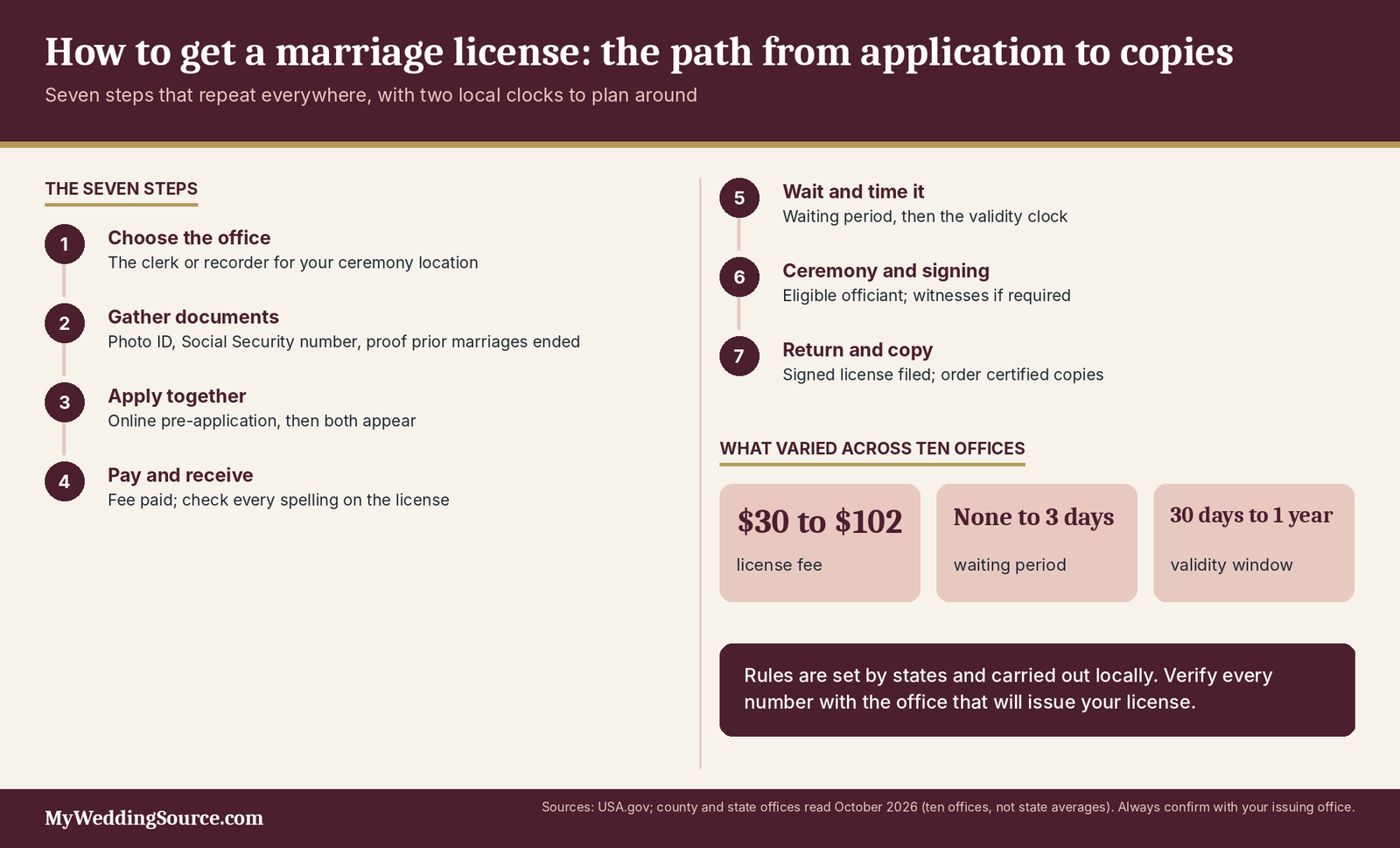
| Step | What happens | Question to ask the office |
|---|---|---|
| 1. Choose the office | You identify the clerk or recorder that issues licenses for your ceremony location | Is this the right office for the place we are marrying? |
| 2. Gather documents | Photo ID, Social Security numbers, proof that prior marriages ended | Which exact documents, and are copies accepted? |
| 3. Apply | Online pre-application, then both of you appear, often by appointment | Do we both need to be present, and can we book a time? |
| 4. Pay and receive | Fee paid, license issued or printed | Which payment methods, and what extra fees apply? |
| 5. Wait and time it | A waiting period may apply, then a validity clock starts | When is the earliest and the latest ceremony date? |
| 6. Ceremony and signing | Authorized officiant, any required witnesses, signatures | Who can officiate, and who signs? |
| 7. Return and copies | Officiant or couple returns the license, then you order certified copies | Who returns it, by when, and how do we get copies? |
Step one: find the right office and read its rules like a checklist
Finding the office that issues your license
Start with where the ceremony will happen
In most cases, the license comes from an office tied to the place you will marry, not the place you live. USA.gov advises contacting the vital records office in the state where you plan to marry, and in practice that usually points you to a county clerk, recorder, or similar office. The license often works anywhere within the issuing state, though not always. Placer County, California says its license is good anywhere in California, and a New York town clerk page says the ceremony can take place anywhere in New York State. Hawaii goes the other direction: its health department says the license is valid only in Hawaii. If your ceremony location is flexible, ask whether the license is tied to a county or to the whole state.
Use official sources, not look-alike sites
Search results for this topic are crowded with third-party sites that charge service fees to “help” with an application that the county handles directly. Some are legitimate convenience services and some are simply expensive middlemen, and it can be hard to tell the difference from a search snippet. A reliable habit is to start from a .gov address. The CDC’s Where to Write for Vital Records page sends you to the correct state or area, and the federal government says on that page that it does not distribute certificates, files, or indexes for vital records. From the state page, follow links down to the county or city office that actually issues licenses.
Reading the office’s page like a checklist
The six facts to pull from every page
Each county page is different, but you can read all of them with the same six questions. First, what ID and documents are required? Second, what is the fee and how can you pay it? Third, is there a waiting period? Fourth, how long is the license valid, and how are the days counted? Fifth, who can perform the ceremony and are witnesses required? Sixth, who returns the license, and by what deadline? Copy the answers into one note with the date you read them, because pages get updated and you will want to know which version you relied on.
What to do when the page is silent
Official pages do not always answer all six questions, and that gap is itself useful information. Among the offices reviewed for this article, Napa County’s FAQ did not state a deadline for returning the signed license, Hawaii’s page did not say how to return it, and Placer County’s page did not list the license fee itself. None of that means the information does not exist, only that it lives somewhere else, such as a printed form, the officiant instructions, or a phone call. When a page is silent on a deadline or a fee, call or email the office and save the answer in writing. A date like “within 10 days” matters too much to leave to memory or to a message from a friend.
Step two: documents, ID, and the application itself
What you will likely be asked for
Photo ID and proof of age
Every office reviewed asks for government-issued photo identification, but the fine print differs. Clark County, Nevada requires original, government-issued photo ID and says digital or photocopied documents are not accepted. Douglas County, Colorado accepts a driver’s license, passport, or military ID, and lists a birth certificate as proof of age. Hawaii requires a certified birth certificate for applicants under 19. The practical takeaway is to bring originals, not photos on a phone, and to check that the name on your ID is the name you want printed on the license.
Social Security numbers
Many offices ask for a Social Security number, but they handle it differently, which is why it deserves its own check. Clark County requires U.S. citizens who have been issued a number to provide it, Fort Bend County asks for it if you have one, and Douglas County asks for the last four digits and offers an affidavit if you do not have one. Miami-Dade County says non-citizens without a number may offer an alien registration card, a U.S. driver’s license or ID, or a passport number. If one of you does not have a number, ask what the office accepts before the appointment, not at the counter.
Proof that a prior marriage has ended
If either of you has been married before, expect questions about when and how that marriage ended. Clark County asks you to count prior marriages, including annulments, in the application. Siskiyou County asks for the final date of any previous marriage and paperwork if it ended within the prior 12 months, and Hawaii asks for the certified decree or death certificate if the divorce or death was less than 30 days before pickup. Texas has its own rule: Fort Bend County describes a 30-day wait after a divorce is final, unless it is waived or the former spouse is the other applicant. Bring a certified copy of the decree or certificate even when the page seems relaxed about it, since the clerk decides at the counter.
Applying: pre-applications, appointments, and both of you in the room
The online pre-application
A growing number of offices ask you to start online and bring a confirmation number to the counter. Douglas County has you complete the online application, write down the transaction number, and then book an appointment. Clark County stores the pre-application for one year, and Hawaii has you complete the online application, pay the fee, and then meet an agent within 30 days before the ceremony. The pre-application saves time at the counter, but it is not the license. In most places it does not start any waiting period or validity clock, so there is no harm in doing it early and real value in doing it before you take time off work.
Both applicants, usually in person
Most offices expect both of you to appear together, though how “together” works is changing. Clark County says you both have to be there in person at the same time, with narrow exceptions for hospitalized or incarcerated applicants, and Hawaii states that proxies are not allowed. Dauphin County, Pennsylvania uses a video conference in which both applicants must be present, though they may join from separate locations. Where one partner cannot attend, offices such as Douglas County and Fort Bend County describe an absentee affidavit or absentee process. Ask about the exception early, since it often takes extra paperwork.
Getting names and details exactly right
The license is a legal record, and what you type on the application usually becomes what is printed on it. Clark County says the name on the license matches the ID exactly, and it allows application mistakes to be fixed at the bureau when you pick up the license. Fixing an error after the license is recorded is a different and slower process, so treat the application like a tax form rather than a guest list. Read the final printout before you leave the counter, check each spelling and date of birth, and ask whether the name you want to use after the wedding is separate from what appears on the license.
| Document | Why it is requested | What the sampled offices said |
|---|---|---|
| Government photo ID | Confirms identity and age | Originals only in Clark County; birth certificate as age proof in Colorado and Hawaii |
| Social Security number | Records and data matching | Required if issued in Clark County; last four digits in Colorado; alternatives in Miami-Dade |
| Decree or death certificate | Shows a prior marriage has ended | Required or requested in Pennsylvania, Hawaii (recent endings), and California (within 12 months) |
| Online confirmation number | Links your pre-application to the visit | Used in Colorado, Hawaii, Florida, and Nevada |
| Premarital course certificate | Reduces fee or waives wait | Texas and Florida offices describe fee and wait effects |
What a marriage license actually costs
The license fee: your sticker price
What ten official pages listed
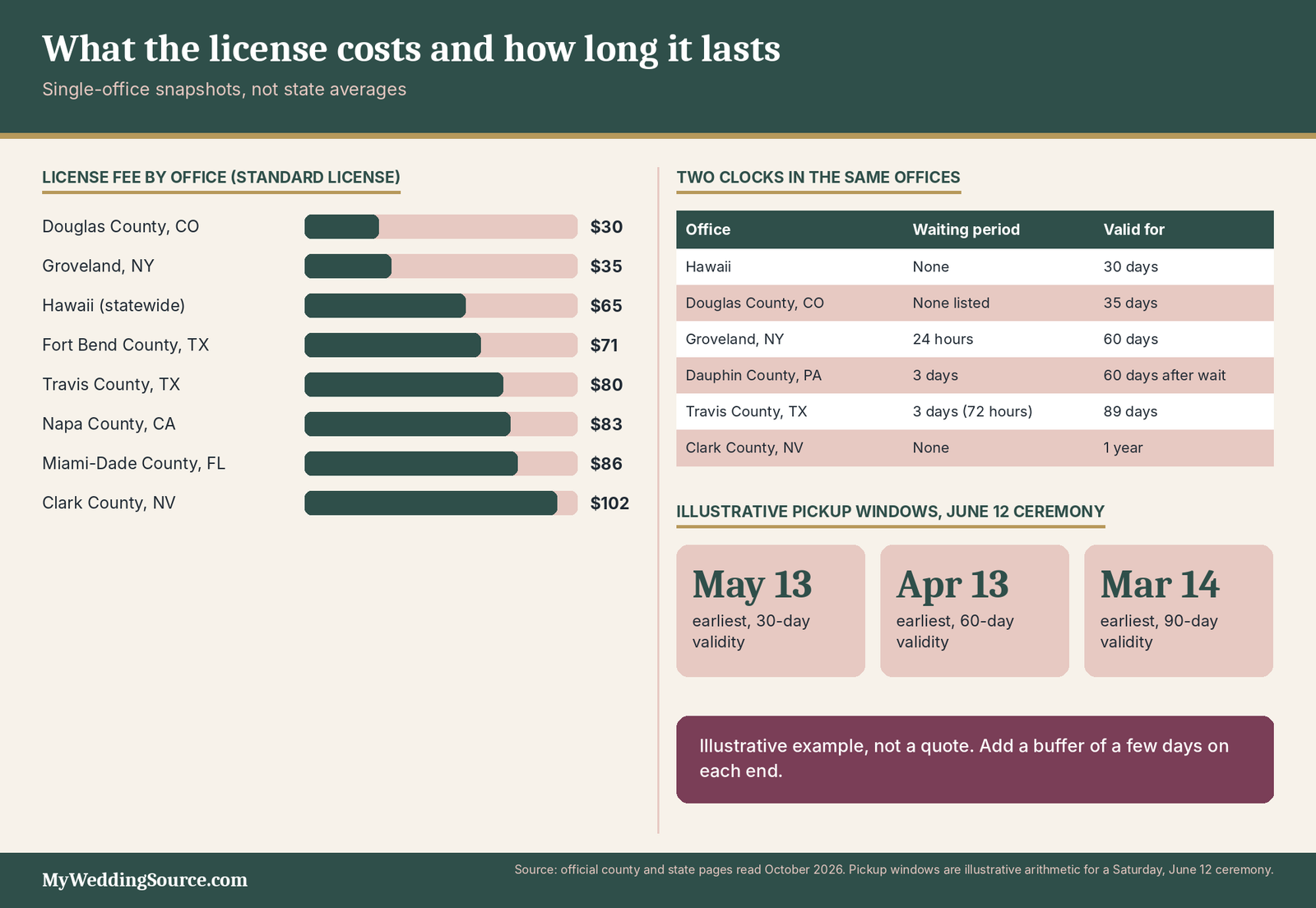
The range is wide, and the price is not a proxy for quality or speed. The least expensive fee in the sample was $30 in Douglas County, Colorado, and the highest was $102 in Clark County, Nevada. Between them sat Hawaii at $65 (a $60 application fee plus a $5 portal fee), a New York town clerk at $35, and several counties in the $70s and $80s. These are single-office snapshots read in October 2026, not state averages, and your office may differ even if it is in the same state.
Premarital course discounts
Some states tie a course certificate to a lower fee. Travis County lists $20 instead of $80 when couples present a completed Texas premarital education certificate, and Fort Bend County lists $11 instead of $71. Florida’s Miami-Dade Clerk lists $61 instead of $86 with a course, and Hernando County lists the same $86 and $61 pair. The course is not free and not instant, since the Miami-Dade page requires at least four hours from a registered provider completed within one year before applying, so compare the course cost to the fee reduction before assuming it saves money. Where the course also waives a waiting period, the time savings may matter more than the dollars.
| Office | License fee | Course or other note | Certified copy |
|---|---|---|---|
| Douglas County, CO | $30 | Card payments carry a vendor fee | Not stated on page |
| Groveland, NY (town clerk) | $35 | Cash, check, or money order | $10 |
| Hawaii (statewide) | $65 | $60 application plus $5 portal fee | Not stated on page |
| Siskiyou County, CA | $71 public; $79 confidential | Cash or money order preferred | $17 confidential |
| Fort Bend County, TX | $71 | $11 with approved course | Available after filing |
| Travis County, TX | $80 | $20 with approved course | Not stated on page |
| Dauphin County, PA | $80 plus processing fee | Card fee 2.50% ($2 minimum) | Separate request form |
| Napa County, CA | $83 public; $95 confidential | Witness provided for $35 | Not stated on page |
| Miami-Dade County, FL | $86 | $61 with course | $9 or $7 (page lists both) |
| Clark County, NV | $102 | Card fee added; no checks | $20 |
The extras that sit on top
Convenience fees, witnesses, and deputized officiants
The line items that surprise couples are small individually. Douglas County says card payments carry a convenience fee from a third-party vendor, Dauphin County adds a processing fee, and Clark County adds a fee to card payments and does not accept checks. Napa County says its office can provide a witness for an additional $35, and Siskiyou County says a person over 18 can be deputized to perform one ceremony for $75. None of these are red flags, and each can be a genuine convenience. They are simply easier to plan for when you see them listed next to the base fee rather than discovering them at the window.
Certified copies and the failure costs
Certified copies are where the real total grows. Clark County lists $20 per copy, Placer County lists $19 for a public record and $24 for a confidential one, and Hernando County lists $3 for additional certified copies. Miami-Dade’s page lists $9 in one place and $7 in another, which is a good reminder to confirm the current amount by phone. Then there are failure costs: Douglas County says late returns incur a minimum $20 fee plus $5 per day, capped at $50, and a lapsed license means paying for a new one.
An illustrative example, not a quote: imagine a county that charges $80 for the license, $20 per certified copy, and a $3 card fee. A couple who orders three certified copies for name changes, benefits, and their own files would spend about $143. If the first license expired before the ceremony because the date moved, a second license would add another $80 or so, taking the total near $223. The point is not the exact number but the pattern: the license is the smaller part of the paperwork budget, and the avoidable cost is the second license.
Waiting periods and validity windows: building your timeline
Two clocks, not one
The waiting period: from none to a few days
A waiting period is a required gap between the moment the license is issued and the moment you may hold the ceremony. Among the offices reviewed, Clark County, Nevada says there is no waiting period, Hawaii says the ceremony can follow right after the license is issued, and Siskiyou County says there is no wait. New York’s town clerk page describes a 24-hour wait. Texas law bars a ceremony during the 72 hours after issuance, with exemptions that include active-duty military and a premarital course certificate, and Dauphin County, Pennsylvania describes a three-day wait. Florida adds another twist: residents face a three-day wait that a course certificate waives, while the Miami-Dade page says non-residents have no wait.
Validity: from 30 days to a year
The other clock starts at issuance and ends at expiration. USA.gov says expiration depends on the issuing state and ranges from 30 days to one year, and that if a license expires or is lost before the wedding you must apply for a new one. The sample bears that out: Hawaii requires the ceremony within 30 days of pickup, Douglas County within 35 days, New York and Florida within 60, Texas and California within 90, and Clark County gives one year. FindLaw’s state-by-state summary groups other states into the same ranges, but it is a secondary source, so use it to understand the spread and your county page to plan.
How the days are counted
The same “60 days” or “90 days” can mean slightly different things in practice. Travis County says a license is valid for 89 days from the date issued and expires if unused by the 90th day, while Fort Bend County says 90 days counting the purchase date. Dauphin County says the license expires 60 days after the three-day waiting period, which is a different starting line than a simple 60 days from issue. Hawaii phrases it as a ceremony within 30 days of picking up the license. Ask the office to confirm the last valid day in writing, and plan to be at least a few days inside it.
A backward-planning timeline
Working backward from the ceremony date
The reliable way to set a pickup date is to work backward from the ceremony using both clocks. Take the validity window and subtract it from the ceremony date to find your earliest safe pickup, and take the waiting period and subtract it to find your latest. The table below shows a Saturday, June 12 ceremony under three illustrative rule sets that mirror the shape of the Hawaii, New York, and Texas pages. The dates are illustrative arithmetic, not guidance for any specific office, and a buffer of a few days on each end protects you from counting errors and closed offices.
| Rule set (illustrative) | Earliest pickup | Latest pickup | Why the window is tight or loose |
|---|---|---|---|
| No wait, 30-day validity | About May 13 | June 12 (same day possible) | A short window means you cannot pick up months ahead |
| 24-hour wait, 60-day validity | About April 13 | June 11 | Loose, but a missed weekend can matter |
| 72-hour wait, 90-day validity | About March 14 | June 9 | Wide, but the waiting period eats the last days |
A planning timeline from twelve weeks out
Start with research and end with copies. About twelve weeks before the ceremony, identify the issuing office and read its page; at about eight weeks, confirm your officiant’s eligibility and gather documents; and at about four weeks, complete any pre-application and book the appointment. At the pickup date, check every detail on the printed license and put it somewhere safe. After the ceremony, confirm who returns it and when, then order certified copies once the record is filed.
| When | Task | Why it matters |
|---|---|---|
| 12 weeks out | Identify the issuing office; read fees, ID, wait, validity | Sets the earliest and latest pickup dates |
| 8 weeks out | Confirm officiant eligibility and any witness rules; gather originals | Avoids last-minute ID or decree problems |
| 4 weeks out | Complete the online pre-application; book the appointment | Appointment calendars fill in busy seasons |
| Pickup day | Both appear; check spellings, dates, and the printed expiration | Errors are cheapest to fix at the counter |
| Wedding day | Hand the license to the officiant; name who returns it | Prevents the unreturned-license problem |
| Within the deadline | Confirm the office received and recorded it | Starts the clock for certified copies |
What to do if the date moves
Dates move: venues close, weather changes the plan, and families reschedule. If the ceremony shifts after you have picked up the license, compare the new date to the expiration before you do anything else. If the new date falls outside the window, you will need a new license and a new fee, so it is worth asking whether the office offers any refund or credit. If you are still inside the window, keep the original, because a replacement for a lost license can take time and may not be possible before the ceremony.
The ceremony and the return: officiant, witnesses, and filing
Who can marry you, and who must be in the room
Officiant eligibility is a legal question
An officiant is not just a person who writes a good script. Many states restrict who can solemnize a marriage, and some require registration or a license. Texas Family Code section 2.202 lists categories of authorized officiants, such as ministers, priests, rabbis, religious officers, and certain judges. Hawaii says officiants must be licensed by the State of Hawaii before performing a marriage, and Clark County says the ceremony must be performed in Nevada by a Nevada-licensed officiant. Dauphin County links a disclaimer for couples who use an officiant not authorized under state law, noting that the couple bears the burden of proof if the marriage’s validity is later questioned.
Witnesses: required in some places, optional in others
Witness rules diverge sharply even among the sampled offices. Clark County’s marriage guidance says you need at least one witness other than the officiant, and Placer County says a public California license needs one witness while a confidential one needs none. Douglas County, Colorado says witnesses are not required, though they may sign if you wish. Napa County will provide a witness for a fee. Our guide on wedding witness requirements takes this topic further, and the short version is to ask your office, not to assume.
Self-solemnization and other unusual routes
Colorado is the example people hear about: Douglas County says couples can sign and record the license at the Recording office during their appointment, and describes that as legally binding as a religious or civil ceremony. That is a Colorado-specific path, and you should not assume your state has an equivalent. Some counties also offer civil ceremonies in the clerk’s office or let a deputized person perform one ceremony, as Siskiyou County describes. These options are useful for a courthouse wedding with a larger celebration later, but they come with their own fees and scheduling, so ask what the clerk’s office offers before you plan around it.
Getting the signed license back to the clerk
Return deadlines are short and different
The signed license has to go back, and the deadline is local. The Texas statute summary reviewed says the officiant returns it to the issuing county clerk no later than the 30th day after the ceremony. Miami-Dade says the officiant returns it within 10 days, Clark County says the officiant files within ten calendar days, and Placer County says 10 days. Douglas County allows 63 days. The range from 10 to 63 days is why one friend’s “just drop it off whenever” and another friend’s “it was due in a week” can both be accurate.
Who actually carries it
Never assume that someone else is doing it. In some counties the officiant is responsible, in others the couple can return it, and in some the clerk mails the license back to the address on the application after recording it. Fort Bend County says the officiant must return the license within 30 days, and that the recorded license goes back to the couple directly if one of them brings it in with ID. Decide before the ceremony who has the license after it is signed, who will confirm the return, and who contacts the clerk if it has not arrived. A coordinator or a trusted family member can take on that job.
What happens if it is late or lost
Late returns can cost money, and in some states they carry legal consequences. Douglas County charges a late fee, and the Texas statute summary describes failure to return the license as a misdemeanor for the person conducting the ceremony. The practical risk for couples is different: without a recorded license, you cannot order a certified marriage certificate, and everything downstream waits. If a license is lost after signing, call the issuing office immediately and ask about the process for a replacement or duplicate, since procedures vary.
| Task | Usually responsible | Deadline to confirm with your office |
|---|---|---|
| Hold the license safely until the ceremony | One named partner | Before the ceremony |
| Check the license is valid and unexpired | Both partners | Pickup day and the day before |
| Sign as officiant and complete the details | Officiant | At the ceremony |
| Sign as witness, if required | Witness | At the ceremony |
| Return the signed license | Officiant or couple, per local rule | 10 to 63 days in the offices reviewed |
| Confirm the record is filed | One named partner | Within a week or two of the deadline |
| Order certified copies | Either partner | After filing |
After the wedding: certified copies and the paperwork that depends on them
Ordering certified copies
Certified, informational, and why the difference matters
A certified copy carries an official seal or stamp from the office that holds the record, and agencies that update your identity usually want that version, not a photocopy of the signed license. Informational copies, where an office offers them, are usually labeled as not valid for identity purposes. When you order, read the product description before paying, because the cheaper option may be the wrong one. Our companion guide on marriage license vs. marriage certificate lays out the document differences, and the short version for this guide is that the record becomes available only after the signed license has been returned and recorded.
Where to order and how many to get
USA.gov says to contact the vital records office in the state where the wedding happened, which will tell you the fee, the information you need to provide, and whether you can order online, by mail, or in person. In many places the county that recorded the license also issues copies, which is why Clark County and Placer County list copy fees directly. If you married abroad, USA.gov points you to the embassy or consulate of that country. How many copies you need is a judgment call: count the agencies and institutions that will ask for proof, such as the Social Security Administration, the passport office, your employer’s benefits team, and any lender, and order enough so that none of them has to wait on another to return an original.
Name changes and other updates
Social Security first, and the 30-day wait
If one or both of you will change names, the Social Security Administration is usually the first stop because other agencies check against its records. SSA tells newlyweds to wait at least 30 days after the marriage before requesting a replacement card so the state can update its records. Couples married in one of 21 participating states may be able to apply online, and SSA says there is no charge and that it usually mails the card within 14 business days of completing the application. Elsewhere, you may need an appointment, and SSA’s name-change FAQ explains that you must show your identity, your new legal name, and the event that changed it. Because this step depends on the marriage record being filed, a late return can quietly delay it.
Passport and everything else
The State Department has its own rules. If your passport was issued within the past year, Form DS-5504 lets you update your name with a certified marriage certificate, and the page says there is no fee, with expedited processing at $60. After a year, you may need to renew by mail or apply in person. Beyond passports, the list typically includes your driver’s license, banks, employer, insurers, and voter registration. The sequence and the documents for each are covered in our guide to name change after marriage, so use it as the next stop after your certified copies arrive.
Special situations that change the plan
Marrying away from home
Another state, another set of rules
When your wedding is in a different state from where you live, the rules that apply are the ones where you marry, not where you live. That means a license from your home county will not help in most cases, and a license from the destination county may not travel back. Hawaii’s license is valid only in Hawaii, Clark County’s officiant must be licensed in Nevada, and California’s confidential license is described by Napa County as valid only for a ceremony in California. For a destination weekend, build the license appointment into your travel schedule and read our guide to destination wedding etiquette for guest-side considerations. Some offices let you pre-apply online from home, which can cut the time you need to spend at the counter.
Marrying in another country
Foreign weddings are governed by the other country’s law. The State Department says local laws govern, that U.S. embassy and consulate employees cannot perform marriages in foreign countries, and that requirements often include residency periods, age limits, proof that previous marriages ended, and translated and authenticated documents. Some countries ask for an affidavit of eligibility to marry, and the U.S. government cannot certify your marital status, though you may be able to provide a written statement. One option the State Department mentions is to marry legally in the U.S. and hold the destination ceremony abroad, which avoids foreign formalities. Start with the destination country’s marriage office or tourism bureau and the nearest U.S. embassy, and allow far more time than a domestic license requires.
Circumstances that add paperwork
Age, prior marriages, and court orders
Eighteen is the common adult threshold in the offices reviewed, but the exceptions differ. Douglas County says applicants aged 16 or 17 need a juvenile court order, an original state-issued birth certificate, and photo ID. Clark County says a 17-year-old resident needs a court order from a Nevada district judge, and Hawaii requires parental or guardian consent for minors. FindLaw’s summary says most states set the minimum age at 16 with parental consent, but state law on minors has been changing, so confirm the current rule directly. For prior marriages, the document you need is the final decree or death certificate, not the petition.
Same-sex couples and recognition
The license process is the same for same-sex and different-sex couples: you apply at the same office with the same documents. What the federal law adds is recognition. The Respect for Marriage Act, Public Law 117-228, enacted December 13, 2022, says that for federal purposes a person is considered married if the marriage between two individuals is valid in the state where it was entered into. It also bars state officials from refusing to recognize another state’s marriage records because of sex, race, ethnicity, or national origin. The act does not set local licensing procedure, so the issuing office remains your source for forms, fees, and timing.
Noncitizens, military service, and hard-to-schedule applicants
Real life complicates the in-person rule. Foreign-language documents may need certified translations, as Hawaii’s page notes for non-English decrees and certificates. Texas exempts active-duty service members from its 72-hour wait, and Clark County describes single-party exceptions for hospitalized or incarcerated applicants. Fort Bend County and Douglas County describe absentee processes when one applicant cannot attend. If you fit any of these situations, call the issuing office before you build the schedule around it, because exceptions are the part of the process most likely to need extra forms.
Your verification checklist: what to confirm with the issuing office
Questions to ask before you apply
Eligibility and documents
Start with whether you can apply the way you want to. Ask whether the office takes appointments or walk-ins, whether both of you must appear in person, and whether any exception exists if one of you cannot. Then confirm the documents: which photo IDs, whether a Social Security number is required, what proof a prior marriage requires, and whether originals or certified copies are needed. These questions matter because the answer decides whether the visit works on the first try. A short call before the appointment is cheaper than a second trip.
Fees and payment
Ask for the total in dollars and the accepted payment methods. Offices differ on cash, card, check, and money order, and several add convenience or processing fees. Ask whether a premarital course changes the fee or the waiting period, and if so, what documentation the course provider must give you. If you plan to order certified copies at the counter or later, ask the price per copy and how many you can buy at once. Write down the amount and the date you were told, since fee schedules do change.
Questions to ask before the ceremony
Timing, officiant, and witnesses
Confirm the waiting period, the expiration date, and how days are counted. Ask whether your chosen officiant qualifies under local rules, whether they need to register, and whether witnesses are required. If you are using a friend as an officiant, ask whether there is an online or in-person process that makes the person eligible, and how long it takes. Compare the answer against your ceremony date and your officiant’s availability, and build in a buffer. A one-day miss on either clock can cost you a second license.
Filing and copies
Ask who returns the license, where it must be returned, and how soon. Ask how you will know that the record has been recorded, and how long certified copies take after that. If the license is mailed back to you, ask which address is on file. Confirm the process for correcting an error on the record, because a misspelled name discovered during a name change can add weeks. Keep the answers in one document, with names and dates, so you can show what you were told if something goes wrong.
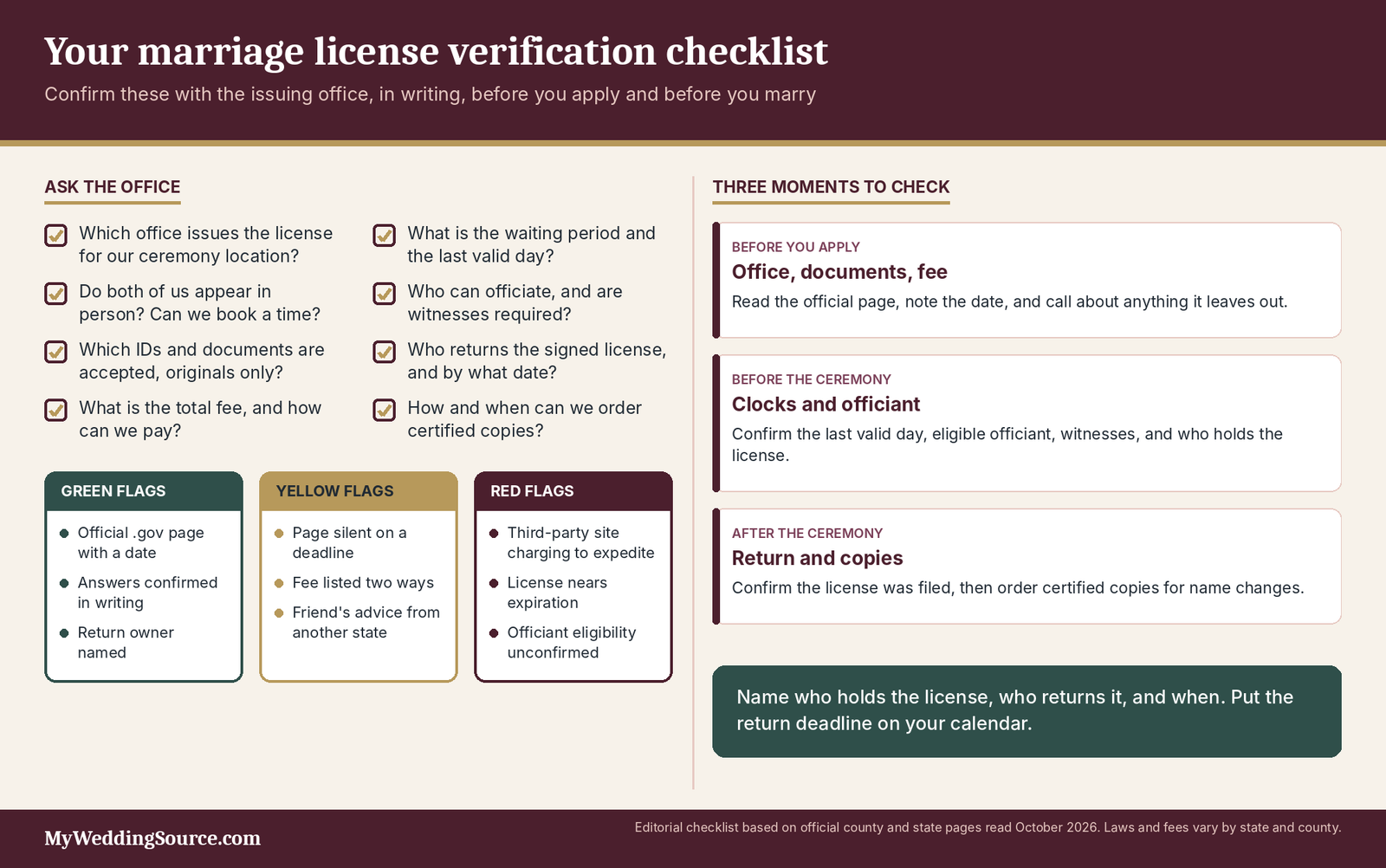
| Question | Why it matters | Where to confirm |
|---|---|---|
| Which office issues the license for our ceremony location? | Wrong office means a wasted trip | County or state .gov page; CDC Where to Write |
| Do both of us appear, and can we book a time? | Appointments and exceptions vary | Office website or phone |
| What documents and IDs are accepted? | Originals and name matches | Office checklist |
| What is the total fee and payment method? | Cash-only or surcharge surprises | Fee schedule page |
| What is the waiting period, and the last valid day? | Two clocks set your pickup window | Office page; ask in writing |
| Who may officiate, and are witnesses required? | An ineligible officiant risks validity | State law and office page |
| Who returns the license, and by when? | Late return delays certified copies | Officiant instructions; office |
| How and when do we get certified copies? | Name change and benefits depend on them | Issuing office or state vital records |
FAQ: marriage license questions couples ask
Before you apply
Do both of us have to be there when we apply?
In most of the offices reviewed, yes, but exceptions exist. Clark County says you both have to be there in person at the same time, with narrow exceptions, and Hawaii does not allow proxies. Dauphin County’s video conference allows applicants to join from separate locations. Where one partner truly cannot attend, Douglas County and Fort Bend County describe absentee affidavit or absentee application processes. Ask your office early, because an exception usually needs extra forms and sometimes a notary.
Can we apply in one state and marry in another?
Generally not. The license is issued under the law of the place that issues it, and offices describe where it can be used. Hawaii’s license is valid only in Hawaii, and Placer County’s license is good anywhere in California. A New York town clerk page says the ceremony can happen anywhere in New York State. Get the license in the state, and when relevant the county, where you will marry, and confirm the rule with that office.
Do we need witnesses at the ceremony?
It depends on where you marry and sometimes on the type of license. Clark County says one witness other than the officiant is needed, Placer County says a public California license needs one witness while a confidential license needs none, and Douglas County says Colorado witnesses are not required. The safest habit is to check your issuing office before you invite a witness or decide not to, since the answer can change with the license type, not just the state.
After the ceremony
How long until we can get a certified copy?
There is no single answer, because it depends on how quickly the signed license is returned, recorded, and made available for copies. Hernando County says the certificate and a certified copy are mailed within 30 days of the ceremony, while other offices let you order once the record is filed. Late returns slow everything down. Ask your office for its typical turnaround, and confirm the officiant has returned the license before you start the name-change process.
Can I use the license itself to change my name?
Usually not. Agencies generally want a certified copy of the recorded marriage certificate, not the license you carried to the ceremony. Douglas County notes that a recorded license is required before a name change and serves as the source document for most name-change processes, and SSA and the State Department describe their own document rules. Order certified copies once the record is available, then follow the sequence in our name change after marriage guide.
What if the license expires or gets lost before the wedding?
You generally have to apply for a new one. USA.gov states that if your license expires or is lost before the wedding, you must apply for a new one, which means another visit and another fee. If the license is lost, call the issuing office right away and ask whether a duplicate or replacement is possible. Do not wait until the week of the wedding to find out.
Your next steps
This week
Find your office and write down six facts
Open the official page for the office that will issue your license, using the CDC’s Where to Write page if you are unsure where to start. Write down the ID and documents, fee, waiting period, expiration, officiant and witness rules, and return deadline, plus the date you read them. If any of the six is missing, call or email and save the reply. This one page of notes becomes the backbone of your timeline and your budget for the license.
Put the two clocks on your calendar
Using your ceremony date, calculate the earliest and latest pickup dates and add a buffer of a few days. Book the appointment, if the office takes them, and complete any online pre-application. Add reminders for the pickup, the day before the ceremony, and the return deadline. If your wedding planning is still taking shape, our wedding planning guide and the wedding planning hub can help you place the license among your other deadlines.
Before you pick up the license
Assemble the document packet
Gather the originals your office asked for, including photo ID, birth certificate if requested, Social Security information, and any decree or death certificate. Check that the name on each document matches what you want printed on the license. Bring the confirmation number from your online application and the payment method the office accepts. Put everything in one folder, because a missing page is the most common reason for a second trip.
Name the person who returns the license
Before the ceremony, agree on who has the license after it is signed, who confirms with the officiant that it was returned, and who contacts the clerk if you hear nothing. Write the deadline on your calendar and the officiant’s phone number next to it. If you are marrying at a venue, share the plan with the person coordinating the day, and ask the venue whether staff will hold or mail the license for you; our wedding venues hub collects the questions worth asking a venue. Then order certified copies once the record is available, and keep one set of originals together with your other important papers.
Sources & methodology
- CDC National Center for Health Statistics: national marriage and divorce rates — 2023 marriage count and rate.
- CDC: Where to Write for Vital Records — how to find the state office for marriage records, and the federal statement that it does not distribute vital records.
- USA.gov: Marriage certificates — license versus certificate, 30-day to one-year expiration range, and ordering certified copies.
- Travis County Clerk, Texas — fee, course discount, waiting period, validity, and return.
- Fort Bend County, Texas — fee, ID, divorce wait, validity, and return.
- Texas Family Code, Chapter 2 — officiant categories, 72-hour wait, and return of the license.
- Clark County, Nevada: marriage license requirements and how to get married — fee, ID, no wait, one-year validity, witness, officiant, and filing.
- Douglas County, Colorado: marriage licenses — fee, 35-day validity, self-solemnization, and return window.
- Hawaii Department of Health: marriage licenses — fee, 30-day validity, agent process, and licensed officiants.
- Miami-Dade Clerk and Hernando County Clerk — Florida fee, course discount, wait, validity, and return.
- Dauphin County, Pennsylvania — fee, video appointment, three-day wait, and 60-day validity.
- Placer County, California, Napa County, and Siskiyou County — California public and confidential licenses, fees, witnesses, and validity.
- Town of Groveland, New York — fee, 24-hour wait, and 60-day validity.
- Social Security Administration: newlyweds and name change FAQ — 30-day wait, participating states, and documents.
- U.S. Department of State: passport name change and marrying abroad — Form DS-5504 and foreign marriage rules.
- Respect for Marriage Act, Public Law 117-228 — federal recognition provisions.
- FindLaw: marriage license requirements — secondary summary of waiting periods, expiration ranges, and age rules.
Methodology. Statistics from the CDC and statutory points are verified facts from the cited pages. Fees, ID rules, waiting periods, and return deadlines are official county or state page statements read in October 2026, and each describes one office, not a state average. The FindLaw material is a secondary survey summary used for context only. The timeline arithmetic, the cost example, and the checklist structure are editorial illustrations and judgments, not quotes or legal advice, and marriage law varies by state and county.
Freshness note. Recheck your own office’s fee, ID list, waiting period, expiration, and return deadline when you start planning and again a few days before pickup. County fee schedules and online application tools change, often at the start of a fiscal year. Revisit the Social Security participating-state list and passport form instructions before you start a name change.