
A postpartum wedding morning is a different schedule from the one most hair and makeup guides assume. It has to leave room for feedings or pumping, pain and fatigue, medication timing, food and water, and a baby who does not read the timeline. That is the real shape of a postpartum wedding morning. This guide gives you a recovery-aware worksheet for building that morning, a support delegation plan, one worked example, and the conditions that tell you to switch to a simpler plan.
Do not start with the artist’s availability. Start with your own anchors: the feeding or pumping times your baby and your body need, the medication and meal times your clinician has given you, and how long you can comfortably sit or stand. Place those on the page first, build the hair and makeup appointments around them, assign each support job to a named person, and write down in advance the specific signs that mean you drop to a smaller plan. The postpartum wedding morning works when the schedule bends before you do.
If you are getting married a few weeks or months after giving birth, you are probably already tired in a way that no wedding checklist anticipated. Your body may still be recovering, your sleep is broken into pieces, and a person who depends on you for food and comfort will be somewhere near the event. Meanwhile, the standard advice for the postpartum wedding morning says to arrive at the salon early, sit still for hours, and trust that everything will run on time.
That advice was not written for you. A postpartum wedding morning has fixed points that do not move for a photographer’s schedule, and some of them are unpredictable. This article is about building the postpartum wedding morning so that those points are protected rather than squeezed. Every decision below is a decision about how to protect the postpartum wedding morning, not how to decorate it.
A note on scope. This is general planning information, not medical, legal or financial advice. Decisions about your recovery, feeding, medication and activity belong to you and your own clinician, and the article points to that conversation rather than replacing it.
Why the postpartum wedding morning needs its own plan
A usual wedding morning is a production line. Hair first, makeup second, photographs of the getting-ready, the dress, then transportation. The artists have a standard block of time, the photographer has a window, and everyone shares one assumption: the person in the chair can stay in the chair.
Several things quietly break that assumption after a birth.
Feeding does not wait. If you are nursing, your baby eats on the baby’s schedule, with a pattern that may change week to week. If you pump, you have times when your body is ready and times when going without feels uncomfortable. If you formula-feed or combine methods, someone still has to prepare, warm and give the feeds. In each case the morning contains events that cannot be moved by an hour without consequences for somebody.
Recovery sets physical limits. Depending on how you gave birth and how you are healing, long periods of sitting, standing in heels, or holding a position for hair work may be uncomfortable or may be something your clinician has asked you to limit. You know your limits better than a wedding schedule does, and your clinician can tell you which ones are firm.
Sleep is fragmented. A morning that starts at five o’clock after a night of two or three wakings is not the same as an early start for someone who slept. Fatigue changes how you handle delays, noise and long hours of being looked at.
The baby is part of the room. Even with the best childcare, a baby near a beauty setup raises practical questions: where the baby sleeps, who holds them during the hair work, whether the products and heat tools are safe around them, and what happens when they cry at the wrong moment.
None of this means a postpartum wedding morning is a problem to be solved with more willpower. It means the schedule needs to be built from different inputs. The rest of this guide is about those inputs and how to arrange them.
What this article covers and what it does not
The broader topic of choosing artists, running trials and pricing a bridal hair and makeup booking is covered in the bridal hair and makeup planning guide. This article assumes you know that background, or will read it, and concentrates on one narrower task: assigning and timing the appointments for a person who is recovering from childbirth and caring for an infant on the day.
It also does not cover the ceremony itself, the childcare plan for the reception, or the wedding-day nursing space. Those are separate decisions that connect to the postpartum wedding morning but have their own logic. Here the question is only this: Here the question is only this, for the postpartum wedding morning: what does the morning look like, hour by hour, and who is responsible for which part?
The recovery-aware worksheet in five steps
The worksheet is the core of the method. It has five steps, and you complete them in order because each step produces the input for the next. You can do the whole thing in an evening with a pen and your calendar, and you can revise it as the date approaches.
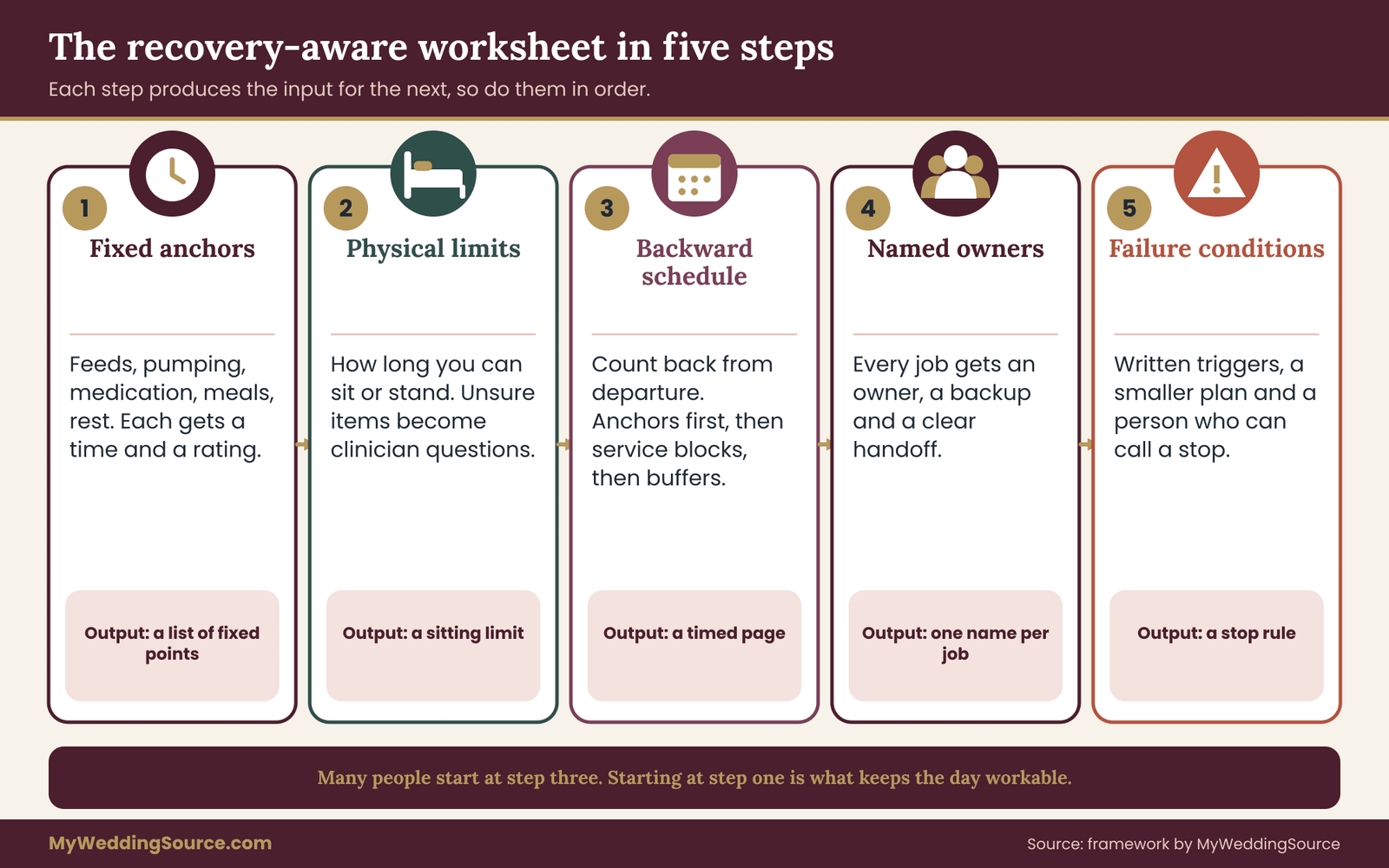
Step one: list the fixed anchors. These are the events in the postpartum wedding morning you cannot or should not move. Feeds or pumping sessions, medication times, meals, and anything your clinician has told you to do at certain intervals. Each anchor gets a time, a duration and a flexibility rating: firm, a window of about thirty minutes, or flexible.
Step two: set your physical limits. Write down how long you can sit without a break, how long you can stand, whether heels are realistic, and any position that causes discomfort. Where you are unsure, mark the item as a question for your clinician rather than guessing.
Step three: build the backward schedule. Start from the moment you must be dressed and ready, and work backward. Place the anchors first. Then fit hair and makeup into the gaps between them, in blocks no longer than your sitting limit. Add buffers. The section on the backward schedule shows the arithmetic.
Step four: assign every job to a named person. Each anchor and each logistical need gets an owner, a backup owner and a clear handoff. A morning with six well-meaning relatives and no assignments produces six people holding the same baby and nobody carrying the pump bag.
Step five: write the failure conditions. Decide now what signs mean you switch to a smaller plan, who makes that call, and what the smaller plan is. People make poor decisions about their own limits on the morning itself, which is exactly why this step happens in advance.
How the five steps fit together
The steps are deliberately sequential. Many people start with step three, because the artist’s availability feels like the hard constraint, and then try to fit their own needs into whatever is left. That order usually produces a schedule that looks efficient on paper and fails at the first delay.
Reversing it changes the conversation with your vendors. Instead of asking whether the artist can start at six, you ask whether the artist can work in three blocks of forty minutes with two breaks. That is a request about structure, and most professionals can answer it directly. If one cannot, you learn that before you sign.
A second reason for the order is that the worksheet is also a communication tool. When you hand your support people a one-page schedule with their names on it, you do not have to explain your needs again on the postpartum wedding morning. The page speaks for you at a moment when you may have little energy to speak. On a postpartum wedding morning, that saved effort is worth more than a perfect curl.
A word on expectations
The goal is not a perfect morning. The goal is a morning in which the important things happen, the unimportant things can slide, and nobody has to improvise about feeding or recovery. If your hair is finished twenty minutes late but your baby was fed calmly and you ate breakfast, the plan worked.
Keep that definition in mind as you read on. Almost every choice in this guide trades a little polish for a lot of reliability. Think of a postpartum wedding morning as a project with a few fixed points and a lot of give.
Talking with your clinician before you plan the postpartum wedding morning
Everything in the worksheet depends on facts that only your own clinician can give you. A planning article cannot tell you how long you can safely stand, whether your recovery allows an early start, or how your feeding and medication should be timed. The American College of Obstetricians and Gynecologists describes postpartum care as an ongoing process rather than a single visit, and that framing is useful here: the conversation about your wedding belongs in that ongoing care, not outside it. Your clinician is the best source for how the postpartum wedding morning should be shaped around your recovery.
Book the conversation early enough to act on the answers. If your wedding is within a few weeks of the birth, raise it at the first appointment you have. If it is months away, raise it at the visit closest to the date, and again once the final schedule exists, because plans that looked fine on paper sometimes need a second look. Bring the same questions to each visit, so the postpartum wedding morning is judged against your current recovery.
What to bring to the appointment
Bring the draft schedule, even if it is only a rough list of times. Clinicians answer concrete questions better than general ones. “Can I stand for the ceremony?” is hard to answer. “The ceremony is forty minutes, I would be standing for about twenty of them, and the morning includes about three hours of sitting for hair and makeup” is something they can respond to. Specific questions about the postpartum wedding morning get specific answers.
Also bring a list of everything you take or use, including prescriptions, supplements and any products you plan to apply on the day. Hair and makeup products are not usually a concern, but your clinician or pharmacist can say whether anything on your list needs attention.
Questions worth asking
Write the answers down, or ask your partner to, because postpartum memory is unreliable.
- How long can I sit or stand at one stretch, and are there positions I should avoid?
- Is there anything about the length of the day, travel, or heels that you want me to limit?
- If I take medication on a schedule, what times should I plan around, and what do I do if a dose falls during the ceremony?
- How should I handle feeding or pumping on a long day, and what signs of discomfort should make me stop and attend to it?
- What symptoms on the postpartum wedding morning should lead me to call you or seek urgent care instead of continuing the plan?
- Are there any concerns about heat, dehydration or skipped meals given how I am recovering?
- If I am nursing or pumping, is there anything about the products or treatments I am considering that you want me to check?
The last question connects to a practical resource. The National Library of Medicine maintains LactMed, a database about drugs and other substances and breastfeeding. It is a reference for you and your clinician to use together, not a replacement for the clinician’s judgment, and it covers medications more than cosmetics. For hair color, relaxers, keratin treatments or any service involving chemicals, the safest approach is to ask your clinician and tell your artist what they said.
Know the warning signs before the day
The Centers for Disease Control and Prevention runs a maternal warning signs campaign called Hear Her, and it lists urgent signs after birth that call for immediate medical attention. Read the current list on the CDC site before the wedding, and make sure your support person has seen it too. On a morning full of excitement and adrenaline, you might brush off a symptom that you would normally take seriously, and the person nearest you may be the one who notices.
State this plainly in the plan: if a warning sign appears, the wedding schedule stops being the priority, and the person named in the failure conditions makes the call. Nobody will think less of you for it, and the photographer will wait.
If you are struggling emotionally
A wedding after a birth can carry mixed feelings. Some people feel joy and exhaustion at the same time, some feel anxious about being watched, and some feel low in ways that deserve attention.
Postpartum Support International and the national maternal mental health hotline run by the Health Resources and Services Administration exist for exactly this. Your clinician is the first call, and these services are an additional route. Put the contact details in your phone and in the support plan, so that a bad hour has somewhere to go. A postpartum wedding morning is easier when the hard hour has a plan.
Turning the answers into inputs
After the appointment, convert what you heard into the worksheet’s first two steps. Medication times become anchors. Medication times become anchors on the postpartum wedding morning. A recommendation to limit prolonged standing becomes a physical limit. A recommendation you did not understand becomes a follow-up question, not a guess.
If your clinician says something that conflicts with a vendor’s preference, the clinician wins. A good vendor will adjust, and the section on contract terms explains how to check that before you commit.
Fixed anchors: feeding, pumping, medication, food and rest
Anchors are the events the postpartum wedding morning is built around. There are five common kinds, and each has its own planning logic. Treat the first four as non-negotiable unless your clinician says otherwise, and treat rest as the one you protect most carefully because it is the first thing everyone else’s schedule consumes. Each anchor shapes the postpartum wedding morning in a different way.
Feeding a baby on the postpartum wedding morning
If you nurse directly, the practical question is where the baby will be at the times they are likely to want to eat. Think in windows rather than exact times. Look back at the last two weeks of feeding patterns, and note the typical gaps. A baby who eats roughly every two to three hours gives you a predictable shape for the morning, even if the exact minutes move.
Place a feeding window just before the hair work begins, so that you start the longest sit with a comfortable body and a settled baby. Place another near the end of the makeup, so there is time to refresh makeup afterward. Then ask what happens if the baby wants to eat during a service. The artist should know this might happen, should be willing to pause, and should have a plan for the products and tools while you step away.
If someone else feeds the baby with a bottle, the same anchor exists for them. They need prepared milk or formula, clean equipment, a place to warm and give it, and a clear idea of how much to offer and when. Write those instructions down rather than leaving them in your head.
Pumping on the postpartum wedding morning
Pumping adds equipment. You need the pump, the parts, a clean place to sit, an outlet or charged battery, containers, a cooler or other storage, and a plan for cleaning the parts afterward. Your body also has expectations. If you usually pump at certain times, skipping a session can lead to discomfort, and the discomfort affects how well the day goes.
Plan pumping times as anchors, and build the privacy in. A pumping session needs perhaps twenty to thirty minutes including setup and cleanup, and you will want a room with a door. For storage and handling, follow the current guidance from the CDC on storing breast milk, and bring a cooler with ice packs, since the venue’s kitchen is not a place to leave it. U.S. federal law also addresses break time and private space for nursing employees, and the Department of Labor publishes the details, which matters if any of your hired vendors are also nursing parents.
Medication and symptom anchors
If you take medication on a schedule, put the times into the worksheet and attach the doses to a person. Your support person should know what you take, when, and what to do if a dose is missed, according to what your clinician told you. Keep the supplies in your own bag, not in a vendor’s room, and do not rely on remembering in the middle of a conversation. Set an alarm on a phone that someone else also hears.
Meals, water and snacks
The postpartum wedding morning has a known failure pattern: the person getting married skips breakfast because of nerves, forgets to drink because their hands are occupied, and arrives at the ceremony light-headed. After birth, and especially if you are nursing, the cost of skipping meals and water is higher.
Treat food as an anchor with a named delivery person. A real breakfast at a fixed time. A water bottle that stays within reach, with a straw if lipstick is a concern. A snack at the midpoint. Food that can be eaten with clean hands in a beauty chair, such as something that does not drip or crumble. If you have dietary needs or restrictions, ask the caterer or a relative to supply the meals rather than relying on the venue.
Rest as a scheduled item
Rest is rarely on the schedule because it feels like the absence of a task. Make it a block. Fifteen or twenty minutes lying down, with the door closed and a person guarding it, between the hair and makeup and the dressing, is often the most valuable item on the page. It also gives your face a break from being worked on and gives the baby’s caregiver a handoff window.
If you cannot sleep, lying down with your eyes closed still counts. The aim is to interrupt the sensation that the whole morning is one continuous performance.
Setting flexibility ratings
For each anchor, assign one of three ratings so that everyone reading the schedule knows how much it can move:
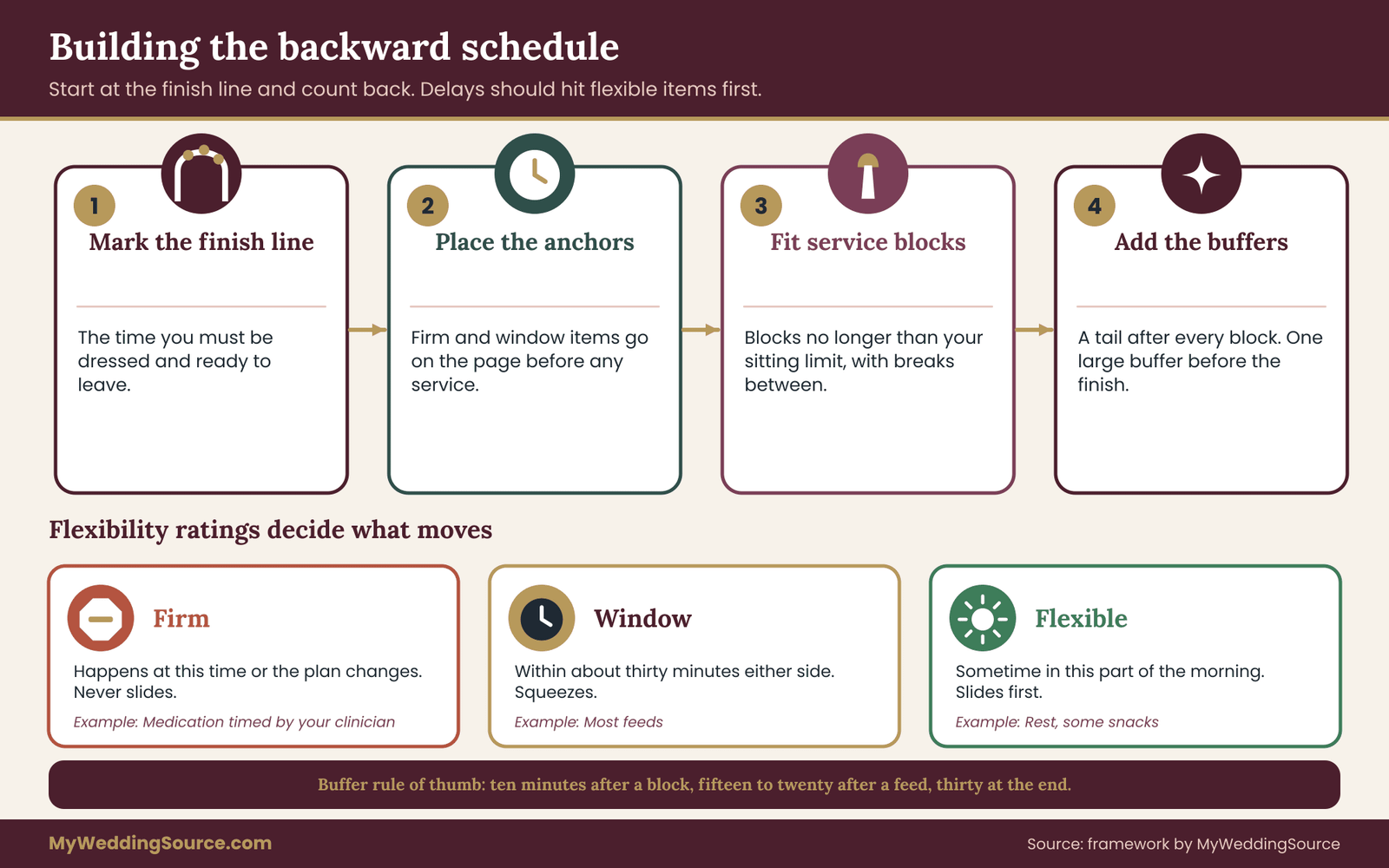
- Firm. It happens at this time or the plan changes. Medication timed by your clinician is usually in this group.
- Window. It happens within about thirty minutes either side. Most feeds fall here.
- Flexible. It happens sometime in this part of the postpartum wedding morning. Rest and some snacks sit here.
The ratings matter later, when the backward schedule meets its first delay. A delay should push flexible items, squeeze window items and never touch firm items. Without ratings, delays tend to eat whichever item has the least vocal advocate, and that is usually your meal or your rest.
Choosing hair and makeup services that fit a postpartum wedding morning
With the anchors and limits on paper, you can now decide what to book. The question is not which artist is best in the abstract. It is which service format lets you keep the anchors and stay within your limits, at a cost you accept. A format that suits one postpartum wedding morning may not suit another.
In-room artist, salon visit or hybrid
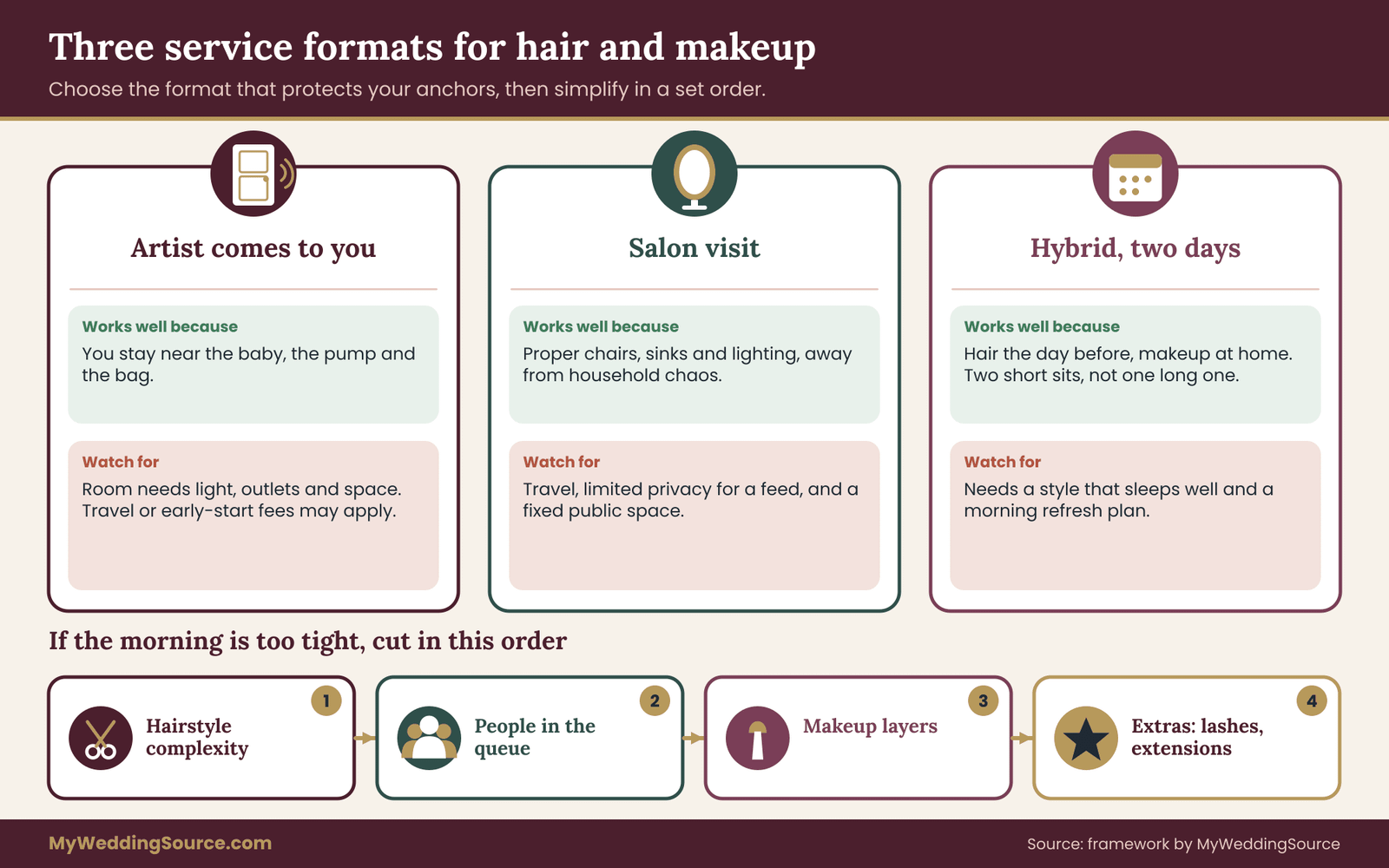
There are three basic formats, and each changes the shape of the postpartum wedding morning.
An artist who comes to you. The strongest advantage is that you stay where the baby, the pump and the bag already are. A feeding does not require packing up and moving. For a postpartum wedding morning the costs are practical: the room needs light, outlets and space, travel or early-start fees may apply, and a small space fills up quickly with the people supporting you. If you choose this route, read the venue’s rules on arrival times and equipment, and check the wedding vendor timeline so the artist’s arrival fits the load-in order.
A salon appointment. A salon gives you proper chairs, sinks and lighting, and it separates the beauty work from the household chaos. It also adds travel, a fixed public space with limited privacy, and the risk that a feeding or a pumping session happens in a place you did not choose. A salon can work well when your baby will be with a caregiver elsewhere and you have a reliable nursing or pumping arrangement nearby.
A hybrid. Some people have hair done at a salon the day before, in a calmer setting, and makeup done at home on the postpartum wedding morning, which shortens the morning’s longest sit. Others reverse it. The hybrid works because it splits one long block into two shorter ones on different days, which suits the sitting limit from step two. That is a common shape for a postpartum wedding morning.
Which service to simplify first
If the morning is too tight, you can reduce the load in a certain order. The goal is to cut what costs the most time and sitting for the least visible result.
- Hairstyle complexity. A long updo can take much longer than a half-up style or soft waves. Your own hair, and how much it has changed since you chose a style, may make the original plan unrealistic. Ask the artist for a version that holds for the day without a long pinning process.
- Number of people being styled. Every additional person in the schedule competes with you for the artist’s time and for your rest. Move others earlier or later, or to a second artist, so that you are not the last in line.
- Makeup layers. A skin-focused look with less layering is faster and often easier to keep comfortable over a long, emotional day.
- Extras. Lashes, adhesives and extensions can add time. Some also add questions about comfort and sensitivity.
Trial planning for someone who is recovering
A trial run is the best way to test timing, but it is also an appointment that costs energy. Schedule it as close to the real time of day as you can, because your skin, hair and energy are different at six in the morning than at two in the afternoon. If you can, hold the trial after most of your physical changes have settled, since faces and hair can look different from one month to the next after a birth.
During the trial, record three things: how long the service takes, how long you could comfortably sit, and how the style or look held up after several hours. Ask for photographs in natural light. Then adjust the plan from the data rather than from hope.
If the trial is difficult, treat that as useful information. It is a cheaper lesson than learning it on the wedding day.
Hair and skin may have changed since you chose the look
Many people notice that their hair, skin or body shape feels different in the months after a birth, and the look you chose before pregnancy may not suit how you are now. You do not need a medical explanation to act on it. Show the artist current photographs, not old ones, and let them see you in person before the trial if possible. If your dress changed because of the same transition, the wedding dress fit and alterations guide explains how to sequence fittings so the neckline and the hairstyle are chosen together.
Products, scents and the baby
Talk with the artist about products near an infant. Hairspray in a closed room is the obvious one, and heat tools, hot surfaces and loose pins are others. A baby asleep in a bassinet is not something to place in the spray zone. Ask for the baby to be in a separate, ventilated space during styling, or for aerosol products to be used outdoors or by a window, and for tools to be cooled and stored out of reach.
For cosmetics generally, the Food and Drug Administration publishes consumer information about cosmetic safety, and you can ask your artist which products they use and whether they will accept a patch test or a product swap if you prefer a fragrance-free option. If you are nursing or pumping, ask your clinician about any service involving chemicals, and share their answer with the artist.
Building the backward schedule
The backward schedule converts your anchors and limits into a timeline. It is simple arithmetic, but it has to be done in the right order, and it works best on paper or a shared document that everyone can see.
Start at the fixed point
Choose the moment by which you must be dressed, photographed and ready to travel or walk. This is the finish line. Count backward from it, and write each block with a start time, an end time and an owner. For a ceremony that begins in the afternoon, this point is usually the departure time or the first-look time, not the ceremony itself, because the photographer and the transportation need you before then.
Place the anchors
Put the firm and window anchors on the page first: medication, feeds, pumping, meals. Do not yet place any hair or makeup. This gives you a picture of the morning’s free spaces, and it often shows that the free space is smaller than you thought.
Fit the services into blocks
Divide the hair and makeup into blocks no longer than your sitting limit, with a break between them. A common pattern is three blocks: a first block for hair, a middle block for makeup, and a short final block for touch-ups and veil or accessory placement. Between blocks, place a feed, a walk, a snack or a rest. If your sitting limit is shorter, use more and shorter blocks and expect the services to take longer in total.
Ask the artist for realistic durations, not best-case ones. Then add the buffers.
The buffer rule
Add a buffer after every anchor and every service block. A workable rule of thumb is ten minutes after each block and fifteen or twenty after any feed or pumping session, because those can run long, and a baby who has just eaten often needs burping, a diaper change and a handoff. Then add one larger buffer, perhaps thirty minutes, before the finish line. The large buffer is what absorbs the surprise.
The exact numbers depend on your baby, your artist and your venue. The exact numbers for a postpartum wedding morning depend on your baby, your artist and your venue. The principle does not: every anchor gets a tail, and the schedule ends with slack rather than with a hard stop.
Check the total against your energy
Add up the hours from the first event to the finish line. Compare that to what your clinician said about the length of the day and to what you know about your own stamina. If the schedule asks you to be in action for five hours before the ceremony and you fade after three, remove items. Do not hope that adrenaline will carry you, because it is unreliable and it wears off exactly when you need to be steady. A postpartum wedding morning needs slack more than it needs speed.
Share a one-page version
Make a clean version for your support team, in large type, with names and times. Remove the explanations. Print two copies, keep one in your bag and give one to the person who runs the schedule on the day. A digital copy shared in a group message works as a backup, but a paper copy survives a dead phone and a loud room.
Support delegation: who does which job on the postpartum wedding morning
A schedule with no owners is a wish. Support delegation turns the schedule into assignments, and it is the part of the worksheet that most often gets skipped because everyone assumes helpful relatives will figure it out. Support is the load-bearing wall of a postpartum wedding morning. They will not, or rather they will figure it out in several different ways at once.
There is a second reason to be deliberate. After a birth, you are the person whose needs the postpartum wedding morning is built around, and you are also the person least able to coordinate it. Delegation protects your energy by moving the coordinating job off you. Delegation keeps the postpartum wedding morning from depending on your memory.
The seven jobs
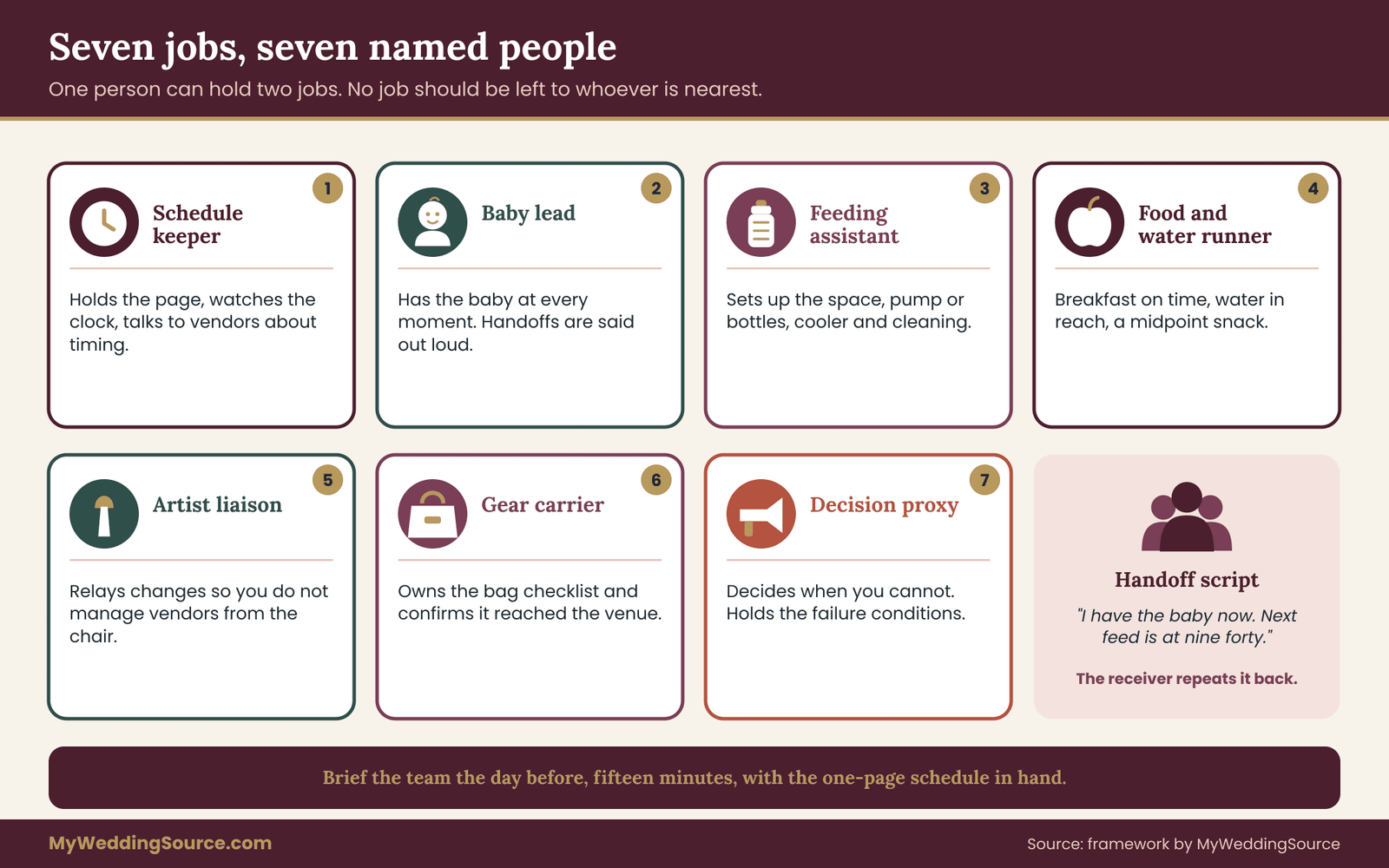
Most postpartum wedding mornings need the same seven jobs. One person can hold more than one, but each job needs a name, and the most demanding ones need a backup.
1. The schedule keeper. This person holds the one-page schedule, watches the clock and tells the artist and the photographer when a block starts and ends. They are the only person who talks to vendors about timing. Choose someone calm who is not also in the wedding party’s front line on the postpartum wedding morning, because a schedule keeper who is also a bridesmaid ends up holding a curling iron instead of a clock.
2. The baby lead. One person is responsible for the baby at any given time, and the handoff between baby leads is announced out loud. This is the cure for the common failure in which two people each assume the other has the baby. The baby lead holds the diaper bag, the feeding supplies and the instructions.
3. The feeding and pumping assistant. This person sets up the space, brings the pump or the bottles, handles the cooler, cleans the equipment and keeps track of timing against the anchors. If you nurse directly, their job is to bring the baby at the right time and to guard the door.
4. The food and water runner. They bring breakfast at the planned time, keep your water within reach and make sure you eat the midpoint snack. This sounds minor, and it is one of the highest-value jobs in the plan.
5. The artist liaison. One person tells the artists what has changed, relays your preferences, and speaks up if a service is running long. This stops you from managing the conversation from the chair.
6. The gear and logistics carrier. The pump bag, the diaper bag, the medication, the dress bag, the stroller or carrier, the spare outfit for the baby. This person owns a checklist and confirms that each item reached the venue.
7. The decision proxy. Someone you trust makes calls in your place when you are in a chair, in the middle of a feed, or too tired to decide. This is the person who also holds the failure conditions, and the next section covers that.
Choosing the people
Match jobs to people by temperament and by relationship, not only by who is closest to you.
- Choose a baby lead who is competent with infants and has handled your baby before. A beloved aunt who has never held an infant for more than a few minutes is better as a food runner.
- Choose a feeding assistant you are comfortable being unguarded around, since the job involves seeing you at your most practical.
- Choose a schedule keeper who can say no politely. That person will occasionally have to tell an artist or a photographer that time is up.
- Avoid assigning two critical jobs to someone who is also going to be emotional on the day. A parent of the couple is wonderful at emotional support and often overwhelmed as a logistics lead.
If some of your closest people will be in the wedding party, a family member or friend outside the party often makes a better schedule keeper or baby lead. A hired helper is another option, covered in the childcare planning in the wedding guest care planning guide, which explains how to vet and brief caregivers for babies and children at weddings.
Decision rights during the morning
A recurring source of conflict is who decides when the plan changes. Settle it in advance, in writing. The simplest structure has three layers.
- You decide about your body, your comfort and your feeding. Nobody overrules you on those.
- The decision proxy decides about the schedule when you are unavailable, within the failure conditions you wrote.
- The schedule keeper decides about timing swaps between vendors, within the buffers.
If you have not yet agreed on who has authority among the people closest to you, the wedding decision rights guide offers a way to share input without losing control. The same logic applies at the scale of one morning. The same logic applies on a postpartum wedding morning.
Scripts for handoffs
Handoffs fail on vague wording. Use short, explicit phrases, and agree on them ahead of time so people do not need to improvise.
“I have the baby now. Next feed is at nine forty. Bag is on the chair.”
“Handing off to you. Diaper changed at nine, last fed at seven thirty.”
The sentences are plain on purpose. The receiving person repeats the key facts back, and the giver confirms. It sounds formal for a family morning, but it only takes ten seconds and it ends the question of who has the baby.
Briefing the support team
Hold a short briefing the day before, in person or by call, for fifteen minutes. Walk through the one-page schedule, the seven jobs, the handoff script and the failure conditions. Show where the supplies are. Share the contact details of your clinician’s office and the other emergency numbers in a note, and make sure at least two people know where it is.
Ask each person what they need to do their job. The baby lead may want to know how the baby settles. The feeding assistant may want a demonstration of the pump parts. These questions take little time and prevent half the problems that appear on the day. Briefing is the cheapest insurance for a postpartum wedding morning.
What to ask of people who want to help but are not assigned
Some relatives will arrive early and want a job. This is useful if you have a clear answer ready. Keep a short list of low-stakes tasks, such as bringing water to the beauty room, steaming a garment, taking photographs of the getting-ready or carrying bags to the car. Offering a task to a willing relative keeps them out of the way of the critical jobs and lets them feel useful.
If someone insists on holding the baby without a job, the baby lead can include them as a second holder under the handoff script. The rule is that nobody holds the baby unless the lead knows who has them.
Paying for help
Some support jobs are worth paying for. A postpartum doula, a hired caregiver or a coordinator familiar with infants can take on the baby lead role, and in many families the cost is balanced against what a stressed, exhausted morning would cost. Ask for quotes before you decide, check references, and confirm the person’s experience with babies of your baby’s age. The decision belongs to you, and it does not need to be justified to anyone. Paid help is a legitimate part of a postpartum wedding morning plan.
Worked case: an invented postpartum wedding morning, hour by hour
The worksheet is easier to judge when you can see it filled in. The following case is invented for illustration. The people, the baby and every time are made up, and the sitting limit stands in for whatever your own clinician tells you. Use it as a pattern, not as a recommendation for your body. Think of it as one postpartum wedding morning laid out in full.
The setup
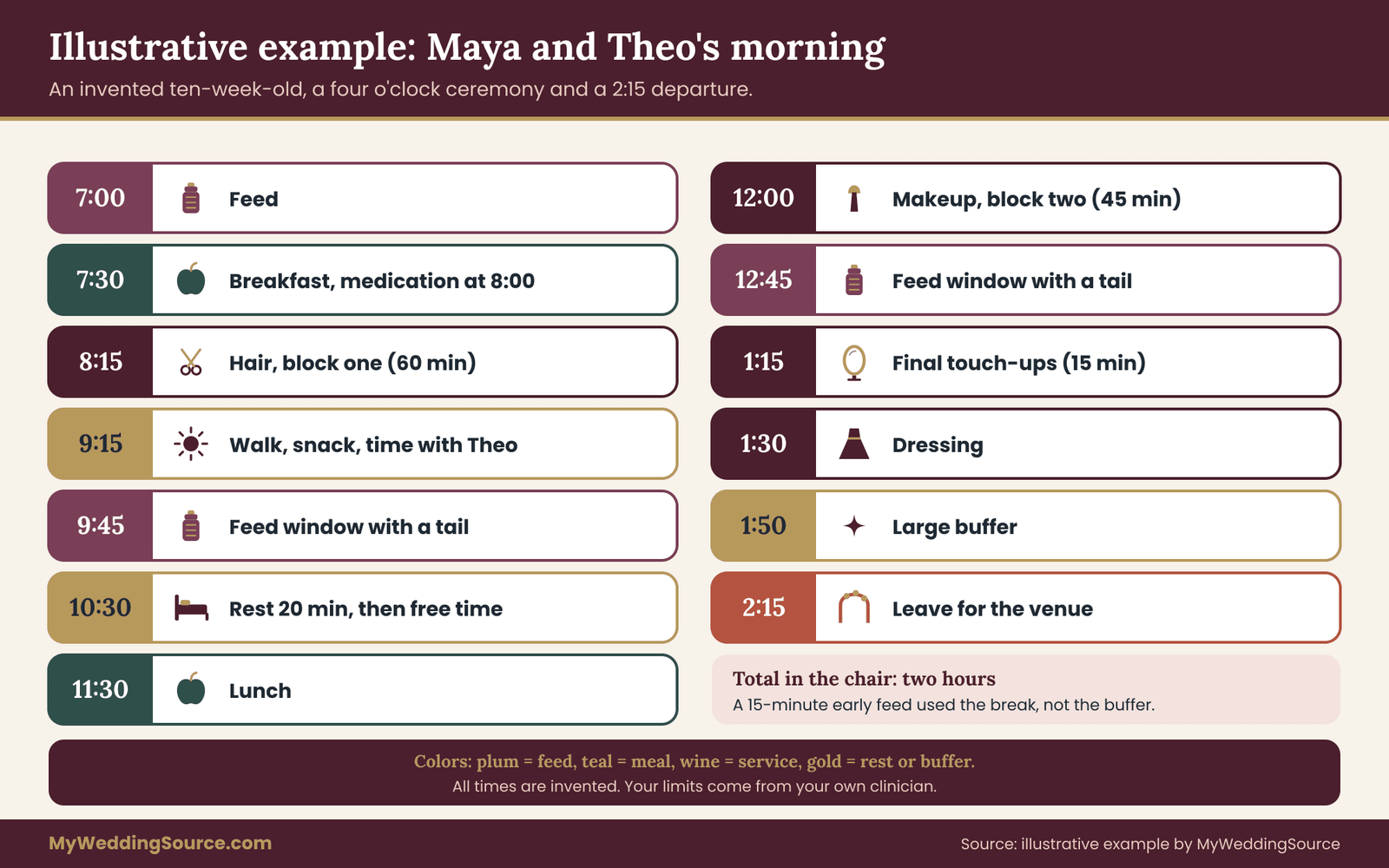
Maya and Jonah are marrying at four o’clock on a Saturday. Their baby, Theo, is ten weeks old. Theo usually eats about every two and a half to three hours, and Maya nurses directly. She takes one medication at eight in the morning, which her clinician asked her to take with food. In the appointment, her clinician suggested she avoid sitting or standing for more than about an hour at a stretch and asked her to eat and drink regularly through the day. Maya chose an artist who works in her home.
Her list of anchors, with ratings:
- Feed at about seven: window.
- Breakfast and medication at eight: breakfast flexible, medication firm.
- Feed at about ten: window.
- Lunch before noon: flexible within an hour.
- Feed at about one: window.
- A venue feed at about three fifteen: window.
- Rest, twenty minutes: flexible.
Her sitting limit is sixty minutes per block. The finish line is leaving for the venue at two fifteen, with portraits at two forty-five and the ceremony at four.
The schedule they built
Counting backward from two fifteen and placing the anchors first, they ended up with this day.
- 7:00 to 7:30. Feed. Baby lead takes Theo afterward. Tail buffer built in.
- 7:30 to 8:00. Breakfast and water, brought by the food runner. Medication at eight with food.
- 8:15 to 9:15. Hair, block one. Sixty minutes, the sitting limit.
- 9:15 to 9:45. Walk, snack, time with Theo. This is the buffer after block one.
- 9:45 to 10:30. Feed window with a tail.
- 10:30 to 11:30. Rest for twenty minutes, then free time while the artist styles a bridesmaid.
- 11:30 to 12:00. Lunch.
- 12:00 to 12:45. Makeup, block two. Forty-five minutes.
- 12:45 to 1:15. Feed window with a tail.
- 1:15 to 1:30. Final touch-ups and accessories, block three. Fifteen minutes.
- 1:30 to 1:50. Dressing.
- 1:50 to 2:15. Large buffer.
- 2:15. Leave for the venue.
At the venue, a feed window at three fifteen leaves about forty-five minutes before the ceremony. The venue day also needs a plan for the ceremony timing, which the wedding ceremony cue sheet guide covers.
Why the order is what it is
Makeup came late in the morning, after lunch, on purpose. Maya and Jonah did not want makeup sitting on her face for five hours before a four o’clock ceremony, and the sitting limit meant they could not put hair and makeup together in one block anyway. Splitting them let hair take the early, quiet part of the postpartum wedding morning and makeup sit closer to the ceremony.
They also kept the artist away from the feeds. Both feeds happened in Maya’s bedroom with the door closed, and the artist used those periods to work on a bridesmaid. That is the kind of detail that a vendor can accommodate only if told early. Details like this make a postpartum wedding morning calmer, and a vendor can only accommodate them if told early.
Total time in the chair came to two hours: sixty minutes, forty-five minutes and fifteen minutes. The span from first feed to departure was seven hours and fifteen minutes, which they compared against what the clinician had said about the length of the day. Because Maya’s rest and meals were built in, they felt it was within her range, and they agreed in advance on the failure conditions below.
The jobs
- Schedule keeper: Maya’s sister, who is not in the wedding party.
- Baby lead: Jonah’s mother, with Jonah as backup after eleven thirty.
- Feeding assistant: Maya’s close friend Ines, who had watched her nurse before.
- Food and water runner: Jonah’s brother.
- Artist liaison: the schedule keeper.
- Gear carrier: Ines, with a printed checklist.
- Decision proxy: Jonah, with Maya’s sister as backup.
What went wrong, and how the plan handled it
The example would be unconvincing if everything went smoothly. In this version, Theo wakes early and wants to eat at nine twenty, twenty-five minutes before the planned window.
The baby lead brings him to Maya in the bedroom. The schedule keeper tells the artist that block one is done, since it ended at nine fifteen, and that the break begins now. The feed runs from nine twenty-five to ten. That absorbs the planned break and uses part of the tail, and it pushes the rest period back by fifteen minutes.
Nothing else changes, because the delay hit flexible items first: the snack was eaten during the feed and the rest was shortened. Firm items were untouched, and the large buffer at the end was never touched. This is exactly what the flexibility ratings are for. This is exactly what the flexibility ratings are for on a postpartum wedding morning. A delay of that size does not threaten the departure time, and nobody has to negotiate.
A second event occurs after lunch. Maya feels a wave of fatigue and mentions it to the decision proxy. They check the failure conditions, which say that fatigue alone triggers a rest and a drink, not a plan change, unless it comes with a specific symptom from the warning list. She rests for fifteen minutes. The makeup block moves from twelve to twelve fifteen, and the large buffer absorbs it.
What this case does not show
It does not show the right durations for your hair, your artist or your baby. It does not show your sitting limit. It does not show a situation in which a failure condition actually trips, which the next sections cover. It shows the structure of a workable postpartum wedding morning: anchors first, services in blocks, buffers behind every block, owners for each job, and a single page.
Alternatives when the standard plan does not fit
Sometimes the worksheet shows that the standard plan cannot work. The sitting limit is too short, the baby is unsettled, the venue is far, or the budget does not stretch to a second artist. In that case you have alternatives for the postpartum wedding morning, and the worksheet makes them easier to compare because you know exactly what you need to protect.
Move part of the work to the day before
Hair done the day before, with a style that sleeps well, removes the longest block from the postpartum wedding morning. It works for styles that hold overnight and for artists who offer it. The trade-offs are sleep quality, a pillow-friendly protection plan such as a silk wrap, and the possibility that the style drops or needs repair, so ask the artist for a quick morning refresh and a clear charge for it.
Choose makeup only, or hair only
If the morning is too tight, professional service for one of the two and a simple do-it-yourself approach for the other is a legitimate decision. Choose the one that benefits most from a professional hand. Many people find that a clean, comfortable hairstyle they can manage with a friend’s help makes a professional makeup booking enough.
A simpler hairstyle
A style that needs no heat or lengthy pinning can cut the first block by half. Ask your artist what they would suggest if the time were limited and the style had to be comfortable, and expect a thoughtful answer rather than a downgrade.
A friend or relative as the stylist
Some people ask a trusted friend with styling skills to do a simple look. The upside is flexibility and comfort. The downside is that a friend is not insured, may be nervous, and cannot always rescue a failed style, so rehearse it at least once, and have a professional on call for touch-ups if the budget allows.
Two artists or two rooms
A second artist can work in parallel on your wedding party while you rest, which shortens the whole morning and moves other people out of your anchor windows. It costs more, and it only helps if the space allows two work areas and the schedule keeper can manage two threads.
Hold the postpartum wedding morning somewhere other than the venue
If the venue is far, a hotel suite near the ceremony location may serve as the base for the postpartum wedding morning, with a place to lie down, a bathroom close by, and no travel after you are dressed. This matters most when the baby needs a room for naps and a feeding assistant needs a private door.
Move the date or the time
If the worksheet shows that the plan cannot be made workable at the current date, you have a bigger option. A later date, or a later ceremony time, gives your body and your baby’s schedule more room. The guide to choosing a wedding date explains how to weigh vendor capacity and guest availability against a move, and your clinician can help you judge whether waiting would ease your recovery. This is a serious decision, and it is only one of several.
Most people find a simpler postpartum wedding morning makes the existing date workable.
Failure conditions and stop rules for the postpartum wedding morning
A plan without failure conditions is optimistic. Failure conditions are the specific, pre-agreed signs that mean you stop following the main schedule and switch to a smaller one. Writing them in advance feels strange, because nobody wants to plan for the postpartum wedding morning to go badly. The reason to do it is that the moment of trouble is the worst moment to decide anything. The reason to do it for a postpartum wedding morning is that the moment of trouble is the worst moment to decide anything.
Three levels
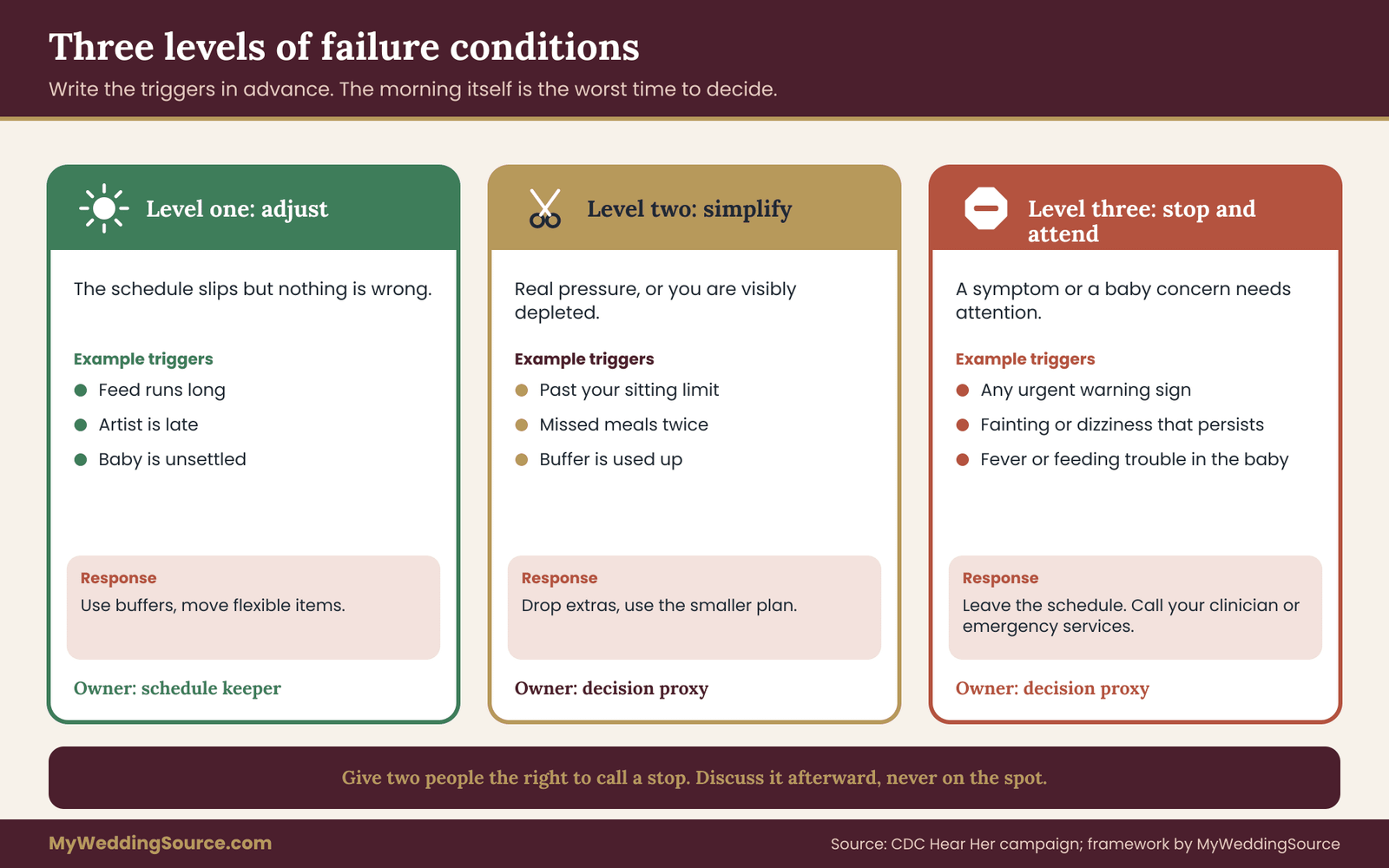
Sort the conditions into three levels. Each level has a trigger, a response and an owner.
Level one: adjust. The schedule slips, but nothing is wrong. A feed runs long, the artist is late, the baby is unsettled. The response is to use the buffers, move flexible items and keep going. The owner is the schedule keeper. Most mornings sit at this level most of the time. Most postpartum wedding morning plans sit at this level most of the time.
Level two: simplify. The schedule is under real pressure, or you are visibly depleted. The response is to drop optional items: a lash application, a complicated pinning step, portraits taken early, a second round of touch-ups. Put the rest block and the meals first. The owner is the decision proxy, in consultation with you.
Level three: stop and attend. A symptom or situation calls for medical attention, or something has happened with the baby that needs your full focus. The response is to leave the schedule, deal with the problem, and rebuild the day afterward, or not at all. The owner is the decision proxy, who calls your clinician’s office or emergency services as appropriate.
Examples of triggers
Triggers should be concrete enough that two people would agree on whether one has been met. These are examples, and your own list should reflect your clinician’s advice.
- You have been in a chair longer than your sitting limit by fifteen minutes. This is level two: the block ends now and the remaining service is simplified.
- You have missed a meal or not had water for more than a set period. Level one, fixed with an immediate snack and drink, or level two if it has happened twice.
- You feel dizzy or faint. Sit or lie down, eat and drink, tell the decision proxy. If it does not pass quickly, treat it as level three.
- Any item from the CDC’s urgent maternal warning signs list. This is always level three, with no discussion.
- The baby has a fever, trouble feeding or any sign your clinician’s guidance names as needing a call. Level three.
- The delay has consumed the large buffer. Level two: remove one service or move the portraits.
- You feel overwhelmed and cannot stop crying, and it is not the happy kind. Level two at least. Step away, bring in the emotional support person, and consider a call to the contacts you put in the plan.
Notice that the list does not tell anyone how to diagnose anything. It tells them when to stop and call someone who can. That is the right division of labor for a wedding party.
The smaller plan
Level two needs a pre-built destination. Write a stripped-down version of the day: what the minimum hair and makeup looks like, what you will do without, and the latest time at which you can still make the departure. A one-line version might read: hair is a simple half-up with no heat, makeup is skin, brows and lips, portraits are moved to after the ceremony, and departure moves to two thirty.
Share the smaller plan with the artist ahead of time. Share the smaller postpartum wedding morning plan with the artist ahead of time. Most professionals can describe their own fast version in a sentence, and knowing it reduces tension when it is needed.
Who can call a stop
Give two people the authority to call a level two or level three stop: the decision proxy and the schedule keeper. If either invokes the plan, nobody argues on the spot. Discuss it afterward. The point of the rule is to remove the burden of deciding from you and to remove the awkwardness of someone having to tell the bride, or the groom, or the parent, that it is time to stop.
If you are the person who tends to say “I’m fine,” tell your team that explicitly and ask them to act on observation rather than on your answer.
What the stop rules protect
These rules protect the wedding as much as they protect you. These rules protect the whole postpartum wedding morning as much as they protect you. A person who pushes past a limit may make it to the ceremony and then have a rough hour, and the people who love them will remember the hour. A person who follows a level two plan arrives rested enough to enjoy the vows. Almost nobody remembers whether a hairstyle was simple or elaborate. Almost nobody remembers whether a postpartum wedding morning hairstyle was simple or elaborate. Nobody forgets that someone was visibly unwell.
Review the plan with your partner
Your partner has a stake and may have different assumptions about how much risk is acceptable. Go through the failure conditions with them, ask whether they would add or change anything, and decide who takes over the baby lead role if the decision proxy needs to be with you. Two people who have talked through the plan are better prepared than two people who each carry a private version.
Talking to your artists: questions and contract terms
You have a schedule, a set of limits and a delegation plan. Now you need to know whether your artist can work within them. This is a conversation to have before you sign, and ideally in writing, because the answers need to be in the contract if they are to protect you.
The general mechanics of choosing an artist, the cost of a bridal booking and what a trial includes are in the guide to bridal hair and makeup planning. The questions below are the additional ones that matter for a postpartum wedding morning.
Questions to ask before you book
- Can you work in blocks of about an hour with breaks, and do you offer a split schedule over two days?
- If I need to stop for a feeding or pumping, how do you handle the pause? Is there a fee for waiting time?
- What is your smallest, fastest version of the look I’m considering, and how long does it take?
- Do you work on location, and what space and power do you need? Can you work in a room where a baby is sleeping nearby?
- Which products and tools do you use near an infant? Can you use aerosol-free or fragrance-free options?
- How do you handle a delay on your side, and what is your lateness policy?
- Can you bring a second artist if the schedule needs it, and how does that change the quote?
- What is your cancellation and rescheduling policy if a recovery issue means I can’t follow the plan?
You are not asking for special treatment. You are asking an experienced professional how their service works with a real constraint, and good artists have heard similar questions from other clients with constraints of their own.
What to put in writing
Ask that the following appear in the contract or in a written confirmation message.
- Start time, end time and block structure, including the agreed breaks.
- Pause handling. If the service pauses for a feed, pumping or a medical reason, how is the time treated and is there any additional charge?
- Lateness and overtime terms on both sides.
- The fallback look and its time, so level two is a known quantity.
- Cancellation and rescheduling terms specific to a health-related change, so you know what happens to a deposit if you cannot proceed.
- Travel and early-start fees, stated as numbers in the quote.
For the broader vendor-contract questions, such as liability, insurance and deposit terms, ask for each document and confirmation in writing well before the wedding. Do not assume the artist’s standard terms cover pauses and health-related changes. Many do not mention them.
If the artist says no
Some artists work in a fixed, fast pattern and cannot split a service. Their answer is not a character flaw. It tells you that this person suits a different client. Ask for referrals, and then compare options using the same questions.
Do not assume the cost of a more flexible artist will be higher. Sometimes a smaller, flexible booking costs less than a full-service package with a long block. Compare the written quotes, rather than the headlines, and let the schedule decide. and let the postpartum wedding morning schedule decide.
Vendor claims and what you can check
Be wary of promises that cannot be verified, such as an artist saying a product is safe for everyone, or that a style will certainly last. Take claims about safety to your clinician, and treat claims about longevity as hopes until you see the trial result.
The Federal Trade Commission publishes consumer protection information on advertising claims and consumer rights, and it is a reasonable place to check what a seller can and cannot promise. Keep the artist’s own wording about your postpartum wedding morning in your records.
The run sheet and the bag list for the postpartum wedding morning
The worksheet turns into two physical documents on the day: the run sheet and the bag list. Neither needs to be elaborate. Neither needs to be elaborate on a postpartum wedding morning. Both need to be readable by a tired person in a noisy room.
The run sheet
A good run sheet fits on one page and has five columns in practice, even though it is written as a list: the time, the item, the owner, the flexibility rating and a note. Write the times in large type. Put the firm items in bold. List the phone numbers of the schedule keeper, the decision proxy and the artist at the top, along with your clinician’s office number and the location of the failure-condition page.
Add a section at the bottom called “If we are behind.” It states which items slide first, which items never slide, and the latest time you can leave. When the schedule keeper is under pressure, that short section answers most of the questions people will ask.
Handing a copy to the photographer is useful. They will see the feeds and rest periods as part of the day and can plan around them, rather than arriving expecting you to be available at any moment. A photographer who knows about the nine forty-five feed will schedule a detail shot of the shoes at that time, not a portrait of you.
The bag list
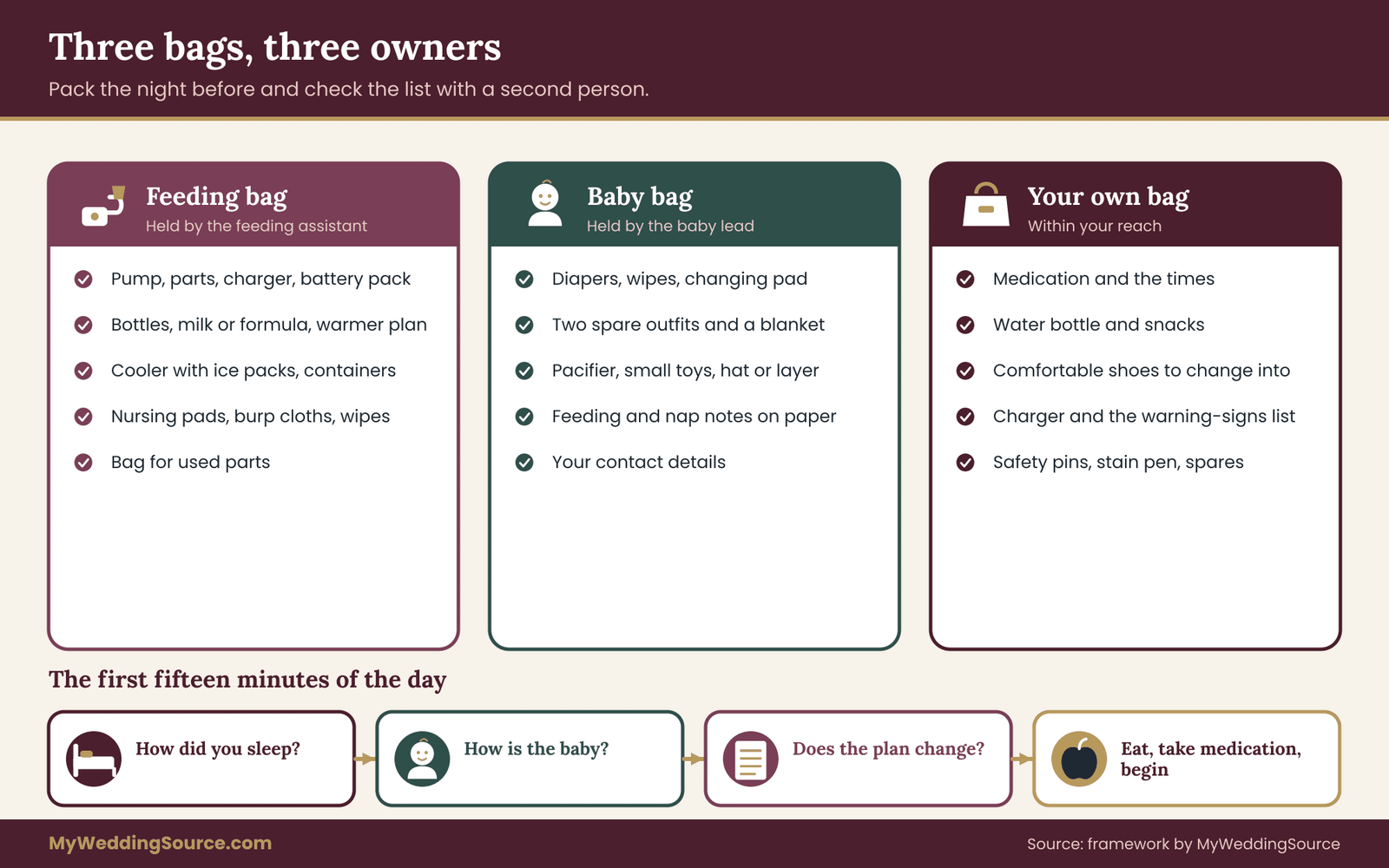
Divide the supplies into three bags, each with an owner, so nobody has to search through one large pile.
The feeding bag. Held by the feeding assistant. Nursing cover or clothing if you use it, nursing pads, burp cloths, bottles and prepared milk or formula, a bottle warmer or a plan for warm water, a pump and all its parts, a charger and a battery pack, storage containers, a small cooler with ice packs, wipes and a bag for used parts. If you pump, also a labeled container for cleaning supplies.
The baby bag. Held by the baby lead. Diapers, wipes, a changing pad, a spare outfit and a spare for the spare, a blanket, a pacifier if you use one, a few small toys, a sun hat or a warm layer depending on the weather, any medication the baby takes with instructions, and a printed sheet with feeding notes, nap patterns and your contact details.
Your own bag. Held by you, within reach. Your medication, water, snacks, any items your clinician advised, lip balm, spare nursing pads, comfortable shoes to change into, a phone charger and the printed warning-signs list. Also a small emergency kit: pain relievers if your clinician has said they are suitable, a stain pen, safety pins and a spare pair of underwear.
Packing the night before
Pack the bags the night before the postpartum wedding morning, and check them against the list with a second person. A second pair of eyes catches the missing charger. Put the bags where the right person can find them. Put the one-page schedule on the door of the room you will use, and keep a second copy in the baby bag.
The first fifteen minutes
The most valuable fifteen minutes of the day are the first. On waking, run a short check with the schedule keeper: how did you sleep, how is the baby, is there anything the plan needs to change? Compare it against the failure conditions, and decide whether to start at level one or level two. Then eat, take your medication and begin. A short check at the start catches problems while there is still time to solve them. A short check at the start of the postpartum wedding morning catches problems while there is still time to solve them.
After the artist leaves
When the services end on a postpartum wedding morning, do not let the morning dissolve into a free-for-all. Eat, feed, rest, and use the large buffer to do what you need to feel steady. A final run through of the bag list before leaving the house can save an hour of trouble later. Hand the baby lead role to the person who will carry it through the ceremony, and brief that person at the door.
Notes for the venue day after the morning
The postpartum wedding morning plan connects to the rest of the day, and the best way to keep it from breaking is to let the venue team and the vendors know about the anchors. Tell the coordinator about the feeding window at the venue, the location of a quiet space, and the expected time you will leave the room. A coordinator can fit that into the cue sheet and hold a space. If the venue has no private area, ask where you could use a closed office or a bridal room, and agree it in writing.
Your next steps
Work through these in order. Work through these in order to prepare the postpartum wedding morning. Each one takes an evening or less.
- Book the clinician conversation and take the draft schedule and the list of questions with you.
- Fill in the five-step worksheet with your anchors, limits and flexibility ratings.
- Build the backward schedule from the departure time, with buffers behind every block.
- Choose the service format and ask the artists the postpartum questions, getting the answers in writing.
- Name the seven jobs and brief the people who will hold them. The wedding guest care planning guide helps if you want to bring in a hired caregiver.
- Write the failure conditions and the smaller plan, and decide who can call a stop.
- Print the run sheet and pack the bags the night before.
- Review the whole plan about a week before, with your clinician’s advice in hand and your partner in the room.
Fit these steps into the rest of your planning calendar using the wedding vendor timeline, so the artist, photographer and transportation all know the same times.
FAQ
How early should I plan the postpartum wedding morning if the baby is a newborn?
Start planning the postpartum wedding morning as soon as you know the date, but treat the first draft as a rough sketch. A newborn’s pattern changes week to week, so revisit the anchors about a month before the wedding and again in the final week. Ask your clinician about timing at your next visit, and fix the vendor structure early because artists book up before the feeding pattern settles.
Should I hire a hair and makeup artist who comes to me or go to a salon?
Either can work. An in-home artist keeps you near the baby and supplies, which helps with feeding anchors. A salon gives you proper equipment and separates the work from household activity. Choose for the postpartum wedding morning according to your sitting limit, your travel tolerance and whether you have a private feeding or pumping space at each option.
What should I tell my artist about my situation?
Tell them you are recovering from a birth and need breaks for feeding or pumping, shorter blocks, and a fallback look. You do not need to share medical details. Give them the schedule in writing, ask about pauses and lateness, and ask which products and tools they will keep away from the baby.
Is it safe to use hair color or chemical treatments while nursing or recovering?
That is a question for your own clinician or pharmacist, not for an article or an artist. The National Library of Medicine’s LactMed database is a reference they may use. Ask before booking any chemical service, and tell the artist what they said. If there is any doubt, choose a service without chemicals for the wedding.
How long should I sit for hair and makeup?
Use the limit your clinician gives you, not a general number. Many people break the work into blocks with rest and movement in between. In the worked example in this guide, the invented bride used sixty-minute blocks, but that was an illustration only, and your limit may be shorter or longer.
What if the baby needs me during a service?
Pause the service. Tell the artist in advance that this may happen, agree on how the time is treated and make sure the schedule has buffers to absorb it. A feeding assistant can bring the baby or set up the space while the schedule keeper tells the artist how long to expect. A flexible artist will adjust and a rigid one should be discussed before booking.
Who should be the decision proxy?
Choose someone calm, trusted by you and comfortable saying no. Often it is a partner, a sibling or a close friend who is not in the front line of the wedding party. Give them written authority, a copy of the failure conditions and your clinician’s contact details. Name a backup in case they are with you in a private moment.
When should I simplify the plan?
When the schedule slips past its buffers, when you pass your sitting limit, when you have missed meals or water, or when you feel overwhelmed. Any urgent warning sign from your clinician or the CDC’s maternal warning signs list means you stop and seek care. Agree these triggers in advance so the decision is not left to the morning.
Sources
- American College of Obstetricians and Gynecologists: patient and clinician information on postpartum care.
- Centers for Disease Control and Prevention, Hear Her campaign: urgent maternal warning signs.
- Centers for Disease Control and Prevention, Breastfeeding: guidance on storing and handling breast milk.
- National Library of Medicine, LactMed: drugs and lactation database.
- U.S. Department of Labor, Break Time for Nursing Mothers: federal requirements for break time and private space.
- U.S. Food and Drug Administration, Cosmetics: consumer information on cosmetic product safety.
- Federal Trade Commission: consumer protection information on advertising claims.
- Postpartum Support International: support for perinatal mental health.
- Health Resources and Services Administration, Maternal and Child Health: national maternal mental health hotline information.
- American Academy of Pediatrics, HealthyChildren.org: parent information on infant feeding and safe sleep.