

Destination wedding room blocks are a contract about rooms, dates and risk, so the way to keep your guests housed without paying for empty beds is to choose the right block type, size it from real traveler numbers, and read the attrition, cutoff and cancellation terms before you sign.
You have found the beach resort, the mountain lodge or the old-town hotel, and the sales manager has just sent a “group rate” proposal with a cutoff date, a deposit schedule and a paragraph about attrition that you have now read three times. Your guests will not be able to drive home after the reception, so lodging is not a side issue; it decides whether the weekend feels like one shared event or like forty separate trips. It is also the part of a destination wedding where a quiet financial risk can hide inside a friendly offer, because a room block is a promise that someone will fill rooms, and the someone who signs is usually you. None of this means resorts are being sneaky. Hotels sell rooms by the night, a block takes inventory off the market for months, and the contract is simply how they price that waiting.
This guide is for couples comparing resorts, hotels or villa-style properties in another city, state or country, and it also gives guests a plain-English view of how to book so they do not accidentally cost the couple money. It covers the four main ways to house a wedding group, sizing, the costs on top of the nightly rate, attrition and cutoff dates, timing against flights and invitations, resort contract clauses and how to protect yourselves if plans change. It stays destination-specific on purpose. Our guide to hotel wedding venues covers room blocks in the context of a hotel ballroom reception, and this article picks up where that one stops, with the added complications of distance, weather season, foreign taxes and guests who need a plane ticket before they need a room.
A word on what the data can and cannot tell you. The Knot’s 2026 Real Weddings Study (couples married in 2025) reports that about 17% of couples held a destination wedding, and its earlier study put the average destination wedding cost at roughly $39,000 versus $32,000 for a hometown wedding. Those figures describe the whole wedding, not the lodging, and we found no reliable national dataset on how many destination guests actually book inside a block or how often couples pay attrition penalties. Where we explain how the math works, we use clearly labeled illustrative numbers, and where a rule comes from a blog or glossary rather than a regulator we say so.

What Makes a Destination Wedding Room Block Different From a Hometown Hotel Block?
A hometown block is a convenience, and a destination block is the foundation of the weekend. When nearly everyone has to fly, the block decides where people sleep, how they get from the airport, whether the welcome drinks fill a room and whether your cutoff date arrives before or after the airfare sale ends.
What does a destination room block actually do for you?
A room block does three things at once: it reserves inventory, it sets a price and it creates a financial obligation, and the third one is where most surprises live. Even in a friendly courtesy block the hotel is trading away flexibility, because every room it holds for you is a room it cannot sell to a conference group or a cruise-line transfer. The contract is the hotel’s way of deciding how much to charge for that wait.
What is a room block in plain terms?
A room block is a set of rooms a property holds for your wedding guests at a negotiated group rate, usually for specific nights and until a specific cutoff date. Guests book individually, typically through a link or code, and the hotel counts how many of the held rooms are actually reserved, which the industry calls pickup. Unreserved rooms return to the hotel’s general inventory at the cutoff, and prices after that date usually revert to whatever the market is charging. EventPipe’s booking guide describes the arrangement this way, and the pattern is the same at a Hawaiian resort, a Mexican all-inclusive or a boutique hotel in Charleston.
The practical value is threefold. Your guests get a predictable price and, often, a better one, since EventPipe reports that group rates commonly run 10% to 40% below standard rates and that most hotels want a minimum of about 10 rooms to offer one. You get a single place to send people, which makes shuttles, welcome events and a Sunday brunch easier to plan. And you can ask for concessions, such as a complimentary room for the couple, waived fees or an upgrade for the wedding party, that a lone guest could never negotiate.
Who signs the contract and who carries the risk?
In a contracted block, the person who signs carries the risk, and that is almost always one of the couple. The attrition clause describes what happens if fewer rooms are filled than the contract requires, and it can be written as a percentage of the shortfall, a share of lost revenue or a sliding scale. In a courtesy block there is typically no deposit and no penalty, but also no guarantee that the hotel will keep the rooms if a larger group asks for them. Beach Bride’s destination room block guide describes courtesy blocks as carrying no attrition clause or financial risk and contracted blocks as unlocking comp rooms, better rates and perks in exchange for that liability.
A useful mental model is to treat the signature like a small loan against your guests’ behavior. If every guest books, the loan costs nothing and you might even earn a free room. If half of them book elsewhere, find a cousin’s couch or decide late that they cannot afford the trip, you owe the difference. That is why the sections below spend so much time on sizing, attrition and the review date: you cannot control your guests, but you can control how much of their behavior you underwrite.
Why do distance and a resort setting change the risk?
Two features of destination weddings make blocks harder to predict than a local one: the trip is bigger, so guests decide later, and the property is often a resort with its own pricing structure. A city hotel that fills its ballroom every weekend and a beach resort that sells all-inclusive packages to leisure travelers are both hotels, but they think about group business differently. Knowing which one you are talking to helps you read the proposal.
Why do guests book later when the trip is bigger?
Guests with a flight to buy tend to lock in the biggest cost first and the smallest cost last. A guest who has not yet decided whether the airfare is affordable will not book a room, and a guest who is waiting for the invitation to confirm the dates will not book either. The Knot’s Guest Study (fielded in October 2024) found that guests who flew spent an average of about $1,680 on a wedding, far above the $610 average across all weddings, which is a reminder that a destination RSVP is a bigger decision than a local one. Our companion guide on destination wedding guest cost covers the guest-side math.
This is the reason block timing at destination weddings so often goes wrong. The couple sets a cutoff 60 days out because that is what the hotel suggested, the invitation goes out four months before the wedding, and the guests who needed a long runway to save, request time off or find a flight are still deciding when the block releases. Setting the cutoff and the invitation date together, rather than separately, is one of the most useful moves you can make, and the timeline section below shows how.
How does a resort differ from a city hotel for block purposes?
A resort sells a bundle of lodging, food, activities and often airport transfers, and its group policy may be organized around packages instead of nightly room rates. An all-inclusive resort may quote a per-person or per-room nightly price that already includes meals, drinks and some activities, so a $400 rate and a $240 rate are not comparable until you know what each includes. A city or boutique hotel, by contrast, usually quotes a room-only rate and expects guests to find their own meals. Some resorts also run dedicated wedding or group teams with their own minimum-night or minimum-room thresholds, while smaller properties negotiate case by case.
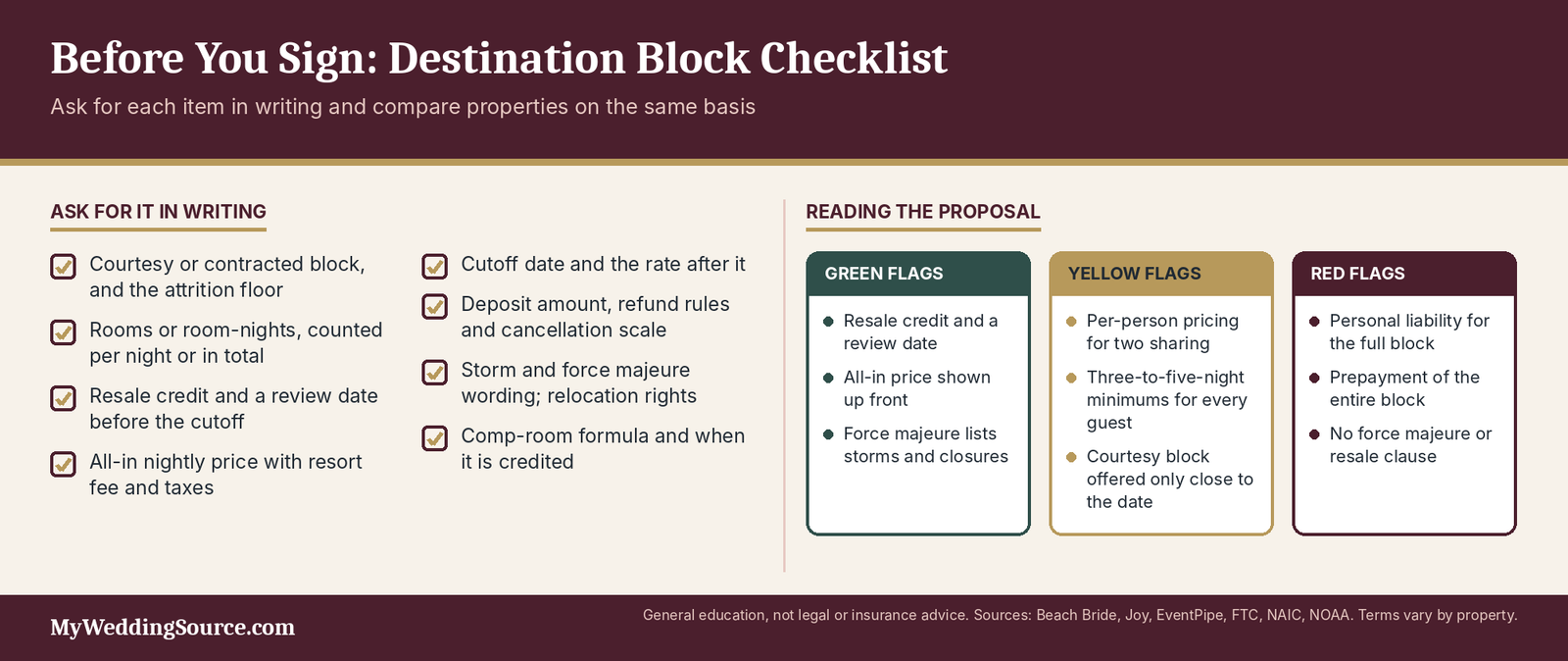
Beach Bride’s brand summary lists a 10-room threshold for several large all-inclusive chains, among them Sandals and Beaches, Secrets and Excellence, and Hyatt Ziva and Zilara, with one comp room per 10 rooms at some of them. That is a blog’s summary of brand programs, not a rate card, and each property sets its own current terms. The same guide notes that some resorts require three-to-five-night minimums for every guest, which can hurt attendance and trigger attrition, and that some all-inclusives skip courtesy blocks entirely. So ask each property the same short list of questions: what is the smallest group that qualifies, whether the quoted rate is per room or per person, what it includes, what is the cutoff, and what attrition applies. The answers will tell you whether you are being offered a hotel block, a resort package or something in between, and that is the information you need before the rest of the contract makes sense.
Which Block Type Fits Your Wedding: Courtesy, Contracted, Resort Group or Guests on Their Own?
Most couples hear “room block” and assume there is one kind. There are really four ways to house a destination wedding group, and each moves the risk to a different person. Choosing among them is a decision about how confident you are in your guests’ behavior and how much money you are willing to put behind that confidence.
What are the main ways to structure the block?
The structures below run from lowest risk and fewest perks to highest risk and most perks, and the table below summarizes them. Each one answers the same underlying question, which is who pays if the rooms do not fill. The paragraphs that follow explain where each fits and what to ask the property before you choose.
| Structure | Who carries the risk | What you usually get | Best fit |
|---|---|---|---|
| Courtesy (open) block | Mostly guests; hotel can release rooms | Group rate, booking link, no penalty | Uncertain guest count, flexible dates |
| Contracted (closed) block | The signer, if pickup falls short | Better rates, comp rooms, concessions | Strong commitment from guests, small property |
| Resort wedding group | Depends on the package terms | Bundled rooms, meals, sometimes event space | Couples wanting one price and one team |
| Guests book on their own | Each guest | Nothing negotiated | Large, scattered or budget-varied guest list |
What is a courtesy block, and what does it leave out?
A courtesy block, sometimes called an open block, holds rooms at a group rate without a deposit or attrition penalty, and unreserved rooms return to the hotel at the cutoff. Beach Bride describes it as having no deposit, no attrition clause and no financial risk, and EventPipe says hotels typically offer fewer concessions in this structure. The trade-off is that the hotel may not hold the rooms against a larger booking, so a courtesy block is only as safe as the hotel’s willingness to honor it. For a small property in a quiet season that is rarely a problem, and for a popular island on a holiday weekend it can be.
If you take a courtesy block, ask the hotel to confirm in writing how long the rooms will be held, whether they can be released before the cutoff if a bigger group arrives, and how much notice you would get. It also helps to ask what the rate will be for guests who book after the cutoff, because that number tells you how much the group rate is really worth. Courtesy blocks are the right default when you do not yet know whether 12 guests or 40 will travel, with two catches: Beach Bride cites a planner’s view that they are often unavailable more than 6 to 8 months out, and A Practical Wedding notes they often hold only 10 to 20 rooms.
What is a contracted block, and why do destination weddings use it?
A contracted block, sometimes called a guaranteed or closed block, commits the signer to a minimum amount of rooms in exchange for better rates, comp rooms or concessions. EventPipe says the attrition floor is typically 80% to 90% of the contracted rooms and recommends a contracted block for destination weddings because travel commitment supports stronger pickup, while Joy’s glossary cites 75% to 90% with 80% the most common. The logic is that a guest who has bought a plane ticket will almost certainly book a room, so the hotel’s risk is lower than at a local wedding.
That logic holds only if guests actually commit early. A contracted block makes the most sense when the property is small enough that your group would be a meaningful share of its inventory, when the dates fall in a high-demand period, or when the concessions you want (a comp suite, free welcome-event space, waived resort fees) are worth more than the risk you are taking. If you choose one, treat the attrition percentage as the single most negotiable number in the contract.
What is a resort wedding group or package?
At many resorts, the wedding itself is the product, and the group rate for guests sits inside a larger package that may include a ceremony, reception, coordinator and a stay for the couple. The mechanics vary by property, and some resorts tie complimentary perks to a minimum number of booked room nights. A package can simplify planning, because one team handles guests and event logistics, and it can also blur the numbers, since the guest rate and the wedding charge appear in the same document. Ask the resort to itemize the room rate, the event charges and any perks separately, so you can see which part would change if guests cancel.
Treat any minimum you hear, whether it is five rooms or fifteen, as that property’s rule and not an industry standard. The same caution applies to a “free” wedding that is conditional on guest room nights: the cost is real if the guests do not materialize, so read the condition and the fallback price. Our guide to wedding venue contract hidden costs offers a general checklist for comparing package quotes line by line.
What if guests simply book on their own?
Skipping the block is a legitimate choice, and it can be the best one when your guests range from backpackers to retirees and no single property suits everyone. The cost is losing the group rate and the leverage for perks, and guests may scatter, which complicates shuttles and welcome events. A middle path is to name two or three suggested properties at different price points on your wedding website without signing anything, which gives guests choices and costs you nothing.
How do you choose among them?
The decision comes down to two questions: how sure are you about who is coming, and how much would a penalty hurt? If a $5,000 shortfall would force you to cut your photographer, a contracted block with a high attrition floor is the wrong fit even if the discount is tempting. If a $1,500 shortfall would be an annoyance but a lost resort concession would be a bigger one, the contracted option may pay for itself.
When does a courtesy block make sense?
A courtesy block makes sense when your guest list is still fluid, when the destination has plenty of hotels in your price range, or when you are early in planning and need a rate and a link more than a guarantee. It also suits couples who are wary of taking on liability and are comfortable with a smaller discount. The honest downside is that the hotel can release rooms and the rates are rarely as strong, so the block’s value depends on the property’s goodwill and the season’s demand.
When is a contracted block worth the risk?
A contracted block is worth considering when you want specific concessions, when the property is small or the date is a peak one, or when a core group of guests has already told you they are coming. A useful test is to count the guests who would almost certainly book, meaning the wedding party, immediate family and anyone who has said yes in writing, and compare their room need to the minimum the hotel requires. If those commitments alone cover most of the attrition floor, the risk is modest. If they cover less than half, you would be betting on persuasion, and a courtesy block or a smaller contracted block is the safer structure.
How Many Rooms Should You Block When Guests Are Traveling Far?
Blocking too few rooms leaves guests scattered across the island, and blocking too many leaves you holding the bill. Because guests commit later than couples expect, the arithmetic is worth doing on paper before you talk to any hotel.
How do you estimate demand?
Why should you start from travelers, not the guest list?
EventPipe’s guide suggests dividing the number of out-of-town guests by two, since most travel as couples, then adding a small buffer for families with children and guests who want a separate room. At a destination wedding almost everyone is out of town, so your invited list is a closer proxy for demand than it would be at home, but it is still an upper bound. Not every invitee will attend, and The Knot’s 2026 data read-out puts the average wedding at 117 guests overall, and the read-out gives no destination-specific guest count. We found no reliable national acceptance rate for destination invitations, so use your own early signals: save-the-date replies, a quick text poll of your closest 20 people or a simple “are you planning to come?” form on your wedding website.
How do you adjust for couples, families, kids and the wedding party?
The divide-by-two rule is a starting point, and real groups bend it. Families with children may need one larger room or two connected rooms, friends traveling together may split a two-bedroom suite, and some guests will choose a different property for budget or accessibility reasons. The wedding party often needs rooms earlier than everyone else and for more nights, which is why many couples hold a few rooms for them under a separate line or a separate comp request. Write down your three groups (wedding party and family, close friends who have said yes, everyone else) and estimate rooms and nights for each, so your block has a shape, and so you can see which group could carry a minimum.
How much should you commit to?
Your estimate is what you expect, and your commitment is what you would pay for if you were wrong, so the two numbers should not match. A sound approach, which is editorial judgment and not an industry rule, is to commit to the rooms you are quite sure will fill and hold the rest as a courtesy or “soft” addition that the hotel releases at the cutoff.
Why shouldn’t you commit to 100% of your estimate?
Estimates are cheerful by nature, and the people who say “we would not miss it” in March sometimes cancel in September for reasons that have nothing to do with you. If you commit to the full estimate and the hotel requires 80% of it, you are really betting that 80% of your hoped-for guests will show up, and a hard-working estimate usually lands below that. Committing to roughly 60% to 70% of your estimated rooms, then asking for the remaining rooms on a courtesy basis, gives you a cushion while still unlocking the contracted-block perks. The table below shows the idea with illustrative numbers.
| Step | Illustrative number | Why it matters |
|---|---|---|
| Guests invited | 90 | Upper bound on demand |
| Expected to travel (assumed 75%) | 68 | Replace with your own early RSVP signals |
| Rooms if travelers pair up (68 divided by 2) | 34 | EventPipe’s divide-by-two rule |
| Buffer for kids and solo travelers | +3 (37 rooms) | Small cushion, not a guess at no-shows |
| Contracted commitment (about 62%) | 23 rooms | Rooms you are confident will fill |
| Courtesy hold on the remainder | 14 rooms | Released at cutoff with no penalty |
What if demand beats your block?
Strong demand is a good problem, and the contract should say what happens. Ask whether you can add rooms later at the same rate, how the hotel will handle requests beyond the block, and whether guests who book after the block fills get the group rate or the public one. A Practical Wedding’s list of block questions includes whether rooms can be added after signing, which is worth asking even if you think your guest list is small. If the property is small, ask for a right of first refusal on adjacent rooms, and if it is large, make sure a second property is on your website as an overflow option.
What Does a Destination Block Really Cost Guests and Couples?
The nightly rate in a proposal is the start of the price, not the end of it. Guests pay the rate plus taxes and fees, and couples carry a different set of costs that only appear if things go wrong. Separating the two keeps you from comparing a resort’s all-in rate to a city hotel’s room-only price, and it keeps your guests from feeling blindsided at check-out.
What layers sit on top of the nightly rate?
How do taxes and resort fees change the price?
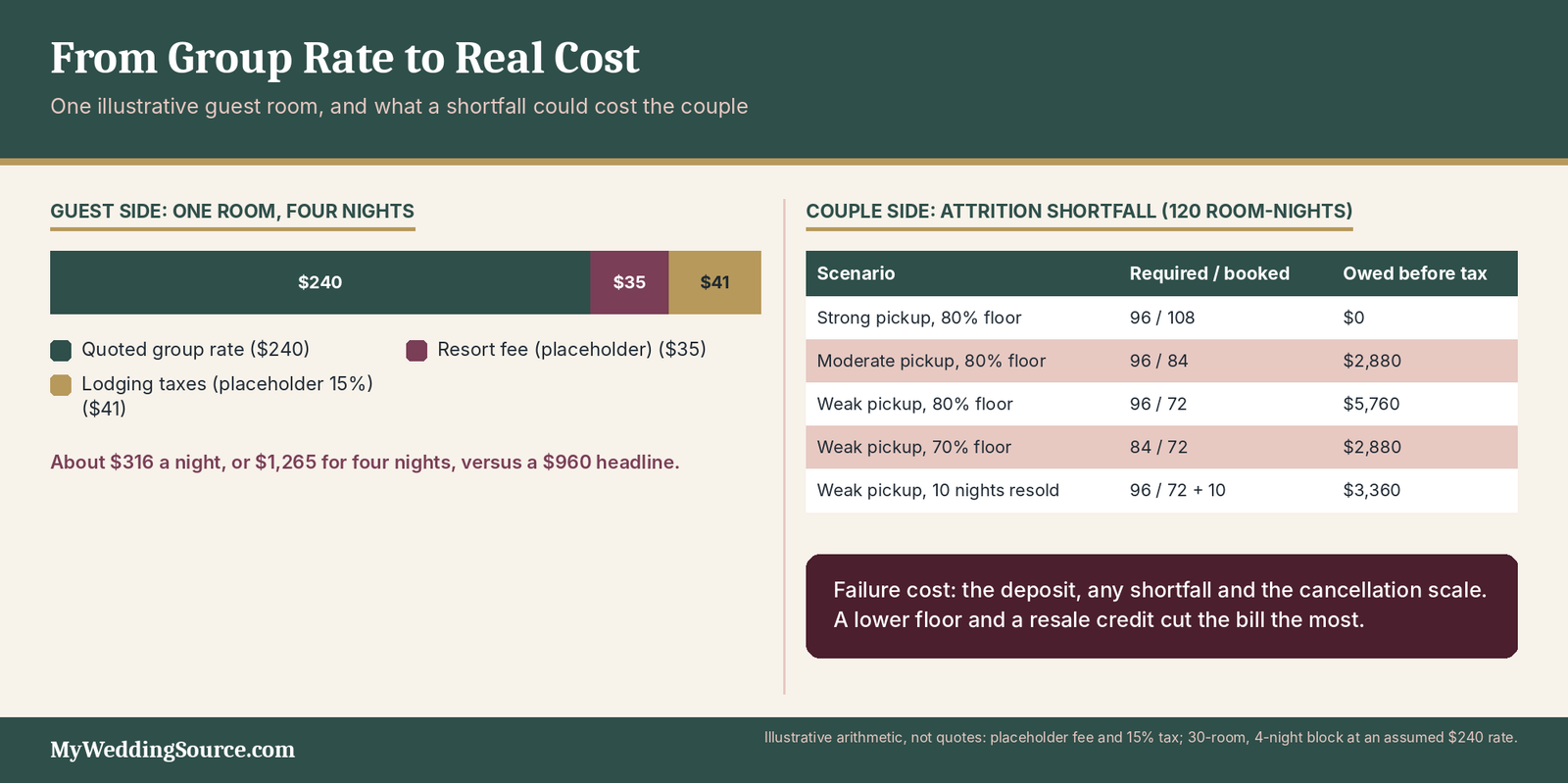
Taxes on lodging vary by city, state and country, and many properties add a daily resort, destination or facility fee on top of the rate. The Federal Trade Commission’s rule on unfair or deceptive fees, effective May 12, 2025, requires businesses that advertise short-term lodging to show the total price including mandatory fees upfront, with taxes and government charges allowed to be listed separately, according to the FTC’s published FAQs, which give a mandatory resort fee as an example of a charge that must be included. The FTC’s guidance does not address group or event bookings specifically, so do not assume it rewrites a group contract, and ask the hotel to state the all-in nightly price for your block. The table below uses placeholder numbers to show how a $240 rate becomes roughly $316.
| Layer | Per night (illustrative) | Four nights |
|---|---|---|
| Quoted group rate | $240.00 | $960.00 |
| Resort or destination fee (placeholder) | $35.00 | $140.00 |
| Lodging taxes (placeholder 15% of rate plus fee) | $41.25 | $165.00 |
| All-in lodging per room | $316.25 | $1,265.00 |
What do tourism fees, transfers and meal plans add?
Some destinations charge visitors a separate tourism fee that never touches the hotel bill; TravelPulse reported in April 2025 that Quintana Roo, Mexico’s Visitax was $17.75 per non-Mexican visitor, a dated example that is worth checking before you travel. Airport transfers, resort credits, meal plans and parking can add more, and each one can be optional or mandatory depending on the property. Ask whether the group rate includes breakfast, transfers or a resort credit, and whether the rate is per room or per person, because an all-inclusive quote and a room-only quote are different products. Our guide to destination wedding guest costs lists the other travel lines guests budget for.
What can the couple owe?
The couple’s exposure is mostly contractual. It includes a deposit, the attrition shortfall, any cancellation charges, and the cost of the concessions you wanted but did not earn. Understanding the structure in advance keeps these from becoming a surprise in the final month.
What deposits and payment schedules should you expect?
Contracted blocks may require a deposit or a credit-card guarantee, while courtesy blocks typically require none. Beach Bride lists a prepayment or a credit-card hold on the entire block as a red flag, since it ties up money for rooms that guests, not you, are supposed to pay for. Ask what the deposit is, whether it is refundable, whether it applies to your own stay or the wedding charges, and when it is due. A deposit that reduces your final bill is different from one that vanishes if guests cancel, and the wording should make that clear.
What does failure cost?
Failure cost is what you pay if pickup lags, the wedding moves or the property cancels. It usually includes the attrition shortfall, any cancellation scale on the block, and the lost value of the concessions that depended on the block filling. The next section works through the shortfall math. For the wedding-level view, our guide to wedding cancellation and postponement explains how contract and insurance choices interact.
Attrition, Cutoff Dates and Comp Rooms: How Do You Read the Fine Print?
Attrition and the cutoff date work as a pair, and comp rooms are the carrot that the pair is attached to. Read them together, because a generous comp formula with a harsh attrition clause is not a bargain, and a friendly cutoff without a review date can leave you with no time to react.
How does attrition work at a resort?
What threshold and penalty formula apply?
Joy’s glossary says most contracts set the minimum between 75% and 90% of the block, with 80% the most common, and that penalties can be percentage-based, revenue-based or sliding-scale. Its example is a 30-room block at $200 a night with an 80% threshold, which requires 24 rooms, so 20 filled rooms leave a shortfall of 4 rooms, or $800 before taxes. The same logic scales quickly with a longer stay, as the table below shows for a four-night block at an assumed $240 rate. The person who signs carries the risk, so ask for the formula in writing, with a worked example at your numbers.
Are rooms counted per night or in total?
A four-night block can be measured per night (every night must meet the threshold) or cumulatively (total room-nights across the stay). Beach Bride suggests asking for cumulative calculation across nights, which is more forgiving because a strong Friday and Saturday can offset a weak Wednesday. Ask the hotel whether the commitment is counted in rooms or room-nights, whether guests who leave early reduce the count, and whether the couple’s own rooms count toward the minimum. These small wording choices can move the shortfall by thousands of dollars on a long destination stay.
| Scenario | Threshold | Room-nights required | Room-nights booked | Shortfall owed (before tax) |
|---|---|---|---|---|
| Strong pickup | 80% | 96 | 108 | $0 |
| Moderate pickup | 80% | 96 | 84 | $2,880 |
| Weak pickup | 80% | 96 | 72 | $5,760 |
| Weak pickup, lower threshold | 70% | 84 | 72 | $2,880 |
| Weak pickup, hotel resells 10 | 80% | 96 | 72 plus 10 resold | $3,360 |
What terms can you negotiate, and what about comp rooms?
Which attrition protections are worth asking for?
Joy suggests asking for a lower threshold such as 70% instead of 80%, a review date two to four weeks before the cutoff so you can release unneeded rooms, a resell credit and a smaller starting block. Beach Bride adds stepped reductions (for example 10% two months out and 5% one month before), a housing audit clause, a target of 70% or lower and a warning about personal liability for the full room rate instead of the shortfall, and a trade-press article on hotel contracts notes that attrition and cancellation clauses should work together and both should include a resale clause. A resale credit means the hotel credits you when it sells unfilled rooms to someone else, which in a busy destination can cut the penalty sharply. If the hotel will not move on any of them, a courtesy block or a smaller contracted block is the safer structure.
How do comp rooms and the cutoff date work?
Comp rooms are free nights the hotel gives when a block fills, and the ratio varies. Beach Bride reports a standard ratio of one comp room per 8 to 10 rooms booked (about one suite per 20 rooms), and warns that payouts can arrive up to six weeks after the last guest checks out, A Practical Wedding describes ratios of 20:1 or 25:1 booked nights as common, with blocks of around 20 rooms or more most likely to qualify, and a state agency’s contract addendum shows one free room per 50 reserved room-nights, which means 96 room-nights would earn one comp night. Ask whether the formula counts rooms or room-nights, when comps are credited and whether you can apply them to the wedding party or the couple’s suite. Beach Bride reports that cutoffs for contracted blocks commonly fall 30 to 60 days out, and for a destination wedding we lean toward the longer end, because guests need time to buy flights; the timeline section explains why.
When Should You Book the Block, and How Does It Fit With Flights and Invitations?
Block timing fails when the hotel’s calendar, the invitation calendar and the airline calendar are set by three different people. The fix is to build one timeline backward from the cutoff date and make sure each guest-facing step arrives before the deadline it feeds. Destination weddings reward starting earlier than a hometown wedding does, because both the venue and the guests need a longer runway.
What does the timeline look like?
EventPipe suggests starting hotel conversations 6 to 9 months out for a standard wedding in a moderate-demand market and no later than 12 months out for a destination event. The table below turns that into a working schedule, with the milestones that depend on guest behavior marked as our editorial lean. Treat the dates as a frame to adjust for your property’s season and your guests’ habits.
| When | What to do | Why it matters |
|---|---|---|
| 12 to 18 months out | Shortlist properties; request proposals from 3 or 4 on the same day | Same deadline creates comparable quotes |
| 10 to 12 months out | Choose a structure; negotiate attrition, resale, review date; sign | Peak dates and small properties go first |
| 9 to 12 months out | Send save-the-dates with the hotel name and booking link | Guests plan flights and time off early |
| 4 to 6 months out | Send invitations and open RSVPs; confirm the block remains open | RSVPs show real demand |
| 90 to 60 days out | Cutoff; pickup review a few weeks earlier | Releases rooms before penalties apply |
| 30 and 14 days before cutoff | Reminder messages to guests who have not booked | EventPipe’s reminder cadence |
| About 2 weeks before arrival | Send rooming list; confirm shuttles and welcome-event headcount | Names must match guests’ IDs |
When should you request proposals and sign?
Request proposals 12 to 18 months before the wedding when you can, because a small property or a holiday weekend may hold only a few group slots. Send the same request, with the same dates, nights, estimated rooms and questions, to three or four properties on the same day with the same reply deadline, as EventPipe recommends, so you can compare like with like. If you hope for a courtesy block, know that some properties will not open one until 6 to 8 months out, which can push a destination couple toward a contracted block. A decision between two properties is easier when both quotes show the all-in nightly price, the attrition percentage, the resale terms and the concessions on a single page. Our destination wedding checklist places the hotel decision inside the wider planning sequence.
When should the booking link go live?
The booking link should be live when the save-the-date goes out, not when the invitation does. A guest who sees the dates and the hotel name nine to twelve months ahead can price flights, request time off and reserve a room that can still be canceled. The Knot’s save-the-date guidance suggests sending them about eight months out for a destination wedding, and our lean toward 9 to 12 months comes from the same logic: guests who need to save for a trip need a longer runway. Ask the hotel to open individual reservations with a flexible cancellation window, so early booking feels safe to guests and helps your pickup.
How do you line up the cutoff with flights and invitations?
How far out should the cutoff fall?
Beach Bride reports that cutoffs for contracted blocks commonly fall 30 to 60 days before arrival, which suits a local wedding where guests decide within a few weeks. For a destination wedding, we lean toward asking for 60 to 90 days, because guests who are still deciding whether to fly will not be able to book the room once the rate expires, and the extra weeks cost the hotel little in most seasons. If the hotel insists on 30 days, ask for a review date a few weeks earlier, so you can release rooms before the attrition count is final.
What should the final 60 days look like?
EventPipe recommends a reminder 30 days before the cutoff, another at 14 days and a look at the first 48 hours of bookings after each message to see whether the reminder worked. Check pickup at the three-week mark before the cutoff, and if the block is lagging, send targeted messages to people who have RSVP’d yes but not booked, ask the hotel to reduce your commitment or request a modification. About two weeks before check-out, send the rooming list so guest names match the IDs they will show at check-in, then spend your remaining energy on shuttles, welcome events and weather plans.
Which Resort Contract Terms Protect You Most?
A room block agreement is rarely the only document: you may also have a wedding services contract, a resort policy sheet and an online terms page. The clauses below decide how much of your money is at stake and how much flexibility you have if the plan changes. This is general education, not legal advice, and terms and laws vary by property, state and country.
Which clauses control the money?
How should you read the deposit and cancellation scale?
Cancellation clauses usually set a sliding scale of what you owe as the date approaches, and the scale should be read alongside the attrition clause, since both can bill you for the same empty rooms. A state agency’s hotel contract addendum caps cancellation fees at 50% of estimated costs, which illustrates what a negotiated clause can look like even though couples rarely have the same leverage. Ask what you owe at 12 months, 6 months, 90 days and 30 days, whether the deposit is refundable, and whether the hotel must resell canceled rooms before charging you. If the penalty for canceling the whole block is bigger than the attrition shortfall, ask why.
How should weather and force majeure be handled?
Force majeure clauses address events outside both parties’ control, and a trade-press article on hotel contracts advises that they should list the events they cover and work alongside attrition and cancellation clauses. NOAA says the Atlantic hurricane season runs from June 1 to November 30, with most activity between mid-August and mid-October, so a Caribbean or Gulf wedding in that window deserves explicit wording about storms, evacuations and a closed property. Ask whether a named storm, a government travel advisory or a hotel closure releases you from attrition, whether the deposit is refunded or credited, and who decides when conditions meet the threshold. Beach Bride lists “no force majeure clause” as a red flag, and in storm season it is one.
Which clauses are specific to far-away properties?
Who signs, in what currency and under whose rules?
Ask who the contracting party is (you, a planner’s company or a resort’s events arm), what currency the rates and charges are in, and what exchange rate or card fee applies. If the contract names a foreign jurisdiction for disputes, a general rule of thumb is to have an attorney or experienced planner read it before you sign, since remedies can be harder to pursue from home. The Knot’s 2025 study reported that 74% of international destination couples hired a planner, with an average destination planner cost of $2,972 for those weddings, and a planner who has worked with the property can often spot unusual clauses quickly. That cost is not required, but it is a real option when the contract is long and the property is far away.
What about renovations, relocation and “comparable” rooms?
A meetings-industry article lists relocation of attendees and construction among key clauses to update, and a state hotel addendum shows how a buyer can negotiate renovation and relocation terms. For a wedding, the practical risks are a renovation that closes the pool or restaurant, or a “comparable property” substitution that puts guests miles from the venue. Ask for notice of renovations in writing, the right to approve any substitute property, a size and quality standard, a price adjustment and the right to cancel without penalty if the replacement is unsuitable. Our guide to wedding vendor contract red flags lists general warning signs that apply here too.
| Clause | What it decides | What to ask |
|---|---|---|
| Attrition | Penalty if rooms do not fill | Threshold, cumulative counting, resale credit, review date |
| Cancellation scale | What you owe if you cancel | Fee at 12, 6, 3 and 1 months; refundable deposit |
| Force majeure | Whether storms and closures excuse you | Listed events, refund or credit, who decides |
| Relocation | Whether guests can be moved elsewhere | Approval right, quality standard, free cancellation |
| Rate and fees | What guests pay | All-in nightly price, resort fee, taxes, post-cutoff rate |
| Currency and law | Where and how disputes are handled | Contract currency, card fees, governing law |
How Should Guests Book, and How Do You Make It Easy?
A good block fails quietly when guests cannot figure out how to use it. Every extra step between “I am coming” and “my room is booked” is a chance for a guest to book elsewhere, forget or wait too long. Because the couple signs the risk and the guests supply the pickup, clear instructions are a financial tool as much as a courtesy.
What should your booking instructions say?
What belongs on the website and invitation?
List the property name, the booking link or group code, the cutoff date, the nightly rate with a note on whether taxes and fees are included, and the cancellation deadline for individual reservations. Add a phone number for the hotel’s group desk, the check-in and check-out times and a line about how to request accessible rooms or adjoining rooms. Tell guests whether the ceremony is on the property and whether a shuttle runs from the airport, because both facts shape which property they choose. A sentence that says “if the rate or dates do not work for you, here are two other places we like” respects guests whose budgets differ and costs you nothing.
How do you handle guests who prefer another property?
Some guests will want a rental house, a cheaper hotel or a points stay, and a contracted block works best when you can say honestly that it is a convenience, not a requirement. A single price point can exclude people, so a second property at a lower price is a kind and practical safeguard, and EventPipe suggests two properties at different price points with three as a practical maximum. Remember that your attrition clause is your problem, not your guests’, so avoid guilt-trip wording like “please stay at the hotel to help us out.” If pickup is tight, a short, warm reminder about the cutoff is fair, while a tone that suggests guests owe you a room is not.
How can guests protect their own money?
How should guests book and pay?
Book through the official link or code, since Beach Bride notes that without a housing audit clause, guests who book through third-party sites or by phone may not count toward attrition, so ask the hotel how outside bookings are handled if guests want to use points or an agent. Confirm the all-in nightly total including taxes, resort fees and parking before paying, which is where the FTC’s total-price rule for short-term lodging helps with advertised prices. Choose a flexible or refundable reservation when one is offered, note the cancellation deadline in a calendar and pay with a card that keeps clear records. Our guide to honeymoon travel insurance coverage explains the coverage categories that guests can use as well.
What should guests do if plans change?
Guests should cancel promptly, ideally before any penalty window, and tell the couple so the rooming list stays accurate. A canceled room before the cutoff can be rebooked by another guest, while one canceled after it may simply reduce your pickup, so early notice matters to both sides. Guests who need to cut their stay short, change rooms or add a night should go through the group desk and not the front desk, since the block’s count depends on it.
How Do You Track Pickup and Protect Yourselves When Plans Change?
Once the block is signed, the work shifts from negotiating to monitoring. Pickup is the number that tells you whether your estimate was right, and the sooner you see it, the more options you have. Protection is the second layer: a plan for the cases that no amount of tracking can fix, such as a storm, an illness or a property that changes.
How do you track pickup without hovering?
What reports should you ask the hotel for?
Ask for a weekly pickup report that shows reservations by name and night, along with the number of rooms remaining in the block, and ask the hotel to send it to one person on your side. EventPipe recommends requesting the rooming list and weekly reports and watching the first 48 hours after each reminder, since the spike shows whether a message worked. Compare the report with your RSVP list so you know which “yes” guests have not booked, which guests have booked who are not on the list and whether anyone has booked outside the block.
What if pickup lags?
If the three-week check shows a gap, your first move is to find out whether it is a timing gap or a demand gap. A timing gap, where guests plan to book but have not, responds to a personal message and a clear deadline. A demand gap, where guests are not coming or prefer other properties, calls for a request to reduce the commitment, an extension of the cutoff or a release of rooms under the review-date clause. EventPipe lists targeted outreach, reducing contracted rooms and requesting a modification as options before the cutoff, and all three work better when requested early and politely.
What protects you when weather, illness or a property change hits?
Which insurance covers which risk?
Insurance for a destination wedding is several products, not one. The NAIC says travel insurance policies typically cost about 5% to 10% of the trip price and describes trip cancellation, interruption and delay coverage, medical coverage and evacuation coverage, with common exclusions such as pre-existing conditions, pandemics and civil unrest, and it notes that coverage related to a storm is likely unavailable once the storm has been named. Cancel-for-any-reason coverage is an add-on that must usually be bought within a set period after booking, costs more and typically reimburses only part of the cost. Wedding cancellation insurance, event liability insurance and vendor insurance are separate again, and Zola’s wedding insurance guide describes cancellation, deposit, liability and liquor coverage with exclusions. Ask any insurer directly whether attrition charges or block penalties count as a covered loss, because we could not verify that they do.
What is a realistic plan B?
A plan B for lodging is simple: know which second property could take your group, keep its contact details and have a message ready for guests. For a hurricane-season wedding, that might mean an inland property or a flexible arrival date, and for any destination it means knowing the airport, the backup shuttle and the hotel’s own storm policy. Keep the contract, the rate sheet and the pickup report together in a shared folder that a planner or sibling can reach if you are traveling. Our labor day wedding travel seasonal check shows how to think about peak-weekend travel risk in the same way.
| Risk | Early signal | First response |
|---|---|---|
| Slow pickup | Under half of “yes” guests booked three weeks before cutoff | Targeted reminders; ask for review date or smaller block |
| Storm in forecast | Named system near the destination | Check force majeure terms; message guests; confirm refund or credit |
| Property change | Notice of renovation or closure | Invoke relocation clause; request approval of any substitute |
| Guest cancellations | Several cancellations after cutoff | Ask hotel to resell rooms and apply the credit |
| Price confusion | Guests quote different totals | Publish the all-in nightly price and the cancellation date |
FAQ: Destination Wedding Room Blocks
Questions from couples
Do we need a room block for a destination wedding?
Not always, but it is worth considering when most guests must stay overnight and the property or date has limited rooms. A block gives guests a group rate and a single booking link, and it gives you a place to send people. If your guest list is small, your destination has plenty of hotels or you are unsure who is coming, a courtesy block or a short list of suggested properties may be enough.
What happens if our guests do not fill the block?
In a courtesy block, unreserved rooms usually return to the hotel at the cutoff with no penalty. In a contracted block, the attrition clause decides what you owe, and Joy’s glossary example prices the shortfall at the room rate for each room below the threshold. Some contracts credit you if the hotel resells the rooms, and some allow reductions before a review date. Read the clause, ask for a worked example at your numbers and ask about resale credit before you sign.
How many rooms should we block?
A common starting rule is to divide the number of out-of-town guests by two, add a small buffer for families and solo travelers, then commit to fewer rooms than that estimate. Our illustrative 90-guest example commits to about 62% of the estimated rooms and holds the rest on a courtesy basis. Your own number should reflect your RSVP signals, your wedding party’s needs and the property’s minimum. If the hotel needs a larger commitment than you are comfortable with, that is a reason to compare other properties, not a reason to guess higher.
Questions from guests and logistics
Do guests have to stay at the block hotel?
Guests are not obligated to stay in the block, and a couple who says so kindly usually keeps goodwill. The block’s value to the couple depends on pickup, so a gentle reminder about the cutoff is fair, but pressure is not. If a guest prefers a rental or a cheaper hotel, a short note thanking them for coming is better than a lecture about attrition. Offering a second property at a lower price makes the question less awkward for everyone.
Can guests cancel without penalty?
It depends on the property and the reservation type. Many group reservations allow cancellation up to a stated date, but the rules vary, and some rates are non-refundable. Guests should confirm the cancellation deadline in writing when they book, calendar it and tell the couple if they cancel. Couples can ask the hotel for a flexible individual-reservation policy, which makes early booking less risky and helps pickup.
Should guests book flights or rooms first?
There is no single rule, but guests who book a refundable room first can often lock in the group rate without committing to a flight, while guests who find a good fare may want to book it before the price changes. The safest pattern is to check both, choose refundable options where possible and avoid paying non-refundable amounts until the flight and the room are both confirmed.
Your Next Steps
This week
What should you do in the next seven days?
Write down your best estimate of how many guests will need rooms and how many nights, using the divide-by-two rule and your early RSVP signals. Choose two or three properties and send each the same request: your dates, nights, estimated rooms and the questions in this guide. Ask each for the all-in nightly price, the minimum, the attrition percentage, the cutoff, the resale policy and the cancellation scale in one document.
Which questions should you ask first?
Start with five: is this a courtesy or contracted block, what percentage must fill, what is the all-in nightly price, when is the cutoff and what happens if a storm closes the property or cancels flights? Add whether comp rooms count rooms or room-nights, whether the couple’s own rooms count toward the minimum and whether the group rate applies after the cutoff. Keep the answers in writing, since a verbal promise rarely survives a staff change.
Before you pay a deposit
What should the contract say before you sign?
Check that the attrition threshold, resale credit, review date, cancellation scale, force majeure wording and relocation terms are all in the document you sign, not in an email. Confirm who the contracting party is, what currency applies and what the deposit covers. If any term is unclear, ask for a worked example and keep the reply with the contract. Where the stakes are high or the jurisdiction is foreign, have a planner or attorney review the agreement; terms and laws vary and this guide is general education.
What should you set up before the first guest books?
Set up the booking link or code, confirm that the hotel can send weekly pickup reports and add a calendar reminder for the review date, the cutoff and each reminder to guests. Draft the website wording with the rate, taxes, cutoff and cancellation deadline, and decide who in your circle will answer guest questions. Review insurance options before the first nonrefundable payment, since some coverage windows start at the first deposit.
Sources & methodology
- The Knot: How much does a destination wedding cost? — 2025 study (couples married in 2024): 18% destination share, about $39,000 versus $32,000 hometown, 74% of international couples using a planner, $2,972 average international destination planner cost.
- The Knot Real Weddings Study 2026 data read-out (PDF) — 17% destination share in 2025 and 117 average guests; sample of 10,474 couples.
- The Knot: Wedding guest cost — Guest Study averages of $610 across all weddings and $1,680 for guests who flew.
- The Knot: when to send save-the-dates — save-the-date timing, with an earlier window for destination weddings.
- EventPipe: How to book a hotel block for a wedding — courtesy versus contracted blocks, 80% to 90% attrition floors, 10% to 40% group discounts, sizing rule, reminder cadence and pickup monitoring.
- Joy: What is an attrition clause? — 75% to 90% attrition thresholds, the 30-room example and negotiating points.
- Beach Bride: Destination wedding room block guide — courtesy versus contracted blocks, comp ratios, cutoff timing and red flags (blog guidance).
- A Practical Wedding: How to reserve hotel blocks — block questions and comp-room ratios (published 2019).
- Meetings & Conventions: Updating important hotel contract clauses — force majeure, attrition, resale and relocation clauses (2016).
- UNC School of Government: hotel contract addendum (PDF) — example of negotiated comp, cancellation and renovation terms (not a wedding contract).
- FTC: Rule on Unfair or Deceptive Fees FAQs — total-price rule for short-term lodging, effective May 12, 2025.
- NAIC: Should you get travel insurance? — coverage types, exclusions, cancel-for-any-reason and typical cost.
- NOAA National Hurricane Center: climatology — Atlantic hurricane season dates and peak activity.
- TravelPulse on Quintana Roo’s Visitax — example of a destination tourism fee (April 2025).
- Zola: Wedding insurance guide — cancellation, deposit, liability and liquor coverage and exclusions (updated February 2024).
Methodology: We separate verified facts (the FTC rule, NAIC and NOAA guidance), survey findings (The Knot’s Real Weddings and Guest studies, whose samples we name), industry guidance from blogs and glossaries (EventPipe, Joy, Beach Bride, A Practical Wedding, whose percentages are common-practice estimates and not regulations), editorial judgment (committing to about 60% to 70% of estimated rooms, a 60-to-90-day cutoff and a 9-to-12-month save-the-date window) and illustrative arithmetic (the 90-guest sizing table, the $240 rate stack and the 120-room-night attrition scenarios), which are labeled as examples and are not quotes. We found no reliable national dataset on how many destination guests book inside a block, typical resort group minimums or how often couples owe attrition penalties, so we do not state them. We read The Knot’s destination cost page and 2026 read-out, EventPipe, Beach Bride, Joy, A Practical Wedding, the FTC FAQs, NAIC and NOAA directly in October 2026; the Guest Study averages, the save-the-date guidance, the Meetings & Conventions and UNC documents, the Zola insurance guide and the Visitax report are cited from earlier editorial research and should be rechecked before publication.
Freshness note: Recheck The Knot’s annual studies when they publish, FTC fee-rule guidance, NAIC travel insurance guidance, hurricane-season dates and any destination tourism fee before you publish dates or numbers to guests. Always ask each property for its current group policy, attrition terms, resale and cancellation scale for your date. This article reflects information available in October 2026 and is general education, not legal, financial or insurance advice.