
A plus size groom suit tailoring plan starts before the order, not at the fitting. The question that protects you is simple: does this garment contain enough fabric, in the right places, for a tailor to make it fit my body? This guide gives you a measurement and alteration feasibility sheet, a worked example, and the questions to ask every seller before you pay.
Measure your body at twelve points, then compare each number with what the garment can give. A tailor can usually shorten sleeves and hems, and can adjust a waist within the seam allowance. Shoulders, collar and chest are much harder to change. So a plus size groom should choose the garment whose shoulders and chest already fit, then budget alterations for the parts that can move. Ask each seller for written answers on allowances, fitting visits, remake terms and deadlines before you order.
Most advice about suits for larger men is either a pep talk or a sales line. Neither helps when you are standing in a shop, holding a jacket that closes but pulls across the back, and a salesperson says the tailor can “take care of that.” Sometimes that is true. Sometimes it is a promise the fabric cannot keep. This article gives you a way to tell the difference before money changes hands.
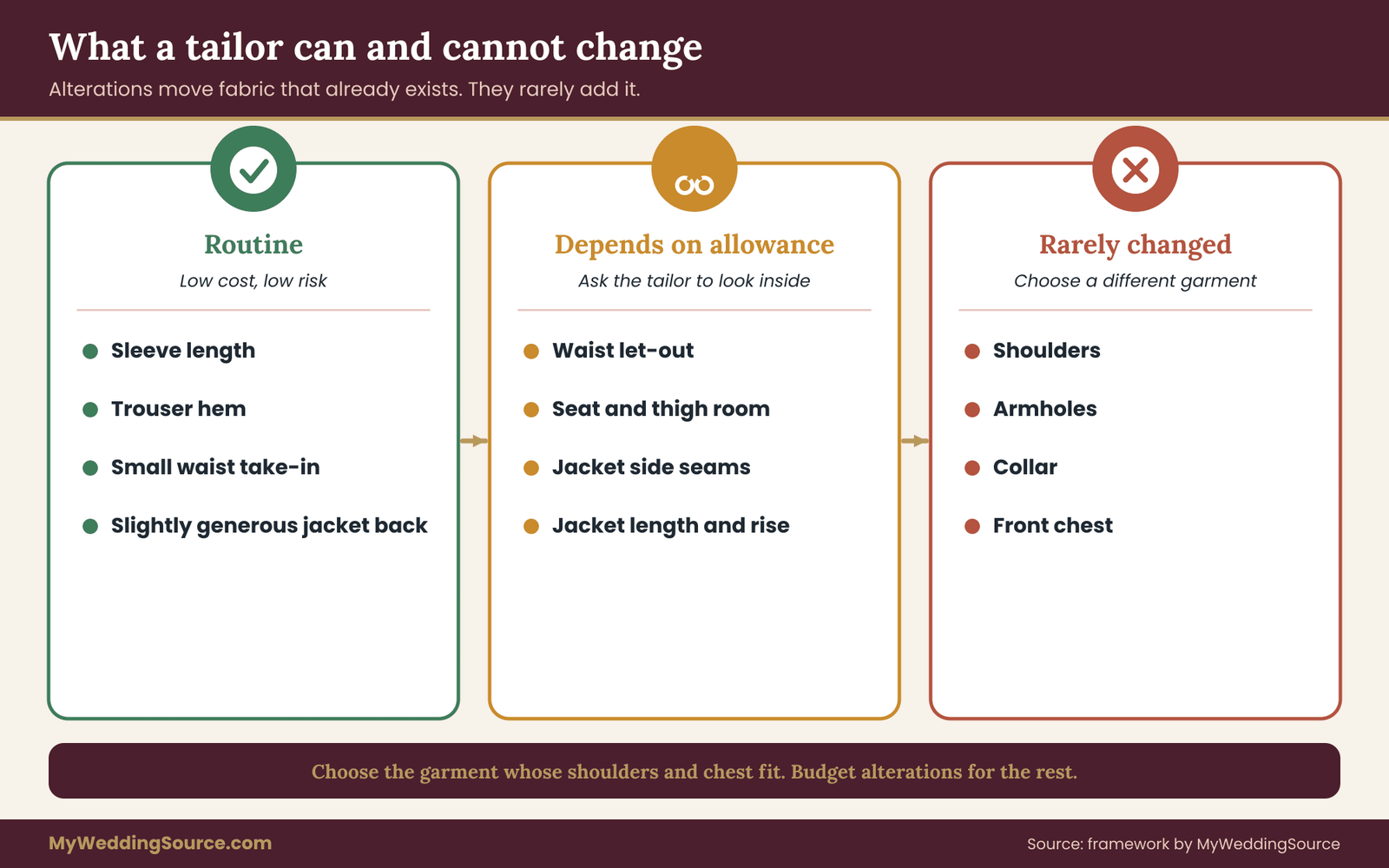
The approach rests on one idea. Alterations subtract or move fabric that already exists. They rarely add fabric that is not there. A plus size groom therefore gets the best result by choosing the starting garment carefully, rather than by hoping a tailor can rescue a poor start. That sounds obvious, but it changes the order of the work: measure first, choose the path second, order third, alter last.
Throughout, you will see the phrase “feasibility sheet.” It is a one-page record you fill in yourself: twelve body measurements, the matching garment measurements, the difference between them, and a color for each line. Green means the tailor can handle it routinely. Amber means it depends on the garment and the tailor. Red means choose a different garment. The sheet is a tool for conversation with sellers, not a test your body has to pass. Any body can be dressed well; the sheet just shows which garments suit which body.
A note on scope. This is general information, not legal, tax or financial advice, and fabric, fit and pricing vary by maker and by tailor. Where a rule or policy matters, the article tells you what to ask the seller to put in writing, and points to the agency that publishes the rule so you can check the current version yourself.
What plus size groom suit tailoring involves
Tailoring covers three different jobs that people lump together, and the same logic applies to a partner’s outfit, which the wedding dress fit and alterations guide covers from the dress side. Knowing which one you are paying for keeps the conversation with a seller honest.
The first job is hemming and shortening: trouser length, sleeve length, sometimes jacket length. These changes remove fabric from an edge, so they are low risk and widely offered. The second job is adjusting: taking in or letting out seams at the waist, seat, thighs, sides and back. These changes depend on how much seam allowance the maker left inside the garment, and on how the cloth and lining are built. The third job is reconstruction: moving shoulders, resetting sleeves, recutting a collar, changing the chest. This work is slow, costly, and sometimes impossible. Many tailors decline it outright.
For a plus size groom, the middle job matters most. Larger bodies often sit between standard garment proportions. A man may need a jacket sized for his chest and shoulders, with a trouser waist that is bigger than the jacket’s matching trousers would give. He may need a chest that is generous and a back that is narrower than the chest suggests. Adjusting is where the difference is made.
The limit that shapes every choice
Every garment has a ceiling and a floor. The floor is how much it can be taken in. The ceiling is how much it can be let out, and the ceiling is the one that catches people. Trousers made for a smaller waist often have only a narrow strip of spare fabric in the waistband and center-back seam.
A jacket made for a narrower chest may have a tiny allowance at the side seams and almost none across the shoulders. When a seller says “we can let it out,” the right follow-up is “by how much, and where did you measure that allowance?”
This is why the plus size groom suit tailoring conversation should start with the garment, not the person. Your body is not the variable that needs fixing. The garment’s available fabric is the variable that needs checking.
Who this guide is for
It is written for plus size grooms who wear larger sizes, for partners and relatives helping with the purchase, and for tailors or sellers who want a shared vocabulary with a client. It assumes a wedding suit or tuxedo bought, made or rented for a date at least a few months away. It does not try to cover every cut or every fabric; it covers the decisions where size changes the answer.
It also does not judge your size. Words like “husky,” “portly” and “stout” appear on some size charts and in some shop signs. Treat them as labels for a cut, not as a verdict on you. What matters is the numbers, so the sheet uses numbers.
Why plus size groom suit alterations fail, and how to avoid it
Alteration problems follow a small number of patterns. Seeing them in advance lets you avoid most of them.
The garment was chosen to close, not to fit. A jacket that buttons while pulling across the middle is not a fit that a tailor can relax. The strain shows as folds that radiate from the button, and the same strain appears across the back and under the arms. The right test is whether the jacket lies flat when buttoned and relaxed, not whether it closes.
The tailor was asked for something the seams could not give. Let-out requests fail when the allowance is smaller than the change needed. A seller should tell you this before you buy, and a good tailor will tell you after a quick look inside the garment. If nobody has looked inside the garment, nobody has answered the question.
The order was placed before the measurements were stable. Bodies change in the months before a wedding. Some plus size grooms lose weight on purpose, some gain it through stress or inactivity, and some change shape through training. If the order comes first and the change comes later, the alterations pile up. A later section gives a timing rule for this.
Nobody owned the deadline. A suit has a dozen steps, each with a lead time. Without a calendar, the last fitting lands in the week of the wedding and any problem becomes an emergency. Ask for each promise and date in writing, as the wedding vendor contract guide explains, and work backward from the wedding date.
The three questions behind the sheet
Everything in the feasibility sheet answers three questions. The first is: what are my real measurements today? The second is: what are the garment’s real measurements and allowances? The third is: what is the gap, and can this tailor close it for this price by this date?
If you can answer all three in writing before ordering, you have done more than most people do. If you cannot, you know what to ask for.
The questions are deliberately practical. They do not ask whether a particular body is difficult to dress, because the answer is always the same: no body is difficult, some garments are poor matches. A plus size groom who understands this stops negotiating from a position of apology and starts negotiating from a position of information.
Setting expectations about “perfect”
A well-altered garment fits the body in a way that looks intentional in photographs and feels comfortable for a long day. It does not fit like a second skin, and it does not need to. Wedding days involve standing, sitting, hugging, dancing and raising an arm for a toast. A jacket that looks sharp in a mirror but restricts the shoulders when you hug someone has failed the day’s real test.
So the target for plus size groom suit tailoring is “fits at rest, moves without pulling, and leaves room for a full meal.” Each part of the sheet works toward that target. A later section turns those words into tests you can perform in a shop.
One more expectation worth setting: compromise is normal. A garment may fit the chest and shoulders well and need a larger waist adjustment than you would like. You may decide the trade is worth it. The sheet makes the trade visible instead of hiding it in a fitting-room moment.
How to measure a plus size groom accurately
Good plus size groom suit tailoring begins with numbers you trust. Measurements taken in a hurry, over bulky clothes, or by a salesperson who is also trying to close a sale are the weakest link in most orders. You can take better ones yourself in about twenty minutes, and you should then compare them with whatever the seller records.
For a plus size groom, the goal is not to replace a professional fitter. It is to have your own set of figures so that you can notice when the seller’s differ, and so that you can ask why.
Set up the measuring session
Use a soft tape measure with both inch and centimeter markings, and decide on one unit before you start. Mixing units is a common source of errors. Wear thin, close-fitting clothes such as a t-shirt and lightweight trousers, or underwear for the trouser measurements if you prefer. Remove keys, phone and wallet from pockets. Stand on a hard floor in the shoes you plan to wear with the suit, or in bare feet for inseam and then note the shoe height.
Ask someone to help, and to write down each number as it is read. Some measurements, such as shoulder width and back length, cannot be done accurately alone. A friend, partner or family member can do this in a few minutes. The measurer should stand still and read the tape at eye level.
Stand naturally. Do not suck in your stomach, and do not stand rigidly upright like a soldier. A plus size groom suit has to fit the body you will have on the day, standing relaxed, sitting, and moving. If you measure a posture you cannot hold, the garment will fit a posture you do not have.
Take each measurement twice. If the two readings differ by more than a quarter inch, take a third. Write all readings down. The habit seems fussy until the day a tailor’s number and yours disagree and you can show your own record.
The twelve measurements
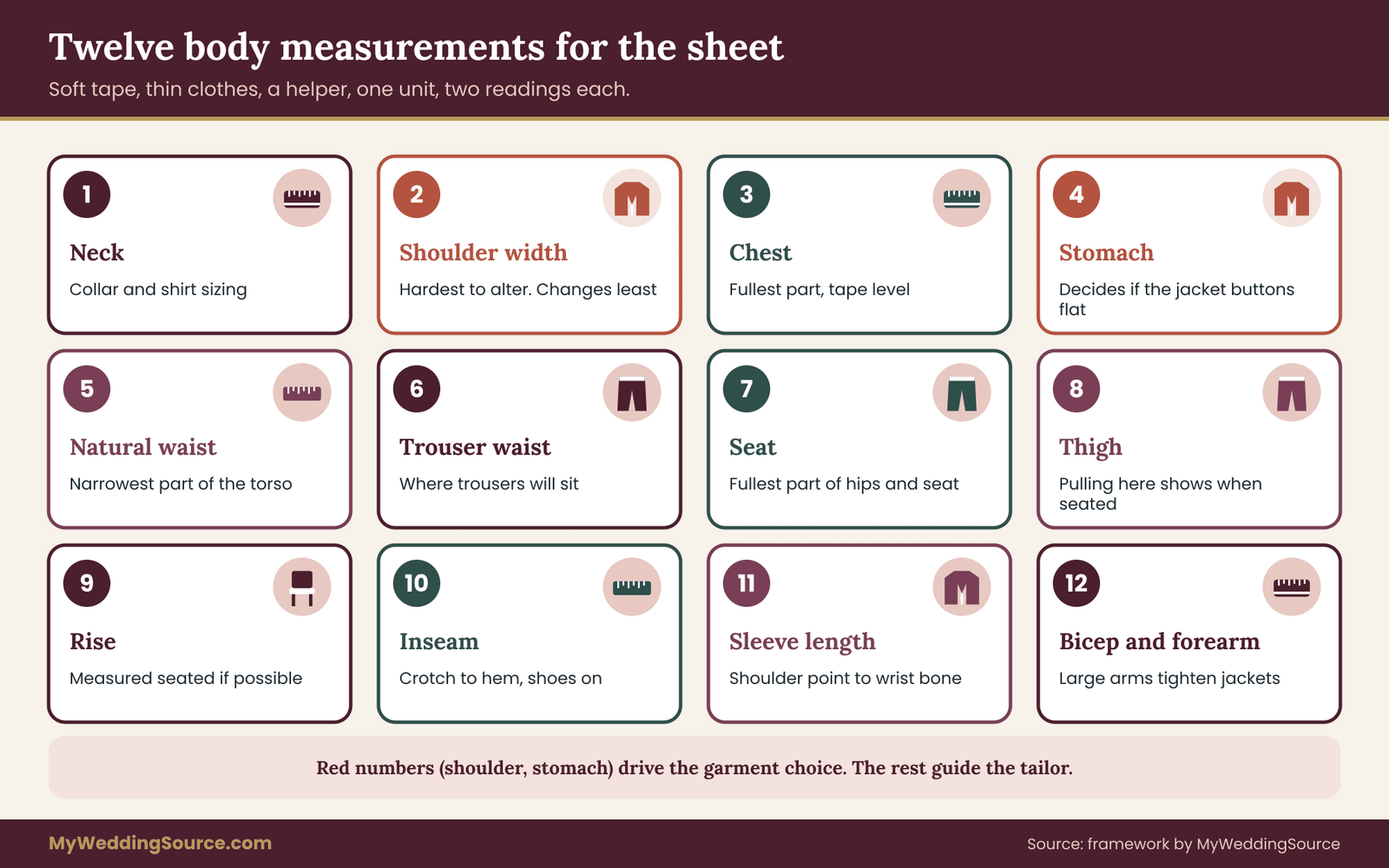
The sheet uses twelve body points. Each one matters for a reason that is worth understanding, because you will be asked about them in shops.
Neck. Measure around the base of the neck, at the point where a collar would sit, leaving a finger’s width of ease. This feeds shirt sizing, and the shirt collar also affects how a jacket collar sits. A separate guide on this site covers collar gaps in photos, which is worth reading alongside this one.
Shoulder width. Measure from the edge of one shoulder bone across the back to the edge of the other. This is the measurement that matters most and changes least. Jacket shoulders are the hardest part of a suit to alter, so a mismatch here usually means a different jacket, not a different tailor.
Chest. Measure around the fullest part of the chest, under the arms and across the shoulder blades, with the tape level. Breathe normally.
Stomach. Measure around the fullest point of the stomach, which for many plus size men is lower and wider than the chest at the jacket’s button line. This is the number that tells you whether a jacket will button without pulling.
Natural waist. Measure around the narrowest part of the torso, or if there is no clear narrowing, at the level of the navel. This is not the same as the number printed in your current trousers, and it is rarely the same as where you wear your belt.
Trouser waist. Measure where the trousers will actually sit. Many larger men wear trousers below the natural waist, and many tailors cut suit trousers to sit at or above it. Decide which you want and measure that line.
Seat. Measure around the fullest part of the hips and seat. This number often drives how much room the trousers need in the back and why some trousers pull at the center seam.
Thigh. Measure around the fullest part of one thigh, near the crotch. Tight thighs make trousers pull in the front when you sit.
Rise. Measure from the crotch seam up to the waistline you chose, while seated on a firm chair if possible. Rise decides comfort when sitting more than any other single measurement.
Inseam. Measure from the crotch to the point where the trouser hem will end, with shoes on. The hem length is a style decision, and the next sections come back to it.
Sleeve length. Measure from the shoulder point over a slightly bent elbow to the wrist bone. Your jacket sleeve should usually end near the wrist bone, with shirt cuff showing slightly. The shirt cuff and the jacket sleeve are separate decisions.
Bicep and forearm. Measure around the fullest part of the upper arm and, if you want, the forearm. Large arms, from build or training, are a frequent reason jackets feel tight even when the chest is fine. Two measurements are listed as one line on the sheet because they belong together.
What a plus size groom’s numbers tell you immediately
Before you compare anything with garments, compare the numbers with each other. Two relationships matter more than the rest.
The first is the difference between chest and stomach. If the stomach is larger than the chest, a standard jacket cut will pull across the middle even when the chest fits. This is common for a plus size groom, and it is a pattern many makers handle with specific cuts. It is also a pattern where an off-the-rack jacket chosen by chest size alone fails.
The second is the difference between chest and waist. In suit sizing, the “drop” is the difference between the jacket’s chest size and the size of the matching trousers’ waist.
A standard garment has a fixed drop, so a man whose chest-to-waist difference is much smaller than that drop will find that jacket and trousers do not come from the same size. The practical answer for a plus size groom is to buy jacket and trousers separately when possible, or to choose a seller who offers a different drop. Ask each seller what drop their garments use, and whether they sell jacket and trousers in different sizes.
You do not have to calculate any of this from a formula. You have to know your own numbers and ask the seller for theirs.
Posture and symmetry notes for a plus size groom
Add three more lines to the sheet, which are not numbers but observations. Write down whether your shoulders are level or one is lower. Write down whether you stand with your head forward, or lean back to balance your stomach. And write down whether you hold one hip higher.
These notes matter because the tailor sees them within seconds, and a good tailor will adjust for them. A lower right shoulder, for example, may need padding on one side or a different sleeve pitch. If you tell the seller, you save a fitting round. If you do not, you may spend that round finding out.
A photograph helps. Ask your helper to take one from the front, one from the side and one from the back in your thin clothes, with your permission and for your own record only. These pictures are for you and the tailor. You do not need to share them elsewhere. Some people find this uncomfortable, and that is fine; the written notes carry most of the value.
Compare your numbers with the seller’s
When a seller measures you, ask to see the recorded numbers. Compare each against yours. A difference of a quarter inch is within normal reading variation. A difference of an inch or more in shoulder, chest or stomach is a reason to ask whether the seller measured over clothes, whether the tape was level, and whether they measured the body or the garment.
This matters because some retailers use “garment measurements,” meaning the finished size of the sample they put on you, rather than body measurements. Garment measurements include ease, which is extra room built into the cloth. A seller who says “you are a 54” may be telling you which sample fits best, not what your body measures. Ask which one you are being told.
For standards on how bodies are measured, the International Organization for Standardization and ASTM International both publish body-measurement standards, and national health surveys publish methods for measuring chest, waist and hip. You do not need to read them. You do need to know that a consistent method exists, and that a seller who cannot describe theirs is guessing.
When a plus size groom’s measurements may still change
Record the date next to your numbers. If you expect your weight or build to change before the wedding, whether by choice, by medication, by training or by life, write that on the sheet too. A later section explains how to handle this, but the starting rule is easy: the closer the order is to the wedding, the less time your body has to change after the garment is cut. A made-to-order suit ordered months early is riskier for a plus size groom whose weight is moving than a purchase made close to the date with room for alterations.
For a plus size groom the date question has a second part: many makers charge for remakes, and many tailors can only take in, not let out. If your weight may go up, ask for the larger allowance. If it may go down, ask for the opposite. Telling the seller this in advance is not an embarrassment. It is useful information, the kind a tailor asks about anyway.
The feasibility sheet for plus size groom suit tailoring
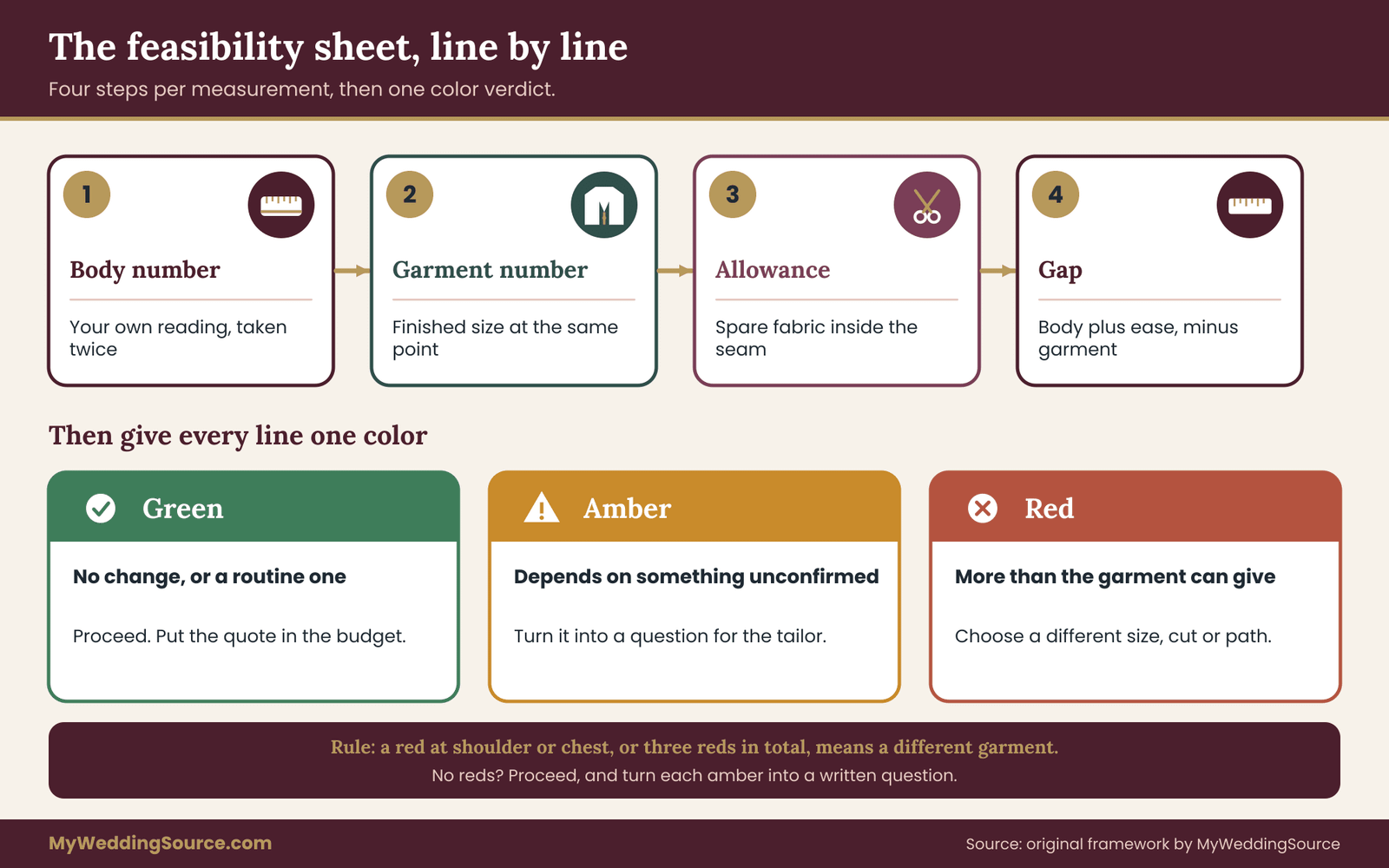
Here is the original tool of this guide for any plus size groom. The feasibility sheet is a one-page record, with one line per measurement, built from four columns: your body number, the garment’s matching number, the gap between them, and the verdict. You can draw it on paper or in a notes app. The point of the layout is that every number is written next to its comparison, so the decision is visible before you pay.
How to fill in each line
Start with the body column. Copy the twelve numbers from the previous section.
Next, ask the seller or maker for the garment’s finished measurements at the same points. For jackets, these are usually chest, waist, shoulder, sleeve length and jacket length. For trousers, they are waist, seat, thigh, rise and inseam. Some sellers publish a size chart. Others will measure a sample on request. A garment you can pick up and measure yourself with a tape is the most reliable source. If you cannot get these numbers, write “unknown” in the column, and treat that line as amber until it is known.
Then ask where the spare fabric is. This is the allowance column. For each line where the garment might need to grow, ask how much fabric is inside the seam. A tailor opens the seam, or feels the allowance with fingers, and reports it. A seller reading from a chart cannot answer this, so ask the tailor.
Last, write the gap. The gap is the body number plus the ease you want, minus the garment number. If the gap is zero or the garment is larger than needed, the line is simple. If the garment is smaller, the gap is the amount the tailor must add, and the allowance must be at least that much.
The three colors
Green means the line needs no change, or only a change a tailor makes routinely: shortening sleeves, hemming trousers, small waist take-ins, reshaping the back of a jacket that is slightly generous. Green lines cost a plus size groom little and carry little risk.
Amber means the line depends on something you have not confirmed yet. It might be a let-out that needs checking against the allowance, a seat or thigh adjustment on trousers with a narrow back seam, or a jacket whose lining makes side seam changes difficult. Amber lines are the ones to ask questions about. Many amber lines turn green when a tailor looks inside the garment.
Red means the change needed is larger than the garment’s available fabric or touches a part that tailors rarely change: shoulders, armholes, collar, or a chest that is smaller than the body by more than the side seams can give. Red is not a failure of the plus size groom wearing it. It is a verdict on that garment. For a plus size groom, a red line in shoulder or chest is a reason to look at a different size, a different maker, or a different path.
The scoring rule
Count the lines. Three reds, or a red in shoulder or chest, means choose a different garment. One or two reds elsewhere means ask whether the maker can build that part from scratch, which is a made-to-measure or made-to-order question. No reds and some ambers means proceed, with the ambers turned into questions for the tailor.
You will notice the rule gives shoulder and chest special weight. That is deliberate. A jacket’s structure, including its canvas, padding, armholes and collar, is built around those two measurements. A tailor can adjust a trouser waist or a sleeve length with straightforward work. Changing the structure of the upper body of a jacket usually means taking it apart, and many shops will not do it at any price they would charge for ordinary alterations.
Why a sheet beats a feeling for a plus size groom
It is tempting to rely on how a garment feels in the fitting room. Feelings are useful, but they miss two things. The first is that the fitting-room jacket is often held shut with clips or pins, and you may not see the seams being asked to do something they cannot do. The second is that a salesperson who is paid on completed sales has a stake in the answer, even when they are honest.
A sheet slows the conversation by about five minutes and protects you from the most expensive kind of mistake, which is paying for a garment that cannot be made to fit. For many plus size groom suit tailoring decisions, those five minutes are the entire difference between a calm fitting schedule and a week of panic.
Reading seams, allowances and the jacket drop for a plus size groom
The sheet’s allowance column depends on knowing what to look for. You do not have to be a tailor, but a few facts help you ask good questions and understand the answers.
Seam allowance in plain terms
Where two pieces of cloth are sewn together, the maker leaves a strip of extra fabric beyond the stitch line. That strip is the seam allowance. In trousers it is found at the waistband, the center-back seam, the side seams and the inseam. In jackets it is found at the side seams, the back seams and the sleeve seams. The wider the strip, the more a tailor can let the seam out.
Makers decide how much allowance to leave. Some leave generous allowances, especially in garments intended for adjusting. Others leave only what the machine needs, because less fabric means a lower production cost. Allowance is rarely printed anywhere, so a tailor finds it by looking inside.
A useful habit: before buying, ask whether the seller will let a tailor check the waistband and back seam of the trousers, and the side seams of the jacket, and tell you in writing how much is available. A seller who refuses may not know, or may know the answer is poor.
Where fabric is hiding
Different parts of a suit hide spare fabric in different places. The most common places a tailor looks are the center-back seam of the trousers, where a “waist let-out” is usually made; the waistband itself, where extra length is sometimes folded in; the side seams of the jacket, which can often give a small amount; and the sleeve hem, which gives length but not width.
The places a tailor usually cannot find spare fabric are the shoulder, the armhole, the collar and the front chest. These are cut precisely, are often reinforced, and have no hidden strip. This is the structural reason the scoring rule treats them as red.
Also consider the lining. Linings are cut to fit the shell, so letting out a shell seam also means letting out the lining, which adds labor. A jacket with a fully built lining costs more to alter than a half-lined one. Ask the tailor, not the salesperson, how that affects the price.
Understanding the drop
Suit sizes are often sold as pairs. A garment marked with a chest number comes with trousers whose waist is a fixed number of inches smaller. That fixed number is the drop. A common arrangement in ready-made suits uses a drop of several inches, but makers differ, and some use a smaller drop for larger sizes. Do not rely on a figure from a general article, including this one. Ask the seller to state the drop in writing.
The drop matters to a plus size groom because many larger men have a waist closer to the chest measurement than the standard drop assumes. A jacket that fits across the shoulders and chest comes with trousers that are too small. If the seller sells jackets and trousers as a set only, you may need to buy the trousers a size or more up, then ask the tailor to take in the seat and thighs. If the seller sells separates, you can buy each part in the size that fits that part.
Two practical points follow. First, choose the jacket by shoulders and chest, then choose the trousers by waist, seat and thigh. Second, if the seller says separates are not possible, ask whether the jacket and trousers can be sized differently at no extra cost, and have that in writing.
Fabric, stretch and cloth weight
The cloth itself affects how far a plus size groom suit can be pushed. Fabrics with a small amount of elastic fiber give slightly under strain, while firm wool and linen do not. Stretch blends can feel more comfortable on a day with a lot of movement, but they do not create seam allowance, and a stretched seam can wear or show strain over time.
Cloth weight affects heat and drape. A heavier cloth drapes well and hides some wrinkling, but holds more warmth on a summer day. A lighter cloth breathes but shows creases more. If your wedding is outdoors or in warm weather, the cloth decision affects comfort at least as much as the cut. The general rule for warm-weather cloth is simple: choose a cloth that you could stand in for an hour without feeling that you are wrapped in it.
Do not assume a fiber label tells the whole story. Textile labeling rules in the United States require a fiber content label, and the Federal Trade Commission publishes guidance on it, but a label does not say how a given cloth drapes or how much it will relax. Touch it, move in it, and sit in it.
Choosing a path: six ways to buy a suit when sizes run large
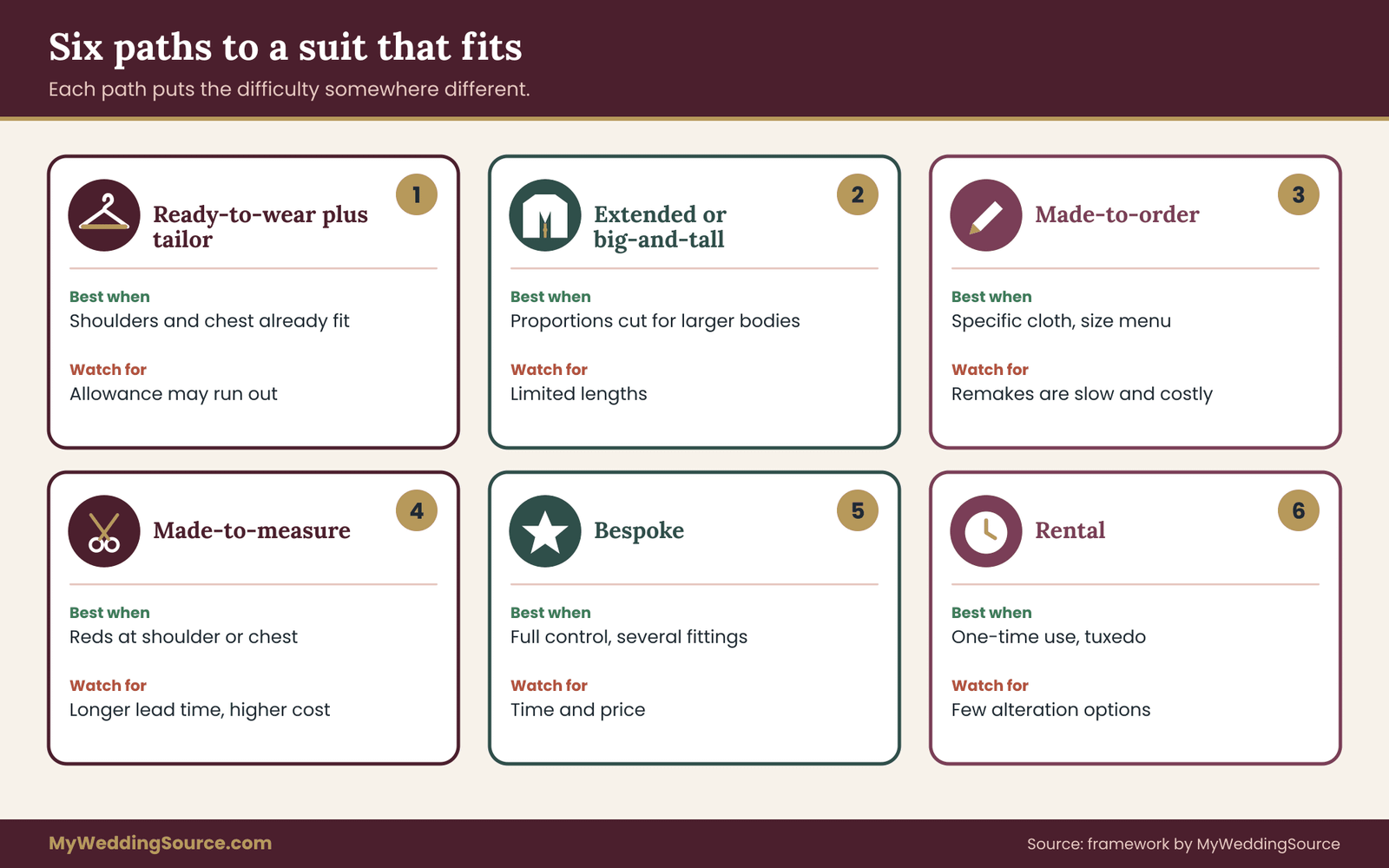
With a filled sheet in hand, you can compare the ways of getting a suit. Each path puts the difficulty in a different place for a plus size groom. None is automatically best. The right one for a plus size groom depends on the date, the budget, how much the body might change, and how many reds appeared on the sheet.
Path one: ready-to-wear with alterations
This is the standard shop purchase: pick a size from the rack or the sizing wall, then have a tailor adjust it. It is the fastest and often the cheapest route. It works best when the sheet shows green on shoulders and chest and green or amber elsewhere. It works poorly when the garment’s ceiling is lower than your measurements.
The risk is that the tailor inherits whatever the factory left. If the shoulders fit and the waist needs work, the path is excellent. If the shoulders do not fit, no alteration budget fixes that. For a plus size groom shopping a standard range, the sheet’s main use here is to stop you from buying the first jacket that closes.
Questions for the tailor: Which lines will you adjust, and what is the price for each? Can you open the seams and tell me the allowance before I buy? What happens if the alteration does not work?
Path two: extended or big-and-tall ranges
Some makers cut larger sizes on purpose, with proportions designed for bigger bodies rather than a standard pattern scaled up. These ranges often use different drops, longer rises, and more room across the back and stomach. The garments may suit a plus size groom whose proportions fall outside standard cuts.
Check the details rather than the label. Ask for the garment’s published measurements, the drop, and whether jacket and trousers can be bought in different sizes. Ask whether the size range stocks the length you need. Some extended ranges offer limited lengths, so a shorter or taller groom may still be between sizes.
This path usually needs less alteration but does not remove the need for it. Expect to have sleeves and hems adjusted, and plan for a fitting.
Path three: made-to-order
Made-to-order starts from a standard pattern, modified from a menu of choices: sizes in specific ranges, lengths, a choice of cloth and style details. The maker produces the garment after you order. This sits between ready-to-wear and fully custom.
It helps when you need a particular cloth or color that stores do not stock, or when the extended sizes you need are only produced to order. It is less helpful if your body does not match the pattern. Ask the maker how far the pattern can be modified, and which of your sheet’s lines it can address. If the sheet shows reds in shoulder or chest, ask whether the pattern allows a different size in those places.
The main risks are lead time and returns. Garments cut to order are often non-refundable, and a mistake means a remake with its own wait. The section on money and contracts below covers this, and a broader checklist for these terms appears there.
Path four: made-to-measure
Made-to-measure alters a base pattern to your individual measurements. A fitter measures you, usually at a fitting, and the maker adjusts a block pattern for your shoulders, chest, stomach, waist, seat and so on, then cuts the garment. A trial garment is often supplied for fitting before the final one is made.
This path is where reds on the sheet most often turn green. Because the pattern is modified for you, a mismatch in shoulders or chest is something the maker can address at the start, rather than something a tailor must undo later. It suits a plus size groom with an uncommon build, or one whose sheet shows several mismatches in a standard range.
It does cost a plus size groom more and take longer. A first fitting may take place weeks after the measuring session, and a second fitting after the garment is made. If the date is near, check whether the maker’s schedule leaves room for a remake. Ask for the lead time from order to first fitting, from first fitting to final garment, and from final garment to the wedding date.
Path five: bespoke
Bespoke means a pattern drawn from scratch for you, with several fittings during construction. It offers the most control and the highest cost, and requires a long lead time. For most weddings, it is more than the situation needs, though some plus size grooms choose it deliberately for a garment they plan to wear for years.
If you are considering this path, plan well ahead of the date, ask how many fittings the price includes, and look at work the tailor has made for other clients. Be careful with the word itself. Some sellers use “bespoke” loosely for what is really made-to-measure. Ask who cuts the pattern and how many fittings are included.
Path six: rental
Rental can be a fair choice for a plus size groom, especially for a one-time use or a tuxedo. The same measurements and sheet apply, though alteration options are narrower: rental shops usually offer sleeve and hem adjustments and little else. Rental garments are often built with fixed allowances because they have to fit many different clients.
The key questions for a plus size groom are whether the rental range covers your chest, stomach and shoulder in the same garment, whether trousers can be sized separately, whether the shop alters at all, and what happens if the garment does not fit on the day. Ask for the fitting date and the return deadline. A guide on renting wedding items covers return and damage terms that apply to suits as well as other rentals.
Pre-owned and borrowed suits for a plus size groom
A used suit or a borrowed one can be a sound choice when it matches the sheet. It is also the path where allowance checking matters most, because the garment has already been altered, and the allowance may have been used. Ask a tailor to look inside before you buy. A jacket that was taken in for a previous owner may have nothing left to let out.
For borrowed garments, remember that the seams are not yours to cut. Agree with the lender about what alterations are acceptable, and whether the garment must be returned in its original form.
Choosing among paths for plus size groom suit tailoring
Here is a decision rule that uses the sheet. Count reds. With none, choose the cheapest path that gives a lead time with room for two fittings: usually ready-to-wear with alterations, an extended range, or a rental. With one or two reds in places that tailors can reach, move up to made-to-order or a different maker’s cut. With a red at shoulder or chest, or three or more reds in total, move to made-to-measure.
Then check the date. If fewer than a few months remain, confirm that the path’s lead time leaves room for a remake. If it does not, a ready-to-wear or extended-range garment with early alterations may be safer than a made-to-measure order that cannot be corrected in time.
Notice what this rule does not do. It does not tell the plus size groom to spend more. It tells the plus size groom to spend where the sheet shows a problem. A plus size groom whose body fits an extended range may get a fine result from a modest alteration budget, and there is nothing second-rate about that.
A word on budgets for plus size groom suit tailoring
Cost differences between paths are real but vary by region, maker and cloth, and this guide does not quote prices. Instead, collect two or three written quotes for the same list of alterations, and compare the total of purchase price plus alterations plus fitting fees. A cheap garment with large alterations can cost more than a mid-priced garment that needs only a hem. Put the totals into your wedding budget before committing.
If the suit is part of a larger set of outfit costs, such as shoes, shirt, belt or braces, and cufflinks, list each so that the total is honest. Alteration costs are the line most often forgotten at the start and most often surprising at the end.
Questions to ask before ordering a plus size groom suit
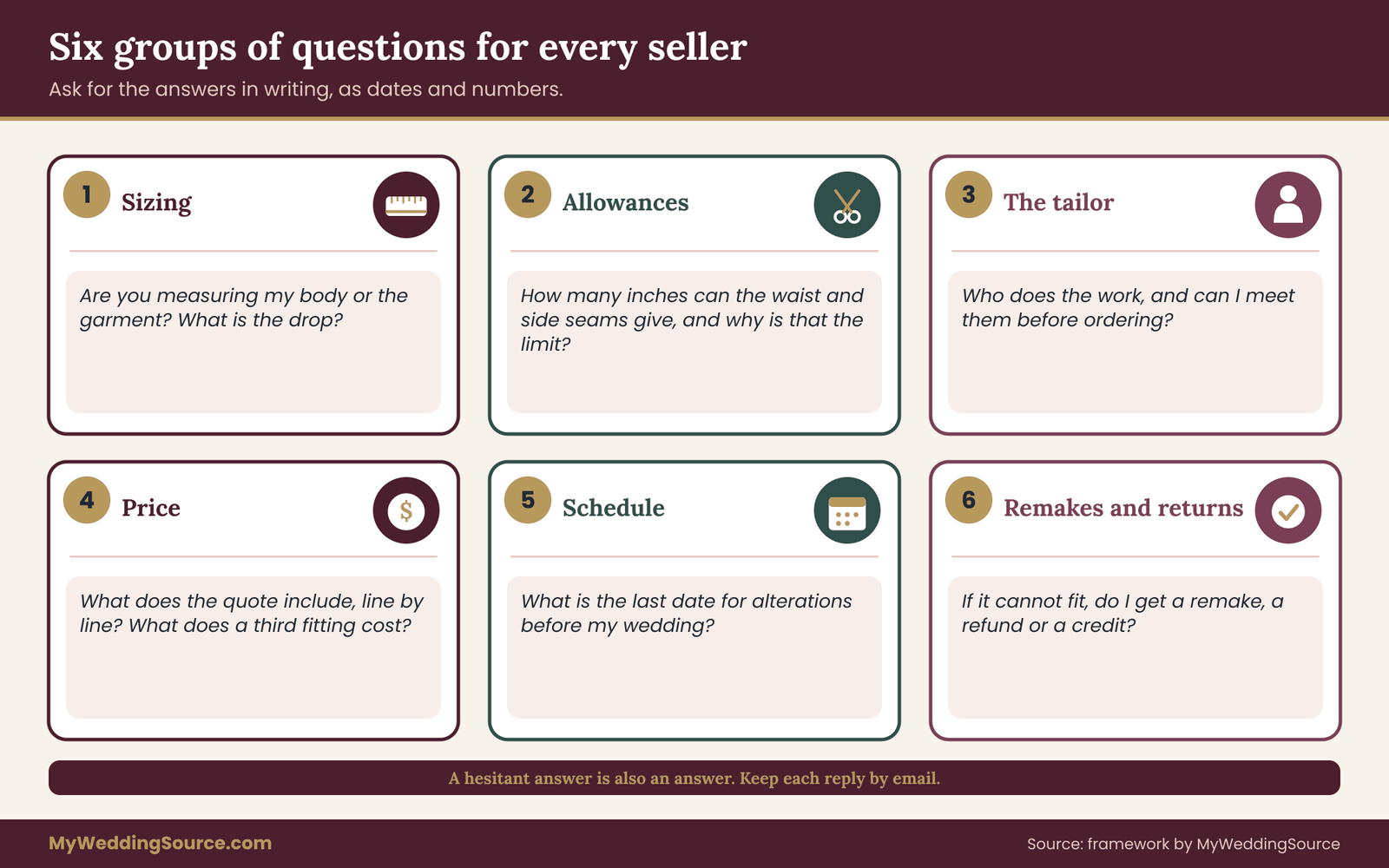
This section is the practical core of any plus size groom suit tailoring purchase. Take it to the shop, or send it to the seller before you visit. Ask for answers in writing, as an email reply or notes on the order form. A good seller is glad to put answers in writing, and a hesitant seller tells you something by hesitating.
The questions are grouped by what they protect. Each group has a reason, so that you can adapt the wording to the situation.
Questions about sizing and the garment
Which size system do you use, and are you measuring my body or the garment? What is the drop between jacket and trousers, and can I buy them in different sizes at the same price? What are the finished measurements of this garment at the chest, stomach, waist, shoulder, sleeve and seat? Do you stock the length I need, or would a different length require ordering?
These questions place the garment on your sheet. If the seller cannot answer, ask who can: the tailor, the maker’s customer service, or a manager. If nobody can answer, treat every line as amber.
Questions about allowances and what can change
How much fabric is inside the waistband and center-back seam of these trousers? How much is at the jacket’s side seams? Which parts can your tailor not change on this garment? Has this garment been altered before? Can I see the inside?
The most useful question is the third. A tailor who says “I would not touch the shoulders or the collar, but waist, sleeves and length are fine” is telling you the garment’s real limits. A tailor who says “we can do anything” has not looked.
Notice the phrasing. Asking “can you let out the waist?” invites a yes. Asking “by how many inches can you let out the waist, and what makes that the limit?” invites an answer you can write on the sheet.
Questions about the tailor for a plus size groom
Who does the alterations: in-house, a partner, or an outside contractor? How much experience does that person have with larger sizes, or with the specific kind of change I need? Can I speak with the tailor before I order? Will the same tailor do all fittings?
It is reasonable to ask to meet the tailor. Not every shop allows it, but a shop that does is signaling confidence. If the person doing the work is different at each fitting, ask who is accountable for the final result.
Questions about price and what it covers
What does the alteration quote include, line by line? Does it cover two fittings or one? What is the fee if I need a third? Is there an extra charge for let-outs, for lined garments, or for rush work? What is the total, including taxes and any pressing or steaming at pickup?
Ask for the quote as a list, not a single figure, so that you can compare it with other quotes. Put the total in the budget. If you are paying in installments, a page on cash-flow planning shows how to space deposits and balances so that a late tailor bill does not collide with other payments.
Questions about schedule and deadlines for plus size groom suit tailoring
When is the first fitting available, and how long after it will the garment be ready? How many days does an alteration normally take? What is the last date by which you can complete alterations and still meet my wedding date? What happens if the garment arrives late?
Write the answers as dates, not as durations. “Three weeks” means little until it is attached to a calendar. A date for each step turns the answer into something that you can check.
Questions about remakes, returns and problems
If the garment cannot be made to fit, what do I get: a remake, a refund, a credit, or nothing? Is there a deadline after which a remake is not possible? Are custom or made-to-order garments refundable? Who pays shipping if the garment must go back? What do you do if the tailor’s work is wrong, as distinct from the garment being the wrong size?
This group matters most to a plus size groom buying expensive garments and for anything ordered from a distance. The Federal Trade Commission publishes rules on how sellers must handle orders placed by mail, phone or the internet, including shipping times and what a seller must tell you if there is a delay. A seller’s own policy may go beyond those rules, but should not fall below them. Ask where the policy is stated, and keep a copy.
A short script for a hesitant seller
Some sellers deflect with “we will take care of you.” A calm, specific reply works better than pressure. For example: “I would like to see the allowance in the trousers and the jacket’s side seams before I buy, and have the tailor’s note on it. Can we do that today, or can you send it by email?” If the answer is no, you can say, “Then I will treat those lines as uncertain and compare with another shop.” That is not rude. It is the same thing a careful buyer does with any significant purchase.
For documentation habits during the buying process, keep a copy of every written promise, and ask the seller to confirm each answer by email.
The fitting schedule, and what to do if your weight changes
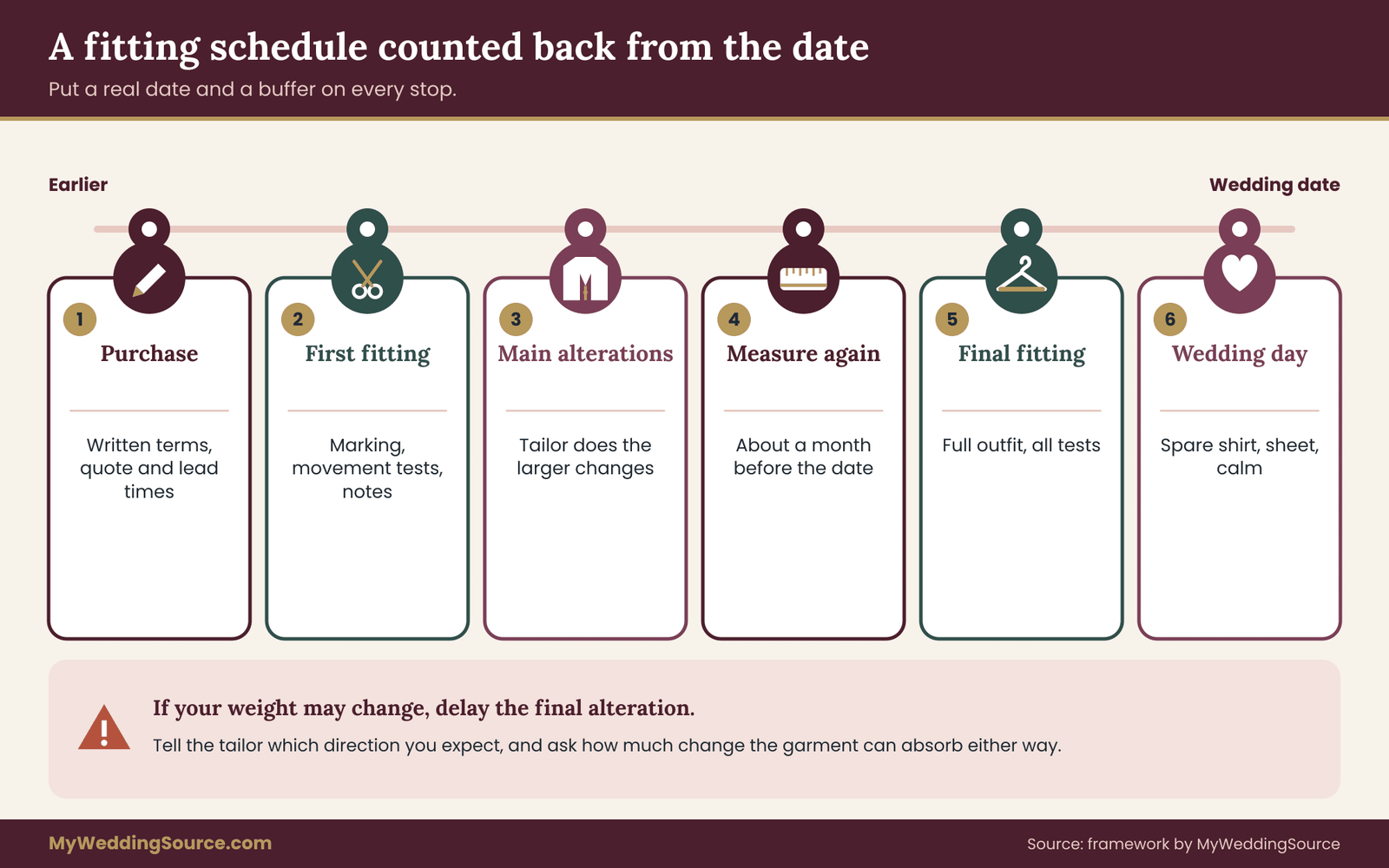
A plus size groom suit needs time to be adjusted correctly. Alterations that are rushed in the last week tend to be rushed twice, because a problem found late leaves no room to correct it. This section builds a schedule backward from the wedding date.
Work backward from the date
Start with the wedding date and move back in four stops. The final fitting, when you wear the whole outfit with shirt, shoes and belt or braces, should happen with enough days left for small corrections, which are usually quick. Before it comes the main alteration fitting, where the tailor makes the major changes. Before that is the first fitting, where the tailor marks and measures and you walk, sit and raise your arms. Before that is the purchase, which must leave room for the whole chain.
Put real dates on each stop. The seller’s answers to the schedule questions above give the lead times. Add a buffer between stops, because delays are common and mistakes need time to fix. The wedding vendor timeline page offers a useful model for turning many dates into one calendar.
What a plus size groom should bring to each fitting
Bring the shirt, shoes, belt or braces, and any accessories that affect fit, such as a vest, a pocket square or a watch. A garment fitted without them may fit differently with them. Bring your sheet, so the tailor can see which lines were flagged and what was agreed.
Eat and drink normally before the fitting. A fitting on an empty stomach may produce a different result than a fitting on a typical day. Wear the same undergarments you will wear at the wedding.
At each fitting, perform the movement tests. Raise both arms forward, as if reaching for a hug. Sit on a chair with your knees bent and see whether the trousers pull. Bend slightly forward and check the back of the jacket. Turn your head both ways and check the collar. If anything feels restrictive, say so while the tailor is still present and still has the garment marked.
When a plus size groom’s weight is likely to change
Weight can move up or down for reasons unrelated to the wedding: medication, training, illness recovery, stress. If your weight is changing, tell the seller and tailor. Do not hide it. They need it to choose the right approach.
A workable rule: if you expect to be a different size by the wedding, fit the garment to the size you will be on the day, not the size you are at the first fitting. That is easy to say and harder to do, because you do not know the future size exactly. So choose a path and a schedule that allow adjustment. Made-to-order and made-to-measure garments cut on a date far ahead of the wedding are riskier than garments bought later or altered later.
Ask the tailor how much change the garment can absorb in each direction. A trouser waist may be taken in more easily than let out, and a jacket may take in at the sides within a limit. The tailor’s answer becomes a range, such as “I can handle a change in this direction but not that one.” Write the range on the sheet.
Plan a last measuring session about a month before the date. Compare the new numbers with those on the sheet. If any line has moved enough to change its color, the tailor needs to know while there is still time. A change of a few pounds rarely matters. A change that moves your stomach or chest measurement by an inch or more is worth a call.
Avoid changing course at the end
Some plus size grooms start a diet or a training program with the wedding as the goal, and then adjust expectations as the date approaches. If that is you, plan for either outcome. Ask for the larger allowance, and consider holding the final alteration until the last fitting before the date. This costs nothing extra in most shops and avoids paying twice.
The aim is to protect the plus size groom from a cycle of surprise alterations. A schedule built on real dates and an honest range of possible measurements keeps the last weeks calm, and it keeps attention on the wedding itself.
Comfort, movement and heat on the wedding day
A suit has to survive a long day. Photographs happen early, but the garment is worn for many hours, through a ceremony, a meal, speeches and dancing. Comfort is not a luxury item on the sheet. It is a measurable part of the result, and for a plus size groom it deserves its own tests.
The sitting test for a plus size groom
Many suit problems appear only when you sit. Trousers that fit standing may pull across the thighs, ride up the back, or pinch at the waist once the hips bend. Jackets that look fine standing may bunch at the stomach and lift at the collar.
Ask to sit during every fitting, in a chair similar to those at the wedding. Hold the position for a minute rather than a moment, since some strain only builds over time. Check the waistband, the thighs and the button. If the jacket must stay buttoned, check that the button does not strain when you sit. Many plus size grooms unbutton the jacket when seated, which is standard etiquette and removes much of the strain, but check that the jacket still lies correctly when open.
If the rise feels short, say so. The tailor may be able to adjust the rise in some trousers, if the seam allows it, or the trousers may be a poor match and need replacing. This is a typical amber line on the sheet.
The reaching and hugging test for a plus size groom
Raise your arms forward and slightly out, as if to hug someone. A jacket with a tight armhole or back lifts at the collar and pulls across the shoulder blades. Fold your arms across your chest, then lower them. Reach for something at head height, then at waist height.
You do not need full range of motion in a suit. You do need enough to hug, to shake hands warmly, to raise a glass and to lift a child. If any of these feels restricted, the jacket may be too snug in the shoulders, back or armholes. These are the places where alterations are limited, so a restriction here often means a different jacket.
Dancing and walking
Walk several paces, turn, and climb a stair or two if a staircase is nearby. Check that the trousers hang without catching and that the hem does not drag. Trouser hems that are fine for standing may be too long once shoes with different heels are worn. Try the exact shoes.
If you plan to dance, move as you would at the reception. A few steps, an arm swing, a turn. Check for seams pulling, shirt untucking, and the jacket riding up. A jacket with a bit more length at the back may sit better during movement. Discuss this with the tailor, as jacket length also affects proportion.
Heat, sweat and cloth for a plus size groom
Larger bodies often run warmer, and a wedding in warm weather, with a crowded room or an outdoor ceremony, tests a suit hard. Cloth choice, lining and fit all affect how much heat the body holds. A tighter fit traps heat and also moves less, so the sitting and reaching tests double as heat tests.
Choose a cloth weight appropriate to the season and the place. Ask about partial linings, which reduce heat and weight in the jacket while keeping the structure where it matters. Ask whether the cloth can be dry-cleaned or steamed, because sweat marks and creases will appear. The National Weather Service and the federal heat.gov site publish guidance on heat safety, which is useful for any outdoor event in summer.
Plan small supports too. Carry a spare shirt or undershirt if the day will be long. Ask the tailor whether the jacket can be taken off easily during the reception, and where it can hang. A jacket that is removed and reapplied several times needs to hold its shape.
A plus size groom who feels comfortable looks comfortable, and the people looking at the photographs later will remember the smile more than the seam. Comfort and appearance both come from the same source: a garment that suits the body in motion.
Belts, braces and trouser support for a plus size groom
How the trousers are held up affects comfort and the line of the garment. A belt sits at the waist and may dig in when sitting. Braces, also called suspenders, carry the weight from the shoulders and keep the waistband from pressing on the stomach. Some trousers are made with side adjusters instead of belt loops, which can be a good option if the waist may change.
If you plan to wear braces, tell the tailor, because the trousers need buttons inside the waistband and a different rise to hang correctly. If you plan to wear a belt, bring it to the fitting, and make sure the buckle will not show or catch under the jacket. A guide on wedding day accessories covers how belts, braces and other accessories fit with the outfit and what backups to carry.
A worked example of plus size groom suit tailoring
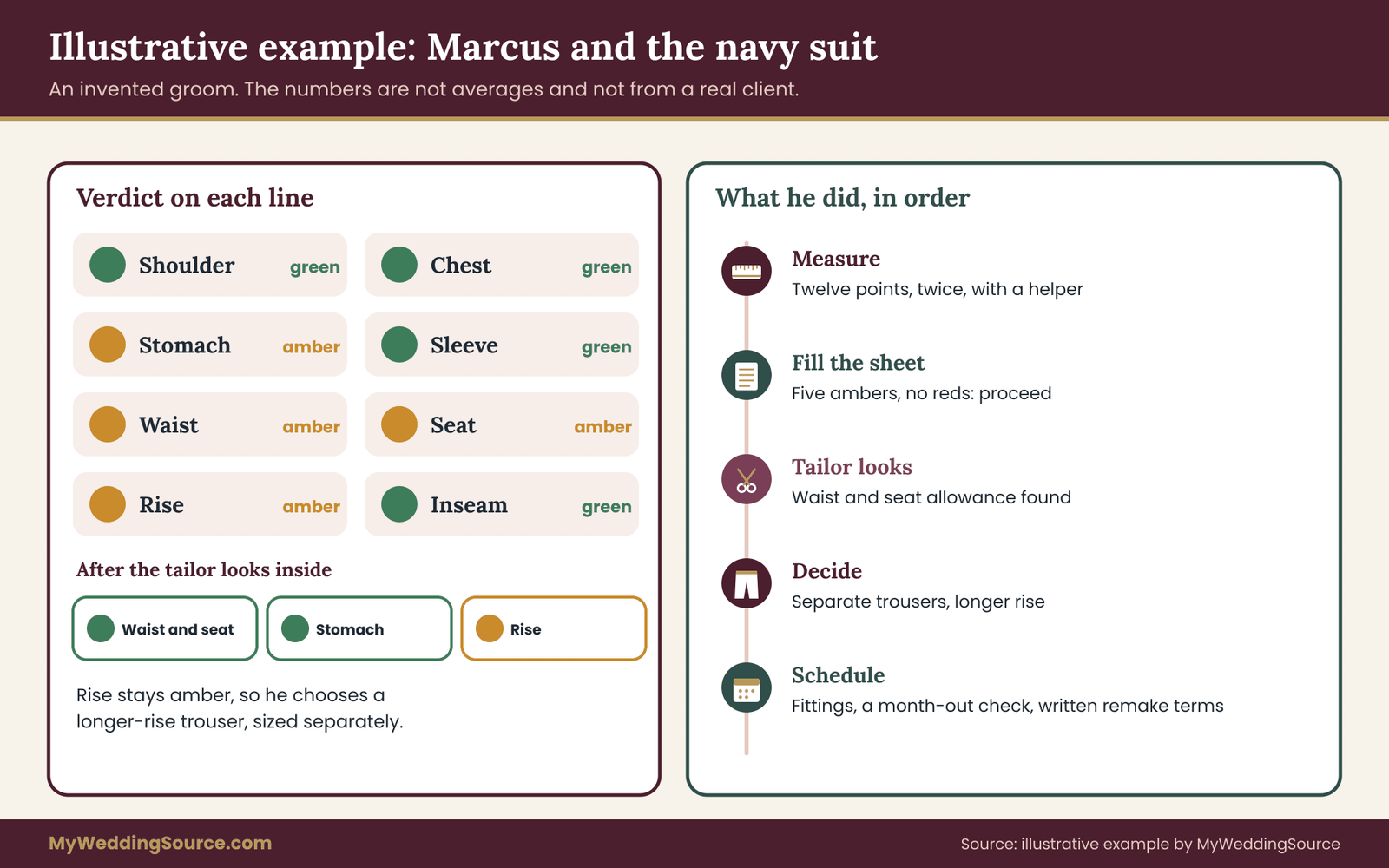
This example is invented to show the method. The names and numbers are illustrative, not typical, and not drawn from any real client or from published averages. Your own numbers will differ, and so will your garments.
The situation facing this plus size groom
Marcus is a plus size groom getting married in a daytime ceremony at an indoor venue, with the date about four months away. He wants a navy suit he can wear again. He has broad shoulders, a large chest, and a stomach that is larger than his chest measurement. He has no planned weight change. His budget is moderate, and he has found a ready-to-wear suit in a size that fits his shoulders.
Marcus measures himself with a helper, writes the numbers in inches, and takes each twice. For this example, suppose his stomach is larger than his chest by a few inches, his waist sits below his natural waist, and his shoulders are level. He writes these observations on his sheet.
Filling the sheet
He asks the shop for the garment’s finished measurements. The shop gives him chest, waist, shoulder, sleeve and length figures for the jacket, and waist, seat, rise and inseam for the trousers. He fills in the gap column. The jacket’s shoulder and chest match his body, so those lines are green.
The jacket’s stomach measurement is slightly smaller than his, so that line is amber: the side seams may or may not have the allowance he needs. The sleeves are a little long, so green. The trousers’ waist is smaller than his chosen trouser waist, and the seat is slightly tight, so both are amber. The rise is short for sitting, so amber. The inseam is long, so green.
No red lines, but five ambers. Under the scoring rule, this means proceed, turning the ambers into questions for the tailor.
The tailor’s look
The tailor opens the waistband and center-back seam of the trousers and measures the available allowance. The result is enough to meet the waist and seat gap, with a little left over, so those two lines turn green. The rise cannot be changed because the seam holds no more fabric. The line stays amber and becomes a decision: accept the rise, or order a different trouser.
The tailor checks the jacket’s side seams, and finds enough to ease the stomach area, with some work on the lining. The jacket line turns green, with a note that it will add to the cost. Marcus asks for the extra cost in writing.
The decision
The rise is the remaining problem. Marcus sits in the trousers and finds they pull slightly. He asks the shop whether the trousers can be bought separately in a style with a longer rise. The shop confirms that they can, and that the jacket and trousers can be different sizes. He chooses the longer-rise trousers in a size that fits his waist, and the tailor takes in the seat slightly. The sheet now shows all green, with a list of alterations and a price.
The schedule
Marcus writes the dates. The first fitting is in four weeks. The tailor needs two weeks for work, then a second fitting. The final check is five weeks before the wedding, with a buffer. He plans a last measuring session a month before the date. He also asks what happens if the alterations do not work, and the shop agrees in writing to redo the work at no charge within a stated period.
What this plus size groom suit tailoring example shows
Three points stand out. First, the sheet found the rise problem before purchase, which is cheaper than finding it at the last fitting. Second, the tailor’s look turned most of the ambers green with a few minutes of checking. Third, a plus size groom who asks for separates and written terms can often buy a ready-to-wear suit with confidence, without moving to a costlier path.
The example also shows what the sheet does not do. It does not choose the style, the color, or the price. It narrows the field to garments that can work, and leaves the aesthetic choices to Marcus. Had his shoulders been red, the example would have gone differently, with a move to a different range or made-to-measure, and a longer schedule.
Edge cases that change the plan
The method above works for most plus size grooms. A few situations need adjustments, and it is better to meet them in a conversation with the tailor than at a fitting.
Very broad shoulders with a smaller waist. The reverse of the common pattern, this groom needs a jacket cut for the shoulders and a much smaller trouser waist. Separates are essential. A different drop, or a made-to-measure jacket with a straight shoulder line, may be the cleanest answer.
Tall and large. Length can become the limiting line for a tall plus size groom. A jacket that fits across the chest may be too short for the torso, and trousers may run out of hem or rise. Ask for long lengths, check that the hem has fabric to let down, and look at maker ranges that list tall sizes with extended chest and waist. Sleeve length and trouser inseam are fixed by what the maker leaves.
Short and large. For a short plus size groom, shortening a jacket is limited, and shortening the sleeves too far can move the buttons and pockets out of proportion. Trousers can be hemmed, but a long rise cannot be shortened easily. Ask the tailor which lines will be affected by a shortening that large.
Asymmetry. If one shoulder is lower or one leg is longer, tell the tailor at the first fitting. These adjustments are routine for experienced tailors. They add time, so allow for it.
Large arms or a broad back. Many jackets run tight across the back when the arms are large, even with a matching chest. Bring a wide-reach test to each fitting. If the back pulls, ask whether the maker offers a different cut through the back, and whether the garment has an armhole that can be let out.
Wheelchair users or those who sit for much of the day. Fit while seated, in the chair you will use. The jacket back needs to fall without bunching, trousers need a longer back rise to avoid sliding, and hems may be cut to the seated position. Tell the tailor that you will be sitting most of the day, since standard fitting practice assumes standing.
Medical devices and support garments. If you wear a brace, a pouch, a compression garment or a device that changes your shape, wear it to each fitting and tell the tailor what it does. A tailor does not need medical details, only the shape and the space required. Plan for the trouser waist and rise accordingly.
Heat sensitivity or sweating. Choose lighter cloth, partial lining and a jacket that can come off easily. Check how the tailor presses garments, and bring an extra shirt.
Matching with groomsmen or a partner. If a partner is also being fitted, the dress fitting guide shows the same fitting rhythm from the dress side. If the plus size groom’s outfit must coordinate with a group, treat each person’s sheet separately, and match on color and style rather than on size or supplier. A plus size groom in a different cut from the groomsmen can still look coordinated if the cloth, color and accessories align. This also avoids pressure on the plus size groom to wear whatever the group package offers.
Destination weddings. If the wedding is abroad, plan to have all alterations finished at home and the suit packed in a carry bag, or arrange a tailor near the venue. Confirm in advance who will press the suit on arrival, and keep the sheet with you in case a local tailor is needed.
Money, deposits and contracts
Garments of this kind involve deposits, lead times and non-returnable cloth. A careful plus size groom treats the suit like any other significant vendor purchase.
What a plus size groom should get in writing
Get the order form or contract to state the garment, the size, the cloth, the price, the deposit, the balance and the delivery date. Add the alteration terms: what is included, how many fittings, the fee for extra work, and the deadline for completion. Add the remedy if the garment does not fit: remake, refund or credit, and the date by which you must report a problem.
If the seller’s standard form says “all custom orders final,” ask for an exception in writing for fit problems that stem from the maker’s error or from an agreed measurement. Ask also what counts as an error and who decides. The wedding vendor contract guide offers more general advice on reading and negotiating contract terms, including keeping every amendment.
Paying and protecting the payment
Pay deposits by a method that leaves a record, such as a credit card, so that you have a receipt and some recourse if the seller fails to deliver. The Consumer Financial Protection Bureau publishes information about disputing card charges, including time limits for reporting errors. Read the current rules there, since time limits matter and are measured from the statement date.
Keep receipts, order confirmations and tracking numbers. If the garment ships from a distance, keep the shipping record, and photograph the package and the garment on arrival. The Federal Trade Commission explains buyers’ rights on online and mail orders, including what a seller must do when shipment is delayed.
Budget the whole plus size groom suit
Add the garment, the alterations, the shirt, the shoes, belt or braces, and a margin for a third fitting. A margin protects the budget from small surprises. Track each payment against the deadlines, so that a deposit due on a particular date does not arrive unannounced. A page on purchase orders for wedding vendors shows how to keep orders, deliveries and claims in one place, which also helps with a tailor.
When plus size groom suit tailoring goes wrong
If the garment arrives wrong, the first step is to stop and document it. Photograph the problem, note the measurements that are off, and compare them with the order form and the sheet. Contact the seller in writing, quoting the order and the agreed terms. Give them a clear request and a date. Most problems resolve at this stage, and the sheet makes the request precise.
If the seller does not respond, review the contract’s remedy clause, and ask the payment provider about disputing the charge. Keep a calm, dated record of each contact. A calm record also helps if the matter must go to a consumer protection office.
Your next steps
A plus size groom can work through these in order, and put a date next to each one.
- Take the twelve measurements with a helper, record them in one unit, and note posture.
- Photograph yourself in thin clothes for your own and the tailor’s reference.
- Set up the feasibility sheet with body numbers and blank garment columns.
- Visit or contact at least two sellers, and get their garment measurements and answers to the written questions.
- Ask a tailor to check allowances inside the trousers and jacket for any garment you are considering.
- Score the sheet, count reds, and pick a path.
- Get quotes as itemized lists, and add the total to the budget.
- Put the fitting dates on a calendar, with a buffer, and a measuring check a month before the wedding.
- Get remake, refund and deadline terms in writing.
- At the final fitting, wear the whole outfit, run the movement tests, and keep the sheet for the day.
FAQ
How early should a plus size groom order a suit?
Order early enough to cover the maker’s lead time, two fittings and a buffer for a remake. Ask each seller for dates for every step, and count back from the wedding. Made-to-measure and made-to-order usually need more time than ready-to-wear, while rentals often have the shortest schedules. If your weight may change, shorter lead times can help.
Can a tailor let out a suit jacket?
Sometimes, by a small amount, at the side seams and back seams, if the maker left allowance inside. Shoulders, armholes, collar and chest are usually fixed. Ask the tailor to look inside and tell you in writing how much is available. If the allowance is smaller than the gap on your sheet, choose a different jacket.
Is made-to-measure worth it for a plus size groom?
It can be, when the sheet shows reds in shoulders or chest, or several mismatches in a standard range. The maker modifies the pattern to your body, so problems are solved at the start. It costs more and takes longer, so confirm lead time and remake terms. If your sheet is green, a simpler path is fine.
What is the drop, and why does it matter?
The drop is the difference between a jacket’s chest size and its matching trousers’ waist size. If your chest and waist are closer than the drop assumes, a standard set will not fit both. Ask the seller to state the drop in writing, and ask whether jacket and trousers can be sized separately.
How do I know if a jacket fits in the shoulders?
The shoulder seam should end at the edge of your shoulder bone. The jacket should lie smoothly across the back, without dimples at the sleeve head or folds under the collar. If the seam sits beyond or inside the bone, or the sleeve wrinkles, the jacket likely does not fit. Shoulders are the hardest part to alter.
What if my weight changes before the wedding?
Tell the seller and tailor, and ask how much change each garment can absorb in each direction. Choose a schedule that delays final alterations until a few weeks before the date. Measure again about a month ahead, and compare with your sheet. Small changes rarely matter, but changes near the stomach or chest should be reported promptly.
Should I rent instead of buy?
Renting can suit a one-time event or a tuxedo, and avoids storage and long lead times. Check that the rental range covers your chest, stomach and shoulders in one garment, whether trousers can be sized separately, and what alterations are offered. If the rental does not fit well, buying and altering may give a better result.
What should I do if the suit does not fit at the last fitting?
Stay calm, point to the exact problem, and ask the tailor what can change in the time left. Check your written terms for remake or refund. If the date is close, ask for the most visible fix first, such as sleeves or waist. Keep records, and contact the seller in writing about any remedy owed.
Sources
- Federal Trade Commission: rules on mail, internet and telephone orders, and textile and care labeling.
- FTC Consumer Advice: buyer guidance on online orders, refunds and returns.
- Consumer Financial Protection Bureau: information on disputing card charges and billing errors.
- USA.gov consumer guidance: where to file consumer complaints.
- National Center for Health Statistics, NHANES: published methods for body measurements.
- International Organization for Standardization: body measurement and clothing sizing standards.
- ASTM International: standards for apparel sizing and body measurements.
- Heat.gov: federal guidance on heat safety.
- National Weather Service: forecasts and heat advisories.
- U.S. Postal Service: shipping, tracking and insurance information.