
Membership gifts are annual passes to museums, zoos, gardens, science centers, parks and similar places, listed on a wedding registry in place of a toaster or a set of towels. They look simple, but each one is really a small contract between an organization and a named person, so a few quiet details decide whether the gift is a pleasure or a wasted purchase. This guide gives you one repeatable check to run before any of them goes on your list.
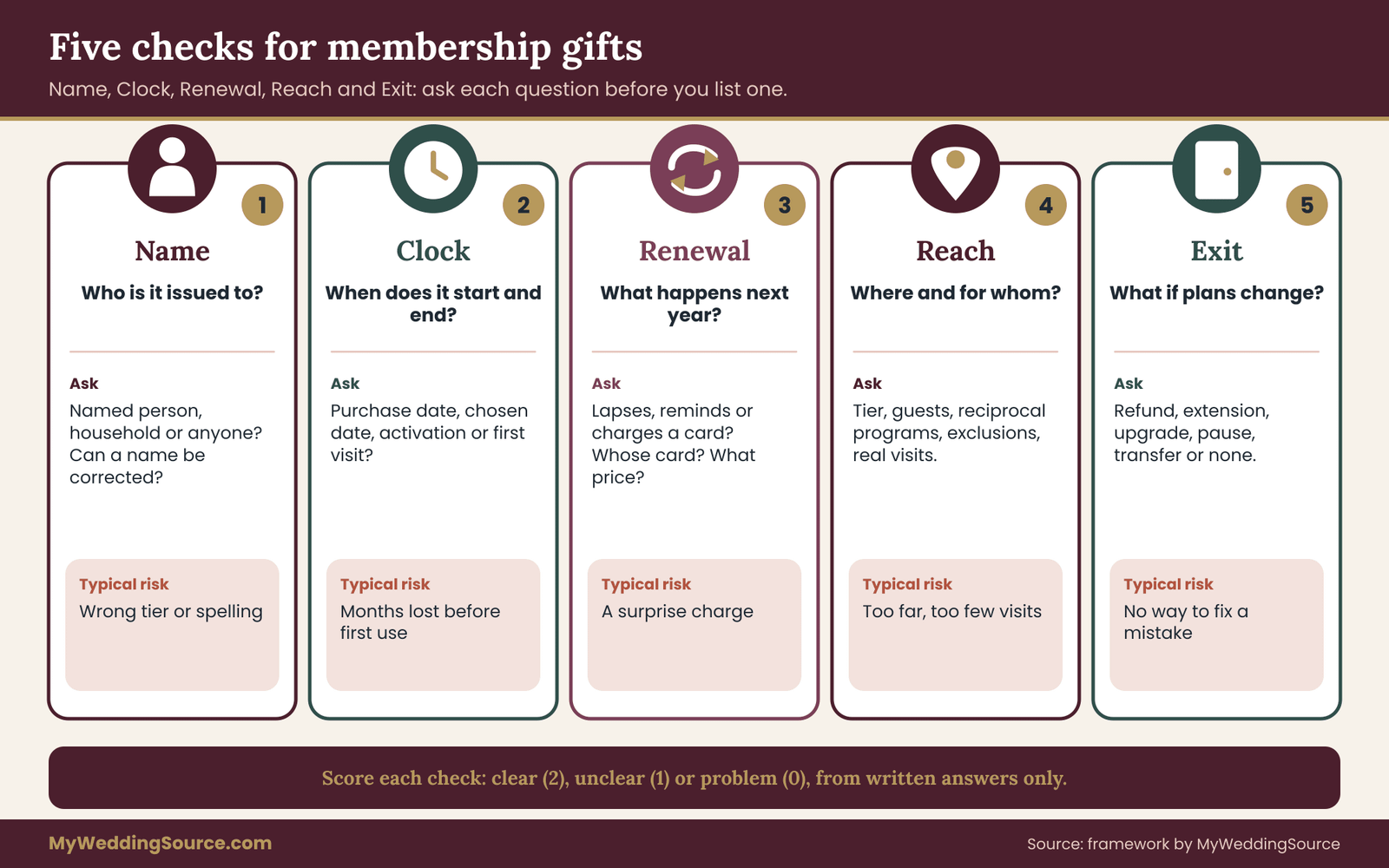
Before you list membership gifts, run five checks on each one: who the membership is issued to (name and transferability), when the clock starts and stops (start date and expiration), what happens after the first year (renewal and billing), where and by whom it can be used (reach), and how to get out or change it (exit). Score each check as clear, unclear or a problem. List only the gifts with no problems, and write the answers down where both of you can find them.
Most registry advice is about objects. An object has a price, a size and a return policy, and once it arrives it is simply yours. Membership gifts are different. A membership is bought on one date, issued to a particular name, valid for a fixed stretch of time and usually tied to a single organization in a single region. The person who pays is rarely the person who uses it. And the wedding sits in the middle of all of this, shifting names, addresses and calendars at exactly the moment the gift is being delivered.
That gap between how membership gifts look and how they actually work is the reason this article exists. You do not need a spreadsheet or a legal background. You need about ten minutes per organization, a short list of questions, and a willingness to put a gift on hold if the answers are vague.
A note on scope. This is general information, not legal, tax or financial advice. Membership terms, refund rules, fees and benefits are set by each organization, they change, and the only reliable source is the organization’s current written policy. Where a rule matters, the article tells you what to ask and which agency to check.
What membership gifts are and where they fit on a registry
The phrase covers more ground than “museum pass.” In practice membership gifts fall into four loose groups.
Cultural and educational memberships. Art museums, history museums, science centers, children’s museums, zoos, aquariums, botanical gardens and historical societies. These usually sell several tiers: individual, dual or household, family, and donor levels with extra perks.
Outdoor and park passes. Annual passes to state parks, county parks, and federal recreation lands. The National Park Service, for example, sells an annual interagency pass, and its own pages explain who the pass covers and how long it lasts.
Performance and subscription memberships. A theater season subscription, a film society, a symphony package or a community arts center. These behave like membership gifts but often involve specific dates and seats.
Community and lifestyle memberships. Food co-ops, rec centers, community gardens and similar local groups. They sometimes require ongoing participation, which changes how well they fit as a gift.
The common thread among membership gifts is access over time rather than a thing delivered once. That is the appeal. A couple who already share an apartment and a drawer full of kitchen tools may genuinely prefer a year of free weekend outings to a seventh serving bowl. A guest who lives nearby may enjoy giving something that gets used together and has no storage cost.
Membership gifts fit best when three things are true. The couple lives within easy reach of the organization, so the pass will be used more than once or twice. The couple has real interest in the place, not just a vague sense that museums are nice. And the couple is not about to move, change names in a way the organization cannot handle, or spend most of the coming year traveling.
They fit poorly when a couple is relocating within the year, when the closest institution is a long drive, when the guest list is spread across the country and few guests could visit, or when the couple would find an assigned outing a chore. None of this makes membership gifts a bad idea. It makes them a decision that deserves the checks in this guide.
Why membership gifts deserve their own checklist
A set of knives or a coffee maker can be judged by its reviews, its warranty and its return window. Membership gifts cannot, because there is nothing to review except the organization’s own terms. Two museums that look alike from the street can run completely different gift programs: one starts the term when the guest pays and another starts it when the couple walks in for the first time.
That is why membership gifts get a separate method here. The method does not ask you to distrust museums, parks or theaters. It asks you to read what they wrote, ask about what they left out, and keep the answers. Couples who do this rarely regret it, and guests who buy membership gifts that were checked first tend to hear a genuine thank-you rather than a polite one.
Three parties, not two
An ordinary gift involves a giver and a receiver. Membership gifts involve three parties: the guest who pays, the couple who will use the pass, and the organization that issues it. The organization has its own rules about who counts as a member, what a gift membership is, how it is delivered, and what happens at the end of the term. Neither the guest nor the couple controls those rules, which is why asking the organization directly is the only dependable method.
This also explains why a registry platform rarely solves the problem on its own. Some registry services let you add an item from any website, others offer a custom entry, and others limit you to partner stores. Features vary and change, so check what your platform currently allows. Whatever the mechanism, the registry only displays the idea. The terms live on the organization’s gift membership page, and a guest who buys there is agreeing to those terms.
How couples usually list them
There are three common ways to present membership gifts without turning your registry into a menu of demands.
- A link to the organization’s gift membership page. The guest buys directly, enters the couple’s names and the delivery details, and the organization sends the card or confirmation.
- A custom registry item with a short description. The couple writes one or two lines, such as the tier and what it includes, and the registry records that someone has claimed it.
- A note on the wedding website. A short line under a “gifts” heading says the couple would enjoy a membership to a named place, with the tier and a link. No claiming, no tracking.
The third is the lightest and the second is the easiest to keep from being bought twice. Whichever you choose, make clear that guests are free to give anything, or nothing at all. The wedding etiquette guide covers how couples can mention gifts without sounding like they expect them, and the same restraint applies here. Membership gifts listed on a registry are ideas, not bills.
What this guide does not cover
Plenty of other nontraditional gifts exist, from honeymoon funds to charitable donations, and the wedding registry ideas page gives the wider picture of how those compare. This article stays on one narrow question: when the registry item is one of these membership gifts, how do you confirm that it will work for the people receiving it? The answer is a short sequence of checks that you can run on a museum, a zoo, a park pass or a theater subscription with the same logic.
The next section lays out that sequence, and the sections after it take each check in turn with examples, scripts and edge cases.
The five-check method for membership gifts
The method for membership gifts has five checks, and the order is deliberate: Name, Clock, Renewal, Reach and Exit. A simple way to remember them is that a membership has to belong to someone, run for a known time, behave predictably afterward, work where you live, and let you step out gracefully. If any link in that chain is missing, membership gifts can disappoint no matter how generous the giver was.
Check one, Name. Who is the membership issued to, and can that change? This covers transferability: whether the pass can be reassigned, shared with a spouse, passed to a relative, or moved to a new name after the wedding.
Check two, Clock. When does the term start, and when does it end? Does it begin on the purchase date, a date the giver chooses, the date the couple activates it, or the first visit? This is the expiration check.
Check three, Renewal. What happens at the end of the term? Does it lapse quietly, send a reminder, or renew by charging a card? Whose card? At what price?
Check four, Reach. Where can the pass be used, by whom, and how often? That includes guest privileges, reciprocal programs with other institutions, blackout dates, and what the pass does not cover, such as special exhibitions or parking.
Check five, Exit. If plans change, what are the options? Refunds, credits, extensions, pauses, transfers to another person, or a move to a different tier.
How to score a check
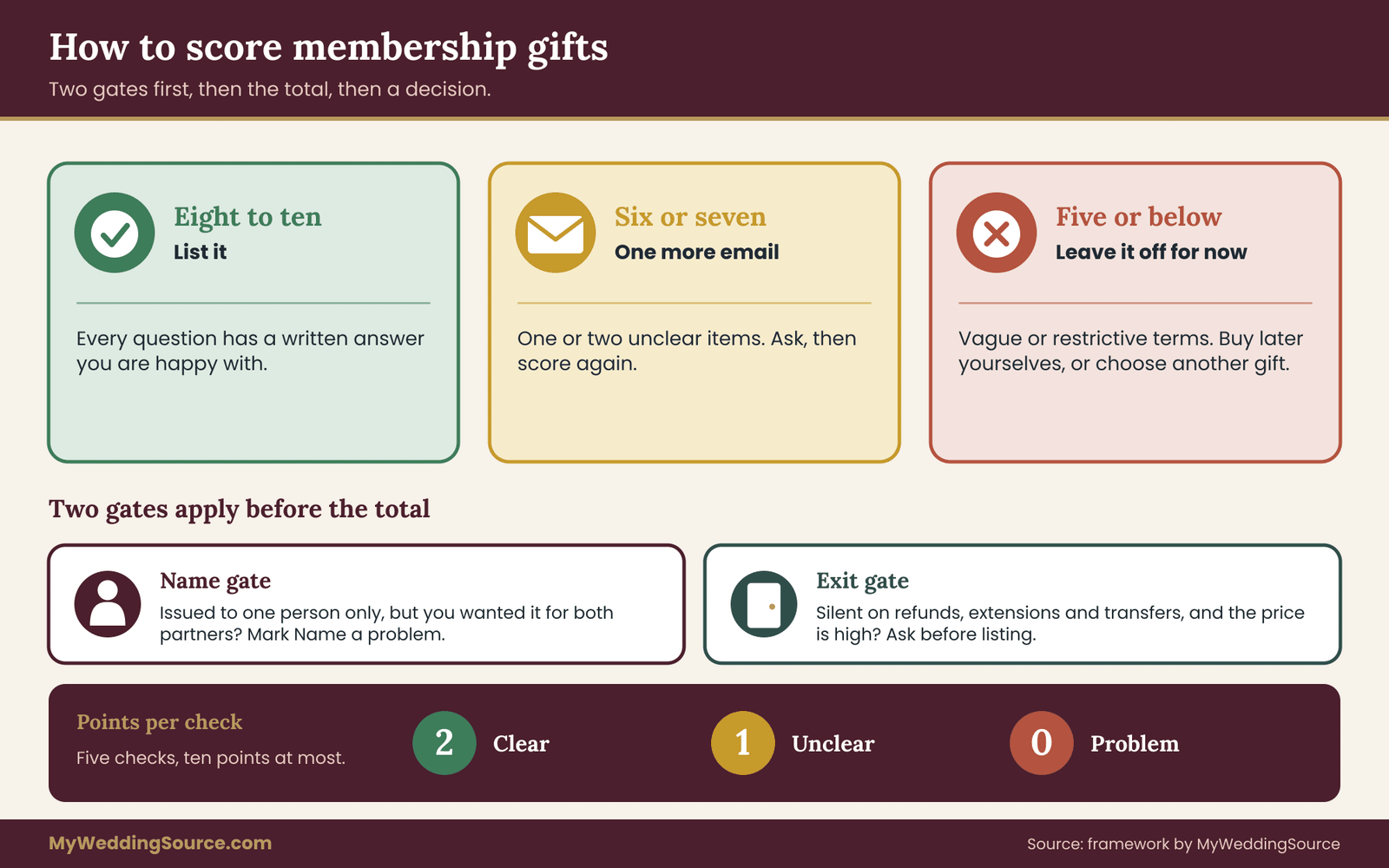
Give each check one of three marks after you have the organization’s written answer. Not a guess, not a memory of a past visit, and not the marketing page alone.
- Clear (2 points). The written terms answer the question and the answer works for you.
- Unclear (1 point). The terms are silent, vague or contradictory, or you only have a verbal answer.
- Problem (0 points). The terms answer the question and the answer does not work for you.
A gift can score from zero to ten. Treat the number as a conversation starter rather than a verdict, because two gifts with the same total can differ a great deal. A ten means every question has a written answer you are happy with. An eight usually means one unclear item you can resolve with an email. Below six, the gift is probably not ready to go on a list.
Two gates before the total
A total can hide a single serious flaw in membership gifts, so apply two gates first.
The Name gate. If the membership is issued to one named person and cannot be changed or shared, and the couple intended it for both partners, mark Name as a problem even if everything else looks good. A pass that only one of you can use is a different gift from the one you described.
The Exit gate. If the terms say nothing at all about refunds, extensions or transfers, and the amount is large, mark Exit as unclear and ask before listing. Silence is not the same as permission.
Beyond those, a gift with a zero on Clock should usually wait. A membership that starts burning its term before you can use it is the most common way for these gifts to lose value quietly.
Who runs the check on membership gifts, and when
The couple runs the check on membership gifts, not the guest. This matters for fairness. A guest should be able to click a link, pay and be done. If the couple does the homework before listing membership gifts, no guest has to read fine print, decide between tiers without guidance, or discover later that the pass cannot be used the way they pictured. The couple is also the party that will live with the answers.
Do it before the registry goes public, and ideally before save-the-dates go out, since registry details often appear on the wedding website early. A realistic schedule looks like this:
- Choose three to five organizations you would genuinely use. Fewer is better, because each one needs its own check.
- Collect each organization’s gift membership page and any posted terms or frequently asked questions. Save a copy of the page, or at least the date you read it.
- Write down the questions the page does not answer. The five checks give you the list.
- Email or call the membership office and ask for the answers in writing.
- Score and decide. Keep, adjust the tier, add a guest note, or drop.
- Save the answers in your wedding records so you can refer to them when a gift actually arrives.
That last step is easy to skip and expensive to skip. If a gift is delivered and something looks off, you want the earlier email in hand. The guide to wedding records after the event explains how to store this kind of correspondence so both of you can find it a year from now.
What counts as written
A written answer can be an email from the membership office, a posted policy page with a date, or a printed terms sheet. A verbal answer on the phone is useful, but it is weaker. If you only have a phone call, send a short follow-up message that restates what you were told and ask the representative to confirm. Something like, “Thank you for speaking with me today. I understood that a gift membership starts on the date the recipient activates it. Please let me know if that is not correct.” It takes a minute and creates a record.
You will sometimes get a reply that says the policy is “at the discretion of the organization.” Treat that as unclear. It does not make the organization unreliable, but it means the answer could change depending on who handles the request, and a gift you cannot predict is worth less.
Keep the check proportional
A twenty-five dollar park day pass does not need the same scrutiny as the largest of the membership gifts, a family-level plan that costs a few hundred. Scale the effort to the stakes. For small, short-term items, a quick read of the posted terms is enough. For anything that costs enough that a guest would want to be sure about it, run the full set of questions. The goal is to avoid wasting a guest’s money, not to treat generosity with suspicion.
It is also fine to skip the check by choosing something other than membership gifts. A set of single-entry tickets with no expiration, or a gift card to a museum shop, are simpler objects. Later sections compare those options. For now the point is that the check exists so that you can say yes to a membership with confidence, or say no without guilt.
One more consideration: guests who do not live nearby
Guests who live far away make the most hesitant buyers of membership gifts, and for good reason. They cannot use the pass and may worry that the gift is impersonal.
Reach, the fourth check, partly answers this: a guest who knows the pass includes reciprocal access to museums in many cities may feel more comfortable buying it. Even so, do not assume out-of-town guests will want to buy memberships. Offer other price points and other types of gifts in parallel so that no one feels steered. The wedding budget guide is useful for thinking about the gift side of your finances without leaning on a single category.
Reading the total honestly
A total out of ten feels precise, and it is not. Treat it as a way to sort membership gifts into three piles. Eight to ten means list it. Six or seven means one more email. Five or below means leave it off the registry for now. The pile matters more than the exact number, and a single zero in Name, Clock or Renewal outweighs a respectable total.
The method also works in reverse. When a guest asks whether a membership would be welcome, you can answer with specifics: “We checked that one, and the dual tier starts on activation.” Couples who have run the check can recommend membership gifts without hesitation, and they can decline them politely when the answers are weak.
With the structure in place, the next five sections walk through each check in detail.
Name and transferability: who the membership belongs to
The first check sounds trivial and is the one that most often goes wrong with membership gifts. A membership is issued to a person or a household, and the wording on the card, the confirmation email and the organization’s database decide who can walk through the door. A gift that was meant for “the couple” can turn out to belong to one partner, or to the guest who bought it, or to a name that no longer matches anyone’s identification.
The common ways organizations name a member
Policies differ, so the following patterns are examples, not rules. Read the terms of the specific organization.
Individual. One named adult. The card or digital pass is tied to that person, and a staff member may check it against photo identification. A spouse cannot usually use it.
Dual or two-adult. Two named adults, often described as living at the same address. Both names appear on the membership, and either person can use it. Some organizations let you name any two adults, while others require a shared household.
Household or family. Two adults plus children or other dependents, sometimes with a cap on the number of children. Some versions allow a named caregiver.
Named plus guest. One member with a guest privilege. The member must be present, and the guest enters with them.
Transferable or unnamed. A pass that works for whoever holds it. This is uncommon for annual memberships and more typical of ticket books and day passes, but it exists.
For a couple, the dual or two-adult version of these membership gifts is usually the target. It is also the version where details such as “same address” or “any two adults” matter most. If you list a membership for a couple, the tier name on the registry should match the tier you actually want, and the description should say so in plain words, such as “dual membership, two adults.”

What transferability really means
People use the word loosely. For membership gifts it covers four separate questions, and an organization can answer yes to some and no to others.
- Can the named person be changed? If the first holder drops out, can another person be added or substituted?
- Can the membership be shared? Can the card be used by someone other than the named holder, or do staff check identification?
- Can it be moved to another household? If the couple decides to give the pass to a sibling or a friend, is that allowed?
- Can the name be corrected after issue? Typos, nicknames and name changes all fall here.
The fourth question is the most practical for newlyweds. A name on a membership card is a detail that gets entered by a guest who may not know how you spell it, how you write your name, or whether you plan to change it.
Name changes and wedding timing
Weddings shuffle names, and membership gifts get caught in the shuffle. Some couples keep their names, some change one, some hyphenate, some use a different name socially than legally. A membership can capture any of those states.
Say a couple, Priya Nair and Sam Ortega, expects Priya to start using Priya Nair-Ortega after the wedding. A guest buys a dual membership six weeks before the ceremony and types “Priya Nair and Sam Ortega.” After the wedding Priya’s identification will gradually change, and the card still shows the old name. Will the museum care? Many will not, particularly if the card has a barcode and a household address. Some check ID against the card. Which kind is this one? You will not know without asking.
The sensible questions are:
- Is identification checked at entry, or does the card or app suffice?
- If a name changes, is the correction free, and how long does it take?
- Will the old name continue to work in the meantime?
If the answer is that the name must match ID and the correction costs a fee, you now know something you can plan for. You might tell guests to enter the names as they currently appear on identification, or choose an organization with a simpler policy. Neither answer is bad. Ignorance is the only bad answer.
The broader question of how and when to change a name belongs to government agencies and your own preferences, and it is covered in the guide to wedding records after the event, which includes the usual order for updating records. For membership purposes, the key point is that a pass should survive the change without a special effort.
Who is the member of record when a guest buys
A second layer of naming concerns the purchaser. When a guest buys one of these membership gifts, the organization’s system often records two people: the buyer, who gets the receipt, and the recipient, who gets the membership. Behavior varies in ways that affect you.
Whose email gets the confirmation? If the confirmation, activation link or digital card goes only to the buyer, the buyer may have to forward it, and the couple may not see it until a thank-you note prompts a question. Ask whether the organization can send the details to the recipient directly or on a scheduled date.
Does the recipient need an account? Many organizations require the member to create a login to activate a gift or download a digital card. Ask whether that is needed and who receives the instructions.
Is the buyer’s contact information stored on the member’s account? In some systems the buyer’s name or email can remain connected to the gift. That could mean renewal notices go to the wrong person, or a guest’s card is linked to a recurring payment. The renewal check covers this, but the origin is here, in who the system treats as the member.
The remedy is simple: ask the membership office how gift memberships are recorded, and set up the couple’s details as the member of record.
Sharing and guests on the pass
Even when the named holders are right, the pass may carry privileges that matter to the couple. Does the dual membership include guest passes? Can a parent or friend borrow a day? Do children of the household enter free, and up to what age? Some organizations allow adding an additional adult for a fee, which is useful for couples who share a household with a relative.
These details alter the value of the gift but not whether it works, so mark Name as clear when the main holders are fine, and record the guest privileges in your notes for the Reach check.
Special cases for couples
Some couples need a slightly different answer to the naming question, and membership gifts can handle most of them if you ask early.
Partners who are not marrying yet, or who keep separate households. A dual tier may assume one address. Ask what proof, if any, is required.
Couples with children from earlier relationships. A household tier may count stepchildren, or may not. Ask how the organization defines a child and what age limit applies.
Couples where one partner is the main visitor. If only one of you will really use the pass, a named individual tier may cost less and still suit the plan. Membership gifts do not have to be dual to be good gifts.
Same-name or similar-name households. Parents and adult children sometimes share a name, which can confuse a database. A middle initial or a different email address avoids duplicate records.
Giving a membership to someone else later
Couples sometimes receive overlapping membership gifts or realize one of them does not suit them. Can they hand it to a sibling or donate it? Most organizations say no for membership gifts, or say it is possible only through their office, because the membership is tied to a name and a database record. Occasionally you can request a transfer for a fee, or they will credit the unused portion toward a different tier. Ask before the gift arrives, because it is easier to get a courteous answer at the start than after a guest has paid.
If transfers are not allowed, that does not rule out membership gifts. It simply means you should list the membership only if you are confident the couple will use it, which brings back the earlier fit questions: distance, interest and timing.
Decision rules for the Name check on membership gifts
- Clear (2): The tier names both partners, name corrections are allowed without a fee, and the confirmation reaches the couple.
- Unclear (1): Terms are silent on corrections or on who receives the confirmation. Ask, then re-score.
- Problem (0): The membership can be used by only one named person, and you wanted it for both, or corrections are not allowed and an upcoming name change would make the pass unusable.
A zero here should send you to the next tier up, a different organization, or a different gift, rather than to a workaround.
A script for the membership office
Short and specific questions get short and specific answers. Here is a version you can adapt.
“We are planning to list membership gifts on a wedding registry. For the dual or household level, could you tell me: whether both adults must live at the same address; whether the card or app is checked against photo identification; how a name correction works and whether there is a fee; and whether the confirmation and activation details can be sent to the recipients rather than the buyer? A written reply would be very helpful, since we want to describe it accurately to guests.”
Notice that the message says what you are doing, asks four related questions, and requests writing. It does not ask the office to design your registry. If a representative replies with a link to the terms, read it and send one follow-up for anything still unclear.
The clock: start dates and expiration for membership gifts
Of the five checks, the clock is the one that quietly changes what membership gifts are worth. A sofa bought in March is a sofa in June. A twelve-month membership bought in March is nine months of membership by June, and if the couple cannot use it until after the honeymoon, even less. Time is the product, and it runs whether or not anyone is walking through the gates.
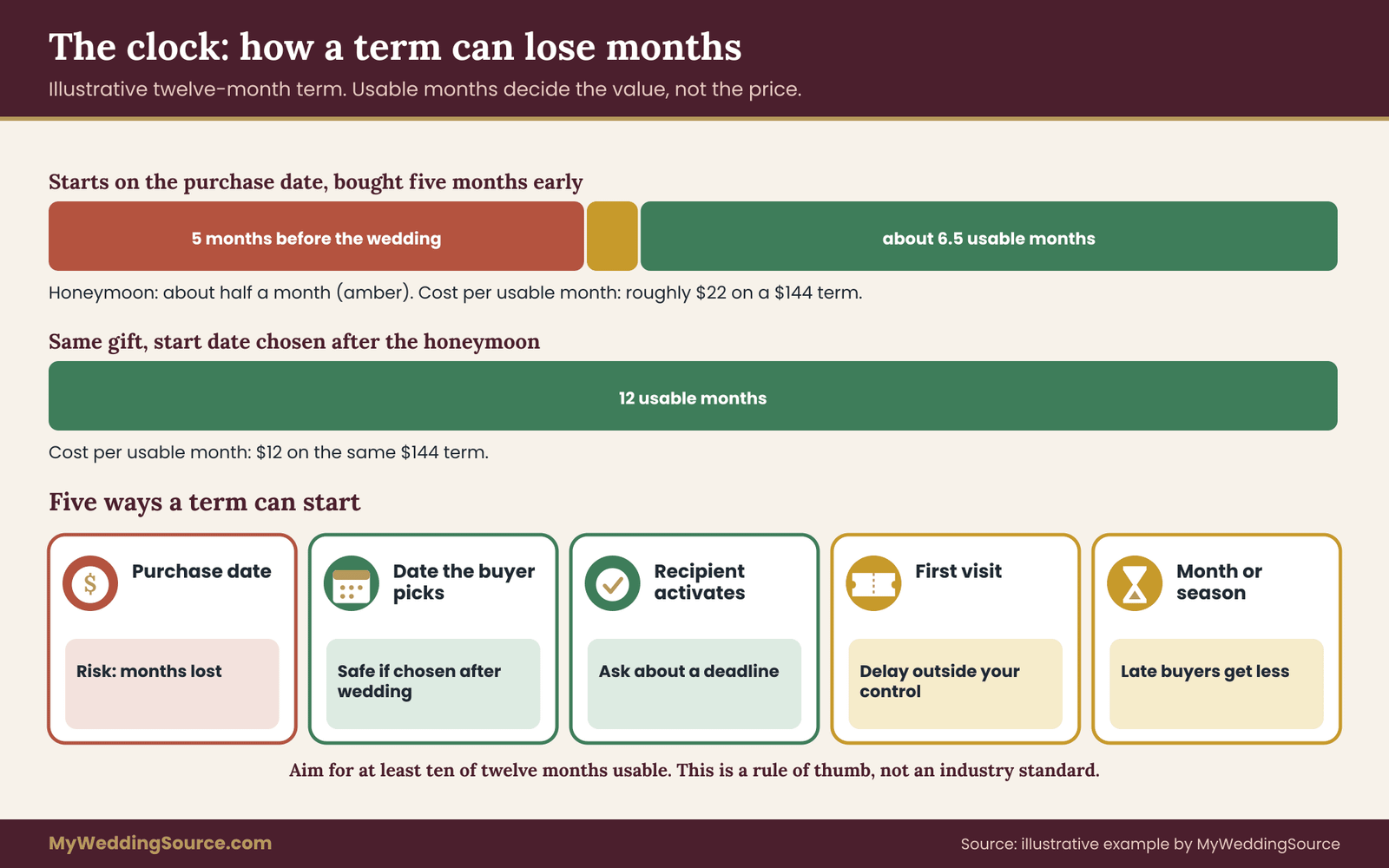
Five ways a term can start
Organizations handle membership gifts in several different ways. Look for which of these the organization uses, and do not assume it matches the last place you checked.
- Starts on the purchase date. The simplest rule. The term runs from the day the guest pays, even if the pass reaches the couple weeks later.
- Starts on a date the buyer chooses. The guest picks a start date at checkout, which can be set to the wedding date or after the honeymoon.
- Starts when the recipient activates it. The term begins when the couple redeems a code or creates an account. This is the most generous rule for gifts, though some organizations set a deadline to activate.
- Starts at the first visit. The term starts when the pass is first scanned at the door.
- Starts at the beginning of a month or season. The term may run from the first of the month, or cover a fixed season or calendar year, so a gift purchased late in a period yields a shorter term.
There is no universally right answer for membership gifts, but the answers differ in risk. Rules one and five can shrink the term before you start. Rules two, three and four protect it, with some tradeoffs. Activation rules can create a hidden deadline, and first-visit rules can create a delay you do not control.
Measuring the clock: usable months
To make this concrete, use one number: usable months. It is the number of months in the term during which the couple can realistically use the pass.
Usable months = months in the term, minus months that elapse before the couple can start using it, minus months when use is unlikely.
Consider an illustrative example with invented numbers. A guest buys a twelve-month dual membership five months before the wedding, and the term starts on the purchase date. The couple spends two weeks away on a honeymoon. When they get home, seven months of the term remain, and the honeymoon takes about half a month. That leaves about six and a half usable months.
If the membership costs $144, the cost per usable month is roughly $22, compared with $12 per month if all twelve months were usable. The price did not change, but the value to the couple fell by almost half.
The same guest could have bought the identical membership with a start date after the honeymoon and delivered twelve usable months for the same price. That is what the clock check is designed to find.
A simple rule of thumb for this guide, not an industry standard, is to aim for at least ten of twelve months usable. If the terms make that unlikely, either choose an organization with a better start rule or advise guests on timing.
Matching the clock to the registry
Registry timing is awkward for membership gifts because guests buy at different points. Some purchase when they receive the invitation, months ahead. Others buy the week before, and some buy after the wedding. You cannot control that, but you can choose gifts that tolerate the variation.
Prefer a flexible start. If the organization allows a start date chosen at checkout or an activation by the recipient, add a line in the registry description such as “Please choose a start date after our wedding.” Keep it gentle and optional. A guest who ignores it has done nothing wrong, and you can then ask the organization about adjusting the start.
Avoid fixed starts for early buyers. If the clock begins at purchase and the organization will not adjust, a membership is best listed on the wedding website as an idea, not on the main registry, because the registry invites early purchases.
Time the listing. Couples sometimes add membership gifts to the registry only after the wedding, when the clock risk drops. It is perfectly fine to add a few items later.
The activation deadline
Some organizations sell gift memberships as a code or certificate that must be redeemed. If so, ask:
- Is there a deadline to redeem, such as twelve months after purchase?
- What happens if the deadline passes? Is the value lost, extended on request, or refunded?
- Does the code expire if the couple forgets to use it?
A redemption deadline on membership gifts is not a problem on its own. It becomes one if nobody tells the couple. If the guest holds the code, or the email lands in a spam folder, the clock may be ticking unseen. In your wedding records, add a line for any gift with a redemption deadline, the date it expires, and who is responsible for checking. Setting a calendar reminder works better than good intentions.
Seasons, closures and blackouts
A membership can be perfectly valid and still unusable for part of the term.
Seasonal places. A botanical garden in a cold climate may reduce its hours in winter. A state park may have limited facilities off-season. An outdoor sculpture garden may close for several months. If the term runs through the dormant season, the usable months drop.
Closures and renovations. Museums sometimes close galleries or entire buildings for renovation. Ask whether memberships are extended during a full closure. Many organizations address this in their terms, and the policy is worth knowing before the gift is bought.
Blackout dates. Some benefits, such as free admission to a special exhibition or a reciprocal program, may exclude certain dates or holidays. This falls under Reach, but a blackout is also a clock matter when it removes the days you were most likely to go.
Your own calendar. A couple that travels for work every other week will get less from a membership than one that works from home. This is not the organization’s problem, but it is part of the honest estimate.
Expiration rules and gift cards are different things
Consumers sometimes assume that federal gift card rules protect any prepaid gift, including membership gifts. The Consumer Financial Protection Bureau explains rules for gift cards and similar products, including limits on expiration dates and fees for certain cards.
A membership is a service with a defined term, and it may not be treated the same way as a gift card. Do not assume that membership gifts have a minimum life, a right to an extension or a refund of the unused value. Ask the organization and check the agency for current rules. The CFPB and the Federal Trade Commission are good places to confirm how consumer rules apply, and state law may add its own requirements.
A simple timing plan for membership gifts
If you want a plan you can follow without thinking, use this one. It treats membership gifts as three groups, according to how the start rule works.
Group one: start on activation or on a date the buyer chooses. These are safe to list on the main registry at any time. Add a short line asking guests to pick a start date after the wedding.
Group two: start on purchase, but with an adjustment policy. These are fine if the organization will move the start date on request. Keep the confirmation email and ask for the adjustment as soon as the gift arrives.
Group three: start on purchase with no adjustment. Hold these back until after the wedding, or buy them yourselves with the start date you want. Membership gifts in this group are the ones most likely to lose months before the first visit.
Sorting membership gifts this way takes a few minutes once you have the start rule, and it removes most of the timing risk. It also gives you a clear answer when a guest asks, “When should I buy it?”
Documenting the clock
Once you have the start rule and the end date, write them where you will see them. A single line is enough:
“Museum X, dual membership, starts on activation, ends twelve months after activation, activation deadline twelve months after purchase.”
When the gift arrives, add the actual dates: bought on, activated on, ends on, and the reminder date, perhaps two months before the end. If you keep a gift log, that line belongs next to the giver’s name. The wedding cash-flow planning guide explains how couples track the money side of the wedding, and a short log of gift-related dates fits neatly beside it.
Decision rules for the Clock check on membership gifts
- Clear (2): The term starts at a date you or the giver can set, or on activation, and the end date and any activation deadline are written down.
- Unclear (1): The start rule or closure policy is not stated.
- Problem (0): The term starts at purchase with no adjustment, the couple expects to lose several months before using it, and the organization will not extend or adjust.
When Clock is a zero, the usual fix is to change the gift, such as a different organization, a different timing plan or a ticket bundle, rather than to rely on goodwill.
Renewal and billing after the first year
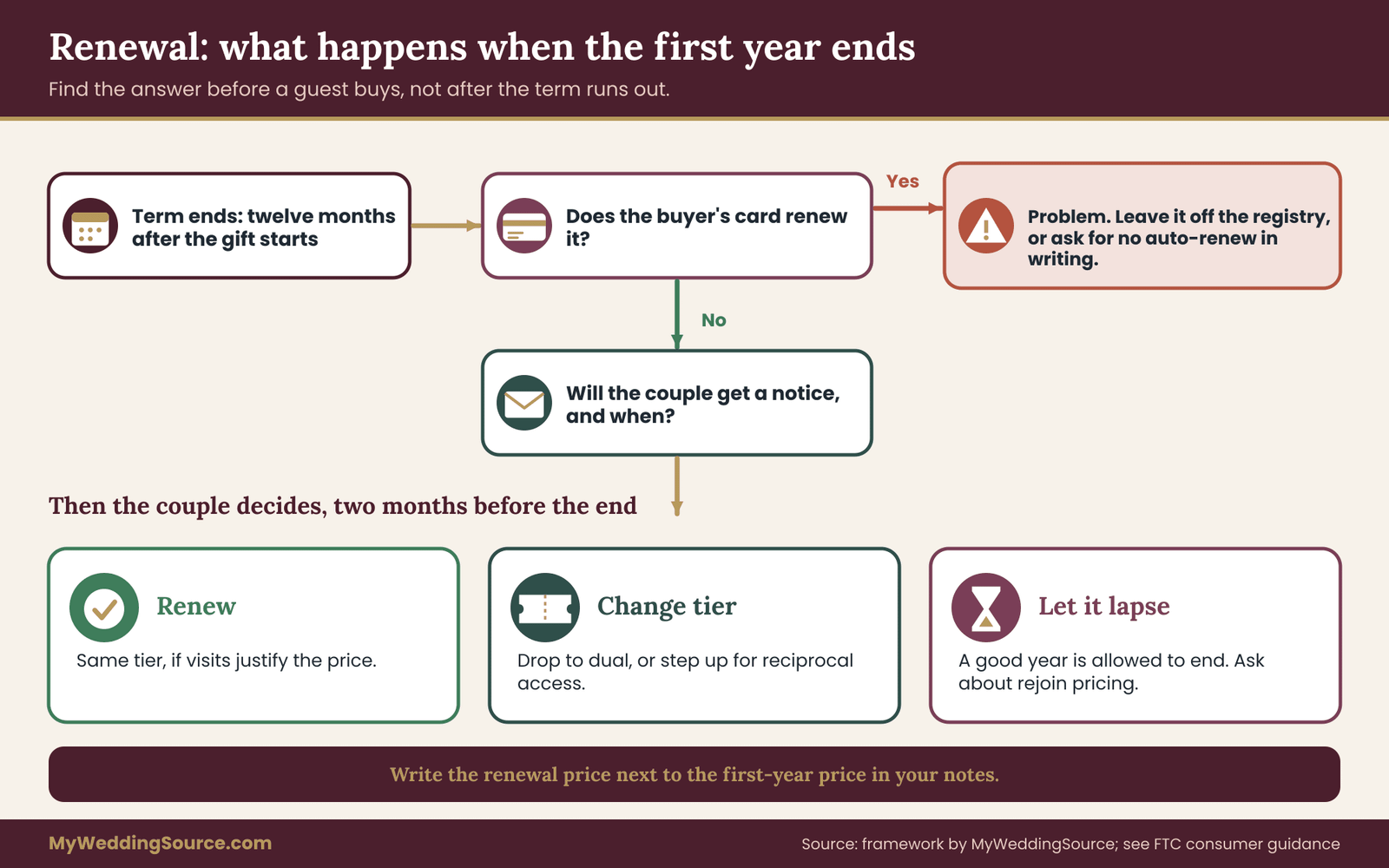
A gift is supposed to end when it is handed over. Membership gifts do not always behave that way. The first year is paid for by the guest, and the second year is a question mark. Some organizations send a polite reminder. Some let the membership lapse without comment. A few set up automatic renewal so that a card on file is charged when the term ends. The third check is simply to find out which of these will happen, to whom, and at what price.
The question that matters most: whose card?
When a guest buys a gift membership, the guest’s card pays the first year. The risk is that the same card, or a stored copy of its details, is attached to the membership record for renewal. If so, a year later the guest could be charged for something they no longer remember buying, and the couple could be blamed for it. That would be awkward for everyone.
In most cases membership gifts are one-time purchases that do not renew automatically. But practices vary, and terms change, so check. Ask the membership office plainly: “If a gift membership is purchased, will the buyer’s payment method be charged again at the end of the term?” A clear no, in writing, is a clear score.
If the answer is yes, or the page is silent, treat Renewal as a problem or at least unclear until you learn more. A registry full of membership gifts should never send a guest into a recurring charge they did not intend.
Automatic renewal in general
Automatic renewal is common in subscriptions and memberships, and consumer protection agencies pay attention to it. The Federal Trade Commission publishes guidance and enforcement information about negative option and automatic renewal practices, and many states have their own laws about disclosure, consent and cancellation. Because these rules change, and because they depend on where the organization and the member are located, this guide does not summarize them. If an organization requires automatic renewal for any reason, check the FTC’s consumer pages and your state attorney general’s consumer protection office for the current rules.
For your purposes, a few plain questions cover most of the risk:
- Is renewal automatic or manual? If it is automatic, how is it disclosed?
- How much notice is given before a charge? Is there an email, and how many days ahead?
- How does the couple cancel? Online, by phone, in writing? Is there a deadline?
- Can a gift membership be turned into an automatic one without the guest’s consent? It should not be possible.
What will the second year of membership gifts cost?
Even with manual renewal, the second year has a price, and it may not match the first. A guest might buy during a sale or a new-member offer, and the renewal price could be higher. A tier might be discontinued. Costs also tend to drift upward over time, as with most things.
This is where the couple’s budget enters. A membership that costs $144 in the first year might cost more in the second, and the couple will be the ones deciding whether to renew. Treat the renewal as a small, optional annual expense and add it to the yearly plan if you intend to keep the membership. The wedding budget guide covers how to set categories for planned expenses, and a recurring line for “memberships” is easy to add after the wedding.
Three honest renewal options
When the first year ends, the couple has three choices, and it helps to decide the rule in advance.
Renew at the same tier. Makes sense if the couple used the pass often enough to justify the price. Use the break-even count from the Reach check.
Change tiers. A couple who mostly visit together may drop from household to dual, or one who rarely uses the extras may move to a basic level.
Let it lapse. There is nothing wrong with letting it end. A membership gift is a nice year, not a lifelong obligation. Some couples find a year was enough to know the place well, and they move on to another.
A simple habit is to review usage two months before the end of the term. Count visits, check the renewal price, and decide. Put the review date in your calendar when the membership is activated.
Keeping renewal costs visible
One quiet advantage of checking renewal early is that it turns a surprise into a plan. Membership gifts that renew at a higher price, or that need to be renewed by hand, are easy to forget. Write the expected renewal price beside the first-year price in your notes, even if it is only an estimate from the organization’s current pricing page.
If you receive several membership gifts in the same year, their end dates may scatter across the calendar. A single list with the organization, the tier, the end date, the renewal price and the review date keeps them from becoming a pile of small decisions you meet by accident. It takes five minutes to build and saves money, because you only renew the ones you actually used.
Grace periods and rejoining
Some organizations allow a grace period after expiration, during which the member can renew at the old rate or keep benefits. Others make lapsed members rejoin at the current price, or treat them as new members, which might even bring a new-member discount. Ask what happens if renewal comes a few weeks late. If you plan to let the membership lapse and rejoin only when you have time, learn whether that costs more.
A note on thank-you messages
A final point on renewing membership gifts is social rather than financial. The guest who gave the membership may later ask whether you enjoyed it. That is a lovely moment, and honesty works best: you can say you loved it and visited often, without needing to promise anything about renewing. Giving a gift does not commit the guest or the couple to a sequel.
Decision rules for the Renewal check
- Clear (2): The gift membership ends at term without any recurring charge to the buyer, the couple will receive a notice, and the renewal price is published.
- Unclear (1): Billing or notice policy is not stated, or the renewal price is not posted.
- Problem (0): The buyer’s card is set to renew automatically or the organization will not confirm otherwise.
Of the five, this is the check where it is most reasonable to be firm about membership gifts. If an organization cannot say that a gift membership will not charge the guest again, leave it off the registry.
Reach and value: who can use membership gifts and how often
The fourth check is about whether the membership actually fits the couple’s life. Reach has three parts: where the membership works, who can use it, and how often the couple is likely to. The first two are facts you can look up. The third takes a little honesty.
Where the membership works
A museum membership usually applies to one institution, but many are part of reciprocal networks that offer free or discounted admission at other institutions. Examples include the North American Reciprocal Museum Association, which links participating museums, and the Association of Science and Technology Centers Passport Program, which links participating science centers. The details are set by each program: which membership levels qualify, how far from home the partner institution must be, and what is included. Do not assume that every tier gets reciprocal access.
If reciprocal access matters to you, because you travel or because you want to tell out-of-town guests that the gift works near them, ask whether the specific tier includes it, check the program’s own site for the current list, and note any distance rule.
For park passes, the National Park Service explains which pass applies to which sites, who is covered, how long it lasts and what it costs. Federal and state passes differ, and state parks run their own systems. A pass bought for one state’s parks will not cover another’s.
Who can use it
Fold in what you learned in the Name check: how many adults, how many children, any guest privileges. Then add practical points.
- Entry requirements. Does the pass need to be scanned? Does it live on a phone?
- Timed tickets. Some places require reserving a time even for members. If so, how far ahead?
- Exclusions. Special exhibitions, parking, workshops, events or tours may carry extra fees.
- Accessibility. Check whether hours, facilities and transit suit anyone in the household who has particular needs.
How often will you actually go?
This is the part people prefer to skip. Membership gifts are good value only if they are used, and each one is a small bet on future behavior. Run a simple calendar test: open next month’s calendar and mark the weekends when you could plausibly visit. If nothing fits, be honest about it.
Then compute a break-even count. Suppose a dual membership costs $144 and a single adult ticket costs $18. For two adults, a visit would cost $36 without the membership. Divide $144 by $36 and you get 4 visits to break even. That is an invented example, so replace it with the real numbers from the organization’s pages. A membership that breaks even after four visits is comfortable for a couple who live ten minutes away. One that needs eleven visits probably is not.
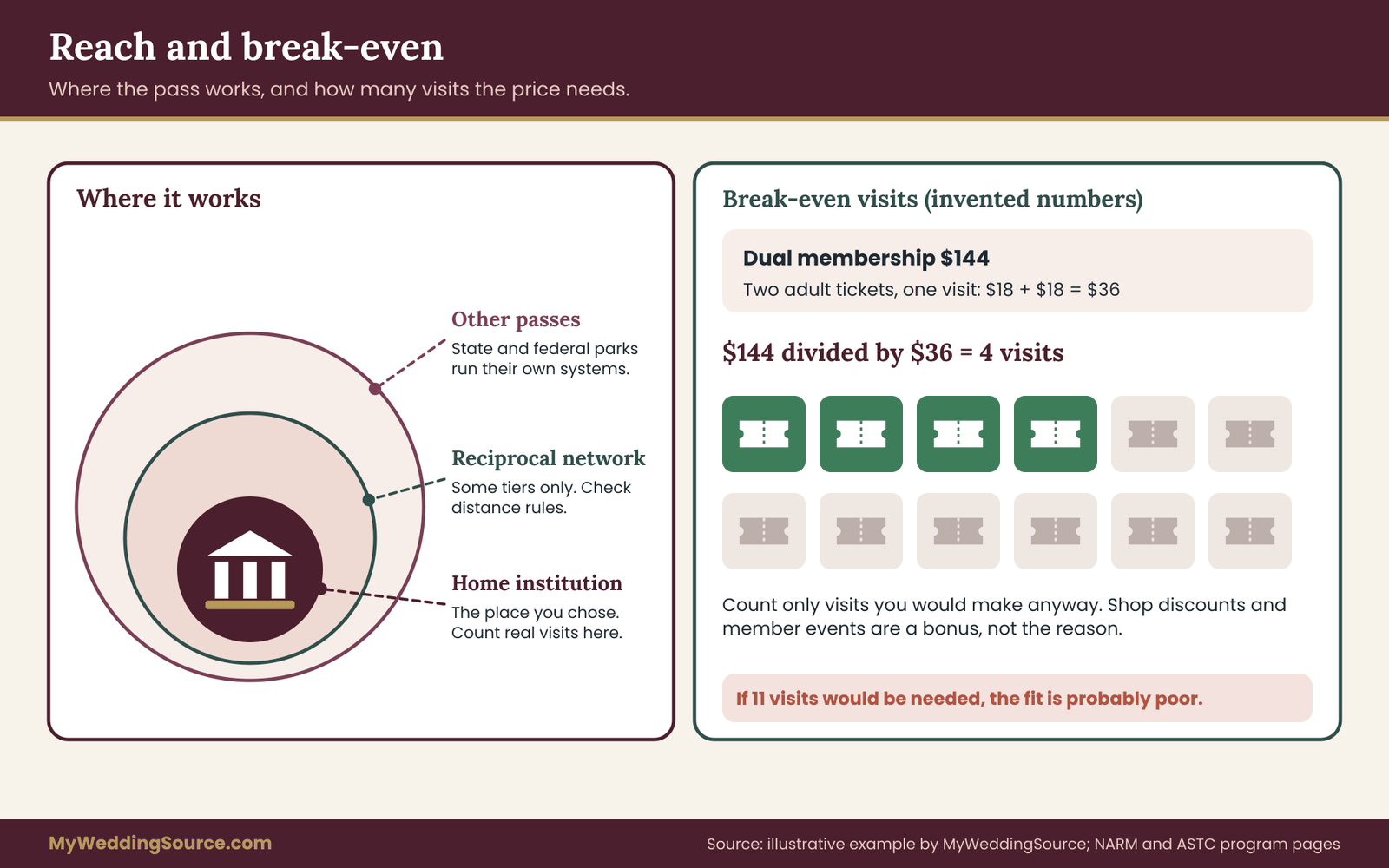
Count only what you would do anyway. If a couple would visit the museum twice a year regardless, the membership is not a bargain just because it technically breaks even at five. And do not overvalue perks like shop discounts or members-only events unless you will really use them. Treat extra benefits as a pleasant bonus, not a reason to buy.
Reach from the guest’s side
A guest deciding whether to buy membership gifts also cares about reach. A guest who lives nearby may like picturing the couple at the garden. A guest in another time zone may feel more comfortable with a gift that has a clear value on paper. For that reason, state the tier and what it includes in the registry description, in one or two lines, without overselling.
Decision rules for the Reach check
- Clear (2): The pass covers the people and places you need, the break-even count is comfortable, and exclusions are known.
- Unclear (1): You do not know about reciprocal access, extra fees or timed entry, or you are unsure how often you would go.
- Problem (0): The pass is too far away, covers too few people, or would need more visits than you can honestly expect.
If Reach is a problem, membership gifts are not wrong in general, only wrong for you. A different organization closer to home may score well.
Exit and edge cases: refunds, moves and name changes
The fifth check asks a question nobody likes asking about a gift: what if it does not work out? Plans change. A couple moves for a job, a wedding date shifts, a membership gets duplicated, or a guest picks the wrong tier. Membership gifts that have a graceful way out are safer gifts, and the organization’s policy decides how graceful it is.
What exit options can look like
Policies vary widely, and many organizations are small nonprofits with simple rules. Look for any of the following, and for the plain statement that none exist.
- Refund. Full, partial or none. Is there a window, such as a few weeks after purchase?
- Credit or upgrade. Applying the amount toward a higher tier, with the couple paying the difference.
- Extension. Adding time to the term after a closure, an illness or a delay.
- Pause or freeze. Suspending the term for a stretch of months.
- Transfer. Moving the membership to another person or household.
- Conversion. Turning the unused portion into something else, such as admission vouchers or a donation.
Many membership programs are final-sale, and some say so openly. That is fair, and it is simply information. A final-sale membership with a clear start rule and a clear name policy can still be a good gift. What you want to avoid is a final-sale membership with a vague clock and an unclear name policy, because then there is no way to repair a mistake.
The nonprofit factor
Many museums, zoos and gardens are nonprofit organizations, and part of a membership price may be treated as a donation. The Internal Revenue Service explains how the value of benefits received affects deductibility for charitable contributions. Membership gifts are also purchases by the guest, not by the couple, and the guest may have their own questions. This guide does not give tax advice. The practical rule is: do not tell guests that a membership is deductible, and do not assume it. If a guest asks, suggest they ask the organization and consult a tax professional.
Moves, long-distance and shared households
A move within the year. If you suspect you may move, weigh that before listing a local membership. Ask whether the organization belongs to a reciprocal program that could give access in the new city, or whether membership can be paused. Some zoo and aquarium memberships, for instance, link to wider networks, and you can check the relevant association’s site for what applies.
Partners who live apart. A dual membership may require both adults to live at the same address. If you live in separate cities until after the wedding, ask whether that rule is checked, and when. Do not guess, and do not enter an address that is not true.
A shared household with a relative. If an adult relative lives with you, a standard dual tier may not cover them. Ask about adding a third adult.
A name that does not match
If a guest enters a nickname, a misspelling or a maiden name, the membership may be issued under a name that creates friction later. The usual fix is a quick correction by the membership office, often free. Ask in advance how corrections are handled, and consider adding a short note to your registry description about how to enter names, such as “Names as they appear on our IDs, please.” It is a courtesy that saves a step.
Duplicate membership gifts
Duplicate membership gifts are easy to create: two guests can buy the same one if the registry does not track claims, or if the membership is listed only as a website idea. Duplicates are not a disaster if you plan for them. Ask the organization whether a second gift can extend the term, upgrade the tier, or be applied to another name, such as a family member. Some organizations welcome this. Others will refund one purchase, and some will do neither. A line in the terms or a short email will tell you.
To reduce the chance of duplicates, use a registry entry that can be marked as purchased, and say in the description how many you would like, such as “one dual membership.” If the registry cannot limit quantity, list only one and accept that you cannot fully prevent a repeat.
Postponed or cancelled weddings
If a wedding is postponed, a membership purchased earlier keeps running. This is the clock issue again, with a sharper edge. If you postpone, check with the organization about adjusting the start date, and tell the guest what you are doing if they ask.
If a wedding is cancelled, standard etiquette is that gifts are returned or the giver is asked what they prefer, and a membership cannot be physically returned. In that case, contact the organization about options, and reach out to the guest to explain. The etiquette guidance on gifts on this site offers general direction on handling awkward situations, and the membership office can tell you what is possible.
When the organization changes
Organizations merge, rename, move or close. A museum might reorganize its tiers, or change from annual terms to rolling monthly ones. If the terms change after a gift was bought, the policy at the time of purchase usually governs, but there is no universal rule. Keep the confirmation and the page copy you saved, since they show what was promised.
What to tell a guest when something goes wrong
Occasionally a problem surfaces after a guest has paid. A tier was wrong, a card never arrived, or the name was misspelled. The couple should handle it without making the guest feel responsible. Write to the organization first and fix what can be fixed. If you do need to tell the guest, keep it short and kind: thank them, say the membership office is sorting out a small detail, and promise nothing you cannot control.
Guests who buy membership gifts are trusting that the couple listed something sensible. Respecting that trust means taking the blame for the fine print yourselves, which is exactly what the checks in this guide are for.
The paper trail for exit
Everything in this section depends on records. Save the guest’s name, the purchase date, the confirmation, the tier, the activation date and the terms you read. If something goes wrong, those records let you resolve it without involving the guest unless you must.
Decision rules for the Exit check
- Clear (2): The terms state options for refund, extension, upgrade or transfer, and you are comfortable with them.
- Unclear (1): The terms are silent, and the price is modest.
- Problem (0): The terms are silent or restrictive, the price is high, and the Name or Clock checks also look weak.
Exit is unusual among the checks because a middling score is often acceptable. Most membership gifts have no perfect exit. What you want is enough clarity that a mistake would cost a little, not a lot.
A worked example: scoring three membership gifts
Here is how the five checks might look on real membership gifts. The couple, the organizations and the answers are invented for illustration. Real organizations will differ, and you should rely on their written terms.
Priya and Sam plan to list a few membership gifts. They live in the same city, they like weekend outings, and they expect to travel for two weeks after the wedding. They shortlist three candidates.
Candidate A: a city art museum, dual membership
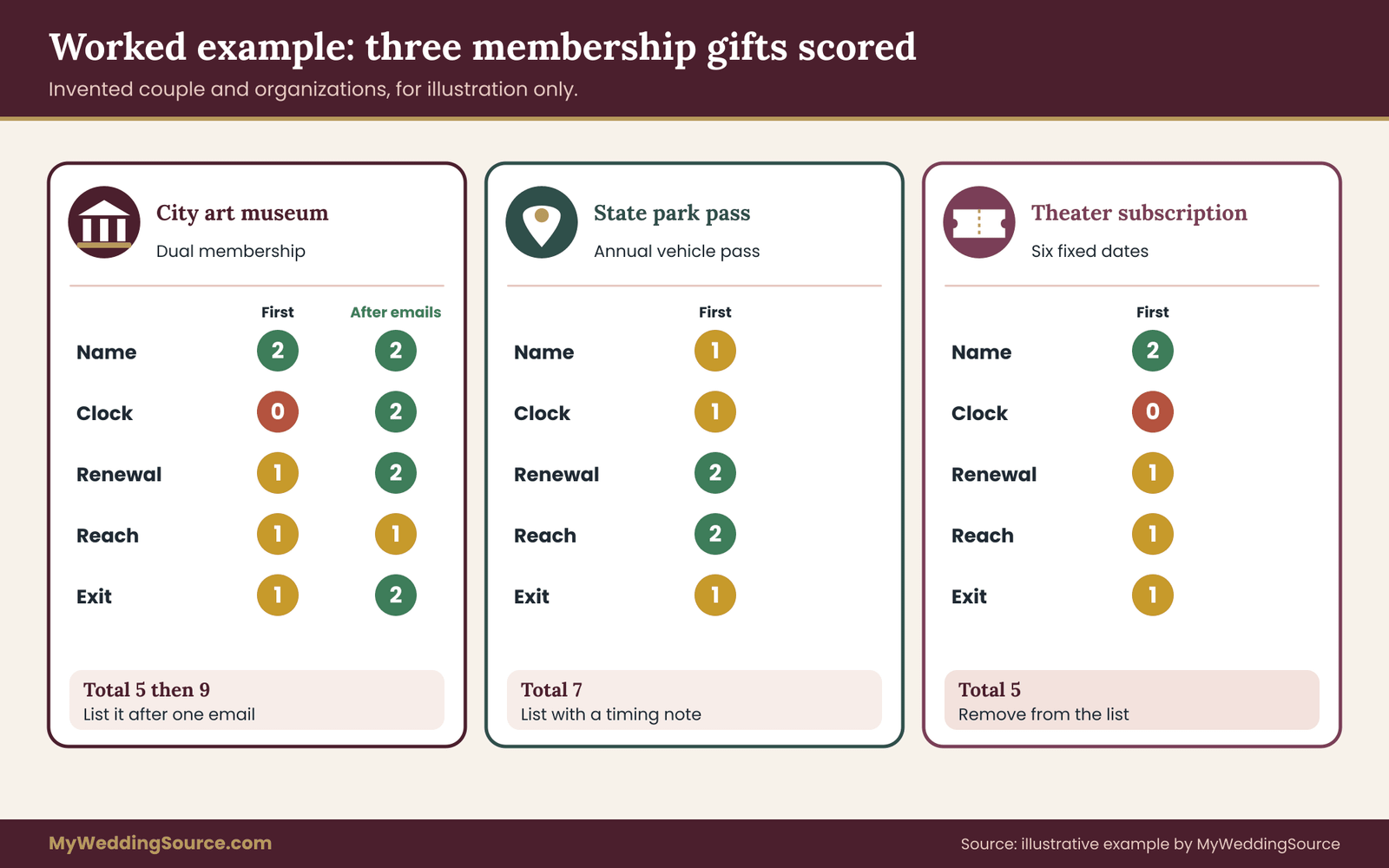
The posted terms say the membership names two adults, requires no shared address, and allows free name corrections. The confirmation can be sent to the recipients. The term starts on the purchase date, with no mention of changing it. The page does not say whether the buyer’s card renews. Reciprocal access is available only at a higher tier. Refunds are not mentioned.
First scores: Name 2, Clock 0, Renewal 1, Reach 1, Exit 1. Total 5. Priya and Sam do not drop the museum. They email the membership office with the script from earlier and ask for the start rule, the renewal policy and the extension policy.
The reply, in this invented example, says buyers can choose a start date up to six months ahead, gift memberships never renew automatically, and the office will extend the term for a full closure. Re-scored: Name 2, Clock 2, Renewal 2, Reach 1, Exit 2. Total 9. Reach stays at 1 because the couple will not pay for the higher tier, and they accept that.
Candidate B: a state park annual pass
The pass belongs to a vehicle owner and covers the vehicle’s passengers at entry. A single name is printed on the pass. It is valid for twelve months from the month of purchase, and no automatic renewal is offered. The terms say nothing about refunds.
Scores: Name 1 (single name, but both can use it), Clock 1 (the month-of-purchase rule shortens early purchases), Renewal 2, Reach 2 (twelve parks within an hour), Exit 1. Total 7. They decide to list it with a note about buying close to the wedding date, and they plan to ask about the month rule.
Candidate C: a small theater’s season subscription
The subscription covers six performances on fixed dates, two of which fall during the honeymoon. Changes are allowed for a fee. Renewal is not described. Names are printed on the tickets.
Scores: Name 2, Clock 0 (fixed dates clash), Renewal 1, Reach 1, Exit 1. Total 5. They remove the subscription from the list and decide to buy tickets to a single show themselves instead.
What the example shows
Three things are worth noticing. First, the museum began with a low score and became the strongest candidate after one email. The scores were measuring unanswered questions, not a poor organization. Second, a total score of seven for the park pass came from small uncertainties rather than a single big one, and the plan is to ask one question, not abandon it. Third, the theater subscription was dropped for a reason that no amount of email would fix: the dates clash. Some membership gifts simply do not fit.
Notice also what the couple did not do. They did not guess at policies, and they did not ask guests to read terms. They did not put a membership on the registry because it sounded nice. They spent perhaps ten minutes each on a few emails and ended with a short list of gifts they understood.
Your own version will have different organizations and different answers. The method stays the same: score, ask, re-score, decide, and file the answers.
Alternatives and vendor questions for membership gifts
Not every organization passes the check, and not every couple wants a membership. A few related gifts keep the spirit of an outing without some of the risks. Compare them against the same five checks, in plain terms.
Single-entry tickets or vouchers. A voucher for a set number of visits has no renewal, usually no name problem, and often a long validity. Its weakness is the clock: vouchers may carry an expiration date. It also lacks the sense of belonging that a membership offers. For a couple unsure about frequency, vouchers are a low-risk way to try a place.
A gift card to the museum shop or cafe. Easy to buy and flexible, but it does not give admission, and federal rules for gift cards, which the Consumer Financial Protection Bureau explains, differ from membership rules. This suits guests who want something small.
A shared outing. A guest offers to join the couple on a visit, perhaps with lunch afterward. There is no purchase to track, but it needs scheduling, and it is not something to list on a registry. Couples sometimes mention it on a wedding website as an open invitation.
A membership the couple buys themselves. If a couple receives cash gifts or has room in a budget, they can buy the membership directly after the wedding, with the exact start date, names and tier they want. The check still applies, but all the choices are theirs, and no guest has to be involved. This is often the cleanest route for organizations with weak gift policies.
A donation in the couple’s name. Some couples prefer to point guests to an organization as a charity instead of a pass. That is a different gift with its own questions, which the broader registry ideas guide covers more widely.
None of these is better in every case. The point is that membership gifts are one option among several, and you can match the option to the couple. A pair who goes to museums twice a year might choose vouchers. A pair who lives next to a garden might choose the full membership. And a pair who are unsure might wait and decide after the wedding.
Questions to ask the membership office
Keep the list short. Fifteen questions will not get answered. Group them by check and send them in one message. Here is a set you can copy and adapt, written in plain language.
Name – Who is the member of record when a gift membership is purchased, the buyer or the recipient? – Does the dual or household tier require a shared address, and how is that checked? – Can names be corrected, and is there a fee?
Clock – Does the term start on purchase, on a chosen date, on activation or at the first visit? – Is there a deadline to activate a gift membership? – Are memberships extended when the institution closes for a period?
Renewal – Will a gift membership renew automatically, and could the buyer’s card be charged again? – What notice is sent before the term ends, and to whom? – Is the renewal price the same as the gift price?
Reach – Which tier includes reciprocal admission, and are there distance or date restrictions? – Are guest passes included? Are special exhibitions, parking or events extra? – Are timed tickets required for members?
Exit – Can a gift membership be refunded, extended, upgraded or transferred? – If two people buy the same membership, what can be done?
Fifteen questions are a lot in one email, so pick the handful that the posted terms do not already answer. Most organizations answer in a few sentences, and a quick, specific message is more likely to get a quick, specific reply.
Reading the answers on membership gifts
You are looking for three kinds of response. A clear answer with specifics, such as dates, amounts or a link to terms, scores as clear. A friendly but general answer, such as “we are always happy to help,” scores as unclear, and you should follow up with a narrower question. And an answer that says no scores as a problem only if the no affects something you care about. A flat no on transfers is fine if you are certain you will keep the membership.
Be wary of answers that contradict the posted terms. If the page says one thing and the representative says another, ask which governs and request it in writing.
What to put on the registry once the check is done
With answers in hand, the registry description can stay brief. A good description of membership gifts names the organization, the tier, what it includes and one practical note. For example: “Dual membership, two adults, free admission for twelve months. Start date is chosen at checkout.” Avoid pressure words or claims about value that you cannot verify. A short, neutral entry respects guests and lets them decide.
If a gift only works in a particular way, such as choosing a start date, say so in one line and leave it there. Guests will appreciate the clarity, and you will have fewer corrections to make later.
A closing rule of thumb
If you remember one thing, make it this: a membership gift is only as good as its fine print, and the fine print is short. The five checks take a few minutes per organization. They let you list membership gifts with a clear conscience, and they let guests buy them without worry. Where the answers are strong, the gifts are a quiet pleasure. Where they are weak, you have lost nothing by asking.
Your next steps
You do not need to finish everything at once, and the wedding planning checklist is a good place to slot these tasks among the others. A reasonable order for membership gifts is the following.
- Choose the organizations. Pick three to five places you would genuinely use. Drop any that fail the fit questions about distance, interest and timing.
- Gather the posted terms. Save the gift membership page and any terms for each, with the date you read them.
- Send one message per organization. Use the questions above, trimmed to what the terms do not answer, and ask for written replies.
- Score each check. Use clear, unclear and problem, apply the Name and Exit gates, and total the points.
- Decide. List the strong ones, ask follow-up questions on the middling ones, and drop the weak ones or buy later yourselves.
- Write the registry notes. Name the tier, say what it includes, and add any timing or name note in a line.
- File the answers. Save emails and terms with your wedding records, and set a reminder for each membership’s end date once it arrives.
- Review before renewal. Two months before a term ends, count your visits and decide whether to renew, change tiers or let it lapse.
Membership gifts work best when the couple has done the checking in advance, the guest has an easy path to buy, and nobody is surprised a year later. A small amount of work now prevents most of the trouble.
FAQ
Are membership gifts a good fit for a wedding registry?
They can be, when the couple lives near the organization, has real interest in it and is not about to move. They fit poorly for couples relocating, traveling most of the year, or with guests spread far apart. Run the five checks first, and keep other gift types on the registry so guests are never steered toward a single choice.
What is the biggest risk with membership gifts?
Usually the clock. If a twelve-month term starts on the purchase date and the couple cannot use it until after the wedding and honeymoon, months of value are gone before the first visit. The second most common problem is the name: a pass issued to one person, or to a name that later changes, may not work for both partners.
Can membership gifts be transferred to someone else?
It depends on the organization. Many tie a membership to a named person or household and do not allow transfers. Some will correct a name or move the membership for a fee, and a few allow credit toward another tier. Ask before the gift is bought, and get the answer in writing so you can refer to it later.
Will membership gifts renew automatically?
Often not, but practices vary and you should confirm it. The concern is that the buyer’s card could be charged again at the end of the term. Ask the membership office whether a gift membership ever renews automatically. For general rules on automatic renewals, check the Federal Trade Commission’s consumer pages and your state attorney general.
What if two guests buy the same membership?
Ask the organization what it can do. Some will extend the term of the first membership, upgrade the tier, apply the second to another name, or refund one purchase. Others will do none of these. To reduce the chance, list a single quantity, mark purchases on the registry and describe exactly which tier you want.
How do I handle a name change after the wedding?
Ask whether the card or app is checked against photo identification, whether the old name will keep working, and whether a correction is free. Many organizations allow quick corrections. If you know a change is coming, ask guests to enter names as they appear on your IDs, and update the membership when the change is done.
Are museum memberships tax deductible for the guest?
Do not assume so. For nonprofits, part of the price may be a purchase of benefits and part a contribution, and the rules depend on the situation. The Internal Revenue Service publishes guidance on charitable contributions. Suggest that a guest who asks check with the organization and a tax professional, and do not promise any deduction on your registry.
What should I do if a membership does not work for us after it arrives?
Contact the membership office first, with the confirmation and the terms you saved, and ask about corrections, extensions, tier changes or transfers. Try to resolve it without involving the guest. If nothing works, thank the guest sincerely for the thought, and use the membership as far as you can, or let it lapse at the end of the term.
Sources
- Federal Trade Commission: consumer protection guidance on automatic renewal and negative option practices.
- FTC consumer advice: plain-language articles on subscriptions, memberships and gift purchases.
- Consumer Financial Protection Bureau: information on gift cards, expiration dates and fees.
- National Park Service: passes: who federal recreation passes cover, how long they last and how they are issued.
- North American Reciprocal Museum Association: reciprocal admission program for participating museums.
- Association of Science and Technology Centers: Passport Program for participating science centers.
- American Alliance of Museums: museum field resources and background on how museums operate.
- Internal Revenue Service: charities and nonprofits: rules on charitable contributions and benefits received.
- USA.gov: directory for state attorney general and consumer protection offices.
- National Park Service: official site for national parks and fee information.