
Gift returns are the quiet second job after a wedding: sorting the duplicates, the wrong sizes and the items that never fit your home, then turning them into exchanges or store credit before a window closes. This guide gives you a four-lane ledger, a store-credit expiration tracker and a set of privacy rules so that nobody who gave you a gift ever learns what happened to it.
Log every gift once, with a short code instead of the giver’s name. Sort each duplicate into one of four lanes: exchange, store credit, refund, or pass on. Find the real return deadline from the store’s own policy, not from memory. Record every credit with its amount, its expiration and where the card or code lives. Keep the list of who gave what in a separate private file, and never mention gift returns in a thank-you note. Then check the tracker every Sunday until the last credit is spent.
Most couples handle gift returns badly for a simple reason: nobody plans for them. The gifts arrive in a rush, in boxes, in the mail, in a pile at the reception, and the first goal is to get the thank-you notes written. The question of what to do with the third toaster comes later, usually after the box has been opened, the receipt has gone missing and the return window has quietly closed.
This guide treats gift returns as a small operations project with a start date, a tracker and a finish line. It covers how to sort what you received, how to find a store’s real deadline, what store credit actually is, how to avoid losing it, and how to protect the privacy of the people who were generous to you. It also includes a worked example with an invented couple, a script for the store counter and a list of edge cases.
A note on scope. This is general information, not legal, tax or financial advice, and store policies change often. Wherever a rule matters, the guide points you to the store, the registry service or the agency that sets it, so you can confirm the current version yourself.
What gift returns involve after a wedding
A return after a wedding is different from an ordinary return. In an ordinary return, one person bought one thing and knows where the receipt is. After a wedding, you may hold a hundred gifts bought by a hundred people at a dozen stores, with receipts that were thrown away, tucked into a card or never printed at all. You did not buy any of it, and in most cases you cannot ask the giver for details without creating an awkward moment.
That single fact shapes everything else. Gift returns depend on proof you did not create, on policies you did not read and on relationships you want to protect. The goal is not to squeeze every dollar out of every item. The goal is to end up with a home full of things you will use, a record that shows where every gift went, and a pile of store credit you actually spend.
The four things you can do with a gift
Whatever lane a gift lands in, the rule for gift returns is the same: decide once, write it down and move on. Reopening the same decision every weekend is what turns a two-evening job into a two-month one. The ledger exists to make each decision final enough to act on.
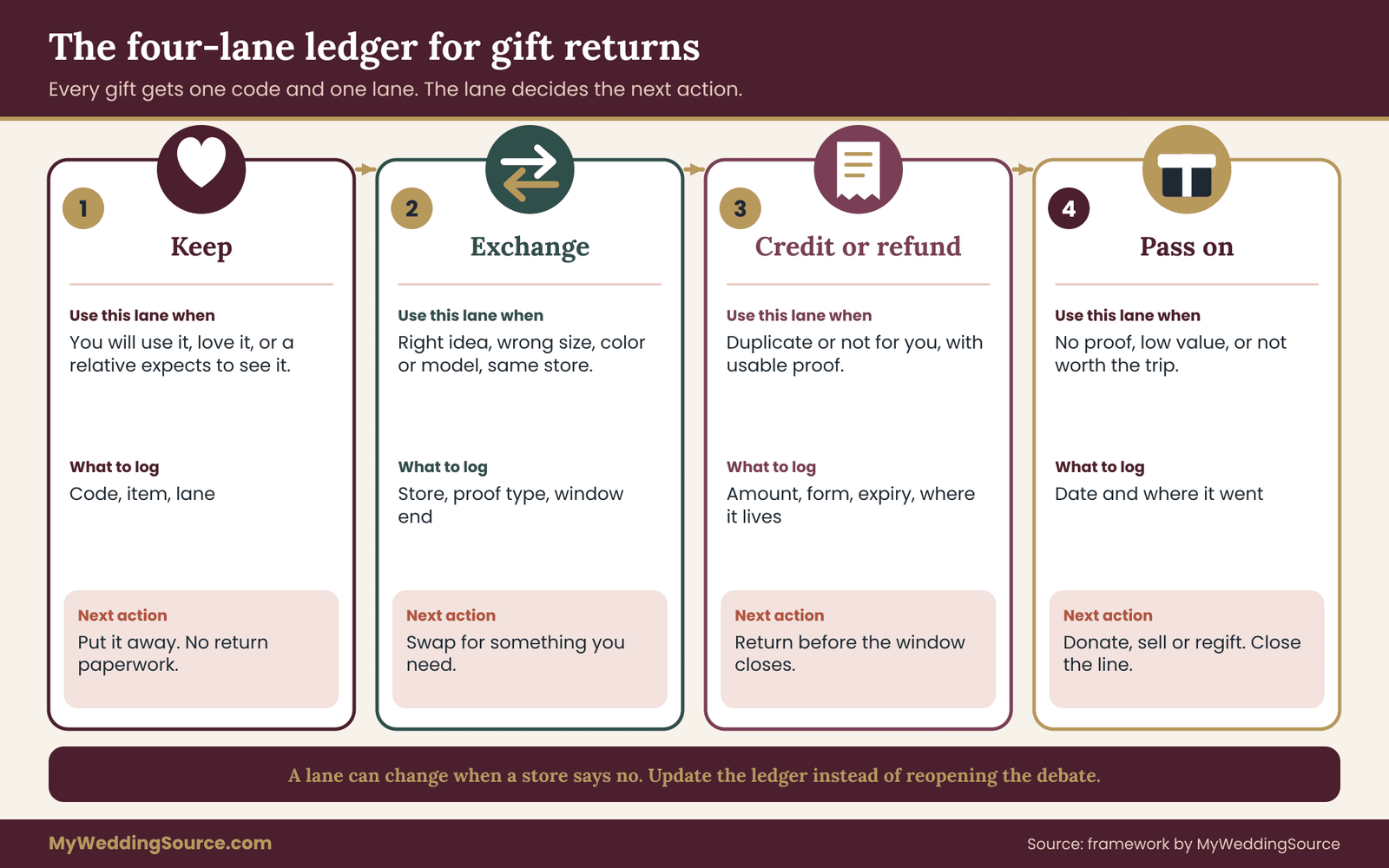
Every gift ends in one of four places. Naming them early keeps the process calm, because each one has its own rules and its own paperwork.
Keep it. You will use it, or it has sentimental value, or it came from someone who will visit and expect to see it. Keeping is the default, and most gifts stay in this lane.
Exchange it. You swap the item for something else of similar value at the same store, often for a different size, color or model. Exchanges usually leave the least paper behind, but they depend on the store allowing them.
Return it for credit or money. You give the item back and receive store credit, a merchandise credit or a refund. This is where most of the money and most of the deadlines sit, and it is the focus of this guide.
Pass it on. You donate it, sell it, or give it to someone who will use it. This lane applies when the item has no receipt, no gift receipt and no identifiable store, or when the value is too small to justify a trip.
Why duplicates happen even with a registry
Knowing why duplicates happen helps you plan the gift returns calmly. They are a side effect of generosity, not a sign that anyone chose badly. A giver who bought a second toaster from a different store did nothing wrong, and neither did you.
A registry reduces duplicates, but it does not remove them. Guests buy off-registry because they want to choose something personal. Some buy the same item from two different stores. Relatives who do not use the registry send the classics, like towels, serving dishes and kitchen appliances. A registry item can also be bought twice if two stores sync with a delay, or if you added the same product on two lists.
For ideas on setting up a list that avoids most of this, the wedding registry ideas guide covers how to build one. After the wedding, though, the registry only matters as a source of proof: registry purchases are often easier to return because the store has a record of them.
The four-lane ledger in one view
Think of the ledger as the map for every one of your gift returns. Each lane answers a different question, and the order of the lanes shows which paths cost the least effort.
The method in this guide is a ledger with four lanes. Each gift gets one line, one code and one lane. The lane decides what you do next, and the lane can change as you learn more, for example when a store refuses an exchange and the gift moves to credit.
The ledger has a second half that most return advice leaves out: a private key that links each code to a giver. The ledger you work from every day shows items, stores, amounts and dates, and nothing else. The key lives in a different file, opened only when you write thank-you notes. Splitting the two is the simplest privacy safeguard in this guide, and a later section explains how to set it up.
How this fits with the rest of your paperwork
Because gift returns create receipts, credits and photos, they belong in the same archive as your other wedding paperwork. A separate folder for them keeps the rest of the archive tidy.
Gift returns sit inside the larger job of keeping your wedding paperwork in order. The broader guide to organizing wedding records after the event covers contracts, receipts, certificates and photos, and it is worth reading beside this one. Here the focus is narrower: the gifts you do not want to keep, the credits those gifts turn into, and the dates that decide whether the credit survives.
How long gift returns take
Couples who finish gift returns quickly tend to share one habit: they start the research before the first box goes back to a store. A single phone call that confirms a window is worth more than three trips made on a guess.
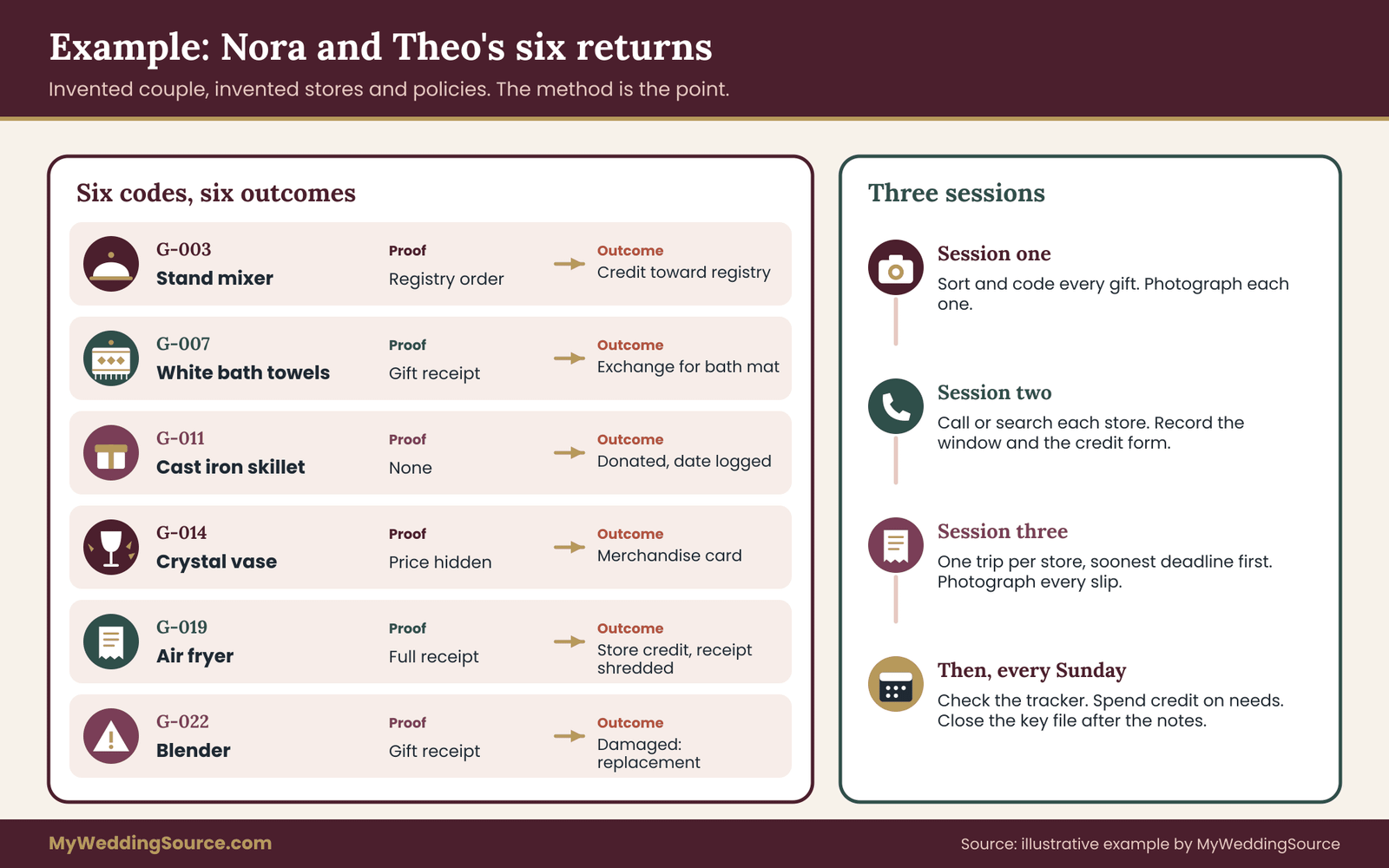
Plan for about three short sessions at the start, and then a few minutes a week. The first session is sorting: open and photograph every gift, assign a code and place it in a lane. The second is research: find the policy for each store that matters. The third is action: go to the stores, or print the labels, and complete the gift returns.
After that, the work is the weekly check. Credits that sit in a drawer for a year are the usual way couples lose money on gift returns, not the returns themselves. A calendar reminder every Sunday, with the tracker open, is usually enough.
What you will need before you begin
Gather a few things before the first session so you do not stop halfway through.
- A way to number gifts, such as a notebook, a spreadsheet or a notes app.
- A phone to photograph each item, its box and any receipt.
- A second, separate file for the private key that links codes to givers.
- A box or shelf where unopened items wait for their lane.
- A place for gift cards and credit slips that is not a kitchen drawer.
None of these require software you do not already have. A spreadsheet is helpful because it can sort by date, but a paper notebook works for a small number of gift returns.
Building the gift returns tracker
The tracker is the center of the whole system. It is a single list with one line per gift that might leave your house. It does not need to list every gift you keep, though many couples find it easier to log everything once, because the gift list also feeds the thank-you notes. What matters is that any gift that could become a return or a credit has a line, and that the line holds enough detail to act on without opening the box again.
The fields that earn their place
Each field should earn its place in the gift returns tracker by answering a question you will really ask. If you never look at a column, delete it.
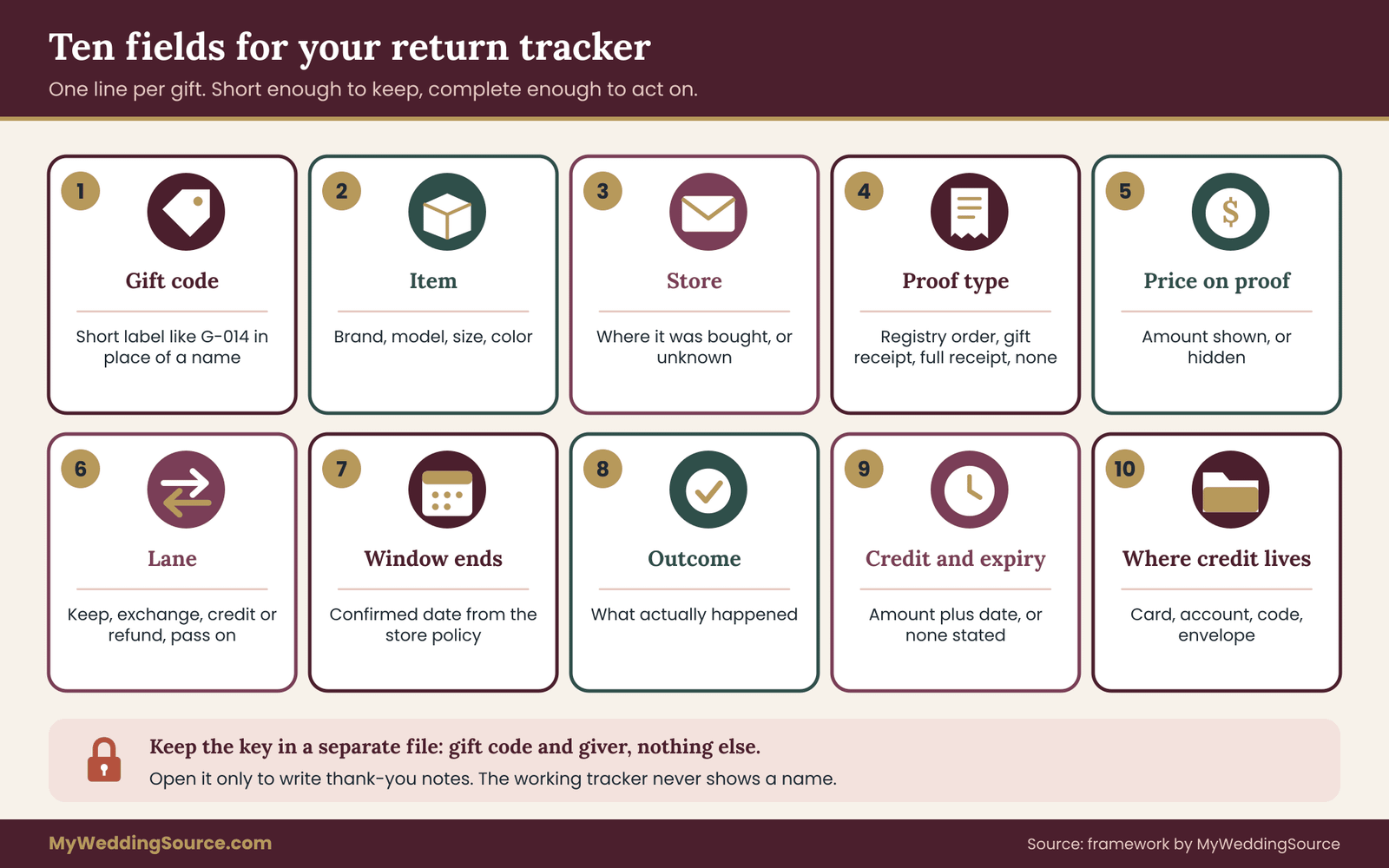
Keep the fields few. A tracker with twenty columns gets abandoned in week two. These ten are enough for nearly every case, and each one answers a question you will actually ask later.
Gift code. A short label such as G-014. This replaces the giver’s name everywhere in the working ledger. Number gifts in the order you open them.
Item. A plain description with brand and model if visible: “stand mixer, white, 5 quart” is better than “mixer.” Model numbers matter, because stores match returns on them.
Store or source. Where it was bought, if you know. If the box has a store label, a price sticker or a gift receipt, write the store. If not, write “unknown.”
Proof type. One of four: gift receipt, registry order, full receipt, or none. This single field predicts how easy the return will be.
Price on proof. The amount printed on the receipt, if any. Some gift receipts hide the price on purpose, in which case write “hidden.”
Lane. Keep, exchange, credit or refund, or pass on. Update it as things change.
Window ends. The date the store’s return window closes, once you have confirmed it. Leave it blank until you have the real policy.
Outcome. What actually happened: exchanged for X, credit of an amount, refund to a payment method, donated.
Credit amount and expiry. If the return produced store credit, the amount and the date it expires, or “no expiry stated.”
Where the credit lives. A physical card in the envelope box, a code in a locked note, an account balance at a named store. Credits get lost because nobody wrote this down.
Where the tracker lives
A good home for the gift returns tracker is wherever you already keep household money notes, because the credits it produces are household money. If you keep a monthly budget file, put the tracker beside it, and link the two so that credit never disappears from view.
Choose one home for the tracker and stay with it. A shared spreadsheet is the most flexible, because both partners can see it and it sorts by the window-ends date. A paper notebook is perfectly fine if only one partner handles returns. The one thing to avoid is splitting the tracker across a notes app, a spreadsheet and sticky notes, because every copy drifts out of date.
If you use a shared spreadsheet, set it to be visible only to the two of you. A link that anyone can open is the wrong setting, even for a list with no names in it, because the item list and the store names can still reveal more than you intend. The privacy section later in this guide explains why.
The separate private key
The second file is short and boring on purpose. It has two columns: the gift code and the giver’s name. Nothing else. You open it when you write thank-you notes, and you close it again.
Keeping the key separate means that the working ledger can be shared with a partner, shown to a family member who is helping, or even photographed on a counter without telling anyone who gave what. It also means that if you decide to get help with the gift returns, the helper does not need to know who gave you the gift in order to carry the box to the store.
Photograph before you pack
Photos are the cheapest insurance for gift returns. A thirty-second photo session per item can settle a dispute about condition, contents or model number months later.
Before an item goes back in a box, take three photos: the item itself, the box with its barcode and model number, and any receipt, gift receipt or tag. Store these in a folder named for the gift code. The photos help in three situations. They show what was in the box if something is later disputed. They give you the model number if the box is damaged. And they let you describe the item to a store’s customer service line without digging it out of storage.
The photos also support the broader recordkeeping habits described in the guide to wedding records habits, where receipts and proof of payment live in their own folder.
Sorting the pile: which gifts stay and which go
Sorting is where couples either save a great deal of time or waste it. The rule that works best is to sort by decision, not by room or by type. You are not organizing a kitchen. You are deciding, once, what each item is for.
Pass one: the obvious keeps
Start by pulling out everything you love or will clearly use. Keep these items out of the gift returns system entirely, but log them if you track gifts for thank-you notes. This pass is usually the fastest and it clears space, which makes the remaining decisions easier.
Items from close family often belong here even when they are not your taste, because the cost of explaining a return can outweigh the value of the credit. That is a personal call. The ledger does not decide it for you, but it does make the cost visible.
Pass two: the clear duplicates
True duplicates are the easiest gift returns, because you lose nothing by sending one copy back. The only real decision is which copy goes.
Next, find items you now own more than once. Compare the models, not just the type of item. Two blenders from different brands are not strictly duplicates if one is a personal-size model and one is a full pitcher. Two sets of sheets in different thread counts may both be worth keeping if you have two beds.
When you do have true duplicates, decide which one to keep using three tests, in this order.
- Condition and packaging. Keep the one whose box is damaged or whose item has a flaw you can live with. Return the one in perfect packaging, because stores accept those most readily.
- Proof. Keep the one with the weakest proof. Return the one with a full receipt or a registry record, because it is the easiest to turn into credit.
- Source. Keep the one from a store with a strict return policy. Return the one from a store with a generous one, because that is where credit or cash is most reliable.
This order matters. Using proof and policy as tiebreakers is not sneaky. It is the same logic any buyer uses when deciding which of two identical products to send back.
Pass three: the not-for-us items
Be honest in this pass, because gift returns that you postpone rarely happen. An item that sits in a closet for six months is usually past its window and its credit value. If you already know you will not use it, move it to a lane today.
Then go through the items that are not duplicates but simply do not fit your life: the wrong size, a color that clashes, a gadget you will not use, a decorative piece with no wall to hang it on. These are candidates for exchange or credit.
For each one, ask a blunt question: if this were free in a store, would you choose it over everything else on the shelf? If not, the gift is worth more as credit. Set a modest threshold so you do not spend hours on small items. Many couples choose to return anything above a certain value and donate anything below it, because a ten-minute trip for a low-value credit is rarely worth it.
Pass four: the questionable and the damaged
Finally, handle items that arrived damaged, defective or incomplete. These follow a different path, because a store or manufacturer may treat a defect differently from a change of mind. Photograph the damage, keep the packaging and check the store’s policy for damaged goods and the maker’s warranty terms.
Keep the warranty card and the proof of purchase for anything that might need repair later. A defective gift is a repair or replacement question first, and a gift returns question only if the store or maker declines to fix it.
Setting a return threshold
A threshold is a number below which you do not bother. It is personal, but it helps to choose it in advance. If a ten-dollar candle holder would take an hour to return, the time is worth more than the credit. If a four-hundred-dollar vacuum is a duplicate, the return is worth a day of effort.
Write the threshold at the top of the tracker. When a borderline item shows up, you do not need to deliberate. You apply the rule and move on.
Proof of purchase and return windows for gift returns
Whether a store will take a gift back, and what it will give you, depends on three things in roughly this order: the proof you hold, the store’s written policy and the condition of the item. You control the third completely, the first partly and the second not at all. This section focuses on what you can control and on how to read what you cannot.
Four kinds of proof, from strongest to weakest
The strength of your proof sets the shape of your gift returns. Rank every item by proof before you plan a single store trip.
The registry order. If the gift was bought from your registry, the store usually has a record linking the purchase to your list. That record often makes the return straightforward, because the retailer can see the order without a paper receipt. Registry services differ in how they handle this, so ask the registry’s customer service what they can look up, and whether they limit the window for registry items.
The gift receipt. A gift receipt is a slip that lets the recipient return or exchange an item without seeing the price. Typically it supports an exchange or store credit, not a cash refund, and the amount is the price paid or sometimes the current selling price. Treat the gift receipt as the strongest paper proof you will get from a guest.
The full receipt. Some givers tuck the original receipt in the box or the card. A full receipt may allow a refund to the original payment method, but the store may refuse to refund to someone other than the purchaser, or may issue credit instead. Never assume it will work the way a normal return would. And if the receipt has the giver’s name or card digits on it, handle it with the privacy rules in this guide.
No proof at all. Many stores will still help, often with store credit at the lowest recent selling price, and often with limits. They may ask for identification, and some record it. Many stores post this in their return policy. If the item has a clear store label or a distinctive product, call before you go.
What each kind of proof usually allows
Write the expected result in the tracker before you go, because gift returns are easier to judge when you can compare the outcome with your own plan. If the store offers less than you wrote down, ask why, then decide whether to accept.
These are patterns, not promises. A store may treat any of them differently, and your job is to confirm, not to assume.
A registry order commonly supports exchange, credit or sometimes a refund to the purchaser. A gift receipt commonly supports exchange or credit. A full receipt supports whatever the store’s policy offers the original purchaser, though the store may be unwilling to refund someone else. No proof commonly supports credit at a reduced amount, or nothing at all.
The point is to match your expectations to your proof before you travel. Going to a store with a plan for credit, and being offered a refund, is a pleasant surprise. The reverse is not.
What federal and state rules generally say
In general, U.S. federal law does not require a store to accept a return of an item that works as described, and the store’s posted policy governs. Some state laws add rules about how a store discloses its policy, and a few address what happens if a store posts no policy at all. Because the details differ, the safest route is to read the store’s written policy and, if it matters, check with your state attorney general or consumer protection office.
For general consumer information on returns and gift cards, the Federal Trade Commission publishes plain-language pages, and USAGov lists state consumer offices. Both are in the sources at the end of this guide.
Finding the real return deadline
The return window is the single most common reason that gift returns fail, and it is the field in your tracker that needs the most care. A window usually starts on a date you did not witness and may not be able to see.
What starts the clock
Many failed gift returns trace back to this one question. People read the number of days on the policy and forget that the days started counting before the gift ever reached them.
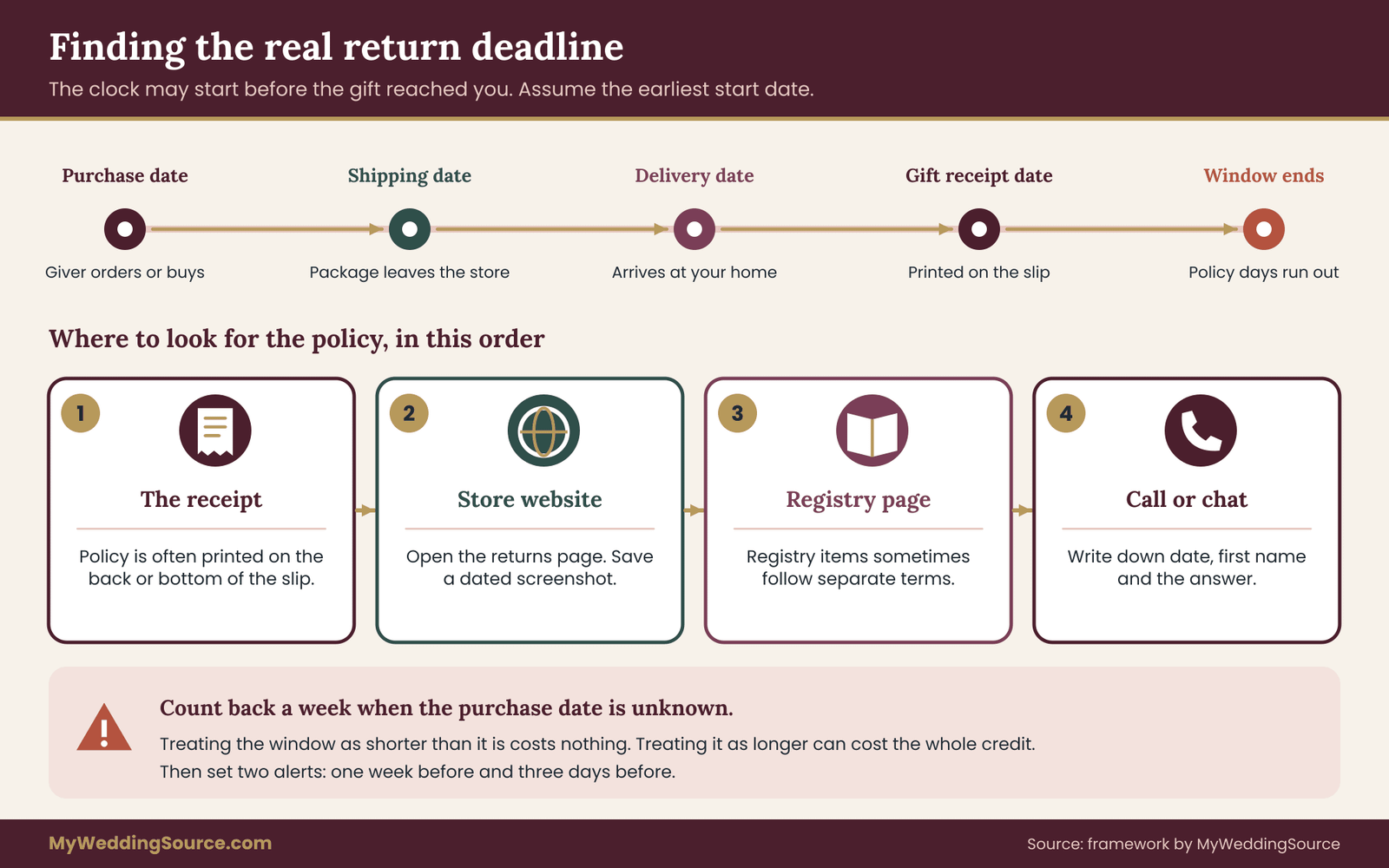
Different stores start the clock at different points, and the policy rarely says which one applies to a gift. The common starting points are the purchase date, the delivery date and the date shown on the gift receipt. Some stores count from the date an item shipped. Some extend their window during the holiday season, and some give a longer window for registry purchases.
If you cannot tell which date applies, assume the earliest. For a wedding gift that came in the mail, the purchase date may be a week or two before the delivery date, and you may have lost days without knowing it.
Where to find the policy
There are four places to look, in this order.
- The gift receipt or receipt itself. Many receipts print the policy on the back or the bottom. Read the small print.
- The store’s website. Look for a page named returns, exchanges or customer service. Print or screenshot the page with its date, so you can show what it said when you checked.
- The registry page. Registry services sometimes publish their own terms, including a different window for registry items.
- A direct call or chat. If the policy is vague, ask. Write down the date, the representative’s first name if given, and what they said.
Treat a screenshot of the policy as part of the record. Policies change, and a screenshot protects you if a store points to a different version later.
Questions to settle for every store
These six questions are the core of the research session for gift returns. Ask them once per store, not once per item, and record the answers in one place.
Before you go, you want a firm answer to six questions, because each changes what you do.
- How many days do I have, and from which date?
- Is a gift receipt enough, or do I need the full receipt?
- Will the store refund money, or only issue credit?
- If credit, is it a physical card, an account balance or a code, and does it expire?
- Does the store restrict returns of certain categories, such as opened items, clearance or custom orders?
- Is there a restocking fee or a shipping charge for the return?
Record the answers in the tracker. Then set the window-ends date for each affected gift and add a reminder a week before it.
Dating a window from limited facts
Sometimes you do not know when a gift was bought. A registry order may show a date. A box may carry a shipping label. A card may mention when the giver ordered it. If none of these exist, pick the delivery or event date as your best estimate and subtract a week.
This is a conservative approach on purpose. If you treat the window as shorter than it is, you may return something a little early, and nothing is lost. If you treat it as longer than it is, you may return it a day late, and the credit is gone.
Registry completion discounts and extended windows
Registry terms can make gift returns more valuable, so check them early. A longer window or a discount changes which items you should send back first.
Some registry services offer a completion discount or an extended return period after the event, and some do not. These terms differ by retailer and change over time, so confirm them rather than counting on them. If you are shopping from your own registry to fill gaps after the wedding, ask whether you can use an eligible discount on those purchases, and whether credit from returned gifts can be applied toward them.
One practical use of this: if you receive a duplicate registry item and the store allows credit toward other registry items, you can turn the duplicate into something you actually listed and wanted. That keeps the value inside the same store and often avoids a fresh policy question.
Online purchases and shipped returns
Shipped gift returns have their own risks, mainly loss in transit and slow refunds. Keep tracking records until the money or credit has landed.
A gift bought online may need to be returned by mail or at a store location. Some retailers allow in-store returns of online orders. Others require a shipping label, and may deduct a fee or require you to pay shipping. Read the details before you box the item.
If you ship, keep the tracking number and the date, and take a photo of the sealed box with the label. A shipped return that goes missing is a dispute, and your proof is the tracking record. The United States Postal Service publishes tracking and insurance information for mailed items, and its website is listed in the sources.
The calendar habit
The calendar is the quiet hero of gift returns. A reminder costs nothing, and a missed window costs the full value of the item. If you only adopt one habit from this guide, make it this one.
Once you know the window-ends dates, put them in a calendar app with two alerts: one a week before and one three days before. Sort the tracker by that date every Sunday. The soonest-expiring gift is always the next job.
A useful practice is to batch the trips. If three gifts go back to the same store, plan one visit for all three, ahead of the earliest deadline. That saves time and reduces the number of conversations with store staff about the same registry.
Store credit, merchandise credit, gift cards and cash after gift returns
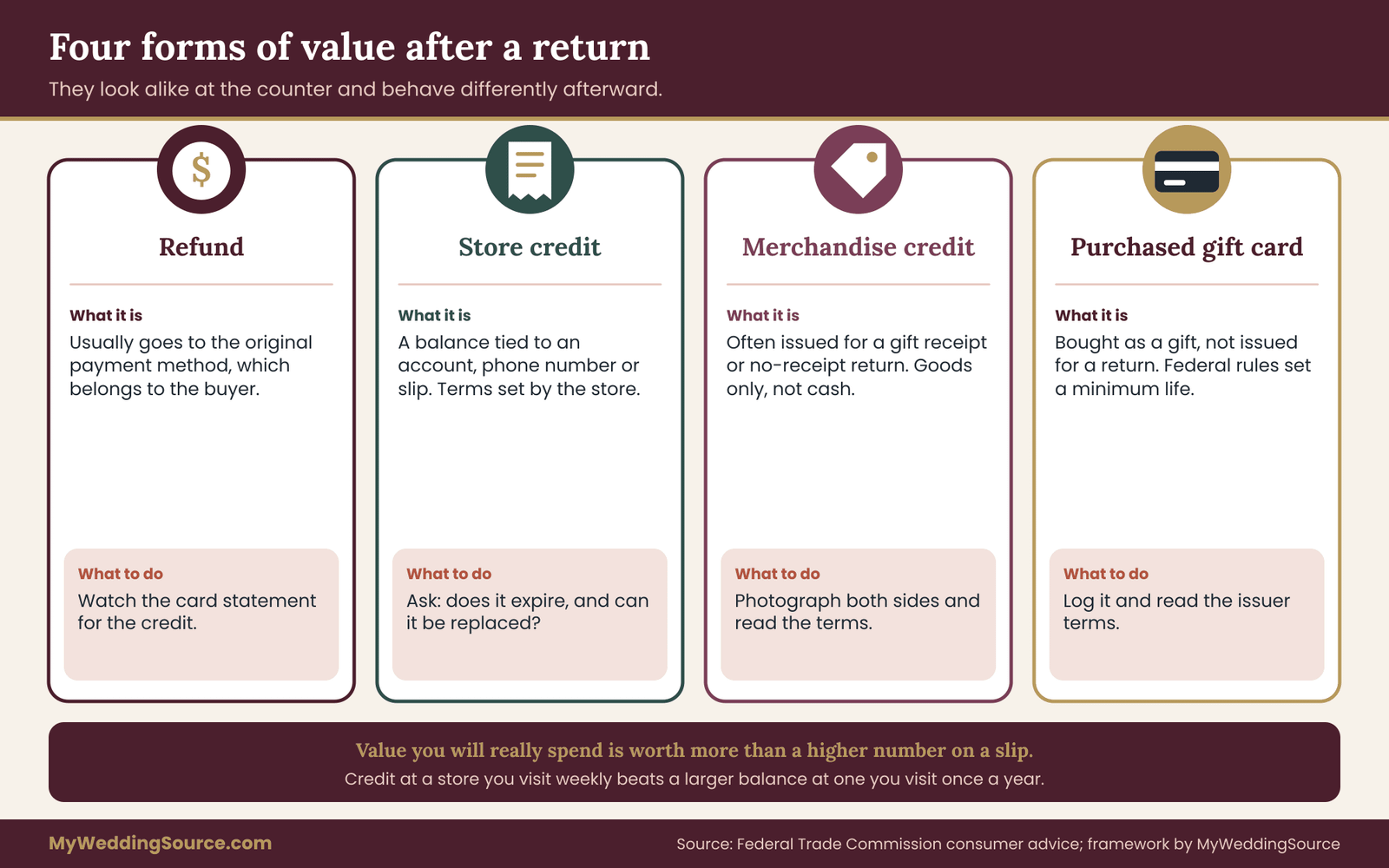
When a gift return succeeds, the store hands back value in one of four forms. They look similar at the counter and behave very differently afterward. Knowing which one you hold changes how fast you should spend it, how safe it is and how much of it you can count on.
Cash or a refund to a payment method
This is the simplest form and the rarest for gifts. A refund usually goes back to the original payment method, which means the person who bought the gift, not you. Some stores will give cash for a returned item that was bought with cash and has a full receipt, but many will not refund a non-purchaser at all.
If a refund does go to a card, watch the card statement for the credit. Credit card billing errors generally have to be reported in writing within sixty days of the statement that shows them, according to the Consumer Financial Protection Bureau, so a refund that never appears is worth catching early. That rule applies to the account holder, which is a reason to be careful about who the refund goes to in the first place.
Store credit
Store credit is the most common outcome of gift returns, which makes its terms the most important to understand. Read the slip before you walk away from the counter.
Store credit is a balance held by the store, usually tied to an account, a phone number or a printed slip. It works only at that store or its brand family, and the terms are set by the store. It may be reduced by tax, adjusted to a lower sale price or restricted to certain categories.
Ask three things every time. Does it expire? Can it be replaced if lost? And can it be used online as well as in the store? Some store credit is recorded electronically, which makes it harder to lose. Some is a paper slip, which behaves like cash that cannot be replaced.
Merchandise credit and merchandise cards
A merchandise credit or merchandise card is often what a store issues for a return without a full receipt, or for a gift receipt return. The wording varies by store, but the principle is similar to store credit: it can be used on goods, usually not on services, and it is not cash. Some merchandise cards cannot be combined with other offers, and some cannot be used to buy gift cards.
Treat it as a coupon with a face value. Before you leave the store, check the card for an expiration date or a note about terms, and take a photo of both sides.
Gift cards
A gift card is a prepaid balance that was bought as a gift, and it is a different animal from store credit issued for a return. Federal rules generally set a minimum life for the funds on a purchased gift card, and the Federal Trade Commission explains what is covered. Those rules may not apply in the same way to credit issued after a return, and states may have their own protections.
This matters because couples often receive gift cards as wedding gifts, and these belong in the tracker too. A purchased gift card has its own rules and may not need the same deadline tracking as store credit from a return. Look at the card and the issuer’s terms and write down what they say.
Which form is better
When you plan gift returns, think about the form of value before you choose a store. If two stores will take the same duplicate, send it where the credit is most useful and the terms are clearest.
None is better in every case. A refund is the most flexible, store credit is usually enough if you shop at that store, and merchandise credit is the most restrictive. The right comparison is not the face value but the practical value: how much of it will you really spend, and by when?
A hundred dollars of credit at a store you visit weekly is worth more than a hundred and twenty at a store you visit once a year. Count credit at a store you rarely use as worth less than its printed value, and plan to spend it on something you needed anyway.
Asking for the better form
You can usually ask for a more flexible form, though the answer is often no. Reasonable requests include credit on an account instead of a paper slip, an exchange instead of credit, or a refund to the original payment method when the purchaser is with you. If the person at the counter says no, ask what the policy says, and do not argue. Staff apply rules they did not write.
Tracking store credit expiration for gift returns
Credit that expires unused is the main way couples lose value from gift returns. The fix is not complicated. It is a habit of writing down the right dates and checking them weekly.
What to record the moment you receive credit
The minutes after a store visit are when gift returns are most likely to leave a gap in your records. Do the notes while the details are fresh.
Do this before you leave the store, in the parking lot if you must.
- The amount. Read it off the receipt or the slip.
- The form. Card, account balance, code or paper slip.
- The expiration. If the slip states a date, copy it. If there is no date, write “none stated,” and ask the store whether that is true.
- The terms. Any restriction, such as in-store only, no sale items or one use only.
- The location of the proof. Where the card, code or slip lives.
Then take a photo of the receipt and the card, front and back, and store the photo under the gift code. If a card is lost, the photo of the number can help the store look up the balance, although a store may not replace a lost card at all.
The three dates that matter
Gift returns that produce store credit create a second set of deadlines on top of the return windows. Keep both sets in the same place so that you can see how one hands off to the other.
Each credit has up to three dates. The first is the stated expiration, which is the one printed on the slip. The second is the practical deadline, which is the date by which you want to have spent it. The third is the review date, a prompt to check whether the balance still matches what you wrote down.
Set the practical deadline well before the expiration. A good default is to aim to spend credit within ninety days of receiving it, and to use anything with a stated expiration at least a month before that date. Credits tend to be forgotten, and a deadline that arrives with no margin leaves no room for a stock problem or a delayed delivery.
The weekly check
The weekly check is how gift returns stay small. Five minutes each Sunday prevents the twenty-minute scramble before a deadline.
Every Sunday, spend five minutes on the tracker. Open it, sort by the soonest expiration, and answer four questions.
- Which credit expires next?
- Is there a plan to spend it?
- Has any balance changed or been used?
- Is any credit missing its proof?
If the answer to the second question is no, make a plan now. That may mean a shopping list, a trip or a decision to spend it on a household item you need. Each Sunday, the gap between credit and plan should shrink.
Spending credit well
A short shopping list makes gift returns pay off. Write down four or five things the household needs, then match each to the store where you hold credit. The list turns a vague balance into a plan.
The best use of credit is on something you were going to buy anyway. Think of it as pre-paid household money. For a couple setting up a home, that often means pantry items, cookware, bedding, cleaning supplies or a replacement for something worn out.
Resist spending credit just to use it. Buying a thing you do not need to avoid losing the credit trades one waste for another. If a balance is small, a modest, useful purchase is usually a better outcome than a gift for someone else, or a gadget you will return.
When credit cannot be used before it expires
Even careful gift returns sometimes leave credit you cannot use. Deciding early what to do with it beats finding out on the last day.
If an expiry date is coming and you have no use for the credit, you have a few options. You can ask the store whether it extends or reissues expired credit, since some will do so as a courtesy. You can spend it on a gift for someone else, such as a housewarming or a birthday. You can sell the card at its stated value, though you should be careful about scams and unfair discounts. Or you can accept the loss and note it in the tracker.
Do not ask a store for an exception without checking the written terms first. If the terms say the credit expires, you are asking for a favor, so be polite and brief.
Credit that has no expiration
Credit with no stated date is a common result of gift returns, and it is worth confirming rather than assuming.
Some credit has no stated expiration. Treat this as unconfirmed until the store says so in writing or on the receipt. Some states regulate expiration and fees for credit and gift cards, and some also have unclaimed property rules that may apply to unused balances, which is a reason to check your state’s rules. The USAGov page on unclaimed money explains the general idea and is listed in the sources.
Linking credit to your budget
Store credit is real money in your household plan. The wedding budget page explains how to categorize costs, and credit from gift returns belongs in a line of its own, labeled with the expected spend-by date. If the wedding left you with a tight month, the guide to wedding cash flow planning helps you decide when to use credit rather than cash for ordinary household purchases.
Keep the credit in the budget until it is spent. When you spend it, move the amount out of the credit line and into the category it covered. That way the numbers stay honest, and you can see how much the gift returns were worth.
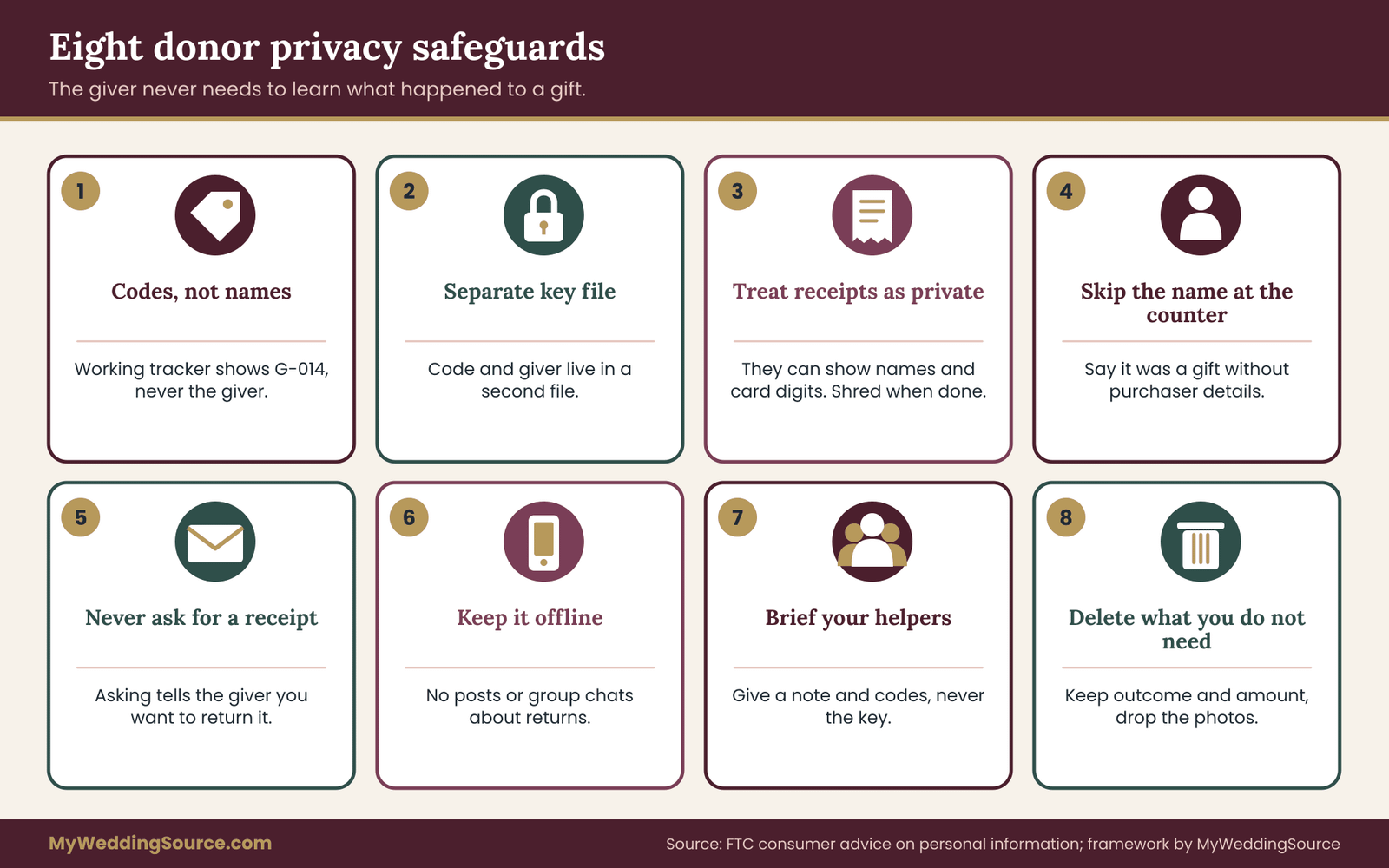
Donor privacy safeguards for gift returns
A gift is a personal act. The person who gave it chose it, paid for it and trusted you with it. A return does not betray that, and gift returns are a normal part of married life. because gifts are given freely and most givers expect you to do what works for your home. But the details of who gave what, at what price, are private, and the gift returns process creates several places where those details can leak.
The safeguards below are small and cheap. Together they keep gift returns invisible to the people it concerns.
Safeguard one: codes instead of names
Codes feel like an extra step at first, but they make gift returns far easier to share with a partner. Neither of you has to remember who gave what, because the tracker never asks you to.
The working tracker uses gift codes, never names. If anyone sees it, including a partner’s relative who is helping with a store run, they see “G-014, stand mixer, store credit, window ends in March,” and nothing about the giver.
The key that links codes to people lives in a separate file. Keep it in a different folder, ideally with a different name, and share it with nobody but your partner. When the thank-you notes are done, you can archive the key or delete it, depending on whether you want a permanent gift record.
Safeguard two: handle receipts like personal documents
Paper is where gift returns most often leak personal details, so give receipts the same care as any other private record.
A full receipt may carry a giver’s name, the last digits of a card, a loyalty number or an address. A gift receipt usually carries less, but may still show a purchase date and a store location. Treat both as private documents.
Store them in a folder or envelope that is not on display, photograph them for the tracker and, once the return is complete, shred anything that shows personal details. The Federal Trade Commission’s consumer pages on protecting personal information explain safe disposal of documents, and the link is in the sources. If a receipt is part of a dispute, keep it until the dispute is over.
Safeguard three: do not name the giver at the counter
At a store, you rarely need to say who gave you the item. If a staff member asks, you can say it was a gift and that you do not have the purchaser’s details. Some stores ask for identification on returns without a receipt, and some record that information in a return log. That log records you, not the giver.
If a store insists on the purchaser’s name or card for a refund, take that as a sign the item should become credit or an exchange instead, and do not chase the giver for details they would have to share only to help with a return.
Safeguard four: do not ask the giver for a receipt
It is tempting to message a giver and ask for the receipt. Do not. That message signals that you want to return the gift, and it asks the giver to dig through their records. The simplest rule is never to ask a giver for proof of purchase.
If a giver volunteers a gift receipt, which many do when they hand over a gift or write it in a card, thank them as you would for any other part of the gift. Volunteering a receipt is a kindness, not a hint.
Safeguard five: keep the return off social media
A casual post about gift returns can reach the very person who gave the gift. Keeping the topic offline is free and effective.
Do not post about returned gifts, store credit hauls or duplicate items, even in a group chat that feels private. Group chats are forwarded, screenshots escape and the giver may know someone in the chat. The same applies to photos of a pile of gifts with cards visible.
A good test is whether the giver could see the post without feeling hurt. If the answer is no, do not post it.
Safeguard six: control who touches the gift returns
Helpers make gift returns faster, and a clear note makes them safer. Write the outcome you want, the limit you will accept and the one thing they should never say.
Many couples ask a parent, a friend or a bridal party member to help with the boxes. That help is generous, but it increases exposure. Give helpers the working tracker with codes only, and tell them the one rule: nothing about who gave what leaves the house.
If a helper wants to take a box to the store alone, give them the proof (gift receipt or registry order) and the plan (exchange, credit or refund) written in a note. Do not give them the key.
Safeguard seven: the registry and its purchaser data
If you registered, the registry service may show you who bought each item, and the store may keep purchaser records. Those records belong to the store’s privacy policy, not yours. You can look at them, but you do not need to share what you see.
When you call a registry to ask about a return, ask what they can look up with the gift code, order number or item, not with the giver’s name. You can get most of the answers you need without it.
Safeguard eight: delete what you do not need
Deleting finished records is part of good gift returns practice. Keep the outcome, the lane and the amount, and let the rest go.
Privacy is also about how long you keep things. Once a return is done and the credit is spent, you do not need photos of the giver’s receipt, a screenshot of a store account or the card number. Delete the photos and keep the tracker line, which holds the gift code, the lane, the outcome and the credit amount.
For the wider question of how long to keep wedding paperwork in general, the section on retention in the wedding records guide offers a map of what to keep permanently, for years and until closed.
Thank-you notes and conversations when gift returns come up
A return is invisible if you handle it well. The giver should receive a warm, specific thank-you note for the gift as it was given, and that note should not mention the return, the exchange or the credit.
Write the note for the gift, not the outcome
The note belongs to the giver and the return belongs to you. Keeping gift returns out of the note protects both, and it keeps the thank-you list moving.
Thank the person for the thought and for the specific item. You do not need to say you are using it. You can say what you appreciated: the care in picking it, the style, the fact that they came to the wedding. Honest, true statements beat invented ones.
If you cannot say something honest about the item, say something honest about the giver. “Thank you for the beautiful serving platter, and for traveling to celebrate with us” is honest even if the platter is on its way back to the store.
If you exchanged for something you will use
When you exchange an item for a similar one that suits you better, it is still fair to thank the giver for the original gift. The exchange is your private adjustment, and the thought behind the gift stays real. Some couples mention the new item in a later conversation as a happy detail, but there is no obligation.
What to say if a giver asks
Preparing a calm answer in advance makes gift returns far less stressful. The question usually comes casually, and a rehearsed reply sounds natural.
Someone will ask, sooner or later. “Are you using the blender?” is an ordinary question. A few honest, kind responses work well.
“We’re so glad you came, and we’re enjoying setting up the kitchen. Thank you again for thinking of us.”
That answer is true, polite and complete. It does not describe the blender, and it does not claim you use it. If the giver follows up and asks directly, you can say something like:
“We ended up exchanging a few duplicates so we’d have exactly what we needed, and we’re grateful for how generous everyone was.”
Say this only if asked, and only if it is true. Most givers have no trouble with it, since many gift receipts exist for exactly this reason. Never lie about the fate of a gift, and never blame the store.
When a giver wants to see the item
A parent or close relative may ask to see the gift in your home. Decide in advance which gifts need to stay, and put them in the keep lane. This is the strongest reason to keep a gift from a family member whose feelings matter more to you than the credit: the cost of an awkward visit.
If an item is already gone, do not scramble. Say that you are still organizing, and move on. An honest, calm answer is better than a rushed purchase of a replacement.
Follow established etiquette
The basic rules for acknowledging gifts are covered in the guide to wedding etiquette, and the questions about timing, wording and guests who gave nothing apply here too. If you are tracking mailing addresses for the notes, the wedding guest list guide explains how to keep a clean household list.
Sending the notes on time also reduces pressure on the gift returns. When the thank-you list is finished, the key file can be closed, and you can work from the code-only tracker without opening names again.
A word on cash gifts and checks
Cash and checks do not go through the return process, but they belong in the private part of your records. The privacy rules above apply to them too: record the amount and the date in the private file, keep checks out of shared photos, and do not discuss amounts. Guidance on tax treatment of gifts is best taken from a qualified professional, and the Internal Revenue Service publishes general information on gift taxes, listed in the sources.
A worked example of gift returns, start to finish
The example below is invented. The couple, the stores, the amounts and the policies are made up to show how the ledger behaves, and none of them describe a real retailer. Real stores will differ, so use the example for its method, not its numbers.
Nora and Theo married on a Saturday in June. They received about ninety gifts. After the thank-you notes were on their way, they set aside one Sunday to build the tracker. Eighteen gifts landed in a lane other than keep. Here are six that show how the rules play out.
The first pass: six gifts, six codes
These six lines show the range of gift returns a typical couple faces: a registry duplicate, a gift receipt exchange, a donation, a hidden-price credit, a full receipt and a damaged item.
G-003, a stand mixer. Registry order from a kitchen retailer, and they had already received a second one from a relative. Proof type: registry order. Lane: credit. They called the retailer, who confirmed that registry purchases could be returned for credit, and that the credit could be used on remaining registry items.
G-007, a set of white bath towels. Gift receipt in the box, from a department store. They already owned good towels, but needed a bath mat and a shower curtain. Lane: exchange. They checked the store’s policy online and saw that gift receipt returns were issued as store credit.
G-011, a cast iron skillet. A duplicate of one they already owned. No receipt, no store label, a plain box. Lane: pass on. They donated it to a local thrift store, and logged the donation with the date.
G-014, a crystal vase. Gift receipt with the price hidden, from a home goods store. Not their style. Lane: credit. The store’s policy page said gift receipt returns were credited at the lowest selling price in the last stretch, which they wrote in the notes.
G-019, an air fryer. Full receipt tucked into the card, bought online. They had received a second air fryer from a coworker. Lane: refund or credit, to be decided. They noticed the receipt showed the giver’s name and last card digits, so they photographed the receipt for the tracker and then put it in the private envelope.
G-022, a blender. Gift receipt, but the item arrived with a cracked lid. Lane: damaged. They photographed the crack, checked the store’s policy and the maker’s warranty, and asked for a replacement.
What they learned in the research session
During the second session, Nora called or searched for each store and wrote down answers to the six questions. The results surprised them a little. The department store gave credit on a gift receipt, but only within a fixed number of days from the purchase date, which was before the wedding. The window for G-007 was shorter than they thought. The kitchen retailer had a longer window for registry items, and G-003 was well inside it.
They also found that the home goods store issued a merchandise card rather than an account balance, with a printed expiration. The online store refunded only to the original payment method, which meant G-019 was a credit or nothing.
Because of this, the lanes shifted. G-019 became credit, with an exchange to a different appliance as the preferred option. G-007 moved to the top of the list, because its window closed first.
The action session
The action session is where gift returns turn into credit, and it went quickly because the research was already done.
Theo took the towels, the vase and the air fryer to the stores on one afternoon. At each counter he said that the items were gifts and that he had a gift receipt. He did not give a name. At the department store, he exchanged the towels for a bath mat and a shower curtain, with a small balance left as a card. At the home goods store, he got a merchandise card for the vase at a lower amount than the price on the original receipt, which they had never seen.
The kitchen retailer returned the mixer as credit on their registry account, which they used toward a stockpot that was still on the list. The air fryer went back for store credit. The blender was replaced under the store’s damaged goods process.
Recording the credits
At each store, Theo photographed the receipt and the card, then texted the photos to Nora. In the tracker, each line now showed the outcome, the amount, the expiration and where the card lived. The merchandise card for the vase had an expiration about a year out. The air fryer credit had no stated date, so they wrote “none stated, confirm” and asked a store employee, who said it had no expiration. They wrote the answer down with the date.
They set practical deadlines for each credit at about three months, and scheduled the Sunday check. The remaining balance at the department store went toward a set of storage containers. By September, two credits were gone and the other three had firm spend plans.
The privacy side of the example
None of the steps involved the givers. The working tracker used codes. The key sat in a separate file in a separate folder. The air fryer receipt, with the giver’s name, went into a private envelope and was shredded when the credit was spent. When the coworker asked months later how the kitchen was coming along, Nora said they were enjoying setting it up and thanked her again for coming. Nothing in the answer was untrue.
What the example shows
Notice also that the couple treated their gift returns as a short project with a finish line. They did not try to perfect it. They set a threshold, ran three sessions and then switched to a weekly check.
Four things stand out. The research session, not the shopping trip, was where the money was saved or lost, because it set the order of the work. The lanes changed as facts arrived, and the ledger made that easy. The credit information was the most perishable part of the whole project. And the privacy rules cost almost nothing, since the codes and the key were set up on day one.
If you want the full records picture for a wedding, including where gift records sit among contracts and receipts, the guide on organizing wedding records shows how the pieces fit.
At the counter: store visits, online gift returns and what to say
The conversation at the counter is short, but a little preparation makes it smoother. Most staff want to help, and most of the friction comes from unclear expectations on both sides.
Before you go
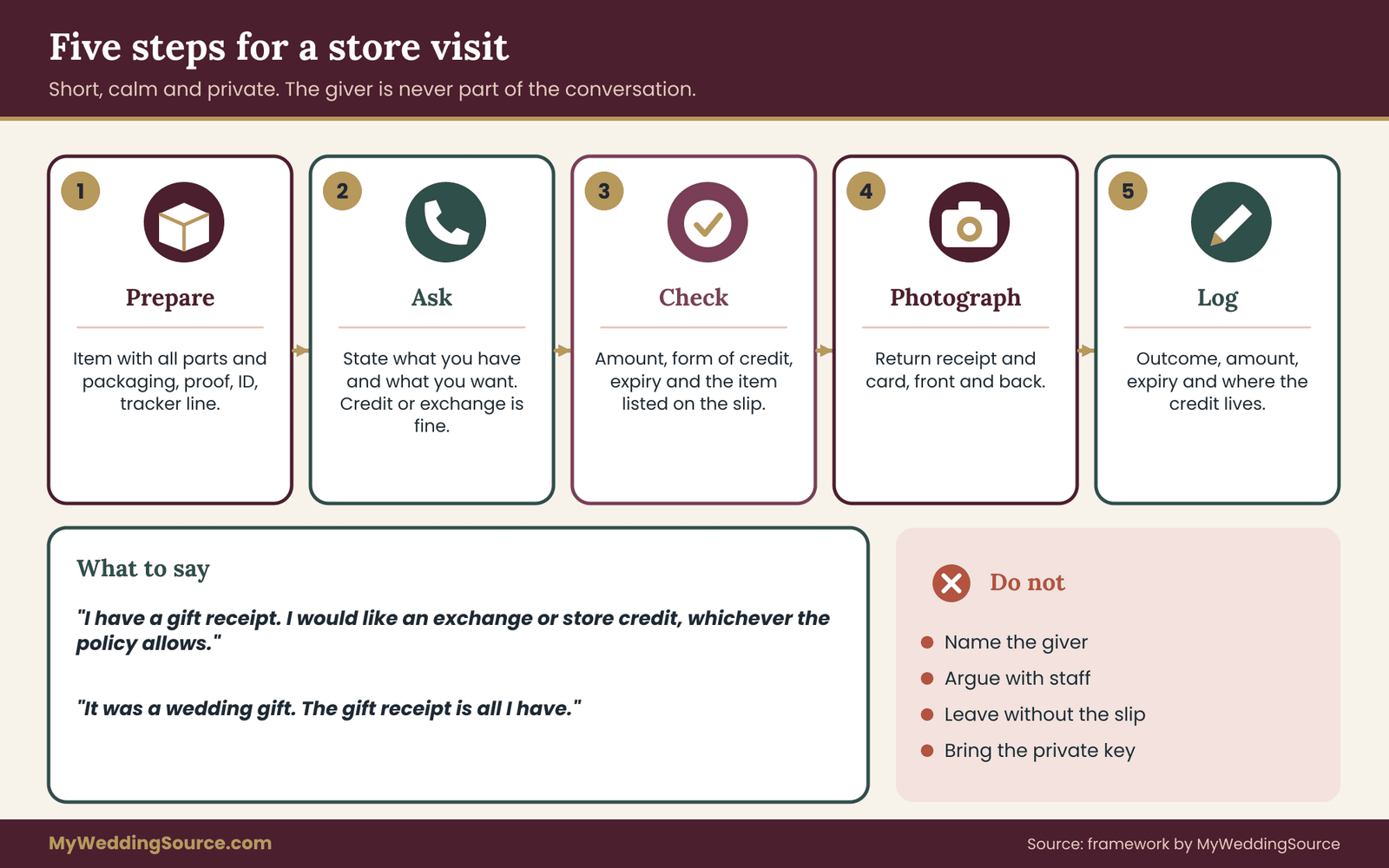
A short checklist helps gift returns go smoothly at the store. Take the item, the proof, your identification and the tracker line. Leave the private key at home, since nothing in the store visit needs it.
Gather the item in its original packaging, with all parts, manuals and tags. Bring the gift receipt, registry confirmation or any proof. Bring identification, since some stores ask for it on returns without a receipt. Bring a printed or saved copy of the store’s policy if it is unusual, and the tracker line so you remember which questions to ask.
Check that the store is open for returns at the time you plan to go. Some stores handle returns at a separate desk with shorter hours, and online-only retailers may have a drop-off partner.
What to say
A simple script keeps gift returns short and friendly. The words matter less than the calm tone and the clear request.
Keep it short and friendly. Start with what you have and what you want.
“I have a gift with a gift receipt. I’d like to exchange it or get store credit, whichever the policy allows.”
If the staff member asks who bought it, you can answer simply.
“It was a wedding gift, and I don’t have the purchaser’s details. The gift receipt is all I have.”
If the offer is lower than you hoped, ask one clarifying question before you decide.
“Is that the amount I’d get on any gift receipt return, or does it depend on something I could change?”
Do not argue, and do not name the giver. If the answer is still not acceptable, thank the staff member and walk away. You can decide whether to accept it later, as long as you are within the window.
What to confirm before you leave
Before you leave the counter, check the receipt or slip and confirm four things out loud or on paper. The amount matches what you were told. The form of credit is what you expected. The expiration, if any, is written down. And the item you handed over is listed on the return receipt.
Take a photo of the return receipt and the card. If something looks wrong, fix it at the counter, because it is much harder to fix later.
Returning online purchases
Online gift returns reward patience and record keeping. Do each step in order and photograph each stage.
If the item came from an online store, find the returns portal or the instruction page. Many online retailers ask you to start the return online and print a label, and some offer drop-off at a partner location. Others handle gift returns only through a customer service chat.
Follow the steps in order, and keep a copy of everything. Write down the return authorization number if one is issued. Photograph the packed item, the label and the drop-off receipt. Then add a line to the tracker with the carrier, the tracking number and the date the refund or credit should appear. If it does not appear on time, contact the retailer with the tracking record in hand.
Using a helper
Helpers are fine for gift returns as long as they carry a note and not the private key.
If a friend or family member does the store run, give them the item, the proof, a short note on what outcome you want and a limit on what they should accept. Do not give them the private key. If the store asks for the purchaser’s name, the helper should say they do not have it, and call you if a decision is needed.
When the answer is no
A refusal is a normal part of gift returns, and it is rarely personal. Staff apply the policy in front of them. Thank them, note the outcome and move to the next lane.
Sometimes a store will not take an item back. The reasons include a closed window, a missing item, a final-sale category or a store policy about items bought from another retailer. When that happens, return to the lanes. The gift can move to exchange at another store, to a sale, to a donation or to keep.
Do not let a failed return turn into a sunk-cost project. Record the outcome, move the gift to the pass-on lane and use the time on the next item.
Selling or donating items you cannot return
If you sell an item, be honest about its condition and listing, and think about the privacy of the packaging, which may carry a gift tag or a card. If you donate, ask the organization about receipts, since some give a written acknowledgment, and tax treatment of donations is a question for a qualified professional. Record the date and the organization in the tracker.
Edge cases and common mistakes in gift returns
Most gift returns follow the pattern above. A few do not, and the exceptions are where people lose money or create friction. Here are the cases that come up most often, with a decision rule for each.
Gifts that were bought overseas or at a store you cannot reach
A gift from a store with no location near you, or from another country, is usually a poor candidate for return. Shipping may cost more than the credit, and the policy may not cover international returns. The rule: if the cost or hassle exceeds a modest share of the value, move it to pass-on.
Items made to order or personalized
Monogrammed towels, engraved glasses and custom art are often final sale. Check the policy, but plan to keep or pass on. If the item has a flaw, the maker may fix or replace it, which is a different path from a return.
Group gifts and large items
A large gift from several people, such as a piece of furniture or an appliance, may have been bought by one person on behalf of others. A return can involve the purchaser’s payment, which you cannot see. If the item is something you do not want, it is kinder and simpler to ask the organizer in a gentle way, or to keep it, than to try to work around them. Some situations call for a conversation, not a workaround.
For group gifts that came through a registry, the registry service can often tell you what is allowed. Ask about both the item and the funds.
Registry items bought twice
When a registry item arrives twice, check the registry first. Some services sync purchases in real time, and a store may let you return one copy without a receipt. The standard fix for these gift returns is to send back the later arrival for registry credit. If the two came from different stores, return each at its own store, and use credit from one to buy something you listed at the other only if the policies allow.
Expensive items and returns of high value
For high-value gifts, check the policy before opening the box. Some stores apply stricter rules or longer verification to large refunds, and some require the original packaging. Keep every part, and photograph the unboxing if you must open the item. A return that is refused over a missing accessory is an avoidable loss.
Gifts that arrive after the wedding
Late arrivals are a regular feature of gift returns, so keep the tracker open for several months.
Gifts keep arriving for weeks and sometimes months. Treat each as a new line in the tracker, and keep the same codes and the same privacy rules. The window for a late gift may be shorter than you expect, because the purchase date can be well before delivery.
Gift cards and cash equivalents
Gift cards you receive are not returns, but they behave like credit. Log them as well, with the issuer, the balance and any expiration printed on the card. Check the issuer’s terms for fees, because some cards reduce the balance after a period of inactivity, and the rules differ by card type and state.
If a gift card is for a store you will never use, you may be able to exchange it for cash through a card exchange service, usually at a discount. Use only well-known services, and read the terms. Gift card scams are common, and the Federal Trade Commission publishes warnings about how to spot them.
Items that are not yours to return
Not every item belongs in gift returns, and the ledger should say so plainly with a keep or pass-on label.
Occasionally someone gives you something borrowed or inherited, or an item that came with a condition. Family pieces, loans and heirlooms are not return candidates. If you are unsure whether an item is a gift or a loan, ask the family before you do anything else.
Common mistakes
Most of these mistakes are small, and most can be repaired if you catch them early. Gift returns go wrong in quiet ways, usually through a date nobody wrote down, so the weekly check is the best protection.
Here are the mistakes that show up most often, with the fix for each.
Waiting too long. The window closes silently. The fix is the Sunday check, with the soonest date at the top of the tracker.
Assuming a policy. A store you like may have changed its rules. The fix is to read the current policy and save a screenshot.
Losing the credit. A paper slip in a drawer is easy to lose. The fix is to photograph it and keep it in a dedicated envelope.
Forgetting the key. Mixing names into the working tracker defeats the privacy design. The fix is two files, kept apart.
Naming the giver at the counter. It exposes details and rarely helps. The fix is a short script and a plan for credit.
Spending on things you do not need. Credit is not free money. The fix is a shopping list made before you walk in.
Letting returns become a project. Some items are not worth the trouble. The fix is the threshold you set at the start.
Closing out the ledger
A closed ledger is also a useful record if you ever need to explain a credit, a donation or a missing gift. Gift returns that ended in donation or sale should carry the date and the recipient organization.
The gift returns project is done when every line in the tracker has an outcome, every credit is spent or has a decision, and the private key is archived or deleted. Then take ten minutes to write down what you learned: which stores were easy, which windows were short and what you would do differently if you ever need to do it again.
File the finished tracker with your other paperwork. The idea of a retention map in the wedding records guide is a good template, and a short summary line is enough: the total credit received, how much was spent, and any balance still open. Keep the registry details too. If you are helping someone else build a list, the registry ideas guide is a good place to point them.
Your next steps
Pick one Sunday and do three things. First, open a tracker and a separate private key, and give every gift that might leave your house a code. Second, sort each one into a lane, and for each store that matters, read the current return policy and write down the window, the proof it accepts and the form of credit. Third, set a weekly reminder with the soonest date at the top.
Then work through the list one store at a time, soonest deadline first. Photograph every receipt and every card, spend credit on things you need, and keep the privacy rules until the last line is closed. A few short sessions will do the work, and nobody who gave you a gift has to know it happened.
FAQ
Is it rude to return a wedding gift?
Generally no. Most people who give gifts, and many who add a gift receipt, expect that some items will be exchanged or returned. What matters is how you handle it: thank the giver warmly for the gift as given, do not mention the gift return and do not ask them for details. If the giver asks directly, answer honestly and kindly.
Can I return a wedding gift without a receipt?
Sometimes. Many stores will offer store credit or a merchandise card, often at a lower amount, and some ask for identification and record the return. Others refuse entirely. Check the store’s written policy, call ahead if the item is distinctive, and do not rely on an assumption.
Will a store give cash for a gift return?
Usually not. A refund normally goes to the original payment method, which belongs to the purchaser, so stores often issue store credit or a merchandise card to a gift recipient instead. A full receipt and the purchaser’s presence may change that. Ask the store what its policy allows for gift recipients before you travel.
Does store credit from a return expire?
It depends on the store and sometimes on state law. Some credit shows an expiration date, and some states regulate it. Federal gift card rules may not apply the same way to credit issued for a return. Ask the store, write the answer down with the date, and treat credit with no stated date as unconfirmed.
What should I do with a duplicate registry gift?
Check the registry service and the store, because registry purchases are often the easiest to return. Ask whether credit can go toward other items on your list, which turns a duplicate into something you wanted. Return the copy with the best proof and keep the one whose packaging is damaged.
How do I keep the giver’s name private during a return?
Use a short gift code in your working tracker and keep the list of givers in a separate file. At the counter, say it was a gift and that you do not have the purchaser’s details. Do not ask the giver for a receipt, and shred receipts that show personal details once the return is finished.
How long do I have to return wedding gifts?
There is no single rule. Each store sets its own window and decides when it starts, which may be the purchase date, the delivery date or the date on the gift receipt. Find the current policy, assume the earliest start date and put the deadline on your calendar a week early. Registry services sometimes offer longer windows.
Are returned gifts or store credit taxable?
Tax treatment depends on your situation, so ask a qualified tax professional. As general background, the Internal Revenue Service explains that gift tax rules generally apply to the person giving the gift, and that most gifts do not result in any tax. Keep your records of what you received and what happened to each item.
Sources
- Gift cards, Federal Trade Commission, Consumer Advice
- Federal Trade Commission
- Protecting your personal information, Federal Trade Commission, Consumer Advice
- How do I dispute a charge on my credit card bill?, Consumer Financial Protection Bureau
- Frequently asked questions on gift taxes, Internal Revenue Service
- Unclaimed money, USAGov
- Consumer protection offices, USAGov
- How to get a copy of a marriage certificate or a marriage license, USAGov
- United States Postal Service