
A hotel crib sounds like a small detail, and for a guest traveling with an infant it is the detail that decides whether the weekend works. This guide shows couples and guests how to confirm a hotel crib, check the room around it, and pack for the trip, so the baby sleeps somewhere safe and the adults can actually attend the wedding.
Treat the hotel crib as a request that needs proof, not a checkbox. Ask the hotel for a hotel crib or play yard by name, get the answer in writing, confirm again three days before arrival, and inspect it in the room before the first nap. Choose a room by noise, distance to the venue and floor space, not only by price. Then pack a short travel-day kit that covers sleep, feeding, diapering and health, and tell the couple only what they need to know.
Picture a guest couple with a five-month-old, booked into the wedding hotel block three months early. Nobody mentioned the baby when they reserved. On arrival at nine at night, after a long flight, the front desk says cribs are first come, first served and the last one went out an hour ago. The baby is overtired, the parents are worse, and the rehearsal dinner starts at eleven the next morning. Nothing in that story is rare. It happens because the hotel crib was assumed instead of confirmed.
This article is about preventing that scene. It is written for two readers at once: the couple hosting a wedding who want their guests with babies to feel considered, and the guests themselves who are doing the booking. The core of it is a four-step confirmation process, a set of room checks, a schedule approach for the wedding weekend, and a supplies list for travel day. It also includes a worked example and the edge cases that tend to go wrong.
A note on scope. This is general planning information, not legal, medical or safety certification advice. Hotel policies, local rules and baby safety guidance change, so confirm current details with the hotel, the manufacturer, your pediatric provider and the agencies named in the Sources section.
What a hotel crib request actually covers
People use “crib” as shorthand for several different pieces of equipment, and hotels do not use the words consistently. One property says “crib” and means a full-size wooden crib. Another says “crib” and delivers a folding play yard. A third has a bassinet for the first few months only. If you ask for “a hotel crib” and the hotel hears something different from what you mean, you may not find out until the item is rolled into your room.
So the first job is to separate the pieces. A hotel crib request can include any of the following:
The sleep surface itself. A full-size crib, a portable crib, a play yard, or a bassinet. Each fits a different age and size range, and each has different rules for what goes inside it.
The bedding. A fitted sheet made for that exact surface. Hotels often supply one, but not always, and a bed sheet cut to fit is not the same thing.
The room. Floor space for the hotel crib to stand open, a spot away from windows, cords and heaters, and a layout that lets parents reach the baby without waking the room.
The extras. A mini fridge for milk or formula, a microwave or kettle, a bathtub or sink for washing bottles, a high chair in the restaurant, and blackout curtains.
The paper trail. The confirmation email, the name of the person who agreed, and any fee that was quoted.
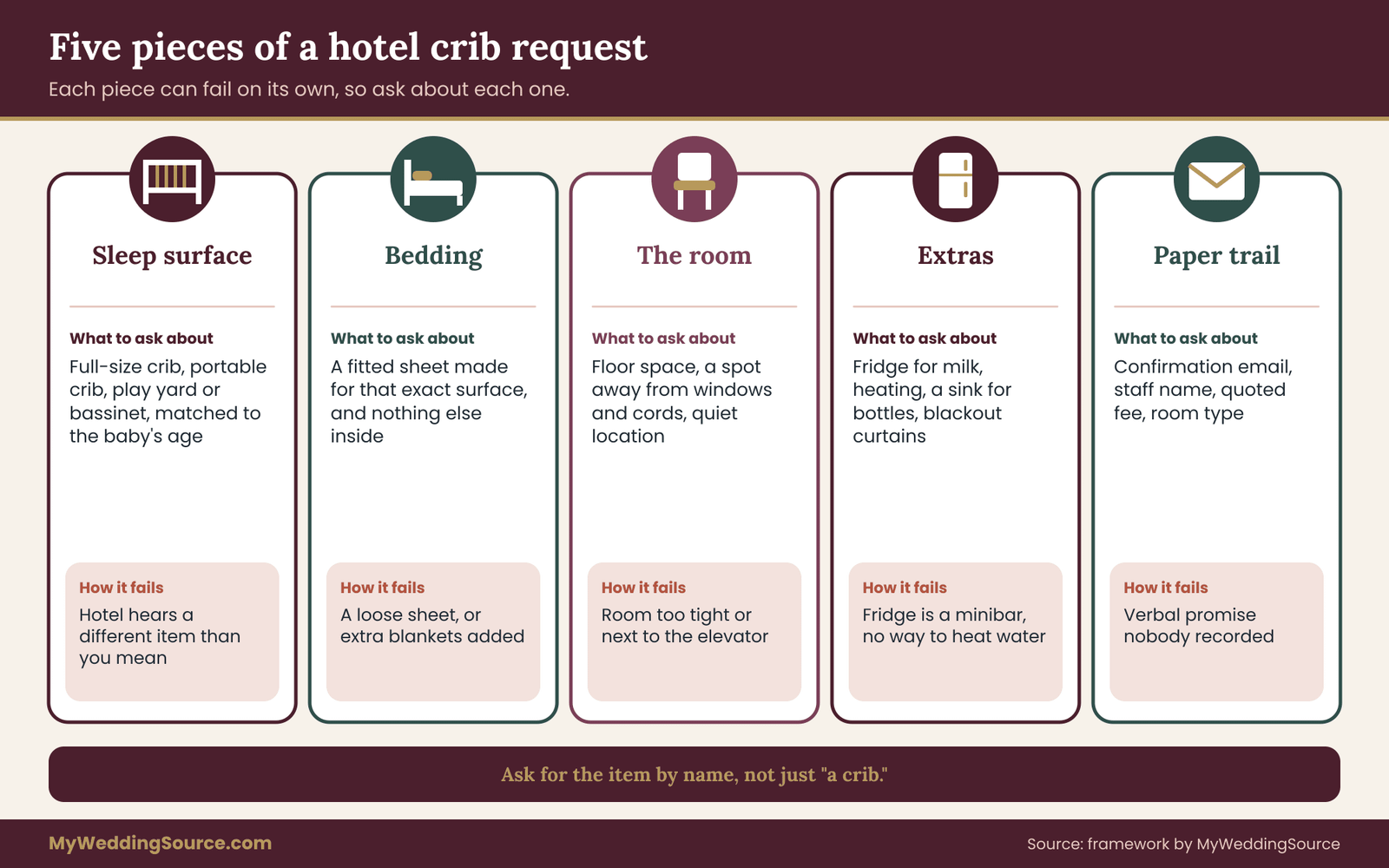
Seeing the pieces separately matters because each can fail on its own. A hotel can have a hotel crib in stock but no sheet. It can have the sheet but no room with enough floor space. It can promise everything on the phone and have no record of it at the desk. The framework in the next sections is built to catch each of these failures before the guest is standing in the lobby with a sleeping baby.
Why a wedding makes this harder
A normal hotel stay with an infant is a one-room problem. A wedding adds three complications.
First, the hotel is busy in a way it does not usually plan for. A room block fills a property with guests who all arrive on the same two days, and the hotel’s small inventory of cribs, which was sized for ordinary leisure demand, can run out at the exact moment you need it. If two or three families with infants are in the same block, they are competing for the same handful of pieces of equipment.
Second, the schedule is fixed by someone else. Ceremony start times, shuttle runs and dinner service do not move for a nap. A family that would normally solve a rough night by sleeping late has nowhere to hide the next morning.
Third, the guest is often in an unfamiliar city, without their usual car seat, stroller or stock of supplies. Anything forgotten has to be bought in a hurry or borrowed from a stranger.
For the broader picture of looking after babies, children and older relatives across the whole event, the guide on wedding guest care planning covers the full set of choices. This article stays narrower: the hotel crib, the room around it, and the journey to get there.
Who owns which job
A confusing part of infant hotel planning is that three parties each hold a piece of the work, and each can assume another is handling it. A clear split prevents the gap.
The guest owns the request. The guest knows the baby’s age, whether they will bring their own portable crib, and what the family can and cannot do without. The guest is also the one who will be in the room, so the guest is the right person to confirm.
The couple owns the information. They know the room block, the hotel’s name and contact, the shuttle times and the schedule. They do not need to book anything for a guest, and they should not collect medical details, but they can share the facts that make the guest’s job easier. The later section on the guest information page shows how.
The hotel owns the equipment and the policy. Only the hotel can say whether a hotel crib exists, what it costs and which rooms can hold it. The hotel’s answer, in writing, is the only answer that counts.
If a couple tries to own the whole process, they end up as a travel agent for people who did not ask for one. If a guest assumes the couple has handled it, the request is never made. Each person doing their own piece is the simplest arrangement.
The hotel crib confirmation ladder
The core of this guide is a four-rung ladder. Each rung is a moment in time and a specific action. A guest who climbs all four rungs has proof, a backup plan and a calm arrival. A guest who stops at the first rung has a hope.
The rungs are: Ask, Confirm in writing, Re-confirm, and Inspect on arrival. They are described in order, with the time each should happen and what a good result looks like.
Rung one: Ask. This happens at the moment of booking, or as soon as you know a baby is coming. Say that an infant will be traveling, give the baby’s approximate age in months, and ask for a hotel crib or play yard to be noted on the reservation. Ask the equipment name, not just “crib.” If you are booking through the wedding block, mention that the reservation is part of the block, because some hotels track block reservations separately.
Rung two: Confirm in writing. A phone call is a conversation, not a record. After the call, ask for the confirmation by email, or send a short summary yourself and ask the hotel to reply “yes.” The record should include your name, the dates, the room type and the equipment promised. If the hotel will not put it in writing, that tells you something about how firm the promise is, and it is worth having a backup.
Rung three: Re-confirm. About three days before arrival, contact the hotel again. Staff change, notes get lost and rooms get reassigned. A short message that restates the request and asks for a reply is cheap, and it surfaces problems while there is still time to fix them.
Rung four: Inspect on arrival. The hotel crib in the room is the only crib that matters. Check it before you unpack, and before the baby goes near it. The inspection section later in the guide describes what to look at.
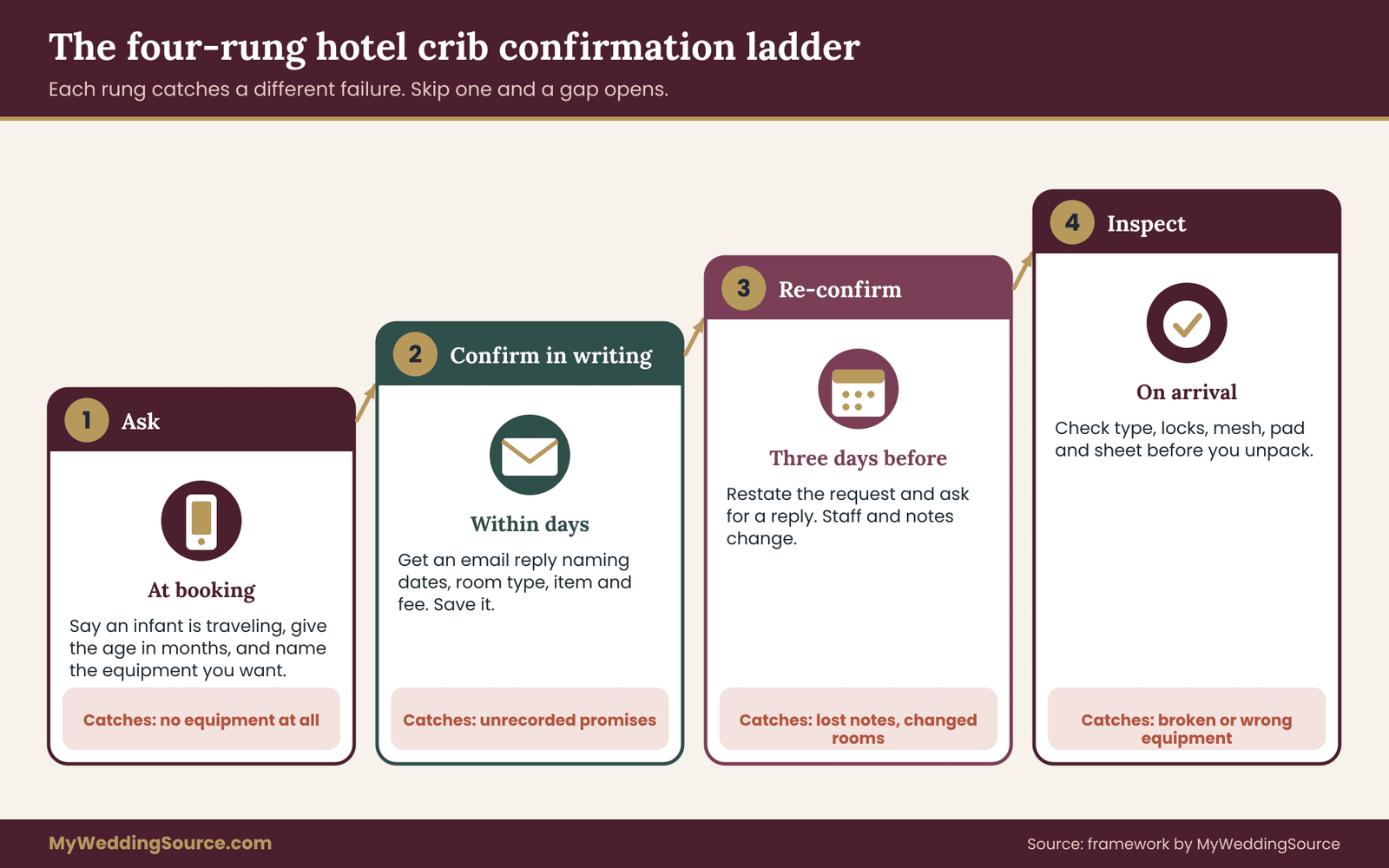
The ladder works because each rung catches a different failure. Rung one catches a hotel that has no equipment at all. Rung two catches a verbal promise that was never recorded. Rung three catches a note that was lost or a reservation that changed. Rung four catches equipment that is broken, dirty or the wrong type.
What the ladder looks like with a wedding block
When the reservation lives inside a room block, a couple of extra points apply. Block reservations are sometimes handled through a group sales contact rather than the front desk, and the person who answers a guest’s phone call may not see the block’s special notes. If the guest’s request goes into the reservation system as a note, ask the hotel to confirm that the note is attached to your individual reservation, not only to the group.
Block deadlines also matter. Many blocks release unreserved rooms back to general sale on a set date, and the wedding guest hotels guide explains how blocks and cutoff dates work. A guest with an infant should book before that date, because rooms that are suitable for a hotel crib, such as ones with more floor space, tend to go early.
The couple’s role on rung one is simply to make sure guests know the block exists, know the hotel’s phone number and know that infant equipment must be requested separately. That single sentence on a guest information page can save several families from a bad first night.
Choosing the right hotel crib: types, ages and limits
Once the request is in, the next question is what kind of equipment fits the baby. Hotels carry different pieces, and the right one depends on the baby’s age, size and mobility. This is an area where the hotel, the manufacturer’s label and a pediatric provider have the final word, and nothing here replaces them. What this section does is give you the vocabulary to ask good questions.
The four common types
Full-size crib. A standing crib with fixed or drop sides, usually wood or metal. Some hotels keep a few for long-stay guests. They are sturdy, but they take real floor space and many properties do not have rooms that fit one.
Portable crib or play yard. A folding frame with mesh sides and a thin mattress pad, the most common hotel crib in practice. It folds for storage, which is why hotels prefer it. The quality varies a great deal with age, brand and how often it has been used.
Bassinet. A small, shallow sleeper for the earliest months. Some hotels offer a bassinet attachment to a play yard. It has a short useful life, since babies outgrow it, so the baby’s age and weight should be checked against the stated limit.
Parent-supplied equipment. A family’s own travel crib, brought by car or checked on a flight. It removes the question of what the hotel has, but it adds a luggage problem and a setup task.
The type matters for the questions you ask. For a play yard, ask about the mattress pad and the fitted sheet. For a full-size crib, ask whether the room has the floor space. For a bassinet, ask the maximum age or weight.
Safety checks the guest can do without being an expert
Parents are not product safety inspectors, and nobody should expect them to certify a hotel crib. But a few observations are within anyone’s reach, and they are worth making before the first nap.
Start with the label. Most juvenile products carry a manufacturer’s label showing the model and date. If the label is missing or unreadable, that is worth mentioning to the hotel. The U.S. Consumer Product Safety Commission publishes federal safety standards for cribs and play yards and maintains a searchable recall database, so a quick check of the model name against recalls is possible from a phone. Federal rules also apply to cribs used in places of public accommodation, which includes hotels, so a hotel should be able to tell you its equipment is compliant.
Then look at the equipment. Does it stand and lock fully? Are any slats, rails or mesh panels cracked, torn or loose? Is the mattress pad thin and firm, and does it fit snugly with no gap at the sides? Is there anything inside that should not be there, such as extra pillows, blankets or bumpers?
On that last point, safe sleep guidance from the American Academy of Pediatrics is consistent and easy to find: a firm, flat sleep surface, a fitted sheet and nothing else in the sleep space. If the hotel offers extra bedding for the hotel crib, a parent can politely decline it. Ask your pediatric provider about anything specific to your baby.
“Could you tell us the brand and model of the hotel crib in our room, and whether it has a fitted sheet designed for it?”
That question is short, factual and the kind a hotel staff member can usually answer on the spot.
When to bring your own
Some families decide that bringing their own portable crib is simpler. It is a reasonable choice, and it is worth thinking through honestly.
Bringing your own means the baby sleeps on familiar equipment, you know its history and you control its condition. It means you have to carry or ship it, assemble it in a small room and check that it fits. Many travel cribs fold into a bag small enough for the trunk of a car, and airlines have their own rules for how they count and charge for baby equipment, so check with the carrier directly.
A middle path is common: request the hotel crib anyway, bring a sheet that fits it, and keep your own on standby if you can. This is more luggage but removes the single point of failure. If you are flying and cannot carry a hotel crib, the hotel’s equipment becomes the plan, and the confirmation ladder becomes more important.
Fees, deposits and quiet charges
Cribs are often free, but not always. Some hotels charge a nightly or per-stay fee, and some tuck it into a general charge. A fee that was never mentioned is annoying, and it also tells you the hotel does not track the request carefully.
Ask three direct questions: Is there a charge for the hotel crib? Is it per night or per stay? Does it appear on my folio under that name? Write the answer down. The Federal Trade Commission has rules about displaying the full price of lodging, including mandatory fees, so if the quoted rate seems to leave something out, you can ask the hotel to explain it, and the FTC’s website explains the rule in plain language.
The rule of thumb is simple: if a fee exists, you want to hear about it before you arrive, not at checkout.
Reading the hotel’s answer: what a good reply looks like
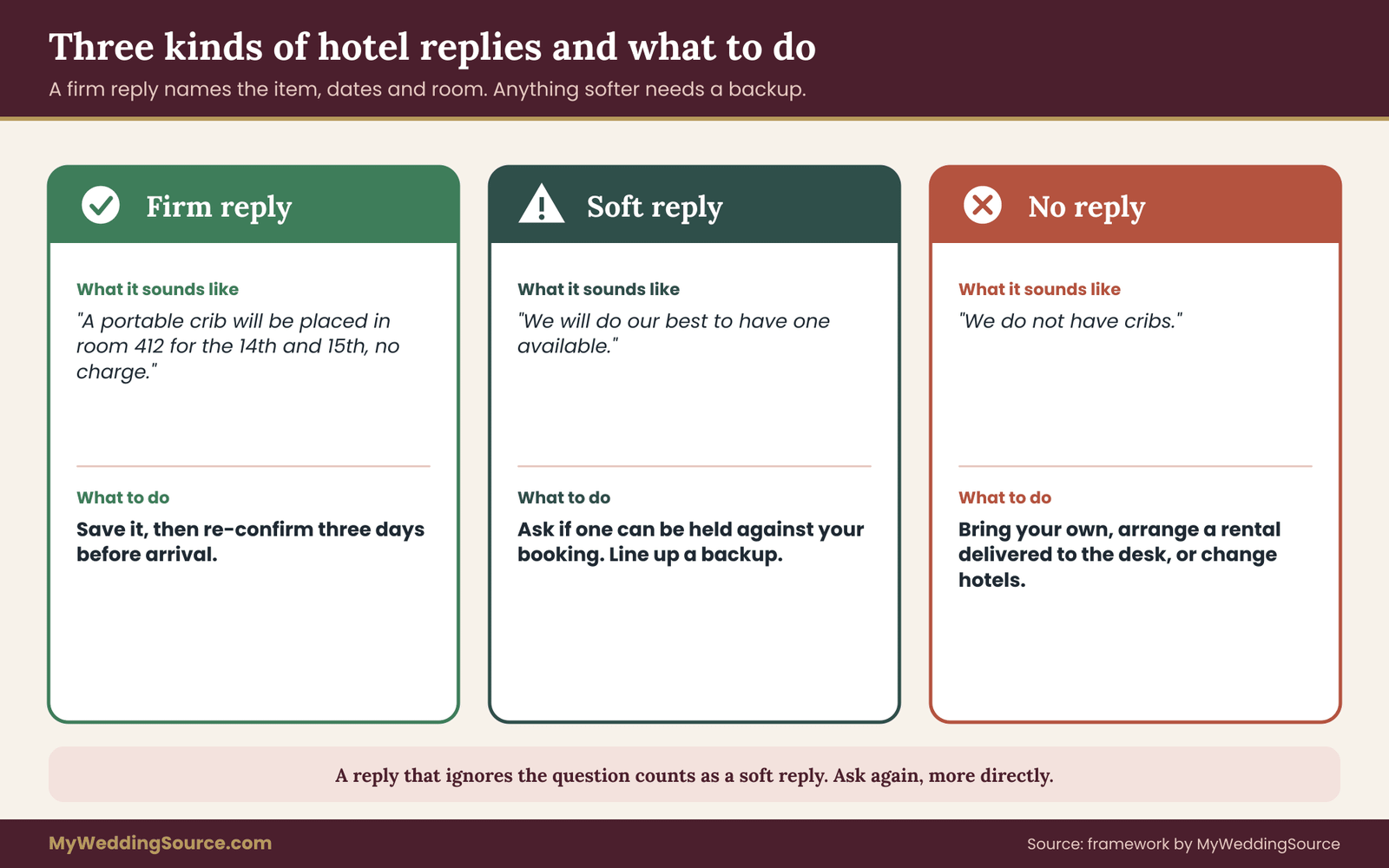
Hotels respond to crib requests in very different ways. Some send a clear confirmation. Some send a cheerful reply with no real commitment. Learning to tell them apart helps you decide whether to move on to a backup.
A firm reply names the item, the dates and the room. For example: “A portable crib will be placed in room 412 for your stay on the 14th and 15th, no charge.” It uses specifics. It could be shown to a different staff member at the desk and still make sense.
A soft reply sounds positive but promises little: “We will do our best to have one available.” This is honest, because some hotels cannot guarantee equipment, but it means you should have a backup. Ask whether the hotel can reserve the hotel crib against your booking, and if not, ask what the odds are, in plain terms.
A no reply, such as “We do not have cribs,” is useful information. It gives you time to arrange alternatives: bringing your own, renting from a local baby equipment service, or changing hotels.
A reply that does not answer is also an answer. If you ask about a hotel crib and the response is about breakfast, ask again, more directly, and mention that it is a safety and sleep question. If you still cannot get a clear answer, treat that as a soft reply.
Three scripts for the most common situations
When the hotel says it has no cribs. “Thank you for letting us know. Do you know of a local company that delivers baby equipment to guests, or would you allow a rental crib to be delivered to the hotel front desk for us?” Many hotels will accept a delivery for a guest, and some keep a list of local rental providers. Confirm their delivery rules before you pay a rental company.
When the hotel says cribs are first come, first served. “Could you tell us how many cribs the hotel has and whether you can hold one against our reservation for the nights of the wedding?” If the answer is that the hotel cannot hold one, ask when the hotel starts distributing them, and plan for an early check-in or a call that morning.
When the hotel will confirm but wants a fee. “Could you confirm the fee and whether it is per night, so we can plan the cost?” Then decide whether the fee is worth it compared with renting or bringing your own.
Quick sorting: which route fits which family
Not every family needs the same solution. A short decision approach helps.
If you are driving, have room in the car and the baby is comfortable in a travel crib, bringing your own is often easiest, and you can still ask for the hotel crib as a backup. If you are flying with a lot to carry, the hotel’s crib becomes the primary plan, and you should be strict about the confirmation ladder. If you are flying and the hotel has no equipment, a local baby gear rental service delivering to the room is the common solution, but you must confirm the delivery with the hotel first.
If the baby is under about three months, ask specifically about a bassinet or a bassinet attachment, because many play yards are not designed for the earliest weeks in the way a bassinet is. If the baby is mobile and can pull up, ask about the height of the sides and keep the manufacturer’s limits in mind. In every case, the manufacturer’s instructions and your pediatric provider are the final word.
Documenting what you were told
Keep a small record on your phone: the date of each contact, the name of the person, what they said, and any written confirmation. A simple note is enough. If anything goes wrong on arrival, a record that the hotel confirmed a hotel crib for your dates turns an awkward argument into a quick fix. Staff tend to respond to a specific, calm reference to a prior confirmation far better than to a general complaint.
If you are the couple, you do not need to keep this record for your guests. But it helps to remind guests, gently, in the information you share, that a written confirmation is worth having. The part of this guide on the guest information page gives a wording that does this without sounding bossy.
Picking the room that works around the hotel crib
A hotel crib is only as useful as the room it goes into. Two families can both have a confirmed crib and have very different weekends, because one room has space and quiet and the other has neither. Room choice deserves as much attention as the equipment, and it is often the part guests skip.
Floor space and layout
A play yard open on the floor needs a clear square a bit under a yard on each side, plus room for an adult to stand beside it. Many standard hotel rooms with two queen beds have very little spare floor, and a room with a king bed and a small desk can be tighter than it looks in photos. Ask the hotel which room types have the most open floor, and whether a room with a sofa or a sitting area is available in the block rate.
Where the hotel crib sits matters as much as whether it fits. Parents commonly want it away from windows, cords from blinds, heaters and air conditioning units, and the minibar. They also want it somewhere they can reach in the dark without stepping on a suitcase. A quick walk-through when you arrive, deciding where the hotel crib goes before you unpack, saves a lot of rearranging at midnight.
Noise and light
An infant who sleeps through a vacuum cleaner at home can still be woken by a hallway ice machine, an elevator or a neighboring room that is celebrating. Hotels hosting a wedding block are often full of guests who are out late, in good spirits and loud in corridors.
When you request the room, ask for a quiet location: away from the elevator, ice machine, stairwell and any ballroom or bar. Ask which floor is quieter and whether the room faces a street, a courtyard or a parking structure. A higher floor on the courtyard side is often quieter than a ground floor on the street, but each property is different, so ask.
Light is the other half. Hotel curtains vary from heavy blackout to nearly transparent. If the baby naps best in the dark, ask whether the room has blackout curtains, and consider packing a portable blackout option or clips for the edges. A small white noise device from home can mask hallway sounds and is one of the more useful things to pack.
Distance to the venue and the schedule
The best room for a family with an infant is often the one that makes the schedule easiest, not the one with the best view. Ask how long it takes to get from the room to the venue door, including the elevator wait and the walk. If a shuttle runs between the hotel and the venue, find out the exact times, and whether the shuttle has room for a stroller or a car seat.
Being close lets a parent slip back during a long reception for a feed or a nap without missing much. Being far means every return trip is a half-hour commitment. When the couple chooses the room block hotel, they can think about this from the start. The wedding guest hotels guide covers how to weigh price, distance and mobility needs across a whole guest list, and infants are one more factor in that same trade-off.
Connecting rooms, suites and sharing
Some families bring a grandparent or a sitter to help, and the question becomes whether to book two rooms or one larger one. A connecting room pair lets a sitter sleep next door, with the door closed but available. A suite with a separate bedroom lets parents put the baby down and stay up in the sitting area without turning on the main light.
Suites and connecting rooms cost more and are limited in number, so request early. If the cost is a stretch, a regular room with a good layout and a quiet location is usually a better use of money than a bigger room in a noisy spot.
In-room kitchen features
Feeding needs are practical. Parents of formula-fed babies need a way to warm water and wash bottles, and parents of breastfed babies who pump need a fridge for milk. Ask what the room has:
- A refrigerator that actually cools, not just a minibar with sensors that charge for items moved.
- A microwave or kettle, or a kitchenette for heating.
- A sink where bottles can be washed, with a small bottle brush you bring along.
Many hotels will provide a fridge on request for medical or infant needs, sometimes without charge. Ask what the process is, and whether the fridge can be emptied of hotel products first. If the family needs to keep breast milk cold, a clear statement to the hotel is usually enough. There is no need to share more detail than that.
Accessible rooms and families with disabilities
An infant and a disability are not mutually exclusive. A parent who uses a wheelchair, or a grandparent who needs step-free access, may also be traveling with a baby. In that case the hotel crib request and the access request must both be met, and the second does not replace the first.
The Americans with Disabilities Act sets requirements for accessible hotel rooms and for reservation practices, and the Department of Justice’s ADA site explains the basics. In practice: when you reserve an accessible room, ask the hotel to confirm the specific features you need, and add the hotel crib request to the same reservation note. Accessible rooms are limited, and equipment for a baby may need to fit in a layout with wider clearances.
If you are the couple and a guest has told you about an access need, the broader hotel guide linked above goes deeper. This article only notes that an infant adds one more thing to confirm on top of whatever the guest already needs.
Inspecting the hotel crib on arrival
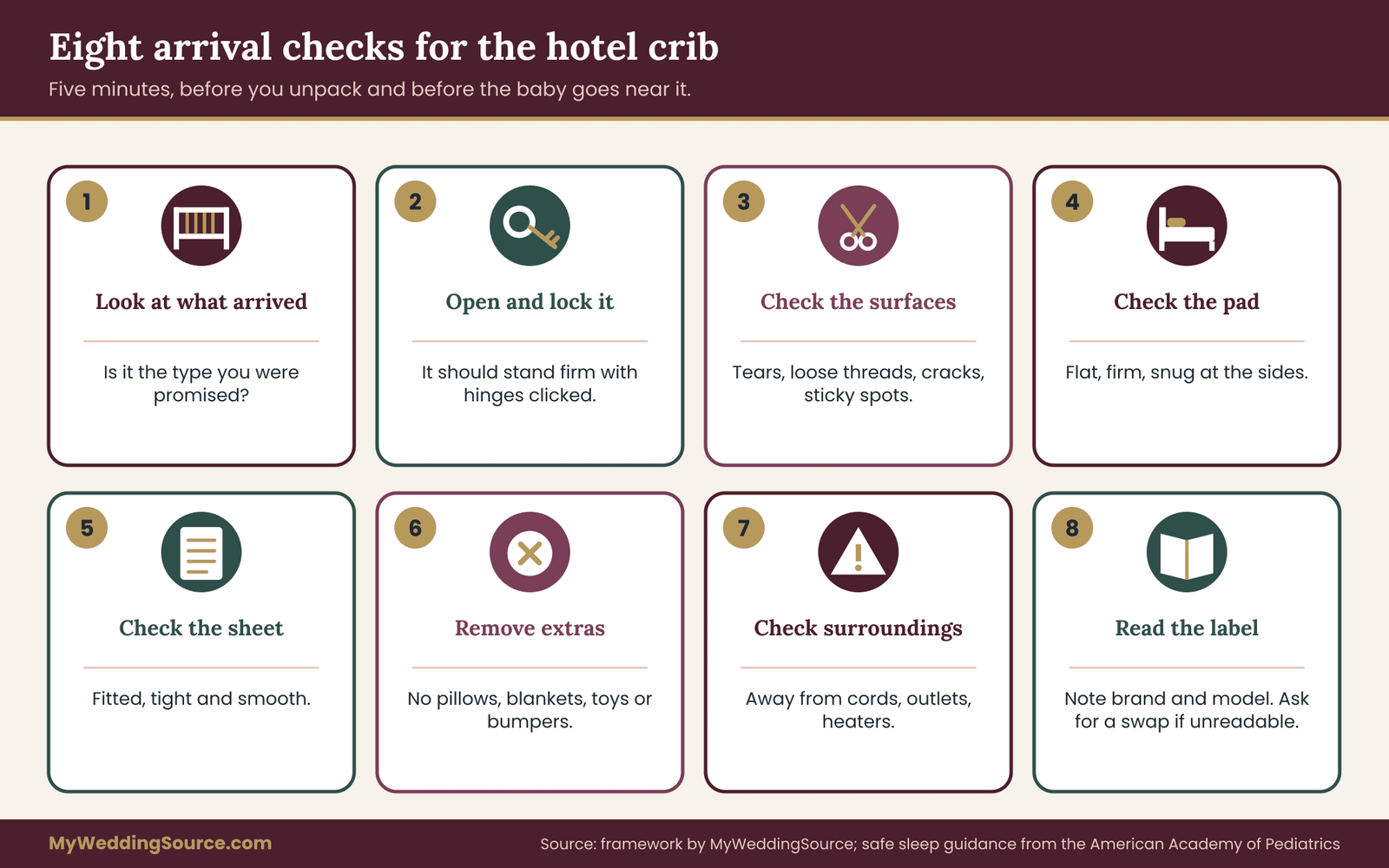
Rung four of the ladder is the arrival check. It is short, it takes about five minutes and it is worth doing before you unpack, feed the baby or start any routine. The equipment in the room is what the baby will actually sleep in, so this is the moment that counts.
A five-minute walk-through
Do these in order, and keep the baby out of the way, ideally in a carrier or with the other parent.
- Look at what arrived. Is it the type you were promised? If you were told a portable crib and found a rollaway cot, say so right away.
- Open it fully and lock it. A play yard should stand on its own with the locking hinges clicked into place. Press down on the rails gently. Nothing should fold or wobble.
- Check the surfaces. Run a hand along the rails and mesh. Look for tears, loose threads, exposed staples, cracked plastic or sticky patches.
- Check the mattress pad. It should be flat and firm, with no sagging, and it should fit snugly so there are no gaps at the sides. A pad that has curled or is stained is a reason to ask for a replacement.
- Check the sheet. It should be a fitted sheet made for that pad, tight and smooth. A loose sheet that bunches is a problem.
- Remove extras. Take out blankets, pillows, toys and bumpers that the hotel may have added. Safe sleep guidance is for a bare sleep space.
- Check the surroundings. Move the hotel crib away from curtain cords, outlets, lamps and heaters.
- Read the label. Note the brand and model. If it is not legible, ask the front desk for a replacement.
This is a parent’s common-sense check, not a safety certification. If anything seems off, trust that impression and ask for another unit.
What to say if something is wrong
Hotel staff generally want to fix a hotel crib problem quickly, because it is a safety issue and a liability one. Being specific and calm helps.
“The hotel crib in our room has a torn mesh panel and the pad is sagging. Could you bring a replacement, please? We would like to check it before we use it.”
If the hotel has no replacement, ask whether another room has one, whether the hotel can borrow from a nearby property, or whether it will cover the cost of a rental. If nothing can be arranged, the fallback is your own equipment, or a hotel upgrade to a room with a different arrangement. Do not use equipment that looks damaged, even if it is the only option offered.
Setting up for the first night
After the inspection, set the room up so that the first night does not turn into a scramble.
Put the hotel crib where you decided during the walk-through. Place the white noise device and a night light within reach but away from the baby’s sleeping space. Lay out a diaper, wipes and a change of clothes where you can find them in the dark. Check that the room temperature is comfortable, since hotel thermostats can behave unpredictably, and keep the baby’s usual sleep routine as close as you can to what happens at home.
If the baby has an unfamiliar sleep surface, some families do a short trial nap during the day before the first night. It lets the baby adjust and lets the parents notice problems while it is still light. This is a personal choice, not a rule.
When arrival is late or the front desk is closed
A late arrival after the front desk has thinned out is where many crib problems surface. Rung three, the pre-arrival confirmation, is the best defense. Ask the hotel, when you re-confirm, whether the hotel crib will already be in the room on arrival, or whether you must request it at the desk. A hotel crib that is already in the room saves a conversation at the worst time.
If you will arrive after midnight, say so in the same message, and ask for the name of the person who will be on duty. If your flight is delayed, call the hotel and make sure your room and your hotel crib are not released. The same principle applies to the airport-to-hotel leg: ground transport is worth settling before the flight, since very late arrivals leave few options.
Couples sometimes worry about how to help guests with babies without taking over. The answer is to share facts and leave decisions to the families. A short, well-placed section on the wedding website or in the hotel information does most of the work. It costs the couple very little and spares each family a round of questions.
The guest information note
The note should be practical and short. It does not need to mention anyone in particular. Here is the kind of wording that works.
“Traveling with a baby? Our hotel block is at the hotel named above. A hotel crib or play yard is the hotel’s to provide, so please ask the hotel directly when you book, and get the answer in writing. We have also listed shuttle times and the quiet spots at the venue.”
That wording does four things. It tells guests that a hotel crib is something to request, it names who holds the equipment, it encourages written confirmation, and it signals that the venue has been considered. It does not promise anything the couple cannot deliver.
A longer version can add the shuttle schedule, whether the shuttle can carry strollers or car seats, the hotel’s front desk hours and the closest pharmacy or grocery for emergency supplies. The wedding planning checklist includes a place to gather these details, so they are ready when the website goes up.
Asking about infants on the RSVP, carefully
Many couples want to know how many babies are attending, for seating, meal counts and planning. That is reasonable. It also means collecting information about children, and the couple should keep it to what they need.
A good RSVP asks for the number of guests in each party and whether any are under a certain age. It does not need a baby’s name, birth date or health details. If a family wants to share more, they can, but the couple should not ask for it. The wedding RSVP etiquette guide covers how to word response cards and online forms, and the wedding invitation etiquette page covers how to indicate who is invited.
Whatever you collect, treat it as private. Keep the spreadsheet in one place, share it only with the person who needs it, such as the caterer or planner, and delete extra detail when the wedding is over. A baby’s age in months is useful to a caterer making a kids’ meal count. It is not something to put in a group chat.
A small block-level step: telling the hotel how many
If the couple is working with a hotel sales contact, it can be useful to mention that several guests will be traveling with infants, without naming anyone. This lets the hotel think about how many hotel cribs it can supply across the weekend. A hotel that knows three families need a hotel crib is better placed than a hotel that discovers it as each family checks in.
The couple should keep this general. Something like: “We expect a few guests with infants, and we will encourage them to request cribs directly. Could you tell us how many portable hotel cribs the hotel can supply on the wedding weekend?” The answer, even if it is a small number, is helpful. If it is very small, the couple can tell guests early so that they can plan to bring their own or arrange a rental.
What not to do as the couple
Some well-meant actions create more trouble than they solve.
Do not book rooms or equipment on a guest’s behalf unless they ask. Policies and fees are tied to the person who reserves. Do not ask guests for sleep schedules or medical details. Do not promise that the venue will have a nap space unless it has been arranged and confirmed. And do not pressure guests to attend every event if the baby’s needs make it hard. Offering a way to attend part of the weekend, or to leave early, is kinder than expecting full attendance.
Building the wedding weekend around an infant
With the room settled, the next question is how a baby fits into a weekend that runs on someone else’s clock. Most of the stress comes from collisions: a nap against a ceremony, a feed against a toast, a long shuttle wait against bedtime. Seeing the schedule early lets a family decide what to do with each collision.
Map the events against the baby’s day
Take the weekend’s schedule and lay it beside the baby’s usual routine. Where does a nap normally fall? When is the longest stretch awake? When is the evening feed? Mark the overlaps. A ceremony at two in the afternoon can land on a nap. A rehearsal dinner at seven can land on the pre-bedtime window, and that is a poor time to ask a baby to sit still.
Once you see the overlaps, you can choose. You can protect the nap by returning to the room beforehand, accept that the baby will nap in a carrier or stroller, or decide that one parent attends one event while the other stays with the baby. None of these is wrong. What matters is that the family chooses in advance, rather than discovering the problem mid-event.
Time zones and the first day
If the family is crossing time zones, the baby’s body clock will be off. Many families find that sticking close to the home schedule for the first day, or moving it gradually, works better than flipping at once. That is a family decision and a pediatric provider can offer guidance for your child. The practical point for a wedding is that the baby may be awake at odd hours, so the room should be a place where the adults can sit quietly, and the hotel crib should be set up before the first bad night, not during it.
The ceremony and reception
Wedding venues vary in how they handle small children. Some provide a quiet room, some have a lobby, some have nothing at all. A family who wants to attend the ceremony with a baby usually wants three things: an aisle seat near an exit, a way to step out without disturbing others, and a place to feed or settle the baby.
Families with a baby often sit near the back, on the aisle. If the couple has set aside such seats, a small sign or a line in the program helps families find them. Guests with infants can also let the couple’s coordinator know that they might step out, so that nobody is surprised. For the feeding side, the article on wedding nursing room setup covers private space and supplies for the venue.
At the reception, the issue is usually length and noise. A reception that runs late with a loud band is hard on a baby. A family may plan to attend dinner and the first dance, then return to the hotel for bedtime, while one parent returns for the later hours if the schedule allows. The distance between the hotel and the venue, chosen earlier, now pays off.
Sitters and shared care
Some families bring a relative or hire a local sitter so that both parents can attend. If a sitter is hired locally, the hotel’s front desk may know of services, but vetting the provider is the family’s job. The article on wedding childcare vetting covers the questions to ask and checks to make. Nothing in this guide replaces that process, and no one should hand over an infant to a stranger on a quick recommendation.
If the sitter will be in the hotel room, tell the hotel and make sure the sitter knows how to reach the parents, where the supplies are and what to do if the baby wakes. A short written sheet on the desk, with the baby’s schedule, a feeding note, the parents’ phone numbers and the hotel front desk number, covers it. Include the venue address and the name of the shuttle. For a different arrangement, the wedding childcare pickup authorization article explains who is allowed to collect a child and how to record it.
The morning after
The morning after a late reception is often rougher than the wedding day. The baby may have slept badly, the adults are tired, and there is a checkout time. If there is a farewell brunch, decide ahead of time whether the family will attend or skip it. Pack the night before, because a half-packed room with a fussy baby is a slow morning. Return or hand back any borrowed hotel equipment as the hotel instructs, and confirm that nothing from the room is left behind, especially small items that slip under the hotel crib.
The travel-day supplies checklist
Hotel crib confirmed, room chosen, schedule mapped. The remaining job is getting the baby and the gear to the hotel, and having what you need on hand when something changes. This section turns that into a checklist organized by when you need things, not by category, because a list sorted by “feeding” and “sleep” does not tell you what goes in the bag you can reach.
The idea is three layers. The in-reach bag holds what you will need during the journey. The room kit holds what you need on arrival and overnight. The buy-there list is everything you can get locally, so you do not carry it.
Layer one: the in-reach bag
This is the bag at your feet or on your lap, and it should hold enough for a delayed day. Think about what a long delay would require, and add a little.
For feeding: enough formula or expressed milk for the trip plus a margin, bottles, a clean nipple or two, and a way to wash them. For diapering: more diapers than the schedule says you need, wipes, a changing pad, disposable bags and a spare outfit for the baby and a top for you. For comfort: a pacifier or favorite item if the baby uses one, a light blanket for the carrier or stroller, and a small toy or two. For health: any medicine the baby takes, the baby’s thermometer if you have one, and the contact details for your pediatric provider.
Add the papers: the confirmation for the hotel crib, the hotel’s address and phone, the airline confirmation and any identification you might need. Put them where you can find them without unpacking.
Layer two: the room kit
The room kit is what you open first at the hotel. It should let you set up the sleep space and survive the first night without opening any other suitcase.
A fitted sheet for a play yard, in case the hotel has none that fits. A white noise device and a charger. A small night light. A portable blackout option for the window. The baby’s sleepwear and a sleep sack suited to the room temperature, since loose blankets do not belong in the sleep space. Bottle brush and a small amount of dish soap. A few clean cloths. And the folded paper note for any sitter.
Pack the room kit so it sits on top, or in its own bag. When the elevator door opens at ten at night, you want to reach it without digging.
Layer three: buy there, do not carry
Heavy and bulky items are often easier to buy or order after arrival. Diapers in large sizes, formula in large tubs, wipes and bottled water are the usual ones. Delivery from a nearby grocery or pharmacy can bring them to the hotel, and some hotels can accept a delivery for a guest. Ask the front desk what is allowed.
The rule is to carry enough for the first twenty-four hours and a delay, and to buy the rest. This keeps luggage manageable and avoids fights with airline limits. The one exception is anything the baby is particular about, such as a specific formula brand or a medication. Those are worth carrying in full, because a substitute is not always acceptable and local stock may not match.

Flying with an infant
Airlines and airports have their own rules for infants, and those rules change, so confirm with your carrier and the agencies directly. A few general points are widely published.
The Transportation Security Administration allows reasonable quantities of breast milk, formula and baby food through security, even above the usual liquid limits, and you should tell the officer you are carrying them. The TSA’s website describes the procedure and what to expect at screening. Plan extra time, because screening for gear and liquids can take longer.
The Federal Aviation Administration recommends that young children ride in an approved child restraint system rather than on a lap, and its website explains what is approved and how to check your seat. Whether you buy a seat for the baby is a family and airline decision, and your pediatric provider and the airline can help you decide. If you use a car seat on the plane, check that it carries the required approval label, and measure the seat width against the airline’s guidance.
Stroller and car seat handling differs by airline. Many allow you to check them at the gate, sometimes at no charge, but check the carrier’s policy. A gate-checked car seat in a protective bag is less likely to be damaged than one sent through the main baggage system, though neither is risk free.
Driving with an infant
Driving gives you more room and control, but it brings its own planning. A rear-facing car seat that fits the baby and is installed correctly is the basis, and the National Highway Traffic Safety Administration publishes guidance on choosing and installing car seats and on finding a local inspection event. Plan stops, since babies should not stay in a car seat for very long stretches without a break, and ask your pediatric provider about your child.
Put the in-reach bag within your reach in the car, not in the trunk. Keep a small kit for a roadside delay: water, a snack for you, diapers, a change of clothes and a sunshade or a blanket depending on the weather. Never leave a baby alone in a parked car, even briefly.
If you are renting a car at the destination, ask the rental company whether it supplies car seats, how it handles them, and whether the seat will be rear-facing and appropriate for your baby’s age and size. Many families bring their own, because they know its history and how to install it.
Shuttle and ride-share questions
Wedding shuttles are great for guests, and awkward for families with car seats. Ask the couple or the shuttle company whether the vehicle has seat belts that can hold a car seat, and whether car seats are allowed. Many large shuttles and buses do not accommodate them, and many ride-share services do not supply them. If a car seat is required for your baby, plan transport that can carry one, such as a rental car, a taxi service that supplies seats or a driver who knows the rules.
This is a good thing for the couple to know early, because it affects the shuttle plan. If the shuttle cannot carry car seats, say so on the guest information page, so that families can arrange their own rides.
Health on the road
A trip is also a chance to pick up germs, and an infant is particularly vulnerable. Pack hand sanitizer for yourself, and consider how crowds at the airport and at the wedding will affect you. The Centers for Disease Control and Prevention publishes guidance on traveling with children and on routine vaccinations, and your pediatric provider can tell you what applies to your baby before you travel. A baby with a fever or illness may need a different plan, and canceling or leaving early is a reasonable decision. Do not hesitate to tell the couple; a single sentence is enough.
Know where the nearest urgent care or pediatric emergency service is near the hotel, and save the number. Having it in your phone before you need it costs nothing.
A worked example: one family, one hotel crib, one weekend
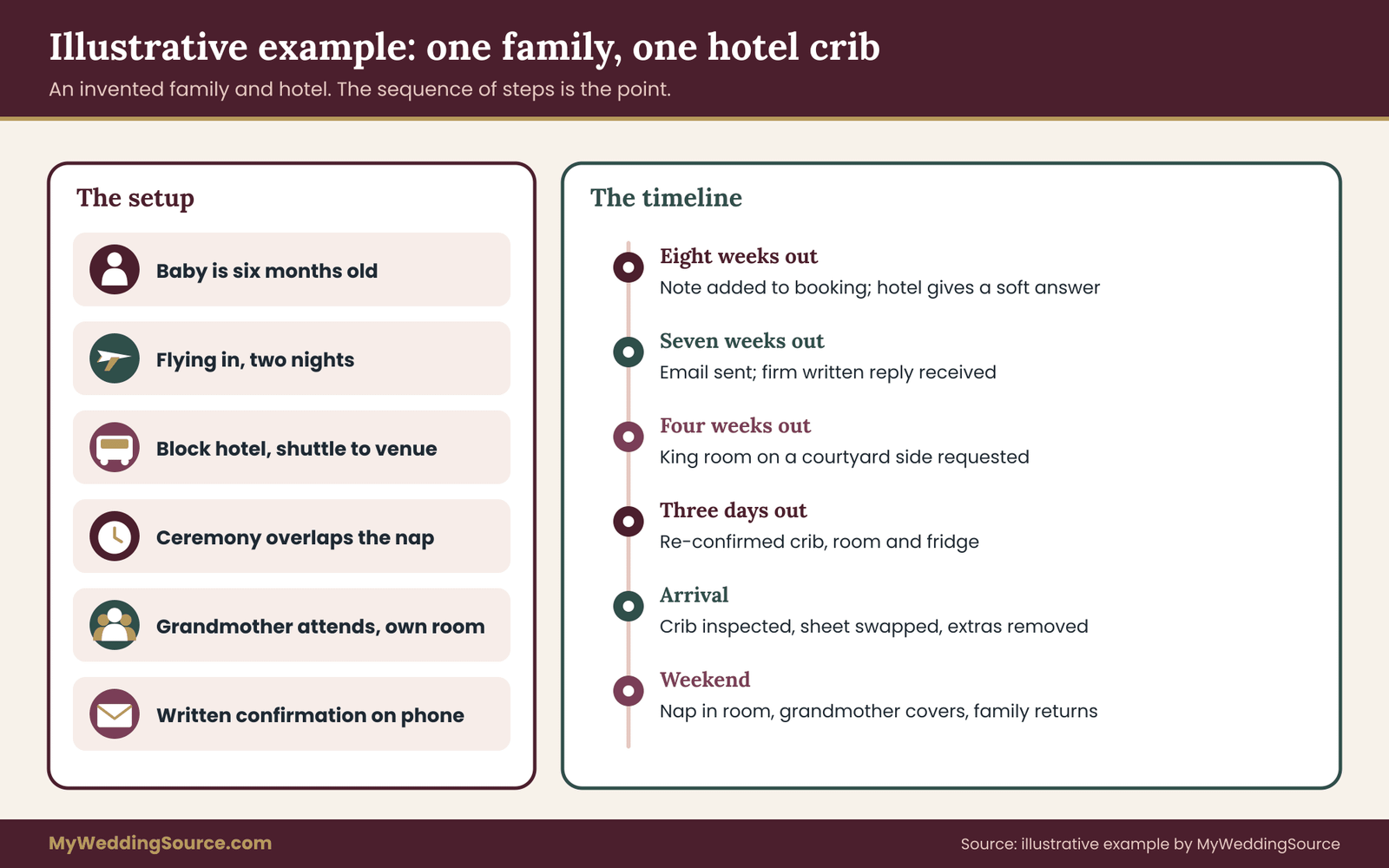
An example shows how the pieces fit together. This one is invented, and the names, hotel and details are illustrative only. The point is the sequence of decisions, not the specifics.
Dana and Marcus are attending a Saturday wedding in a city three hours’ flight from home. Their daughter is six months old. The couple’s website lists a room block at a hotel and a shuttle to the venue. The family will stay Friday and Saturday nights and fly home Sunday.
Eight weeks out: booking and the first rung
Dana books a block room online the same day she RSVPs, and adds a note: “Traveling with a six-month-old, please note a portable hotel crib for both nights.” She then calls the hotel and asks the front desk to confirm that the note is on her individual reservation, since the block was booked through a group contact. The agent says yes, and says the hotel has a limited number of portable hotel cribs and cannot guarantee one.
That is a soft answer. Dana asks whether the hotel can assign a hotel crib to a specific room. The agent says no, but the hotel keeps cribs in housekeeping and places them in rooms before check-in for guests who have noted the request. Dana asks for that in an email.
Seven weeks out: the second rung
The next day, Dana sends a short email restating the dates, the room type, the baby’s age and the request, and asking the hotel to reply to confirm. The hotel replies two days later: “A portable hotel crib has been noted for your stay and will be placed in your room before check-in. There is no charge.” That is a firm reply. Dana saves it in a folder on her phone.
At the same time she asks about the layout. She is told that rooms with a king bed have a little more floor than rooms with two queens, and that a higher floor facing the courtyard is quieter. She asks to be moved to a king room on the courtyard side. The agent agrees, subject to availability, and Dana notes it on the confirmation.
Four weeks out: deciding the travel plan
Marcus and Dana decide to fly and not bring their own crib, since the hotel’s confirmation is in writing. They will bring a fitted sheet for a play yard, a white noise device, and a car seat, which they will gate-check. They check the airline’s policy on car seats and strollers and confirm that both can be checked at the gate.
They look at the schedule on the wedding website. The ceremony is at four on Saturday, a time that overlaps with the baby’s afternoon nap. They decide to put the baby down in the hotel crib at three, with Dana’s mother, who is also attending, staying in the room until the family returns for the evening. That means Dana’s mother needs her own room, and they book one next door in the block.
Three days out: the third rung
Dana emails the hotel again: “We arrive Friday at about nine at night. Could you confirm that the portable hotel crib will be in our room and that our king room on the courtyard side is still reserved?” The hotel replies the next morning to confirm both. Dana also asks whether a fridge is available, and the hotel says one can be delivered at no charge. She asks for it.
She prepares the in-reach bag, the room kit and a short note for her mother with the baby’s schedule, the feeding plan and the phone numbers.
Arrival: the fourth rung
They arrive at nine. The hotel crib is in the room. Marcus holds the baby while Dana checks it. It stands and locks. The mesh is intact. The pad is flat and firm, though the sheet is a bit loose, so she swaps in the fitted sheet she brought. She removes a small extra blanket the hotel left in the hotel crib. She moves the hotel crib away from the window and the curtain cord, between the bed and the wall, where she can reach it in the dark.
She reads the label, notes the brand and model in her phone, and checks it against recalls on the Consumer Product Safety Commission website while Marcus unpacks the room kit. Nothing comes up. They turn on the white noise device and the baby goes down within the usual time.
The weekend itself
On Saturday the baby naps in the hotel crib before the ceremony, as planned. Dana’s mother stays in the room until two hours before dinner, when the family returns. The couple attends the ceremony together, then dinner, and leaves at nine to put the baby to bed. Dana returns to the reception for an hour while Marcus stays in the room. On Sunday they pack the night before, hand back the fridge and fly home.
None of it was complicated. It worked because each rung of the ladder was climbed at the right time, the room was chosen for noise and space, and the schedule was mapped before the weekend. When the hotel gave a soft first answer, Dana followed up and got a firm one.
Where the example could have gone wrong, and the fix
Suppose the hotel had never replied to the email on the second rung. Dana would have had two options: call again and ask who could confirm, or build a backup. A backup might be a local baby equipment rental, confirmed with the hotel for delivery to the front desk, or bringing the family’s own travel crib.
Suppose the hotel crib had arrived with a torn mesh panel. Dana would have asked for a replacement. If none had been available, she would have used the backup rather than the damaged unit.
Suppose the shuttle had no room for a car seat. The family would have used a taxi service that supplies them, or rented a car for the weekend. The point is that every failure has a fallback, and the fallback is easier to arrange early than late.
Edge cases and what to do
Real trips rarely follow the clean path. Here are the situations that cause the most trouble, and sensible responses.
Two or more infants in the same block
When several families need cribs, the hotel’s supply may be thin. If you are one of them, request early. If you are the couple and you know more than one family has an infant, you can raise it with the hotel sales contact, without naming anyone, and ask how many cribs the property can supply across the weekend. Families can coordinate informally if they wish, for example by sharing what they learn about local rental services. Nobody should hand over personal details to another guest.
Twins or an infant and a toddler
A family with twins needs two sleep spaces, and a family with an infant and a toddler needs one crib plus a safe place for the older child, often a bed with rails or a second play yard. Ask for both on the same note, and ask whether the room can accommodate them. This is a case where a suite or connecting rooms often make sense, even though they cost more. Consider the cost against the alternative of a night with nobody sleeping.
The hotel runs out on the night
If you arrive and the hotel has no crib, stay calm, and use the written confirmation. Ask the manager on duty to find one, to borrow one from a sister property or to arrange an emergency delivery. If the hotel cannot, ask what it can offer: a refund of the night, an upgrade, help finding another hotel. The records you kept become your leverage.
The fallback is one you prepared earlier. If you brought a travel crib, you have it. If you have a rental company’s number, call it. Whatever happens, do not put the baby to sleep in an adult bed or on a sofa with pillows because nothing else is available. Safe sleep guidance exists precisely for the night when a better option is missing, and the American Academy of Pediatrics and your provider are the right sources for what to do.
A baby who is ill or a family who cannot travel
If the baby is sick, or a flight is canceled, the plan changes. Contact the hotel as soon as you know. Ask about its cancellation and change policy, and whether the block rate allows changes. Many blocks have a cutoff date after which the rate is not honored, and a late change may cost more. Tell the couple, in a single plain sentence, that you cannot make it. They have a lot to manage, and a short message is kinder than silence.
A hotel with no crib and no delivery option
Some small properties have nothing and will not accept deliveries. If that is the block hotel, you have three choices: bring your own, book at a different hotel nearby, or find a rental that includes in-room setup through a different route. Moving away from the block can cost the group rate and the shuttle, so weigh it against the cost of bringing your own. The couple should know about this situation early, because it is a signal that the block hotel is a poor match for guests with infants and they might change it or add information.
What a hotel crib really costs, and what it saves
Money questions around infant travel are easy to get wrong, because the visible price of a hotel crib is often zero and the real cost sits elsewhere. A clear view of the trade-offs helps you pick the option that suits your family, without inventing numbers or assuming what any one property charges.
The visible cost
The line on the folio, if there is one, is the easy part. Some hotels charge nothing, some charge per night, some charge per stay. Ask, and write the answer down. If a fee appears at checkout that nobody mentioned, you have your written confirmation to point to, and many hotels will remove it.
The room cost
The larger cost is often the room itself. A room with enough floor for a play yard, or a suite, costs more than the cheapest block rate. A connecting room for a grandparent adds another night’s charge. The right comparison is not “crib fee versus no fee”, it is “room that works versus room that does not”. A cheaper room that forces a sleepless family into a bad weekend is poor value, while a slightly more expensive quiet room that lets everyone rest may be the better buy.
The gear cost
Bringing your own travel crib costs little if you already own one, but it can add a checked-bag fee or shipping. Renting a hotel crib locally costs a delivery and a rental charge, and the rental is billed whether or not you use it. Buying a cheap travel crib at the destination and donating it afterward is possible but wasteful, and it must still meet safety standards and be assembled correctly. Compare these routes in the order you would actually use them: first the hotel crib at the quoted fee, then your own, then a rental.
The cost of failing
The hidden cost is what happens when the plan fails. A lost night’s sleep, an emergency purchase, a taxi to another hotel, a missed event: these add up, and they are why the confirmation ladder is worth the small effort. When you weigh whether to spend an extra twenty minutes on a written confirmation and a re-check, the comparison is not against nothing, it is against the cost of finding out at the front desk at ten at night.
Cancellation and changes
Check the block’s cancellation terms before you book. Infants raise the chance of a last-minute change, since illness can strike without warning. Ask what the deadline is, whether a deposit is refundable, and what happens to your hotel crib request if the dates change. If you must change dates, restart the ladder, because a note attached to the old dates may not carry over.
Travel insurance is a separate topic, and its terms vary by product. Read the policy for what it counts as covered reasons, and ask the insurer directly. Nothing here is financial advice, and a licensed professional can answer questions about your own situation.
Common mistakes with a hotel crib request, and how to avoid them
Most failures come from a handful of habits. Seeing them in advance helps you avoid them.
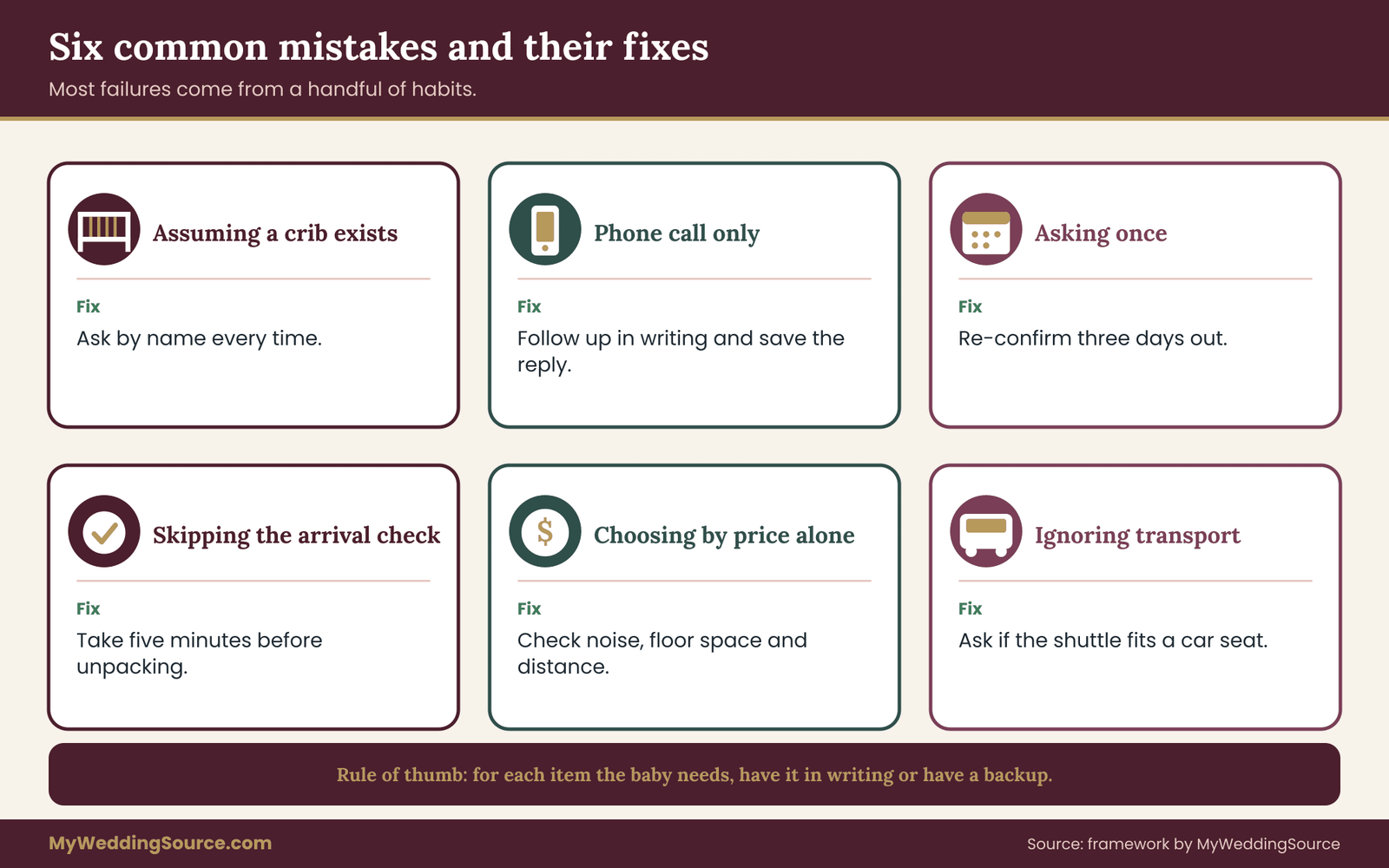
Assuming the hotel has a hotel crib. Most do, many do not, and almost none will guarantee it unless asked. Ask every time.
Asking by phone only. Calls leave no record. Follow up in writing.
Asking once and never again. Notes get lost. The three-day re-check exists for that reason.
Skipping the arrival inspection. The unit in the room is what counts. Do the five minutes.
Choosing the room by price alone. A noisy room next to the elevator turns a good crib into a poor night.
Overpacking on the in-reach bag and underpacking the room kit. The first fills your arms, the second is what you need at ten at night.
Ignoring transport. A shuttle without car seat room is a wedding-weekend problem hiding in plain sight.
Oversharing with the couple, or asking guests to overshare. A baby’s age is plenty. Health details and birth dates are not needed.
Leaving the couple out of the loop entirely. A line saying you will have a baby with you helps the couple plan seats and meals, and a line saying you cannot come is kinder than silence.
A decision rule to carry with you
If you remember one thing, make it this. For every item that the baby depends on, ask: do I have it in writing, or do I have a backup? If the answer to both is no, that item is the next thing to fix. A hotel crib that is confirmed in writing needs no backup beyond the arrival check. A hotel crib promised on the phone needs a backup, or a written confirmation, before you travel.
Apply the same rule to the car seat on the shuttle, the fridge in the room, the sitter’s phone number and the pharmacy near the hotel. It is a simple test, and it covers most of what can go wrong.
Your next steps
Whether you are the couple or the guest, the next step is small. Pick the list that fits you and do the first item today.
If you are a guest traveling with an infant:
- Add a note about the baby to your hotel reservation, and ask for a hotel crib or play yard by name, since the hotel crib is the item that matters most.
- Ask the hotel to confirm in writing, including the fee and the room type.
- Ask for a quiet room with floor space, and note the distance to the venue.
- Map the weekend’s events against the baby’s routine and decide which you will attend.
- Pack the in-reach bag, the room kit and a short note for any sitter.
- Three days before arrival, ask the hotel to re-confirm, and inspect the hotel crib on arrival.
If you are the couple hosting the wedding:
- Add a short infant note to the guest information page, naming the hotel and saying that cribs are requested directly.
- Ask the hotel how many hotel cribs it can supply for the weekend, without naming guests.
- Check whether the shuttle can carry strollers and car seats, and say so on the website.
- Keep infant details to a minimum on the RSVP, and delete extras after the wedding.
- Use the guide to looking after babies, children and older relatives for the wider picture of children and older relatives, and the wedding budget page if you plan to cover any extra costs.
FAQ
Do hotels have to provide a hotel crib?
Hotels are not generally required to provide one, and many offer them as a courtesy that depends on stock. Federal safety rules apply to cribs that a hotel does supply. Always ask directly, request it by name, and get the answer in writing, since a hotel crib is not something to assume when you book.
How early should I request a hotel crib for a wedding weekend?
Request it when you book the room, ideally weeks before the wedding. Wedding weekends concentrate demand, and a small stock of equipment can run out. Then confirm in writing and re-check about three days before arrival. Booking early also helps you get a room with enough floor space for a play yard.
Is a hotel crib safe for my baby?
A hotel crib can be a good option, but nobody can promise that for every unit. Check the label, the locks, the mesh, the mattress pad and the sheet on arrival, and remove extra bedding. Safe sleep guidance from the American Academy of Pediatrics calls for a flat, firm surface with nothing else in it. Ask your pediatric provider about your baby.
Should I bring my own travel crib instead?
It depends on how you travel. Driving makes it easy, and it gives you familiar equipment. Flying makes it a luggage task, and airlines have their own rules. Many families request the hotel crib anyway and keep their own as a backup. Whichever you choose, check that it fits in the room and that it is not recalled.
What if the hotel has no crib on arrival?
Show the written confirmation, ask the manager on duty to find one, and ask about delivery from a rental service or a sister property. If nothing works, use your backup. Do not put the baby on an adult bed or sofa with pillows. Ask the hotel what it will do about the night, and keep records of everything.
Can I bring formula and breast milk through airport security?
The TSA allows reasonable quantities of breast milk, formula and baby food through screening, even above the usual liquid limits. Tell the officer at the start and expect extra screening. Check the TSA website for the current procedure, and allow more time. Your airline may also have rules for baby equipment, so confirm those directly.
What should I tell the couple about my baby?
Tell them the number of people in your party, and whether any are infants, so they can plan seats and meals. You do not need to share a name, birth date or health details. If you need an aisle seat or may leave early, a short note to the couple or coordinator is enough, and it is much appreciated.
Can the couple book the hotel crib for guests?
They can pass on information, but the guest should make the request, because the reservation, fees and notes belong to the person who books. The couple can help by naming the hotel, sharing shuttle times and asking the hotel how many cribs it can supply. They should not collect medical details or arrange childcare unless a guest asks.
Sources
- U.S. Consumer Product Safety Commission: federal crib and play yard standards, recalls and safe sleep information.
- HealthyChildren.org, American Academy of Pediatrics: safe sleep and travel guidance for babies.
- Transportation Security Administration: screening procedures for infants, formula and breast milk.
- Federal Aviation Administration: guidance on child restraint systems on aircraft.
- National Highway Traffic Safety Administration: car seat selection and installation guidance.
- ADA.gov, U.S. Department of Justice: accessible hotel room and reservation requirements.
- Centers for Disease Control and Prevention: travel health guidance for families with children.
- Federal Trade Commission: rules on displaying total prices and fees for lodging.
- U.S. Department of Transportation: air traveler consumer information, including family travel.