
A silent disco party at a wedding after-party puts the music in wireless headphones instead of speakers, which solves some venue problems and creates a few new ones. This guide gives you a headphone count you can defend, an accessibility check for every kind of guest, and an approval order for the venue, the music rights and the vendors.
Plan a silent disco party in three moves. First, count the headphones: expected listeners, plus an accessibility pool, plus spares, plus staff. Second, cover every guest, including people with hearing devices, sensory sensitivities, limited mobility or no wish to wear headphones, by giving each a real way to take part. Third, confirm the rooms and the rules in writing: venue approval, end time, music rights, power, safety and who pays for lost gear. Do the approvals before you pay a deposit, not after.
Couples usually come to the idea of a silent disco party for one of three reasons. The venue has a strict sound cutoff and the dance floor would otherwise end at ten. A subset of guests wants to keep going while the grandparents want to talk. Or the couple simply thinks it would be fun, and a friend remembers a festival where everyone wore glowing headphones and sang along to different songs. All three are good reasons. None of them is enough on its own, because a silent disco party is a logistics project with a dance floor attached.
The equipment is the easy part. A rental company brings a transmitter, a stack of headphones, charging cases and a technician. The harder questions come from the guests and the building. Who gets a headphone when there are fewer headphones than people? What happens to the guest who uses a hearing aid and finds that over-ear headphones whistle? Can a venue that bans amplified music after a certain hour really treat a silent disco party as quiet? Does the music license that covers the speakers also cover the headphones? Each answer lives with a different person, and no one will volunteer it.
A note on scope. This is general information, not legal, insurance or licensing advice. Venue rules, local ordinances, accessibility duties and music licensing differ by place and by contract, and they change. Where a rule matters, this article tells you who to ask so you can get the current answer in writing.
The guide is deliberately narrow. It covers the after-party itself: the headphones, the guests who will use them, and the approvals. For the music across the whole reception, the order of songs and how to please several generations, the guide on wedding reception music is the better starting point, and this article assumes you have read it or have equivalent decisions in hand.
What a silent disco party at a wedding after-party actually is
A silent disco party is a dance event where guests listen to the music through wireless headphones. A DJ or a laptop sends audio to a transmitter, the transmitter broadcasts to the headphones, and each headphone has a switch that selects one of several channels. Most rentals use two or three channels, each tied to a color on the headphone’s glowing ring, so across the room you can see who is listening to what. A person on the green channel might be hearing 1990s pop while a friend on the red channel hears hip-hop, and a third group on blue hears whatever the guest DJ is trying.
The after-party part matters as much as the silent part. An after-party is the later, looser stretch of a wedding, after the formal timeline is over. It may be in the same room as the reception, in an adjoining space, on a terrace, or at a different location entirely. It often has fewer guests than the reception, a younger average age, a looser bar situation and a different set of vendors, since many of the people who ran dinner have gone home. All of that changes the planning.
What the equipment chain looks like
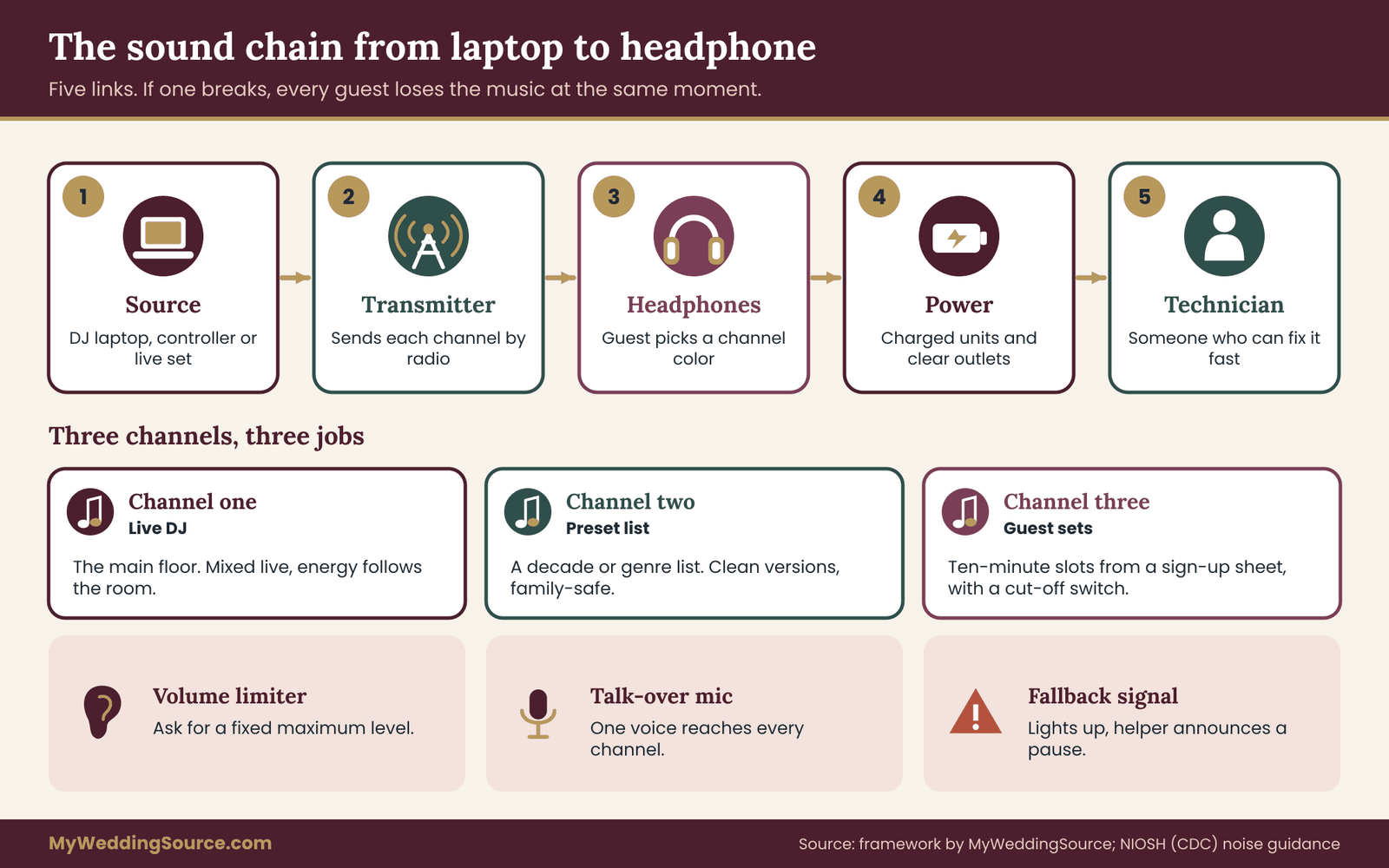
Think of five links in a chain. There is a source, which is the DJ’s laptop or controller, or a mix from a live set. There is a transmitter, which sends the audio out. There are the headphones, which receive it. There is power, which means batteries or charging. And there is a human, a technician or the DJ, who keeps all of it running. If any link breaks, the party stops, and it stops in a way that is awkward to fix: there is no room speaker to fall back on.
Because the chain is longer than for ordinary speakers, the questions you ask a vendor get more specific. Ask how many channels the system supports. Ask whether the headphones have a volume limiter. Ask how long a charge lasts and what happens when a unit dies mid-event. Ask whether the company sends a person or just drops off boxes. Ask what the room needs: power outlets, a place for the transmitter, a clear line between it and the dance floor.
What a silent disco party is not
It is not a way around music rights, because a public performance is still a performance if the audience wears headphones. It is not a sure way around noise rules, because people still shout, sing and stamp, and the building still has a closing time. It is not automatically accessible, because the same headphones that make the party private can shut out guests who cannot or will not wear them. And it is not cheap by default; the cost depends on headphone count, hours, delivery and staffing, and a long guest list pushes the order up fast.
None of this is a reason to skip the idea. It is a reason to treat it as a small production with a few approvals, and to know who signs off on each before anyone books anything.
When a silent disco party fits, and when it does not
The first decision is not about headphones at all. It is whether a silent disco party suits the guest list and the evening you have in mind. A simple test helps: say the plan out loud to the three people who will be most affected, and listen for hesitation. They are the person who runs the venue, the person who most wants to keep dancing, and the guest who will be least comfortable.
Reasons it works well
It works when the venue is the limit. Some venues, including residential neighborhoods, historic buildings and hotels with guest rooms nearby, set hard cutoffs for amplified sound. A silent disco party can stretch the dance floor beyond that cutoff, provided the venue agrees that quiet really means quiet. Get that agreement in writing, because “quiet” is a word that means different things to a banquet manager and a neighbor.
It works when guests want different music. If your group splits between people who want classic pop and people who want electronic music, channels let both groups have a good night without a compromise playlist nobody loves. This is particularly useful at the late hour, when the crowd is smaller and more opinionated.
It works when you want a sound-sensitive crowd to relax. Guests with young children, older relatives and people who dislike loud rooms can sit in a space where conversation is easy while a dance group moves nearby. This is more of a side benefit than a design goal, and it only holds if the room layout supports it.
Reasons it does not work
It works poorly when the group is large and mostly older, with few guests who will actually dance. A stack of headphones that mostly sits on a table is money spent on an idea. Walk through the guest list by name, if you must, and ask how many would put on headphones at eleven at night after a full dinner and a long day.
It works poorly when conversation is the main activity. A silent disco party isolates people from one another in a way that speakers do not. Two people wearing headphones cannot easily talk, and a group on three channels can feel like three separate parties. If the evening’s purpose is a family reunion, the headphones may fight it.
It works poorly when nobody on the team can run it. A rental without a technician puts the burden on a friend who volunteered, and that friend will spend the party fixing channels. If your DJ has never run a silent disco party, you may be adding two roles to one person.
A quick fit test
Here is a short decision rule you can use. If the venue limit is the main reason, the silent disco party fits as long as the venue approves in writing. If guests’ taste is the main reason, it fits as long as at least a third of the after-party crowd is likely to wear headphones. If the main reason is novelty, hold a smaller version first: ask the rental company about a short window, for example the last hour, rather than the whole evening. A one-hour silent disco party after speaker music ends is a gentle way to test the idea and cap the cost.
The next section turns the fit test into a number, because the headphone count is where most of the money and most of the mistakes live.
The headphone inventory: counting for a silent disco party
Most overspending on a silent disco party starts with one shortcut: ordering a headphone for every guest on the list. The reception guest list is the wrong number. It counts people who left after cake, people who will sit at the bar, people who dislike headphones and children who went home at nine. The right number is smaller and has four parts.
The four parts of the count
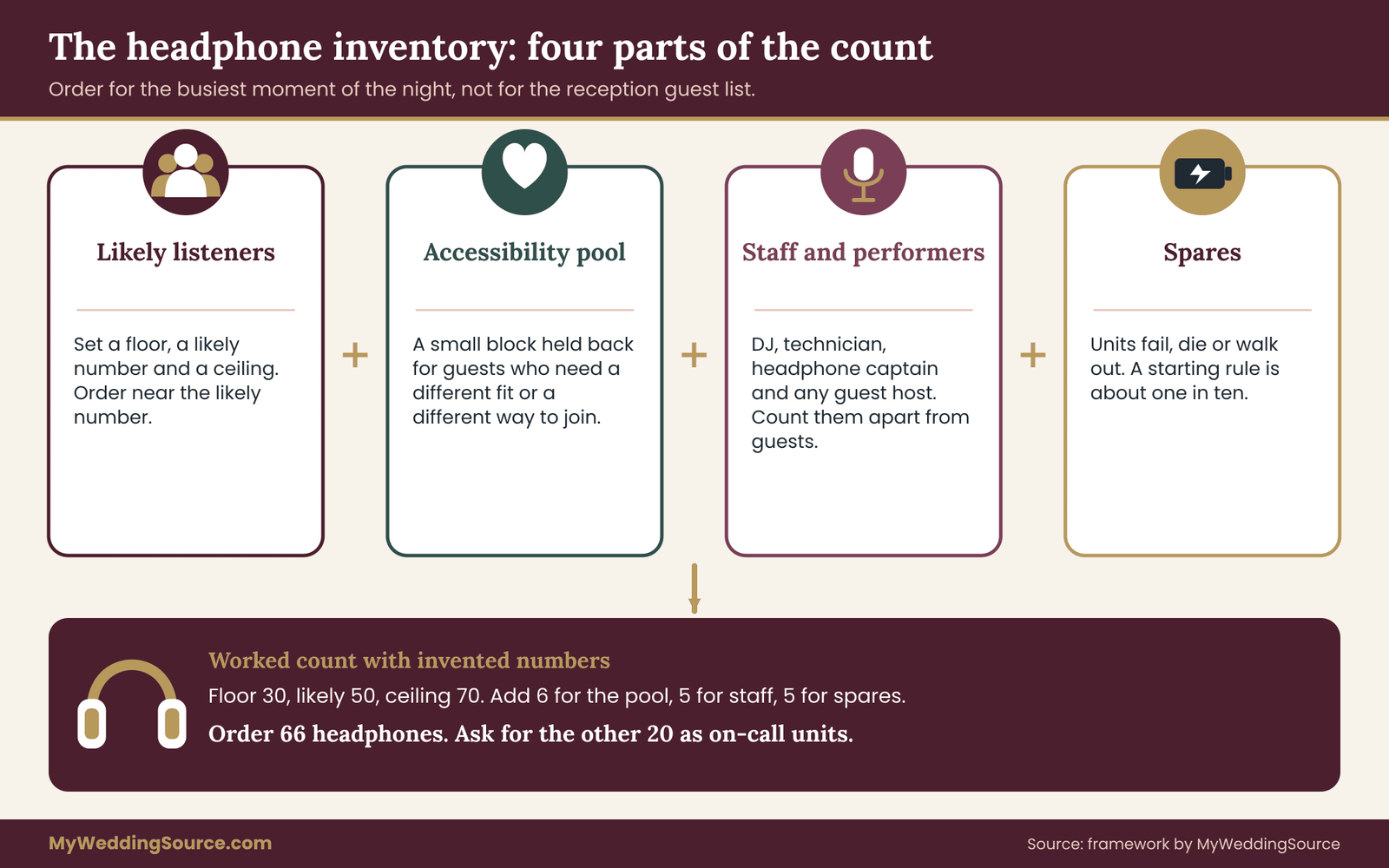
The inventory rule is simple to state. Order for likely listeners, add an accessibility pool, add staff and performer sets, then add spares. Each part has its own logic, and mixing them is how couples end up with either an expensive pile of unused headphones or a line of guests waiting for a pair.
Likely listeners. This is the number of people you expect to be wearing headphones at the busiest moment, not at the start and not over the whole night. Build it from three guesses: how many guests will still be there after the formal reception ends, what share of them are dancers or curious guests, and how many will rotate in and out. Write down a floor, a likely number and a ceiling. The floor is the group you know will go: the wedding party and a few friends. The ceiling is everyone who might possibly join. Order near the likely number and ask for the ceiling as an on-call option.
The accessibility pool. This is a small block of headphones set aside for guests whose needs differ, which the next sections explain in detail. It might include headphones with larger ear cups, a set that fits over a hearing device, or simply units kept out of the main rotation so that a guest with particular needs never has to wait or negotiate for one. You may not use all of them, and that is fine. The pool is insurance for the guests who would otherwise be left out.
Staff and performers. The DJ, the technician, a bartender who wants to hear the cue and a photographer who needs to know when the lights change may all need a set. So might the guest who agreed to run the third channel. Count them separately so they do not eat into the guest allotment.
Spares. Units fail, are dropped, run out of charge or get carried out to the parking lot. A common starting rule is to hold back about one in ten, then adjust once the rental company tells you how it handles failures. If the company sends a technician with swap units, you can keep spares lean. If it drops off boxes and leaves, spares matter more.
Turning the guess into an order
Here is the arithmetic, without any invented statistics, because the inputs are yours. Say the reception ends at ten and you expect many more guests at the bar than on the dance floor. You decide the floor is thirty, the likely number is fifty and the ceiling is seventy. You set aside six for the accessibility pool, five for staff and performers, and five for spares. The order is the likely number plus the three extras, which is sixty-six. The remaining twenty are the on-call ceiling, and you ask whether the company will deliver them if the dance floor is full at eleven.
That structure keeps the discussion with the vendor concrete. Instead of asking for “enough for everyone,” you ask for sixty-six headphones, three channels, one technician and twenty on-call units, and you ask how each is priced. Vendors answer specific requests more clearly than vague ones, and the quotes become comparable. If you want help comparing several vendors on the same scope, the guide to vendor due diligence gives you the questions to ask before you sign.
Fewer headphones, more hours: the shared-set option
If cost is the constraint, there is a middle route. Rather than ordering for the peak, order for about two-thirds of the likely number and run the silent disco party as a rotation. Guests hand back headphones when they leave the floor, and the technician cleans and re-issues them. This works if the silent disco party is long and guests drift in and out. It fails if everyone arrives at once, which is usual right after the last formal event, so check your timeline before relying on it.
The other route is a shorter window. A silent disco party that runs for the last ninety minutes of the evening needs the same headphone count as one that runs for four hours, but the rental fee is usually tied to time, delivery and staffing in some combination. Ask the company how the price changes with duration, and how it changes with unit count, because the two often move differently. Do not assume the cheaper variable is the one you are trying to shrink.
Hygiene and handling
Headphones touch hair, ears and sometimes the skin of sweaty guests. Ask what the company does between uses. Common practices include wipeable ear pads, disposable ear pad covers and a cleaning station at the return table. If the company has no answer, bring your own supply of sanitizing wipes and ask whether the pads tolerate them, because some materials degrade. A small card at the return table that says “wipe and hand back” sets the habit faster than a verbal announcement at midnight.
Hair, makeup and formal wear raise a practical issue as well. Large headpieces, elaborate updos, veils and some hair accessories do not sit comfortably under over-ear headphones. Offer a hook at the check-in table where a guest can leave a veil or a pin, so that nobody has to choose between their outfit and the silent disco party. Put a small mirror near the return table too; people want to fix their hair when they take the headphones off.
Lost and damaged units
Lost units are the largest hidden cost. Rental contracts usually set a replacement charge for each missing or damaged headphone, and the charge can be well above the rental fee. Read that clause before you sign, and decide in advance how you will reduce the risk.
A check-out system is the simplest solution. Each guest receives a numbered headphone, and a helper writes the number next to a name or holds a small deposit item such as a ring of keys or a driver’s license photo with permission. Many couples reject this as too formal for a party. The compromise is a visible, friendly process: a table at the entrance, a helper with a clipboard, and a return table near the exit. A guest who walks out wearing a headphone is stopped by a person, not by a rule.
Another approach is to assign responsibility. Name one person, ideally not the DJ, as the headphone captain. Their job is to issue, count and collect. They know the total in circulation at any moment and can tell the technician when twenty units are missing before the end of the night. Choose someone dependable and sober for this role, and give them a break time so they are not stuck at the table all evening.
What to ask the rental company about the count
Before you commit, gather a short list of answers, and write them in the quote or contract:
- How many headphones are in the base package, and what is the price per additional unit?
- Does the package include a technician for the full event, or only for setup?
- What is the policy on units returned unused, and can I reduce the count within a set number of days?
- How are lost, broken and unreturned units priced, and is there a damage waiver?
- How long does a charge last, and what is the plan if units die?
- Are there headphones suited to different needs, such as larger ear cups or models with a volume limiter?
The last question connects the inventory to the accessibility work. Counting headphones is only the first half of the job. The second half is deciding who they are for.
Channels, transmitters and the sound chain of a silent disco party
Once you know how many headphones you need, the next question is what they will play. A silent disco party gives you the unusual option of running several musical experiences in the same room, and the sound chain decides how well that works. This section covers channels, sources, hearing safety, radio interference, power and the failures to prepare for.
How many channels, and who feeds them
Two channels are the minimum that makes a silent disco party interesting, and three is the usual maximum for a wedding. Beyond that, the silent disco party fragments, and each channel needs its own source of music. A single DJ can switch one channel between songs while the others play from prepared lists. A DJ cannot properly mix three live channels at once. So the question is not just “how many channels” but “who is feeding each one.”
Here are four setups, in order of increasing demand on people:
One live source, one preset channel. The DJ mixes live on the main channel. A second channel plays a prepared playlist, such as a decade mix or a genre list, with no one watching it. This is the easiest to run and the one most DJs can do without extra help.
Two live sources. Two people each mix a channel. One might be the professional DJ and the other a friend with a controller. This produces the strongest sense of choice but needs real rehearsal, because a friend who has never played to a room can run out of music at the worst moment.
Three preset channels with a floating host. All channels play prepared lists, and a host walks the floor, reads the mood and nudges tracks. This works if you have a lot of prepared music and a technician who can swap lists quickly.
A main channel with a guest takeover. One channel is reserved for guest sets, with a sign-up sheet of ten-minute slots. It is fun but needs a rule about content and a person who can cut the feed.
Pick the setup based on the people you have, not the number of channels you can imagine. A smaller system that runs smoothly beats a bigger one that needs three volunteers.
Briefing each channel
Treat each channel as its own short assignment. Write a few lines for each: the genre or era, the energy level, any songs that must or must not play, and the rule for clean versus explicit versions. Share these with the DJ well before the day. A silent disco party is more sensitive to mismatches than a normal dance floor, because a guest who chose a channel did so for a reason. If the “classic pop” channel plays a metal song, the guest takes the headphones off and does not put them back.
If you already have a do-not-play list from the reception, reuse it, and adjust for the late hour. Guests at a silent disco party are usually less bound by family sensitivities and may want different content, but your grandparent might still wander over and borrow a headphone. A simple rule is to make one channel family-safe, with clean versions and no surprises, and label it clearly. That also helps guests who are sensitive to lyrics or want music suitable for older children. If you have not yet decided how to handle explicit lyrics for the main reception, settle that first, because the after-party inherits the answer.
A talk channel and announcements
Headphones isolate guests from the room, which makes ordinary announcements harder. If you need to say something, such as “last song in ten minutes,” “please return headphones here” or a safety message, the DJ must be able to speak into all channels at once. Ask the rental company whether the transmitter supports a microphone mix that overrides every channel, and test it before guests arrive. If it does not, plan to flash the lights, switch the headphone ring colors and have staff walk the floor.
Volume, limiters and hearing safety
Headphones put sound very close to the ear, and a dance crowd tends to turn the volume up. This is a hearing risk, and it is also easy to reduce. The National Institute for Occupational Safety and Health, part of the Centers for Disease Control and Prevention, recommends limiting workplace noise exposure to 85 A-weighted decibels averaged over eight hours, and its guidance notes that every increase of three decibels halves the safe listening time. That standard is about workplace exposure, not parties, but it is a useful anchor: loud sound for a long time is the issue, and the late-night peak at a wedding often lasts hours.
Ask the rental company three things. Do the headphones have a built-in limiter or a fixed maximum level? Can the technician set the transmitter’s output so guests cannot go beyond a chosen level? And does the volume control sit on the guest’s headphone, so guests can lower it freely? A limiter is the best answer, since it sets a ceiling without taking away the guest’s control.
Then add a human check. Put a note at the check-in table: “Start the volume low and turn it up slowly.” A technician should listen to a few units at intervals and ask the DJ to keep the master level moderate. If a guest complains that a headphone sounds painfully loud, treat it as a possible fault and swap the unit.
Guests with sensitive hearing, tinnitus or hearing devices deserve a special mention. They may want to try one ear cup off, or to listen at a lower level than other guests, and the channel system should allow that. The accessibility section below returns to this.
Radio interference and the venue environment
Wireless headphone systems send audio by radio, and different products use different technology. Some use dedicated radio frequencies, some use other standards. In a venue crowded with phones, wireless microphones, photographer equipment and the venue’s own network, interference is possible. In the United States, the Federal Communications Commission regulates radio equipment, and unlicensed devices must accept interference from other sources. You do not need to read the rules, but you should ask the rental company whether its equipment is made for U.S. use, whether it can change channels if the room is noisy with other signals, and whether it has run the system in similar venues.
The practical test is a walk-through. During the technical visit, which the guide to the venue technical walkthrough describes, the technician should carry a headphone to the corners of the dance area, the bar, the restrooms entrance and the farthest seating, listening for dropouts. If the venue has thick walls, a mezzanine or a large metal structure, say so beforehand. Coverage that works in a ballroom may fail on a terrace around the corner, and a guest standing at the edge of the signal hears static instead of music.
Power and charging
Headphones run on rechargeable batteries, and the transmitter needs a steady power source. Ask how many outlets and what kind of power the setup needs. A technician usually places the transmitter near the DJ, and the charging cases sit somewhere safe. Keep three rules in mind.
First, never plug a stack of chargers into one overloaded strip, and do not run cords across a walkway. A dance floor is a bad place for a trip hazard, and a person wearing headphones may not hear a warning. Second, follow the manufacturer’s guidance for charging, and keep charging units away from exits, curtains and décor. The Consumer Product Safety Commission publishes general safety guidance for lithium-ion batteries, and the rental company should have its own handling procedures. Third, ask how long a full charge lasts and how many hours the event runs. If the silent disco party is longer than a charge, ask for a swap schedule.
What to do when the system fails
A silent disco party has a failure mode that a speaker party does not: if the transmitter or the laptop stops, everyone hears nothing at once. A short plan keeps the silent disco party intact.
Agree with the DJ on a fallback signal. For example, the lights come up slightly, and a helper announces a two-minute pause. Ask whether the company carries a spare transmitter. Find out whether the venue allows a small speaker to play at a low level for a short time if the system goes down. Decide in advance whether the room’s own speakers are permitted for emergencies, so no one has to negotiate with a manager at midnight.
Finally, a safety rule: headphones should never be the only way guests learn about an emergency. Ask the venue how alarms work, make sure staff can reach the transmitter to cut all channels at once, and agree on who takes off their headphones first when an alarm sounds. A single click that stops the music and a bright, steady lighting change tell guests to remove their headphones and listen.
Making a silent disco party accessible to every guest
A silent disco party is accessible only if a guest can take part in the way that suits their body, not just the way that suits the equipment. A silent disco party creates specific barriers: it depends on wearing something on the head, it depends on hearing through a particular device, it often uses flashing lights and it asks guests to read a color code. That does not mean you should drop the silent disco party. It means each barrier needs an answer before the night, and the answers should be ordinary, quiet and respectful.
Start by asking, early and plainly
You cannot guess what your guests need. The most useful single step is a short line on your website or invitation inserts, well ahead of the day, that mentions the after-party format and invites guests to tell you what would help. Keep it neutral and unembarrassing. Something like this works: “Our after-party will use wireless headphones. If you would like a different way to join in, or you need anything to make it comfortable, please tell us by this date.” Route the answers to one person, such as a family member or the planner, rather than to the couple on the wedding day.
Ask in a way that does not require a guest to disclose a diagnosis. A guest who needs to sit near the speaker-free zone does not owe you an explanation. A yes-or-no box and a free-text line are enough. Then keep the answers private, share only what the headphone captain and the technician need, and write down what you promised so that it happens at eleven at night.
If your wedding already uses an accessibility checklist for the venue, build on it. The article on accessible wedding venue red flags covers the building itself, such as ramps, restrooms and routes, and this section covers the party inside the building.
Six needs to plan for
These are the most common situations. They are not an exhaustive list, and individual guests vary, so treat each as a prompt to ask a question, not as a script that fits everyone.
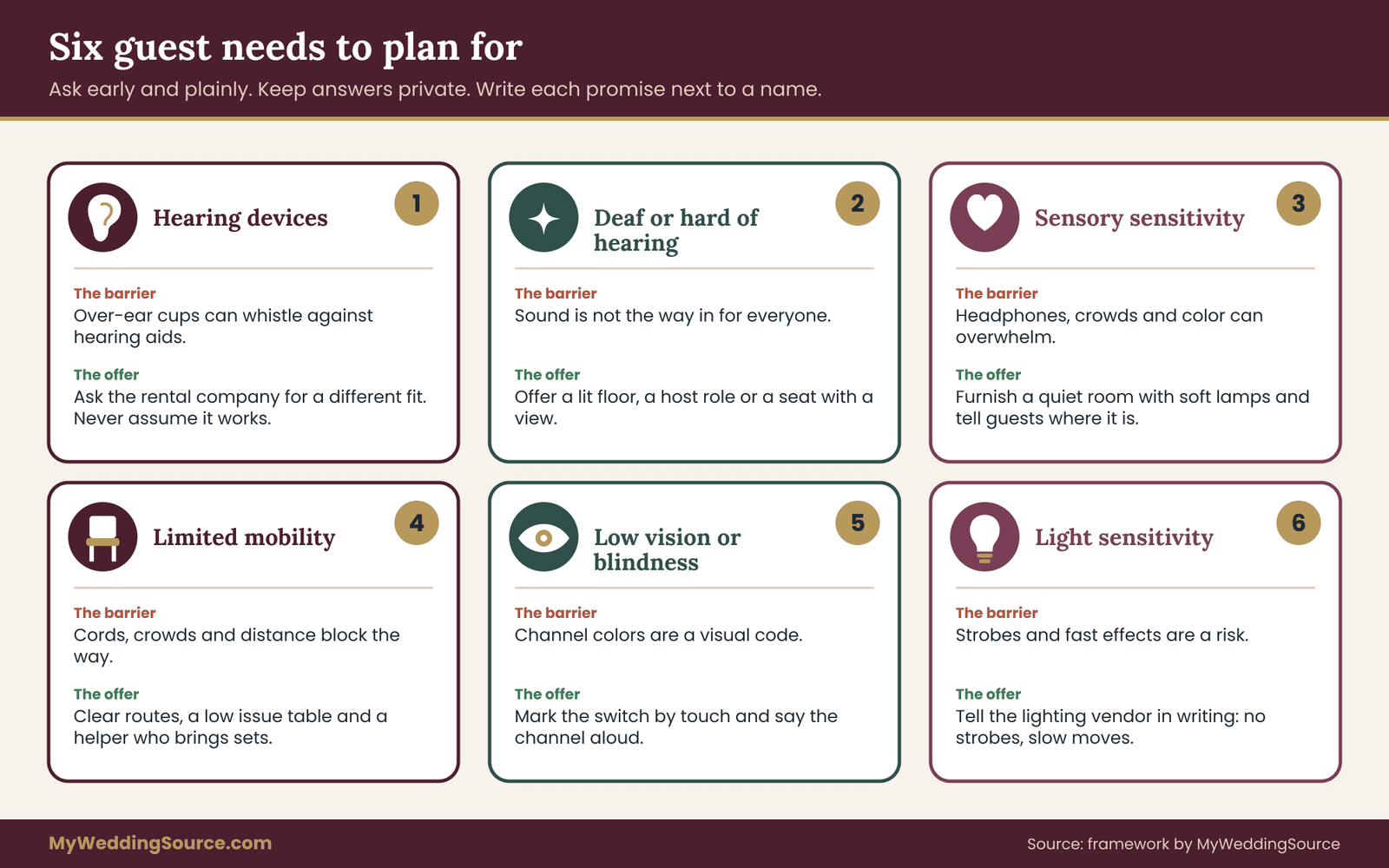
Guests who use hearing aids or cochlear implants. Over-ear headphones can sit awkwardly over hearing devices, and some produce whistling or feedback when pressed against them. Some guests prefer to remove the device and wear the headphones, while others want to keep it on.
Many hearing devices can connect to other audio sources, and some include a feature called a telecoil, but standard rental headphones usually do not work with these directly. Ask the rental company whether any option works with hearing devices, such as a model with a different fit or an audio output that can feed a guest’s own equipment. Do not assume yes. If the company cannot help, offer a different way to join, described below.
Guests who are deaf or hard of hearing. Not everyone benefits from headphones, and some guests will not want to wear them. For these guests the party must offer something other than sound. That might be vibration near a dance-floor speaker, a lit floor that pulses with the beat, a visual display of the song and channel, or simply a role as a host, a photographer’s helper or a co-DJ. Ask the guest what they would enjoy, because they know better than you do.
Guests with sensory sensitivities. Autistic guests, people with migraines, and people who find crowds and loud music overwhelming may like a silent disco party, since the room’s noise is lower, but some will find headphones on the head unbearable or the colored lights too much. Provide a quiet space with soft lighting and seating, away from the flashing, and tell guests where it is. Do not treat the quiet space as a punishment area; furnish it as well as the dance floor.
Guests with limited mobility. A guest who uses a wheelchair, cane or walker needs clear routes to the dance floor, the headphone table, the restrooms and the quiet space. Cords and charging stations should stay out of paths. Put the headphone table at a height that works for a seated guest and have a helper bring headphones to a guest who prefers to stay seated. Reserve some seating with a clear view of the dance floor so that guests who do not dance can still watch and feel part of the night.
Guests with low vision or blindness. The color system is a visual cue, and a guest who cannot see the ring colors cannot tell which channel is which. Label the channel switch by touch, for instance with a raised sticker or a simple verbal system such as “left setting for pop, right setting for dance,” and have a helper confirm the setting aloud. Keep walkways clear, and brief the staff to speak when approaching, so a guest wearing headphones is not startled. Print the channel guide in large, high-contrast type on the table, and read it aloud whenever a guest asks.
Guests who are sensitive to flashing light. Headphone rings glow steadily, but a party often adds strobes, rapidly changing lights and screens. Ask the lighting vendor to avoid strobing effects, and keep any moving lights slow. Tell guests where the calmer lit areas are. If a guest has told you they are prone to seizures triggered by light, discuss the whole lighting plan with them rather than guessing which effects are safe.
The guest who does not want headphones
Some guests will decline headphones for reasons you will never hear: hygiene, hair, tinnitus, a bad experience, or plain preference. A silent disco party that leaves them with nothing is a party that has split in two. Offer a headphone-free way to belong.
The best answer is a space, not a speaker. A lounge area with conversation lighting, a dessert or coffee station and a view of the dance floor gives people something to do while others dance. A host who rotates between the lounge and the floor can tell guests when something fun is happening. A photo corner works well too, as long as the photographer is aware of it.
A speaker for the lounge is a harder question. A small speaker playing a low-level mix would solve the problem for guests who cannot use headphones, but it undermines the quiet that the venue approved. If you want one, ask the venue directly, and describe the level and position in writing. A venue may allow a low-volume speaker in an interior room even when it bans amplified music on a terrace, and the answer may depend on the hour. Do not assume the silent disco party exemption extends to a speaker you add yourself.
Seating, rest and the long day
Many after-party guests have been up since morning, are in formal shoes and have been drinking. Good seating spread around the dance area lets people join in short bursts. Provide water. Make sure there are enough chairs near the dance floor for older guests and for those who need to rest, and put some of them at a distance that suits conversation. Guests who are pregnant, recovering from illness or just tired should be able to sit and still feel part of the party.
For families with children, decide whether the after-party is adult-only. Kids and headphones are a poor mix: ear cups are made for adults, volume limits matter more, and children can be hurt by a lost unit’s cable or a charging case. If children are welcome, the guide to wedding guest care covers how to plan supervision and breaks for younger and older relatives, and the same principles apply late at night. If they are not, say so clearly on the invitation to avoid awkward conversations at the door.
Language, instructions and first-time wearers
Many guests have never used a silent system. Give instructions in a few plain words at the table, and make them simple to follow in a noisy room: “Press the button to turn on. Slide the switch to pick a color. Turn the dial for volume.” A card with pictures and large print is better than a spoken speech. If your guests speak several languages, put the instructions in each of them, and have a helper who can demonstrate.
Consider the guest who has been drinking. Alcohol affects balance, volume judgment and the care taken with equipment. Ask the bar team how they will handle guests who are intoxicated, and agree that headphones are issued at the table, not on the floor, so the headphone captain can decide when a guest should wait. This is not about policing guests; it is about keeping equipment and people safe.
A rule that keeps accessibility real
Accessibility plans fail when they depend on goodwill at midnight. Write each commitment next to a name and a time. For example: “Quiet room set up by nine, with lamps and chairs; owner, cousin A.” “Larger ear cup headphones, two units, held at the table; owner, headphone captain.” “Lighting vendor told in writing no strobe; owner, planner.” That list is short, takes ten minutes to write and is the difference between a statement of intent and a party people can actually join.
Venue rules and the approval ladder for a silent disco party
The venue can say no, and it can say no at any point, including a week before the wedding. That makes the venue the first rung of an approval ladder, and the rule of the ladder is simple: ask in order, get each answer in writing, and do not pay the next vendor until the previous rung has held. A rental deposit paid before the venue answers is the most common way a good idea becomes a bad expense.
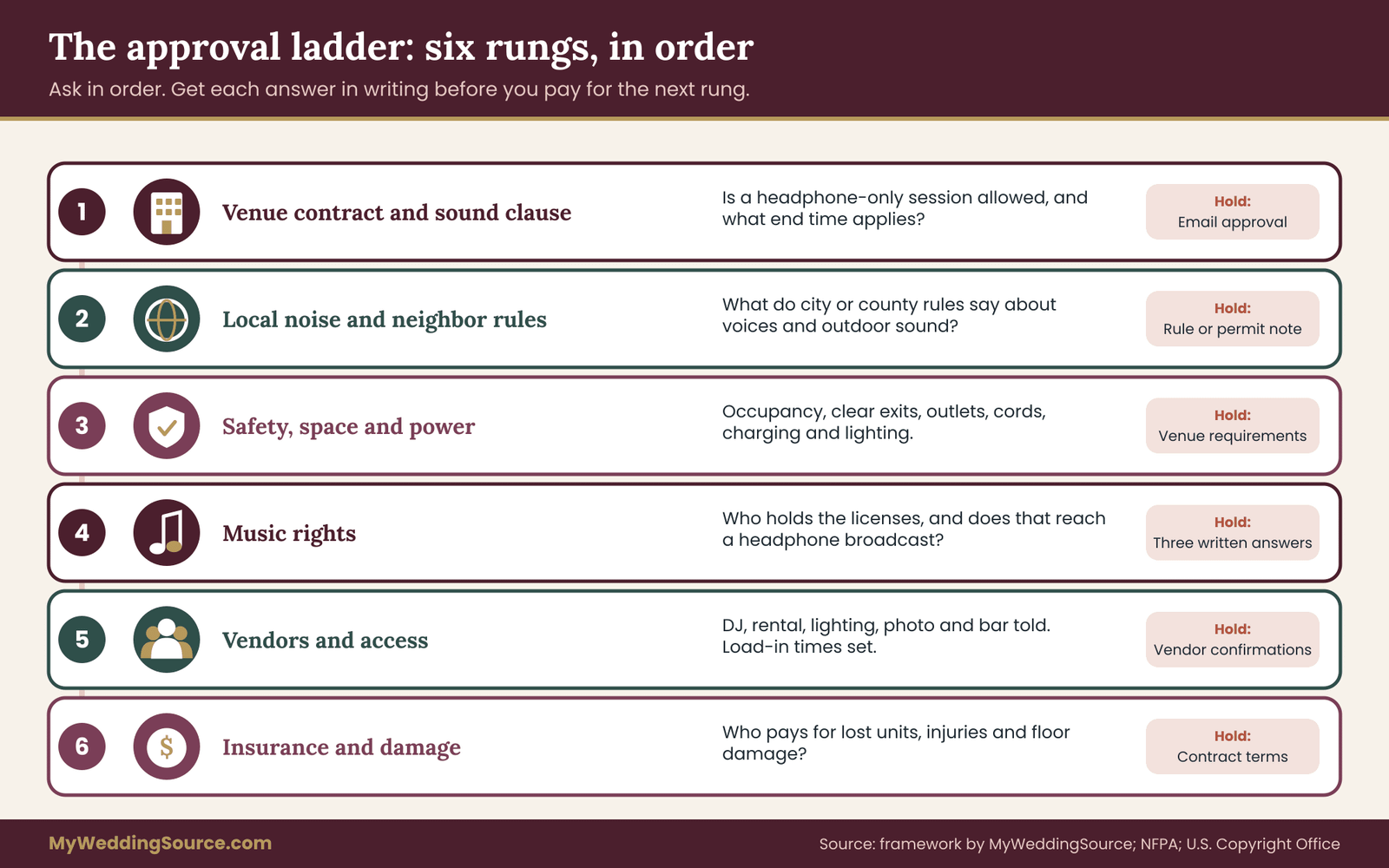
The six rungs
The ladder has six rungs. Each one has an owner, a question and a document to collect.
- The venue contract and its sound clause. Owner: the venue manager. Question: does the contract allow a silent disco party, and does it set an end time for it?
- Local noise and neighbor rules. Owner: the venue, with the city or county for anything outdoors. Question: what do local rules say about sound, and does a silent system change the answer?
- Safety, space and power. Owner: the venue and, where relevant, the fire authority. Question: how many people, which exits, how much power and where can equipment sit?
- Music rights. Owner: whoever holds the licenses, usually the venue, the DJ or the rental company. Question: who is responsible for public performance rights, and does the existing license cover a headphone broadcast?
- Vendors and access. Owner: the planner or the vendors themselves. Question: who is hired, who has exclusivity, and when can each one enter?
- Insurance and damage. Owner: you, the venue and the rental company. Question: who pays for lost headphones, damaged floors or a guest’s injury?
The next sections walk through the first three. Music rights, vendors and money follow after that.
Rung one: the contract and the sound clause
Read your venue contract for any language about music, amplified sound, end times and outside equipment. Venues use several patterns. Some set an end time for all music. Some set an end time for amplified sound and say nothing about other noise. Some require that sound stay below a measured level at the property line. Some set an overall closing time that applies regardless of music.
These differences decide whether a silent disco party extends your night. If the contract ends music at ten, a manager could argue that a silent disco party is still music. If the contract ends amplified sound at ten, a silent system might fit, provided it uses no speakers. If the contract sets a closing time for the building, a silent disco party changes nothing about it. Do not argue the point from the page. Ask the person who enforces it.
Here is a short message you can send, adapted to your situation: “We are considering a wireless-headphone dance session after the reception, from about ten until midnight, with no speakers. Would that be permitted under our contract? If so, could you confirm in writing the end time that applies to it, any noise limits that still apply to voices, and any fees for outside audio equipment?” Keep it specific, ask for a written reply and save it with your contract. A phone conversation is useful for rapport but is not a record.
Rung two: local rules and neighbors
Noise ordinances are set by cities and counties, and they vary widely: some use clock times, some use decibel limits at a boundary, some are triggered by complaints. A silent disco party reduces amplified sound but does not eliminate it. Guests sing, shout, laugh and stamp, and the unusual thing about a silent disco is that the room is quiet while people are visibly dancing, so the voices stand out. Outdoors, a crowd of loud singers wearing headphones can be heard across a field, because they cannot hear themselves.
For an indoor venue, the manager usually knows the local rules and the neighbors. For an outdoor or private property, you may need to ask the local government. Your city or county website often lists a noise ordinance or a special-event rule, and a short call to the relevant office will tell you whether a permit or notice is required. Ask what the rule says about voices and about equipment, and take notes of who you spoke to and when.
Good neighbor practice helps too. If the venue is near homes, a short note to nearby residents ahead of the wedding, with a contact number for the day, can prevent complaints. That is common courtesy, not a legal requirement in most places, and the venue manager may have a view on whether it is wise.
Rung three: safety, space and power
A dance floor full of people wearing headphones changes how the room behaves. People cannot hear instructions, so staff have to use light and gesture. People move in different directions to different beats, so collisions are likelier. People take headphones off and leave them on tables, floors and chairs, so the clutter grows. Raise four topics with the venue.
First, capacity and exits. Venues have an occupancy limit for each room, set under fire and building rules, and the limit applies whether or not the party is loud. Ask what it is, how the after-party fits within it and where exits are. The National Fire Protection Association publishes the fire codes that many jurisdictions adopt, and the local fire authority decides which version applies. You do not need to cite the code. You do need to know that exits must stay clear, so the headphone table, charging station and DJ booth cannot block them.
Second, power. A technician will tell you what they need. The venue knows what it can supply on which circuits, and whether a generator is in use outdoors. Ask where outlets are, whether circuits are shared with the kitchen or bar, and whether the venue prefers its own electrician to handle connections. Plan for equipment to be near the DJ and out of walkways.
Third, floors and surfaces. Dance floors, terraces, grass and stone patios all behave differently. Cords on grass are easy to trip over, and wet surfaces near an outdoor bar are slippery. If the after-party moves outside, ask about lighting for walkways and about the weather fallback. The technical walkthrough you do with the venue and vendors is the right moment to check all of this on site.
Fourth, lighting. Headphone rings add color to a dark room, but dark rooms carry their own risk. Ask for exit signs to remain visible, for the aisles to stay lit and for the dance floor to be clear of obstacles. Check with the venue on any limits on haze, strobes or open flame.
Ask for the three documents
By the end of the first three rungs, you should hold three pieces of paper or email. The first is a written approval of the silent disco party, with the end time that applies. The second is a note on the local sound rules and any permits or notices needed. The third is a list of the venue’s requirements for outside equipment, such as insurance, load-in windows, power use and fees. If the venue lacks a standard document, a short email thread that you save and forward to your vendors will do.
If the venue refuses or hedges, you still have choices. You might move the silent disco party to a different room, a shorter window or an earlier time. You might ask whether a different part of the property, such as an interior room away from the street, is allowed. Or you might drop the silent disco party and use speakers at a lower level until the cutoff. Learning that early costs you an email. Learning it at the door costs you a deposit and an evening.
Timing the asks
Do not leave the rungs until the last month. The venue’s answer shapes what you can hire, and the rental company’s schedule fills up around peak wedding dates. A sensible order is to ask the venue as soon as you are seriously considering a silent disco party, then ask for rental quotes once you hold a written yes, then confirm music rights and vendors before signing the rental contract, then finalize insurance and damage terms with the rental. The article on the wedding vendor timeline shows where these decisions fall in a full planning schedule, and the wedding planning checklist can hold them as line items.
One more practical point: if the venue has an in-house audio team, they may insist on running or supervising the system, or they may charge an outside-equipment fee. Ask early, because an in-house team can be an asset, since they know the room, or a cost, since they set their own rate. Either way, you will be dealing with them on the night.
Music rights and playlist rules for a silent disco party
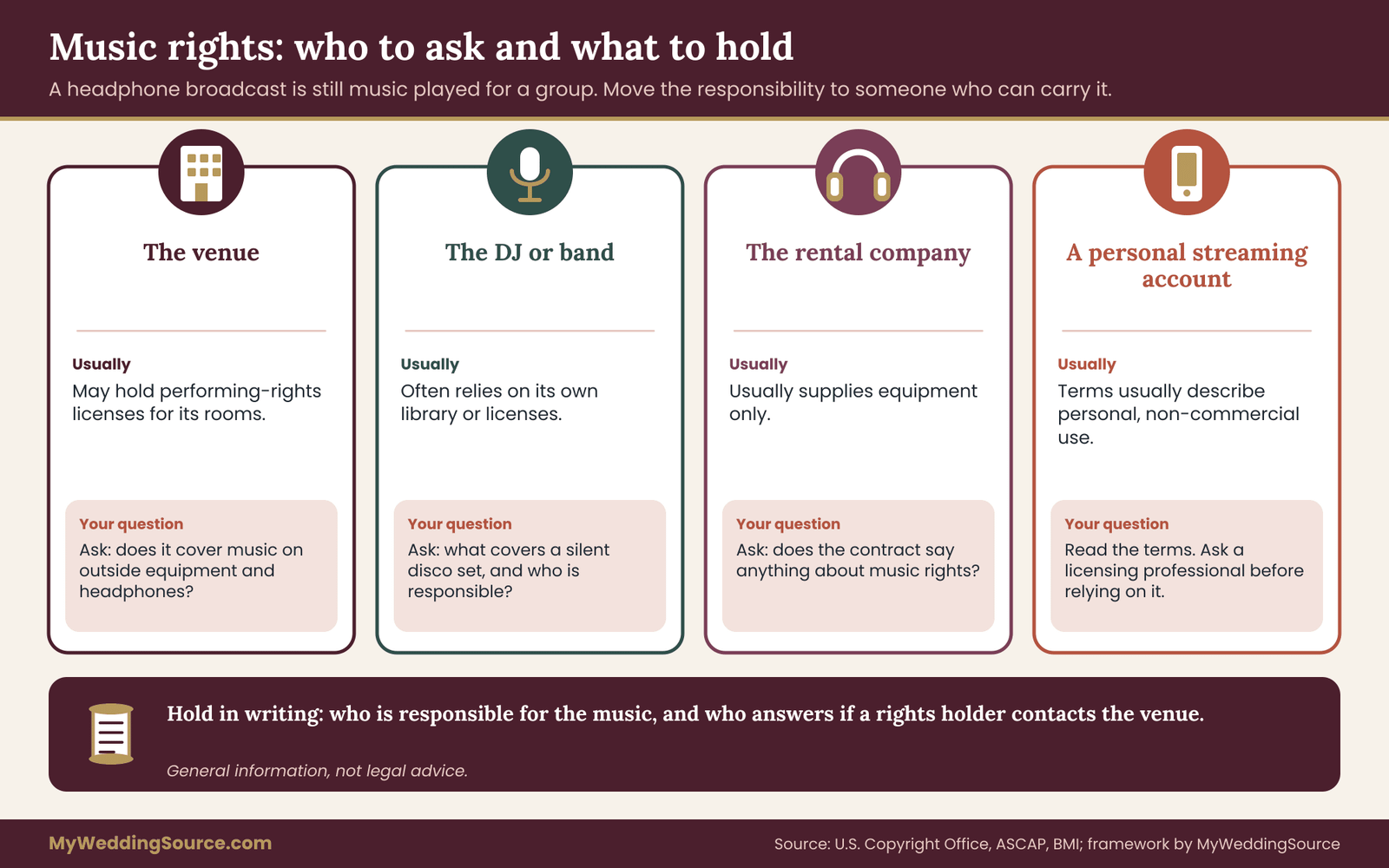
Music rights are the rung most couples skip, because it feels like a problem for the venue or the DJ. In practice the question is who holds the right to play music for an audience, and a silent disco party does not remove it. Headphones change where the sound goes, not whether the music is being performed for a group of people.
The basic idea, in plain terms
In the United States, copyright law gives the owners of music the exclusive right to authorize public performances of it. The U.S. Copyright Office explains this on its site. Performing rights organizations such as ASCAP, BMI, SESAC and Global Music Rights license those performances on behalf of songwriters and publishers, and many venues, restaurants and DJ companies hold licenses that cover the music they play. Whether a given license reaches a particular silent disco party depends on its wording, and nobody should assume it does.
Three questions sit underneath. Is a wedding guest gathering a public performance? That depends on the setting and the law, and the answer is not always the same for a private party and a ticketed event.
Next, does the venue’s license cover music played by someone else’s equipment? Some licenses are written around the venue’s own speakers. And does a streaming account give you the right to play to a crowd? Most consumer streaming services state in their terms that the account is for personal, non-commercial use, and playing from a personal account to a group of guests may fall outside that. Read the terms of any service you plan to use, and ask a music licensing professional or lawyer for a firm answer.
That last sentence is intentionally cautious. You do not need to resolve the law. You need to move the responsibility to someone who can carry it.
Who usually carries it
A professional DJ company usually holds its own licenses or works from a library that the company has paid for, and can tell you how it handles the question. A band or a live performer is typically responsible for the music they perform, though the venue may be responsible for the venue license. A rental company that supplies only equipment usually does not take on any music responsibility, so do not assume it does. A friend with a laptop and a personal account is the weakest option, because nobody else is responsible and the terms of the service are probably personal.
So ask three people the same question. Ask the venue: “Does your performing-rights license cover music played through the headphone system we plan to use?” Ask the DJ: “What licenses or library do you rely on, and does that cover a silent disco format?” Ask the rental company: “Does your contract say anything about music rights, and who is responsible?” Write the answers down. If the three answers do not agree, the gap is the thing to resolve before you sign.
Playlists, mixes and requests
If a DJ plays from the company’s library, the DJ also controls the explicit content, the edit versions and the transitions. That is usually a benefit. If you or your friends build the playlists, remember that downloads, rips and mixes carry their own rules, and that a continuous mix assembled by someone else may have its own rights attached. When in doubt, use a professional source or ask the licensing professional.
For guest requests, set a simple rule. Requests go to the DJ or a request card at the table, not to the guest’s phone. The DJ decides what fits the channel. This protects the music, the mood and the license, and it keeps the silent disco party from becoming a series of phone handoffs.
Recording, streaming and social posts
A silent disco party looks good on camera, and guests will post it. Posting a clip with copyrighted music in it is a separate matter from playing the music, and platforms handle it differently. Livestreaming the silent disco party or hiring a videographer who captures the music in the final video adds another layer. If you plan to keep a video of the silent disco party, ask the videographer how they handle music, and talk to the DJ before the day. Set a simple rule: the photographer and videographer may film the dance floor, and a small sign tells guests where filming happens.
You may also want a rule about headphones themselves. Some systems have a recording output; others do not. If a guest DJ plans to record their set, ask first.
The writing you want to hold
By the end, you should have in writing: who holds the licenses for the music played, what the DJ’s library covers, whether the venue’s license applies, and who is responsible if a rights holder or a licensing organization contacts the venue. You are not asking for a legal opinion. You are asking each party to say what they cover, so there is no surprise later.
Vendors, contracts and costs for a silent disco party
A silent disco party touches several vendors who may not talk to each other: the venue, the DJ or band, the rental company, the lighting vendor, the photographer and the bar. Each has a stake in how it unfolds.
Who needs to know
Tell the DJ first, because the DJ is the person most affected. Some DJs welcome a silent disco party and others have never done it. Ask whether they have run one, what they would need to change and whether they charge extra for a second channel. If the DJ plays the reception on speakers and then switches to headphones, ask about the handover: a break of ten minutes with the room in half-light is typical, and a plan for it avoids a dead dance floor.
Tell the photographer and videographer, because the lighting and the visual feel change. Headphone rings create a distinctive look, and the photographer can plan for it. Tell the lighting vendor, who must avoid strobes and keep the walkways clear. Tell the bar team, who will see headphones on guests who might not hear an order or a last call. Tell the catering lead or the planner, because a silent disco party may change late-night food timing. For the whole picture of how guests move between spaces over the evening, the guide to reception guest flow is a useful reference.
What the rental contract should say
A rental contract for a silent disco party is more than a price list. Look for these items, and ask for changes where they are missing:
- The number of headphones, channels and transmitters, and the delivery and pickup times.
- The technician’s hours and whether a second person is included.
- The replacement price for each lost or damaged unit and any damage waiver.
- The cancellation and reduction policy, including how many days before the event you can reduce the headphone count.
- The power, space and setup the company needs from the venue.
- What the company does if the system fails, including spare equipment.
- Any statement about music rights, and whether the company expects you to hold licenses.
The article on the wedding vendor contract explains how to read contract terms in general, including deposits and cancellation. Use it to check that the rental company’s terms look normal before you sign.
Cost logic without invented numbers
You will see widely varying quotes, so it helps to understand what drives them. The main drivers are the headphone count, the length of the event, the delivery distance, the technician’s hours and the number of channels. Peak-season dates and late-night pickup often cost more. Lost-unit charges are the wild card.
A few comparisons help. A larger order costs more in total but may cost less per unit, so ask about tiers. A longer rental may be cheaper per hour than a short one, since setup and travel are fixed costs.
A technician’s presence adds cost but reduces risk, and if the venue has no one who can fix a problem, it is usually worth paying for. A second channel adds cost for the DJ or for another source, and a third adds it again. The accessibility pool adds a small cost and has the highest value per dollar, because it is what makes the silent disco party work for every guest.
Compare quotes on the same scope. Write the same list for each vendor: headphone count, channels, hours, technician, delivery, damage terms. Without a common list, the cheapest quote may simply cover less. And add a line for the cost of failure: what does the silent disco party look like if the transmitter dies, and what does the vendor offer?
Insurance and responsibility
Ask the venue whether it requires outside vendors to carry liability insurance, and ask the rental company whether it does. If the venue requires a certificate, the vendor can request one from its insurer, usually at no cost or a small one. Ask who is responsible if a guest is injured tripping over a cord, or if a headphone is damaged. These are questions of contract and insurance, and the answers vary, so a short written confirmation is enough for your purposes.
Running the night: a silent disco party run-of-show
Approvals and counts only matter if the evening runs. A short run-of-show for the silent disco party, written on one page and shared with the DJ, the technician, the headphone captain and the planner, keeps the night calm. The times below are relative to the moment the headphones go on, so you can slide them to fit your own schedule.
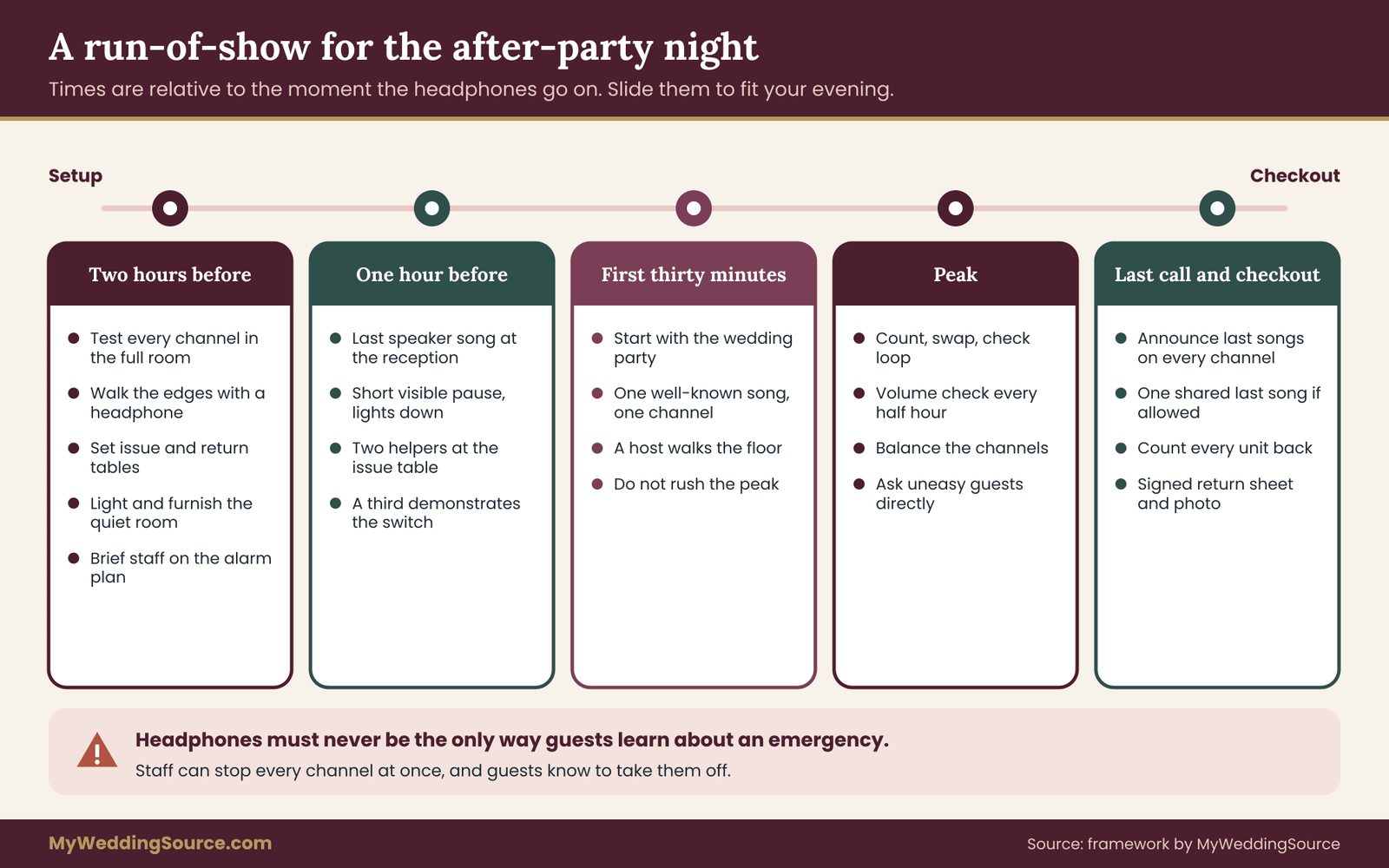
Two hours before: setup and testing
The technician arrives, places the transmitter, tests every channel and walks the room with a headphone, as described earlier. The headphone captain sets up the issue table and the return table, with the numbered list, the wipes and the instruction card. The quiet room is furnished and lit. Charging cases are placed away from walkways and exits. The DJ and the technician agree on the signal for pausing all channels and on the announcement routine. Staff are told where the exits are and who takes off their headphones first if an alarm sounds.
A small point that matters: test with the room full of vendors, not empty. A technician who finds dropouts when the caterers are moving around has learned something that an empty-room test would have missed.
One hour before: the handover from the reception
If the reception ends on speakers, the move to headphones needs a bridge. The best bridge is a short, visible pause. Lights come down a little, the DJ plays a last song on the room speakers, and a host announces that the after-party is starting in the next room or after a ten-minute reset. Guests who are tired can leave at that point without feeling that they missed the silent disco party. Guests who want to continue head to the issue table.
Staff the table well in the first fifteen minutes. A line of forty guests waiting for a headphone while the music is silent is the moment people give up and go to the bar. Two helpers, one issuing and one writing numbers, move people through quickly, and a third demonstrates the switch and the volume.
The first thirty minutes: teach by doing
Guests learn the system by watching. Start with a group that knows what to do: the wedding party, a few friends, the DJ’s guest set. Pick a first song that is widely known and keep it on the main channel. Let the room see the colors change as people switch. A host walks the floor, helps guests find the volume and checks that nobody is struggling with a fit. Do not rush to the three-channel peak. A silent disco party feels strange for the first ten minutes, and after that it feels natural.
Peak and rotation
During the busiest stretch, the technician and the captain watch for three things: units going missing, units running low and guests with issues. They keep a short, quiet loop: count, swap, check. The DJ watches the floor and the channel balance. If a channel is empty, the DJ moves the music or a host nudges guests to try it. If one channel is overloaded, a second one gets a boost. The balance changes through the night, and the point of channels is that you can respond.
Check the volume. Every half hour, the technician asks a few guests how the level feels and puts the master volume within a moderate range. A guest who looks uncomfortable should be asked directly. Remember that people at a late-night wedding are often tired and may be less aware of the damage that loud sound can do.
Last call and checkout
Plan a clear ending, not a fade. Ten minutes before the end, the DJ announces the last songs on every channel. The lights come up slightly. The captain stands at the return table, and a helper walks the floor collecting units from tables and chairs. When the music stops, the DJ can turn on a short last song on the room speakers if the venue allows it, so the party ends together. That final shared song is a lovely touch, since it gives everyone the same sound for a moment.
Count every unit before anyone leaves. The captain compares the number returned to the number issued, checks for damage and records any missing units with a note about who had them. Return the equipment to the technician, get a signed return sheet and photograph the final count. This is the record you will need if the rental company later claims a missing unit.
Worked example: a silent disco party for a 140-guest wedding
The example below is invented, to show how the pieces fit. The numbers are the couple’s own estimates, not statistics.

Imagine a couple with a 140-guest reception in a historic hotel ballroom. The hotel stops amplified music at ten. The couple wants dancing until midnight, and about thirty friends have said they want to keep going. They also have a grandmother who uses a hearing aid, a cousin who is autistic and dislikes loud rooms, and an uncle who uses a wheelchair.
Rung one. The couple asks the hotel manager in writing whether a silent disco party is allowed after ten. The manager replies that amplified speakers must stop at ten, that a silent disco party with no speakers is acceptable until midnight in the ballroom annex, and that voices must stay at normal levels. The reply also notes a fee for outside equipment and asks for a certificate of insurance from the vendor.
Rungs two and three. The manager says the hotel has no special city requirements beyond its own rules. The annex holds a stated number of guests, and its two exits must stay clear. The couple decides the headphone table sits against a side wall, away from the doors, and that the cords run along the wall.
The count. The couple estimates a floor of thirty, a likely number of forty-five and a ceiling of sixty. They add six for the accessibility pool, four for staff and performers, and five for spares. The order is sixty, which is forty-five plus fifteen, and they ask for twenty on-call units. They choose two channels: one run live by the DJ and one preset family-safe list with clean versions.
Accessibility. The grandmother tells the couple, through a cousin, that she prefers to keep her hearing aid in. The rental company offers two units with a different fit, and the couple holds them at the table. The grandmother tries one and decides to sit in the lounge, where the cousin keeps her company. The autistic cousin uses the quiet room, which has soft lamps, and joins the floor for two songs. The uncle’s seat is next to the dance floor, with a clear path to the issue table, where a helper brings him headphones.
Music rights. The hotel confirms that its performing-rights licenses cover the music played by the DJ in its ballrooms but does not say whether that covers headphones. The DJ states in writing that the company’s library licenses cover the set and that the DJ takes responsibility for content. The couple asks the rental company, which says it supplies equipment only. They record all three answers.
The night. The captain, a cousin who does not drink, runs the issue and return tables from a numbered sheet. At ten, the DJ plays a last speaker song, and the lights come down. Guests move to the annex. By ten-fifteen, forty guests are wearing headphones. By eleven, the dance floor is full, and the channel split is about two-thirds on the live channel. At midnight, a last song plays on both channels, the captain collects the units, and the count matches.
What this example shows is that none of the individual steps was difficult. The work is in the order: the venue first, then the count, then the guests, then the rights, then the night.
Limits, pitfalls and edge cases for a silent disco party
No guide can cover every venue or every guest. Here are the situations that most often catch couples out, and how to think about them.
The venue says yes verbally and no in writing. Treat a verbal yes as a lead. If the written contract says music ends at ten, you need an email or an addendum to rely on the exception.
The rental company changes the equipment. Ask for the model and specification in the contract. Some companies swap models based on stock, and a model without a limiter or with different batteries changes your safety and accessibility planning.
The after-party is at a different location. A hotel suite, a bar or a private home brings different rules: lease terms, neighbors, occupancy, and in some cases licensing that the bar holds. Repeat the ladder for the new place, because nothing carries over automatically.
An outdoor party. Weather, power and sound travel are bigger issues. Wind, rain and damp grass affect equipment and footing. Singing carries. Have a covered fallback and ask the technician about moisture protection.
A very large group. Beyond a certain size, a silent disco party becomes a production: more transmitters, more channels, more staff, more storage and a longer line at the table. Ask whether the company has done events of your size, and consider splitting the guests into waves.
A small group. For twenty or thirty guests, a silent disco party may cost more than a speaker and a lower volume, if the venue allows it. Compare honestly, and consider a hybrid: speakers at a low level in one room and a small headphone set for those who prefer it.
Guests who feel excluded. If the silent disco party looks like a club of people in glowing headphones, the others may feel left out. A visible, friendly lounge, a toast or a shared last song helps. A silent disco party should have a place for everyone, even if not everyone dances.
What this guide cannot settle. It cannot tell you what your venue’s contract means, whether your local rules treat a silent disco party differently, or what your licenses cover. Those answers belong to the venue, your city or county, and the license holders. Ask them, in writing.
Your next steps
Start with the venue. Send the short email that asks whether a silent disco party is allowed, what end time applies and what fees come with outside equipment. While you wait, count your likely listeners using the floor, likely and ceiling method, and write down who in your guest list needs a different way to join.
Once you hold a written yes, request quotes from two or three rental companies for the same scope, and ask each the music rights and failure questions. Then write the one-page run-of-show, name a headphone captain and save every answer in one folder. If you want the music for the main reception sorted too, the guide on programming reception music shows how to build it around the same guests.
FAQ
Is a silent disco party allowed after a venue’s noise cutoff?
Not automatically. Some venues end all music at a set time, while others only limit amplified sound or measure noise at the property line. A silent disco party may fit the second kind but not the first. Ask the venue manager to confirm in writing what end time applies to a silent disco party, and check local noise rules for anything outdoors, since voices still carry.
How many headphones should we rent for a silent disco party?
Start from the number of guests likely to be wearing headphones at the busiest moment, not the reception guest list. Add a small accessibility pool, a few sets for staff and performers, and about one in ten as spares. Then ask the rental company about on-call extra units and how late you can reduce the order without penalty.
Can guests with hearing aids join a silent disco party?
Some can, but standard headphones often fit poorly over hearing devices and may cause whistling. Ask the rental company whether any model or audio output works with hearing devices, and do not assume it does. Ask guests what they prefer, offer a headphone-free way to take part, and keep a lounge area where conversation and the view of the dance floor are easy.
Do we need a license to play music at a silent disco party?
Playing music for a group can count as a public performance, and headphones do not change that. Venues, DJ companies and bands often hold licenses, but the wording differs. Ask the venue, the DJ and the rental company who is responsible, and get the answers in writing. For a firm answer on your situation, ask a licensing professional or a lawyer.
Is a silent disco party safe for guests’ hearing?
It can be, if volume is controlled. Headphones place sound close to the ear, and long exposure to loud sound can harm hearing. Ask for headphones with a volume limiter or a fixed maximum, set the transmitter’s output moderately, tell guests to start low and have staff check levels. The National Institute for Occupational Safety and Health offers noise exposure guidance.
What happens if the system fails during a silent disco party?
Everyone loses sound at once, so prepare for it. Ask the rental company for a technician and a spare transmitter, agree a signal with the DJ for a short pause and find out whether the venue permits room speakers at low level in an emergency. Also make sure staff can stop all channels so guests remove headphones and hear safety announcements.
Who pays for lost or damaged headphones?
Usually the renter, under the rental contract, and the replacement price can be higher than the rental fee. Read that clause before you sign, ask about a damage waiver and set up a numbered issue and return system with a headphone captain. Count every unit at the end of the night, and keep a signed return sheet.
Is a silent disco party worth it for a small after-party?
Often not, unless the venue forces the quiet. For twenty or thirty guests, a speaker at a lower level may cost less and be simpler, if the venue allows it. A silent disco party earns its place when a sound cutoff is the limit, when guests want different music or when a short, one-hour session lets you try the idea cheaply.
Sources
- U.S. Copyright Office
- ASCAP, performing rights organization
- BMI, performing rights organization
- ADA.gov, U.S. Department of Justice Civil Rights Division
- U.S. Access Board
- Noise and hearing loss prevention, CDC National Institute for Occupational Safety and Health
- Occupational noise exposure, Occupational Safety and Health Administration
- Federal Communications Commission
- U.S. Consumer Product Safety Commission
- National Fire Protection Association