
Elderly guests can love a wedding and still run out of energy halfway through it. This guide shows how to build a speech and photo schedule around their limits: who needs to be photographed first, where toasts belong, and how to give each person an easy, optional way to leave early without anyone feeling pushed out.
Ask each elderly guest, or the relative who knows them best, three plain questions: when they are at their best, how long they can sit or stand comfortably, and when they would like to head home. Put the family photos that include elderly guests first, before the ceremony or right after it, while they are fresh. Place the speeches and toasts that matter most to them early in the reception, and give every older guest an optional departure window printed in your own run-of-show. Nobody is asked to leave. They are simply offered a graceful exit that is already arranged.
Most wedding timelines are built around the couple, the venue and the photographer’s light. Guests who tire easily are usually handled as an afterthought: a reserved chair, a polite question about the car, and a hope that grandma will say something if she needs to rest. She usually will not. People who have spent decades being gracious guests rarely announce that they are worn out in the middle of someone else’s celebration.
The result is a pattern that planners see again and again. The grandparents who matter most to the family arrive early, sit through a long ceremony, wait through a cocktail hour in a crowded room, are asked to stand for group photos at the one moment the light is best, and then leave quietly before the toasts that were written partly for them. Nobody planned it that way. It happened because the schedule never asked what elderly guests could comfortably do.
This article is about changing that. It covers the energy limits that tend to matter, a simple three-window method for each older guest, the order in which to take the family photos, where to place speeches, how to write optional departure windows, and a worked example you can copy. It stays on one question: how to schedule speeches and photos around elderly guests. For the wider job of caring for babies, children and older relatives across the whole day, see the guide to wedding guest care.
A note on scope. This is general planning information, not legal, medical or accessibility advice, and the right choices depend on each person and each venue. Where a rule or a health question matters, the article points you to the agency or the person who can answer it.
What energy limits mean for elderly guests
“Energy limits” is not a polite way of saying frailty. It describes how much sitting, standing, noise, heat, waiting and conversation a particular person can take in before the day stops being enjoyable or safe. Two guests who are both eighty can be completely different. One dances through the first hour and cheerfully drives herself home. The other needs a chair within ten steps of wherever he is standing and a quiet corner after an hour of noise.
For planning purposes, five kinds of limits show up most often, and each one connects to a part of the wedding schedule.
Standing and walking. Long processions, outdoor photo locations, uneven ground and cocktail hours with no seating all draw on this limit. The Centers for Disease Control and Prevention treats falls as a serious concern for older adults and publishes guidance for preventing them, which is a good reason to take footing, steps and lighting seriously on a wedding day.
Sitting. Folding chairs without arms, pews and long dinners can be as tiring as walking for some people, particularly those with back or hip trouble. A guest who needs to shift position often or to stand up slowly should not be placed in the middle of a row.
Noise and crowds. Hearing loss is common in older adults, according to the National Institute on Deafness and Other Communication Disorders. A loud band and a crowded room can make conversation exhausting and make speeches hard to follow, even when the guest is physically comfortable.
Heat, cold and light. Outdoor ceremonies in summer sun or evening chill take a bigger toll on some elderly guests than on everyone else. The CDC publishes information on heat and health, including the point that older adults can be more vulnerable to heat-related illness.
Time and routine. Medication schedules, meals, naps and a long drive home all shape when a person is at their best. The National Institute on Aging offers general information on healthy aging, and it is a reasonable place to start if you want background. It cannot tell you what your grandfather needs, though. He can, or the person who helps him can.
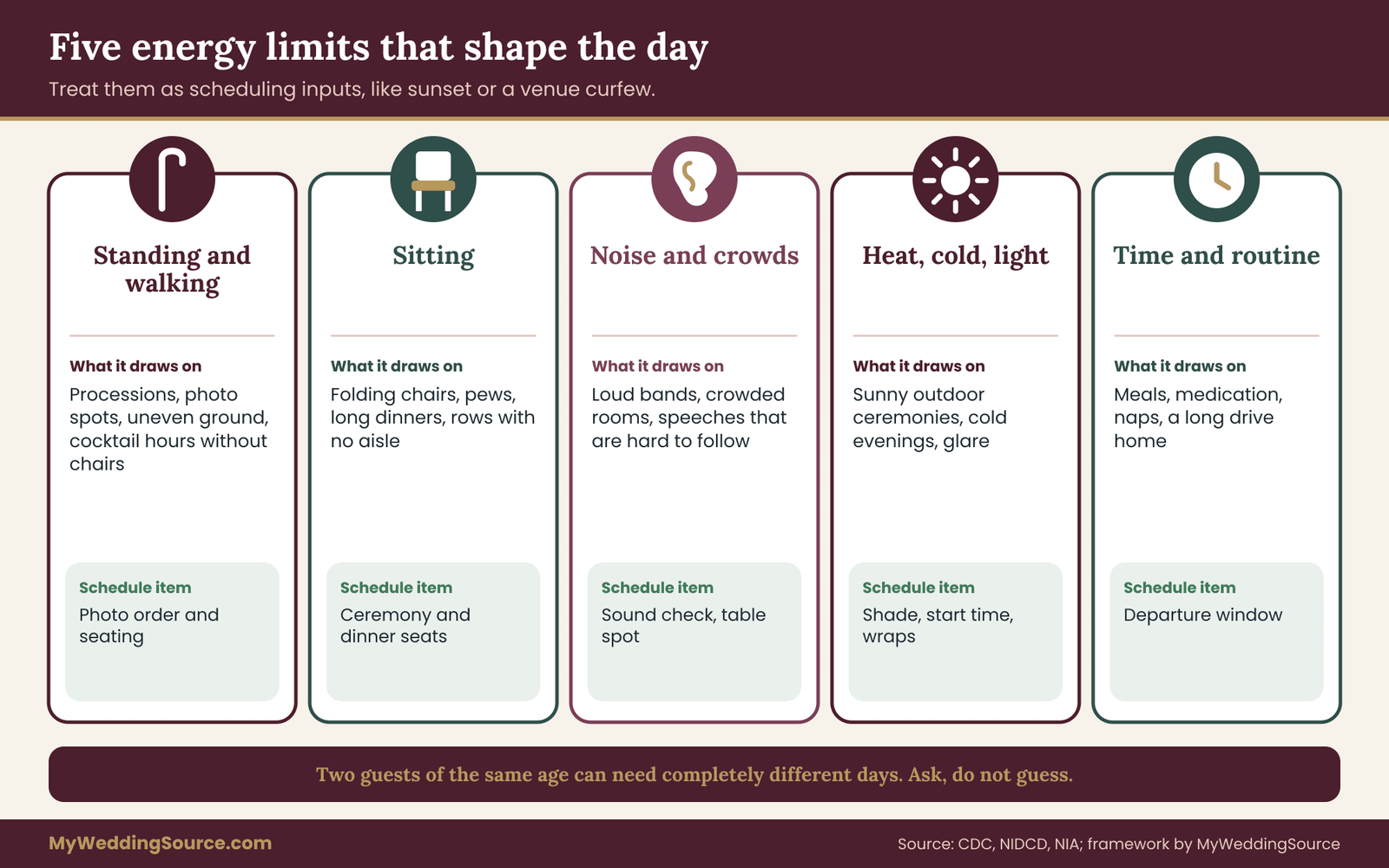
The useful move is to treat these limits as scheduling inputs, the same way you treat sunset time or a venue curfew. If the ceremony is outdoors at five and the guest of honor’s grandmother is at her best before three, the photo schedule should account for that, rather than hoping she rallies.
Why speeches and photos are the pressure points
Of everything on a wedding day, two items ask the most of elderly guests while giving them the least control: family photos and speeches.
Family photos need people to be in a specific place at a specific time, standing or posed, often waiting while other groups are arranged. Elderly guests are frequently the most important people in those photos and the least able to wait around for them. A group portrait that takes the photographer ten minutes to organize might cost an older relative twenty minutes of standing.
Speeches need people to stay put, stay quiet and stay present at a moment chosen by someone else. They also tend to cluster after dinner, when the evening is already long. If the toast that matters most to an elderly guest happens at the ninety-minute mark of a four-hour reception that began after a three-hour ceremony day, the guest may be gone before it begins.
Both problems have the same solution: decide on purpose where the elderly guests’ energy goes, and spend it on the moments they care about most.
What this guide does not try to do
It does not tell you how to judge anyone’s health, and it does not suggest guessing at who is “too old” for a long evening. Age is a poor predictor. The method here relies on asking, and on giving every guest a choice. It also does not replace professional help. If a guest has a medical condition that affects their day, their own doctor or caregiver is the right source for advice about travel, medication timing or mobility aids, not the wedding planner.
Find out what your elderly guests actually need
Everything in the schedule depends on information you do not have yet. The way you gather it matters as much as the information, because a clumsy question can make a proud person feel managed.
Who to ask and how
Start with the guest when you can. Most older adults are happy to be asked a plain, practical question by someone who clearly wants them to enjoy the day. Frame it around the event rather than around their age or health: “We want to schedule the photos so you are comfortable and don’t wait around. Would you rather be photographed before the ceremony or just after?” That sounds like hospitality, because it is.
When a guest has a spouse, a child or a caregiver who handles their daily routine, ask that person too, separately and kindly. They know how long the drive tires someone out, which time of day is hardest, and whether a particular chair or a particular noise level is a problem. A sibling or adult child will often give you more specific, more candid answers than the guest would.
Some guests will say they are fine. Take that at face value and still build a quiet option into the schedule. The goal is not to override anyone’s own judgment. It is to make sure the easier path exists if they need it.
The five questions that cover most of it
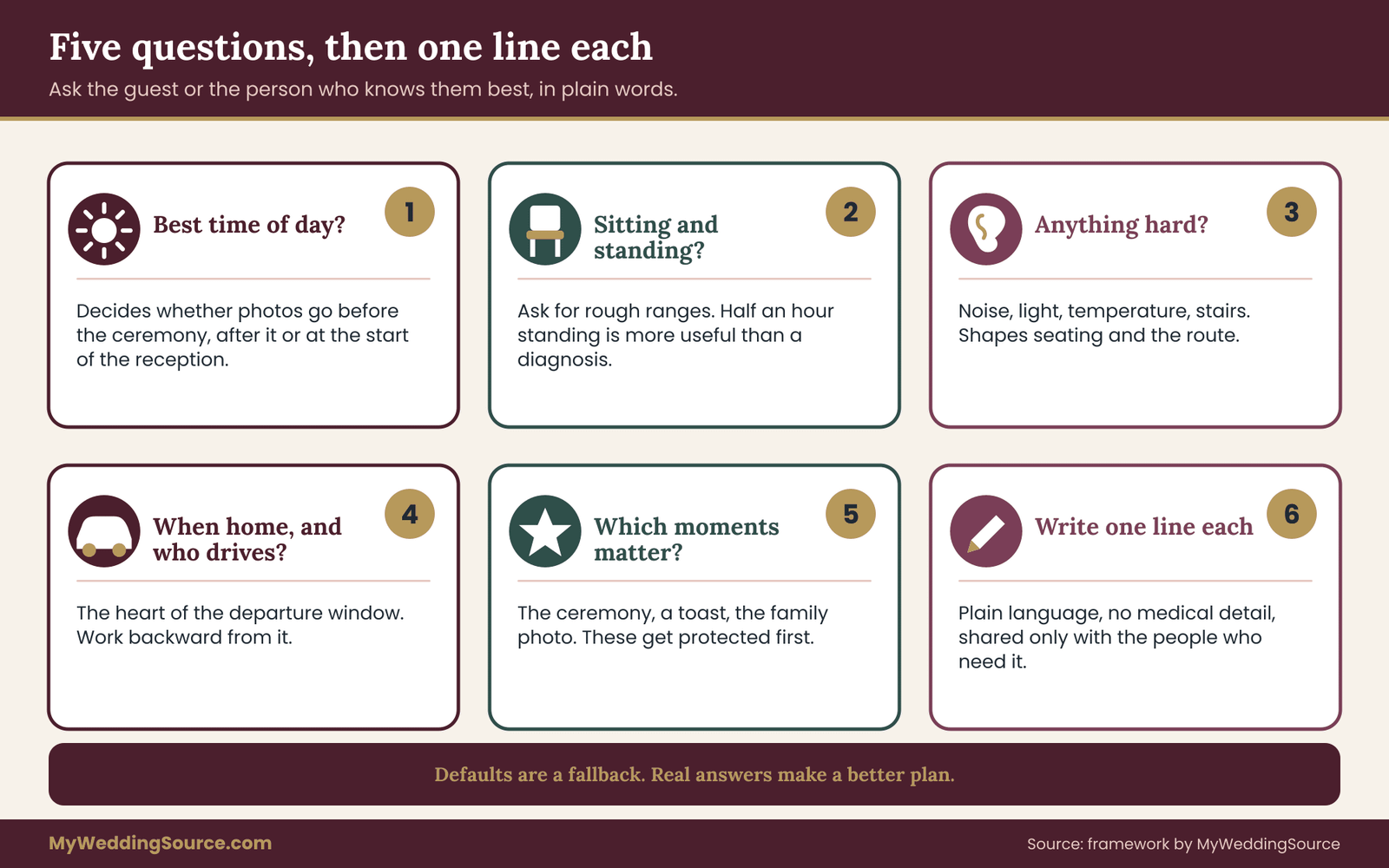
You do not need a long form. These five questions, asked in conversation or in a short phone call, cover nearly everything the schedule needs.
First, what time of day are you at your best? This tells you whether the guest should be photographed before the ceremony, between the ceremony and dinner, or at the start of the reception.
Second, how long can you comfortably sit, and how long can you stand? Ask for ranges, not exact numbers. “About half an hour standing” is more useful than a diagnosis.
Third, is there anything about noise, light, temperature or stairs that is hard for you? This surfaces seating needs, the quiet-room question and the venue-access questions covered later.
Fourth, when would you like to head home, and who is driving you? This one is the heart of the departure window. The answer often changes the plan: a guest who plans to leave at nine needs the toast that matters to them earlier.
Fifth, which moments do you most want to see? Some elderly guests will say the ceremony and the first dance. Others will say they want to hear their granddaughter’s toast. A few will say they only want to be in the family photo. Whatever they choose becomes a priority in the schedule.
“We are putting the schedule together and want you to be comfortable. Which parts of the day matter most to you, and when would you like to head home?”
Record the answers where the planning team can use them
Write the answers in one shared place, in plain language, one line per guest. A line might read: “Grandpa Leo: best before three, sits comfortably forty-five minutes, wants to hear the best man’s toast, leaving around eight with his daughter driving.” It should not contain medical detail. Share only what the photographer, the coordinator, the DJ and the family member in charge of that guest need to do their job.
Privacy matters here. A guest’s health or mobility is their own business. If you keep a list, keep it to scheduling and seating needs, share it with as few people as possible, and delete it after the wedding. Guests are also entitled to decide how their own images are used, and the same respect for individual choices applies to this list.
What to do when you cannot ask
Sometimes the guest lives far away, has difficulty on the phone, or the information has to come through a busy relative. In that case, ask one person to be the contact for that guest and accept their answers. Then build the schedule with generous defaults: photographs early, a chair nearby at all times, the speeches that matter most scheduled in the first half of the reception, and a departure window that opens early enough to be useful.
Defaults are a fallback, not a plan. The more you can replace them with real answers, the better the day goes.
The three-window method for elderly guests
Once you have answers, you need a way to turn them into a schedule without building a spreadsheet for every person. The three-window method does that. Every elderly guest gets three windows on the day, and the whole timeline is checked against them.
The peak window is the stretch of the day when the guest is at their best: alert, comfortable, happy to be photographed and to talk. For many people it is late morning through mid-afternoon, but the answer to the first question in the previous section is the real source. The peak window is where the most demanding things go, namely group photos, the processional and any role the guest has in the ceremony.
The fade point is the time or the kind of effort after which the guest is likely to be tired. It can be a clock time (“after about six”) or a measure (“after the first hour of sitting”). It is not a failure, just a fact about the day. Anything you want the guest to experience, such as a toast or a dance, should land before the fade point, or be arranged so that it does not demand much.
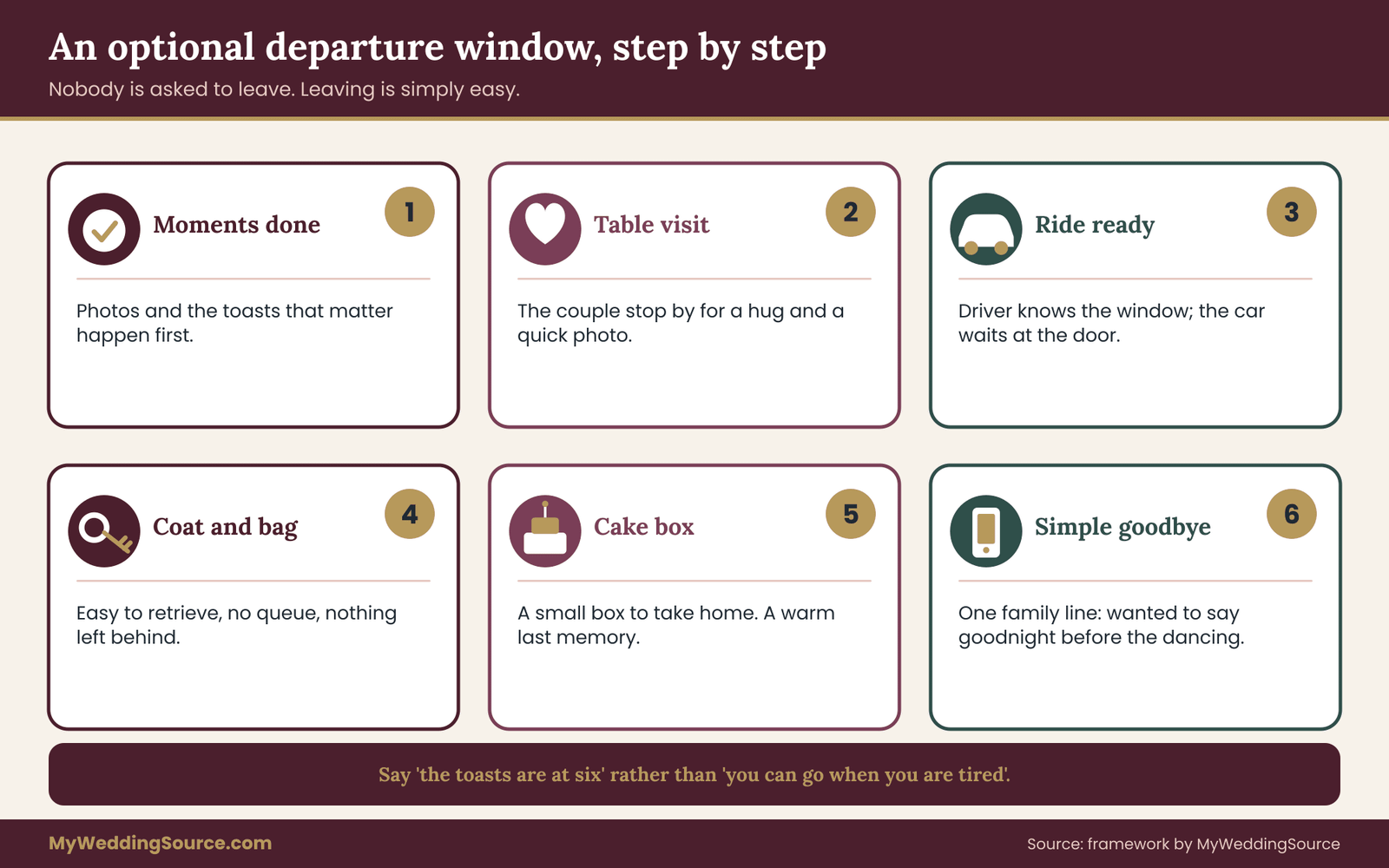
The departure window is the span of time in which the guest may want to leave, and in which leaving should be easy. It opens a little before the likely fade point and runs for a generous stretch. It is not a deadline and nobody is told when to go. It is a window in which the car is available, the coat is retrievable, the goodbye is simple, and any moment that the guest wants to see has already happened.

How the three windows work together
Imagine an eighty-six-year-old grandmother who says she is at her best before three, can sit for about an hour and stand for fifteen minutes, wants to see the ceremony and hear her grandson’s toast, and would like to be home by eight. Her peak window runs from arrival until about three-thirty. Her fade point is around five-thirty. Her departure window runs roughly from seven to eight-thirty.
Now check the draft timeline against those windows. If the ceremony starts at four, she is already near the end of her peak window when it begins, so the family photos that include her should happen before the ceremony, not after. If dinner begins at six-thirty and the toasts are scheduled for the dessert course around eight-thirty, she will probably miss them. Move the toast she cares about to the start of dinner, or hold it before the first course, and her departure window comes after it rather than before.
None of that required knowing her medical history. It required three pieces of information and a willingness to move two items on the timeline.
Turning windows into schedule rules
The method becomes useful when it produces rules the whole team can follow. Four rules cover most situations.
Rule one: spend peak-window time on the priority photographs and the moments the guest named. If a guest said the family photo matters most, that photograph goes inside their peak window, even if it means moving the photographer’s preferred light.
Rule two: nothing the guest cares about happens after their fade point. If a toast, a cake cutting or a dance cannot move, tell the family honestly that this guest may not see it, and offer an alternative, such as a short private moment earlier in the day.
Rule three: the departure window must be open before the fade point arrives. That means the car, the driver and the coat check are ready before the guest is tired, not after.
Rule four: ask again on the day. Windows are estimates. A morning’s rest, a poor night’s sleep, hot weather or a long drive can move them, and a calm check-in with the guest or their companion an hour before the first photo is part of the method.
What the method does not require
You do not need to share anyone’s windows publicly, and you do not need to track them with elaborate tools. A single page, with one line per guest and a trusted person responsible for each, is enough. The method works because it forces three questions: what is this person’s best time, when do they fade, and when can they leave easily. If you answer them for each elderly guest and compare the answers with the timeline, the conflicts show themselves.
Building an energy budget for the whole day
The three windows tell you about one guest. An energy budget tells you what the whole day costs an elderly guest who attends everything. Think of the guest as having a limited amount of comfortable effort and the day as a series of withdrawals. Your job is to make sure the withdrawals go to the moments that matter and not to waiting, standing and moving around.
The common withdrawals
Walk through a typical wedding day as the guest would live it, and note what each part asks.
Getting there. A long drive, a parking lot far from the entrance or a shuttle with high steps counts as effort before the day begins. If the venue has a drop-off point near the door, tell the family which one it is.
Arrival and waiting. Arriving early to be photographed or seated can mean thirty minutes of waiting in a hallway. Ask whether there is a chair, a quiet room or a cool place to sit, and arrange the arrival time so the guest waits as little as possible.
The ceremony. A long ceremony asks for sitting, listening and sometimes standing. Chair type and row position matter. Aisle seats with extra room allow a person to stand, sit and step out without climbing over anyone. The guide to wedding ceremony structure shows where the longest stretches fall, which helps you judge how demanding the service will be.
Photos. Posed group photos ask for standing and holding a smile while a photographer adjusts a group. The priority photo timeline in the next section is aimed squarely at this withdrawal.
The cocktail hour. A standing hour with drinks and appetizers, in a room full of people, can be the most draining part of the day for someone who cannot stand comfortably. Seating placed in the cocktail space, and a quiet table away from the loudest speaker, change the cost completely. The cocktail hour guide covers layout questions that bear on this.
Dinner and speeches. Sitting is easier than standing, but noise, long waits between courses and microphones that are hard to hear all add up. Speeches are discussed in detail later.
The evening. Music volume, dance floor crowding and the pace of the night shape whether an elderly guest stays or leaves.
Leaving. Finding a coat, waiting for a ride, walking to the car in the dark and saying many goodbyes at once can undo a good evening.
Setting the budget
For each elderly guest, decide which two or three withdrawals matter most to them and protect those. If it is the family photo, the ceremony and the toast, then the cocktail hour can be a seated, quiet break, and the evening can be optional. If it is dancing with a granddaughter, then the earlier hours need to be gentler so the energy is there.
A useful test is to read the timeline top to bottom and mark each place where an elderly guest would have to stand, wait or listen to something they cannot hear. Those are the leaks. Fix the biggest leaks first: reorder the photos, add a chair, or move a toast. Small changes often return a lot of energy.
The cost of doing nothing
Couples sometimes worry that all this adjusting turns the wedding into a care schedule. It does not. Most of these changes are invisible to other guests. A reserved chair near the cocktail bar, a photo taken before the ceremony and a toast moved forty minutes earlier do not change the feel of the day. What they change is whether the people you most want present are still there, and still enjoying themselves, when the moments you planned for them arrive.
There is a budget in a literal sense too. Staffing a drop-off, hiring a golf cart or shuttle, or renting a few comfortable chairs costs money, and sometimes a venue charges for it. Ask early, because the cost of a few extra chairs is small beside the cost of redoing a layout on the day.
The priority family photo timeline for elderly guests
Family photos are where elderly guests lose the most energy for the least return, and also where the stakes are highest. A portrait of the couple with all four grandparents may be the one photograph in the album that matters most in thirty years. The priority family photo timeline is built to protect that picture and to spend elderly guests’ time carefully.
The idea is simple. Rank the photographs by who is in them and how much effort they ask of each person, then schedule the photographs that include elderly guests first, inside their peak windows, with the shortest possible wait.
Step one: split the photo list into two piles
Start with the family photo list you already have. If you do not have one, the guide to a wedding family photo list explains how to build it. Then divide the groups into two piles.
The priority pile contains every group that includes an elderly guest whose energy is limited, plus any group where the elderly guest is the reason for the photograph. Typical entries: the couple with each set of grandparents, the couple with parents and grandparents, the couple with great-grandparents and children, and the full extended family if an elderly relative is central to it.
The flexible pile contains every group without a guest who has limited energy: the couple with siblings, with the wedding party, with cousins, with friends from college. These groups can wait, move around and be photographed during the cocktail hour or after the reception starts without anyone’s comfort depending on it.
The two piles do not reflect how much anyone matters. They reflect who can wait and who cannot.
Step two: put the priority pile in the earliest sensible slot
There are three common places to photograph the priority pile, and the right one depends on the day.
Before the ceremony. If the couple does a first look, or if the family is willing to gather beforehand, this is usually the easiest option for elderly guests. They arrive, are photographed while rested, and then sit down to the ceremony without a photo session ahead of them. The downside is that it requires the family to arrive earlier than they otherwise would, and early arrival is its own withdrawal, so make sure there is a chair and a cool, quiet place to wait.
Right after the ceremony. This works when the ceremony is short and the elderly guests are still comfortable. Photographs happen in the ceremony space or just outside it, with chairs close by. The limitation is that everyone is excited, the line to hug the couple forms immediately, and the photographer must work quickly. Without a plan, elderly guests end up standing while a crowd mills about.
Early in the reception. If neither of the earlier options works, the priority pile can be taken at the start of the cocktail hour, in a seated arrangement. The weakness is that by this point some elderly guests are already tired and the room is loud.
For most weddings with several elderly guests, the strongest pattern is before the ceremony for the photographs that include the oldest and most fragile guests, and right after the ceremony for the rest of the priority pile.
Step three: set a time cap for each group
Give each priority group a stated time cap that the photographer and the family member in charge both know. A cap does not need to be precise. A planning figure such as “no more than five minutes per group, with elderly guests seated between shots” is enough to protect them.
The cap forces the photographer to arrange the group quickly and shoot a small number of frames, rather than iterating through ten variations. It also gives the person guiding the elderly guest a concrete moment to say, “That’s all we need, thank you.” It is a planning target, not a rule from any authority, so adjust it to the people involved.
Step four: assign a guide to every elderly guest in the photographs
Each elderly guest who is in the priority pile should have one named person, a relative or a trusted friend, who walks them to the photo spot, keeps a chair close by, and walks them back. This person is not the photographer, who is busy, and not the couple, who are the subject. A guide means the elderly guest never has to find their own way through a crowd or work out where to stand.

Step five: build the sequence in order of effort
Within the priority pile, order the groups so that the most demanding ones come first and the standing time is spread out. The most demanding group is usually the largest one, because a large group takes longest to arrange. Put it first, while the elderly guests are fresh, or put it last and let the oldest guests sit out the end of it. For many weddings the better order looks like this:
The couple alone with the oldest guest, seated, as a short, unhurried portrait. Then the couple with each set of grandparents. Then the couple with the parents and grandparents together. Finally, the large extended family group, arranged with the elderly guests in chairs at the front, which keeps them seated and in the center of the frame.
If a group needs people standing, elderly guests sit in the front row while others stand behind. Chairs in group photographs are completely normal. Photographers handle this all the time, and a seated grandparent at the center of a portrait usually looks better than a standing one at the edge.
Photo logistics that save energy
The sequence is only part of the work. The setting and the small mechanics decide whether the photos are easy or tiring.
Choose the location with the guest in mind
The photographer will have a favorite spot, usually chosen for light and background. Before accepting it, ask whether elderly guests can reach it comfortably. Look at distance from where they are waiting, steps or slopes, surface (grass and gravel are hard for walkers and canes), shade, and whether a chair can sit in the shot. The venue’s own accessible route is often the best answer. The article on accessible wedding venue red flags lists the access questions worth asking, and the U.S. Department of Justice’s ADA site at ada.gov is the official source for accessibility rules in public places.
If the best photo spot is not accessible, take the priority pile in an easier location and move the photographer’s favorite background to the flexible pile. A good photographer can make almost any setting look intentional.
Tell the photographer plainly
Do not expect the photographer to discover the plan on the day. Give them the priority pile in writing, with the names, the order, the time cap, the seated arrangement and the guide for each elderly guest. Tell them which guests have limited energy, using the same plain language as in the shared list, without medical detail. Most professionals appreciate this, because it makes their job easier and their shots better.
A short note to the photographer might read:
“The first twenty minutes are for the priority groups, listed in order. Each includes an older relative who should be seated between frames and out of the sun. Please keep each group to about five minutes, and let the guide for each person signal when to stop.”
Keep the wait short and comfortable
The longest part of a photo session is rarely the photographs themselves. It is the waiting. Arrange arrivals so elderly guests come at their own time and not at the start of the session. Stagger them: the couple’s grandparents arrive when the photographer is ready for them, and the other family members come in after. Have water available, and shade or air conditioning nearby.
If a group is delayed because someone is missing, do not make elderly guests wait while the rest of the family is gathered. Take the elderly guests with the couple and whoever else is present, and shoot the group again later with the missing person and without the elderly guests. A photographer can usually composite or simply deliver two versions.
Plan for the one photograph that matters most
Every family has a photograph that matters more than the rest. Often it is the couple with the oldest living relative. Treat that photograph as a protected item. Decide who it is, decide where and when it will be taken, and make sure the photographer knows. If that guest has told you they want a quiet moment with the couple, give it to them away from the crowd, and take the photograph there.
Candid photographs count too
Not every meaningful picture is a posed one. Candid moments, such as a grandfather laughing at a table or a grandmother holding a newborn cousin, often become the most treasured. Ask the photographer to spend a little time during the seated parts of the day, the cocktail hour and dinner, capturing elderly guests when they are comfortable and engaged. It costs the guest no energy at all and tends to produce the photographs that families return to.
For couples who have agreed with guests about how and whether they are photographed, the guide to wedding photography consent covers how to ask, and the same courtesy applies here. Check that each elderly guest is comfortable being photographed and shared, and respect a refusal.
When the weather or the light changes the plan
If the schedule slips, because of rain, a delayed ceremony or a late shuttle, the priority pile still goes first. Move the flexible pile, not the grandparents. If the weather ruins the outdoor location, pick the sheltered spot that elderly guests can reach with the least walking, and let the photographer adapt. The couple can always retake a stylized portrait later, but the family portrait with the oldest relative cannot be recreated if they leave early.
Placing speeches and toasts when elderly guests are listening
Speeches are the second pressure point. A toast asks guests to sit still, stay quiet, hear every word and stay awake, all at a time chosen by someone else. For elderly guests, that is a lot to ask late in the evening, and a lot to ask when the sound system is poor. The good news is that almost every problem here is solved by placement, length and sound, not by cutting anyone’s speech.
Decide who the speeches are for
Before choosing times, ask a plain question: which speeches do the elderly guests most want to hear, and which do they not need to hear? Some toasts are for the room. Some are for one person. A father’s welcome, a grandparent’s blessing or a toast from the couple to their families may matter far more to an older relative than a long best-man story with jokes about college.
Ask the elderly guests, using the fifth of the five questions. Then rank the speeches by importance to them. The ranked list controls the schedule.
Put the toasts that matter early
The most dependable rule in this guide is to place the speeches that matter most to elderly guests before their fade point. In most receptions, that means the first part of the evening, before or during the first course of dinner, not after dessert.
Many couples are used to the traditional order of dinner followed by toasts. It is a convention, not a requirement, and moving toasts earlier has several advantages. Guests are fresh and attentive. Nobody has had a long wait with a drink in hand. The speakers are less likely to be nervous after waiting two hours. And elderly guests who plan to leave around eight o’clock have already heard everything that mattered to them.
The guide to wedding reception guest flow covers how the evening can be paced from entrance to exit, and the toast placement here is one piece of it.
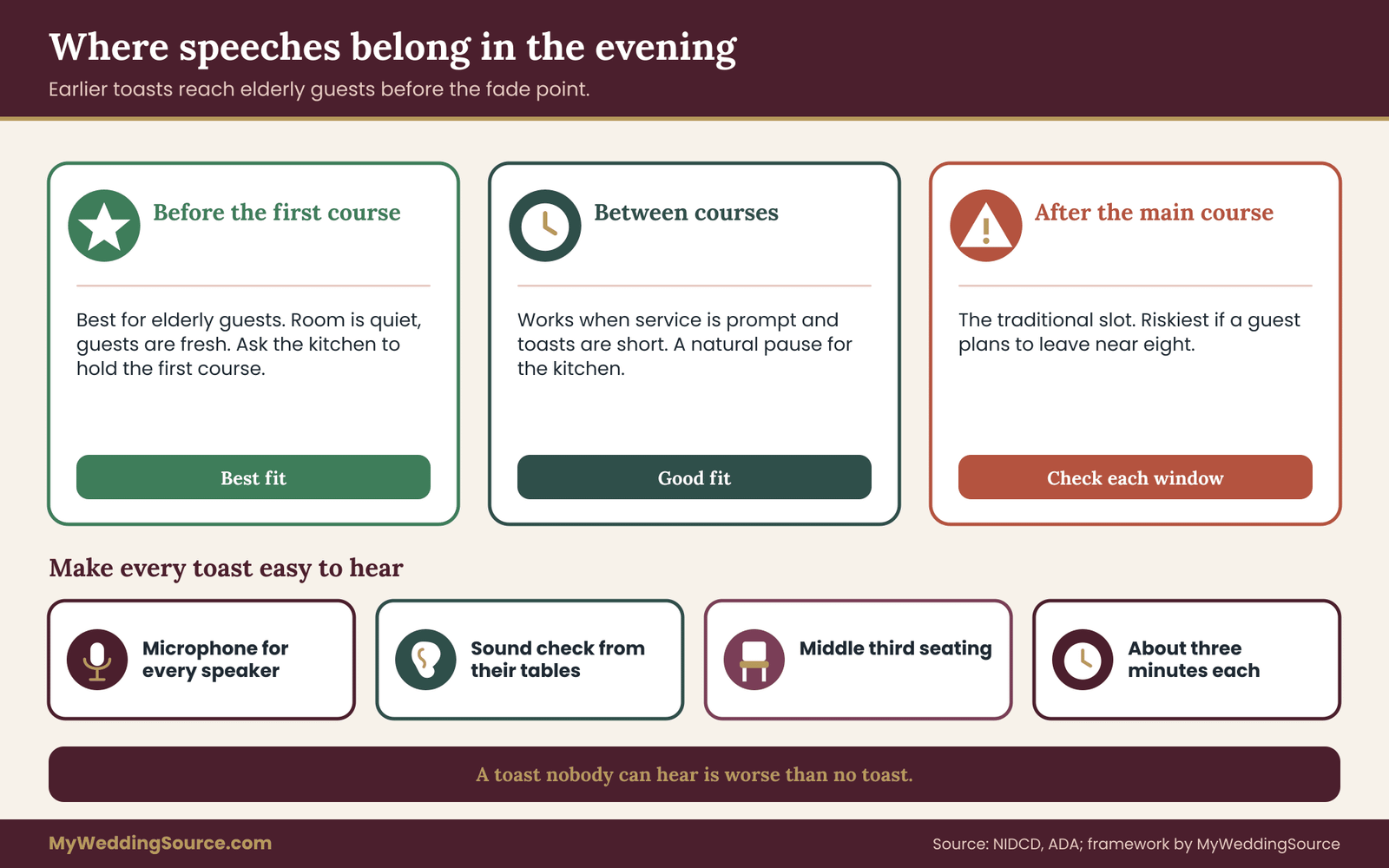
There are three workable patterns.
Toasts before the first course. Guests are seated, the room is quiet and the meal has not started, so no one is chewing or talking. This pattern is the best one for elderly guests, though it means the food waits a little. Tell the caterer so the first course is timed to the end of the toasts and does not arrive cold.
Toasts between courses. This lets the room settle and gives the kitchen a natural pause. It works best when the courses are served promptly and the toasts are short.
Toasts after the main course. This is the traditional placement and still fine when the main course ends early and the toasts are short. It is the riskiest for elderly guests with an early departure window, so check it against their windows.
Keep the speech block short and bounded
A speech block that runs a long time wears everyone out, and it is hardest on people who cannot easily shift position. Ask each speaker for a stated length, and agree on a total for the whole block. Planning figures such as “about three minutes per speaker and no more than four speakers” are the kind of thing couples set. Nothing official defines the right length, so choose what suits your room.
A few practical measures help. Give the speakers a written order and share it with the DJ or emcee. Ask the first speaker to be the shortest, so the block opens briskly. Tell speakers that people at the back and elderly guests will be listening hard, and ask them to speak slowly and clearly. If a speaker is likely to run long, ask someone they trust to give them a signal.
Here is the kind of message that works well with a speaker:
“We are keeping the toasts to about three minutes each so everyone, including our elderly guests, can enjoy the whole evening. Would you be comfortable with that?”
Fix the sound before you fix anything else
For a person with hearing loss, a toast is useless if it cannot be understood. The National Institute on Deafness and Other Communication Disorders explains that hearing loss is common among older adults, so assume some elderly guests will have trouble following speeches in a noisy room. Good sound is the most effective change you can make.
Use a microphone for every speaker. Even a small room benefits. Do not expect a speaker to project. Ask the DJ or venue to provide a handheld or lapel microphone and test it with a quiet voice.
Check the speakers and the room. Sound that is loud near the speakers and muddy at the far tables does not help the people who struggle most. Ask the DJ to walk the room during a sound check and listen from the tables where elderly guests will sit.
Seat elderly guests where they can hear. The best seats are usually in the middle third of the room, facing the speaker, away from loudspeakers pointed straight at them and away from the bar and kitchen doors. A table very close to a speaker can be uncomfortably loud for someone with sensitive hearing, so move away from direct speaker lines, not just away from the back.
Reduce competing noise. Lower the background music during toasts, ask servers to hold service, and close doors to noisy areas if possible.
Offer a printed copy if it suits. A speaker who has written their toast can give a copy to an elderly relative, to read afterward. It is a small gift and many guests keep them.
Some venues have an assistive listening system, and the Americans with Disabilities Act covers communication access in public settings. The Department of Justice’s ADA site is the official place to read about it, and the venue can tell you what it provides. If a guest uses hearing aids, ask them, kindly, whether a seat close to the speaker or a quieter spot suits them better.
Handle the special toasts with care
Some speeches are more personal and more demanding than the rest.
A grandparent’s toast or blessing. If an elderly guest is giving a speech, treat them as a speaker with specific needs. Offer a chair at the microphone, a short written reminder, a microphone stand that does not need to be held, and a stated time. Ask what they want. Some will prefer to speak from their table. Put them early in the order so they are not waiting. And have someone ready to help them to the microphone and back.
A moment of remembrance. If the couple wants to honor someone who has died, which is often an emotional moment for elderly guests, place it where it will not be rushed and where elderly guests are present and rested. A quiet photo display is a gentler alternative if a spoken tribute feels too heavy.
The couple’s own thank-you. Many couples want to thank their families in person. Do it early, while elderly guests are present, even if it is only a few sentences before the first course.
Allow for the long goodbye
Some elderly guests will want to speak to the couple before they leave. If a toast is delayed, that conversation may be crowded out. Build a short, calm window into the timeline, perhaps at the end of dinner, in which the couple visit the older tables. It spares elderly guests the need to queue and gives the couple a quiet few minutes with the people most likely to leave early.
The speech and toast rules in one place
It helps to gather the above into rules the emcee and the family can follow.
Rule one. The speeches that matter most to elderly guests go before their fade point, usually before or between the first courses.
Rule two. Every speaker uses a microphone, and the sound is checked from the elderly guests’ tables.
Rule three. The speech block has a stated total, and each speaker has a stated length.
Rule four. A grandparent who speaks gets a chair, a short reminder and an early slot.
Rule five. The couple visit the elderly guests’ tables before the long evening begins.
A calm, written order of speeches, shared in advance with the emcee, the DJ, the caterer and the family member who looks after each elderly guest, is the thing that makes the rules work. The more people who know the plan, the fewer the surprises. The guide to the wedding planning checklist can help you decide when in your planning to gather those details.
Optional departure windows for elderly guests
A departure window is the idea that gets the most resistance from couples and the most relief from elderly guests. The resistance comes from a fear of seeming to hurry people out. The relief comes from the fact that many elderly guests want to leave earlier than the rest of the room and do not want to be the first to break the spell.
The aim is to make leaving easy, ordinary and unembarrassing. Nobody is asked to go. The schedule simply contains a point after which leaving is smooth, so that elderly guests who are tired can step out with their dignity and their coat, and guests who are not tired can stay.
What an optional departure window is
It is a stretch of time, usually an hour or two, printed in your internal run-of-show and shared with the people who help elderly guests. During it, three things are true. The moments that matter most to elderly guests have already happened. A ride is ready, and the person who is taking the guest home knows the window. And a goodbye is simple, because the couple have already visited the table or planned a short farewell.
It is optional in both directions. A guest may leave before the window opens if they wish, and may stay long after it closes. The window just describes the stretch in which leaving is easiest and the schedule is arranged to support it.
How to set the window for each guest
Use the answer to the fourth question: when would you like to head home, and who is driving you. If a guest says they would like to be home by eight, work backward. Allow the drive time, allow time for coats and goodbyes, and open the window about an hour and a half before the guest wants to be home. Leave a little slack, because things always take longer than expected.
For example, a guest who wants to be home at eight and lives forty minutes away has a departure window that begins around six-thirty and ends around seven-fifteen. Every important moment for that guest must happen before six-thirty. That is why the toasts move earlier, and why the family photos come first.
If you do not have an exact answer, use the fade point. The departure window opens at the fade point or just before, never after it.
Make the window visible to the right people
Tell the person who drives or accompanies each elderly guest, and tell the coordinator or the family member responsible for the guest. Do not announce it to the room, and do not put it on a printed program for guests to see. The goal is to prepare quietly, not to publish an exit time.
Practical items to arrange before the window opens:
- The car or ride is booked and the driver knows the time.
- The coat, bag and any medication are easy to retrieve, as covered at the end of the next section.
- A path to the exit with good lighting and no stairs is identified.
- A seat near the exit is available if the guest needs to wait.
- A favor or a small gift of wedding cake in a box is ready, so the guest leaves with something and not just a goodbye.
The cake box is a small touch that does a lot of work. It gives the guest a reason to leave on a good note, shows the couple were thinking of them, and keeps the farewell warm.
Give the guest an honorable exit
Some people dislike leaving first. Others worry that they will upset the couple. Give them an easy way out with a plain sentence a family member can say for them: “Grandpa wanted to say congratulations and say goodnight before the dancing starts.” It is specific, kind and puts the decision in the guest’s hands.
The couple can help too. A short private visit to the table before the window opens, with a hug, a photograph or a few words, gives the guest the sense of having been celebrated, not dismissed. After that, leaving is easy.
What to say, and what not to say
Scripts matter because awkward wording turns a courtesy into an insult. Here are lines that work and lines to avoid.
“We will be doing the toasts at six, so you won’t miss them. After that, whenever you like, your ride is ready.”
That sentence tells the guest the plan, names the toasts as the important event, and leaves departure to them.
Avoid wording like “you can go home whenever you get tired,” or “we know it’s late for you.” Even when meant kindly, it points at age. Better to talk about the schedule: “The family photos are first, then the toasts, then dancing for those who want it.”
When someone wants to stay longer
Some elderly guests will stay for the whole evening, and some will thrive on it. That is a good outcome, and the plan should accommodate it. Having a ride available earlier does not mean pressing it. Check in gently, once or twice, and let the guest lead. If they stay, make sure they have a quiet place to sit during the loudest part and a ride that is still available later, since some drivers will not wait.
If a guest is staying and a family member is driving, discuss the later departure in advance, so the driver is not stuck and the guest does not feel like a burden. The driver may want to take a break or sit somewhere quiet themselves.
Seating, sound and comfort that stretch the energy budget
The best schedule still fails if the room itself is tiring. A few comfort decisions can double the time an elderly guest enjoys the day.
Seating that fits the person
Reserve seats for elderly guests at the ceremony, in the cocktail space and at dinner, and mark them subtly. A small card on the chair, or a quiet word to the ushers, is enough. Think about each seat.
Ceremony seating. An aisle seat in the second or third row works well for most guests: near enough to hear, near enough to leave without a long walk, and not so close to the front that standing becomes difficult. Offer chairs with arms where the venue allows. Make sure there is space for a walker or a wheelchair beside the seat, without blocking the aisle.
Cocktail hour seating. Place a small group of chairs and a low table in the cocktail space, away from the bar line and the loudest speaker. Tell the family where it is. Servers can bring food and drinks to people who are seated, which spares an elderly guest the line.
Dinner seating. Choose tables near the entrance and restrooms, not in a far corner, with enough room to push a chair back. The guide to wedding seating charts has more on grouping people at tables. For elderly guests, the best table is usually a quiet one with family around them, close to the exit and well away from speakers.
Moving through the venue
Walk the route an elderly guest would walk, from the entrance to the ceremony, to the cocktail space, to dinner, to the restrooms and to the exit, ideally during the venue walkthrough. Look for steps, slopes, thresholds, doors that are heavy to open, long distances and poor lighting. The Centers for Disease Control and Prevention publishes guidance on preventing falls among older adults, and it is a helpful reminder to check lighting and floor surfaces on the day, including at dusk and for the walk to the car.
If the route has a problem, ask the venue for a fix: a ramp, an alternate door, a golf cart for the longer stretches, or simply a staff member stationed at the tricky spot. Raise it early, since changes cost less before the final plan is set.
Temperature and shade
Outdoor ceremonies need particular thought. The CDC’s heat and health information notes that older adults can be at higher risk in hot weather. Provide shade, water and a cooler place to sit, and consider starting the ceremony later in the day. Cold evenings call for blankets or a heated indoor place. These are cheap measures that make a real difference to comfort.
A quiet space
If the venue has a room that can serve as a quiet space, with a few comfortable chairs, softer light and less noise, tell the family it exists and where it is. Elderly guests can rest there without leaving the wedding, and it is also useful for anyone who needs a break. Do not make an announcement. A quiet word to the guide for each guest is enough.
Food, drink and medication
Elderly guests may need to eat at specific times, may have dietary needs, and may need to take medication on a schedule. Make sure the first course is not delayed beyond an hour and a half after the cocktail hour begins, and ask the caterer about early plating for guests who need it. Water should be easy to reach. A guest’s medication is their own concern, but a gentle word from their companion about what they need on the day helps you avoid a clash with the timeline.
Make the exit easy
Leaving is part of the day. A coat check with short lines, a car brought to the door and a well-lit path matter. If the venue has a coat check, tell the staff that some elderly guests may want to retrieve their things early, and ask that they be handled quickly and without a queue. If there is no coat check, ask a family member to hold the coat and bag in an accessible place.
Scripts for the planner, the photographer, the DJ and the family
A plan only works if each person on the team hears the part that applies to them, in plain words, before the day. Here are short scripts you can adapt. They are written for people who are busy and do not want a long email.
For the family member who guides an elderly guest
Choose one relative or friend for each elderly guest. Ask them kindly, and make the role small and specific.
“Could you be Grandma Ruth’s person on Saturday? That means walking her to the photos and back, keeping a chair near her, and making sure her ride is ready around seven. She knows about the plan, and she can change her mind about any of it.”
Give the guide a one-page summary: the photo order and times, the speech order, the departure window, the quiet room, the route to the exit and a number to call for the coordinator. Tell them they can say no, and that they are not responsible for anything beyond the plan.
For the photographer
Share the priority pile, the order and the time cap in writing a week or two before, then repeat the main points on the day.
“We want the photos with our grandparents taken first, before the ceremony, with each group limited to about five minutes. Could you let us know what time you need them and how long you need to set up? They should be seated between shots, and we would like to stay out of direct sun.”
Ask the photographer how they like to arrange seated portraits and whether they bring a stool or a chair. Some do, and some prefer the venue’s chairs.
For the DJ or emcee
The DJ often controls the microphone and the order of events, so their cooperation matters.
“The toasts will run before the first course, in this order, with a maximum of about three minutes each. Please announce each speaker and hand them the microphone. Could you do a sound check from the tables where our elderly guests will sit, and lower the music during the speeches?”
Ask them to avoid surprising anyone with a loud announcement or a sudden volume jump near the elderly guests’ tables. A quiet, clear voice is better than a dramatic one.
For the caterer
“We are moving the toasts to the start of dinner. Please hold the first course until the toasts finish, and let us know if you need a few minutes’ warning. A few of our guests need to eat on time, and we would like them served first.”
Ask whether the caterer can plate early for specific tables and whether the kitchen can accommodate a slightly shifted schedule. A caterer who is told early rarely minds. A caterer who is told on the day often does.
For the venue coordinator
“We have several elderly guests who will need seating in the cocktail area and a short, easy route to the ceremony. Can you tell us where the nearest accessible entrance is, whether a quiet room is available, and whether staff can help with coats and rides around seven?”
The venue knows the building better than you do. If they have an accessible route, a drop-off point or an assistive listening system, they will tell you if you ask. If you need a policy confirmed, request it in writing.
For the elderly guest
“We have scheduled the photos before the ceremony so you do not have to wait, and the toasts will be early in the evening. There is a quiet room if you want to rest and a ride arranged for whenever you want to go. Please tell us if anything about this doesn’t suit you.”
The last sentence is the important one. It signals that the plan is an offer, not an instruction, and it invites correction.
For the couple, to each other
Couples sometimes disagree about how much to rearrange. One partner may feel that moving toasts earlier or doing the photos before the ceremony changes the day they imagined. Agree on the principle first: which moments matter most to you, and which people do you most want present for them? If the answer is the grandparents and the toasts, the schedule follows. If it is something else, such as a sunset portrait or a long dance floor, you may decide to protect that and accept that some elderly guests will leave earlier. Both are legitimate choices. What matters is that you make them on purpose, together, and tell the affected guests.
A worked example: a Saturday with four elderly guests
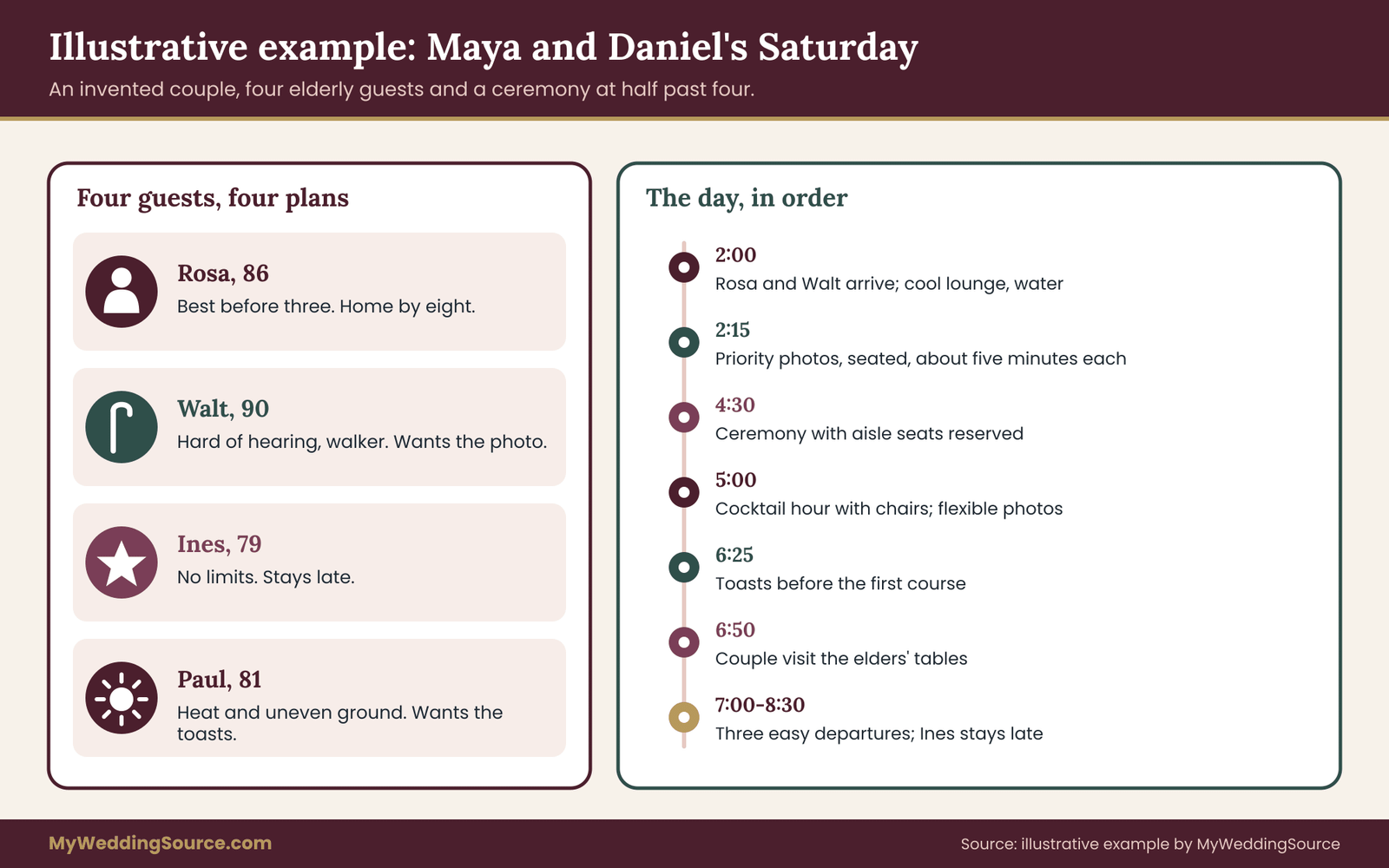
An invented couple, Maya and Daniel, are planning a wedding with a four-thirty ceremony, a cocktail hour, a seated dinner and dancing until eleven. This example is illustrative, not a prescription, and the numbers are planning choices, not standards.
Four elderly guests are central to the family. Maya’s grandmother, Rosa, is eighty-six, at her best before three, comfortable sitting for about an hour, and wants to see the ceremony and hear Maya’s brother’s toast. She plans to be home by eight and her daughter is driving. Daniel’s grandfather, Walt, is ninety, hard of hearing, uses a walker, and wants the family photo above all else. Daniel’s great-aunt Ines is seventy-nine, active, and happy to stay late. Maya’s great-uncle Paul is eighty-one, has trouble with heat and uneven ground, and wants to hear the toasts.
Step one: set the windows
From the five questions, the planners record windows in plain language.
Rosa’s peak window runs until about three-thirty, her fade point is near five-thirty, and her departure window runs from about six-thirty to seven-fifteen. Walt’s peak window is late morning through mid-afternoon, his fade point is about five, and his departure window starts around six. Ines has no limit and no early window. Paul’s peak window is the cooler part of the day, his fade point is about five-thirty, and his departure window runs from about seven.
Step two: build the priority photo timeline
The photographer would normally take family photos after the ceremony at five. That would put Rosa and Walt well past their peak windows, standing outdoors in the heat of the late afternoon. So the couple adjust.
Arrivals are staggered. Rosa and Walt arrive at two, with their guides, and sit in a cool lounge with water. At two-fifteen the priority pile begins in an accessible indoor room with good light: the couple with Walt alone, seated, then with Rosa alone, seated, then with both sets of grandparents, then with all four grandparents and both sets of parents, with the elderly guests in chairs at the front. Each group is capped at about five minutes. By two-forty-five the most important photographs are done.
The flexible pile, which includes siblings, the wedding party and cousins, moves to the cocktail hour, away from the elderly guests’ schedule. Great-aunt Ines joins the extended family photograph there, since she has no limit, and Paul is photographed with the group in the shade, seated.
Step three: place the speeches
Rosa wants to hear Maya’s brother’s toast and Paul wants to hear all of them. Walt wants the photo above all, which has now been taken, and will enjoy the toasts if he can hear them. The couple move the toast block to the start of dinner, before the first course, with four speakers at about three minutes each. The DJ tests the microphones from Walt’s table, which is in the middle of the room and away from the speakers. Rosa’s table is next to his. Paul sits near the exit and the restroom, which also keeps him away from the loudest part of the room.
The caterer holds the first course until six-forty. The toasts take about fifteen minutes. Everything that matters to Rosa, Walt and Paul happens between six-twenty-five and six-forty, which is before the start of Rosa’s departure window and well before Walt’s fade point at the earliest.
Step four: set the departure windows
Maya and Daniel visit the elderly guests’ tables at six-fifty, as the first course arrives, to thank them and take a quick candid photograph. Rosa’s daughter has the car ready at seven. Walt’s son takes him at seven-thirty, with a box of cake. Paul stays through the cake cutting, then leaves around eight-thirty with his sister. Ines stays until the last dance.
Nobody was asked to go. Each person left at a time that suited them, having seen what they wanted. The plan allowed for it, and the family said so quietly: “Grandma wanted to say goodnight before the dancing.”
What the example shows
The schedule changed in three places: the priority photographs moved before the ceremony, the toasts moved to the start of dinner, and the cocktail hour got seating and a quiet corner. None of these changes affected the other guests, and the couple still had their sunset portrait with the wedding party. The elderly guests had what they most wanted, and their departure was calm. That is the aim: not a perfect timeline, but a plan that matches the people on it.
Edge cases and common mistakes with elderly guests
Even a good plan meets awkward situations. This section covers the ones that come up most often and what to do about each.
Several elderly guests with different needs
A single schedule rarely suits everyone. One guest is at their best in the morning, another in the evening. One needs to leave early, another wants to dance. Do not average them. List each person’s windows and look for the point of greatest conflict. Usually it is the photographs, because they depend on many people at once. Solve for the most limited guest first and let the others adapt. A guest with plenty of energy can always arrive a little later or stay later, but a guest who is exhausted by four o’clock cannot be fixed with a better plan at five.
A guest who insists they are fine
Some guests will wave away every offer. Respect that, and keep the quiet options available anyway. A chair beside the photo spot costs nothing and need not be used. A ride that is booked but not needed can be released. The guest keeps control, and you keep a way to help if their energy surprises them. Do not argue. Do not tell a proud person that you worry about them.
A guest with memory or health conditions
If a guest has a condition that affects memory, orientation or safety, their regular caregiver or family member is the right person to decide what the day can safely include. Ask that person what the guest needs, follow their lead, and make sure they have a quiet place, a clear route and a way to leave without drawing attention. For questions about caregiving, the Administration for Community Living is the federal source for information about older adults and caregivers, and the guest’s own clinician can advise on specific needs. Do not try to judge anyone’s condition yourself.
A guest who is also a participant
A grandparent may be asked to walk in the processional, hold a ring, do a reading or give a blessing. These roles are meaningful, and they are also the most demanding thing an elderly guest does on the day. Ask each person whether they want the role and how they would like it adapted. A reading can be done from a seat. A processional can be shortened or begin from the front. A blessing can be spoken from the table. Give them the same priority as the photographs: place the role inside the peak window, offer a rehearsal-free way to do it, and have a guide close by.
Late arrivals and delays
If the ceremony starts late, the photographs slip, or the toasts are pushed back, the departure windows do not move. Re-check each elderly guest’s plan on the spot. Often the fix is to shorten something: take two of the five priority groups, or move one toast earlier. The coordinator or a named family member should have the authority to make these calls, because the couple will be busy.
Hot, cold and wet weather
Weather is the most common way a good plan fails. Have a sheltered option for the priority photographs, a heated or cooled place to wait, and a clear path for a wheelchair or walker to the alternative space. If the ceremony moves indoors, the seating plan changes, so confirm that aisle seats and wheelchair spaces are preserved. The question of whether elderly guests can reach the indoor space easily should be asked well before the day, not on it.
Travel and time zones
Guests who have flown in may be tired before the wedding begins. If a grandparent is arriving from another time zone, treat their windows as moving targets and check them the day before. A shorter itinerary may serve them better than the full day. Put the check-in call on your calendar for the day before the wedding.
The mistakes that cause most of the trouble
Looking across all of these, a handful of mistakes account for most of the problems.
Assuming age tells you what a person needs. It does not. Ask.
Scheduling the family photographs after the ceremony without a plan. The line of well-wishers, the heat and the wait together wear down elderly guests quickly.
Leaving the toasts to the end. If the toast matters to an elderly guest, it needs to happen before they leave.
Skipping the sound check. A toast nobody can hear is worse than no toast, especially for guests with hearing loss.
Telling the whole room about the plan. An optional departure window works because it is quiet. Publicizing it turns it into a rule.
Forgetting the exit. Coats, rides and lighting at the end of the night matter as much as the ceremony.
Giving one person too many jobs. A family member who guides three elderly guests and also gives a toast will drop something. Assign one guide per guest or per small group.
Making the schedule a secret. The best plans are shared with the people who need them, including the guest.
When to simplify
A schedule can also get too clever. If you find yourself building a minute-by-minute plan with five contingencies for each elderly guest, step back. The method is meant to produce a few clear moves: photographs first, toasts early, chairs in the right places, and a quiet exit. If the plan needs more explanation than that, simplify it. Anything the guide cannot remember on the day is a plan that will not work on the day.
Your next steps
Start with the people. This week, ask each elderly guest, or the person closest to them, the five questions, and write the answers on a single page. Next, mark each person’s peak window, fade point and departure window, and lay them beside your draft timeline to find the conflicts. Move the priority family photographs into the earliest sensible slot, and move the speeches that matter most to before the first fade point.
Then brief the team. Send the photographer the priority pile, tell the DJ and the caterer about the toast order, and give each family guide a one-page summary. Walk the route with the venue, confirm the seating and the quiet space, and check the exit. For the wider planning of elderly guests and children across the whole event, the guide to caring for babies, children and older relatives at weddings is the natural next read.
On the day, check in with each elderly guest once, calmly, and be ready to adjust. If the plan has done its work, nobody will notice it, and the people you most wanted there will have seen what mattered to them and gone home happy.
FAQ
When should elderly guests be photographed on a wedding day?
Usually as early as possible, inside their peak window, which for many people is before the ceremony or right after it. Ask each guest or their companion when they are at their best. Photograph them seated, with a short time cap per group and a guide nearby, so they wait very little and never stand for long periods.
Should we move the toasts earlier for elderly guests?
Often yes. If a toast matters to an elderly guest, place it before the first course or between courses, not after dessert, so it happens before their likely fade point. Check each guest’s departure time, and ask the caterer to hold the first course until the toasts end so the food is not cold.
How do we suggest leaving early without offending anyone?
Make leaving easy and keep it optional. Arrange the ride and coat in advance, have the couple visit the table before the window opens, and use wording about the schedule, not age. A family member can simply say that the guest wanted to say goodnight before the dancing starts. The guest decides.
Is it rude to give elderly guests special seating?
No. Quiet, reserved seating near the aisle, exits and restrooms is ordinary hospitality, and most guests appreciate it. Do it discreetly, with a small card or a word to the ushers, and ask the guest what suits them. Avoid labels or announcements, and never seat someone in a spot they have not agreed to.
How long should group photos take with elderly guests?
There is no official figure, so set a planning cap with your photographer. Many couples aim for about five minutes per group that includes an elderly guest, with chairs between shots. Do the priority groups first, in a comfortable location, and move groups without elderly guests to the cocktail hour so no one waits.
What if an elderly guest wants to stay for the whole evening?
Support it. The departure window is an option, not a limit. Make sure they have a quiet place to sit during loud moments, water, and a ride that will still be available later. Check in gently once or twice, let them lead, and talk with their driver in advance so nobody is stranded.
How do we help guests who cannot hear the speeches?
Use a microphone for every speaker, sound-check from the elderly guests’ tables, and seat them in the middle of the room away from loudspeakers and the bar. Lower background music during toasts. Ask the venue about an assistive listening system, and offer a printed copy of a toast if the speaker has one.
Who should coordinate all this on the day?
Name one person, usually a coordinator or a calm relative who is not in the wedding party, to hold the plan and make small calls. Give each elderly guest a personal guide as well. The couple should not manage it. A one-page summary shared with the photographer, DJ, caterer and guides keeps everyone aligned.
Sources
- Americans with Disabilities Act, U.S. Department of Justice
- U.S. Access Board, accessibility guidelines and standards
- National Institute on Aging, health information for older adults
- National Institute on Deafness and Other Communication Disorders, hearing and older adults
- Older adult fall prevention, Centers for Disease Control and Prevention
- Heat and health, Centers for Disease Control and Prevention
- Administration for Community Living, resources for older adults and caregivers
- Older adults health topics, MedlinePlus, National Library of Medicine
- Services for seniors and caregivers, USAGov