
Childcare pickup at a wedding is the moment a child leaves the care room and goes back to an adult, and the authorization behind it decides who is allowed to take that child. This guide gives you a plain workflow for the end of the reception: an approved-contact card, an identification routine, a four-rung release ladder and a plan for the hard cases.
Collect one approved-contact card for every family before the reception starts. List the guardians and the named adults who may collect each child, and give the guardian and the child matching numbered tokens. At childcare pickup, staff compare the token, the card and the adult’s identification, then release the child only on a green result. Anything less than a match goes up the release ladder: pause, call the guardian, and hold the child until a guardian confirms in person or by a call the staff place themselves.
Most wedding childcare pickup plans fail in a boring way. Nobody is malicious. The room is dim, the band is loud, a tired aunt walks in and says she is here for her grand-nephew, and the staff member on duty, who met the family two hours ago, has to decide in a few seconds. Without a written rule she either guesses or makes the aunt wait while she goes looking for someone with authority. Both outcomes are bad. One risks a child leaving with the wrong adult. The other leaves a relative standing at a door while a small child cries inside.
A good childcare pickup authorization process removes the guessing. It is decided in advance, with the guardians, in writing, and it is applied the same way to the best man’s mother and to a stranger. It does not require anyone to be suspicious of guests. It requires everyone to follow the same simple steps, which is what makes it feel polite rather than hostile.
A note on scope. This guide is general information, not legal advice, and it does not set staffing rules or safety standards, which come from your state or local childcare authority and from the qualified people who run the care room.
The wider question of whether to offer care at all, how to staff it and how to look after babies and older relatives is covered in the guide to wedding guest care. This article does one narrow job well: it covers the handover at the end of the night.
In everyday language, “pickup” can mean a dozen things. For a wedding it helps to be precise, because the plan only works if every person involved means the same thing.
Childcare pickup is the event in which a child moves from the care of the people running the care room to the care of an adult. It happens once for every child, and it can happen at different times. Some families collect early, because a toddler is exhausted at eight. Some collect in the last half hour. Some children are collected during dinner for a bathroom trip or a medicine and then returned, which is not a pickup in the full sense and needs its own light rule.
Authorization is the set of decisions that say who may do that. In practice it is a short list for each child: who the guardians are, who else may collect, and how a stranger at the door proves he or she is on the list.
The approved-contact card is the single piece of paper, or the single digital record, that holds that list. One card per child, or one card per family if the children share the same adults.
The release desk is the physical place where the handover happens. It may be a table at the door of the care room, a clipboard held by the lead caregiver, or a spot just outside the room. What matters is that it is one place, with one person responsible for it, not a free-for-all at the door.
The care room is wherever children are supervised. It might be a ballroom annex, a hotel suite, a classroom at a hall, or a corner of the venue with a divider. The childcare pickup plan has to work in all of them.
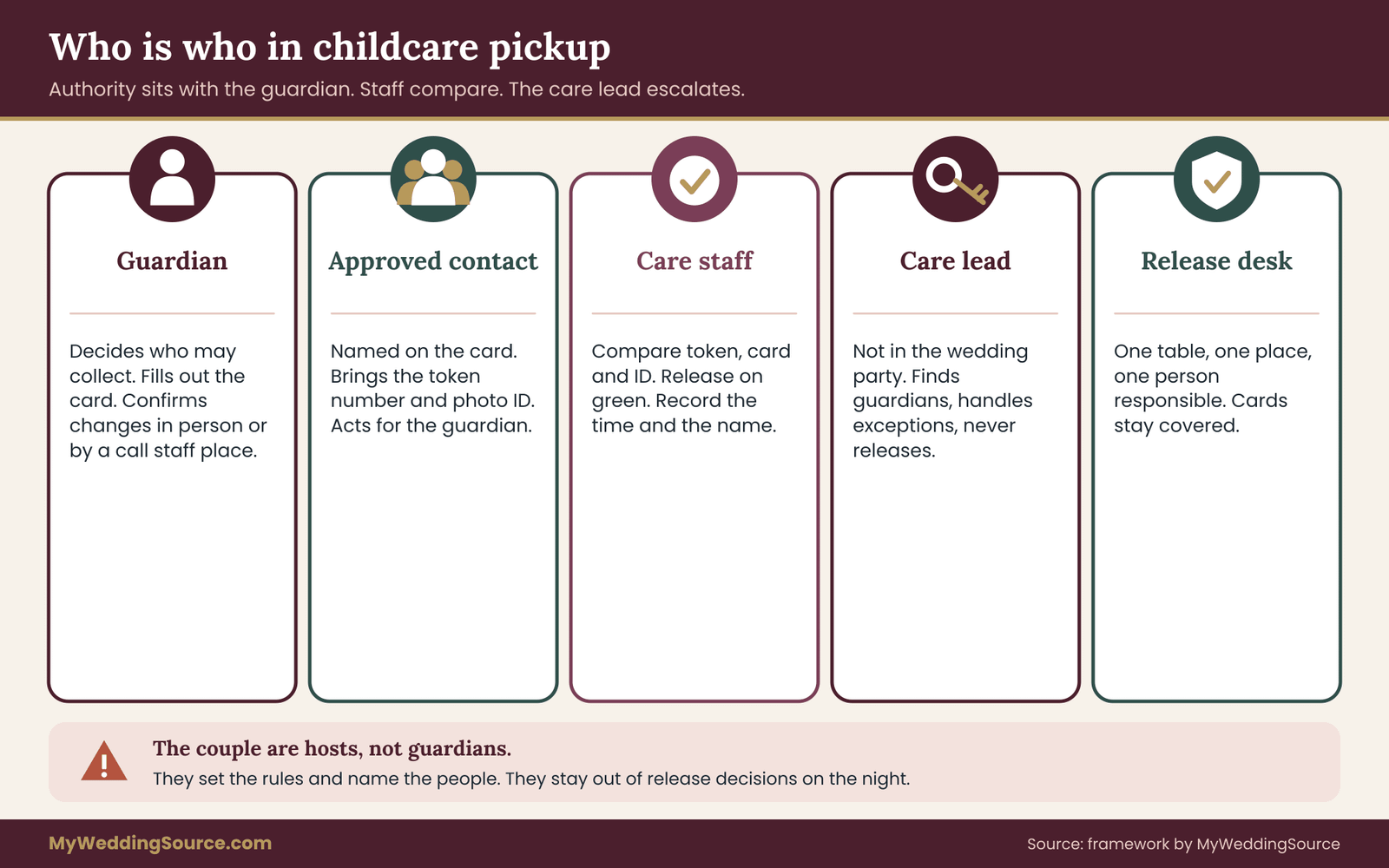
Four roles appear throughout this guide.
- Guardians. The parents or legal guardians who decide who may collect their child. This is a legal and family matter, not a wedding-planning one, so the couple never overrides a guardian.
- Approved contacts. Adults the guardians name on the card: a grandparent, an aunt, a family friend, a hotel roommate.
- Care staff. The provider’s employees or the volunteers running the room. They apply the rules.
- The care lead. One named person on the couple’s side who is not in the wedding party and who stays near the care room during the childcare pickup hour. This person is the escalation point and does not release children.
What this guide does not do
It does not tell you how many staff you need for a given number of children, whether your provider needs a license, or how to screen caregivers. Those questions depend on local law and on qualified providers, and they belong in the earlier stages of hiring. If your care arrangement is a licensed company, it will probably have its own release procedure, and your job is to read it and fill gaps. If it is a family friend with a few cousins in a hotel suite, this guide gives you a lightweight version of the same ideas so that the arrangement is not run on memory.
It also does not try to settle custody or family disputes. When a legal order is involved, the legal order wins, and the childcare pickup plan is built around what the guardian shows you, not around what any adult claims.
Why the end of the night changes the risk
A wedding care room is calm at four in the afternoon and different at eleven at night. The change is predictable, which is useful, because predictable problems can be planned for.
Attention is thin. The reception is at its loudest. Guardians are dancing, toasting or talking to people they have not seen for a year. Care staff are tired after hours of running activities. The couple is thinking about leaving. Everyone’s attention is somewhere else, so the childcare pickup step that was easy at six o’clock becomes easy to skip at ten.
Roles blur. A guardian asks a friend to “grab the kids on your way out.” A grandmother who has been told she is not on the list is offended and goes to find the groom. A teenage cousin offers to carry a sleeping seven-year-old to the car. These are kind gestures, and each of them is a childcare pickup that no one authorized.
Alcohol is in the building. This is not a statement about any guest. It is a plain fact that at an evening reception some adults who arrive at the care room will have been drinking, and that staff need a rule for it that does not depend on guessing who has had how much. The rule in this guide is neutral: the release depends on the card, the token and the identification, and on whether the adult can safely take responsibility for the child at that moment.
Children are tired and cannot speak for themselves. A sleepy four-year-old will go with anyone who looks friendly or with whoever is holding the blanket. Older children may say “that is my uncle” about someone who is not. A child’s statement is information, and a useful one, but it is not authorization.
The exits multiply. A daytime pickup happens at one door. A late pickup may involve a side exit, a coat check, the hotel lobby, a parking structure and a shuttle. The more places a child can be walked to, the more the plan has to say about where responsibility changes hands.
People are leaving at different times. There is no single moment when “everyone picks up.” There is a trickle for two hours, then a rush when the band stops. The rush is when mistakes happen, and a good plan has extra hands for it.
Because the risk concentrates at the end, the childcare pickup plan should be strongest at the end. Registration and cards can be handled at four in the afternoon when everything is calm, and by ten o’clock the staff should be doing something nearly automatic.
The idea behind the workflow
Everything in this guide rests on one idea: separate the decision from the moment. The decision about who may collect a child is made by a guardian, earlier, with time to think, and written down. At the moment of handover, staff do not decide anything about trust. They compare what they are shown with what was written. When the two match, the child goes. When they do not, the staff follow the release ladder, which tells them exactly what to do next.
That split does two things. It protects children, because staff are not asked to make fine judgments about strangers late at night. And it protects relationships, because when a grandmother is asked to wait for a guardian’s call, the staff member is not accusing her of anything. The staff member is following the card the guardian filled out. Nobody has to be the villain.
Here is what a good childcare pickup process looks like from the staff’s side, in four sentences. Does the adult have the matching token or a name on the card? Is the identification consistent with the card? Does the adult appear able to take responsibility for the child right now? If the answer to all three is yes, release and record. If any answer is no or unsure, move to the next rung of the ladder and call the guardian. The rest of this guide fills in the detail.
The approved-contact card for childcare pickup
The card is the heart of the system. If it is clear, almost everything else becomes easier. If it is vague, no amount of training at the door will rescue the childcare pickup hour. The card should be short enough that a parent will actually fill it out in the hallway and complete enough that a stranger could use it at midnight.
What goes on the card
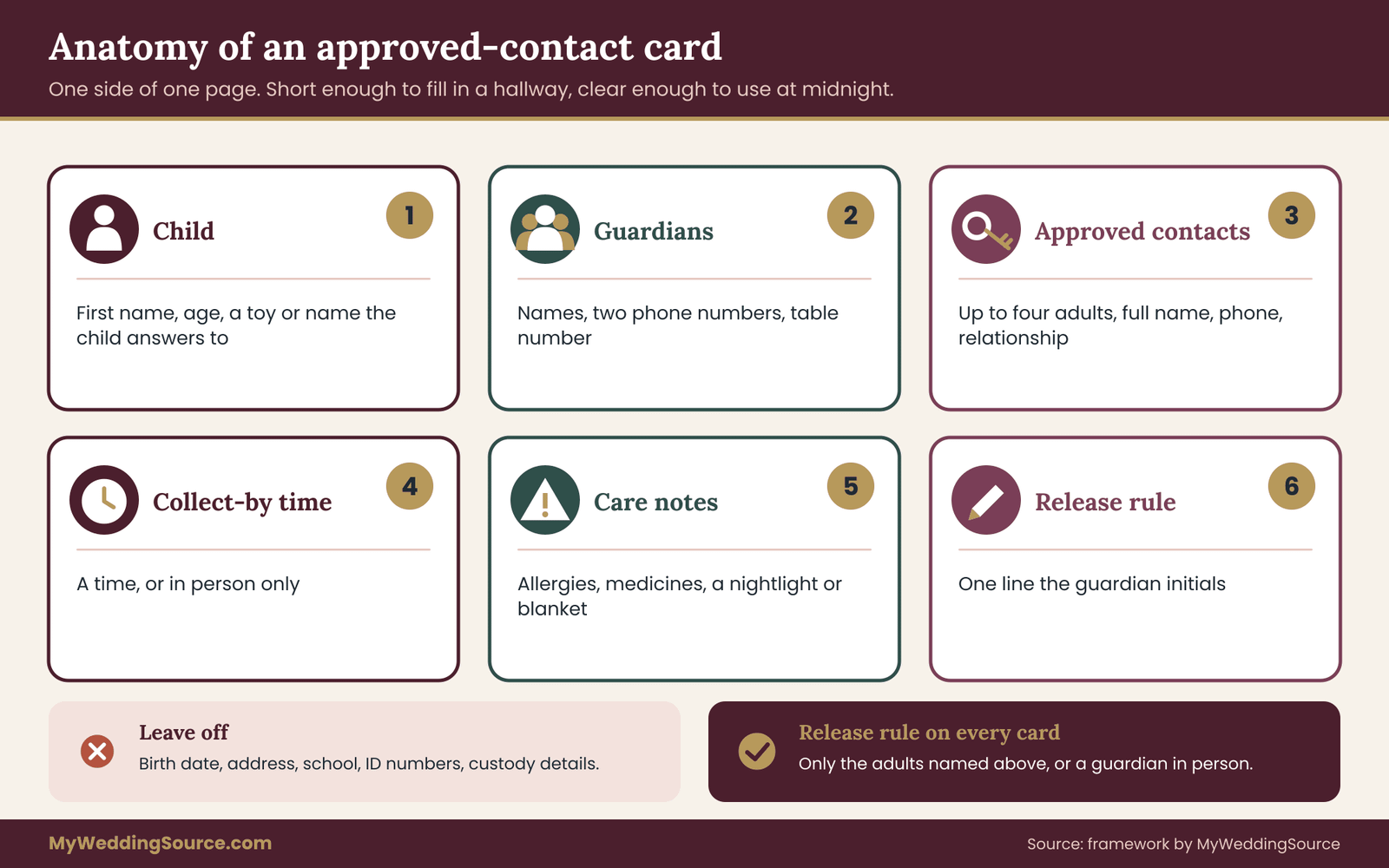
Keep it to one side of a page, or one short digital form. Here is a sensible set of fields, and the reason for each.
The child. First name, age and a short description of anything staff need in order to recognize and care for the child: hair color, a favorite toy, a name the child answers to. The full legal name is not necessary. A first name and a token number are enough, and a short record is easier to protect.
The guardians. Full name and mobile number for each guardian who is attending, plus a second number for one guardian in case the first phone is in a coat pocket. State where each guardian will be seated or standing. “Table nine, near the window” saves ten minutes later.
The approved contacts. Full name and phone number for every adult, other than the guardians, who may collect the child. Leave space for up to four names. An approved contact should be someone the child knows, not only someone the guardian trusts.
The collect-by time. Some families plan to collect at a set hour. Some want the child kept until a guardian comes in person. A single line such as “Collect by 9:30 p.m. unless we come sooner” helps staff plan their evening.
Health and care notes. Allergies, medicines, a nap routine, a fear of the dark, a need for a nightlight, a blanket or a stuffed animal. Keep the medical part short and ask the guardian to sign next to anything that staff are expected to act on. The care staff need clear instructions, not a medical history.
The release rule. A short sentence that the guardian initials: “Release only to the adults named above, or to a guardian in person.” This line turns the card from a list into an instruction.
The exception contact. One number that staff may call if something goes wrong and the guardian cannot be reached. This might be the care lead or another guardian in the family. This is not a collector. It is only a person who can help staff find the guardian.
The photo line. A tick-box that says whether staff may take or share pictures of the child. Photography in the care room is a consent question, and the wedding photography consent guide shows how to set the same boundary for the rest of the event.
What does not belong on the card
Leave off anything the care team does not need. That includes the child’s full birth date, home address, school, passport or identification numbers, insurance details and any information about custody or family disputes. If a guardian wants staff to know about a court order, there is a better way to do it, which is described in the hard-cases section.
Do not ask for a copy of the guardian’s identification in advance. The aim is to know who may collect, not to build a file on the family. The identification check for childcare pickup happens at the desk, against a person, and nothing needs to be copied.
Make the card easy to fill out
Guardians will complete the card in the worst conditions: standing in a hallway, holding a coat, with a child pulling at one hand. A few small choices help.
- Print cards in a readable size with plenty of writing space, and provide pens that work.
- Offer a digital version through the wedding website or a short link in the invitation, so that guardians who prefer to fill it out early can do so. Make it work on a phone, with large tap targets.
- Pre-fill the child’s name and guardians’ names if you already have them from the RSVP, so that the card is mostly a review.
- Tell families to bring a phone with the numbers saved, since the card asks for them.
- Offer a very short version at the door for the guest who forgot: child’s first name, one guardian’s number, one approved contact’s name and number.
If your invitation set or website asks for children’s names at the RSVP stage, check the RSVP and guest list material on the site so that the names you collect once are not collected again in a slightly different form.
A sample card, in words
A completed card might read like this. It is invented for illustration.
Child: Nia, age five, answers to “Nini,” carries a gray stuffed rabbit. Guardians: Sam Whitfield, table nine, and Dana Whitfield, table nine. Approved contacts: Carol Hughes (grandmother), Ruth Hughes (great-aunt). Collect by: 9:30 p.m. unless we come sooner. Notes: peanut allergy, no medicines. Release only to the adults named above, or to a guardian in person. Exception contact: Mia, care lead. Photos: no.
That is the entire card. A caregiver can read it in ten seconds, and nothing in it exposes the family. That is the standard for any childcare pickup card.
One childcare pickup card per child or per family
If three children from one family share the same guardians and approved contacts, one card with three first names is enough. If cousins from different households are going to be cared for together, give each household its own card. Do not combine households on a single card, even if the adults are close friends, because the childcare pickup desk then cannot tell who may collect whom.
Guardians and approved contacts in childcare pickup
The words matter here, because the authority sits with the guardian, and the whole childcare pickup plan depends on keeping that straight.
Guardians decide
A guardian is a parent or legal guardian of the child. The guardian’s word on who may collect that child is final, short of a court order. If a guardian says “my brother may collect Nia,” he may. If a guardian says “do not release Nia to my brother,” he may not, whatever the brother says. A couple who happen to be the child’s aunt and uncle do not have this authority at their own wedding. They are hosts, not guardians.
When the two guardians of a child are both at the wedding, either may change the card in person. If they disagree, staff do not choose a side. They keep the child in the care room and ask the care lead to bring both guardians to the desk. That is a family conversation, not a staffing one.
Approved contacts act for the guardian
An approved contact is an adult the guardian trusts with the child for a defined purpose: taking the child to the hotel, bringing the child home, or holding the child during a toast. They carry out childcare pickup under the guardian’s instruction, and they are expected to carry identification and the token or know the child’s number.
The card should record how the approved contact relates to the child, in one or two words. “Grandmother” or “family friend” is enough. The relationship word helps staff notice a mismatch. If the card says “grandmother” and a man in his twenties arrives, staff should pause and ask.
Three groups who need extra thought
Other guests who offer to help with childcare pickup. A guest who says “I will take the kids to their parents” is not an approved contact unless a guardian has said so. The kind answer is easy: “Thank you, that is generous. I will walk the child to the table myself, or I can call the parents to come.” Staff walk children to guardians when the guardian is in the room. They do not hand children to well-meaning guests.
Older children and teenagers. A sixteen-year-old cousin may be the person the guardian trusts most. The card can name a teenager, but the guardian should say so in writing, because staff cannot guess. Whether a minor may collect a younger child is a decision for the guardian and for any local rules the care provider follows, and the card should record that decision in plain words.
Hired helpers and wedding-party members. The photographer, the DJ, the planner and the wedding party are not approved contacts, unless a guardian names them. The couple should say this plainly to their own team ahead of time so that a helpful bridesmaid does not carry a flower girl out of the room at midnight.
Who cannot be an approved contact
The guardian may name anyone, but staff should be allowed to decline a handover when the named adult cannot safely take responsibility at that moment. This is not about judging the guardian’s choice. It is about the condition of the adult. Examples include an adult who is visibly impaired, who is in great distress, or who cannot say where the child will sleep tonight. The release ladder in a later section gives staff a way to act on this that is neutral and reversible. They pause and call the guardian. They do not argue about the adult’s behavior.
Changing the card during the evening
Plans change. A grandparent gets tired and a different aunt will drive. The rule for changing childcare pickup details is one sentence long: a change must come from a guardian, in person or by a call that staff place to the number on the card. A text from an unknown number, a message passed through another guest, and a change requested by the person who wants to collect the child do not count.
Staff record every change with the time and the way it was confirmed. A single line on the card is enough: “9:40 p.m., Dana confirmed by phone, Aunt Ruth may collect.”
The couple’s own families
At weddings the couple’s own relatives often fill several roles, and childcare pickup is where those roles collide. The best man’s mother is a guest, an approved contact and a babysitter at once. Be careful to keep the roles separate when the card is built. Her name appears on the card of the children she may collect, and only those children. The fact that she is the groom’s aunt does not extend her authority to the flower girl’s baby brother, whose own guardians have named someone else.
If you are the couple, resist the urge to “take care of” the card for relatives. The guardians know the child and the family situation, and a quick conversation at the hallway table is more reliable than a spreadsheet you built from memory.
Identification at the childcare pickup desk
The card says who may collect. Identification is how the childcare pickup desk checks that the person standing there is one of those people. Done well, it takes about thirty seconds and feels like a coat check.
The token at childcare pickup
Give each guardian and each child a matching numbered token when the child is checked in. A wristband for the child and a small card or wristband for the guardian works. The number links the two, and staff write it on the child’s card. This is the simplest part of childcare pickup to run well.
A few practical rules make the token useful.
- Use a number or a short code, not the child’s name. A stranger can read a name from across a room, and a name on a wrist is an invitation to say “hi, Nia” and look like a friend.
- Make the guardian’s token hard to lose. A wristband is better than a slip of paper. A phone photo of the number is a fine backup.
- Give approved contacts the number too. The guardian can text it, or write it on the back of the card, so that an aunt arriving at ten does not need to find a parent first.
- Treat a token as a clue, not proof. Tokens can be handed on, lost or copied. The token starts the check. It does not finish it.
If your provider has its own system, such as sticker pairs or a pickup code, use it and do not add a second one. Two systems at one desk create confusion at the worst moment.
The three things staff compare
At the desk staff compare three things, in this order.
First, the token. Does the adult hold the matching number, or can the adult say it correctly? A match is a good sign. A missing token is not a failure. It sends the adult to the next check.
Second, the card. Is this adult’s name on the child’s approved-contact card, or is the adult a guardian listed on it? Staff read the name aloud and compare it with the adult’s identification.
Third, the person. Is the identification consistent with the person who is standing there, and can the adult safely take responsibility for the child at this moment? This third check is brief and quiet. It looks at whether the adult can walk steadily, can answer a simple question and knows where the child will go next.
A match on all three is a green result.
What counts as identification at childcare pickup
Identification can be any government-issued photo identification the staff can read: a driver’s license, a state identification card or a passport. Many guests will not carry a passport and will not have a license if they came by shuttle or ride service. Plan for these cases before the childcare pickup hour begins.
- Known guardians. If staff checked in a guardian and met them at registration, a face match and the matching token are normally enough, and the staff do not need to ask for identification again. The first meeting at registration is a form of identification.
- Approved contacts who were not at registration. These are the people who most need the check. Ask for photo identification, and compare the name with the card.
- Adults with no photo identification. Staff should not release the child on a verbal claim. They move to the next rung of the release ladder and call a guardian, who can confirm by voice and, if possible, by video or by coming to the desk.
- Digital identification. Some states allow a driver’s license to be shown on a phone. Staff should accept whatever form the provider’s own policy accepts. If you are working with a family friend rather than a company, decide ahead of time and say so on the card.
Staff do not need to copy, photograph or retain identification. They look at it, compare it and hand it back. Keeping copies creates a data problem that the privacy section explains.
How to ask without insulting anyone
The way staff ask matters as much as what they ask. A good script is short, kind and the same for everyone.
“Hi, I am glad you are here. The families chose a simple rule: I can release a child to the adults they listed, and I check ID for everyone I have not met. May I see yours?”
If the adult looks annoyed or says “I am her grandmother,” the response is the same.
“I understand, and I am sorry for the extra step. It applies to everyone, including me if I had a child here. It will take a moment.”
Staff do not argue and do not apologize for the rule itself. They apologize for the delay, and they keep the child in the room while they check.
A short sign at the desk helps. Something like “Childcare pickup: please have your wristband number and photo ID ready” tells people what to expect, and most will have it in hand before they arrive.
Guardians who arrive without a token at childcare pickup
Guardians sometimes lose the wristband, change clothes or come back from the hotel without it. The guardian is still the guardian. Staff confirm by name against the card, by a face they met at check-in, and, if they did not meet the guardian, by identification. Then they issue a replacement and record the change.
The release ladder: four decisions at the desk
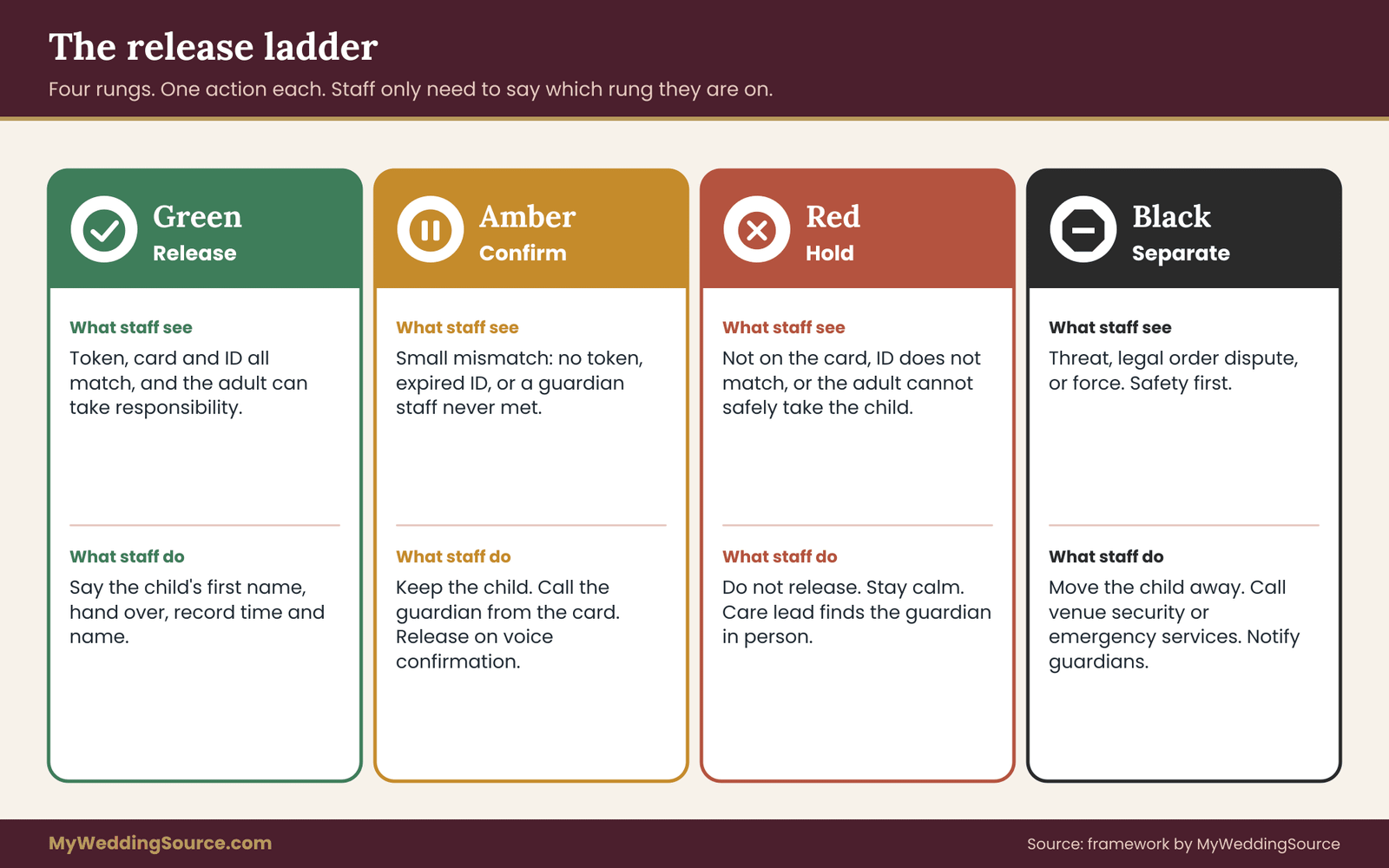
This is the original framework in this guide, and the part meant to be copied onto a card at the childcare pickup desk. The release ladder for childcare pickup gives staff four rungs, one for each kind of result, and a single action for each. The staff running childcare pickup do not need to decide how risky a situation is. They only need to say which rung they are on.
Rung one, green: match and release
All three checks match. The token fits, the name is on the card or the adult is a listed guardian, the identification is consistent and the adult appears able to take responsibility.
Action: Say the child’s first name, bring the child to the adult, write the time and the adult’s name on the card, and watch the child leave with that adult. A green release takes under a minute. Most childcare pickup events at a wedding are green, and the ladder exists so that staff do not slow these down.
Rung two, amber: a small mismatch
One of the childcare pickup checks is incomplete or slightly off, but nothing is alarming. The adult is named on the card but has no token. The identification is expired. The adult is listed as “grandmother” but cannot say the child’s number. The adult is a guardian whom staff did not meet at check-in.
Action: Keep the child in the room, tell the adult that a quick confirmation is needed, and have the care lead or a second staff member call the guardian using the number on the card. When the guardian confirms by voice, release. If the guardian cannot be reached within a few minutes, escalate to rung three, and do not rely on a text message for confirmation.
An amber childcare pickup result is not an accusation. It is a pause. It should be common, and staff should be comfortable saying “let me confirm that with the family” a dozen times in a night.
Rung three, red: an unlisted or unsafe handover
The adult is not on the card, the identification does not match, or the adult cannot safely take responsibility for the child at this moment. Examples include an adult who is visibly impaired, an adult who is angry or distressed, or an adult who tries to bypass the desk.
Action: Do not release. Stay calm, keep the child with staff, and keep the tone friendly. Tell the adult that the child will stay in the care room while the staff reach the guardian. The care lead goes to find the guardian in person. Staff do not discuss the adult’s condition with the adult. They say what they will do and then they do it.
A red result also applies when a guardian arrives and seems unable to take responsibility. Staff do not decide whether a guardian is fit. They ask the second guardian or an approved contact on the card to come to the desk, and the care lead helps arrange that.
Rung four, black: a safety or legal concern
A situation arises that staff cannot handle at the desk: an adult who is threatening, a dispute that involves a legal order, a report that a child is missing, or a person who is trying to remove a child by force.
Action: Keep the child away from the adult. Move the child to a separate space with a staff member if it is safe to do so. Call the venue security contact or emergency services if anyone is in danger. Do not argue about custody or rules. The care lead notifies the guardians immediately.
Rung four should be rare in any childcare pickup plan. Its value lies in telling staff, ahead of time, that they are allowed to stop, to separate and to call for help without feeling they are overreacting.
Why four rungs and not a rulebook
A long rulebook fails at midnight, and a childcare pickup plan that fails at midnight has failed. Four rungs fit on a card, and each has one action. Staff can remember green means release, amber means confirm, red means hold and find the guardian, black means separate and call for help. A new staff member can learn it in a few minutes, and a guest can understand why a pause happens when staff say what rung they are on.
The rungs also give the couple and the provider a shared language. When a guardian tells the care lead “I think my father is amber,” everyone knows what it means.
Two rules that apply on every rung
Never release on a child’s word alone. A child may recognize someone who is not on the card, or may say “that’s Mommy’s friend” because that is who walked in. The child’s reaction is useful, since a child who shrinks back from a listed adult deserves attention, but it does not authorize anyone.
Never release on a message passed through a third person. “Dana said it is okay” from a guest who is not Dana is not a confirmation. Only a guardian can confirm, in person or by a call that staff place.
These two rules close the most common childcare pickup gaps, and they are easy to explain to families before the event.
Practicing the childcare pickup ladder
Spend ten minutes before the guests arrive. Have the care lead play three adults: a green one with the right token, an amber one with no token, and a red one who is not on the list. Staff practice the words. Walk through where the child stands, who calls, where the lead goes and who writes the time. Ten minutes of practice does more for the childcare pickup hour than a page of policy.
Hard cases for childcare pickup at the end of the reception
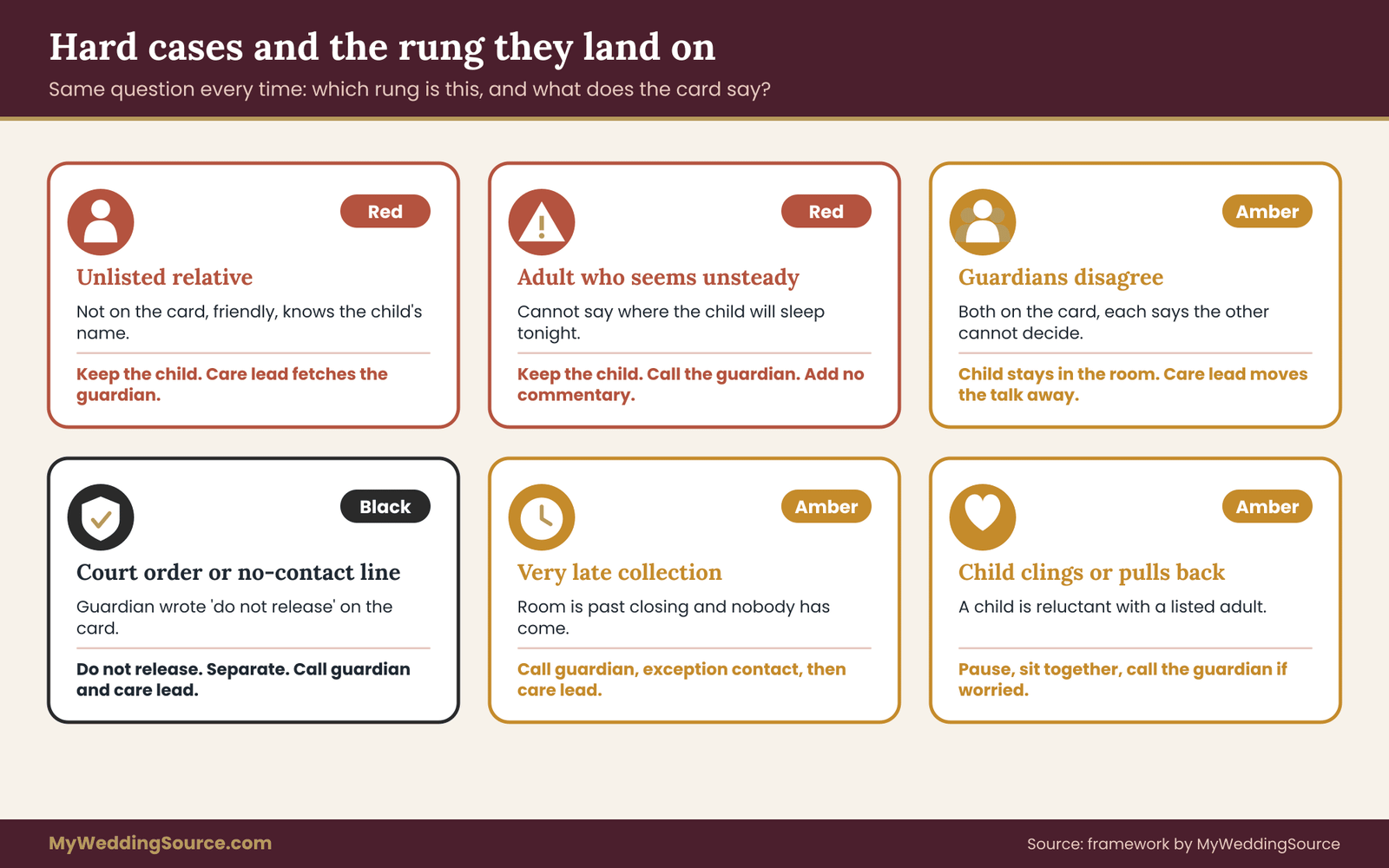
The release ladder handles the ordinary childcare pickup evening. This section applies it to the situations that make people nervous. For each case, the useful question is the same: which rung is this, and what does the card say?
The unlisted relative
A man walks in, says he is the child’s uncle and asks to take her to her mother. He is friendly and he knows the child’s name. He is not on the card.
This is red, and the response is simple. Staff keep the child with them. They tell him they will bring the guardian to the desk, and the care lead goes to the guardian’s table. Most of the time the guardian says “oh, of course, he is fine” and adds his name to the card on the spot, which turns the case green with a recorded change. Occasionally the guardian says no. Either way, the decision came from the guardian, and the staff were polite throughout.
The key discipline in childcare pickup is that staff do not weigh whether he seems trustworthy. A charming stranger and a real uncle look the same at the door. The card is what separates them.
The guardian who cannot be found
The reception is loud, and a guardian’s phone is in a coat in another room. An approved contact is at the desk with the right token and good identification, but a guardian is expected to confirm a change from the card, such as “Ruth may collect instead of Carol.”
If the name on the card matches and the token matches, no change is needed and the case is green. The confirmation only matters when the adult is not on the card. For an unlisted adult, the care lead finds the guardian. If the guardian cannot be found, the child stays in the care room until a guardian appears or another listed adult comes. The room does not close until every child has been released, and the provider’s agreement should say so.
This is why the couple’s care lead matters to childcare pickup. A named person who can walk the floor, with a list of table numbers, solves most of these cases in a few minutes.
The adult who has been drinking
Some adults arrive for childcare pickup after several hours at the bar. Most are fine. A few are not able to take responsibility for a child safely, whether the issue is balance, attention or judgment.
Staff are not asked to measure anything. They are asked to notice, quietly and in plain terms, whether the adult can do the ordinary things the next hour will require: walk steadily with a sleepy child, answer a simple question, say where the child will sleep and how they will get there. If the answer is unclear, the case is red, and the action is the same as always: keep the child, call the guardian, and let the care lead find another listed adult.
Staff say it without commentary.
“Thanks for coming. I am going to ask one of the parents to come by, and I will keep her here until they do. It will be a few minutes.”
They do not say “you have had too much to drink.” They do not argue about whether the adult can drive. If the adult insists, or turns angry, the case moves to black, and the staff call the venue contact. The couple can prepare for this by telling the venue about the care room and asking who handles alcohol-related concerns after hours. The wedding reception guest flow guide is a useful companion for thinking about where the care room sits in relation to the bar, the exits and the transportation points.
The National Institute on Alcohol Abuse and Alcoholism publishes general information about alcohol and its effects, and it is a sensible neutral reference if a couple wants to understand why this rung exists. Neither staff nor the care lead should try to apply medical standards at the desk.
Two guardians who disagree
A mother tells the desk she is taking her daughter to the hotel. The father says the child should stay until the end because the grandparents want to see her dance. Both are guardians, both are on the card, and each says the other has no right to decide.
The staff do not pick a side, and they do not need to. They tell both guardians that the child will remain in the care room, in the care of staff, while the guardians talk it through. The care lead helps by moving the conversation away from the room and the child. If an adult becomes aggressive, the case is black, and staff separate and call for help.
If the guardians are in a legal dispute, the next case applies.
A custody order or a no-contact instruction at childcare pickup
Sometimes a guardian tells the couple, or a staff member, that a person is not allowed near a child. Sometimes a guardian brings a copy of a court order. Sometimes the adult who arrives claims a legal right to take the child.
The rule is firm and short: a guardian’s written instruction on the card stands, and staff do not interpret legal documents. If a guardian wants a specific adult blocked from collecting a child, the guardian writes that on the card, in plain words, and tells the care lead privately. The card should say, “Do not release to Mr. X under any circumstances; call me first.” The care lead briefs the staff, discreetly.
If an adult arrives who has been named in that way, the case is black: staff do not release, they move the child away from the desk, and the care lead and the guardian are called at once. Staff do not argue about who has what right. They explain only that the child will stay in the room until the guardian arrives.
If the adult presents a court order, staff do not read it for the legal outcome. They keep the child where the child is, and they call the guardian and the care lead. A wedding care room is not a courtroom, and a staff member should not have to decide a dispute that a judge decided. For legal questions, families need a qualified family law professional. This guide only helps the childcare pickup desk stay out of the middle of the argument.
Handle this case with the couple’s full privacy in mind. It is the kind of thing that should be told only to the staff who need to know, and it should not appear in group messages or on the main card that other staff will see.
The childcare pickup that happens very late
The reception is over. The band packed up. One child has been in the care room for two hours past the planned closing time, and the guardians have not come.
The agreement with the provider should set a closing time and say what happens after it. A reasonable rule is that staff call the guardian at the closing time, then the exception contact, then the care lead, who goes to look. The child is never sent out to the lobby, the parking lot or a different adult because staff want to go home.
If the guardians cannot be found at all after the venue’s closing time, the venue’s manager and the care lead decide together whether to contact a local non-emergency line. This should be extremely rare, and it should be in the contract so that no one improvises.
If the care provider charges for overtime, agree the fee beforehand. A staff member who is worried about the cost of staying is not able to focus on the child.
A child who does not want to go at childcare pickup
A child clings to a caregiver and refuses to go with the adult at the desk. Or the child pulls back from a listed adult and says something that worries the staff.
A child’s reluctance is information. In most cases, a sleepy child wants the person who has been looking after them, and a few minutes of calm conversation makes it easy. Staff do not force a handover. They keep the child in the room, ask the adult to sit with the child for a moment and watch what happens. If the child’s behavior or words concern staff, they call the guardian, and the case is amber.
If a child says something that suggests the child might be unsafe, staff do not interrogate the child. They note the words exactly, keep the child with a trusted caregiver, and tell the guardian and the care lead. If staff believe a child is in danger, they follow the provider’s safeguarding policy and local reporting rules, which are a matter for the qualified people running the room. The Child Welfare Information Gateway, a federal resource, explains the reporting framework and where to find state contacts.
A child who has fallen asleep
A sleeping child is the commonest case at the end of the night. Waking a child to ask whether she knows the adult is unkind and pointless. The release ladder still applies. The adult shows the token and identification, the staff compare them with the card, and the adult carries the child out. The child’s sleep is not a reason to skip a step. A sleeping child cannot say no, which is the reason to be careful.
If an adult wants to carry a sleeping infant to a car seat, staff can help by carrying the car seat to the door. They should not install a car seat or provide advice on its use. That is the guardian’s responsibility.
A minor named for childcare pickup
If a card names a teenager as an approved contact, the staff treat that as a guardian instruction. They check the token and the identification, which may be a school card for a young person. If the teenager cannot show any identification, the case is amber, and staff call the guardian. The provider’s policy decides whether a minor may collect a child at all. If it does not allow this, the card is an unworkable instruction, and staff should tell the guardian at check-in rather than at midnight.
A worked sequence: the unlisted uncle at 10:40
Here is the unlisted uncle case, step by step, to show how the ladder runs in practice. It is invented for illustration.
- A man arrives at the desk at 10:40 p.m. and says he is Nia’s uncle. He has no token. Staff see that his name is not on Nia’s card. That is red.
- The staff member says, “Thank you for coming. I need to confirm with Nia’s parents, and I will keep her here while we do.” She stays calm and keeps Nia with her.
- A second staff member signals the care lead, who goes to table nine.
- Dana tells the lead, “That is Jerome, my husband’s brother. He is fine. Please add him.”
- The care lead returns with Dana. Dana adds Jerome’s name to the card and initials the change. The staff member checks Jerome’s identification against the new line. The case is now green.
- Staff record the time, 10:46 p.m., the change and the confirmation. Jerome carries Nia out.
Six minutes, no harsh word, and a clean record. That is what the ladder is for, and it is what a calm childcare pickup looks like.
Overnight, hotel and after-party childcare pickup
Some weddings do not end when the music does. Children may sleep in a hotel suite while parents attend an after-party. A group of cousins may stay overnight with a sitter. The care room may move from the venue to a hotel room at ten. Each of these changes where responsibility changes hands, and the childcare pickup plan has to say so in plain terms.
The handover is the whole risk
When children move from the venue to a hotel, there are two handovers, not one. The first is from the guardian to the care staff, which already happened at check-in. The second is from the staff to an adult at the end of the night. In between, there is a journey, and someone has to be responsible for each child during it.
For a move from the reception room to a nearby hotel suite, decide four things in advance.
Who walks the children. Name the adults who move with the group. Two staff members are better than one, because a single caregiver cannot also hold a door, watch a toddler and carry a bag. The number of staff is a matter for your provider and local rules, so let those set it.
Which route. Walk it before the wedding. Note elevators, stairs, crosswalks, and doors that lock behind you. A route that works at three in the afternoon can be different at eleven at night.
Who is at the other end. A staff member or the care lead should already be at the suite to open the door, check the room and turn on lights. Children should arrive into a prepared space, not stand in a corridor while someone finds a key.
Who is told. Each guardian should know the new location, the suite number and the time of the move. Put it on the card, or send one short message to guardians before the move, and say that childcare pickup will continue at the new location with the same card and the same ladder.

A second desk at the hotel
The release desk moves with the children. At the hotel, a table or a chair just inside the suite becomes the desk, and the same three-part check applies. This sounds obvious, but it is where plans most often break down. The staff who were strict at the venue relax in a quiet hotel room, and a guest who knows the suite number walks in. Keep the rule: the card, the token, the identification and the ladder travel with the children.
If the hotel has a front desk, ask whether they will call the suite before sending a guest up. A simple request, “Please call the suite before sending anyone to this room,” keeps strangers from knocking on the door. Hotels differ in what they offer, so ask rather than assume. The guide to guest hotels across budgets and mobility needs covers the wider logistics of room blocks and access, and it is worth reading before you place children in a suite.
Overnight care
Overnight care is a different service from evening care, and it raises questions that go beyond pickup. This guide does not cover how to run overnight care, which belongs to qualified providers and local rules. It does give you a few childcare pickup points to settle if overnight care is on the table.
- Who has the keys. A key card in the pocket of one adult is a single point of failure. Agree who holds the cards and what happens if that person leaves.
- When guardians may collect. Some families want to collect a child at one in the morning. Others want the child to sleep until seven. The card should state which, and staff should not release at a time the card does not allow without a guardian’s confirmation.
- Safe sleep. For babies, the sleep surface and position are safety questions with established guidance. The Safe to Sleep campaign from the National Institute of Child Health and Human Development and the Consumer Product Safety Commission both publish information. The people running the room should know it. A wedding is not the place to improvise.
- Morning handover. The childcare pickup in the morning is just as real as the one at night. The same card, the same token and the same ladder apply, and a guardian who arrives for breakfast is as likely to be late or half awake as one at midnight.
The after-party and the plus-one problem
At many weddings the after-party includes a different group of people than the reception. Some children’s guardians go to the after-party, and the children go to bed. Others invite friends who were not at the wedding. A guest who was not at the reception may not know the care rules, and may turn up and ask for a child by name.
The ladder handles this. The new arrival is not on the card, so the result is red. The practical fix is to tell the guardians, ahead of time, that cards stay in effect all night, and that a friend who was not at the wedding must be named on the card. Mention it in the message that tells families about the hotel move.
Phones, batteries and no signal
A childcare pickup plan that depends on a phone call works until the phone dies. Think about what happens when a guardian’s phone is off, a venue has weak reception, or a staff phone has no charge.
- Put two numbers for each guardian on the card.
- Keep a charger and a power bank at the desk.
- Have the care lead carry a list of table numbers, so that a guardian can be found on foot.
- Keep a paper copy of every card. A digital card is easy to read, but it is not easy to read on a phone with a cracked screen and one percent charge.
The wedding day digital contingency plan covers backup communication, shared files and permissions for the whole event, and the childcare pickup cards belong in it as a short, specific item.
Transportation at the end
Rides are a hidden part of pickup. A parent who has been at the bar may be planning to drive home with two children. The couple cannot control that, and the care room staff should not try to. What the couple can do is arrange transport so that the safest option is also the easiest: a shuttle, a ride-service code, a hotel room for families who need one. Most families make the safe choice if it is available and simple.
If a car seat is needed, make sure the guardian brings it or that a rental has been arranged ahead of time. Staff do not install car seats, and a handover that cannot happen because there is no car seat should be resolved by the guardian, not at the door.
Access, language and different needs
A childcare pickup plan that works only for a particular kind of family is not a plan. The families at a wedding may include people with disabilities, older relatives who are the primary carers, guardians who speak a language other than English, and children with needs that staff have not seen before.
Guardians with disabilities
A guardian who uses a wheelchair, has low vision, is deaf or hard of hearing, or has a cognitive or learning disability should find the childcare pickup process as usable as anyone else does. The Americans with Disabilities Act is the federal civil rights law that sets requirements for places of public accommodation and for state and local government services, and the ADA website explains how it applies in general terms. Your venue and your provider will have their own obligations, which you should ask them about rather than assume.
Some practical points follow from that.
- Reach the desk. The release desk should be on an accessible route, at a height that works for a seated guardian, and in a spot with enough room to maneuver.
- Read the sign. Print the instructions in a large, plain type, and have staff willing to read them aloud.
- Hear the check. In a loud room, a hard-of-hearing guardian may not hear the questions. A written card with the key steps lets the check happen without shouting.
- Offer another way to confirm. If a guardian cannot easily use a phone, the care lead can go and fetch them in person, or the card can name an approved contact who may confirm instead. Do not require a phone call as the only method.
- Service animals. If a guardian arrives with a service animal, staff should know the venue’s and provider’s policies ahead of time. Questions about this go to the provider and the venue, not to the guardian at the desk.
The needs of the children matter too. A child who is autistic, who uses a communication device or who is easily overwhelmed by noise may need a quiet handover, with fewer people at the desk and more time. Ask about it on the card, in one line: “Anything that helps the handover go smoothly?” The wider question of how to design the event for older relatives and children with different needs is part of the broader wedding guest care guide.
Language
If a guardian or approved contact does not speak English comfortably, staff cannot rely on a long spoken explanation. Offer the card in the languages your guests actually use, and keep the wording simple enough to translate. A translated card that says “release only to the adults named above, or to a guardian in person” can be checked by a bilingual friend of the couple. Ask someone you trust to read it, not a free translation tool alone, since a wrong word on a safety card is worse than a missing one.
Name a bilingual helper if you can, and put that person’s name on the sign. Staff should not use a child as an interpreter at the desk. A child who is asked to translate for a handover is being placed in the middle of a decision that belongs to adults.
Older relatives as approved contacts
Grandparents are among the most common approved contacts, and they come with their own practical details. A grandparent may not carry a driver’s license, may not have a smartphone, or may be unable to carry a child. The childcare pickup plan can help by naming a second person who will accompany the grandparent, noting a mobility need on the card, and offering a seat at the desk. Do not treat an older relative as a risk because of age. Treat the check as the same for everyone and make it easy to complete.
Families who do not use the card system
Some guests will resist forms on principle, or say “everyone knows us.” The answer is the same as always: kind, brief and consistent. “The couple asked us to use this for every family, and it takes one minute.” Most guests accept it once they see that it applies to everyone. A guest who still refuses to complete a card should be told that without a card the child cannot be left in the care room, and the care lead can help the guest decide whether to keep the child with them.
Protecting children’s information in childcare pickup records
A childcare pickup process creates records: cards, sign-in sheets, token lists, notes and sometimes photographs. Those records describe children and the adults who look after them, which makes them sensitive. The best rule is also the simplest: collect little, share narrowly, keep briefly and destroy on a date you set in advance.
Collect only what the desk needs
The approved-contact card earlier in this guide holds a first name, an age, a few care notes, guardian and contact names and phone numbers. That is enough to run the childcare pickup desk. Resist any request to add more because a form “might as well” ask. Extra fields are extra risk, and they make guardians less willing to complete the card at all.
If your provider is a company, it may have its own forms and its own privacy terms, and it may be subject to rules about children’s data. The Federal Trade Commission explains the Children’s Online Privacy Protection Rule, which applies to certain online services directed to children under thirteen and to services that knowingly collect personal information from them. A paper card at a wedding is not likely to be in that category, but a digital form that collects children’s information is worth a closer look. If a provider’s app or online system collects children’s information, ask the provider how it handles it and read its terms.
Keep the cards in one place
During the reception, the cards live at the desk, in a folder or a clipboard that staff control. They are not left on a table, passed around, photographed for convenience or posted in a group chat. A digital version stays on one device with a lock, and not on every staff member’s phone.
Two practical habits make a difference.
- Cover the card at the desk. Use a clipboard with a cover sheet, so that a guest standing at the desk cannot read other families’ details.
- Never read details aloud. Staff can say a child’s first name and the number to a guardian. They do not say phone numbers, allergies or other families’ details where others can hear.
Share narrowly
The couple and the care lead need to know who is in the room, who may collect which child, and any care instructions that affect safety. They do not need every card. The caterer, the photographer and the DJ do not need any of it. The more people hold the cards, the more places a mistake can happen.
If the care lead keeps a master list of table numbers and exception contacts, keep that list to what the lead needs to find a guardian. A list of names and tables is enough.
Photographs of children in the care room
Photographing children is a separate decision from childcare pickup, and it needs its own consent. The card includes a tick-box for it. If a guardian says no, staff do not photograph that child, and they keep the child out of any group photo taken in the room. The wedding photographer should be told which children are not to be photographed. The same consent thinking that applies to guest photography applies here, only with more care.
Never photograph the cards. A phone picture of a card is a copy of a record that now sits in a camera roll, in a cloud backup and possibly in a shared album. If staff need a record, the card itself is the record.
Destroy on a date
Decide in advance when the cards are destroyed, and put the date in the agreement with the provider. A short period after the event is enough: long enough to resolve any complaint, short enough that nobody is holding the data in a drawer for years. Shred paper cards and delete digital forms and any backup. Ask the provider to confirm in writing that this has happened.
If an incident occurred and a report has to be kept, the records related to the incident follow the provider’s own policy and any legal advice it has received. This is a narrow exception, and the rest of the cards go.
What to say to families
Tell families what you collect and what happens to it, in two sentences, on the card or on the sign-up page. For example: “We collect only what is needed for pickup. The cards are kept at the desk during the event and shredded within a few weeks afterward.” Most guardians appreciate the clarity, and the plain statement tends to improve the quality of what they write on the card.
Who does what: roles, contract language and a worked example
A childcare pickup plan works when each person knows the part they play and when the provider has agreed to it in writing. The couple does not need to supervise the room. They need to set the rules and name the people.
Who does what
The couple. Decide whether the wedding offers care, appoint the care lead, agree the plan with the provider, tell guardians about it and stay out of release decisions on the night. The couple should not be at the childcare pickup desk. They have other things to do, and a bride or groom who is asked to settle a handover is a person who should not be settling it.
The care lead. Holds the master list of guardians and tables, finds guardians when staff need them, is the contact for the exception cases and checks that the room is empty at the end. The care lead does not release children. The separation matters: staff release, the lead escalates.
The provider. Runs the room, applies the release ladder, keeps the cards secure, records every release and does the final sweep. The provider is responsible for its own policies, licensing and training, which you should ask about, and which are outside the scope of this guide.
The venue. Provides the space, a security or manager contact for black cases, and information about exits, elevators and after-hours access. Ask the venue before the wedding who answers a call at midnight.
The guardians. Fill out the card, keep the token, tell staff of any changes in person or by a call staff place, and collect or arrange for collection of their child. Remind them, once, that cards matter more at the end than at the start.
Contract language for childcare pickup
If you hire a provider, the written agreement should include the release rules. You do not need legal language. You need clear statements the provider agrees to. For general guidance on reading vendor agreements, see the wedding vendor contract guide. The childcare pickup points to include are these.
- A statement that children are released only to guardians or to adults named on the approved-contact card, after a token and identification check.
- A statement that changes to the card may only be made by a guardian, in person or by a call the staff place.
- The release ladder, or the provider’s own equivalent, attached to the agreement.
- A closing time, a fee for staying later, and what staff do if a child has not been collected.
- A requirement to complete a final sweep and sign a sheet confirming that every child was released.
- A privacy clause that limits the data collected, restricts sharing and sets a destruction date.
- The name of the person at the provider with authority to make decisions on the night.
If the provider says its own terms cover these, ask to see them. A provider with a good process will usually be happy to share it.
A worked example
This example is invented to show how the pieces fit together. It is not a real wedding or a real provider.
The setting. Priya and Daniel are married on a Saturday in a rented hall. Eleven children from seven families will use a care room, which is run by a small licensed provider. The reception ends at midnight. The childcare pickup plan has been agreed with the provider in writing.
Before the day. Two weeks ahead, the couple send guardians a short message with a link to a digital card and an explanation of the release rule. Four families complete it online. Priya’s cousin Maya is named as the care lead. She is a close family member but is not in the wedding party. She collects table numbers from the seating chart and puts them on one page.
At four o’clock. Families arrive and check in. Staff match each child to a numbered wristband and give the guardian the same number. Three guardians forgot their cards and complete the short version. One grandmother cannot use her phone, so staff help her write the card on paper.
At eight o’clock. One family collects early. The guardian shows the token, staff compare it with the card and the child is released in under a minute. This is green. Staff note the time.
At ten forty. An uncle who is not on the card arrives to collect a child. This is red. Staff keep the child with them, Maya fetches the guardian, and within a few minutes the guardian adds the uncle to the card and initials the change. Staff check the uncle’s identification, and the child goes home with him.
At eleven thirty. A guest who has been drinking arrives for her niece, who is on her card. She has the token and the identification, but cannot say where the child will sleep. Staff mark it red, call the child’s mother, and keep the child. The mother comes over, thanks the staff and takes the child herself. Nobody argues.
At midnight. The lead caregiver reads out the sign-in list. Every child has a release time and a name. She walks the room, checks under the tables and the coat rack, and Maya signs the sweep sheet. The cards go into a sealed envelope that the provider takes away and shreds three weeks later.
What made it work. The decisions were made by guardians, ahead of time. At the desk, staff compared and recorded. The care lead did the walking. The couple danced. No one raised a voice, and no one needed to remember a complicated rule.

Mistakes and a timeline for childcare pickup
Most failures of childcare pickup at weddings repeat the same few patterns, and most are easy to remove before the day.
Mistakes that weaken a childcare pickup plan
Leaving the plan until the night. If the rules are invented at the desk, they will be different for each family and will depend on who happens to be working. Settle the card, the token and the ladder a few weeks ahead.
Letting the couple make release decisions. The couple is surrounded by people who want their attention. A bride who is asked to confirm that an uncle may collect a child is being asked to speak for a family she may not know well. The guardian decides. Send every question about collection to the guardian.
Treating a familiar face as authorization. The adults most likely to be waved through are the relatives and friends everyone knows. They are also the adults the guardians may have specific reasons to limit. The card is the rule, and the card does not care who is charming.
Making the check feel like an interrogation. A harsh tone teaches guests to resent the desk and makes staff dread it. Keep the words short and the manner warm. The rule can be firm while the person delivering it is friendly.
Writing a plan that needs a phone to work. Dead batteries, noisy rooms and missing signal are normal at weddings. Paper cards, a charger and a care lead who can walk are the backup.
Collecting too much information. A card that asks for ten fields is less likely to be filled out and more costly to protect. Aim for a card that takes a minute.
Skipping the sweep. The final sweep feels like a formality at one in the morning, and it is the step that finds the child asleep under a coat. Keep it, and make someone sign for it.
Forgetting the morning. If children stay overnight, the next day’s childcare pickup is a handover too. Apply the same card and ladder to it.
Not telling families. A good plan that guardians have not been told about is a surprise at the door. Send one short message a week before and one at check-in.
Assuming the provider’s policy covers your case. A provider may have a good policy and still not know that a particular guardian wants a particular adult blocked. Ask each family for any special instruction, and ask the provider how it records it.
A timeline for childcare pickup planning
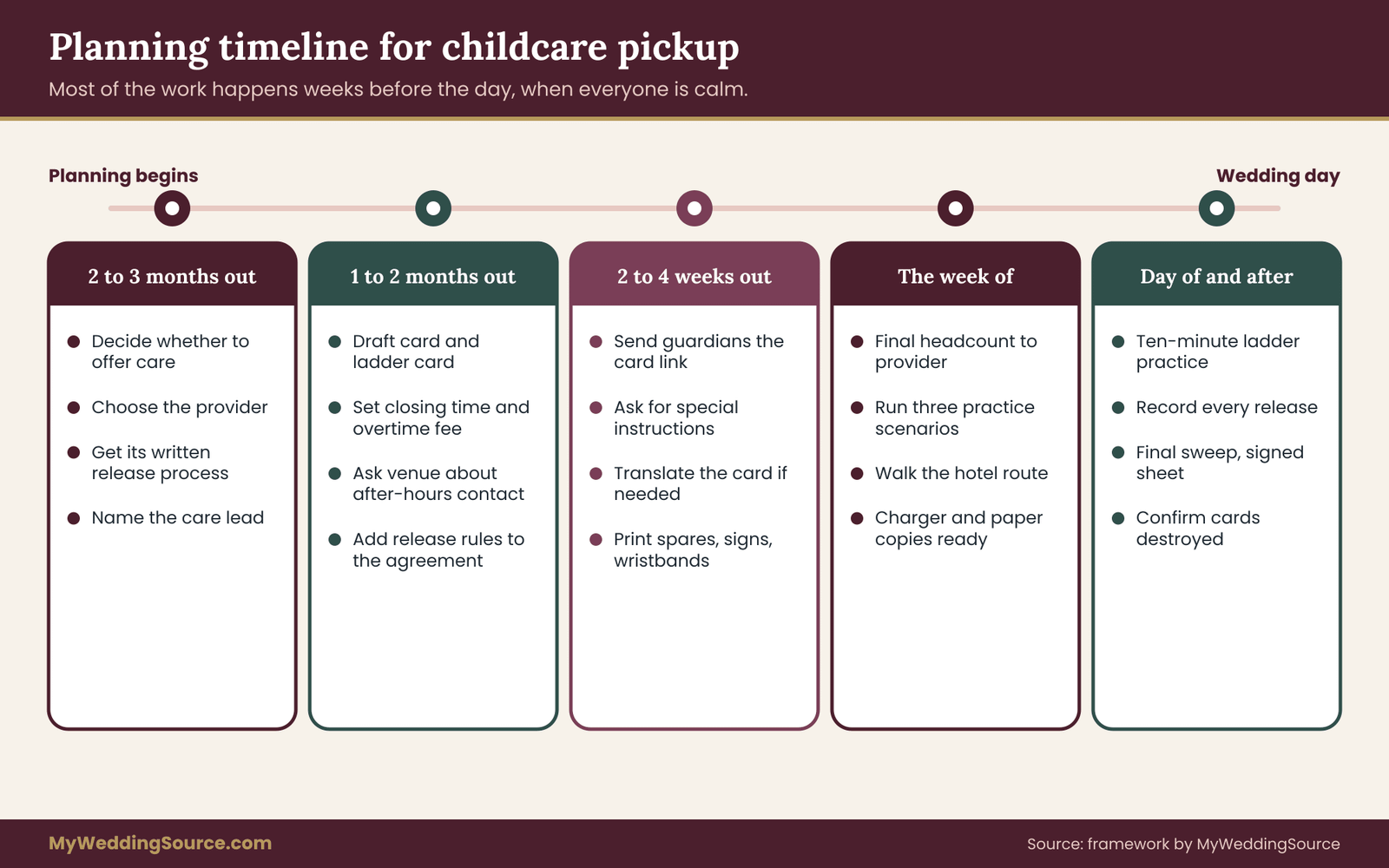
A childcare pickup plan does not need months, but it does need a sequence. The timing below is a guide. Compress it if your wedding is closer, and put the items into your overall wedding planning checklist so that they do not slip.
Two to three months before. Decide whether you will offer care. If you do, choose the provider, and confirm that the licensing and screening questions have been answered by the people qualified to answer them. Ask the provider for its written release procedure. Name the care lead.
One to two months before. Draft the card and the release ladder card. Decide the closing time, the overtime fee and the destruction date for records. Ask the venue about the care room, the route to the hotel and who handles after-hours problems. Add the release rules to the agreement.
Four weeks before. Send guardians the first message: what the care room offers, what childcare pickup involves and a link to the card. Ask for any special instructions or access needs. Translate the card if you need to.
Two weeks before. Follow up with families who have not completed cards. Print spares, a clipboard, pens, a sign, wristbands and a cover sheet. Check that the card, the sign and the ladder card are readable at arm’s length.
One week before. Send the final headcount to the provider. Confirm the staff’s names, the hotel route and the timing of any move. Send a short reminder to guardians: where the care room is, when it opens and closes, and how pickup works. Hold a call with the provider to run three scenarios: a normal pickup, an unlisted relative and an adult who seems unable to take a child safely.
On the day, before guests arrive. Walk the route. Set up the desk. Practice the ladder for ten minutes with staff and the care lead. Put a charger at the desk. Confirm where table numbers are.
During the reception. Check children in with tokens and cards. Handle changes through guardians. Record every release. Keep the desk clear and the room calm.
At the end. Final sweep, signed sheet, care lead’s check, cards sealed.
After the wedding. Confirm the destruction of the cards in writing. Thank the staff and the care lead. Note what worked and what did not, in case you plan a family event again.
Your next steps
Start with the card. Draft a one-page approved-contact card with the fields in this guide, and ask two friends with children to try it and tell you what confused them. Then write the four rungs of the release ladder on a single index card, and read it aloud to the person who will run the care room. If they cannot say what to do at each rung without looking, simplify the wording until they can.
Next, name your care lead and tell that person what the role is and what it is not. Add the release rules and a records destruction date to the written agreement with your provider. Send guardians a short message with the card and the plain rule: only listed adults, only with the token and identification, and changes only through a guardian.
Finally, walk the route and test the desk. A childcare pickup plan that has been practiced for ten minutes will carry the evening, and the rest of your attention can go where you want it to go.
FAQ
What is a childcare pickup authorization at a wedding?
It is the guardian’s written permission, usually on a short card, that names which adults may collect a child from the wedding care room. Staff compare the card with a matching token and the adult’s identification. If anything does not match, they keep the child and call the guardian, who is the only person who can change the list.
Who should be on the approved-contact card?
The guardians who are attending, plus a few adults the child knows and the guardian trusts, such as a grandparent, an aunt or a family friend. Four names is usually plenty. Record each person’s full name, phone number and relationship. Leave off anyone the guardian is unsure about, since anyone who is not on the card can be added later in person.
Do staff have to check identification for every adult?
Not for a guardian they met at check-in and who holds the matching token, though they should still confirm the name against the card. For approved contacts who were not at registration, yes: photo identification checked against the card is the normal step. Staff should look, compare and return it, without copying or photographing it.
What if a parent loses the wristband or token?
The parent is still the parent. Staff confirm the name against the card, match the face to the person who checked in the child, ask for identification if they did not meet the parent, and then issue a replacement number and record the change. The token is a convenience, so a missing one is an amber check, not a refusal.
Can the couple approve someone to collect a child?
No. Only a guardian can authorize a collector. The couple are hosts and usually cannot know each family’s circumstances. If someone asks the bride or groom to approve a pickup, they should send the person to the care lead, who finds the guardian. This also keeps the couple out of the middle if the situation is sensitive.
What should we do if an adult seems unable to take responsibility for a child safely?
Keep the child with staff, stay calm and say only that a guardian will be asked to come to the desk. Do not comment on the adult’s condition or argue. The care lead finds the guardian or another listed adult. If the adult becomes aggressive or tries to take the child, call the venue contact or emergency services.
How do we handle a custody order or a no-contact request?
Ask the guardian to write the instruction on the card, in plain words, and to tell the care lead privately. Staff do not interpret legal documents. If the named adult appears, staff keep the child away from the desk and call the guardian and care lead. A family law professional can advise on the legal side.
How long should we keep the pickup cards?
Only as long as needed. Set a destruction date in the agreement with the provider, usually a few weeks after the wedding, and ask for written confirmation that paper cards were shredded and digital forms deleted. Keep records longer only if an incident occurred, and follow the provider’s policy and legal advice for those records.
Sources
- Americans with Disabilities Act, U.S. Department of Justice
- Office of Child Care, Administration for Children and Families, U.S. Department of Health and Human Services
- Child Welfare Information Gateway, Administration for Children and Families
- National Center for Missing and Exploited Children
- Children’s privacy, Federal Trade Commission
- National Institute on Alcohol Abuse and Alcoholism, National Institutes of Health
- Safe to Sleep campaign, National Institute of Child Health and Human Development
- U.S. Consumer Product Safety Commission
- USAGov