
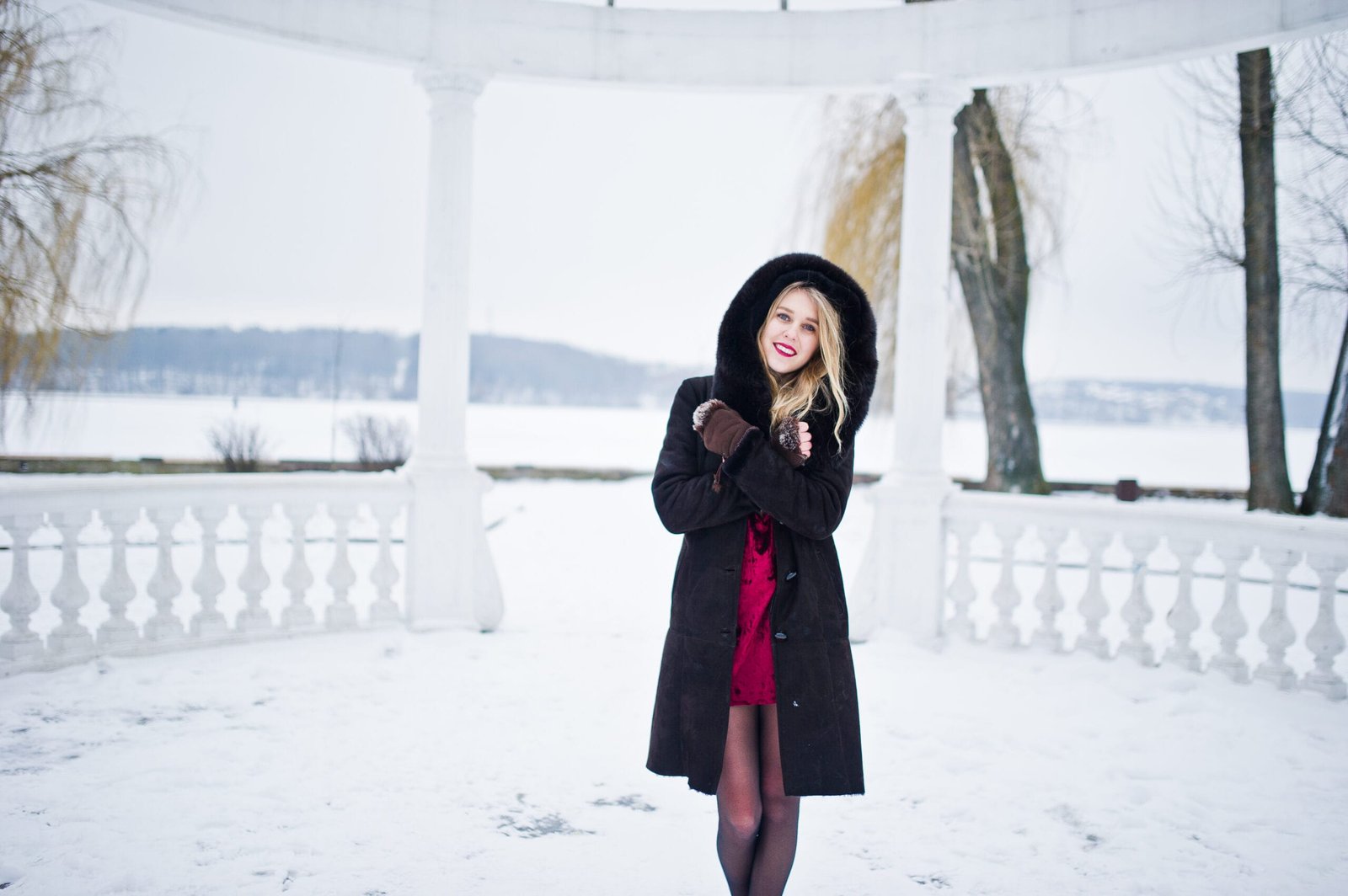
Winter Wedding Dress Code Outfit Ideas for Every Level of Formality
A winter invitation gives you a word — cocktail, formal, festive — and expects you to work out the rest. What it does not tell you is that the ceremony is on a stone terrace, that you will walk a hundred yards from the parking field, that the reception room runs hot by nine, or that the photographs everyone will look at afterward were taken while you were standing outside in a coat.
That gap is why winter wedding guest outfit ideas tend to fail in the same specific way: the outfit is correct and the day is uncomfortable. The dress itself was right; the shoes were wrong for gravel. The suit was perfect; the coat over it was a parka. Nobody notices a beautifully judged outfit and everybody notices someone spending the evening cold, or limping, or holding a wrap they cannot put down.
The other half of the problem belongs to the couple. A dress code is a signal about formality, and it is a poor vehicle for the practical information guests actually need: how long you will be outside, what you will be standing on, whether there is a coat check. The best-dressed weddings are almost always the ones where guests were told what the day would physically involve, not the ones with the strictest code.
This guide decodes each dress code in plain terms, then explains the winter variables that override all of them — outerwear, footwear, fabric, and the transitions between warm and cold. It compares sixteen outfit directions across black tie, formal, cocktail, semi-formal, festive, daytime, and genuinely outdoor weddings, for different bodies, budgets, and mobility needs. It closes with what couples should put on the details card, a checklist, and answers to the questions guests actually ask.
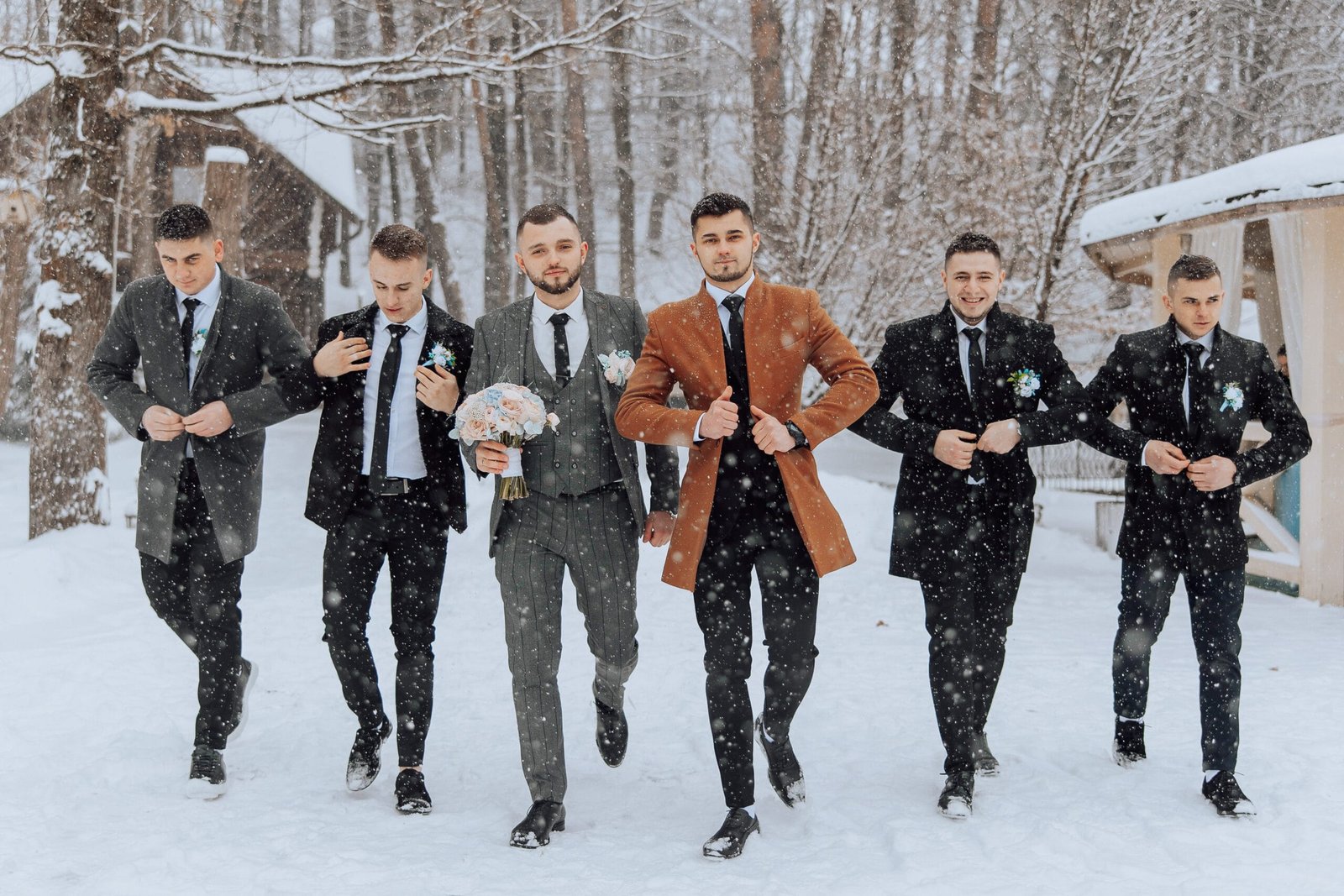
What Each Dress Code Actually Tells You
The codes, in practice
These are conventions rather than rules, and they vary by region and community. Read them as a signal about how formal the evening will be, then adjust for the venue.
| Code | What it signals | In winter, that means |
|---|---|---|
| Black tie | The most formal common code. Tuxedos and floor-length or very formal short dressing. | A proper overcoat, not a puffer. Wrap or stole. Real coat check. |
| Black-tie optional | Tuxedo welcome, dark suit equally correct. Long or elegant midi. | The most forgiving formal code for cold: heavier fabrics are fine. |
| Formal / black tie creative | Formal, with room for personality — color, texture, an unexpected shape. | Velvet, jewel tones, and long sleeves genuinely belong here. |
| Cocktail | The most common wedding code. Suit or knee-to-midi dressing. | Sleeves, tights, and a good coat make this work in January. |
| Semi-formal / dressy casual | A step down. Suit without a tie, separates, a simple dress. | Knitwear becomes an option rather than a compromise. |
| Festive | Cocktail, with permission to be shiny or colorful. | It means sequins and velvet, not novelty sweaters. |
| Daytime / garden party | Lighter and less formal, often ending before dark. | In winter, this is usually a lunch or brunch wedding. |
| No code given | Assume cocktail and read the venue. | Check the wedding website before assuming anything. |
What the venue tells you that the code does not
Two invitations can both say “cocktail” and describe completely different afternoons. The venue is the second half of the instruction.
- Hotel ballroom or country club: heated, carpeted, a coat check, no outdoor walking. The safest place for heels and lighter fabrics.
- Barn or farm: gravel, uneven ground, and cold that comes up through the floor. Block heels or flats, and warmer layers than the code implies.
- Restaurant or small venue: often no coat check and no room for a large coat. A slimmer coat you can hang on a chair back is worth planning.
- Historic house or museum: stone floors, drafts, and stairs. Cold underfoot in a way heating does not fix.
- Tented or partly outdoor: the code is a suggestion; the temperature is the instruction. Assume you will be genuinely outdoors at some point.
When in doubt, ask
Asking is normal and welcome, and it is far better than guessing. Message the couple, someone in the wedding party, or check the wedding website, and ask a practical question rather than a stylistic one: “Will we be outside at all, and what will we be walking on?” That single question answers most outfit decisions, and it is easier for the couple to answer than “what should I wear.”
The rule that overrides every code
Dress one notch above what you think is required, and prioritize being able to walk, sit, and stay warm. Nobody has ever regretted being slightly overdressed at a wedding; plenty of people have spent one cold on a terrace.
The Winter Variables That Change Everything
Outerwear is part of the outfit
This is the single most useful shift in thinking. Your coat appears in every arrival photograph, in the group shots taken outside, and in the entire journey between car and door. At many winter weddings you will be seen in it more than in the outfit underneath.
What works: a tailored wool overcoat, a long belted coat, a cape or opera coat over formal dressing, a good trench with a liner for milder days, a faux-fur or shearling jacket for less formal weddings. What does not: a technical parka over a tuxedo, a hood over an updo, or a coat so bulky it crushes the outfit.
If you own one good coat and one great outfit, spend the effort on the coat. It is the piece that has to work outdoors, in photographs, and over everything you own.
Footwear decides your evening
Covered in detail below, but the principle belongs here: the surface you will walk on matters more than the shoe’s formality. Stiletto heels sink into grass and catch in gravel and cobblestone, and both are common at winter venues. A block heel, a low heel, or an elegant flat is not a compromise; it is the correct answer to a specific question.
Fabric, and the heat problem nobody plans for
Winter venues are usually cold at the edges and hot in the middle. You may go from a windy car park to a chapel at 62°F to a dance floor at 78°F with two hundred people on it. Dressing only for the cold ends with you overheating by nine.
The answer is layers you can remove without changing your outfit’s shape: a jacket over a sleeveless dress, a wrap you can drape or hand to a coat check, a waistcoat under a suit jacket, tights you can live with all evening. Fabric that traps warmth without bulk — wool, velvet, crepe, ponte, heavier silk — does more than adding a layer.
The transitions are where people get cold
The ceremony is rarely the problem. The problems are the walk from parking, the outdoor cocktail hour, the group photographs on a terrace, the shuttle queue, and the wait for a car at midnight. Those add up to far more outdoor time than most guests picture, and they happen at the coldest hours.
Plan for them specifically: a coat you will actually keep on, gloves in a pocket, and shoes that survive a treated path.
Sixteen Winter Outfit Directions by Dress Code
Each direction below names the pieces, the outerwear, the footwear, and a rough cost band. None of them is gendered; choose the version that suits how you dress. Cost bands assume buying new at mid-market prices, and the budget section covers renting and secondhand.
Black tie
1. Classic tuxedo, winter weight
The outfit: a midnight blue or black tuxedo in a heavier wool, white dress shirt, black bow tie, cummerbund or waistcoat optional. Midnight blue reads richer than black under artificial light and photographs beautifully.
Outerwear: a tailored wool overcoat in black, charcoal, or camel, worn open. Footwear: polished black oxfords or velvet slippers for a less rigid version.
Cost band: $$$ new, $ to rent. Works less well when: the invitation says black-tie optional and you would feel conspicuous. Both are correct; choose by how you like to dress.
2. Floor-length with sleeves
The outfit: a long dress in crepe, velvet, or heavier satin, with long sleeves or a high neck. Sleeves are the single best winter formal decision: they remove the wrap problem entirely and read as more considered, not less.
Outerwear: a long coat or a cape; a stole for the walk if the coat is checked. Footwear: a covered heel or an elegant block heel, plus a folding flat in your bag for the end of the night.
Cost band: $$–$$$, and one of the best rental categories. Works less well when: the venue floor is gravel or grass and the hem is unlined — check the length against your shoes.
3. Velvet suit or tuxedo jacket
The outfit: a velvet dinner jacket in emerald, oxblood, or midnight over black trousers, or a full velvet suit for a bolder version. Velvet is warm, formal, and unmistakably winter.
Outerwear: plain wool overcoat; let the jacket be the statement. Footwear: black patent or velvet loafers.
Cost band: $$–$$$. Works less well when: the room is very warm. Velvet holds heat, which is a virtue outside and a problem on a crowded dance floor.
Black-tie optional and formal
4. Dark three-piece suit
The outfit: charcoal, navy, or deep green wool, waistcoat included. The waistcoat is a genuine warmth layer and lets you remove the jacket later without looking undressed.
Outerwear: overcoat, leather gloves, an optional scarf in a quiet color. Footwear: oxfords or polished derbies with a rubber sole if there is any ice.
Cost band: $$–$$$, and a genuinely reusable purchase. Works less well when: the wedding is very casual, where it can read as more formal than the couple intended.
5. Jewel-tone midi in crepe or velvet
The outfit: emerald, sapphire, garnet, or plum, cut below the knee, with sleeves or a light jacket. It suits nearly every formality level between cocktail and formal, which makes it the most useful single purchase in this guide.
Outerwear: tailored coat in a neutral. Footwear: block heel or a heeled boot — a sleek boot under a midi is entirely appropriate in winter.
Cost band: $–$$$. Works less well when: the fabric is thin jersey, which clings and creases under a coat.
6. Tailored separates: wide trousers and a statement top
The outfit: high-waisted wide-leg trousers in wool or satin-backed crepe, with a beaded, silk, or velvet top. Warmer than a dress, endlessly re-wearable, and comfortable to sit and dance in.
Outerwear: long coat. Footwear: anything, because the hem hides it — which makes this the best direction for anyone prioritizing comfort.
Cost band: $–$$. Works less well when: the trousers are long enough to drag on wet ground. Have them hemmed to your actual shoes.
Cocktail
7. Long-sleeve knee-length dress with opaque tights
The outfit: the winter workhorse. A structured knee-length dress in ponte, crepe, or wool blend, with opaque tights in black or a deep shade. Tights are not a compromise in winter; they are correct.
Outerwear: wool coat. Footwear: block heel, heeled boot, or a good flat.
Cost band: $–$$. Works less well when: the dress is strapless and you will be outdoors. Add a jacket you like enough to keep on.
8. Suit without a tie, with a fine-knit layer
The outfit: a well-fitting suit in a mid or dark tone with a fine merino roll neck or crew neck instead of a shirt and tie. Warmer, more comfortable, and reads as deliberate rather than casual.
Outerwear: overcoat or a smart wool bomber for a relaxed venue. Footwear: loafers, chelsea boots, or derbies.
Cost band: $–$$. Works less well when: the code is black tie. This is a cocktail and semi-formal solution.
9. Slip dress with a tailored blazer
The outfit: a satin or velvet slip with a sharp blazer over it. The blazer does the warmth and structure; the slip does the occasion. Easy to dress up or down by changing the shoes.
Outerwear: a coat that fits over a blazer — check this before the day. Footwear: heeled sandal indoors, boot for the journey.
Cost band: $–$$. Works less well when: the slip is very thin and static-prone. A slip layer underneath solves it.
Semi-formal and festive
10. Sequins, restrained
The outfit: one sequinned piece — a skirt, a top, or a jacket — against solid matte pieces. Festive means sparkle, and a full head-to-toe sequin dress can compete with the couple in photographs.
Outerwear: plain dark coat. Footwear: simple, so the shine has one home.
Cost band: $–$$. Works less well when: the wedding is a daytime or religious ceremony where heavy sparkle can feel out of place.
11. Knitwear, done properly
The outfit: a fine-gauge merino or cashmere knit with tailored trousers or a satin skirt. Warm, forgiving, and genuinely elegant when the knit is fine rather than chunky.
Outerwear: anything. Footwear: boots work particularly well here.
Cost band: $–$$. Works less well when: the knit is heavy or bobbled. Chunky knits read as casual regardless of the price.
12. Tartan or check, one piece only
The outfit: a check jacket, a tartan skirt, or checked trousers with everything else plain. Seasonal without tipping into costume, and a real tradition at winter weddings in several communities.
Outerwear: solid coat. Footwear: plain.
Cost band: $–$$. Works less well when: the pattern is red and green together, which reads as a holiday costume rather than a wedding outfit.
Daytime weddings
13. Winter brunch: soft neutrals
The outfit: camel, cream, oatmeal, and grey in wool and knit. Daytime winter weddings suit lighter neutrals better than the deep evening palette, and the low sun flatters them.
Outerwear: a camel or cream coat, which becomes the whole look. Footwear: loafers, flats, or low boots.
Cost band: $–$$. Works less well when: cream reads too close to white. Keep it clearly warm-toned or add a strong accessory.
14. Midweight suit in a lighter tone
The outfit: mid-grey, stone, or soft brown with a knit or open-collar shirt. Less severe than an evening suit and right for a ceremony that ends at three.
Outerwear: overcoat in a contrasting neutral. Footwear: suede loafers or boots, weather permitting.
Cost band: $$. Works less well when: the reception runs into the evening and the room becomes formal around you.
Genuinely outdoor or very cold weddings
15. Formal, built for outdoors
The outfit: a long dress or suit with thermal base layers underneath — fine merino, fleece-lined tights, silk long underwear. Invisible under the outfit, and the difference between enjoying the ceremony and enduring it.
Outerwear: your warmest coat that still looks intentional, plus gloves and a hat you like in photographs. Footwear: insulated boots to arrive, good shoes to change into.
Cost band: $ for the base layers, which is the best value in this article. Works less well when: you skip the base layers because they feel unglamorous. Nobody sees them.
16. Mountain or lodge wedding
The outfit: texture over formality — wool trousers or a heavy skirt, a fine knit, a structured jacket, leather or shearling. The venue sets a relaxed but considered tone.
Outerwear: a genuinely warm coat is expected here, not a compromise. Footwear: boots with grip, always.
Cost band: $–$$. Works less well when: you dress for a ballroom. At altitude and on snow, elegant impracticality is very visible.
Layering, Fabrics, and Color
A layering system that survives the whole day
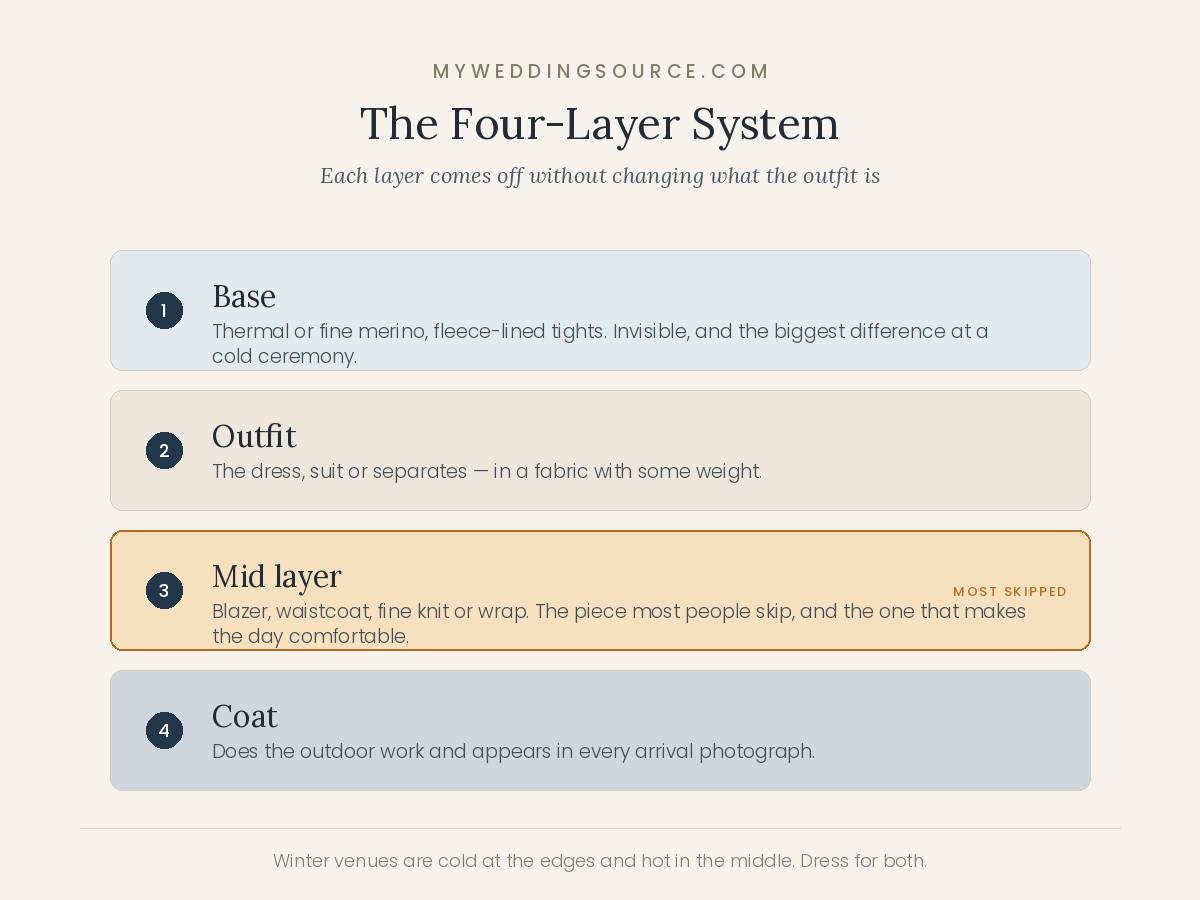
Think in four layers, each of which can come off without changing what the outfit is.
- Base: thermal or fine merino underneath, invisible, worth more than any other single choice at a cold wedding. Fleece-lined tights are the same idea.
- Outfit: the dress, suit, or separates in a fabric with some weight.
- Mid layer: a blazer, waistcoat, fine knit, or wrap that you can remove indoors and put back on for photographs.
- Coat: the piece that does the outdoor work and appears in the arrival photographs.
The mid layer is the one most people skip and the one that makes the day comfortable, because it is the only piece you can take on and off freely without the outfit looking incomplete.
Fabrics that hold heat and photograph well
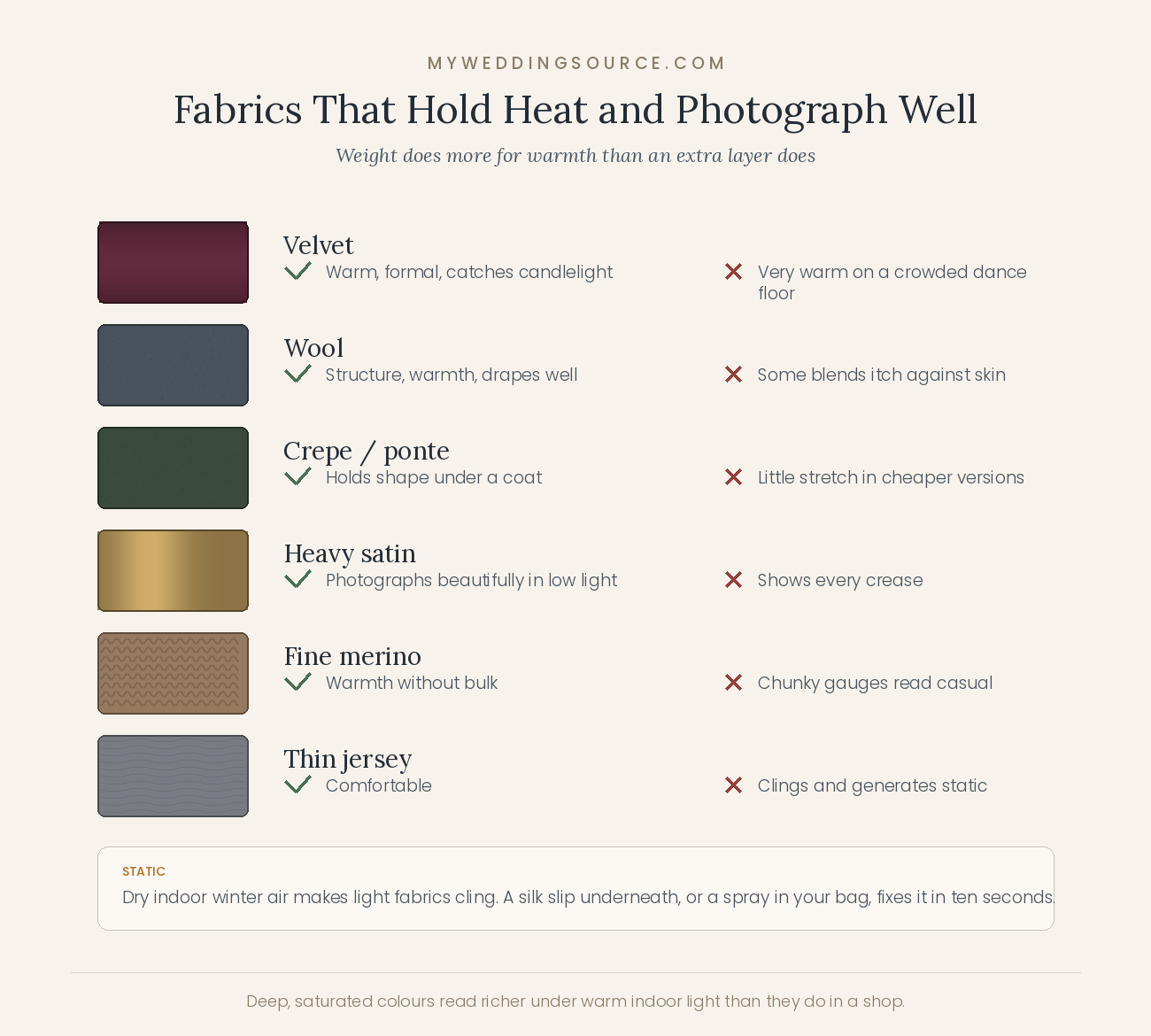
| Fabric | Why it works in winter | Watch for |
|---|---|---|
| Velvet | Warm, formal, catches candlelight | Very warm on a crowded dance floor |
| Wool and wool blends | Structure, warmth, drapes well | Some blends itch; check against skin |
| Crepe and ponte | Holds shape, resists creasing under a coat | Little stretch in cheaper versions |
| Heavier satin | Formal, photographs beautifully in low light | Shows every crease and pull |
| Fine merino, cashmere | Warmth without bulk, comfortable all evening | Chunky gauges read casual |
| Thin jersey | Comfortable | Clings and generates static in dry winter air |
| Chiffon and organza | Movement and lightness | No warmth at all; needs real layers underneath |
One practical note on static: dry indoor winter air makes lightweight fabrics cling. A silk or bamboo slip underneath, or an anti-static spray in your bag, solves it in ten seconds.
Color in winter
Deep, saturated colors suit the season and the lighting. Jewel tones, oxblood, forest, midnight, chocolate, and camel all read richer under warm indoor light than they do in a shop. Metallics work at any formality above semi-formal, and one metallic accessory is usually enough.
Two conventions worth knowing rather than obeying blindly. Avoid white, ivory, cream, and champagne unless the couple has explicitly invited them, which some couples now do. And black is entirely acceptable at weddings in most of the United States, particularly in winter and in the evening; if a family or community you are attending treats it differently, that is worth a quick check rather than an assumption.
Footwear and Venue Surfaces
Match the shoe to the ground, not the outfit
| Surface | What works | What fails |
|---|---|---|
| Grass or frozen lawn | Block heel, wedge, flat, heel caps | Stilettos, which sink even when frozen |
| Gravel or farm track | Boots to arrive, change inside | Thin soles and open toes |
| Cobblestone | Low block heel or flat | Any narrow heel — a genuine ankle risk |
| Ice or treated path | Rubber sole with grip | Leather soles, which are slippery when cold and wet |
| Stone or marble floors | Anything with a cushioned insole | Thin soles — the cold comes up through them |
| Ballroom carpet | Whatever you like | Nothing much; this is the easy one |
The two-pair strategy
Wear boots or comfortable shoes to travel, carry the pair you want photographed, and change inside. It costs you a bag and solves cold feet, wet hems, gravel, and the walk from the shuttle in one move. Nobody will notice you arriving in boots, and everybody notices someone barefoot on a cold floor at eleven.
Related: pack the flats you will want at the end of the night. Folding flats live in a clutch, and a pair of loafers in a coat pocket works equally well.
Small things that matter
- Heel caps or protectors for grass and gravel, which cost very little and work.
- Break shoes in for a few hours at home first. A wedding is nine hours of standing.
- Non-slip pads on new leather soles if there is any chance of ice or polished stone.
- Warm socks in your coat pocket if you are wearing loafers or thin shoes to an outdoor ceremony.
Comfort, Body, and Mobility
Dress for how you will actually spend the day
Map the day before choosing: a car journey, standing outside, sitting for a ceremony, standing at a cocktail hour, sitting for two hours at dinner, dancing, then waiting for a ride. Most of it is sitting and standing, not posing.
Practical consequences: check that you can sit comfortably for two hours in whatever you choose, that you can raise your arms, that a strapless piece will not need adjusting all night, and that you can get in and out of a car. Try the outfit on and sit in it for ten minutes before the wedding, not on the morning of.
Bodies and fit
Fit does more for how an outfit looks than price does, and tailoring is the cheapest upgrade available: hemming trousers, taking in a jacket, adjusting straps, or shortening a hem to your actual shoes typically costs a fraction of the garment and transforms it.
Two winter-specific fit notes. Check that your coat closes comfortably over the outfit, including over a blazer or a full skirt — a coat that will not close is a coat you will carry. And if you are between sizes, size for the layer you will wear underneath rather than for the shop fitting room.
Order early. Alterations typically need one to three weeks, longer in December, and popular sizes sell out in the weeks before the holidays.
Mobility, seated guests, and accessibility
If you use a wheelchair, a cane, crutches, or a walker, or if you will be seated for most of the event, a few adjustments help.
- Length: a hem that sits well seated is different from one that sits well standing. Midi and tea lengths often work better than full-length for wheelchair users, and trousers avoid the question entirely.
- Coats: a cape, a poncho, or a shorter coat is easier to wear seated than a long coat that bunches. A blanket wrap in a good fabric is a legitimate and elegant option.
- Fastenings: front closures, larger zips, and pull-on styles are easier if dexterity is affected by cold or by a condition.
- Grip: the surfaces table above matters more, not less. Ask the couple about the route from parking and whether there are steps.
- Warmth: guests who are seated and less mobile get cold faster than guests who are moving. Plan an extra layer rather than fewer.
Asking the couple in advance about surfaces, steps, distances, and heating is entirely reasonable, and most couples would far rather answer the question than have a guest struggle quietly.
Pregnancy, nursing, and temperature
Stretch fabrics, empire and wrap shapes, and separates all adapt as sizing changes between purchase and the wedding. If you are nursing, front-opening styles and wrap tops save a great deal of trouble. And if you run hot — many pregnant guests do — plan the layers so you can remove one without changing the outfit’s shape, and choose breathable fabrics over velvet.
Budget: Where to Spend and Where Not To
| Approach | Best for | Watch for |
|---|---|---|
| Rent | Black tie, one-off formal dressing, tuxedos | Book early for December; check the return date |
| Buy secondhand or resale | Coats, velvet, tailoring — the categories that last | Allow time for alterations |
| Buy new, wear repeatedly | A dark suit, a good coat, one jewel-tone piece | Trend-led pieces date faster than classics |
| Borrow | A coat, a wrap, jewelry | Agree what happens if something is damaged |
| Restyle what you own | Almost everyone, most of the time | New accessories change an outfit more cheaply than a new outfit |
If you are building something you will use for several weddings, the order that gives the most use is: a good coat, then a dark suit or one excellent dress, then shoes you can stand in, then accessories. Tailoring beats spending more, every time.
And one honest note about repetition: wearing the same outfit to several weddings is entirely normal, and different guests attend each one. Changing the shirt, the shoes, or the jewelry is enough.
For Couples: How to Communicate a Dress Code Without Controlling Guests
If this is your wedding, the goal is to give guests enough information to be comfortable and appropriately dressed — not to art-direct them.
State the code, then the conditions
The code goes on the invitation or details card. The practical information goes on the wedding website, where you have room. The conditions are the part guests genuinely need and almost never receive.
Website wording that works
“Cocktail attire. The ceremony is indoors, but there is a short walk across a gravel courtyard from the parking area, and we will step outside for photographs before dinner. Late January evenings here are around 30°F, so we recommend a warm coat and shoes that handle uneven ground. There is a staffed coat check, and blankets and hot drinks will be available.”
Four facts: what to wear, what you will walk on, how long you will be outside, and what we provide.
What to include
- The dress code, in one standard term.
- Whether any part of the day is outdoors, and roughly for how long.
- What guests will be walking on: grass, gravel, cobblestone, stairs.
- Typical temperature for your date and location.
- Whether there is a coat check, heating, or shelter.
- Anything you are providing: blankets, heaters, hot drinks, a shuttle.
- Any cultural or religious expectations, such as covered shoulders or head coverings.
What to avoid
- Mandating a color palette for guests. It reads as controlling and creates real cost for people who own nothing in that color.
- Banning specific garments beyond the widely understood convention about white.
- Inventing a code that nobody can decode. “Winter enchanted formal” produces forty text messages.
- Being vague and then disappointed. If it matters to you, say the standard term clearly.
- Assuming everyone can afford new clothes. A strict code has a cost, and it falls hardest on the guests who traveled furthest.
If you want a sense of the traditional conventions behind these codes, Emily Post’s overview of wedding guest attire covers where they come from, which is useful background when you are deciding how strictly to hold them.
Answer questions warmly
Guests will ask, and each question is a guest trying to get it right. One prepared sentence handles nearly all of them: “Cocktail — think what you’d wear to a nice dinner, and bring a warm coat, we’ll be outside for photos.”
Common Mistakes
Treating the coat as an afterthought
You are in it for the arrival, the photographs, and the entire journey. Choose it as part of the outfit, not after it.
Wearing the shoes for the whole day
Two pairs. Boots to travel, the good ones inside, flats for the end.
Dressing only for the cold
Winter receptions run hot. Without a removable mid layer you will be uncomfortable at both ends of the evening.
Ignoring the venue
A cocktail code at a barn and a cocktail code at a ballroom are different instructions. Read the venue, then choose.
Bare legs and strapless in January
It photographs as cold because it was. Tights and sleeves are correct in winter, not a compromise.
Buying without time for alterations
Fit does more than price. Allow one to three weeks, longer in December.
Wearing white, cream, or ivory without an invitation to
Still the one convention worth simply following unless the couple has said otherwise.
Chunky knitwear at a formal wedding
Fine-gauge knits are elegant; heavy ones read casual regardless of what they cost.
For couples: inventing a dress code
Use a standard term and add the practical conditions. Creativity in the code produces confusion, not better outfits.
Outfit-Planning Checklist
Before you buy anything
- ☐ Dress code read, and the venue type identified
- ☐ Checked whether any part of the day is outdoors, and for how long
- ☐ Asked what we will be walking on, and whether there are steps
- ☐ Checked whether there is a coat check
- ☐ Typical temperature for the date and location looked up
The outfit
- ☐ Coat chosen first, and it closes over the outfit
- ☐ A mid layer that can come off without changing the look
- ☐ Base layer or fleece-lined tights if any part is outdoors
- ☐ Fabric with some weight; a slip layer if it is prone to static
- ☐ Alterations booked, allowing one to three weeks
- ☐ Sat down in it for ten minutes to check comfort
Shoes and extras
- ☐ Shoes matched to the surface, not just the outfit
- ☐ Travel pair, main pair, and something flat for the end of the night
- ☐ Heel caps or non-slip pads if there is grass, gravel or ice
- ☐ Shoes broken in at home
- ☐ Gloves, and a wrap or stole if the coat gets checked
- ☐ Small bag: lip balm, anti-static spray, plasters, a hair tie
Frequently Asked Questions
What does cocktail attire mean at a winter wedding?
The same thing it means in any season — a suit, or dressing at knee to midi length — with winter adjustments that are entirely expected. Sleeves, opaque tights, heavier fabrics like crepe, velvet, or wool, and a proper coat all sit comfortably inside cocktail attire in January. A fine-knit layer under a suit instead of a shirt and tie is also correct. If you are unsure how formal the particular wedding is, look at the venue: a ballroom pushes cocktail upward, a barn pushes it down.
Can I wear boots to a wedding?
Yes, and in winter they are often the better answer. A sleek heeled or flat boot under a midi dress or wide trousers reads as deliberate and modern, and it solves gravel, ice, and cold floors at the same time. Keep them plain and polished — a dressy boot rather than a hiking or heavily buckled one. For black tie, boots are a stretch unless they are very sleek, so consider the two-pair approach instead: boots to arrive, formal shoes inside.
Is it still wrong to wear black to a wedding?
In most of the United States, black is entirely acceptable and very common, particularly for evening and winter weddings. The old objection has largely disappeared. Two caveats: some families, cultures, and religious communities still read black differently, so if you are attending a wedding in a tradition unfamiliar to you, a quick question is worth asking. And a black outfit reads better with texture, a strong shoe, or an accessory than as a plain matte column.
What about white, cream, or champagne?
Avoid them unless the couple has explicitly said otherwise, which some now do. The convention is one of the few still worth simply following, because the cost of being wrong falls entirely on you and the discomfort is not worth it. Pale neutrals adjacent to white — oatmeal, stone, pale grey, blush — are generally fine, but if a piece could be described as ivory in a photograph, choose something else.
How do I stay warm without ruining the outfit?
Layer invisibly and removably. A thermal or fine merino base layer under a dress or suit is undetectable and makes the biggest difference; fleece-lined tights do the same job. Add a mid layer you can take off indoors — a blazer, waistcoat, fine knit, or wrap — and treat the coat as part of the outfit rather than as something to endure. The pieces nobody sees are the ones that let you enjoy an outdoor ceremony instead of counting the minutes.
What shoes work on grass, gravel, or ice?
Block heels, wedges, flats, and boots. Stilettos sink into grass even when it is frozen and catch badly in gravel and cobblestone, which is an ankle risk rather than an inconvenience. Leather soles are slippery on cold wet stone, so a rubber sole or non-slip pads are worth it if there is any ice. The simplest solution is to travel in boots and change inside, and to keep something flat in your bag for the end of the night.
Do I need to buy something new?
No. Renting is excellent for one-off formal dressing and tuxedos, resale is strong for coats and tailoring, and borrowing a coat or jewelry is normal. If you do buy, the pieces that earn their cost across several weddings are a good coat, a dark suit or one excellent jewel-tone piece, and shoes you can stand in for nine hours. Tailoring an inexpensive garment usually looks better than an expensive one that does not fit. And wearing the same outfit to more than one wedding is entirely unremarkable.
I use a wheelchair or will be seated most of the evening. What should I consider?
Length and layers, mainly. Hems that hang well standing can bunch when seated, so midi or tea lengths and trousers often work better than full-length. A cape, poncho, or shorter coat is easier than a long coat, and a good blanket wrap is a legitimate option. Front fastenings help if cold affects your grip. Plan an extra warm layer rather than fewer, because seated guests get colder than moving ones, and ask the couple about the route from parking, the surfaces, and any steps — most would much rather be asked.
We are the couple. How specific should our dress code be?
Use one standard term — cocktail, black-tie optional, formal — and then spend your words on the conditions rather than on the style. Tell guests whether any part of the day is outdoors and for how long, what they will be walking on, the typical temperature, whether there is a coat check, and what you are providing. That information is what guests actually need, and it produces better-dressed, more comfortable guests than a stricter code does. Avoid mandating colors or inventing a bespoke code name.
What if I get the formality wrong on the day?
It matters far less than it feels like it will. Guests remember whether they enjoyed the evening, not whether someone’s jacket was a shade too casual. If you are worried, aim one notch above what you think is required and choose fabrics with some weight — slightly overdressed is invisible, while visibly cold or unable to walk is not. And if you do arrive underdressed, a confident manner and a good coat cover a great deal.
Read the Venue, Then the Code
Every winter wedding outfit decision comes down to two questions the invitation only half answers: how formal is this, and what will the day physically involve. The code tells you the first. The venue, the walk from parking, and the length of the outdoor portion tell you the second, and the second is the one that determines whether you enjoy the evening.
The practical order: choose the coat first, add a mid layer you can remove, put warmth underneath where nobody sees it, match the shoes to the ground rather than the outfit, and carry a second pair. Deep colors, weighty fabrics, and sleeves all read as more considered in winter, not less — which is convenient, because they are also the warm options.
And if you are the couple: name the code in one standard term, then tell your guests what they will be standing on and how long they will be outside. That single paragraph does more for how your wedding looks than any styling request could.
Your next step
Before you shop, send one message to the couple or check their website for three things: whether any part of the day is outdoors and for how long, what you will be walking on, and whether there is a coat check. Those three answers decide your coat, your shoes, and your layers — which is most of the outfit.
