

December Wedding Budget: Holiday Premiums and Off-Season Savings Explained
Almost every couple who considers a winter date hears the same thing: December is off-season, so it will be cheaper. Almost every couple who books one discovers that the sentence is half true, and that which half applies depends entirely on which December Saturday they choose.
The honest version is this. December wedding cost is not one number and not one direction. A Friday in the first week of December is genuinely one of the best-value dates in the American wedding calendar. A Saturday between Christmas and New Year is one of the most expensive weeks of the year to ask people to travel. And New Year’s Eve is, in most markets, priced above a peak-season Saturday in June. When planning for a December wedding cost, consider these fluctuations carefully.
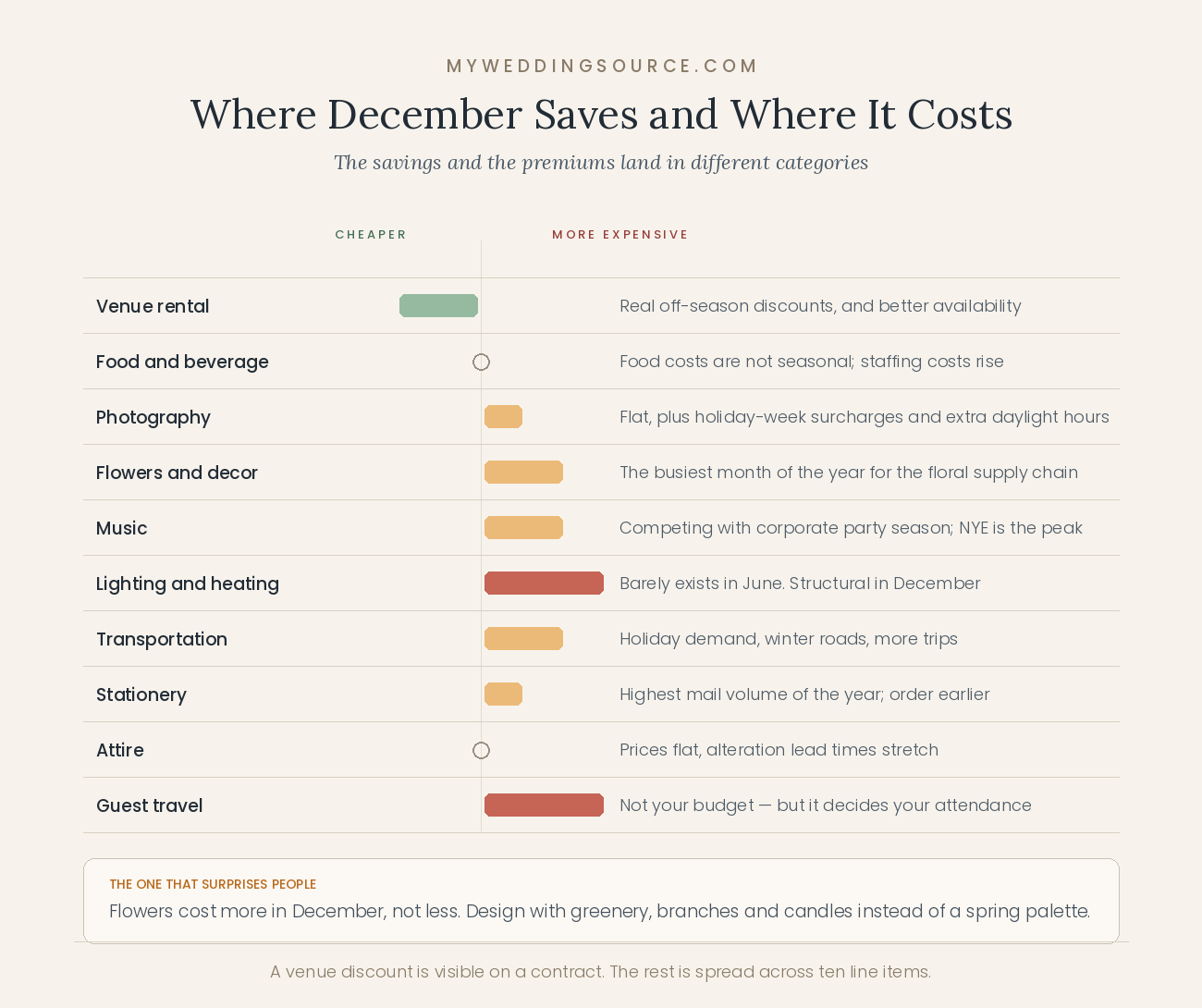
The difficulty is that the savings and the premiums land in different categories, so they are hard to see at once. Your venue may genuinely quote you thirty percent below its June rate while your guest list quietly shrinks because flights that week cost double. Your florist may charge more for the same stems because the holiday supply chain is under pressure. Your photographer may add a holiday-week fee. The venue discount is visible on a contract; the rest of it is spread across ten line items and two hundred guest decisions.
Handled without a full picture, the outcome is predictable: a budget built on the discount, and then a series of unbudgeted additions — heaters, lighting because sunset is at 4:35, snow removal, shuttle service on icy roads, holiday labor rates — that arrive one at a time and land somewhere between five and fifteen percent over plan.
This guide maps December week by week, works through every budget category in the direction it actually moves, and then builds three complete line-item budgets for 100 guests: an early-December Friday, a Christmas-week Saturday, and New Year’s Eve. It closes with the costs most budgets miss, the negotiations that genuinely work, the contract clauses to read before signing, and a worksheet you can fill in with your own quotes. Everything here is illustrative rather than a price list, and the section on national averages explains why that distinction matters.

The December Paradox: Both Things Are True
Where off-season pricing is real
Demand is genuinely lower in most of the United States in early and mid December, and that shows up in four places specifically.
- Venue rental. The most reliable saving. Many venues publish tiered pricing with a low season that includes January through March and, in a large number of markets, part of December.
- Availability, which is itself a saving. Popular venues that require booking eighteen months ahead for a September Saturday may have December dates open at nine months, which gives you leverage and time.
- Vendor calendars. Photographers, planners, and bands with open dates are more willing to discuss packages than they are in peak season.
- Day-of-week pricing. A Friday or Sunday in a low-demand month is where the two discounts stack, and this is the single biggest lever in the whole article.
Where December stops being off-season
Four forces push in the opposite direction, and they intensify as the month goes on.
Holiday demand for the same resources. Hotels, restaurants, caterers, florists, and transport companies are all serving corporate parties and holiday events in December. Their staff, vehicles, and inventory are committed elsewhere, which raises prices regardless of what the wedding market is doing.
Labor. Staffing a wedding on a holiday weekend costs more. Some vendors apply an explicit holiday surcharge; others simply quote higher because they are paying their teams more to work those dates.
Guest travel. Not your line item, but it decides your attendance and it can quietly reshape your budget. Airfare and hotel rates around Christmas and New Year are among the highest of the year, and every decline changes your per-guest math.
The weather and the darkness. Sunset before five means lighting is not optional. Cold means heat, coat check, and possibly snow removal. These are not premiums exactly — they are real costs a June wedding simply does not have.
The sentence worth holding onto
December can be cheaper than June, and a December wedding is not automatically cheaper than a June one. The difference is decided by the week you choose, the day of the week, and how much of the season’s real costs you build in from the start.
Not One Month: The December Calendar Map
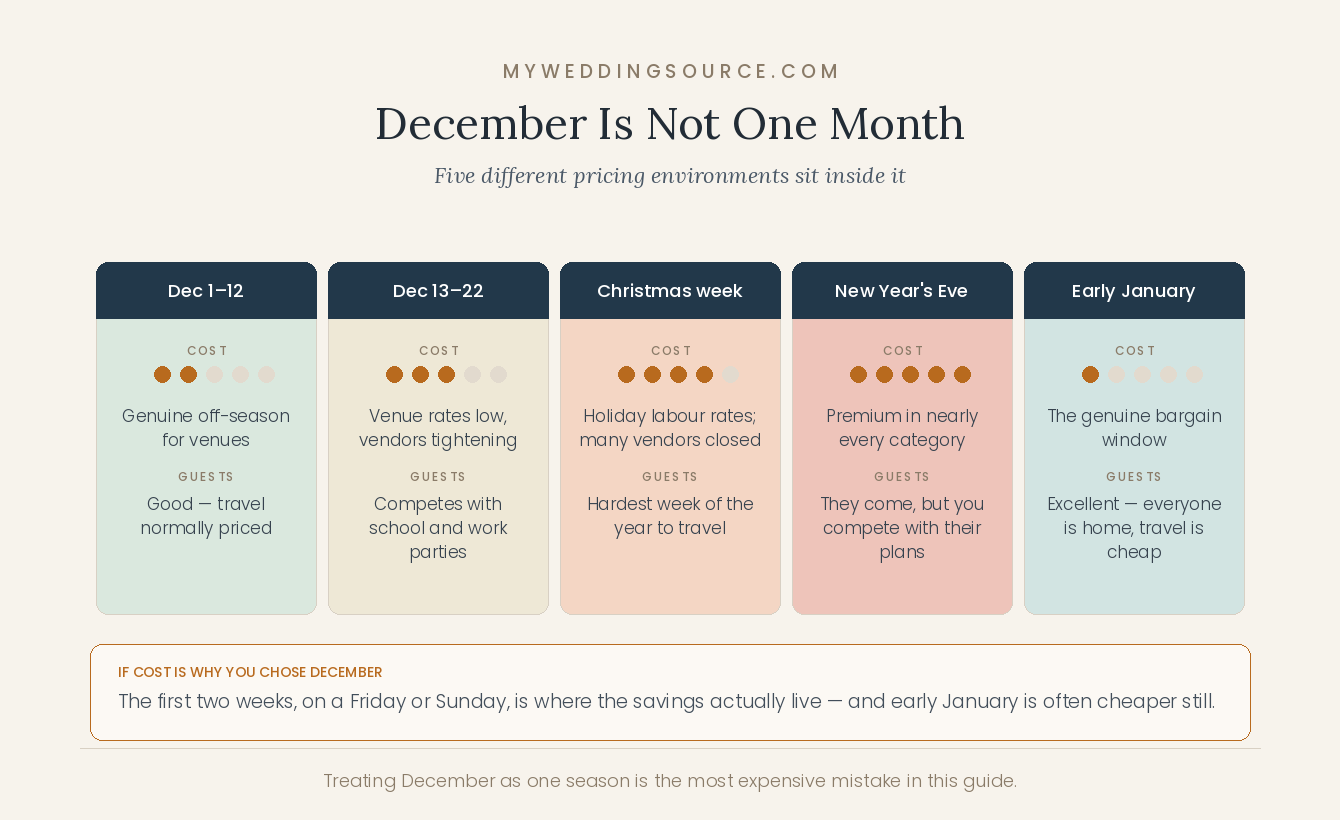
Treating December as a single season is the most expensive mistake in this article. Four distinct pricing environments sit inside it.
| Window | Pricing environment | Guest attendance |
|---|---|---|
| Dec 1–12 | Genuine off-season for venues; corporate party season competes for catering and transport | Good. Travel is normally priced. |
| Dec 13–22 | Mixed. Venue rates still low, vendor availability tightening, holiday events at their peak | Competing with school holidays and work parties |
| Christmas week | Holiday labor rates; many vendors closed or charging premiums; venues sometimes discount to fill | Hardest week of the year for guest travel and cost |
| New Year’s Eve | Premium across nearly every category; often priced above a peak-season Saturday | People come, but you compete with their own plans |
| Early January | The genuine bargain window, and rarely considered | Excellent. Everyone is home and travel is cheap |
If cost is your main reason for choosing December, the first two weeks and a Friday or Sunday are where the savings actually live — and early January is frequently cheaper still.
Understanding December Wedding Cost
Category by Category: Where You Save and Where You Pay
Venue
Direction: usually down, sometimes substantially. This is where the off-season reputation comes from. Many venues price by season and by day, and December weekdays and Sundays can sit well below a peak Saturday. Some venues also lower or waive food and beverage minimums in low season, which can be worth more than the rental discount.
Two December-specific things to check. First, whether the venue’s holiday decorations are installed on your date, since that can either save you a decor budget or force a palette you did not choose. Second, whether the “off-season rate” applies to the entire month, because a great many venues carve out Christmas week and New Year’s Eve into their own top tier.
Catering and bar
Direction: flat to up. Food costs do not fall because your wedding is in December, and staffing costs rise. Caterers are running corporate events all month, so their teams are stretched, and holiday-week weddings frequently carry a labor premium.
Where December helps: seasonal ingredients are affordable, braises and roasts scale well, and a shorter daylight window makes an early dinner natural, which can shorten the event and the staffing hours. Where it hurts: overtime past midnight on New Year’s Eve, and any late-night service that pushes staff into holiday hours.
Photography and video
Direction: flat, with holiday-week premiums. Many photographers price by day and by hours rather than by season, so December is often the same as May. Some add a surcharge for Christmas week and New Year’s Eve; ask directly rather than assuming.
The December-specific cost is coverage hours. With sunset before five, couples frequently add an earlier start for daylight portraits, which is an hour or two of extra coverage. Budget the extra hour rather than discovering it at the timeline meeting.
Flowers and decor
Direction: up, sometimes noticeably. This surprises people. December is when the floral supply chain is at its busiest, with holiday installations, corporate work, and retail demand competing for the same stems, the same freight, and the same labor. Certain flowers carry a seasonal premium, and installation labor is priced higher.
Where December helps: greenery, evergreens, branches, and candles are inexpensive and genuinely seasonal, and a venue already decorated for the holidays can reduce what you need. Where it hurts: pale spring-look palettes, large floral installations, and anything requiring imported stems in the last two weeks of the month.
Music and entertainment
Direction: up in December, sharply up on New Year’s Eve. Bands and DJs work corporate holiday parties throughout the month, which reduces availability and raises rates. New Year’s Eve is the single highest-demand night of the year for live music in most markets, and pricing reflects that.
Rentals, lighting, and heating
Direction: up, and often forgotten entirely. This is the category that most reliably breaks a December budget, because none of it exists in a June plan.
Sunset before five means the reception is lit entirely by what you provide, so uplighting, pin spots, or bistro lighting move from optional to structural. Cold means heaters if any part of the event is outdoors or tented, and possibly a generator to run them. Snow means removal and treatment. And a room full of coats means either a coat check with staff or a genuinely unattractive pile of outerwear.
Stationery and shipping
Direction: slightly up, mostly through timing. The printing itself is not seasonal, but December mail volume is the highest of the year, which pushes couples toward earlier ordering or rush production. Mailing invitations that arrive in the holiday crush also risks them being lost in a stack of cards, which is a reason to send earlier rather than to pay more.
Attire and alterations
Direction: flat, with a timing squeeze. Prices are not seasonal, but alteration shops are busy in November and December, so lead times stretch. Winter fabrics and an outer layer add a modest amount. Build in more time rather than more money.
Transportation
Direction: up. Shuttle and car companies serve holiday parties all month, and December pricing reflects it. Winter conditions may also require more vehicles running shorter routes, or additional trips. New Year’s Eve is a category of its own, with premium rates and, in many cities, genuine difficulty securing vehicles at all.
What your guests pay
Not your budget, but it belongs in your planning, because it determines who comes.
| Guest cost | Early December | Christmas week / NYE |
|---|---|---|
| Airfare | Normal to low | Among the highest of the year |
| Hotel | Often discounted midweek | Premium rates, minimum-night stays common |
| Time off work | Ordinary | Competes with family plans already booked |
| Childcare | Normal availability | Hard to find and priced accordingly |
| Attire | Ordinary | Same, but stacked on holiday spending |
A holiday-week wedding does not cost your guests a little more. It asks them to spend during the most expensive fortnight of their year, which is worth knowing before you assume a ninety percent acceptance rate.

Three Worked Budgets for 100 Guests
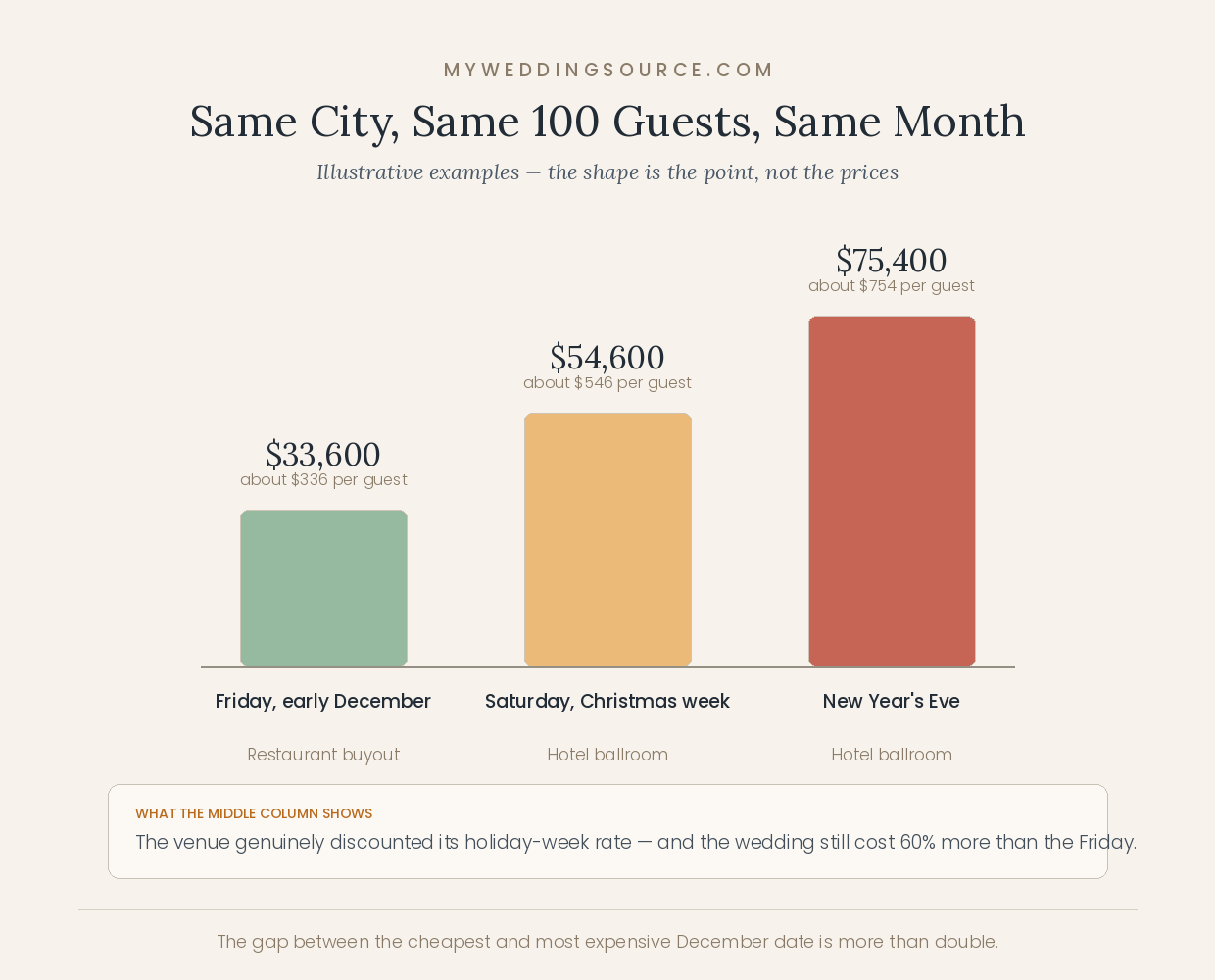
These are constructed examples, not quotes. They use plausible mid-market U.S. figures to show how the same guest count moves across three December dates. Your market may run substantially higher or lower; use the shape rather than the numbers.
Scenario A: Friday, early December, restaurant buyout
| Line item | Cost | Note |
|---|---|---|
| Venue minimum (food and drink) | $12,000 | Friday minimum well below Saturday |
| Service charge and tax | $3,800 | 22% service plus sales tax |
| Photography, 8 hours | $3,800 | Earlier start for daylight portraits |
| Flowers and decor | $2,600 | Greenery-led; restaurant already atmospheric |
| Music (DJ) | $1,600 | Friday rate |
| Lighting and rentals | $600 | |
| Stationery | $700 | Mailed early to beat holiday volume |
| Attire and alterations | $2,800 | Both partners, incl. outerwear |
| Coordination (month-of) | $1,800 | — |
| Cake and dessert | $500 | Small cake plus restaurant dessert |
| Transportation | $0 | City venue; guests use rideshare |
| Gratuities | $900 | — |
| Contingency (8%) | $2,500 | — |
| Total | ~$33,600 | about $336 per guest |
Scenario B: Saturday during Christmas week, hotel ballroom
| Line item | Cost | Note |
|---|---|---|
| Venue rental | $4,500 | Discounted to fill a holiday-week date |
| Food and beverage, $145/guest | $14,500 | In-house catering, bar included |
| Service charge and tax | $5,300 | 24% service, tax on the total |
| Photography and video | $6,200 | Includes a holiday-week surcharge |
| Flowers and decor | $5,500 | Peak floral demand week |
| Lighting | $1,800 | Reception entirely after dark |
| Band | $4,500 | Competing with corporate party season |
| Rentals | $1,200 | Linens, glassware upgrades |
| Stationery | $900 | Earlier mailing, some rush |
| Attire and alterations | $3,200 | — |
| Shuttles | $1,600 | Winter roads, extra return trips |
| Coordination | $2,500 | — |
| Cake | $700 | — |
| Weather contingency | $1,200 | Snow removal, coat check staff |
| Gratuities | $1,500 | — |
| Contingency (8%) | $4,000 | — |
| Total | ~$54,600 | about $546 per guest |
Notice what happened. The venue genuinely discounted, and the wedding still cost sixty percent more than Scenario A — because catering scaled with a ballroom rather than a restaurant, and because six other categories carried holiday-week premiums the venue discount did not touch.
Scenario C: New Year’s Eve, hotel ballroom
| Line item | Cost | Note |
|---|---|---|
| Venue rental | $9,000 | Top-tier date, above peak-season Saturday |
| Food and beverage, $175/guest | $17,500 | Higher minimum on the date |
| Midnight service and late-night food | $2,000 | Champagne pour, late snack |
| Service charge and tax | $9,700 | 24% service, tax on the total |
| Photography and video | $7,500 | Premium date, coverage past midnight |
| Flowers and decor | $6,500 | — |
| Lighting | $2,500 | Full evening event |
| Band | $7,000 | Highest-demand night of the year |
| Rentals | $1,500 | — |
| Stationery | $1,000 | — |
| Attire and alterations | $3,500 | Formal dress code |
| Transportation | $3,200 | NYE rates; late-night returns essential |
| Coordination | $3,000 | — |
| Cake and dessert | $900 | — |
| Vendor overtime past midnight | $1,800 | The line most NYE budgets forget |
| Gratuities | $2,200 | — |
| Contingency (8%) | $5,600 | — |
| Total | ~$75,400 | about $754 per guest |
Same month, same guest count, same city. The gap between the cheapest and most expensive December date in this example is more than double, and almost none of it is explained by how nice the wedding is.
The December Line Items Most Budgets Miss
These are the costs that turn a well-planned budget into an over-budget one, because they are invisible until they are urgent.
- Lighting, because of the sunset. A reception that runs entirely after dark needs uplighting, pin spots, or an overhead element. Frequently $800 to $3,000 depending on the room and the rigging.
As you navigate your December wedding cost, it’s crucial to remember that the unique aspects of winter weddings can add both beauty and expense. Factor in the December wedding cost variations to ensure your budget reflects the true nature of your celebration.
- Heating and generators for any tented or partly outdoor element. Heaters, fuel, and the power to run them are a package, not a single rental.
- Snow removal and treatment, including whether the venue does it, how many times on the day, and whether it is billed.
- Coat check. Two hundred coats need a room, hangers, and usually a staffed position.
- Holiday labor premiums, which vendors may or may not itemize. Ask.
- Vendor overtime past midnight, which is a New Year’s Eve certainty rather than a risk.
- Extra photography hours to capture daylight portraits before an early sunset.
- More transportation, because winter roads mean slower routes and often additional trips.
- Shipping and rush fees on stationery, favors, and anything arriving in December.
- A weather contingency, whether that is an indoor backup, a tent on standby, or event insurance.
- Guest comfort supplies: blankets, hand warmers, hot drinks, mats at entrances. Individually small, collectively a line item.
A realistic December budget carries a contingency of eight to twelve percent rather than the five percent that suits a June wedding. The reason is not pessimism; it is that more of the plan depends on conditions.
Regional Caveats
Everything above assumes a market with a real winter. Two other situations behave differently.
In warm-weather destination markets, December is peak season. Phoenix, Palm Springs, South Florida, coastal Southern California, and much of the Gulf Coast see their best weather and highest demand in winter. In those markets a December Saturday can cost more than a July one, and the off-season logic in this article inverts entirely.
In snow-belt and mountain markets, December splits. Ski towns are in high season, with lodging priced accordingly, while nearby non-resort towns are in genuine low season. A wedding forty minutes from a resort can cost a fraction of one inside it, though your guests’ lodging costs may not fall as much.
In the Northeast, Midwest, and interior Northwest, the pattern in this article holds most strongly: real venue discounts, real weather costs, and a sharp premium at the end of the month.
Where Negotiation Actually Works in December
Negotiation in weddings is mostly about choosing a date and a structure rather than about asking for a discount. These are the levers that genuinely move.
- Day of the week. The largest single lever available. A Friday or Sunday in early December can be dramatically less than the Saturday beside it.
- Time of day. A lunch or early-afternoon wedding uses less alcohol, shorter staffing, and daylight, which suits December’s early sunset rather than fighting it.
- Food and beverage minimums. Often more negotiable in low season than the rental fee itself, and worth more.
- Package inclusions. Additional setup time, a waived ceremony fee, upgraded linens, or an extra hour are easier to obtain than a lower headline price.
- Filling a specific gap. If a venue has an unsold date close to the wedding, that is where flexibility lives.
- Bundling. Ceremony and reception in one place, or a photographer’s second shooter and album together, can be priced better than separately.
What rarely works: asking a vendor to match a competitor, asking for a discount on New Year’s Eve, or asking for a lower rate on a date the venue can easily sell. Ask about specific items rather than requesting a general discount, and ask politely and early.
Contract Questions Specific to December
Read these clauses before you sign anything for a December date. The answers are the difference between a budget and a guess.
- Is there a holiday or seasonal surcharge, and which dates does it cover?
- Does the off-season rate apply to our specific date, or is our date carved out?
- What is the food and beverage minimum for this date, and does it differ from other December dates?
- At what point does overtime begin, and what is the hourly rate per staff member?
- Who is responsible for snow removal and treating walkways, how often on the day, and is it billed?
- Does the venue have heating in every space we are using, including the ceremony space and the restrooms?
- What lighting is included, and what does it cost to add?
- Is a coat check included, and is it staffed?
- What are the load-in and strike windows, and do they change over the holidays?
- What happens if a weather emergency prevents the event, and what is the postponement policy?
- Are there other events in the building on our date, and does that affect access?
- What is the deposit schedule, and are payments due before or after the holidays?
Why National Averages Mislead
Any figure you read for “the average American wedding” blends a courthouse ceremony in Ohio with a two-hundred-guest weekend in Napa, then averages markets that differ by a factor of three. It is a fine number for a headline and a poor number for a budget.
Two better approaches. First, build from your own quotes: three venues, three caterers, and your actual guest count produce a far more accurate picture than any national figure. Second, when comparing a number you read a year ago to what you are quoted now, remember that prices move. The Bureau of Labor Statistics publishes the Consumer Price Index, which is a reasonable neutral reference for how much general prices — including food, apparel, and services — have shifted since an article was written.
Treat every figure in this guide, and in every other wedding cost article, as a shape rather than a price. The relationships between the scenarios are the useful part; the absolute numbers belong to your market and your year.
How to Build the Number From Zero
Guest count is the multiplier, not a detail
Before any of the December-specific reasoning applies, one thing has to be settled: how many people are coming. Guest count multiplies the largest categories directly — food, beverage, service charge, tax, rentals, transportation, stationery, and favors all scale with it — and it sets the size of venue you need, which then scales the rental fee and the lighting and heating required to fill it.
This matters more in December than in June because several of the season’s costs are per-guest rather than fixed. Coat check scales with guests. Shuttle capacity scales with guests. Blankets, hot drinks, and hand warmers scale with guests. Reducing a hundred-guest December wedding to seventy-five typically saves more than every negotiation in this article combined, and it is the only lever that gets harder to pull the longer you leave it.
A useful early exercise: take the total number you can realistically spend, subtract a contingency of ten percent, then divide by your guest count. If the remaining figure is uncomfortable once you account for catering and service charge alone, you have learned something valuable before you have signed anything.
How a December allocation differs from a June one
Most wedding budget templates were written for a summer Saturday, and they allocate accordingly: a large share to catering, a substantial share to photography and flowers, and a small residual for everything else. A December budget needs three deliberate adjustments to that shape.
More to lighting and environment. A category that barely exists in a June budget becomes structural in December. If a template gives you two percent for lighting, a winter evening wedding may need four to eight percent depending on the venue, and that money has to come from somewhere.
More to transportation and guest comfort. Winter roads, longer shuttle rotations, coat check, and the small supplies that keep guests warm all sit in a category that summer weddings can largely skip.
Potentially less to flowers, if you design with the season. This is the offset. A greenery-led, candle-heavy December design can cost meaningfully less than an equivalent summer floral scheme, while looking more appropriate to the room. Couples who fight the season here pay twice: once in supply premiums, and again because pale spring palettes are the least flattering choice in a dark, warmly lit winter room.
Two ways to move the number without changing the wedding
If your first complete estimate comes in above what you want to spend, the two changes that move the most money without altering how the day feels are the date and the format.
The date: moving from a Saturday to a Friday, or from the third week of December to the first, changes the rental fee, the minimum, the music rate, and often the photography rate at once. Nothing about the guest experience changes.
The format: an earlier start suits December’s daylight and shortens the event. A lunch or late-afternoon wedding uses less alcohol, fewer staffing hours, and less lighting than an evening reception ending at midnight, and it lets guests travel home in daylight — which in winter is a genuine kindness rather than a compromise.
Payment Timing Over the Holidays
One practical wrinkle specific to a December wedding: your deposits, balances, and final payments all fall during a period when your own household spending is at its annual peak, and when many vendors are closed.
Final balances usually fall before the holidays
Most vendors require final payment somewhere between two and four weeks before the wedding. For a wedding between Christmas and New Year, that means writing several large checks in late November and early December — the same weeks as holiday travel, gifts, and everything else. Map every payment deadline onto a calendar the month you book, and check whether any of them can be shifted earlier into a quieter month.
Vendors are closed when you need answers
Many wedding businesses operate on reduced hours from around December 20 through the first working week of January. If your final details, seating chart, or timeline questions land in that window, expect slow replies. Build your final-details meetings into early December rather than the week before.
Guest-side deadlines move too
Hotel block cutoff dates, RSVP deadlines, and final headcounts all behave differently when they fall across the holidays. Set your RSVP deadline before the holiday period rather than during it, since replies sent in the last two weeks of December reliably arrive late, and your caterer’s final count deadline will not move to accommodate them.

Common Mistakes
Budgeting from the venue discount
The rental saving is real and it is one line among twenty. Build the whole budget before deciding the date is cheap.
Treating December as one month
The first week and the last week are different pricing environments, and the gap between them can exceed the gap between December and June.
Forgetting that the reception happens in the dark
Lighting is structural in a December wedding, not decorative. A budget without it is a budget that will grow.
Assuming your guests will all come
A holiday-week wedding asks people to spend during their most expensive fortnight. Model a lower acceptance rate, then be pleased if you are wrong.
Skipping the weather contingency
Eight to twelve percent, not five. More of a December plan depends on conditions that can change.
Missing the overtime clause
On New Year’s Eve, running past midnight is the plan rather than the risk. Price it before you sign.
Comparing quotes that include different things
One venue includes lighting, staffing, and a coat check; another includes a room. Rebuild both as a total at your real guest count before comparing.
Booking flowers on a spring palette
Pale, delicate, out-of-season palettes cost the most in the busiest floral month of the year. Greenery, branches, and candles are both seasonal and inexpensive.
Leaving stationery to December
The highest mail volume of the year, plus rush production, plus your invitation arriving in a stack of holiday cards. Order and mail earlier.
Total-Cost Worksheet
Fill this with your own quotes rather than the illustrative figures above. Compare two dates side by side — ideally an early-December Friday and the Saturday you are considering.
Venue and catering
- ☐ Rental fee for this specific date: ____________
- ☐ Food and beverage minimum for this date: ____________
- ☐ Cost per guest × guest count: ____________
- ☐ Service charge %: ______ Sales tax %: ______ Applied to what: ____________
- ☐ Cake cutting, vendor meals, corkage: ____________
- ☐ Overtime trigger and hourly rate: ____________
Creative and entertainment
- ☐ Photography, including extra hours for daylight portraits: ____________
- ☐ Video: ____________
- ☐ Music, plus any holiday or NYE premium: ____________
Understanding the December wedding cost can help you make informed decisions about your venue and vendor selections. Many couples overlook the implications of peak holiday pricing, which can significantly impact your overall December wedding cost.
- ☐ Flowers and decor: ____________
- ☐ Lighting, quoted specifically: ____________
Winter-specific
- ☐ Heating, generators, fuel: ____________
- ☐ Snow removal and treatment — included or billed? ____________
- ☐ Coat check, staffed or not: ____________
- ☐ Transportation, including extra winter trips: ____________
- ☐ Guest comfort supplies: ____________
- ☐ Weather contingency or event insurance: ____________
Everything else
- ☐ Stationery, including shipping and any rush: ____________
- ☐ Attire and alterations: ____________
- ☐ Coordination or planning: ____________
- ☐ Cake and desserts: ____________
- ☐ Gratuities: ____________
- ☐ Contingency at 8–12%: ____________
- ☐ Total, and total ÷ guest count: ____________
Frequently Asked Questions
Is a December wedding actually cheaper?
Sometimes, and it depends almost entirely on which December date you choose. The first two weeks, especially on a Friday or Sunday, are genuinely among the better-value dates in the American wedding calendar, mainly through venue rental and food and beverage minimums. Christmas week carries holiday labor premiums across most vendor categories, and New Year’s Eve is typically priced above a peak-season Saturday. Early January is often cheaper than any of them and is rarely considered.
How much cheaper is an off-season venue?
It varies enormously by market and venue, and the honest answer is that you should ask each venue for its own seasonal tiers rather than rely on a percentage. What is more useful than the headline discount is whether the food and beverage minimum drops, because at a hundred guests the minimum usually matters more than the rental fee. Ask for a full estimate for your guest count on two different dates — the difference between those two totals is the only number that means anything.
Why do flowers cost more in December?
Because December is the busiest month of the year for the floral supply chain. Holiday installations, corporate work, and retail demand compete for the same stems, the same freight capacity, and the same labor, and installation crews are booked. Certain varieties carry a genuine seasonal premium in the last two weeks of the month. The practical workaround is to design around what is abundant and inexpensive in winter — evergreens, greenery, branches, dried elements, and candles — rather than around a pale spring palette.
What does a New Year’s Eve wedding cost compared with a normal date?
In most markets, meaningfully more across nearly every category: venue, catering minimums, music, transportation, and photography can all carry a premium, and vendor overtime past midnight is a certainty rather than a risk. In the illustrative scenarios in this article, the same hundred-guest wedding runs roughly twice the cost of an early-December Friday. If the date matters to you, it can be worth it — but it should be a choice made with the number in front of you rather than an assumption that December is cheap.
What costs exist in December that do not exist in June?
Lighting is the big one, because sunset before five means the reception happens entirely under light you provide. Then heating and possibly a generator for any outdoor or tented element, snow removal and treatment, a staffed coat check, additional transportation for winter roads, extra photography hours to capture daylight, and a weather contingency. Individually each is modest; together they commonly account for several thousand dollars that a summer budget simply does not carry.
How much contingency should we hold?
Eight to twelve percent for a December wedding, rather than the five percent that suits a summer one. The reason is not pessimism but exposure: more of the plan depends on conditions that can change, including weather, guest counts affected by travel, and vendor availability during a compressed holiday period. Hold the contingency as a real reserve rather than allocating it in advance, and treat any of it you do not spend as a genuinely good outcome.
Will fewer guests come to a holiday-week wedding?
Often, yes, and it varies with how far people are traveling. A holiday-week date competes with existing family plans, and it asks guests to buy flights and hotel rooms during the most expensive fortnight of their year. Many couples find their acceptance rate lower than expected, which cuts both ways: it reduces your catering cost and it means some people you wanted are not there. Model a lower acceptance rate when you plan, and give guests as much notice as possible, ideally eight to twelve months.
Can we negotiate a better price for a December date?
The December wedding cost can vary widely based on the specific date chosen. It’s essential to evaluate every aspect of the December wedding cost, including venue availability and seasonal pricing.
You can often improve the structure of a deal rather than the headline price. The strongest levers are choosing a Friday or Sunday, choosing an earlier time of day, and negotiating the food and beverage minimum or package inclusions rather than the rental fee. Asking about specific items — extra setup time, a waived ceremony fee, an upgraded linen, an additional hour — works better than asking for a general discount. Almost nothing is negotiable on New Year’s Eve.
Is early January really cheaper than December?
In most winter markets, yes, and it is the most overlooked date range in this article. Demand collapses after New Year’s Day, venues are keen to fill dates, and guests have no competing holiday commitments and cheap travel. The trade-offs are weather risk at its highest and a slightly awkward proximity to the holidays for anyone still recovering. If cost is your primary constraint and you are comfortable with the weather planning, it is worth pricing alongside December.
How do we compare two venue quotes fairly?
Rebuild both as a total cost at your actual guest count, including everything each one excludes. One venue may include lighting, staffing, a coat check, and tables; another may include a room and nothing else. Add service charge and tax the way each contract applies them, then add the winter-specific items each venue does or does not cover — heating, snow removal, coat check, and load-in access. Compare those two totals. The lower headline rental fee frequently loses.
Price the Date, Not the Month
December is not cheap or expensive. Specific December dates are, and the difference between them can be larger than the difference between December and peak season. An early-December Friday genuinely saves money. A Christmas-week Saturday trades a venue discount for premiums in six other categories. New Year’s Eve costs more than most peak-season Saturdays, and it can still be entirely worth it if that is the wedding you want.
The sequence that produces a reliable number: choose two or three candidate dates rather than a month, get a complete estimate for each at your real guest count, add the winter-specific lines that do not appear in a summer quote, apply an eight to twelve percent contingency, and only then compare. The date that looked cheapest at the rental fee is frequently not the one that is cheapest at the bottom of the page.
When considering the December wedding cost, remember that each aspect can influence your overall budget in unexpected ways. Always plan ahead and review potential December wedding cost variations before finalizing any arrangements.
And if your reason for choosing December is that you love winter weddings rather than that you are trying to save, that is a perfectly good reason. Just build the budget for the season you actually chose.
Your next step
Pick two December dates — ideally an early-month Friday and the Saturday you are actually considering — and ask the same venue for a complete estimate on both at your real guest count, including service charge, tax, lighting, and anything weather-related. One email, one reply, and you will know what the date is costing you rather than what the month is supposed to cost.
