
Knowing how to verify a wedding vendor’s business registration and reviews comes down to two plain questions: is this business a real, traceable company that is allowed to do the work, and does what past customers say add up to a believable picture, and you can answer both in an evening with free public tools before you pay a deposit.
Quick answer
Collect every name the vendor uses (brand, legal entity, and the name on the invoice), then look the legal name up in the business registry of the state where the vendor operates. Next, ask the vendor which licenses or permits apply to the work and check any license with the issuing agency. Read reviews on at least three separate places and look for patterns rather than star averages, such as sudden bursts, vague praise, or hostile replies to complaints. Ask for two recent references, request insurance proof and call the insurer, and pay with a credit card rather than cash. A clean result lowers your risk but never removes it, so keep the paper trail. This is general information, not legal advice, and rules differ by state. Sources were checked on November 12, 2026.
How to verify a wedding vendor’s business registration and reviews: what checking can and cannot tell you
Most couples who search for how to verify a wedding vendor’s business registration and reviews end up checking vendors in one of two ways. Some skip it, because the vendor was recommended by a friend or looked polished on social media. Others spend hours scrolling reviews without ever finding out whether the business behind the photos exists on any official record. Neither habit is unreasonable, and both leave gaps. A short, structured approach to how to verify a wedding vendor’s business registration and reviews closes most of them, and it works the same way whether you are hiring a florist for a backyard wedding or a caterer for a ballroom.
This guide on how to verify a wedding vendor’s business registration and reviews is built around a single idea: every claim a vendor makes about itself can be tied to a document or a record that someone other than the vendor controls. A registry entry is controlled by a state office. A license is controlled by the agency that issued it. An insurance policy is controlled by a carrier. Reviews are controlled by the platforms that host them and, in part, by the law. When you compare what the vendor says with what those outside records say, you are doing due diligence in the plainest sense.
Three questions behind every check
It helps to keep three questions separate, because each one is answered by a different source and each one can fail independently. A vendor can be properly registered and poorly reviewed. A vendor can have glowing reviews and no registration on record. A vendor can have both and still be uninsured for the work you are asking for.
Does this business exist on record?
The first question is about identity. Registration with a state is how most companies that are not run by one person under their own name become legally separate from their owners. According to the U.S. Small Business Administration, LLCs, corporations, partnerships, and nonprofit corporations usually register with the state where they do business, often through the Secretary of State or a similar agency. If a vendor tells you it is an LLC, there should be a matching record you can find yourself. That is the check this guide calls the registration check.
Is it permitted to do this work?
The second question is about permission. Registration alone does not authorize a business to cut hair, serve alcohol, or inspect a kitchen. The SBA explains that required licenses and permits depend on the business activity and location, and that they can sit at the federal, state, and local level. For a wedding vendor, the relevant permission might be a professional license, a food or health permit, or a local business license. Which one applies is a question for the vendor and the issuing agency, not something this guide can settle for every state.
What did other customers actually experience?
The third question is about track record, and reviews are the most visible evidence for it. They are also the easiest to distort. The Better Business Bureau advises reading reviews across several sites instead of relying on one, because patterns across platforms are more informative than a single score. Later sections show how to do that and what the federal rule on fake reviews actually prohibits.
The limits of any lookup
Verification lowers risk. It does not eliminate it, and it is worth being clear about that before you begin, so a clean result does not give you false comfort and a messy one does not make you jump to conclusions.
A registry entry proves existence, not quality
A registry record tells you that a legal entity was formed and, depending on the state, whether it is currently in good standing. It does not tell you whether the owner is a good photographer, a punctual caterer, or an honest negotiator. Many excellent vendors are sole proprietors with no entity at all. Many mediocre ones have perfectly tidy filings. Treat the registration check as a test of whether the business can be found and held accountable, not as a grade.
A review profile is evidence, not a verdict
A star rating compresses hundreds of different experiences into one number. Two vendors with the same average can have completely different histories, and one unhappy customer can reflect a mismatch of expectations rather than a failure. The goal of reading reviews is to form a hypothesis, such as “this florist is strong on arches and slow on replies,” and then to test that hypothesis with references and direct questions.
This is education, not legal advice
State laws differ on what a vendor must register, what a contract must say, and what remedies exist when something goes wrong. Nothing here is legal, financial, or insurance advice. For a large contract, a dispute, or a vendor that is not responding, a licensed attorney in your state or your state’s consumer protection office is the right next call. We also say where a statement comes from a retailer, a trade source, or a government page, and where it is our own judgment.
Start with the name chain
Nearly every attempt at how to verify a wedding vendor’s business registration and reviews stalls for the same dull reason: the person searching typed the wrong name. A wedding vendor usually appears under several names at once, and the official record will be filed under only one of them. Before you search any database, build a short list of every name attached to the business. We call this the name chain, and the figure below shows how the names usually relate.

Collect every name the vendor uses
You can gather the chain from material the vendor has already given you. Open the website footer, the contract draft, the invoice or payment link, the social profile, and the email signature, and write down every business name you see. Differences between them are normal, and the next three subsections explain why.
The brand name
The brand name is what you saw first: the name on the Instagram account, the marketplace listing, or the sign at a bridal show. It is chosen for marketing and may not be a legal name at all. Searching a state registry for a brand name often returns nothing, which can look alarming even when everything is in order. Treat the brand as the start of your list, not the thing you search.
The legal name and the trade name
The SBA distinguishes an entity name, which is registered with the state, from a DBA, also called a trade, fictitious, or assumed name, which gives the business a public name different from its legal name. The SBA adds that a DBA does not provide legal protection by itself, and that most states require one to be filed if you use it. So a studio that trades as “Willow & Pine Florals” might be legally “WP Events LLC.” You want both names, and you want to know which one will appear on the contract.
The name on the contract and the payee
The most useful name is the one you will actually pay. Look at the payment link, the check payee line, or the card processor descriptor that will appear on your statement. If the contract names one company and the payment goes to another, ask why before you send money. Plenty of small businesses use a payment service or a parent company, so a mismatch is a question, not an accusation. The answer should be easy to give and easy to put in writing.
Find the right office to search
Once you have the names, decide where to look. The right office depends on the kind of business and where it operates, and a few minutes spent choosing it saves a lot of confusion.
State business registries
The National Association of Secretaries of State explains that most of its member offices handle registration of domestic and foreign businesses, for-profit and nonprofit, and that selecting a state on its page leads to that state’s business registration pages and name database. Start there, or search the Secretary of State website for your vendor’s home state. Each state has its own search tool and its own vocabulary, so expect the layout to differ.
Local and county filings
The SBA says registration of a trade name is handled at the state, county, or city level, and that counties and cities may also require licenses and permits of their own. If a vendor operates under a trade name, the filing may sit in a county clerk’s records rather than the state database. When a state search turns up nothing, a county or city search is a reasonable next step before drawing any conclusion.
Sole proprietors and what an empty result means
The SBA notes that someone operating under their own legal name generally does not have to register, though they may give up the liability and tax protections that registration provides. It also says sole proprietorships do not create a separate business entity. That means a skilled makeup artist or officiant working under her own name may legitimately have no registry record. Absence from a registry is a prompt for a different check, such as a local license, a tax or business ID she is willing to share, and references, rather than proof that something is wrong.
Reading a registry record without over-reading it
A registry search returns a record or a short list of records. Most people glance at the name, see that it exists, and move on. A little more care turns the record into useful evidence, as long as you remember that every state sets up its own database and uses its own words.
What a record can show
State records generally share a few kinds of information. The exact fields differ, so treat the following as things to look for rather than a guaranteed layout.
Entity name and entity type
The record should show the exact legal name and the kind of entity, such as an LLC, a corporation, or a partnership. The SBA describes how these structures differ: owners of LLCs and corporations are generally not personally liable for business debts, while a general partnership typically leaves owners personally exposed. Why does that matter to you? When you pay a deposit to an LLC, your claim for a refund is against the company. Knowing the entity type tells you who is on the other side of the contract.
Registered agent and address
The SBA says LLCs and corporations need a registered agent located in the state where they register. A record usually lists that agent. The agent is a legal contact point and may be a commercial service rather than the vendor’s office, so the address on the record is not necessarily where the vendor works. Still, it gives you somewhere that legal papers can be delivered, which is part of what makes a company traceable.
Status and filing history
Many state databases show whether an entity is active and may list annual reports or past filings. Status words differ across states, and we did not find a single national vocabulary, so read the state’s own definitions before deciding what a particular label means. The SBA mentions that some businesses may need a certificate of good standing, which is a document states can issue to show that an entity has met its filing obligations. If a vendor’s status looks unusual, ask about it plainly and ask for a certificate or an explanation in writing.
Mismatches and what to do about them
Differences between what the vendor told you and what the record shows are the whole reason for checking. The skill is separating mismatches that have ordinary explanations from those that need a real answer.
Mismatches with ordinary explanations
Several differences are common and low risk. The record may list a parent company or a holding entity. The studio may have rebranded after the filing. The record may use “Inc.” where the vendor’s website drops it. A trade name may be filed with the county, not the state. In each case, one question usually settles the matter: “Which legal entity will sign our contract and receive our payments?” A prompt, specific answer is reassuring.
Mismatches that need an answer
Pause when the vendor’s story and the record disagree in ways that matter to your money. Examples include a contract signed by a company that cannot be found, a payee that is a different person’s name with no explanation, an entity whose record shows it has stopped operating, or a vendor who becomes vague when you ask which entity you are contracting with. None of these proves wrongdoing. All of them are reasons to slow down, ask in writing, and avoid paying until the answer is clear.
Vendors who operate across state lines
A vendor may be registered in one state and travel to work in another. The SBA says a business may form in one state and file for foreign qualification in others, which can involve a Certificate of Authority. It also lists signs that a business is “doing business” in a state, such as a physical presence, meeting clients in person there, or employees working there. You do not need to resolve those legal questions yourself. Search the vendor’s home state first, and if the vendor travels often to your venue’s state, ask whether it has any local registrations or licenses and how it handles them.
Registration is not a license, and a license is not insurance
The most common mistake after a clean registry result is to treat it as the end of the process. In practice, how to verify a wedding vendor’s business registration and reviews starts with registration, but registration answers one narrow question. Licenses and insurance answer others, and for some wedding vendors they matter more than the entity filing does.
Which wedding vendors may need a license or permit
There is no single national list of licensed wedding vendors, and we will not pretend to give one. What the sources support is a method: ask what applies, then check with the agency that issues it.
Beauty and personal services
Professional licensing for hair and similar services is run by state agencies, and the details vary. As one example, Washington State’s Department of Licensing offers a public lookup that shows a cosmetology license’s current status, the date it was first issued, and the types of licenses held, and the same tool lists disciplinary actions against licensees and salons. Other states have their own boards and their own rules about which services need a license. For a hair or makeup artist, ask which license the work requires in your state, ask for the number, and check it with the board rather than relying on a photo of a certificate.
Food, alcohol, and venues
The SBA lists restaurants among the activities often regulated locally, and it names the Alcohol and Tobacco Tax and Trade Bureau as the federal agency for alcohol. Practically, that means a caterer, bartender, or food truck may carry a local food permit, and a business that sells alcohol may need alcohol-related permission whose form varies by state and locality. We did not verify the rules for any particular state, so ask the vendor and the venue which permits apply and who holds them. Our guide to choosing a wedding bartender covers one common version of that question.
Everyone else
Photographers, DJs, planners, officiants, and florists may face no vocational license in many places, though local business licenses can still apply. The SBA advises checking the Secretary of State’s website and the county and city sites for the location. If a vendor says no license applies to its work, that can be true. A reasonable follow-up is “How did you confirm that?” A confident vendor can usually answer in one sentence.
Insurance proof that holds up
Insurance questions come up for many vendors and venues, and a certificate shown in a text message is the weakest form of proof. Our wedding insurance guide covers your own policy. This section is about what to ask a vendor to show.
What a certificate of insurance does and does not do
A law firm’s guidance on certificates of insurance, which we read for this guide, lists several limits. A certificate is informational, is not part of the policy, and gives its holder no rights. Being listed as an additional insured does not make someone one, since that status comes from an endorsement added to the policy. Carriers generally are not required to tell certificate holders about cancellation unless the policy says so, and a certificate shows coverage at one point in time. The firm still treats certificates as worth requesting because they identify the carrier and policy number.
Calling the carrier
The BBB’s tip on researching a business says that if a company claims to be insured, you should call the carrier to confirm the policy is active and covers the work. This is the step most people skip, and it takes a few minutes. Ask the vendor for the carrier’s name and the policy number from the certificate, then call the carrier or its agent and ask whether the policy is in force. The carrier may limit what it will discuss, so also ask the vendor to send a current certificate directly from its agent.
What your venue may require
Many venues set their own insurance rules for outside vendors, and the exact requirements are written in the venue’s contract or vendor packet, not in any general guide. Ask the venue coordinator what each vendor must provide and by when, and add those dates to your calendar. Our guide to venue load-in and vendor rules explains how restrictions like these tend to surface late, and our rental damage waiver guide covers what rental coverage can and cannot do.
Reading reviews as evidence
Reviews are the half of how to verify a wedding vendor’s business registration and reviews where most couples spend their time, and where careful reading pays off the most. The goal is not to find a vendor with a perfect score. It is to notice whether the story told by many strangers is consistent with the story the vendor tells, and whether there are signs that the record has been curated.
Where to look, and why one place is not enough
Each platform sees a different slice of a vendor’s customers and applies its own rules. Reading across several places gives you a view that no single operator controls.
Search results and map listings
A business search often returns a map listing with reviews from the general public. Google’s published content policy says reviews must reflect a real experience, and it prohibits paid reviews, multiple accounts, and reviews written by people with a conflict of interest such as employees or relatives. It also says merchants may not selectively ask happy customers for reviews or discourage negative feedback. Those are the platform’s rules, and enforcement is imperfect, so use the listing as one input and not as a certificate.
Wedding marketplaces and social media
Wedding directories and social media tags show a different crowd: people who booked through a particular site or who posted publicly about the day. The BBB recommends searching the business name with the word “reviews” and checking review sites and social media directly. A vendor’s own Instagram highlights are marketing, not reviews, so look at what clients tagged on their own accounts and read the comments under those posts.
The BBB profile and complaint record
The BBB says its Business Profile shows a company’s rating, complaints, and reviews, and that if a business is not listed you can ask your local BBB what information it has. A profile can include complaints and how the business responded. Read the text, not just the letter or score, because the details tell you what kind of problems came up and whether they were resolved. Absence of a profile is not a warning sign by itself, since many small vendors never appear in one.
Patterns that matter more than stars
Once you have read from three or more places, step back from individual comments. The following patterns are our judgment calls and not rules from any source, so use them to decide what to ask, not what to conclude.
Timing and volume
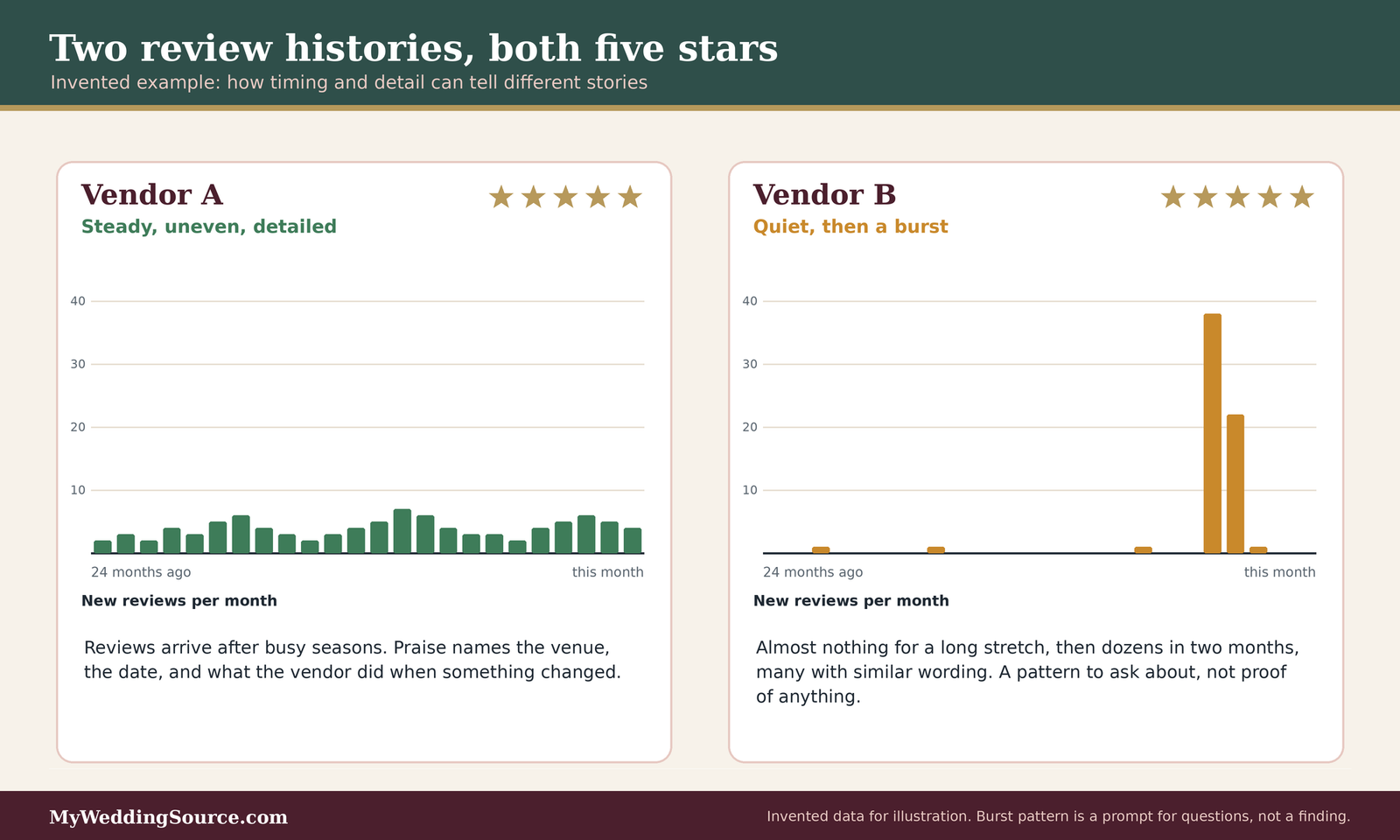
A natural history grows unevenly, with more reviews after busy seasons and a few quiet stretches. A history in which dozens of five-star reviews arrive within a few days after months of silence deserves a question. Google’s policy specifically prohibits unusual volumes or patterns of reviews meant to shift a rating, and Yelp’s published description says its software weighs signals such as reviewer activity. We cannot tell from outside whether any given burst is manipulation, since a vendor may have legitimately asked past clients to post after a long gap, so treat it as a reason to ask for references rather than a finding.
Specific detail versus generic praise
Useful reviews describe things that could be checked: the venue, the date range, what went wrong and how the vendor fixed it, how communication felt, whether the vendor arrived on time. Reviews that say only “amazing, highly recommend” tell you little. When many reviews of a vendor are generic and strikingly similar in wording, that is a reason for more caution, again as a prompt for questions and not as proof. Look at the lowest ratings too, because a single detailed three-star review can be more informative than ten short five-star ones.
How the vendor replies to criticism
How a business responds to a bad review shows how it will respond to you after you have paid. A calm reply that acknowledges the issue and offers a path forward is a good sign. A reply that accuses the reviewer of lying, shares private details of the client’s contract, or threatens legal action is a warning. The FTC’s rule on reviews, discussed next, treats false accusations, intimidation, and unfounded legal threats aimed at stopping a review as a form of review suppression.
What the rules say about fake and pressured reviews
It helps to know what is prohibited, partly so you can weigh what you see and partly so you understand what a vendor is and is not allowed to do to its own review page.
The FTC rule on consumer reviews
According to the FTC’s staff guidance, a federal rule on consumer reviews and testimonials took effect on October 21, 2024. The guidance says the rule prohibits writing, buying, or selling fake or false reviews; offering incentives that are conditioned on a particular sentiment; insider reviews that do not disclose the reviewer’s relationship with the business; company-controlled sites that pose as independent review sites; review suppression by false accusations, intimidation, or unfounded legal threats; and misuse of fake social media followers. The guidance says courts can impose civil penalties for knowing violations, that individuals cannot sue under the rule, and that ordinary consumers are not liable for what they write. It also says the page is staff guidance and not a safe harbor.
Platform rules and filters
Platforms layer their own rules on top. Google’s policy says rewards for reviews, or for removing negative ones, lead to removal. Yelp says its recommendation software is automated, scores reviews using many signals, and treats reviews solicited by the business as potentially more biased. Yelp also says reviews that are not recommended remain reachable by a link at the bottom of a business page and do not count toward the star rating or review count. So a vendor’s Yelp score may reflect only a portion of what was written, and it can pay to look at the hidden section too.
What you can and cannot conclude
Rules on paper do not tell you what happened on a specific page. A vendor with a handful of reviews may simply be new. A vendor with only glowing reviews may have good service, or it may have asked only satisfied clients to post, which the FTC’s endorsement guidance says advertisers should not do. A vendor with several detailed complaints and a calm, specific response may be a better bet than one with a spotless page. What you can do is form a question list and test it. Our guide to wedding website scam messages covers a different problem, where the “review” arrives as a message asking you to pay or click.
References, complaints, and the people behind the page
Reviews are public and self-selected. Two other sources add direct, human information: references you request and complaint records kept by consumer organizations and government offices. Use them to confirm or challenge the picture you built from reviews.
Asking for references
The BBB’s research tip says established businesses with satisfied customers usually can provide references, and that you should be wary of a company that refuses or discourages contact with past clients. A request for references is routine in many trades, though some wedding vendors have confidentiality or privacy limits on sharing client details, so ask politely and accept a reasonable alternative.
Choosing what to ask for
Ask for two or three recent clients with events of similar size and type to yours, preferably in the last year or two. A vendor who offers only its three best-known weddings from five years ago has told you something. Also ask for a client whose event had a problem, and how it was handled. Some vendors can offer this and some cannot, and either answer is information. If the vendor offers sample galleries or sample deliverables, ask whether you may see a full gallery or complete set from one wedding rather than selected highlights.
Questions for a past client
Keep the call short and specific. Useful questions include whether the vendor arrived and finished on time, whether the final result matched what was promised in the contract, how they handled a change or a problem, whether the final invoice matched the quote, and whether the client would hire them again for a similar event. Ask what the vendor did when something went wrong, because that is where vendors differ most. Our vendor due diligence checklist lists reference questions alongside the other checks.
Complaints and regulators
Complaint records are not a ranking. They are a record of what people chose to report and how the business responded.
Consumer organizations and state offices
The BBB’s tip says you can contact your state Attorney General, who may not share details but may confirm whether it has received complaints about a business. USA.gov explains how to find your state consumer protection office, which may be run by the attorney general or by a separate agency, and says these offices handle complaints against businesses and investigate scams and fraud. These are also the places to file your own complaint if a problem arises, and the same directory lists offices by state.
A complaint is an allegation, not a finding
Treat a complaint count or a single negative report with the same care you would apply to a single glowing review. A complaint may be unresolved, resolved, unrelated to your concern, or disputed. What matters is the pattern: the same problem repeated, the same unanswered question, or a business that never responds. If you find something worrying, put the question directly to the vendor in writing and judge by the answer.
The verification calendar: who sends what, and when you approve
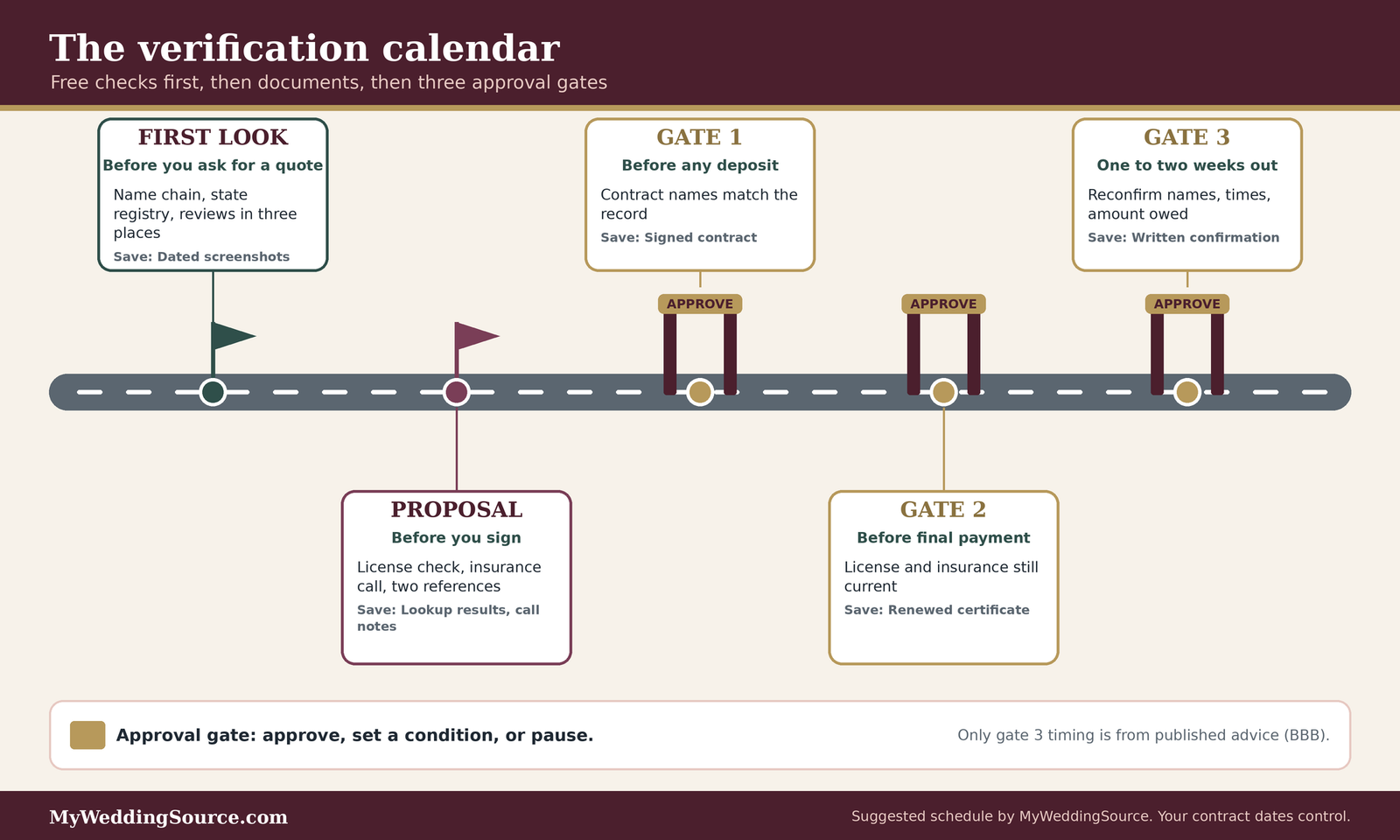
Knowing how to verify a wedding vendor’s business registration and reviews is not enough if the checks happen in a rush on the night before signing, because they tend to be shallow, and checks done once and forgotten can go stale. A calendar fixes both. It gives each check a date, names who must deliver the document, and marks the moment when you either approve the vendor or step back. The calendar below is our own suggested structure, not a published standard, so adjust the timing to your engagement length and to the dates written in your contracts.
The calendar from first contact to the final week
The only date in this section that comes from a published source is the final reconfirmation. The BBB’s wedding tips say to verify all details with each vendor one or two weeks before the event. Every other timing is a suggestion and should give way to your contract.
Before you inquire
Spend ten minutes on the free checks before you ask for a quote. Build the name chain from the vendor’s website and profiles, search the state registry for the legal name if there is one, and skim reviews on three places. This step costs nothing and keeps you from investing time in a vendor who cannot be found. If the vendor works under a personal name, skip the registry step and note that you will ask about licenses and references instead.
Before you sign
Between receiving a proposal and signing, work through the remaining checks. Ask which license or permit applies and check it, ask for a certificate of insurance and the carrier’s details, request two references, and confirm the exact legal name and address that will appear on the contract. Our vendor contract guide explains what the signed document should contain, and the red-flag review in our due diligence checklist covers contract language that deserves a second look. Do not pay a deposit until the legal name on the contract matches what you verified.
After you sign
Within a few weeks of signing, file the proof. Save the registry search result with the date, a screenshot or PDF of the license lookup, the certificate of insurance, and your notes from reference calls in one shared folder. Add the renewal or expiry dates you can see, since the SBA reminds business owners to track renewal dates because some licenses and permits expire. A document that was valid at signing may lapse before the wedding.
In the final weeks
Repeat the quick checks about one to two weeks before the wedding, in line with the BBB’s reconfirmation advice. Reconfirm the name of the person arriving, the arrival time, the final amount owed, and whether the license and insurance are still current. If a vendor’s certificate had an expiry date before your wedding, ask for the renewed one now. Our vendor timeline guide and communication deadlines guide show how to fit these dates into the wider schedule of vendor tasks.
Who approves what
A calendar of checks is only useful when someone owns each one. Decide in advance who sends the document, who reviews it, and who says yes, so a delayed reply does not quietly become an approval by default.
What the vendor owes you, and by when
Ask the vendor to deliver the following documents by dates written into the contract or confirmed in writing: the exact legal name and business address, the license or permit number where one applies, a current certificate of insurance, and, if the work will be done by other people, the names or company names of any subcontractors. The right deadline for each item depends on the vendor. A reasonable ask is that they arrive before you pay the first deposit, and that renewed documents arrive before the final payment.
Your approval gates
Treat three moments as gates. The first is before you pay any money, when the name chain, the registration check, and the review reading must be complete. The second is before the final payment, when proof of license and insurance must be current. The third is the final reconfirmation. At each gate, either approve in writing, note a condition that must be met, or pause. Writing “approved subject to renewed insurance by this date” is better than a vague nod.
Splitting the work between partners and a planner
If you work with a planner or a family helper, agree who contacts which vendors and where the answers are stored. Duplicate requests confuse vendors and conflicting approvals cause trouble. If a planner recommends vendors, ask whether the planner receives any fee or commission from them, because that relationship matters when you weigh the recommendation. Our planner commission disclosure guide explains what to ask.
A tracker you can copy
The table below is a simple version of the calendar. Copy it into a spreadsheet and fill in the dates that apply. The “Evidence to save” column is the part most couples skip and later wish they had kept.
| Stage | Suggested timing | Check | Who delivers | Evidence to save |
|---|---|---|---|---|
| First look | Before requesting a quote | Name chain, state registry search, reviews on three places | You | Dated screenshots or PDFs |
| Proposal | Before signing | License or permit confirmed with the agency | Vendor gives the number, you check | Lookup result with date |
| Proposal | Before signing | Certificate of insurance and carrier call | Vendor and its agent | Certificate and call notes |
| Proposal | Before signing | Two recent references | Vendor | Notes from each call |
| Contract | At signing | Legal name, address, payee match the record | Vendor | Signed contract with names highlighted |
| After signing | Within a few weeks | Expiry dates on license and insurance noted | You | Calendar reminders |
| Mid-planning | Before final payment | Updated insurance and license proof | Vendor | New certificate |
| Final weeks | About one to two weeks out | Reconfirm names, times, and amount owed | Vendor | Written confirmation |
How to read the table
Read the table from top to bottom as a sequence of gates. Nothing in the first three rows costs money, and every row after that depends on the vendor sending something. If a vendor misses a date, do not treat the delay as a verdict. Send a polite reminder, note the date, and decide whether the delay is a pattern.
How to keep it light
The calendar does not require a project manager. For a small wedding with a few vendors, a single shared note listing each vendor, the date each check was done, and a link to the saved evidence is enough. The aim is to find the answer in thirty seconds on a stressful day, not to build a database.
Money, contracts, and keeping your options open
Verification matters most at the moment money moves. The way you pay and the way the contract is written decide how much of the checking you can rely on if something still goes wrong.
Paying in a way that keeps options open
Payment method and timing are protections of their own. They work best alongside the checks rather than instead of them.
Prefer a credit card where the vendor accepts one
The BBB’s wedding tips advise against paying the full amount in advance and recommend paying by credit card rather than cash or other methods, because cards generally offer more protection if something goes wrong. The FTC explains the mechanics for credit card billing errors: you must get a written dispute to the issuer within 60 days after the first bill showing the error was sent, the dispute can cover items not delivered as agreed, and the issuer must acknowledge within 30 days and resolve within 90. Its page also says quality disputes follow different rules, including that the amount generally exceeds $5 and the purchase was made in your home state or within 100 miles of your billing address. It does not cover debit cards. Card rules are technical, so read the FTC page and your card agreement, and do not assume a chargeback will succeed.
Pay in stages tied to deliverables
Where the vendor agrees, split payments into a deposit, a mid-point payment, and a final payment tied to dates and milestones in the contract. This does not prevent a loss, but it limits how much is at risk at any moment. Our credit card reconciliation guide shows how to track what has been charged to which vendor so errors show up quickly.
Cost check
Consider an invented example: a $2,400 deposit and a $3,000 balance for a vendor you booked a year ahead. Verification takes perhaps two hours of your time and costs nothing, while an unverified vendor who closes or vanishes could put the deposit at risk and leave you paying a replacement vendor’s rush rate. The numbers here are illustrative only and are not drawn from any source. The practical point is timing: do the free checks before the deposit, because after payment your leverage is lower and your options are narrower.
Putting what you verified into the contract
A check that is not reflected in the paperwork protects you less. The contract is where verified facts become promises.
Legal names, addresses, and license numbers
Make sure the contract names the same legal entity you found in the registry, with the address and the license number where one applies. If the vendor signs as an individual, the contract should say so. If a payment goes to a different company, have the contract name it. Matching names make it easier to identify who is responsible if you later need a refund or file a complaint. A lawyer can advise on how your state treats a business name mismatch, so seek one for a large contract.
Insurance, subcontractors, and substitutions
If the vendor will send staff you have not met, or hire a subcontractor, ask the contract to say who will do the work and whether you approve any substitute. Our guides to wedding vendor subcontractors and the vendor replacement policy explain what to ask for. Add a line asking the vendor to keep the required insurance in force through the event and to send renewed proof. If something changes later, document it as a written amendment. Our change orders guide explains how.
Edge cases: when the standard checks need adjusting
The routine for how to verify a wedding vendor’s business registration and reviews fits a typical business vendor. Real weddings include friends, venue partners, new companies, and out-of-state travelers. Each needs a small adjustment.
Vendors with unusual structures
Some of the most important people at a wedding are not conventional companies, and rigid checking can feel awkward. The goal is the same, but the evidence will look different.
Friends, relatives, and informal helpers
A friend who offers to photograph the day or bake the cake may have no business, no license, and no insurance. That can be perfectly fine when everyone understands it. Replace the registry check with a short written agreement covering what is being delivered, by when, and what happens if the friend cannot come. Ask whether any venue rule requires proof of insurance from anyone who works at the site, since a venue may not distinguish between paid and unpaid helpers.
Vendors required or recommended by the venue
Some venues require couples to use certain vendors or offer a preferred list. A venue’s vetting is a reasonable starting point, but it is the venue’s process and not yours. Ask what the venue actually checks, whether you can see those documents, and who is responsible if a preferred vendor fails. A venue that has worked with a vendor many times can be a useful reference, so ask what problems it has seen as well as what it likes.
Out-of-state and destination vendors
For a vendor based in another state or country, the registry for the vendor’s home location is the right one, and local license rules for your wedding location may differ. For a destination wedding, local permits and vendor rules vary and are beyond the scope of this guide. Ask the venue or local government which approvals the vendor needs there. Our destination wedding legal requirements guide covers the marriage side of the question.
Situations that complicate the picture
Some cases do not fit a clean checklist. A calm approach is to say what you checked, say what you could not, and decide how much risk you will carry.
New businesses with few reviews
A business that started recently will have few reviews and a short registry history. That is not a flaw. Offset the thin record with stronger checks elsewhere: a confirmed license, a call to the insurer, references from the owner’s previous employer or earlier clients, and smaller staged payments. The BBB advises considering how long a business has operated and whether it has a steady client base, since a newer or struggling company may close before finishing an order, so match your payment exposure to that risk.
Name changes, rebrands, and closures
Vendors rebrand, merge, and sometimes close. If a vendor now operates under a new name, ask when and why, whether the legal entity changed, and who is responsible for contracts signed before the change. The SBA notes that an EIN generally changes when ownership or structure changes, which is one reason a business may appear under a different entity than its old reviews suggest. A reasonable vendor will explain without defensiveness, and the explanation should appear in the contract.
Marketplace listings and agencies
Some vendors are listed through a booking platform or agency, and the contract may be with the platform rather than the individual provider. Verify the entity that will sign and receive payment, then verify the individual who will perform. Ask whether the platform substitutes providers and what its refund policy says. Read the reviews for the specific provider, not only for the platform.
Signs of a scam
The BBB’s wedding tips warn of a known scam in which a buyer sends a fake overpayment check and asks the vendor to forward the difference to a planner, and of very cheap designer dresses from private sellers that may be counterfeit. Other warning signs include pressure to commit on the spot, which the BBB cautions about for bridal expo offers, requests to pay in unusual ways, and a business with no clear physical address or contact details. If something feels wrong, stop paying, keep every message, and contact your state consumer protection office. We have a separate guide to wedding website scam messages.
Deciding what to do with what you found
After you have worked out how to verify a wedding vendor’s business registration and reviews, you have a pile of small findings. Most will be fine. The job now is to decide, calmly, whether to proceed, ask more, or walk away, without letting a single odd detail or a single glowing review settle it.
A simple way to weigh the results
A scoring system should be light enough to use. The approach below is our own and not a published standard, so use it as a thinking aid.
Green, amber, and red findings
Sort each finding into one of three groups. Green means the evidence is clean and checked with an outside source, such as a registry record that matches the contract name or a license confirmed with the issuing agency. Amber means a gap or mismatch with a plausible explanation, such as a new business with few reviews or a trade name filed at the county. Red means a mismatch the vendor will not explain, a refusal to share basic documents, or pressure to pay before you can check. One red finding is usually enough to pause, while several ambers can add up to a conversation.
Match the effort to the exposure
Not every vendor deserves the same scrutiny. A large deposit, a vendor who will handle food or alcohol, or a vendor who will work around guests and equipment warrants the full routine. A small purchase from a well-known retailer may need only a quick name and reviews check. Spend your time where a failure would cost the most or be hardest to repair. This is the same logic our due diligence checklist uses to scale checks to risk.
When to walk away
Walk away when a vendor cannot or will not identify the legal entity that will take your money, refuses every form of insurance proof for work that carries real risk, or pushes you to pay in a way that removes your options. Walking away early is cheaper than recovering later. If you have already paid a deposit, read the cancellation terms in the contract, and consider speaking with a licensed attorney before you decide how to proceed.
Scripts for the awkward moments
Many couples hold back from asking for documents because they worry about seeming distrustful. Established vendors are usually used to the requests. A neutral tone and a routine framing help.
Asking for documents politely
A short message works: “We are finalizing our vendor list and confirm each business’s legal name, license, and insurance before signing. Could you send the legal name that will be on the contract, any license number that applies to your work, and a current certificate of insurance?” Add a date by which you need them. Framing the request as your standard process, not a doubt about this vendor, keeps the tone friendly.
When the answer is vague
If the reply dodges the question, ask once more and make it specific: “Which entity will sign our contract and receive our payments?” If the next reply is still unclear, record both messages and the date and consider that an answer. A vendor who cannot name its own legal entity is asking you to take more risk than a vendor who can.
When a review or complaint worries you
If you find a detailed complaint, share what you read and ask for the vendor’s side: “We saw a review mentioning a delayed delivery in June. Could you tell us what happened and what you changed?” You are looking for specifics and ownership. Avoid quoting reviewers by name or asking the vendor to identify them. That is both unkind and unnecessary.
Questions to ask, and who to ask
The questions below turn how to verify a wedding vendor’s business registration and reviews into conversation. Use the vendor questions in your first substantive call and the source questions when you check with outside parties.
Questions for the vendor
Identity, licensing, and insurance
Good vendors answer these quickly and without irritation. Save the replies with the dates, and ask for documents in writing instead of accepting a verbal yes.
Questions to ask each vendor
- What is the exact legal name of the business that will sign our contract and receive our payments?
- Is that the same name that appears on your website and invoices, and if not, what trade name do you use?
- Which license or permit applies to your work where our wedding takes place, and what is the number?
- Can you send a current certificate of insurance and tell us the carrier and policy period?
- Who will actually perform the work, and do you use subcontractors or other companies?
- Can we speak to two clients from the past year with events similar to ours?
- What happens if you are unable to attend, and how do you handle a replacement?
- How do you respond to a client who is unhappy with a result?
Track record and problems
The last three questions in the box matter more than they look. A vendor who has a clear answer about substitutes, references, and unhappy clients has usually handled those situations before. A vendor who bristles at them has told you how a future disagreement may go. Note the tone as well as the content of each answer.
Questions for the other sources
Outside sources can confirm or challenge what you hear, and they do not take long to ask.
The state registry or Secretary of State
Search by exact legal name and look at the entity type, status, and any registered agent. If the search returns several similar names, check which one lists the address and owner details that match the vendor’s paperwork. If anything is unclear, the state office’s help line can usually explain its own terms, since each state defines its status labels differently.
The licensing board and the insurer
Use the agency’s own lookup tool or call to confirm that a license is current and whether any discipline is on record. For insurance, call the carrier or the vendor’s agent and ask whether the policy is active, what the policy period is, and whether the listed coverage matches the certificate. Write down the date, the name of the person you spoke with, and what they told you, because records of calls help if there is a disagreement later.
The venue, planner, or past clients
Ask your venue coordinator whether it has worked with the vendor, whether it has required documents on file, and whether it has seen problems. Ask a planner about any fee or commission arrangement. Ask past clients specific questions about timeliness, communication, and the final invoice. Each of these sources has its own interests, so weigh what you hear accordingly.
FAQ: verifying a wedding vendor
Registration and licenses
How do I check a wedding vendor’s business registration?
Gather the legal name from the contract or invoice, then search the Secretary of State business database in the state where the vendor operates. The National Association of Secretaries of State links to each state’s search. If you find no record, ask whether the vendor is a sole proprietor or uses a different legal name before concluding anything.
Does a business registration mean a vendor is trustworthy?
No. Registration shows that a legal entity exists and can be identified, which helps if you ever need to pursue a refund. It says nothing about quality, reliability, or honesty. Combine it with license checks where they apply, insurance proof, references, and a careful read of reviews and complaints.
Do wedding vendors need a license?
It depends on the vendor, the state, and sometimes the city. Hair and similar services are often licensed by state boards, food service is often regulated locally, and alcohol sales involve additional permits. Many other vendors face no vocational license. Ask each vendor which license applies and confirm it with the issuing agency.
Reviews and complaints
How can I tell whether a vendor’s reviews are real?
You cannot be certain from outside, but you can look for patterns: reviews on several platforms, specific details, a believable timeline, and calm replies to criticism. Sudden bursts of similar five-star reviews or hostile responses to complaints are reasons to ask for references. The FTC prohibits fake and bought reviews under a rule that took effect in October 2024.
Are vendors allowed to pay for or demand positive reviews?
Under the FTC’s staff guidance, businesses cannot buy or sell fake reviews or offer incentives tied to a required sentiment, and they cannot use intimidation or unfounded legal threats to suppress reviews. Platforms such as Google add their own bans on paid reviews. Individual consumers are not liable under the rule for what they write.
Should I trust BBB ratings?
Treat a BBB profile as one input. The BBB says its profile shows a rating, complaints, and reviews, and its own advice is to check several sources. Read the complaint text and the business’s responses, and remember that many small vendors have no profile at all, which is not a warning sign by itself.
Insurance and payment
Is a certificate of insurance enough proof?
It is a useful start but not proof of coverage by itself. A law firm’s guidance notes that a certificate is informational, is not part of the policy, and reflects one moment in time. Call the carrier to confirm the policy is active, and ask for any endorsement your venue requires.
What is the safest way to pay a wedding vendor?
The BBB advises against paying in full in advance and suggests a credit card because cards generally offer more protection. The FTC says credit card billing disputes must reach the issuer in writing within 60 days of the first bill with the error. Check your card agreement, keep receipts, and ask an attorney about large disputes.
Your next steps
Do the free checks first
Make the name chain this week
The first step in how to verify a wedding vendor’s business registration and reviews is the cheapest. List every name each vendor uses and write down which legal name will go on the contract. Searching the state registry for that name takes a few minutes per vendor. Our wedding planning checklist and planning guide show where vendor research fits in the larger plan.
Read reviews in three places
Read reviews on three separate sites, including the one the vendor does not link to. Write two lines for each vendor about what you noticed, and list the questions you want to ask. Use the questions in this guide as a starting set.
Make the checks part of the paperwork
Ask for documents before signing
Send the polite request for a legal name, license number, and certificate of insurance, with a date. Save every reply in a shared folder with the date. Our guide to wedding vendor contracts explains what to look for in the signed document.
Put renewals on your calendar
Add reminders for the expiry date of each license and insurance policy, and for the final reconfirmation about one to two weeks before the wedding. For a wider view of deadlines, see our communication deadlines guide.
Related reading: Writing fair and useful wedding vendor reviews.
Sources & methodology
How we built this guide
What we relied on
This guide draws on federal and state government pages about business registration, licensing, consumer reviews, and credit card disputes, the BBB’s published tips for researching businesses and planning a wedding, the published review policies of Google and Yelp, and a law firm’s explanation of certificates of insurance. We read each source in November 2026, and the date checked for all of them is November 12, 2026. Where a statement comes from a company or trade source, we attribute it. The schedule, the green-amber-red scoring, and the review pattern tips are our own suggestions and not published standards.
What we did not do
We did not test any vendor, query any state database for a specific business, or give legal, financial, or insurance advice. Registration and licensing rules differ by state and city, and we did not verify them for any individual state beyond the examples cited. Rules and platform policies change, so check the current version of any page before relying on it. Several pages we attempted to fetch were unavailable at the time, and we did not use them.
Source list
Government and regulatory sources
- Federal Trade Commission, Consumer Reviews and Testimonials Rule: Questions and Answers: https://www.ftc.gov/business-guidance/resources/consumer-reviews-testimonials-rule-questions-answers
- Federal Trade Commission, FTC’s Endorsement Guides: What People Are Asking: https://www.ftc.gov/business-guidance/resources/ftcs-endorsement-guides-what-people-are-asking
- Federal Trade Commission, Disputing Credit Card Charges: https://consumer.ftc.gov/articles/disputing-credit-card-charges
- U.S. Small Business Administration, Apply for licenses and permits: https://www.sba.gov/business-guide/launch-your-business/apply-licenses-permits
- U.S. Small Business Administration, Register your business: https://www.sba.gov/business-guide/launch-your-business/register-your-business
- U.S. Small Business Administration, Choose a business structure: https://www.sba.gov/business-guide/launch-your-business/choose-business-structure
- USAGov, State consumer protection offices: https://www.usa.gov/state-consumer
- National Association of Secretaries of State, Corporate registration: https://www.nass.org/business-services/corporate-registration
- Washington State Department of Licensing, Verify cosmetology licenses and exams: https://dol.wa.gov/professional-licenses/cosmetology/verify-cosmetology-licenses-and-exams
Consumer organizations, platforms, and professional sources
- Better Business Bureau, How to research any business before you buy: https://www.bbb.org/article/tips/21401-bbb-tip-how-to-research-any-business-before-you-buy
- Better Business Bureau, BBB wedding tips: https://www.bbb.org/article/money/16783-bbb-wedding-tips
- Google, Maps user contributed content policy: https://support.google.com/contributionpolicy/answer/7400114
- Yelp, How Yelp’s recommendation software works: https://trust.yelp.com/recommendation-software/
- Miller Nash LLP, Why you need more than just a certificate of insurance: https://www.millernash.com/industry-news/why-you-need-more-than-just-a-certificate-of-insurance