

Wedding gift tracking is a small record-keeping system that follows every present, check, and card from the moment it arrives to the day you write the thank-you note, so no giver is forgotten, no return window quietly closes, and no missing shipment goes unreported.
Quick answer
Keep one ledger, with one owner, that gets one new row for every gift the moment it arrives. Each row needs who gave it, how it arrived, what it is (or how much), whether you have thanked the giver, and the date any return or claim window ends. Use a spreadsheet as the master copy, add a printed sheet at the gift table, and photograph every card before you open the next. Wedding gift tracking works best when the same few fields are filled in the same order every time, because the hard part is not the typing, it is doing it consistently across a shower, a wedding weekend, and three months of late deliveries.
What wedding gift tracking has to capture
Most couples treat gifts as a happy side effect of the wedding and handle them with a mental note and a stack of envelopes. That works for ten gifts. It stops working when presents arrive from a registry in four boxes on three days, a guest hands you a card with no last name, an aunt sends money through a payment app, and a package that tracking calls “delivered” is nowhere on the porch. This section defines what the job is, so the rest of the guide has something concrete to build.
The job: one record per gift, from arrival to thanks
A gift record has a start and an end. It starts when anything of value reaches you or is promised to you, and it ends when two things are true: the giver has been thanked, and any item you plan to exchange or return has been dealt with. Everything in between, such as photographing, storing, matching to a guest, and filing an issue, is a step that should leave a mark in the record.
Why memory fails after a long wedding weekend
For wedding gift tracking, the timing is the problem. Wedding days compress a lot of social contact into a few hours, and you will be tired, hungry, and happy. Nobody is at their most reliable for note-taking at 11 p.m. in formalwear. The gifts also arrive across several weeks, which spreads the information thin: a shower gift in April, a registry order in May, a card at the reception in June, and a package in August. A written approach to wedding gift tracking takes the load off your memory at the exact moments it is weakest.
Defining “tracked” so you know when you are done
A useful definition is a done-when test. A gift is tracked when its row shows the giver as they appear on your guest list, the gift or amount, the channel it came through, the date it arrived, and a thank-you status. It is closed when the thank-you status reads “sent” and any open issue, such as a damaged item or a pending return, says “resolved.” Writing those two tests at the top of your ledger turns a vague chore into something you can check off.
Where gifts come from, and what each channel loses
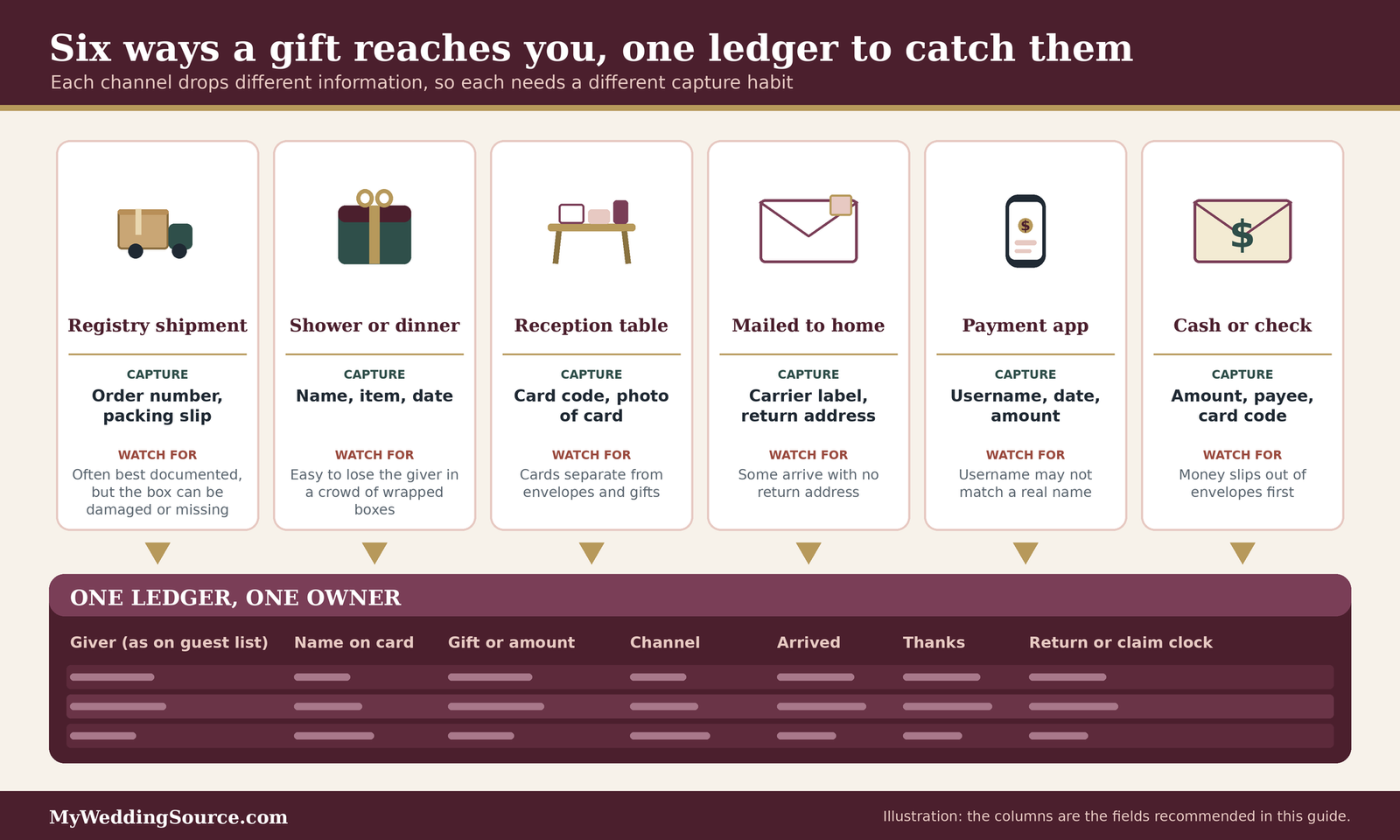
Gifts do not all arrive the same way, and each path drops different information. A registry order carries an order number and a name, but a gift tucked in a bag at the reception may carry only a first name on a card. Thinking in channels shows you where wedding gift tracking will leak before they happen.
Shipped from a registry or an online store
A registry order usually arrives with a packing slip or an order record in your registry account, which makes it the best-documented channel. The risks are logistical: the package may go to an address nobody checks, the box may be damaged, or the delivery may be split across several shipments. Your registry platform may show who bought what, but the platform’s record is theirs, and it can change or disappear, so copy the essentials into your own ledger.
Handed over at a shower, dinner, or the reception
In-person gifts tend to lose the giver. A card might say “Love, the Hendersons,” while your guest list has the household under a single first name. Cash and checks are especially easy to separate from their envelopes. This channel needs the most care in the moment, which is why the gift-table routine later in this guide matters so much.
Mailed to your home, and money sent by app
Packages that guests ship themselves come with no registry record at all, only a carrier label, and some arrive without a return address. Money sent by payment app shows up as a notification with a username that may not match the person’s real name. Both channels reward the habit of logging the gift the day it appears, while the label or notification is still in front of you.
Who owns the record, and who can see it
A ledger with no owner is a ledger nobody updates, and wedding gift tracking without an owner is just a pile of envelopes. The system works when one person is responsible for it, even if several people feed it information. It also holds guest names and addresses, so it deserves a little care.
One keeper, several helpers
Choose one person to hold the master ledger. That is often one half of the couple, but it can be a trusted sibling or friend if you are traveling or the wedding is far away. Everyone else, from the person watching the gift table to the relative who takes in a delivery, sends information to the keeper and does not keep a separate version. Two competing lists are worse than none, because you will not know which one is right.
Treating guest data with care
Your ledger will contain addresses and, for cash gifts, amounts. Keep it in an account that is protected by a strong password and shared only with the people who need it. If you build the ledger from your guest list, which you likely gathered with your save-the-date cards and RSVP wording, copy only the fields you need, such as name, household, and mailing address, and leave out anything unrelated.
Designing the gift ledger
The ledger is the center of wedding gift tracking. It does not need to be elaborate. It needs the right fields, a consistent way of filling them in, and a home you can reach from your phone when something arrives. This section lays out the fields, compares tools, and walks through a small example.
The fields that earn their place
Every column in a wedding gift tracking ledger is a promise to fill it in. Too many columns, and the keeper stops. Too few, and the information you need later is missing. The fields below are grouped by the question they answer.
Identity fields: who is this from?
You need the giver’s name exactly as it appears on your guest list, the household or party it belongs to, and a mailing address for the thank-you note. Add a column for “name on card” because that is often different. If a card says “Aunt Jo and Uncle Ray,” your guest list may carry them as “Josephine and Raymond Alvarez,” and the match between those two is the information you will otherwise lose. A final identity field, “uncertain,” lets you flag a gift whose giver you cannot match yet.
Gift fields: what is it, and how did it arrive?
Record the item description or the amount, whether it was cash, check, gift card, or payment app, the channel it came through (registry, in person, mailed, app), and the date it arrived. Add the order number for registry purchases and a short card code, which is a number you write on the envelope and in the ledger so the two can always be matched. For cash and checks, record the amount, and for checks, the date and who it was made out to.
Status fields: what has happened, and what is still open?
Three statuses carry most of the weight: arrival (received, damaged, missing, or expected), thanks (not started, drafted, sent), and return clock (the date a return or claim window ends, if it applies). A notes column catches everything else, such as “arrived without box” or “duplicate of row 14.” Keep the status values short and fixed, so you can filter on them later without cleaning up spelling.
Choosing a tool: registry dashboard, spreadsheet, or paper
Wedding gift tracking does not require special software. You need a tool you will actually open. Each option has strengths and limits, and most couples end up using two of them together.
What registry gift trackers do, and what they do not
Registry platforms often include a tracker for gifts bought through them. Zola’s help center, for example, says you can mark a thank-you note as sent for each gift in its gift tracker and download a CSV file with fields such as the order number, gift name, quantity, gift value, gift message, the giver’s address, order status, and thank-you note status. That is useful, and exporting it is a good way to seed your own ledger. What it cannot know about is everything that did not go through the platform: cash at the reception, a check in the mail, a gift from a different store. For those, you need your own record, and the rest of the guide assumes you will have one.
A spreadsheet as the master copy
A spreadsheet is the most flexible home for wedding gift tracking because you can sort by giver, filter by status, and share it with a helper. Keep one row per gift, not one row per guest, since some guests give more than once, from a shower gift to a registry purchase. Add a second tab for “issues” if you want a short log of damaged items, missing packages, and return requests. If you have already built a guest list, paste it into a tab so you can look up names and addresses without leaving the file.
A paper sheet at the gift table
A phone is not always at hand at a reception, and handing a guest’s envelope to someone who is juggling a drink and a camera is how gifts go missing. A printed sheet with the same columns, kept on a clipboard near the table, lets a helper write a line the moment a gift is placed. Zola’s advice, in an article about thank-you timing, is similar: keep a printed copy near the gift table at the reception to note gifts as they arrive. After the wedding, the keeper copies the paper sheet into the spreadsheet and photographs the sheet as a backup.
A worked example of the ledger
Seeing real-looking rows makes wedding gift tracking concrete. The rows below are invented for illustration, and no guest in them is a real person. They show the same ledger holding a registry gift, an in-person card, a money gift with an ambiguous name, and a missing shipment.
| Row | Giver (guest list) | Name on card | Channel | Gift or amount | Arrived | Status | Thanks | Clock or note |
|---|---|---|---|---|---|---|---|---|
| 1 | Maya and Dev Rao | Maya and Dev | Registry | Stand mixer, order 1042 | Apr 18 | Received | Sent Apr 25 | Return window to be checked |
| 2 | Josephine and Raymond Alvarez | Aunt Jo and Uncle Ray | In person | Check, $150, card code 31 | Jun 20 | Received | Not started | Deposit check by Jun 23 |
| 3 | Unmatched | “The Ellis crew” | In person | Card with $100 cash, code 32 | Jun 20 | Received | Hold | Compare with guest list |
| 4 | Priya Shah | Priya | Registry | Cookware set, order 1077 | Expected Jun 5 | Missing | Not started | Tracking says delivered, nothing found |
| 5 | Dana Whitfield | Dana | Payment app | $75, username “dw_designs” | Jul 2 | Received | Not started | Confirm name before thanking |
Reading the example
Row 2 shows why the name-on-card column matters: the two names are different, but the card code ties them together. Row 3 shows the “hold” status, which is better than guessing, because a thank-you note addressed to the wrong family is more awkward than a short delay. Row 4 shows that “missing” is a status, not a failure, and that it stays on the list until someone resolves it. Row 5 shows a payment-app gift where the username did not match a name.
Handling a group gift or a shared card
When several people chip in for one gift, create one row for the gift and list each contributor in the notes, or add one row per contributor with the same item. Emily Post says to thank each contributor to a group gift individually, so the ledger should preserve that list. If a group gift arrives with one card signed by many names, photograph it and keep the card with the ledger, because it is the only record of who is included.
Before the wedding: deliveries, damage, and missing shipments
Gifts start arriving long before the ceremony, usually after a shower or once the registry link circulates. This is the stretch where wedding gift tracking prevents the most trouble, because the problems are small and fixable when they are caught on the day they happen. If you wait until after the honeymoon, a “delivered” package that never reached you can be impossible to trace. For the registry choices that feed this stage, see our guide to the wedding registry.
Set up deliveries so every box can be traced
In wedding gift tracking, a package you cannot find is easier to resolve when you know exactly where it was supposed to go, who was supposed to receive it, and what it was supposed to contain. A few choices made in advance help.
Choose a ship-to address that someone checks
Pick an address where a person can receive packages on most days. If you both work away from home, a family member’s address, a building office, or a delivery locker may be more reliable than a front step. Make sure the name on the registry shipping address matches the name on the door or mailbox, since a mismatch can cause a delivery to be returned. Before the wedding, confirm with whoever takes the packages that they know to open nothing and to photograph any damage right away.
Match each registry order to a ledger row
When an order confirmation arrives, add a row with the order number and an expected arrival date. When the box arrives, change the status to “received” and add the date. That one habit gives you a way to see at a glance which orders have not arrived and how long each one has been outstanding, without searching your email. If your registry platform lets you export gift data, as Zola’s tracker does, an export can seed those rows, and your own ledger adds the channels that the platform cannot see.
Keep the packing slip and the box until you decide
A packing slip often carries the order number, the gift message, and a note on how to return the item. Keep it with the item until you have decided to keep it. Photograph the slip, then store the original in a labeled folder or envelope so a later return does not depend on a search through recycling.
What to do when a shipment does not arrive
A missing package has a sequence of reasonable steps, and wedding gift tracking is what lets you follow it. The order matters, because each step produces information the next one needs, and because two people filing the same claim can create confusion.
Step one: read the tracking history carefully
Start with the carrier’s tracking page. Check whether the status says delivered, where it says the package was left, and whether the address matches yours exactly, including an apartment or unit number. A third-party shipping guide notes that a tracking record changes only when the barcode is scanned, so a quiet page does not by itself prove the package is lost. Look around the door, garage, and mailbox, and ask neighbors or building staff, since carriers sometimes leave packages in a different place than you expect.
Step two: decide who should file the report
The U.S. Postal Service describes a path for mail that does not arrive: check tracking first, submit an online help request, and if the item has still not arrived seven business days after that request, submit a Missing Mail search request with details such as the sender and recipient addresses, the container type, tracking numbers, a description of the contents, and photos if you have them. For insured mail, USPS says a claim for missing or damaged contents must be filed no later than 60 days from the date of mailing. Because you are the recipient, you may not hold the mailing receipt or proof of value, and a third-party shipping guide says the sender usually files the claim for that reason. A gift from a registry is usually shipped by the retailer, so the retailer is often the party to contact first. When a guest mailed the gift themselves, you may need to let the guest know, gently, so they can contact the carrier.
Step three: tell the giver in a way that spares them stress
If the sender is a guest, a short message works. Thank them for the gift, say that the tracking shows delivery but you have not received it, and ask whether they have the tracking number and mailing receipt, since they may need these for a claim. Avoid sounding like you are blaming anyone. Emily Post notes that the giver chooses the gift, which is one more reason to keep the tone appreciative and the request small. If the retailer shipped the gift, contact the retailer through your registry account and leave the guest out of it unless the retailer asks.
Damaged and duplicate arrivals
Wedding gift tracking also covers problems that are not a missing box. Some gifts arrive broken, and some arrive twice. Both need a record and a plan, and both involve a deadline.
Photograph damage before you move anything
When a box arrives crushed or a dish is cracked, take photos of the outside of the box, the shipping label, the packing material, and the damaged item before you clear anything away. Then log the issue in the ledger. According to Joy’s registry returns guide, Zola handles damaged items through the gift tracker page and The Knot provides a return label for approved damaged-item claims, so look in your registry account first. Those are the platforms’ own descriptions of their own processes, and details change, so read the current instructions on the page before you act.
Spot duplicates by looking at the item field
Registries are designed to prevent duplicates, as Emily Post notes, but they still happen when a guest buys from a different store. Your ledger shows a duplicate when two rows describe the same item. Mark both rows, decide which one to keep, and attach the return deadline to the other. Keep the thank-you notes separate and specific: each giver should be thanked for the gift they gave, not for the one you kept.
At the wedding: the gift table, cards, and cash
The reception is where wedding gift tracking is most likely to fail, because there are many people, many envelopes, and no spare minutes. The goal of wedding gift tracking at the reception is not to log every gift in real time. It is to capture enough that nothing is lost between the table and your kitchen counter. For the wider flow of the event, see our wedding reception guide.
Setting up the table so gifts are not left alone
A gift table is a convenience for guests and a weak point in wedding gift tracking. It holds envelopes that can contain cash and checks, and it often sits near an open door. A few small choices reduce the risk.
A card box that closes
An open basket invites a casual grab. Use a card box with a slot, or a container with a lid, and attach a small sign that tells guests where to put cards. Ask your venue whether it provides a secure space or a locked room for gifts overnight, which is a question you will find on the list below.
One person watching the table
Ask a reliable friend or relative, not a vendor, to keep an eye on the table for the reception. The job takes little effort and can be handed from one person to another, but it should always belong to someone by name. Give that person the printed ledger and a pen, and tell them what to write if a guest hands over a gift directly: the guest’s name, a description of the item, and a card code if there is one.
A named person who leaves with everything
Before the reception ends, decide who will carry the card box and gifts out, who will drive them, and where they will go. Write the name on the day-of timeline. Leaving this to the end of the night makes it easy for the box to be left on a chair. Our wedding photographer shot list may remind you to ask for a photo of the gift and card table early in the evening, which doubles as a record of what was there.
Opening cards and logging gifts without losing the giver
For wedding gift tracking, the first night’s goal is simply to keep each card with its envelope and each gift with its giver. Opening and logging can wait until the next day, when you have rested and you are not trying to read handwriting in dim light.
The card-code method
Number each card in the order you open it, writing the number on the back of the envelope and in the ledger’s card code column. Photograph the card and the envelope together before putting them in a folder. If a card names the giver clearly, the code and the name together make a record. If it does not, the code lets you come back to the card later without opening the stack again.
Cash and checks
Record the amount of each cash gift and the amount, date, and payee of each check. Deposit checks promptly, since a check can go stale. Emily Post says you should thank people who give money, and that mentioning the amount is optional while saying what you plan to do with it is a nice touch. Your ledger needs the amount, and your note can leave it out.
Gifts that arrive without a card
Zola suggests keeping cards, envelopes, and wrapping paper after the reception, since they can help you match gifts to givers, particularly for guests who did not use the registry. If something still has no giver, compare it against your guest list and any registry records, and ask a friend who was near the table if they noticed. Zola also advises against asking guests afterward what they gave you, saying that tracking gifts is the couple’s responsibility and that asking can make people feel unappreciated. If you cannot identify a giver after a reasonable effort, a general thank-you to the group or a mention on your wedding site is better than a guess.
The morning-after reconciliation
The best time to turn a messy pile into reliable wedding gift tracking is the day after the wedding, or the first calm day after the honeymoon. The task takes an hour or two and removes a long list of loose ends.
Count first, then log
Count the cards and compare the number with the number of rows on the paper sheet. If the counts do not match, check the venue, the car, and the wedding party’s bags before you log anything else. After the counts agree, copy the paper sheet into the spreadsheet and add a row for each card you opened. Photograph the paper sheet as a backup.
Mark what is still unknown
Anything you cannot yet match, such as “The Ellis crew,” gets a “hold” status and a note. This keeps unresolved rows visible instead of buried. Before the first thank-you note goes out, scan the “hold” rows, make a best effort to resolve them, and set a date to review the remainder.

After the wedding: thank-you notes, returns, and money gifts
Once the wedding is over, wedding gift tracking changes from catching information to acting on it. Three clocks are running at once: the clock on your thank-you notes, the clocks on returns and claims, and the quieter clock on any money you received. This section turns each into a date you can see.
Thank-you clocks: the authorities do not fully agree
Etiquette sources give different answers to “how soon,” and the differences matter when you build a schedule. Rather than pick one and ignore the rest in your wedding gift tracking, set a target and a latest date.
What Emily Post and Zola say
Emily Post says the couple does not get a year’s grace period and that notes should go out within three months of receiving each gift, ideally on the day it arrives, and it advises not delaying notes for gifts that arrive before the wedding. A separate Emily Post article suggests thank-yous within a day or so, and says that if you fall behind, you should finish within a month of returning from the honeymoon. Zola recommends a card within two weeks for gifts received before the wedding and within three months of the wedding day for gifts received at the wedding. Our wedding thank-you cards guide goes deeper on what to write and how to address the envelopes, so this guide covers only the tracking side.
Turning the range into a schedule
A practical reading is to treat the shortest window as your target and the longest as your outer limit. For an early gift, aim for about two weeks and treat three months as the limit. For gifts opened after the wedding, aim to finish within a month of returning from the honeymoon, and treat three months from the wedding date as the limit. Put those two dates on the first line of your ledger so every status update is measured against them.
How long thank-you notes take, as an estimate
The notes side of wedding gift tracking is a time cost you can estimate, and an estimate helps you schedule the work in small sessions, which Zola also suggests. The figures below are our arithmetic from assumptions, not survey results.
A worked example
Assume a wedding with 110 invited guests that produces about 70 gift rows, counting households and multiple gifts from the same guest. These numbers are illustrative, since gift volume varies widely by wedding. If each note takes about six minutes, counting looking up the address, writing a specific line, and addressing the envelope, the total is about 420 minutes, or seven hours. At four notes a day, that is about 18 days of work, which fits easily inside a three-month limit and leaves room for late gifts.
What the estimate tells you
Seven hours spread over three weeks is manageable. Seven hours attempted on the last weekend before a deadline is how people end up rushing, repeating a phrase, or leaving someone out. If your count is higher, the arithmetic is the same: divide the number of rows by the number of notes you can write in a sitting, and give yourself a start date that leaves slack. Your wedding gift tracking ledger’s “thanks” column shows how many remain.
Returns and exchanges without losing the record
Some gifts will not suit your home, and some will be duplicates. Returning them is common and fine. What matters for tracking is that the return does not erase the giver from your thank-you list, and that you do not let a window close by accident.
Return windows differ, and they start at different moments
A 2026 returns guide from the registry company Joy, which is a self-interested source and says retailer policies change, summarizes several windows. It reports that Amazon allows 180 days for registry gifts, Target allows a return up to one year after the event date for most new, unopened items, Macy’s gives 90 days from the wedding for items bought before it, The Knot gives 90 days from when the gift is received, and Zola’s window is usually 90 days counted from the purchase date, which means an early gift’s window may have expired. Treat these as leads to confirm on each retailer’s current page, not as promises. The point for your ledger is that the clock does not always start on the day you open the box.

A hypothetical return clock
Suppose a guest buys a gift on April 1, and the retailer counts 90 days from purchase. The window ends June 30. If your wedding is June 20, you have only ten days after the wedding to decide, and you may be on a honeymoon for some of them. A ledger that records the purchase date and the computed deadline in the “clock” column turns that trap into a date. A good habit is to review the clock column weekly during the month before the wedding and any early gifts you are unsure about.
Keep the giver on the thank-you list
Return the item, not the relationship. The note thanks the giver for the gift and the thought, and you can mention that you plan to use the store credit or exchange on something you need, or simply thank them for the gift without describing what happened next. According to Joy’s guide, both Joy and The Knot say the giver is not notified of a return, though the guide does not say whether other retailers notify givers, so ask or check before assuming. Keep the packing slip, the receipt, or the order number in the ledger until the refund has landed, and note the refund form, whether a gift card, store credit, or a refund to an original payment method.
Money gifts: what to record and what to leave to a professional
Money gifts need slightly different handling in wedding gift tracking than objects do, since cash, checks, and payment-app gifts have no packing slip and may involve a tax question. This is general information, not legal, tax, or financial advice.
What to record for money
Record the date, the amount, the form (cash, check, app, registry fund), the giver, and where the money went, such as “deposited to joint savings Jun 23.” Emily Post says to thank money givers and that the amount can be left out of the note while saying how you plan to use it is a good touch. If you opened a cash fund on your registry, your platform’s own record can confirm the amount, but save a copy of it in your ledger. For more on paying for the wedding, including how gifts may or may not fit into your plan, see our guide on how to pay for a wedding.
Taxes in plain terms
The IRS says the donor is generally responsible for paying gift tax, and that the annual exclusion in 2025 and 2026 is $19,000 per recipient, or $38,000 for a married couple giving jointly. The IRS page does not give a simple answer on whether recipients owe income tax on gifts, so for a large gift, especially a very large one from a relative, a note of the amount and date in your ledger makes it easy to ask a tax professional. We are not tax advisers, and your situation may differ.
Payment-app safety
If a guest sends money by payment app, the FTC advises people to be sure they know who is on the receiving end, to verify a request for money using a number they already know, and to review statements regularly. As the recipient, you can apply the same logic in reverse: confirm that a username matches a real guest before you thank them for it. If you shared a payment handle on your wedding website, check it for typos before sending it widely, and use only the handle you intended.
The working checklist and the final-week handoff
Everything about wedding gift tracking so far can be collapsed into two tables you can copy. The first is an operational checklist that runs from the start of the engagement to three months after the wedding. The second is a short handoff sheet for the final week, when the people helping you need to know exactly what to do, who to call, and what to do when something goes wrong.
The operational checklist
A wedding gift tracking checklist is useful when each line has an owner, a due date, a done-when test, and a note about what blocks it. The dates below are relative, so you can adapt them to your own calendar. Our wedding planning checklist and wedding planning timeline can help you place them in the larger plan.
| Task | Owner | Due | Done when | Blocked by |
|---|---|---|---|---|
| Build the ledger with the fields above | Keeper | At registry launch | Sheet has a row template, fixed status values, and a guest-list tab | Guest list with addresses |
| Choose and confirm the ship-to address | Keeper | Before the registry link goes out | The receiver agrees and knows to photograph damage | Receiver’s availability |
| Log each registry order with an expected date | Keeper | Within a day of each confirmation | Every order has a row with an order number | Registry platform email |
| Review open orders and return clocks | Keeper | Weekly in the month before the wedding | No order is past its expected date without a note | Ledger up to date |
| Prepare the gift table kit | Table watcher | One week before | Card box, pen, printed ledger, and sign are in one bag | Venue approval |
| Name the person who carries gifts out | Couple | Day-of timeline | Name and vehicle are written on the timeline | Transport plan |
| Count, photograph, and log all cards | Keeper | The day after the wedding or first calm day | Card count matches the paper sheet | Gifts returned from venue |
| Deposit checks and record deposits | Keeper | Within three days | Each check row shows a deposit date | Bank access |
| Resolve every “hold” row | Keeper | Within two weeks | No unmatched giver remains, or a review date is set | Guest list, helpers’ memory |
| Finish thank-you notes | Couple | Within one month after the honeymoon, three months at most | Thanks column reads “sent” for every row | Addresses, stationery |
| Close returns, claims, and issues | Keeper | Before each clock ends | Issue rows read “resolved” | Receipts, retailer replies |
How to read the checklist
Each row has a single owner, even if the work involves several people. The “blocked by” column matters most, because a task that is waiting on another task will not move until the first one is done. If the keeper cannot log the cards because the box is still at the venue, the dependency is the box, and the fix is to retrieve it, not to remind the keeper.
Changing it for your wedding
A micro-wedding or a very small guest list might skip the paper sheet and the card codes, and a destination wedding may need a different delivery plan. Delete rows rather than leaving them blank, since a row that nobody owns is a source of false reassurance. If you add a row, make sure it has an owner and a done-when test, or leave it out.
The final-week handoff sheet
In the last week of wedding gift tracking, you will not want to be the person answering questions. The handoff sheet gives each helper what they need on a single page. It names the contact, says when the task happens, tells them what proof to keep, and tells them what to do if something goes wrong.
| Role | Contact | Timing | Proof to keep | Escalation |
|---|---|---|---|---|
| Gift-table watcher | Name and mobile number | Doors open until the last guest leaves | Printed ledger, photo of the table | Call the keeper if a card is dropped, a gift has no giver, or a guest asks where to leave a large item |
| Package receiver | Name and mobile number | Every delivery day in the final week | Photos of boxes and labels | Text the keeper the same day if a box is damaged or opened |
| Keeper | Couple or trusted helper | Final week through three months after | The ledger and its backup | Contact the registry platform or retailer for missing or damaged orders |
| Carrier of gifts | Name, vehicle, and drop-off address | End of the reception | Photo of the box at the drop-off | Call the keeper if the box is left behind or the venue is locked |
| Venue coordinator | Name and phone | Load-in to load-out | Written storage and pickup arrangements | Ask the couple’s contact for a decision if the venue cannot store gifts overnight |
| Check depositor | Couple or keeper | Within three days of the wedding | Deposit slips or mobile deposit images | Contact the giver only if a check is returned |
Who is on call
Name a person who can answer questions during the wedding, and make it someone other than the couple. The sheet gives that person the authority to make a decision, such as moving the box to a locked room, without asking you. This is a small act of delegation, and it protects the day from interruptions. For more on lowering the load on yourselves during the wedding, our guide to wedding planning stress has practical ideas.
Escalation rules in plain words
An escalation rule is a sentence of the form “if X happens, do Y, and tell Z.” For example: “If the box is left behind, call the venue coordinator first and the keeper second.” Write two or three of these on the sheet. A rule that exists before the problem happens is more likely to be followed than a decision made in the moment.
A risk register for the most common failures
A wedding gift tracking risk register lists what can go wrong, how you would notice, and what to do. Most of the risks below come up in the sections above. They are grouped here so you can look at them together.
Using the register
Read down the first column once, before the wedding, and ask which risks apply to you. A destination wedding raises the custody risks, and a registry-heavy wedding raises the damaged and missing-package risks. Tape the table inside the lid of the card box if it helps.
| Risk | How you would notice | First response |
|---|---|---|
| Card and giver cannot be matched | Name on card is not on guest list | Mark “hold,” compare to guest list, ask a helper who was at the table |
| Cash or check separated from its card | Envelope is empty or card has no amount | Check the box and bags, then compare with the paper sheet |
| Package marked delivered but missing | Tracking says delivered, nothing found | Search, ask neighbors, contact the retailer or sender, and follow the carrier’s process |
| Damaged item | Box is crushed or item is broken | Photograph, log, and use the retailer’s damage process |
| Duplicate gifts | Two rows describe the same item | Choose which to keep and note the return deadline for the other |
| Return window closes unnoticed | Clock date passes with no action | Review the clock column weekly and set a calendar reminder |
| Wrong person thanked | Username or card name does not match | Confirm the identity before writing |
| Ledger lost or overwritten | File missing or changed | Keep a dated backup and one owner |
Adding your own rows
Every wedding has a risk that is not on this list, such as a relative who always mails gifts without a return address. Add a row when you spot one, with a sign to watch for and a first response, so the next person who sees it does not have to improvise.
What wedding gift tracking costs
The main cost is time, not money. Our estimate is about seven hours of note writing for 70 gift rows at six minutes each, plus an hour or two for the morning-after reconciliation and a few minutes a week for the ledger. These are assumptions, and your numbers will differ. If you buy stationery through a registry platform, check the price on the page: Zola’s help center says it addresses envelopes for free and charges $0.35 per card for personalized notes, and fees change. The larger financial risk is a missed deadline. For insured mail, USPS says claims must be filed no later than 60 days from the date of mailing, and the value of a gift can be lost if no one notices a problem until later.
Questions to ask your venue, retailers, and helpers
- Venue: Is there a locked space for gifts overnight, and who can open it after the reception?
- Venue: Will staff hand the gift table to a named person, and can you authorize that in writing?
- Registry platform: Does the tracker show gifts bought from other stores, and what can I export?
- Retailer: How long is the return window, what date does it start from, and what form does a refund take?
- Retailer: Will the giver be notified if I return an item?
- Retailer: What is the process and deadline for reporting a damaged or missing order?
- Helper: Do you have a phone and a pen, and do you know whom to call if something goes wrong?
- Bank: Can I deposit a check by mobile, and are there limits?
Weddings that change the workload
The wedding gift tracking system above fits a typical wedding with a registry and a reception. Some weddings change the shape of wedding gift tracking. A smaller guest list means fewer rows but sometimes larger gifts. A destination wedding adds distance. A wedding with more than one event splits the gifts across venues and dates.
Smaller and shorter weddings
A smaller wedding does not remove the need for wedding gift tracking, but it can shrink the system to a single page. Keep the fields that carry information and drop the ones that would be empty.
Micro-weddings and elopements
With a very small guest list, you may know every giver by name and know where every gift came from. The ledger still helps, because gifts from people who could not attend arrive over weeks and by mail, and the thank-you list is still a list. Our guides on small wedding planning and micro-wedding planning discuss how guest counts change the rest of the plan. A single sheet with giver, gift, date, and thanks is enough.
Larger weddings with several events
If you have an engagement party, a shower, a rehearsal dinner, and a reception, create a “source event” column so you can see which gifts came from which gathering. Emily Post says party and shower hosts should receive notes within two days of the event, which is a separate task from thanking the gift-givers, so add a short list of hosts to the ledger as well.
Distance and timing
When the guests, the couple, or the venue are far apart, the main problem is custody: who has the gifts, and where are they.
Destination weddings
If you are traveling, you may not want to carry gifts home from a distant venue. Decide before the wedding whether guests will be asked to send gifts to your home address, and say so on your wedding website. Gifts brought to the event need a plan for getting home, which could be shipping, a trusted relative’s car, or a request that guests send gifts later. Write the plan into the handoff sheet and name the person who will carry the cards.
Gifts that arrive late
Late gifts are normal. The Knot’s article on completion discounts notes that guests traditionally have up to a year to send a gift, while Emily Post says the couple does not have a year to send their thanks. That means your ledger stays open for a long time, but each new row has its own clock that starts when the gift arrives. Keep your registry address current, and consider leaving a few spare cards on hand, as Zola suggests keeping extra stationery for a few months after the wedding.
When the work is too much
Wedding gift tracking is a manageable job, but it sits at the end of a long planning process, and some couples reach it exhausted.
Splitting the work without losing control
You can hand off the card writing, but the ledger is easier to keep consistent with a single owner. If you share the thank-you notes, divide the rows by giver or by family, and let each person work only from a filtered view of the ledger so that two people do not write to the same giver. Zola suggests dividing the card writing into sections and working in short sessions.
Making peace with a slow start
If you fall behind, start from the oldest unthanked row and work forward. A late note that is specific and warm is better than none, and Emily Post’s advice for those who fall behind is to finish within a month of returning from the honeymoon. For a wider view of etiquette questions that come up, our wedding etiquette guide is a good companion.
FAQ: wedding gift tracking questions
Getting started
What should a wedding gift tracking list include?
For wedding gift tracking, each row should show at minimum who gave the gift as they appear on your guest list, what or how much it was, how it arrived, the date, and whether you have thanked them. Add the return or claim deadline if one applies. A card code and a notes column help you match gifts that arrive without clear names.
Do I need a spreadsheet, or is my registry’s tracker enough?
A registry tracker covers gifts bought through that platform. Zola’s help center, for example, describes marking thank-you notes as sent and exporting gift data. It will not see cash, checks, or gifts from other stores, so most couples need a spreadsheet as the master copy and use the platform’s export to fill in the registry rows.
Who should keep the ledger?
One person should own it, either one of you or a trusted helper if you are traveling. Others send that person information and do not keep separate versions. A single owner avoids two lists that disagree. Share the file only with people who need it, since it holds names, addresses, and amounts.
Should I ask guests what they gave me?
Zola advises against it, saying tracking gifts is the couple’s responsibility and that asking afterward can make guests feel unappreciated. Use cards, envelopes, wrapping paper, your guest list, and your registry records to work out the giver. If you still cannot tell, a general thank-you is kinder than a guess.
Problems and deadlines
What if a package says delivered but never arrived?
Look carefully at the tracking record, search around your address, and ask neighbors or building staff. Then contact the retailer if it shipped the gift, or tell the guest if they mailed it. USPS describes a help request, then a Missing Mail search seven business days later, and insured claims within 60 days of mailing.
How long do I have to write thank-you notes?
Sources differ. Zola suggests two weeks for gifts that arrive before the wedding and three months from the wedding day for others. Emily Post says within three months of receiving each gift and notes there is no year’s grace. A sensible target is the shortest window, with three months as your limit.
When does a return window start?
It depends on the retailer. A 2026 Joy guide reports windows counted from purchase, from the date the gift is received, or from the event date, and lengths from 90 days to a year. Retailer policies change, so confirm the current terms and note the computed deadline in your ledger when each gift arrives.
Will the giver know if I return a gift?
Joy and The Knot both say they do not notify the giver of a return, according to Joy’s guide, which does not state the policy for other retailers. Check the terms before assuming. Either way, keep the giver on your thank-you list and thank them for the gift and the thought.
Your next steps
Set up the system this week
Build the ledger and name its keeper
Start wedding gift tracking by creating a spreadsheet with the fields in this guide, add your guest list on a second tab, and write the two done-when tests at the top. Decide who the keeper is. Our wedding planning checklist can hold the other tasks that sit around it.
Confirm your delivery address
Choose an address that a person checks, and make sure the name on the registry matches the name on the door. Return to your wedding registry settings and update it if needed.
Prepare the day itself and the weeks after
Fill in the handoff sheet
Copy the handoff table, add names and phone numbers, and give it to the people who will use it. Place it on your wedding planning timeline so the transport and the gift table get a time and an owner. For the broader picture, our wedding planning guide is a good place to start.
Schedule the notes before you need them
Count your rows, divide by the notes you can write in a sitting, and put the sessions on your calendar. When it is time to write, our wedding thank-you cards guide covers wording and addressing.
For a closer look, read Wedding Favors: Which Guests Keep, Which Get Left, and When to Skip Them Entirely.
Sources & methodology
How we built this guide
What we relied on
This guide to wedding gift tracking draws on etiquette guidance from Emily Post and Zola, the U.S. Postal Service’s description of its missing-mail process, the IRS’s gift-tax FAQ, FTC consumer advice on payment apps, and registry-company help pages and guides. Statements from registry companies and retailers are attributed to them, because they describe their own products. Return windows come from a registry company’s 2026 guide and can change, so confirm them with each retailer. The ledger, the example rows, the thank-you time estimate, and the return-clock example are our own illustrations and arithmetic, and the example guests and gifts are invented.
What we did not do
We did not test registry platforms, file shipping claims, or survey couples about gift volume. We could not verify some retailer return policies on the retailers’ own pages, so we cite the secondary guide and say so. This guide is general information and not legal, tax, or financial advice. For a tax question, a large gift, or a dispute with a carrier or retailer, check the current rules and ask a qualified professional.
Source list
Etiquette and registry sources
- Emily Post Institute, Wedding thank-yous: https://emilypost.com/advice/wedding-thank-yous
- Emily Post Institute, Inside Weddings: Registry rules: https://emilypost.com/advice/inside-weddings-registry-rules
- Zola, When to send wedding thank-you cards: https://www.zola.com/expert-advice/when-to-send-wedding-thank-you-cards
- Zola help center, What about thank-you notes: https://www.zola.com/faq/115002837032-What-about-thank-you-notes-
- The Knot, Registry completion discounts: https://www.theknot.com/content/registry-completion-discount
- Joy, Wedding registry returns guide for 2026: https://withjoy.com/blog/stress-free-wedding-registry-returns-a-brides-essential-guide-for-2026/
Government and regulatory sources
- U.S. Postal Service, Find missing mail: https://www.usps.com/help/missing-mail.htm
- Internal Revenue Service, Frequently asked questions on gift taxes: https://www.irs.gov/businesses/small-businesses-self-employed/frequently-asked-questions-on-gift-taxes
- Federal Trade Commission, Using payment apps safely: https://consumer.ftc.gov/node/298410
Shipping guidance (third party)
- ParcelPath, USPS missing package guide: https://parcelpath.com/shipping-companies/usps/usps-missing-package/