

A wedding party entrance looks effortless only because someone decided the order, the gaps, the music and the handoffs ahead of time. This guide covers wedding party entrance logistics from the first choice (who walks, and in what sequence) to the last one (what happens when a child attendant stops halfway down the aisle), with a rehearsal plan built on consent and supervision.
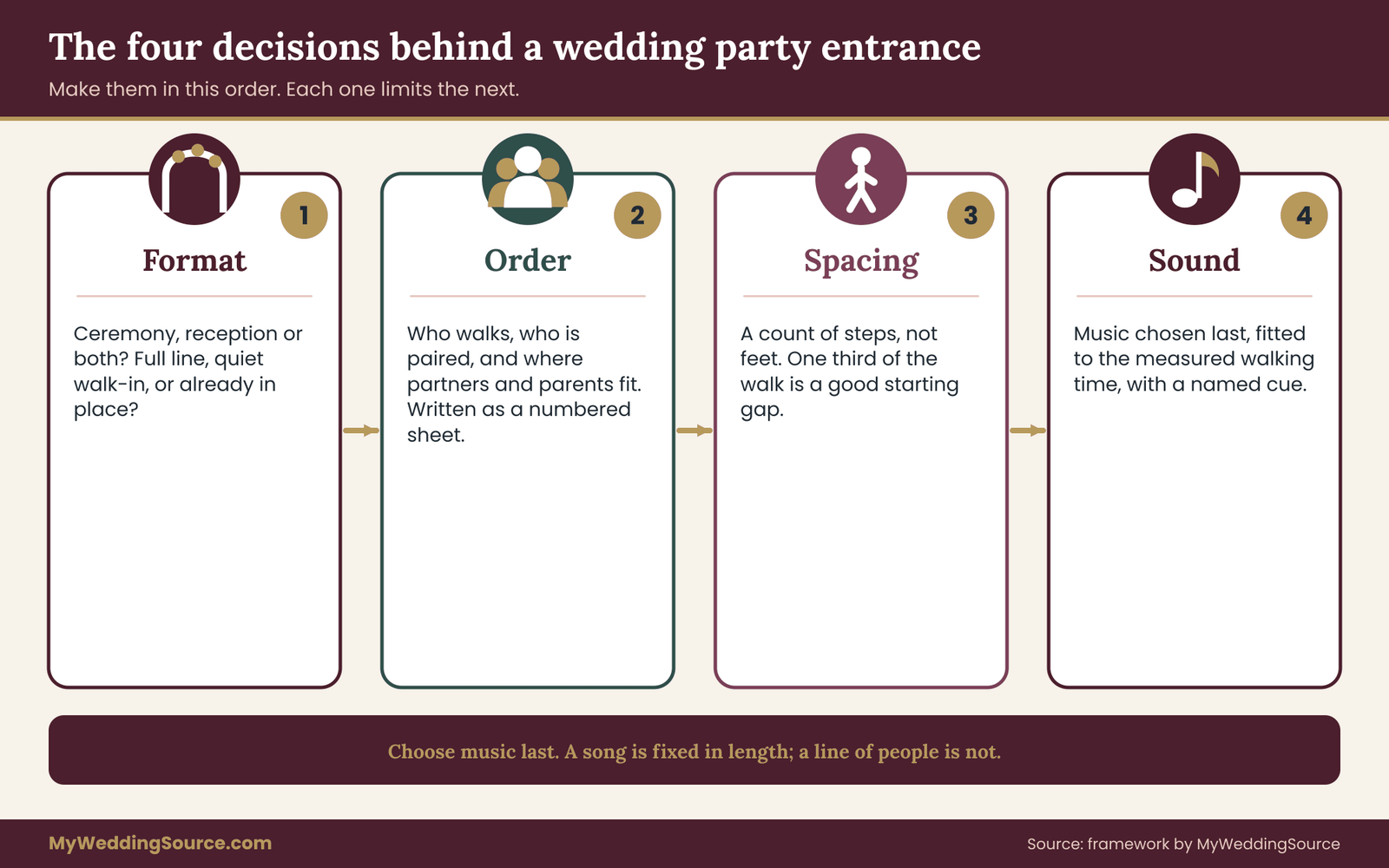
Treat the wedding party entrance as four decisions made in this order: format (ceremony, reception, or both), order (who walks and who walks with whom), spacing (a count of steps or beats, not a distance), and sound (music length measured against the real walking time). Write each decision down. Rehearse once with everyone who has a role, using a short consent-based plan for children, and give one named adult the job of running the line. Then confirm the doors, the music and the photographer’s position in writing with the venue and your vendors.
Most couples picture the moment: the doors open, the music changes, and a line of people they love walks toward them. What they rarely picture is the logistics behind it. Somebody has to hold the line at the door. Somebody has to cue the music. Somebody has to know that the attendant with the cane needs a slower pace, that the five-year-old will not walk alone, and that the aisle is eleven steps shorter than it looked on the venue tour.
None of this needs to feel like stage management. A wedding party entrance is a few minutes long, and the plan that supports it fits on one page. But those few minutes carry more small risks than almost anything else in the day, because they combine music, timing, nerves, young children, formal clothing and an audience.
A note on scope. This is general planning information, not legal, financial or safety advice, and rules at venues, in places of worship and for accessibility differ, so confirm anything that matters with the people who control the space.
The article is written for couples, planners and anyone asked to coordinate a wedding party entrance. It assumes nothing about the size of the group, the gender of anyone in it, or the tradition you are following. If you are building the whole ceremony timeline, the wedding ceremony cue sheet guide covers officiant, readers and music cues around this moment, and the wedding planning checklist places the wedding party entrance within the larger schedule.
What a wedding party entrance has to solve
Strip away the tradition and a wedding party entrance has five jobs. It moves a group of people from a waiting area to a front position. It signals to the guests that the ceremony or the reception is starting. It gives each person a short, visible moment. It lets the photographer and videographer capture that moment. And it does all of this without anyone feeling exposed, rushed or lost.
Each job pulls against the others, and every wedding party entrance settles the tension in some way, whether or not anyone chose it on purpose. A longer gap between attendants gives the photographer room and gives each person a moment, but it stretches the music and makes the walk feel slow. A tight line looks tidy and fits a short song, but a tripped hem or a pause at the front ripples through every person behind. A big, noisy reception entrance gets the room’s energy up, but some attendants and some guests find that kind of attention hard.
So the useful question is never “what is the correct way to do a wedding party entrance?” There is no correct way. The useful question is “which of these jobs matters most to us, and what are we willing to trade for it?” A couple who wants a quiet, intimate ceremony will trade photographer convenience for a slow, unhurried pace. A couple hosting a lively reception will trade a little polish for energy. Both are reasonable. The trouble comes when nobody chose.
The four decisions
The framework used throughout this guide has four decisions, always in the same order, because each one limits the next.
Format comes first. Does the wedding party enter at the ceremony, at the reception, or both? Is it a full line with music, a quiet walk in, or a group that is already in place when guests arrive? The format sets the stakes for everything else.
Order comes second. Who walks, who is paired, and where the partners and any parents or special guests fit. This is the decision that carries the most feeling, and it is the one that most often needs a conversation.
Spacing comes third. How far apart people walk, measured in a unit people can actually follow. The section on spacing explains why a count of steps works better than a number of feet.
Sound comes last. Which music, how long it runs, where it changes, and who presses the button. Music is last on purpose. If you pick songs first, you end up forcing people to walk to the song’s tempo. If you set format, order and spacing first, you can measure the real walking time and choose music that fits it.
What this guide does not cover
Some neighboring topics have their own guides on the site. The full ceremony script, the vows and the officiant’s role sit in the ceremony step-by-step guide. Reception music for dancing and background is covered in the reception music planning guide. Parent processional traditions, blended-family choices and the broader question of who gets which role belong to related coordination topics. This article stays with the mechanics of getting a group of people into the room well: the order, the gaps, the sound, the children, the vendor questions and the things that go wrong.
Choosing the format before choosing the order
It is tempting to start the wedding party entrance plan by writing a list of names. Resist that for a few minutes and decide the format first, because a format question can remove half the other questions.
Ceremony entrance, reception entrance, or both
A ceremony entrance is a processional. Guests are seated, usually facing one direction, and the group walks an aisle or path toward a front position. The timing is tied to the officiant, the music and often a start time that matters to the venue or to a permit.
A reception entrance, sometimes called a grand entrance, introduces the wedding party to a room where guests are already seated or standing. It often involves a host or DJ announcing names. It is shorter in distance and louder in sound, and it can be skipped entirely without anyone noticing a gap.
Some couples do both. Some do the ceremony processional and then simply open the reception doors and let everyone find their seats, with no announcement. Some do no processional at all and gather at the front before guests are seated. All of these are normal.
A practical rule: do the wedding party entrance that you will still be glad you did when you are tired. If a reception announcement would make you or an attendant dread the evening, drop it. If a ceremony processional with music is the part you have looked forward to for a year, protect it.
When there is no aisle
Not every venue has a center aisle. A beach, a courthouse hallway, a restaurant dining room, a garden with winding paths and a boat deck each change the wedding party entrance. The same four decisions apply, but format may collapse into something simpler: the group walks in from one side, takes positions and waits. The principles below still apply to spacing and sound, with the walking route standing in for the aisle.
Reading your group honestly
Before settling the format, take a quiet inventory of the people involved. How many are walking? Is anyone using a mobility aid, carrying a baby, or likely to find a long walk in front of a crowd hard? Are there children, and how old are they? Does anyone have a sensory need, such as sensitivity to loud music or flashing cameras? Is anyone traveling in late and likely to arrive with little time to rehearse?
This is not a form to fill out for its own sake. It is the information that lets you choose a format with no surprises. A line of eight adults who all walked in a recent wedding can handle a fast, tightly spaced wedding party entrance. A group with three children under seven and one attendant who tires easily is a different plan (the guest care planning guide covers supervision for children and older relatives across the whole day), and calling that out at the start is far kinder than discovering it at the rehearsal.
Decide who owns the decision
A wedding party entrance usually has more than one opinion attached to it. Parents may expect a particular order. A friend may have a strong view about who walks with whom. Your officiant or place of worship may have fixed customs. Decide early whose decision it is. In most cases the couple decides, informed by the venue’s and the officiant’s real constraints. If a family tradition matters to someone you love, you can honor part of it without adopting all of it.
Write the format of your wedding party entrance down in a single sentence, such as: “A ceremony processional with eight attendants and two child attendants, no reception announcement, music by a live musician.” That sentence is the brief for everything that follows.
Setting the order of the wedding party entrance
Order is where feeling lives in any wedding party entrance. It is also where small misunderstandings start, so it deserves a written version that everyone can see.
Start from the front and work backward
Planners often build a line from the back, but it is easier to start at the front of the room and work backward. Decide first where people end up standing. Then the order of walking follows from where each person needs to arrive.
If attendants stand on both sides of the front, the line alternates: first person goes left, second goes right, and so on. If everyone stands on one side, the line is a single file that peels off in order. If the group splits unevenly, say five on one side and three on the other, the walking order has to hide that, usually by sending the longer side’s people first so the two sides finish together.
Consider the arrival too. Whoever walks last stands closest to the partners. Whoever walks first goes farthest down the line. If someone has a mobility aid, a baby on the hip or shoes that need a slow pace, put them where a long reach to the final spot does not cost them anything. A person who uses a cane or a walker should not be asked to travel past a row of people who then have to wait on them. Put them first or last, and ask which they prefer.
Common order patterns
These are patterns for a wedding party entrance, not rules.
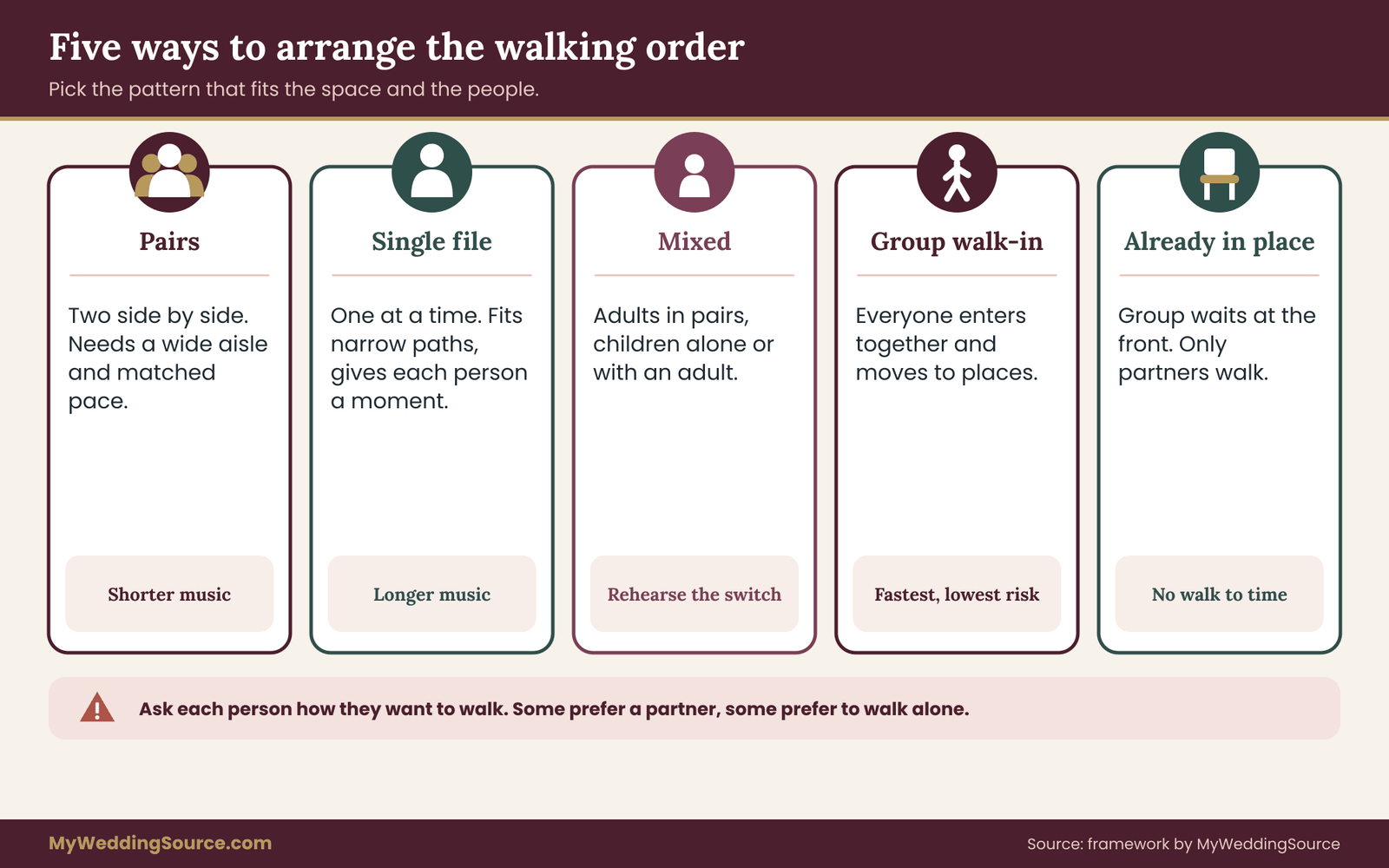
Pairs. Two people walk side by side. It looks balanced and halves the number of entrances, which shortens the music. It needs an aisle wide enough for two, and it asks pairs to match their pace. Pair people by comfort with each other, not by height or by who sits near whom in a photograph.
Single file. Each person walks alone, with a gap between them. It gives each attendant a distinct moment and works in narrow spaces. It takes longer, and some people feel exposed walking alone.
Mixed. Pairs for the adults, singles for the children, or the reverse. It is common and it works if the transitions are rehearsed.
Group walk-in. The whole group enters together, as a cluster, and moves to places. It is relaxed and fast, and it suits outdoor or informal ceremonies. It has the least ceremony and the least risk.
Already in place. The group stands at the front before guests arrive or while they are seated. There is no walk, only a reveal when the partners enter. This format removes spacing and music decisions for the group altogether, and it is worth a serious look if anyone has a hard time with walking in front of a crowd.
Partners, parents and special guests
Where the partners walk is a separate decision. Some partners walk together. Some walk separately, each accompanied by a person or people of their choosing. Some enter from different doors and meet at the front. Some wait at the front for the group to arrive and no one escorts them. The wedding party order only needs to know when the partners enter, and the gap between the last attendant and the first partner is a spacing decision covered below.
Parents, grandparents and other relatives sometimes enter before the group, sometimes within it, and sometimes are seated before the line starts. If this is a sensitive question, treat it as its own small decision with its own conversation. A short rule of thumb: if anyone’s role at the wedding party entrance has been the subject of a long family conversation, write down the final decision and send it to everyone affected in a single message, so there is no later disagreement about what was promised.
Inclusive titles and pairings
Avoid assuming that pairs are one of each of any category. Pair people by who walks well together, who would like to walk together, or by the order that fits the space. Ask each person what they would like. Some attendants are glad to be paired and some would rather walk alone. Some would like to walk with a particular friend or family member. Asking takes two minutes and removes a quiet source of discomfort.
Titles can follow the same principle. If your group uses traditional titles and everyone is happy with them, keep them. If anyone is uncomfortable with a title, drop it or choose another. On a printed program or in a spoken announcement, use the name and the role in the words the person prefers, and confirm pronunciation ahead of time, particularly if a host or a DJ will read names aloud.
Write the order as a numbered sheet
Create a plain one-page sheet for the wedding party entrance. Number each position. For every number, list the person’s name, who they walk with (if anyone), which side they end on, and what they carry. If a child needs an adult nearby, write the adult’s name next to the child’s. Include a line for the cue that sends that person: “Starts when the music changes”, “Starts when the person ahead reaches the third row” or “Starts on the usher’s nod.”
Print copies. Give one to the person running the line, one to the officiant or host, one to the musician or DJ, and one to the photographer. A sheet like this is more useful than any group message, because it can be held in a hand at the door.
Spacing: a count, not a distance
Spacing is the least discussed part of a wedding party entrance, and the part that most visibly separates a smooth one from a bunched or stretched one.
Why distance fails
A good wedding party entrance depends on cues that people can follow while smiling and nervous.
People talk about spacing in feet or in rows. “Start when the person ahead reaches the fifth row” sounds precise, but under stress it is hard to follow. The aisle is crowded with faces. Chairs may not be numbered. Row five looks different from the back of the room than from the front. And a cue in distance does not adjust to a person who walks slower or faster than planned.
A count adjusts. “Start when the person ahead has taken eight steps” travels with the line. If someone walks slowly, the count follows them. If someone moves quickly, so does the next person. A count is also something a person can run in their head while they smile, which they cannot do with a distance estimate.
The three spacing choices
Choose a gap in beats, steps or a simple phrase.
Tight. The next person starts when the person ahead is a few steps in. The line looks continuous. It suits short songs and wide aisles. It is hard on photographers, because the frame is crowded.
Standard. The next person starts when the one ahead is about a third of the way down. It gives each person a moment and leaves room for a photo.
Spacious. The next person starts when the one ahead is at or near the front. It makes the wedding party entrance long and stately. It needs longer music or a pause, and it works when the room is small.
The right gap for a wedding party entrance depends on the length of the walk. A short aisle can handle only a tight gap without the line reaching the front before the music has begun. A long outdoor path may need a spacious one just to avoid a long, thin string of people.
How to set the count
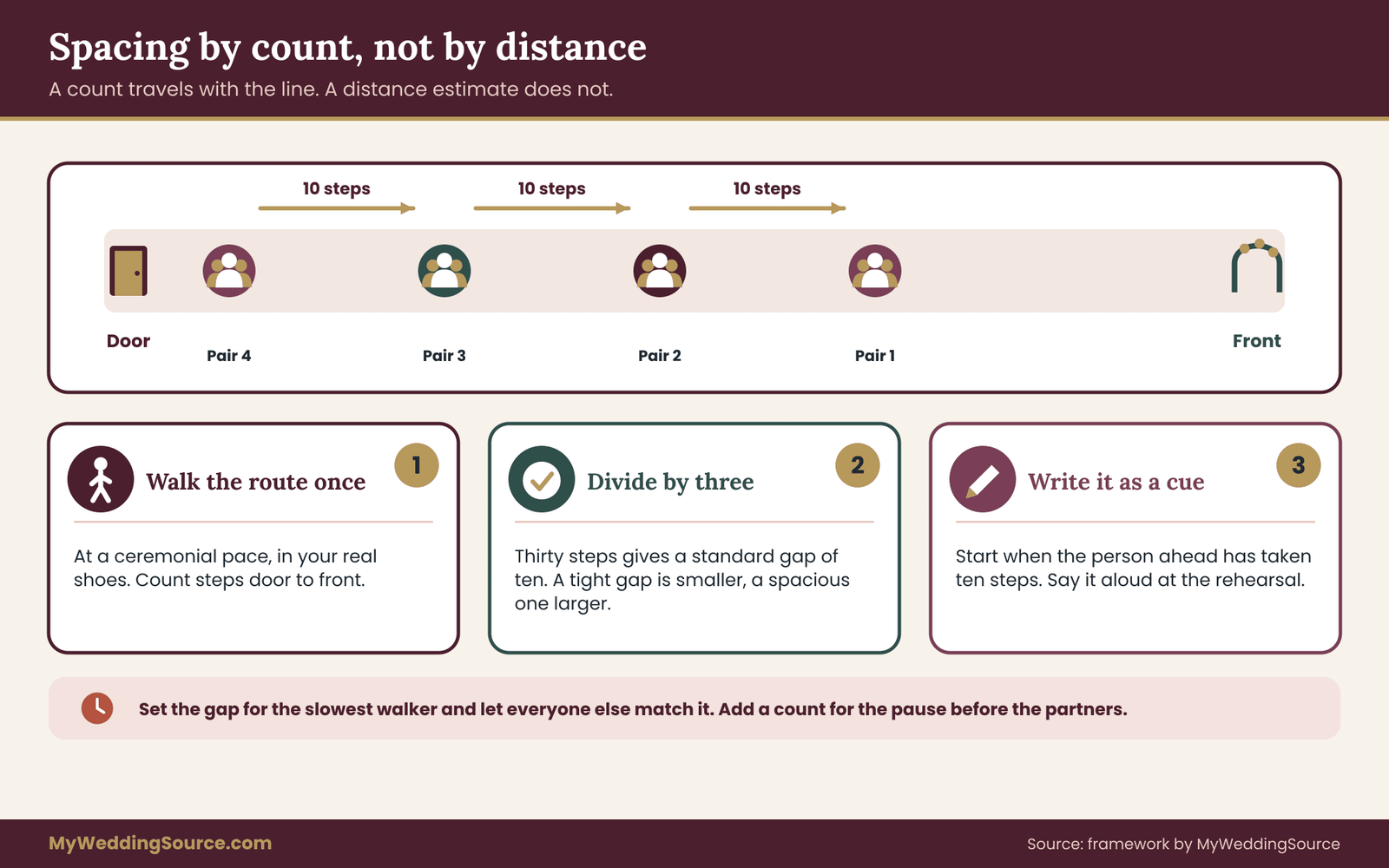
Do this at the venue, or on a space the same size as the venue. Walk the route once at a comfortable ceremonial pace, not a stroll and not a march. Count the steps from the door to the front position. If you cannot be at the venue, use a measured space like a hallway, then adjust once you have the real length.
Say the total is thirty steps. A standard gap of one third is ten steps. So the rule becomes: “Start when the person ahead has taken ten steps.” Write it as a count on the sheet. If your group includes people with different pace, pick the count for the slowest person and let the others match it. Someone setting the pace should not be hurried by the person behind.
Test the count with the actual group. Pairs often walk a little slower than singles. Children walk unpredictably. A count that works for adults can be too tight for a four-year-old, which is why child attendants are handled separately later.
A spacing example
Picture a venue with a thirty-step aisle and eight adult attendants walking in pairs, four pairs in all. A standard gap of ten steps means each pair starts when the pair ahead has reached step ten. The first pair reaches the front at step thirty, by which time the second pair is at step twenty, the third at step ten, and the fourth is just leaving the door. That creates a continuous but uncrowded line of four pairs, with all pairs visible at once.
Now add the partner entrance. If the partners are to enter after the last pair has reached the front and settled, there is a pause. If the pause is meant to be a held breath, say eight counts, the music or the host needs to know. If the partner enters as soon as the last pair is at the second row, there is no pause and the music must carry straight through. Neither is wrong. The point is that spacing includes the gap before the partners, and it should be written as a count too.
Spacing at the front
Spacing does not end at the front of the aisle. Each person needs a spot to walk to, and those spots need to be clear. Mark the final positions with something discreet, such as a small piece of tape that matches the floor, or a stem placed on the chair edge, if the venue allows it. Check that the line fans out in time: the first person must go far enough that the last person has room to arrive without a crowd building at the entrance of the front space.
The person running the line should stand where they can see the front. If the venue’s layout blocks that view, a second person at the front can signal back, a pre-agreed small gesture such as a raised hand or a nod. That second person is part of the wedding party entrance plan and belongs on the sheet.
Music and the timing of the wedding party entrance
Music is where the wedding party entrance plan meets the clock. A song is a fixed length. A line of people is a variable length. The job is to make them agree.
Measure the walk before choosing the song
With the order and the spacing count set, time the whole wedding party entrance. Use a phone timer. Walk the route with the real order if you can, or simulate it by timing one person’s walk and adding the gaps. You are looking for three numbers.
The first is the time for one person or pair to walk door to front. The second is the time for the whole group to enter, from the first person’s first step to the last person’s arrival. The third is the pause before the partners enter, if there is one.
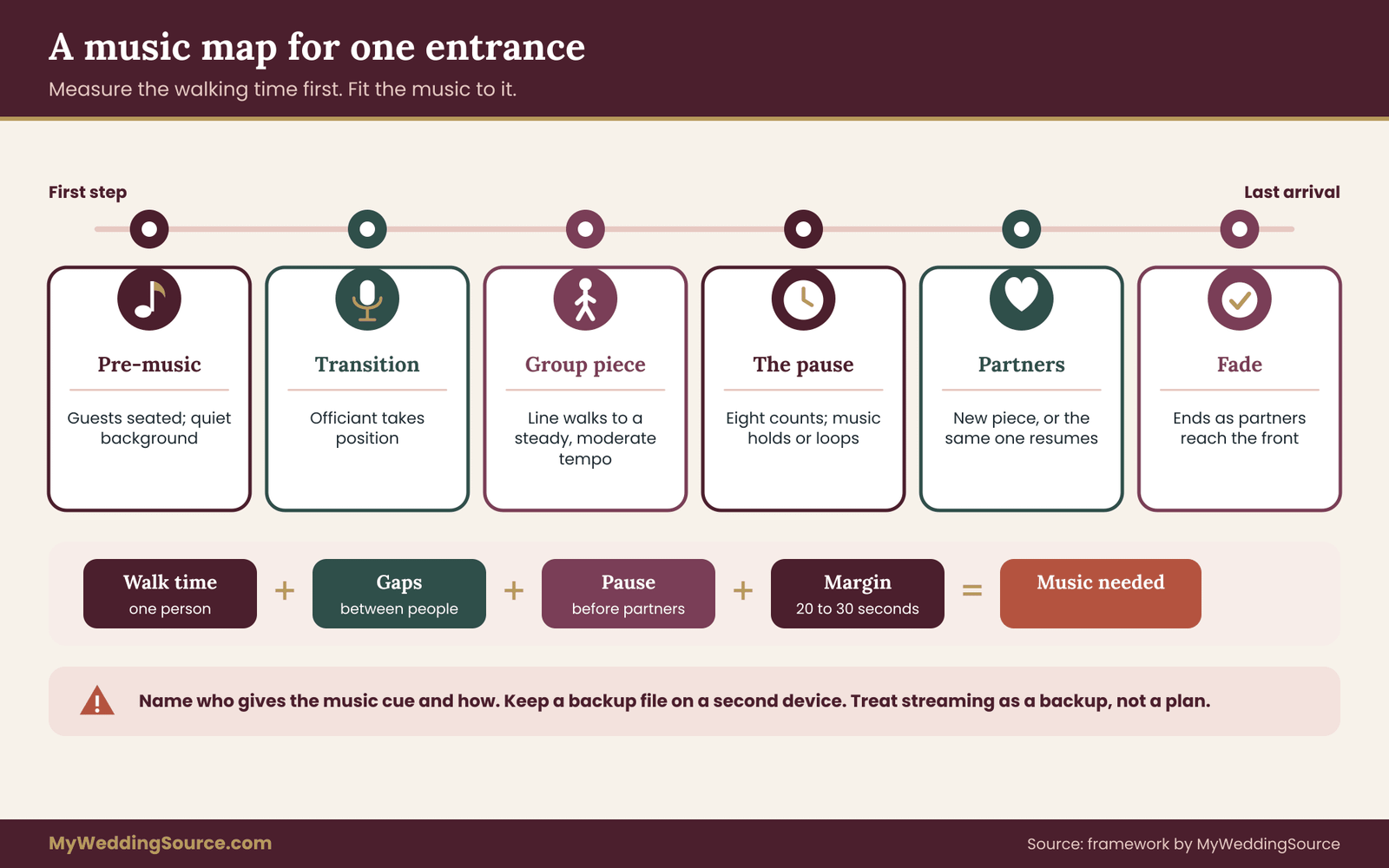
Add them. That total is the music length you need for the wedding party entrance. If the total is ninety seconds, a three-minute song is far too long unless you plan to fade it or cut it. If the total is four minutes, a two-minute piece will end while the line is still moving.
Do not pad the number optimistically. Real walks are slower than imagined ones, especially with children, formal shoes or a surface like grass or sand. Add a margin of twenty to thirty seconds, then plan a way to extend or end the music gracefully if the line runs shorter or longer than expected.
Three music structures
One piece, whole entrance. A single song or instrumental runs from the first step through the partner’s arrival. It is simple, and it suits a short wedding party entrance. The risk is a mismatch: the song’s natural end falls before the last person arrives.
One piece for the group, one for the partners. The attendants walk to one piece, then the music pauses or changes as the partner’s entrance begins. It is the most common structure, and it gives the partners’ entrance its own moment. It needs a clear cue to change, and someone who is watching the line.
Looped or extended instrumental. The musician or DJ plays a section on repeat, or an extended version, until the cue arrives. It is flexible and safe, and it is only possible if the music source allows it. A live musician can do this naturally. A recorded track needs to be edited or have a loop point.
The cue for the change
The music change is a signal, and signals fail when nobody knows who owns them. Decide who gives the cue to the musician or the DJ and how. In small ceremonies this might be the person running the line, who signals with a raised hand. In larger ones it might be a coordinator with a headset or a phone message. The cue should be tied to something visible: the last attendant reaching their place, the doors closing, or a nod from the officiant.
Rehearse the cue. It is the single most common failure in entrances: the line is ready and the music is not, or the music changes and the line is not ready. A five-minute run-through with the musician, even if only the cue is practiced, prevents both.
Choosing music that fits the walk
Tempo matters more than genre. A slow song may stretch each step into an awkward drag, and a fast one may push people into a march. A moderate pace at which a person can walk without thinking is generally the most forgiving. When in doubt, walk to the music in the venue, in your real shoes, and see how it feels.
Children and people with mobility differences are the test. A piece that works for a confident adult may be wrong for a five-year-old or someone with a cane. Often a gentle, steady instrumental works better than a song with a strong beat that attendants feel obliged to follow. If you want a song with a particular meaning, consider using it for the partners’ entrance and letting the group walk to something calmer.
Lyrics matter too. If the room includes children or older relatives, check lyrics for anything you would not want to be heard. A quick read of the full lyrics, not only the chorus, avoids a surprise. For a wedding party entrance that is a few minutes long, a single careful listen to the full track is enough.
Live musician or recording
Both work for a wedding party entrance, with different trade-offs. A live musician can follow the line. If someone is slow, the musician slows down or extends a phrase. If the line is short, they end early. That flexibility is worth a lot at a ceremony, and it explains why many couples with a live player rely less on a countdown.
A recording is predictable and does not need to be paid for by the hour. It cannot adapt. If you use a recording, build a margin into the track, or ask the person controlling it to be ready to fade the end. Ask a DJ or sound technician whether they can start a song at a given point, hold a track on a loop, or fade on request. The answers shape your structure.
If the music is a streaming service on a phone, treat that as a backup, not a plan. Notifications, screen locks, connection drops and automatic playback of the next track can all interrupt the moment. Save the file locally on a device set to airplane mode, or use the sound vendor’s equipment.
Licensing and venue rules
Music played in public may be covered by licenses. Performance rights organizations such as ASCAP and BMI license public performance of music, and many venues hold blanket licenses that cover events. Whether a particular ceremony or reception needs anything more is a question for the venue and the person providing the music. For the wedding party entrance itself, the practical question is simple: does the venue’s license or the vendor’s arrangement cover the song you plan to play, and if you are using your own recording, does the venue allow it?
Some places of worship and some venues limit recorded music, amplified sound or particular types of songs. Ask early. A late discovery that a song cannot be played is easier to handle when you have weeks to choose another.
A short check of the sound system
If the venue provides sound, ask where the speakers are and whether the music will be clear at the door where the line waits. Attendants at the door need to hear the cue. If the speakers face the audience and the door is behind them, the line may hear nothing, and a person who cannot hear the music cannot time a start. In that case a small monitor speaker or a human cue at the door is needed.
Microphones matter at the reception entrance. If a host will announce names, check that the host has the correct pronunciations, the order, and a printed copy. Ask whether the microphone carries to the door or whether the host will need to move. Plan the names to be read at a pace that matches the walking pace, not faster.
A music map for one wedding party entrance
A simple map keeps all this in one place. List each section of the music, its length and the action it covers. A typical ceremony map might read: pre-music while guests sit, a short transition as the officiant takes position, the group piece for the line, a pause for the held breath, the partners’ piece, and an end-of-walk fade as the partners reach the front. Next to each section, write who gives the cue and how. Hand the map to the musician or DJ along with the order sheet.
Venue, doors and sightlines for the wedding party entrance
The venue decides more of the wedding party entrance than most couples expect. A beautiful space can have a door that opens inward, a threshold that catches a heel, or a side hallway where attendants wait in full view of arriving guests. A site visit with the wedding party entrance in mind catches these before they become problems.
Where the line waits
The waiting area is part of the plan. Ask where attendants will stand before they walk. Is it out of the guests’ sight? Is there room for the whole group, including a child with a parent and a person using a mobility aid? Is it climate-controlled, shaded, near a bathroom? A waiting area that is hot, cramped or visible to guests makes people tense before they walk, and tense people walk badly.
If the waiting area is outdoors, think about wind, sun and surface. A group standing on grass for fifteen minutes in heeled shoes will have a worse walk than one that waited indoors. If the space is shared with other events or vendors, confirm that nobody else will be using the hallway at that time.
Give the group a hold time. If the ceremony start slips, they will wait longer than planned. Water, a place to sit and a few minutes of quiet make that wait tolerable. Someone should be responsible for the group during this time, and for children in particular that responsibility is not optional.
The door itself
Doors cause more small delays than any other feature. Check how the door opens, whether it latches, whether someone will hold it, and whether the sound of it is a problem. A heavy door that closes with a bang during a quiet moment is a feature of the venue, not a flaw in your plan, but you can plan around it by having a person hold it.
Ask if the door has a threshold, a step or a slope. A raised threshold is easy to miss in a long dress, long trousers or with a mobility aid. If there is a ramp, ask whether it is the main route or a separate one. A route that sends one person around the back while others use the main door can feel isolating, and it is better to plan the main route so everyone can use it.
If the doors will be opened at the cue, decide who opens them and when. An usher, a coordinator or a venue staff member can do this. Make sure that person knows the cue and is not busy with something else.
Accessibility of the route
A route that works for everyone avoids the need for a special arrangement later. Walk the full path from the waiting area to the final position with accessibility in mind. Is the surface firm and level? Is the aisle wide enough for pairs, or for someone using a wheelchair or walker, with room to maneuver at the front? Is there a step up to a platform or altar? Can someone who cannot manage the step still have a place in the front?
The U.S. Department of Justice and the U.S. Access Board publish information on accessible design and the Americans with Disabilities Act, and the venue is responsible for the accessibility of its own space. Ask the venue what it offers, and ask the person who needs the route what they need. Do not guess for someone. A person who uses a mobility aid knows far better than anyone else which pace, which surface and which arrangement works for them.
If a route is not fully accessible, change the plan, not the person. That might mean moving the final positions to ground level, changing the walking surface, or placing a chair at the front. The principle is that no one should be asked to take a role they cannot physically do, or to attempt a walk the venue has made difficult.
Sightlines and what guests see
Think about what guests see while the line waits. If the door is open and guests can see the group assembling, the moment of the wedding party entrance is spoiled and some attendants feel exposed. A closed door, a curtain or a short screen can help. If you do want guests to see people arriving, make sure the arrival looks calm.
Think about what the group sees too. The walk is easier when each person can see the front and a friendly face. If the front is bright and the aisle is dim, or the other way around, people walk with squinting eyes. If the sun is behind the front position, attendants face glare. A site visit at the same hour as the ceremony shows these things.
The photographer and videographer
They see the wedding party entrance from a different angle than anyone else. Photographers and videographers need a position that lets them capture the wedding party entrance without blocking guests or being in the shot. A common pattern is one at the front, facing the door, and one at the back or side. Ask your photographer where they plan to stand and whether they need a wider gap between attendants to capture each person. If they want a wider gap and you want a tight line, that is a trade-off to discuss before the rehearsal, not during it.
Flash is a particular issue for entrances. A sudden flash can startle a child, a person with a sensory sensitivity, or someone walking carefully.
Ask the photographer whether they will use flash, and if the venue or officiant has a policy. A short message makes the position clear: “We would like no flash during the wedding party entrance. Where will you stand, and do you need any extra gap between attendants?” If you have a policy about photographing children, the wedding photography consent guide is the place to look, and that conversation belongs in the same message as the wedding party entrance.
Weather and a second plan
If the wedding party entrance is outdoors, there is a weather plan, and it affects the wedding party entrance. An indoor backup space may have a shorter aisle, a different door and a different sound system. A count set for the outdoor route will be wrong indoors. Set a second count for the backup, and decide who makes the call and when.
Even without rain, wind can lift veils and hats, hot sun can wear out the group in a few minutes, and a cold, still morning can make hands too numb to hold flowers. Build a short hold, and a place to wait, into the schedule.
Reception entrances and room flow
A reception entrance has its own room issues. Where do guests stand or sit while the group is introduced? Is there a path through the room, or will the group have to walk between tables? Is the dance floor in the way? Is the DJ near the door or across the room? The related guide on reception guest flow covers entry, seating and movement for the whole room, and the wedding party entrance should be consistent with it.
If the reception entrance involves a path between tables, check the width. Chairs pulled out by seated guests narrow a path quickly. A path that works when the room is empty can be blocked when it is full. Walk it during setup and again when the room is full if possible, or ask the venue for a set-up that leaves a clear route.
Timing within the schedule
The wedding party entrance sits inside a schedule that includes the previous event and the next. If the ceremony is followed by a cocktail hour, the group’s exit and the guests’ movement need space. If the reception entrance follows photographs, the group needs to be back, dressed and ready. Check the wedding party entrance time against the venue’s timeline and the wedding vendor timeline so that it does not push other vendors out of their windows.
Allow a few minutes of buffer before the wedding party entrance. Late arrivals, a toilet stop, a last-minute fix to a hem or a delay in the music all use that buffer. A schedule that has no buffer turns each small delay into a visible one.
Child attendants in the wedding party entrance: a rehearsal built on consent and supervision
Children are the most variable part of any wedding party entrance, and also the part most people remember fondly. A child who walks confidently, scatters a few petals and waves at a grandparent is a highlight. A child who freezes, cries or sits down in the aisle is also, in the end, a normal moment, as long as the adults around them handle it kindly. The aim of the plan is not to make children behave like adults. It is to make the moment safe, comfortable and genuinely optional.
Why consent comes first
Being asked to walk in front of a hundred people is a real request. Adults can weigh it. Children cannot, so adults have to do it for them without pressuring them. Two kinds of consent apply.
The first is the parent’s or guardian’s agreement. A parent knows whether their child is shy, anxious, tired by seven in the evening, or likely to melt down near loud music. A parent should be asked whether the child may take part, not told. Ask in writing, so the answer is clear and there is no later confusion about what was agreed: what the role is, when the rehearsal is, how long the child will be asked to stay, and who will be with them.
The second is the child’s own willingness. A child is not a prop. Ask them, in words they can understand, whether they would like to do it. Make it easy to say no, and mean it. A child who says no, or who says yes and changes their mind on the day, should be able to step back without any sense of having let anyone down. The plan should include a way for that to happen quietly.
A script that works for most families: “We would love for your child to walk in the ceremony, if they want to. You know them best. Would that feel good for them? If they would rather sit with you, that is completely fine, and nothing changes about how much we want them there.”
Age and readiness, without checklists
Children’s development varies widely, and no age sets a fixed rule. The U.S. Centers for Disease Control and Prevention publishes developmental milestone information for parents, and it consistently notes that children reach milestones at different times. The practical point is to follow the child, not the calendar. A confident four-year-old may do well. A shy seven-year-old may not. A toddler may walk happily with a parent and refuse without one.
Rather than ask “how old is old enough?”, ask four plain questions about each child. Will they walk a short distance without a hand to hold? Will they stay calm near loud music and a crowd? Can they wait in one place for several minutes? Do they respond to a trusted adult’s gentle reminder? If the answer to most is yes, a solo walk may work. If not, plan for a walk with an adult, a wagon, a carrier, or no walk at all.
The role options, from lightest to fullest
A role should match what the child can comfortably do.
Seated with family. The child is not part of the walk at all and sits with their parent. Many children are happiest here, and the child can still be part of the day in other ways, such as handing out a program or sitting in the front row.
Walking with a trusted adult. The child holds a hand or walks beside a parent, a grandparent or an attendant. The adult, not the child, carries the responsibility for the pace.
Walking as a pair of children. Two children walk together. It can reduce nerves, but it can also double the difficulty, because one child’s mood affects the other.
Walking alone. A child walks the full aisle by themselves. It requires the most readiness, and even then an adult should wait at the front.
Carried or pulled. A baby or toddler is carried by an adult or pulled in a wagon. The adult is, in effect, the attendant.
Roles that are carried, not performed
If a child is carrying something, think about what it is. Petals, a pillow with rings, a sign and a basket are common. A ring pillow with real rings is a risk: a nervous child can drop it, and the rings can be lost. Many couples use decoy rings tied to the pillow and keep the real ones with another person. Petals, where the venue allows them, can be slippery on a hard floor and can stain, so check the venue’s rule. A sign should be light and should not be the child’s responsibility to hold up.
The U.S. Consumer Product Safety Commission publishes safety guidance on children’s products and choking hazards. Small items such as loose beads, small candies or buttons on a child’s outfit are worth a second look for younger children. If an item is part of the outfit, check that it is secure and comfortable.
Supervision: who is responsible, and when
Supervision should be explicit. Name one adult who is responsible for each child from the moment the child arrives for the rehearsal until the moment they are handed back to their family. Do not rely on a general sense that someone is watching. A group of adults assuming someone else has the child is how children get lost.
The responsible adult should know the child, or at least be known to the child, and should not have a competing job that takes their attention. A busy attendant who is also getting dressed, or a parent who is giving a reading, is not available. A relative, a family friend or a hired caregiver is often the right choice. The broader guide on how supervision fits the whole wedding day covers choosing a caregiver and handing children back safely.
Decide in advance what happens to the child if they are not ready, tired or upset. The responsible adult should know who to hand the child to, where, and how to do it without anyone making a fuss. Write it on the sheet.
Photographs and children
Photographs of children are a consent issue too. Some parents prefer that their child’s image is not shared online. Ask parents, as part of the same message, whether they are comfortable with photos of their child being taken and shared, and pass the answer to the photographer and videographer.
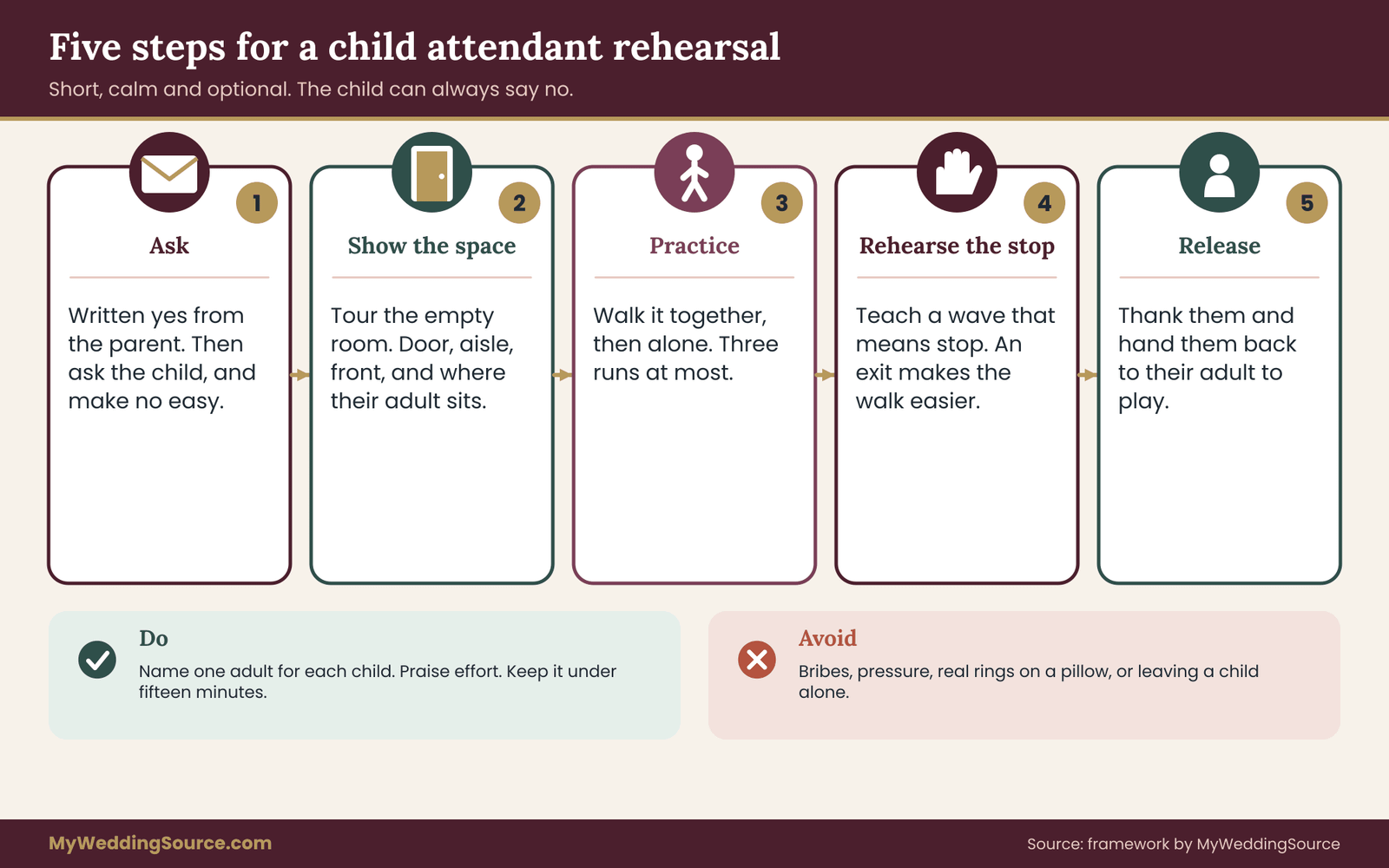
The rehearsal for children: five steps
The rehearsal for child attendants works best when it is short, calm and treated as practice, not performance. A good rehearsal takes ten to fifteen minutes, not an hour.
Step one: ask. Before the rehearsal, confirm with the parent or guardian and with the child. Re-ask at the rehearsal. A child who agreed last week may have changed their mind.
Step two: show the space. Take the child on a walk through the space when it is empty. Let them see the door, the aisle, the front. Show where the person they will walk to will be standing. Point out where their parent or adult will be sitting. Children are more confident in a space they have seen.
Step three: practice the walk. Walk it once together, slowly. Then walk it with the child leading. Then with the music, if you can. Do not run it more than three times. Repetition tires children and can turn a calm walk into a chore.
Step four: rehearse the stop. Practice what happens if they want to stop. Say something like: “If you want to stop or go to your grown-up, just stop and wave, and I will come and get you.” Then practice it. A child who knows there is an exit is more likely to complete the walk, and a child who needs it can use it.
Step five: release. At the end, thank them and let them go. Do not keep a child at a rehearsal for the adults’ conversation. Hand them back to their responsible adult, and let them play.
Language that keeps it light
The words adults use during the wedding party entrance matter as much as the choreography. Adults set the tone. Compliment effort, not performance. Avoid phrases like “be good”, “don’t mess up” or “everyone is watching”. Use calm and specific instructions: “Walk to the flowers, and then stop and wait for me.” Offer small, honest choices, such as which hand to hold. If a child says they do not want to, thank them for telling you. That response makes it far more likely they will tell you the truth next time and, sometimes, makes them willing to try after all.
What not to do
A few habits make a child’s part in the wedding party entrance harder than it needs to be. Do not bribe or pressure a child to participate. Do not promise a reward for a walk that goes well, since that makes a stumble feel like a failure.
Do not hold a rehearsal at a time when the child is hungry or tired. Do not leave a child alone in the waiting area. Do not ask an adult attendant to take charge of a child while also doing their own part, unless they have agreed to it and have a backup. And do not make a child’s participation a condition of anything, including a seat at the table.
Running the full rehearsal for the wedding party entrance
A rehearsal is a tool, not a ritual, and the wedding party entrance benefits from it more than most parts of the day. Its purpose is to find problems while they are cheap to fix. A good one for a wedding party entrance takes about forty minutes and answers a small set of questions.
What the rehearsal must answer
By the end, the group should have settled six things. The order is final and everyone knows their number. The spacing count works with the real group and the real space. The music fits the timing, or the plan to extend or end it is agreed. The cue to the musician and the cue to the door both work. Each child has a named adult and an agreed way out. And the person running the line knows exactly what to do when something goes wrong.
If the venue does not allow a rehearsal, or the rehearsal is only possible for part of the group, run a shorter version: a walk-through on the morning of the wedding with the person running the line, the musician, and whoever is available. Even a ten-minute run is worth far more than none.
Who has to be there
The rehearsal list is short but firm. The couple, all attendants, the person running the line, the officiant or host, the musician or DJ, and any parent or special guest walking. Child attendants attend a short, separate segment, ideally with their responsible adult, as described in the previous section. The photographer does not need to be there, though a message to them afterward with the confirmed order and count saves time.
If an attendant cannot attend, send them the sheet, a short video of the walk if you can record one, and a call to answer questions. Assign a stand-in during the rehearsal so the line has the right number of people, and give the missing person a buddy who will check on them on the day.
A forty-minute run order
Treat the time as a budget.
Minutes zero to five: arrival and the sheet. Gather everyone at the front, not at the door. Hand out printed order sheets. Say in two sentences what the wedding party entrance is meant to feel like. Calm and warm, or celebratory and lively. A clear intention shortens the discussion.
Minutes five to ten: the route. Walk the full route together, door to front, without music, at a ceremonial pace. Point out the threshold, any step, and the final positions. Anyone who has a question or a concern can raise it here.
Minutes ten to twenty: the line without music. Run the wedding party entrance in order with the spacing count. Use the real order and, where possible, the real objects such as flowers or signs. The person running the line gives the cues aloud. Do it twice, and adjust the count if needed after the first run.
Minutes twenty to twenty-eight: the line with music. Add the music. Time the full wedding party entrance and note the gap to the partners’ entrance. Practice the music change cue. Adjust the song, the length or the plan to extend it.
Minutes twenty-eight to thirty-four: the partners and the front. Practice the partners’ entrance and the final positions. Check that nobody is hiding anyone in photographs, that the line has fanned out correctly, and that everyone can see the officiant.
Minutes thirty-four to forty: the exit, the questions and the sheet. Walk the exit, if there is a recessional. Ask each person whether anything feels uncomfortable. Correct the sheet. Confirm times for the day.
Scripts for the person running the line
The person who runs the line, usually a coordinator, a planner or a reliable friend, needs a few short phrases, repeated the same way each time. Short phrases are easier to hear under stress.
For starting: “Ready. Walking in three, two, one.” For spacing: “Start when they reach ten.” For a delay: “Hold. We are waiting for the music.” For a quiet correction: “Slow down, you are fine.” For a child who stops: “That is okay. We will wait with you.”
The tone matters. A person who sounds calm makes everyone calmer. A person who whispers sharply, even with good intentions, makes attendants more nervous. If the person running the line is also an attendant, the plan is fragile, because they cannot be at the door and in the line. Choose someone who is not walking, if at all possible.
Giving feedback during the rehearsal
Feedback in a group can embarrass people. Keep corrections about the plan, not the person. Say “the count needs to be eight, not ten” instead of “you are walking too slowly.” Give one correction at a time. If a person is struggling with something, offer to talk to them separately, away from the group. A lighthearted tone helps. A rehearsal that feels like a test makes people worse at the thing it is testing.
Common rehearsal findings
Rehearsals tend to turn up the same few things. The count is too tight for pairs. The first song is too long, or too short. The door person did not know the cue. The photographer’s position blocks a sightline. A child who was confident in the planning conversation hesitates in the room. Someone’s shoes are wrong for the surface. These are all easy to fix at a rehearsal, and all awkward to fix on the day.
When something does not work, change one thing at a time and run it again. If you change three things at once, you will not know which one fixed it.
The rehearsal when the group cannot gather
Some groups are spread across cities and cannot all be in one place before the wedding. The answer is a layered rehearsal. Send the sheet and a short written explanation of the wedding party entrance a week ahead.
Hold a video call to walk through the order and the counts. Ask each person to practice the walk at home, in a hallway, with a phone timer. On the morning of the wedding, run a ten-minute walk-through at the venue with whoever is there. It is not as good as an in-person rehearsal, but it covers the essentials, and it does so without asking people to make expensive trips that are not necessary.
If someone is traveling and will not reach the venue until shortly before the ceremony, tell them honestly what to expect, give them a buddy, and assign a simple position in the line, such as last or first, where there is the least to remember.
Money and obligations around roles
Roles in a wedding party entrance sometimes arrive with assumptions about money: attire, travel, hair, makeup and gifts. Keep the wedding party entrance plan separate from any financial obligation, and be careful not to pressure anyone. Be clear, in writing, about what you are asking people to cover, and what you are not. If a person cannot afford a particular expense, offer a lower-cost alternative, or cover it yourself if you can, and never make participation in the wedding party entrance depend on a payment. Written roles, plain expectations and an easy way to say no keep friendships intact.
Vendor and source questions for the wedding party entrance
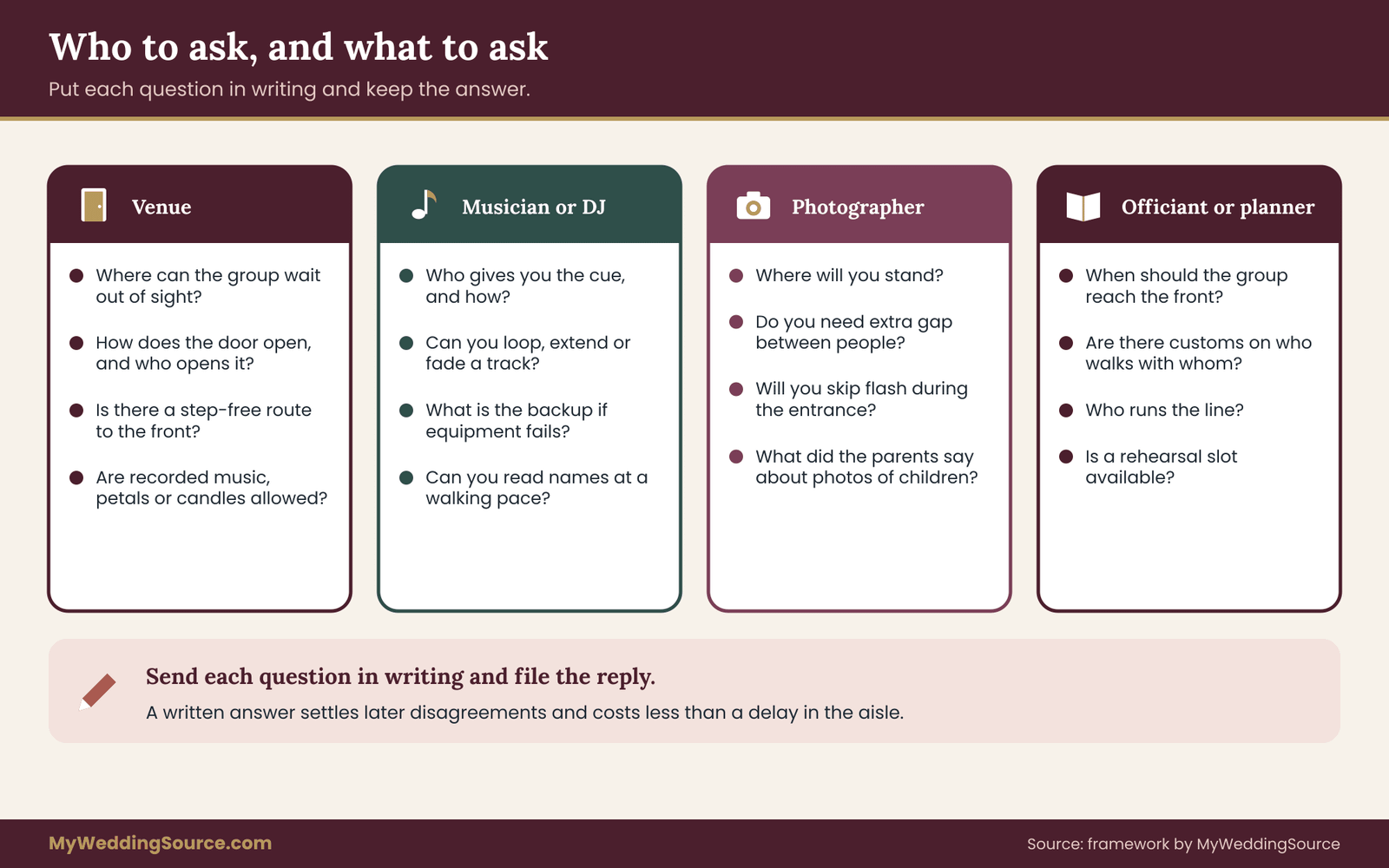
Several of the people you hire or borrow from shape the wedding party entrance. A short, specific question to each, in writing, saves misunderstandings. The answers also become a record if there is a later disagreement.
Questions for the venue
Ask where the group can wait, out of sight. Ask how the door opens and who will open it. Ask whether there is a threshold, a step or a slope on the route, and whether there is a step-free path to the front.
Ask what the venue’s sound system covers, whether recorded music is allowed and whether amplified sound has restrictions. Ask whether petals, flower stems, candles or other items are allowed, and who cleans up. Ask whether a rehearsal is available, and at what time. Ask whether the venue’s staff will be in the space during the wedding party entrance, and what their instructions are.
Questions for the musician or DJ
Ask how they take cues, and from whom. Ask whether they can extend, loop or fade a song. Ask what formats they use and whether they can play a file you provide. Ask whether they will be at the rehearsal, or at least have a call. Ask whether they can read names at the pace you want, and whether you can provide a pronunciation guide. Ask what happens if their equipment fails and what the backup is. If music is on a phone or a laptop, ask what stops notifications and automatic playback of the next track.
Questions for the photographer and videographer
Ask where they plan to stand, and whether they need a particular gap between attendants. Ask whether they use flash, and whether they will skip it during the wedding party entrance. Ask how they handle photographs of children, and give them the parents’ answers. Ask whether they would like a copy of the order sheet. A short note ahead of time is better than a conversation in the aisle.
Questions for the officiant, planner or coordinator
Ask the officiant when they want the group to arrive at the front, where they will stand, and what they need from the line. Ask whether their place of worship or organization has customs about the wedding party entrance, such as who may walk with whom, whether music is permitted and whether photography is allowed during certain moments. If you have a planner or coordinator, ask whether they will run the line, and what they need from you. If you do not, decide who will, and give that person the sheet.
Questions for attire and rental providers
If attendants are wearing matching outfits or rented items, ask about alterations, delivery dates and return policies, and be clear about who pays for what. Ask about shoes and surfaces: if the venue is on grass, sand or gravel, the shoes need to suit it. Heel protectors and flat alternatives can help, depending on the surface. Put the details in writing before the order is final, and check the terms before you ask anyone to commit.
Primary references worth checking yourself
For rules on accessibility, children’s product safety, music licensing and fire safety, rely on the organizations that set them rather than on a vendor’s summary. The Sources section at the end lists the primary pages. Rules change and differ by place, so check the current version for your venue, and ask the venue or the local authority when the answer affects your plans.
Edge cases that change the wedding party entrance
Every wedding party entrance meets real people, and people are unpredictable in ordinary, forgivable ways. The cases below come up often enough to prepare for. For each, the useful question is the same: what is the quietest way to keep the moment going?
An attendant is late
If someone is not at the door when the music is due, do not hold the entire ceremony for a long time. Decide in advance how long the group will wait, and what happens next.
A reasonable plan is a short hold of a few minutes while the person running the line tries to reach them, then closing the gap by moving the line up and giving the late person a place to slip in at the front. Write the fallback on the sheet. The line should look intentional, with no visible empty space, and the person who arrives late should be welcomed, not scolded.
A child freezes or runs
A child who stops in the aisle is not an emergency. The responsible adult, who is waiting near the front, walks calmly to meet them, crouches, and offers a hand or an arm. Guests are usually warm about it. If the child wants to go back, they go back.
If they want to continue with the adult, they continue. If they want to sit down with a parent, they sit. The line behind them should hold, and the music should continue or loop. Do not call the child’s name loudly or ask them to hurry, and do not let the line walk around them.
If a child runs ahead of the group, the adult follows at a normal pace and meets them at the front. Chasing causes more excitement. If a child needs to leave the aisle, the adult steps in and takes them out without fuss. The point of the earlier rehearsal, where the child learned that stopping was allowed, is that this moment feels like a plan rather than a failure.
An attendant has a mobility need, or tires easily
Set the pace by the person who walks most slowly, and treat that as a feature of the wedding party entrance, not an exception to it. Place them first or last, depending on their preference, and give them a place to sit at the front if they want one.
If a walking aid is part of their style, check that the aisle surface and the threshold work for it. If they would like a companion walking with them, let them choose who. If standing for the whole ceremony is hard, provide a chair, quietly, rather than asking them to ask for one.
Ask early. A message such as “We would like you to be part of the wedding party entrance. What pace and route would feel best for you? We can adjust the music, the count and the front positions” gives the person a chance to shape the plan.
An attendant has a sensory need
Loud music, a crowd, flashing cameras and sudden doors can be hard for some people. Ask what would help. Options include lowering the volume at the door, agreeing on no flash, offering a quieter waiting place, allowing a trusted person to walk beside them, or offering a different role. A person who is not comfortable in the line can do something else that matters to you, such as a reading, a toast or a place in the front row.
The music fails
A speaker, a laptop or a phone can fail. Plan for it. The simplest backup is the human voice or an instrument. A friend who can hum, or a short, calm silence, is better than a scramble. If the music fails, the person running the line signals the group to hold for a moment, and the person controlling the sound has a plan: restart the track, switch to a backup device or let the line walk in silence. Walking in silence is not a disaster. It is often moving, and many guests will remember it kindly.
Have a backup copy of the file on a second device, and a printed list of the music cues with the track names. If the sound system is the venue’s, ask for a contact who can fix a problem during the event.
The door does not open, or the route is blocked
A door that sticks, a vendor with a cart in the hallway or a guest who wanders into the aisle can all hold the line. Assign someone, usually an usher or a coordinator, to clear the route before the cue and to stand near the door. If the route is blocked, the line waits, and the music loops. Do not push the line through while a person or a cart is in the way.
A partner or special guest arrives at the wrong moment
If a parent, partner or another person is not in place when the cue arrives, do not move the line forward. Pause the music, if you can, and send someone to find them. The cost of a short pause is small. The cost of walking without the person who matters is large.
Weather turns during the wedding party entrance
If the weather changes while the line is walking, the person who owns the decision, named in advance, calls it. A light drizzle may call for umbrellas, a gust may call for a short hold, a storm may call for the backup space. The group should know who that person is, and trust the call.
A last-minute change in who walks
People get sick, children change their minds, and plans shift. Keep a short list of backups: who can fill a gap, who can walk with a child, who can take a reading. If the group changes size, adjust the count and the music, and tell everyone before the walk starts. A change made quietly ten minutes before is better than one made in the aisle.

A worked example of a wedding party entrance
The following example is invented to show how the pieces of a wedding party entrance fit. Two partners, Sam and Dana, are planning an outdoor ceremony at a garden venue, followed by a reception in a hall next door. They have six attendants, two adult family members who will walk before the group, and two child attendants, a six-year-old and a three-year-old, who are family.
The four decisions
Format. They choose a ceremony processional with music and no reception announcement. At the reception, the group simply enters and finds their seats, with no host announcement, because one attendant told them privately that loud announcements make them uncomfortable.
Order. The two family members walk first, as a pair. Then the six attendants walk in three pairs. Then the older child walks with a parent. The younger child is carried by a grandparent, who walks last before the partners. The partners enter together.
Spacing. They walk the garden path and count thirty-six steps. They choose a standard gap of twelve steps. The attendants find that pairs walk slightly slower than expected, so the count is adjusted to ten after a trial run. The gap before the partners’ entrance is set at eight counts, with the music holding.
Sound. Timing the full walk, they find it takes about two minutes and twenty seconds. They book a guitarist who can loop the final phrase. The guitarist will take the cue from the person running the line, who will stand behind the last row where both the door and the front are visible.
The child attendants
The parents of the six-year-old agree to the role by message, and the child says they would like to walk, but only with a parent. The three-year-old’s parent says the child may not walk and might cry at the music, so the plan is for a grandparent to carry the child, with no pressure.
A family friend who is not in the line, and who the children know, is named as the responsible adult for both during the waiting time. At a ten-minute rehearsal, they walk the path twice with the children and practice the stopping signal. The photographer is told that no flash will be used, and the parents have confirmed that photographs may be shared with the couple’s guests.
What the rehearsal finds
At the rehearsal, three things appear. The path has a slightly uneven stone at step twenty, which the venue agrees to mark with a small, discreet cover. The waiting area behind the hedge is too small for the whole group, so the group splits, with the children waiting with the family friend in a shaded seat nearby. The guitarist and the person running the line agree on a nod as the cue. After a second run, the group has a clear plan.
On the day
On the day, the three-year-old decides in the waiting area that they would rather sit with a parent. The family friend walks them to a seat. The line adjusts, with the grandparent walking alone, and nobody in the audience notices. The six-year-old walks with a parent and waves. The guitarist loops the last phrase for eight counts, and the partners walk in. The whole entrance takes two minutes and forty seconds, and nobody has to say a word about what changed.
The lesson of this wedding party entrance is not that plans always work. It is that a plan with a gentle exit, a named adult and a clear cue lets small changes pass without anyone noticing.
Common mistakes in a wedding party entrance
A few errors recur in almost every wedding party entrance that goes wrong. Choosing the music before measuring the walk leaves the line racing a song or standing in silence. Setting spacing by distance instead of a count means the line bunches or stretches under stress. Leaving the cue to the musician unassigned means nobody gives it.
Treating children as part of the choreography instead of as people who can say no leads to tears and, occasionally, to resentment. Skipping the rehearsal because everyone is busy saves an hour and costs more than an hour on the day. Putting the person running the line in the line makes them unavailable when needed. Assuming the venue’s door, floor and sound are as expected, without checking, causes more delays than any other single thing.
Another common mistake is overplanning. A plan that tries to control every step, every look and every second leaves no room for people to be human. The best entrances have a clear structure and a relaxed tone. If someone smiles at a friend, waves at a grandparent or wipes a tear, the wedding party entrance is working.
Your next steps
Start with the one-sentence format of the wedding party entrance. Write who walks, in what order, with which music, and with what options for children. Then walk the route, count the steps and set the spacing as a count. Time the full wedding party entrance and choose music that fits, with a plan to extend or end it. Ask parents for permission in writing, ask each child whether they want to walk, and name one responsible adult for each child.
Next, send the short questions to the venue, the musician, the photographer and the officiant, and keep the answers. Print the order sheet. Schedule a forty-minute rehearsal and invite the people who have roles. Choose a calm, steady person to run the line, who is not in the line. When the day comes, trust the plan, let small changes pass, and enjoy watching the people you chose walk toward you, and the wedding party entrance will do what it was meant to do.
FAQ
How long should a wedding party entrance take?
A wedding party entrance takes as long as its route, group size and gap require, so measure it instead of guessing. Walk the route at a ceremonial pace, count the steps, and time the full line with the spacing you plan to use. Add a margin of twenty to thirty seconds for real-life slowness, then choose music or a loop that covers the total.
Should we pick the music first or the order first?
For a wedding party entrance, pick the format and order first, then the spacing, and music last. If you choose a song first, the line has to match its length and tempo, which often feels forced. Once you have timed the actual walk, you can choose a piece that fits, or ask a live musician to extend a phrase. Songs are easier to swap than people’s positions.
How do we know if a child is ready to walk alone?
Follow the child rather than an age. Ask whether they will walk a short distance without holding a hand, stay calm near music and a crowd, wait in one place, and respond to a trusted adult. If most answers are yes, a solo walk may work. Always have an adult waiting at the front, and make it easy to opt out.
What should the consent message to a parent say?
Say what the role is, when the rehearsal happens, how long the child will be asked to stay and who will be with them. State clearly that no is an acceptable answer and that nothing changes if the child sits with family. Ask separately about photographs of the child. Send it in writing so everyone remembers what was agreed.
Who should run the line on the day?
A calm, reliable person who is not walking in the wedding party entrance, such as a coordinator, a planner or a trusted friend. They need the order sheet, the spacing count, the cue for the music and a short set of phrases. If they are also an attendant, they cannot be at the door and in the line, and the plan becomes fragile.
What if the venue does not allow a rehearsal?
Run a shorter version of the wedding party entrance rehearsal. Send the order sheet and spacing count ahead, hold a video call to walk through it, and ask people to practice the walk at home with a timer. On the morning of the wedding, do a ten-minute walk-through at the venue with whoever is there. It covers the essentials, including the cue to the musician.
How do we handle someone who does not want to be in the line?
Treat it as a reasonable preference. Ask what would help, and offer alternatives: a quieter route, a walk with a companion, no announcement or a different role such as a reading. Many people are glad to stay involved without being watched while walking. Do not tie participation to any cost or favor, and keep the conversation private and kind.
Do we need a reception announcement as well?
No. A reception announcement is optional for a wedding party entrance and some groups skip it without anyone noticing. If you do one, confirm pronunciations, give the host a printed order and check the microphone and the path through the room. If anyone in your group finds loud attention hard, a quiet entry with no announcement is a perfectly good choice.
Sources
- Americans with Disabilities Act information and technical assistance, U.S. Department of Justice
- Accessible design guidance, U.S. Access Board
- Developmental milestones for children, Centers for Disease Control and Prevention
- Children’s product safety information, U.S. Consumer Product Safety Commission
- Fire and life safety information for events, National Fire Protection Association
- Music licensing and copyright information, U.S. Copyright Office
- Public performance licensing, ASCAP
- Public performance licensing, BMI
- Consumer advice on contracts and payments, Federal Trade Commission
- Real Weddings Study, The Knot