
Documentary wedding coverage means the photographer follows the day as it happens instead of arranging it. This guide shows how to build a timeline that supports that style: fixed anchors, flexible windows and honest buffers, so you get natural pictures without handing over a stack of poses to schedule.
Build your documentary wedding coverage timeline in three layers. First list the anchors, the moments that happen at a fixed time, such as the ceremony and the toasts. Second mark the windows, the moments that happen sometime inside a stretch of time, such as getting ready or guests arriving. Third add buffers for travel, delays and light. Then write one short brief per window, add a rain alternative location map, and agree in writing on what is planned, what is left alone and who owns the files.
Couples often choose a documentary approach because they dislike being posed. Then they hand the photographer a timeline built for a posed day, with a twenty-minute slot for couple portraits, a ten-minute slot for each family grouping and no room anywhere for anything unplanned. The style and the schedule disagree, and the pictures usually show it. People look rushed because they were rushed.
The fix is not a longer schedule. It is a different kind of schedule. A timeline that suits documentary wedding coverage protects the few things that cannot move, leaves honest room around the things that will drift, and tells the photographer where the light, the doors and the people will be. This guide walks through how to build that schedule, how to plan for rain without turning the day into a series of staged portraits, and what to settle in the contract so nobody is surprised afterward.
Guests are part of this too, and the photo consent plan for your wedding should be settled early, because it shapes what a photographer may record. A note on scope. This is general planning information, not legal advice, and copyright, drone and venue rules differ by situation and change over time. Where a rule matters, the article points to the agency or document that sets it so you can confirm the current version.
What documentary wedding coverage is, and what it still needs from you
The phrase gets used loosely, so start with a working definition. In documentary wedding coverage the photographer’s main job is to observe and record: the father adjusting a boutonniere, the flower girl refusing the aisle, a cousin laughing too hard during a toast. The photographer may suggest where to stand or ask people to move toward better light, but does not direct poses or stage moments that would not have happened anyway.
That definition has an immediate consequence for documentary wedding coverage. Staged work can be scheduled, because the photographer controls when it starts and stops. Observed work cannot. The photographer has to be present, positioned and ready for the whole window in which something might happen. So the planning question changes from “how many minutes do we give this shot” to “when will this part of the day be happening, where, and in what light.”
It helps to separate three things that often get blurred together.
Style. Style describes how the pictures look and feel: candid, unposed, natural light, in-the-moment. Style belongs in your conversation with the photographer and in the portfolio you review before booking.
Coverage. Coverage describes how much of the day is photographed and how many photographers are there. Documentary wedding coverage is usually described in hours, not in shots, which is one reason your timeline matters so much. If coverage ends at 9:00 and the first dance runs at 9:10, the style is irrelevant.
Deliverables. Deliverables describe what you receive: the number of edited images, the gallery, the license to print and share. None of those is promised by the word “documentary.” They come from the contract.
Many couples who want documentary wedding coverage also want a small amount of planned material. Two or three family groupings, a quick portrait of the couple, a picture of the rings and the invitation suite. These are not a betrayal of the style. They are a short, bounded list that keeps the rest of the day free. Later sections show how to keep that list short and where to put it so it does not eat the windows you care about. The wedding family photo list on this site is a good starting point for deciding which groupings are worth the time.
One more distinction matters for the rest of the guide. A documentary photographer is not a guest with a camera. The professional reads the room, anticipates, and recovers when a moment is missed. What the professional cannot do is invent information. If nobody tells the photographer that the grandmother who rarely leaves home will be at the ceremony but leaving before dinner, her pictures will depend on luck. Most of the planning for documentary wedding coverage is simply moving that kind of information from your head into a shared document.
The Anchor, Window and Buffer method for documentary wedding coverage
The method has three parts, and the rest of the article builds each one in turn. It is meant to be original working vocabulary, not an industry standard, so use the terms only if they help you and your photographer talk.
Anchors are the moments with a fixed start. The ceremony begins at 4:30. The caterer opens the buffet at 6:15. The venue closes the lawn at 9:00. Anchors are set by other people, vendors or rules, and in documentary wedding coverage the photographer builds everything else around them. A typical wedding has six to ten anchors, and the list is usually shorter than couples expect.
Windows are the stretches of time in which a recognizable part of the day will happen, with no exact start. Getting ready is a window. Guests arriving is a window. The cocktail hour is a window. Dancing is a window. Within each one, the photographer works from observation, and the moments worth keeping appear when they appear. A window has a rough start, a rough end and a likelihood score that tells the photographer how much is expected to happen.
Buffers are the gaps you put between anchors and windows to absorb the delays that every wedding has. A buffer is travel time between the hotel and the venue. It is the ten minutes between “the ceremony is at 4:30” and “guests are seated.” It is the extra half hour you leave at sunset because clouds might arrive early. Buffers are what make documentary wedding coverage realistic rather than hopeful.
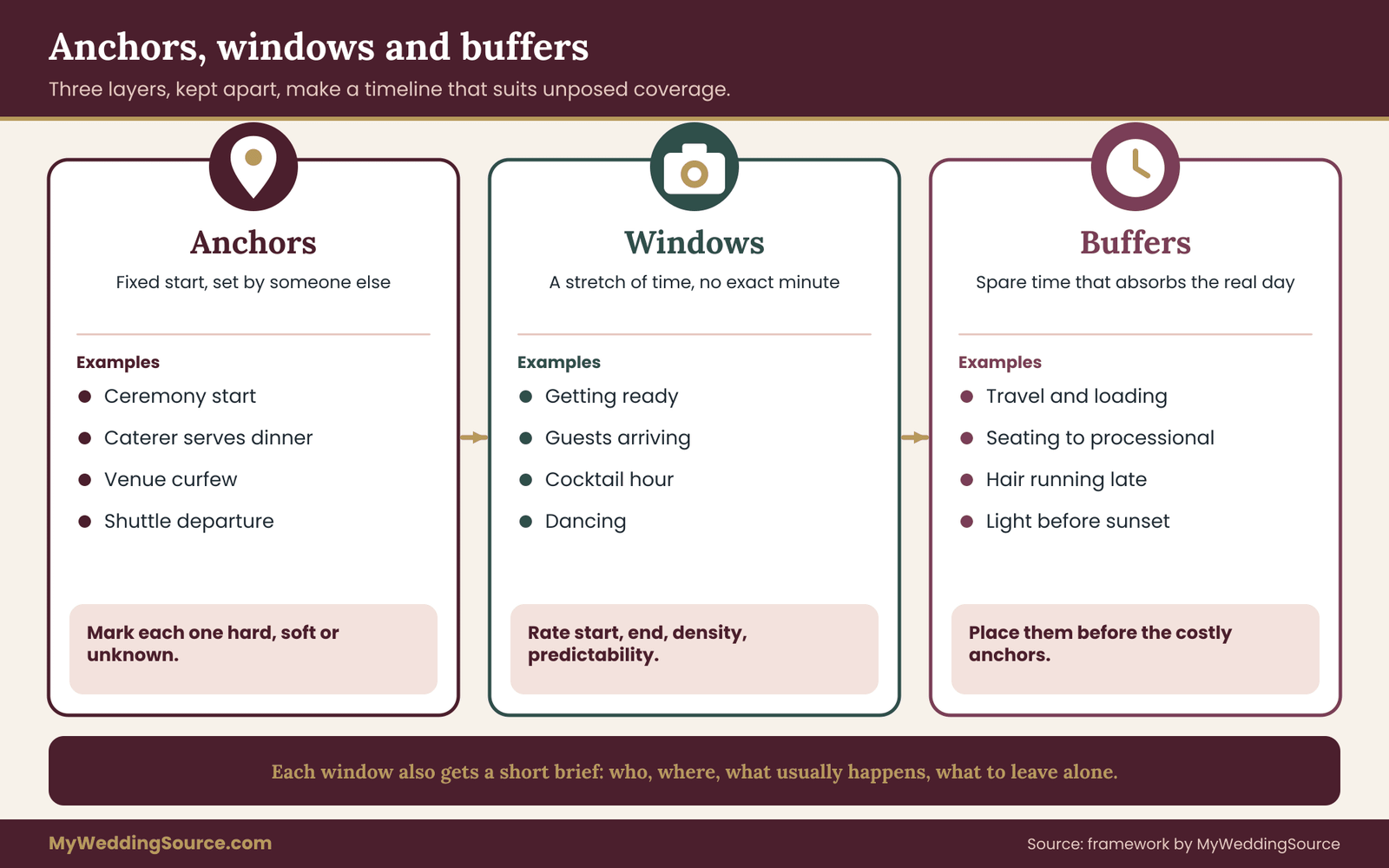
The three layers are deliberately kept apart. Couples and planners often write a timeline as a single column of times, which treats a fixed ceremony start and a “sometime around five” cocktail hour as the same kind of fact. They are not. When a window overruns, a good timeline lets it overrun and spends buffer time; it does not treat the overrun as a failure. When an anchor slips, the planner knows exactly which windows lose time.
There is also a fourth, quieter element that the later sections return to: the brief. Each window gets a few lines for the photographer. Who is in the room, where the light is coming from, what usually happens there at weddings like yours, and what you would prefer not to be photographed. The brief is the thing that lets a documentary photographer behave like someone who knows your day, rather than someone arriving cold.
Why not simply trust the photographer to figure it out? Because documentary wedding coverage depends on information only you have. Because the cost of missing information lands on you. A professional with years of experience will still not know that your two families have not been in a room together since the engagement, or that the bridal party is leaving the hotel by a side door because a guest block is checking out at the front. Those facts change where the camera should be and who should be in front of it.
The method also keeps the cost conversation honest. When you know your windows, you can see which hours of coverage you are actually paying for. If the photographer is booked eight hours and three of them fall in windows where little happens, such as a long gap between ceremony and reception, you can move the start time or shorten the gap rather than buy more hours. Your wedding vendor timeline should show the same anchors, so the caterer, the DJ and the photographer are all working from one set of fixed times.
The sections that follow take the three layers in order, then cover light and position, the short planned list, a rain plan, contract questions and a worked example with edge cases. ## Step one: list the anchors of your documentary wedding coverage timeline
Start with a blank page and write down only the things that cannot move. Do not write the whole day. A common mistake is to begin at “getting ready” and walk forward, which produces a chronological list where everything looks equally fixed. Begin instead with the hard constraints and ask of each one: who set this, and can it change?
Here are the usual sources of anchors, with a question for each.
Venue rules. The ceremony space may be available only until a certain hour. A garden may close at dusk. A hotel ballroom may need to be cleared by a set time for another event. For documentary wedding coverage, ask the venue for access hours in writing, including load-in, which tells you when the photographer can enter to photograph an empty, styled room before guests arrive.
Officiant and legal requirements. The officiant arrives at a set time and the ceremony starts then, give or take a few minutes. If the license must be signed and witnessed, the signing is an anchor. It is also a quiet, observable moment that many documentary photographers like to cover, so note who signs, where, and whether anyone wants it private.
Catering and service. The caterer needs a plated course served at a set time, or the buffet needs to open and close at set times to keep food safe. Toasts usually have to fit around service. The wedding reception guest flow guide explains how entry, seating and food service connect, which helps you place toasts and the cake cutting between courses without creating dead time.
Light. Sunset is an anchor even though nobody scheduled it. Official sunset times are published by the National Oceanic and Atmospheric Administration and other agencies, and the photographer will care about golden light and the minutes after sunset. If your ceremony is outdoors in the evening, the time of sunset on your date decides how much natural light you have for the recessional and for any outdoor pictures afterward.
Transport. A shuttle that leaves at a fixed time is an anchor for everyone who rides it. If the couple is going to leave in a vintage car at 9:30, that is an anchor for the exit photographs.
Other vendors. The DJ’s start time, the band’s first set, the cake delivery window and the florist’s final setup all come with times. Collect them from the contracts rather than from memory.
Once you have the list, rank each anchor by how much it can drift. A ceremony may start ten minutes late without anyone panicking, but a venue curfew will not move at all. Mark every anchor as hard, soft or unknown. A hard anchor will not move. A soft anchor can drift by a stated number of minutes. An unknown anchor needs a phone call this week.
Anchors the photographer needs that you may not think to list
Several anchors matter only to the photographer, and they are easy to forget because they are not events.
The first is the first-look decision, if you are considering one. A private first look before the ceremony is a scheduled moment that changes the whole afternoon, because it moves the couple’s portraits and some family pictures ahead of the ceremony. It is a separate decision with its own trade-offs, and it can fit documentary wedding coverage because the photographer can observe the moment from a distance rather than direct it.
The second is the last guest arrival. Guests who arrive during the ceremony processional create a disruption that documentary photographers want to know about. Ask the officiant or planner for a realistic cutoff and tell the ushers.
The third is the family departure time. If the elderly relatives and young children leave after dinner, their pictures need to happen before dinner or at the latest during it. This is an anchor for a short, specific set of pictures, not for the whole day.
The fourth is the vendor meal. A photographer who works eight or more hours needs to eat, and a meal break that lands in the wrong place means a missed toast. Put it between anchors, during a window that you already know is quiet, and put it in the contract if the photographer’s team needs a fed break.
The fifth is the card and battery rhythm. Photographers swap memory cards and batteries, and a professional will do this during quiet moments without being told. You do not need to plan it, but you do need to avoid scheduling every minute of the evening as an event.
What goes wrong when anchors are wrong
A wrong anchor does more harm to documentary wedding coverage than a wrong portrait slot, because everything downstream inherits the error. Consider a ceremony listed for 4:30 that actually begins at 4:50 because the officiant’s arrival time was never confirmed. The photographer arrives for the ceremony at 4:00, which is fine, but the golden-hour portraits scheduled for 5:15 are now at 5:35 in different light, the cocktail hour starts late, and dinner is delayed. None of this is dramatic, but it shaves the time you were counting on. Confirming anchors is the cheapest part of the process and the part with the largest return.
Write each anchor for your documentary wedding coverage on one line with four parts: what it is, the time, who set it and how firm it is. A line might read: “Ceremony start, 4:30, officiant and venue, soft by ten minutes.” Keep the list in a shared document so the planner, photographer and venue all see the same version. If a vendor says a time changed, change it in one place and send the new version, rather than correcting individual emails. Your wedding vendor contract guide covers how to make sure the times in the contract match the times in the timeline.
Step two: mark the windows where documentary wedding coverage happens
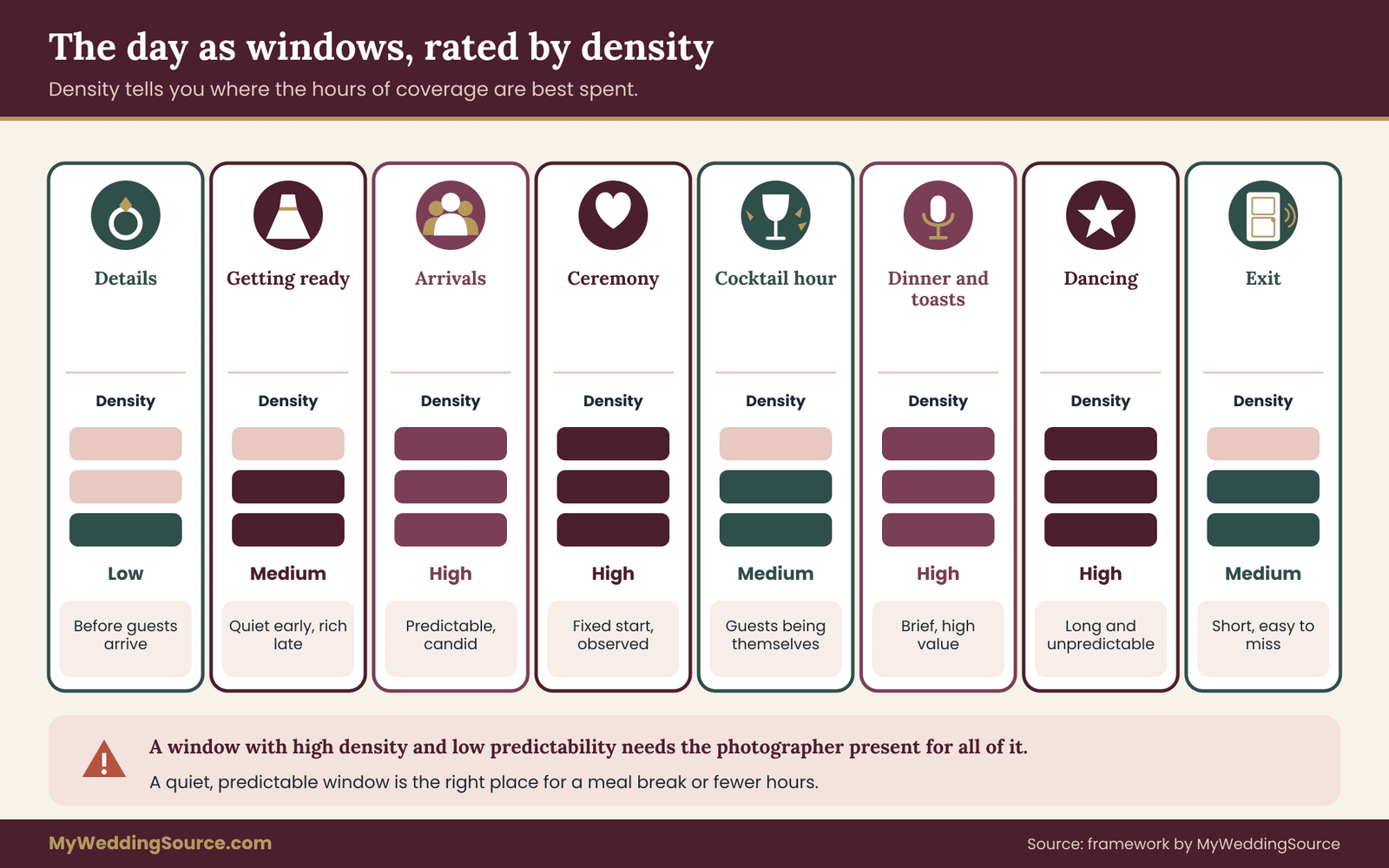
Windows are where documentary wedding coverage earns its place. A window is a stretch of time with a recognizable character and no fixed minute at which the best moment will occur. In documentary wedding coverage your job is to name each window, give it a rough start and end, and rate how much is likely to happen in it.
Think of the day as a handful of windows rather than a minute-by-minute script, because that is how documentary wedding coverage actually works. A typical day has these.
Getting ready. This is usually the longest window, often two hours or more. Early in it, little happens: hair, makeup, steaming, a quiet room. The moments the photographer wants are concentrated near the end, such as the dress going on, the fastening of jewelry, a parent seeing the couple dressed, a letter being read. If you give the photographer a two-hour window with no guidance, most of it will be spent photographing hairspray.
Details. The rings, the invitation suite, the shoes, the flowers, the signs. Details are photographed without people, which means they do not need to follow any human schedule. They need good light and a short, uninterrupted period before the room fills up. Many photographers do these early, and the brief should say where each item will be.
Arrivals. Guests arrive, find seats and greet each other. This is a rich window for candid reactions and takes place in a predictable thirty to forty minutes before the ceremony.
Ceremony. An anchor with a fixed start, but within it the moments are observed, not directed. Where the photographer may stand depends on the officiant and the venue. This is where your brief matters most, and the wedding ceremony step-by-step guide can help you list the beats the photographer should expect.
Cocktail hour. Guests mix, drink and eat while the couple may be elsewhere. It is a high-yield window for candid pictures of people being themselves. The wedding cocktail hour guide covers how long it should run and what happens during it.
Reception. Entrances, dinner, toasts, cake, dancing. Each of those is its own sub-window with a different pace.
Departure. The exit, the last dance, the send-off. It is short and easy to miss if nobody warns the photographer.
Rating a window
For each window, write three numbers or words.
The first is the start and end, to the nearest quarter hour. These are honest estimates, not promises.
The second is the density: how many recognizable moments you expect. A rating of low, medium or high is enough. Getting ready is usually low early and high late. The cocktail hour is medium. The toasts are high, but brief.
The third is the predictability: how sure you are of when things will happen. The toasts follow the meal, so their timing is fairly predictable. A child’s reaction during the ceremony is not predictable at all. Predictable moments can be covered with fewer resources. Unpredictable ones need the photographer to be present for the whole window.
Together, density and predictability tell you where to put the hours of documentary wedding coverage you buy. A window that is high in density and low in predictability is where you most want an experienced person standing and watching. A window that is low in density and high in predictability, such as a long gap while the room is flipped from ceremony to reception, is where you can reduce coverage or schedule the photographer’s meal.
Windows for people, not only places
There is a second way to cut the day into windows, which is by person. Every wedding has a few people whose presence matters to you and whose availability is limited. A grandparent who tires by early evening. A sibling flying in who arrives at the last moment. A child who will be asleep by eight. Documentary photographers cannot create access to these people, but they can plan around them if they know.
Make a short list of people with limited windows. For each, note the time they arrive, the time they will probably leave and where they will be sitting. Then compare that with your anchors. If the grandmother leaves at seven and the toasts begin at seven fifteen, you have a conflict that is cheap to fix now and impossible to fix in the moment. Move the toasts, ask for a short private moment before dinner, or accept that the pictures of her will come from the ceremony and the cocktail hour.
This also applies to consent. Some guests prefer not to be photographed at all, and documentary wedding coverage, which records people continuously, has a bigger footprint than staged coverage. The consent guide on this site explains how to plan guest boundaries and image use, and it is worth reading before you finalize any briefs that mention specific guests. ## Step three: add buffers so documentary wedding coverage can breathe
Buffers are the part of a documentary wedding coverage timeline that couples most often leave out, because buffers look like waste. A ten-minute gap with nothing written in it feels like a blank that someone should fill. In practice the gap is doing a job. It is the space where the real day is allowed to differ from the plan.
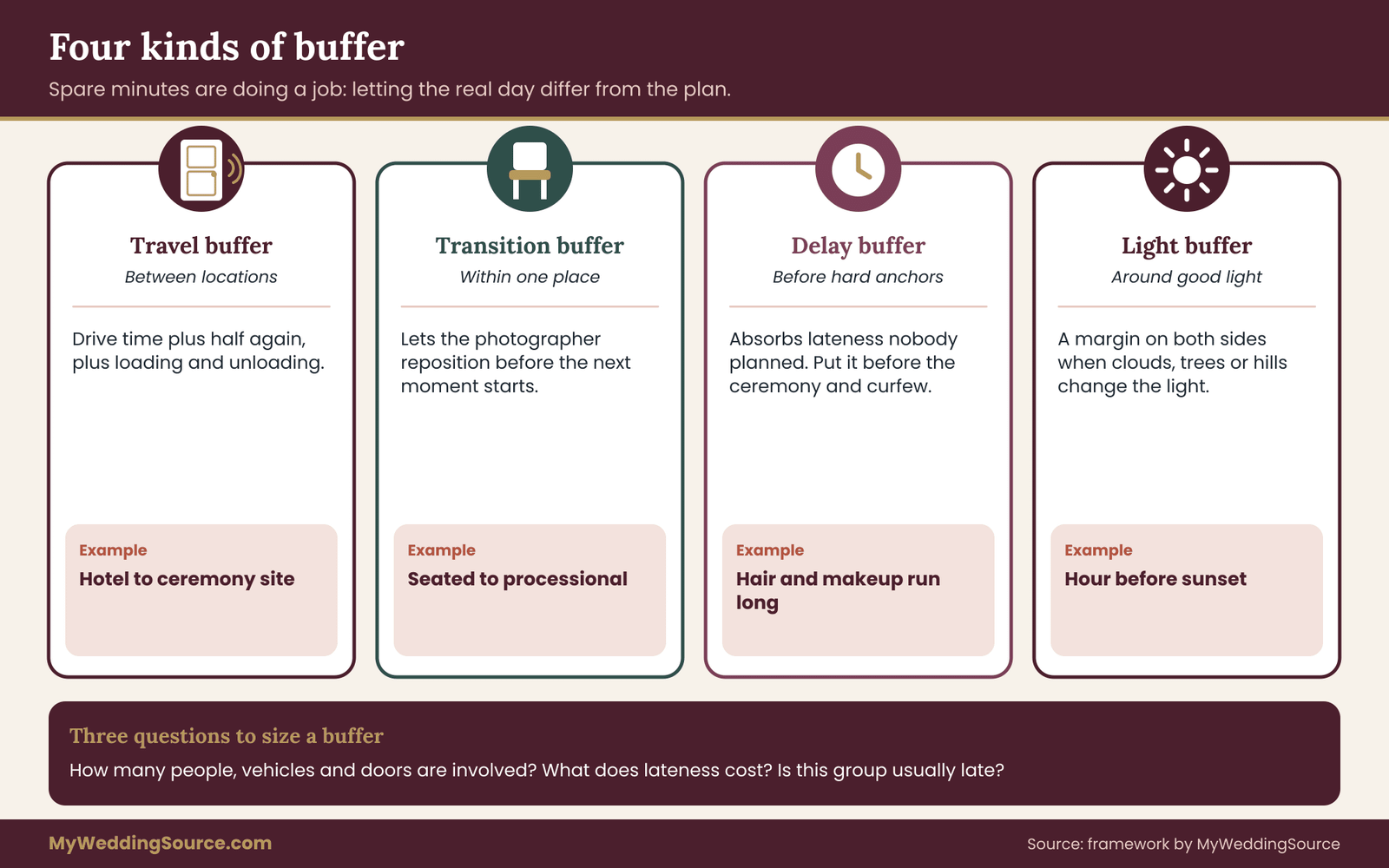
There are four kinds of buffer, and each one protects something different.
Travel buffers. Moving between two locations always takes longer than the map suggests. People park, find doors, wait for elevators, carry dresses and gather children. If the bridal party leaves the hotel for the ceremony site, build in the drive plus a margin for the group to assemble. A common rule of thumb is to take the drive time you expect and add half again, then add a separate allowance for loading and unloading. Write the number down, because it is easier to challenge a number than a feeling.
Transition buffers. These sit between windows within the same location: the minutes between guests being seated and the processional beginning, or between the last toast and the first dance. They let the photographer reposition, change a lens or move to the other side of a room without missing the start of the next moment.
Delay buffers. These absorb the lateness that nobody plans. Hair takes longer. A vendor arrives late. A guest cannot find parking. Place delay buffers just before your hardest anchors, not evenly across the day. The point is to protect the ceremony start and the venue curfew, not to make every moment slightly later.
Light buffers. If any of your outdoor coverage depends on a particular quality of light, such as the hour around sunset, add a margin on both sides. Clouds, hills, buildings and trees change when direct light arrives and when it disappears. Your photographer can tell you how much margin the site needs after a walk-through.
How much buffer is enough
There is no universal figure, and anyone who offers one is guessing. What works is a short decision rule. Count the number of moving parts in a transition: people, vehicles, items to carry, doors to pass through. Each one adds risk. A transition with two people walking across a courtyard needs little buffer. A transition with a bridal party, a dress with a train, two cars and a hotel lobby needs a lot.
Another useful test is to ask what the cost of lateness is. If the cost is a slightly later cocktail hour, a small buffer is fine. If the cost is losing the only daylight for outdoor photographs, make it larger, or move the outdoor part earlier. Buffers are cheapest when they are placed before something expensive to miss.
A third test is to look at the history of your own group. If everyone in the wedding party is habitually late, set the real call time earlier than the published one. This is common planner practice and does not need to be dramatic. Tell the group to be ready at 2:00, plan for them to be ready at 2:20 and let the photographer know that the true start of getting-ready moments is closer to 2:30.
Where buffer time is spent in a documentary schedule
A staged schedule spends spare time on more photographs. A schedule for documentary wedding coverage spends spare time on watching. That is a quiet but important difference. If the photographer arrives ten minutes early to a window because the previous one ended early, the extra time is used to settle into the room, notice the light and see where people are gathering. That is productive time even though it generates no obvious moments.
It follows that buffers in documentary wedding coverage should not be filled with additional requests. If you have ten spare minutes before the ceremony, do not add a “quick picture with the cousins.” Leave the minutes empty. The photographer will use them, and so will the couple, who often say the best part of a long day was a few unscheduled minutes alone. This is also why documentary wedding coverage works better with a calm timeline. A packed schedule leaves the photographer chasing the plan and missing the moments.
Reading the timeline for pressure points
Once you have anchors, windows and buffers for your documentary wedding coverage, read the timeline from start to end and look for three kinds of pressure.
The first is stacked anchors: two or more fixed times that fall close together, so that a small delay in the first one pushes the second one out of place. For example, a ceremony anchor at 4:30, a caterer anchor at 6:00 and a sunset anchor at 7:20. If cocktail hour is only a little over an hour long and the couple’s private time falls inside it, any ceremony delay eats the private time first. Decide in advance which thing gives way.
The second is a window with no exit. If there is only one door out of the ceremony space and the recessional goes through it into a narrow corridor, the photographer may be trapped on the wrong side. Ask the venue about routes and whether the photographer can move through a service door.
The third is an overloaded person. Some people are in every window: the couple, the parents, the best man, the maid of honor. If the same four people are needed for portraits, a toast, a reading and a family grouping all within one hour, someone will be late. Spread the demands out or share them among more people.
A master vendor schedule shows how a master schedule can be shared with every vendor. The documentary timeline you build here is a more detailed layer that sits underneath it, written for the photographer.
Light and position: telling the photographer where moments will happen
A photographer doing documentary wedding coverage works with whatever light and space the day provides. That makes the physical details of each window more valuable than a list of shots. The most useful thing you can give the photographer is a short note for each location: where the people will be, where the light comes from and what the constraints are.
For each window, write down the following.
Where. The room, the area of the garden, the specific table. A photographer who knows the bridal party will be in the room with the large east window can plan to be there when the sun is lower and the light is softer.
Light. Is the space bright, dim or mixed? Does it have windows? Will the sun be behind the guests during the ceremony, which can turn faces dark? Is there overhead lighting that a venue will not let you change? Your photographer will often visit the venue in advance to prepare documentary wedding coverage and can answer these questions, but you can help by supplying a floor plan, photographs and the times of day when you plan to use each space.
Movement. Where will people walk? Where will they stand? A ceremony where the couple faces the guests gives different photographs from one where the couple faces away. Ask the officiant about positioning, and share the answer.
Restrictions. Some venues limit where photographers can stand during a ceremony, ban flash during certain moments or require that no one enter a certain area. Religious ceremonies may have rules about movement near the altar. Find out in advance, not on the day.
Positioning without posing
Telling a photographer where moments will happen is not the same as arranging them, and documentary wedding coverage depends on that difference. The difference lies in who decides. In staged coverage the photographer places people and then takes the picture. In documentary wedding coverage the photographer positions themself and waits. For that to work, the photographer needs to know where people are likely to be.
Here are practical examples of what that looks like.
For getting ready, tell the photographer which room the dress is in, which room the parents will be in and what time each is expected to be ready. Arrange the space so that the room has some natural light and some clear floor. A tidy room is not a posed room. Removing a pile of coats from the background does not change what happens in front of it.
For the ceremony, tell the photographer which side each family will sit on, where the officiant will stand and whether readers will walk to a lectern or speak from their seats. If the venue has a balcony or a side aisle that gives a clear view without being in the way, mention it.
For the reception, tell the photographer which tables the grandparents and children are at, where the toast will be given from and whether there is a clear path to the dance floor. If the venue plans to dim the lights at a particular moment, tell the photographer that too. The change affects exposure and what equipment is needed.
The sun, in plain terms
Natural light changes through the day, and documentary wedding coverage is shaped by it whether or not you plan around it. A few plain observations help you place your windows.
Midday sun is harsh and produces strong shadows on faces. Documentary photographers manage this with shade, open doorways and reflected light, but it is more difficult. If your ceremony is at noon in an open field, the photographs will look different from those at 5:00.
The hour before sunset is warm and low, which flatters most scenes, but it passes quickly. If you want pictures in that light, schedule your anchors so that the couple is free at the right time and add a light buffer.
After sunset there is a short period when the sky still glows and the light is soft and even. It ends faster than people expect. The solar calculator published by the National Oceanic and Atmospheric Administration lets you check sunrise, sunset and the position of the sun for your location and date, and the photographer may use similar tools.
Indoors, the same ideas apply to windows, lamps and the venue’s own lighting. A room can look bright to the eye and still be difficult to photograph. Ask the photographer what the room needs, and ask the venue what it will and will not allow.
{{INFOGRAPHIC:4}} ## The short list: where documentary wedding coverage still needs a few planned frames
A purely observational day of documentary wedding coverage still produces gaps. Nobody asked the two sides of the family to stand together, so no picture of them together exists. The couple were busy with guests and have no portrait of just the two of them. A hybrid version of documentary wedding coverage covers this without turning the day into a photo shoot: keep the planned list short, bounded and placed where it does the least damage.
The central idea is a cap. Decide the total number of minutes you are willing to give to planned pictures across the entire day, write it on the timeline and treat it as a budget. A cap forces trade-offs that a loose intention does not. If you give the planned list thirty minutes in total, then adding a fifth family grouping means removing something else.
There are three kinds of planned pictures worth considering.
Family groupings. Pick the groupings that would matter in ten years. Typically this means the couple with each set of parents, the couple with each side’s immediate family, and the grandparents. Rather than writing a long list, name each grouping, say who is in it and name one person from each side who can gather the right people. A family photo list helps you choose the groupings and decide which ones to skip. A good rule is to write the list with the oldest and youngest guests first, since those are the people whose time is the most limited.
Couple portraits. Even documentary photographers often ask for a short, relaxed block with the couple. This does not need to be posed. A walk, a conversation and a few quiet minutes in good light usually produce natural images. Fifteen to twenty minutes is a common starting point, and you can discuss with the photographer whether a shorter or longer block fits your schedule. It is helpful to put the block where the light is good, and to let the photographer suggest the timing.
Detail and venue pictures. The rings, the flowers, the table settings and the room itself are photographed without people. They do not belong in the guest-facing part of the day at all. Schedule them before guests arrive, and make sure the room is ready.
Where to place the planned blocks
The location of a planned block in the day matters as much as its length. A few placements work well with documentary coverage.
Family groupings fit best immediately after the ceremony, while everyone is together and already dressed. This is also the time when people are in a good mood. Placing them before the cocktail hour keeps the guests from being pulled away from the party in the middle of it. Keep the grouping to a time cap, hand the list to your two gatherers and let the photographer work quickly.
Couple portraits fit best at the start of golden light, or whenever the couple has a natural break. Some couples prefer to do them before the ceremony as part of a first look. Others take ten minutes during cocktail hour, which has the advantage of giving the couple a quiet break and the disadvantage of missing some of the party.
Detail photographs fit in the early part of the day, while the venue is clean and the light is gentle. If the florist is late, move them. They are the most flexible item on the list.
Writing the planned list so it stays short
A short planned list is easiest to keep when each entry is specific. Compare these two entries.
“Family photos, 30 minutes.”
“Couple with Maya’s parents; couple with Dev’s parents; couple with both sets of parents; couple with the four grandparents; couple with Maya’s siblings. Gatherers: Maya’s brother and Dev’s aunt. Location: the rose garden steps. Cap: 15 minutes.”
The second is easier to run and easier to say no to. It tells you at a glance that the list has five groupings, two gatherers and a time limit. If a guest asks for a sixth grouping on the day, the planner can point to the cap and suggest taking it during the cocktail hour, if the photographer agrees.
The list should also include who should not be in a grouping. In families with complicated histories, the list should say which combinations to avoid. The photographer will not know that two relatives who appear in a group picture have not spoken for years. A single line on the brief prevents an uncomfortable moment.
Handling requests from guests
Guests often make requests during the day. “Can you take one of us by the fountain?” is polite and harmless, but a stream of such requests can derail documentary wedding coverage. Agree in advance with the photographer about how to handle them. Some photographers happily take a quick picture. Others redirect guests to a friend with a phone. Either approach is fine. What matters is that the photographer and the planner say the same thing.
You can also reduce the pressure by providing other opportunities for guest photographs. A simple backdrop, a photo wall, or a corner with good light where guests can take their own pictures leaves the photographer free to watch the room.
What to leave unplanned on purpose
For the benefit of the style, some moments are best left entirely unplanned. Reactions during the vows. Parents watching the first dance. Children falling asleep on chairs. A room full of people singing along to a song. These happen only when no one is told to do anything. The timeline should therefore show them as windows, not as shots. If you find yourself writing “photo of grandma crying at the ceremony,” cross it out. Instead, write “grandmother seated in the second row, left side,” and let the photographer do the rest.
Writing a one-page brief for each window in documentary wedding coverage
The anchors, windows and buffers give your documentary wedding coverage its structure. The brief is what turns the structure into something a photographer can use. A brief is short, written for the photographer alone and focused on information the photographer cannot easily get any other way.
A good brief for one window of documentary wedding coverage fits on a single page, or half of one. It has five parts.
One sentence of purpose. What is this window for? “Getting ready: the hour before the bridal party leaves for the ceremony; the quietest and most intimate part of the morning.”
Who is there. Names, relationships and anything the photographer would find useful. “Maya, her mother Anita, her sister and two close friends. Anita is emotional and has asked not to be filmed while crying.” That last detail is the sort of information that changes how a photographer behaves.
Where, and what the light is like. The room, the windows and any restrictions. “Second-floor suite, large window facing east, curtains stay open. No flash in the nursery next door where a baby is sleeping.”
What usually happens. A few expected moments, without scripting them. “Dress goes on around 2:45. Mother fastens necklace. A friend reads a card.”
What to leave alone. Anything that should not be photographed, or should be photographed only from a distance. “Do not enter the bathroom. Do not photograph the pre-ceremony phone call with Maya’s father, who is unwell and will join by video.”
Keep each brief to what the photographer needs. If a sentence does not change where the photographer stands or what they do, delete it.
Who writes the brief and who receives it
The couple usually writes the first draft, with help from a planner if there is one. A parent or friend who knows the family can add details. The photographer reads it and replies with questions. The final version goes to the photographer, the planner and the two people each side trusts to answer questions on the day.
Share the briefs only with the people who need them. Briefs contain details about families, health and relationships that should not be forwarded casually. Send them through a method you would use for other private information, and ask the photographer how long they keep them. A records guide explains how to store contracts and planning documents so that they remain available later without being sprayed across inboxes.
Testing the brief
Before the day, give the briefs to someone who was not involved in writing them, such as a friend or a sibling, and ask them to describe what they think will happen in each window. If their description does not match your intention, the brief is unclear. Fix it. This takes ten minutes and prevents most misunderstandings.
You can also test the brief against the timeline. For each window, check that the start and end times match, that the people listed will be in the right place and that the light described matches the time of day. A brief that says “bright east window” for a window that begins at 4:30 in the afternoon probably contains a mistake.
{{INFOGRAPHIC:5}} ## A rain alternative location shot map for documentary wedding coverage
Rain is the clearest test of whether a timeline is built for documentary wedding coverage. A staged day depends on a particular backdrop at a particular time, so rain forces a scramble. A day of documentary wedding coverage depends on people and moments, which survive a change of weather far better, provided the photographer knows in advance where those moments will move.
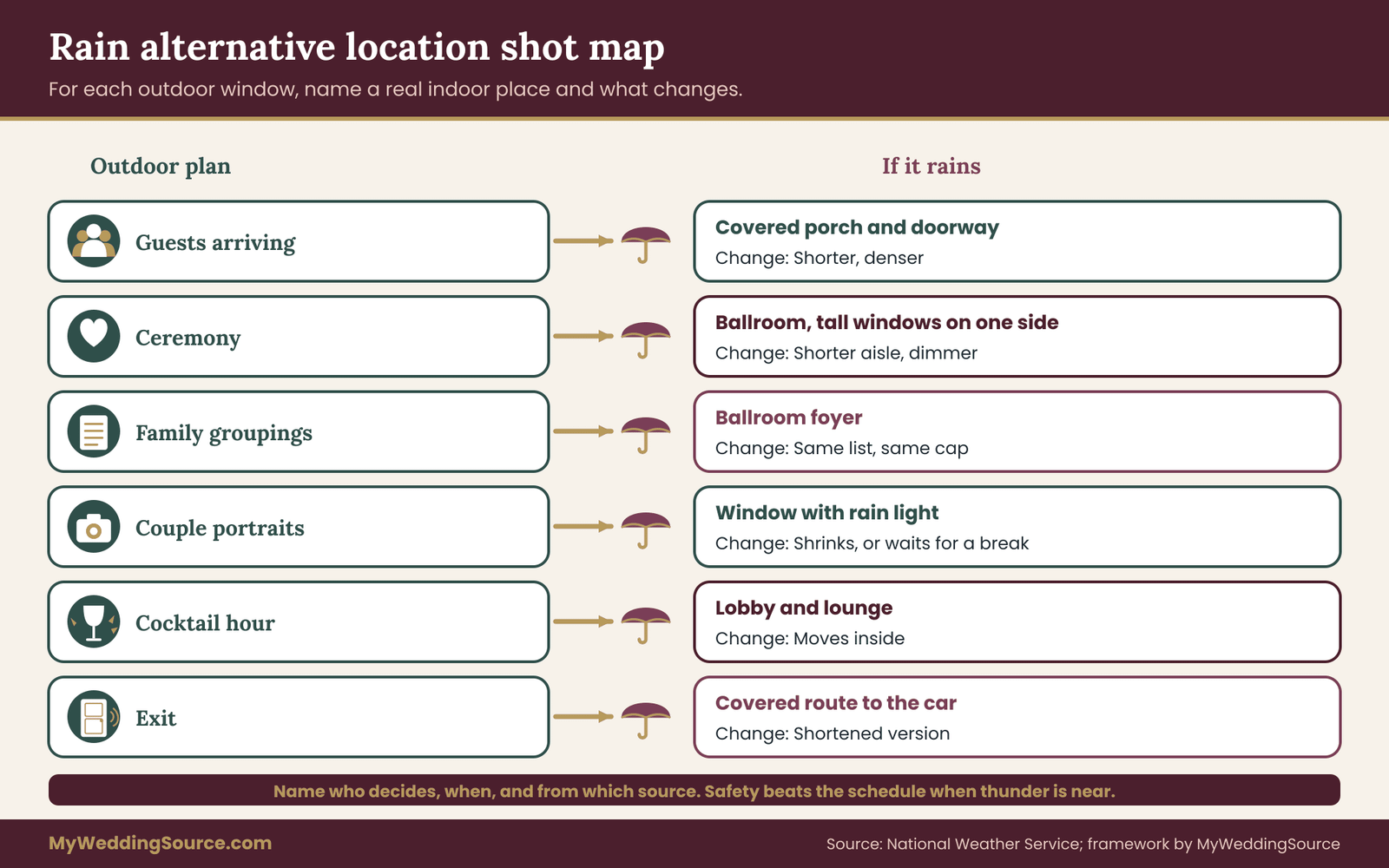
A rain alternative location shot map is a one-page plan that answers a single question for each outdoor part of the day: if this window cannot happen outside, where does it go, what changes about the light and where does the photographer stand? It is not a list of shots, and it fits documentary wedding coverage because it plans for places and people. It is a map of places and the people and moments expected in them.
Building the map in four passes
Pass one: list every outdoor window. Go through the timeline and mark each window that currently takes place outside. Typical entries include guests arriving at the ceremony site, the ceremony itself, the recessional, family groupings, couple portraits, the cocktail hour on a terrace and the exit.
Pass two: give each one a covered or indoor alternative. Name a specific place, not a general idea. “Inside” is not a location. “The ballroom foyer, between the two staircases” is a location. Ask the venue for a floor plan and for the rain plan it already has. Many venues have a standard one and have strong opinions about which areas can be used and when.
Pass three: describe how the light and the space change. An indoor alternative is usually dimmer, with mixed light sources and tighter space. Say whether the room has windows, whether the venue will change lighting levels and whether flash is allowed. Mention whether the alternative can hold the same number of people, because a ceremony moved from a lawn to a lobby may not.
Pass four: mark what moves, what shrinks and what disappears. Some outdoor moments have a straightforward indoor version. Others do not. A walk through a garden has no indoor equivalent. Be honest about what shrinks, such as a long outdoor couple portrait session that becomes a short indoor one, and what is simply dropped.
The decision point matters more than the plan
A rain map is only useful if someone decides when to use it. Write down three things.
Who decides. Pick one person, usually the planner or the venue coordinator, and tell everyone who it is. A decision made by committee in a doorway at the last minute is a poor decision.
When they decide. Set a time before which the decision is made and a time after which it is final. A ceremony at 4:30 might have a “call” at 2:30, which gives the venue time to move chairs and the photographer time to reposition. If the weather is uncertain, the call can be to move indoors anyway, rather than to wait.
What they look at. Name the source. The National Weather Service at weather.gov publishes local forecasts and hourly forecasts, and it is the usual primary source for U.S. weather. Pick a checking time and stick to it, rather than refreshing a forecast every ten minutes.
For thunderstorms, the guidance is more serious than for rain. The National Weather Service advises that when thunder can be heard, you are close enough to be struck by lightning and should move to a substantial building or a hard-topped vehicle. It also recommends waiting a period after the last thunder before going back outside. That is a safety decision, not a photography decision. The photographer, the planner and the venue should all understand that the plan changes when a storm comes, regardless of the schedule. Check the current guidance on weather.gov before the day.
Keeping the style when the location changes
A rain plan can drift away from documentary wedding coverage towards staged work if no one is careful. When the beautiful lawn is unavailable, there is a temptation to find a decorated corner and pose everyone in front of it. That defeats the purpose of documentary wedding coverage. A few principles keep the day documentary.
Photograph the weather as part of the story. Umbrellas, a dash across a courtyard, guests huddled in a doorway. These are moments that would not happen on a dry day, and they are often favorites.
Choose indoor spaces with life in them. A lobby with traffic and conversation gives more material than an empty room set up for pictures. If the couple need a quiet portrait, a window with soft rain-light is often better than a staged backdrop.
Keep the planned blocks short. Rain adds stress, and long portrait sessions in cramped spaces tend to produce tired faces. Use the cap you set earlier and, if anything, shorten it.
Let the photographer lead on equipment. Wet weather affects gear. Photographers may switch lenses, add covers or shoot from a sheltered spot. A good brief tells them where there is shelter, and a good timeline gives them time to adjust.
What rain does to each window
Different windows respond differently to a change of weather. Use these notes to decide what to write on your map.
Getting ready is usually indoors already and often benefits from the soft light of an overcast day. Little changes except travel to the ceremony, which needs an umbrella plan and a drying plan for shoes and hems.
Arrivals become shorter and denser. Guests rush inside rather than lingering, and the interesting moments move to the entrance. Position the photographer at a sheltered point where people pause, such as a doorway or a covered porch.
The ceremony changes most when it moves indoors. The space may be smaller, the aisle shorter and the light very different. Ask the officiant whether the order of events changes, and give the photographer a floor plan of the new layout.
The recessional and exit often move to a covered route. If there is no covered route, plan for a shortened version and tell the photographer what the new path is.
Portraits often shrink the most. If you want pictures outdoors, tell the photographer you are willing to use a break in the weather and set a window for it, with a condition: only if the rain stops. A short stretch of dry time during cocktail hour can produce a few natural pictures.
The reception is mostly unchanged, except for arrival and departure, which need umbrellas and a covered loading area.
Heat, wind and other weather
Rain is not the only weather that moves a shot map. Heat affects how long guests can stand outside and how long the couple can comfortably do outdoor pictures. Wind affects veils, programs and any open-flame candles. Cold affects how long people stay outdoors and what they wear. Add a line to your map for each of these if they are relevant to your date and place, and use the same method: name the alternative, describe the change and say what moves.
Sharing the map
Send the map to the planner, the photographer, the venue contact and whoever is making the weather call. Keep it to one page, with each outdoor window on its own line. Add the call time and the name of the person deciding. If your photographer works with a second shooter, make sure the second shooter has it too.
A rain map also helps with the contract for your documentary wedding coverage. If your agreement says the photographer’s coverage ends at a set hour, a rain delay that pushes the ceremony back by thirty minutes may affect it. Ask about overtime and about what happens if a weather delay moves an anchor. Vendor contract guides explain what to look for in terms of change and overtime clauses. ## Contract and rights questions to settle before documentary wedding coverage begins
Documentary wedding coverage changes what you ask a photographer in two ways. First, because the photographer works without a shot list, the contract should say more about hours, positions and how the team behaves, since there is no list to point to. Second, because documentary wedding coverage records many people who did not agree to be recorded, rights and privacy questions come up more often.
This section on documentary wedding coverage is not legal advice. It lists questions to ask and documents to read, and it points to the agencies that publish the rules. Anything in your contract is between you and the photographer, and a lawyer is the right person for questions about your specific agreement.
Coverage terms to confirm in writing
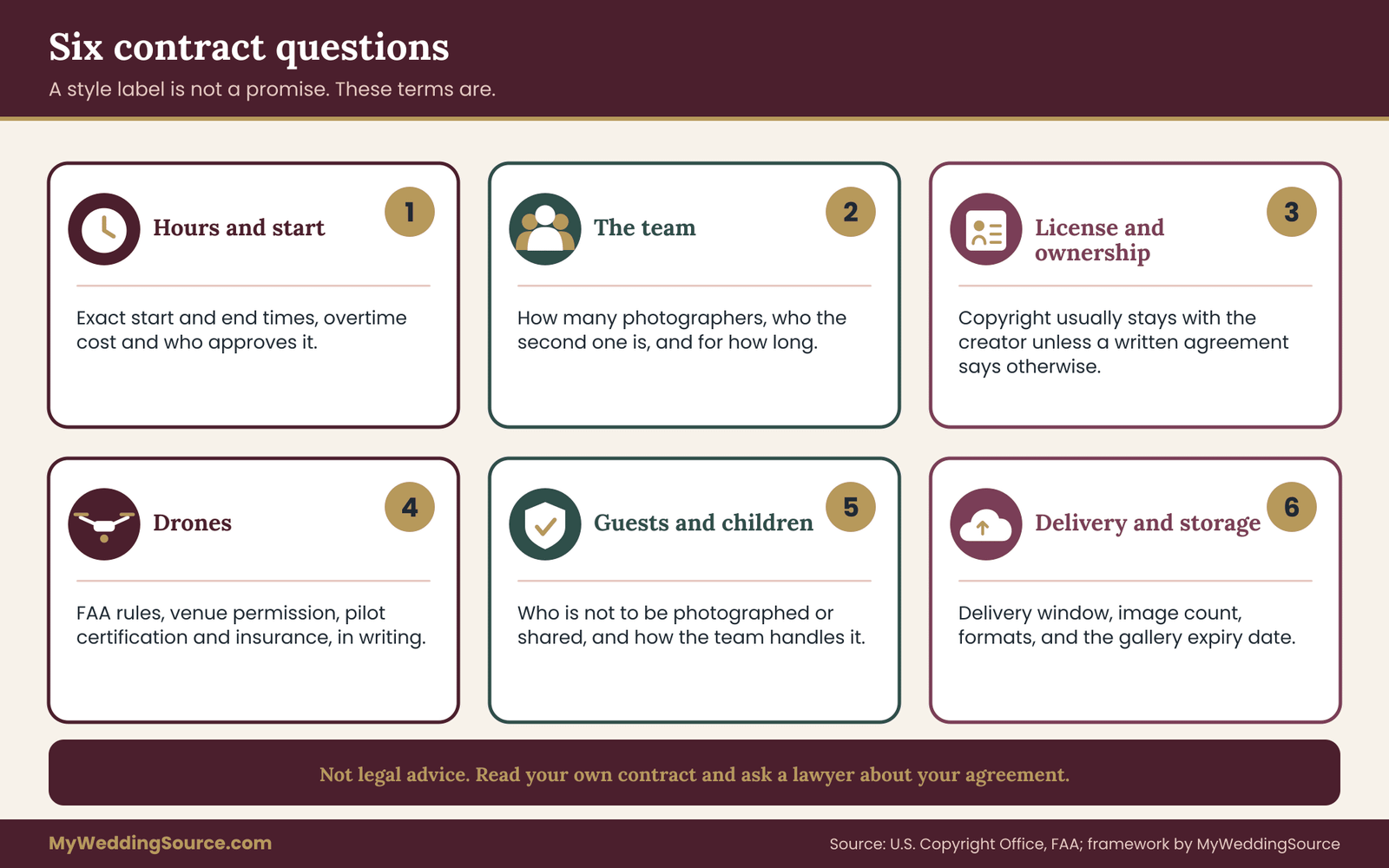
Hours and start time. State when coverage begins and ends, not only how many hours. If your timeline puts the first window at 1:00 and coverage starts at 2:00, the pictures you were counting on will not exist. Ask what happens if the day runs long, what overtime costs and how it is approved.
Number of photographers. A documentary day is often covered by two photographers so that the ceremony, the guests and the couple can all be watched. Ask who the second person is, whether they are an employee or a contractor and whether they will be at the whole event or only part of it.
Position and conduct. Ask how the photographer plans to move during the ceremony and toasts, how they use flash, and whether they follow the venue’s and officiant’s rules. A short written statement saves an argument at the altar.
Breaks and meals. State when the team eats and whether they need a meal provided. This should match the quiet window you identified earlier.
Backup and failure. Ask what happens if the photographer is ill or has an emergency, how they record the day (for example, with two memory cards in the camera, which many professionals do) and how quickly they back up files after the event. You are not asking for a technical specification. You are asking whether the photographer has a plan.
Weather and changes. Ask how the photographer handles rain and what happens if the schedule changes on the day. This ties directly to your rain map.
Who owns the pictures
Ownership is the question couples most often skip and most often regret. The U.S. Copyright Office explains that copyright generally belongs to the person who creates a work, which in the case of a photograph is usually the photographer, unless there is a written agreement that says otherwise, such as a transfer of ownership or a work-made-for-hire arrangement. In practice, most wedding contracts leave copyright with the photographer and give the couple a license to use the images.
A license can vary widely. Ask the following.
What may you do? Print them, post them, share with family, send to a printer, use them in an album. Most contracts allow personal use. Read the exact wording.
What may the photographer do? Many photographers keep the right to use images in a portfolio, on social media or in advertising. That is a common arrangement, but it should be a choice you make, not a default you did not see. If you want to limit or prohibit public use, say so before signing, and ask whether that changes the price.
Can you edit them? Some licenses allow filters and cropping. Others forbid changes because the photographer wants the edited look kept intact. If you plan to add filters before posting, check.
How long does the license last? Most are indefinite, but read to be sure.
Who else may use them? Your venue, your florist and your planner may ask for pictures. Whether they can use them depends on the contract. The agency that explains the basics of copyright is the U.S. Copyright Office at copyright.gov, and its introductory pages are a useful way to understand the terms before you ask the photographer.
Do not assume that because you paid for documentary wedding coverage you own the images. Do not assume the opposite either. Read the contract. The Copyright Office pages are the right primary source for how the law treats ownership by default, and your contract tells you what actually applies to your pictures.
Drones and aerial pictures
Some photographers offer aerial coverage by drone. It can be a good fit for a large outdoor setting, and it also raises several questions that a ground photographer does not face.
The Federal Aviation Administration sets the rules for flying unmanned aircraft in the United States. Flying for compensation or business use is generally treated differently from recreational flying, and commercial operators are typically expected to hold the appropriate FAA certification. The FAA’s pages for drone pilots explain the current requirements, and you should check them rather than rely on a summary. Do not assert that a drone is authorized until you have checked.
Venue rules are a separate layer. Many venues, parks and public lands restrict or ban drones regardless of federal rules. A park may require a permit or may prohibit launching entirely. National parks, for instance, have their own policies, which are published by the National Park Service. Ask the venue in writing whether drones are allowed, and ask the photographer to show their certification and their insurance.
Safety and privacy matter too. A drone over a crowd is a risk, and some guests will object to being filmed from above. Decide in advance where the drone may fly, when it may fly, whether guests are told and who is responsible for stopping it. Many couples decide to use a drone only before the ceremony, when no guests are present, or after guests have left. If your documentary wedding coverage includes aerial pictures, put the time, place and conditions in the contract.
Guests, children and consent
Documentary wedding coverage observes everyone, so it is worth deciding what the policy is for people who do not want to be in pictures. Photographers usually have no way of knowing who those people are unless they are told. The wedding photography consent guide walks through how to collect boundaries from guests and how to decide what happens to images afterward. For this timeline, the important points are these.
Tell the photographer about any guest, adult or child, who should not be photographed or whose picture should not be shared. Ask how the photographer will handle that in practice, for example by letting them know discreetly or by avoiding frames that include a particular person.
Decide whether children’s pictures are used in the photographer’s portfolio. Parents often feel differently from the couple.
Ask whether the photographer records audio during the ceremony and toasts. Some jurisdictions have rules about recording conversations, and a venue or officiant may have its own policy. If audio is recorded, say who will hear it and who keeps it.
Delivery, galleries and storage
The pictures only matter if you can get them and keep them. Ask these questions before the wedding.
When will you receive the images? Ask for a delivery window in writing, such as a range of weeks, and ask what happens if it is missed.
How many images will there be? Documentary wedding coverage often produces a large number of pictures. Ask whether the delivered count is a minimum, a range or an estimate, and whether you will get every image or only a selected set.
What format and resolution? You want files you can print and files you can share. Ask whether you get both.
How long will the gallery stay online? Online galleries often expire. Ask for the date and mark it on your calendar.
Who keeps the originals, and for how long? A photographer’s backup is not your backup. Download everything as soon as it is available and keep copies in more than one place. The Library of Congress publishes personal digital archiving guidance that explains simple ways to do this. The guide to organizing wedding records covers how to store galleries, contracts and receipts together.
Questions to put on your call with the photographer
These questions are short enough to use in a single conversation, and they uncover most of the issues above.
How would you describe the way you work during the ceremony, and where do you usually stand?
What do you need from us in a timeline, and what do you prefer we leave alone?
How do you handle a window that runs over?
What is your plan for rain, and how soon do you need to know?
What would you change about the timeline we sent?
How do you handle guests who do not want to be photographed?
What happens if you cannot work on the day?
When will the full gallery be ready, how long will it stay online, and what license do we receive?
Listen to the answers as well as the content, because documentary wedding coverage depends on trust in the person behind the camera. A photographer who asks you questions back, such as about the family, the venue or the flow of the day, is likely to be the one who reads your brief carefully. A photographer who answers every question with “don’t worry, I’ve got it” has told you what you need to know about how much they will use it.
Commercial relationships and recommendations
Wedding vendors often recommend one another, and some have formal referral arrangements. If your planner or venue recommends a photographer, it is reasonable to ask whether they receive anything for the referral. This is not a sign of bad faith. It is simply information. Ask for it, compare more than one photographer and decide for yourself. ## A worked example: one documentary wedding coverage timeline from start to finish
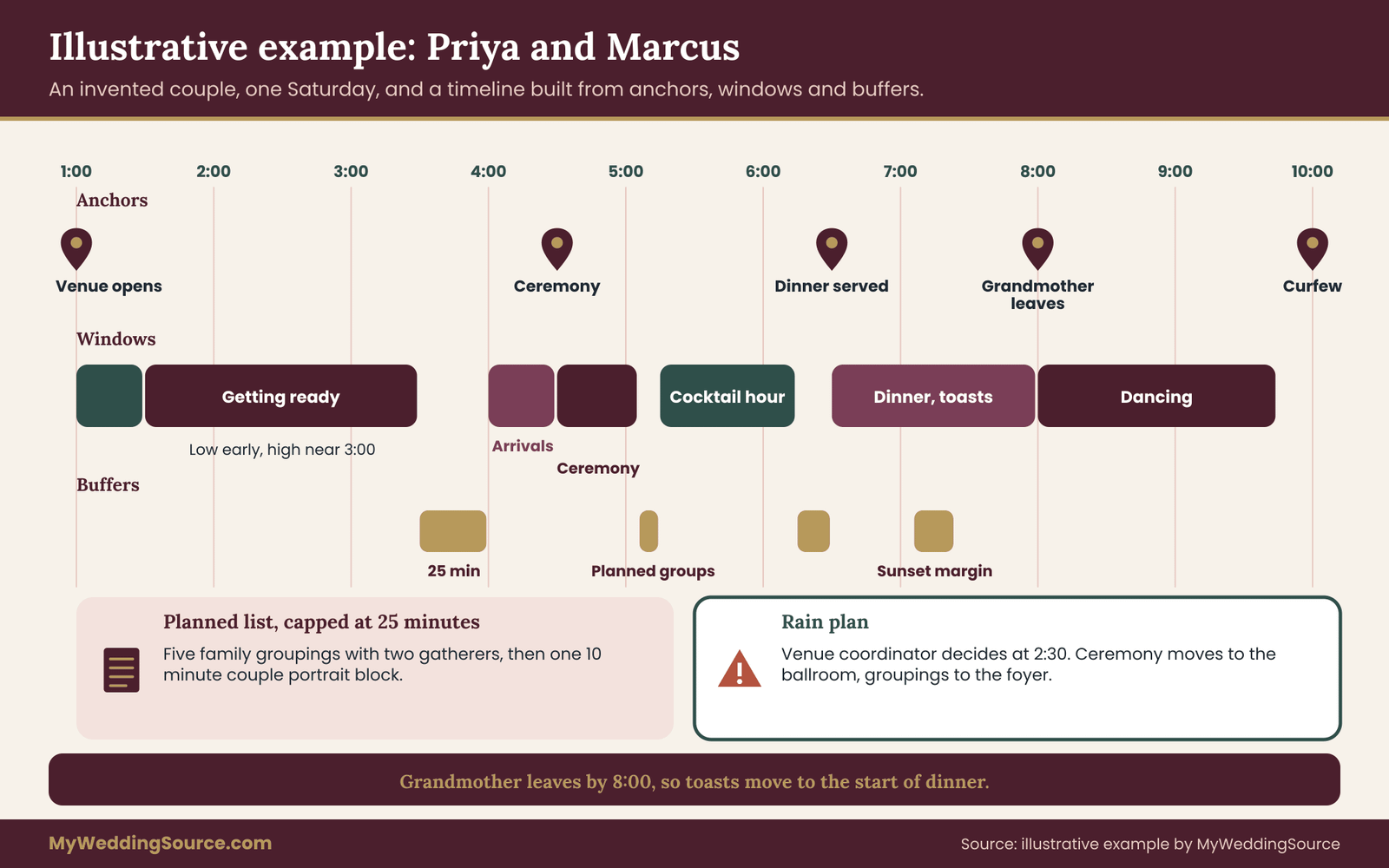
The couple in this example are invented, and the times are illustrative, not a recommendation. Priya and Marcus are marrying on a Saturday in late spring at a garden venue with an indoor ballroom as its rain plan. They have booked eight hours of documentary wedding coverage with two photographers and about ninety guests are expected.
Their anchors. The venue opens at 1:00 and requires everything to end at 10:00. The officiant arrives at 4:00 and the ceremony begins at 4:30, soft by ten minutes. The caterer serves dinner at 6:30. In this example, sunset falls at about 7:50. Priya’s grandmother, who is eighty-six, will leave after dinner by 8:00. These are the only fixed times, and they live on one page.
Their windows. Getting ready runs from 1:30 to 3:30 at the venue’s bridal suite, low density until about 3:00, then high. Details are photographed from 1:00 to 1:30 before anyone arrives. Arrivals run from 4:00 to 4:30. The ceremony runs from 4:30 to about 5:05. Cocktail hour runs from 5:15 to 6:15. Dinner and toasts run from 6:30 to 8:00. Dancing runs from 8:00 to 9:45.
Their buffers. There is a twenty-five minute buffer before the ceremony, because the bridal party is walking from the suite across the garden, and a thirty-minute buffer between the ceremony and the start of dinner, which covers family groupings and a short couple portrait session. A light buffer is placed before sunset, so the couple has a gap at 7:15 that can be used if the sky is good and skipped if it is not.
Their planned list. The couple allows a cap of twenty-five minutes. Family groupings take fifteen minutes immediately after the ceremony: the couple with each set of parents, the couple with both families, and the couple with the four grandparents. Two gatherers hold the list. The couple’s portrait block is ten minutes in the early light of the cocktail hour. There is nothing else planned.
Their grandmother’s window. Because she leaves at 8:00, Priya moves the toasts to the beginning of dinner, so the photographer is positioned at her table at 6:45 and again before she leaves. The brief says: “Grandmother, second row left at the ceremony, table two at dinner. Walks slowly. Please do not ask her to stand for long.” The photographer uses that to plan.
Their rain map. If it rains, the ceremony moves to the ballroom, where the aisle is shorter and the light comes from tall windows on one side. The decision is made by the venue coordinator at 2:30, based on the National Weather Service forecast. Family groupings move to the ballroom foyer. The sunset portrait slot is dropped and replaced with a ten-minute window during cocktail hour if the rain stops. Arrivals are photographed at the covered porch.
Their contract. The agreement states the start and end of coverage, the second photographer’s presence from 3:30 to 9:00, a license for personal use, the photographer’s right to use images in a portfolio with the exception of anything involving children, and a delivery window. Marcus’s cousin, who works in a role where public exposure is a problem, is named in the brief as someone not to publish.
What happens on the day is not exactly what the plan said, and for documentary wedding coverage that is the point. The ceremony starts at 4:42. The officiant takes slightly longer than expected. The family groupings take eighteen minutes because one grandparent wants a picture with a great-grandchild. Dinner is served ten minutes late. The sunset window is cut short by clouds.
The timeline absorbs these because the buffers were there and because nothing was packed too tightly. The photographer, who read the briefs, is at the grandmother’s table for the toast and again as she leaves. The result is a set of pictures in which people look like themselves, because they were not hurried.
Notice what the couple did not do. They did not write a shot list. They did not specify poses. They did not ask for a sunset kiss at exactly 7:50. They told the photographer what was fixed, what would flow, where people would be and what to leave alone, and then they let the day happen.
Edge cases and common mistakes in documentary wedding coverage planning
Most problems with documentary wedding coverage come from a small number of recurring situations. Here are the ones worth planning for.
A very short wedding. A courthouse ceremony or a ten-person gathering has few windows, and the photographer may cover the whole event in two hours. In that case, drop the buffer categories you do not need and keep only the anchors and one brief. The method scales down, and documentary wedding coverage still works on a small day.
A very long wedding. Multi-day weddings or those with several ceremonies make it hard to cover everything. Pick the windows you most want and ask the photographer how documentary wedding coverage would work for each. It is better to cover three events well than six events thinly.
Two ceremonies or two locations. If a civil signing happens in the morning and a larger ceremony in the afternoon, treat each as a separate anchor, with its own brief, and give the travel between them a real buffer.
A cultural or religious ceremony with restrictions. Some traditions limit photography, flash or movement during parts of the ceremony. Ask the officiant or a respected family member what is acceptable, tell the photographer and put it in the brief. Mark those moments as windows in which the photographer will observe from a distance or not photograph at all.
A reluctant couple. Some people do not want to be photographed, even by a documentary photographer. If one partner is uncomfortable, talk to the photographer about how to work with that: smaller moments, fewer close-ups, more distance. Do not force a style that makes you tense.
A large wedding party. More people mean more windows and more chance that someone is in the wrong place. Appoint one person to keep the wedding party moving and make sure the photographer has that person’s number.
A venue with strict rules. Some venues limit photographers to specific areas, ban flash or require a vendor insurance certificate. Ask early, because those rules change what the photographer can do.
A late vendor or a missing anchor. If a key vendor does not appear, the photographer should know quickly. Decide who tells them and how. A phone number on the brief solves most of this.
Phones and guests. Guests with phones can block aisles and crowd the photographer. Consider asking guests to keep phones away during the ceremony. If you do, tell the photographer, and tell the guests clearly and kindly in advance.
Mistakes that cause the most trouble
Treating windows as anchors. Writing “getting ready, 2:00 to 2:30” as if it were a ceremony produces a schedule that is wrong from the first hour. Windows should have rough edges.
Overloading the planned list. Twelve family groupings and a long portrait session are no longer documentary wedding coverage. If the list grows, ask what you are giving up.
Leaving out the brief. A timeline with no briefs gives the photographer times but no context.
Ignoring light. A schedule that puts the ceremony in harsh light and the portraits in the dark may look fine on paper but is hard to photograph well.
Forgetting the photographer’s meal. A hungry team makes worse decisions late in the evening.
Skipping the contract details. A style label is not a promise. Hours, positions, license and delivery are.
Failing to share changes. If the ceremony moves by half an hour, the photographer needs to hear it today, not at the venue.
Not downloading the gallery. Online galleries expire. Download everything when it arrives.
Your next steps
Work through these in order to finish your documentary wedding coverage plan. Each one takes an evening or less.
- List your anchors and mark each as hard, soft or unknown. Confirm the unknown ones with the venue, officiant and caterer.
- Mark your windows with a rough start, end, density and predictability.
- Add buffers before your hardest anchors and between locations.
- Decide the cap for planned pictures and write the short list with named gatherers.
- Write a half-page brief for each window and ask a friend to test it.
- Build the rain alternative location shot map and name the person who decides.
- Read the contract against the questions in this guide, and ask for changes in writing.
- Send the timeline, briefs and map to your photographer and ask what they would change.
- Review everything two weeks before the date and again the week of, and send updates in one place.
FAQ
What is documentary wedding coverage?
Documentary wedding coverage is an approach in which the photographer records the day as it unfolds rather than arranging poses. The photographer watches, anticipates and positions themself where moments are likely to happen. Most couples still add a short list of planned family and couple pictures, so it is usually a blend with a small, clearly limited posed element.
How is a documentary timeline different from a regular wedding timeline?
A regular timeline gives a time to every event, while a timeline for documentary wedding coverage works differently. A timeline for documentary wedding coverage separates fixed anchors from flexible windows and adds buffers and briefs. It tells the photographer when and where moments are likely to occur, rather than when each picture will be taken. It leaves more unscheduled time and gives each part of the day a short written description.
How many hours of documentary wedding coverage do we need?
It depends on your windows, not on a standard number. Mark the windows you most want, add travel and buffers, and count the hours from the first window to the last. If long quiet gaps sit between windows, consider moving the start or shortening the gap rather than buying more hours. Ask your photographer to review your timeline and suggest documentary wedding coverage that fits it.
Can we still have family photos with a documentary photographer?
Yes. Most documentary photographers will take a short planned set. Keep it small, name each grouping and choose two people to gather family members. Set a time cap and place the groupings right after the ceremony, when everyone is together. A short list protects the rest of the day and gives you the pictures you would regret not having.
What should a rain plan include for documentary wedding coverage?
A rain plan for documentary wedding coverage should name an alternative location for every outdoor window, describe how the light and space change and say what moves, shrinks or is dropped. It should also name who makes the weather decision, when and from what source. Share it with your planner, venue and photographer well before the day.
Who owns the pictures from documentary wedding coverage?
It depends on your contract. The U.S. Copyright Office explains that copyright generally belongs to the creator unless a written agreement says otherwise. For documentary wedding coverage, as with other styles, many wedding contracts leave copyright with the photographer and give the couple a license for personal use. Read the license terms, ask about the photographer’s portfolio use and ask a lawyer if you have questions about your agreement.
Can the photographer add a drone to documentary wedding coverage?
Only if several things are true. The pilot must meet current Federal Aviation Administration requirements for the kind of flying involved, and the venue or park must allow drones. You should also agree on when and where it flies and whether guests are told. Ask for the pilot’s certification and insurance, and check the FAA’s current pages yourself.
What if a guest does not want to appear in documentary wedding coverage?
Tell the photographer before the day and agree how documentary wedding coverage will handle it, for example by avoiding certain frames or alerting the second photographer. Also decide whether the person’s image may appear in the photographer’s portfolio or on social media. The photography consent guide on this site explains how to collect guest boundaries and keep them private.
Sources
- U.S. Copyright Office
- What is copyright?, U.S. Copyright Office
- Unmanned aircraft systems (drones), Federal Aviation Administration
- Commercial drone operators, Federal Aviation Administration
- NOAA solar calculator, National Oceanic and Atmospheric Administration
- National Weather Service
- Lightning safety, National Weather Service
- National Park Service
- Personal archiving, Library of Congress
- Federal Trade Commission