
A simple first dance is a short, calm routine built from a few easy movements, with no lifts, dips or tricks, that two people can repeat on a small floor in a formal outfit. This guide gives you a card-based method for building one: movement sequence cards, a floor budget, a worked example, and clear rules for when to cut a move.
Plan a simple first dance as a deck of five or six movement cards, each with a count, a footprint, a facing direction, a cue and an exit. Measure the floor you will really have, keep the total travel inside about half of it, and end every card in the same home position, a closed hold. Drop any move that needs a lift, a deep dip, a fast spin or a clear view of your feet. If a card fails any of those tests, replace it with a sway, a walk or a single slow turn.
Most couples who ask for a “first dance without tricks” are not asking for less. They are asking for a simple first dance that still looks intentional, that they can actually do in a dress or a suit, on a floor they have not seen yet, in front of everyone they know. The popular image of a choreographed first dance is a studio routine with a lift at the end. The real conditions are a nine-foot square of parquet, a long skirt, new shoes and a room full of phones.
A simple first dance is the answer to those conditions. It is not a lesser version of the big routine. It is a different design problem, and it has a different method. With a simple first dance, you do not ask what the most impressive thing is that you could fit into three minutes, you ask what the most reliable thing is that you can repeat when you are nervous, and how you can make that look warm and deliberate.
This article is about that design problem. It walks through what counts as a simple first dance, why lifts and tricks tend to fail in wedding conditions, how to measure a small floor, and how to build a movement sequence card deck. It then follows one invented couple through a worked case, covers alternatives to the usual showpiece moves, and lists the failure conditions that should make you change the plan. If you are still choosing a style or an instructor, the guide to first dance lessons covers that decision and the practice timeline.
A note on scope. This is general planning information, not medical, legal or safety advice. If either partner has an injury, a health condition or a mobility need, talk to a qualified dance instructor and, where relevant, a health professional, and let them set the limits of the choreography.
What a simple first dance actually means
The phrase can mean three different things, and mixing them up is the main reason couples end up with a plan that does not fit them. It helps to separate the dimensions.
The first is movement vocabulary. A simple first dance uses a small number of basic movements: standing in a hold, shifting weight from one foot to the other, walking a few steps, rotating slowly in place, and making one turn. It does not use lifts, where one partner leaves the floor or is carried. It does not use drops, deep dips, drags or catches. It does not depend on speed.
The second is spatial demand. Some routines travel across a room. A simple first dance stays inside a footprint that you can describe in feet. That footprint might be the size of a doormat, or it might be a small circle that you walk around. The important part is that you know the number.
The third is dependence on conditions. A complicated routine works only when everything cooperates: grippy shoes, a clear floor, a fitted dress, steady light, a sound system that starts on time. A simple first dance is designed to survive losing any one of those. If the song starts two seconds late, the simple first dance still works. If a shoe slips, you have a safe move to fall back on.
Simple does not mean unrehearsed
There is a common belief that if you keep the dance basic you can skip rehearsal and just sway. A sway can work, and sometimes it is the right answer. But a sway with no plan often turns into a few awkward minutes of not knowing when it ends, where to look and who should lead the exit. A short, repeatable routine with named parts is easier to do under pressure than an open-ended improvisation, because it gives you something to do next.
So the work shifts. Less time goes on learning difficult steps and more goes on deciding the structure: what comes first, what repeats, how it ends and what you do if something goes wrong. That is where the movement sequence cards come in, later in this guide.
Who tends to choose this approach
Couples reach a simple first dance for many reasons, and none of them is a problem to be solved. Some have little dance experience and little time. Some have a venue with a small or uneven floor. Some are wearing a long gown, a sheath, a heavy skirt or a train.
Some have a partner with a pain condition, a recent injury, a pregnancy, a cast or a mobility device. Some are shy and want the dance to be short. Some want a dance that older relatives can watch without worry, and some simply find lifts a bit much for a wedding.
The method for a simple first dance is the same for all of them, with different parameters. If your partners have very different experience levels, the guide on choosing a first dance style when partners differ in experience explains how to match a style to the less experienced partner first, which is also the sensible starting point here.
Why lifts and tricks cause more trouble than they solve
Lifts and tricks look good in rehearsal videos. They are harder at a wedding for reasons that have little to do with talent. Understanding those reasons helps you decide, calmly, to leave them out.
The conditions are different from a studio
A studio has a sprung or sealed floor, mirrors, good light, comfortable clothes and a teacher watching. A wedding has a floor that might be rented panels, a hotel ballroom carpet, a patio, grass or a barn board. The clothing is formal and often restricts movement. Shoes are new or only worn a few times. The lights may be low. There may be a lot of people standing close to the floor. Any move that has been tuned in a studio is being performed in a different environment.
A move that needs good grip, a clear view of the floor, a long stride or a stable upper body is the first to suffer. Lifts need all of those at once. That is why dance instructors who work with wedding couples often steer clear of them for people without a performance background, and why many venues and insurers are cautious about them. Ask your instructor and your venue what they will allow rather than assuming.
The cost of failure is public and physical
If a sway goes wrong, you step on a foot and laugh. If a lift or a dip goes wrong, someone can be hurt, a gown can tear, and an entire room will watch. Even without injury, a failed trick is the part of the dance that guests remember, because it is the part that breaks the mood. A simple first dance makes the cost of any single mistake small. The worst case is a missed step, which most people will not notice and which you can absorb.
Nerves shrink your skill
People dance worse in front of a crowd than in their living room. Adrenaline changes balance, timing and the feeling in your hands. It narrows attention. A rule that works well here: plan the simple first dance for the version of yourself that is nervous, slightly dehydrated, wearing unfamiliar shoes and trying not to look at anyone.
If you can do the simple first dance well in that state, you can do it well on the day. A trick that works only when you are relaxed is a trick that has a good chance of failing on the day it counts.
Tricks compete with the moment
A simple first dance is mostly a chance to be seen being close to each other. The photos that people treasure afterward are usually a forehead touch, a laugh, a hand on a shoulder or a hug at the end, not an acrobatic move. When the couple is concentrating on a lift, they are not looking at each other. A simple first dance leaves attention free for the point of the exercise.
If the move needs you to stop looking at each other, it probably does not belong in the dance.
Tricks are hard to fix at the last minute
Suppose your floor turns out to be smaller than expected, or your dress turns out to be heavier than the fitting suggested, or the DJ cuts the song by thirty seconds. A routine built around a showpiece move has to be reworked or abandoned. A routine built from interchangeable cards can lose a card or swap one. That flexibility is worth more than the lift would have been, and it is the real argument for the approach in this guide.
A last point on honesty about skill. If one of you has a real dance background and wants to include a more advanced move, that is a separate decision to make with an instructor, on the actual floor, in the actual outfit. This guide is written for the much larger group who want to look good doing something they can do, and the next sections show how to measure what is possible before adding anything.
Measuring the floor your simple first dance really gets
The single most useful number in planning a simple first dance is the size of the space. Most couples guess, and most guesses are too generous. A dance floor on a venue diagram is the whole marked area, but the space you can actually use is smaller once you subtract the edges, the guests who crowd in, the photographer and the cables.
Three floor numbers to write down
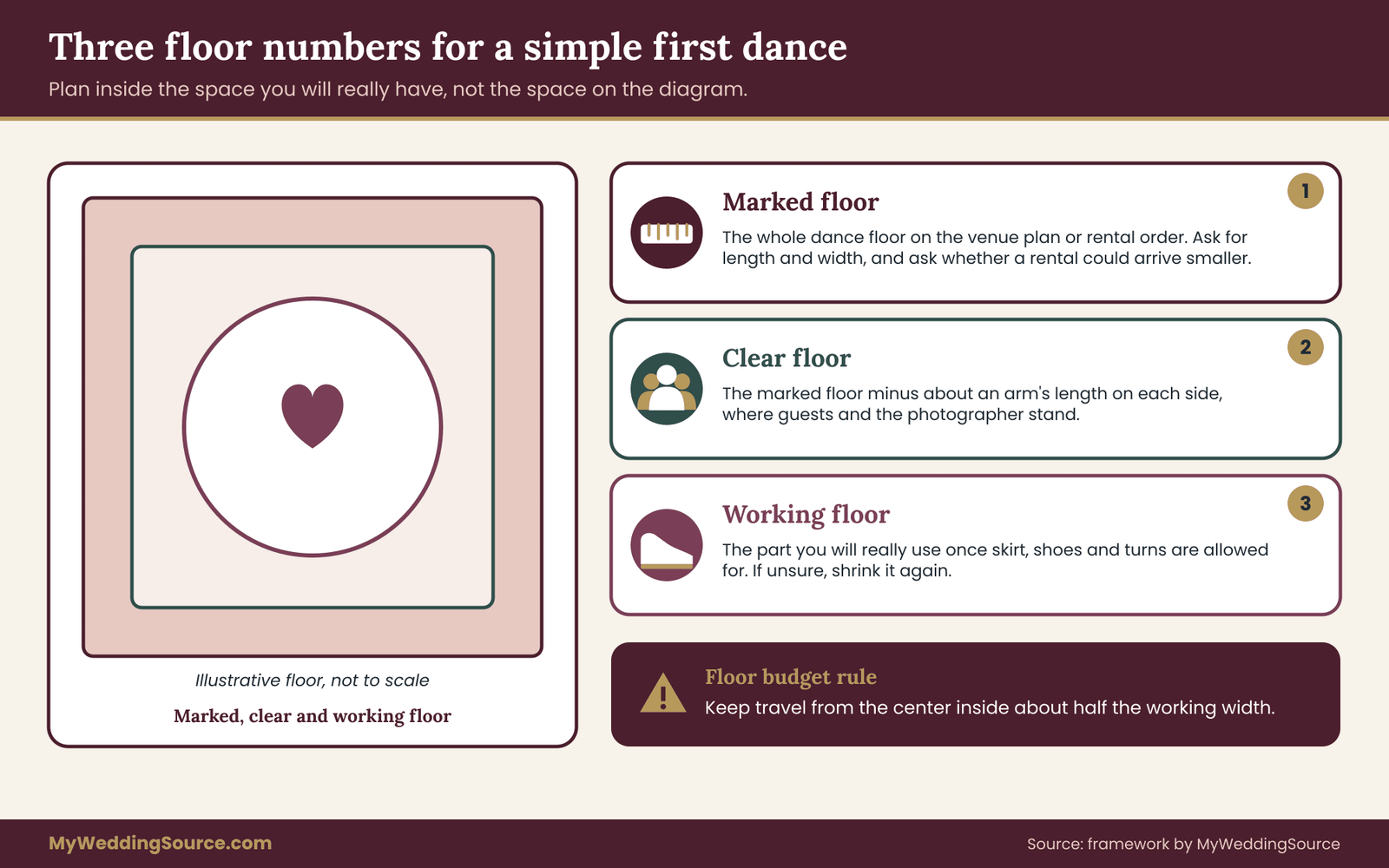
Ask for three measurements, and write them in feet so that you can compare them with your own stride.
The marked floor. This is the dance floor on the venue plan or the rented panel set. Ask for length and width, and ask whether it is a fixed floor or a rental that might be a different size on the day. A rental that arrives short is a common surprise, so it is worth confirming with the rental company, not only the venue.
The clear floor. This is the marked floor minus a margin of roughly an arm’s length on every side. Guests stand close to a first dance and photographers move at the edges. The clear floor is the area that you can treat as yours without bumping into someone.
The working floor. This is the part of the clear floor you will actually dance in, once you allow for the train or skirt, the shoes and the need to turn. A reasonable working assumption is a circle or square somewhat smaller than the clear floor. If you are unsure, take the clear floor and reduce it again until the plan feels roomy.
If you can visit the venue, walk the working floor with a tape measure or a pair of long steps and mark it in your mind. If you cannot visit, ask the venue coordinator for a floor plan and a photo of the floor with a person standing on it. For the wider technical questions you will want to ask a venue at the same visit, the venue technical walkthrough guide lists measurements and access routes in a form you can bring with you.
Turning feet into steps
A walking step of a slow dance is shorter than a street step. A rough rule for planning is that a slow dance step covers a little under two feet, and a sway step covers well under one. Your own stride is better data than a general rule. Have each partner take ten slow, comfortable dance steps on a hard floor in the shoes they will wear, measure the distance and divide by ten. Use the smaller of the two numbers, since you will dance together.
With a skirt or a train, the step is shorter again. If a dress restricts your step, plan the footprint using the restricted stride, not the free stride. The article on short wedding dresses for dancing covers hem lengths and proportions in more depth, and the same logic applies to any gown: measure the stride in the outfit, not in the abstract.
The floor budget rule
Here is the rule that keeps a routine inside the space. Add up the travel of every card in the order you will dance them, and keep the total footprint inside roughly half of the working floor. The remainder is margin for nerves, drift and the fact that two people never repeat a movement identically. If the total is more than half, remove travel from a card, not margin from the plan.
Drift is the quiet problem. When two people dance, they slowly slide in one direction without noticing, usually toward whichever partner is moving backward. On a large floor nobody sees it. On a small floor it carries you into the guests by the end. The fix is a card that returns you to the start, such as a slow circle, which later sections include. Plan for drift rather than hoping you will not have it.
What the floor is made of matters
The surface changes what is safe. Polished wood, vinyl, laminate panels, stone, carpet, grass and decking all behave differently under dress shoes. Slick floors reward flat, gliding movements and punish turns. Carpet grips and can catch a heel during a turn. Grass and soft ground make heels sink. Ask the venue what is underneath and what is allowed on it.
Some venues restrict decals, tapes and floor treatments, and a few do not allow certain shoe types on historic floors. If a rented or wrapped floor is involved, the guide to custom dance floor wraps, proofs and surface safety explains what to ask the supplier about slip and surface.
Take shoes to the floor if you can. A short test of five minutes in the real shoes tells you more than any general advice about whether you should turn, glide or stand your ground. If the floor is not available before the wedding, plan the simple first dance for the worst plausible surface and be pleasantly surprised if the real one is better.
Light, sightlines and the audience ring
Think about where people will stand. A first dance often takes place with guests in a ring, or in rows on one side, or at their tables. Each layout creates a different front. If most guests are on one side, a routine that has you facing away from them for half the song loses much of its effect. If guests ring the floor, a small circle of travel works well, because everyone sees a good angle at some point.
Also consider light. A first dance is often held under a spotlight or in dim light. A dark floor, a dark outfit and a bright spot can make it hard to see edges. You do not need to solve this, only to be aware of it. Choose movements that do not rely on seeing the floor, which is one of the tests in the card system.
Song length, tempo and counts for a simple first dance
The song decides the structure of your dance before you choose any movement. Two numbers matter: how long you want to dance, and how fast the music is.
Shorten the song, not the dance
Many couples dance to a full song and feel the last minute drag. A song of three or four minutes is a long time to stay inside a small routine. A common solution is to edit the song to a length you can fill comfortably, usually somewhere between one and a half and two and a half minutes, and to plan for guests to be invited onto the floor afterward, with the DJ cueing the next track.
If your song has a long instrumental intro, a fade or a quiet bridge, those are natural edit points. The DJ or an audio editor can build a clean cut, and the guide to wedding reception music planning explains how first dance edits, transitions and the handoff to open dancing fit into the evening.
If you are thinking about clearing a song for rights or editing it, remember that editing does not change who owns the recording. The venue or the DJ usually holds the right licenses for playing music at an event, but ask them rather than assuming. This guide does not cover music licensing in detail.
Beats per minute and the eight-count
Dancers count music in groups of eight beats, called an eight-count, because the movements fit into that frame. You do not need dance training to use it. You only need to know the tempo of the song, which is its beats per minute. Many free tools and apps display it, and your instructor or DJ can tell you.
Here is the arithmetic, which is simple enough to do on paper. Sixty divided by the tempo gives the length of one beat in seconds. Multiply by eight and you have the length of one eight-count. For a slow song at 72 beats per minute, one beat lasts about 0.83 seconds and one eight-count lasts about 6.7 seconds. A song edited to 90 seconds then holds a little more than thirteen eight-counts. For a song at 60 beats per minute, an eight-count takes 8 seconds and a 90-second edit holds about eleven.
The point is not exactness. The point is that a simple first dance has a countable number of slots, and each slot gets a card. Once you know the number of eight-counts, you can build the sequence and see at a glance whether the plan is too long, too short or too repetitive.

Slower is not always easier
It is tempting to choose a very slow song because slow seems safe. Very slow music can be harder, because each step takes longer, balance must be held longer and the dance can feel stretched. Many couples find a gentle moderate tempo easier than a very slow one. Try your song at a comfortable sway and notice whether the eight-count feels roomy or cramped. If you are unsure which tempo suits your song, your instructor can listen and suggest a counting pattern, including half-time counts that make a fast song feel slow.
Half-time and slow-feeling counts
Some songs have a quicker tempo but a slow feel. The instructor may count every second beat so that the movement feels unhurried. This is useful when you love a song that is a little brisk. In a simple first dance, half-time counting lets you keep the music you want without turning the dance into a scramble. Test it: if you cannot comfortably take a step on each counted beat, count every second beat instead and let the music move around you.
Intros, endings and the first four seconds
Plan the beginning and the end of a simple first dance as carefully as the middle, because they are the parts people see most and rehearse least. A good start gives you a position to hold during the first bars of the song: for example, standing in a closed hold with a gentle sway while the intro plays.
A good finish has a held pose or a gesture that matches the last chord, so that you know when it ends and do not wander. Decide what you do in the last two counts and what you do when the music stops. Then rehearse those two moments separately and often.
If the DJ fades the song, agree on how long you hold the pose after the fade and who gives the small signal to stop. A forehead touch, a kiss or a hug is an ending that suits a simple first dance. A twirl or a dip as a closer reintroduces the risk you were trying to remove.
Writing the song map
Before you move on to cards for your simple first dance, write a rough song map on a sheet of paper. List the sections you can hear: intro, first verse, chorus, second verse, bridge, final chorus, outro. Next to each, write the number of eight-counts it holds. A song map is an ordinary tool for choreographers, and it makes the next stage of this guide concrete, since each section can take a particular card or a particular group of cards. It also shows you early whether the song is a good fit, or whether a different edit would give you a calmer shape.
The movement sequence cards for a simple first dance
This is the working method of the guide. Instead of learning a routine as one long chain, you build the simple first dance from separate cards, each describing one small movement block. You can shuffle them, drop them or repeat them, and every card carries the information you need to decide whether it belongs.
What goes on a card
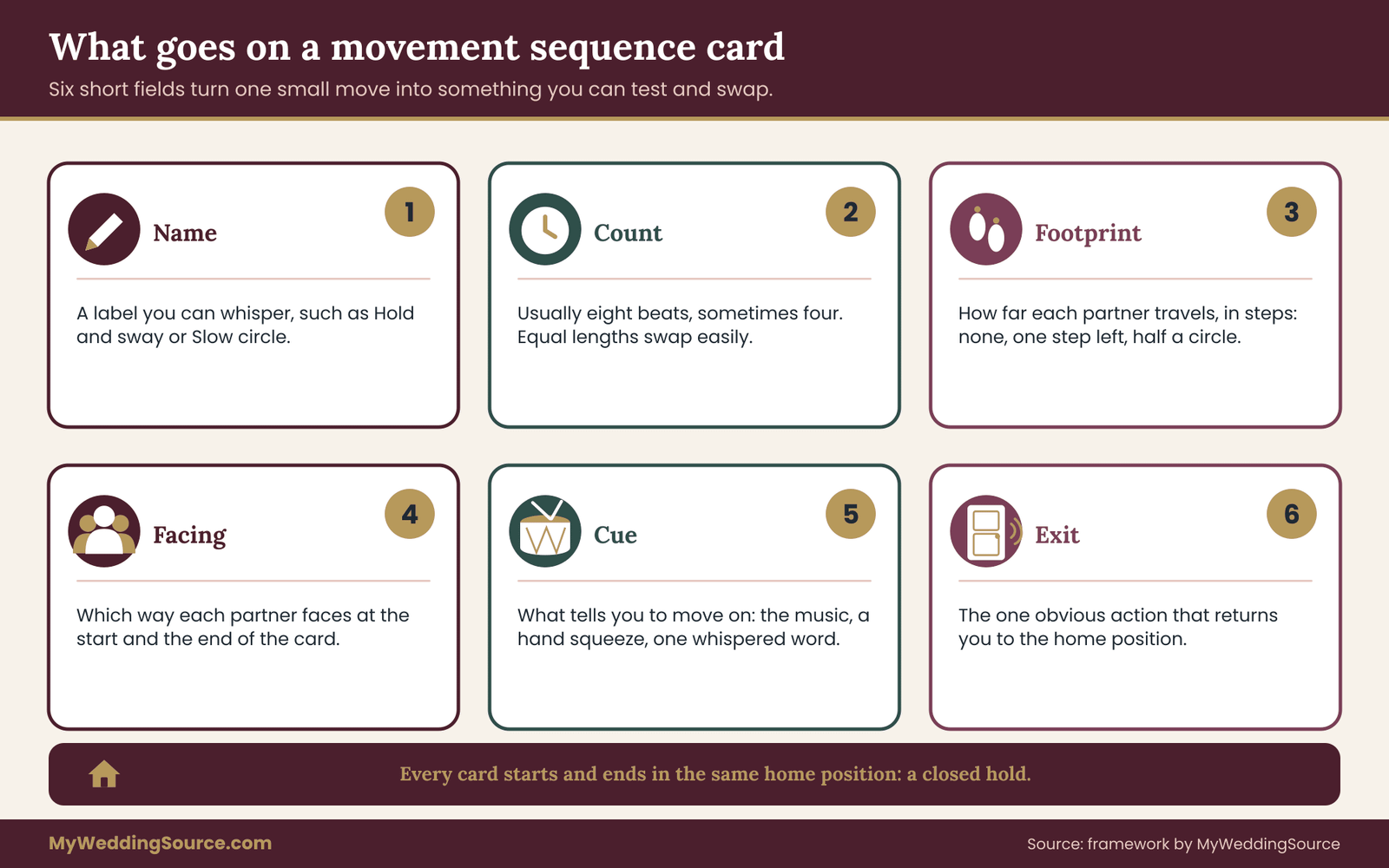
Take index cards, or use a note on your phone. Each card has six fields. Write them in plain words, as if you were explaining the move to a friend who has never danced.
Name. A short label you both understand, such as “Hold and sway” or “Slow circle”. Pick names you can say aloud in a whisper, since a quiet verbal cue is the easiest way to keep each other on track.
Count. The number of beats the card takes, nearly always eight, sometimes four. Keeping cards to equal lengths makes them easy to swap.
Footprint. How far, in steps, each partner travels and in which direction. Write “none”, “one step left”, “half a circle clockwise” or similar. This is the field that feeds the floor budget.
Facing. Which way each partner faces at the start and the end of the card, for example “facing each other” or “side by side, facing guests”. It matters for sightlines and for avoiding a pileup of arms.
Cue. What tells you to move to the next card. It might be the end of the eight-count, a word of the lyric, a squeeze of the hand or a whispered word. Choose a cue you will notice when your mind is busy.
Exit. How you return to the home position if the card goes wrong. The exit is the safety net. It should be a single obvious action, such as stepping together into a closed hold.
The home position
Every card begins and ends in the same shape, called the home position. For most couples it is a closed hold or a loose hold with hands on each other’s shoulders or waist, facing each other, feet roughly under the hips. The home position is where you recover. If you forget what comes next, step to home and sway. Nobody in the room will see an error, because the simple first dance never left the shape that people expect from a first dance.
Because every card ends at home, the cards can be combined in any order. That is what makes the system forgiving. A conventional routine is a chain, and if one link breaks the whole chain is in doubt. A deck of cards that return to home is a set of independent pieces.
The four tests every card must pass
Before a card goes into the deck of your simple first dance, put it through four tests. They are short and honest, and they are the practical basis for leaving out lifts and tricks.
The footprint test. Does the card fit inside the share of the working floor you have allotted it? If a card needs two steps in a direction and your budget allows one, shorten it.
The outfit test. Can you do it in the clothes you will wear, or in a stand-in that behaves the same way? A turn that works in leggings might trap a heel in a long skirt. A step that works in sneakers might not in leather soles. If you cannot test in the real garment, test in something close and keep a margin.
The dark test. Can you do it without looking at your feet or at each other’s hands, in dim light, while someone else is talking in your ear? If you can do it with your eyes mostly on your partner, it passes. If it needs visual checking, it fails, because on the day you will want to look at your partner and at the room.
The recovery test. If one of you makes a mistake in the middle of the card, is there a clean way to return to home within two counts? If recovery requires a restart, the card is too brittle for a wedding.
A card that fails any one of the four is either fixed or removed. Notice that every lift and dip fails at least two of them, usually the outfit test and the recovery test. That is not a judgment on anyone’s skill. It is the result of a consistent check against wedding conditions.

A starter library of cards
You do not need to invent your own cards. Here is a starter library that suits most couples. All eight pass the four tests for the majority of outfits and floors, and your instructor can adjust them for your bodies and your song.
Hold and sway. Eight counts in the home position, shifting weight gently from one foot to the other, two beats a side. Footprint none. This is the foundation card and also the rest card.
Side step and close. Step to the left on one, bring the feet together on two, step to the right on three, bring the feet together on four, and repeat. Footprint about one step each way. It travels very little.
Slow circle. Walk a small circle, a quarter turn every two counts, so that a full eight-count turns you all the way around. Footprint is small and returns you to where you began. This is your anti-drift card.
Rock step. Rock gently forward and back, weight on the front foot then the back foot, in a closed hold. Footprint about one short step in each direction. A little more energetic than the sway but still gentle.
Underarm turn. One partner raises a hand, and the other makes a single slow, flat-footed turn underneath over four counts, then returns to hold. Use it once or twice, at most. It is the single most “dance-like” move in the deck and it is still not a trick.
Hand-in-hand walk. Release the hold and walk side by side for four steps, hands joined, perhaps toward the guests who are standing on one side, then turn back into hold. Good for engaging the audience.
Forehead hold. Stop moving, rest foreheads together or lean close and stay still for two to four counts. This is the emotional card, and it is also a rest. It is easy to hit because it asks you to stop.
Finish. The last card: a closed hold, a final sway, the music’s last chord and a held pose, kiss or hug.
Notice how little each card asks. That is deliberate. A simple first dance should feel generous because the couple looks relaxed, not because the steps are impressive.

Building the deck from the song map
Return to your song map and the count of eight-counts for the simple first dance. A rough method that works for most songs: start with a long sway during the intro, put calmer cards in verses and slightly fuller cards in choruses, save the underarm turn for the middle of the final chorus, and end with the forehead hold and the finish.
Write the sequence as a row of card names with counts under them, for example Sway, Sway, Side step, Circle, Rock, Turn, Circle, Hand-in-hand, Sway, Forehead, Finish. Then read it aloud while looking at the song map, and check each card against the part of the song it covers. If the energy of the music rises and your cards stay flat, move a fuller card there. If the lyric is tender, put a calm card under it.
Limit the number of different cards
Resist the urge to use every card. Five or six different cards, repeated, are plenty for a simple first dance of ninety seconds. Repetition is not a flaw. Guests see a couple moving easily together, and the repeated shapes read as intentional. Too many different cards raise the memory load and increase the chance of a mix-up. A good starting rule is no more than one new card per ten seconds of music.
Cues you can actually hear
A cue is the glue of the system. The best cues are things you can feel or hear even when nervous. Examples: a squeeze of the left hand to start the circle, a change in the music such as the entrance of the chorus, a word that you whisper once, such as “round” or “hold”. Choose one cue per card and rehearse with it so that it becomes automatic. A cue that you have to remember is less reliable than one that arrives from outside, like the music.
Who leads
Decide who leads each card, in plain terms, and write it on the card. Traditional partnering assigns one leader, but you can split it. One partner can lead the circle, and the other can lead the turn, or you can alternate. What matters is that for each card, one of you has the job of starting it, so there is no hesitation. If you are both nervous, an agreed leader for the entire dance can be easier. Do whatever removes doubt.
Keeping the deck on paper, not in your head
Print the deck or keep it in your phone for rehearsals, and treat it as a living document. After each rehearsal, mark which cards were smooth and which were bumpy. By the last rehearsal the deck should be stable, and you should be able to say the whole sequence out loud without looking. On the day, there is no need to carry anything. The deck’s purpose in a simple first dance is to give you structure while you learn, and to give your instructor and DJ something concrete to review.
A worked case: a simple first dance on a small rented floor
The following example is invented, and its numbers are illustrative. It is here to show how the method for a simple first dance runs from start to finish, not to suggest that these figures fit your wedding. Call the couple Ana and Ben. Ana will wear a fitted gown with a chapel-length skirt. Ben has danced twice in his life. They are getting married in a restaurant’s private room, and the venue has said a rented floor will be set in front of the head table.
Step one: the floor and the stride
The rental company lists the floor as twelve feet by twelve. Ana and Ben subtract roughly two feet on each side for the guest ring and the photographer, which leaves a clear floor of about eight feet square. They then take the working floor as a seven-foot circle, to leave margin for the skirt and for nerves. Half of that width is about three and a half feet, so their rule is that neither of them gets further than three and a half feet from the center at any time.
They each take ten slow steps in the shoes they will wear, with Ana in a borrowed skirt of similar weight. Ben’s steps average about twenty inches. Ana’s, in the skirt, average about sixteen. They plan on sixteen inches, the smaller figure. Three and a half feet is a little more than two of those steps, which means no card may travel more than two steps away from the center without coming back.
Step two: the song map
Their simple first dance song runs at 72 beats per minute, so one eight-count lasts about 6.7 seconds. The original is three minutes forty. They want ninety seconds or so. The DJ builds an edit that keeps the intro, the first verse, one chorus, the bridge and the final chorus, and ends on the last chord. It comes out at 96 seconds, which holds fourteen full eight-counts and a few beats for the last chord.
Their song map reads: intro, two eight-counts; verse, four; chorus, two; bridge, two; final chorus, four. That adds up to fourteen. They write the numbers on a sheet and tape it beside the mirror in the hallway where they will rehearse.
Step three: a first draft, and what the tests remove
Ana and Ben’s first idea for a simple first dance comes from a video they like. It has a long walk across the floor, two fast spins, a dip at the end and a lift for the final beat. They write each element as a card and run the four tests.
The long walk fails the footprint test, because it covers eight feet. The fast spins fail the outfit test, since the skirt wraps and the floor is slick. The dip fails the recovery test: if either of them loses balance, there is no clean way back to home in two counts, and Ana’s dress makes it hard to catch her footing. The lift fails the outfit, recovery and dark tests all at once, and the restaurant has asked that nothing leave the floor.
None of this is dramatic. They simply replace each failing card. The long walk becomes the slow circle. The fast spins become one slow underarm turn. The dip becomes the forehead hold. The lift becomes the finish, a closed hold with a kiss on the last chord. What they keep from the video is the shape: a gentle build, one moment that looks like a flourish and a quiet ending.
Step four: the deck and the sequence
Here is their final order, with each number standing for one eight-count.
- Hold and sway, during the intro.
- Hold and sway.
- Side step and close.
- Rock step.
- Slow circle.
- Side step and close.
- Rock step.
- Slow circle.
- Underarm turn (Ben turns Ana under his raised hand, four counts, then settles into hold for four).
- Hand-in-hand walk toward the head table, four steps out and four steps back.
- Slow circle.
- Rock step.
- Forehead hold.
- Finish, with the final chord.
Notice what the pattern does. There are five different cards, and the three that repeat most (sway, rock, circle) are the ones that return them to center or require no travel. The two cards with more spread, the turn and the walk, appear once each. Every card ends at home, so a stumble in the middle can be recovered with a step to hold and a sway.

Step five: the cues
For each card they write one cue. The sway begins with the intro. The side step starts when Ben squeezes Ana’s left hand. The circle starts with the first line of the verse and the rock with the second. The turn starts on the first word of the final chorus. The walk begins when Ben says “out” in a low voice. The forehead hold is triggered by the last line of the lyric. The finish is the last chord, which both of them can hear.
They agree on one extra rule: if either of them is lost, say “home”, and both go to hold and sway for one eight-count until the next lyric cue arrives. They never expect to use it, which is exactly why they practice it once.
Step six: rehearsal, and what changed
They rehearse over four weeks, mostly in the evening in a hallway, in short blocks. In the second week they notice that the walk looks fine when they glance at their feet but falls apart when they look up, because they drift toward the wall. They fail the dark test and fix it by choosing a fixed point to walk toward, a lamp, in the rehearsal space, and by planning to walk toward the head table on the day.
In the third week, wearing a skirt that matches the gown’s weight, Ana finds that the circle pulls the hem across Ben’s shoe. They shorten the circle’s radius and slow it to a quarter turn every two counts, with a bustle in place for the dance. They test again. It holds.
In the fourth week, they run the whole sequence three times in a row with a friend watching from the side, who gives one note: the forehead hold looks lovely, and could last two counts longer. They add two counts by shortening the final sway by two.
Step seven: on the day, with a changed floor
When the room is set, the rental floor is ten feet by ten, not twelve. The clear floor shrinks accordingly, and the working circle is closer to five and a half feet across. Their half-width rule now allows less than three feet from center.
They look at the deck. The hand-in-hand walk is the largest traveler, so it is swapped for a second rock step. Everything else stays. The simple first dance is still fourteen eight-counts, and the new card is one they know well. The change takes thirty seconds with a pen and a card. If they had built a single long routine, it would have required a rewrite. This is the practical advantage of a deck.
What the example shows
The case of this simple first dance does not prove that this method works for every couple. It shows that the steps are modest and sequential, and that the tests do real work. Without them, Ana and Ben might have walked into the reception with an ambitious plan they could not use. With them, they walked in with a simple first dance they could do half asleep, in a dress, in front of a room.
If you want to build your own, copy the method, not the specifics: measure the floor, write the song map, take away anything that fails a test, write cues, rehearse in the real outfit, and be ready to swap a card on the day. The next section explains alternatives that give you variety without adding risk, which helps when you want your simple first dance to feel personal and not only safe.
Alternatives to lifts, dips and spins that still look like choreography
Leaving out the showpiece moves can feel like leaving out the dance. It does not have to. A simple first dance can have drama, surprise and personality. It just gets them from different sources: timing, stillness, eye contact and small changes of shape.
Use contrast instead of difficulty
Choreographers know that an audience responds to contrast more than to difficulty. A moment of stillness after a stretch of movement reads as a big event. So does a sudden softening, or a change in direction. In a simple first dance you can borrow that idea directly. Put the forehead hold right after the busiest card. Let the final chord land on a stop. Stand still for the first half of the chorus and begin to sway only on the second half. These choices cost nothing, they carry no physical risk and they look intentional.
Change the angle, not the effort
A change of facing is one of the cheapest ways to make a simple first dance look planned. In the hold, partners face each other. In a side-by-side card, both face the guests. In the circle, each partner’s view of the room keeps changing. A simple first dance with three different facings feels richer than one with ten different steps, because the audience sees new angles without either partner doing anything hard.
Try a card in which you stand side by side, one arm around each other’s waist, and sway toward the guests for four counts before turning back into hold. It is easy, it looks warm, and it gives photographers a front-facing frame.
Use the arms and hands
Hands are often ignored in plain routines, and they carry a lot of expression. Instead of a lift, you can raise joined hands overhead and then lower them slowly over four counts. You can slide a hand from the shoulder to the back of the neck. You can let go with one hand and hold the other out for a slow reveal. None of this needs strength, speed or balance beyond ordinary standing. Keep arm movements below shoulder height if the dress or jacket restricts the shoulder, and test them in the outfit.
A single slow turn in place of spins
A flourish is welcome, and a slow underarm turn is the usual substitute for a spin. Done flat-footed and slowly, it takes four counts, allows the skirt to move and gives the audience a clear moment of display. A few things make it safe and reliable. Raise the hand to about shoulder height or a little higher, not above the head.
Keep the turn to a single rotation. Use small steps and keep the feet close to the floor. Practice with the exact heel height and the exact floor surface. If the floor is slick or the shoes are untested, replace the turn with a side-by-side sway and keep the flourish for a different moment.
A walk-through as a substitute for a grand entrance
A staple of showy first dances is a dramatic movement across the floor. The simple counterpart is a slow, composed walk of four to six steps, hand in hand, toward a chosen point, followed by a turn back to hold. Because the footprint is known and small, you can plan it to fit the floor. The walk gives the guests a long look at both of you, and it creates a sense of movement without risk.
Interaction with the audience
A dance does not have to be inward. If you are comfortable with it, a small gesture to the guests, such as a nod, a wave, a hand on the heart or a bow with your partner, can be a card of its own. It introduces warmth, breaks tension and gives you a moment to breathe. Many couples find it easier to look at the audience for two counts than to look at nobody for ninety seconds.
Add a personal element rather than an advanced move
The reason people want a trick is often the wish for the simple first dance to feel like theirs. There are better ways to do that. Some ideas:
- Take one gesture that belongs to you as a couple, such as a private wave, a way of holding hands or a small ritual, and make it a card.
- Echo a line of the song with a movement. When the lyric says “stay”, you stay still. When it says “come”, one of you steps in.
- Begin the dance in a way that recalls a place or a moment, such as standing back-to-back for the first two counts and turning to face each other.
- End with a phrase that you say to each other aloud on the last chord. Guests will not hear it, but the photographer will see it.
These touches are free, safe and personal. They give the simple first dance a point of view without a single advanced step.
Surprise without risk: the mid-dance change of partner
Some couples like the idea of bringing in parents or a wedding party. A safe version is a handoff card: the music’s last chorus begins and one parent or friend steps in to tap one of you, who steps out and holds the other’s hand for a second as they trade. A longer discussion of staging parent dances sits in the guide to wedding reception music planning, including how the DJ cues the next dance.
Keep the handoff on a clear count, and agree on it in advance with the guests involved, since a surprise partner who has never practiced can add risk the system is meant to remove.
What to keep out, even if you want something more
If you do want a showier moment, there is a middle path. Choose one card that is a little more than the rest, such as a controlled turn or a short walk. Place it in the middle of the song, where you are warmed up and the music supports it. Practice it more than anything else.
Give it its own exit. And agree that if the floor, the shoes or the nerves are wrong on the day, it will be swapped for a sway without discussion. This preserves the shape of a simple first dance and lets you keep a single flourish, with a clear way to drop it.
Clothing, shoes and surfaces that change a simple first dance
Most first dance problems do not come from the steps. They come from what you are wearing and what is under it. A short list of checks handles most of them.
The skirt and the train
A long skirt changes stride, balance and turning. A wide skirt can catch on the partner’s feet. A narrow skirt limits the step. A train can wrap around a heel. Fabric also matters: satin slides, tulle bounces, heavy lace hangs. If the gown has a bustle, decide whether it will be bustled for the simple first dance and rehearse in that state.
If a train will be removed or lifted, decide who does it and when. For gown-specific questions such as hem length and fit through the hips, see the guide to wedding dress fit and alterations before the final fitting, so that any change is made while the seamstress can still do it.
Ask your seamstress for a short practice session in the dress, or at least a few steps and a turn in the fitting room. Note any places where the fabric pulls, and ask whether a small alteration can ease it. Do this early, since alterations take time.
Jackets, sleeves and stiff fabrics
Suits and tuxedos matter as well. A tight jacket restricts the raised arm in an underarm turn. A stiff shirt limits the neck. A new belt or waistband can dig in when you lean. Test the arm positions in the jacket, and ask the tailor whether a small adjustment would help. Take the jacket off for rehearsals only if it is not part of the final plan.
Shoes
Shoes decide grip, balance and comfort. New leather soles can be very slippery. Heels can sink into soft ground or catch in carpet. A pair that feels fine for twenty minutes may not for three hours. Practice in the shoes you will wear, on a surface similar to the floor, for at least a few sessions.
The guide to reception shoes and hem length covers how heel height and hem interact, and a shoemaker or a shoe shop can suggest ways to improve grip on smooth soles. Pay attention to venue rules about shoe treatments, since some floors restrict what can be applied to soles.
If the shoes are the problem and the dance depends on them, the simplest plan is a backup pair of flats in the car, and a rule that you switch before the dance if the floor feels wrong. A dance in comfortable shoes is better than a nervous one in elegant ones.
The floor surface
Return to the surface notes from earlier. Slick wood favors slow, flat movement. Carpet grips and can twist an ankle on a turn. Stone is hard and can be cold underfoot. Grass sinks. A simple first dance on grass should drop turns and keep the movement mostly in place, or use a panel floor if the venue offers one.
If the floor is a rental, ask the supplier about its surface and about any treatment you may use. If it is a wrapped or printed floor, ask about slip ratings and cleaning, as discussed in the guide to dance floor wraps and surface safety.
Weather and temperature
Outdoor and tent receptions add variables. Wind lifts veils and skirts. Heat shortens energy and tempers. A damp evening can make the floor slick. If the simple first dance is outdoors, plan a version that survives wind: shorter circles, no overhead arm movements that catch a veil, and a ready plan to move the dance indoors or to a covered area. A calm weather backup is worth writing on the same sheet as the deck.
Things in your hands and pockets
Rings, jewelry, boutonnieres, pocket squares and phones can all interfere. A bracelet can catch in a sleeve. A ring on a swollen hand can feel odd. Leave the phone with someone. Decide whether the bouquet is left on the table or handed to a friend. A small detail that distracts a nervous mind is a real risk to a simple first dance built on calm.
A rehearsal routine for a simple first dance without a studio
You do not need a studio, a mirror or a large block of free time. What you need is a handful of short, regular sessions and a clear order of work. A rehearsal path for a simple first dance can run over a month or two, in a hallway or a living room, with the cards and the song map in hand.
Start with the floor size, not the steps
Mark out your working floor at home with tape or a rug, at the size you measured, before you learn anything. Dancing inside a known boundary from day one means you never learn a version that is too big. If you have no tape, use furniture or a towel in each corner. Many couples skip this and then discover in week three that their favorite card does not fit.
A suggested sequence of sessions
Think of the work in stages rather than dates, and adjust to the time you have.
Stage one: the home position and the sway. Ten minutes. Find a hold that is comfortable for both of you, with hands where they will not pinch fabric and shoulders relaxed. Practice the hold and sway card with the song playing, until you can do it while talking. Notice where your eyes go and decide where you want them to go.
Stage two: the traveling cards. Fifteen minutes. Add the side step, the rock and the circle, one at a time. For each, say the cue aloud, do the card, and return to home. Check each against the floor boundary. Do not link them yet.
Stage three: the flourish cards. Fifteen minutes. Add the underarm turn and the walk, if you are using them. Do them slowly and flat, in the shoes. Practice the exit for each card on purpose: do the card, pretend to go wrong, and step to home.
Stage four: linking. Twenty minutes. Put the cards in order and dance the full sequence to the song map, counting aloud if needed. Expect it to feel stiff. Stop and fix the weak joins, which are often the changes between cards.
Stage five: the outfit. Two or three sessions in the shoes, and at least one in the real skirt or jacket, or a close stand-in. This stage is where most problems surface, so schedule it early enough to react.
Stage six: the audience. Invite one or two friends to watch from the side, or record a video on a phone. Ask for one observation each and nothing more. A video is useful for sightlines, drift and facial expression. Do not use it to judge yourselves harshly. You are looking for information, not for faults.
Stage seven: the stress run. Dance the sequence three times in a row, once with the lights low, once with someone talking to you, and once after a short sprint or a flight of stairs so that your heart rate is up. The point is to see how the simple first dance holds up when you are not calm.
Learning from a video or an app
Online instruction can help, especially for people who live far from a teacher, but it has limits. A video cannot see your floor, your shoes or your hold. If you use one, use it to learn the vocabulary of the cards and then check the result with a person. The guide to online dance lessons and private lessons explains what each format does well and where it falls short, and it is a sensible read before you decide how to split your time.
One lesson with an instructor can be enough
Many couples planning a simple first dance do not need a full course. A single private session, with your deck of cards, your song and your shoes, can be the best use of money. Bring the song map and your sequence, ask the instructor to check each card against the four tests and to adjust the holds for your bodies.
Ask for adaptations if either of you has an injury, a condition or a mobility need. If you want a longer program, the guide to first dance lessons covers how to choose a style, how many lessons to book and how to space them.
Say clearly that you want no lifts or tricks. A good instructor will be relieved, since it narrows the work, and will tell you honestly how a given move will behave in a long skirt.
Rehearsing with a partner who dislikes rehearsing
One partner often loves practice and the other avoids it. A few things help. Keep each session short and say when it will end. Make the first sessions about the hold and the song, not about getting steps right. Give the less enthusiastic partner a veto over any card that feels embarrassing. Finish with something pleasant. A simple first dance that one partner dreads is not a good wedding memory, so protect the experience as much as the result.
How many run-throughs are enough
There is no magic number. A useful measure is whether you can do the whole sequence, in order, twice in a row with no mistakes that either of you notices, while someone is talking in the room. When you reach that level, stop adding. More rehearsal after that point often adds anxiety. Keep one short run-through on the day before the wedding to remind your bodies, and then leave it alone.
Resting the legs and the nerves
The days before a wedding are tiring. Eat, drink water and sleep as best you can, and avoid a strenuous practice the day before, since fatigue and sore muscles make a simple first dance harder. On the day, a few minutes of quiet before the dance, with a slow breath and a loose shake of the hands, does more than another run-through.
Failure conditions: when to change a simple first dance
A simple first dance plan that cannot say when it has failed is not a plan. Here are the conditions that should make you cut or change a card, or the whole approach. Write them on the back of the deck so you can use them calmly.

A card fails a test twice
If a card fails a test in rehearsal, fix it. If it fails the same test again after the fix, remove it. A card that needs repeated rescue will not be stronger on the day. Replace it with a sway or a walk and move on.
The floor is smaller than the plan
If the working floor is smaller than the plan assumed, apply the swap rule: remove the card with the largest footprint first and replace it with a card of the same length that travels less. Never compress the whole dance into a smaller space by dancing with tighter steps without rehearsing it, because the dance will not feel the same.
The outfit changes
If a hem, a heel height, a jacket or a train changes after you have rehearsed, go back to the outfit test for every card. A last-minute change of shoes is the most common trigger, and the simplest answer is to rehearse again in the new shoes for at least one session.
The song is cut or delayed
DJs and sound systems have bad days. If the song starts late, hold the home position and sway until the first bar you rehearsed to. If the DJ plays the wrong version or a different cut, your song map may no longer fit. Agree in advance that you will fall back to the sway card, repeating it as needed, and then finish with the forehead hold when the music ends. This works because the sway needs no count and the finish needs only the last chord.
Someone is not feeling well
If either partner feels dizzy, in pain or unsteady before the dance, do not dance the full routine. Choose a shorter version, a sway for the length of the song, or postpone the dance to later in the evening. Nobody is owed a performance. If a health concern is serious or sudden, treat it as a health matter first and a dance matter second.
The room is too crowded
If guests have pressed in so that your working floor has shrunk, ask the DJ or coordinator, calmly and before the music starts, to widen the ring. If you cannot, reduce to a sway and a forehead hold. A routine inside a crush of people is a safety matter as well as an aesthetic one.
Nerves take over
If you lose your place in the middle, say “home”, step into hold and sway for an eight-count. When the next lyric cue arrives, pick up there. This is the recovery card in action. Guests rarely know the plan, so they cannot tell that it went off track. What they see is two people holding each other and swaying.
The dance is no longer something you want
Sometimes a couple discovers during planning that they do not want a first dance at all. That is a valid choice, and it does not mean the planning has failed. Options include a very short dance, a group dance, skipping the dance and walking in to the first dance song, or inviting everyone to the floor from the first note.
A first dance is a custom, not a requirement. Choose what suits the two of you, whether or not that means a simple first dance, and say so to the DJ and the planner so that the evening’s schedule can reflect it.
A note on pain and injury
If either of you has pain, an injury or a condition that affects movement, the plan needs a professional’s input, not just an internet checklist. A qualified instructor who works with adaptive dance can tailor holds, steps and pacing, and a health professional can advise on limits. Nothing in a wedding dance is worth an injury.
Working with the DJ, photographer and venue on a simple first dance
A simple first dance involves other people besides the two of you. A short conversation with each, a few weeks ahead, prevents most day-of confusion. Keep it brief and written.
The DJ or band
Send the DJ the edited song for the simple first dance, the song map and the order of events around the dance: who announces it, how you enter, what plays afterward. Ask for a backup copy of the edit in a second format, and ask what happens if the file will not play. Agree on the cue for starting, since a sloppy start is the commonest reason a nervous couple loses its place. A good DJ will let you stand in your home position for a few seconds before the music begins.
If you are working with a live band, the plan changes: tempo can drift, endings can vary, and the band may need a signal. Rehearse with them if possible, and keep the sway card as your fallback. The broader questions of how the first dance fits with other dances and the evening’s music are covered in the wedding reception music planning guide.
The photographer and videographer
Share the song map and the facing of each card with the photographer. Tell them where the strongest moments are, for example the underarm turn, the forehead hold and the finish, so that they can position themselves. Ask them to stay outside the working floor, and agree on how far they may move. Photographers who know the plan can shoot from good angles without stepping into your space.
If a lighting change is planned, such as a spotlight or dimmed room lights, make sure they know when it happens. Timing for these vendor handoffs sits well beside the schedule in the guide to the wedding vendor timeline.
The venue and the coordinator
Ask the venue about the floor, rules on shoes and treatments, any restrictions on movement near fixtures, and who controls the lighting and sound. Ask whether the floor will be set and checked before the dance, and who is responsible for clearing the ring of guests. Provide the coordinator with the deck and the song map so that they can warn you early if a card collides with something, such as a pillar, a step down or a cable run.
If the venue will not allow certain moves, take that as a useful constraint and not an argument. A simple first dance is easy to adapt.
The guests and family
Let close family know what is planned, especially if parents will join. A short note to the wedding party about where to stand and when to move onto the floor after the dance avoids the awkward gap at the end. If there are young children or older relatives, make sure they have seats with a clear view and that the path to the floor is open. A first dance can feel exposed, and a warm, quiet room helps.
A one-page handoff sheet
Prepare a single page for the DJ, the coordinator and the photographer. It should contain the song title and edit length, the start cue and the finish, the floor size you plan to use, the sequence of cards in plain words, where you will enter and where you will stand at the end, and the plan if the song fails. Add a contact for the day. Keep it to one side of paper, and send it a week before. One page is more likely to be read than five.
The run-through at the venue
If the venue allows, do a short run-through on the floor before guests arrive. Walk the working floor in your shoes. Check the surface, note where the lights fall and test the sound. Even a five-minute walk gives you better data than weeks of planning. If a run-through is not possible, ask a friend to stand at the edge of the floor on the day and tell you honestly whether the ring looks wide enough.
Adapting a simple first dance for mobility, pain or a seated partner
Many couples need a dance that adjusts to a body, not the other way round. The card method is well suited to this, since each card is small and can be changed or replaced separately.
Start from what is comfortable
Ask what feels good, what hurts and what is uncertain, and write it down for the instructor. A simple first dance can be done standing, seated, with a cane or a walker, with one partner seated and the other standing or kneeling, or in a wheelchair. The cards then become movements of arms, shoulders and torso, small rotations, forward and back rolls and holds. Facing, cue and exit still apply, and the four tests still work: footprint, outfit, dark and recovery.
An instructor who has worked with adaptive dance can help you build a version that looks natural and is safe for both of you. Ask for that experience when you hire. If either partner uses a mobility device, ask the venue to confirm that the path to the floor and the floor surface suit it.
The Americans with Disabilities Act sets accessibility requirements for many public venues, and the ADA site explains the general rules. A venue that cannot give you a step-free route to the floor is worth discussing with early, as the guide to accessible wedding venue red flags explains.
Seated and low-impact options
A seated simple first dance can be as expressive as a standing one. Hold hands, sway the shoulders, trace a slow circle with the arms, lean toward each other and finish with the forehead hold. The audience reads intention from faces and hands. If one partner stands and the other sits, the standing partner can move around the seated one in a slow circle, hand held, which gives the simple first dance a path without asking the seated partner to move more than they wish.
Pain, fatigue and pacing
If pain or fatigue is part of daily life, plan the simple first dance’s length and intensity for a bad day, not a good one. A shorter edit and a lower tempo help. Place any rest in the sequence on purpose, such as a longer forehead hold, so that it looks like part of the design. Keep seating close to the floor and have water nearby. Agree on a quiet signal that means “stop”, and honor it with no discussion.
A note on the guests
A good first dance leaves room for everyone’s comfort. Some guests find loud music, close crowds and flashing lights hard. If you are planning a dim room, a spotlight or a loud intro, consider a brief heads-up in the program or from the DJ. It takes a sentence and avoids an unpleasant moment.
Your next steps
Start your simple first dance with a sheet of paper and three numbers: the working floor in feet, the stride you can manage in your outfit, and the number of eight-counts in your edited song. With those three numbers you can write the song map and begin the deck.
Then pick five or six cards from the starter library, write the six fields on each and run them through the four tests. Remove anything that fails twice. Book one session with an instructor to check the deck, and book one run-through of the floor on the day. Share a one-page handoff sheet with the DJ, the photographer and the coordinator, and put the failure conditions on the back of your deck.
Keep the standard for success of a simple first dance modest and honest. A good simple first dance is one that you finish smiling, that people enjoyed watching and that nobody had to rescue. If you manage that, the sway, the circle and the forehead hold will have done their job.
FAQ
Is a simple first dance too plain for a wedding?
No. Guests respond to warmth, timing and eye contact more than to difficulty. A simple first dance uses contrast, such as a quiet hold after a busier card, and personal touches, such as a private gesture or a line you speak on the last chord. Many couples find that the calmer version produces better photos and a better memory, because they are looking at each other instead of concentrating on a move.
How long should a simple first dance be?
Most couples choose between about one and a half and two and a half minutes, which is usually an edited version of the song. That gives enough time for five or six cards and a finish without dragging. A shorter dance is fine, especially for shy couples. Ask the DJ to cut at natural points, such as after a chorus, and invite guests to join afterward.
Do we need dance lessons for a simple first dance?
Not always. Many couples benefit from one private session where an instructor checks the cards, adjusts the hold for your bodies and tests the plan in your shoes. If you want more help, a short package is enough. Online instruction can teach the basic vocabulary, but it cannot see your floor or your outfit, so a live check is useful.
What should we do if one of us has two left feet?
Choose cards that depend on rhythm and closeness instead of footwork: hold and sway, rock step and the forehead hold. Keep the footprint small and the cues clear. Let the more comfortable partner lead, or split the leading by card. Rehearse in short sessions and stop when it stops being fun. Most guests will not notice small slips, but they will notice a relaxed couple.
Can we do a simple first dance on grass or in a tent?
Yes, with changes. Grass and soft ground sink heels and grab soles, so drop turns and keep the movement mostly in place. Ask whether the venue can provide a panel floor, and test shoes on a similar surface. In wind, shorten circles and avoid raised arms that catch a veil. Have an indoor or covered backup, and write it on the same sheet as the plan.
What if the DJ cuts the song or it starts late?
Hold the home position and sway until the music reaches the part you rehearsed. If the edit differs from your plan, fall back to the sway card and repeat it, then finish with the forehead hold when the music ends. Agree on this in advance, and give the DJ a one-page sheet so they know your start cue and your fallback.
Can a simple first dance work for a seated or mobility-limited partner?
Yes. The cards can be rewritten for arms, shoulders and torso, with the same facing, cues and exits. A seated partner can lead a slow circle of joined hands, and a standing partner can move around them. Ask an instructor with adaptive experience to help, and confirm that the venue offers a step-free route to the floor.
Should we keep one bigger move for the middle of the song?
You can. Choose one controlled card, such as a slow underarm turn, and place it in the middle where you are warmed up. Rehearse it more than the others, give it an exit and agree to swap it for a sway if the floor, shoes or nerves are wrong. A simple first dance does not need a showpiece, but one flourish is fine with a safety net.
Sources
- ADA.gov, U.S. Department of Justice Civil Rights Division
- Falls and fall prevention, National Institute on Aging
- Centers for Disease Control and Prevention, injury prevention
- Occupational Safety and Health Administration
- U.S. Copyright Office, music and licensing information
- ASCAP, music licensing for venues and events
- BMI, music licensing for businesses and events
- National Fire Protection Association, assembly occupancy safety
- U.S. Consumer Product Safety Commission