
A parent wedding speech that welcomes a new family member has one job: to tell a specific person, in front of people who matter to them, that there is a real place waiting for them. This guide gives you a five-beat outline, a cliche audit, a worked case and a list of failure conditions, so the parent wedding speech you give sounds like you and lands as a welcome instead of a recital.
Build the parent wedding speech from observations, not adjectives. Collect three or four small things you have actually seen the new family member do, then shape them in five beats: name them, show one moment, say what you are making room for, acknowledge the other family and anyone missing, and close with a short toast. Run every sentence through a swap test. Keep it near three minutes, agree topics with the couple, and have a plan B if a microphone is the wrong tool.
Most parents who agree to speak at a wedding are not worried about being unkind. They are worried about being forgettable, or about repeating the same warm sentences that every parent has said since microphones were invented. “We are not losing a daughter, we are gaining a son” has been said so often that it now works as a signal to the room to clap politely and look at the cake. The sentence is kind. It is also nearly empty, because it says nothing about the actual person standing beside your child.
A good parent wedding speech works the other way around. It begins with the person you are welcoming and gets specific fast. It does not need to be funny, long, poetic or emotional. It needs to be true, short and aimed at the right person. When it is, even a plain speech sounds generous, because everyone in the room can tell you paid attention.
This article is about that narrow job: the welcome. It is not a full guide to wedding toasts in general, and it does not cover who should speak or in what order. If you are still deciding whether a relative gets the microphone at all, the guide to wedding etiquette on this site covers the courtesies that surround family roles. Here we assume you are the parent, or you are helping one, and the parent wedding speech is happening.
A note on scope. This is general writing and planning advice, not legal, medical or financial advice. Where a rule matters, such as the use of someone else’s poem or song lyrics, the article points you to the agency or owner who sets it, so you can confirm the current version yourself.
What a parent wedding speech is for when it welcomes someone new
Before you write a word, decide what the parent wedding speech is for. A parent wedding speech can do at least five different things, and trying to do all of them in three minutes is the reason so many of them wander.
It can tell the story of your own child. It can thank the guests and the people who paid for or built the day. It can describe a marriage you hope for and give advice. It can honor family history. And it can welcome the person your child chose. All five are legitimate, but they are different speeches. The welcome is the one that is most often skipped or buried under the others, even though it is the part the new family member is most likely to remember.
Think of three audiences listening at the same time. The first is the new family member, who is hearing a parent speak about them in public, possibly for the first time. The second is your own child, who wants to feel that the person they love has been seen. The third is the room, which includes relatives on both sides who will quietly judge whether the parent wedding speech was fair. A welcome that satisfies the first audience and respects the other two is the target.

The first audience deserves the most attention, and it changes how you write. If you aim at “the couple,” you drift toward general wishes, because it is hard to be specific about two people at once. If you aim at the one person you are welcoming, you can be concrete. You can say what you noticed, what you are glad about, and what you are offering. The couple still hears every word, and so does the room.
Welcome versus tribute versus advice
It helps to be clear about the three most common modes, because a parent wedding speech often slides from one into another without the speaker noticing.
A tribute looks backward and is about your own child: how they grew up, what you admire. A piece of advice looks forward and is about the marriage: what you hope they remember on a hard Tuesday. A welcome looks sideways and is about the new relationship: who this person is to you, and what the family is now.
None of these is wrong. The trouble starts when a parent wedding speech meant as a welcome spends two minutes on childhood stories and then adds a sentence about the new person at the end, as if completing a form. If the new family member appears in the last thirty seconds of a three-minute speech, the speech is mostly a tribute with a welcome stapled on.
A simple check is to count where the new person first appears by name. In a parent wedding speech whose purpose is to welcome them, that should happen in the first third, and the person should remain the subject for most of what follows.
Who is a “new family member” here
The phrase usually means a child’s spouse, but the same method works for other situations. A parent might be welcoming a partner who has children of their own, a spouse who is joining the family from another country or culture, a partner of the same gender whose own family has been slow to accept the relationship, or a person the family has known for years but who is only now becoming a daughter-in-law, son-in-law or child-in-law. A parent might also be a stepparent, a grandparent speaking in place of a parent, or a guardian.
The details differ, and later sections cover several of those cases. The core move is the same: you are making a public statement about belonging, and the quality of that statement depends on how specific and honest it is.
What the room actually remembers
It is tempting to believe that guests remember the beautiful line. In practice, guests usually remember two things about a parent wedding speech: how long it felt, and whether it made the person being welcomed look comfortable or cornered. Neither of those depends on literary skill.
This is good news for anyone who is not a natural writer. You do not need a gift for phrases. You need three observations, a clear order, a respectful length and a person who has agreed to what you plan to say. Those are things anyone can prepare.
Why familiar parent wedding speech lines fail
A cliche is not a bad sentence. It is a sentence that has been used so often that listeners stop processing it. They hear the first four words, recognize the shape, and finish it in their heads. The meaning slides past. That matters for a welcome in particular, because a welcome only works if the person feels individually addressed.
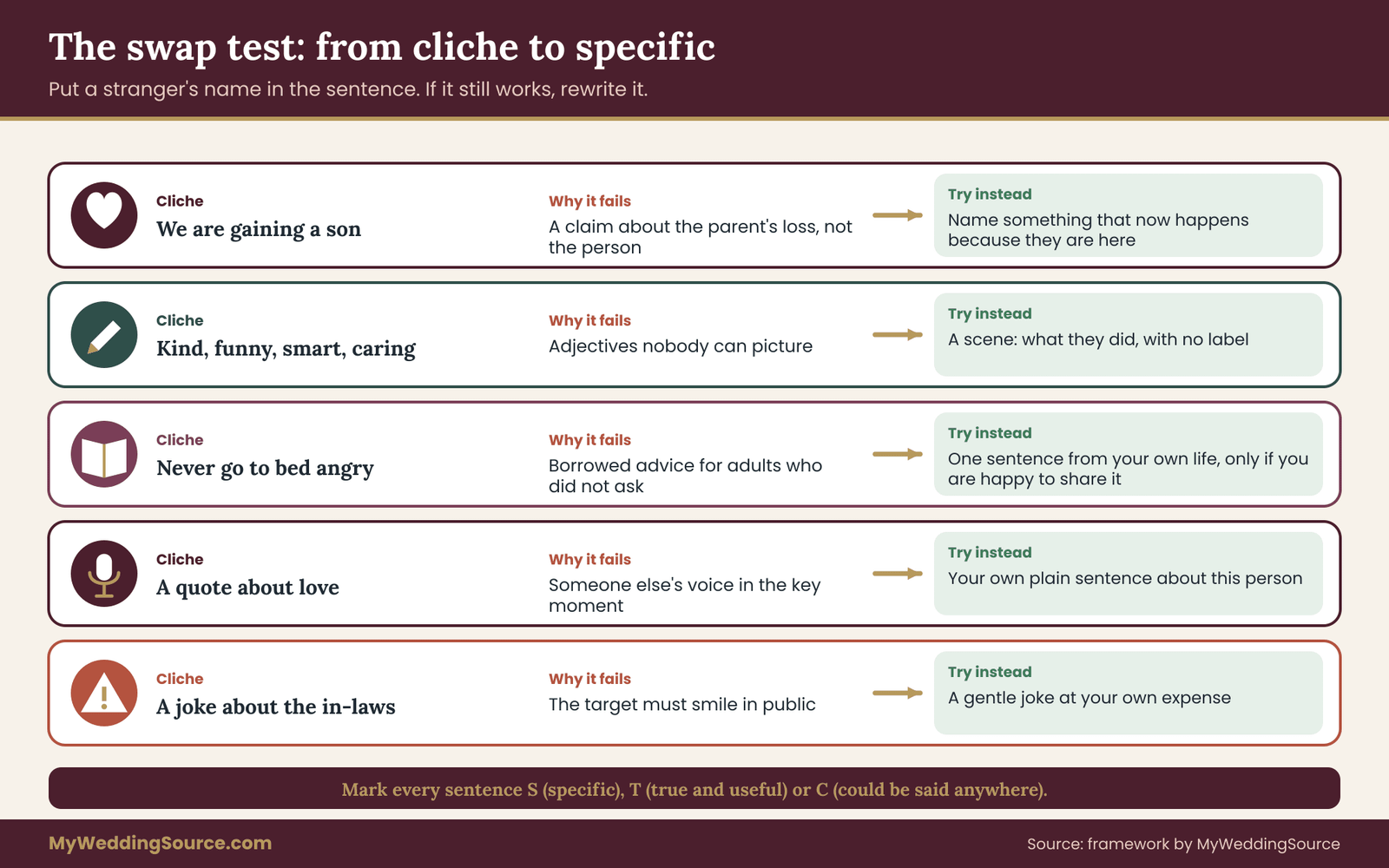
Here are the families of cliche that appear again and again in a parent wedding speech, and what is wrong with each one. This is not a ban list. It is a map of the places where speeches tend to go quiet.
The gain-not-loss formula
“We are not losing a child, we are gaining one” is the best known. The sentence is meant to reassure, but it carries a hidden claim: that the new person is a replacement or a bonus. Many new family members, and many adult children, do not hear it as warm. The child may feel talked about as something that was supposedly lost. The new person may feel measured against an unspoken ledger. It also makes the parent wedding speech about the parent’s feelings of loss, not about the person arriving.
A replacement is to say what actually changes. Name something that will now happen because this person is in the family: a seat at a table, a standing call, a holiday role, a skill that is now part of family projects.
The list of adjectives
“Kind, funny, smart, caring and beautiful” is the second family. Every adjective is probably true, and none of them carries information. You cannot picture anyone from them. Adjectives also invite the room to nod without listening.
The fix is to attach each trait to a moment. Instead of “he is thoughtful,” describe what he did: he noticed the grandmother needed a chair before anyone asked. The adjective can then be dropped, because the listener supplies it.
The marriage advice list
Advice speeches often borrow familiar rules: never go to bed angry, keep dating each other, communication is everything. These are not harmful, but they are borrowed, and the new person is not mentioned at all. They are also easy to hear as a parent instructing adults who did not ask. If advice belongs in your speech, one sentence drawn from your own marriage, only if you are comfortable with it being public, is more honest than three general maxims.
The dictionary or quote opener
Opening with a definition of love, a famous quotation or a line from a poem is a way of postponing the real speech. It is also a way of borrowing someone else’s voice for the part where yours matters most. Quotations also raise a quieter question about permission and attribution, which a later section covers.
The joke at the new person’s expense
Teasing a new family member is risky for a simple reason: they have not yet earned the right to be teased by you, and you have not yet earned the right to tease them. Jokes about in-laws, about the new person’s family, or about how long it took them to propose or accept all carry a price, because the target must smile in public to avoid looking sensitive. A gentle joke at your own expense is nearly always safer than one aimed at them.
The inventory of firsts
“I remember the day you were born” is a lovely thing to say about your own child. In a welcome, it can pull the spotlight away from the person you are trying to include. A short memory of your child belongs in the parent wedding speech only if it leads directly to the new person, for example by showing what changed about your child after they met.
Why these lines survive
Each cliche survives because it is safe. It cannot offend anyone, and it cannot be wrong. A specific sentence, by contrast, can be wrong: you might remember a detail incorrectly, or mention something the person would rather not hear in public. That risk is real, and the answer is not to retreat into generalities. The answer is to prepare specific material, check it, and share the draft with the couple. Later sections describe how.
The cliche audit in one pass
Read your draft out loud and mark each sentence with one of three letters. Mark it S if it is specific to the person being welcomed and could not be moved to another wedding. Mark it T if it is true and general but useful, such as a thank-you or a practical announcement. Mark it C if it could be said at any wedding by any parent.
A healthy welcome has mostly S sentences, a few T sentences and very few C sentences. If more than a quarter of the sentences are C, the draft is a template. You do not have to delete all of them, since a parent wedding speech with no common ground can sound strange, but each one should have earned its place.
The swap test is the faster version of the same audit. Take a sentence and mentally replace the new family member’s name with a stranger’s. If the sentence still works, it is not yet a welcome. Rewrite it until the swap breaks it.
The five-beat outline for a parent wedding speech
An outline protects you from the two most common failures: wandering and stopping short. The five-beat outline below is built for a welcome that runs about three minutes, which is roughly four hundred spoken words at a calm pace. It is an original framework, not a published formula, so adjust it to your own voice and family.
The beats are: Name, Moment, Room, Others, Toast. Each has a job, a rough share of the time, and a test for whether it worked.

Beat one: Name
Open by saying the person’s name, plainly, and saying who you are to them. For example, a parent can begin by naming the new family member and saying they speak as one of the people who love the child they are marrying. That is all. No warm-up about the weather, no joke about the microphone, no thanks to the caterer.
The point of the first beat is to turn your attention toward the person, in front of everyone, in the first fifteen seconds. If you use their preferred name or the name their family uses, say so. If their name is difficult for you to pronounce, practice it with them beforehand. Getting a name right in a welcome is a form of respect that guests notice more than they admit.
Test: could a guest who arrived late tell within twenty seconds who is being welcomed? If not, the opening is too slow.
Beat two: Moment
This beat carries the most weight. Choose one small, true scene that shows what you have observed about the person. Not a trait, a scene. It should be something you saw, or something you were told by someone who saw it and who is happy to be named, and it should show the person doing something that reveals character.
A scene works because the listener can picture it. “On the first Thanksgiving, you quietly took over the dishes and never mentioned it” is a scene. “You are generous” is not. The scene also does the work of an adjective without using one, which is why it avoids the cliche problem.
Keep the scene short: three or four sentences. Resist the urge to tell the story of how they met; the couple will probably have told that already, and it belongs to them. Stay with something you saw, and choose a moment that flatters the person without embarrassing them.
Test: after hearing the moment, could the room name a quality of the person without you naming it? If so, the beat worked.
Beat three: Room
This is the welcome in a literal sense. “Room” means what you are making space for. You are saying, in concrete terms, what the person can count on from your side of the family.
Be careful here, because this beat is where parents often over-promise. A welcome should offer things you can deliver. You can offer a seat at holiday meals, an open invitation to call, a standing place in a family tradition, or a promise to learn a few words of their family’s language. You should not offer things that depend on other people, such as “you will always be loved by every one of us,” because you cannot speak for every relative.
If you are unsure what to offer, ask yourself what a real new member of the family would actually do next month: come to a birthday, be added to the group chat, get a nickname, receive a recipe, be asked to help with an annual project. The most affecting offers are small and ordinary.
Test: can you picture the new person doing the thing you just offered, within a year? If not, make the offer smaller.
Beat four: Others
The fourth beat is the one most speeches skip, and it is what separates a welcome from a performance. Here you acknowledge the people around the new family member: their parents, their siblings, their guardians, the family that raised them, and the people who cannot be present.
A parent wedding speech that praises the new person without mentioning the people who raised them can sound as if the speaker is claiming credit. A line of thanks to the other parents, by name and with a specific reason, fixes that. If the other family is not present, or if a parent has died, or if the relationship is strained, the acknowledgement may be shorter and quieter, and the next section covers those cases.
This beat also covers your own family. If you speak for a household that includes stepparents, a former spouse, grandparents or siblings, a short, accurate acknowledgement can keep anyone from feeling skipped. It does not need to be a roll call. Two or three sentences usually work.
Test: would the other family’s parents, listening from their table, feel seen by this beat? If the answer is no, add a sentence.
Beat five: Toast
Close with a short toast. Invite the guests to raise a glass, say to whom, and stop. A toast is one sentence, perhaps two. It should not summarize the speech or introduce a new idea.
Many speeches end badly because the speaker keeps adding afterthoughts. The toast is a signal that the parent wedding speech is finished and that the room can respond. If you have written it clearly, you will not need to say “so, to wrap up” or “in conclusion.” The microphone can go back down at once.
Test: does the last sentence ask the room to do something, such as raise a glass? If it only wanders to a stop, rewrite it.
How the beats share the time
For a three-minute speech, a reasonable split is roughly fifteen seconds for Name, ninety seconds for Moment, forty-five seconds for Room, thirty seconds for Others and fifteen seconds for Toast. That adds up to about three minutes without feeling rushed. These numbers are a starting guide, not a rule. If your Moment is a particularly good scene, let it run a little longer and shorten something else.
What matters is the proportion: the Moment is the largest beat, the Toast is the smallest, and the new person is the subject of the first three. If you find that Others has grown to two minutes because of a complicated family situation, that is a signal to look at the alternatives later in this guide, since the parent wedding speech may be trying to do too much.
Why five beats and not a script
Some people prefer to write out every word, others to speak from notes. The beats work either way. Written in full, each beat becomes a short paragraph. From notes, each beat is a single cue on an index card. The structure is the same.
Speakers who are nervous often do better with the full text, held on paper or a phone, because it removes the fear of going blank. Speakers who read too closely often sound distant, so a hybrid approach can help: write it in full, then practice until you can look up at the end of every sentence. The delivery section covers this in more detail.
A common objection: it feels too structured
Some parents resist an outline because they want the parent wedding speech to feel spontaneous. That is a fair concern, and the response is that structure is what makes the spontaneous parts visible. A well-built parent wedding speech leaves room for one or two unplanned sentences, usually in the Room or Toast beat, because the speaker knows where the parent wedding speech is heading and can stop at any point without losing the thread.
A speech with no structure can only be spontaneous by accident. It is more likely to ramble, which is the opposite of how it feels from the inside, and the room usually notices before the speaker does.
Matching the beats to what you actually know
You do not need to know the new person well to use the five beats. If you have only met them a handful of times, the Moment can be shorter and the Room can lean on your child’s description of them, credited honestly. Saying “I have only known you for a short while, and here is what I have seen” is more convincing than pretending to long familiarity.
If you know the person very well, the risk goes the other way: you may have too many good stories and choose the wrong one. The test in that case is to pick the moment that best serves the new person in public, not the one that is the funniest or the most revealing. Stories that make a person look good in a private family setting can look different in front of two hundred people, including their colleagues and their own relatives.
Finding real material for a parent wedding speech
Most parents say they do not have anything to say. They do, but it is not yet written down, and they are not used to treating small observations as material. The following method takes about a week of light effort and produces enough to build a full speech.
Keep an observation list
For one week, keep a note on your phone or a piece of paper. Each time you see the new family member do something, however small, write one line. The line should describe an action, not a judgment. “Offered to carry the grandmother’s bag without being asked” counts. “Is helpful” does not.
If you cannot see them in person during that week, use the past: write down everything you remember from every encounter, as many as you can recall. Do not filter. A list of fifteen small things usually contains three or four that matter.
Ask three other people
Ask three people who have seen the new family member in different settings what they have noticed. One might be a sibling of your child, one a friend of the couple, one a relative. Ask an open question: “What have you noticed about how they treat people?” Write down their answers, with their words, and get their permission before you repeat anything.
This step does two things. It widens your sample beyond your own, necessarily limited view. It also gives you material that you could not have collected alone, and it spreads the sense that the speech belongs to the family and not to you alone.
Ask the couple for two things
Ask your child what they would like the person to hear from you, and what they would rather you did not say. Both questions are valuable. The first gives you a target. The second prevents surprises. A parent wedding speech that has been previewed, even in summary, almost never goes wrong in a way that cannot be repaired, while one that is a surprise sometimes does.
Ask the new person directly, if you have the kind of relationship where that is possible, whether there is anything they would rather you did not mention. Their answer may be a short list, such as a former partner, a health matter or a family disagreement. It is easier to honor a request you were told than to guess.
Sort the material into three piles
Take your observation list and sort it into three piles. The first pile is for things that show character: kindness, patience, humor, steadiness. The second pile is for things that show how the person treats your family. The third pile is for things that show how the person treats your child. You want at least one entry from each pile for the Moment and Room beats.
Anything that does not fit a pile is probably an adjective in disguise. You can drop it. What remains is your raw material, and for most parents it is more than enough.
Check the material for fairness
Read each candidate moment and ask whether the person would be comfortable hearing it in front of their grandparents, their manager and their closest friends. If you are unsure, ask. If the answer is no, drop it, even if it is a good story. The point of a welcome is to make someone feel safer in the family, and a single embarrassing anecdote can undo that.
Also check for fairness across the two families. If you tell a detailed story about the new person and the other family’s relationship to your child, make sure the balance does not suggest that one side is more important. A rough parity in warmth is enough; you are not keeping score, but the room is.
Facts you should verify
Names, ages, job titles, places and dates are easy to get wrong, and the cost of a mistake in front of a room is high. Verify each one. Ask for the correct spelling of the new person’s full name, their parents’ names, and any family titles. If you plan to mention someone’s profession, make sure you describe it correctly. A speech that gets a title wrong is remembered for that error.
If the new family member is from a different culture or country, ask a family member how to pronounce names and whether there are customary ways to address elders. Taking the time to learn is itself part of the welcome. The guide to guest lists on this site is a useful reminder that a family is a longer list of people than the couple, and you may need to know who is in the room before you decide who to acknowledge.
Writing the parent wedding speech: sentences, rhythm and length
With material in hand, the writing is mostly arrangement. The goal is a parent wedding speech that sounds like you talking, with the clarity of something you have edited. These principles apply whether you write every word or just the cues.
Write for the ear
A speech is heard once, at your speed, with no chance to re-read. That changes how sentences should be built. Short sentences are easier to follow than long ones. A sentence that makes the listener wait for the verb is harder than one that gets to the point. Lists of more than three items blur together.
A useful habit is to read each paragraph aloud and mark where you need to breathe. If you run out of air before the sentence ends, the sentence is too long. Split it. If you stumble on a word, replace it. The audience will not hear the cleverness of a long sentence, but they will hear you struggle.
Vary the length. A run of short sentences sounds clipped, and a run of long ones sounds like a lecture. A short sentence after a long one has weight. Use it where you want the room to stop and take something in.
Say it the way you would say it at dinner
Many parents drop into an unnatural voice when writing a parent wedding speech: formal, flowery and slightly pompous. The words “cherish,” “bestow” and “union” tend to creep in. If you would not say a word at the kitchen table, do not use it at the microphone.
Plain wording is not cold wording. “I am glad you are here” is warmer than “We are delighted to extend a heartfelt welcome,” because it is what a person would actually say. The Federal Plain Language Guidelines give the same advice for government writing, and it translates: short words, active verbs, direct address.
Use “you” for the person you are welcoming
Decide early whether you will speak about the new family member in the third person (“she is”) or speak to them directly (“you are”). Direct address is usually warmer for a welcome, because it makes the person the audience. But it can feel intense if the room is large and the speaker is not used to it.
A good compromise is to begin in the third person, setting the scene for the guests, then turn to “you” in the Room beat, where the offer is made. That shift signals the moment of welcome and gives the person a chance to look up from their plate. Whichever you choose, keep it consistent within a beat.
Cut adjectives, keep verbs
When reviewing a draft, circle every adjective. Many can be cut. Replace the ones that remain with a verb or a detail. “A wonderful cook” can become “someone who brought four dishes to a house with a broken stove.” The second version takes longer, but it is the only one that the room will remember.
This does not mean every sentence must be an anecdote. It means each sentence should earn its place by delivering information, rhythm or feeling. A sentence that does none of these can go.
Be careful with humor
Light humor is an asset in a parent wedding speech, and it should come from the situation and from yourself. A gentle joke at your own expense, about how you handled the first meeting or how long it took you to learn the new person’s favorite food, relaxes the room and makes you human.
Humor aimed at the new person needs a stricter test. Would they laugh if the joke were told to them privately? Would they laugh in front of their grandmother? Has the couple heard and approved it? If the answer to any of these is uncertain, cut it. A joke that does not work is more costly than a missing joke, and a parent wedding speech that is warm without being funny is still a good speech.
Avoid humor about appearance, body, age, past relationships, money, or the new person’s family. These are the topics that most reliably hurt feelings, and they are often what a nervous speaker reaches for.
Decide how emotional you can be
Parents are sometimes afraid they will cry. Tears are not a failure. A short pause, a sip of water and a slow breath are usually enough to continue, and the room tends to be supportive. What does cause trouble is writing a parent wedding speech that depends on an emotional peak you may not be able to reach, or that depends on staying composed through a moment you know will break you.
If a particular line is likely to cost you your voice, move it to the end, or cut it, or write a version you can get through. You can also use the card trick: write the hardest sentence on a card in large letters so that you can read it even if your eyes blur.
Length: three minutes is plenty
For a welcome that covers the five beats, three minutes is a comfortable target, and five is a firm ceiling for most receptions. Beyond five minutes, even a very good speech tends to lose the room, especially during a plated dinner when guests are hungry. How the speech fits into the evening is a question for the person running the schedule, and the reception guest flow guide explains how toasts sit alongside courses, music and movement.
To check your length, read the parent wedding speech aloud at the pace you would use in front of a crowd, which is slower than silent reading, and time it. Add a few seconds for pauses and laughter. A typical person speaks at roughly the speed of a calm conversation, and a parent wedding speech of four hundred words usually lands near three minutes. Your own pace may vary, so use a stopwatch, not an estimate.
If the parent wedding speech is too long, cut in this order: advice first, then secondary stories, then extra adjectives, then the opening warm-up. Leave the Moment and the Room for last, since they are the core of the welcome.
Revise in three passes
Do not try to fix everything at once. Make three separate passes over the draft.
The first pass is for meaning. Does each beat do its job? Is the new person the subject? Is anything misleading or unfair?
The second pass is for sound. Read it aloud. Fix tongue-twisters, shorten sentences, vary the rhythm, and check names and pronunciations.
The third pass is for cuts. Remove every sentence that fails the swap test, every repeated idea and every word that does not do work. A speech almost always improves when it loses ten percent of its words.
Choose how you will hold the speech
Decide before the day whether you will read from paper, a phone or cards, or speak from memory. Paper is reliable but visible. Cards are easy to hold and flip. A phone is convenient but risks notifications and screen dimming. Memory looks natural but fails under stress, especially for a speaker who is already emotional.
Whichever you choose, print a backup copy and give it to someone who will be present, such as a sibling or the person coordinating the toasts. If the microphone cuts out or a page goes missing, a backup can save the parent wedding speech.
Acknowledging both families in a parent wedding speech
The fourth beat, Others, is where real family situations show up. Few families are tidy. Parents are divorced, remarried, widowed, estranged or no longer in contact. Some guests are strangers to each other. Some have unspoken tensions. The way you handle these facts in a parent wedding speech tells the new family member how safe the family is.
The general principle
Acknowledge what is true and relevant, and leave out what is only painful. The speech is not a place to resolve old disputes or to make a point. It is a place to include people. If a person is present and important to the couple, name them. If a person is absent and important, mention them briefly. If a person is a source of tension, think carefully about whether a mention helps or harms, and ask the couple.
When the other family is present
If the new person’s parents, guardians or other family are in the room, thank them. Do it specifically. “Thank you for raising someone who thinks to ask whether everyone has eaten” is better than “Thank you for raising such a wonderful person.” If you do not know them well, say so honestly and say what you hope to learn.
You may also want to speak briefly about how the two families are meeting. This does not need to be elaborate. A line such as “We are glad to be getting to know each other” is enough. Avoid comparing the two families or suggesting that one side has contributed more.
When a parent has died
A deceased parent is often the most delicate subject. For the new person, the absence may be central to how the day feels. For the other family, a mention may be a comfort or a stab. Ask the couple, and ask the surviving family, how they would like it handled. Some want a name spoken; some prefer a moment of silence; some want nothing said from the microphone.
If a mention is welcome, keep it short and warm.
Tie it to the new person’s presence. “Your mother would be proud” is a claim you cannot verify. “I wish I had met her; I can see her in how you treat people” is more honest and less presumptuous. If grief is acute, a quiet gesture such as a reserved seat or a photo may do more than a spoken line. Anyone struggling with a loss around the wedding date can reach the 988 Suicide and Crisis Lifeline in the United States if the feelings become overwhelming.
When parents are divorced or remarried
Name the people who are in the room and who matter to your child. If the couple has asked that former spouses not be mentioned, honor that. If both parents of your child are present and are speaking, coordinate with them so you do not repeat each other, and so one speech does not seem to answer the other.
Stepparents deserve explicit acknowledgement if they have been part of your child’s life. A single sentence can include them: a thank-you for their role, with a concrete detail. The aim is to let nobody sit at their table wondering whether they were skipped.
When families have different cultures, languages or faiths
If the new family member comes from a different cultural, linguistic or religious background, the welcome is a chance to show that you have paid attention. Learn one or two words or customs, ask permission before including them, and do not turn them into a performance. A phrase said correctly, with warmth, is a gift. A phrase said carelessly, or a custom described wrongly, can feel like a mistake made on a stage.
Ask a member of the other family to review any phrase or reference. If a translation is needed for older relatives, the couple may arrange an interpreter or provide a printed version. A short bilingual line, if the couple welcomes it, can be one of the most meaningful parts of the speech.
When the new family member’s own family is not supportive
Sometimes the new person’s relatives disapprove of the marriage, are absent by choice, or have not accepted the relationship. In that case, your welcome may carry a different weight. It may be the first public acceptance the person has received.
Do not make the other family’s absence the subject. Do not criticize them, even gently. Say what you are offering and leave it there. The Room beat becomes the center of the parent wedding speech, and the Others beat can be one sentence or omitted. The aim is to give the person a clear, steady welcome without forcing a public conflict.
When you are not sure what is safe
If you are uncertain about any family situation, ask the couple, and ask the person closest to the situation. Do not guess. The cost of asking is a few minutes of mild awkwardness. The cost of an error can be a hurt that lasts years. When in doubt, shorten the Others beat to a general line of thanks to everyone who raised, supported and traveled for the couple, and leave the specifics for private conversations.

Keeping the balance between two families
In many weddings, both families have a parent who speaks, and the room will compare. You cannot control the other speaker, but you can be aware of the balance. A rough match in length is a courtesy. If the other speaker is expected to run long, you might choose to run shorter, not longer, and to avoid referring to what they said.
If you can, talk to the other speaker beforehand. Ask about the plan, share your topic outline, and agree on who goes first. Coordinating takes five minutes and can save a lot of discomfort. The wider question of how families share decisions without conflict is covered in the guide to wedding decision rights, which is a good companion if the family has strong views about who speaks.
A worked case: one parent wedding speech from blank page to final draft
A method is easier to trust when you can watch it work. The case below is invented for this guide. The people, details and lines are made up, and nothing here describes a real family or a real speech. It is included so you can see the decisions, including the ones that cost something.
The situation
Ruth is the mother of Sam. Sam is marrying Jordan. Ruth has met Jordan perhaps a dozen times over two years. Jordan’s father died some years ago, and Jordan’s mother, Priya, will be at the wedding. Ruth is divorced from Sam’s father, who will be present with his second wife. The couple has asked Ruth to speak for about three minutes at the reception, after dinner.
Ruth’s first instinct is to write about Sam. She has stories about Sam learning to ride a bike, and a line she likes about gaining a son. She sits down and writes a draft in twenty minutes. It is warm. It is also, she realizes on rereading, a parent wedding speech that could be given by anyone.
The first draft, and what the audit finds
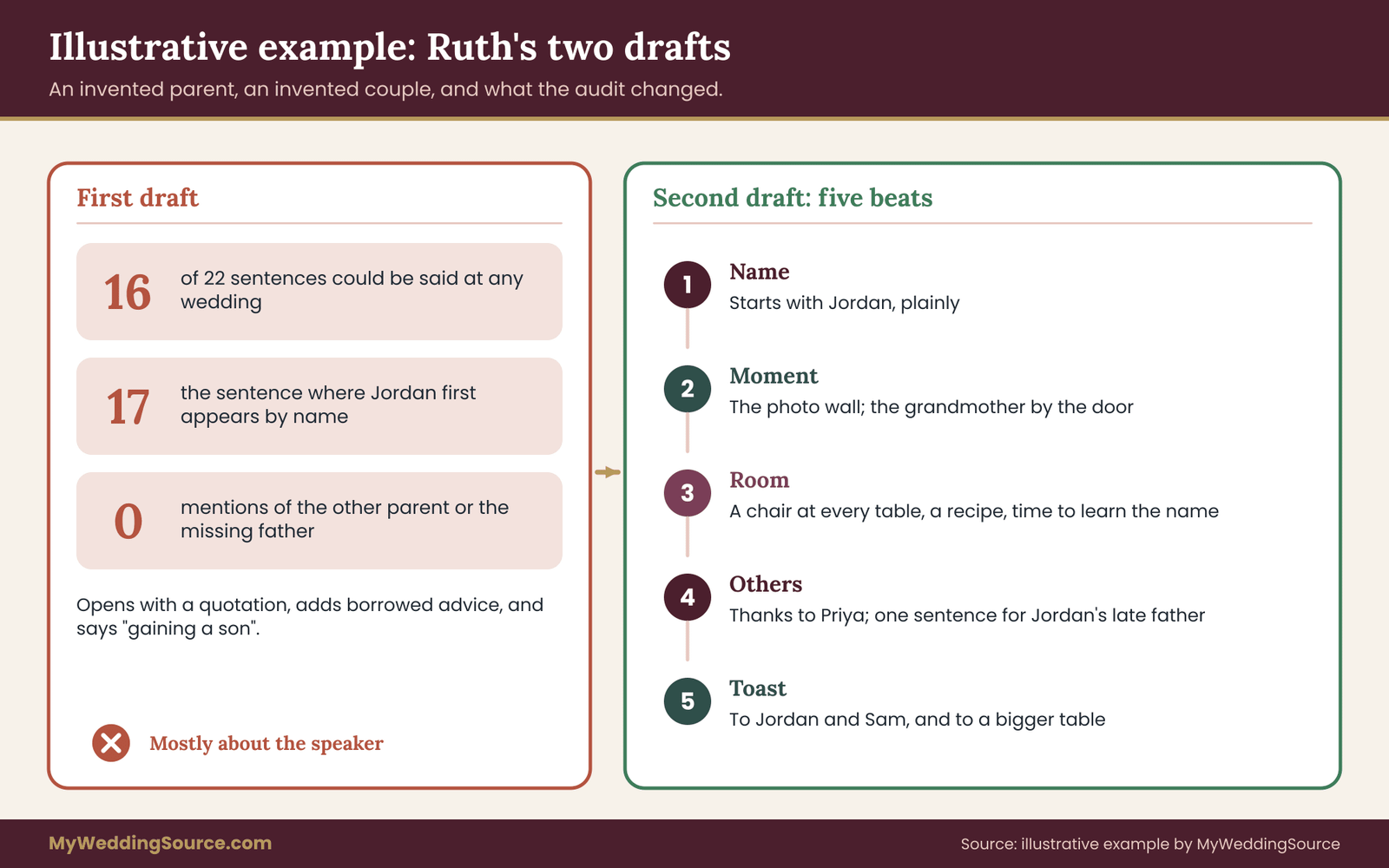
The first draft opens with a quotation about love from a famous poem, moves to a story about Sam at age eight, offers three pieces of marriage advice, says “we are not losing a son, we are gaining one,” and ends with a toast. Jordan is mentioned by name twice, in the last third.
Ruth runs the cliche audit. She marks each sentence S, T or C. Of twenty-two sentences, two are S, four are T and sixteen are C. Jordan first appears by name in sentence seventeen. The quotation is the opening sentence, which means the first thing the room hears is someone else’s voice. The advice is borrowed. The “gaining a son” line fails the swap test completely.
She also notices that the draft says nothing about Priya, nothing about Jordan’s father, and nothing about the fact that she and Sam’s father will both be in the room. Four of the five beats are missing or misplaced.
Collecting observations
Ruth spends a week on the observation list. She writes down what she remembers and asks two people. Her list includes these items, all invented for the example.
On the first visit, Jordan asked about the photo wall in the hallway and wanted the names of the people in the older pictures, then used those names later in the conversation.
At a family birthday, Jordan noticed that Ruth’s own mother was sitting alone and moved to sit with her, without making a point of it. When Ruth’s oven broke before a holiday, Jordan did not offer advice; Jordan arrived with a toolbox and a flashlight and asked what had already been tried. Sam says that Jordan always asks for the other person’s opinion first, and then uses it.
Ruth sorts the list. Some entries show how Jordan treats her family, some show character, some show how Jordan treats Sam. The photo wall and the grandmother entries are the strongest, since they show attention to people in the family who are easy to overlook.
Checking with the couple
Ruth asks Sam and Jordan two questions. What would you like Jordan to hear? What would you rather I did not say? Jordan answers that a mention of the late father would be welcome, if kept short, but would rather not have the oven story told, since it makes the oven repair sound like a rescue and Jordan finds that embarrassing. Sam asks Ruth to leave out any comparison with Sam’s previous partners, which Ruth had not planned to include anyway.
Ruth keeps the photo wall and the grandmother. She drops the oven. She asks Priya, through Sam, whether a line about Jordan’s father would be welcome, and Priya says yes, with the condition that it be one sentence.
The second draft, beat by beat
Here is the parent wedding speech Ruth ends up with, written out so you can see how the beats work. It is invented, and it runs about three minutes at a calm pace.
Jordan, I want to start with you. I am Sam’s mother, and I am also, as of today, glad to be yours in whatever way you will have me.
That is the Name beat. It names the person and states the relationship, and it takes about fifteen seconds.
The first time you came to my house, you stopped in the hallway and asked about the photographs. Not politely, the way people do. You wanted names. You wanted to know who the man in the hat was. A month later you asked my mother how her knee was, and you used the name of the doctor she had mentioned once.
At Sam’s cousin’s birthday, my mother was sitting by herself near the door. You noticed before I did. You walked over, sat down and stayed there. You did not look around to see who was watching. I did, and I will tell you what I saw: someone who pays attention to the people most of us forget to look at.
That is the Moment beat. It uses two small scenes and names no adjectives. A listener forms the conclusion without help.
Here is what I would like to offer you. A chair at every table in my house, including the ones nobody sits at. A recipe of your choosing, which I will teach you, so long as you promise to improve it. And a family that will take some time to learn your name properly, the way you learned ours.
That is the Room beat. It makes three small promises, each of which Ruth can keep. The last one is honest about the family being imperfect.
Priya, thank you for raising someone who asks first and listens second. I know there is a person who should be here and is not. I wish I had met him. I think I can see him in the way Jordan walks into a room. And to Sam’s father and his wife, thank you for being here and for making today easier for all of us.
That is the Others beat. It names the other parent, includes one honest sentence about the absent father, and acknowledges the divorced parent and stepparent in a single clause. It takes about thirty seconds.
So please raise a glass. To Jordan and Sam, and to a bigger table.
That is the Toast. Ruth sits down.
What changed between the drafts
The first draft was about Ruth’s feelings and about Sam. The second is about Jordan, with room for the people around Jordan. The first had sixteen sentences that failed the swap test. The second has two, both of them thank-yous that work in any family.
The second draft also contains no quotation, no advice and no joke about Jordan. Ruth did add a small joke about herself, in the Room beat, with the line about a family that will take some time to learn Jordan’s name properly. It is a joke at the family’s expense, not Jordan’s, and it is also true.
What this example costs
Be honest about the trade-offs. The second draft is shorter, less ornamental and, in a sense, less impressive on paper. It lost the story about the bike, which Ruth loved. It lost the advice, which she believed was important. It required a week of preparation, three conversations and an uncomfortable question to Priya.
It also carries a risk. Because it is specific, it could be wrong. If Ruth had misremembered which relative was sitting alone, or if Jordan had not wanted the photo wall mentioned, the parent wedding speech would have drawn attention to the error. That is why the check with the couple matters, and why the facts were verified. The generic version could not fail in that way, and it could not succeed either.
How the same method changes for other parents
The method is the same for a father, a stepparent, a grandparent or a guardian.
What changes is the Room beat, since the offer must come from what that person can actually give, and the Others beat, since each family has its own cast. A stepparent who joined the family late might emphasize the idea of being chosen, which is a theme the new family member may recognize. A grandparent speaking in place of a deceased parent may give a Room beat that is shorter and more careful, with a promise to keep something alive. The structure is steady, and the content bends.
Reading the example critically
Do not copy Ruth’s lines. They are written for an invented person in an invented family. The point is the pattern: the first draft is a mood, the second is a set of choices. If you notice your own draft looks more like the first, run the audit, collect three observations, and rebuild around the beats.
Notice, also, what Ruth did not do. She did not use Jordan’s private history, she did not speak for the other family, and she did not make a claim she could not keep. Each of those decisions reduced risk without reducing warmth. That combination, specific but careful, is what a good welcome looks like.
Alternatives to a spoken parent wedding speech
A microphone is only one way to welcome someone. For some parents, some families and some receptions, it is the wrong tool. Choosing an alternative is not a failure of nerve. It can be the more generous choice, because it fits the person, not the tradition. The point is to deliver the same welcome by a route that suits the people involved.
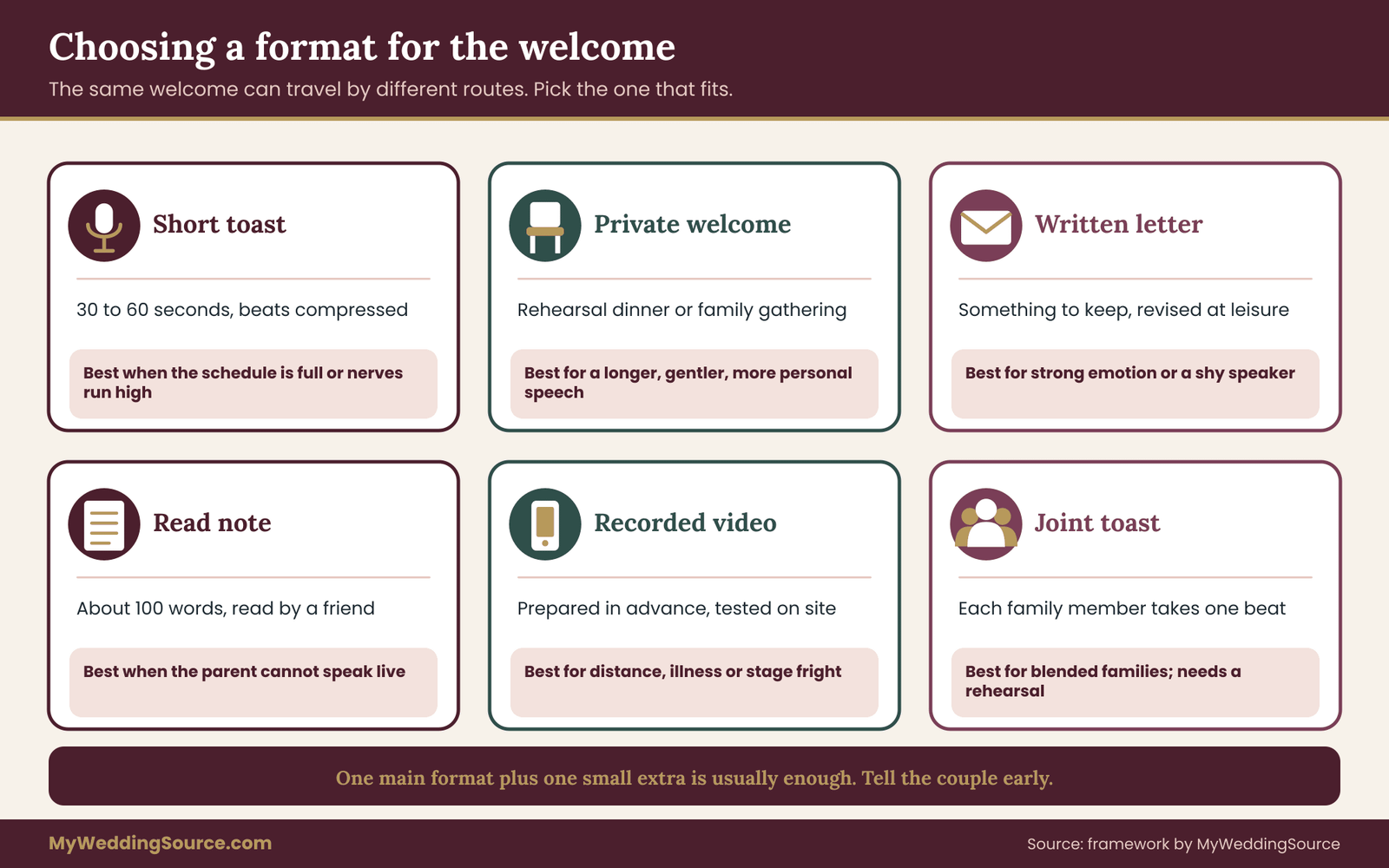
Here are the main alternatives, what each is good at, what each costs, and when to choose it. None is better in general. Each fits certain conditions.
A short toast instead of a full speech
A toast of thirty to sixty seconds keeps the structure of the five beats but compresses them. Name the person, give one observation, make one offer and raise a glass. It suits parents who are nervous, receptions that are already full of speeches, and families where the microphone moments need to be tightly controlled.
The cost is that the Moment must be very good, since there is no space to compensate for a weak one. Choose the single strongest scene and drop the rest. Skip the Others beat or reduce it to a single clause of thanks.
A private welcome at the rehearsal dinner or a family gathering
Sometimes the most honest place for a welcome is a smaller room. A rehearsal dinner, a family breakfast or a gathering at home can hold a longer, more personal speech to a handful of people who know each other. There is no need for a stage voice, and humor can be gentler because the audience is smaller.
The cost is that fewer people hear it, and the public statement of belonging is lost. Some new family members prefer the privacy, and others would rather have the public version. Ask. Many couples choose both: a longer private welcome and a short public toast. In that case, the two should not repeat each other.
A written letter
A letter lets you say things at length, revise them, and give the person something to keep. It suits parents who write better than they speak, families where emotion runs high, and situations where a public statement might create pressure. It can be handed over before the ceremony, tucked into a gift, or placed at the couple’s table.
The cost is that a letter is a private act, so it does not give the room a chance to witness the welcome. It also needs the same discipline as a speech: specific observations, no filler, no advice disguised as affection. The same cliche audit applies. A letter full of “we are so proud of you both” is the written version of the same empty sentence.
If you write a letter, consider asking whether the person would like it read aloud later, in private, or kept for themselves. Do not assume.
A card or a short note read by someone else
Some parents are comfortable writing but not speaking. A short note, perhaps a hundred words, can be read by the host, the officiant or a sibling. The reader should be someone the parent trusts to deliver it as written, and who has seen it beforehand.
The cost is that the parent’s voice is absent, and the reader must handle emotion on someone else’s behalf. It works best for a short, simple welcome, not for a layered one.
A recorded video message
A short video recorded in advance suits a parent who cannot attend, who is unwell, or who would be overwhelmed on the day. It can be played at dinner or kept for the couple. A recording also allows more than one take, which can reduce nerves.
The cost is technical: the venue must have the equipment and a person in charge of playing it, and a failure of sound or screen can spoil the moment. Test it in advance, and have a backup, such as the file on a second device. The couple should know the length and the content ahead of time. A recorded welcome also has a different feel from a live one, since the room cannot respond in the same way.
A shared speech or a family toast
When two or more family members want to speak, a joint toast can serve everyone. A parent, a stepparent and a sibling can each take one beat. This avoids three long speeches and gives each person a defined part. It works well when the family is blended and a single speaker might seem to leave out the others.
The cost is coordination. The three people must agree on the order, the length and the topics, and rehearse at least once. If one of them is likely to run long or improvise, a joint speech may be fragile. A clear rule, such as thirty seconds each, helps.
A ritual or gesture in place of words
Some welcomes are better shown than said. A parent might present a family heirloom, add the new person’s name to a family recipe book, hand over a key, or invite the person into a family custom. These gestures can be done with one or two sentences of explanation.
The cost is that objects carry meanings that are hard to control. An heirloom that is treasured by one relative may be contested by another, and a custom from one culture may feel foreign to another. Check with the couple and with any family who might have a stake. A gesture with a short, plain explanation is usually safe. A gesture with a long explanation is a parent wedding speech in disguise.
If your family is considering a gift or ritual with cultural or religious meaning, consult someone who understands that tradition. The guide to wedding ceremony steps on this site shows where family gestures commonly fit in a ceremony, which can help you decide whether a ritual belongs there or at the reception.
Silence is also an option
It is acceptable for a parent not to speak. Some parents prefer to express welcome in private, through conversation and action, and a parent wedding speech would be out of character. If you are in that group, say so early so the couple can adjust the program. A kind private note, a toast at a small moment and an open door afterward can do as much as a public speech.
What does not work is agreeing to speak, dreading it, and then delivering something half-hearted. If a parent wedding speech is a source of anxiety, pick an alternative. Public speaking is a common source of strong anxiety, and the National Institute of Mental Health provides general information on anxiety. A person who finds the prospect truly distressing can speak to a doctor or counselor, and the couple can offer a gentler format.
How to choose between them
Use a short set of questions. Does the parent want to speak? Does the new family member want to be addressed in public? Does the schedule have room? Is the room the kind of audience for which a spoken welcome works? Is there a strong reason, such as distance or health, that rules out a live speech?
If the answer to the first two questions is yes, a spoken speech or a short toast is the natural choice. If either answer is no, look at the private or written options. If the answer to the fourth is doubtful, consider a short toast. If the fifth applies, a video or a read note can carry the welcome.
Combining formats
The best welcome is often more than one format. A short toast in public, a longer letter in private and a gesture such as a recipe card together give the new family member three different kinds of welcome, with no repetition. The risk is excess: if every family member does all three, the day becomes crowded and the person being welcomed may feel they are being asked to react to everything. A single main format with one small supporting piece is usually enough.
What to tell the couple
Whatever you choose, tell the couple early. Say which format you plan, roughly how long it will be, and what you would like to mention. Offer to share the draft. That conversation is a courtesy and a safeguard, and it also lets the couple tell you if the format does not fit their plans.
If the couple would like a different format from the one you proposed, take their preference seriously. The wedding belongs to them, and the parent wedding speech is a gift to them. A parent who can accept a change gracefully shows the very quality the welcome is supposed to promise.
When the couple asks you to change the plan
Occasionally the couple will ask a parent to shorten, change or skip a parent wedding speech. This is often hard to hear. It helps to remember that the request is usually about the schedule, the mix of speakers or a worry about a topic, and rarely about the parent’s worth. Ask what the concern is. Offer an alternative from the list above. If the request is to skip the speech altogether, a card or a private toast can preserve the welcome.
The reverse is also true. If you are asked to speak and you do not want to, say so as early and kindly as possible. A decline given three months ahead is a gift. A decline given on the day is a problem.
Failure conditions: when a parent wedding speech should change or stop
Every method has conditions under which it stops working. Knowing them in advance is part of being honest about a plan. The conditions below are the points at which a planned parent wedding speech should be changed, shortened, moved or dropped. Treat them as a checklist you run twice: once during drafting, and once the week of the wedding.

Condition one: the new family member has not agreed
If you have reason to think the person would be uncomfortable being addressed in public, the parent wedding speech should not proceed in its current form. Some people dislike attention. Some are in a difficult position with their own family. Some have a history that makes a public welcome complicated. If the person says they would rather not, a private welcome or a note respects that.
The check is simple: ask the couple, and if possible the person, whether a public welcome would be wanted. A yes is useful. A hesitant yes deserves a follow-up question. A no ends the question.
Condition two: the draft cannot pass the fairness check
If the parent wedding speech contains a story that would embarrass the person, a comparison that favors one family over the other, or a reference to a private matter, it fails. The fix is to cut or replace the material, not to hope. If you cannot find enough material that passes, the issue may be that you do not know the person well enough yet, and an alternative format or a shorter toast is a better choice.
Condition three: the speech is not agreed with the couple
A parent wedding speech that has not been previewed, in some form, by the couple is a risk. You do not need to share the whole text, but the couple should know the topics, the length and any story you plan to tell. If they have asked you not to mention something and you plan to, stop. The wedding is not the place to test their patience.
Condition four: the schedule has no room
If the reception is already crowded with speeches, performances and logistics, an additional three minutes can push dinner service, music or other vendors off schedule. The decision belongs to the couple and whoever runs the timeline. If your speech does not fit, offer a shorter version, a different moment or a different format. The guide to wedding vendor timelines on this site shows how a day’s vendor commitments interlock, which helps explain why a seemingly small overrun matters.
Condition five: alcohol and nerves
A speaker who has had several drinks before speaking is at higher risk of saying something regrettable. A common and sensible rule is to hold drinking until after the parent wedding speech. Toasting with a glass in hand is fine. Drinking steadily through cocktail hour and dinner before taking the microphone is a different matter. The National Institute on Alcohol Abuse and Alcoholism publishes general information on how alcohol affects judgment and speech.
If a parent is known to have difficulty with alcohol, the couple may prefer a format that does not depend on live delivery, such as a recorded message or a read note. That conversation should be kind and private.
Condition six: the family is in open conflict
If there is an active dispute among relatives, a parent wedding speech can become a vehicle for it, intentionally or not. The risk is highest when the speaker has strong feelings about someone in the room. A welcome should not carry a hidden message to a third party. If you feel the pull to make a point, that is a sign the speech should be reviewed by someone neutral, or replaced with a plainer format.
If the conflict is serious and involves safety, the couple should involve appropriate professionals. A speech outline is not a substitute for that help. In the United States, the National Domestic Violence Hotline provides support when safety is a concern.
Condition seven: the setting does not suit a speech
Some receptions are noisy, outdoors, or loosely organized, and a spoken speech will not be heard. If the sound system is poor, the crowd is standing or the music is loud, a long speech is wasted. Consider a shorter toast, a different time, or a different format. If a guest has a hearing difficulty or uses an interpreter, plan for that too. The ADA information published by the U.S. Department of Justice gives general guidance on accessible communication, and the venue or the couple’s coordinator can help with practical arrangements.
Condition eight: the speaker is unwell or unable
Illness, travel problems or a bereavement can make a live speech impossible. A backup person, a card or a video can preserve the welcome. It helps to have a short written version ready, even if you hope not to need it. A speech written down can be read by someone else, and the welcome survives.
Condition nine: the language does not match the room
If many guests do not speak the language of the parent wedding speech, much of it will be lost. A parent who speaks a different language from the new family member’s family may need a translator or a bilingual structure. Plan for a short pause after each beat, if translation is live, and keep sentences short. A speech that is translated sentence by sentence loses a lot of rhythm, so keep it simpler than usual.
What to do when a condition is met
When one of these conditions applies, do not push on. Name the issue, choose a response from the alternatives section, and tell the couple. The response may be to shorten the parent wedding speech, change the format, change the timing or drop the parent wedding speech. Each of those is a legitimate outcome. The aim is a welcome that works, not a parent wedding speech that happens.
A useful habit is to set a decision date, perhaps two weeks before the wedding, when you check these nine conditions and decide whether to go ahead. That gives time to adapt. A last-minute change is much harder than an early one.
Failure is usually small
Most problems with a parent wedding speech are minor: a joke that falls flat, a name slightly mispronounced, a story that runs long. Guests tend to be generous, and a sincere speaker who stumbles is usually forgiven. The serious failures are the ones this section describes, where the content hurts someone, ignores the couple’s wishes or turns the day into the speaker’s own moment. Those are avoidable with planning, and the cost of planning is small.
Rights, quotes and borrowed words in a parent wedding speech
Many parents want to include a poem, a song lyric, a line from a book or a passage from a religious text. Others want to read a speech they found online, or adapt one from a published collection. This section explains the main questions to ask. It is general information, not legal advice, and the U.S. Copyright Office is the authority for current rules in the United States.
Why it matters at a wedding
A parent wedding speech delivered at a private event raises different questions from a published work, but the underlying issues are the same: who wrote the words, whether permission is needed, and how to credit them. Most family weddings are not likely to attract any enforcement. The more practical concerns are courtesy, honesty and accuracy. Passing off someone else’s speech as your own is a risk in itself, because a guest may recognize it.
Short quotations
A brief quotation, with the author named, is the most common use. It is usually fine in a spoken, private context, but the best test is whether the quotation does real work. If it is only decoration, it adds little. If it says something you could not say as well, it can be worth keeping. Keep it short, name the author correctly, and say the words accurately.
If the parent wedding speech will be recorded, published online or printed in a program, the situation is different, since copying and distribution are involved. The Copyright Office explains the general idea of fair use, which depends on several factors and cannot be reduced to a word count. When in doubt, paraphrase, or choose a work that is in the public domain.
Song lyrics and poems
Lyrics and poems are often protected, and the owner can be a publisher, an estate or the author.
Reading a few lines aloud at a family wedding is a smaller matter than printing a whole poem on a program or posting a video online. If you want to print or record the whole thing, check the owner’s terms or choose something older. The Copyright Office website explains how to search registration records and how copyright terms work. For a deeper look at readings in particular, the site’s wedding ceremony steps guide notes where readings commonly sit in a service.
Using speeches found online or in books
Many websites and books offer sample speeches. Reading one aloud as your own has two problems. The first is that it is probably someone else’s work, and copying it may raise rights issues and is certainly an honesty issue. The second is that it will not pass the swap test, because it was written for no one in particular.
It is better to treat samples as examples of structure, and write your own words. If a sample contains a line you love, rework it so that it speaks about your person, or credit the source out loud.
Templates and generated drafts
Templates, outlines and drafting tools can help you organize your thoughts. Be careful about treating any template as free of rights, since some are covered by license terms, and be careful about treating a generated draft as ready to use. A draft produced by a tool is only as good as the observations you feed it, and it tends to produce the very cliches this guide warns against. If you use any such aid, run the audit and replace every generic sentence with a specific one.
Do not present a template, a published speech or any borrowed passage as your own work without changes, and do not claim that a published speech is free to use unless you have confirmed its terms.
Religious and traditional texts
Many traditional blessings and passages are very old and are in the public domain, but particular translations or arrangements may be protected. If you plan to read from a translation, check which one and whether permission is needed for printing. If the text comes from a faith tradition that is not your own, ask a member of that community whether it is appropriate to read it, and how.
Quoting people in your family
Stories you tell about relatives are also quoted material, in a sense. If you plan to repeat something a family member said, ask whether they are comfortable with it. A line that was said privately may not be meant for a room. Also, do not invent quotations. If you cannot remember exactly what was said, paraphrase honestly: “She once told me something like…” is acceptable, and “She always said…” is a claim you should be sure about.
A short rights routine
Before the parent wedding speech is final, ask four questions about each borrowed element. Who wrote it? Is it short enough and private enough to use as it stands? Will it be recorded or printed? Have you named the author? If any answer is unclear, replace the element with your own words. The speech will usually be better for it.
Delivering the parent wedding speech: rehearsal, microphone and the day itself
A well-built speech can still stumble in delivery, and most of the stumbles are preventable. This section covers what to practice, what to ask the venue, and what to do when things go slightly wrong. None of it requires acting skill. It requires a few hours of preparation and a calm plan.
Rehearse out loud, three times
Read the parent wedding speech aloud three times before the day. The first time, read it alone and fix anything that trips you. The second time, read it standing up, at the pace you intend to use, and time it. The third time, read it to one person you trust, such as a sibling or friend, and ask a single question: where did you lose interest? Mark that spot and cut or tighten it.
Do not memorize every word unless you are comfortable doing so. Knowing the order of the five beats is enough, with the written text as a safety net. Practice looking up at the end of each sentence, since eye contact with the new family member during the Room beat is the moment of welcome. Looking at them is the whole point of the beat.
Talk to the person running the schedule
Find out when you will speak, who will introduce you and who will hand you the microphone. If a coordinator, band leader or emcee is handling the cues, send them your timing and your last line so they know when to resume. If no one is in charge, assign a person, because a parent wedding speech with no cue for ending tends to drift.
The wider question of where toasts sit in the evening belongs to the people building the timeline. The wedding reception flow guide explains how courses, speeches and music interlock, which is useful background if your slot is flexible. Tell the host how long you will take, then keep to it.
Check the microphone before guests arrive
Ask to try the microphone beforehand, in the room, with the sound system on. Learn whether it is handheld or fixed, whether it has an on/off switch, and how far from your mouth it should be. A microphone held at the chest is hard to hear, and one pressed to the lips can distort. A hand-width from the mouth is a common starting point.
If you wear glasses, plan where your notes will sit so that you can read them without tilting your head. If you use a hearing aid or a mobility aid, tell the coordinator so the setup works for you. Accessibility is a reasonable request, and the venue should be able to arrange a chair, a stand or a different position.
The thirty seconds before you speak
Stand slowly. Take one deep breath. Put your notes where you can see them. Look at the room, find the new family member, and wait a second before you begin. That small pause signals calm to the room, and it also settles you.
If your voice shakes at the start, slow down. Nerves speed up speech, so a deliberate pace is the best correction. If your hands shake, hold the cards in both hands, or rest them on a lectern. The shaking is usually more noticeable to you than to anyone else.
Speak to the person, not to the page
During the Moment and Room beats, look up. If you are reading from a page, plant your eyes on the next phrase and say it to the person, not to the paper. A speech that is read well, with regular glances up, feels personal. A speech that is read with no eye contact feels like a notice.
If you cannot look at the person without losing composure, look at the couple’s table or at a friendly face near them. The room will read it as address to the table.
If something goes wrong
Small errors will happen. You may skip a line, mispronounce a name or forget a detail. The best response is to keep going, correct the name if it matters, and not apologize at length. A one-word correction, said calmly, is enough. If you lose your place, pause, glance at your notes, and resume. Guests do not know your script and will not notice most omissions.
If the microphone fails, speak louder and move on, or ask a person near you to fetch another. If you become emotional, stop for a few seconds, breathe and take a sip of water. The room will wait. If you cannot continue, hand your notes to a trusted person and ask them to read the Toast beat, or simply raise your glass and say the Toast sentence yourself. That is a complete ending.
If the speech includes a translation or an interpreter, pause after each beat and give the interpreter time. Keep your sentences shorter than usual and avoid idioms that do not translate. If you are unsure who from each side will be in the room, the family photo list the couple is building often names the key relatives, which helps you decide who to acknowledge in the parent wedding speech.
After the speech
Hand the microphone back and return to your seat. Do not add a post-script. If the new family member comes to thank you, receive it simply. If the couple speaks to you later about something that went wrong, listen without defending yourself. A parent wedding speech is a small part of a long day, and how you handle the aftermath is part of the welcome as well.
A few days later, a short note to the new family member, or a message through your child, can close the loop. It does not need to repeat the parent wedding speech. It can say what you enjoyed about the day and repeat one concrete offer, such as the date of the next family meal. A promise made in public is only as good as the follow-up in private.
Keep a copy
Save the final text. Some couples treasure it, and a copy may be asked for later, for a video, a scrapbook or an anniversary. If a guest or vendor recorded the parent wedding speech, ask who will keep it and whether the couple has agreed to share it. A short written copy, given as a gift, is often valued long after the details of the day have blurred.
Your next steps
Work through these in order. Each takes less than an hour, and the whole process takes about two weeks of light effort.
- Decide the purpose. Write one sentence that says what the parent wedding speech is for: a welcome to a named person.
- Ask the couple whether a spoken welcome fits the schedule, how long you have, and what to include or leave out.
- Start the observation list. Write down at least ten small things you have seen the new family member do.
- Ask three other people what they have noticed, and get permission to use what they say.
- Draft with the five beats: Name, Moment, Room, Others and Toast. Keep the Moment the largest beat.
- Run the cliche audit and the swap test. Replace every sentence that could be said at any wedding.
- Check facts, names and pronunciations. Check borrowed words for permission and credit.
- Share the outline or draft with the couple, and adjust.
- Rehearse aloud three times, time it, and prepare a backup copy.
- Set a decision date two weeks before the wedding to review the failure conditions and choose the final format.
If a step does not fit your situation, skip it. The aim is a speech that is specific, short and respectful, and any route that gets you there is fine. For the broader courtesies around family roles and speeches, the wedding etiquette hub on this site is a good place to continue.
FAQ
How long should a parent wedding speech be?
About three minutes, or roughly four hundred spoken words, is a comfortable target, and five minutes is a firm ceiling for most receptions. Time yourself reading aloud at a calm pace, and add a few seconds for pauses. If the parent wedding speech runs long, cut advice and secondary stories first, and protect the moment that shows who you are welcoming.
What should a parent say to welcome a new family member?
In a parent wedding speech, say the person’s name, describe one small scene that shows their character, offer something specific you can actually deliver, thank the people who raised them, and close with a short toast. Specific observations work better than adjectives, because listeners can picture them and the person feels individually noticed.
How do I avoid cliches in a parent wedding speech?
Use the swap test. Replace the new person’s name with a stranger’s, and if the sentence still works, rewrite it with a detail only they could own. Cut quotations, borrowed advice and phrases like “gaining a son or daughter.” Replace adjectives with things you have seen the person do.
Is it okay to tell a funny story about the new family member?
Only if the person has agreed and would be comfortable hearing it in front of their grandparents and colleagues. Humor aimed at yourself is safer than humor aimed at them. Avoid jokes about appearance, past relationships, money or their family, and ask the couple to approve any story before you tell it.
What if I barely know the person my child is marrying?
Say so honestly, and speak about what you have seen and what your child has told you, crediting the source. Spend time with the person before the wedding if you can, and ask friends and relatives what they have noticed. A short, true welcome is better than a long one that pretends to deep familiarity.
Should I mention a parent who has died?
Ask the couple and the surviving family first. Some people welcome a short, warm mention, and others prefer silence or a quiet gesture. If it is welcome, keep it to a sentence, and say something you can honestly claim, such as that you wish you had met them, not a claim about what they would feel.
Can I quote a poem or song lyric in my speech?
A short, credited quotation spoken aloud at a private family event is a common practice, but rights depend on the work and on how it is used. If you will print, post or record it, check the owner’s terms or the U.S. Copyright Office guidance, or paraphrase. Your own words are usually stronger anyway.
What if I do not want to give a speech at all?
Tell the couple as early and kindly as you can, and offer an alternative such as a card, a private toast at the rehearsal dinner, a short video or a family gesture. A parent who prefers to skip a parent wedding speech can still welcome the new family member warmly through action, and a thoughtful decline is better than a reluctant speech.
Sources
- U.S. Copyright Office: copyright basics, registration search and permissions
- U.S. Copyright Office: fair use overview
- Emily Post Institute: etiquette guidance on weddings and toasts
- PlainLanguage.gov: federal plain language guidelines
- National Institute of Mental Health: anxiety disorders
- National Institute on Alcohol Abuse and Alcoholism
- ADA.gov: U.S. Department of Justice Americans with Disabilities Act information
- Toastmasters International: public speaking resources
- 988 Suicide and Crisis Lifeline
- National Domestic Violence Hotline