

Memorial charms are small keepsakes tied or fixed to a bridal bouquet to carry the memory of someone who cannot be at the wedding. This guide treats memorial charms as a practical problem of consent, attachment and handling: which item to use, how to fix it so it holds, what could go wrong, and how to keep an heirloom safe before, during and after the day.
Run every idea for memorial charms through four gates in order: consent from the people the memory belongs to, the item itself (is it safe to risk?), the attachment (will it hold and come off cleanly?), and the afterlife (where does it go after the day?). Prefer a replica, a fabric piece or a small new charm over an irreplaceable heirloom. Use a removable attachment, rehearse a short carry test with a stand-in weight, and write down in advance what you will do if a charm comes loose.
A bouquet is an odd place to hold a memory. It is carried, squeezed, handed to a friend, set on a chair, photographed from every angle and sometimes thrown. Flowers are wet, stems are sticky, and the person holding the bouquet is also managing a dress, a veil, a microphone and about a hundred greetings. Anything you add to that has to survive an ordinary day of being handled, and it has to do so without harming the flowers, the gown or the object itself.
Most advice about memorial charms stops at the sentiment: choose a locket, add a photo, tie a ribbon. That part is easy to find. The harder questions come later. What if the item belonged to someone else in the family who has not agreed? What if the clasp opens when you hug your uncle? What if the metal marks your lace? What if the charm is a grandmother’s brooch and it ends up in a vase of water at the venue? Those are the questions this guide answers.
A note on scope. This is general information about handling keepsakes and planning a ceremony, not legal, tax, medical or financial advice, and nothing here is a statement about how anyone should grieve. Wider ways to honor people who cannot attend, such as readings, reserved seats and memory tables, are separate topics. This article stays with one object: a charm on a bouquet.
What memorial charms on a bouquet actually involve
The phrase covers more than one kind of object, and the differences matter for safety. Before comparing options, it helps to see what couples usually mean when they say they want memorial charms for a bouquet.
A hanging charm. A small pendant on a ribbon or short chain that dangles from the bouquet handle. This is the classic form: a locket, a small frame, a metal tag, a bead or a tiny keepsake. It moves when the bouquet moves, which makes it visible and also makes it vulnerable.
A wrapped-in item. Something tied into the handle wrap, such as a strip of fabric from a shirt or dress, a handkerchief, a piece of lace or a button sewn onto the ribbon. It does not swing, and it is usually softer and lighter than metal.
A pinned or clipped piece. A brooch, a small pin or a clip fixed to the ribbon, the handle collar or a bouquet holder. This is the form with the sharpest edges and the most risk to fabric.
A set-in item. A ring, a pendant or a photo disc that sits in the center of the flowers, or in a cuff-style holder. It is better protected from knocks and worse protected from moisture.
A replica. A new object made to look like or stand in for the original: a custom charm engraved with a name or date, or a printed photo charm. A replica carries the meaning without the risk to the object itself.

Each form has its own failure. Hanging charms fall off or knock against things. Wrapped fabric gets wet and stained. Pins catch lace and tulle. Set-in items corrode or get crushed. Replicas are the safest, though some people feel only the real object will do. None of this means you should skip memorial charms. It means the choice of form and the choice of object should be made together.
Why this small decision gets its own plan
It might seem excessive to give a tiny keepsake a whole process. There are three reasons it earns one.
First, the object may be irreplaceable. A new locket can be bought again. A great-aunt’s brooch cannot. The more irreplaceable the item, the more the plan should protect it from the ordinary hazards of a wedding day.
Second, the people involved are grieving, or may be. A charm that goes wrong in public, whether it falls into a drain at the venue or is lost in the rush of a group photo, can turn a quiet tribute into a painful moment. A little planning removes most of that risk.
Third, a bouquet changes hands. A bridesmaid holds it during the vows. A photographer asks to borrow it for a detail shot. A child wants to carry it. The more hands, the more reason to know exactly how the memorial charm is attached and what to do if it is not.
Consent and ownership come before any charm
Nobody enjoys beginning with permission, but with memorial charms it is the gate that saves the most trouble. The questions are simple: whose memory is this, whose object is it, and who might feel surprised or hurt?
Whose object is it
Start by naming the owner of the item, not the person it reminds you of. A watch belonged to a grandfather, but it may now belong to his widow, to his eldest son, or to the estate. A ring may have been promised to a cousin. If you are not the legal or family owner, ask before you use it, even if you have always assumed it would come to you.
This is not about legal technicalities. It is about avoiding an argument at the reception. A short conversation now costs almost nothing, and a family disagreement over a missing brooch costs a great deal.
If the item is held by someone else, ask in a way that is easy to decline. A message such as this works:
“We would love to carry something of Grandpa’s in the bouquet. Would you be comfortable lending his tie clip for the day? If you would rather it stayed home, we will use a small photo charm instead.”
The second sentence matters. It gives the owner a graceful way to say no, and it tells them you already have a fallback.
Whose memory is it
Several people can claim a memory, and they may not agree on how to honor it. A parent who died may have left a former spouse, a second family, children from different relationships and friends who knew a different side of them. A memorial charm that looks like a gentle tribute to one person can look like a statement to another.
You do not need everyone’s approval for every personal choice. You do need to know who is closest to the person being remembered and whether any of them would be upset. If there is a surviving parent, sibling or partner of the person being honored, tell them before the day. Tell them privately, and tell them what you plan to carry and how. Many people welcome it. A few ask you to wait, to choose something else, or not to mention a name aloud. Asking first lets you adjust before it matters.
Some people prefer no public reminder
Some relatives want to grieve privately and would rather not see a memorial item on display at a celebration. Others worry about tears, about their own composure or about a guest asking questions. A hidden charm, sewn inside the handle wrap or pinned to the underside of the bouquet, can honor the person without announcing it. For couples who want to leave a choice open, a charm that can be revealed or concealed on the day gives the family room.
If you plan to mention the charm during the ceremony or in a toast, check with the people most affected. The page on the step-by-step ceremony flow shows where short remembrances usually fit, and the guide on wedding etiquette offers wording for sensitive family conversations.
A short consent check you can write down
Before choosing a charm, write one line for each of these and keep the answers in a note on your phone:
- The owner of the object and whether they agree to its use.
- The people closest to the person being remembered, and whether each has been told.
- Whether the memorial charm will be visible, hidden, or revealed at a chosen moment.
- Who decides if the plan changes on the day.
- What you will use instead if anyone says no.
That list is the first gate. If any line is blank, or contains a no, stop there. The remaining gates assume consent is in place. A well-attached charm that a family member objects to is still the wrong charm.
When consent is unclear or no one can be asked
Sometimes the person who could say yes is no longer reachable, or the family has not spoken in years. In that case, treat unclear as a reason to choose the lower-risk path. Use a new item, such as a memorial charm engraved with initials or a date, rather than a family heirloom whose ownership is uncertain. Avoid anything likely to start a conflict. And consider whether a different tribute, such as a reserved seat or a line in the program, would give you the same meaning without the question of who owns what.
Memorial charms work best when the people closest to the memory feel included rather than managed. That usually means telling them early, giving them a way out, and treating a refusal as information rather than an obstacle.
A four-gate check for memorial charms
Ideas for memorial charms tend to arrive as a picture: a locket swinging from white ribbon, a brooch pinned to the stems. A picture does not tell you whether the idea will work. The four-gate check turns the picture into a decision. Each gate asks one question, and the gates are taken in order. If an idea fails a gate, you fix it or move to an alternative before going further.
Gate one: consent. Is the charm welcome to everyone it touches? This is the gate covered in the previous section. It comes first because a technical success cannot repair a family problem.
Gate two: the item. Is this particular object safe to risk on a wedding day? The risk is measured by how replaceable it is, how fragile it is, and whether it can be harmed by water, sweat, perfume, friction or a drop onto stone.
Gate three: the attachment. Will it hold for the whole day, and can it come off without leaving damage? This gate covers weight, the fixing method, the sharp edges and what it might do to the bouquet and the dress.
Gate four: the afterlife. Where does the memorial charm go once the bouquet has done its job? Bouquets wilt, get dried, get tossed or end up in a hotel room. A plan for the charm itself, such as who removes it, who stores it and how, keeps the object from being lost in the cleanup.

How the gates work together
The gates are not independent. A heavy item fails the attachment gate unless the bouquet is built to carry it, and a delicate item fails the item gate whatever the fixing. A fragile heirloom can still pass if the plan chooses a protected position, such as a sewn pocket inside the wrap, and a short carrying time, such as only the ceremony and the first photographs.
The point of the check is to make trade-offs visible before the morning of the wedding. If an item passes gates one and two but struggles at gate three, you can change the attachment. If it fails gate two, you can swap in a replica. If it fails gate one, you stop and talk to the family. Only when all four gates are open does the memorial charm go on the bouquet.
Scoring an idea without a spreadsheet
You do not need numbers. Give each gate one of three marks on a piece of paper: open, open with a condition, or closed. A condition is something specific and checkable, such as “only if the clasp is replaced” or “only if the owner agrees in writing by email.” A closed gate sends you to the alternatives section later in this guide.
Here is how the marks read in practice. A custom engraved disc on a ribbon loop, with the family’s blessing, usually gets open, open, open with a condition (a rehearsal), open. A grandmother’s pearl brooch pinned to lace-trimmed ribbon gets open, closed or conditional on a protective position, closed or conditional on a pin guard, and open with a condition (a labeled box). The marks tell you where the work is.
The order matters
Many couples begin with gate three, looking up how to attach things, because it feels like the practical part. Starting there tends to produce a charm that is attached very well and chosen poorly. Starting with consent and the item tells you what you are attaching and whether the plan is wanted. The attachment methods compared later in this guide make far more sense once you know what is being attached.
Choosing the item: what makes a good memorial charm
The strongest memorial charms are not necessarily the most valuable ones. They are the ones that carry the meaning, survive the day and can be handled by someone other than the person they matter most to. Use the questions below to sort your candidates.
Replaceable or irreplaceable
Sort everything on your shortlist into two piles. In the first pile are items that could be replaced or recreated if they were lost: a new engraved charm, a printed photo in a small frame, a button bought to match one from a shirt, a copy of a handwritten note. In the second pile are items that cannot: the actual ring, the actual watch, the actual cufflink, the actual handwriting.
There is no rule that says irreplaceable items must stay home. Some people feel strongly that the real object is the point, and that is a legitimate choice. But the second pile deserves extra protection and a more careful fixing, and for many couples it is the pile where a replica makes the most sense. A faithful copy, held next to the original in a drawer, can carry the same meaning in public while the real thing waits safely at home.
Weight, size and edges
A charm that is pleasant to hold in the hand may be a problem on a bouquet. Weight pulls on ribbon and wire. Size catches on sleeves and veils. Edges snag fabric.
A useful way to judge weight is to hang the charm from the ribbon you plan to use, hold the bouquet by the handle at waist height and tilt it slowly. If the memorial charm swings far, bangs against the stems, or makes the bouquet feel unbalanced, it is too heavy for that position. Move it to a protected spot at the handle, or choose something lighter. You do not need a precise weight limit; you need a bouquet that behaves normally with the charm on it.
For size, think about a day of hugging. A memorial charm larger than a thumb pad tends to be in the way. For edges, run a fingertip and then a scrap of lace or tulle over every surface of the item. If it catches, it will catch the dress.
Materials and how they react
Metals, stones and organic materials respond differently to moisture, sweat, hand lotion and perfume.
Plated metals can wear through where they rub. Silver tarnishes, and the tarnish can mark ribbon and skin. Costume jewelry sometimes contains nickel, which causes skin reactions in people who are sensitive to it; the American Academy of Dermatology publishes information on nickel allergy, and anyone holding the bouquet for long should know whether they react. Pearls and soft stones can be damaged by chemicals and water. Fabric absorbs stems’ water and can stain. Paper and photographs curl and fade when wet.
Items made from feathers, shell, bone, ivory or other animal material can raise a separate question. Some are restricted by law, especially if they cross borders, and the U.S. Fish and Wildlife Service explains the rules on its site. If an heirloom includes such material and you are traveling abroad, check the rules before you pack it.

Sentimental fit
The last test is the most personal. Does the item fit the person, and does it fit the day? A deep-sea fisherman’s reel is a wonderful memento and a terrible bouquet charm. A small brass key, a button, a tiny compass, a folded-paper crane or a piece of a favorite shirt can carry the same story in a form a bouquet can bear.
If the real object is too large, think about what part of it can speak for the whole. A single button from a coat, a thread from a handkerchief, a cutting of a recipe card in the person’s handwriting, the initials stamped on a leather tag. Small pieces are easier to attach, easier to replace and easier to hand over to a florist.
A shortlist routine
Put three candidates on a table. For each, answer five plain questions: Who owns it? Could I replace it? Does it pass a gentle tilt test on ribbon? Does it have edges, nickel or moisture-sensitive parts? Would the people closest to the memory approve? The candidate with the fewest worries is usually the right first choice. The one with the most meaning but the most worries becomes the one you keep safe at home, or you make a copy of it.
Talking with the florist early
If a florist is building the bouquet, mention memorial charms at your first design conversation, not on the morning of the wedding. Florists handle fixings every week and can tell you what their wrap and handle will carry. They can also build in a hidden loop or pocket if you ask. Bring the actual item or a clear photograph of it, with its dimensions.
Ask who will attach it, when, and what happens if it needs to come off for photographs or travel. The guide to wedding vendor contracts helps you get these promises written into the agreement rather than left to memory.
Attachment methods for memorial charms, compared
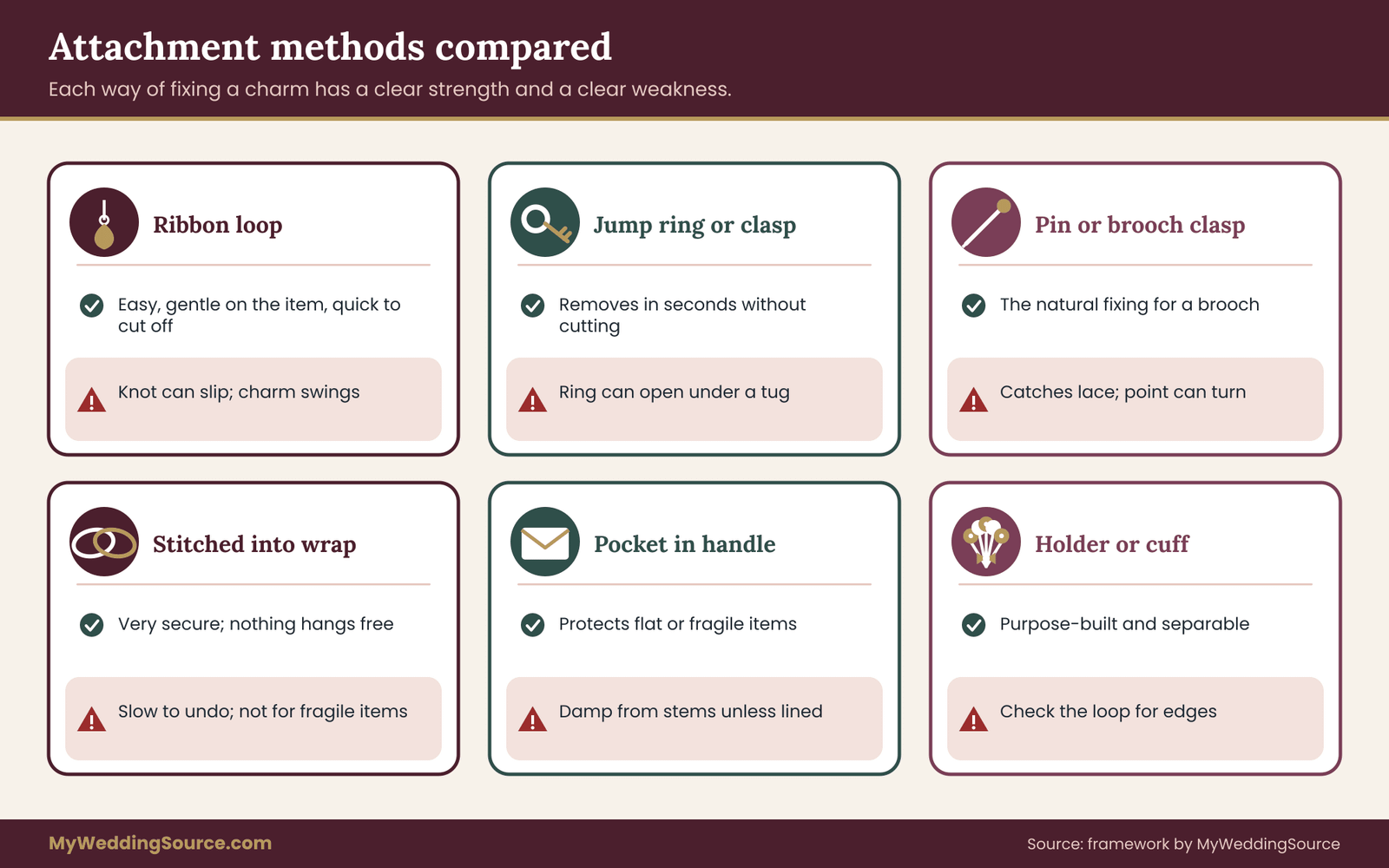
Gate three is where most memorial charms succeed or fail. There are only a handful of ways to fix a small object to a bouquet, and each has a clear strength and a clear weakness. The comparison below is in plain language so you can match the method to the item rather than the other way around.
Ribbon loop tied to the handle
A loop of ribbon threaded through the memorial charm and tied around the bouquet handle is the most common method, and for good reason. It needs no special parts, it is easy for a florist to do and it can be undone by cutting or untying a knot.
Its strengths are that it is gentle on the object and quick to remove. Its weaknesses are that a knot can slip if the ribbon is slick, such as satin, and that the loop lets the charm swing. A double knot with a small dab of clear fabric glue on the knot, kept away from the memorial charm itself, reduces slipping. A short loop that keeps the charm close to the handle reduces swinging and knocking.
Choose a ribbon wider than the hole it passes through, so the memorial charm cannot pull free, and test the knot by hanging the charm from it and giving the ribbon a firm tug. If the item has a small hole, thread a jump ring first rather than forcing ribbon through.
Jump ring or lobster clasp
A metal jump ring or a small clasp lets you hang a charm from a ring that is itself tied to the handle. Jewelry makers use these constantly, and they let you remove the memorial charm in seconds without cutting anything.
The weakness is the opening. A jump ring that is not fully closed can open under a tug. A spring-gate clasp can open if pressed against fabric or a hand. If you use one, close the ring with two pairs of small pliers so the ends meet exactly, or ask a jeweler to solder or secure it. For a clasp, add a loop of ribbon as a backup, so that if the clasp opens the charm is still caught.
Pin or brooch clasp
Brooches are made to pin, so pinning is the natural way to use one. The method is also the riskiest. Pins have points that catch lace, tulle and satin. A pinned brooch can pivot and turn upside down. A pin through delicate ribbon leaves a hole that does not close.
If you pin an heirloom brooch, pin it to a stable base, such as a small piece of sturdy ribbon or a fabric patch sewn to the handle wrap, not to the flowers. Use a safety catch or a pin guard on the back so the pin cannot open. Face the point away from the body and the dress, and cover the end of the pin with a small piece of foam or a clear pin cap if you will be hugging people.
Avoid pinning through the item’s finish, and avoid using a brooch at all if the dress is lace, beaded or very fine.
Stitched into the wrap
Sewing a charm, a button or a fabric keepsake into the ribbon wrap with thread is more secure than most other methods. Nothing hangs free, nothing catches and the item sits flat against the handle.
The cost is that it is not easy to undo. You will need a small pair of scissors and patience after the wedding to snip the threads without cutting the ribbon or the object. Use a strong thread, make several passes through each hole, and leave a loose tail marked with a small colored thread so whoever removes the item knows where to cut. This method suits buttons, small tags and fabric pieces. It is less suitable for fragile or hard-to-sew items such as thin metal or old glass.
Pocket or sleeve inside the handle
A small pocket of ribbon or soft fabric, closed with a few stitches or a hidden snap, holds an item without pressing on it. It suits flat or fragile items such as a photograph on card, a folded note, a coin or a small ring in a pouch.
The main hazard is moisture. If the handle sits near the stem water, the pocket can get damp. A thin layer of clear plastic or a small sealed envelope inside the pocket keeps the contents dry. Do not rely on the florist’s tape as a barrier; it is meant for stems, not for protecting paper or metal.
Bouquet holder or cuff
Some florists and accessory makers offer a bouquet holder with a memorial charm loop, a locket-style frame or a cuff that wraps the handle. This is a purpose-built option, and it usually has a ring or hook rated for light charms.
It gives the most reliable result if you want the memorial charm to be visible and secure. Ask for a demonstration. Check the loop for sharp edges, and hang a stand-in weight from it before you commit. It can also be separated from the flowers after the day, which helps if you want to keep the holder and discard the bouquet.
Wire through the stems
Some people wrap floral wire around a charm and push it into the stems. This is not advised for memorial charms. Wire cuts into the item, can be hard to remove without bending it and can scratch skin and fabric. Wire also conducts moisture into the stems and corrodes. If a florist suggests it, ask for the ribbon or pocket alternative.
Matching method to item
You can use a quick rule for choosing. For a light, new or replaceable item, the ribbon loop or jump ring is enough. For a heavier item, add a second point of attachment, so that if one fails the other holds. For fragile items, use the pocket or sewn method and keep them from water. For brooches and pins, build a stable base and use a safety catch. For an irreplaceable item, keep every attachment reversible and test it twice.
A backup is worth having for any method. A single thin loop of thread tied from the charm to the handle, loose enough not to show, will catch it if the main fixing fails. It costs almost nothing and takes a minute to add.
Safety around skin, the dress, children and travel
A memorial charm is a small object that spends a day near a lot of people. Beyond whether it holds, think about what it might do to those around it.
Skin and allergies
The person carrying the bouquet may hold it for hours, and the handle often rests against skin. If the memorial charm touches skin, nickel or other metals can cause rashes in people who are sensitive. If you know that you or a bridesmaid reacts to costume jewelry, keep the charm away from skin by placing it above the wrap or inside a pocket. The American Academy of Dermatology offers general information on nickel allergy, and a clinician can advise on your own situation.
The dress and the veil
Lace, tulle, beading and fine silk are easy to snag. Check the memorial charm against a scrap of your actual fabric, or ask your seamstress to run the item gently over a seam allowance. The guide to wedding dress fit and alterations explains how a seamstress assesses fabric and what to ask about hems and bodices that touch the bouquet. If any part of the charm catches, change the position or add a soft cover such as a ribbon wrap over metal edges.
Pins and sharp clasps also threaten the veil, which tends to wrap around a bouquet during a hug. A bouquet carried at the waist with the memorial charm facing outward is more exposed than one with the charm turned toward the handle.
Small children and pets
Charms are small. Small objects are a choking risk for young children, and the U.S. Consumer Product Safety Commission publishes safety information on small parts and on children’s jewelry. If a flower girl or a young relative will carry or touch the bouquet, choose a charm that cannot come loose or that is sewn in firmly. Keep the bouquet out of reach of toddlers and pets when it is set down, especially if it includes beads, tiny metal parts or glued elements.
Fragrance, lotions and sprays
Hairspray, perfume and hand cream can mark silver, cloud pearls and stain fabric. Ask the person holding the bouquet to apply products first and wait before taking the memorial charm in hand. If the charm will be hidden in a pocket, there is less risk, though a spray near a photograph on paper can still leave marks.
Travel and security
If you are traveling to the wedding, or leaving for a honeymoon with the bouquet, think about how the memorial charm will cross security checkpoints. The Transportation Security Administration publishes guidance on what can be carried in a cabin bag. Small jewelry and keepsakes are usually fine to carry in a cabin bag, but pins and tools can draw attention, and a dried bouquet can be examined. Carry an heirloom in your hand baggage, never in checked luggage, and pack it in a labeled box.
For items with feathers, shell or other animal material, check the U.S. Fish and Wildlife Service guidance before you cross a border. That includes small decorative pieces.
A day-of safety line
Give one trusted person a short job: they know where the charm is attached and what to do if it comes loose. Write it as a single sentence on a card in their pocket: “If the memorial charm falls, pick it up, put it in the small box in my bag, and tell me after the ceremony.” That single instruction means nobody has to improvise in the middle of a group photograph.
A carry test for memorial charms before the day
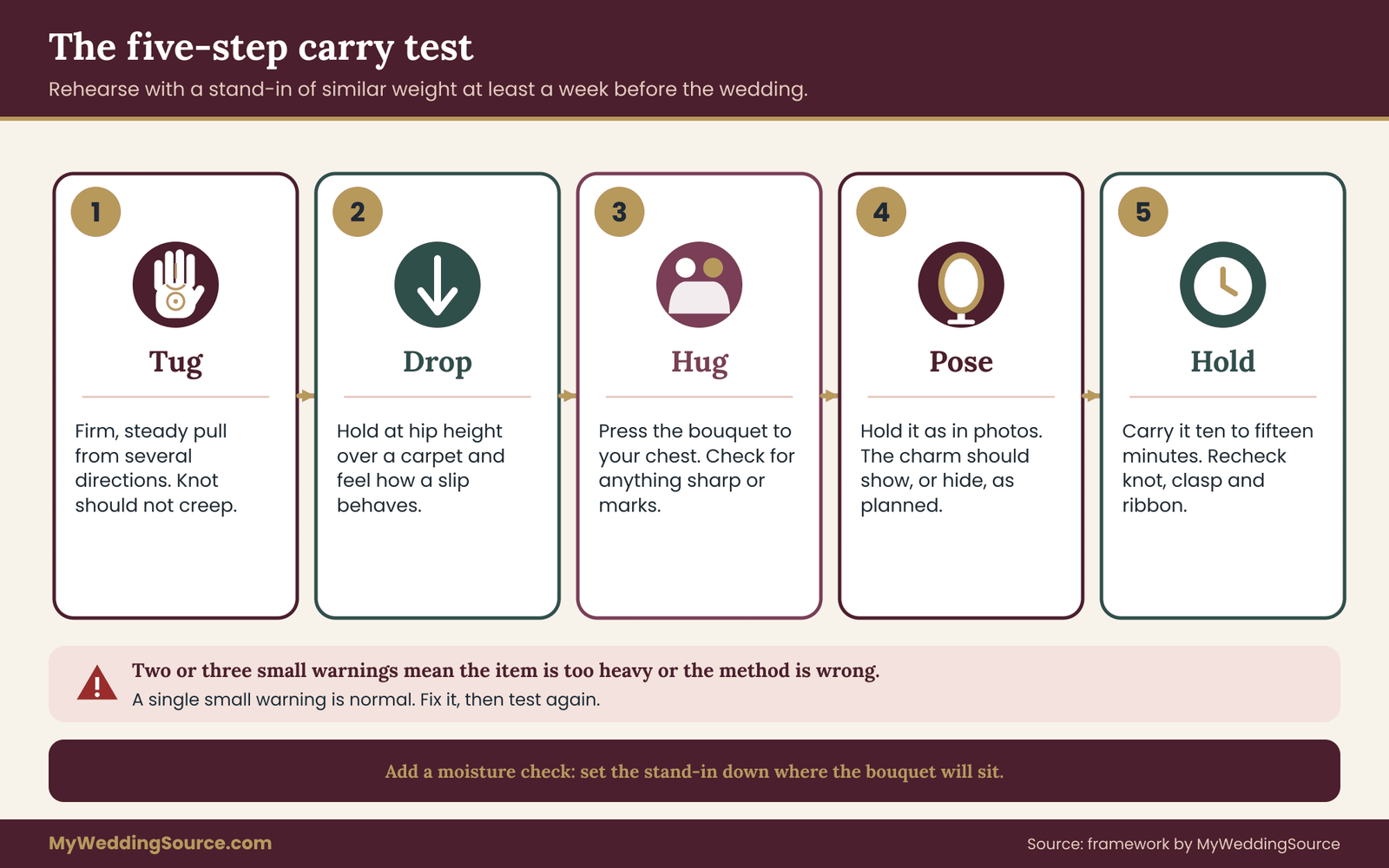
The most useful hour in the whole plan is a rehearsal. A carry test tells you what a diagram cannot: how your own bouquet, your own ribbon and your own charm behave when handled. It does not need special equipment, and it should happen at least a week before the wedding so there is time to change course.
Use a stand-in first
If the real item is irreplaceable, do not test with it. Test with a stand-in that matches it in weight, size and shape. A coin, a washer, a button of similar mass or a small piece of metal wrapped in the same ribbon will do. Weigh both on a kitchen scale if you have one, and aim for a stand-in at least as heavy as the real item. When the stand-in survives the test, you can repeat the shortest version with the real item.
If the florist has not yet built the final bouquet, ask for a practice handle or a leftover bouquet to test on. A florist who has fixed charms before will usually be glad to let you try the method on a spare.
The five checks
Work through these in order, with the person who will carry the bouquet. Each takes a minute or two.
The tug. Hold the bouquet by the handle and give the charm a firm, steady pull, about as hard as a child might tug it out of curiosity. Do it several times from different directions. The memorial charm should stay put, the knot should not creep, and the ribbon should not fray at the edge of the hole.
The drop. Hold the bouquet at hip height over a carpet or a bed and let go of it, catching it before it falls too far. The aim is not to drop it. It is to feel what a slip feels like: does the charm swing hard, does it tangle with the stems, does it strike the handle? Repeat with the bouquet held at chest height for a ceremony pose.
The hug. Hold the bouquet against the chest while another person gives you a normal hug. This is the real-world check for pins, clasps and edges. Ask them whether they felt anything sharp, and look afterward for any marks on a scrap of the dress fabric you wore.
The pose. Hold the bouquet the way you will in photographs: low at the waist, tilted forward, then lifted. Turn it in the light. The memorial charm should be visible if you want it visible, or hidden if you do not, and it should not flip upside down or flash into the lens in an unflattering way.
The hold. Carry the bouquet for ten to fifteen minutes while you do something else, such as walking around the room, shaking hands, setting it down on a chair and picking it up. At the end, check the charm, the knot, the clasp and the ribbon. Anything that has loosened is a warning.
Reading the results
You are looking for any sign that the attachment is working at the edge of its limits. A knot that has crept, a ring that has opened a hairline, a pin that has rotated, a ribbon that has creased at the hole: each is a signal to reinforce, shorten, add a backup or change the method. A single small warning is normal. Two or three suggest the item is too heavy or the method is wrong.
Write down what you changed and test again. A second pass is quick, and it gives the carrier some muscle memory for how to hold the bouquet so the memorial charm is protected.
Test the moisture too
Wet stems are part of the bouquet. If the bouquet will sit in a vase at any point, such as on the head table or during the first dance, test where the charm hangs when it is set down. Place the stand-in in the same position over a damp towel for ten minutes and check for transfer: does the ribbon darken, does the knot swell, does paper curl? If you are using a pocket, put a folded paper napkin inside and see whether it is damp afterward.
Check the camera view
Ask the photographer or a friend to take three or four photos of you holding the bouquet in the planned poses. Look at what the memorial charm does in the frame. It might catch a flash, hide behind the flowers or dominate a detail. If it is meant to be a quiet tribute, a bouquet that reads as busy with metal is not helping. The guide to the family photo list can help you decide which moments matter most, and when a close detail of the bouquet and charm should be photographed in calm conditions.
Keep the test notes
On a single card, record the method you used, the knot, the stand-in, the problems you found and the fix. Give a copy to whoever might re-attach the charm on the day. It turns a clever fix into a repeatable one, and it saves you from having to remember in a hurry.
A worked example of memorial charms: one invented bouquet
The example below is an invented, illustrative case, not a real couple or a tested product. It shows how the four gates, the attachment comparison and the carry test fit together on a single decision. Nothing in it should be read as a statistic or a claim about how often anything happens.
The idea. Priya and Tom are planning an outdoor ceremony. Priya wants to carry something of her late grandmother in her bouquet: a small gold brooch shaped like a leaf, set with a single pearl. She pictures it pinned to the ribbon at the handle.
Gate one: consent
The brooch is not Priya’s. After the grandmother died, it passed to Priya’s aunt. Priya asks her aunt by phone, using the kind of message shown earlier, with a fallback offered. Her aunt is touched, and then admits she is nervous: she was hoping the brooch would stay in the family safe. They agree that the brooch can be present, but only for the ceremony and portraits, and that the aunt will hold it before and after.
That is a conditional pass. Notice that the condition changes the plan: the brooch will not be carried through the reception.
Priya also tells her mother, who was closest to the grandmother, and her mother asks that the grandmother’s name not be read out. Priya agrees. The memorial charm will be shown without announcement.
Gate two: the item
The brooch is irreplaceable, and its pin is fine and slightly bent. It has a pearl, which dislikes water and perfume. It is light but has a sharp pin. The gate is open with conditions: protect the pearl from moisture, protect the dress from the pin, and replace the clasp or add a catch.
Priya asks a jeweler to check the pin and add a small safety catch to the back. She also asks for a quote on a faithful replica in a similar gold tone, for the reception.
Gate three: the attachment
Priya compares methods. The ribbon loop is not possible, since the brooch has no loop. A pin is the natural method but risky for a lace bodice. She and the florist choose a stable base: a small sturdy patch of ribbon sewn to the handle wrap, with the brooch pinned to the patch, pin pointing down into the wrap and away from the dress, with a safety catch fixed and a foam cap on the tip. A thin thread loop ties the brooch to the handle as a backup.
The florist agrees to attach the brooch in the last hour before the ceremony, and to put the replica on the bouquet instead if Priya prefers. Priya asks for the attachment to be written into the contract.
The carry test
A week before the wedding, Priya and her sister test with a brass washer of similar weight, pinned in the same way. The tug test shows no movement. The hug test finds that the pin cap sits too close to the sleeve, so the florist turns the brooch ninety degrees. The pose test shows that the pearl catches the light well. The hold test reveals that the thread backup is slightly too long, so it is shortened.
A moisture test shows the base patch gets damp where the stems touch it. The florist adds a layer of waterproof ribbon underneath.

Gate four: the afterlife
On the day, Priya’s sister is the designated charm guardian. After the portraits, she removes the brooch with a tiny pair of scissors, using the colored tail thread as a guide, and gives it to the aunt in a small labeled box. The replica, which arrived a week earlier, goes on the bouquet for the reception.
After the wedding, the bouquet is dried by a florist. The replica is kept with it. The original brooch goes back to the aunt, along with a printed photograph of it on the bouquet, so the family has a record of the day.
What the example shows
The final plan is not the first idea. The brooch moves from a full-day charm to a ceremony-and-portraits charm. The attachment becomes a stable base plus a safety catch plus a backup. A replica fills the gap. Three people, the aunt, the sister and the florist, each know their job. None of that came from a clever trick. It came from taking each gate in order and letting each answer change the plan.
Handling memorial charms on the wedding day
A good plan can still fall apart in the rush of a wedding morning. The day-of plan is short and boring on purpose. It names who attaches the charm, who guards it, when it moves, and what happens when it has to be set down, handed off or photographed.
Who attaches it, and when
The best time to attach a memorial charm is as late as possible, and by the person who knows the method. For many couples that is the florist, at delivery, or a trusted friend who practiced the knot. Attaching it the night before leaves a long window for knocks, damp and curious children. Attaching it hours before the ceremony leaves enough time to check it.
If the florist attaches it, make sure the florist has the item in hand before the wedding or on the delivery morning, and has seen the attachment plan on paper. If a friend attaches it, give them the test notes and a small kit: scissors, a spare length of ribbon, a few spare jump rings, and a small box. The kit costs very little and it saves a scramble.
The charm guardian
Pick one person who is not the carrier, not the officiant and not rushed. Their job is to know where the memorial charm is and to keep a close watch on it. They should be able to describe the attachment in one sentence and know the order of events well enough to see when the charm might be at risk.
The guardian carries the spare kit and the box. They check the memorial charm after the bouquet is delivered, after the photographs and before the bouquet is put down at the reception. They also hold the written fallback: what to do if it comes loose, what to do if the item is lost, and who to call.
Moments of highest risk
Some moments in the day put more strain on a charm than others. Knowing them in advance helps you plan around them.
Getting dressed. The bouquet is often set on a bed or a counter while hair and makeup are finished. Keep it away from hairspray and perfume, and keep it in a spot where the charm is not pressed against a surface.
The car or carriage. Seatbelts, doors and car seats are hazards for pins, dangling charms and delicate petals. Hold the bouquet upright on your lap or ask someone to carry it separately. Never wedge it between a seat and a door.
The processional and the vows. The bouquet is often handed to an attendant during the vows. Remind that attendant to hold it by the handle with the memorial charm facing inward. They are about to be handed something precious, and an attendant who has not been told may treat it as an ordinary bunch of flowers.
Hugs and receiving lines. This is where clasps open and pins catch. If the charm is on display, the carrier may want to hand the bouquet to the guardian before the receiving line starts.
Group photographs. Bouquets get passed around, held upside down by children, tilted, tossed in the air for a playful shot. Tell the photographer in advance which handling rules apply.

Photography with a memorial charm
If the memorial charm matters, plan a calm moment to photograph it. A detail shot of the bouquet and charm, taken against a plain surface before the ceremony, preserves the object and the attachment for later. It also records how the charm looked in case anyone later needs to recreate it.
Tell the photographer what the memorial charm is, and where it is, so they do not skip it by accident. The page on photography consent explains how to agree on which images may be shared, which matters if the charm carries a relative’s photograph or name.
If a relative of the person being remembered would like a photograph of the memorial charm, offer to send one. It takes a minute and it can mean a great deal.
Setting the bouquet down
At the reception the bouquet often ends up on the head table or in a vase. A vase is the most dangerous place for a charm, since the water level rises and the charm can end up submerged. If the bouquet must go in a vase, move the memorial charm out of the water first, or remove it entirely and put it in its box. Keep the bouquet away from candles, drinks and the cake table. A small sign or a quiet word to the venue staff is enough: “Please leave this bouquet where it is.”
The bouquet toss
Many couples toss a bouquet, and many guests expect it. If the bouquet carries a memorial charm, the charm should not be in the air. The standard solution is a second, smaller bouquet for the toss, with no charm. If you want the toss to be part of the day, this is the way to keep it. A florist can make a toss bouquet from leftover stems, and the cost is small compared with a lost heirloom.
If you did not plan a toss bouquet, remove the memorial charm before the toss and hand it to the guardian. Do this quietly, ahead of time, rather than in front of everyone.
Weather and venue conditions
Wind, rain, heat and humidity affect a bouquet and its charm. Wind makes a dangling charm swing and catch on the veil. Rain soaks ribbon and wets paper. Heat softens glue and wax. If the forecast is poor, shorten the time the charm is on show, or move it to a sewn or pocket position. If you have a backup plan for the ceremony space, include the memorial charm in that plan.
If something goes wrong
Decide before the day what you will do if the charm falls, breaks or goes missing, and who will say it. Often a short, calm sentence is enough: “Please pick it up for me and put it in the box.” If it is lost, avoid a search in the middle of the reception.
Ask the venue staff and the guardian to look after the ceremony, and take the loss as a stage in the day, not a failure of the tribute. The meaning is held by the people in the room, and not only by the object.
After the wedding: heirloom handling for memorial charms
Once the dancing ends, the memorial charm is still in the world. The afterlife gate asks who removes it, who stores it and how, and what happens to the bouquet.
Removing the charm
Do this within a day, ideally before the bouquet is packed or stored. Choose a clean, flat, well-lit surface and lay down a soft cloth. Use small scissors or snips, not a knife, and cut the ribbon or thread, not the object. Hold the memorial charm from the side, not the clasp. If it is stitched, use the colored tail thread as a guide. If it is pinned, close the catch before lifting it.
If you are not confident, ask the florist or the person who attached it to remove it. It is a few minutes of work for them and it avoids a bent pin.
Cleaning and drying
Wipe the item gently with a soft, dry cloth. Avoid water, polish and household cleaners unless you have been advised for that material. Pearls, soft stones, paper and fabric each need different care. The National Park Service publishes Conserve O Gram leaflets on caring for museum objects, and they are useful for heirlooms at home, while the American Institute for Conservation lists professional conservators who can advise on valuable pieces.
Let the item dry completely before you put it in a box. A damp item in a closed box can mold or tarnish.
Storage that suits the object
Use acid-free tissue or a small archival box, not a plastic bag that traps moisture. Store metals away from rubber, wool and other materials that give off compounds that tarnish. Keep items out of direct sun and away from heat and damp, which means not in a basement or an attic. Label the box with the item, its owner, the date and a short note on what it was used for.
The Library of Congress publishes preservation guidance for family papers and photographs. For a photograph or a note used in a memorial charm, follow its advice on handling, cool storage and avoiding adhesives.
Return and ownership
If the item belongs to someone else, return it promptly, in its box, with a note and a photograph from the day. This closes the loop on gate one. If the family agreed that the charm would stay with you, write that down so there is no confusion later. A single line in an email is enough: “We are keeping Grandpa’s tie clip in our home; if you ever want it back, please say so.”
The bouquet itself
If you plan to dry or preserve the bouquet, tell the preserver about the memorial charm, and ask whether it will be mounted with the flowers or removed. A charm left on a drying bouquet can mark petals, and a charm taken off later can leave a gap. Many couples remove the item and place a small card or a replica in the frame. Ask what the preserver can do, get it in writing, and photograph the bouquet before handing it over.
A record for the future
Add one page to your wedding records: a photograph of the charm, what it was, who it belonged to, how it was attached and where it is stored. Keep it with your other post-wedding papers and photographs. A future relative will thank you for a note that explains why a small brass key is in a box.
Buying or commissioning memorial charms: questions for suppliers
Many couples do not use an heirloom at all. They buy or commission new memorial charms from a jeweler, an engraver, a florist’s accessory line or an online maker. That is a perfectly good route, and it often solves the safety questions in one step. It also brings a set of consumer questions, and the right way to handle them is to ask plainly and keep the answers in writing. This guide does not rank suppliers or quote prices, because those change and a fair comparison needs your own quotes.
What to ask about the object
Ask what the memorial charm is made of, and ask for the answer in words rather than a marketing label. If the supplier says the metal is plated, ask what lies under the plating. If it is described as hypoallergenic, ask what that means for this item, and whether the supplier states the nickel content. The U.S. Federal Trade Commission publishes guidance on how products can be described in advertising, and plain, specific answers are a good sign.
Ask for the weight and dimensions. A supplier who cannot say how heavy a memorial charm is, or how large the loop is, is asking you to find out on the day. Ask whether the loop or ring is closed or can open, and how it is joined. Ask whether the charm has sharp edges, and whether any parts, such as beads or enamel, can come away.
What to ask about personalization
If the memorial charm is engraved, ask for a proof before work starts, with the exact text, spelling, font and placement. Check the names and dates against a trusted source, such as a funeral program or a family record, not against a message. Ask whether the proof is final, what happens if the supplier makes an error, and what happens if you make one. Engraving cannot usually be undone.
If a photograph is used, check whether you own the image and whether it will be printed on a durable surface. A photograph of a person who has died is also a family matter, and the same consent question applies. Ask how the print resists moisture and fading, and whether the supplier keeps your image after the order.
What to ask about timing and returns
Memorial items are often made to order, and a made-to-order item is not always returnable. Ask for the production time, the shipping time and the date by which you must approve the proof to receive it before the wedding. Add a buffer of at least a couple of weeks, in line with the carry test. Ask what the policy is for items that arrive damaged or wrong, and who pays for a remake. A written order confirmation that includes the text, the materials and the delivery date is worth saving.
If the charm is made by the florist, add the same questions to the agreement. The guide to questions to ask before you sign with a vendor explains how to check a supplier’s record and paperwork before paying a deposit.
Keep the supplier’s attachment claims in context
A supplier may say a charm is “securely attached” or “wedding ready.” Treat that as a starting point rather than a result. The supplier does not know your ribbon, your bouquet or your day. Run the carry test regardless, and ask for a spare loop or ring so that the test and the real wedding use the same part.
Handmade and commissioned items
Small makers, such as jewelers, leatherworkers and seamstresses, can build exactly what you describe, including a charm from a piece of a garment. Give them clear measurements, the intended position on the bouquet and the maximum weight you are comfortable with. Ask them to build the attachment point in a way that suits the method you chose, such as a closed ring for a ribbon loop or a sewing tab for a stitched fixing.
Ask for photographs at each stage, and keep the originals of anything you send them in a labeled bag, with a receipt for what you handed over.
When you give a maker an heirloom, such as an old garment or a piece of jewelry to be reworked, get a written receipt that describes the item, its condition and its value to you. Ask where it will be kept while in their care and who else may handle it. Make sure that what comes back is the original with the work done, and agree beforehand what happens to offcuts and leftovers. These are your family’s materials, and the answer should be that they come back.
A note on endorsements and reviews
Be careful with glowing reviews for memorial products. People who buy them are often in a tender state and may not report problems. Look for photographs of actual items, descriptions of delays and how the supplier handled complaints. Ask for the supplier’s contact details and business address, and be wary of any supplier who will not give them.
When memorial charms are the wrong choice, and what to do instead
A good plan includes the freedom to decide against the idea. Memorial charms are one way to honor someone, and they are not always the best. This section sets out the conditions that should stop you and the alternatives that keep the meaning.
Failure conditions: when to stop and change course
Each of the following is a reason to step back. You do not need all of them; one is enough.
Consent is missing or refused. The owner of the object has said no, or someone closest to the person being remembered has asked you not to. This is the strongest reason of all. Do not argue the case; switch to an alternative.
The item cannot be risked. It is irreplaceable and fragile, and no protected position exists. The loss would be unbearable. Keep it safe at home and use a replica or a photograph.
The attachment fails the test. After a second pass, the memorial charm still creeps, opens, pivots or swings. The cause might be weight, the clasp or the bouquet itself. Change the method, change the item, or stop.
The charm hurts or harms someone. It scratches skin, snags lace, triggers an allergy or poses a risk to a child. Stop and remove it.
It cannot be attached late enough or removed early enough. If a long gap before the ceremony or a long time after it cannot be managed, the memorial charm is exposed for too long.
The people carrying it are overloaded. If the carrier, the attendants and the guardian are already stretched, adding a precious object may be unwise. A simpler tribute may suit the day.
The venue or the weather makes it unsafe. A beach in wind, a garden in rain or a venue with open water features is hard on small objects.
The meaning is lost. If the charm has become a source of stress, tied up in logistics or arguments, it is no longer doing what you hoped. Setting it aside is not a failure of love.

Alternatives that keep the meaning
If a gate closes, the memory does not have to go with it. These options carry the same meaning with less risk. For the full range, the pages on wedding day accessories planning and on the ceremony itself offer more choices.
A replica or a new charm. A custom charm, engraved with initials or a date, carries the memory and can be replaced. This is the closest substitute, and many couples find it just as moving.
A fabric tie. A strip cut from a shirt, a handkerchief or a lace edge, tied into the handle wrap. It is light, soft and safe on a dress. Ask the owner before cutting anything that cannot be replaced.
A hidden keepsake. A small item sewn inside the wrap, or a note placed in the handle, which only you know about. It is private, protected and requires no explanation.
A pin or charm elsewhere. A small pin on the inside of the dress, sewn into a hem, or placed on a groom’s lapel, boutonniere or pocket. This keeps the object off the bouquet and away from water. The seamstress can sew a small label or loop inside a bodice during a fitting.
A reserved seat or a framed photograph. A single chair with a flower, a photograph on a stand by the guest book, or a framed note beside the aisle. They bring the person into the room and leave the object alone.
A moment in the ceremony. A sentence in the program or a short remembrance by the officiant, agreed with the family in advance. The ceremony step-by-step guide shows where such moments can be placed without disrupting the flow.
A donation or a private ritual. A gift in the person’s name, or a moment alone before the ceremony, with no object at all. For many people this carries more weight than anything in the bouquet.
Talking about the change
If you have already told family members that you will carry a memorial charm and you decide to change the plan, tell them yourself, early and kindly. The advice on family etiquette for sensitive announcements applies here too. A short message works: “We decided to keep Grandma’s brooch at home to keep it safe, and we are carrying a small replica instead. We wanted you to hear it from us.” Most people understand, and many are relieved.
Respect is the common thread. The aim of a tribute is to keep a person in the room, in a way that is comfortable for the living and kind to the memory. The best memorial charms are chosen with that in mind, and the best decision is sometimes to choose something else.
Your next steps
Planning memorial charms does not take long once the order is clear. Here is a sequence you can work through over a few evenings, starting about a month before the wedding and leaving room for a remake if the first attempt fails.
Four weeks out: decide whether to proceed. Write the one-line consent check for each charm idea. Talk to the owner of any heirloom and to the people closest to the person being remembered. If anyone prefers no public reminder, choose a hidden position or an alternative. If the answer is not clear, take the lower-risk path.
Three weeks out: choose the item and the method. Sort your candidates into replaceable and irreplaceable, apply the tilt test, and pick the attachment method that matches. If you are buying or commissioning a charm, send your supplier questions now, approve any proof, and confirm delivery dates with a buffer. Add the attachment plan to your florist’s agreement, using the vendor contract guide as a reference for the wording.
Two weeks out: run the carry test. Use a stand-in, work through the tug, drop, hug, pose and hold, and add a moisture check. Write down what changed. If anything fails twice, change the method or the item.
One week out: brief your helpers. Give the charm guardian the test notes and the small kit. Tell the carrier, the attendant who holds the bouquet during the vows and the photographer what to expect. Arrange the second bouquet for the toss, if you want one. Pack the box for the memorial charm, and label it.
The day before: pack and photograph. Photograph the charm and its attachment in good light. Place the box, the spare ribbon and the scissors in the bag the guardian will carry. Confirm when and by whom the memorial charm will be attached.
The wedding day: keep it simple. Attach late. Check after delivery, before the ceremony and before the reception. Move the charm out of any vase. Remove it before the toss. Hand it to the guardian at the end of the evening.
The week after: close the gate. Remove the memorial charm, dry it, store it in a labeled box and return any borrowed item with a note and a photograph. If you are preserving the bouquet, tell the preserver about the charm. Add a page to your records.
If grief is close to the surface
Planning a tribute can bring up strong feelings, and that is normal. If it becomes heavy, take a break, talk to someone who knew the person, or ask your officiant for a conversation. Organizations such as the Hospice Foundation of America and the Association for Death Education and Counseling publish information on grief and bereavement, and a counselor or a spiritual adviser can offer support that a planning guide cannot.
Nothing in this guide is a prescription for how to grieve. Some people want a visible tribute, some want a private one and some want none at all, and each is a valid choice.
A closing checklist in plain words
Before you finish, ask yourself five questions. Does everyone who needs to agree know the plan? Could I replace this item if it were lost, and if not, is it protected? Have I tested the attachment with a stand-in? Does a named person know what to do if it comes loose? Do I know where the memorial charm goes after the day? If every answer is yes, the plan is sound, and your memorial charms are ready.
FAQ
What are memorial charms for a wedding bouquet?
Memorial charms are small keepsakes, such as lockets, pendants, buttons, fabric strips or photo discs, that are tied, sewn or pinned to a bridal bouquet to honor a person who cannot attend. They can hang from the handle, sit in a wrapped pocket or be hidden inside the ribbon. The meaning comes from the memory, and the safest versions are light, replaceable and easy to remove after the day.
Is it safe to use a real family heirloom as a bouquet charm?
It can be, if the owner agrees and the item passes a careful check. Irreplaceable pieces face water, knocks, drops and crowds. Many couples use a replica for the long day and keep the original close, or use the heirloom only for the ceremony and portraits with a guardian nearby. If losing the item would be unbearable, choose a replica instead.
How do I attach a charm so it does not fall off?
Match the method to the item. A closed jump ring or a double-knotted ribbon loop suits light charms, stitching suits buttons and fabric, and a stable base with a safety catch suits a brooch. Add a thin backup loop, keep the charm close to the handle and run a tug test before the day. Test with a stand-in if the item is precious.
Could a memorial charm damage my dress or hurt someone?
Yes, if it has sharp edges, a pin or a metal that catches lace and tulle. Check the memorial charm against a scrap of your dress fabric, cover pin points, and place it away from skin if anyone is sensitive to nickel. Keep small charms out of reach of young children, since small parts can be a choking risk. A hidden pocket removes most of these concerns.
Do I need permission from family to carry a memorial charm?
If the object belongs to someone else, ask its owner first. It is also considerate to tell the people closest to the person being remembered, privately and before the day, and to offer a way to say no. Some relatives prefer a private tribute. Treat a refusal as information, and use a replica, a fabric piece or another tribute instead.
What should I do with the charm during the bouquet toss?
Do not throw it. Use a separate, smaller bouquet for the toss, or remove the memorial charm quietly beforehand and give it to your charm guardian. A toss bouquet made from spare flowers costs little compared with a lost keepsake. Plan this in advance so you are not removing the charm in front of guests or guessing in the moment.
How should I store a memorial charm after the wedding?
Remove it within a day, using small scissors on the ribbon or thread rather than pulling the item. Let it dry fully, wipe it gently with a soft cloth and store it in a labeled box with acid-free tissue, away from heat, damp and sun. Return borrowed items promptly with a note and a photograph from the day.
What are good alternatives to bouquet charms?
Options include a fabric strip tied into the wrap, a hidden item sewn inside the handle, a small pin inside the dress or on a lapel, a reserved seat, a framed photograph, a line in the program or a short remembrance during the ceremony. A donation in the person’s name or a private moment before the ceremony also works, and none of them risk the bouquet.
Sources
- Hospice Foundation of America
- Association for Death Education and Counseling
- Conserve O Gram, preserving museum collections, National Park Service
- Preservation, Library of Congress
- American Institute for Conservation
- U.S. Consumer Product Safety Commission
- U.S. Fish and Wildlife Service
- Transportation Security Administration
- American Academy of Dermatology Association
- Federal Trade Commission