
Best man speech length is a timing problem before it is a writing problem: a draft that reads well on paper can run twice as long once you add laughs, pauses and nerves. This guide gives you a worksheet that turns words into minutes, a worked case that cuts a six-minute draft to three, and the points where a short speech still fails.
Pick a target between two and four minutes, measure your own speaking pace by recording yourself, and subtract time for pauses and a safety buffer. What is left, divided into words, is your budget. At a pace of about 135 words per minute, a three-minute speech holds roughly 315 words once pauses are counted. Keep one story, one turn toward the couple and one toast. Run three timed rehearsals out loud, because only the last number you record counts.
Most best men do not run long because they are careless. They run long because every sentence in the draft feels necessary to them. The college story, the story about the first apartment, the line about meeting the partner, the thank-you to the parents: each one earns its place when you read it alone, and together they add up to a speech that is hard to sit through.
Guests at a reception are holding drinks, watching food that has not been served yet, and sitting in clothes they chose for looks rather than comfort. Three minutes feels generous to them. Six feels like a different event. Speech length is the first thing a room judges, long before it judges the jokes.
This article is about the decision you are making when you settle on a speech length, and about the mechanics of getting a draft down to it without gutting what made it yours. It does not tell you what to say about your friend. It tells you how long the thing can be, how to measure that honestly, and how to cut with rules instead of with mood.
The wider question of who speaks, in what order, and for how long overall belongs to the wedding toast side of the site and to the reception schedule; this page stays on the best man’s own piece. Every section that follows comes back to one question: what speech length can this room carry?
A note on scope. This is general guidance for a spoken toast, not legal, tax or financial advice, and it cannot replace what your couple, their emcee or the venue tells you about the actual schedule. When a rule outside your control matters, such as a sound limit or a quoted text under copyright, the article points you to the office that sets it.
Why speech length decides how a best man speech lands
A speech is the only part of a reception that asks everyone in the room to stop what they are doing and look at one person. That is a real request, and the room grants it for a limited time. Past that time, attention does not drop politely. It leaks. Phones come out, conversation starts at the back tables, servers hover in doorways, and the bride’s grandmother, who has been smiling for four minutes, begins to look for the exit to the restroom. A sensible speech length respects that bargain.
The cost of overrunning is not only boredom. A long toast pushes everything after it, and everything after it was scheduled by someone. Dinner service has a kitchen behind it. A dance set has a band or DJ who have a start time on a contract. A cake cutting may be tied to a photographer’s lighting window. A toast that runs three minutes over is not three lost minutes for the best man; it is three minutes subtracted from some other person’s plan.
The wedding vendor timeline on this site shows how tightly those handoffs are usually packed, and why a few extra minutes in one slot do not stay in that slot. An honest speech length is part of working with the schedule, not against it.
There is also a quieter reason to care about speech length: it protects the best man. A short speech with a clear shape feels confident even when the speaker is nervous. A long one invites mistakes, because the longer you speak, the more chances there are to lose your place, repeat yourself, or drift into a story that was funnier in the group chat. Brevity is not a lack of effort. It is the visible result of a lot of cutting. Getting the speech length right is a kindness to yourself.
None of this means shorter is always better. A speech that ends in ninety seconds can feel like a shrug if the best man is the person closest to the groom and the room expected something. The target is not “as short as possible”. It is the length at which the speech does its job and stops. For most receptions that falls between two and four minutes, and for most speakers the sweet spot sits near three.
What the speech is actually for
A best man speech has three jobs, and the length question is easier once you name them. First, it shows the room who the speaker is and why they have standing to speak. Second, it tells one true thing about the person being honored, in a way that lets people who barely know him understand him. Third, it turns the attention toward the couple and ends with a toast. Everything else is optional. Judge any proposed speech length by whether those three jobs fit inside it.
When you test any paragraph against those three jobs, a surprising amount of a first draft fails. The thank-you list is a job for the host or the couple. The inside joke that needs six sentences of setup is not doing job two for anyone except four people. A tour of the groom’s entire dating history is not job three. These are the first things to go, and the cutting passes later in this guide are built around that test.
How many words fit in a given speech length
Speakers tend to estimate time by feel, and feel is wrong in a predictable direction. People who write a speech silently think of it as shorter than it is, because reading in your head is far faster than speaking aloud, and because the mind skips the pauses. The fix is to stop using feel and use arithmetic backed by a recording. Guessing the speech length by feel is the most common mistake.
Spoken English at a comfortable, clear pace for a room is commonly planned somewhere around the low-to-mid hundreds of words per minute, with many speakers landing in the 120 to 150 range when they are not rushing. That is a planning range, not a rule, and nervous speakers drift faster while speakers who love the sound of their own voice drift slower.
The honest number for your speech is your own, and you can get it in under five minutes. Take a passage of about 200 words from any text, read it aloud into your phone as if to a room, and time it. Divide words by seconds and multiply by 60.
For example, if 200 words took 90 seconds, your pace is about 133 words per minute. Use that figure for the rest of your planning, and measure again once your draft is memorized, because speaking from memory or from notes tends to be slightly slower than reading aloud, and your own jokes get a slower delivery than a neutral passage. Your own pace is the foundation of every speech length calculation that follows.
The time that words do not account for
If you multiplied your word count by your pace and stopped, you would produce a number that is correct only for a speech with no laughs, no breaths, no moment where the speaker lifts a glass, and no reaction from anybody. That speech does not exist. Real delivery includes at least four kinds of time that sit outside the word count. Ignoring them makes every speech length estimate too low.
The first is the pause after a joke or a reveal, when the room reacts. A good laugh line needs a beat after it so the audience can finish laughing before you continue; if you talk over it, you lose the laugh and the next line. The second is the breath and rhythm pause that makes speech sound like a person rather than a recording.
The third is the physical business of a toast: lifting the glass, saying the names, waiting for the room to lift theirs. The fourth is the buffer for the unexpected, such as a microphone adjustment, a tray dropped somewhere, or the groom’s father shouting something encouraging from table four.
The next section turns these into a worksheet, because the useful move is to give each one a number before you write another word.

Why the range matters more than the exact number
You do not need to hit three minutes to the second. A speech that runs two minutes forty or three minutes ten is the same speech to the room. What you need is a range you can hit on a bad day, and a plan for which sentences to drop if the day goes badly.
A speaker whose rehearsed time is just under the target and who knows which paragraph can be skipped has far more control than one whose rehearsed time is exactly the target and who has nowhere to go when the room laughs longer than expected. What matters is a speech length range you can hit reliably.
That is why the speech length worksheet in the next section includes a buffer line and a “cut first” list. The buffer is the difference between a speech that survives contact with the room and one that does not. A dependable speech length depends on that buffer.
The speech length worksheet: five lines to fill in before you write more
The speech length worksheet below is the core tool of this guide. It has five lines, and you can complete it on the back of an envelope. Its purpose is to turn a fuzzy goal (“keep it short”) into a word budget you can check a draft against. Fill it in before you cut anything, because the numbers tell you how much to cut, and that is usually more than you hope. Treat the numbers as a first draft of your speech length, to be corrected in rehearsal.
Line one: the speech length target. Decide the time from your first word to the final words of the toast, including pauses. Do not include the walk to the microphone or the thank-you from the emcee. If the couple or the emcee has given you a slot, use it. If nobody has, choose three minutes. It is long enough to tell one story properly and short enough that no one has time to get restless.
Line two: the buffer. Subtract time you will not plan to use. A common choice is about ten percent of the target, which on a three-minute speech is roughly fifteen to eighteen seconds. This is the margin that absorbs a longer laugh than you expected, a stumble, or a slow start. If your rehearsal ends at the target exactly, you are over the target in the room. A buffer is what lets a speech length plan survive the room.
Line three: the pause count. Mark every place in the draft where you expect the room to react or where you want a beat of silence. Count them. Then give each one a length. Three to five seconds is a reasonable planning figure for a laugh pause; a pause before a serious line may be a bit longer. You will refine these during rehearsal, but you need a first guess now so the word budget is honest.
Line four: the spoken-time budget. Subtract the buffer and the total pause time from the speech length target. What remains is the time your words may occupy.
Line five: the word budget. Multiply the spoken-time budget in minutes by your measured pace. That is the number of words your speech can contain, and it is the number you will cut toward.
The speech length worksheet with numbers in it
Take a speaker whose measured pace is 135 words per minute, aiming at three minutes. The speech length target is 180 seconds. A buffer of 15 seconds leaves 165. Six pauses at about four seconds each is 24 seconds, which leaves 141 seconds of actual speaking. That is 2.35 minutes, and at 135 words per minute it comes to about 317 words.
That is the surprise most best men have not prepared for. A three-minute speech is not 400 or 450 words, as some people guess when they imagine reading steadily. Once you give the room time to laugh and give yourself margin, it is closer to 300 to 330 words, which is about the length of two to three short paragraphs in a printed article.
A draft of 700 words is not a long three-minute speech. It is a six-minute speech, and a bit more. Many best men underestimate how little text a realistic speech length holds.
If you want to run the sums at other targets, the logic is the same. A two-minute speech with a ten percent buffer and four pauses lands close to 190 to 200 words at the same pace. A four-minute speech with five or six pauses lands near 450 to 470. The figures shift with your pace and your pause habits, which is the reason to measure instead of copying someone else’s number. Change the target and the speech length changes with it.

Why a pause count belongs on the speech length worksheet
Most guides on speech timing talk about words per minute and leave out pauses, and then speakers are puzzled when a rehearsal that “should” take three minutes takes four. The difference is nearly always the pauses. Humor needs air. A line like “and that was the last time he was allowed near a rental car” needs a second of silence on either side of it to work.
If you have six lines like that, you have a quarter of a minute or more spent in silence, and none of it shows up in a word count. Pause time is the hidden part of speech length.
It also changes how you judge a joke. A joke that earns a four-second laugh and costs fourteen words is more expensive than it looks, because its true cost is about eight seconds of room time. Sometimes that is a fair price, because the laugh is the best moment of the speech. Sometimes it is not. The speech length worksheet lets you ask the question with real numbers rather than gut. Each joke has a speech length cost as well as a laugh value.
Choosing the speech length target honestly
The target is a decision, and three things should push it up or down.
Push it down toward two minutes if the speaking order is crowded, if you are one of several speakers, if the room is mostly guests who do not know the groom well, or if dinner is about to be served and the kitchen is waiting. Several speakers at three minutes each is a quarter of an hour of toasts before the first dance, and the room feels it. A crowded order argues for a shorter speech length.
Push it up toward four minutes only if you are the single main speaker, if you know the room well, and if the story you have is strong enough to carry the extra minute. Even then, four minutes should be the ceiling, not the plan. If you find yourself arguing for five, stop and ask which of the three jobs from the previous section the extra minute is serving.
Leave it at three minutes if you are not sure. That is not an arbitrary convention. It is the length at which a single story, a short turn toward the couple and a toast can all fit without any of them feeling rushed. Three minutes is the default speech length for good reason.
What to ask before you commit to a number
Before you fix the target, ask the couple or the person running the reception three practical questions. Who else is speaking, and in what order? Is there a hard stop, such as a dinner service that starts after the toasts, a band set time, or a venue curfew? And is there a person, such as an emcee or the venue’s coordinator, who will cue you, or are you expected to watch the clock yourself?
The answers decide whether three minutes is a comfortable choice or an ambitious one. If you are one of four speakers and the couple has set a ten-minute toast window for all of them, your real slot is two and a half minutes, and the speech length worksheet should be redone with that target.
The wedding reception guest flow guide on this site explains how toasts, seating, food and dancing share the same stretch of the evening, which is useful context for any best man asking what the room can bear at that point. Ask for the slot before you commit to any speech length.
A small example of the speech length worksheet going wrong
A best man writes a draft, reads it aloud once without a stopwatch, and decides it is “about four minutes”. He does not measure his pace, does not count pauses, and does not set a buffer. On the night, he is nervous and speaks faster than usual in the first minute, then slows when the first joke lands better than he expected.
The room laughs for seven seconds. He waits, loses his thread, and checks his notes. The second story, which was supposed to be quick, takes a full minute because he adds a clarifying sentence he did not rehearse. He finishes at just under six minutes.
Nothing in that account is a character flaw. Every piece of it is what happens to an unmeasured speech. The speech length worksheet would have shown him a word budget near 420 for four minutes, and his draft was closer to 700. The gap was visible in advance. The speech length problem was visible in advance.
A worked case: cutting a six-minute draft to three
This section follows one invented example from first draft to final cut. The people are made up, the draft is made up, and none of the numbers come from a study. The point is to show the method in motion so you can copy the steps on your own material. It is a worked case of settling on a speech length and then meeting it.
Dani is the best man for his college roommate Ravi, who is marrying Hannah. Dani wrote his speech over a weekend and read it aloud into his phone. It ran 5 minutes 52 seconds. Dani was pleased with it and a little alarmed, because the couple had asked the speakers to keep to about three minutes each.
Step one: measure before you cut
Dani first measured his pace. He read a 200-word passage from a magazine article and it took 89 seconds, which works out to about 135 words per minute. He then counted the words in his draft: 720. At 135 words per minute, that is about 320 seconds of pure speech, or 5 minutes 20 seconds. The rest of his six minutes was pauses and a few stumbles, roughly 30 seconds in all. That fixed his speech length budget in words.
His target was 180 seconds. He took off a 15-second buffer and planned six pauses at about four seconds each, which left 141 seconds of speaking and a word budget of roughly 317. Dani needed to lose about 400 words, which is a little more than half of the draft.
Step two: label every section by its job
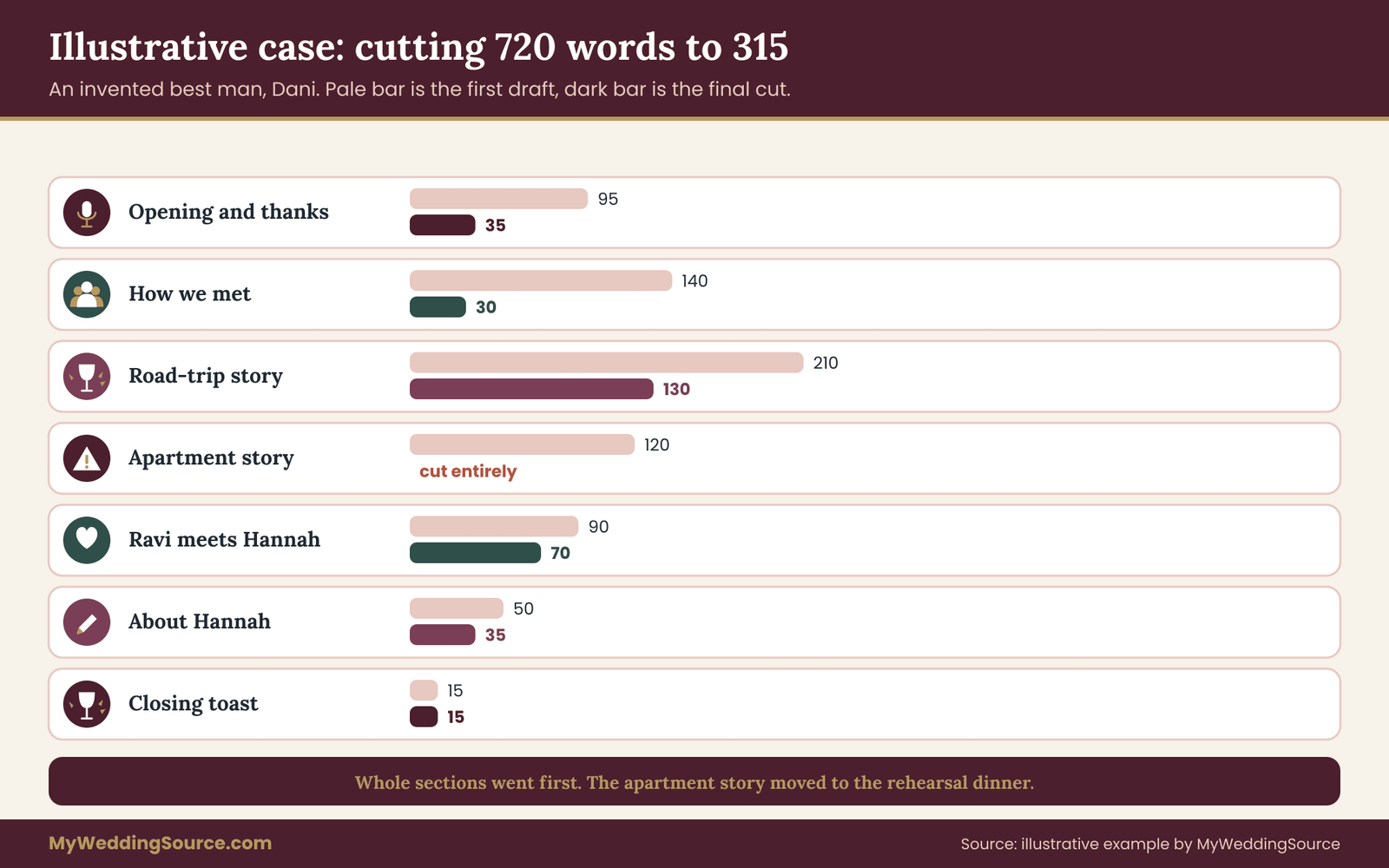
Dani then split the draft into sections and wrote next to each one the job it was doing and how many words it used. The draft had seven parts.
The opening ran 95 words. It thanked the couple for asking him, joked about how long Ravi had taken to propose, and introduced himself as the roommate. Its job was to establish standing, but most of it was about Dani.
The “how we met” section ran 140 words. It described the first week of freshman year, the shared bunk bed frame, and Ravi’s habit of labeling his food. It was charming and it was background.
The road-trip story ran 210 words. A three-day drive in a borrowed car with a failing air conditioner, a wrong turn that cost five hours, and Ravi staying calm throughout. It was the best thing in the draft and the only real story.
The apartment story ran 120 words. It was about a flooded kitchen in their second year and was funny mainly to people who had been there.
The “Ravi meets Hannah” section ran 90 words. Dani described how Ravi’s behavior changed after their first date.
The Hannah section ran 50 words and said she was kind and funny and that Ravi was lucky.
The closing and toast ran 15 words.
Adding them gives 95 plus 140 plus 210 plus 120 plus 90 plus 50 plus 15, which equals 720. The sections that served job two (one true thing about Ravi) were the road trip and part of the meeting. The sections that served job three (turning toward the couple) were the last three, and they were by far the shortest. The draft was spending almost 300 words on background and less than 160 on the couple.
Step three: apply the cut order
Dani cut in a fixed order. He did not trim every paragraph a little, because that produces a speech in which everything is slightly thinner and nothing is memorable. He removed whole sections first and then tightened what was left. The speech length came down fastest when whole sections went.
He cut the apartment story entirely. It was funny, but it needed a lot of setup and it would not land with Ravi’s family. He kept it in a note to tell at the rehearsal dinner or, if the room allowed, in a private moment later. That removed 120 words and left 600.
He cut the “how we met” section to a single sentence of about 30 words: that he and Ravi were assigned the same dorm room and that Ravi labeled his yogurt on day one. That removed 110 words and left 490.
He cut the opening from 95 to 35 words by dropping the long thank-you and keeping one joke and his name and relationship. That removed 60 words and left 430.
He tightened the road-trip story from 210 to 130 words by removing the description of the car’s history and keeping the wrong turn, Ravi’s calm, and the closing line. That removed 80 words and left 350.
He tightened the “Ravi meets Hannah” section from 90 to 70, and the Hannah section from 50 to 35, which removed 35 words and left 315. The closing stayed at 15 words.
Step four: re-time and compare
Dani read the 315-word version aloud with a stopwatch, leaving a pause where he had planned one. His time was 2 minutes 58 seconds, which is just inside the speech length target but not inside the buffer line. He had planned to finish near 2:45. The pauses had run closer to five seconds each, not four, because the road-trip line earned a real laugh in rehearsal. The first timed run is where speech length turns from a plan into a number.
That is exactly the kind of result the speech length worksheet exists to catch. Dani had two options: cut another 15 to 20 words, or accept that he was at the upper edge of the target with no buffer. He chose to cut the sentence about Ravi’s yogurt, which saved about 8 seconds, and to shorten the opening joke, which saved about 5 more. His next rehearsal came in at 2 minutes 44 seconds.
What the example shows
Three things are worth noticing about how Dani worked. First, the biggest savings came from removing whole sections, not from trimming sentences. Two sections, the apartment story and the meeting background, accounted for most of the cut. Second, the section that served the couple was already short, so he did not touch it. The cuts came from the sections that served the speaker. Third, his first re-timing was a failure by his own rule, and the failure was useful. Each lesson applies to any speech length.
None of this required rewriting for style. Dani did not change his voice. He changed the proportions. His final speech was one story, one turn toward Ravi and Hannah, and one toast, and it ran about two and three-quarter minutes.
What Dani did with what he cut
He did not throw the cut material away, and that matters psychologically. Cutting is easier when the material has somewhere to go. The apartment story went into a note for the rehearsal dinner, where the audience is smaller and the expectations are different. The meeting background became a sentence. The long opening thank-you became a quick private message to the couple a week before. Nothing was lost, only moved to a setting where it had room. Moving material elsewhere makes a shorter speech length easier to accept.
This is the single most useful trick for anyone who cannot bear to cut a good line. The question is not “is this good?” because almost everything in a first draft is good to its author. The question is “does this belong in these three minutes, in front of this room?” Good material that does not belong can belong elsewhere.
Reading the case against your own draft
You can run the same four steps on your own draft in a single sitting. Measure your pace on a neutral passage. Count the words in your draft. Label each section by its job and its word count. Compare the total to the budget from the speech length worksheet, and cut whole sections in the order given in the next part of this guide until you are under. Then record yourself and check. Use the same speech length arithmetic on your own words.
If your own proportions look like Dani’s, with most of the words spent on the speaker and the background, expect the same shape of cut. If your draft is already one story and a toast and still runs six minutes, the problem is probably not content. It is delivery: long pauses, repeated phrases, or a story that takes too many sentences to arrive at its point. The pauses and rehearsal sections later in this guide deal with that case.
The cut order: what goes first when speech length is over budget
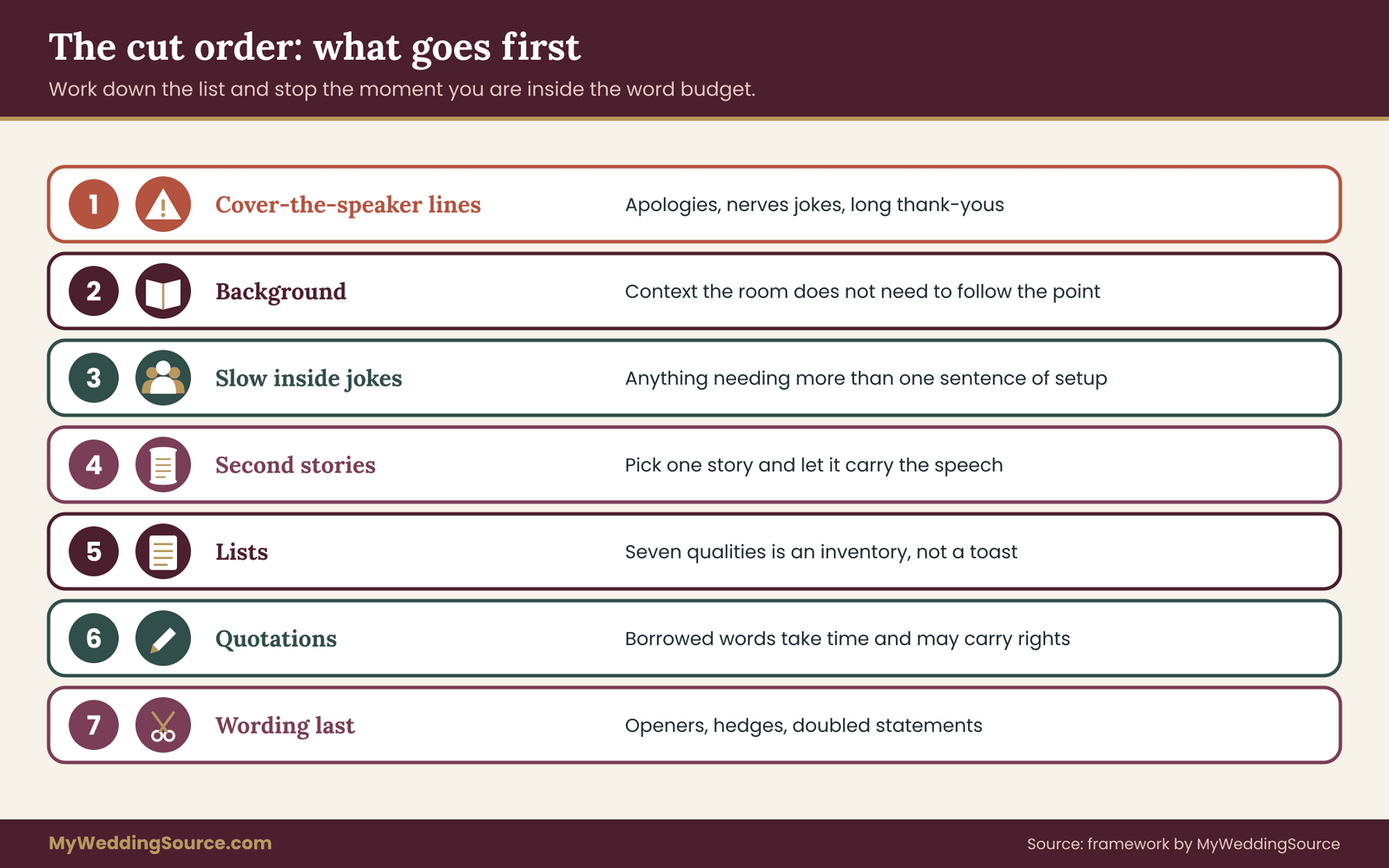
Cutting by feel leads to two bad results. Either you cut the parts you like least, which are often the parts the room needed, or you trim everything evenly, which gives you a speech that is uniformly thin. A fixed order avoids both. The order below works from the least valuable material to the most valuable, and it stops the moment you are under your word budget. Cutting in a fixed order keeps speech length under control without flattening the speech.
First, cut anything that exists to cover the speaker. This includes apologies for not being a good speaker, jokes about how nervous you are, a long thank-you to everyone who made the day possible, and a preamble about how hard it was to write. Audiences are forgiving of nerves and do not need a speech about them. This category often removes fifty to a hundred words with no loss at all.
Second, cut background that the room does not need to follow the point. A story needs enough context to make sense, and no more. If you can tell the road trip without explaining how you first met, then the first-meeting section is background. If the audience will understand the joke without knowing the name of the dorm, cut the dorm.
Third, cut inside jokes that need more than one sentence of setup. An inside joke can work in a short speech, but only if the whole room can enjoy it. If it requires three sentences of explanation, the people who were not there are being asked to wait for a payoff that is not for them, and the people who were there are being asked to relive the explanation. Move it to a smaller setting.
Fourth, cut second stories. If the speech has two or more full stories, pick one. This is the hardest cut for most people and the one that makes the biggest difference to how the speech feels. A single story told well is memorable. Two stories told quickly blur.
Fifth, cut lists. Lists of the groom’s qualities, lists of the couple’s shared interests, lists of the memorable years. A list of three can work as a rhythm device. A list of seven is an inventory.
Sixth, cut quotations from other people. Quotes from songs, films, books and famous speakers often feel like safe material, but they replace your voice with someone else’s and they usually take longer than you think. The next section covers a further reason to be careful with them.
Last, tighten sentences. Only when the structure is right and the word count is still over should you start trimming wording. Sentence-level edits save seconds, whole-section cuts save minutes, and it is worth doing the big ones first.
The one-story rule
For a three-minute speech, the one-story rule is simple: tell one story, and let it carry the speech. The story should show a trait of the groom rather than list it. Instead of saying that he is calm under pressure, tell the story of the wrong turn on the road trip and let the room conclude it. Show it once and the audience is doing the work, which is the part that makes a speech feel personal. One story is the simplest way to hold speech length down.
The best story for this purpose has four features. It is short enough to tell in about 130 to 150 words. It has a clear turn, a moment where something changes or surprises. It makes the groom look good, or at worst endearingly human, rather than embarrassed. And it can be understood by someone who has never met you.
That last feature is the filter that cuts most candidates. If a story only works with a long explanation, it is not a three-minute story. It might be a good one-on-one story, a good rehearsal-dinner story, or a good story to tell in the receiving line, but it is not what the room needs from you at the microphone.
Deciding between two good stories
Sometimes you have two stories you like equally and cannot decide. Use three tests. Which one is easier for a stranger to follow? Which one makes the groom look better? Which one connects more naturally to the couple, either by showing a trait that the partner also loves, or by leading into the moment he met her?
If the tests tie, choose the shorter one. If they still tie, choose the one you can tell without checking your notes, because a story told from memory is warmer than a story read from a card.
Moving what you cut
Cut material does not have to disappear. A speech is not the only place to say something. Many good stories belong in a toast at a smaller event, in a handwritten card, in a private message, or in the memory book some couples set out. Some may belong in the speech of another speaker if you and they agree. The point of the exercise is to put each piece where it can have the room it needs.
Sentence-level tightening that saves seconds
After the structural cuts, a draft often still sits fifteen to thirty words over budget. Sentence edits can close that gap, and they have the side benefit of making the speech easier to say aloud. Small edits can close the last gap in speech length.
Start with openers that do no work. Phrases such as “I just want to say”, “I would like to take a moment to”, and “as many of you know” add words and slow the first impression. Delete them and start with the point. “Ravi and I shared a dorm room for a year” is stronger than “I would like to take a moment to talk about how Ravi and I met, because as many of you know, we shared a dorm room”.
Next, look for doubled statements. People often say a thing and then say it again in different words, because on paper the second version feels like clarification. In speech it sounds like repetition. Keep the clearer of the two.
Then look for hedges. Words such as “kind of”, “sort of”, “basically”, “really” and “pretty much” fill space without carrying meaning. A speaker who hedges every claim sounds unsure about their own story.
Finally, read each sentence aloud and mark where you ran out of breath. A sentence that makes you gasp is too long for the room as well. Split it into two, and often the second half can be cut entirely.
Sound over spelling
Spoken language is built on sound and rhythm, and the best edits for speech sometimes make a sentence look worse on paper. Short sentences can sit beside longer ones. A fragment can land a joke. A word that is hard to say quickly, such as a long place name or a tongue-twisting phrase, may be replaced by a simpler one. Hard-to-say words cost time and add risk, and a laugh gets killed when the speaker trips on the setup.
If your draft includes names, say them aloud several times. Names of people, venues and places are where a nervous speaker most often stumbles, and each stumble can cost several seconds.
Borrowed lines, quotations and the copyright question
Many first drafts include a quotation, a line from a song, a passage from a poem, or a paragraph that the writer found online and adapted. These are often the weakest parts of a speech and the riskiest, for different reasons. Quotations also add to speech length.
They are weak because they swap a personal voice for a general one. A line about love from a famous author is something every guest has heard in some form, and it tells them nothing about your friend. They also take time to introduce and attribute, which is time out of your word budget.
They are risky because some of these materials are protected by copyright. A short, spoken quotation at a private event is a different thing from reproducing someone’s work on a printed program or in a recording posted publicly, and the rules are not as simple as “short is fine” or “private is fine”. The U.S. Copyright Office publishes plain explanations of how copyright and fair use work, and it is the right place to check if you plan to use more than a phrase or two, print the speech, or post a recording.
Many wedding quotations come from works that are still protected, and a guide cannot tell you that any specific use is safe.
The cleaner approach is also the shorter one. Write your own lines. If a quotation is essential, keep it to a few words, attribute it, and do not print or post it without checking. Do not copy a speech you found online and adjust the names, because published speeches and templates can carry rights of their own, and because a borrowed speech never sounds like it came from the person at the microphone.
Your own awkward sentence about your friend is worth more to the room than someone else’s polished one. Your own lines are also better for speech length.
A short test for borrowed material
Ask three questions about any line that is not yours. Does the room need it, or does it merely sound impressive? Could I say the same thing in my own words in half the time? Would I be comfortable if this line were printed on a program or posted in a video? If the answer to any of these is no, cut it and use your own words.
Pauses, laughs and silence inside your speech length
A pause is a unit of time and a tool, and a speech that has no planned pauses has them anyway, in the wrong places. The speech length worksheet gave you a count and a first guess. This section shows how to place them and how to adjust them in rehearsal. Pauses are part of speech length, whether or not you plan them.
There are three kinds of pauses, and each has a different job and a different length.
The laugh pause comes after a line you expect to get a reaction. It lasts as long as the laugh does, and a little longer. In practice that is often three to five seconds, though a big laugh can run more. The rule is simple: do not start the next sentence while the room is still reacting. Starting early teaches the audience that they should stop laughing, and it cuts the effect of everything that follows.
The weight pause comes before or after a serious line, such as the sentence where you turn from the story to the couple. It is usually a little longer than a laugh pause because there is no reaction filling it. Two to four seconds of quiet before “Hannah, I have watched my friend become more himself since he met you” tells the room to listen differently. It is the cheapest emphasis there is.
The breath pause is short, less than a second, and it keeps you sounding human. It comes at the end of a sentence or a natural clause and costs almost nothing, but it is what separates a speech from a recitation.
Where to place the pauses
For a three-minute speech, five or six marked pauses is plenty. More than that and the speech starts to feel like a series of punchlines. Place them at these points.
After your opening line, so the room settles and looks at you. After the punchline of the main story, because that is where the laugh lands. Before the turn toward the couple, as a weight pause. After the most sincere line about the partner, so it is not rushed. And right before the toast itself, to give people time to find their glasses and stand.
Mark each one in your notes with a visible symbol, such as a slash or the word “beat”, so you do not skip it in the moment. Nerves speed everything up, and the first thing a nervous speaker drops is silence.
What to do when a laugh does not come
Every speaker has a joke that dies. If a line gets no laugh, the worst response is to wait for one. Silence that you planned for a laugh turns into awkwardness if the laugh does not arrive. Plan a short recovery for each major joke: a half-second of pause, a small smile and a move to the next sentence. Do not explain the joke. Do not repeat it more slowly. Move on, and the room will move with you.
This matters for timing too. A pause you budgeted at four seconds will become one second if the laugh does not come, and the speech will run shorter than expected. That is the safe direction for an error. The reverse, where a bigger laugh stretches a pause to eight or nine seconds, is what the buffer line is for.
Rehearsal timing: three timed runs and what to record
Rehearsal is where the speech length worksheet’s estimates turn into measurements. A common mistake is to rehearse several times, never write down the times, and then trust a feeling of familiarity. Familiarity speeds you up. By the fifth read, your recall is smooth and your pace is faster than it will be in a room, and you have lost the sense of how long the speech takes when you have to think. Timing the rehearsal is how you test the speech length.
Use three timed runs, each with a different purpose. Three runs give you a speech length you can trust.
Run one: the cold read. Read the draft aloud at a normal volume, standing up, with a timer running and your pauses marked. Do not stop when you stumble. Write down the total time and note where you stumbled. This run tells you whether the structure fits the budget.
Run two: the room simulation. Do the speech again after at least a few hours, standing, in a space that is not your desk. Wear shoes if you will wear shoes. Hold a glass if you will hold a glass. If possible, do it in front of one person who will give honest feedback and is willing to react. Laughter, or the absence of it, changes your pauses in ways you cannot simulate alone. Record the time and ask your listener one question: where did you start to lose interest?
Run three: the final check. Do it close to the wedding, ideally the day before or the morning of the rehearsal dinner, with only your notes. Record the time and compare it to the speech length target and the buffer line. This is the number you use. If it is over, you cut again. Do not tell yourself the room will be more energized and you will speak faster, because that is the exact reasoning that produces overruns.

The rehearsal log
Keep a short written log with five entries for each run: the date, the total time, the word count, the number of pauses and the longest stumble. After three runs you will see a pattern. If your time drops by more than ten percent between run one and run three, you are speeding up as you memorize, and you should deliberately slow the last run. If it stays flat, your estimates are reliable. If it climbs, you are adding material as you go, which is a warning sign.
The log also guards against a common self-deception, which is to remember the best run. We tend to remember the version where everything went right and forget the one that ran long. A written number cannot flatter you. A written log keeps your real speech length honest.
Notes: cards, phone or memory
How you hold your notes affects your timing. Index cards are reliable and silent, but flipping them takes a second or two each, so use no more than two or three and mark the pauses. A phone is fine if you can read it at a glance, but a screen that dims or a notification that arrives mid-speech is a risk; set it to a do-not-disturb mode and keep a printed copy in a pocket.
The wedding day digital contingency plan covers backup copies of files and devices in more detail, and it applies to a speech in a phone just as well as to a playlist. Even your notes affect speech length.
Memorizing a three-minute speech word for word is not necessary and not always wise. A better approach is to memorize the structure, which is five or six beats, and the exact wording of the opening line, the punchline of the story, and the last two sentences. The rest can be delivered from the shape. This also helps with timing because you are less likely to rush through a memorized block in a single breath.
Nerves and the clock
Nervous speakers rush. That is the single most consistent effect of stage fear on timing, and it is why a speech that ran 3:05 in rehearsal may run 2:30 on the night. This is not a disaster, but it can leave a speech feeling thin and breathless. Two habits help.
Mark the first pause as a hard stop and take a real breath before you begin. And in the last rehearsal, practice speaking a little slower than feels natural, so your nervous pace lands near your normal pace. Nerves shrink speech length, and a thin speech has its own cost.
If anxiety about speaking is more than ordinary nerves, such as a fear that interferes with your daily life, the National Institute of Mental Health publishes general information on anxiety and where to find help, and a doctor or licensed counselor can talk through options. A best man who needs more support is not failing at the job, and the couple would rather have a calm friend than a perfect speech.
Using a stopwatch in the room
Some speakers like to start a timer on their phone or watch when they begin. It works, but only if the timer is silent and you can glance at it without the room noticing. The simpler option is to mark checkpoint times in your notes. For a three-minute speech, you might note that you should be at the start of the story by about thirty seconds, at the punchline by about ninety seconds, and at the turn toward the couple by about two minutes.
If you are more than fifteen seconds off a checkpoint, you know which section to compress as you go. A checkpoint is a quick way to stay inside the speech length.
Do not use the checkpoint to rush. Use it to decide which optional sentence to drop. A speech with a marked “skip if long” sentence in the middle can be shortened in the moment without any visible panic.
Alternatives when cutting to a shorter speech length is not enough
Sometimes you cut, rehearse and re-time and the speech still does not fit, or it fits and feels like a different, smaller thing than you wanted to say. Before you accept that, consider that the three-minute microphone moment is not the only place a best man can speak. Each alternative below solves a different problem and costs something different. No single speech length fits every story.
Move the extra story to the rehearsal dinner. If there is a rehearsal dinner, the audience is smaller, closer to the couple, and often more tolerant of longer and sillier material. The apartment flood in the worked case was a rehearsal-dinner story from the start. The trade-off is that the family on the other side may not be at that dinner, and the couple may have their own plan for it. Ask first.
Write it down. A short handwritten note or a letter to the groom, given before the ceremony or on the wedding morning, can carry material that would be too personal or too long for the room. It costs nothing in schedule time. It is also kept, unlike a toast that disappears when the glasses are set down.
Split the speech into two moments. Some couples are glad to have a short welcome-style toast at dinner and a second, more personal toast at a quieter point in the evening. This works only if the couple and the person running the schedule agree, and only if the second moment has a real home, such as the start of the dance floor opening or a coffee-and-dessert pause. Without a slot, a second toast is just a longer speech in two pieces.
Share the microphone. If there are two people who feel entitled to speak about the groom, such as a best man and a brother, they can agree to a combined three minutes, not two separate three-minute turns. This is a coordination task more than a writing one. The agreement should state who tells which story and who gives the toast, so they do not duplicate the same anecdote.
Pair a short toast with a visual. A short slideshow or a photo on a screen can carry background so you do not have to say it. This only works if the venue has the equipment, someone is responsible for running it, and the file has been tested. A slideshow that fails on the night adds minutes of awkward waiting, which is worse than the extra sentence it replaced.
Use the cocktail hour. Some friends and relatives who would like to say something personal can do so informally during the cocktail hour, to a small group, without a microphone. The wedding cocktail hour page on this site covers how that stretch of the evening usually runs, and it can be a good place for the stories that do not need a full room.

Which alternative fits which problem
Matching the fix to the problem avoids wasted effort. If your problem is that the material is too private for the room, a letter solves it. If it is too long for the slot but still public, the rehearsal dinner solves it. If it is too much for one person, sharing solves it.
If the draft is fine and the real worry is the room’s attention, the problem is probably the speech’s place in the schedule, and the answer is a conversation with the couple or the emcee, not a rewrite. Match the fix to the problem rather than just shrinking the speech length.
Two warnings apply across all of these. Do not create a second public speaking slot without the couple’s agreement, because the schedule belongs to them and their vendors. And do not use an alternative to avoid the actual cut, because the discipline of the cut is what makes the final speech good.
Room conditions that change the right speech length
The same speech can be the right length in one room and too long in another. A few conditions deserve a look before you finalize your target. The right speech length depends on the room.
Seated dinner, buffet or cocktail reception
At a plated dinner, guests are seated, the food is coming or is being cleared, and the toast competes with service. Many couples place toasts between courses or after entrees are served, and a long toast at the wrong moment means cold food and staff standing idle. A buffet makes the audience mobile, so a toast usually starts after most guests have their plates.
A stand-up cocktail reception has the shortest attention span of all, since no one is sitting. In that setting, two minutes is often plenty. The wedding reception guest flow guide explains how these formats differ, and the toast timing should follow the format. Format changes the sensible speech length.
Alcohol and the bar
Guests who have been drinking for an hour or two are more talkative and less patient with a long speech, and the speaker may also have had a drink or two. A best man who is nervous and reaches for the bar before the toast is making a timing decision, even if he does not think so. Speakers generally do better with water and a clear head. If the bar is open before the toasts, the wedding bar service planning page covers how couples and venues pace service, and it is worth knowing whether the bar will pause during speeches.
The National Institute on Alcohol Abuse and Alcoholism publishes general information on how alcohol affects the body, and the practical point is plain: the less you drink before speaking, the closer your timing will be to your rehearsals.
Microphone and sound
If you are speaking into a microphone, plan for it. A mic that is too close produces loud sounds on the letters p and b, one that is too far makes you hard to hear, and either problem makes you slow down or repeat yourself. If there is a DJ or a band, ask them for a quick sound check before the reception, and ask whether the microphone is handheld or on a stand, because a handheld one keeps one of your hands occupied while you hold notes and a glass.
The wedding reception music planning guide covers the music-side roles at a reception, and the person running the sound is often the one who also cues the toasts. A speaker who rushes because the sound is poor will land under the target and feel worse.
In the United States, wireless microphones operate under rules from the Federal Communications Commission, and venues and sound providers normally handle that equipment. It is not something a best man should have to worry about, but it is one reason to leave the equipment to the people who run it.
Interpreters, translation and accessibility
If your speech will be interpreted into another language, or signed by an interpreter for deaf or hard-of-hearing guests, the delivery time grows. Interpretation takes time in addition to speaking time, and good interpreters need you to pause so they can keep up. A speech that runs three minutes in English may take five or six with consecutive interpretation, and you should cut the speech to a length that allows for it.
Talk to the interpreter in advance, share your notes if they ask, and ask how much pause they need. Interpretation changes the speech length you can plan for.
The U.S. Department of Justice publishes information on communication access under the Americans with Disabilities Act, and venues and event hosts can find it on ADA.gov. For a best man, the practical lesson is simpler: if guests rely on an interpreter, ask the couple how the time has been budgeted, and use that number as the speech length target.
Children, elders and a long evening
A toast at 6:30 pm in front of families with young children is different from one at 10:15 pm in front of a tired dance floor. Children have the shortest attention span and older guests may be tired by late evening. If there is a wide age range, lean toward the shorter end of your range and avoid jokes that require adult background.
The point is not to talk down to anyone. It is to make the speech useful to the largest number of people in the room. Time of evening and audience both shift the speech length.
Failure conditions: when a short speech still goes wrong
Hitting three minutes is not the same as giving a good speech. A speech can be exactly the right speech length and still fall flat, and a speech that runs a little over can still work. The conditions below are the ones to check for, because they tell you when the number on the stopwatch is misleading. The right speech length is necessary, not sufficient.
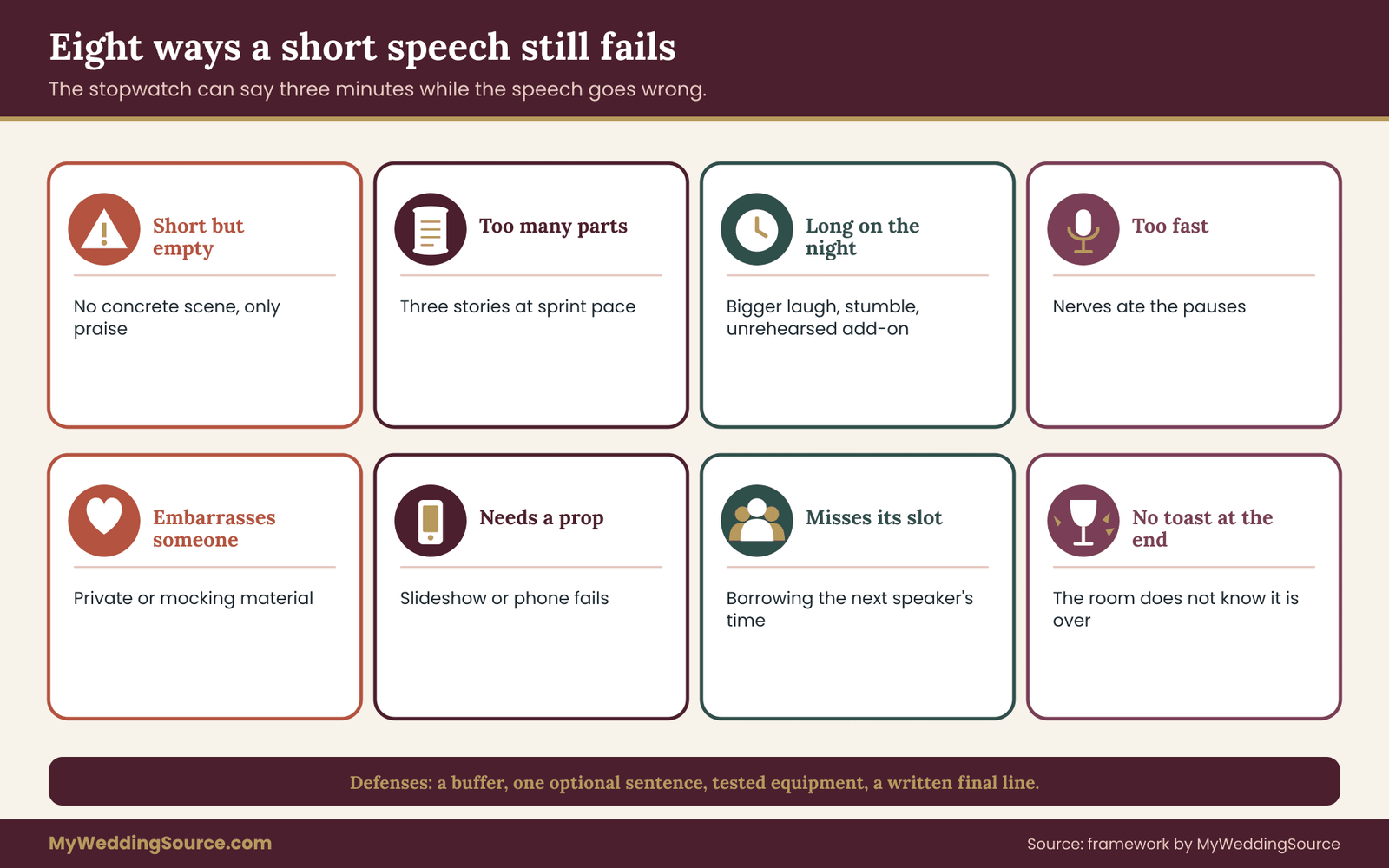
The speech is short but empty. Cutting for time can strip out the single specific detail that made the story real. If your three-minute version is all summary and no scene, the room will hear praise without evidence. Keep one concrete moment, with a place, an action and a result. If you cut the wrong thing, the speech will be on time and forgettable.
The speech is short but still has too many parts. Three minutes can hold one story. It cannot hold three stories told at high speed. If your rehearsal run feels like a sprint, the problem is not your pace; it is that you tried to keep too much. Cut a section, not words.
The speech is on time in rehearsal and long on the night. This is the most common failure, and it has three usual causes: a bigger laugh than planned, a stumble that took time to recover, or an unrehearsed addition. The buffer and the “skip if long” sentence are your defenses. If you consistently run over on the night, add more buffer next time or lower the word budget.
The speech is on time and too fast. If you finish at 2:10 because nerves compressed everything, the room will feel rushed even if the clock is fine. Mark the pauses and practice breathing at them.
The speech embarrasses someone. A speech can be the right length and still be a problem if a story reveals something private, mocks the partner or in-laws, or mentions a past relationship. Time is not the only limit on what you say. The wedding etiquette guide on this site covers the general expectations around toasts and family sensitivities, and a quick read-through by someone who knows the couple is a fair test.
The speech depends on a prop or technology. A slideshow that fails, a phone that locks, or a microphone that cuts out can add minutes of dead time. If anything in the speech needs equipment, test it at the venue, have a spoken fallback and cut the speech to a length that works without it.
The speech misses its slot. If the emcee has given you a slot and you take more, you are using someone else’s time. If the schedule is vague, you may be borrowing from the next speaker without knowing it. Ask for the slot in minutes, not in general terms.
The speech ends without a toast. A surprising number of speeches trail off. A toast is a specific act: a raised glass, the names of the couple, and a short line that invites the room to join. If the speech does not end with that, the room does not know it is over. Write the last sentence first, and learn it by heart.
A quick self-check before the day
Before the wedding, check these five points with your last rehearsal in hand. Is the last timed run inside the speech length target, with the buffer included? Is there exactly one story? Is the toast the last sentence? Do you know which sentence to drop if you are running long? And has someone other than you heard it aloud? Confirm your speech length one last time.
If any answer is no, you have a clear next task and still some time to do it.
Day-of coordination: telling the people who run the room
A best man’s speech is one entry on a schedule that other people are responsible for, and a short conversation can save a lot of trouble. You do not need to make it formal. Telling people your speech length lets them plan around you.
Tell the emcee, planner or venue coordinator your name, your approximate time and when you would like to be called. Ask where you will stand, whether there is a microphone, and who hands it to you. Ask what happens right before and right after your toast, so you know what the room will be doing when you begin. If the DJ or band is cueing music, ask whether the first dance or the next course depends on your finishing by a particular time.
Share your time, not your content. A line such as “three minutes, ending with a toast” is enough. If anything in your speech affects the schedule, such as a request for the room to stand, a video, or a long pause for glasses, say so.
What the vendors need from you
A photographer wants to know when the toast is happening and where you will stand, so they are in position and the light is right. A videographer wants the same, and may need to place an extra microphone. A caterer wants to know if servers should stop moving during the toast. A band or DJ wants to know when to hold music.
Most of these conversations go through the planner or the couple, and a best man does not need to contact each vendor, but you should know who is making sure it happens. The wedding vendor timeline page shows how these handoffs are usually arranged, which helps you see where your three minutes sit in the larger run of the evening.
Reading the room while you speak
During the speech, glance at the room, not only at your notes. If the room is with you, you can hold a pause a beat longer. If the room is drifting, drop the optional sentence and move to the turn. This is not an exercise in improvisation. It is applying decisions you made in advance: the skip-if-long sentence, the checkpoint times and the toast as a firm ending.
When you finish, raise the glass, say the names, take a sip and sit down. Do not add “one more thing”. The most reliable way to leave a good impression is to stop when people want a little more.
Your next steps
Put the speech length worksheet to work this week in this order.
- Record yourself reading a 200-word passage and calculate your pace in words per minute.
- Ask the couple or the emcee for your slot in minutes, and who else is speaking.
- Fill in the five lines of the speech length worksheet and write down your word budget.
- Count the words in your draft and label each section by its job.
- Cut whole sections in the order given until you are under budget, and move good leftovers to a note or the rehearsal dinner.
- Mark five or six pauses and write the first and last sentences by heart.
- Do three timed runs on three different days, log them, and trim again if the last run is over.
- Tell the person running the room your time, where you will stand and how you will end.
Then stop editing. A speech that has been timed three times and cut once is better than a speech that is still being rewritten the night before.
FAQ
How long should a best man speech be?
Most receptions work well with two to four minutes, and three minutes is a safe default. At a measured pace near 135 words per minute, that is about 315 words once you allow for laughs and a small buffer. If the couple or the emcee has given you a slot, use their number instead, and ask who else is speaking before you decide.
How many words is a three-minute speech?
It depends on your pace and your pauses, but a planning figure is about 300 to 330 words. Many people guess higher, around 450, because they forget pauses. Record yourself reading a 200-word passage, calculate your own words per minute, and subtract time for pauses and a short buffer before multiplying.
Is five minutes too long for a best man speech?
Five minutes is long unless you are the only speaker and have a strong story and a patient room. For most receptions it risks losing attention, delaying the next part of the schedule and tiring the speaker. If your draft runs five minutes, cut a whole section rather than trimming every paragraph, and check the slot with the couple.
What should I cut first from a long speech?
Cut material that covers the speaker, such as apologies, nervous jokes and long thank-yous. Then cut background the room does not need, inside jokes that need long setup, a second story, lists and quotations. Tighten sentences last. Whole-section cuts save minutes, while sentence edits only save seconds.
Should I memorize my best man speech?
You do not need to memorize every word. Memorize the structure, which is five or six beats, plus the opening line, the punchline of your story and the final toast. Keep short notes for the rest. This reads as warmer than a recitation and leaves room to adjust if the laughs run long.
How do I time a speech with pauses and laughs?
Mark every planned pause in the draft, give each three to five seconds, and rehearse with a stopwatch and ideally one listener who reacts. Subtract the total pause time and a buffer from your target before setting the word count. Record three timed runs on separate days and use the last number, not the best one.
What if I run long on the night?
Mark one sentence in the middle as optional and skip it if you pass your checkpoint times. Do not rush the toast at the end to make up time. Finish with the same final sentence you rehearsed, raise the glass and sit down. A slightly shorter ending is better than a hurried one.
Can I quote a song or a poem in my speech?
A short phrase is usually low risk in a spoken toast, but many songs, poems and speeches are protected by copyright, and printing or posting a recording changes the picture. The U.S. Copyright Office explains how copyright and fair use work. Your own words are shorter, safer and almost always more memorable.
Sources
- U.S. Copyright Office: copyright basics and registration information.
- U.S. Copyright Office: Fair Use: plain explanation of the fair use doctrine.
- Library of Congress: reference collections and public-domain research guides.
- National Institute of Mental Health: general information on anxiety and where to find help.
- National Institute on Deafness and Other Communication Disorders: voice, speech and hearing information.
- National Institute on Alcohol Abuse and Alcoholism: information on alcohol and the body.
- ADA.gov, U.S. Department of Justice: effective communication and accessibility under the Americans with Disabilities Act.
- Federal Communications Commission: rules for wireless microphones and radio equipment.
- USA.gov: directory of U.S. government agencies and services.
- Centers for Disease Control and Prevention: public health information, including alcohol use.