
A deceased parent tribute is a short, planned moment in the wedding ceremony that names a mother or father who has died, without turning the ceremony into a funeral. This guide gives you an officiant briefing sheet, a sensitivity checklist and a worked case, so the words are ready, the family agrees, and nobody is surprised at the altar.
Decide first whether to mention the parent at all, using four plain questions. Ask the people closest to the loss before you ask the guests to share it. Choose one placement (an officiant line, a pause, a reading, a piece of music, a symbolic item or a spoken vow line) rather than stacking several. Give your officiant a one-page briefing with the exact words, the pronunciation of every name and a do-not-say list. Rehearse once, name a calm backup plan, and keep the whole deceased parent tribute under about ninety seconds.
Some couples know from the day they get engaged that a parent will be missing, and they know exactly how they want that absence acknowledged. Many more feel two pulls at once. They want the person named. They also fear that one sentence will tip the room, or the surviving parent, or themselves, into a grief that takes over the afternoon.
Both instincts are reasonable. A deceased parent tribute that is planned with care usually does neither of the feared things. It gives the loss a small, honest place in the ceremony and then lets the day continue. A deceased parent tribute that is improvised, or that arrives as a surprise, is the version that goes wrong.
This article is about the ceremony itself: the officiant, the script, the placement and the people who need to be consulted. It does not cover memory tables, reserved seats, speeches at the reception or keepsakes worn on the day, which are separate decisions with their own trade-offs. The focus here stays narrow on the spoken moment, and your officiant should be someone who may legally lead the ceremony, which the guide to who may officiate explains.
A note on scope. This is general planning information, not legal, medical or mental health advice. If grief feels unmanageable for you or someone in your family, a licensed counselor or your doctor is the right person to ask, and the sources at the end of this guide point to national organizations that can help you find support.
What a deceased parent tribute is, and what it is not
The phrase covers a wide range. At one end, a deceased parent tribute is a single sentence from the officiant in the welcome: “We remember with love Maria’s father, Tomas, who is with us in spirit today.” At the other end it is a three-minute reading, a hymn that was played at the parent’s funeral, and a lit candle. Both are legitimate. They are not equally right for every family.
It helps to separate four things that often get blended together.
Acknowledgment says that the person existed and mattered. It names them. It asks nothing of the guests except that they hear it.
Remembrance adds a memory, a quality or a story. “He taught Maria to drive in a church parking lot” is remembrance. It tells the room something about who was missed.
Ritual asks the guests to do something: stand, pause, light a candle, say a response. A ritual is a larger request, and some guests will not want to take part for religious or personal reasons.
Memorial turns the ceremony, in part, into an occasion for mourning. It is the heaviest of the four, and it is the one that most often disrupts the mood of a wedding.
Most couples are best served by acknowledgment, sometimes with a touch of remembrance. Ritual can work when the family shares a tradition that already includes it. Memorial belongs elsewhere, and the section on alternatives later in this guide covers where else it can go.
What the tribute should not do
A deceased parent tribute should not ask the surviving parent to carry the moment. If your mother is widowed, she is not a prop for the deceased parent tribute. She should not be asked to read, stand or react in a particular way unless she has asked to do so herself.
It should not compete with the vows. The ceremony exists to marry two people, and the deceased parent tribute is a guest in that ceremony, not its subject. That is a matter of proportion rather than of embarrassment, and a short mention often has more weight than a long one.
It should not speak for the parent. Lines such as “He would have wanted this” or “She is watching over us” are claims about the dead that some families find comforting and others find presumptuous. Unless the family uses that language already, the safer choice is to describe what the parent did or loved, in the past tense, and leave their wishes alone.
It should not surprise anyone who is grieving. This is the most reliable rule in the guide, and the consent section below is built around it.
Why the ceremony, and not just the reception
The ceremony is the one part of the wedding where the whole group is quiet, seated and facing the same direction. That is why a mention here lands with weight. It is also why it carries risk: there is no music to cover a pause, no table conversation to soften it, and nowhere to step away. The ceremony step-by-step guide shows where each part sits in the order of events, which makes the placement choices later in this article easier to follow.
Some couples decide, after thinking it through, that the ceremony is too exposed and that the deceased parent tribute belongs at the reception or in a private moment before the ceremony. That is a good outcome of this process, not a failure of it. The goal is the right container for the memory, not the most visible one.
The four-question gate: should you mention them at all
Before you write a word, run the idea through four questions. They are blunt on purpose. If any answer is a clear no, pause and talk it over before going further.
Question one: do the two of us agree on what we want? Partners sometimes disagree quietly. One person has lost a parent and wants a named tribute. The other has not been through that loss and assumes it will be fine either way. Or the person who lost the parent says they cannot say that name aloud in front of two hundred people, while their partner has already drafted a paragraph. Settle this between you first, privately, before anyone else is involved.
Question two: will the people closest to the loss welcome it? That means the surviving parent, siblings, a stepparent and, where relevant, the deceased parent’s own parents or former spouse. Their feelings matter more than yours here, because the ceremony will ask them to sit in public while their loss is named.
Question three: can it be done in a sentence or two? If you cannot picture the moment in under about ninety seconds, you are probably describing a memorial, not a deceased parent tribute. That is worth noticing early. You can still honor the parent in a bigger way somewhere else.
Question four: do we have a calm plan if someone cries? Tears are fine, even expected. What you want is a plan, not a prevention strategy: a tissue within reach, an officiant who knows how long to wait, and a clear signal for when to continue.

If all four answers are yes, the rest of this guide applies directly. If one is a maybe, the consent section and the alternatives section are the ones to read first. If one is a firm no, you have lost nothing by asking, and you have probably prevented the exact surprise that the deceased parent tribute is meant to avoid.
A note on timing and recent loss
Nothing in this guide assumes how long ago the death happened. A parent who died last spring and a parent who died when you were nine call for different handling, and neither is more or less valid.
With a recent loss, the safest default is a quieter, shorter acknowledgment, with the freedom to change your mind up to the morning of the wedding. With a long-ago loss, the grief may be older but it can still surface in unexpected ways, particularly at a milestone like a wedding. Hospice and bereavement organizations, such as the Hospice Foundation of America, publish accessible material on how grief resurfaces around family events, and a counselor can help you plan for it.
You do not need to prove that you are ready. You only need a plan that works whether you are ready or not.
Who this guide is written for
This guide is written mainly for the couple, for a planner or relative helping with the ceremony, and for the officiant who will say the words. If you are the officiant reading this, the briefing and wording sections are the heart of it. If you are the parent who is still living, the consent section explains what you can reasonably ask for and what you can decline.
If you are a guest who has been asked to read or perform something in the deceased parent tribute, ask the couple for the exact wording and the exact timing, and ask what to do if you cannot finish. A good couple will have thought about that already, and if they have not, your question helps them.
Consent map for a deceased parent tribute
Consent is the part of this topic that couples most often skip, because it feels awkward to ask. Asking is much less awkward than the alternative. A deceased parent tribute is public, it is spoken, and it concerns people who may have strong and different feelings about the person who died. The map below shows who to ask, what to ask, and what to do with the answer.
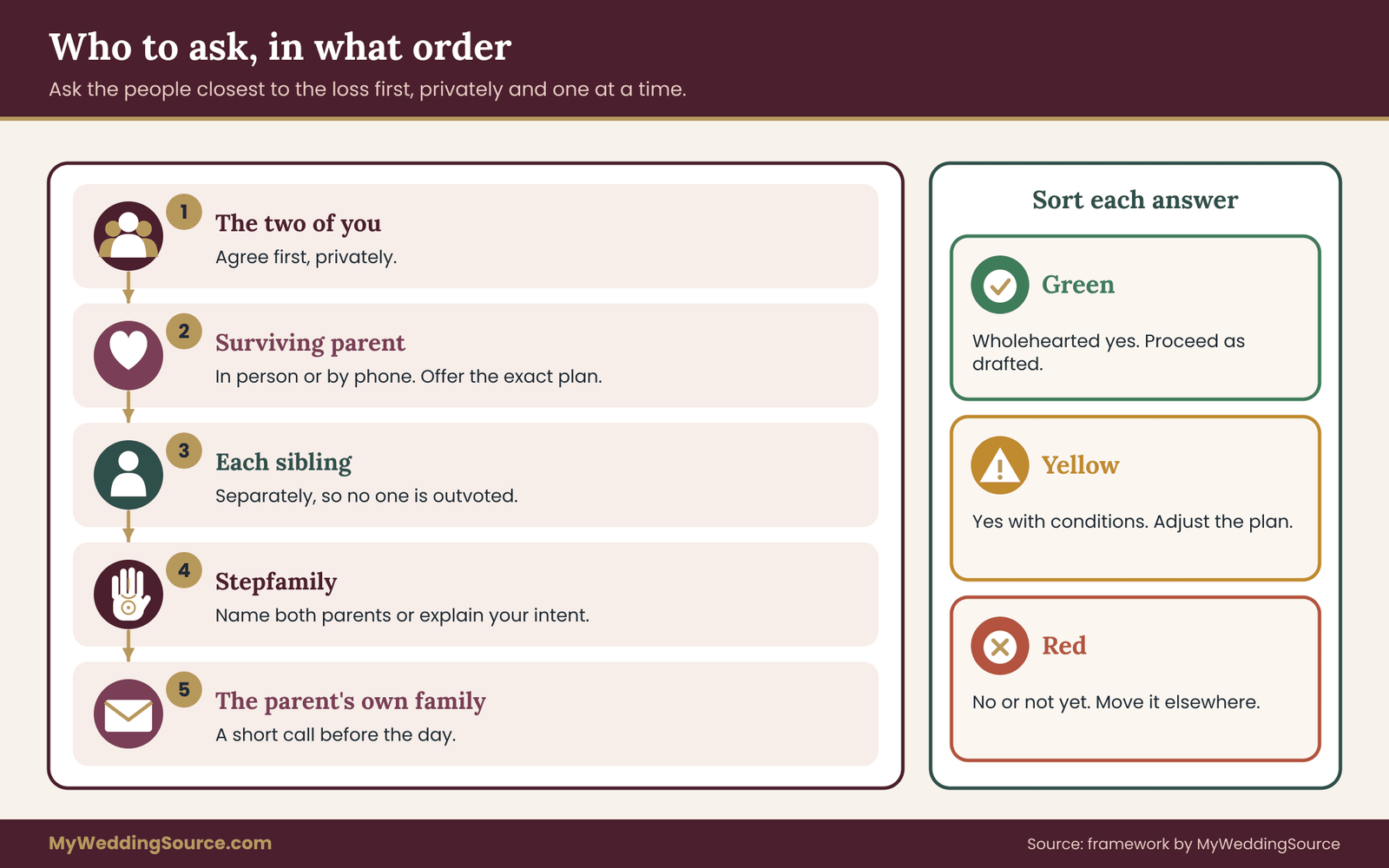
The surviving parent
If one of your parents has died and the other is living, the surviving parent is the first conversation after the two of you. They lost a spouse, or an ex-spouse, or a partner. They may have been grieving this person for decades, or for months. They may be sitting in the front row, and they may be walking you down the aisle.
Ask in private, in person or by phone, not by text and not in front of other relatives. Offer the idea as a question, not a plan: “We have been thinking about mentioning Dad in the ceremony, very briefly. How would you feel about that?” Then listen. You are listening for relief, for hesitation, and for the specific things they would like included or left out.
If they say yes, ask whether they want to see the wording. Many do. If they say no, or “not in the ceremony”, believe them, and ask whether there is another place that would feel better. A surviving parent who is not ready is giving you information about their grief, not a verdict on your wedding.
Siblings and stepfamily
Siblings often feel the loss in a different way from the surviving parent. They may want the mention to be larger, or smaller, or not to exist. Ask each sibling separately, because a group conversation can push people to agree with the loudest voice.
Stepparents deserve particular care. A stepmother whose husband’s first wife has died, or a stepfather who raised you after your father died, may feel unseen when only one parent is named, or may feel that a deceased parent tribute rewrites the story of the family. A single honest line that names both, or a conversation beforehand that explains your intention, usually settles it. If you are not sure how to word that, the wedding etiquette guide on this site covers general family courtesies and is a useful companion.
If the deceased parent was divorced from the surviving parent, the picture is more delicate. Do not assume the surviving parent will welcome a spoken deceased parent tribute, and do not assume they will object. Ask.
The deceased parent’s own family
Grandparents, aunts and uncles on the side of the person who died may be present, and for them the mention is a loss of their own child or sibling. They may be the people most moved by it, and the people for whom the moment is hardest. Where the relationship is warm, a short phone call from you before the wedding is a kindness. Where it is strained, a quiet message through a trusted relative can serve the same purpose.
Your partner’s family
If it is your partner who lost the parent, your own family may be unsure how to behave. A short heads-up helps: “Chris is going to include a line about his mother in the ceremony. If you see people tearing up, that is normal and fine.” That one sentence spares several people a minute of awkwardness.
What to do with the answers
Write the answers down, even if only in your phone. You are building a short record of who agreed to what. This matters on the wedding morning, when a stressed relative may say “I thought we were not doing that.”
Then sort the responses into three groups.
Green: wholehearted yes. Proceed with the plan as drafted.
Yellow: yes with conditions. The surviving parent agrees, but would prefer no mention of the illness, or no music, or not before the processional. Adjust the plan. These are not obstacles. They are the specifics that make the deceased parent tribute work.
Red: no, or not yet. Respect it. Move the deceased parent tribute to a different part of the day, make it private, or hold it for an anniversary. You can always add something later. You cannot take back a sentence once it has been spoken.
When people disagree with each other
Sometimes the answers conflict. Your sister wants her father named; your mother would rather not hear it. Your fiancé wants a deceased parent tribute; you do not. A few principles help.
The person closest to the loss does not automatically win, and neither does the person with the most dramatic feelings. The couple has the final decision about their own ceremony, but they should treat a firm objection from a grieving parent as a serious cost, not a preference to be overridden.
Look for the smallest version that meets the most needs. A single sentence from the officiant, with no music and no pause, is often acceptable to people who would reject a reading. If even that is too much for someone, a private moment before the ceremony may satisfy the wish to mark the person without involving the whole room.
If you reach a stalemate, ask a neutral person to help. A clergy member, a family counselor or the officiant can often hear each side more calmly than relatives can. A bereavement-aware counselor is the most useful person to have in that role.
What not to ask
Do not ask a grieving person to approve the wording by committee. Two or three readers is plenty. Do not send a mass message to the whole family asking “Is anyone against us mentioning Dad?” because it invites debate and puts people on the spot. Do not ask the surviving parent to write the deceased parent tribute, unless they volunteer. And do not treat a lack of reply as consent. Silence usually means someone is thinking, or avoiding.
Seven ways to place a deceased parent tribute in the ceremony
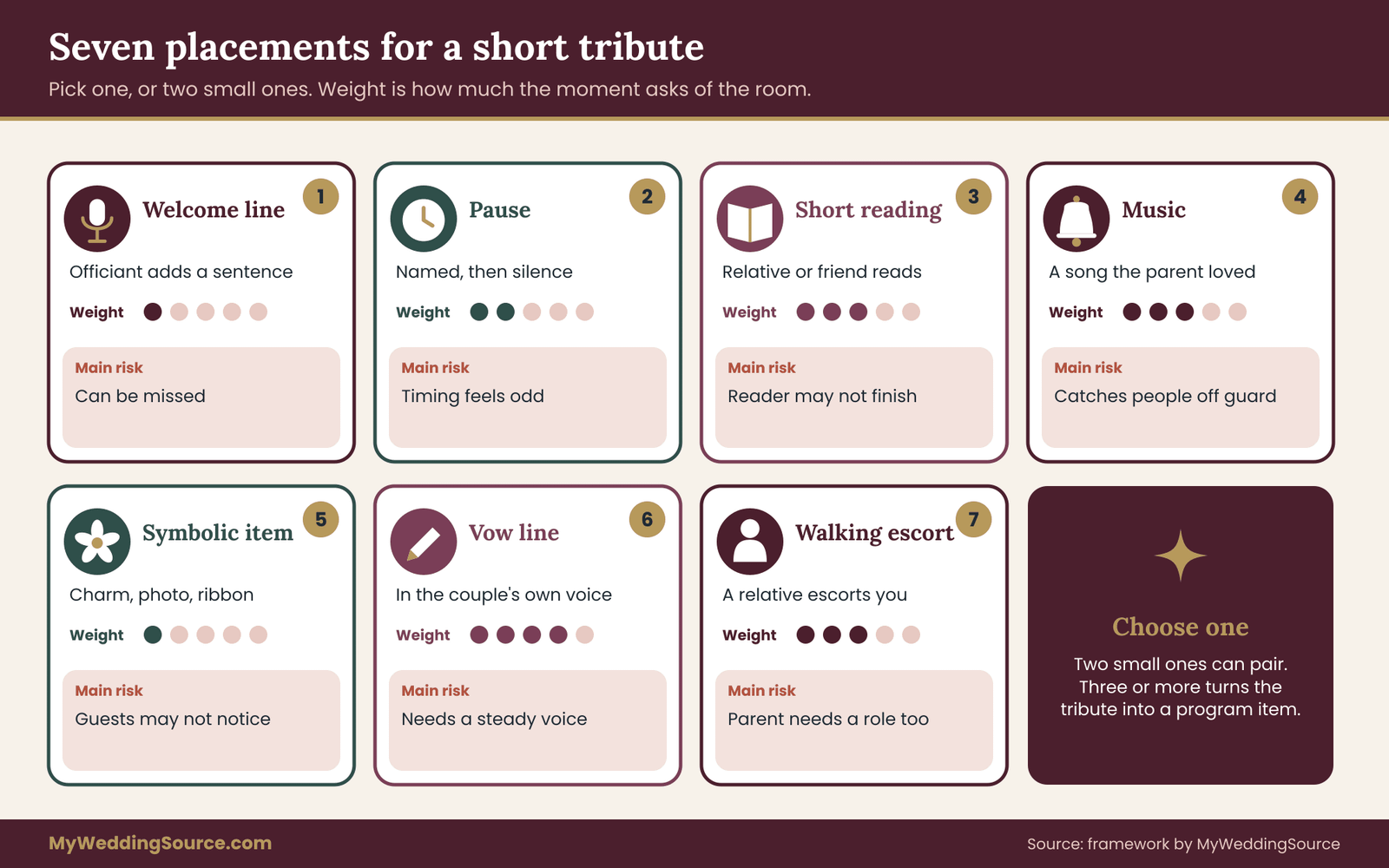
Once the group has agreed, you need to choose where in the ceremony the moment goes and what form it takes. There is no single correct answer. There are seven common options, each with a different weight, a different risk and a different need for rehearsal.
One: a line in the welcome
The officiant adds a sentence or two to the opening remarks. This is the lightest and most flexible option. It requires no change to the order of events, no extra performer and almost no rehearsal. It works well when the family is wary of bigger gestures, or when the ceremony is short, or when the parent who died is one of several people being remembered. Its weakness is that the guests are still settling, so it can be missed.
Two: a pause before the vows
The officiant names the parent and then stays quiet for a few seconds. The silence does the work. This option suits families who prefer not to put words around the loss. Its risk is that a pause that is too long becomes awkward, and one that is too short feels like a mistake. Agree on a count in advance, such as ten seconds, and let the officiant hold it.
Three: a short reading
A relative or friend reads a brief passage, either about loss in general or about the parent in particular. A reading gives the family a way to take part. It also requires a reader who can get through it, a backup, and a printed copy. For a deceased parent tribute, choose a reader who is close but not the person most affected.
Four: a piece of music
A song or instrumental piece the parent loved, played during the processional, the signing or a quiet moment. Music can say what words cannot, and it needs no one to speak. The risks are copyright and licensing for recorded music in some venues, and the way a familiar tune can catch a grieving person off guard. Tell the closest relatives which song it is.
Five: a symbolic item
A reserved bouquet charm, a photograph in the pocket, a handkerchief, a ribbon on the program. This keeps the deceased parent tribute physical and private. Only the couple, and perhaps the family, may know. It places no demand on the guests, which is its strength and also its limit: the room may not realize anything has been honored.
Six: a spoken line within the vows or the declaration
The partner who lost the parent adds a sentence to their own vows or to a response, such as thanking the people who brought them to this day, including the parent who is gone. This puts the words in the couple’s own voice, which many families find most moving. It takes the most nerve, and the speaker should be able to finish the line even if their voice shakes. Practice it aloud, more than once.
Seven: a walking tribute
A relative, such as a sibling or an uncle, accompanies the person down the aisle, or a seat is acknowledged at the front. Walking is sometimes the most natural way to honor a parent who would have done it. Planning it is a matter of choreography and kindness toward the surviving parent, who may also want a role.
Choosing one
Pick one. Two can work together if they are small, such as a line in the welcome and a symbolic item. Three or more starts to feel like a program item, and the ceremony begins to bend around it.
If you are weighing these against each other, ask which one the surviving parent would be most comfortable sitting through, and which one you can deliver on your steadiest day. The answer is usually the quieter option.
The officiant briefing for a deceased parent tribute
The officiant is the person who will say the words, hold the silence and decide in real time whether to continue when someone cries. Most officiants are skilled at this, but they cannot read your mind. A one-page briefing turns a vague request (“say something about my dad”) into a specific, deliverable plan. If you are still choosing someone, check what an officiant must be authorized to do before you ask them to take on anything sensitive.
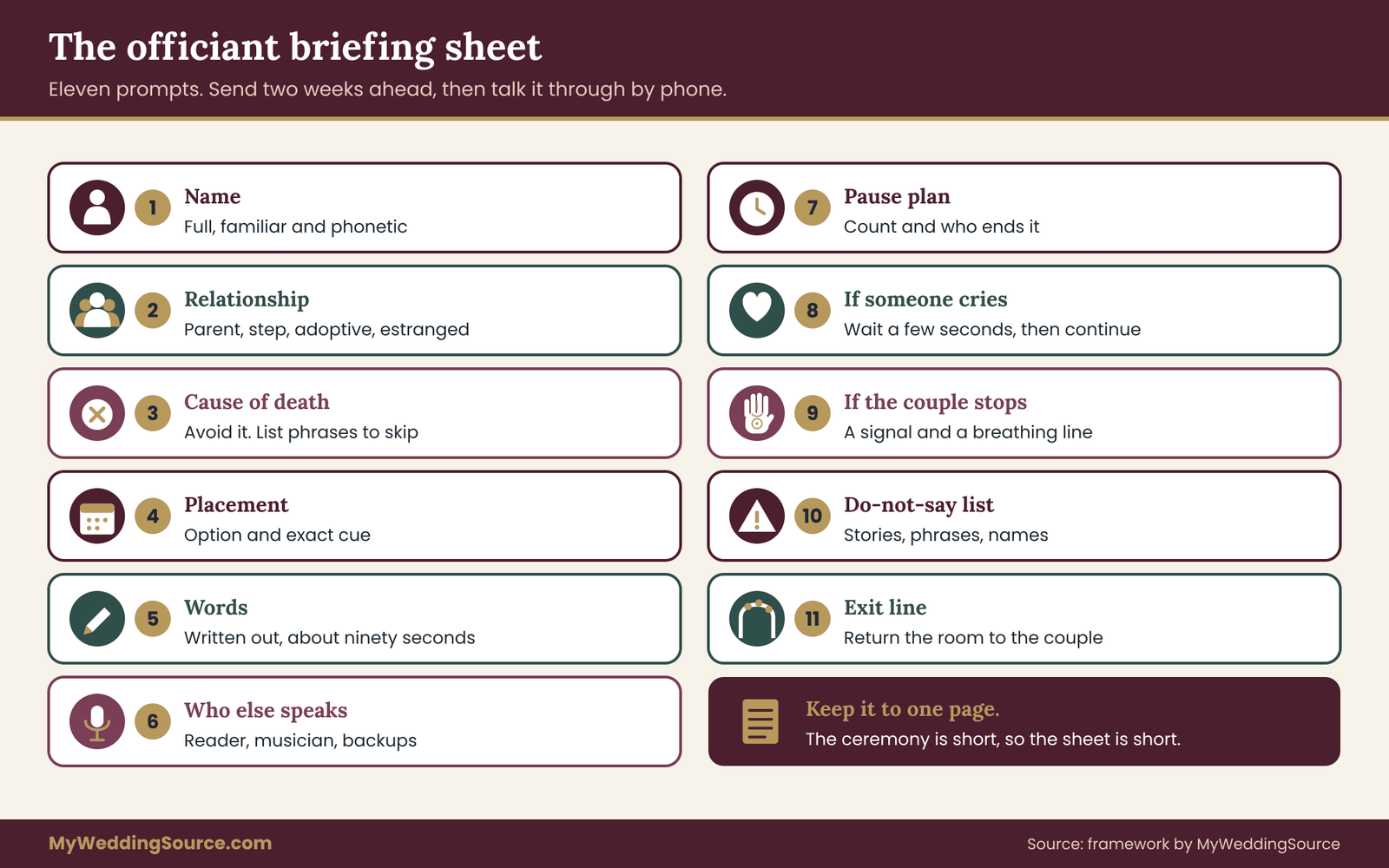
The briefing below is the original tool in this guide. It has eleven prompts. Fill it in together, send it at least two weeks before the ceremony, and talk it through by phone or in person rather than only by email.
The eleven prompts
One: the name, exactly as it should be said. Write the full name, the nickname the family used, and which one belongs in the ceremony. “Robert”, “Bob” and “Dad” are three different sentences. Add a phonetic spelling if the name is unusual, and have a family member record it on a phone so the officiant can hear it.
Two: the relationship, in the officiant’s words. “Father of the bride” is clear. If the person was a stepfather, an adoptive parent or a parent the bride was estranged from, say so plainly and agree on the phrase. Do not assume the officiant knows.
Three: how they died, and whether it is to be mentioned. In nearly every case the answer is no. The officiant should know the cause only so they can avoid language that touches it. A long illness, a sudden accident, an overdose and a suicide each have words and images that can wound. Give the officiant a short list of phrases to avoid, such as “lost the battle”, “taken too soon” or “at peace now”, if those are unwelcome.
Four: the placement and the exact moment. Name the placement from the seven options and the cue, such as “after the welcome, before the opening reading”. Mark it on the cue sheet. The wedding ceremony cue sheet guide explains how to build the sheet the officiant, musicians and readers will all follow.
Five: the words, written out. Do not leave this to improvisation. Write the exact sentences and agree on them. Officiants may adjust phrasing to their natural voice, and that is fine, but the content should be settled. Length: no more than about ninety seconds when spoken slowly.
Six: who else speaks. If a reader or a musician is involved, give their name, their cue and their backup. If the surviving parent will say anything, write down what and when.
Seven: the pause plan. Agree how long the silence lasts and who signals the end. A sensible default is ten seconds, ended by the officiant with a short phrase such as “Thank you” or by moving straight into the next line.
Eight: what to do if someone cries. The officiant should know whether to wait, to speak softly, to offer a moment, or to carry on. The most useful instruction is a simple one: “If anyone in the front row is crying, stay silent for a few seconds, then continue gently. Do not stop the ceremony unless I signal.” Write the instruction in your own voice.
Nine: what to do if the couple cannot continue. Sometimes it is the person marrying who is overcome. Agree a signal, such as a hand squeeze or a nod, that tells the officiant to pause, and a line the officiant can use to give a breath: “Take your time. We are all in no hurry.”
Ten: the do-not-say list. Write down the stories, jokes, religious phrases, comparisons and names that should not come up. If a former spouse or a second family is in the room, the list may be long. This is not a sign of fragility. It is a map of the landmines in the room.
Eleven: the exit line. Decide how the officiant returns the room to the ceremony. Without an exit line, a deceased parent tribute can hang in the air. A plain sentence such as “And now we turn to the reason we are all here” brings the focus back to the couple.
How to run the briefing conversation
Send the sheet by email, but treat the conversation as the actual briefing. Ask the officiant to read the deceased parent tribute aloud once to you, as they would on the day. Listen for pacing and tone, not only content. A line that looks tender on paper may sound clinical or theatrical when spoken.
Ask the officiant what they have seen go wrong at ceremonies like this, and what they would change. Officiants who do this often have practical knowledge about pacing, microphones and the way grief sounds in a quiet outdoor space. If your officiant is a friend or relative with no ceremony experience, give extra time to rehearsal and consider having a second person, such as a coordinator, hold a copy of the script.
If the officiant resists
Occasionally an officiant will want to improvise, or to add a religious frame the family does not share, or to lengthen the moment. You are the client. Say kindly and clearly what you want: “We would like exactly these two sentences and nothing more.”
If the officiant cannot work within that, it is better to learn it at the briefing than at the altar. The non-religious ceremony script and the Christian ceremony script pages show how a spoken ceremony is usually framed in two different traditions, which can help you tell the officiant what you do and do not want in a religious or secular setting.
Sample briefing language
The following is a model of how a filled-in sheet might read. It is an invented example for illustration.
Name: Thomas Alvarez, “Tom” to the family. Say “Tom Alvarez, father of Elena”. Placement: after the welcome. Words: two sentences, drafted. Silence: ten seconds, officiant ends it. Do not mention: the illness, the hospital, any “watching over” language. If Elena cannot continue: pause, let her take a breath, then offer her the next line. Exit line: “Now, to Elena and Daniel.”
The sheet is short because the ceremony is short. Keep it to one page.
Wording a deceased parent tribute: structure and sample lines
Most people overwrite tribute wording. They try to say everything and end up saying nothing in particular. A strong deceased parent tribute has a plain shape, and you can build it in under ten minutes.
The three-part shape
Name them. The first sentence says who is being remembered and how they were connected to the couple.
One true detail. The second sentence offers a quality, a habit or a memory that makes the person specific. It should be something the family would recognize immediately and that does not need explaining.
Return to the day. The third sentence turns back to the wedding, often with a sentence of gratitude or presence.
That is all. If you add a fourth sentence, check whether it is needed.
Sample lines
These samples are written as models. Change the details to fit your family, and adjust anything that does not sound like the person who will say it.
For a father, the officiant: “We remember Elena’s father, Tom Alvarez, who loved a good long drive and a short toast. His daughter carries his steadiness into today.”
For a mother, in the welcome: “Today we hold a place in our hearts for David’s mother, Ruth. She would have been in the front row, probably straightening someone’s collar. We are glad to be here in her memory.”
For a stepparent: “We also remember Priya’s stepfather, Jon, who joined the family when she was ten and never stopped showing up.”
For both parents: “Our thoughts are with Sam’s parents, Carol and Reg, who are not with us today but whose kindness we can see in him.”
Within the vows, spoken by the person who lost the parent: “I wish my dad could be here. I know he would have liked you, and I am grateful you are in my life.”
Each of these is two or three sentences. Each is in the past tense where it refers to the person, and in the present where it refers to the day. Each avoids stating what the dead would want.
Language to use and to avoid
Plain language is gentler than euphemism. “Died” is a good word, and many grieving people prefer it to “passed”, “lost” or “gone”. Others do not. This is a place where you should use the words the family uses.
Avoid religious language the family does not share. “Gone to a better place” is comforting to some and offensive to others. If the family is religious and wants such language, use it. If you are not sure, leave it out.
Avoid comparisons that rank the grief: “the hardest loss”, “the empty chair”. A phrase like “empty chair” can be especially hard if the family has been looking at one at every holiday.
Avoid humor unless the family clearly shares it. A funny story can be a joy when the room knows the person, and a mistake when it does not. If you include one, test it on two relatives first.
Avoid details about illness, hospital stays or the circumstances of death, even if you think they are well known. They are rarely what the family wants repeated at a wedding.
Reading the deceased parent tribute aloud
Say the deceased parent tribute aloud, at the speed you expect on the day, which is slower than you think. Time it. If it runs over ninety seconds, cut it. If it goes by in twenty seconds and feels abrupt, add a short pause rather than more words.
Read it to someone who knew the parent and ask one question: “Does this sound like him, or like a greeting card?” If the answer is the second, replace the most general sentence with a specific one.
The sensitivity checklist for a deceased parent tribute
The briefing tells the officiant what to say. The sensitivity checklist tells you whether the plan is safe to carry out. Run it once when you draft the deceased parent tribute and once more about a week before the wedding, because families change their minds, and because a new grief, a new illness or a new family tension can arrive in the final month.

The checklist has five areas with four checks each. Work through them in order. A single failed check does not cancel the deceased parent tribute, but it tells you what to fix.
Area one: consent
Did the surviving parent hear the exact plan, not just the idea? A general “we thought we might mention Dad” is not the same as “the officiant will say these two sentences after the welcome.”
Have siblings and stepfamily members each been asked separately? If anyone has not, ask before the invitations go out or at the latest before the rehearsal.
Is there a written note of who said yes? It need not be formal. A few lines in your phone are enough.
Is there an easy way for anyone to withdraw? Tell people they can change their mind up to the morning of the wedding, with no explanation needed. That freedom makes many of them more willing to say yes in the first place.
Area two: wording
Is the deceased parent tribute under about ninety seconds when spoken slowly? Time it with a stopwatch, not by feel.
Is it free of cause of death, illness and hospital details? Read it again for any phrase that points toward the circumstances.
Does it avoid speaking for the dead? Cross out any “he would want” and “she is watching” line unless the family uses such language and has agreed to it.
Is the name correct, and does the officiant know how to say it? Check spelling, pronunciation and the choice between formal and familiar versions.
Area three: people
Is anyone asked to perform who might not be able to finish? A reader who is also a primary mourner needs a backup, and a gentle way out.
Is the surviving parent free to simply sit and listen? They should not be handed a task they did not request.
Are children in the family prepared? A small child who has lost a grandparent may ask a loud question at an unlucky time. A brief explanation beforehand helps. A trusted adult sitting nearby helps more.
Do guests who did not know the person have enough context? A single sentence of identification, such as “Elena’s father”, is enough. Do not assume everyone knows.
Area four: logistics
Is the placement marked on the cue sheet, with a cue for each person involved? If the deceased parent tribute is not on the sheet, it is easy to skip or repeat.
Has the music, if any, been cleared for the venue and tested on the sound system? A song that skips or starts at the wrong point is a small disaster in a quiet moment.
Are printed copies of any reading in the hands of the reader and the backup? Phones lose charge and screens glare in sunlight.
Is there a tissue, a water glass and a chair within reach of the person most likely to need them? It sounds minor, and it matters.
Area five: aftercare
Does someone know to check on the surviving parent and the closest relatives after the ceremony? Assign this to a calm, trusted friend or relative so the couple is free to enjoy the photographs.
Is there a quiet place to step away? A side room, a bench or a walk around the building gives people a way to recover without leaving the celebration.
Do you have a plan for the days after? A call or a note to the surviving parent a day or two later is often appreciated, and it is also a chance to ask how they felt about the moment.
Is there room to adjust at the reception? If the ceremony tribute went deeply, the reception may need a lighter tone, and the DJ or the host should know.
Reading the results
If all twenty checks pass, you have a plan that is likely to work. If three or four fail, fix them and run the list again. If a consent check fails, treat it as serious and return to the consent map. A deceased parent tribute with a weak wording section can be edited in an afternoon. A deceased parent tribute with a weak consent section can wound someone, and you cannot edit that afterward.
Special situations that change the plan
Not every family fits the standard picture. Several situations come up often enough to deserve their own thinking.
Both parents have died, or more than one person is being remembered
When two or more people are being remembered, the deceased parent tribute can sprawl. A good approach is to name them together in one sentence rather than giving each their own paragraph. “We remember the parents and grandparents who are not with us today, and we are grateful to them.” It is brief, inclusive and leaves no one out. If one of the people is a recent loss and others are not, mention the recent one by name and group the rest.
A complicated or estranged relationship
Some people lose a parent they had a painful relationship with, and a warm deceased parent tribute would be false. You are not obliged to give one. A neutral acknowledgment, such as “We acknowledge the absence of Anna’s father today”, respects the reality without pretending. Another option is to say nothing publicly and to mark the parent privately. A counselor can help you think this through, and there is no right answer. If you are unsure whether a deceased parent tribute would feel honest, the unadorned fact is usually safer than a flourish.
A parent who died a long time ago
A long-ago death does not mean the family has no feeling about it. Some find that a milestone brings it back strongly. Others have made peace and are happy to see the parent named lightly. Ask. Do not assume that time has smoothed everything, and do not assume it has not.
A parent who died very recently
If the death was within the past few months, treat the entire wedding as a delicate event. The family may be in an early, raw stage of grief, and decisions that seem reasonable now may feel wrong in a week. Keep the deceased parent tribute short and flexible, build in the right to cancel it, and consider keeping it private. Couples in this position sometimes ask whether to postpone the wedding. That is a personal decision for the two of you and your family, and a counselor or clergy member can help you weigh it.
A blended family or a second marriage
When one or both partners have children from earlier relationships, a deceased parent tribute to a deceased parent may also touch the children’s own grandparent or another relative. Check with the children’s other parent where it applies, and think about how the deceased parent tribute will sound to a child. If a child is in the ceremony, an adult should be near them for support.
A secular, interfaith or multicultural ceremony
In a secular ceremony, a spoken acknowledgment with a pause is usually enough. In a religious ceremony, the tradition may have its own prayers or customs for the dead, and the officiant may have rules about what can be added.
In an interfaith or multicultural ceremony, the families may differ about what is appropriate: some traditions invite open remembrance, and others consider it unlucky or inappropriate to name the dead during a celebration. The interfaith ceremony planning guide is a good place to read about how to bring two traditions into one ceremony, and a conversation with a senior member of each family will tell you what is welcome.
Guests who are grieving for their own reasons
At any large gathering, some guests will have lost someone recently, and a deceased parent tribute may touch their own sorrow. You cannot plan for every guest, but you can keep the moment brief and gentle, and you can make sure the aisle seats are available for anyone who needs to step out. A plain ceremony program with a note that a short remembrance will take place is a courtesy some couples add.
A sudden or traumatic death
When a parent died suddenly, by accident, by violence or by suicide, the family may carry shock, guilt or anger alongside the sadness. A public sentence can touch all of it. Keep the wording to the name and one plain, warm detail, and leave out anything about how or when. Ask the surviving family what they would want the room to know, and accept that the answer may be nothing.
Consider having the officiant check in quietly with the closest relatives just before the ceremony, so that nobody is caught unprepared by the sound of the name. A trained counselor can help you and your family plan for the day, and national resources such as the 988 Lifeline and SAMHSA, listed in the sources below, can point you to support if the weeks before the wedding feel heavy. Reaching for help is not a sign that the wedding is going wrong.
Accessibility and language
A deceased parent tribute spoken quietly in a large outdoor space may not reach everyone. Ask the sound technician to test the microphone and consider whether guests who are hard of hearing will be near a speaker. If part of the family speaks another language, a translated line in the program or a bilingual officiant can allow them to follow. This keeps the moment inclusive, not only moving.
Running a deceased parent tribute on the day: cues, readers, music and microphones
The planning is done. The day is a matter of execution, and execution is where small details decide whether the moment feels calm or chaotic. This section follows the deceased parent tribute from the rehearsal through to the first minute after it.
At the rehearsal
If you have a rehearsal, run the deceased parent tribute once, standing in the place where it will happen. Do not run it as a full performance. Walk through the cue, the words and the exit line, and do it quietly. The aim is not to practice emotion. It is to make sure everyone knows where to stand, when to begin and what happens next.
If a reader is involved, have them read aloud from the printed page, at the pace they will use on the day. If music is involved, play the first fifteen seconds through the actual speakers and confirm the volume. If a symbolic item is involved, confirm who has it and where it will be.
Do not rehearse the grief. Some people will tear up even in rehearsal, and that is fine. The point is to let them know the moment will be short and survivable.
If there is no rehearsal, which is common at small or courthouse-style weddings, gather the officiant and anyone involved ten minutes before the ceremony and walk through the plan in one conversation. Hand the officiant a printed copy of the briefing. The order of events decides where a short rehearsal fits.
The cue sheet
The deceased parent tribute needs a line on the cue sheet, like any other element. A typical entry looks like this: welcome, then officiant tribute line, then ten-second pause, then opening reading. Each person with a part gets their own cue. The cue sheet should also include the backup: “If reader cannot continue, officiant reads the remaining lines.”
Print the sheet. Give copies to the officiant, the coordinator or day-of helper, the musician or DJ, and any reader. If your venue has a coordinator, ask them to carry a copy too.
Readers and backups
A reader in a deceased parent tribute carries a heavier load than a reader at an ordinary wedding. Choose someone steady, who loved the person but is not at the center of the loss. Give them the text at least a week ahead, ask them to practice aloud, and name a backup.
Tell the reader, directly: “If you cannot finish, stop. The officiant will take over, and no one will mind.” Permission to stop makes it less likely they will have to.
A reader who stumbles is not a problem. A reader who is left alone at a microphone with no support is. Agree on a nod or a hand signal.
Music
If the deceased parent tribute includes a piece of music, choose one that can be cut off cleanly or that can be played at low volume in the background. A song with sudden changes in volume can startle people. Consider an instrumental version.
Check licensing with the venue. Venues often hold public performance licenses for recorded music, and live musicians may have their own arrangements. The U.S. Copyright Office publishes general information on how copyright works, and your venue or musician can tell you what is covered. For a short deceased parent tribute at a private ceremony, the question usually has a simple answer, but it is worth asking early.
Give the person running the sound a printed cue and a backup file on a second device. Technical failures are the most common cause of awkward moments in quiet ceremonies.
Microphones and sound
A quiet deceased parent tribute can be inaudible in a large or windy space. Ask the sound technician or the venue to test the officiant’s microphone at the place where the deceased parent tribute will be spoken. If the officiant moves between a lectern and the couple, check the sound at both places.
A low voice carries less than a loud one, but a booming voice breaks the mood. The goal is a clear, slow, medium-volume delivery that everyone can hear without strain.
Photographs and video
Tell your photographer and videographer about the deceased parent tribute and ask for their discretion. Photographs of a grieving mother are often treasured later, and they are also sometimes unwelcome. A good photographer will step back, shoot from a distance and avoid flash during the pause. If you want the moment captured, ask. If you want it private, say so.
This is a matter to settle in your contract or your shot list. The wedding family photo list page explains how to organize family portraits, and it is useful when you are working out whether a portrait with the surviving parent should be quiet or not.
If guests are filming on phones, the officiant can ask at the start for the ceremony to be kept unplugged, which also protects the deceased parent tribute from being recorded without consent.
The first minute after
When the deceased parent tribute ends, the officiant moves to the exit line and the ceremony continues. The couple may need a moment. The officiant can give it with a short pause or a smile. Resist the urge to apologize or to explain. A calm tone tells the room that the moment was welcome and the ceremony is moving on.
At the first chance, such as the recessional or the receiving line, a trusted friend should quietly check on the surviving parent and the closest relatives. A glass of water and a few words are often all that is needed.
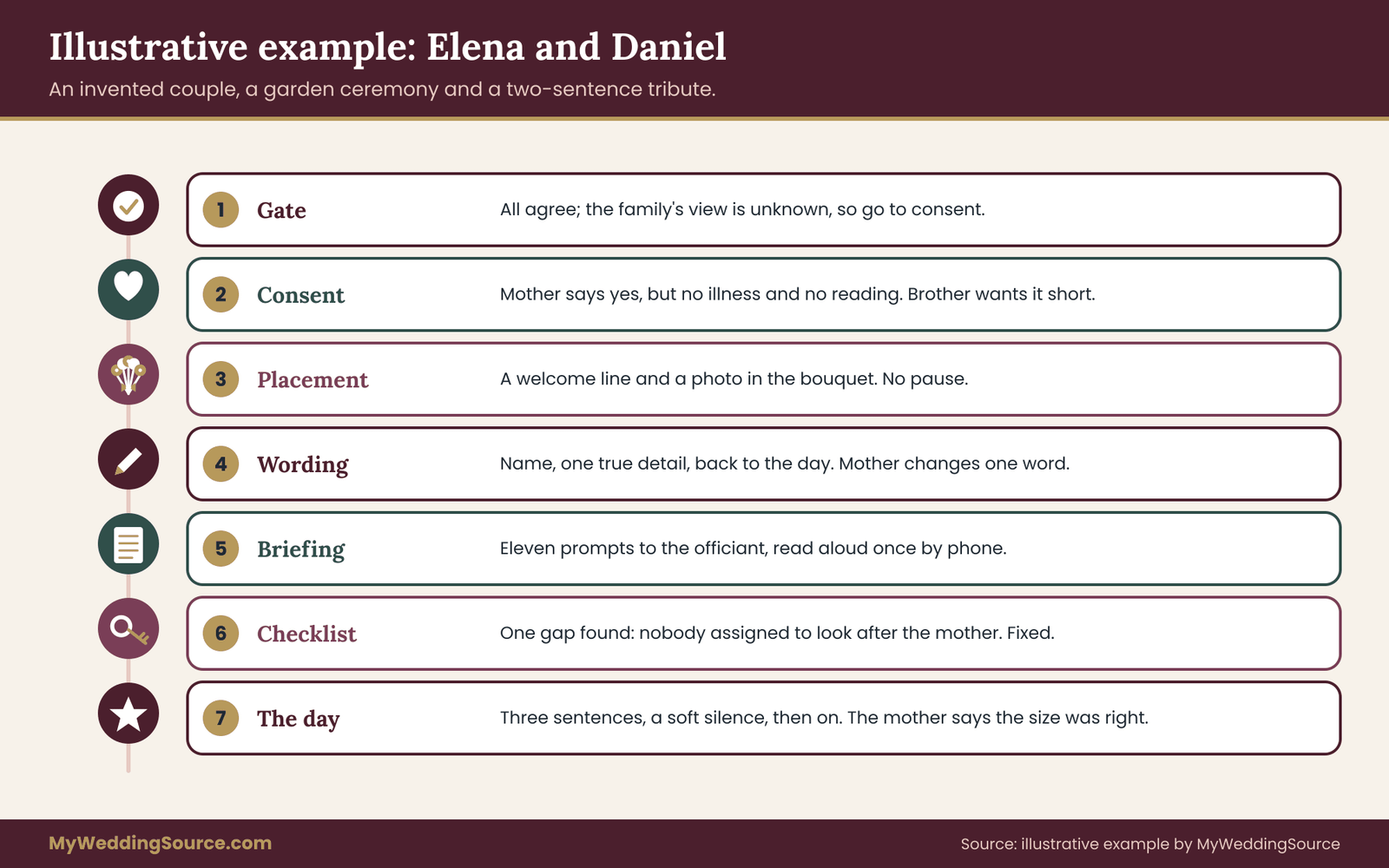
A worked case: Elena, Daniel and a two-sentence tribute
The following example is invented to show how the tools in this guide fit together. It is not a real couple, and the details are illustrative.
The situation
Elena and Daniel are planning a ceremony for about eighty guests at a garden venue. Elena’s father, Tom, died two years ago after a long illness. Her mother, Rosa, is living and will walk Elena down the aisle. Elena has one brother, Marco. Elena wants her father named. Daniel agrees, and he is a little worried that Rosa will be overwhelmed.
Step one: the gate
They run the four questions. Do they agree? Yes. Will the closest people welcome it? Unknown. Can it be done in a sentence or two? Yes. Do they have a calm plan if someone cries? Not yet. So the answer to question two is the open one, and they go to the consent map.
Step two: consent
Elena calls her mother and asks gently. Rosa is quiet, then says she would like Tom named, but she does not want anything about the illness and she does not want a reading, because she would not be able to listen to one. Elena asks whether she would like to see the wording, and Rosa says yes.
Elena speaks to Marco separately. He wants the deceased parent tribute but would prefer it be short. Elena also calls her father’s sister, Aunt Lucia, who will be there, and Lucia is moved and says thank you.
The result is green with two yellow conditions: no mention of the illness, and no reading. They record this in a note.
Step three: placement
They compare the seven options. A reading is ruled out by Rosa’s wish. A song would be too much. A symbolic item, such as a small photo in Elena’s bouquet, appeals. A line in the welcome is simple and quiet. They choose two small things: a line in the welcome and a photo tucked into the bouquet wrap. They agree to skip the pause, because Rosa would find a silence harder than words.
Step four: wording
They draft three sentences using the shape from the earlier section. Name: “Elena’s father, Tom Alvarez.” One detail: “He loved long drives and short toasts.” Return: “His daughter carries his steadiness into today.” Rosa reads it and asks to change “steadiness” to “kindness”, because that is what she remembers. They make the change.
Step five: the briefing
Elena fills in the eleven prompts for the officiant, a friend named Dana who has married several couples. She gives the name as “Tom Alvarez, father of Elena”, the placement as after the welcome, and the do-not-say list: the illness, the hospital, any “watching over” language. For the cry plan, the instruction is to pause, wait, then continue gently. Dana reads the deceased parent tribute aloud on a call, and they trim a word.
Step six: the checklist
A week before, they run the twenty checks. One fails: nobody has been assigned to check on Rosa afterward. They ask Daniel’s cousin, who is calm and kind, to sit near Rosa and offer water and a hand afterward. Everything else passes.
On the day
Dana says the three sentences after the welcome. Rosa holds a tissue and nods. There is a short, soft silence, not planned but natural. Dana says “Thank you” and moves on to the opening words. Elena squeezes her mother’s hand on the way up. The photo is in the bouquet, and few guests notice. Later, Rosa tells Elena it was the right size.
What this deceased parent tribute example shows
Three points are worth drawing out. The consent step changed the plan: the reading and the pause were dropped because of what Rosa said. The wording was short and specific, and the surviving parent improved it. And the checklist caught a gap, the aftercare, that a plan made only of words would have missed.
None of this required special skill. It required asking, writing things down and rehearsing once.
Failure conditions for a deceased parent tribute, and how to respond
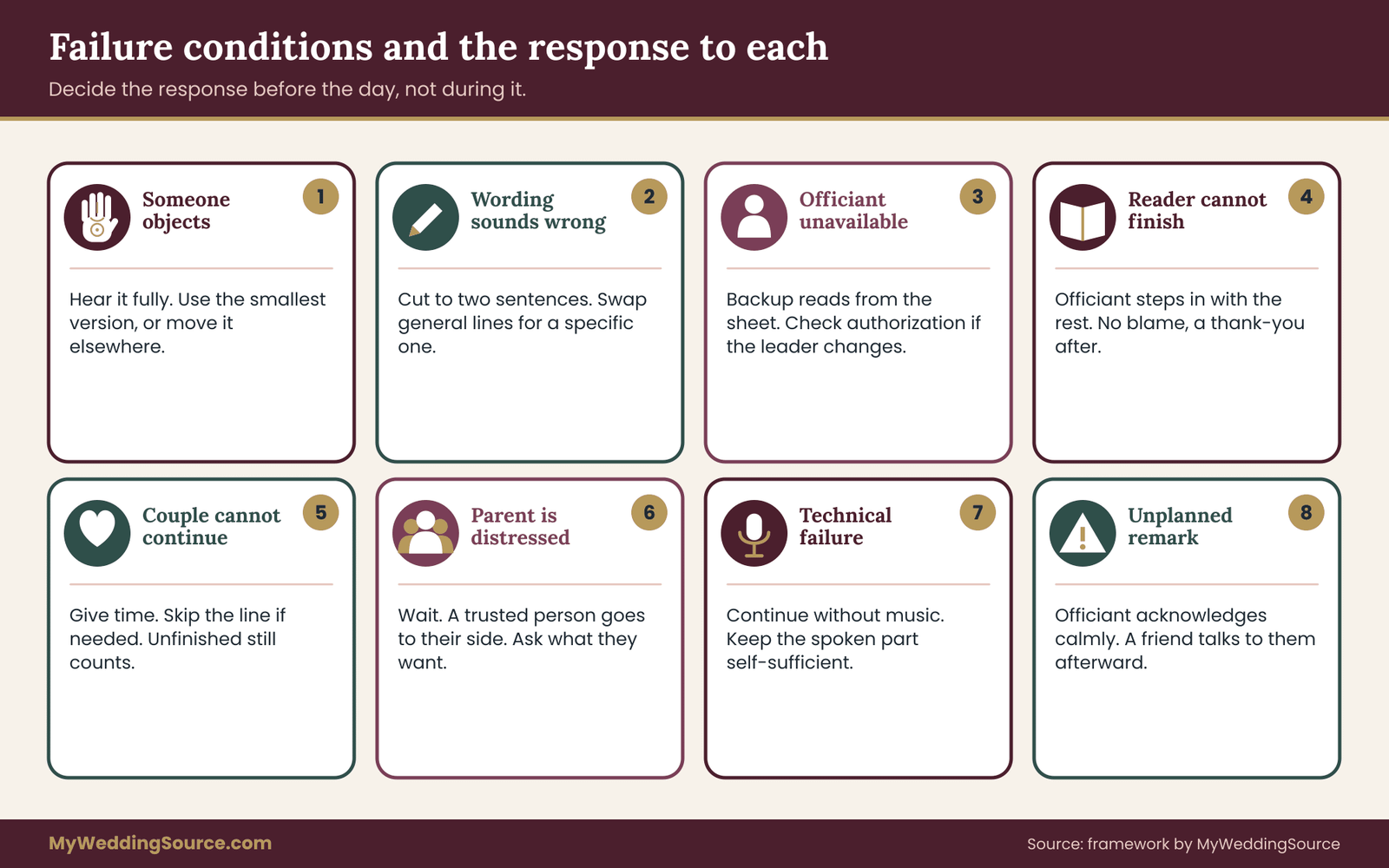
A good plan includes a clear idea of what failure looks like. Some failures are small and recoverable. Others are signals to stop. Naming them in advance keeps you from making hard decisions under pressure.
Condition one: someone objects before the day
A relative says they do not want the deceased parent tribute, or asks for changes you had not expected. Treat this as information. Return to the consent map, hear the objection in full and look for the smallest version that works. If a surviving parent objects firmly, cancel the spoken deceased parent tribute in the ceremony and move to an alternative. The cost of changing the plan is a few minutes of editing. The cost of overriding a grieving parent can last years.
Condition two: the wording sounds wrong aloud
You read the deceased parent tribute out and it sounds sentimental, or too long, or unlike the person. Cut it. Replace any general line with a specific one, shorten it to two sentences, and read it again. If it still does not sit right, move to a quieter option, such as the symbolic item with no spoken words.
Condition three: the officiant is unavailable or unwilling
The officiant falls ill, or cannot agree to the wording, or turns out to be uncomfortable with the subject. Have a backup person who can read the lines from the sheet, such as a coordinator, a close friend or a second officiant. If the officiant is simply unwilling, hear why. If the reason is religious policy, a different officiant or a different placement may be needed. The wedding officiant requirements page can help you check the legal side of any change in who leads the ceremony.
Condition four: the reader cannot finish
A reader begins and stops. This is the most common live failure, and the plan for it is simple. The officiant, who has a copy, steps in with the remaining lines or moves on gently. Nobody is blamed. Afterward, a friend thanks the reader and tells them it was well done. Where possible, shorten any reading to a few lines so that the burden is small.
Condition five: the person marrying cannot continue
If it is the bride, groom or partner who is overcome, the officiant gives time. A plain “Take your time” and a sip of water are enough. The partner can step closer or take a hand. If the pause grows long, the officiant can offer to move on and return to the line later, or skip it. Agree beforehand that skipping the line is acceptable. A deceased parent tribute that is not finished is still a deceased parent tribute.
Condition six: the surviving parent is visibly distressed
A parent leaves their seat, or sobs openly, or turns away. The right response is calm. The officiant waits a moment, and a trusted person quietly goes to the parent’s side. The ceremony need not stop unless the parent signals that they want it to. Afterward, speak with them privately and ask how they would like the rest of the day to go. Do not assume you know what they want.
Condition seven: technical failure
The music does not play, or the microphone cuts out. Have the officiant continue without music, and have the sound person fix the fault without drawing attention. A deceased parent tribute that loses its song is still complete if the words stand alone. This is another reason to keep the spoken portion self-sufficient.
Condition eight: an unplanned remark
A guest calls out, or an uninvited comment disrupts the moment. The officiant, who has seen this before, can acknowledge it with a calm word and carry on. If a family member makes a remark that causes pain, a friend should speak to them afterward, not during the ceremony.
When to cancel the tribute altogether
Cancel the spoken deceased parent tribute, and choose an alternative, if the surviving parent withdraws consent, if the person who lost the parent feels they cannot manage it, if a recent bereavement makes the occasion too raw, or if you find, on reflection, that the deceased parent tribute is meant to settle a family conflict rather than to honor a person. A deceased parent tribute is meant to be gentle. If the plan is straining the family, it is working against its purpose.
Recovery after the day
If the moment went badly, you can repair it. Call the people affected. Say what you intended, ask how it felt and listen. If someone was hurt, apologize without defending. You may also offer another way of honoring the parent, such as a private visit to a grave, a donation or a small gathering. Grief is not tidy, and a family that knows you care about it will usually forgive an imperfect moment.
When the ceremony is not the right place: alternatives
Sometimes the right outcome of this process is a different venue for the memory. Several alternatives preserve the intention while lowering the stakes.
A private moment before the ceremony
The couple, the surviving parent and perhaps siblings gather for a few minutes before guests arrive. They might read a short passage, place a flower, look at a photograph or simply stand together. This keeps the moment personal and removes the pressure of an audience. It is also a good setting for an emotional conversation, because no one has to hold composure for a crowd.
A note in the program
A short line in the printed program, such as “In loving memory of Tom Alvarez”, acknowledges the parent without any spoken moment. Guests who want to notice it will. Others will pass over it. It is the lightest public acknowledgment there is. Before printing, check the spelling and the wording with the surviving parent.
A word at the reception
A toast or a speech at the reception can include a short mention of the parent. The setting is looser, there is music and food, and people can move around. The tone is usually warmer and the risk of a heavy mood is lower. Reception speeches have their own pitfalls, and a mention should be short and planned. A reception is also the place where stories, which can be funny, fit more naturally.
A memory table or photograph display
A table with a photograph and a few objects can sit near the entrance or the guest book. It gives people a place to remember without requiring anything of them. Its logistics, including where to place it and how to avoid crowding, are a topic of their own.
A gesture that is private to the couple
A charm on the bouquet, a handkerchief, a piece of jewelry, or a note tucked into a pocket can carry the memory privately. The couple knows it is there, and the guests need not. This is often the most comfortable option for people who want to keep their grief personal.
An act of giving
A donation in the parent’s name to a charity they cared about, or a small fund, can be mentioned in the program or on the website. It turns remembrance into something useful. Where relevant, a short line on the wedding website can explain. Keep any request to guests optional.
An anniversary or a later ritual
Some families prefer to wait. A visit to the grave on the first anniversary, a family dinner on the parent’s birthday or a yearly toast can mark the person without tying them to the wedding day. This can ease the pressure to say everything at once.
How to choose
Think about what you want the memory to do. If you want guests to hear the name, choose the program line or the spoken welcome. If you want the family to share a quiet moment, choose a private gathering. If you want the memory to be warm and lively, choose a reception toast. If you want to keep it personal, choose a private gesture. Combining a small spoken line with a private gesture is a common and satisfying choice.
You can also change your mind. Many couples plan one thing and, on the day, find the right size is smaller or larger. If the plan includes some flexibility, you can adapt. A deceased parent tribute that fits the moment is worth more than one that follows the script.
Your next steps
Work through these in order. Each takes a short time, and most can be done in a week or two.
First, settle between the two of you whether you want a deceased parent tribute at all, and run the four-question gate together. Write down your answers.
Second, talk privately to the surviving parent, then to siblings and any stepfamily, using the consent map. Record who agreed to what, and any conditions.
Third, choose one placement from the seven options. If you are unsure, begin with a line in the welcome, or with a private symbolic item. You can always add more later.
Fourth, draft the wording in the three-part shape, in two or three sentences, and time it aloud. Share it with the surviving parent before it is final.
Fifth, fill in the eleven-prompt briefing and send it to your officiant at least two weeks ahead. If you do not yet have an officiant, the officiant requirements guide is the place to begin, and the order of events guide shows where the moment fits in the order of events.
Sixth, add the deceased parent tribute to your cue sheet with a cue for every person involved, and name a backup for any reader or musician.
Seventh, run the twenty-check sensitivity list for your deceased parent tribute a week before, and again if anything changes in the family.
Eighth, assign one calm person to look after the surviving parent on the day of the deceased parent tribute, and plan a call or a note afterward.
If at any step you find the plan straining someone, step back and use the alternatives section. A smaller, quieter tribute that everyone welcomes is better than a larger one that someone endures.
FAQ
How long should a deceased parent tribute last in a wedding ceremony?
Aim for under about ninety seconds in total, including any pause. Most couples find that two or three sentences from the officiant, or a short reading, is enough. A longer moment starts to feel like a memorial and can change the mood of the ceremony. If you have more to say, move it to the reception or a private gathering.
Who should say the words, the officiant or a family member?
The officiant is usually the safest choice, because they are practiced at speaking in front of a group and can keep going if emotion rises. A family member can be a good reader if they are steady and have a backup. The surviving parent should not be asked to speak unless they have offered. The person marrying can add a line within their own vows.
What if the surviving parent does not want the tribute?
Respect that, and ask whether another form would feel better, such as a note in the program, a private moment before the ceremony or a mention at the reception. Their discomfort is information about their grief, not an obstacle to be argued around. You can revisit the idea later, and you can mark the parent privately in the meantime.
Should we mention how the parent died?
Almost never. Cause of death, illness and hospital details are rarely what a family wants repeated at a wedding, and they can be painful to hear. Give your officiant a do-not-say list so they avoid phrases that touch the circumstances. Describe a quality, a habit or a memory of the person instead.
Can a deceased parent tribute include a stepparent or an estranged parent?
Yes, if the family welcomes it, and you can word it honestly. A stepparent who raised you can be named warmly. For a painful or estranged relationship, a neutral acknowledgment or no public mention is fine. You are not obliged to give a warm deceased parent tribute that would feel false. A counselor can help you decide what feels honest.
What if I cry or cannot finish my own vow line?
That is common and acceptable. Agree on a signal with your officiant, such as a squeeze of the hand, and give them a line to buy you a breath, like “Take your time.” Practice the sentence aloud several times beforehand. If you cannot finish, the officiant can move on, and the moment still counts.
Can we include music the parent loved?
Yes. Choose a piece that can be played at a low volume, tell close relatives which song it is so it does not catch them off guard, and test it on the venue’s sound system. Ask the venue or musician about licensing for recorded music. Have a backup file on a second device in case the first one fails.
How do we handle guests who are grieving too?
You cannot plan for every guest, but you can keep the moment brief and gentle and leave aisle seats free for anyone who needs to step out. A short note in the program can signal that a remembrance will take place. Offer a quiet space away from the celebration, and ask a trusted friend to watch for anyone who needs support.
Sources
- Hospice Foundation of America: grief and bereavement education and resources for families.
- National Institute on Aging: guidance on coping with grief and loss.
- National Institute of Mental Health: information on mental health and where to find help.
- 988 Suicide and Crisis Lifeline: free, confidential support in a crisis.
- SAMHSA: national mental health and behavioral health resources and treatment locator.
- Centers for Disease Control and Prevention: public health information, including mental health and coping resources.
- U.S. Copyright Office: general information about copyright and music use.
- USA.gov: government guidance on marriage licenses and state vital records offices.
- ADA.gov: Americans with Disabilities Act information for accessible event spaces and communication.
- Library of Congress: reference and research resources for readings and poetry in the public domain.