
A memorial table is a small display of photos and objects that honors people who cannot be at your wedding, and most of its trouble is physical rather than emotional. This guide shows how to size, place and arrange a memorial table so guests can look, pause and move on without a pile-up, and how to check each photo’s permission before it goes on the table.
Work out how many people will stand at the memorial table at the same moment (guests who visit, times seconds spent looking, divided by the minutes of the busiest window). Place it where a stopped guest does not block a door, the bar line or the dance floor. Use a shape with two open sides, keep photos at eye level, and tag every photo for permission before printing. If the numbers show a queue, split the display or move part of it to a program page or screen.
Most advice about a memorial table is about feeling: which photos to choose, what to say, how to honor someone well. That matters, and a calm layout does not replace it. But a memorial table is also furniture in a room full of people holding drinks, and rooms have limits.
A table that looks lovely in a mood board can turn into a knot of guests next to the cocktail line, a frame knocked off by a passing elbow, or a grandmother who cannot get close enough to see her late husband’s picture.
The problem tends to show up at the worst possible moment. Guests arrive at the memorial table in waves: right after the ceremony, in the first quarter hour of the cocktail hour, and again as dinner doors open. During those waves, a table sized for a quiet afternoon becomes a bottleneck. People who came to pause for a moment end up waiting behind strangers, and the quiet space you meant to create feels crowded.
A note on scope. This is general planning information, not legal, tax or financial advice. Questions about copyright, venue contracts or local fire rules belong with the people who issue or enforce them, and a short list of official sources sits at the end of this guide.
This guide has one job: help you arrange photos on a memorial table so that traffic flows and permission is settled. It does not try to cover everything about remembering absent people at a wedding. If you are still deciding whether the tribute belongs in the ceremony, the reception or both, the ceremony step-by-step guide shows where each moment sits in the order of the day. Here, the assumption is that the tribute is decided and the question is how to build it.
What a memorial table has to do, and why it jams
A memorial table has four jobs, and they pull against each other. It has to be seen, so guests know it exists. It has to be readable, so a guest who never met the person understands who they are looking at. It has to be left alone, so the objects survive the evening. And it has to be respected, so no one feels the memorial table was built without their blessing.
Each job asks for something different from the space. Being seen wants a visible, central spot. Being readable wants good light and a short label at eye level. Being left alone wants distance from the bar, the dance floor and the buffet. Being respected wants a calm corner, away from the loudest speakers. No single location satisfies all four, so the layout is always a compromise, and the compromise should be chosen on purpose.
Bottlenecks come from a short list of causes. Knowing them lets you check your own layout against each one.
Too little frontage. Frontage is the length of table edge where guests can stand and look. A small round table has less usable frontage than it appears to, because the back half faces the wall or other furniture.
Photos that demand close reading. Small prints, long captions and dim light make guests lean in and stay longer. Dwell time rises, and so does the crowd.
A dead-end location. If the only way out of the viewing area is back through the people arriving, every visitor creates two movements in a narrow space.
Competing magnets. Placed beside the bar, the guest book, the cake or the photo booth, the memorial table shares a crowd with something that has its own line.
A fragile or hands-on display. If guests want to hold a picture, a heavy frame, a handkerchief or a pair of glasses, they will pick it up, and someone has to put it back.
No one assigned to it. When nobody owns the table, a tipped candle, a fallen frame or a displaced photo goes unfixed until the end of the night.
None of these needs special expertise. They need a measurement and a decision, which is what the rest of the guide supplies.
The flow-and-permission method in six steps
The method below is the spine of this guide. Each step produces a short written answer you can hand to a planner, a venue manager or a relative who offered to help.
- Count. Estimate how many people will be at the table at the same time (the dwell math in the next section).
- Site. Choose a location by testing it against traffic, noise, light and power, not by looks alone.
- Shape. Pick a layout shape that gives you the frontage the count demands.
- Items. List every photo and object, assign it a permission tag, and decide its size and position.
- Rules. Write the label, the handling rule and the name of the person who watches the memorial table.
- Failure and fallback. Decide in advance what you will do if the table jams, an object is damaged, or someone objects.
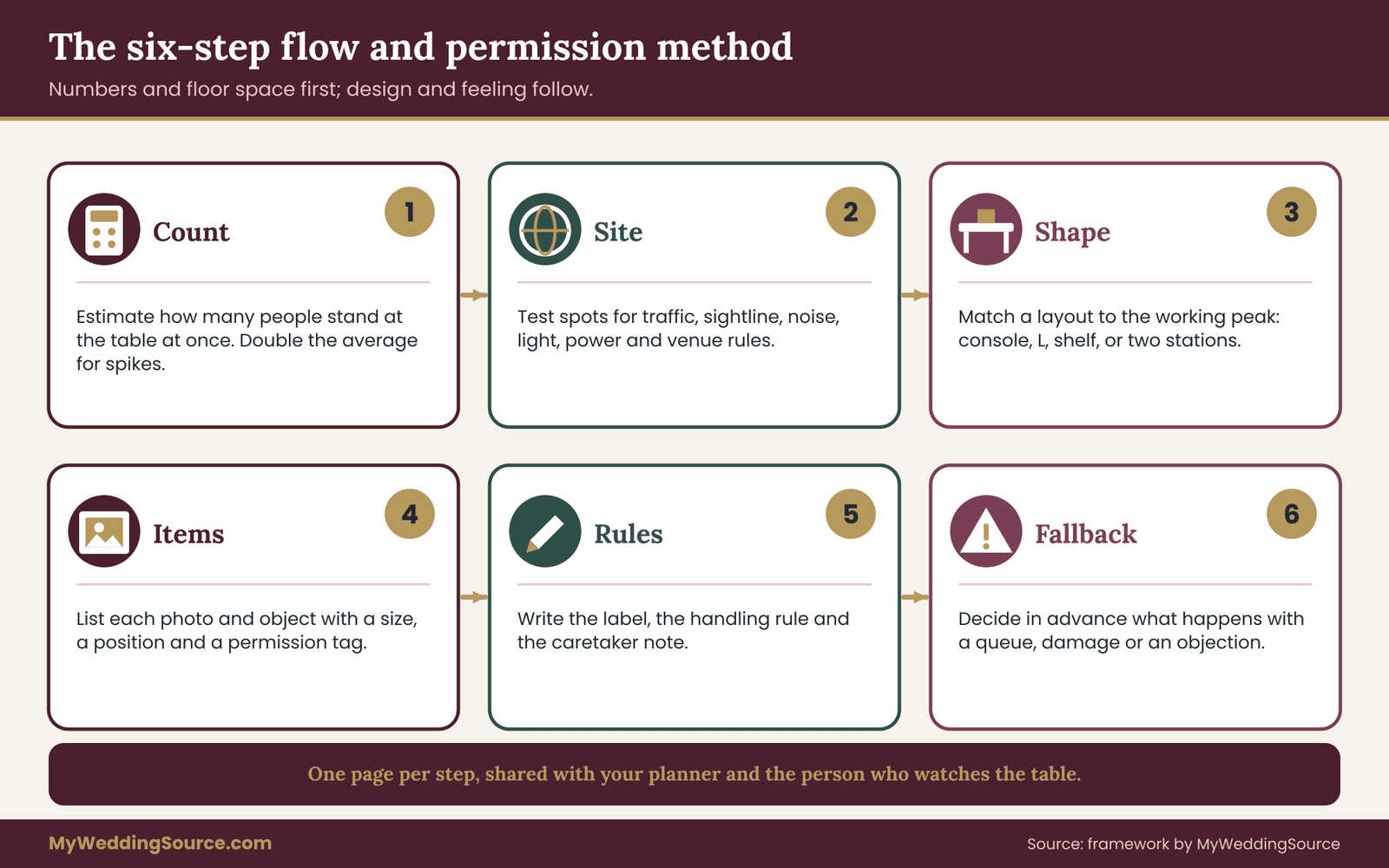
Notice what the sequence does. It puts arithmetic and floor space first and emotional design second, because a tribute that guests cannot approach does not honor anyone. It also puts permission inside the layout work rather than in a separate conversation that happens after the frames are bought. A photo that turns out to be unwelcome is cheap to replace in step four and painful to replace on the wedding morning.
A word about expectations. A memorial table does not need to be large to be moving. Many of the best ones are small, uncrowded and quiet. The method is meant to protect that quality, not to make the table grander. If your count shows that three people will be at the memorial table at once, you need about three people’s worth of frontage and clear space behind them, and you do not need more.
The dwell math: how many people stand at a memorial table at once
The central question for any memorial table is how many guests will be standing at it during the busiest few minutes. You can estimate this with a short calculation, and the calculation is useful even when the inputs are rough. The inputs below are planning assumptions that you adjust for your own wedding. They are not statistics.
The formula has four pieces.
Visitors. How many guests will actually walk up to the table? Start with your guest count, then multiply by the share you expect to visit. A wedding where the person honored was close to many guests, such as a parent or grandparent, sees a higher share than one honoring a distant relative.
Many couples assume that most guests will come by at least once, and a share of two-thirds to four-fifths is a reasonable cautious assumption if the table is easy to find. If the memorial table is hidden, the share falls, and that is not a success; it is a table nobody can see.
Peak share. Visits are not spread evenly. A large part of them arrive in the first stretch of whichever window opens the table. Assume that half of all visits fall in the first third of the window. That is a guess, and you can raise it if the table sits on the route out of the ceremony.
Dwell time. How long does one visitor or group stand there? A guest who glances at four photos and reads a label may stay thirty to sixty seconds. A relative who wants to talk about the person pictured may stay several minutes. Use a short typical dwell time for the math and treat the long stayers as the reason you add buffer space.
Window. The length of time in which the memorial table is open and guests are free to wander. A cocktail hour is often an hour. A table that is open only for a short interval before dinner has a much tighter window and a much higher peak.
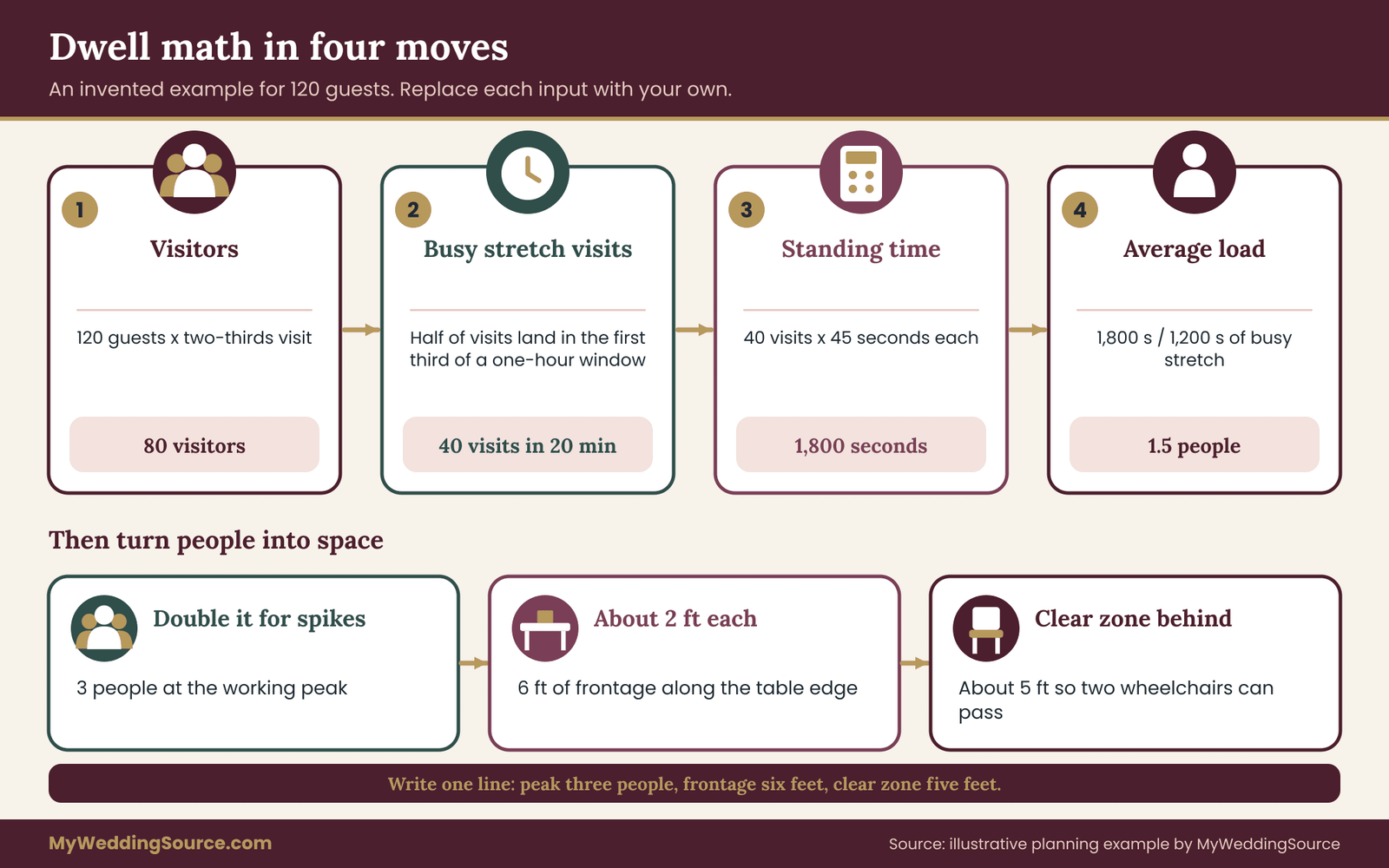
Here is the calculation in plain words. Multiply guests by the visiting share to get visitors. Multiply visitors by the peak share to get the visits that land in the busy stretch. Multiply those visits by the dwell time in seconds, which gives total standing time.
Divide by the number of seconds in the busy stretch. The result is the average number of people at the table at any moment during the busy stretch. Because average hides spikes, double it, and treat the doubled figure as your working peak.
Then convert people into space. Each person standing and looking needs some width along the table edge. A planning figure of about two feet of frontage per viewer is comfortable for adults, and a bit more helps for wheelchair users or for a guest holding a plate. Behind the viewers you need clear floor so others can pass. That clear zone is the part that most layouts forget.
A short example shows how the pieces fit. This is invented for illustration. Suppose 120 guests attend and you assume two-thirds will visit, which gives 80 visitors. Half of those visits land in the first third of a one-hour window, so 40 visits fall in the first twenty minutes.
Each visit lasts about forty-five seconds, so total standing time is 1,800 seconds. The busy stretch is twenty minutes, or 1,200 seconds. Divide 1,800 by 1,200 and the average is one and a half people at the memorial table. Doubled for spikes, the working peak is three people.
Three people at two feet each means about six feet of frontage, plus clear space behind them. A single small round table seldom offers that, and a short console or a long rectangular table does.
Reading the dwell math when the numbers get bigger
The example above produced a small number. Real weddings vary, and it helps to see how each input moves the result, because that tells you where to spend effort.
If the guest count doubles and nothing else changes, the working peak roughly doubles. If the window shrinks from an hour to twenty minutes, the same visits are squeezed into a third of the time and the average load triples. If dwell time doubles because you added long captions or a handwritten letter, the load doubles. The most powerful lever is rarely the guest count, since you cannot change that. It is dwell time and window length, and both are design choices.
Shorten dwell time with a legible, quiet layout: larger prints, a one-line label, good light. Lengthen the window by opening the memorial table earlier, such as during the arrival period before the ceremony, so that visits spread out instead of stacking. A table that is available from the moment guests sign the guest book through the end of cocktail hour has a far gentler curve than one that appears only when the cocktail hour begins.
There is also a floor to the calculation. Even when the average is under one person, you still want room for two or three guests at once, because grief does not follow averages. A relative who comes alone, a couple who stand close together, and a child who asks questions can make the table feel full even when the numbers say it is quiet. Treat three people as the minimum design size for any memorial table, and scale up from there when the math says so.
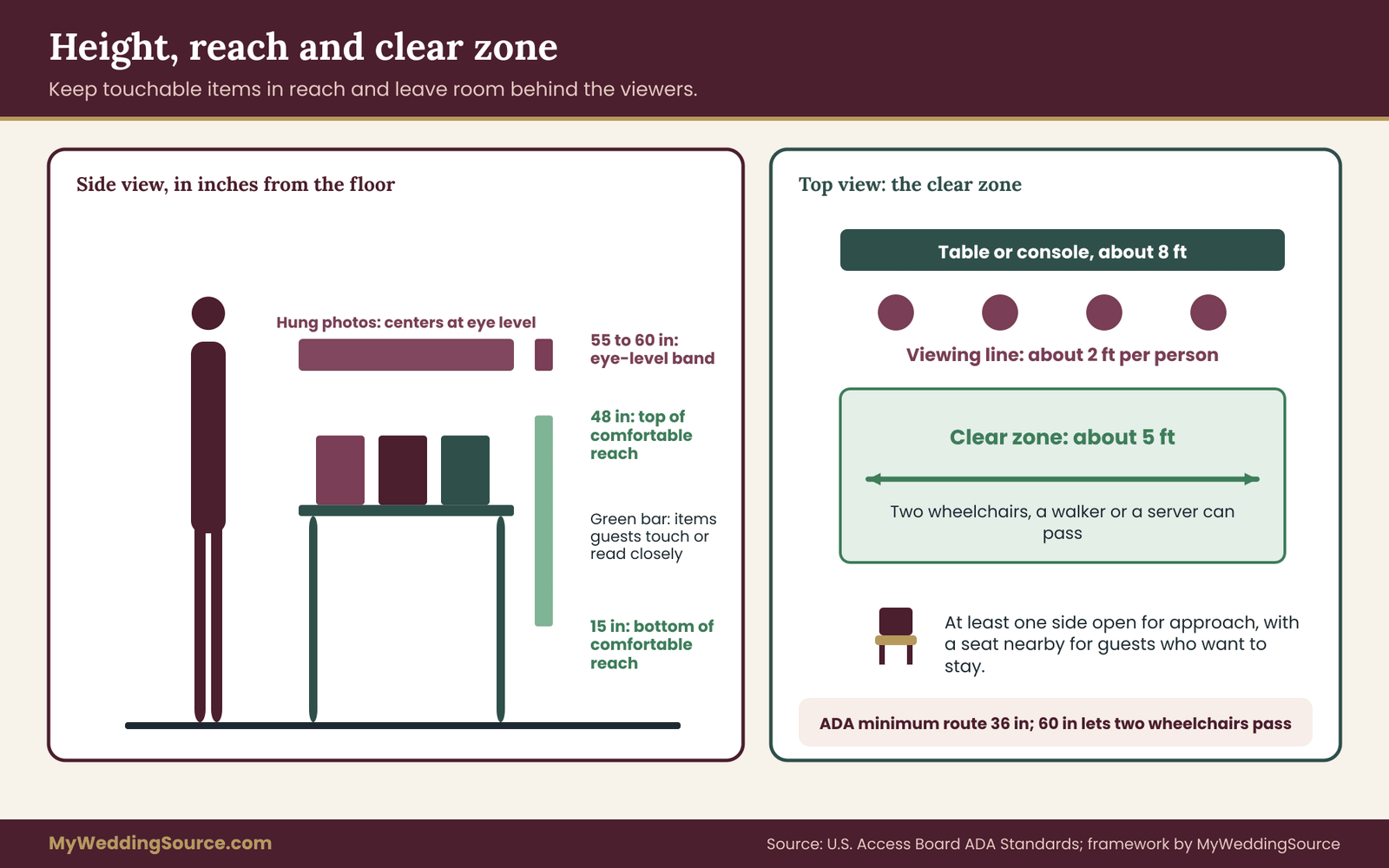
Round the result into a design brief with three numbers: the working peak (how many people), the frontage you need (peak times two feet, rounded up), and the clear zone behind the viewers. For the clear zone, accessibility guidance is a good yardstick. The ADA Standards treat a clear width of thirty-six inches as the minimum for an accessible route and sixty inches as the width at which two wheelchair users can pass each other.
Those are the federal design rules for public facilities, and they are a sensible target for a wedding even where they do not strictly apply. A clear zone of about five feet behind the viewing line lets a person in a wheelchair, a guest with a walker or a server with a tray pass without asking anyone to move.
Write the three numbers on one line. For the invented 120-guest wedding, the line reads: peak three people, frontage six feet, clear zone five feet. This single line is what you will use to test every site and every layout from here on.
A common mistake is to size the table by the number of photos instead of the number of people. Twelve photos can sit comfortably on a small table that nobody can reach. Six photos on a long console with a clear zone behind it can serve a crowd. Photos are the content; frontage and clear space are the capacity. Plan the capacity first, then fit the content into it.
Another mistake is to treat the dwell math as a precise forecast. It is a tool for catching big errors. If your layout offers four feet of frontage and the math says you need six, you have found a problem a month early, and you can fix it by lengthening the memorial table or adding a second station. If your layout offers eight feet, you can relax. The goal is to be roughly right in the right direction, not to be exact.
Choosing the site for a memorial table
With the design brief in hand, you can judge locations. A venue usually offers several possible spots, and the best one is seldom the most obvious. Walk the room, ideally with the planner or venue coordinator, and test each candidate against the checks below.
Traffic. Where do guests walk in the first ten minutes? Stand at the ceremony exit, the reception entrance and the bar, and watch how the flow moves. A site on the main route gets the most visitors and the most trouble. A site just off the route, visible from it, gets steady visits without stopping the stream. The best spot is usually a few steps to the side of the busiest path, at a place where a guest can turn off, look, and rejoin the flow.
Sightline. Can a guest see the memorial table from where they stand when they first enter the room? Visibility matters because a table that is found by accident is often found late, and the late visitors arrive in a lump.
Magnets. Note every feature that gathers a line: the bar, the guest book, the place-card display, the cake, the dessert table, the photo booth, the restrooms and the coat check.
Keep the memorial table at least a room’s width away from the bar line in particular, because people holding drinks and waiting are the most likely to bump into a display. The guide on wedding reception guest flow covers entry, seating, food and exit in more depth, and it helps to read the memorial table’s spot against that wider map.
Noise. A tribute loses something when the nearest speaker is playing dance music. Test the location with the venue’s sound setup if you can, or ask the DJ or band where the speakers and the loudest zone will be.
Light. Photos are hard to see in dim rooms, and candlelit tables look romantic in photographs and frustrating in person. Check whether the location gets daylight, overhead light or only spotlights, and whether a small lamp or picture light can be added without causing trouble.
Power and surfaces. If you plan a digital frame, a lamp or a small speaker, you need a safe outlet that does not require a cord across a walkway. Check that the surface is level, sturdy and cleared for decoration.
Climate and weather. For an outdoor memorial table, consider wind, direct sun and rain, all of which can damage prints. A table under a tent, an overhang or a covered porch is a safer choice than an open lawn.
Quiet exit. Can a guest who becomes emotional step away without crossing the whole room? A site near a side door, a patio or a hallway gives people a private moment without an audience.
After the walk, score each candidate against the design brief. Does it offer six feet of frontage and a five-foot clear zone? If a site fails one check, ask whether a simple change fixes it, such as moving a plant, shifting a rental table by a few feet or asking the venue to reposition a stanchion.

The memorial table sites that usually cause trouble
Some locations look appealing and then fail under real traffic. It helps to name them, so you can recognize them on the walk-through.
The entrance foyer. Guests arrive in a cluster, carrying gifts and cards, looking for the guest book and the seating chart. A memorial table placed there competes with every one of those tasks. It is visible, but it is also the point in the venue where the most people stop at once. If the foyer is the only possible place, give the table a corner, and keep the main doorway clear.
The bar wall. Bars have lines, and lines have people standing still with drinks. A memorial table beside a bar invites spills and awkward moments, and the tone clashes with the party atmosphere.
The dance floor edge. A table near the dance floor will be bumped, and the music will compete with any quiet reflection. The photos may also be at risk from a celebration that has moved beyond the dance floor.
The head table. Putting a memorial table beside the couple’s own table keeps it close and visible, but it keeps it on public display and gives guests no privacy. Some couples like the closeness. Others find that guests feel they cannot approach.
The hallway outside the ballroom. Hallways are narrow by design. A table in a hallway forces visitors to stop in a passage that other guests need, and it leaves no clear zone.
The restroom corridor. The traffic is steady, and the setting is an awkward fit for a tribute.
By contrast, good sites tend to share a few features: a wall or corner behind the table so that the display has a back, an open side or two for approach, a little distance from sound and lines, and an easy way to step out.
A quiet alcove, a bay window, the end of a lounge area, or a patio nook often fits that description. A venue with a library, a lounge or a secondary room can offer a calmer setting, and it may be worth asking whether a room that is not used during cocktail hour could host the display.
One more practical check concerns the venue’s rules. Many venues limit what can be attached to walls, where candles can burn, how items can be hung, and what can be placed on historic furniture or in front of exits. Ask the coordinator for the venue’s decoration policy in writing, and keep the answer with your planning notes. Getting approval early for anything you place or attach is the same habit that keeps signs and other displays on schedule.
When two sites are better than one
Sometimes the math is clear that one table cannot handle the load. A large wedding with a popular relative honored, a short window, or a cramped venue can produce a peak of six or eight people. Rather than building one very long table, consider splitting the display.
A split works well when the people honored fall into natural groups. For example, one station for the couple’s grandparents near the ceremony exit and another for a parent and a close friend near the reception entrance. Each station is small, and each has its own frontage and clear zone. The load is divided, and the emotional tone of each station stays quiet.
A split also works when the layout offers two weak sites instead of one strong one. Two small stations in two calm corners can be better than a single large display at a crowded entrance. The trade-off is that guests may miss one of them, and the caretaker has two places to watch. Handle that with a simple sign or a mention in the program that tells guests where each station is.
A second approach is a short main table plus a screen or a printed page. The table carries a few key photos and objects. A slideshow on a small screen or a page in the program holds the rest.
Guests who want to linger can look at the slideshow, which does not require standing in front of the memorial table, and guests who want a quick moment can use the table. This approach cuts dwell time at the table and keeps the broader tribute available. If you use a screen, remember that it needs power, a stable spot and a looping setting that does not require anyone to operate it.
Layout shapes for a memorial table, and how large the photos should be
Once the site is chosen, the shape of the display decides how guests approach it. The shapes below are the ones that come up most often. Each has a different frontage, a different effect on traffic, and a different best use.
The single round table. This is the default, because round tables are plentiful at any venue. Its weakness is frontage. Only the front arc faces the room, and when it sits against a wall, the viewing edge is cut roughly in half. A round table suits a very small display, perhaps four or five photos and a candle, and a modest peak of two or three people. It is the shape most likely to create a ring of people three deep.
The straight console or rectangular table against a wall. A long, narrow table against a wall gives a single viewing line, and that line can be as long as you need. Guests stand in a row along it, like a gallery. This shape has the best frontage for its footprint, and it is easy to light with a wall sconce or a picture light. Its weakness is that everyone faces the same direction, so the viewing line forms a queue if the peak is high.
The L-shape. Two tables or a table and a wall panel meeting at a right angle create a corner where guests can step in. The L gives two viewing lines and a natural pocket for a private moment. It works well in an alcove. Its weakness is that the inner corner can trap a person, so keep the opening wide enough that a guest can leave without asking others to shift.
The open front, with items on a stepped ladder or shelf. A freestanding shelf or an easel set lets you build upward instead of outward. Frontage per item rises because items sit at different heights, and the footprint stays small. This is a good fit when the room is tight and the number of photos is high. It needs a stable base and a check that nothing can topple.
A wall display with a small shelf. Photos hang on the wall, with a narrow ledge below for a candle, a flower or one object. Wall displays have the smallest footprint and the cleanest sightline. They require permission to hang anything on the wall, and a clear plan for removal that leaves no marks. Some venues will not allow it, which is why the policy check in the site step comes first.
The wandering or mobile display. A photo on an easel at the ceremony entrance, a small frame on a chair at the front row, or a printed page in the program is a gentle way to include someone without a station at all. These pieces cost nothing in frontage and add nothing to queues.

Choose the shape by matching it to the working peak and the clear zone. A peak of two or three can be served by a round table in a quiet corner or a short console. A peak of four to six needs a long console, an L or a split into two stations. A peak above six calls for a second station, a slideshow or both. If you cannot find the space, shrink the dwell time instead: fewer words, larger prints, better light.
Approach sides and flow direction
Whatever shape you use, think about how guests arrive and leave. The ideal is a one-way feel, even if no one is told to follow it: guests enter from one side, look, and leave from the other, without turning around in a narrow gap. An L in a corner, with one open side and one lead-in, can do this. A console along a wall can do it if the table is long enough for guests to drift along it.
Avoid placing a barrier, such as a plant, a rental screen or a stack of chairs, that forces guests to retrace their steps. And avoid putting the display’s open front against a pillar or a door swing, which narrows the approach and makes the clear zone smaller than it looks on paper.
Photo size, count and height
Guests look at a memorial table briefly. They want to recognize a face and absorb one clear idea. A photo that needs squinting costs dwell time and builds the crowd.
Size. As a working rule, the main photo of each person should be large enough to read at arm’s length: an eight-by-ten-inch print is a common and comfortable starting point, and smaller prints can sit beside it as supporting images. If the table has many people to honor, give each person one primary photo and at most two secondary ones, so that the visual field does not become a collage.
Count. More photos do not make a better tribute. They lengthen the dwell time and increase the number of places a guest looks. A dozen well-chosen images are often too many for a standing visit, and four to six can say everything. If a family has a large archive, use it elsewhere: an album, a slideshow, a framed collage in the foyer, or a page for guests to flip through at a seat.
Height. Place primary photos so the center of the image sits near standing eye level, roughly in the range of fifty-five to sixty inches from the floor, with seated guests in mind as well. A photo that is too low forces a guest to bend.
A photo that is too high is out of reach of wheelchair users and children. ADA guidance on reach ranges puts the comfortable range for a person seated in a wheelchair between fifteen and forty-eight inches. Keep any item you expect guests to touch or read closely within that range, and keep the rest in the eye-level band.
Frames and mounting. Lightweight frames with a stable base, or photos mounted on foam board or in standing holders, resist knocks better than heavy glass and fragile easels. Avoid free-standing frames near the front edge of a table, where a sleeve or a bag strap can catch them. Keep a few inches of margin between the edge and the nearest item.
Matting and glare. Glass reflects overhead lights and can make a face hard to see. Matte finishes, non-glare glass, or a protected print without glass reduce reflections. Whatever you choose, view a test print in the actual room, at the actual time of day.
Color and condition. Old photos can be faded, torn or creased. A high-quality scan, printed on good paper, is a safer display choice than the original, and it protects the family’s only copy. The original can stay in an album at home, and the print can be replaced if it is damaged. This also removes the worry of an irreplaceable object left unattended in a crowded room.
Objects. Objects add warmth: a watch, a hat, a recipe card, a pair of reading glasses, a small tool. They also create handling questions. Decide in advance whether the object may be touched, and mark it accordingly. If the object is valuable or fragile, use a replica, a photograph of the object or a small card describing it, and leave the original at home.
Giving each photo a permission tag
A memorial table is a public display of a private person, and the people who loved that person have a right to a voice in it. The guide on wedding photography consent covers consent for guest photos and the way images are used, and the approach there applies in a smaller form here. This section gives you a quick method for tagging each photo on the memorial table, so that the display plan and the permission plan travel together.
The method has no complicated forms. It uses three tags and a short log.
Green: cleared. The person closest to the one honored has said yes to this photo, and anyone else clearly pictured has no objection. A green photo can be printed, displayed and, if the family agrees, shown in a slideshow.
Amber: conditional. The photo can appear with a change, in a limited way, or only in some forms. An amber photo might need to be cropped to remove a person who does not wish to be pictured. It might be allowed on the table but not in the slideshow. It might be fine in print but not for posting online afterward. The condition is written next to the tag, so no one has to remember it.
Stand-in: replaced. The photo stays at home, and something else takes its place: a candle, a name card, a favorite flower, a printed phrase, an object. A stand-in is not a lesser tribute. It is the answer when a photo is unwelcome, and it keeps the table’s balance.
If a photo cannot be tagged green, amber or stand-in because no one has answered, treat it as a stand-in until someone does. Silence is not a yes. That rule saves more difficult conversations than any other.

The permission log
Keep a single page with one line per item. Each line records the item, the tag, the name of the person who gave the answer, the date, and any condition. This log is for you and your planner, not for guests.
It takes five minutes to build and removes arguments later, because the record shows what was agreed. When a relative says “I never said that photo could be there,” you can look at the line and answer gently, and when you need to swap a photo at the last minute, you know which ones are clear.
Who counts as the person to ask? For a parent, the surviving spouse and the adult children usually come first. For a grandparent, the grandparent’s children. For a friend, the closest family or whoever holds the photos. The relationships vary, and the question is not who is the most senior but who feels most connected to the person and the picture. If two people hold equal standing and disagree, the more cautious answer wins for the memorial table, and the other can be accommodated elsewhere.
You also need to think about the living people in each photo. A group shot may include relatives who are not on good terms with each other, children whose parents prefer them not to appear in public displays, or guests who do not want to be seen at all. Crop or replace those photos. A photo that works at a private family gathering may not work on a table seen by every guest.
For the broader question of how couples and families share decisions like these, the guide on wedding decision rights offers a way to set who decides what, and it can help when relatives hold different views about the memorial table.
Printing and copyright, kept short
A family photo is usually the property of whoever took it, or their heirs, and a professional photographer may hold the copyright in a studio portrait. For a private display at a wedding, most people never run into a problem, but printing from a studio portrait or an online album can come with rules about copies.
Check the terms on the original, or ask the photographer, if the image came from a professional session. The U.S. Copyright Office publishes plain-language basics for anyone who wants to read the rules at the source.
Pay attention to printing services. Many photo labs refuse to print images that look professionally shot, such as portraits with a studio watermark, without a release. Ask early, because a refusal on the week of the wedding is stressful.
Labels, timing and light: keeping visits short and kind
A guest standing at a memorial table is deciding in seconds whether to stay or move on. Three details shape that decision more than anything on the table itself: the label, the timing and the light.
One short label, not a wall of text
Most guests who approach the memorial table do not know everyone on it. A new spouse’s college friends have never met the groom’s late grandfather. A sibling’s coworkers do not know the bride’s aunt. A label gives them a way in without a conversation.
Keep the label short. A name, the relationship to the couple and, if the family wishes, a single line about the person is enough. “Frank Delgado, Maria’s grandfather, who taught three generations to dance” does the work in one breath. Long biographies belong in a program page, an album or a toast, where a guest can read sitting down.
Put the label where the eye lands naturally, below or beside each photo, in a type size a guest can read from two feet away. A card with a clean serif or sans-serif font at a modest size is easy to read in low light. Avoid script fonts on small cards, which become hard to decipher in a dim room. The guide on wedding signage goes into readability and placement in more detail, and the same rules about contrast and size apply to a small card.
One general sign for the whole table can say what it is and, if you want, invite guests to pause. A line such as “With us in spirit” or “Remembering those we love” tells guests what they are looking at and gives them permission to be quiet. Avoid instructions that sound like rules, such as “Please do not touch,” in favor of a calm description. If an item is fragile, a small card that says “Please look, and leave it in place” works better than a warning.
Handwritten cards add warmth, and they also add reading time. Use handwriting for a single heartfelt note, not for every label.
The question of names and sensitive details
Some families prefer to leave out dates, causes of death or the full history. Others want them included. Ask, and follow the wish. If you do not know, use only the name and relationship, and leave the rest out. A guest who wants to learn more can ask a family member.
For a person who has died recently, an extended family may be raw about seeing the display at all. Ask the closest relatives whether they want to see the memorial table before the event, and whether they would prefer a quiet moment alone with it before guests arrive. A private preview, even for five minutes, can matter a great deal to someone who would otherwise meet the display in a crowd.
Timing: when guests visit the memorial table
Timing is a flow lever as strong as the table’s size. Think through the day and decide in which windows the memorial table is open, which windows are the busiest, and which windows are quiet.
Before the ceremony. If the table is available as guests arrive and take their seats, visits spread over a long window and the peak is low. This is especially useful when the ceremony site has a space near the entrance or a gathering area. Some guests will visit once they sit, and the early opening reduces the later crush.
Right after the ceremony. This is the most likely time for a rush, because guests move together to the reception area. If the memorial table sits on the path from ceremony to cocktails, expect a spike. Spread it by placing the table a little off the main path and by letting the couple’s photographs absorb part of the cocktail hour, so that guests are not all released at the same moment.
During cocktail hour. This is usually the best window. Guests are mingling, they have time, and the mood invites a quiet moment. The window is long enough to dilute the peak, provided the memorial table is not competing with the bar line.
At dinner. Dinner seating can create a second small wave if guests are directed to their tables, and a table near the dining room doors will see people pass. A table placed in the dinner room itself, away from the main aisle, can remain visible without catching all the traffic.
After dinner. A slow, quiet period sometimes follows toasts and cake. A memorial table is still available to guests who want to visit away from the crowd, but this window comes with a different risk, which is unattended objects. Decide who is watching it, and whether it should be taken down before the dancing begins.
If a toast or a spoken tribute is part of the evening, think about how it affects the table. A tribute spoken near the table draws a crowd at once. A tribute spoken from the head table sends guests to the memorial table afterward in a wave. Mention the memorial table in the toast only if you have planned for the peak. If you are weaving a remembrance into a speech, keep the table’s capacity in mind.
Light that lets guests read a face
Dim venues are common at receptions, and a memorial table can fade into the dark. Test the light early.
Warm, soft light shows faces better than harsh overhead light. A small lamp, a battery-powered picture light or a few LED candles can bring up a display without adding heat. For an outdoor table at dusk, check that the light will not flicker in the wind.
Real candles are a venue question and a safety question, and many venues ban open flame or restrict it to enclosed holders. LED candles give the glow with none of the risk, and they are a safe default near paper, fabric and flowers. If you want a real flame as part of the tribute, ask the venue, and keep it in a deep, stable holder away from the edge of the table.
Test the placement at the hour of the event. A table that looks bright at noon can look dark at seven. A ten-minute check at the same time of day, with the room lights at the level the event will use, is worth more than hours of guessing.
Setup day, safety and venue rules for a memorial table
Setup is where good planning either holds or fails. The memorial table should be built early, in a quiet period, by someone who knows the plan.
Build it in advance. Aim to finish before the first guest arrives, and before the photographer begins room shots. A rushed setup is how a photo ends up face down or a candle ends up near a napkin. If the venue allows early access, assemble the memorial table during a setup window, check the sightlines and then step back.
Test it by walking it. Stand where a guest will stand and look at it. Check that the photos can be seen from the front. Check that the nearest guest does not block a door or the path to the bar. Ask someone to walk past it with a drink in hand, and see how close they come to the edge.
Secure what can fall. Use museum putty or small adhesive dots to hold frames in place. Tape a small piece of non-slip material under easels. Keep the heaviest or tallest items toward the back, and keep cords taped flat or routed behind the table.
Keep flowers and food away. Water from a vase, wax from a candle or a crumb from a canapé can damage a print. Use a tray or a non-slip mat under any vase, and avoid placing food or drink on the table. A small sign may help, but a good layout with a clear edge helps more.
Reach and wheelchair access. Leave a clear approach to at least one side, with enough room for a wheelchair or walker. The federal accessibility guidance gives a clear floor space of thirty by forty-eight inches as the space needed for a person using a wheelchair to approach an element, which is a useful figure when you set up the front of a table. Keep a seat nearby, because some guests, especially older relatives, may want to sit near the memorial table for a while.
Fire and exits. Never block an exit, an aisle or a fire-safety feature. Venues and local fire officials have rules about candles, decorations and clearance, and the National Fire Protection Association publishes codes that many jurisdictions follow. Ask the venue for its rules in writing, and follow them. If the venue’s rules conflict with your layout, the venue wins.
Hanging and attaching. Many venues forbid nails, tape or adhesive on walls and historic surfaces. Ask what is allowed. If hanging is not allowed, use a freestanding display, an easel or a shelf, and secure it according to the venue’s instruction.
Weather and outdoor risk. An outdoor table needs protection from wind, rain and sun. Use weights on lightweight displays, shield prints from direct sun, and plan a backup indoor spot. If rain arrives, someone should know who will move the memorial table, where it will go and what the backup arrangement looks like. The guide on wedding rental planning covers tables, linens and other rentals, and it is useful for confirming that the surfaces you plan to use are in the order.
Photographs of the table. Your photographer will likely want a shot of the memorial table, and some relatives may want to photograph it too. Tell the photographer in advance where the table is, whether any items should not be photographed, and when the best, calmest moment is. A shot with no guests, taken before the doors open, is often the most peaceful one. If any photo on the memorial table is amber, mark it so the photographer knows what can be shared online.
A short setup checklist in prose. Before leaving the table, confirm four things: the label is readable, the frames are secure, the clear zone is open and the caretaker knows what to do. If you can answer yes to each, the table is ready. If you cannot, fix it now, because after doors open it becomes much harder.
Who looks after the memorial table
A memorial table without an owner is a table that will be moved, bumped or forgotten. The owner does not have to be formal. They need to know the plan, have a few minutes at key moments and feel free to act.
Choosing a caretaker
Pick one person for the memorial table, and name a backup. Good caretakers are close enough to the family to be trusted with delicate items and relaxed enough not to hover. A cousin, an aunt, a close friend or a member of the planning team can all serve. Avoid asking the couple, who have plenty to do, or the person most affected by the loss, who should be free to simply be a guest.
Give the caretaker a one-page note, not a long briefing. The note covers the table’s location, the photos and objects on it, the permission log, the rules for handling, the times when the table is open and what to do if something goes wrong. It also names a person to call if a family member objects, which is usually the couple’s planner or a parent.
If the venue or planner provides a coordinator, tell them about the memorial table and who owns it. A coordinator can quietly redirect a crowd, relocate a displaced item or alert the caretaker, and a short walk-through before the event makes this easy. Lean on the planner or coordinator you already have, and ask them to add the memorial table to their running notes.
What the caretaker does during the event
The role is small, and it has three moments.
Before doors open. Check the table against the setup list: labels visible, frames secure, candles or lights working, clear zone open. Take a quick photograph of the table as it looks, which becomes a reference if something shifts.
During peaks. Stand near, not at, the memorial table. If a crowd forms, a gentle word can help: offering to hold a drink, inviting someone to step forward, suggesting a second look later. Do not police the table or shoo people, since the point is to protect a quiet space. If a guest handles an object, thank them and, if needed, return it to its place afterward without comment.
At the end. Decide in advance when the table comes down. Some families want it to stay through the last dance. Others prefer to take photos and objects home before the party gets loud. Whichever you choose, the caretaker collects the items, checks that nothing has been left behind and hands everything to the person responsible for returns.
Returning photos and objects
Items that came from a family member should go back to that family member, with a note in the permission log. Do not leave them in a venue’s lost-and-found, in a vendor’s van or in the trunk of a car overnight. Assign a specific person to take each item home and confirm that it arrived.
If a photo belonged to someone who could not attend the wedding, such as a relative who lives far away, plan how it will be returned. A shipping envelope, a photograph of the print and a handwritten note often matter as much as the display itself.
After the event, a short note to each person who lent an item is a kind and simple gesture. Mention what they lent and how it was used, and thank them. It closes the loop and builds trust for future occasions.
Making the memorial table safe from guest photos and posts
Guests will photograph the memorial table, and some will post those photos online. That may be fine, and it may not be. A family that kept a loved one’s photo private for years may be unprepared to see it on a stranger’s feed.
If any photo on the table is amber or restricted, say so in the permission log and let the photographer and caretaker know. A small, calm note near the table can state the family’s wish without sounding like a rule, such as “Please enjoy these photographs in person.” For the wider picture of guest photography and sharing, the photography consent guide mentioned earlier is the right place to look for wording and boundaries.
If the memorial table includes children’s faces, extend the same care. Parents may not want a child’s image shared widely, and a quick check before printing avoids awkwardness later.
A worked case: one invented couple, one room and one table
The following example is invented to show the method at work. The people and numbers are made up. The reasoning is the part to borrow.
Priya and Daniel are planning a wedding for 120 guests. The reception will be in a restored hall with a long lobby, a main room with a dance floor, a bar along one wall and a small side lounge. They want to honor three people: Priya’s grandfather, Daniel’s mother and a close family friend who died two years ago. All three had family and friends in the room.
Step one: count. Priya and Daniel assume two-thirds of the guests will visit, which gives 80 visitors. They expect half the visits in the first third of the cocktail hour, so 40 visits in twenty minutes. They use a dwell time of forty-five seconds, and they know two of the three honored people have large circles, so they allow some longer visits.
The math gives an average of about one and a half people at the table and a working peak of three. Because three people are being honored and some relatives may linger, they raise the design peak to four. That means eight feet of frontage and a five-foot clear zone.
Step two: site. They walk the hall with the coordinator. The lobby is the first choice for visibility, but it is the arrival crush point and has a narrow door. The bar wall is out. The edge of the dance floor is out.
The side lounge is quiet, has a window, a low bench and a wall with space for a long console, and it is a few steps off the cocktail route. They choose the lounge and plan a small sign in the lobby and a line in the program to point guests there. The lounge door stays open so the table is visible from the corridor.
Step three: shape. The lounge wall can hold a console about eight feet long. They choose a straight console against the wall with an L-shaped return at one end, formed by a short side table, which gives a pocket for a person to step into and a second small viewing line. The bench stays beside the display for anyone who wants to sit.
Step four: items and permission. Each honored person gets one eight-by-ten primary photo and one smaller supporting photo, six prints in all, plus one object: Priya’s grandfather’s reading glasses, shown in a photo rather than as the real pair.
Daniel’s mother’s photo is a family portrait, and Daniel’s sister, who is pictured, prefers not to be in a public display, so they crop the print to show only his mother and mark it amber, with the note “crop only, no posting.”
The family friend’s relatives were hard to reach by phone and had not answered by the print deadline, so that line becomes a stand-in: a candle, a name card and a single flower, while they wait for an answer. When the relatives reply with a photo and a yes, the photo is added the week before, and the tag becomes green.
Step five: rules. Each photo has a short label with the person’s name and relationship. A general sign reads “Remembering those we love.” The table opens as soon as guests arrive, because the lounge is part of the arrival area, so the load is spread over about ninety minutes. LED candles replace real flames, in line with the venue’s policy. A cousin, Mina, is named caretaker, with a backup, and gets a one-page note with the permission log.
Step six: failure and fallback. If more than five people are waiting at one time, Mina will invite guests to return later and tell the coordinator, who will propose that the planned slideshow begin in the lobby. If a family member objects to a photo on the day, Mina will move the item to a stand-in position, a card or a candle, without debate, and tell the planner. If a frame is damaged, there is a spare print in the folder.
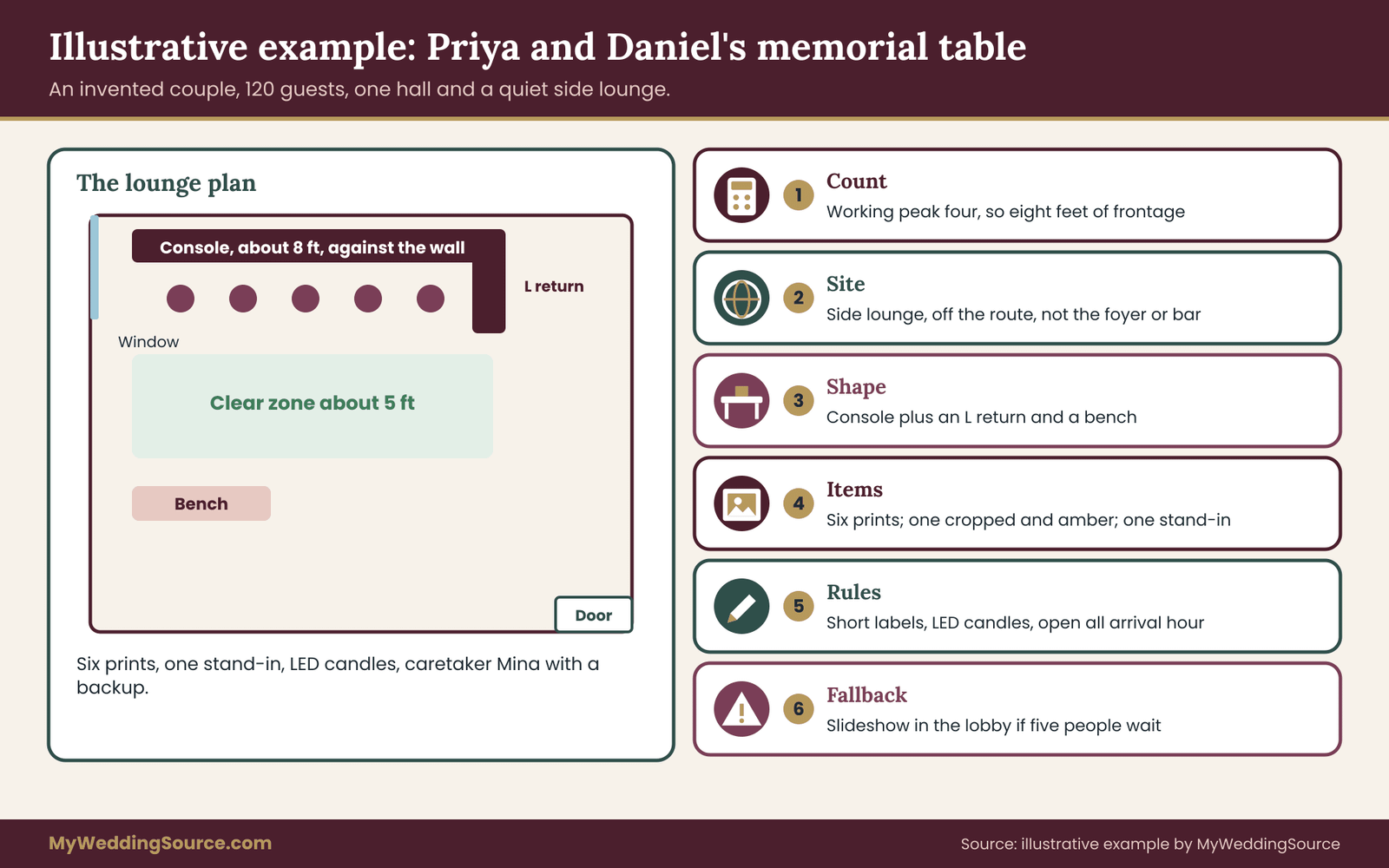
What happened in practice is not part of this example, because the example is a plan, not a report. The point is that every choice is traceable to a number or a rule: the lounge was chosen because it fit the clear zone, the L-shape was chosen because it gave two viewing lines, and the stand-in was chosen because silence is not consent. If a relative asks why the memorial table is in the lounge, the couple can answer without hesitation.
What the example leaves out on purpose
Priya and Daniel’s plan does not try to dictate how anyone should feel. It does not predict that guests will cry, or that the table will bring comfort. It provides a calm space and a clear process, and leaves the feelings to the people who have them. That restraint is part of the design. A memorial table works best when it makes room for grief and joy together, without insisting on either.
The plan also does not claim to be the only way. A couple with a small guest list and a quiet reception may need only a single round table and a candle. A couple with a very large guest list may need two stations and a screen. The method is the same, and the numbers will be different.
Failure conditions, fallbacks and alternatives to a memorial table
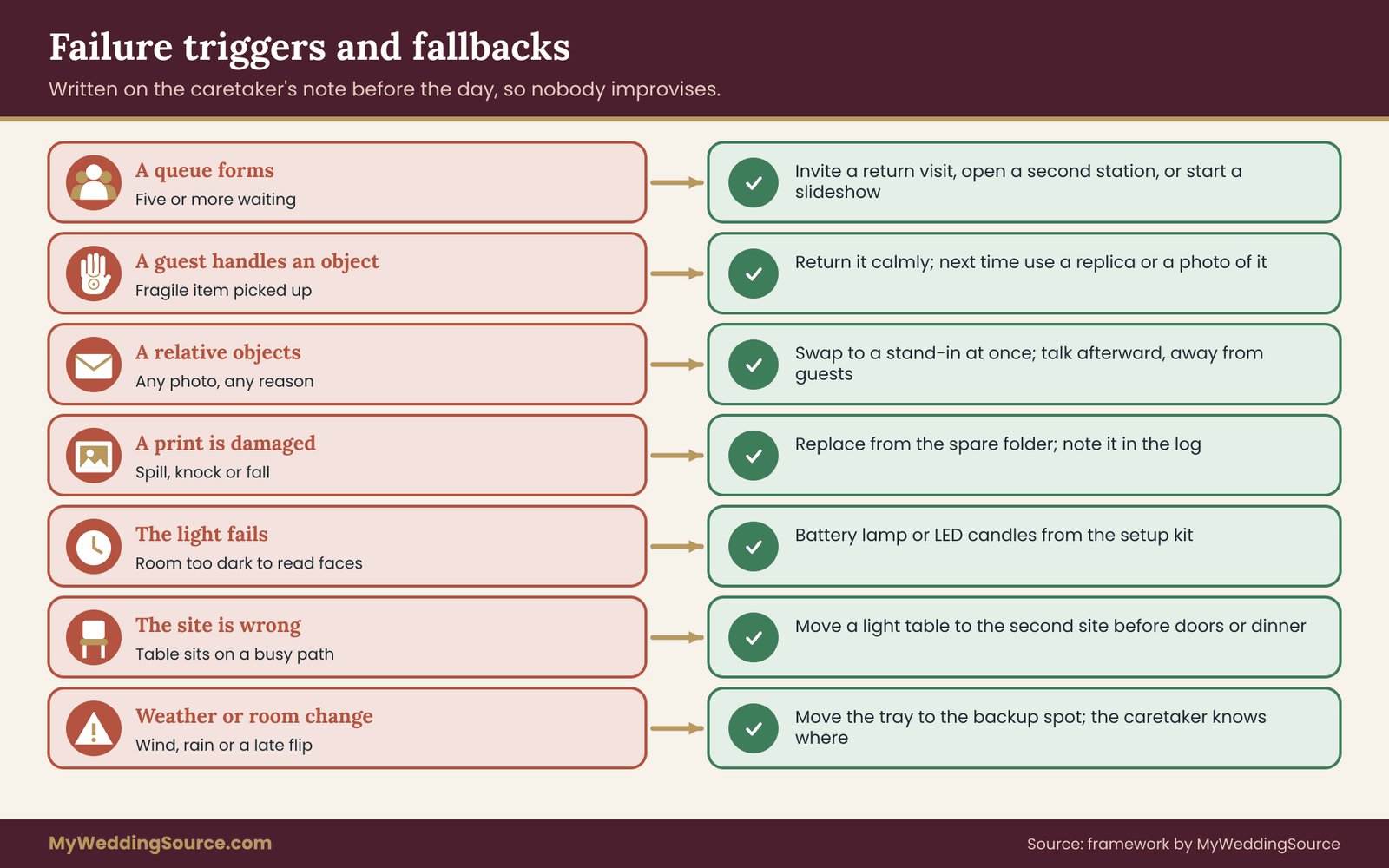
A good plan states how it can fail. The conditions below tell you when to change course, and the fallbacks tell you how. Write the ones that apply to your wedding on the caretaker’s note, so that nobody has to improvise in a crowded room.
Seven failure conditions and what to do about each
A queue forms. More than four or five people waiting at once, or a line that reaches a doorway, bar or aisle, means the table is under-sized for the moment. Fallbacks, in order of effort: invite guests to return later, open a second small station, start a slideshow in a different room, or move a few photos to a program page. Do not shorten the table’s story to speed people along. Spread them out instead.
A guest handles an object that should not be handled. This is a layout failure more than a guest failure. Move the object back, and use a replica, a photo of the object or a small acrylic stand next time. If the object is valuable, remove it from the memorial table and keep it at home.
A family member objects to a photo. Honor the objection at once, without debate. Replace the photo with a stand-in, and update the permission log. Offer to talk afterward, away from guests. The point is to protect the relationship, and a swap takes a minute.
A photo is damaged, lost or moved. This is why you print from scans and keep spares. Replace it from the folder, and note the incident in the log. If the original was used by mistake, set up a protected copy afterward and return the original to its owner.
The light fails or the room is too dark. Add a battery lamp or LED candles from the setup kit. A small flashlight in the caretaker’s pocket is sometimes the most useful tool of the night.
The table is in the wrong place. If the table turns out to sit on a busy path, a calm corner is a short move away. A caretaker and a coordinator can shift it before doors open, or before dinner service. Moving a light table is easier when it was built to move: foam-board prints, lightweight frames and a single tray.
Weather or venue changes. A thunderstorm, a late room flip or a different layout may take your chosen spot away. Keep a second site in mind, and tell the caretaker where it is.
Alternatives that need little or no floor space
Sometimes the best answer to the numbers is a smaller or different kind of tribute. These options can replace a memorial table or sit alongside it. They are not lesser forms of remembrance. Each one fits a different room and a different family.
A program page. A page or a half page in the printed program carries names, a short line and, if the family agrees, a small photo. It reaches every guest, costs no floor space and cannot be knocked over. The guide to wedding etiquette can help with wording that keeps the tone warm and respectful.
A reserved seat. A chair in the front row, with a flower or a small card, honors someone without a display. It adds nothing to the traffic, and it draws the eye at a quiet moment. Check that the seat will not be taken by a late guest, and let ushers know.
A moment in the ceremony. A sentence in the officiant’s remarks, a reading, a moment of silence or a candle lit at the start can say what a table says, in less than a minute. The ceremony step-by-step guide shows how such a moment fits into the order of events without taking over the service.
A digital frame or looping slideshow. A small screen shows many photos with a small footprint, and it can sit in a quiet corner or in the lobby. It needs power, a stable surface and a file that loops without anyone starting it. It also needs the same permission tags as prints, since digital images travel more easily. Keep the loop short, and put a label on the screen so guests know what they are seeing.
A guest note station. Guests write a memory on a card and leave it in a box or on a ribbon. This turns visitors into participants, and the cards become a keepsake. It does increase dwell time, so use it only where the table has room, and offer pens and cards at a separate spot rather than at the display itself.
A single object or flower. A bouquet carried in memory, a boutonniere, a charm sewn into a hem or a flower placed on a chair is a private way of carrying someone along. It needs no photo and no frontage, and it needs no permission from anyone beyond the couple, unless an object belongs to a relative.
A moment at the cocktail hour. A short pause, with a drink raised, honors everyone at once. It requires no display at all.
Edge cases that deserve a sentence each
A very recent loss. When a death occurred within weeks or months of the wedding, relatives may find a public display hard. Ask the closest family whether they want a table at all, or whether a quieter form feels better. Do not use the dwell math to argue the point; use it only after the family says yes.
An estranged or complicated relationship. Some of the people you hope to honor may have had hard histories with relatives who are attending. A photo or name that seems gentle to you may be painful to someone else. When in doubt, use a stand-in, and let the people who know the history decide.
Multiple traditions. Families with different customs may have different expectations about displaying photos of the deceased, using candles or marking the dead. Ask for guidance from the relatives who hold the tradition, and follow it. If expectations differ, a program page or a private moment may be a way to include everyone without forcing a single answer.
A lot of people to honor. If you want to remember more than five or six people, a single table becomes crowded. Consider a gallery wall, a shared album or a short roll of names read aloud, in addition to a smaller table with a few photos. Say something to the families so no one feels left out.
An indoor-outdoor wedding. A table may need to move between spaces. Build it on a tray that can be lifted by two people, and decide in advance who moves it and where it goes.
A venue that restricts decoration. If the venue allows only freestanding items on specific tables, check which ones are allowed. If the display must be minimal, the program page or the reserved seat may do the work the memorial table cannot.
A destination or travel wedding. Carrying framed photos by air is a hassle. Print on site, use a digital frame or carry thin prints in a flat folder. The guide to the wedding cocktail hour can help you think through where a quiet display fits in the part of the day when guests mingle.
How to know the table worked
A memorial table worked if guests could find it, look at it without waiting, and leave without having to squeeze past anyone. The most reliable sign is that the caretaker had very little to do. Afterward, a short note to yourself is useful: when the peak was, how many people stood at once, where the crowd formed and what you would change. If you are helping a friend or sibling later, the note is the most useful thing you can pass along.
A table that is quiet is not a failed tribute. Many guests will look in silence and walk away, and a few will stay a long time. Both are valid responses, and the layout’s job is to allow both.
Your next steps
Work through these in order, and write each answer on one page that you can share with your planner or caretaker.
- Count. Write your guest count, your assumed visiting share, your busiest window and your dwell time. Run the dwell math, double the average and round up. Record the result as the working peak, the frontage and the clear zone.
- Walk the venue. Visit the room at the hour of the event if possible. Score two or three candidate sites against traffic, noise, light, power and the venue’s rules, and ask for the decoration policy in writing.
- Choose a shape. Match the working peak to a layout, and decide whether you need a second station, a slideshow or a program page.
- List every item. For each photo and object, record its size, its position, its permission tag and who gave the answer. Treat any unanswered item as a stand-in.
- Write the rules. Draft the labels, the general sign, the handling rule and the one-page caretaker note, and name a backup.
- Plan the failures. Choose your fallback for a queue, a damaged photo, an objection and a change of site.
- Plan the return. Assign a person to take each item home, and plan thank-you notes to the families who lent them.
If you do only one thing this week, do the first one. A single number, the working peak, will tell you whether you need a corner, a console or a second station, and it settles most of the arguments before they start.
FAQ
How big should a memorial table be?
Size it by the number of people who will stand there at once, not by the number of photos. Estimate the busiest stretch, double the average load for spikes, and allow about two feet of frontage per person. For a typical peak of three or four people, a console of six to eight feet works, with about five feet of clear floor behind the viewers.
Where is the best place for a memorial table at a reception?
A spot just off the main traffic route, with a wall behind it, a little distance from the bar and the dance floor, and good light. Quiet lounges, alcoves and bay windows often work well. Avoid entrance foyers, hallways, bar lines and the dance floor edge, which gather crowds or noise. Confirm the venue’s decoration rules first.
How many photos should go on a memorial table?
Fewer than most couples expect. One primary photo per person, around eight by ten inches, plus one or two small supporting images, is usually plenty. More photos raise dwell time and crowd the table. If a family has many pictures worth sharing, put them in an album, a slideshow or a program page where guests can look sitting down.
How do I get permission to display someone’s photo?
Ask the person closest to the one honored, in writing, with an easy way to say no. Record the answer as green, amber or stand-in, plus any condition. If no one answers, treat the photo as a stand-in and use a candle, a name card or a flower. Silence is not consent, and a swap costs little.
Can I use real candles on a memorial table?
Only if the venue allows them. Many venues ban open flame or restrict it to enclosed holders, and candles near paper prints, fabric and flowers carry real risk. LED candles give the glow without the flame and are a safe default. Ask the venue for its rules in writing, and follow any local fire code that applies.
Who should look after the memorial table during the wedding?
Name one caretaker and a backup, such as a cousin, an aunt or a friend close to the family. They check the table before doors open, stand near it during the busiest period, handle small problems calmly and collect the items at the end. Give them a one-page note, and avoid asking the couple or the most grieving relative.
What if the memorial table creates a line?
Act early. Invite guests to return later, open a second small station, or start a slideshow in another room. The root cause is usually a small table, long captions or a poor site, so note it and adjust. Do not shorten anyone’s tribute to speed people along. Spreading out the visits is kinder and easier than hurrying them.
What are alternatives to a memorial table?
A program page, a reserved seat with a flower, a moment in the ceremony, a looping slideshow, a guest note station, a carried flower or charm, or a short pause during cocktail hour. These take little or no floor space and suit small rooms, strict venues and families who prefer a less public tribute.
Sources
- U.S. Access Board, ADA Standards for Accessible Design
- ADA.gov, U.S. Department of Justice
- U.S. Copyright Office
- Copyright Basics, Circular 1, U.S. Copyright Office
- Care, handling and storage of photographs, Library of Congress
- Personal archiving: preserving your digital memories, Library of Congress
- National Fire Protection Association
- Hospice Foundation of America
- Preservation, National Archives and Records Administration
- Federal Trade Commission