
Wedding ideas are only useful when each one arrives with a cost note, a setup plan, and a question to ask your vendor, so this guide sorts ideas by decision area and labels every one Low, Mid, or High.
Most couples do not have an idea shortage. They have a saved-board problem: four hundred pins, a venue that has never heard of a stained glass arch, a caterer who needs a final count in three weeks, and a budget that was set before the first pin landed. The gap between an idea and a plan is where weddings get expensive, and it is also where a little advance thinking saves the most money. This page is built for that gap, so every idea below comes with a plain-language price band, a note on who sets it up and what the venue might say, and the exact question that tells you whether it will work for your date.
The ideas are grouped by the decisions you will actually make: ceremony, venue concept and reception flow, food and drink, decor and florals, music and entertainment, guest experience, personal touches, photography and video, and favors and stationery. Later sections cover small and micro weddings, weekday and off-season dates, blending family traditions, and budget-smart swaps. Two sibling pages cover adjacent ground, so we will not repeat them here: 2027 Wedding Trends analyzes what is rising and fading, and Unique Wedding Ideas goes after unconventional concepts. This page sits between them as the practical hub, where an idea from either one gets translated into a budget line and a vendor email.
How do you read an idea’s real cost before you commit?
What do the Low, Mid, and High labels mean?
Why this guide uses bands instead of single prices
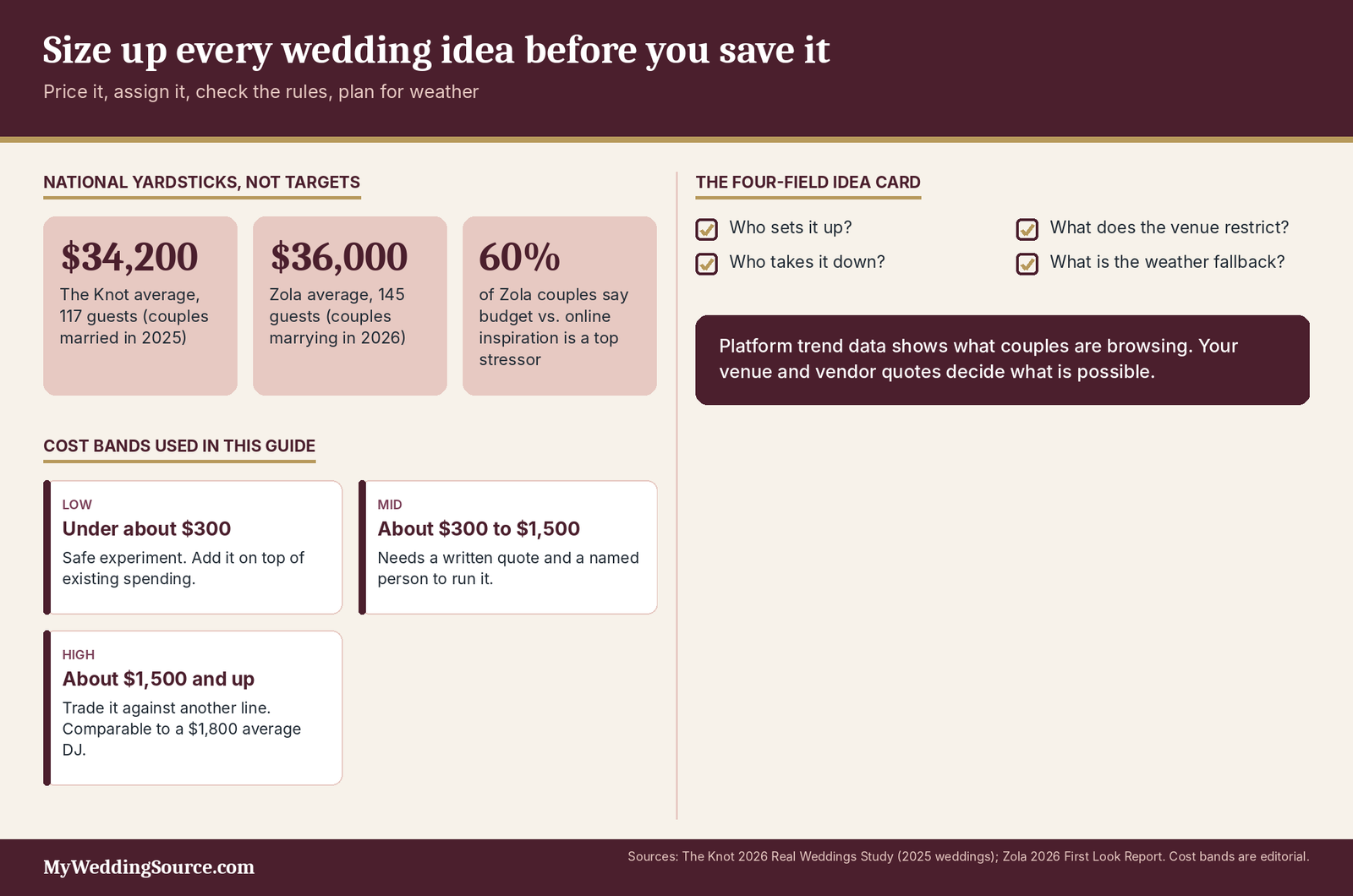
Wedding pricing swings by region, date, guest count, and vendor experience, so a single national price for “a flower bar” or “a live painter” would be false precision. The labels in this guide are editorial bands meant to help you triage ideas quickly, not quotes. We anchor them to something concrete: Low is roughly what you would add on top of existing spending for under $300, Mid runs from about $300 to $1,500, and High starts around $1,500, which is close to what the average couple pays a reception DJ ($1,800 in The Knot’s 2026 Real Weddings Study). When a source offers a real range, the range appears next to the label, with the year and the source named so you can recheck it.
How the bands map to numbers you can verify
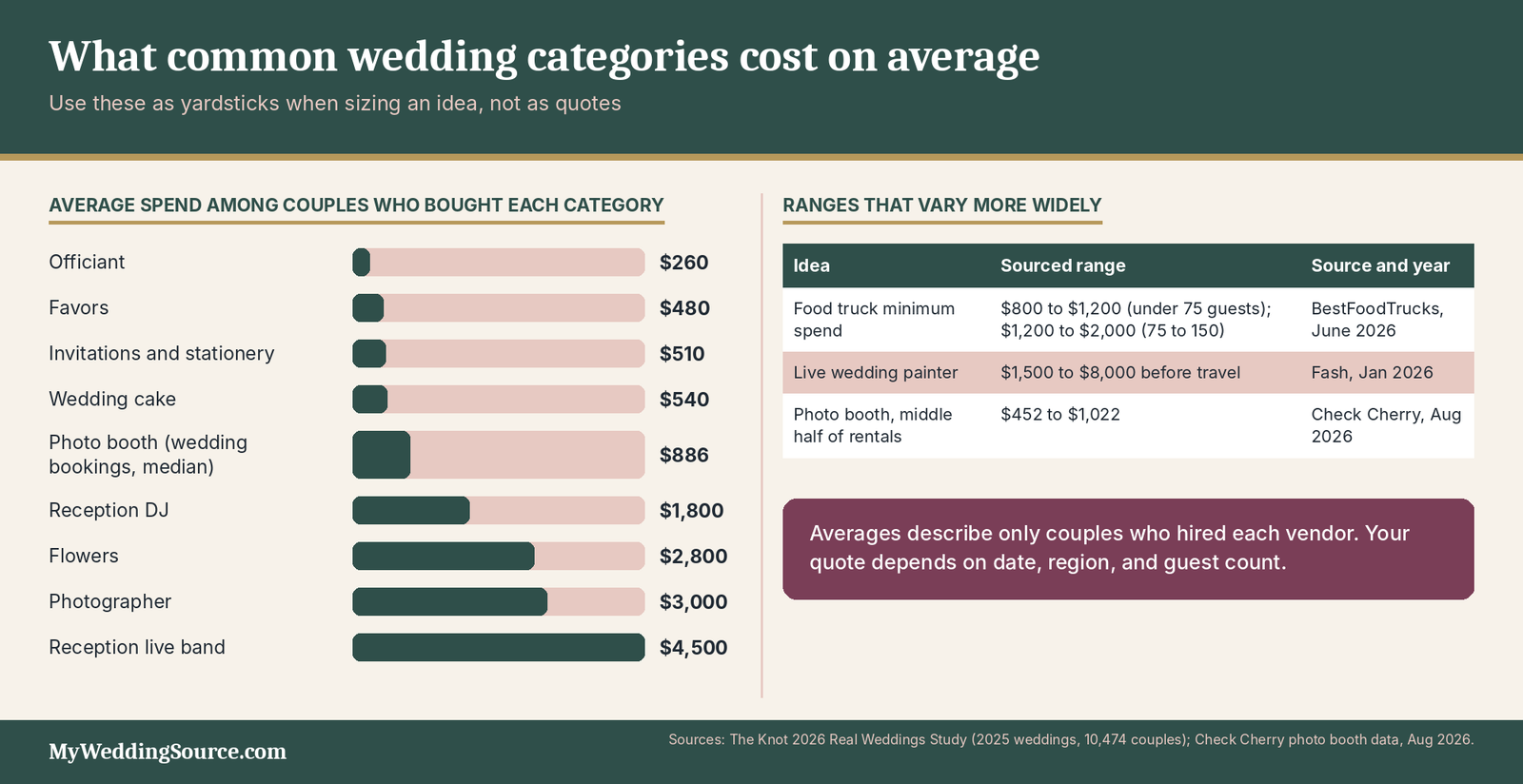
The Knot’s 2026 study surveyed 10,474 U.S. couples who married in 2025 and reports category averages that make good yardsticks. Couples spent an average of $540 on a wedding cake, $510 on invitations and stationery, $480 on favors, and $260 on an officiant. Those four categories sit at or below the Mid threshold, which tells you that a Mid idea is roughly “one more cake-sized line item.” Higher up the ladder, the average couple spent $1,800 on a DJ, $2,800 on flowers, and $3,000 on a photographer. Keep in mind that these averages cover only the couples who bought each category, so they describe what people paid, not what you should pay.
Why your own total will not match a national average
The same study puts the average 2025 wedding at $34,200 with 117 guests, while Zola’s 2026 First Look Report, which surveyed more than 11,500 couples marrying in 2026, reports an average of $36,000 and an average guest count of 145. The gap comes from different samples and timing: The Knot asked couples who had already married, and Zola asked couples who were still planning. Neither number is a target. If your guest list is 40 people, your costs will be shaped far more by per-person food and drink pricing and by venue minimums than by any national average, which is why the bands above are tied to add-on size rather than to total budget.
How should you size an idea against your own budget?
The percent-of-budget test
A quick way to judge an idea is to ask what share of your total it consumes. On a $30,000 budget, a $1,500 High idea is 5 percent, which is a meaningful choice but not a crisis. On a $10,000 budget the same idea is 15 percent, and it would need to replace something else rather than sit on top of the plan. Run the numbers before you fall in love, because once a vendor has sent a mockup, the idea feels already purchased. Our 2027 wedding budget reality report breaks down where the larger line items land if you want the full-budget view before choosing ideas.
The one-in, one-out rule
Budgets stay intact when every new idea displaces something. If you add a Mid-priced live artist at $2,500, find a line to trim by the same amount: a smaller flower package, one fewer hour of bar service, or a simpler dessert. This rule feels restrictive for about a day and then makes decisions faster, because each idea has to earn its slot against something you already like. It also protects you from a quiet budget leak, where five Low ideas at $250 each quietly add up to $1,250 and nobody notices because no single line looked large.
What belongs on every idea’s information card?
Four fields that prevent most surprises
For each idea you are considering, write down four things: who sets it up, who takes it down, what the venue or a local authority might restrict, and what the weather does to it. Setup and teardown matter because the common failure is not that couples cannot afford an idea, but that nobody is assigned to it on the day. Venue rules matter because many places limit open flame, wall attachments, confetti, and amplified sound. Weather matters because an idea that works under a clear sky can fail in wind, heat, or a surprise shower, so every outdoor idea in this guide has a rain note.
A short template you can copy
Use a note like this for each saved idea: “Idea / cost band / who sets up / who removes / venue rule to confirm / weather fallback / deadline to book.” Keep it in a shared note so your partner, planner, or parents who are helping can see the status. When a vendor replies, paste their answer under the idea so the quote and its conditions stay together. By the time you sign contracts, you will have a clean record of what was promised for each idea, which is much easier than searching three months of email.
What does the 2026 data say couples actually want?
What do Pinterest, Zola, and The Knot each measure?
Pinterest: search growth on one platform
Pinterest’s 2026 wedding trend report lists individual search terms with growth percentages, such as plum and olive wedding (+1,380%), jazz club wedding (+1,115%), drapery backdrop (+1,510%), and flower bar set up (+870%). The page does not state the time window, the geography, or the comparison period, and the percentages describe single terms, not whole trends. A term can grow 1,000 percent from a tiny base and still be niche. We use these figures only as a signal of what people are browsing on that platform, and we never treat them as Google search volume or as proof of how many weddings will include the idea.
Zola: what couples report doing and feeling
Zola’s First Look Report is behavioral: 87 percent of surveyed couples say they made planning choices based on something they saw on social media, and 48 percent increased or reallocated their budget to achieve something seen online (55 percent of Gen Z). Pinterest is used for inspiration by 77 percent and TikTok by 50 percent, up from 41 percent the year before. The most telling number for this page is that 60 percent name managing their budget against online inspiration as a top planning stressor. That is the exact tension this guide exists to ease.
The Knot: what couples spent and which vendors they hired
The Knot’s Real Weddings Study is the spending record. Its 2026 edition, covering weddings from January to December 2025, reports averages for reception venue ($12,900), catering ($80 per person), photographer ($3,000), videographer ($2,300), flowers ($2,800), band ($4,500), DJ ($1,800), and more. Its summary page also notes that couples favor personalized celebrations and professional expertise, and that AI-embedded planning tools are entering the market while lab-grown diamonds now dominate engagement rings. Survey respondents were recruited by email from The Knot and WeddingWire membership, so the sample leans toward couples who use those platforms.
How do you turn platform signals into usable decisions?
Separate attraction from execution
A trend tells you what looks good in a photo. It does not tell you whether it fits a ballroom with a no-attachment ceiling policy or a barn that closes music at 10 p.m. For every trend that catches your eye, split the question in two: what feeling do I want, and what is the lowest-friction way to get that feeling here? A stained glass arch is a statement, but a single hanging piece of colored glass, a window backdrop, or a rented frame might deliver the same color and light for a fraction of the effort. The rest of this guide repeatedly makes that move, going from the pinned object to the underlying goal.
Use platform data to choose categories, not specific products
Zola finds that green is the most-used wedding color at 53 percent, with sage green at 30 percent, while Pinterest shows fast growth for plum and olive. Those two facts are compatible: a mainstream, familiar palette sits next to a more daring one. Choose the palette by looking at your venue’s carpet, wood tones, and light, then decide which trend reference you want, rather than choosing a trend and fighting the room. Most couples are happier with a restrained palette plus one bold accent than with a bold palette everywhere.
| Signal | Source and year | What it can tell you | What it cannot tell you |
|---|---|---|---|
| Search-term growth (for example, +1,380%) | Pinterest, 2026 report; no time window stated | What people are browsing and saving | Google volume, adoption, or cost |
| Couple behavior and attitudes (87% acted on social content) | Zola First Look, 11,500+ couples marrying in 2026 | How inspiration changes choices and stress | What your vendors charge |
| Spending averages ($34,200, 117 guests) | The Knot, 10,474 couples married in 2025 | What couples paid in each category | A price for your city, date, or guest count |
| Vendor quotes | Your own written proposals | What an idea costs for you, with conditions | Anything about other couples’ weddings |
Which platform trends are practical and which need caution?
Low-friction trends that translate well
Several 2026 Pinterest terms translate into low-risk, low-cost choices. Button pictures, matchbox inspo, printable wedding games, and cornhole boards are tactile, guest-friendly, and do not depend on venue approval. Fuzzy-wire bouquets and book flower arrangements offer a keepsake alternative to fresh flowers and can be made or commissioned in advance, with no wilting on the day. Palette ideas such as plum and olive or merlot cost nothing extra if you choose them before ordering linens, flowers, and stationery.
Trends that need a venue conversation first
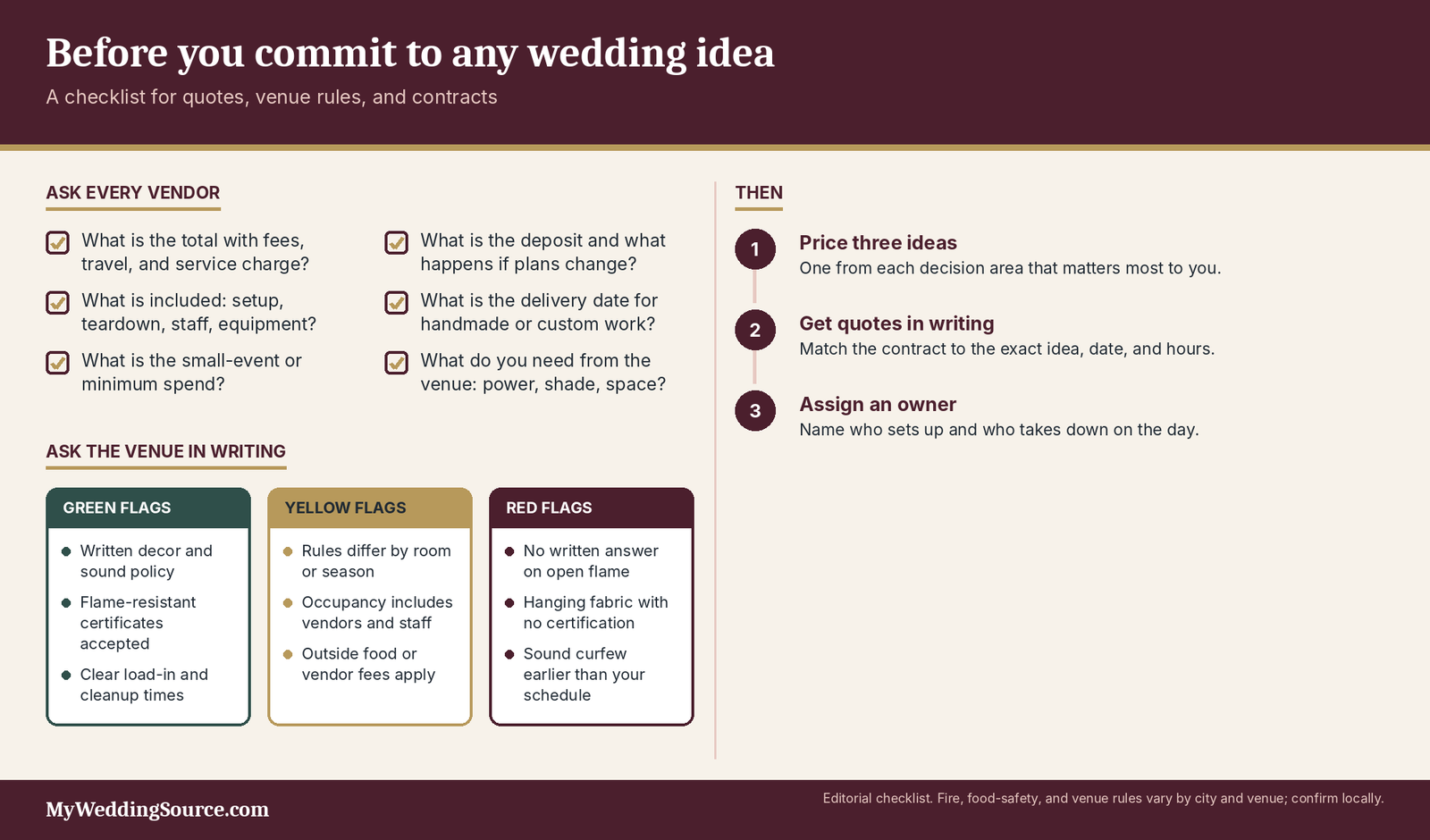
Drapery backdrops, stained glass arches, candlelit installations, and jazz club or speakeasy settings involve the venue’s rules, and sometimes a fire marshal’s. Decorative fabrics in assembly spaces often need to be flame resistant, open flame may be restricted, and a building with an occupancy limit has a hard cap on guest count. These are not reasons to skip the idea. They are reasons to ask the right questions early, which the decor and venue sections below spell out with a specific question list.
Which ceremony ideas add meaning without adding much cost?
What ceremony ideas feel personal and cost little?
Written vows, shared readings, and ceremony scripts
Personal vows, a reading chosen by a friend, and a short script that tells the story of how you met cost nothing beyond time, which is why they are the highest-return ideas in this guide. Cost: Low. Setup is yours and your officiant’s, venue involvement is zero, and weather does not matter. The one question to ask is how long the officiant expects the ceremony to run, because a ten-minute ceremony and a thirty-minute ceremony need different seating, shade, and program planning. Zola’s report found that 63 percent of surveyed couples say AI has no place in writing vows, so if you use a writing tool for admin, keep the vows themselves human.
Involving guests: ring warming, shared blessings, and unplugged moments
Passing the rings through the guests’ hands before the exchange, asking each side to say a blessing in unison, or inviting guests to take a quiet moment before the vows turns an audience into participants. Cost: Low. These ideas need a short instruction from the officiant and, for ring warming, a small pouch or ribbon. An unplugged ceremony, where guests put phones away, is also free, but it only works if your photographer agrees and a sign or officiant announcement sets the expectation. Ask your photographer whether an unplugged ceremony changes how they will cover the processional, since a clear aisle often improves their shots.
Live acoustic music for the processional
One or two musicians playing for the ceremony changes the mood far more than recorded music through a speaker. Cost: Mid in most markets, with the price depending on whether musicians need amplification and travel. The Knot’s 2026 averages put a reception DJ at $1,800 and a reception band at $4,500, so a solo guitarist or string duo for 45 minutes typically lands well below both, but get a quote because rates vary with the market. Ask the musicians whether they bring their own stands, power, and sound equipment, and what they need from the venue, such as shade and a flat surface.
What do you need to know before adding a ceremony installation?
Arches, drapery, and statement backdrops
Pinterest shows drapery backdrop up 1,510 percent and stained glass wedding arch up 750 percent, which means your guests have probably seen them on a feed. Cost: Mid to High depending on whether you rent, build, or hire a florist to design one. The practical questions are who delivers it, who installs it, how it is anchored in wind, and whether the venue permits attachment to walls or ceilings. Fabric installations in indoor assembly spaces are often subject to fire-safety rules, which is covered in detail in the decor section. For many couples, a simple freestanding frame with fabric or greenery covers the look at a lower cost and moves easily if the ceremony relocates for rain.
Aisle and seating ideas that save effort
A short aisle with flower-lined chairs at the front only, a circular or semicircular seating layout, and no assigned ceremony seating are all ways to reduce setup labor and rental cost. Cost: Low. A semicircle can feel more intimate in a small group, and open seating avoids the awkward moment of sorting families at the door. Ask the venue how many chairs are included and whether they flip from ceremony to reception, since a chair count that matches your guest list exactly can save rental fees. If you are using a rental company, confirm the delivery window and who strips and returns chairs.
How can you blend cultural or family traditions?
Weave in a ritual without rewriting the whole ceremony
Many couples bring together two or more family traditions, whether religious, cultural, or regional. The simplest approach is to choose one ritual from each side, give each its own moment, and have a family member or officiant explain it briefly for guests unfamiliar with it. Cost: Low to Mid, since many rituals need only a table, a cloth, or a small set of items, while some require specialist items or an officiant trained in that tradition. Ask each family elder what part of the tradition matters most to them, because that is the piece to protect even if the rest is shortened.
Plan for time, space, and the officiant
A ceremony that blends traditions can run longer, and it may need floor space, seating arrangements, or timing changes. Ask your officiant or religious leader whether they will participate in a blended ceremony and whether a second leader can share the service. Confirm with the venue whether special items, such as certain flame ceremonies, incense, or ground-level seating, are allowed. For legal requirements around who can marry you and what paperwork is needed, check your state or county clerk’s official page, because rules vary by jurisdiction, and your planning timeline should place that task early.
| Ceremony idea | Cost band | Who sets up | Ask before booking |
|---|---|---|---|
| Personal vows, readings | Low | You and your officiant | How long will the ceremony run? |
| Ring warming, guest blessing | Low | Officiant | Can guests hear from the back row? |
| Acoustic ceremony musicians | Mid | Musicians, with venue power | What do you need for sound and shade? |
| Drapery or arch installation | Mid to High | Rental company or florist | Who installs, anchors, and removes it? |
| Blended cultural ritual | Low to Mid | Family and officiant | Does the venue allow the items or flame? |
| Unplugged ceremony | Low | Officiant announcement and signs | How will the photographer cover it? |
Which venue concepts and reception layouts fit real budgets?
What does a venue concept mean for your costs?
Garden, barn, loft, restaurant, and unexpected venues
Zola reports outdoor garden venues as the top choice for the second year running, so the familiar format is still the mainstream. Pinterest shows jazz club wedding up 1,115 percent and speakeasy lounge up 225 percent, which signals interest in nightlife-style settings. Cost: varies widely, Mid to High. The headline price is rarely the real price: the average reception venue in The Knot’s 2026 study was $12,900, but a restaurant or club buyout may come with a food and beverage minimum instead of a rental fee. Ask whether there is a rental fee, a minimum spend, a service charge, and a room-flip fee, and compare venues using the total, not the first number you see. Our wedding venues guide walks through those questions in detail.
Capacity, sound, and curfew are the hidden gatekeepers
Nightlife-inspired venues are usually smaller than a banquet hall, and their legal occupancy is posted for a reason. In Seattle, for example, the fire department’s nightlife-venue guidance requires a posted occupant load that matches the certificate of occupancy and a place-of-assembly permit when the load is 100 or more, or 50 or more when candles or open flames are used; your city may differ. Sound limits and neighbor rules can end the music earlier than you expect. Ask for the maximum legal occupancy in writing, the sound curfew, and whether your guest count includes vendors, because staff and band members can count against the limit.
How does reception flow change what ideas work?
Cocktail hour, dinner, and dancing: where ideas fit best
Think of the evening as three zones, each with a different energy. The cocktail hour is the natural place for interactive ideas such as a flower bar, a guest book station, or a live artist, because guests are standing and mingling. Dinner is for conversation and toasts, where the strongest idea is often a printed menu and decent sound. Dancing is for music and light. Matching each idea to the right zone prevents the common mistake of scheduling three activities at the same moment.
Room flips and ceremony-to-reception transitions
If your ceremony and reception happen in one room, someone has to turn it, and the time it takes shapes the schedule. How long a flip takes depends on the room size, staff count, and how much changes, so ask the venue for its typical time and plan a cocktail hour or garden break to cover it. Ask the venue how many staff do the flip, whether it is included or billed, and what decorations they can move. If you want a hidden surprise such as a dance floor reveal, confirm that the flip schedule supports it.
Do weekday and off-season dates change which ideas are realistic?
What the seasonal data shows
The Knot reports that May through October accounts for 76 percent of weddings, with October and June each at 16 percent and November through April at 24 percent combined. December sits at just 1 percent. Fewer couples on a date generally means more availability, and NerdWallet’s September 2026 guide notes that a Saturday is typically the most expensive day and that a Sunday or weeknight can reduce a venue’s price, though it offers no dollar figure. In other words, flexibility on the date is one of the most reliable budget levers, but the size of the savings depends on your market and your venue.
Ideas that suit weekday and winter dates
Evening weddings with candles or warm string lights, cozy brunch receptions, and a limited-hours reception all suit off-peak dates, and our winter wedding decor and lighting ideas shows how to make a short-daylight venue feel intentional. If you are leaning toward fall, the fall wedding weather and seasonal costs report lays out what weather and demand do to prices. For a weekday date, confirm that your key guests can attend and that vendor rates are actually lower, since some vendors price by hours and not by day.
What food and drink ideas fit your guest list and budget?
Which serving styles make an idea affordable?
Food trucks and stations
Food trucks and stations suit informal receptions and smaller guest lists, and they give guests something to see and choose. Cost: Mid. A June 2026 pricing guide from BestFoodTrucks reports typical event costs of $22 to $38 per person, with a wedding-reception average of $31.12, and it notes that many trucks charge a minimum spend instead of a per-head quote: roughly $800 to $1,200 under 75 guests and $1,200 to $2,000 for 75 to 150 guests. Compare that with The Knot’s 2026 catering average of $80 per person, but compare carefully, because a truck often covers one meal while a caterer’s price may include service staff, rentals, and plated courses. Ask who supplies plates, napkins, and trash service, whether the truck needs power or water, and what the permit requirements are in your county.
Family-style, shared plates, and late-night snacks
Family-style service puts big platters on each table and encourages conversation, but it needs larger tables and more serveware, which can raise rental costs. Cost: Mid to High. A late-night snack, such as pizza, tacos, or sliders handed out near the end of the dance, is a favorite with guests and often costs less than expected if you order by the dozen from a local shop. Check whether your caterer or venue allows outside food and whether they charge a cake-cutting or outside-food fee. Tell the caterer your plan early, because last-minute additions can collide with their service flow.
Cakes, dessert tables, and quirky sweets
Pinterest lists flower pot cake ideas up 715 percent and tiramisu wedding cake up 635 percent, a sign that couples are rethinking the traditional tiered cake. Cost: Low to Mid. The Knot’s average wedding cake cost was $540 in its 2026 study, so a small display cake for cutting paired with sheet cake or desserts from a local bakery can cost less and satisfy more tastes. Ask the bakery about delivery, setup, and whether they supply stands and knives. If you buy desserts from several vendors, confirm in writing who sets them out and who clears them.
How do you plan drinks without overspending?
Signature cocktails, mocktails, and beer-and-wine bars
A signature drink for each partner personalizes the bar without opening a full liquor selection. Cost: Low to Mid for the extra ingredients, plus bartender time. NerdWallet’s September 2026 guide suggests that sticking to beer and wine instead of a full liquor bar is a common way to save, though it gives no dollar figure and your caterer’s package will set the real number. Include a mocktail that feels like a real choice, not an afterthought, since some guests do not drink for health, religious, or personal reasons. Ask your bar provider about licensing, insurance, and whether they bring glassware and ice.
Coffee, tea, and non-alcoholic stations
A coffee or tea cart at the end of dinner, a lemonade station on a hot afternoon, or a hot cider setup on a cold evening gives guests something to do with their hands and makes the event feel considered. Cost: Low. Ask the caterer or a local coffee shop about service packages, and make sure the setup does not need an outlet that is also running your sound system. In hot weather, provide shaded water stations for guests and staff.
What food safety and allergy checks matter for creative serving?
Keep hot food hot and cold food cold
Outdoor receptions, food stations, and long cocktail hours increase the time food sits out. The USDA’s food safety guidance defines the danger zone as 40°F to 140°F, advises that perishable food should not sit in that range for more than two hours, and cuts that limit to one hour when the outdoor temperature is above 90°F. Ask your caterer how they hold hot food at 140°F or above and cold food at 40°F or below, and who is responsible for monitoring it. This matters especially for self-serve stations, seafood, dairy-based desserts, and any food that sits through a long photo session.
Allergen planning for guests
The FDA lists nine major food allergens: milk, eggs, fish, crustacean shellfish, tree nuts, peanuts, wheat, soybeans, and sesame, which was added in January 2023. Collect dietary needs with the RSVP, give your caterer the final list, and ask how they separate allergen-free dishes from others. Label stations clearly, because shared utensils at a buffet or a dessert table can cross-contaminate. This is general information, not medical advice, so guests with serious allergies should speak to the caterer directly if they have concerns.
| Food or drink idea | Cost band | Who handles it | Ask before booking |
|---|---|---|---|
| Food truck for dinner | Mid | Truck operator | Minimum spend, power, permit, service window? |
| Family-style dinner | Mid to High | Caterer | Table size, serveware, extra rentals? |
| Late-night snack | Low to Mid | Caterer or local shop | Outside-food rules, delivery time? |
| Small cake plus desserts | Low to Mid | Bakery | Delivery, setup, cutting fees? |
| Signature drinks and mocktails | Low to Mid | Bar provider | Licensing, insurance, glassware? |
| Coffee, tea, or cider cart | Low | Caterer or cafe | Power, staffing, cleanup? |
How do you use color, florals, and installations without surprises?
Which color palettes and styling ideas are worth choosing?
Plum, olive, opalite, and merlot palettes
Pinterest shows plum and olive wedding up 1,380 percent, opalite aesthetic up 2,710 percent, and merlot wedding up 370 percent, while Zola reports green as the most-used color at 53 percent. Cost: Low, because a palette is a decision, not a purchase. Choose it once, then give the same swatches to your florist, stationer, linen rental company, and attire shop so everything matches in real light. Ask each vendor for a physical sample, because a color on a screen looks different on fabric, paper, or petals.
Using the venue’s own character to cut decor spend
A venue with exposed brick, tall windows, or a view needs less decoration than a blank ballroom. Cost: Low. Spend where guests will look: the ceremony backdrop, the head table, the entrance, and the bar. Skip decor on surfaces no one sees. If your venue is dim, spend on lighting before centerpieces, because lighting changes the whole room. The winter decor and lighting guide linked earlier explains how to layer warm light in a short-daylight setting.
How do flower ideas work in practice?
Flower bars and guest-built bouquets
Pinterest shows flower bar set up up 870 percent, and the idea suits a cocktail hour: guests build small bouquets or boutonnieres from buckets of stems. Cost: Mid. We could not verify a national price, so ask your florist for stem count, price per stem, containers, and whether staffing is included. One planning guide recommends sturdy, low-maintenance flowers over delicate ones, a dedicated helper to demonstrate any wiring, a visible trash can, and a plan to donate leftovers the next morning. Confirm what the venue allows, since water on a floor and stems on a carpet can trigger cleaning fees.
Alternative bouquets and keepsakes
Fuzzy-wire bouquets are up 1,275 percent on Pinterest, bouquet purses up 1,015 percent, and book flower arrangements up 725 percent. Cost: Low to Mid, depending on whether you make them or commission a maker. These options do not wilt, they photograph well, and they become keepsakes. Ask the maker for production time, because handmade work can take weeks, and ask for a sample of the exact materials. For fresh florals, ask your florist to quote a fully fresh version alongside a mixed version so you can compare totals.
Seasonal stems and smart substitutions
The Knot’s 2026 average for flowers was $2,800, and that figure reflects only couples who hired a florist. Seasonal and locally grown stems usually cost less than out-of-season imports, and greenery-heavy designs can cut stem counts. Cost: Low to Mid. Ask your florist for two or three seasonal options and a version with fewer large blooms. Dried arrangements and potted plants can double as favors or be reused.
What are the safety rules for drapery, candles, and installations?
Fabric and decor in indoor venues
Drapery backdrops and hanging fabric are among the fastest-growing looks, yet indoor assembly spaces often have fire-safety rules about decor. The Seattle Fire Department’s guidance says decorative materials in assembly venues must be flame resistant under standards such as NFPA 701, requires documentation on site, and says not to treat fabrics yourself with a coating. A university safety office elsewhere limits treated combustible decor to 10 percent of wall and ceiling area. These are examples, not national rules, so ask your venue what it requires and have the rental company provide certification. Our approach: if you want fabric installations, ask for the venue’s written decor policy before ordering anything.
Candles, open flame, and alternatives
Candles create warmth, but many venues and tents restrict or prohibit open flame. The same university guide prohibits candles in buildings and tents and recommends battery-powered LED candles as an alternative. Cost: Low to Mid. Ask the venue what flame is allowed, what holders are required, and who monitors candles during the event. LED candles in glass holders can look convincing in photos and are accepted at many venues. The same caution applies to sparklers, matchbox favors, and fire-based ceremony elements.
| Decor idea | Cost band | Setup | Risk to check |
|---|---|---|---|
| Palette and linens | Low to Mid | Rental company or florist | Color match in real light |
| Flower bar | Mid | Florist or helper | Staffing, floor, cleanup |
| Fuzzy-wire or book bouquet | Low to Mid | Maker, delivered early | Lead time, sample approval |
| Drapery backdrop | Mid to High | Rental company | Flame-resistant certification |
| Stained glass or statement arch | Mid to High | Rental or builder | Wind, anchoring, transport |
| Candlelit tables | Low to Mid | Venue or planner | Open-flame rules, LED option |
Which music, entertainment, and guest-experience ideas earn their cost?
How should you choose and personalize the music?
DJ, band, or live musician with a playlist
The Knot’s 2026 study reports an average of $1,800 for a reception DJ and $4,500 for a reception live band, and that gap is one of the largest within a single decision area. Cost: Mid for a DJ, High for a band. A hybrid, such as a DJ with a live saxophonist or violinist for a set, often gives the energy of live music at a lower price than a full band. Ask each candidate about overtime rates, setup time, what equipment they bring, and whether they can run a ceremony sound system as well. Request a list of songs they will not play and the ones you want, so there are no surprises when your cousin makes a request.
Written songs and custom music
Pinterest reports written songs up 1,975 percent, and the idea fits a couple who wants a custom piece for the processional, first dance, or a surprise performance. Cost: Mid to High, and variable. Pricing depends on the songwriter and whether you want a recording, a live performance, or both. Ask who owns the recording, whether you can share it online, and what the revision process looks like. A cheaper version is asking a musical friend to write or adapt a short piece for the ceremony, with a written agreement about performance and any recording.
Sound limits and the quiet-hours question
Music is one of the most common venue conflicts. Some venues cap amplified sound at a set hour, some require in-house equipment, and outdoor locations may be subject to local noise rules. Cost: no direct cost, but it can force a change. Ask the venue for its sound curfew, decibel limits if any, and whether vendors must be approved. If you plan a jazz-club feel, confirm that the room’s acoustics suit live instruments and that your guest count does not exceed the legal occupancy.
Which guest activities are worth paying for?
Photo booths and photo stations
A photo booth gives every guest a keepsake. Check Cherry’s August 2026 analysis of about 118,000 bookings since January 2024 found a median rental of about $681, a middle range of $452 to $1,022, and a median of $886 for bookings tagged as weddings. Staffed booths had a median of about $656, while drop-off booths had a median of about $450. Cost: Mid. Only 18 percent of bookings carried a travel fee (median $50), and 26 percent included add-ons (median $147). Ask whether prints, a digital gallery, and a custom backdrop are included, how many hours of service you get, and whether an attendant stays on site.
Analog games and keepsake stations
Pinterest shows button pictures up 1,140 percent, matchbox inspo up 940 percent, cornhole boards up 440 percent, and printable wedding games up 210 percent. Cost: Low to Mid. These activities suit a cocktail hour or an outdoor reception because they need little staff and no power. A button-making station or a sign-and-draw guest book needs supplies, a table, and one person who knows how it works. If you add matchbooks, check that your venue allows open flame, and consider them as a printed keepsake rather than something guests light.
Live artists and performers
A live painter, caricaturist, or portrait artist adds an entertainment moment and a finished piece. Cost: High. A January 2026 estimate from Fash puts a live wedding painter at $1,500 to $8,000 before travel, says the artist typically completes 70 to 80 percent of the painting at the event, and puts delivery at two to six weeks afterward. Digital images can add $150 to $400 and framing $200 to $800, and peak-season dates may cost 10 to 25 percent more. Ask for a portfolio, the time needed on site, the space and lighting they need, and the delivery date in writing.
Nostalgic tech: video guestbooks and projectors
Pinterest reports wedding projector up 625 percent and video guestbook up 240 percent. Cost: Low to Mid, depending on whether you rent equipment or use an app. A video guestbook asks guests to record a short message, which works best with a clear prompt and a quiet corner. A projector needs a dim room and a surface, so it is a poor fit for an outdoor daytime reception. Ask your venue about power, screen options, and who will operate the equipment.
| Music or activity idea | Cost band | Who runs it | Ask before booking |
|---|---|---|---|
| DJ with live instrumentalist | Mid to High | DJ and musician | Overtime, setup time, equipment? |
| Full live band | High | Band | Stage size, power, breaks? |
| Custom written song | Mid to High | Songwriter | Rights, recording, revisions? |
| Photo booth | Mid | Booth company | Hours, prints, attendant, travel fee? |
| Button or sign-and-draw station | Low to Mid | You or a helper | Supplies, who runs it? |
| Live painter | High | Artist | Delivery date, space, travel? |
| Video guestbook | Low to Mid | You or a helper | Power, privacy, who owns the clips? |
How do you personalize photography, video, favors, and stationery?
What should you ask for in photography and video?
Social-first content and what your contract should say
Zola’s report found that 21 percent of surveyed couples plan to create their own social-first content, and The Knot reports an average of $3,000 for a photographer and $2,300 for a videographer. If you want short vertical clips for social media, ask the photographer or videographer whether that is included, how quickly they deliver, and who owns the usage rights. Cost: Mid to High. Put delivery timing, edit counts, and backup procedures in the contract. Before signing, ask the photographer for sample galleries from weddings at similar venues and confirm what happens if they are ill on the day.
Priorities when the budget is tight
If you cannot afford both a photographer and a videographer, choose the one whose output you will use most. Photographers usually deliver a gallery you can print and share, while video captures vows, toasts, and movement. Cost: Mid to High. A shorter coverage window, a second shooter only for the ceremony, or a highlight film instead of a full feature can reduce cost. Ask what is included at each tier and what overtime costs, because a delayed ceremony can push key moments past the coverage window.
Which favors and stationery ideas are worth the money?
Favors guests will use
The Knot’s 2026 study puts the average favor spend at $480. Edible favors, plants, seed packets, donation cards, and a small local product tend to be used, while generic trinkets often stay on the table. Cost: Low to Mid. Match the quantity to households, not guests, since a couple or family often takes one. If you choose food items, ask about allergen labeling and shelf life, and make sure anything with a flame, such as candles or matchbooks, fits the venue’s rules.
Stationery that does a job
Invitations and stationery averaged $510 in The Knot’s 2026 study. A value-minded approach is to print what guests handle and digitize the rest: a printed invitation, a digital RSVP, a single-page program, and a menu or sign that doubles as decor. NerdWallet notes that printing your own invitations can save a couple of hundred dollars over a professional suite and that digital invitations are free. Cost: Low to Mid. Ask the printer for proofs, paper samples, and turnaround time, and give yourself buffer for corrections.
How can personal touches carry the meaning?
Heirlooms, vintage, and family details
Zola notes a rise in vintage and personalized choices, and Pinterest lists 1980 wedding dress up 1,090 percent. Personal touches can be a grandparent’s brooch pinned inside a bouquet, a handkerchief used as a ring pillow, a recipe printed on the menu, or a family photo wall. Cost: Low. Ask relatives early, because items may need repair or cleaning, and have a safe place to store them on the day.
Writing the story into the day
Stories move people more than objects do. A short note on the table describing why you chose a song, a toast from a sibling, or a program that names the people who could not attend all cost almost nothing. Cost: Low. Decide in advance who will gather and set out each item, so the task does not fall to you in the final hour.
Which wedding ideas suit small and micro weddings?
What counts as small, and what does it change?
Definitions and how common small weddings are
Reporting by CNBC in 2024 described a micro wedding as roughly 50 guests at most, and a “minimony” as a gathering of no more than 10, citing The Knot. The Wedding Report data in that story put weddings with 25 to 50 guests at about 15 percent of the market in 2023 and weddings with fewer than 25 guests at roughly 2 percent. That 2024 CNBC article is older than the other sources here, so treat the shares as a rough picture of 2023, not today. The practical point is that small is a normal choice, and venues, caterers, and photographers are used to it.
Why a small guest list does not shrink every cost
Some costs fall quickly as your guest list shrinks, like catering and rentals, but others stay close to flat. A photographer’s coverage window, an officiant, and a florist’s design minimum do not drop by half when guests do. Food trucks are a good example: the BestFoodTrucks guide notes that events under 50 guests often cost more per person, because the truck still has a minimum. Ask every vendor for their small-event minimum before you assume a savings, and compare per-person pricing with total pricing.
Which ideas shine at a small scale?
Private dining, backyard, and shared-table receptions
A private dining room or a restaurant buyout gives you food, service, and atmosphere in one booking. Cost: Mid to High for the room, but you may skip separate rentals, linens, and staff. A backyard can cost less, but you will rent or buy everything, from chairs and lighting to restrooms, and NerdWallet notes that DIY and backyard venues usually mean supplying all of it. Ask the restaurant or caterer about a minimum spend, a service charge, a room fee, and what is included, such as linens, glassware, and a cake-cutting service.
Ideas that need a small group
Some ideas only work at small scale. A single long table where everyone can hear a toast, a hand-written note at each seat, a ceremony in the round, a tasting-menu dinner, or a trio that plays just for you all depend on intimacy. Cost: Low to Mid. With 30 guests, a $25-per-person upgrade adds $750, which is a budget decision you can make quickly, while the same upgrade for 150 guests is $3,750. Use that math to choose where to splurge.
Splitting the celebration into two events
Zola found that 37 percent of surveyed couples host at least one additional event and 18 percent host a two- to three-day wedding weekend. A small ceremony followed by a larger casual party later is a common version, and it lets you pay for a high-touch ceremony and a low-cost reception. Cost: depends on the events. Ask whether your vendors charge separately for two events and whether a rain or travel plan applies to both. Tell guests early which event they are invited to so no one is surprised.
Blending family food and music traditions
A small guest list makes it easier to feature dishes, songs, and customs from each family. Cost: Low to Mid. Ask the caterer whether they can prepare a family recipe or whether a relative can bring a dish, noting that venues and caterers often have rules about outside food, and food safety practices apply to homemade dishes. Add one or two songs from each family to the playlist and ask elders to introduce them. Written notes on the menu explaining each dish help guests feel included.
How do you combine budget-smart swaps into one plan?
Which swaps keep the look at a lower cost?
Match the feeling, not the object
Most inspiration photos carry a feeling, such as warmth, glamour, nostalgia, or play, and there are usually several ways to deliver it. If you love a stained glass arch, a single colored-glass piece or a windowed venue may deliver the light. If you love a flower bar, a tray of potted herbs at each table gives a similar hands-on feeling. If you love a jazz club, a small group playing standards in a dim room does it. Ask yourself what you would keep if the object were unavailable, and let the answer guide the swap.
| If you are drawn to | Lower-cost route | Cost band | Watch for |
|---|---|---|---|
| Drapery backdrop | Freestanding frame with fabric panel | Low to Mid | Fire-safe fabric, wind |
| Flower bar | Small bar with sturdy stems only | Mid | Staffing, cleanup |
| Live painter | Guest sketch cards or a portrait later | Low to High | Delivery and quality |
| Full band | DJ plus one live instrumentalist | Mid to High | Setup and overtime |
| Large cake | Small display cake plus desserts | Low to Mid | Cutting and delivery fees |
| Full liquor bar | Beer, wine, and a signature drink | Low to Mid | Bartender and licensing |
Guest count and date are the biggest levers
NerdWallet says that trimming a guest list by 10 to 20 people can save thousands on food, alcohol, and rentals, and that a less popular month or a Sunday or weeknight can lower venue prices. In The Knot’s data, only 24 percent of weddings happen from November through April, so those dates are less crowded. Zola reports that 44 percent of couples have already adjusted plans to avoid rising costs and that 43 percent of Gen Z couples budget under $20,000, which shows that these trade-offs are common. Choose your lever before your ideas, then fit ideas into what is left.
Where to spend and where to save
Spend on what guests experience for the longest time: food, comfort, sound, and light. Save on what guests glance at once: oversized signs, extra centerpieces, and favors that go unused. Our 2027 wedding budget reality report shows how those categories stack against each other in a full budget. If you are unsure, ask your three closest guests what they remember from their last wedding. The answer is usually the music, the food, and the people, not the centerpiece.
How do the numbers work in three illustrative packages?
A small wedding: 40 guests, $15,000 total budget
Illustrative example, not a quote. A couple chooses a food truck (minimum $800 to $1,200 under 75 guests per BestFoodTrucks), a drop-off photo booth (about $450 median per Check Cherry), and two Low ideas, such as a button station and LED candles, at up to $300 each. The idea package comes to roughly $1,250 to $1,850, or about 8 to 12 percent of the budget. That is a manageable share, and the couple keeps the rest for venue, photography, and attire.
A mid-size wedding: 100 guests, $35,000 total budget
Illustrative example, not a quote. This couple chooses a food truck at $1,200 to $2,000 (75 to 150 guests), a staffed photo booth at about $656 median, an acoustic ceremony musician in the Mid band ($300 to $1,500), and a flower bar in the Mid band ($300 to $1,500). The package adds up to roughly $2,456 to $5,656, or about 7 to 16 percent of the budget. The wide range shows why quotes matter: two Mid-band ideas can differ by more than $2,000 depending on the vendor.
A large wedding: 140 guests, $50,000 total budget
Illustrative example, not a quote. This couple upgrades from a DJ to a live band, a difference of about $2,700 using The Knot’s averages ($4,500 minus $1,800), and adds a live painter at $1,500 to $8,000. The idea package comes to roughly $4,200 to $10,700, or about 8 to 21 percent of the budget. At the top of that range, the painter alone may be larger than the DJ-to-band upgrade, so the couple should decide which one matters more.
| Package | Guests and budget | Ideas included | Added cost range |
|---|---|---|---|
| Small | 40 guests, $15,000 | Food truck, drop-off booth, two Low ideas | $1,250 to $1,850 |
| Mid-size | 100 guests, $35,000 | Truck, staffed booth, musician, flower bar | $2,456 to $5,656 |
| Large | 140 guests, $50,000 | DJ-to-band upgrade, live painter | $4,200 to $10,700 |
FAQ: Wedding ideas questions couples ask
Budget and planning questions
How much should we set aside for extra ideas?
There is no standard percentage, but many couples find it useful to cap added ideas at 5 to 10 percent of the total budget until quotes are in. That number is an editorial rule of thumb, not a statistic. If your budget is $20,000, that gives you $1,000 to $2,000 for ideas on top of core costs like venue, food, and photography. Revisit the cap after you sign your main contracts, because you will know how much room is left.
Are trends worth following?
Trends are worth following when they match how you want guests to feel and fit your venue, and they are worth skipping when they only exist because of a viral post. Zola found that 60 percent of couples name managing budget against online inspiration as a top stressor, so you are not alone. A useful test is to ask whether you would still want the idea if nobody photographed it. If the answer is yes, price it. Our 2027 wedding trends analysis, linked above, is a better place to judge what is rising and what is fading.
Should we hire a planner to help execute ideas?
If your plan has several vendor-dependent ideas, such as a custom installation, a food truck, and a live artist, a planner or day-of coordinator can save you stress by managing the schedule and the load-in. This is general information, not a recommendation for your situation, and prices vary by market. Ask any planner what they handle on the day, how many events they run at once, and who is on site.
Venue and logistics questions
Do we need to tell the venue about decor and entertainment ideas?
Yes, tell the venue before you buy. Venues have different rules about open flame, wall attachments, confetti, fog, outside vendors, and amplified sound, and some require certificates of insurance from vendors. Ask for the rules in writing and share them with each vendor, so everyone is working from the same list. A simple email with your idea list and a request to flag anything restricted usually gets a clear answer.
What ideas work for a fall or winter date?
Candlelight or LED candles, warm lighting, hot drinks, seasonal stems, and layered textiles suit colder dates, and an evening or brunch format often fits shorter daylight. Check weather and daylight, and plan indoor backups for any outdoor idea. Our fall weather and seasonal costs report and our winter decor and lighting guide go into the details.
Your next steps
This week
Shortlist three ideas and price them
Pick one idea from each of three decision areas that matter most to you, such as food, music, and decor, and write the cost band next to each. Email the relevant vendors the idea, your date, your guest count, and your venue, and ask for a written quote with conditions. Set a calendar reminder to follow up in five business days. Do not save a fourth idea until at least two quotes are back.
Fill out the four-field card for each idea
For each shortlisted idea, write who sets up, who takes down, what the venue restricts, and what happens in bad weather. Where you do not know an answer, add the question to your vendor email. Share the cards with your partner and anyone who is helping, and decide who owns each task on the day. A short list with owners beats a long list with none.
Before you pay a deposit
Confirm venue rules in writing
Before paying for any idea that touches the venue, such as fabric, candles, music, or food, get written confirmation from the venue. Ask about fire-safety rules, maximum occupancy, sound curfew, load-in times, and cleanup fees. If a rule changes your plan, adjust the idea before you pay. The venues guide linked earlier lists more questions to ask.
Make the contract match the idea
Check that the contract names the exact idea, the date, the hours, the setup and teardown tasks, the delivery date for anything handmade, and the refund and substitution terms. Contract and cancellation terms vary by vendor and state, so this is general education, not legal advice, and a lawyer can review anything high-stakes. If something promised in email is missing from the contract, ask for it to be added before you pay.
Sources & methodology
- The Knot: Average Wedding Cost and vendor averages (2026 Real Weddings Study) — $34,200 average, 117 guests, and category averages for 10,474 couples married in 2025; updated June 24, 2026.
- The Knot: Real Weddings Study data read-out page — study scope, sample period, and headline themes such as personalization.
- The Knot: Is there an off-season for weddings? — monthly and seasonal share of weddings; updated May 11, 2026.
- Zola: 2026 Wedding Trends First Look Report — survey of more than 11,500 couples marrying in 2026; budget, guest count, social media, and AI findings.
- Pinterest Newsroom: Wedding Trend Report 2026 — search-term growth percentages; the page does not state a time window or geography.
- NerdWallet: 24 Ways to Have a Cheaper Wedding — qualitative savings levers (date, day of week, guest count); updated September 3, 2026.
- Check Cherry: Photo booth rental pricing (2026) — median and range prices from about 118,000 bookings; updated August 10, 2026.
- BestFoodTrucks: Cost to hire a food truck (2026) — per-person costs, minimum spends, and deposits; June 2026.
- Fash: Live wedding painter cost — cost range and factors; published January 6, 2026, with undisclosed sample size.
- CNBC via NBC Los Angeles: micro wedding coverage (2024) — micro wedding definition and 2023 guest-count shares from The Wedding Report.
- USDA: Danger Zone, 40°F to 140°F — two-hour and one-hour food holding guidance.
- FDA: Food allergies, what you need to know — the nine major allergens including sesame.
- Seattle Fire Department: nightlife venue guidance — an example of flame-resistant decor, occupancy, and candle rules; local, not national.
- Cornell Environmental Health and Safety: event decorations — an example of a campus policy on decor, candles, and balloons; local, not national.
Verified facts in this guide are the figures published by the named sources, cited with their year and sample. Survey findings (The Knot, Zola) describe what couples reported, not what vendors will quote you, and Pinterest percentages are platform search-term growth and are never treated as Google search volume. Cost bands (Low, Mid, High), the three idea packages, and the 5 to 10 percent rule of thumb are editorial judgment and illustrative arithmetic, and vendor-cost figures from pricing sites such as Fash, Check Cherry, and BestFoodTrucks are industry estimates with limited sample disclosure. We could not verify a national price for flower bars, custom songs, or ceremony musicians, so those carry bands only. Fire, food-safety, and venue rules vary by city, county, and venue, and nothing here is legal or medical advice.
Freshness note: recheck The Knot and Zola figures when each publishes its next annual report (typically early in the year), reconfirm Pinterest terms when its 2027 report appears, and re-verify food truck, photo booth, and painter prices every six months. Before relying on any figure for your own date, replace it with a written quote from your vendor.