
The wedding bouquet ideas that hold up in real life are the ones where shape, flowers and budget are chosen together: pick a silhouette that suits your outfit and venue, build it from stems that are actually in season on your date, and decide up front whether you want to keep it afterward.
Most couples start this decision on a phone, scrolling through hundreds of photos of cascading greenery, tiny single-stem bundles, beaded wire flowers and bouquets shaped like handbags. The images are lovely, but they rarely tell you the three things that decide whether a bouquet works on your day: how heavy it is after an hour of photos, what the flowers cost in your month, and what happens to it once the cake is cut. That gap is why a saved image can turn into a surprising invoice or a bouquet that wilts during an outdoor ceremony.
This guide is built for the second half of the process, after the inspiration board and before the florist contract. It covers the main bouquet shapes and what each is good at, which flowers are realistic by season, how to read the 2026 color and trend signals without over-trusting them, and what non-floral and keepsake bouquets involve. It also puts numbers on the budget, from national averages to a transparent stem-math table, then walks through attendant and family flowers, DIY versus florist, preservation, and a few safety points about allergies and pets.
It is deliberately different from our broader planning pages. If you are still working out the whole floral package, start with wedding flowers: design ideas, real costs and venue-smart planning, and if the total is the question, the companion piece on wedding flowers cost covers fees, minimums and how to control the final number. This article stays with the bouquet itself, the one arrangement that will be in nearly every photo and in someone’s hands for most of the day.
One note on tone before we start. Nothing here assumes who carries a bouquet, who pays for it, or how formal your wedding is; the same options apply to a courthouse ceremony, a backyard dinner and a ballroom. Where we give prices, we say whether they come from a survey, a florist-supply guide or our own arithmetic, because bouquet pricing is complicated rather than secretive, and the honest answer to “how much?” is almost always “it depends on three things you can control.”
Which Bouquet Shape Suits Your Outfit, Venue and Ceremony?
Shape is the decision that quietly controls everything else, including the stem count, the weight in your hand and the line item on the quote. A small, loose bundle and a floor-length cascade are both “bridal bouquets,” yet they can differ by several times in flowers used and in labor. This section explains the classic shapes in plain language and then shows how to match one to your clothing, your venue and the length of your day.
What are the main bouquet shapes, and what is each one good at?
Florists use a shared vocabulary, though individual designers apply the names a little differently. The definitions below follow The Knot’s glossary of bouquets and wedding flowers, and the shapes are compared in the table that follows. Treat any single name as a starting point, and ask each florist for photographs of finished work so you are both picturing the same thing.
Hand-tied and garden bouquets
A hand-tied bouquet is built in the florist’s hand by layering and crisscrossing stems, which gives it a natural, slightly asymmetrical look, and long ribbons are usually left loose below the wrap. The Knot describes the style as medium-sized and garden-like, and it is the shape that most “straight from the garden” inspiration photos are actually showing. Because it relies on varied textures rather than a rigid pattern, it forgives small substitutions: if your florist cannot get one pink ranunculus, a similar bloom rarely changes the overall impression. That flexibility is a real cost advantage, since the design tolerates whatever is freshest and most affordable that week. The trade-off is that a loose shape needs a skilled hand to avoid looking messy, so ask to see photos of finished hand-tied work rather than assuming the name guarantees the look.
Cascade, presentation and crescent bouquets
A cascade is an oversized, upside-down teardrop that is wider at the top and tapers to a point, with flowers and greenery spilling over the hand and arm. The Knot notes that length can run from halfway down the front of the body to nearly touching the floor, and it mentions that Princess Diana’s cascade was rumored to be longer than 40 inches. A presentation bouquet, also called a pageant or arm sheaf, is different: it is a long-stemmed bundle balanced on one arm rather than gripped, usually built from tall, stalky flowers such as roses, calla lilies, gladiolus, delphinium and foxgloves. The word crescent is used by many florists for a curved, arm-cradled arc, which The Knot’s glossary does not list by that name, so treat it as a florist’s term and ask for a photo of what they mean. All three are stem-hungry and visually bold, so they suit long gowns, grand staircases and ceremonies with a long aisle, and they are the shapes most likely to push a quote upward.
Posy, nosegay and round bouquets
A posy is a small, loosely designed bouquet that fits in one hand; a nosegay is similar but more tightly packed, usually with one dominant flower or color and minimal greenery, with stems wrapped in ribbon or fabric. A round bouquet is the traditional formal shape that is symmetrical from the side and from above, with flowers at an even height and little greenery. The Knot points out that a posy’s petite size will not block your outfit, which matters if you have beading, a detailed bodice or a jacket with a lapel pin you want visible. These are also the shapes behind the 2026 “micro bouquet” idea of tiny single-variety bundles, covered later in this guide. Their small size makes them naturally budget-friendly, but small does not always mean cheap, because a premium stem such as a peony or garden rose still costs the same per stem whether it is in a big bouquet or a little one.
Pomander and hoop bouquets
A pomander is a sphere with flowers on all sides, carried by a ribbon loop at the top, and it can also be hung from hooks, chairs or pews. The Knot says the loop makes it easy to carry, which is why it is a classic choice for flower girls and other young attendants, and it is equally useful for a ceremony arrangement that needs to be set down without crushing blooms. A hoop bouquet, as described on the same site, can be carried by hand or slipped onto the wrist, which suits anyone who wants both hands free for hugging, drinks or a dance floor. Both shapes are more structured than a hand-tied bundle, so they are usually built on a base, and that base adds a small amount of cost and a little weight. If you are choosing for a child, ask the florist to keep the base light and the flower heads sturdy, since a toddler is likely to carry it upside down at some point.
How do you match a shape to your day?
The most useful test is practical rather than aesthetic: imagine the bouquet in your hand during the longest stretch of the day, usually the ceremony, the receiving line and the portraits. The questions below cover clothing, weight, photographs and the venue itself. Run through these four checks before you fall in love with a photo, because each one can change which shape makes sense.
Which shape works with your outfit?
Start with the area of the outfit you most want seen. A detailed bodice, a statement lapel or an embroidered jacket argues for a posy, nosegay or loose hand-tied bundle that sits low and out of the way; a plain, streamlined silhouette can handle a cascade or an arm-carried presentation bouquet that adds drama. The Knot’s sizing guidance is general rather than numeric, so the most reliable method is to bring a photo of the outfit, or the actual fabric swatch, to the florist and ask them to sketch two sizes. For a suit or jumpsuit, many florists steer toward compact shapes because long trailing stems can look like they are fighting the line of a jacket. Treat this as editorial judgment rather than a rule, since plenty of people carry a trailing bouquet with a suit and love the contrast.
How heavy is too heavy?
Weight is the sleeper problem in bouquet planning, because a bouquet that feels light in a florist’s studio can feel heavy after an hour of standing for photographs. Stems hold water, and larger heads such as hydrangeas, dahlias and peonies carry more than their size suggests. The Knot contrasts the posy with “larger, heavier bouquets” and notes that a posy is small enough for one hand, which is the honest reason many people choose it when the day involves a long ceremony or a lot of hugging. A practical step is to ask the florist for a mock-up at the real size and hold it for a few minutes in the shoes you plan to wear, passing it between hands as you would at a ceremony. If your wrists or shoulders tire, ask for fewer stems or a lighter shape, which also tends to lower the price.
How should you hold it for photos?
A common styling rule of thumb, which we treat as editorial judgment and not a tested standard, is to hold the bouquet near the navel with relaxed elbows, so the flowers stay visible without blocking the outfit or pulling the shoulders up. Arm-carried presentation bouquets are the exception, because they are designed to rest in the crook of the elbow and angle outward. The point worth discussing in advance is hand position and ribbon length, since long loose ribbons can twist, and a stem wrap that is tight and comfortable looks better than one that is slick or bulky. If you have a photographer, mention the shape you are considering during your shot-list conversation, and ask the florist for a small wrist loop or tape wrap if a bouquet will be passed between hands. A rehearsal-day mock-up photographed on a phone will show most problems before they cost anything.
Does the venue change the answer?
It does, in several ways, and these are worth checking before you commit. A garden or outdoor ceremony can wilt delicate stems quickly in heat or wind, so sturdy flowers such as roses, lisianthus, protea and chrysanthemums are more reliable than sweet peas or ranunculus on a hot afternoon. A historic or narrow venue may restrict long aisles and cascades, and some venues limit open flame, loose petals or anything that sheds on carpet or stone. The Knot’s fall flower guidance makes the point directly, noting that your venue will play a major role in what your bouquet should look like. Ask the venue coordinator whether there are rules about shedding materials, pollen-heavy flowers on light-colored floors, or items attached to railings and chairs, and write the answers into your florist timeline.
| Shape | Typical feel | Works well when | Watch out for |
|---|---|---|---|
| Hand-tied / garden | Natural, loose, slightly asymmetrical | You want relaxed style and flexible substitutions | Needs a skilled hand; ask for finished photos |
| Cascade | Dramatic, long, tapering | Long aisle, plain silhouette, formal setting | Stem-heavy, heavier to hold, higher quote |
| Presentation (arm sheaf) | Elegant, long-stemmed, cradled on the arm | Tall, structured flowers and a slim silhouette | Stalky stems can bruise; limited hand freedom |
| Posy / nosegay | Small, one-handed, compact | Detailed bodice, long day, tight budget | Premium stems still cost the same per stem |
| Round | Symmetrical, formal, tidy | Traditional ceremonies, tailored looks | Little greenery; less forgiving of substitutions |
| Pomander / hoop | Sphere or ring, ribbon-carried | Children, hands-free carrying, ceremony decor | Needs a base; keep it light for small hands |
Which Flowers Are Realistic for Your Month, and What Do You Do When Your Favorite Is Out of Season?
Seasonality is the single biggest lever on both the look and the price of a bouquet, and it is also the area where inspiration photos mislead most. A peony bouquet photographed in May tells you nothing about what a peony bouquet costs in October. This section gives a season-by-season map of what is typically available, and then shows how to keep the look you love when your favorite flower is not in season.
What is usually available in each season?
Availability depends on region, weather and the grower, so use the lists below as a starting conversation with your florist rather than a guarantee. They draw on a florist-supply company’s seasonal guide, Poppy Flowers’ seasonal availability guide, which we treat as industry guidance rather than government data. Ask your florist what their growers and wholesalers can actually supply for your week, since local conditions often override any national calendar.
Spring flowers: peonies, ranunculus, tulips and lily of the valley
Spring is the season most people picture when they imagine a romantic bouquet, and it is also when the most-requested flowers are at their best. The guide lists peonies from April to June, ranunculus from March to May, tulips from March to May, sweet peas and lilac from April into June, hyacinths and daffodils in March and April, and lily of the valley in April and May. It notes that peonies cost roughly $5 to $8 per stem wholesale in May, and that ranunculus is at its most affordable in spring. Delicate spring flowers also have a durability catch, because sweet peas and ranunculus can fade quickly in warm weather, so a spring outdoor ceremony in a warm region may do better with a sturdier supporting flower in the mix. If your date lands in spring, this is the time to ask for your favorite flowers by name and let the florist build around them.
Summer flowers: dahlias, delphinium, garden roses and zinnias
Summer brings volume and color rather than delicacy, and the guide lists dahlias from July to October, delphinium from June to August, and sunflowers, zinnias, lisianthus and garden roses through the warm months. Hydrangeas run roughly June to October, and cosmos continues until frost. For bouquets, the useful distinction is between flowers that hold up out of water for a few hours, such as roses, lisianthus and protea, and flowers that droop in heat, such as many soft-stemmed garden flowers. The same guide notes that June and August have some of the highest average floral spends in its data, which is consistent with strong demand for peak-season weddings and a reason to confirm availability and delivery windows early. Summer is generous but not automatically cheap, so ask for a quote tied to your specific date.
Fall flowers: dahlias, chrysanthemums, celosia and amaranthus
Fall is where a surprising amount of beauty is also good value. The Poppy guide lists dahlias at their peak in September and October, chrysanthemums from September to November, and marigolds, celosia, amaranthus and scabiosa in the same stretch, with hydrangeas lasting through October. The Knot’s fall flower guide, updated in 2023, adds alstroemeria, astrantia, calla lilies, gerbera daisies, yarrow and fall foliage such as seeded eucalyptus, snowberry and hypericum, and suggests pairing burgundy dahlias with yellow chrysanthemums for a warm palette. Because this guide leans on older trend material, treat the specific combinations as ideas rather than 2026 forecasts. If your wedding is in November, our piece on November wedding flowers, seasonal options, costs and smart substitutions goes deeper on the late-season supply picture.
Winter flowers: amaryllis, anemones, hellebores and evergreens
Winter bouquets lean on textured, cool-weather stems, and the Poppy guide lists amaryllis and paperwhites from December to February, ranunculus from December to March, anemones from December to April, hellebores from December to March, and cymbidium orchids from November to March. Forced tulips are available from December into spring, while roses, carnations and dusty miller are year-round staples. Winter also invites non-floral textures such as evergreens, pinecones, berries and dried grasses, which can lower the stem bill and add a seasonal feel. For lighting, candles and the overall look of a cold-weather venue, see our guide to winter wedding decor and lighting ideas. Ask your florist which winter blooms they can source locally, because winter is when imported stems and shipping delays most affect timing.
What do you do when your favorite flower is out of season?
Out-of-season requests are not impossible, but they work best when you understand the premium you are paying and the substitutes that give a similar impression. The next three points are the practical tools. None of these is a trick, and a good florist will welcome the conversation because it helps them buy well.
How much more does an out-of-season flower cost?
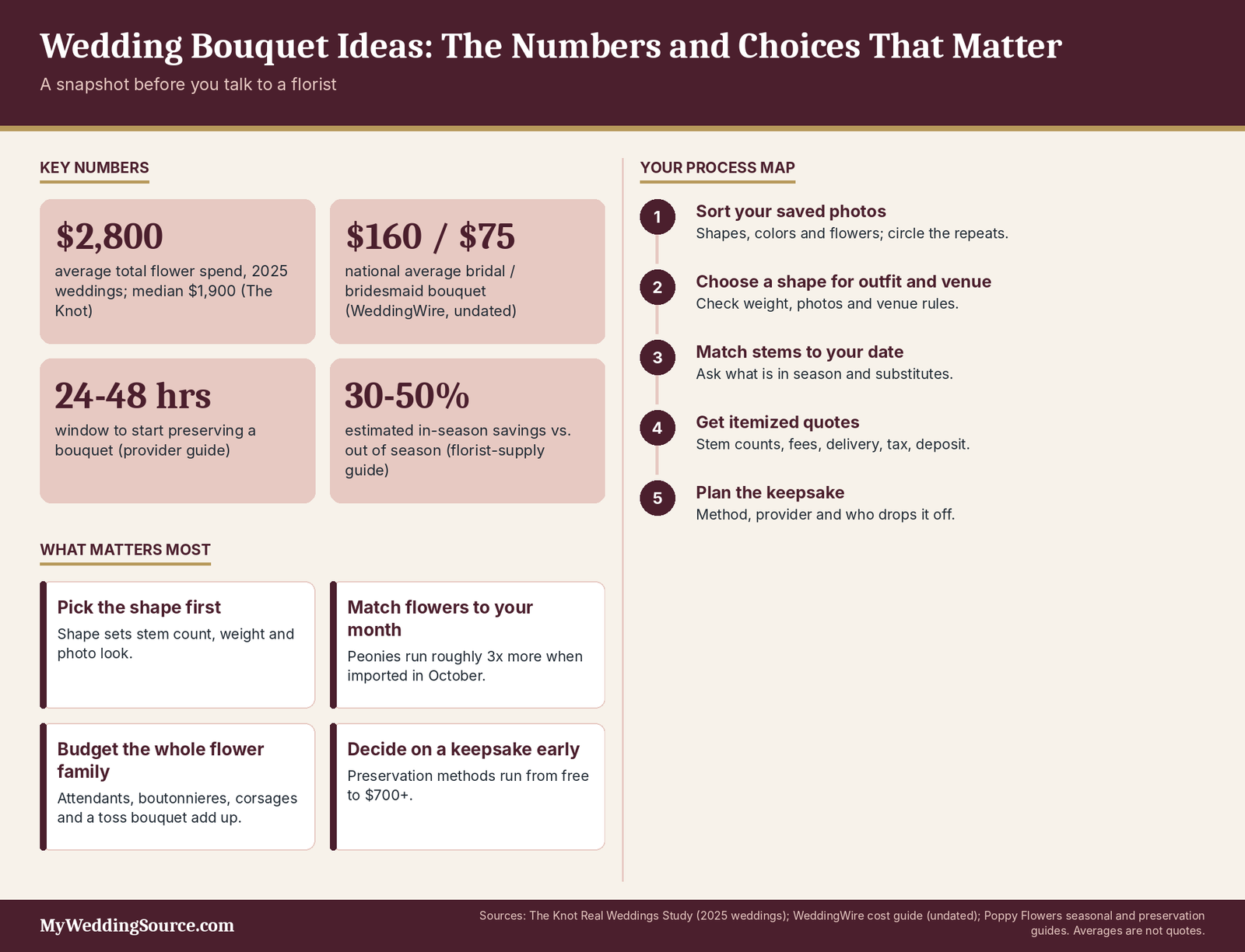
The Poppy guide estimates that in-season flowers cost roughly 30 to 50 percent less than the same variety out of season, and that importing from the opposite hemisphere raises prices about two to three times. Its example is peonies: wholesale around $5 to $8 per stem in May versus about $15 to $25 per stem when imported in October, a premium of 200 to 300 percent. Those are one supplier’s figures, so use them as an order-of-magnitude warning and not as a quote. Imports matter more broadly too, since a University of Illinois farmdoc daily analysis reports that imports supply nearly 80 percent of the value of cut flowers sold in the United States, with Colombia and Ecuador as the leading sources. Ask your florist where your key stems come from and whether the quote holds if supply tightens.
Which look-alike flowers can stand in for a favorite?
Substitution is the most common professional answer to out-of-season requests. The Poppy guide suggests garden roses as a look-alike for peonies, and, as an editorial observation rather than a sourced rule, florists often pair ruffled blooms with lisianthus, spray roses or carnations to get a similar layered petal effect. The Knot’s cost guidance also recommends staying flexible on flower types and sharing your color palette so the florist can buy to what is available. A useful way to frame the conversation is to describe the feel you want, for example ruffled, soft, blush and airy, and let the florist propose two or three alternatives with photos. Agree in writing that substitutions of equal or greater value are allowed, so a supply problem does not become a last-minute scramble.
Which flowers are reliable in almost any month?
A short list of workhorses covers most situations. The Poppy guide lists roses, hydrangeas, lisianthus and orchids as year-round reliable at mid-range prices, and carnations, baby’s breath, eucalyptus and chrysanthemums as year-round and inexpensive. The Knot adds that mixing greenery and branches into arrangements helps, because blooms usually cost more per stem than greens. These flowers are not boring when handled well: a bouquet of tightly bunched garden-style roses with eucalyptus can look luxurious, and a monochrome mix of lisianthus and spray roses photographs beautifully. If you want a dependable, mid-priced base, build the bouquet around two of these, then use one or two premium or seasonal accent stems where they will be seen.
| Season | Often available | Premium-priced or limited | Reliable year-round |
|---|---|---|---|
| Spring | Peonies, ranunculus, tulips, sweet peas, lilac | Sweet peas and ranunculus fade fast in warm weather | Roses, hydrangeas |
| Summer | Dahlias, delphinium, zinnias, lisianthus, garden roses | Delicate garden stems in heat | Lisianthus, protea |
| Fall | Dahlias, chrysanthemums, celosia, amaranthus, marigolds | Peonies (imported), sweet peas, lilac | Roses, eucalyptus |
| Winter | Amaryllis, anemones, hellebores, paperwhites, cymbidium orchids | Peonies, delicate spring stems | Carnations, dusty miller |
Which Colors and Trends Are Shaping Bouquets Right Now, and How Much Should You Trust Them?
Trend reports are useful for finding words to describe what you like, and they are less useful for predicting what will still look right in your photos in ten years. The 2026 bouquet conversation is unusually rich, with moody palettes, tiny single-variety bundles and handmade pieces all growing at once. This section sorts the signals, explains what the percentages mean, and shows how to borrow a trend without letting it take over the whole bouquet.
Which palettes are showing up in 2026 reports?
Three sources are worth reading side by side: Pinterest’s platform data, The Knot’s floral designer round-up, and the editorial trend lists from the wedding publication The Wed. They overlap in places and disagree in others, which is useful information in itself. Where the sources agree, the signal is stronger, and where they diverge, you can simply choose the direction that suits your outfit and venue.
Deep, moody palettes: plum, olive, merlot and fig
Pinterest’s 2026 Wedding Trends Report, published in April 2026, groups several searches under a “Rooted Romance” palette. It reports growth of 1,380 percent for “plum and olive wedding,” 630 percent for “plum wedding theme,” 270 percent for “dusty olive,” 545 percent for “muted terracotta,” 515 percent for “fig wedding,” 370 percent for “merlot wedding” and 345 percent for “muted rose.” For a bouquet, those translate into dark dahlias, burgundy ranunculus, plum-toned lisianthus, olive-tinted greenery and a touch of dusty rose, which is also a strong match for a fall date. The practical advice is to choose one deep color and one muted companion rather than the whole palette, because dark flowers read as intense in photos, and a small number of them often lands better than a full bouquet of the same tone.
White, monochrome and single-variety bundles
The Knot’s wedding flower trends round-up, updated in November 2025 with input from floral designers, calls white “the shade du jour” for 2026 and highlights monochrome and single-variety arrangements, petite monofloral bundles of calla lilies or lily of the valley, and exposed stems that look freshly picked. It also mentions green flowers such as hydrangeas, viburnum, allium and orchids, plus sculptural shapes with slender silhouettes. This is the opposite end of the palette spectrum from the deep, moody colors above, and the two directions can coexist: a single white bundle looks deliberate against a dark outfit, while a deep-toned bundle looks deliberate against a light one. If you are choosing between them, the useful test is contrast with the clothing and background, not what is trending.
Cool blue, opera red and other editorial directions
The Wed’s forecast of floral trends according to Pinterest lists a softer, frostier blue shown in hydrangea towers and delphiniums, an “opera aesthetic” of deep crimson blooms with candlelight, laced-up bouquets wrapped in vintage lace, and leafy-green concepts such as layered savoy cabbage. These are editorial forecasts based on Pinterest Predicts and search interest, and the article cites no numbers, so they are best read as inspiration rather than measured demand. They are helpful when you want a distinctive but still floral direction, and a good florist can translate them into stems that are actually available on your date. Ask for two versions of any unusual concept, one faithful and one simplified, so you can compare cost and practicality.
How do you test a palette against your actual day?
Photograph the real fabrics or a swatch next to a few stems under the lighting you expect, ideally at the time of day your ceremony will happen. Candlelight and warm evening light shift whites toward cream and deepen reds toward brown, while shade and overcast skies cool everything down, so a color you love on a screen can look quite different in person. Bring your attendants’ fabric swatches, any table linen colors and a photo of your venue’s walls or flooring, and ask the florist to lay out a trial arrangement if the budget allows a consultation. If you are planning a winter or evening event, our guide to winter wedding decor and lighting ideas explains how warm and cool light change the way flowers photograph.
How do you read trend percentages without being misled?
A big percentage looks like a stampede, but it is only one signal, and it is easy to misread. Three habits keep the numbers useful. Keeping these in mind will help you use trend reports as a vocabulary for your preferences, and not as a to-do list.
What do Pinterest growth numbers actually measure?
They are growth figures for search terms on one platform, not Google search volume and not a count of weddings that will use the idea. The Pinterest report we cite does not state the comparison window or the baseline for its percentages in the article text, which means we cannot tell how large the starting numbers were. A term that grows 1,000 percent from a very small base can still be small in absolute terms, so a high percentage tells you the idea is gaining attention, not that it is mainstream. We use these figures for direction, and we recommend you do the same.
Which bouquet trends are growing fastest?
Within bouquets specifically, Pinterest reports “fuzzywire bouquet” up 1,275 percent, “bouquet purse” up 1,015 percent, “book flower arrangement” up 725 percent, “bedazzled flower” up 715 percent, “men’s flower bouquet” up 565 percent, “note bouquet” up 555 percent, “beaded flowers bouquet” up 305 percent, “bouquet with no flowers” up 240 percent and “embroidery flower bouquet” up 205 percent. The report frames the pattern as a shift toward expressive, personalized bouquets that can double as accessories or keepsakes. The Wed’s list of ten major bouquet trends for 2026 echoes that theme with “objet d’art” handcrafted bouquets, bouquet bags, metal-wrapped stems and a farm-fresh trend using vegetables, berries and herbs. The common thread is that couples want a bouquet that is also an object, which is why the next section covers non-floral and keepsake options in detail.
Which trends tend to age well in photos?
This is an editorial judgment and not a measured result. Shapes and colors that echo your outfit and venue tend to age more gracefully than trends that rely on a single novelty element, such as a specific accessory or a very bright dye, because the context stays timeless even as the novelty fades. Natural, garden-style and monochrome bouquets are difficult to date, while heavily trend-coded pieces can look strongly of their year, which is not a flaw if you love them. A helpful question to ask yourself is whether you would still choose the bouquet if nobody had ever posted it online. If the answer is yes, the trend is serving you instead of the other way around.
How can you borrow a trend without committing the whole bouquet?
Scale the trend down to one deliberate accent. You can wrap an otherwise classic hand-tied bouquet in vintage lace for the “laced up” look, add a ribbon cascade, tuck in a handwritten note as in the “note bouquet” idea, or use a single protea or calla lily as a focal point. Attendants can carry a simpler version, and a bouquet purse or wire flower can be a second, photo-only item rather than your main bouquet. Trying a trend in one place, with a plain bouquet around it, lets you keep the idea without staking your entire look on it.
Are Non-Floral and Keepsake Bouquets Worth It?
The fastest-growing bouquet searches in 2026 are about bouquets that do not wilt: wire flowers, beaded blooms, embroidered stems, handbags with flowers on them. If you have a sentimental reason to keep the bouquet, or a venue that makes fresh flowers hard, these options deserve a serious look. They also come with trade-offs in cost, lead time and how they handle the practical parts of the day.
What kinds of non-fresh bouquets can you choose?
The category is broad, so it helps to divide it by material and by how much of the work you want to do yourself. Each type has a different lead time, a different durability and a different relationship with the budget, which is why it helps to look at them one at a time.
Dried and preserved bouquets
A dried bouquet is built from flowers that were dried before the wedding, and a preserved bouquet is typically fresh flowers treated to hold their form. Dried-style stems such as baby’s breath, lavender, pampas grass and wheat-like grasses have a long run in boho and rustic styles, and The Knot’s cost guidance notes that dried flowers can lower the bill, including dried baby’s breath that can be colored to match your palette. Because they are dry, they do not need to be kept in water, and they are lighter than many fresh bouquets, which helps with long photo sessions. The trade-offs are that colors are more muted, stems are more brittle and the bouquet usually should not be tossed or squeezed. If you want dried stems, ask the florist how far in advance they need to order and how they transport a delicate arrangement.
Fuzzy-wire, beaded and embroidered bouquets
These are handmade pieces, typically built from chenille wire, glass or acrylic beads, fabric or embroidery thread, and they are the bouquets driving the biggest percentage increases in the Pinterest data. Their appeal is obvious: they can be made in any color, they photograph consistently, and they become a keepsake you can display. They are labor-intensive, and maker timelines vary, so it is worth contacting a maker early and asking for a firm delivery date in writing. A wire bouquet can also be fragile in a suitcase or a hot car, and a long ceremony with a lot of hugging is hard on beaded petals. Ask about repair or replacement terms in case a piece is damaged before the wedding.
Bouquet purses, books and note bouquets
Pinterest’s data shows “bouquet purse” up 1,015 percent, “book flower arrangement” up 725 percent and “note bouquet” up 555 percent, and The Knot’s floral designers also mention handled bouquets with pearl handles or botanical frames. A bouquet purse combines a small bag and a floral display, which gives you a place to carry a phone or a lip balm, and it can be a charming option for an attendant who wants a hands-free bouquet. A book arrangement tucks flowers into a hollowed book, usually as a sentimental or literary gesture, and a note bouquet adds written messages from friends and family. These are conversation pieces, so the practical question is weight and balance: a bag with a rigid frame can be heavier than a simple bundle, and a paper-based design can suffer in rain or humidity.
Faux, silk and farm-fresh bouquets
Silk or other artificial flowers are an option when you want to carry and keep the exact same bouquet, and they can be a thoughtful choice for people with pollen sensitivities or for photo-only portraits. The Wed’s “farm-fresh” trend takes the opposite approach, using vegetables, berries, herbs and even corn as a seasonal, sustainable take on florals. Edible and herb-based bouquets can be fragrant and personal, though they wilt quickly and are not intended to be eaten after being handled for hours, so treat them as decorative. Whichever direction you choose, remember that a faux bouquet should be judged on how it photographs, so look at images of the actual item under natural light before ordering.
How do you compare cost, durability and risk?
Handmade does not automatically mean cheaper, and fresh does not automatically mean fragile. The three questions below cover what you need to compare apples-to-apples. Spending a little time on these comparisons before you commit can prevent both a surprise invoice and a bouquet that does not survive the day.
What do handmade bouquets cost?
Prices vary widely by maker, material and complexity, and we could not verify a reliable national average for fuzzy-wire, beaded or embroidered bouquets, so we are not giving one. What we can say is that the main cost driver is hours of hand labor, so the price tends to track the number of flowers, the detail and how custom the colors are. Ask for a written quote that lists the number of pieces, the materials, the delivery date and the policy if the piece is damaged. Compare that quote with a fresh florist quote for a bouquet and, if you want a keepsake, with the cost of preserving a fresh bouquet in the table later in this guide, since a preserved fresh bouquet and a handmade one can land in a similar range.
How do non-floral bouquets handle the toss, travel and weather?
A non-floral bouquet usually survives heat and a long day better than a fresh one, but it has its own weak points. Wire, beads and glued parts can bend, snag or detach, so a toss onto a hard floor can be rough, and many couples choose a separate inexpensive toss bouquet. For travel, a rigid box and a firm plan for who carries the bouquet are better than hoping it will fit in a car seat. If your wedding is outdoors and humid, ask whether the material will absorb moisture, and if you are flying, check the airline’s rules for carry-on items and pack the piece so it can be re-shaped on arrival.
When does fresh still make the most sense?
Fresh flowers bring scent, softness and the sense of something alive, and for many couples that is the whole point. A fresh bouquet can also be the easiest option when your timeline is short, since a florist can often work in a few weeks, whereas a handmade piece may take months. If you want the look of fresh but need it to last, a hybrid approach works well: carry fresh flowers on the day and preserve them afterward, or commission a small handmade piece as a keepsake alongside a fresh bouquet. The right answer is the one you will actually enjoy holding.
How Much Does a Wedding Bouquet Cost, and What Moves the Price?
Bouquet pricing is complicated, and the reason is not that florists are hiding something: a single arrangement combines stems that vary tenfold in price, hours of design labor, supplies and delivery. National averages help you check whether a quote is in a reasonable neighborhood, but they cannot tell you what your bouquet should cost. This section gives you the most reliable anchors we could verify, a transparent stem-math table and the levers that move the total.
What do national numbers say about bouquet and floral spending?
Two national sources are useful, though neither is a quote for your market. One reports total floral spending from a large 2025 survey, and the other reports per-bouquet averages without a stated data year, so they should be read together and with care. We summarize both below and explain why the average and the middle of the range can tell different stories.
What did couples spend on flowers overall in 2025?
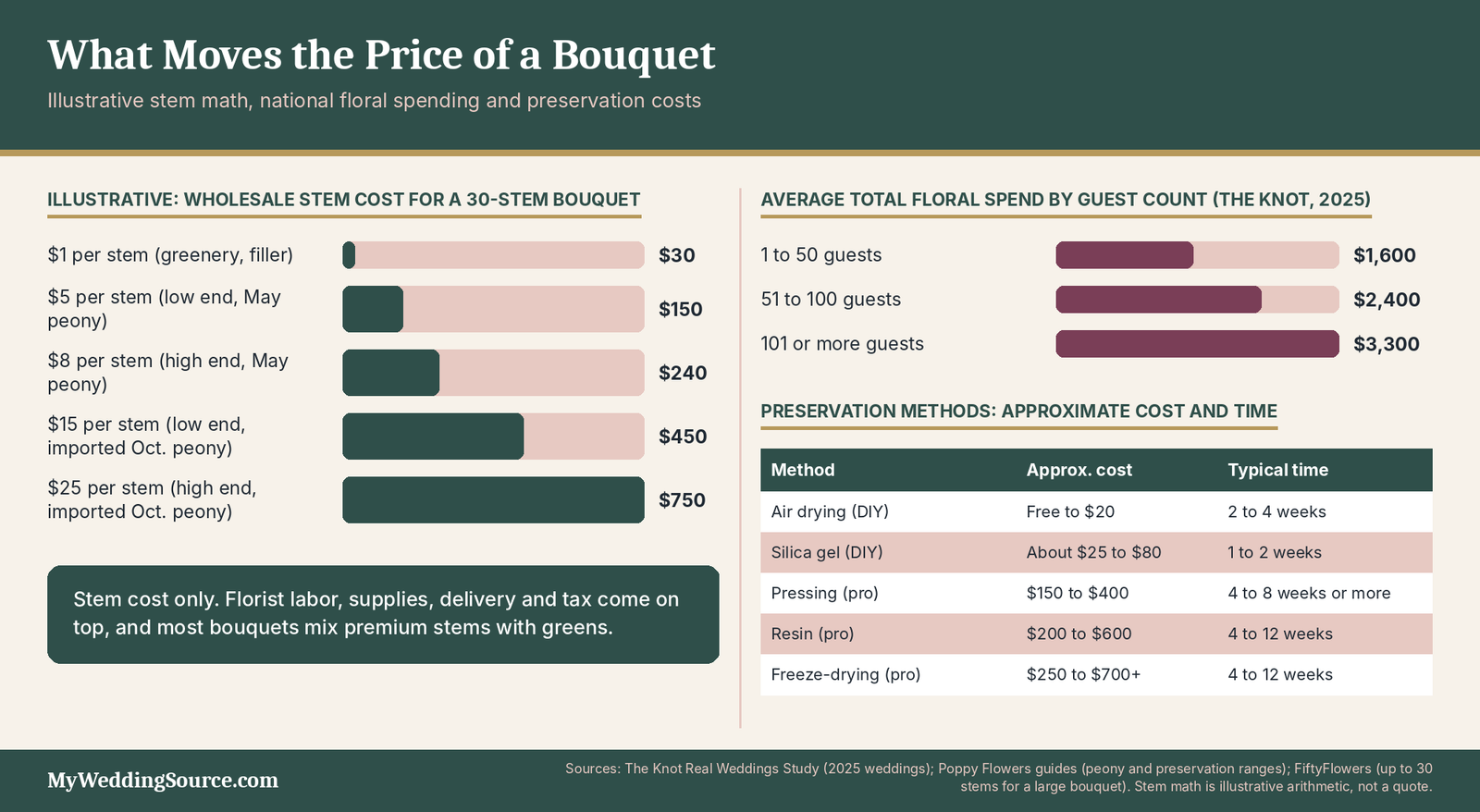
The Knot’s average cost of wedding flowers page draws on its Real Weddings Study of 10,474 U.S. couples married between January 1 and December 31, 2025, and reports an overall average of $2,800 for flowers, including the bridal bouquet, boutonnieres, wedding party flowers and centerpieces. The 25th percentile, median and 75th percentile were $900, $1,900 and $4,800, which tells you that half of couples spent $1,900 or less and that the average is pulled upward by high spenders. The study does not break out the bouquet separately, so this is a total-flowers number, and it includes centerpieces and ceremony pieces as well. For context on the study itself, The Knot published the full Real Weddings Study in February 2026.
What do individual bouquets average?
WeddingWire’s wedding flowers cost guide lists a national average of $160 for a bridal bouquet and $75 for a bridesmaid bouquet, with total floral costs averaging about $1,500 and most couples spending $700 to $2,500. The page says its figures are based on pricing reported by couples in reviews, but it does not state a data year, so we treat the numbers as a rough, undated guide. These are national blends of very different markets and bouquet types, and a premium-stem cascade in a major city can sit far above them. The more useful comparison is whether a quote feels proportionate to the size, the flowers and the labor, and not whether it matches an average.
Why do the average and the median differ so much?
A $2,800 average beside a $1,900 median is a signal that a minority of weddings have very large floral budgets, such as installations, ceiling pieces and large guest counts. If you only look at the average, you might assume you are underspending when you are actually near the middle. The reverse can also happen: a couple with 40 guests and a simple bouquet might wonder why quotes seem high when they are comparing to a number inflated by large events. Use the median as a sanity check, and then use guest count, region and style to narrow the range, as the table below allows.
How much do guest count, region and season change the total?
The same Knot data breaks floral spending down by guest count, region and season. Guest count has the clearest effect, because more guests mean more tables, more centerpieces and more people to decorate for, while the bouquet itself stays roughly constant. The regional spread is wide, from $2,400 in the West to $3,600 in the Mid-Atlantic, and the seasonal spread is narrow, with October through December at $2,700 and January through March and April through June at $2,900. Remember that these are totals for the whole floral package, so a smaller wedding in an expensive region can still spend relatively little in absolute terms.
| Segment | Group | Average floral spend |
|---|---|---|
| Overall | All couples | $2,800 |
| Guest count | 1 to 50 guests | $1,600 |
| Guest count | 51 to 100 guests | $2,400 |
| Guest count | 101 or more guests | $3,300 |
| Region | Mid-Atlantic | $3,600 |
| Region | Northeast | $3,300 |
| Region | Southwest | $3,000 |
| Region | South/Southeast | $2,800 |
| Region | Midwest | $2,500 |
| Region | West | $2,400 |
| Season | January to March | $2,900 |
| Season | October to December | $2,700 |
What moves the price of one bouquet?
Once you know the national picture, the useful question is what you can change. Five levers account for most of the difference between a modest bouquet and an expensive one. Each lever below includes the practical question to ask your florist, so you can test a quote instead of simply accepting or rejecting it.
How much do your stem choices matter?
Stem choice is the biggest single driver, and a simple calculation shows why. The Knot’s cost guidance notes that blooms usually cost more per stem than greens, and the Poppy Flowers guide cited earlier gives peonies at roughly $5 to $8 per stem wholesale in May and $15 to $25 per stem when imported in October. FiftyFlowers, a wholesale flower seller, describes a large, luxurious bouquet as using up to 30 stems and a medium bouquet as up to 15 stems. Multiplying those numbers gives the table below, which is illustrative arithmetic and not a quote: it shows wholesale stem cost only, before a florist’s labor, supplies, markup, delivery and tax.
| Wholesale price per stem | 15 stems | 30 stems | Example |
|---|---|---|---|
| $1 | $15 | $30 | Greenery, filler, some carnations |
| $2 | $30 | $60 | Hypothetical mid-low stem |
| $5 | $75 | $150 | Low end of May peony price |
| $8 | $120 | $240 | High end of May peony price |
| $15 | $225 | $450 | Low end of imported October peony |
| $25 | $375 | $750 | High end of imported October peony |
How do size and shape change the quote?
A cascade or presentation bouquet can use far more stems than a posy, so the same flowers can produce very different totals. The stem table assumes a single type of stem, whereas most bouquets blend a few premium stems with fillers and greenery, so the real stem cost often sits between the rows. Shape also changes labor: round and cascading shapes take more careful construction than a loose hand-tied bundle, which can show up in the design fee. When you compare quotes, ask each florist for the approximate stem count and the main flowers, which turns a vague price into something you can test.
Which fees sit on top of the flowers?
Florists typically add design and labor, supplies such as ribbon, floral tape and pins, and delivery or setup, and some have a minimum order. These are normal costs of running a floral business, so the useful step is to ask for them itemized, not to try to avoid them. Ask whether the bouquet is delivered to the getting-ready location or the ceremony venue, and whether there is a charge for a second delivery if the timeline changes. Sales tax rules vary by state and by whether an item is a good or a service, so ask how tax is applied on your invoice.
What does the timeline do to the price?
Late changes, rush orders and holiday weeks can add cost, and supply shocks can move wholesale prices. The farmdoc daily analysis reports that imports supplied nearly 80 percent of the value of cut flowers sold in the United States in 2023 data, so shipping disruptions and trade changes can affect stems that are grown abroad. Ask your florist when final stem counts are locked and what happens if a stem becomes unavailable. A clear substitution clause, which allows swaps of equal or greater value in your palette, protects both sides.
What should the contract say, and how should you pay?
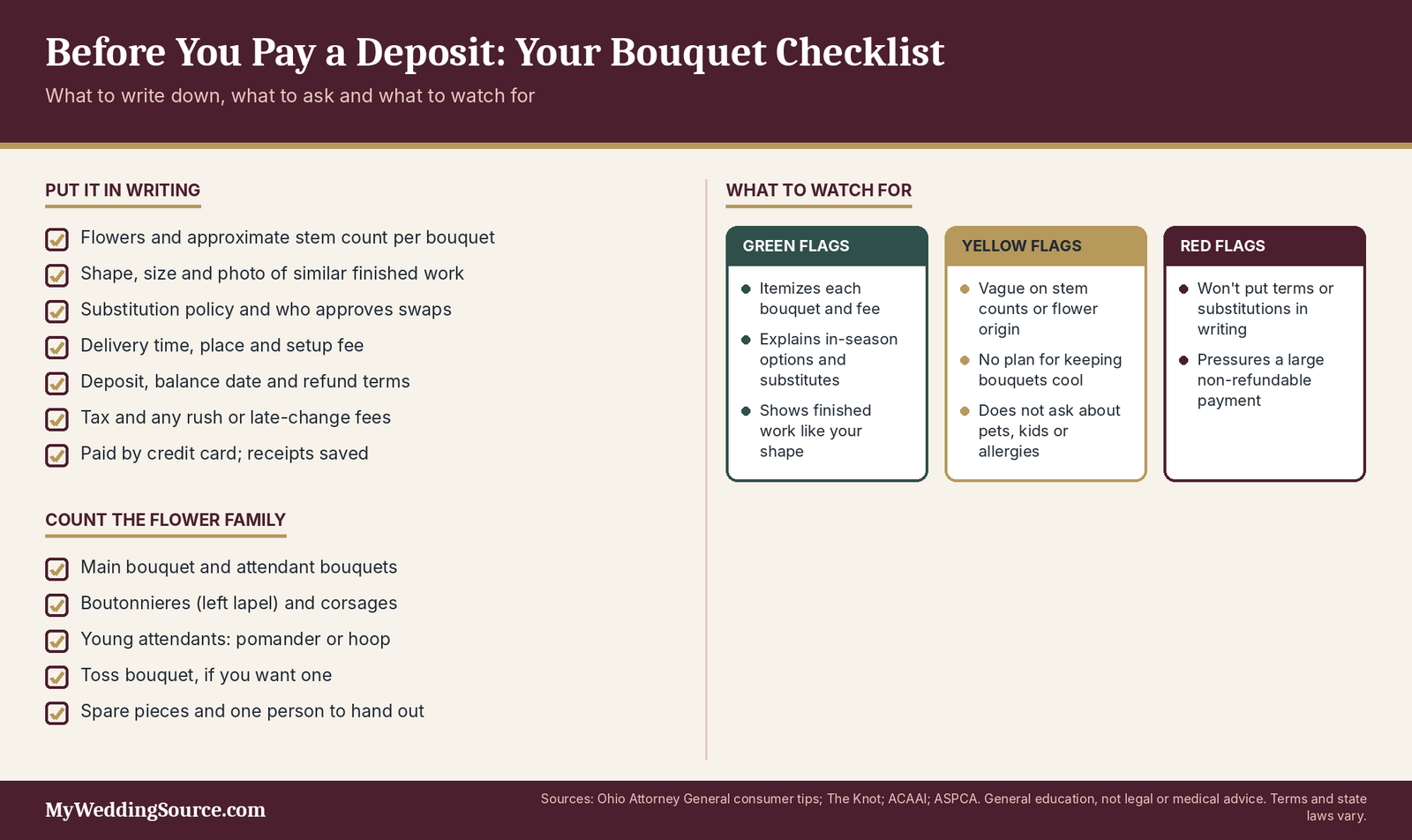
Get the details in writing: the bouquet descriptions, the number of pieces, delivery time and place, substitution terms, the deposit amount and the cancellation or refund policy. The Ohio Attorney General’s consumer guidance for wedding planning advises putting verbal promises in writing, asking whether deposits are refundable, and paying with a credit card where possible because card companies allow disputes if goods or services are not delivered. This is general consumer information, not legal advice, and terms and state laws vary. For a deeper look at fees and contract terms across the whole floral package, our guide to wedding flowers cost walks through the line items.
How Do You Coordinate Attendant, Family and Boutonniere Flowers?
The main bouquet gets the attention, but the flower family around it is where budgets quietly grow and where coordination mistakes happen. A boutonniere for the wrong person, a corsage that clashes with beading, or a head count that is short by two can all be avoided with a list. This section covers who gets what, how to coordinate the look and how to price the whole group.
Who carries or wears what, and should it all match?
Traditions are flexible, and most couples now decide by role and comfort. The Knot’s guidance is a useful starting point, though you can adapt it freely. The four questions below cover matching, boutonnieres, corsages and young attendants, in the order most couples ask them.
Should attendant bouquets match yours?
Not necessarily, and many couples now prefer coordination over matching. The Knot’s 2026 floral designer round-up describes small bouquets that range down to a single stem for the wedding party as well as the couple, with some attendants carrying one signature bloom and others carrying different but coordinating flowers. A good way to coordinate is to share a color family and one repeated flower or foliage across all bouquets, then vary the size and shape. This gives your photos a cohesive look and lets attendants carry bouquets suited to their height, outfit and comfort.
Who traditionally gets a boutonniere?
According to The Knot’s guide to corsages and boutonnieres, the traditional recipients include the groom or grooms, fathers and stepfathers, grandfathers, wedding party members, ring bearers, ushers or greeters, male officiants who are not wearing religious garb, and other VIPs such as readers. The piece is worn on the left lapel, named for the buttonhole of a suit jacket, though it can also be pinned to a shirt over the heart. The point to remember is that anyone in a suit can wear one, so you can choose by role and not by gender. Making your list early helps you count accurately.
Who gets a corsage, and how is it worn?
The same guide lists mothers, stepmothers and grandmothers, wedding party members, female ushers or greeters, female officiants not wearing religious clothing and other VIPs as traditional corsage recipients. A corsage can be pinned to a bodice or tied to the wrist with ribbon, and The Knot notes a wrist corsage is preferable for heavily beaded or delicate dresses. The article also suggests asking loved ones which style and placement they prefer, which is a kind gesture that avoids pin holes in a treasured outfit. If a family member would rather not wear flowers, a small bouquet, a pin-on brooch or no flower at all is also fine.
What do young attendants and special guests carry?
Pomanders and hoops are practical for children, since a pomander’s ribbon loop makes it easy to carry and a hoop can be slipped over the wrist. Petals, a small basket or a single stem are all sweet options, and a lightweight alternative is often best for a toddler. Ask the venue whether loose petals are allowed, since some spaces prohibit them for slip or cleanup reasons. For special guests, such as a grandparent carrying a family heirloom, a small posy is a lovely and low-cost gesture.
How do you budget the whole flower family?
Small additions add up, so it helps to see the whole list before you decide on the main bouquet. Seeing the group as one budget also makes it easier to decide where to splurge, since a modest attendant bouquet can free money for a statement piece in your hands.
What does a typical set of bouquets add up to?
Using WeddingWire’s undated national averages, a $160 bridal bouquet plus four attendant bouquets at $75 each comes to $460 before boutonnieres, corsages, tax and delivery. That arithmetic is illustrative, not a quote, and your market could be lower or higher. If you add a toss bouquet and boutonnieres for a handful of people, the total can climb quickly, so it is worth asking the florist for a per-piece price list. Compare the bouquet subtotal with the total floral spend of $2,800 reported by The Knot to see how much of your floral budget the personal flowers take.
Where can you save without making it look smaller?
Small bouquets and single-stem designs reduce the stem count without reducing impact, since The Knot’s round-up shows a trend toward petite bundles. Another approach is to spend more on the main bouquet and give attendants simpler bundles with the same foliage and one accent flower. Greenery-heavy designs can also stretch a budget, because The Knot reports that blooms usually cost more per stem than greens. The point is to decide where you want impact, and to be comfortable with simplicity everywhere else.
Which boutonniere flowers hold up through a long day?
Flowers that hold up out of water for several hours are the safest. The Knot’s fall flower guide names lisianthus as well suited to boutonnieres, and roses are widely used because they are sturdy and available year-round. Delicate blooms such as sweet peas and ranunculus can wilt quickly, so they are better as small accents than as the only flower. Ask your florist how they will keep boutonnieres and corsages cool before the ceremony, and keep them in the refrigerator or a cooler until pinning.
How do you make sure nobody is forgotten?
Write a complete recipient list at least a month before the wedding, including parents, stepparents, grandparents, readers, officiants, greeters and anyone you want to honor. The Knot’s guidance advises listing all recipients before the wedding so the florist knows how many pieces to make. Add two spare boutonnieres and one spare corsage if your budget allows, because last-minute guests and broken stems happen. Assign one person on the day to hand out the pieces and pin them, which prevents the chaos of everyone arriving at once.
Should You Make Your Own Bouquets or Hire a Florist?
DIY bouquets are one of the most popular ways to cut a floral line, and they can work well, especially for small weddings and simple shapes. They also move risk from the florist to you and your helpers, and the risk is concentrated in the final 48 hours when you are least likely to have spare hours. This section lays out what DIY really involves, the middle routes that keep the savings without the stress, and a decision table.
What does DIY actually involve?
Think of it as a small production with a supply chain, a storage plan and a deadline, not a craft afternoon. The four points below cover the real work. Read the four points below before you decide, and be honest about how many hours and helpers you really have in the week of the wedding.
How far ahead do you need to order, and how long do flowers need to drink?
Wholesale flowers usually arrive in boxes, tightly packed and thirsty, and they need time to open and hydrate before they can be arranged. FiftyFlowers notes that fresh flowers drink heavily during the first several hours after processing, and it describes bucket sizes by variety, with a 3 to 4 gallon bucket holding about 40 to 60 roses and a 5 gallon bucket holding about 75 to 100 roses or 20 to 30 hydrangeas. That means a full set of bouquets requires several buckets, clean water and floor space, which is a larger footprint than most apartments have spare. Plan for delivery at least a few days before the wedding so you have time to process and to replace anything damaged in shipping, and confirm the delivery date with the seller in writing.
Where do you keep stems cool until the wedding?
Temperature matters more than most DIYers expect. A University of California postharvest technology research note found that vase life decreased as storage temperature rose, and its authors advised that the industry continue to transport flowers dry while paying closer attention to proper storage temperatures. In plain terms, flowers kept warm age faster, so a cool room, a spare refrigerator or a rented cooler is a real asset. Ask your venue or a friend whether you can store buckets in a walk-in cooler, and avoid putting flowers next to ripening fruit or in a hot car. If you cannot keep them cool, consider ordering later or choosing sturdier varieties.
Who will build the bouquets, and when?
The most common DIY failure is not the flowers but the schedule: the couple ends up building bouquets the night before, tired and stressed. If you go DIY, assign the job to a friend or family member who enjoys it, or hire a florist for a short assembly session, and do a practice bouquet with inexpensive stems a few weeks ahead. Floral tape, wire, shears, ribbon, pins and a vase for each bouquet are small costs that add up, and you will want a few spares. Build a written timeline with times for processing, arranging, boutonnieres, photos and delivery, and name who carries each piece to where it is going.
What does DIY really cost?
The savings are real but smaller than they look on social media. You pay wholesale prices for stems, but you also pay for shipping, supplies, extra stems to account for damage, and the time of whoever is helping. If you buy a premium flower out of season, the price gap can swallow the saving, as the stem math earlier shows. A fair comparison asks for a florist’s quote for the same bouquets and compares it with your itemized stems, supplies, shipping and a cushion of 10 to 20 percent for losses, which is our editorial estimate and not a sourced rule.
What are the middle routes between DIY and full service?
Hybrid options let you save on the parts that suit DIY and hand the stressful parts to a professional. The three approaches below are the most common, and each one can be tuned to your comfort level, your skill and the time you have available.
Can a florist build the bouquets while you handle the rest?
Yes, and it is a popular compromise because the bouquet is the most photographed, most handled and most fragile piece. You might ask a florist for the bridal bouquet, boutonnieres and corsages, and DIY loose centerpieces, aisle greenery or a flower bar. Some florists will sell bulk flowers and consult for a fee, so ask what they offer and whether the consultation fee is applied to a later order. The goal is to put professional hands where failure is most visible.
Is a grocery store or wholesale market a good source?
It can work for informal weddings, and some couples use grocery store flowers for centerpieces or casual bouquets. The risks are consistency and quantity: you cannot reliably order a specific color or variety for a specific date, and stems may arrive with less lead time for hydration. Wholesale markets and online sellers give you more control but require advance ordering and delivery windows. Whichever route you choose, treat the first batch as a trial run, and keep a backup plan such as a few extra bundles or a florist you can call.
What about rental, silk or dried alternatives?
For people who want to skip the fresh-flower logistics, a faux or dried bouquet removes the cold-storage problem and the risk of last-minute wilting. Some florists and event rental companies offer rental bouquets or ceremony pieces, though availability varies by market and we could not verify typical rates, so ask for a written quote. A dried or silk bouquet can be ordered well ahead and checked in person before the day, which is a big comfort for people who dislike surprises. If you are choosing between these and fresh, compare the photos of finished work, not the product descriptions.
How do you decide? A quick comparison
Use the table below as a starting point, and add your own numbers for time and cost. The right choice depends on your skills, your helpers, your date and how much stress you can absorb. If any answer makes you hesitate, the hybrid option usually fits best.
| Option | Best for | Cost pattern | Main risk |
|---|---|---|---|
| Full DIY | Small weddings, simple shapes, skilled helpers | Lower flower cost, plus supplies, shipping and your time | Storage, timing and day-before stress |
| Hybrid | Couples who want savings plus professional bouquets | Moderate; pay a florist for key pieces only | Coordinating two sources |
| Full-service florist | Complex shapes, large parties, tight schedules | Higher, but includes design, delivery and backup | Quote creep if scope is vague |
| Faux or dried | Keepsake focus, allergies, outdoor heat | Often an upfront cost with no day-of freshness risk | Look can read as less natural in photos |
How Do You Keep, Carry and Safely Handle Your Bouquet?
What happens to the bouquet after the photographs is a decision worth making in advance, and so is how it behaves in your hands, in a crowd and around pets and sensitive noses. The details are small, but they are the kind that can turn a lovely bouquet into a problem. This section covers preservation, day-of care and a few safety notes drawn from allergy and poison-control sources.
How do you preserve a bouquet?
Preservation is time-sensitive, and the choice of method affects both cost and how the finished piece looks. A few minutes of planning before the wedding can protect hundreds of dollars of flowers and an object you may want to keep for decades.
What is the preservation window, and where do you keep the bouquet until then?
Poppy Flowers’ preservation guide says that most methods should begin within 24 to 48 hours, because flowers begin dehydrating in the first 12 hours and are generally too deteriorated for good results after about 48 hours. Until a provider receives the bouquet, it advises refrigerating it at 34 to 38 degrees Fahrenheit and not freezing it, and it recommends booking popular providers two to three months ahead. In practical terms, that means arranging the preservation plan before the wedding and asking a friend or family member to put the bouquet in a cool place right after the reception. If your wedding is on a Saturday night and you are leaving for a honeymoon, this is the kind of task to hand off in advance with written instructions.
Which preservation method fits your goal and budget?
The approximate costs and timelines below come from the same provider guide, so treat them as ranges to confirm with a local studio. Air drying is the cheapest and least reliable, pressing makes framed art that flattens the flowers, silica gel and resin sit in between, and freeze-drying holds the most color and shape at the highest price. Peonies, ranunculus and sweet peas are delicate and tend to do best with freeze-drying, while roses, hydrangea, eucalyptus and lavender handle several methods. Ask each provider for sample photos of finished work with bouquets similar to yours, and ask about turnaround time, shipping, insurance and what happens if the bouquet arrives too late.
| Method | Approx. cost | Typical time | Trade-off |
|---|---|---|---|
| Air drying (DIY) | Free to $20 | 2 to 4 weeks | Colors darken; fragile; lasts about 1 to 5 years |
| Pressing | $150 to $400 (professional) | 4 to 8 weeks or longer | Flattened, framed art; bouquet is taken apart |
| Silica gel (DIY) | About $25 to $80 | 1 to 2 weeks | Better color than air drying; handled flower by flower |
| Resin | $200 to $600 (professional) | 4 to 12 weeks | Very durable; cannot be undone once sealed |
| Freeze-drying | $250 to $700+ | 4 to 12 weeks | Best color and shape; professional only, most expensive |
Who should handle the bouquet right after the wedding?
Name one specific person, give them the provider’s address and instructions, and tell the florist who will pick up or deliver. Ask your florist and your preservation provider whether they offer drop-off, pickup or shipping, since options differ by provider. If you are taking a honeymoon flight the next morning, that person can also take photographs of the bouquet before it is preserved for your records. This small piece of delegation is often the difference between a preserved bouquet and a plan that never quite happens.
What about the bouquet toss?
Many couples now skip the toss, and others use a separate, inexpensive toss bouquet so the main bouquet can be preserved. A toss bouquet can be a simple bundle of in-season stems, a smaller replica or a fabric alternative, and it is a good place to save. If you do a toss, announce it clearly and consider whether a pet-safe or allergy-friendly version makes sense for guests. Tell your florist in advance, because a toss bouquet is another piece to count in the contract.
What safety and day-of details deserve attention?
None of these needs to dampen the joy of flowers, and all are easy to handle if you plan for them. The notes below draw on allergy, poison-control and postharvest sources, and they are written as general education rather than medical advice.
Allergies and pollen
The American College of Allergy, Asthma and Immunology offers wedding-season tips, and its guidance on keeping “achoos” from interrupting your “I do’s” advises choosing flower varieties that produce little or no pollen, listing roses as a dependable pick and naming begonia, columbine, crocus, daffodil and geraniums as lower-risk options. It also notes that pollen counts shift with the season, peaking in the evening in spring and summer and in the morning for ragweed in late summer and early fall. If you or a close family member has pollen allergies, ask the florist for low-pollen choices and consider faux flowers for the people most affected. This is general information, not medical advice, so check with an allergist if you have severe reactions.
Lily of the valley and other toxic plants
Lily of the valley is a favorite for micro bouquets, and it is also a plant that deserves care. The ASPCA lists it as toxic to dogs, cats and horses, citing cardenolides and clinical signs that include vomiting, irregular heartbeat, low blood pressure, disorientation, coma and seizures, and the National Capital Poison Center’s plant list names lily of the valley among poisonous plants. Keep bouquets out of reach of children and pets, wash hands after handling, and choose another flower if your household has young children or animals. If you suspect ingestion, contact poison control or a veterinarian immediately; this is general information and not medical advice.
Lilies and cats
True lilies in the Lilium family are a special concern for cat owners. The ASPCA lists the Easter lily as toxic to cats, with clinical signs of vomiting, loss of appetite, lethargy and kidney failure that can be fatal, and it advises calling a veterinarian or the ASPCA Animal Poison Control hotline right away if ingestion is suspected. If you have a cat or plan to give the bouquet to someone who does, ask your florist to avoid lilies or choose a different bloom. Calla lilies are a different plant from true lilies, so ask your florist or vet to confirm what is in the bouquet rather than relying on the common name.
Keeping the bouquet fresh on the day
Ask the florist whether the bouquet has a water source such as a wrapped stem or a water tube, and put it in a vase of clean water whenever you set it down, especially during cocktail hour. The University of California research note we cited above describes recutting stems under water before and after storage, which is why florists often recut stems at delivery. Avoid leaving the bouquet in a hot car, in direct sun or near a heating vent, and ask your photographer or coordinator to keep it in a cool, shaded spot between photos. For outdoor ceremonies, confirm where the bouquet will wait during the vows and who will hold it.
FAQ: Wedding Bouquet Questions Couples Ask
These answers are general and based on the sources cited in this guide. Confirm specifics with your florist, venue and any preservation provider. If an answer here conflicts with a vendor’s written policy, the contract and your vendor’s guidance take priority.
Choosing and styling
The questions below come up most often when couples are deciding on a shape, size and look. Each answer points back to the sections above in case you want the detail behind it.
How many flowers go into a wedding bouquet?
It depends on the shape and the flower. FiftyFlowers, a wholesale seller, describes a medium bouquet as using up to about 15 stems and a large, luxurious bouquet as up to about 30 stems. Large-headed flowers such as peonies, dahlias and hydrangeas use fewer stems for the same visual size, while slender stems such as ranunculus and spray roses use more. Ask your florist for the approximate stem count of the bouquet you like, since that number connects directly to price.
Do bridesmaid bouquets need to match the main bouquet?
No. Coordination is usually more flattering than matching, and The Knot’s floral designers describe attendants carrying one signature bloom or different but coordinating flowers. A shared color family and one repeated flower or foliage are enough to make the group look intentional. Smaller or simpler bouquets for attendants also save on stems.
Can I carry something other than flowers?
Yes. Pinterest’s 2026 data shows rising interest in bouquets with no flowers, beaded flowers, fuzzy-wire designs and bouquet purses, and many couples carry a handmade piece or a hybrid. Confirm the delivery date in writing, ask how the piece holds up to travel and weather, and have a plan for the toss. If you want fresh flowers in photographs too, consider a small fresh posy for portraits alongside the keepsake piece.
Money, timing and keeping
These questions tend to arrive after the first quote lands.
How can I lower the cost of my bouquet?
The main levers are stem choice, size and season. Choose flowers that are in season, since a florist-supply guide estimates in-season stems cost about 30 to 50 percent less than out-of-season ones, add greenery to stretch the bouquet, and consider a smaller shape such as a posy. The Knot also suggests staying flexible on flower types and sharing your palette so the florist can buy what is available. Always compare itemized quotes, since a lower sticker price can hide extra fees.
When should I order or book bouquet flowers?
We could not verify a universal rule, because lead times depend on your florist, date and market. Many florists book popular dates months ahead, so start conversations as soon as your date and venue are set, and confirm the bouquet details and substitutions in your contract. If you are working with a handmade maker or a preservation studio, ask about their booking windows too, since the preservation guide we cite recommends two to three months ahead for popular providers.
Can I keep my bouquet?
Yes, and the key is timing. Start within 24 to 48 hours, refrigerate until then, and choose a method based on how much color, shape and durability you want. Costs range from free for air drying to several hundred dollars for resin or freeze-drying according to the provider guide, so get a local quote before the wedding and assign one person to deliver the bouquet.
Your Next Steps
You do not need to decide everything at once. Two short passes, one this week and one before you sign anything, will turn an inspiration folder into a quote you can compare. Each step below is small on purpose, and together they give you a brief, a head count and a set of questions you can reuse with every vendor.
This week
Start with the choices that cost nothing and make every later conversation easier. These two tasks take less than an hour combined, and they make the later conversations with a florist much more productive.
Sort your saved photos into three piles
Open your inspiration board and sort it into shapes, colors and flowers, then circle the three details that appear most. If most of your saves are cascades in plum and olive, you have just described your brief. Note anything that depends on a specific season, such as peonies or sweet peas, and flag it for a conversation about substitutions. Bring ten images at most to your florist, because a focused set communicates more than a hundred.
Count the flower family
Write down every person who might carry or wear flowers, including you and your partner, attendants, parents, grandparents, readers, officiants and young attendants. Add a toss bouquet if you want one, and decide whether you want to preserve your main bouquet. Use WeddingWire’s national averages as a rough check, which for a main bouquet plus four attendants is about $460 before other items, then replace them with real quotes. This list becomes the foundation for your quote request.
Before you pay a deposit
These steps protect your budget and your design. Take your time with them, since a short list of clear questions saves far more than it costs.
Ask the florist these questions
These questions turn a vague price into a comparison. Ask the same list of every florist so quotes line up apples-to-apples, and save the answers in one document. If a florist is reluctant to itemize, that is a signal to ask again politely and to compare with another quote.
Confirm the contract and the payment method
Before you pay, check that the written agreement matches what you were told: the bouquet descriptions, the number of pieces, delivery time and place, substitution terms and the cancellation policy. The Ohio Attorney General’s guidance suggests paying with a credit card where possible and being cautious about large upfront payments, and terms and state laws vary, so read the contract carefully and ask questions about anything unclear. If you are comparing a florist with a handmade maker or a preservation studio, ask each for the same details in writing. For the wider planning picture, our wedding planning hub and wedding venues hub can help you line up dates, venue rules and timelines, and our guide to wedding arch ideas covers the ceremony backdrop your bouquet will be photographed against.
Sources & methodology
- The Knot: Average cost of wedding flowers — $2,800 average floral spend, quartiles, and breakdowns by guest count, region and season, from the 2025 Real Weddings Study of 10,474 couples.
- The Knot Real Weddings Study — study description; covers 2025 weddings, published February 2026.
- WeddingWire: Wedding flowers cost — undated national averages for bridal ($160) and bridesmaid ($75) bouquets and total floral cost.
- Pinterest Wedding Trends Report 2026 — platform search-growth percentages for bouquet and color terms, published April 2026.
- The Knot: Wedding flower trends — 2026 floral designer trends, updated November 2025.
- The Knot: Glossary of bouquets and wedding flowers — bouquet shape definitions.
- The Knot: Finding the right bouquet size — size and handling notes for posy, cascade, pomander and hoop shapes.
- The Knot: Who gets corsages and boutonnieres — recipients, placement and listing advice.
- The Knot: Fall wedding flower trends — fall flowers and foliage (2023; older trend material).
- The Wed: 10 major bouquet trends for 2026 — editorial bouquet trend list.
- The Wed: Top wedding floral trends for 2026 according to Pinterest — editorial floral forecasts.
- Poppy Flowers: Seasonal availability guide — seasonal flowers, wholesale price examples, in-season savings estimate (industry guidance).
- Poppy Flowers: Wedding bouquet preservation guide — preservation methods, timing and cost ranges (provider guidance).
- FiftyFlowers: DIY kit stem guidance — stem counts for medium and large bouquets.
- FiftyFlowers: Bucket sizes and storage — bucket capacities and hydration note.
- University of Illinois farmdoc daily: Cut flowers in the US — import share and source countries.
- UC ANR Postharvest Technology Center research note — storage temperature and vase life.
- ACAAI: Tips to keep achoos from interrupting your I do’s — low-pollen flower guidance.
- ASPCA: Lily of the valley — toxicity to pets.
- ASPCA: Easter lily — toxicity to cats.
- National Capital Poison Center: Plant list — lily of the valley listed as poisonous.
- Ohio Attorney General: Tips for savvy wedding planning — written agreements, deposits and credit card dispute rights (2014 consumer newsletter; general information).
Methodology: Verified facts here are limited to what the cited pages state, such as bouquet definitions, survey averages and plant toxicity listings. Survey findings (The Knot, WeddingWire) are national averages and not quotes. Pinterest growth rates are platform search-trend signals, not Google search volume, and the report does not state the comparison window. Seasonal availability, preservation ranges and in-season savings come from florist-supply providers and are industry estimates. Stem-math tables and attendant totals are illustrative arithmetic, and statements labeled editorial judgment are our own opinion.
Freshness note: Reviewed October 12, 2026. Recheck The Knot and WeddingWire figures when the next Real Weddings Study is published, recheck Pinterest and floral trend lists each spring, and confirm all preservation prices, florist policies and plant-safety information with the provider, your florist or a veterinarian or physician before you buy. This guide offers general education and not legal, medical or financial advice.