
Wedding trends are worth borrowing in 2027 only after you translate each one into a price, a venue check, a sourcing timeline, and an honest guess at how it will look in your photos ten years from now.
Many couples meet a trend the same way: a plum-and-olive tablescape, a drapery backdrop, or a flower bar shows up on a phone screen at 11 p.m., and by morning it is on a shared board with three heart icons. The real decision comes a few weeks later, when a vendor quote arrives and the pretty idea has a line item, a rental window, a power requirement, and a deposit. This guide is built for that second moment. It sorts the current signals by area (palettes, attire, florals, food, entertainment, photography, guest experience, money and technology, and small weddings) and, for each trend, says what it is, what the evidence actually shows, what it changes in cost and logistics, who it suits, how to try it affordably, and when to skip it.
One honesty note before the trends. The big wedding reports published this year describe 2025 and 2026 behavior, not 2027 weddings, because 2027 weddings are mostly still being planned. Where this article looks ahead, it says so and labels the statement as outlook or editorial judgment. Where a number comes from a platform or survey, it names the source, the sample, and the time window, or says plainly that the source did not give one. Nothing here is a search-volume claim: Pinterest growth percentages are platform trend signals, not Google search data.
How should you read a 2027 wedding trend report?
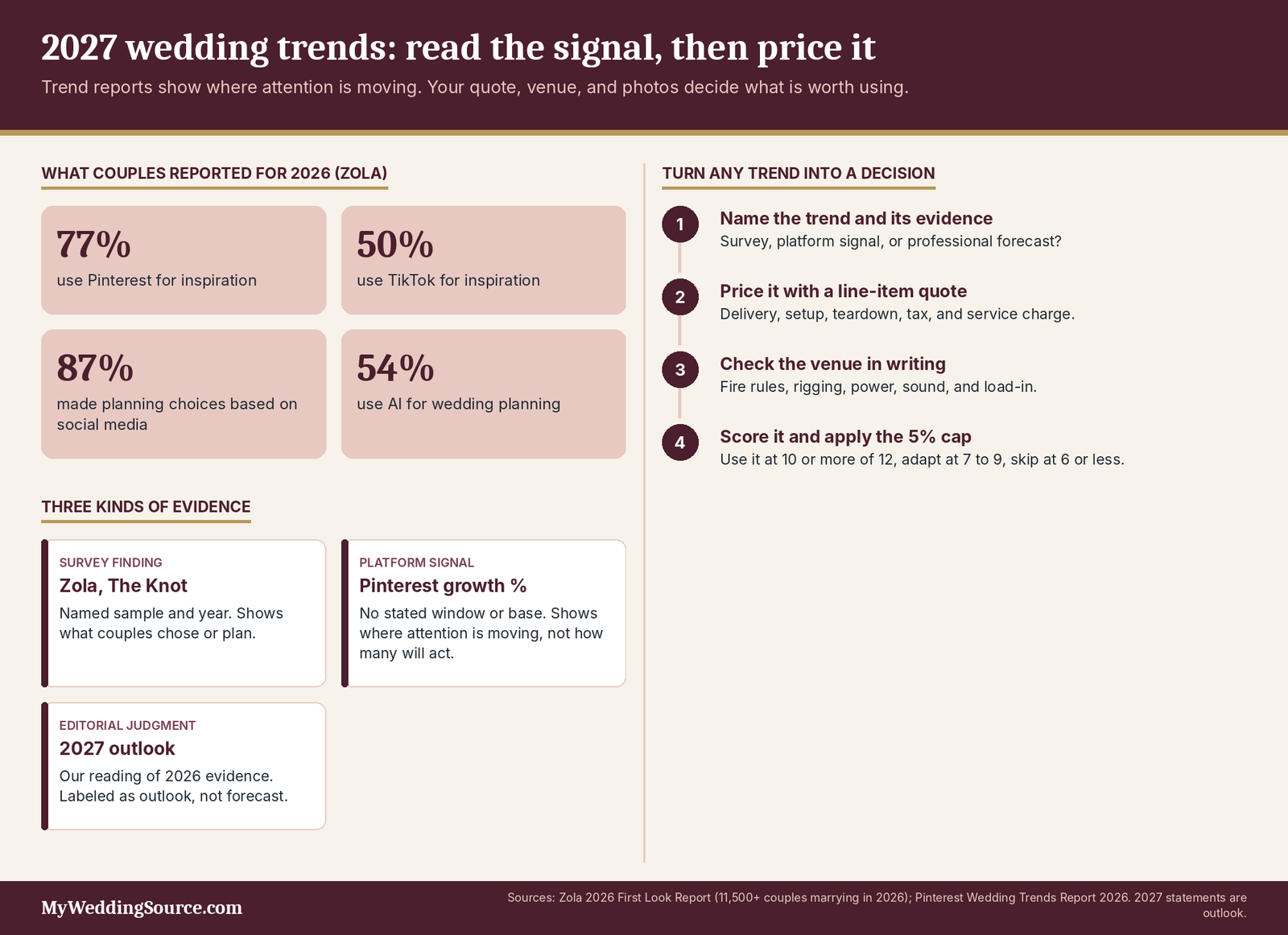
A trend report is a clue about what other people are looking at or choosing, not an instruction about what your wedding needs. The reports differ so much in method that putting their numbers side by side without context can mislead you. Pinterest measures growth in what people search for or save, Zola and The Knot survey couples who chose to answer, and trade editors report what they saw on runways and in planners’ inboxes.
What do the big reports actually measure?
Three sources carry most of the numbers you will see quoted in 2026 and 2027 trend roundups: Pinterest’s wedding trend report, Zola’s First Look Report, and The Knot’s Real Weddings Study. They overlap on themes such as personalization, social media influence, and budget pressure, but they are built from different raw material. Knowing the raw material tells you how far to trust each figure.
What do Pinterest’s growth percentages mean?
Pinterest’s Wedding Trends Report 2026, published April 28, 2026, lists terms with large growth figures: “opalite aesthetic” at +2,710%, “written songs” at +1,975%, “drapery backdrop” at +1,510%, and “plum and olive wedding” at +1,380%. The page does not state the time window or the comparison period, and it does not define the metric (searches, saves, or something else), so this guide calls them Pinterest trend-growth signals. A term that starts from a very small base can post a huge percentage without being widely used, which is why a +2,710% line tells you where attention is moving, not how many couples will act on it.
What do Zola and The Knot add that Pinterest cannot?
Zola’s 2026 First Look Report is based on more than 11,500 couples getting married in 2026 (published January 26, 2026, updated March 19, 2026), though it does not state how couples were recruited or the survey dates. The Knot’s Real Weddings Study data read-out covers 10,474 U.S. couples married during 2025, recruited by email from The Knot and WeddingWire membership. Both samples are large but self-selected, meaning they reflect couples who use these platforms and chose to respond. They measure what couples did or plan to do, which Pinterest’s growth figures cannot, but they do not forecast the next twelve months on their own.
| Source | Sample and window | What it measures | Main limit |
|---|---|---|---|
| Pinterest Wedding Trends Report 2026 | Published Apr. 28, 2026; window and base not stated | Growth in terms on the platform | Metric undefined; no absolute volumes |
| Zola First Look Report 2026 | 11,500+ couples marrying in 2026; survey dates not stated | Plans, budgets, tools, style choices | Self-selected platform users |
| The Knot Real Weddings Study 2026 | 10,474 couples married in 2025 | Costs, guest counts, vendors, behavior | Backward-looking; email-recruited |
| The Knot editor roundups (dress, decor, food, flowers, photography) | Runway visits and planner interviews, Oct. 2025 to Sep. 2026 | Professional forecasts | Mostly quotes, not measured data |
How does this guide label what it knows?
What counts as evidence in this article?
There are four tiers. A survey finding is a percentage from Zola or The Knot with a named sample. A platform signal is a Pinterest growth figure with no stated window. A professional forecast is what editors, designers, planners, and photographers expect, as in The Knot’s 2026 decor, food, flower, and photography trend articles, which cite named experts but no survey data. Editorial judgment is MyWeddingSource’s own reading of how a trend translates into cost and logistics.
Which statements here are about 2027?
As of October 12, 2026, the clearest 2027-labeled material from a major publisher is The Knot’s 2027 wedding dress trends roundup, published September 29, 2026 and based on editors’ visits to New York Bridal Fashion Week for Spring-Summer 2027. Pinterest’s newsroom listing in early October 2026 showed a beauty trend report but no 2027 wedding report, and Zola’s annual First Look arrives early in the year. That means almost every 2027 statement in this guide is an outlook: the 2026 evidence plus a judgment about what couples marrying in 2027 will do, since the average engagement runs about 14 months in The Knot’s data and 18 months in Zola’s.
Which wedding colors and aesthetics are rising for 2027?
Color is the cheapest trend to adopt and the easiest to get wrong, because it touches everything in the photos at once. The 2026 signals point toward deeper, moodier, nature-linked tones and a shimmering finish on top, while the largest surveyed color group is still green. That tension is useful: you can borrow the new look through small, swappable items and keep the big surfaces calm.
Which palettes are gaining ground?
Pinterest groups its palette signals into two moods: a “Rooted Romance” family of plums, figs, and olives, and an “Ethereal Shimmer” family of opalescent and chrome tones. Zola’s survey shows what couples actually chose for 2026, which is a more conservative picture. Read the two together and the practical advice is to treat the Pinterest palettes as accents and the Zola palettes as foundations.
Is a plum-and-olive palette worth using?
Pinterest’s report lists “plum and olive wedding” at +1,380%, “plum wedding theme” at +630%, “muted terracotta” at +545%, “fig wedding” at +515%, “merlot wedding” at +370%, and “dusty olive” at +270%, all without a stated window. Zola’s 2026 survey found green the top color at 53% of couples (sage green 30%), with burgundy or wine at 10%, terracotta at 7%, and rust at 7%. That overlap makes plum and olive a low-risk step from what is already popular: the olive is a cousin of sage, and the plum is a cousin of burgundy. It suits fall and winter weddings, garden and barn venues, and candlelit dinners, and it costs little because the color can live in linens, candles, napkins, ribbons, and stationery. Skip it for a midday summer tent if dark linens would run hot, and test it where the room is dim, since deep plum can read as black in photos. Our fall wedding weather and seasonal costs guide covers the fall daylight and demand issues that go with this palette.
What should you know about opalite, chrome, and iridescent finishes?
Pinterest’s “Ethereal Shimmer” group includes “opalite aesthetic” at +2,710%, “opalescent aesthetic” at +685%, “purple opal” at +545%, “midnight teal” at +470%, and “chrome wedding” at +340%. This is a platform signal only; Zola’s color list for 2026 does not feature it, so treat it as a styling layer rather than a mainstream palette. The cost question is what carries the finish: iridescent glassware, mirrored risers, acrylic signs, and chrome candlesticks are usually rentals or small purchases, while custom fabric or a full installation can climb quickly. It suits modern venues, evening receptions, and couples who want a quiet sparkle. Skip it if you want a look that will not read as 2026 in the album, and keep any finish away from where flash will bounce straight back at the lens.
How do you make a palette work in a real room?
How do you test a palette against your venue and light?
Ask the venue for photos of the room at the time of day you will use it, and note the colors you cannot change: walls, carpet, drapery, wood tones. Then lay physical swatches (napkins, a ribbon, a sample candle) in the space or in a similar-lit room, because screens shift color. A workable structure is one neutral base, one deep color, and one accent, which gives vendors a clear brief and keeps the palette from fighting the room. If your reception will run after dark, the lighting plan matters as much as the linens, and our winter wedding decor and lighting guide explains dimmers, pin spots, and warm-light consistency in detail.
When is a color trend a bad idea?
A color trend is risky when it sits on the largest, least reversible surface. The Knot’s 2027 dress roundup notes that “unexpected muted color” such as butter yellow, dusty rose, and light blue is appearing on runways, but also that it could take decades for colored wedding dresses to become mainstream, which is a reminder that color on a gown is a bigger bet than color on a napkin. The same logic applies to bridesmaid dresses, a full backdrop, or painted furniture you will not reuse. Put the trending hue on things you can swap, resell, or retire, and let the permanent items stay in a tone you have worn or loved for years. Editorial judgment: if you would be uncomfortable seeing the color in a photo on your wall in 2037, move it to a smaller item.
What are couples wearing in 2027, and what is worth buying?
Attire trends have two clocks. Runway trends move first and reach salons months later, and survey trends show what couples already bought. The 2027 dress material is mostly runway-driven, so it tells you about silhouettes you will see, not about what is selling, and the practical question is how to borrow a detail without paying for a whole new look.
Which dress and suit trends are showing up for 2027?
The Knot’s editors watched Spring-Summer 2027 collections in New York and reported thirteen themes. Pinterest’s separate list is search-based and leans toward the 1980s and corsetry. Where the two overlap (corsets, drop waists, richer fabrics), the signal is stronger than where only one source mentions a trend.
Which 2027 gown shapes and details are worth knowing?
The Knot’s September 29, 2026 roundup describes reinvented strapless necklines (cat-eye, scalloped, envelope), a basque-and-drop-waist hybrid, micro bows, asymmetry, peplums, long-line and exposed corsetry, continued 1990s minimalism, draping, mantilla veils, and bridal midis. It also notes the editors based this on what they saw at designer appointments and shows, not on sales data, and framed the outlook as 2027 and likely 2028. Pinterest’s report lists “drop waist wedding dress corset” at +1,405% and “1980 wedding dress” at +1,090%, which supports the drop-waist and structured-bodice thread. Gown spending reference points are about $2,100 (The Knot, 2025 weddings) and $2,000 (Zola’s 2026 cost index), with alterations averaging $550 in Zola’s index; structured corsets, heavy appliqué, and asymmetric drapes generally mean more fitting time, so ask the salon for the written delivery and fitting schedule. A veil, a neckline detail, or a bow is an easier way to borrow a trend than changing the whole gown, and anyone who has already ordered a dress has nothing to chase.
Are colored gowns and suits ready for real weddings?
The Knot’s roundup shows muted colored gowns appearing alongside white, and Pinterest’s “Iridescent Tailoring” group lists “pink silk suit” at +225%, “dusty rose suit” at +155%, and “sea green suit” at +140%. The Knot’s own 2026 data points the same direction in a smaller way: it lists multiple outfit changes among the trends rising in 2026. A second look is the cheapest way to test color, such as a reception suit, a jumpsuit, a sash, or an after-party jacket, because it limits the risk to a few hours of photos and gives you a piece you may rewear. A fully colored gown or suit suits couples with a strong sense of style who are comfortable with a bolder album, and it needs earlier fittings because made-to-order color can be harder to source and to rent. Skip it if rental availability in your shade is unknown, or if the venue’s lighting is yellow enough to shift pastels toward gray.
Which accessories and jewelry trends cost the least to try?
Is headwear worth adding to your look?
Pinterest’s accessories edit lists “fascinator styles” at +1,865%, “juliet veil cap” at +245%, “pearl headdress” at +225%, and “custom wedding hats” at +155%, while The Knot’s 2027 roundup highlights mantilla veils and its 2026 trend notes list pearls as rising. Headwear is usually a small share of the attire budget compared with the gown, but custom pieces are made to order, so ask for the production timeline and a written delivery date. It suits courthouse weddings, small ceremonies, and couples who want one dramatic photo detail. Bring it to your hair trial so the style, pins, and weight can be tested together, and skip heavy lace or tall headpieces for a windy outdoor ceremony unless you have a secure anchor plan.
What about men’s jewelry, silver metals, and lab-grown rings?
Pinterest’s “Men’s Jewelry + Silver” group includes “men’s jewelry aesthetic” at +890%, “silver earrings design” at +875%, “hand bracelet men” at +595%, and “groom brooch” at +435%. On rings, The Knot’s data read-out reports that lab-grown stones made up 61% of 2025 engagement-ring purchases, that yellow gold rose to 39% (up 140% over five years), and that 88% of purchases involved custom edits or custom design; wedding rings averaged about $3,000 in The Knot’s cost page. Jewelry suits couples who will wear it daily or pass it on, so favor durable settings over a one-season shape. A lab-grown stone or a family heirloom reset can lower the cost of a center stone, though prices and resale vary by seller. Skip statement pieces that need a full outfit to make sense, and do not feel pressure to match metals just because a roundup says silver is in.
Which floral and installation trends are worth the rental fees?
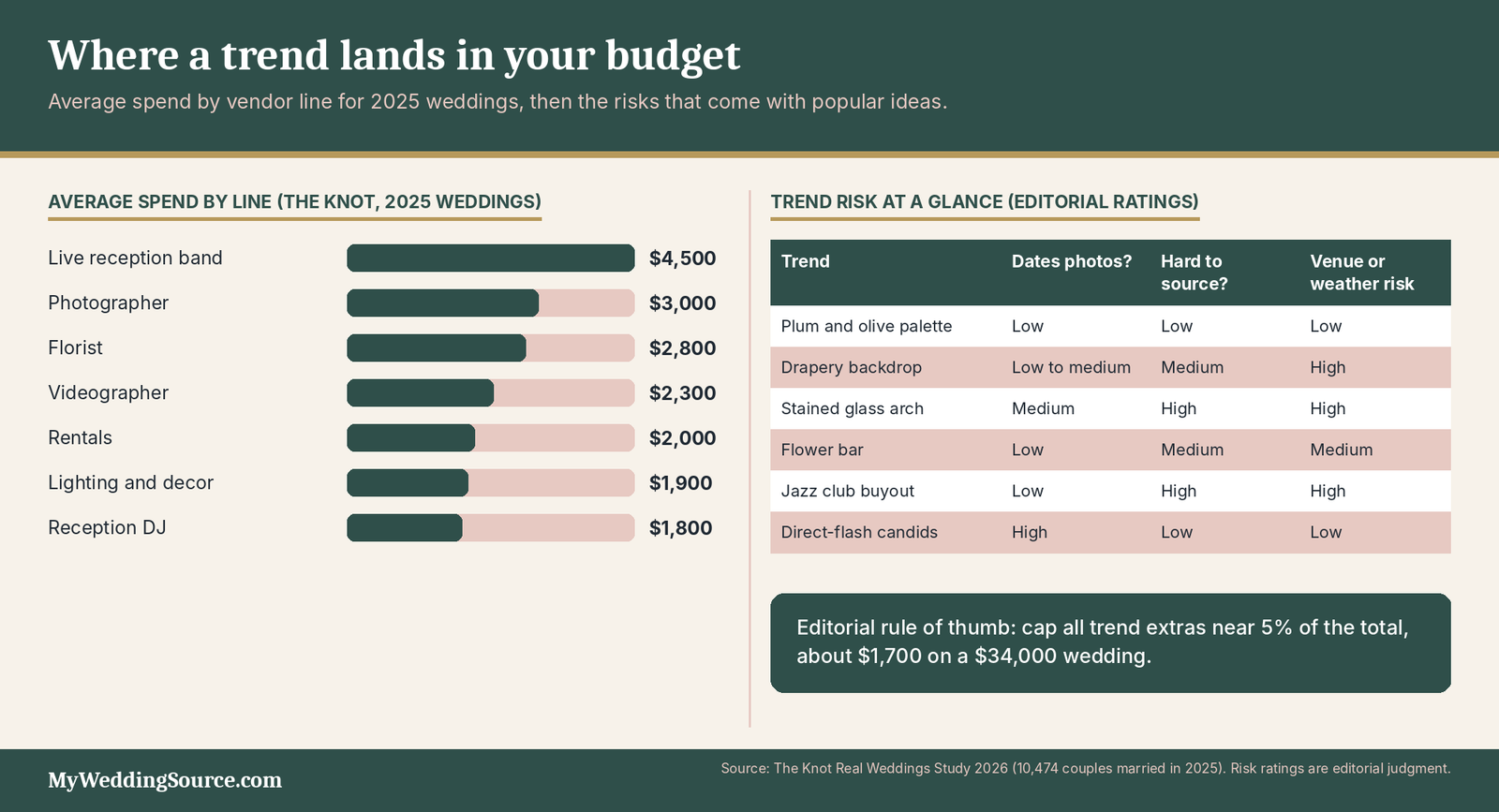
Florals and installations are where trend photos most often outrun a budget. A drapery backdrop or a stained glass arch looks effortless in an image, but it comes with rigging, transport, fire rules, and weather exposure that the image never shows. The Knot’s 2025 average for florals was about $2,800, and its figure for lighting and decor was about $1,900, so a single statement piece can claim a large share of a line you were expecting to spread across a whole room.
Which installation trends need venue approval before you fall for them?
What should you know before booking a drapery backdrop?
Pinterest lists “drapery backdrop” at +1,510%, and The Knot’s decor article quotes a planner calling drapery “the unsung hero of wedding decor.” Costs depend on scale. Our winter wedding decor and lighting guide gives illustrative ranges of roughly $800 to $5,000 or more for ceiling or wall drape, plus rigging, and notes that drape is the most expensive way to change a room. The venue questions are structural: where fabric may attach, what weight the ceiling or truss can take, and whether the fabric must be certified flame retardant. Fire rules are local; as one example, the Seattle Fire Department’s holiday decorations memo (updated 2017) says decorations other than natural cut trees must be flameproof or fire retardant and must not block sprinklers, extinguishers, or exits, and your jurisdiction may differ.
Is a stained glass arch or other statement structure practical?
Pinterest lists “stained glass wedding arch” at +750% and “book wall backdrop” at +555%, while The Knot’s flower roundup describes grounded, natural-style ceremony arches growing in popularity. A true glass panel is heavy and fragile, so ask the maker or rental company about lightweight acrylic or film alternatives, how it is transported, how it is anchored against wind, and whether the venue lets vendors use it indoors and out. The structure typically serves for a twenty-minute ceremony and perhaps ten minutes of portraits, so its cost per minute of use is high unless it is reused for the entrance, the cake table, or a photo corner. It suits couples with a defined color scheme and a venue that allows built or rented structures. Skip it for ceremonies on exposed hillsides or beaches, or if the structure cannot be loaded in by the vendor’s scheduled time.
How are bouquets and guest-facing florals changing?
Are alternative bouquets worth the lead time?
Pinterest’s “Alt Bouquets” group lists “fuzzywire bouquet” at +1,275%, “bouquet purse” at +1,015%, “book flower arrangement” at +725%, “bedazzled flower” at +715%, “beaded flowers bouquet” at +305%, and “bouquet with no flowers” at +240%. The Knot’s flower article adds a florist’s observation that handled bouquets reflect a desire for escapism. These pieces are usually handmade by individual makers, so the main cost is lead time and the risk of a one-person shop being unavailable; ask for a written delivery date and a replacement plan. They suit couples with allergies, destination travel, or a wish to keep the bouquet, since nothing wilts. Skip them if scent and fresh texture matter to you, and consider commissioning only the bridal bouquet while leaving attendants’ flowers simple and seasonal.
Do flower bars and edible centerpieces make financial sense?
Pinterest’s sensory-styling group lists “flower bar set up” at +870%, “vegetable centerpieces” at +380%, and “lavender decoration” at +185%. Zola’s 2026 report adds that 49% of couples use locally sourced or seasonal blooms, which is worth knowing because a flower bar depends on stem availability in your month. The cost drivers are stem counts, containers, a florist or attendant to run the bar, and cleanup, so ask for a quote that states how many stems per guest it assumes. Produce-based centerpieces can reduce flower spend, but they spoil in heat, so confirm with the caterer or florist what happens to the produce afterward; do not assume it is safe to eat. Both ideas suit cocktail hours and relaxed receptions, and they are poor fits for hot outdoor afternoons or when a venue restricts late-day vendor access.
Trends in this category are often about format (stations, family-style, late-night) and not just ingredients, so they change staffing and timing as much as flavor. Evidence is mixed: The Knot’s food trends article, published October 28, 2025, cites no survey data and relies on caterers’ predictions, while Zola’s 2026 report adds a few survey signals. That difference in evidence is why the advice below leans on formats and logistics more than on flavors.
What is changing on the plate and the dessert table?
Are personalized menus and interactive stations worth it?
The Knot’s data read-out found that 60% of 2025 couples chose a buffet or self-serve stations and 30% chose plated sit-down service, so interactive formats are already mainstream. Zola’s 2026 report notes hyper-personalized catering, including global cuisines and interactive stations, and The Knot’s food article mentions menus that tell a couple’s story, heritage grazing tables, street-food stations, and raw seafood bars, all as caterer predictions. The Knot’s average catering spend was about $80 per person, and Zola’s 2026 cost index lists catering at $6,927 and bar services at $5,542, but stations do not automatically lower the per-guest price because they need more staff, equipment, and servers. Ask the caterer for an all-in per-guest quote with service charge and tax shown. A single meaningful station, such as a family recipe or a regional dish, delivers the personal touch at modest cost. Skip raw seafood or elaborate live cooking if the venue kitchen is limited or the caterer cannot describe how they will keep food at safe temperatures, and always confirm how allergens are labeled and separated.
Which dessert trends are practical?
Pinterest’s “Quirky Cakes” list includes “flower pot cake ideas” at +715%, “wedding cake tiramisu” at +635%, “kitsch cake” at +545%, “pink and red vintage cake” at +415%, and “lyrics cake” at +355%; The Knot’s food article quotes a caterer predicting a tiramisu moment, and Zola’s 2026 report says Gen Z is reviving multi-tiered cakes. Cake and dessert spending ranges from about $300 to $917 depending on the source and scope (The Knot’s data read-out, The Knot’s vendor cost page, and Zola’s cost index), and cutting or plating fees can change the total. Perishable desserts need refrigeration plans, especially outdoors, so ask the baker how long each item can be out before service. A small display cake paired with a sheet cake or dessert table gives you the look at a lower cost than a tiered showpiece. Skip delicate textures if your venue has no cold storage or your timeline runs long.
What is changing at the bar and after dinner?
Should you add a mocktail menu?
Zola’s 2026 report highlights mocktail menus alongside bars, and its 2025 report found 54% of couples offering signature cocktails or mocktails. Mocktails cost little per serving, but a bartender still has to make them, and inside a fixed per-person bar package they may not reduce the price, so ask whether a non-alcoholic menu changes the quote. They suit weddings with guests who do not drink for health, religious, or personal reasons, and they work well for daytime events. A short menu of one cocktail and one mocktail avoids ordering more mixers than you need. Skip a complicated menu if your bar staffing is thin.
Are late-night snacks and recovery brunches worth adding?
Zola’s 2026 report notes that Millennials favor late-night snacks, and The Knot’s food article quotes caterers predicting daytime celebrations and more experiential late-night desserts. Zola found 37% of couples host at least one extra event and 18% hold a two- to three-day weekend, and The Knot reports 71% of celebrations span two to three days. A late-night snack means extra staff after the main service, so confirm the venue’s end time, overtime fees, and noise limits before you promise it. A brunch is often a separate booking, so compare it with a simpler casual meal.
Are unexpected venues and new entertainment worth the logistics?
This is the section where search interest and booking behavior diverge most. Pinterest’s venue terms grew fast, but Zola’s 2026 survey found romantic outdoor garden venues the number one choice for the second year in a row, followed by rustic farms, barns, and ranches, while banquet halls and ballrooms saw a slight uptick and ultra-unique spaces such as museums, galleries, and restaurant buyouts cooled slightly.
What does an unexpected venue really require?
Pinterest’s “Unexpected Venues” group lists “jazz club wedding” at +1,115%, “enchanted palace” at +545%, “rocky mountain wedding” at +270%, “speakeasy lounge” at +225%, “mini chapel” at +180%, “cabin wedding ideas” at +110%, “movie theater wedding” at +105%, and “glass greenhouse wedding” at +100%. The Knot’s average venue spend was about $12,900, with a range of $3,500 to $24,800, but a buyout of a club or theater is priced differently from a wedding venue. The sections below turn the appeal into questions.
Is a jazz club, speakeasy, or theater wedding realistic?
Spaces like these suit small, adult-focused weddings of perhaps 40 to 80 guests, evening receptions, and couples who value atmosphere over a flexible floor plan. The usual constraints are a food-and-beverage minimum or a buyout fee, a fixed capacity set by the venue’s occupancy rules, sound limits for neighbors, a limited vendor list, and tight load-in windows around their normal business. A club may also lack a bridal suite, a rain plan, or accessible restrooms. Ask for the maximum occupancy, the sound curfew, the loading route, and whether a ceremony space exists. Skip these venues if you have guests with mobility needs and the building has stairs, or if your timeline needs a long, flexible day.
What should you ask before booking a one-of-a-kind space?
Use five questions: What is the occupancy limit for my event layout? What are the restroom, kitchen, power, and cooling capacities? Can my vendors bring their own equipment, and is there a preferred list? What does the quote include in tax, service charge, and cleaning? What happens if the venue closes or cancels? Our unique wedding ideas guide covers the idea side of unconventional settings, and these questions cover the contract side.
Which entertainment trends add something guests will feel?
Are written songs worth commissioning?
Pinterest lists “written songs” at +1,975%, one of the largest growth figures in the report, in a section on analog activities and keepsakes; the page does not define the term, so this guide reads it as songs written for or about a couple or a guest-participation songwriting activity, which is an interpretation. A commissioned song can cost as little as a thoughtful gift or as much as a professional booking, so get a written scope and price. Under U.S. copyright law, copyright initially vests in the author and a transfer must be in a signed writing, so ask in the contract what rights you receive to perform, record, and share the song. It suits couples with a musical friend or a ceremony moment that needs a centerpiece, and it is a poor fit if the deadline is close or the song’s tone is a gamble.
Is live music worth the premium over a DJ?
The Knot’s 2025 averages were about $4,500 for a live reception band and $1,800 for a DJ, while Zola’s 2026 cost index lists music and entertainment at $1,567. Live music suits venues with good acoustics and guests who like to dance to familiar songs, and it is a weaker choice in small rooms where volume cannot be controlled. A hybrid, such as a DJ plus a live saxophonist or violinist for cocktail hour, can add live atmosphere for less than a full band, though you should price both options. Ask about breaks, sound checks, power needs, setup time, meals for the band, and overtime. Our wedding ideas guide shows how these choices fit into a broader plan.
A candid, flash-lit reception makes a plum palette read differently than a soft, window-lit one, and a vendor who shoots for social clips needs different time and rights than one delivering a gallery. Zola’s 2026 report found that 87% of couples made planning choices based on social media, and photographer and videographer selection was one of the areas it named.
Which photo and video styles are couples asking for?
Is documentary photography with direct flash a safe choice?
Zola’s report page says 67% of couples prefer natural, unposed, documentary-style photos, and The Knot’s data read-out lists candid flash photography among the trends rising in 2026 and posed portraits giving way to documentary shots. The Knot’s photography roundup (October 28, 2025) predicts “restraint” in flash use and a move toward true-to-life color, but those are photographer predictions, not survey results. The Knot reports an average photographer spend of about $3,000, and Zola’s cost index lists photography at $4,400. Documentary coverage suits couples who dislike posing, but ask for a family shot list so candid does not mean missing the formal groups, and request a portfolio from a dim, late-evening venue like yours. Direct flash is the likeliest piece to look dated later, so ask for a mix of flash and available-light frames.
Should you add video, a drone, or coverage of more events?
Zola’s 2026 report notes more couples adding video, The Knot’s average videographer spend was about $2,300 in its vendor cost page, and Zola’s index lists videography at $3,993. The Knot’s photography roundup also predicts photographers covering pre-wedding events and notes that drone work requires special skills and licensing and is often a premium add-on, which are professional forecasts. Extra events mean extra hours, so price coverage by the hour for the welcome party and brunch and decide which moments matter. Ask any drone operator for proof of licensing and the venue’s written permission. Skip video if it would force you to cut photography hours, since a gallery usually has a longer life as prints and albums.
How do you handle social-first content without losing the day?
What should a social-content plan include?
Zola found that 54% of Gen Z couples feel pressure to be social media-worthy, and that 21% of all couples plan to create their own social-first content, with 40% of them asking professionals to capture it. Decide in advance whether you want a same-day teaser, a short highlight reel, or only a gallery, because each needs editing time and a clear deadline. A phone-free ceremony request is a reasonable option, and it is easier to follow when guests hear the reason and see a sign. This sort of planning protects the ceremony itself, which no trend report can replace.
Who owns the photos and videos, and who may post them?
Under U.S. copyright law, copyright initially vests in the author, so a photographer or videographer normally owns the images unless the contract says otherwise, and a transfer must be in a signed writing. That makes the license language the part to read: personal use, printing, social posting, and vendor use of your images for marketing. Ask for the delivery timeline for social clips, the backup method, and how long the vendor keeps files. This is general education, not legal advice, and terms vary by vendor.
Which guest-experience and personalization ideas are worth trying?
Guest experience is where the trend research and the contract reality are friendliest to each other, because most ideas are small, tactile, and low in cost. The Knot’s data read-out found that 90% of couples aim for an authentic, highly personalized wedding, but also that guests being well cared for ranked first among priorities, with personalization third.
What analog and nostalgic touches are guests actually using?
Which analog activities and keepsakes are cheap to try?
Pinterest lists “unique wedding activities” at +720%, “button pictures” at +1,140%, “match box inspo” at +940%, “cornhole boards wedding” at +440%, “playing cards wedding” at +220%, “printable wedding games” at +210%, and “wedding coloring book” at +105%. Zola’s 2026 data found couples most willing to save on favors (48%), and The Knot’s vendor cost page lists favors at about $480, so pick an activity that doubles as the favor, such as button-making or custom playing cards. If you plan personalized matchboxes, check the venue’s rules on open flame or smoking before ordering. Skip an activity that needs a volunteer to run it for hours, and do not buy a favor nobody will carry home.
How do video guestbooks, projectors, and disposable cameras work in practice?
Pinterest lists “wedding projector” at +625%, “newspaper photobooth” at +420%, “slideshow pics” at +340%, “vinyl record wedding” at +245%, “video guestbook” at +240%, and “camcorder wedding” at +90%, and The Knot’s photographers also mention disposable cameras left on tables. Each has a logistics catch: a projector needs a surface, a dim room, and power; a video guestbook needs a quiet corner and a plan for file delivery; and disposable cameras need development time and cost after the wedding. Video guestbooks should have a plan for who sees the clips and where they are stored. Bright outdoor tents and rooms with large windows are weak fits for projector-based ideas.
How do you personalize without overdoing it?
Are vintage, thrifted, and cultural touches worth building in?
Zola’s report page says 39% incorporate vintage or pre-loved decor, and The Knot found 32% include religious, ethnic, or cultural elements, 28% include eco-friendly or sustainable options, and 22% include locally sourced products. Thrifting can lower spend, but it costs time for sourcing, storage, delivery, and breakage, so decide who is responsible for pickup and return. Vintage and cultural touches suit couples who want the day to reflect their histories and who have a trusted person to manage them. Skip a heavy vintage plan if you have a short timeline or no storage space.
Is a perfume bar or other scented station a good idea?
Pinterest lists “perfume bar wedding” at +140%, “lavender decoration” at +185%, and “herb wedding” at +65%. The FDA notes that some fragrance components may cause allergic reactions or sensitivities and that “unscented” products can still contain fragrance ingredients, which matters in a room full of guests you cannot screen. If you want a scent moment, make it optional and place it away from the dining area, and offer a fragrance-free alternative such as herbs on tables or a candle-free signature drink. Skip a perfume bar in a small indoor room where guests cannot step away.
How are budgets, AI, and planning tools changing wedding decisions?
The money story behind the trends is pressure. Zola’s 2026 report found that 84% of couples believe the same wedding would cost more than it did two years ago, 78% worry that economic conditions or tariffs will raise their bill, and 44% have already changed plans to avoid price increases. The Knot’s data read-out found that 41% of 2025 couples went over budget, and 21% had no budget at all.
Where is money moving?
Spending is polarizing: couples say they will splurge on a few things and cut the rest. The table below combines survey signals with an editorial reading of what they imply for 2027, labeled as outlook. Treat the right-hand columns as a starting point for your own decisions, not a forecast you can bank on.
Where do couples say they splurge and save?
Zola’s 2026 report found couples most likely to splurge on the venue (47%) and photography (45%), and to save on favors (48%) and stationery (36%). It also found that 48% increased their budget or moved money to achieve something seen online (55% of Gen Z), and 60% said managing budget against online inspiration was their top stressor. Our 2027 wedding budget reality report models a projected 2027 average of roughly $37,281, a projection built from published data and not a survey result. For a full step-by-step, see our wedding budget guide.
| Area | 2026 signal | 2027 outlook (editorial) | Practical move |
|---|---|---|---|
| Venue and photography | 47% and 45% of Zola couples splurge | Likely to hold priority | Protect these lines first |
| Favors and stationery | 48% and 36% save (Zola) | Likely to stay low priority | Merge favor and activity |
| Florals and decor | Knot $2,800 florals, $1,900 decor | Pressure from installations | Cap at one statement piece |
| Video | More couples adding video (Zola) | Growing, with social clips | Price by the hour |
| Beauty and wellness | $1,100 average (Zola) | Stable | Budget a trial and a backup |
| Registry and cash funds | 27% added cash funds, up from 16% (Zola) | Likely to rise | Use funds for big-ticket items |
How much of your budget should a trend get?
Editorial rule of thumb: allow about 5% of your total budget for all trend-led extras combined, and choose the one or two that guests will notice. A trend that costs more should replace something rather than stack on top of it, such as swapping a bar of flowers for a smaller centerpiece. If a trend fails the scorecard later in this article, it does not belong in the plan even if it is cheap.
How are couples using AI and planning apps?
AI is the fastest-moving behavior in the data. Zola’s 2025 report found 23% of couples using AI in planning, and its 2026 report found 54%, while The Knot estimates about 36% of engaged couples had used AI by the end of 2025. The two figures come from different samples and definitions, so treat them as the same direction, not the same number.
What are couples using AI for, and where do they draw the line?
Zola’s 2026 report lists etiquette questions (54%), timelines and to-dos (44%), vendor and guest emails (40%), image-based decor, attire, or floral inspiration (31%), budgeting (27%), and travel (27%). Couples also set boundaries: 63% say AI should not write vows, 44% say not speeches, and 36% say not the ceremony script. Avoid pasting guest addresses, contract text, or payment details into tools whose data practices you have not read. Verify rules with the venue, vendor, or an official source.
Which planning tools are actually standard?
The Knot’s data read-out found that 90% of couples create a wedding website, 82% set up a registry, and about 41% of planning happens on a mobile device, with roughly seven hours per week spent on planning. The one worth a closer look for 2027 is the cash fund: Zola reports 27% of couples added cash funds to their registry, up from 16% the year before. A shared spreadsheet that tracks quote, deposit, balance due, and cancellation terms still does the job better than any app.
Are micro and small weddings still a trend for 2027?
Small weddings are a structural trend more than a seasonal one, and the data is less tidy than the headlines suggest. The Knot’s data read-out does not use the term micro wedding and describes a split between couples going all-out and couples going ultra-intimate. That split is the useful part: small weddings change how trends fit.
What does the data say about small weddings?
Definitions matter. The Knot has described micro weddings as roughly 50 guests at most and a “minimony” as 10 or fewer, according to CNBC’s July 2024 report, which also cited The Wedding Report for 2023 market shares. Because definitions vary, compare the guest-count brackets in each source rather than the labels. A wedding of 48 guests may be called micro by one outlet and simply small by another.
How common are weddings under 50 guests?
CNBC reported that weddings with 25 to 50 guests made up about 15% of the market in 2023 and weddings under 25 guests about 2%, per The Wedding Report. Zola’s 2025 report found 6% of weddings under 50 guests and 14% under 75. Meanwhile The Knot’s 2025 average was 117 guests and Zola’s 2026 average was 145, and couples spending $12,000 or less averaged 92 guests. These samples differ in year and method, so they show the shape of the market, not a precise share. No source in this guide projects a 2027 micro-wedding percentage.
Do small weddings cost less?
Usually the total is lower, but the cost per guest often is not. The Knot reports about $292 per guest on average, and Zola’s cost page estimates about $150 to $300 per guest for guest-dependent costs, excluding fixed costs such as photography and music. Illustrative example, not a quote: 50 guests at $292 is $14,600 and 117 guests is about $34,164, but a small wedding with the same photographer, attire, and officiant carries fixed costs that do not shrink.
How do trends fit a smaller wedding?
Which trends suit under 50 guests?
Jazz club and supper-club venues, family-style menus, a flower bar, written songs, a custom cake, and an intimate ceremony all fit best at small scale. A song can be performed for 40 people to hear every word, and a menu can include each family’s dish. Skip trends whose value is spectacle, such as a ceiling canopy or a large installation, since their cost stays the same while the audience shrinks.
What should not shrink with the guest list?
Photography hours, officiant fees, attire, and any venue minimum or buyout stay roughly the same at 30 guests as at 100. Ask each vendor whether there is a minimum for small events, and check whether the caterer’s per-person price rises under a certain headcount. If you use the savings for one trend, choose the one that guests will feel.
Which trends will date your photos, and how do you score one before you commit?
Every trend gets a second life as an album photo that looks either timeless or like a time capsule. The risk is not that a trend is bad; it is that you pay for it once and live with it in images for decades. This section gives you two tools: a table that rates the common 2027 ideas on dating, sourcing, and weather or venue risk, and a scorecard that turns your own situation into a yes, a scale-down, or a skip.
What is fading, and how risky are the trends that are rising?
Which trends do the sources say are fading?
The Knot’s data read-out lists traditional bouquets and garter tosses as trending down for 2026, and Zola’s 2025 report listed bow embellishments, champagne towers, neon signs, wedding hashtags, and bouquet tosses as “out.” Zola’s 2026 report then found Gen Z reviving bouquet tosses and multi-tiered cakes, and it noted that ultra-unique spaces such as museums, galleries, and restaurant buyouts cooled slightly. The Knot’s September 2026 dress roundup features micro bows as a 2027 gown detail, one year after Zola called bows out.
How should you read the trend risk table?
The ratings below are editorial judgment, not measured data, and they assume a typical U.S. venue and a couple who wants to stay inside a budget. “Dates the photos” asks whether the look will read as a particular year; “hard to source” asks whether the item depends on one maker or a scarce rental; and “weather or venue risk” asks whether wind, heat, fire rules, capacity, or sound limits can derail it. A high rating on any one is a prompt to ask a specific question before you pay.
| Trend | Dates the photos? | Hard to source? | Weather or venue risk |
|---|---|---|---|
| Plum, olive, and merlot palette | Low | Low | Low; dark tones read heavy in dim rooms |
| Opalescent and chrome finishes | Medium to high | Medium | Medium; reflections under flash |
| Drapery backdrop | Low to medium | Medium | High; fire rules, rigging, wind |
| Stained glass or statement arch | Medium | High | High; wind, weight, load-in time |
| Flower bar | Low | Medium | Medium; heat and staffing |
| Fuzzy-wire or non-floral bouquet | Medium | High; made to order | Low |
| Fascinators and headwear | Medium | Low to medium | Medium; wind and hair |
| Colored gowns and suits | Medium to high | Medium to high | Low; lighting can shift color |
| Jazz club or theater buyout | Low | High | High; capacity, sound, access |
| Written song | Low | Medium | Low |
| Projector or video guestbook | Medium | Low | Medium; needs a dim room and power |
| Direct-flash candid style | High | Low | Low |
| Perfume bar | Low | Medium | High in small indoor rooms |
How do you score a trend before paying a deposit?
What belongs on the scorecard?
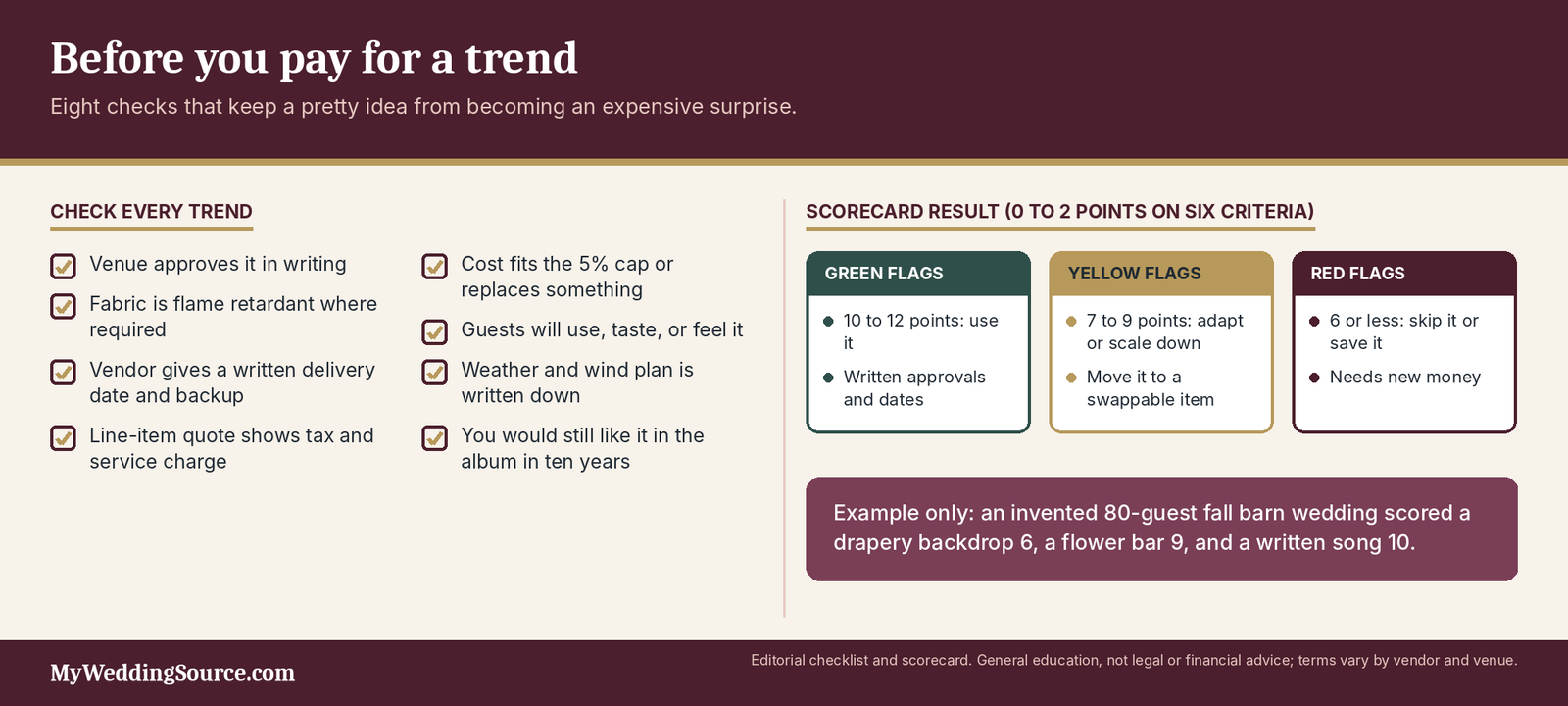
Give each idea 0, 1, or 2 points on six criteria: venue fit, longevity, sourcing, cost share, guest value, and risk or safety. A total of 10 to 12 means use it, 7 to 9 means adapt or scale it down, and 6 or fewer means skip it or save it for a smaller item. The criteria are designed so that the answers are written down, such as the venue’s approval in an email or a vendor’s delivery date in a contract.
| Criterion | Question to answer | Score 2 | Score 0 |
|---|---|---|---|
| Venue fit | Does the venue allow it, in writing? | Approved in writing | Not asked, or prohibited |
| Longevity | Will you like it in the album in ten years? | Yes, on a swappable item | Only works as a 2026 reference |
| Sourcing | Can a vendor deliver by a written date, with a backup? | Written date and backup | One maker, no date |
| Cost share | Does it fit the 5% cap or replace something? | Within the cap | Needs new money |
| Guest value | Will guests use, taste, or feel it? | Yes | Only photographs |
| Risk and safety | Are weather, fire, and allergen issues handled? | Plan in writing | Unanswered |
What does a worked example look like?
Take an illustrative couple planning an 80-guest fall wedding at a barn venue, with a $34,000 budget and a $1,700 trend cap. They score three ideas below. The numbers are invented for illustration, not from a real wedding, and the point is the shape: a drapery backdrop that needs new money and venue approval drops out, while a flower bar and a written song survive.
| Criterion | Drapery backdrop | Flower bar | Written song |
|---|---|---|---|
| Venue fit | 1 | 2 | 2 |
| Longevity | 1 | 2 | 2 |
| Sourcing | 2 | 1 | 1 |
| Cost share | 0 | 1 | 1 |
| Guest value | 1 | 2 | 2 |
| Risk and safety | 1 | 1 | 2 |
| Total | 6; skip or scale down | 9; adapt | 10; use |
FAQ: 2027 wedding trends
Short answers to the questions couples ask most when they start sorting trends from tradition, with the reasoning in the sections above.
What do the reports say, and how reliable are they?
Are Pinterest’s growth percentages the same as Google search volume?
No. Pinterest’s report gives growth percentages for terms on its own platform, without a stated time window, comparison period, or definition of the metric, so they are platform trend signals, not Google search data. A large percentage can come from a small starting point. Use them to spot where inspiration is heading, then check survey behavior before you spend.
What colors are popular for 2027 weddings?
The strongest survey evidence is for 2026 weddings: Zola found green the top color at 53% of couples, with sage at 30%, and burgundy or wine at 10%. Pinterest’s signals add plum, olive, fig, muted terracotta, and opalescent tones. For 2027, the likely outlook is deeper, nature-linked colors with a shimmer accent, but that is editorial judgment, not a measured forecast.
Will a 2027 trend look dated later?
Some will. Lower-risk choices are those placed on swappable items, such as linens, candles, and signs. Higher-risk choices are those built into the largest surfaces, such as a colored gown, a full backdrop, or a heavy photo-editing style, as the risk table above shows. The Knot’s editors call their 2027 gown outlook a forecast for 2027 and likely 2028, so no one can promise how it will age.
How do you use trends without overspending?
How much should a couple spend on trends?
There is no standard. As an editorial rule of thumb, cap trend-led extras at about 5% of your total budget, which is about $1,700 on a $34,000 wedding, and put that money on the one or two ideas guests will feel. The Knot reports a median wedding cost of $24,000 and an average of about $34,000, so a trend budget that would be small for one couple would be large for another.
Is it fine to skip trends entirely?
Yes. The Knot’s data read-out found that guests being well cared for ranked first among couple priorities, with personalization third, and nothing in the surveys suggests a wedding needs a trend to be well received. A day built around guest comfort, good food, and a few personal choices is a complete plan. A trend is an add-on, not a requirement.
Your next steps
The goal here is to turn a feed full of ideas into a short list that is priced and checked against your venue. It should take a week of evenings. That is far cheaper than a changed order or a rejected installation on the wedding morning.
What should you do this week?
Pick two trends and price them
Write down every trend you have saved, then circle the two that you would still want if nobody ever saw the photos. Ask the relevant vendor for a line-item quote for each, including delivery, setup, teardown, tax, and service charge. Score both on the scorecard above, and save the scores next to the quotes.
Run the venue check
Email your venue or planner a short list: ceiling or wall attachment rules, flame-retardant requirements for fabric, open-flame and candle policy, power and projection access, sound limits, and load-in times. Ask for the answers in writing, since a verbal yes at a tour can disappear by the time a new coordinator takes over. If you plan a draped, scented, or flame-based feature, ask who at the venue is responsible for approving it. Our fall wedding weather guide and winter decor and lighting guide list more seasonal questions.
What should you check before you pay a deposit?
Get the trend in the contract
If the trend depends on a specific item, such as a custom bouquet, an arch, or a song, the contract should name it, with a delivery date, a substitution policy, and the refund terms if it cannot be delivered. Ask what happens if the maker is ill, if the venue refuses the installation, or if weather blocks setup. Ask who owns the item afterward and whether rental fees include pickup. Terms and state laws vary, and this is general education, not legal advice.
Recheck in January
Zola published its 2026 First Look Report in January 2026, so a 2027 edition may follow a similar schedule, and Pinterest and The Knot may publish further 2027 material before then. In January, recheck the numbers in this guide against the new editions, especially the AI figures, the color data, and any new venue trends. Then lock in the vendors you have decided on and move on to the details that matter more, such as the timeline and the seating plan.
Sources & methodology
- Pinterest Newsroom: Wedding Trends Report 2026 — platform trend-growth signals for palettes, decor, venues, bouquets, and activities (published April 28, 2026; window and metric not stated).
- Zola: The First Look Report 2026 — survey of 11,500+ couples marrying in 2026: colors, venues, AI, social media, budget pressure.
- Zola: First Look Report 2026 summary page — vintage decor, documentary photo preference, and splurge-and-save figures.
- Zola: The First Look Report 2025 — 2025 AI use, out-trend list, mocktail and signature drink figures, and guest-count distribution.
- Zola: What Weddings Really Cost — 2026 cost index category averages and per-guest estimates.
- The Knot: Real Weddings Study 2026 data read-out (PDF) — 10,474 couples married in 2025: cost, guest count, vendors, AI, personalization, rings, trends.
- The Knot: Real Weddings Study overview — methodology and scope of the 2026 study.
- The Knot: Average wedding vendor costs — category averages for florals, rentals, decor, video, favors, and entertainment.
- The Knot: Biggest wedding dress trends of 2027 — editors’ observations from Spring-Summer 2027 bridal fashion week (September 29, 2026).
- The Knot: 2026 wedding decor trends — planner-sourced decor forecasts, December 2025.
- The Knot: 2026 wedding food trends — caterer forecasts, October 2025.
- The Knot: 2026 wedding flower trends — florist forecasts, November 2025.
- The Knot: 2026 wedding photography trends — photographer forecasts, October 2025.
- CNBC via NBC Los Angeles: micro weddings (July 2024) — micro wedding definitions and 2023 market shares.
- U.S. Copyright Office: Title 17, Chapter 2 — initial ownership and written transfers for creative works.
- FDA: Fragrances in cosmetics — fragrance sensitivities and labeling limits.
- Seattle Fire Department: holiday decorations memo — one local example of flame-retardant and clearance rules for decor (Seattle only, 2017).
Methodology: Percentages from Zola and The Knot are survey findings from the named samples and years. Pinterest figures are platform signals with no stated window. Quotes in The Knot’s decor, food, flower, and photography articles are professional forecasts without survey data. Cost ranges drawn from our own guides are illustrative. The scorecard, the trend risk ratings, the 5% cap, and every 2027 statement are MyWeddingSource editorial judgment, and the worked scorecard example is invented. Fire, venue, and contract rules vary by jurisdiction and vendor, and this guide is general education, not legal, financial, or safety advice.
Freshness note: Reviewed October 12, 2026. Recheck in January 2027 when Zola’s next First Look and any Pinterest or Knot 2027 wedding reports appear, and again before booking any made-to-order item.