
The unique wedding ideas worth building are the ones that pass three tests: your venue and vendors can say yes in writing, every guest can take part comfortably, and you know what the extra piece costs on top of your base budget.
You have a saved board full of jazz clubs, flower bars, hand-written songs and a draped backdrop that looks like it belongs in a film. Then the venue coordinator mentions an occupancy limit, the caterer asks who is cleaning up the craft station, and your grandmother wants to know where she will sit during the walking ceremony. None of that means the idea was wrong. It means the idea has moved from inspiration to logistics, which is where most unique wedding ideas either get better or quietly disappear.
This guide is organized by decision area rather than by aesthetic, so you can find the idea that fits the choice you are making this week. For each idea you will see a plain-language cost note, how it works in practice, what to ask your venue or vendor, and when it is a bad idea. If you want a broad gallery of looks first, the wedding ideas hub is the place to browse, and the 2027 wedding trends analysis covers what is rising and fading across the industry. This page stays narrower: it helps you decide whether a specific unconventional idea is feasible for your guest count, your budget and your location.

How to tell a unique idea from an expensive detour
What the data says couples are searching for, and what it does not
Pinterest’s 2026 signals are platform search growth, not Google volume
Pinterest’s 2026 wedding trend report, dated April 28, 2026, lists a cluster of fast-growing queries that read like a map of this article: “unique wedding activities” up 720%, “jazz club wedding” up 1,115%, “flower bar set up” up 870%, “written songs” up 1,975%, “button pictures” up 1,140%, and “drapery backdrop” up 1,510%. Pinterest also reports that people made more than 7 billion wedding-related searches last year and saved more than 16.7 billion wedding ideas globally. These are platform search-growth figures from one company, not Google search volume, and the report page does not state the comparison period or a U.S.-only scope. A large percentage on a small starting base can look dramatic, so read the numbers as direction, meaning “people are curious about this,” not as a measure of how many couples actually do it.
Zola and The Knot show what couples do after the saving stops
Behavior data is a useful counterweight to inspiration data. Zola’s 2026 First Look Report surveyed more than 11,500 couples marrying in 2026 and found an average cost of $36,000 and an average of 145 guests, with 87% of couples saying they made at least one planning choice based on something they saw on social media. The same report points to a rise in vintage decor, hyper-personalized catering and interactive guest experiences. The Knot’s 2026 Real Weddings Study, which covers 10,474 couples married in 2025, puts the average cost at $34,200 for an average of 117 guests. Together the two sources say the same practical thing: couples are asking for personal and interactive details, and they are still paying for them out of a finite budget.
What neither source can tell you
None of these reports can tell you whether a specific idea will work at your venue, in your county, for your guests. The Knot reports that couples describe a shift away from “cookie-cutter” toward intentional, personalized celebrations, and Zola’s data shows the same appetite, but neither measures how often a particular activity succeeds or fails. That gap is why this guide pairs every idea with a feasibility check instead of a popularity claim. If a source in a search result says an idea is “everywhere,” ask what it measured and when, because a trend can be real on Pinterest and still be impractical in your price range or on your venue’s fire permit.
The three-filter test: feasible, welcoming and affordable
Feasibility: can a venue, vendor and permit office say yes?
An idea is feasible when the people who control the space and the rules can approve it in writing. That usually means the venue manager, the fire marshal or local permitting office for anything involving occupancy, candles, tents or structures, your caterer, and any vendor who has to operate, install or supervise the idea. Ask the venue for its own policy first, because many spaces have house rules that are stricter than the law, such as no open flame, no confetti, no nails in walls or a required in-house caterer. A good rule of thumb is that anything the venue has not done before needs a named person who can approve it, not a verbal “should be fine.”
Guest experience: who is this idea for?
Every unconventional idea works better when you can name who it is designed for and what a guest who does not want to participate does instead. A craft station is a pleasant break for guests who like hands-on activities and an obligation for guests who would rather talk. A late-night food truck is welcome after four hours of dancing and irrelevant to a daytime reception. Build an easy opt-out into every interactive element, make sure the people who matter most to you (older relatives, children, guests with disabilities, guests who do not drink) have an obvious way to enjoy the day, and avoid any idea that requires guests to perform, dress up or share personal information to take part.
Affordability: how the cost notes in this article work
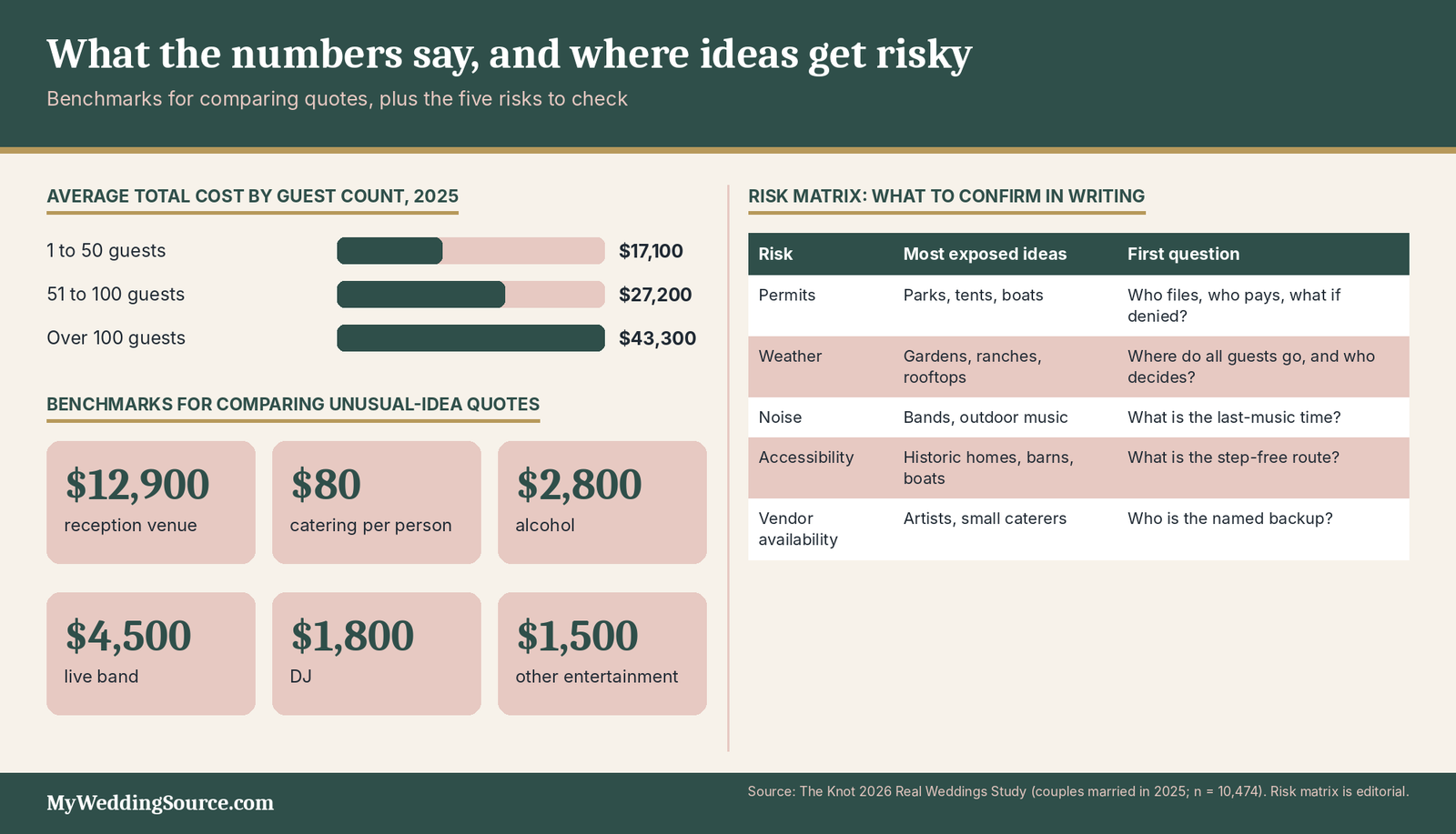
Unique is not automatically expensive, and expensive is not automatically better. Where a sourced figure exists, this article uses it and names the study and year. Where no reliable national figure exists, it uses editorial tiers: Low means roughly under $500 added to a base plan, Mid means roughly $500 to $2,500, and High means above $2,500. These tiers are editorial judgment, calibrated loosely to The Knot’s reported average of $1,500 for additional non-musical entertainment, and your local quotes will differ.
| Item | 2025 average | How to use it |
|---|---|---|
| Total wedding, all guest counts | $34,200 | Context only; local prices vary widely |
| Average guest count | 117 | A rough midpoint, not a target |
| Total cost, 1-50 guests | $17,100 | Compare micro and small formats |
| Total cost, 51-100 guests | $27,200 | Mid-size formats |
| Total cost, over 100 guests | $43,300 | Large formats and multi-event weekends |
| Reception venue | $12,900 | Benchmark for venue swaps |
| Catering per person | $80 | Benchmark for food formats |
| Alcohol | $2,800 | Benchmark for bar changes |
| Live band / DJ | $4,500 / $1,800 | Benchmark for entertainment swaps |
| Additional non-musical entertainment | $1,500 | Anchor for activities and performers |
Ceremony formats and rituals
Couple-led and non-traditional ceremony formats
Written songs and custom music
Pinterest’s “written songs” query grew 1,975% in its 2026 report, and the idea is easy to understand: a song composed for the two of you, performed live or recorded, becomes a keepsake. Options range from a friend who writes and plays a processional to a hired songwriter who interviews you and delivers a recording. The cost note is Low to Mid if a friend or guest performs and Mid to High if you commission a professional, because songwriting, rehearsal and live performance fees stack up. Ask any musician about the delivery date, who owns the finished song, whether you can share the recording publicly, and what the backup is if the performer is ill. Skip it if the performer’s nerves or availability would put pressure on a friendship, in which case a recorded version played through the venue’s speakers carries less risk.
- Cost note: Low to Mid (friend or guest performer), Mid to High (commissioned professional); editorial tier.
- Ask: Rehearsal time, sound check, who owns the song, recorded backup.
- Bad idea when: The ceremony space has no sound support or the performer cannot attend the rehearsal.
Writing your own ceremony script
A couple-led script is usually the lowest-cost way to make a ceremony feel specific to you. Many officiants will work from your draft, and some couples choose a friend or family member to officiate, which is a legal question as much as a creative one. Whether a friend can officiate, whether a one-day designation is available, and what paperwork the officiant must file all vary by state and sometimes by county, so verify requirements with the issuing office before you ask someone to stand up front; the marriage license verification guide explains how to check your jurisdiction. Plan the script for time as well as meaning: a ceremony of 15 to 25 minutes holds attention better than 40, particularly outdoors or in a historic building without air conditioning. A script is a bad idea when it has too many inside jokes for guests who are meeting your partner’s family for the first time, so aim for stories that a stranger can follow.
- Cost note: Low; the main cost is your time and any officiant fee.
- Ask: Officiant’s review process, length limits, license filing responsibility.
- Bad idea when: Nobody has verified who may legally officiate in your county.
Private vows and ceremony-in-the-round layouts
Some couples exchange vows privately, with only an officiant or photographer present, and share a recording or a printed copy later. Others replace rows of chairs with a circle or horseshoe so guests face each other and see both partners’ faces. Both ideas are Low cost in themselves, but the in-the-round layout changes photography, audio and aisle design, so tell your photographer and sound provider early. Ask whether the venue permits rearranged seating and whether a circle still leaves clear exits and an accessible route to every seat. A circle is a bad idea in a space with a fixed stage or a narrow room, where chairs set at angles can block aisles and make wheelchair or walker access awkward.
- Cost note: Low; possible added microphone or lighting needs.
- Ask: Seating layout approval, number of microphones, sightlines for photos.
- Bad idea when: The room’s exits or accessible route would be blocked by the circle.
Cultural fusion and family rituals
Blending two traditions in one ceremony
A ceremony that draws on two families’ cultural or religious traditions can be moving, but it needs a plan so that neither tradition is compressed into a token gesture. Ask a knowledgeable family member, a community leader or an officiant familiar with each tradition what is essential, what is flexible and what is simply customary, and what the order of events should be. Then write a short program that explains each ritual in a sentence or two for guests who are unfamiliar with it, and consider printing the key phrases in more than one language if your guests need it. Time and logistics matter as well, since some rituals need specific objects, seating arrangements, food or a quiet space. Never treat a tradition as a styling option: if a ritual belongs to a faith or culture that neither of you shares, talk with people from that community before including it.
- Cost note: Low to Mid; programs, ritual objects and possible interpreter or translator fees.
- Ask: Which elements are required, who leads each one, how long each takes.
- Bad idea when: A ritual would be included only for its look and nobody from the tradition has weighed in.
Handfasting, ring warming and community vows
Guest-participation rituals bring the room into the ceremony without adding vendors. In a ring warming, guests hold the rings briefly and silently offer a wish before the exchange. In a community vow, guests respond together to a promise to support the couple. A handfasting uses cords or ribbons tied around the couple’s hands, and it lands more clearly when the officiant explains the gesture in a sentence for guests who have not seen it. The cost note is Low, and the main execution questions are time (a ring warming across 120 guests takes longer than it sounds), accessibility (guests in the back or with mobility limits need a way to take part without leaving their seats) and cleanliness (rings passed from hand to hand are best kept on a ribbon or in a pouch). Skip any ritual that would single out a guest, put someone on the spot, or force physical contact people may not want.
- Cost note: Low; ribbons, cords or a pouch.
- Ask: How long it will take with your guest count, how seated guests take part.
- Bad idea when: The ceremony is large, outdoors in wind, or on a tight schedule.
Unusual venues: museums, breweries, gardens, boats and other non-wedding spaces
Venue types and what each one changes
Museums, galleries and historic homes
Museums, galleries and historic homes offer built-in character, which can reduce the amount you spend on decor, but they usually come with a long list of house rules. Expect restrictions on open flame, food and drink near collections, floor loads, adhesives and nails, and load-in times, plus a preferred or required vendor list. Many are operated by nonprofits that use rental income to support their mission, so rates and policies can be firm. Because the space was not built for a reception, check restroom counts, the route from parking to the ceremony, elevator access and how guests with mobility needs reach each level. The cost note is Mid to High in most cases, since the rental fee is only part of the total once staffing, security, cleanup and insurance are added, and the average reception venue cost of $12,900 in The Knot’s 2026 study is a reasonable benchmark for comparing quotes.
- Cost note: Mid to High; rental, required staff, insurance and vendor restrictions.
- Ask: Capacity by room, approved caterers, decor limits, accessible route, rain or heat plan.
- Bad idea when: The only entrance has steps and the venue cannot offer a step-free alternative.
Breweries, restaurants, jazz clubs and speakeasies
Pinterest’s “jazz club wedding” query rose 1,115% in its 2026 report, and breweries, restaurants and music venues share the same appeal: the food, drink, atmosphere and staff already exist. The questions are about how the space operates as an event venue. Ask whether you can buy out the entire space or only a section, what the food and beverage minimum is, whether there is a service charge, whether outside food, cake or alcohol is allowed and at what corkage fee, and who controls the sound system. A venue that works well on a regular night may be too loud for toasts, too narrow for a dance floor or too dim for photographs. See the guide to open bar hidden costs for how bar minimums and service charges change the total.
- Cost note: Mid to High; usually a food and beverage minimum rather than a flat rental.
- Ask: Buyout terms, minimum spend, service charge, posted occupancy, sound limits, restroom count.
- Bad idea when: The minimum exceeds what your guest count will realistically eat and drink.
Gardens, parks, ranches and barns
Outdoor and rural spaces are popular because they give you scenery, room for lawn games and flexibility on layout. They are also where the most hidden logistics live: no climate control, uneven ground, limited power, long walks from parking, portable restrooms, and weather. Public parks and gardens often require a permit and may limit amplified sound, alcohol, tents and decor, and a public space may remain open to others during your ceremony. Barns and ranches that are converted to events can trigger building and fire requirements, and Maryland’s agriculture department publishes wedding barn guidelines that treat a wedding barn as a change of use to assembly occupancy, with sprinkler, exit and crowd manager requirements at certain sizes. That is one state’s guidance, not a national rule, but it shows why you should ask any converted barn how it is approved for events. Pair this choice with an outdoor wedding rain plan before you sign.
- Cost note: Low to High; a public garden permit may be modest while a private ranch with rentals can be high.
- Ask: Permit status, restroom plan, power, parking, noise cutoff, rain location.
- Bad idea when: The venue has no storm shelter or indoor backup for your full guest count.
Boats, ferries and rooftops
Water and rooftop venues give views that no decor package can match, and they are the formats with the least room for error. A vessel has a hard capacity, a fixed schedule, a captain who can change plans for weather or safety, and limited restrooms and accessibility. If a vessel carries paying passengers, ask the operator what Coast Guard credentials and inspection documentation apply to that vessel and passenger count, and get the answer in the contract; the U.S. Coast Guard’s Office of Boating Safety is a starting point for federal boating rules, and your state’s marine agency may add its own. Rooftops raise different questions: structural load, elevator capacity, wind, edge protection and exits. The cost note is High, because capacity-limited spaces price per hour or per charter.
- Cost note: High; charter or rooftop fees, plus catering and rentals that must be transported.
- Ask: Capacity, alcohol license, restrooms, boarding access, weather cancellation terms, refund policy.
- Bad idea when: Any guest has severe motion sickness or mobility needs that the boarding route cannot meet.
| Venue type | What is different | First questions | Common deal-breaker |
|---|---|---|---|
| Museum or historic home | Collections, preservation rules | Decor limits, caterer list, access route | Steps with no alternative |
| Brewery or restaurant | Working kitchen and bar | Buyout, minimum spend, sound limits | Minimum above your spend |
| Garden or park | Public rules, weather | Permit, restrooms, amplified sound | No indoor backup |
| Ranch or barn | Change of use, rural access | Approval for events, exits, sprinklers | No sprinkler or exit plan |
| Boat or rooftop | Hard capacity, fixed time | Credentials, boarding, weather terms | Inaccessible boarding |
Five questions to ask any space that does not host weddings regularly
Is the occupancy approved for the number of guests you plan to invite?
Any gathering space has a maximum occupant load that is set by the local building and fire authorities, usually tied to a certificate of occupancy. Ask for the posted number for each room and check that it covers your headcount including vendors, staff and the musicians, and not only guests. Seating, a dance floor, a buffet and a band all reduce the number of people a room can comfortably hold, even when the legal limit looks high enough. If the venue cannot tell you its approved occupant load, treat that as a pause signal and ask the local fire marshal’s office what applies.
Does the venue hold the permits and licenses the event needs?
Permits can be held by the venue, by you, or by a vendor, and the contract should say which. Public land, street closures, amplified sound, fireworks-style effects, tents and alcohol sales or service can each need a separate approval, and the deadlines can be weeks or months. Ask who applies, who pays, what happens if a permit is denied, and whether your deposit is refundable in that case. The wedding cancellation and postponement guide explains how to read the clauses that decide who bears the loss.
What are the venue’s insurance requirements, and who carries what?
Venues often require a certificate of insurance showing event liability coverage, sometimes naming the venue as an additional insured, and may require your caterer, bartender and DJ to carry their own. That is different from cancellation insurance, which protects your money if the event is postponed or canceled for covered reasons. The National Association of Insurance Commissioners describes liability insurance as the most common type of event insurance, notes that liquor liability can be added, and warns that voluntary cancellations typically are not covered. Ask your agent how long coverage takes to begin and whether the policy applies to your type of venue.
Can the space be accessible, and who is responsible?
Accessibility is both a legal and a guest-experience question. The ADA’s Title III applies to businesses and nonprofits that serve the public, and the Department of Justice’s Title III primer describes accessible routes and the idea of readily achievable barrier removal, while religious organizations are exempt from Title III but may be subject to other rules. Whether a specific venue is covered depends on the facts, so ask the venue to describe, in writing, the step-free route, restroom access and seating options. Our guide to accessible venue red flags covers what to look for during a walk-through.
What happens in bad weather, a power failure or an emergency?
Unusual spaces tend to have fewer built-in backups. Ask where guests go if it rains, who decides to move the event and by what time, whether the backup space holds your full count, and what the venue does in a power outage or medical emergency. The National Weather Service’s message is that there is no safe place outside when thunderstorms are in the area, so an outdoor ceremony needs a clear indoor option and a named person who calls it. Write the weather decision time into your day-of timeline and share it with your coordinator and vendors.
Permits, fire code, ADA, noise and insurance: the rules behind unconventional spaces
Rules that apply to the space itself
Occupant load, assembly permits and posted limits
Assembly rules exist to get people out of a crowded room safely, and the details vary by jurisdiction. Seattle’s fire department publishes guidance for nightlife venues showing the kinds of requirements a city may set: a posted occupant load that matches the certificate of occupancy, exit doors that stay unlocked and unblocked, and a place of assembly permit for 100 or more people or 50 or more with candles or open flames. New Hampshire’s fire marshal describes assembly occupancy as a gathering of 50 or more people for purposes such as eating, drinking or entertainment, with a lower threshold for tents. These are examples only, and your city or county may use different thresholds. Ask the venue for its current permit and posted capacity, and ask your local fire marshal if the answer is unclear.
Decor, drapery, candles and open flame
Drapery backdrops grew 1,510% in Pinterest’s 2026 report, and fabric, hanging installations and candles are exactly where fire rules apply. Las Vegas Fire & Rescue’s place-of-assembly sheet notes that decorative materials must be tested by an approved agency and meet flame-propagation criteria, and that open flames or candles can require an operational permit. Seattle’s guidance adds that decorative materials in assembly spaces must be flame resistant and that treating them yourself with a coating is not acceptable. Ask your decor provider for flame-resistance documentation for any fabric, ask the venue whether it allows candles, and switch to battery candles where the answer is no. The winter wedding decor and lighting guide covers lighting choices that look warm without a flame.
Tents, heaters and temporary structures
A tent is a temporary building, and many jurisdictions regulate it by size, wind rating, flame resistance and heating. New Hampshire’s fire marshal, for example, notes that tents of 400 square feet or larger must meet a tent inspection checklist and that temporary heating requires carbon monoxide alarms. In Westport, Connecticut, a tent that does not meet certain wind provisions needs a safety plan submitted as part of the building permit. Your tent rental company usually knows the local process, so ask who pulls the permit, who is responsible for stakes and utility locates, and what the wind threshold is for evacuating the tent. Heaters, generators and cooking equipment inside or near a tent should always be addressed with the venue and the tent company together.
Accessibility inside the unusual space
The Title III primer describes an accessible route as the path a person with a disability takes to enter and move through a business, and it recommends keeping that route clear of furniture and obstacles. In a wedding, the obstacles are often decorative: a ceremony arch placed on the only ramp, a photo booth in a narrow hallway or a dessert table that blocks a wheelchair-width path. Walk the guest route from parking to ceremony, cocktail area, dining, restrooms and exits, and mark the width you need clear. Offer a reserved seat in every area, not only at the back. If the venue says a barrier cannot be removed, ask what alternative it can provide and put that in the contract.
Rules that apply to the event
Noise limits, hours and neighbors
Noise rules are typically local ordinances that set decibel limits or quiet hours, and they may differ between a ceremony with amplified vows and a late-night dance floor. A band, a DJ or a brass section changes the neighborhood’s experience differently than a quiet acoustic set. Ask the venue for its last-music time, whether the limit is measured at the property line, and whether a sound permit is needed for outdoor amplified music. Then ask your music provider whether they can control volume, use sound-limiting equipment or switch to a quieter format after a set time. The band versus DJ cost guide can help you compare formats, and The Knot’s 2026 averages are $4,500 for a live reception band and $1,800 for a DJ.
Alcohol service, licensing and standard drinks
Alcohol rules are set by states and sometimes by cities, and they affect who may sell, serve or bring alcohol into a venue. Some venues hold a liquor license and require you to use their bartenders, others allow outside alcohol with licensed bartenders and insurance, and some public spaces prohibit alcohol altogether. Ask who holds the license, whether servers are trained, whether the venue requires liquor liability coverage and when service must stop. The CDC defines a U.S. standard drink as 12 ounces of 5% beer, 5 ounces of 12% wine or 1.5 ounces of 40% spirits, which is a useful way to compare a signature cocktail to a pour of wine. Offering good non-alcoholic options is a hospitality decision that also lowers the pressure on your bar total.
| Coverage | What it addresses | Who usually buys it | Question to ask |
|---|---|---|---|
| Event liability | Guest injury or property damage | You or the venue requires it | Is the venue an additional insured? |
| Liquor liability | Alcohol-related incidents | You, bartender or venue | Who must hold it? |
| Cancellation coverage | Covered reasons for postponement or loss | You | When does coverage begin? |
| Vendor insurance | Each vendor’s own liability | Each vendor | Can you get a certificate? |
Public land, street use and outdoor permits
Public parks, beaches, plazas and streets can be wonderful settings, and they are shared. A permit generally reserves a defined area, sets limits on headcount, decor, amplified sound and alcohol, and may require insurance or a deposit. It may not close the space to other visitors, so plan for strangers walking through your ceremony. Apply early, since popular dates fill, and ask what happens if weather forces you to cancel. Treat every rule in this article as an example and use the managing agency’s own page, since city, county, state and federal land each have separate processes.
Time of day, day of week and event format: changing the clock instead of the venue
Rethinking when the wedding happens
Brunch and daytime receptions
A morning ceremony followed by a brunch or lunch reception changes the menu, the bar and the energy of the day. Daytime menus can be less expensive per person than a plated evening dinner, and guests with children or long drives often prefer finishing before dark, though no national study quantifies the savings and caterers price by menu rather than clock. Ask each venue for a side-by-side quote for a daytime and an evening booking, since some spaces charge the same rental fee and others discount off-peak hours. Plan for light: midday sun is harsh for portraits, so discuss shade, timing and a covered portrait spot with your photographer. The cost note is Low to Mid savings potential, which you should treat as unconfirmed until you hold real quotes.
- Cost note: Potentially lower food and bar costs; editorial estimate, verify with quotes.
- Ask: Daytime rental rate, alcohol service start time, bar package options, shade or indoor backup.
- Bad idea when: Your venue is unshaded in summer heat and has no cool indoor space.
Weekday, Friday and Sunday weddings
Venues and vendors often have more availability, and sometimes more flexible pricing, on days other than Saturday, but this is not guaranteed. Some venues price every day the same, some add a peak-season surcharge on Fridays, and some require a higher food and beverage minimum on a Saturday than on a Sunday. The tradeoffs also fall on guests: people who must take time off work, buy flights or arrange child care may find a Tuesday harder than a Saturday, and older guests may not travel as easily midweek. Ask venues to quote the same date range for several days of the week and compare the full totals, including minimums, service charges and any required overnight booking. A weekday is a bad idea if many guests are traveling a long distance or if a key family member cannot take the day off.
- Cost note: Low to Mid potential savings; no sourced national figure, so compare real quotes.
- Ask: Day-of-week pricing, F&B minimum by day, vendor rates by day, room block rules.
- Bad idea when: Most guests are traveling and would need extra time off.
Rethinking the size and structure of the celebration
Micro weddings and small guest counts
The Knot’s 2026 study reports average total costs of $17,100 for weddings with 1 to 50 guests, $27,200 for 51 to 100 guests and $43,300 for more than 100, though the article does not use the phrase micro wedding. Smaller guest counts usually lower the total, but not always the cost per guest, because some costs, such as a photographer, officiant or venue minimum, do not shrink with the guest list. A small wedding can let you spend more per person on food, a better room or a personal touch like a tasting menu. The tradeoff is the invitation list, which has to be drawn deliberately and communicated kindly, since a smaller list means some people will not be invited. Decide before you book what you would rather spend the savings on.
- Cost note: Total usually lower; per-guest cost can rise. Sourced averages above.
- Ask: Minimum spend for small groups, vendor minimums, venue room size.
- Bad idea when: A list cut would cause lasting family hurt you are not prepared to manage.
Elopement with a celebration afterward
Some couples handle the legal ceremony privately, then hold a party weeks or months later, which separates the paperwork from the celebration and gives each its own budget and timeline. Before any private ceremony, verify the license rules in the jurisdiction where you will marry, including any waiting period, who may officiate and what witnesses are required, because these vary and a ceremony that skips them may not be valid. Then decide how to announce it: a note to family before the news is public, a ceremony photo and an invitation to the later party. Plan the party as its own event, including a real ceremony moment or a toast, so guests feel included rather than as an afterthought. The cost note is Mid, since two events can cost more than one even when each is small.
- Cost note: Mid; two events, two sets of vendors, possible travel.
- Ask: License rules, officiant rules, photographer elopement package, whether the later party needs a second venue contract.
- Bad idea when: Close family expects to attend the legal ceremony and has not been told otherwise.
Multi-day weekends and split events
A welcome party on Friday, a ceremony on Saturday and a farewell brunch on Sunday give guests more time together and spread activities across the weekend, so no one event has to carry everything. It also multiplies the costs of rentals, catering, staff and guest travel, and it asks more of guests’ time and wallets. Decide who is invited to which event; many couples invite everyone to the wedding and a smaller circle to the welcome party or brunch, and say so on the invitations to avoid confusion. Keep the schedule loose enough that older relatives and children can rest. The cost note is Mid to High, and a smaller welcome event often delivers most of the benefit.
- Cost note: Mid to High; three events of catering and rentals.
- Ask: Venue availability for multiple days, per-event minimums, vendor multi-day rates.
- Bad idea when: Guests are already stretching to attend a single day.
| Format | Where costs may fall | Where costs may climb | Good fit |
|---|---|---|---|
| Brunch or daytime | Menu, bar hours | Shade, rentals, early staff | Local guests, families |
| Weekday or Sunday | Venue rate, vendor access | Guest travel, time off | Mostly local guest list |
| Micro or small wedding | Total, guest-driven items | Per-guest cost, fixed fees | Close-circle weddings |
| Elopement plus party | Ceremony logistics | Two events, travel | Private ceremony first |
| Multi-day weekend | Nothing automatic | Rentals, meals, travel | Mostly traveling guests |
Guest experience, food, drink and entertainment: giving people something to do and eat
Welcome events, activities and interactive stations
Welcome gatherings that set the tone
A casual welcome event on the night before gives guests who do not know each other a first chance to meet, and it moves some of the socializing out of the wedding day. It can be a backyard cookout, a pizza night, a tea or a walk, and it runs smoothly when the invitation states who is invited, what to wear and when it ends. Keep the cost down by choosing a format that is already designed for groups: a casual restaurant, a food truck or a park pavilion. The cost note is Low to Mid for a small gathering and Mid to High if it becomes a second full catered event. Make sure the plan does not push people into late nights, because guests who stay up past midnight before the ceremony may be tired and unfocused.
- Cost note: Low to Mid, depending on catering and venue.
- Ask: Capacity, outside vendors, end time, accessible route.
- Bad idea when: Guests are arriving at different times and many would miss it.
Flower bars, button-making and other hands-on stations
Pinterest’s 2026 report shows “flower bar set up” up 870% and “button pictures” up 1,140%, and the report page does not itemize either, so this guide reads them as pointing toward hands-on, tactile guest activities. A flower bar needs stems, vases or wraps, water, scissors and a person to guide guests; a button-making station needs a machine, supplies and supervision, and small parts need care around young children. These stations work well during cocktail hour, when guests are waiting for the room to flip, and badly if the line is long or the activity is the only thing to do. The cost note is Mid to High once supplies and staff are included, and The Knot’s reported $1,500 average for additional non-musical entertainment is a useful anchor. Ask the caterer or the florist about water access, trash, cleanup and the cost of leftovers.
- Cost note: Mid to High; supplies, staffing, cleanup.
- Ask: Staff-to-guest ratio, stem count per guest, cleanup, allergy considerations for scents and pollen.
- Bad idea when: Cocktail hour is short or the station could block a main walkway.
Live artists, games and analog activities
Pinterest reports “unique wedding activities” up 720%, a broad phrase that the report page does not break down, so this guide treats it as covering anything from lawn games and instant-film cameras to live portrait artists. Strong activities ask little of guests and give them something to keep: a sketch, a polaroid or a postcard to write. Treat each as optional, and give guests a reason to wander without pushing them into a line. Live artists are typically Mid to High because they are paid per hour; lawn games and playlists are Low. Ask any performer or artist about their minimum, their setup space, whether they bring their own table and whether there is a limit on how many pieces they can produce in the time.
- Cost note: Low (games, playlists) to High (live artist for several hours).
- Ask: Hourly minimum, supplies, number of guests served, power and lighting.
- Bad idea when: The ground is uneven or the area is too dim for the activity.
Food, drink and entertainment formats
Food stations, family-style service and food trucks
The Knot’s 2026 study reports average catering of $80 per person, and format changes can move that number up or down. Stations and family-style service can feel more relaxed than plated dinners, but they require more space, more serving ware and sometimes more staff, while food trucks add menu personality but limit how many people can be served at once. For a truck, ask about permits, power, health inspection, handwashing, insurance and service speed for your guest count. The real question is whether the format fits your venue’s kitchen and floor plan, and whether the caterer has run it at your headcount before. Food safety belongs in the contract: ask how hot and cold items are held, how long buffet items stay out and what the caterer does with leftovers.
- Cost note: Mid; compare to the $80-per-person benchmark, but quotes depend on menu and staffing.
- Ask: Staff per guest, service duration, permits for trucks, power, allergen labeling.
- Bad idea when: The line could take more than 30 minutes or the kitchen cannot support the format.
Signature drinks, mocktails and tastings
A signature cocktail or a local beer can personalize the bar without changing the total number of drinks served. A well-built non-alcoholic menu, with a signature mocktail, a good soda and quality coffee, welcomes guests who do not drink for any reason without making the point. The Knot reports an average alcohol cost of $2,800, so ask whether a limited menu reduces your cost or only your options. Count carefully: the CDC’s standard drink sizes are useful when comparing a cocktail with a wine pour. Ask the bartender how many ounces each signature drink contains and whether specialty ingredients add to the price.
- Cost note: Low to Mid; sourced benchmark above.
- Ask: Ingredients per drink, number of bartenders, license and insurance, non-alcoholic menu.
- Bad idea when: Specialty ingredients are hard to source and the bar line grows long.
Live entertainment beyond the band or DJ
Jazz trios, string quartets, acoustic duos, dancers and roaming performers can create atmosphere without the volume of a full band. The Knot’s 2026 study reports average costs of $4,500 for a live band, $1,800 for a DJ and $1,500 for additional non-musical entertainment, which gives you a rough range for deciding where a performer fits your plan. Ask each performer for a written set list, set length, breaks, sound requirements and a backup plan. A trio can be a smart choice for the ceremony and cocktail hour, with a DJ taking over for dancing, but the transitions need a timeline so the room does not go quiet.
- Cost note: Mid to High; sourced averages above.
- Ask: Set length, breaks, sound gear, backup performer, overtime rates.
- Bad idea when: The venue limits amplified sound and the performer needs a full sound system.
Designing for every guest
Accessibility-first layout and seating
An accessible layout is not a special section; it is a plan that works for as many people as possible without a separate request. Wider aisles, step-free routes, seating at every level of the room, a quiet place to sit and clear signage help guests who use mobility devices, but also parents with strollers, older relatives and anyone recovering from an injury. Ask the venue about accessible parking, drop-off, restrooms, ramps and power for charging devices. If you choose an interactive station, place it where a seated guest can reach it. For captions, consider a printed program and a microphone for ceremony speakers so guests who are hard of hearing can follow along.
- Cost note: Low; mostly planning, with possible rental ramps or signage.
- Ask: Step-free route, accessible restrooms, reserved seating, audio support.
- Bad idea when: The only way to join an activity is to stand in line for a long time.
Quiet spaces, dietary needs and allergens
Some guests need a break from noise, and a quiet room or a shaded corner with seats is a thoughtful addition. Dietary needs are a safety issue as well as a courtesy: the FDA lists nine major food allergens, including milk, eggs, fish, shellfish, tree nuts, peanuts, wheat, soybeans and sesame, and notes that symptoms can become life-threatening in a short time. Collect dietary information on the RSVP, share it with the caterer in writing and ask how the kitchen prevents cross-contact. Label stations clearly so guests do not need to ask. This article offers general education, not medical advice, so guests with serious allergies should have a direct conversation with the caterer.
- Cost note: Low to Mid; separate meals may add cost.
- Ask: Allergen process, ingredient lists, labeling, separate prep for allergy meals.
- Bad idea when: A station uses open nuts or shared utensils for a guest with a severe allergy.
Personal storytelling, sustainability and low-cost ideas
Personal storytelling touches
Heirlooms, vintage pieces and something borrowed
Zola’s 2026 First Look Report points to a rise in vintage decor, and an heirloom is the most personal version of that trend: a grandparent’s tablecloth, a family brooch on a bouquet, a parent’s wedding photograph on a memory table. These touches are usually Low cost and carry meaning without needing explanation. Be realistic about fragility, because a delicate lace runner or a handed-down vase can be damaged by candles, spills or a crowded room, and the person who loaned it may be more upset than you are. Photograph every borrowed item before the event, agree in advance who is responsible for returning it, and ask your insurance agent whether valuable items need a separate rider. An heirloom is a bad idea when the family disagrees about who should keep it afterward, so settle that before the day.
- Cost note: Low; possible cleaning, framing or insurance rider.
- Ask: Who owns it, who returns it, whether the venue allows it near candles or food.
- Bad idea when: The item is irreplaceable and the setting is crowded, messy or outdoors.
Place and food stories
Weddings feel specific when the details come from your actual lives: the corner bakery where you had your first date, a family recipe, a map of the places you have lived, a playlist built from songs your guests nominated. Zola’s report also points to hyper-personalized catering, so a dish from one partner’s family or a regional menu can anchor the meal. Share recipes with the caterer well ahead of time and ask whether they can adapt the dish for quantity and food safety, because a recipe that works for eight people may not scale to 120. The cost note is Low to Mid, with the main cost being specialty ingredients or a caterer’s recipe-development fee. Skip a family recipe if the person who owns it would rather keep it private.
- Cost note: Low to Mid; ingredients and kitchen time.
- Ask: Whether the caterer can scale the recipe, ingredient sourcing, allergen labeling.
- Bad idea when: The dish depends on an ingredient that is a common allergen and cannot be labeled clearly.
Sustainability and lower-cost choices
Rentals, secondhand and reusable decor
Renting or buying secondhand decor can lower both cost and waste, particularly for items used once: arches, linens, candle holders, signage and some floral containers. Ask rental companies about delivery, setup, damage fees, late-return charges and cleaning requirements, since a rental that arrives damaged or returns late can cost more than the sticker price suggests. Secondhand fabric used as a backdrop or canopy still needs to meet the venue’s flame-resistance rules, and a vintage piece may not come with documentation. The cost note is Low to Mid, and flowers can be repurposed from ceremony to reception or donated to a care facility, if the facility accepts them. Your budget worksheet can show which categories are worth the spend.
- Cost note: Low to Mid; check damage and late fees.
- Ask: Condition, delivery, returns, flame-resistance papers for fabric.
- Bad idea when: The rental depends on an installation crew your venue does not allow.
Reducing food waste
Wasted food is one of the less visible costs of any event. The EPA’s Wasted Food Scale ranks the options from most to least preferred, starting with preventing waste, then donating, then upcycling and animal feed, and ending with landfill and incineration. For a wedding, prevention means a realistic headcount for catering and asking the caterer how they plan quantities, while donation means asking whether a local food rescue can accept leftovers and whether the caterer is willing to pack them safely. Donation rules and food safety requirements vary by location, so ask the caterer and the rescue organization before the day. The cost note is Low, and it may save money if the caterer adjusts quantities.
- Cost note: Low; potential savings on over-ordering.
- Ask: Headcount buffer, leftover policy, donation partner, containers.
- Bad idea when: The kitchen cannot hold food at safe temperatures before pickup.
Low-cost ideas that look intentional
Several ideas in this guide cost little and still feel specific: a self-written ceremony script, a guest-nominated playlist, lawn games, handwritten place cards, a family recipe, a daytime reception and a smaller guest list. What makes them feel intentional rather than improvised is a plan: someone assigned to set them up, a clear place for them and a reason they belong at your wedding. Low cost does not mean low effort, and a shortage of money should never be the reason an idea feels like a compromise. Choose two or three details you care about and let the rest be simple. The broader ideas hub linked in the opening has more options if you want a longer list to choose from.
- Cost note: Low; time and coordination more than money.
- Ask: Who sets up, who takes down, who is responsible for day-of.
- Bad idea when: Nobody is available to run the detail on the wedding day.
Feasibility scorecard, risk matrix and the guest-enjoyment checklist
A feasibility scorecard you can use in five minutes
How to score an idea
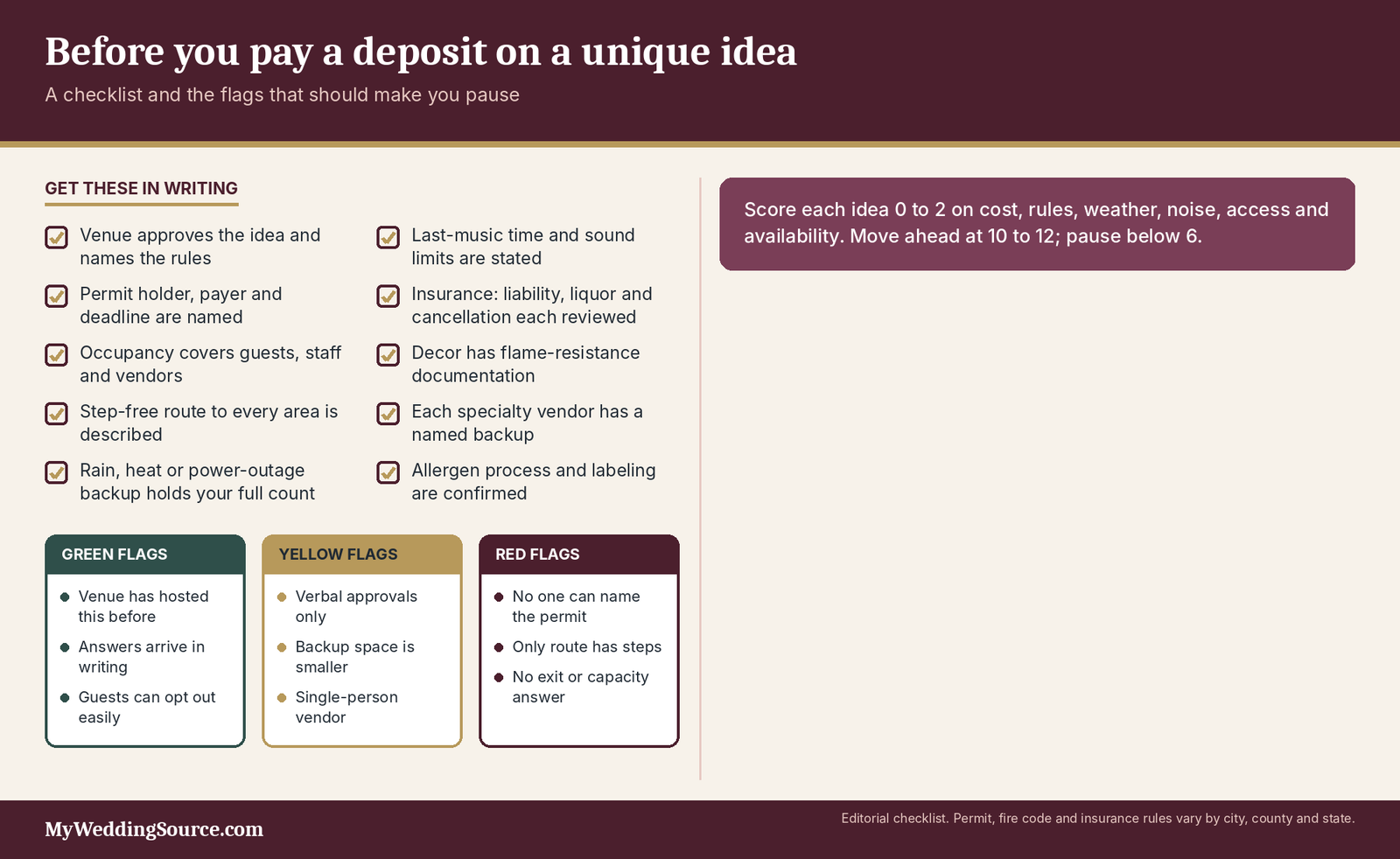
Score each idea from 0 to 2 on six factors: cost fit, permit or rule clarity, weather exposure, noise exposure, accessibility, and vendor or venue availability. Give 2 when the answer is clearly yes and written down, 1 when it is probably fine but unconfirmed, and 0 when you do not know or the answer is no. A total of 10 to 12 means proceed, 6 to 9 means proceed with conditions you can name, and 0 to 5 means pause until you have more information. The scale is an editorial tool, not an industry standard, and the point is to turn a feeling into a list of questions. Re-score after each vendor or venue answer, because an idea that starts at 6 can reach 11 with three emails.
Scorecard for the ideas in this guide
The table below gives a quick view of how the ideas in this guide compare. Cost tiers are editorial and risk labels describe what usually needs attention, not a prediction for your venue. Use it to find the questions you most need to ask first, and not to rank ideas by quality.
| Idea | Cost tier | Main thing to check | Good fit when | Skip when |
|---|---|---|---|---|
| Custom song or live music | Low-High | Rehearsal, sound support | Quiet ceremony | No sound support |
| Couple-led script | Low | Legal officiant rules | Any ceremony | Officiant unverified |
| Museum or historic home | Mid-High | Access route, decor rules | Character venue | No step-free route |
| Brewery or restaurant | Mid-High | Minimum spend, sound | Food-forward guests | Minimum too high |
| Garden, park or ranch | Low-High | Permit, restrooms, weather | Flexible layouts | No indoor backup |
| Boat or rooftop | High | Capacity, boarding, weather | Small guest lists | Mobility limits |
| Brunch or weekday | Low-Mid | Quotes by day | Local guests | Long-distance guests |
| Micro wedding | Low-Mid | Fixed fees, list decisions | Close circle | Family conflict risk |
| Flower bar or craft station | Mid-High | Staffing, cleanup, flow | Long cocktail hour | Short cocktail hour |
| Food trucks or stations | Mid | Permits, service speed | Casual venues | Long lines likely |
| Live artist or performer | Mid-High | Hourly minimum, space | Mingling time | Dim or crowded room |
| Rentals or secondhand decor | Low-Mid | Fire rules, damage fees | Reusable items | Venue bans installs |
A risk matrix for permits, weather, noise, accessibility and vendors
Permits, weather and noise
These three risks decide whether an idea happens at all, and they are the ones most likely to show up late. A missing permit can stop an event or change the location, weather can force a backup plan that costs extra, and a noise complaint can shut down music early. The common thread is that the person who can fix each problem is rarely you: it is the venue, the local authority or the weather forecast. Build decision dates into your timeline, such as the date by which a permit must be filed and the hour by which weather must be called. Share both with your coordinator and vendors.
| Risk | Ideas most exposed | Early warning sign | Mitigation |
|---|---|---|---|
| Permits | Parks, tents, boats, public land | Venue cannot name the permit holder | Get permit status in writing |
| Weather | Gardens, ranches, rooftops, boats | No indoor backup for full count | Set a call time and a backup space |
| Noise | Bands, outdoor music, urban venues | No last-music time given | Confirm cutoff and sound limits |
| Fire rules | Drapery, candles, tents, heaters | Decor has no flame documentation | Use approved fabrics and battery candles |
| Accessibility | Historic homes, boats, barns | Steps or gravel on the main route | Ask for a step-free plan in writing |
| Vendor availability | Specialty artists, small caterers | One person runs the service | Ask for a named backup |
Accessibility and vendor availability
Accessibility and vendor availability are quieter risks, and both can be addressed by asking early. For accessibility, walk the guest route with the venue, ask for a written description of step-free access and make sure decor and stations leave the route clear. The walk-through checklist in the earlier venue section lists the issues to look for. For vendors, unusual services such as live artists, specialty food trucks and custom musicians are often one-person or small operations that book far in advance and may have no backup if someone is ill. Ask each one who covers the event if they cannot, and whether the deposit is refundable if they cancel.
Will your guests actually enjoy it?
The comfort and flow checklist
An idea that photographs well can still fall flat if guests are cold, hungry, bored or stuck in a line. Walk through the guest’s day in order: arrival, parking, seating, food, drink, restrooms, activity and departure. At each step ask whether a person of any age or ability could do it without help or special knowledge. Use the checklist below as a final test before you commit, and revise anything that gets a no.
| Question | Green flag | If the answer is no |
|---|---|---|
| Can every guest reach it? | Step-free, seating nearby | Move it or add an alternative |
| Is it optional? | Guests can skip without notice | Remove pressure to participate |
| Does it fit the time? | Takes under 10 minutes | Add stations or shorten it |
| Is the food clear? | Labeled, allergen process stated | Add labels and ask the caterer |
| Is it comfortable? | Shade, heat, seating covered | Add seating or a backup space |
| Is the volume manageable? | Conversation possible | Lower the music in some areas |
| Does it respect privacy? | Photo and recording expectations stated | Add a sign or announcement |
The participation test
The simplest check is whether a quiet guest who does not want to take part still has a good time. Imagine a guest who does not drink, does not dance, does not want to be photographed and arrives knowing only one person. Does the day still give that guest a seat, something to eat, a comfortable place to talk and a reason to stay? If the answer depends on joining in, add a lower-pressure alternative. Be careful with photo-heavy stations and social media prompts; let guests know in advance if a photographer will be near an activity, and respect anyone who prefers not to be on camera.
FAQ: Unique wedding ideas
Ideas, cost and fit
How do I know whether a unique idea is worth the cost?
Compare the idea against your base plan and ask what you would give up to pay for it. If a hands-on station adds $1,500 and the same money would cover an hour of live music or dessert for everyone, which one will more guests notice? Use the feasibility scorecard to estimate cost, risk and effort, then ask the venue and vendors for written quotes. An idea is worth the cost when it matters to you, works for most guests and does not put another category at risk. If you cannot say who it is for, wait.
Are unique wedding ideas more expensive than traditional ones?
Not necessarily. A self-written ceremony script, a daytime reception, a smaller guest list and a guest-nominated playlist can cost less than a traditional format, while a chartered boat or a staffed activity station can cost more. The Knot’s 2026 study reports lower average totals for smaller weddings, and Zola reports a record average of $36,000 for couples marrying in 2026, so context matters. The costs that surprise couples are usually the ones attached to the idea, such as insurance, staffing, rentals, permits and cleanup. Ask for the full total, not only the headline price.
What if my venue says no to an idea?
A no is often a policy question, not a judgment about your idea. Ask what the concern is: fire, noise, damage, liability or staffing. Then offer a solution, such as battery candles in place of flames, a smaller activity area or a licensed vendor who carries insurance. If the venue still declines, ask if there is a similar approved option. If the idea is central to your plan, that may be a signal to consider another venue before you sign.
Rules and logistics
Do I need a permit for an unusual venue?
It depends on the space, the activity and the local rules. Public parks and beaches commonly require a permit, tents and open flame often trigger fire or building review, and amplified sound or alcohol may need approval. Ask the venue whether it holds the relevant permits and who is responsible for any that you must file, and then check the local fire marshal or permitting office for your area. This article gives general education only, and local rules differ, so confirm with the official source and keep the answer in writing.
Do I need special insurance for an unconventional wedding?
Many venues require liability insurance, and some require liquor liability if alcohol will be served. Cancellation coverage is separate and protects your money in covered situations, but it typically does not cover voluntary cancellation and may take time to begin. Ask the venue what it requires, ask each vendor for a certificate of insurance and ask a licensed insurance professional what fits your event. The policy language matters more than the name, so read what is covered and what is excluded.
Your next steps
This week
Choose one or two ideas and score them
Pick the one or two ideas from this guide that you want most, and run each through the feasibility scorecard. Write down what you do not know, since each unknown is a question for a venue or vendor. If an idea scores below 6, decide whether you can improve it with answers or whether to let it go. Share the scores with your partner so you decide together which is worth pursuing.
Send three written questions to your venue
Ask the venue whether the idea is allowed, which permits and approvals apply and who is responsible for each, and what its rules are on sound, open flame, decor and outside vendors. Ask for the answers in writing, and add your accessibility questions at the same time. Save every reply in a folder so you can refer to it later. If the venue does not know, ask which local office does.
Before you pay a deposit
Get approvals and responsibilities into the contract
Make sure the contract names who files each permit, who pays for it and what happens to your deposit if a permit is denied or the weather forces a move. Add any special arrangements, such as the activity, the layout and the backup space. Check the cancellation and postponement terms against the cancellation and postponement clauses discussed earlier. If something is verbal, ask to have it written down.
Confirm insurance, backups and a decision date
Confirm what insurance the venue and vendors require and what you need to buy, and ask each vendor for a named backup. Set a weather decision time and a date by which you will lock the final guest count for any limited-capacity activity. Add both dates to your timeline and share them with your coordinator. Then book the idea you scored highest, and keep a simpler alternative ready.
Sources & methodology
- Pinterest 2026 Wedding Trend Report — platform search-growth figures for unique wedding activities, jazz club wedding, flower bar set up, written songs, button pictures and drapery backdrop.
- Zola 2026 First Look Report — survey of more than 11,500 couples marrying in 2026: average cost, guest count, social media influence, vintage and personalization.
- The Knot 2026 Real Weddings Study cost breakdown — 2025 averages for total cost, guest count, cost by guest tier, venue, catering, alcohol, entertainment and photography.
- ADA.gov, Introduction to the ADA — Title III coverage of businesses and nonprofits serving the public, and the religious organization exemption.
- ADA.gov, Title III primer for small businesses — accessible routes, readily achievable barrier removal and alternatives.
- NAIC, event insurance consumer insight — liability, liquor liability and cancellation coverage; voluntary cancellations and start-up time.
- Seattle Fire Department, nightlife venue inspection guide — example of posted occupant load, exits and flame-resistant decor requirements.
- Las Vegas Fire & Rescue, place of assembly sheet — example of operational permits, decorative material testing and candle rules.
- New Hampshire Division of Fire Safety, places of assembly — example of assembly definitions and tent requirements.
- Westport, Connecticut Fire Marshal, tent emergency evacuation plan — example of a local tent safety plan requirement.
- Maryland Department of Agriculture, wedding barn guidelines — example of change-of-use fire safety rules for converted barns.
- FDA, food allergies — nine major food allergens and the seriousness of reactions.
- CDC, standard drink sizes — U.S. standard drink definitions.
- EPA, Wasted Food Scale — preferred order of wasted-food pathways.
- National Weather Service, lightning safety — no safe place outside during thunderstorms.
- U.S. Coast Guard Office of Boating Safety — starting point for federal boating safety information.
Methodology: Dollar figures labeled as averages come from The Knot’s 2026 Real Weddings Study (couples married in 2025, n = 10,474) and Zola’s 2026 First Look Report (couples marrying in 2026, n = more than 11,500), which are survey findings and not quotes. Pinterest percentages are platform search-growth signals from one company and are not Google search volume. Cost tiers (Low, Mid, High), the feasibility score and all “bad idea when” notes are editorial judgment, and the permit, fire code and insurance examples come from individual cities, counties and states and should be treated as illustrations, not as the rules in your area; this article is general education and not legal, insurance or medical advice.
Freshness note: Recheck The Knot and Zola figures when each publishes its next annual study (typically early in the year), recheck Pinterest’s report when the next edition is released, and confirm every permit, fire code, alcohol and insurance rule with your venue and local authority before you book. Review this page each October.