
A wedding dress listing is the page, photo set and set of promises you publish when you sell a gown after the ceremony. This guide shows how to decide what to clean, what to leave alone, what to photograph and what to write, and how to work out what you will actually keep once fees, shipping and cleaning are paid.
Before you clean or list anything, photograph the dress exactly as it came home and record its condition in a photo inventory. Then decide on cleaning with a simple rule: clean when the dress has stains or odor a buyer would object to and the cleaning cost is small compared with the price gap it closes, and otherwise disclose and list as is. Write the wedding dress listing from the inventory, not from memory. Finally, fill in a net-proceeds worksheet so you compare channels by money in hand, not by asking price.
Most gowns are sold in the weeks and months after the wedding, when the dress is still in the garment bag, the hem is gray and nobody has looked at it closely. That timing matters. The decisions you make in the first few days, before the dress is cleaned, determine how honest and how complete your wedding dress listing can be, and how much of the sale price you keep.
There are two kinds of mistakes people make at this stage. Some rush to list, with three flattering photos and a vague “worn once” line, and then spend weeks answering questions and handling a disputed return. Others spend a large sum on cleaning and restoration before asking whether that spending raises the price by anything close to what it cost. A thin wedding dress listing and an expensive restoration look like opposite errors. Both mistakes come from the same gap: no one made a written record of the dress, and no one wrote down the numbers.
Money is part of this too, so the results can feed your overall wedding budget. This guide fills that gap with two tools you can build in an evening. The first is a photo inventory, a numbered set of photographs that show the gown’s condition panel by panel. The second is a net-proceeds worksheet that turns an asking price into the amount you will really receive. Everything else in the article, including cleaning choices, wording, channels and edge cases, hangs off those two documents.
A note on scope. This is general information, not legal, tax or financial advice, and rules about taxes, platform fees and consumer protection change, so check the current terms with the issuing agency or platform before you rely on any figure. The money examples in this article are invented to show the arithmetic and are not typical prices or fee rates.
Why a wedding dress listing is a different job from the original purchase
When you bought the gown, a salon had already done most of the work. It showed the dress on a body, in good light, on a rack with a label. Someone else described it, someone else steamed it, and the return rules were written long before you tried it on. A buyer who finds your wedding dress listing has none of that. They see only what you chose to show them, and they cannot touch the fabric.
That gap changes what a good wedding dress listing is. A good wedding dress listing does not make the dress look as beautiful as possible. It lets a stranger predict what will arrive at their door. The buyer is usually spending a meaningful amount of money on an item they cannot try on, and that is why photographs of flaws are not a liability. They are what make the other photographs believable.
It also changes who carries risk. Used-dress buyers know that a gown can arrive with a stain the seller never mentioned, a broken zipper, or a bust measurement that differs from the stated size. Honest condition notes reduce disputes, and clear measurements reduce returns. If you have read about buying a preowned gown, you already know what a careful buyer will ask for. This article is the seller’s side of the same conversation, so the list of what buyers want is also your checklist of what to provide.
Finally, the dress has a history in your life that the buyer does not share. You may feel an urge to describe how much you loved wearing it. A short, warm line is fine. Most of the wedding dress listing, though, should be facts: size labels, measurements, fabric, condition and what is included.
What you are deciding, and in what order
Every decision in this process falls into one of five questions. Answering them in order saves money, because each answer limits the next.
Question one: is it ready to be assessed? Before any cleaning, you need a record of the dress as it is. After cleaning, you cannot show the stains the cleaner removed or the stains that came back. The assessment comes first.
Question two: what is the condition, in words and photographs? This is the photo inventory. It produces a list of known flaws and a list of confirmed good areas, each with a numbered photograph.
Question three: should it be cleaned, and by whom? The decision rule in the cleaning section below turns the inventory into one of four outcomes: leave as is, spot-treat, professional cleaning, or cleaning and repair with disclosure.
Question four: where and how should it be sold? Consignment, a resale marketplace, a local sale and a bridal boutique each charge differently in money, time and risk. The net-proceeds worksheet compares them.
Question five: what do you promise? That means the measurements you state, the condition words you choose, the returns you accept, and the shipping and insurance you offer. These promises are what a buyer relies on later.
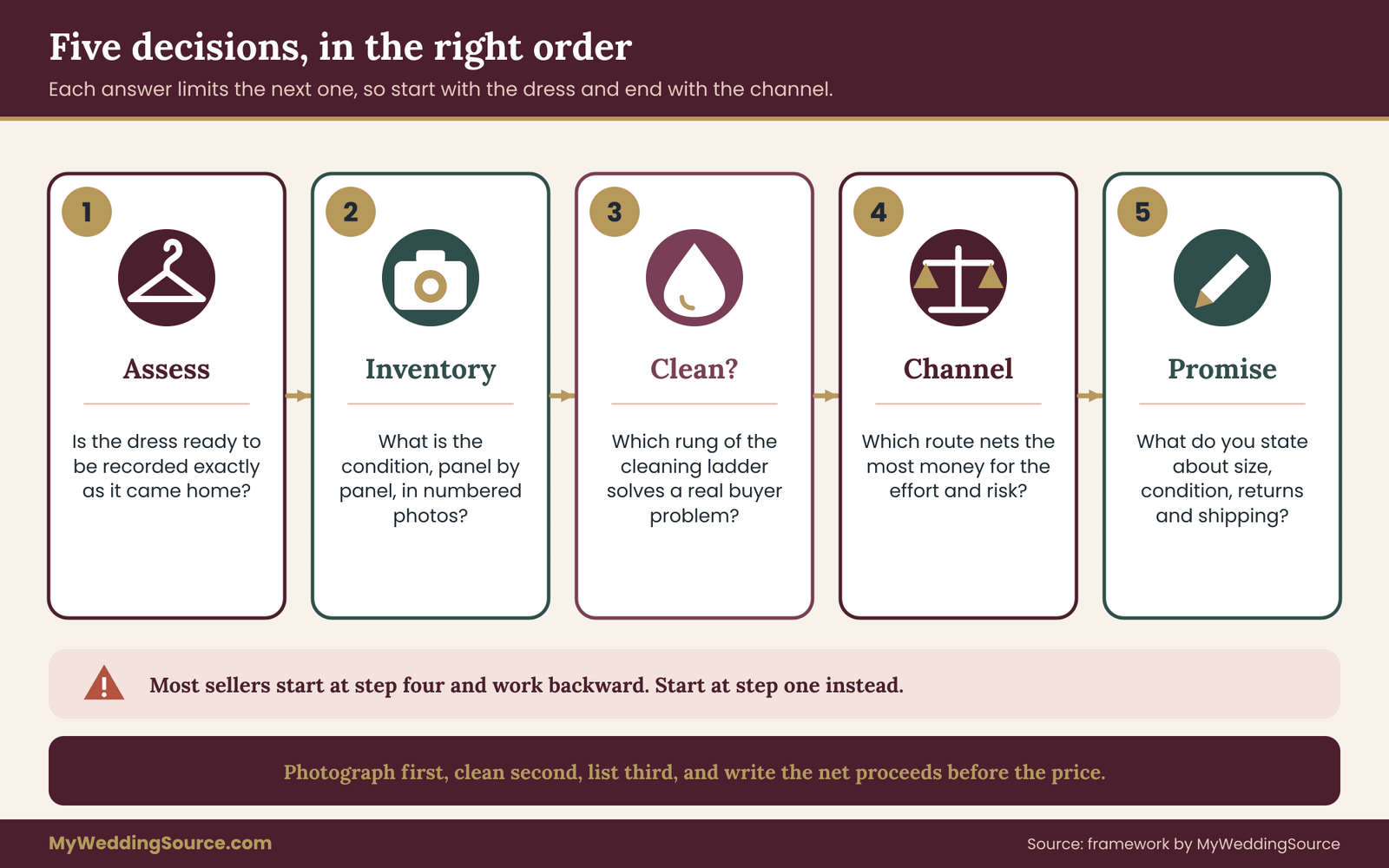
The order matters because people tend to start at question four, picking a website because a friend used it, and then work backward. That route usually produces a rushed set of photos and a cleaning decision made out of anxiety. Starting with the dress itself keeps the process calm, and it makes every later step shorter.
A realistic timeline
You do not need to finish in a weekend. A reasonable pace is to complete the assessment and photo inventory in the first week after the dress comes home, decide on cleaning within the second week, and publish the wedding dress listing only when the dress is back, photographed again and measured. If the dress is going to a cleaner, ask for an honest turnaround time and write it down, because bridal cleaning and restoration can take several weeks and the schedule depends on the shop.
If you plan to sell for a seasonal reason, such as a buyer who is engaged now, the timeline may be shorter. Even then, protect the first step. A clean, complete photo inventory takes about an hour or two for a simple gown, and it is the one piece of work you cannot reconstruct later.
One more point on timing. The longer a worn dress sits in a bag, the more any invisible residue, such as perspiration or drink that dried clear, can darken into visible marks. This is general textile care knowledge, and a cleaner can tell you more about your specific fabric. It is a reason to avoid leaving the question open for a year, even if you are not ready to sell.
The first week: what to do before you clean or list anything
The first week is mostly about not making things worse. The temptation is to hang the dress, let it air out and fix what you can see. Resist the urge to treat spots yourself, because home treatment can set a stain or leave a ring that a cleaner then has to deal with.
Take it out of the plastic. Dry cleaning bags and sealed boxes trap moisture and can encourage yellowing. If you are not cleaning right away, move the dress to a clean cotton sheet or an unbleached muslin garment bag and hang it from its own hanging loops or on a padded hanger, supported by the bodice, not by the shoulder straps if the skirt is heavy. If you do not know how the dress was designed to hang, ask your alterations professional or the salon.
Stop and photograph it as is. Before you do anything else, take wide photographs of the whole dress front and back, in daylight if you can. These are your before pictures. They also protect you if a cleaner damages the gown, because you can show the condition it arrived in.
Check your list. Dress tasks usually sit on a general wedding planning checklist as one line, “deal with dress,” which hides the work in this guide.
Collect the paperwork. Find the original receipt or order confirmation, the care label, any tags, the alteration invoice, the cleaner’s receipt if the dress has been cleaned since the wedding, and any garment documents that came with it. You do not need all of it to sell, but a buyer will often ask who made the gown and what has been altered.
Count what comes with it. Veils, slips, crinolines, belts, sashes, detachable sleeves, hoop skirts and bustle ties are separate items. A buyer will want to know which ones are included, so make a short list and set aside any items that stay with you.
Avoid wearing it again to test. A second wearing to check a bustle or a zipper adds new wear before the record exists. Do the checks with the dress on a form or hanger.
What to do about sentimental concerns
Some people find the first look at the dress after the wedding emotional, and that is fine. If you are not sure you want to sell, hold the process at the photo inventory stage. The photo inventory is useful even if you keep the gown, because it records condition for insurance, for a later preservation decision or for a family member who might wear it. The site’s guide to organizing wedding records after the event covers where to file the inventory with the receipts and contracts from your wedding.
If the dress is meant to be reworked into something else instead of sold, the questions are different, and a separate guide on this site covers how to repurpose a gown without erasing its story. Do not mix the two paths. A dress that is cut apart, even slightly, can no longer be sold as a complete gown without full disclosure.
What to leave undone
There are a few things to leave alone until the inventory is finished: do not remove beads or appliqués that look loose, do not cut off the alteration threads, do not remove the bustle ties or take out any pins, and do not wash the veil. Each of these changes the evidence. A cut thread shows how the hem was taken up, and a buyer or alterations professional may want to see it.
You should also hold off on posting teaser photos on social media or in marketplace groups. A rushed post with poor photos can set the price in people’s minds, and it may attract the wrong buyers, who then request a discount for flaws you had not yet recorded. Wait until the full photo set is ready, then publish once.
Nothing in this first week produces a published wedding dress listing, and that is deliberate. By the end of the first week you should have a dress that is out of plastic and safely stored, a set of wide before photographs, a folder with the paperwork, and a list of included items. That is all you need before the real work begins, which is looking at the gown panel by panel.
Cleaning decisions that shape your wedding dress listing
Cleaning is the single largest cost you control before a sale, and the one people feel most pressure about. A common belief is that a dress must be professionally cleaned before it can be sold. That is not a rule. It is a choice with a price, and sometimes the better choice is to sell the gown as is with clear disclosure. The right answer depends on the dress, the marks and the buyer you are likely to reach.
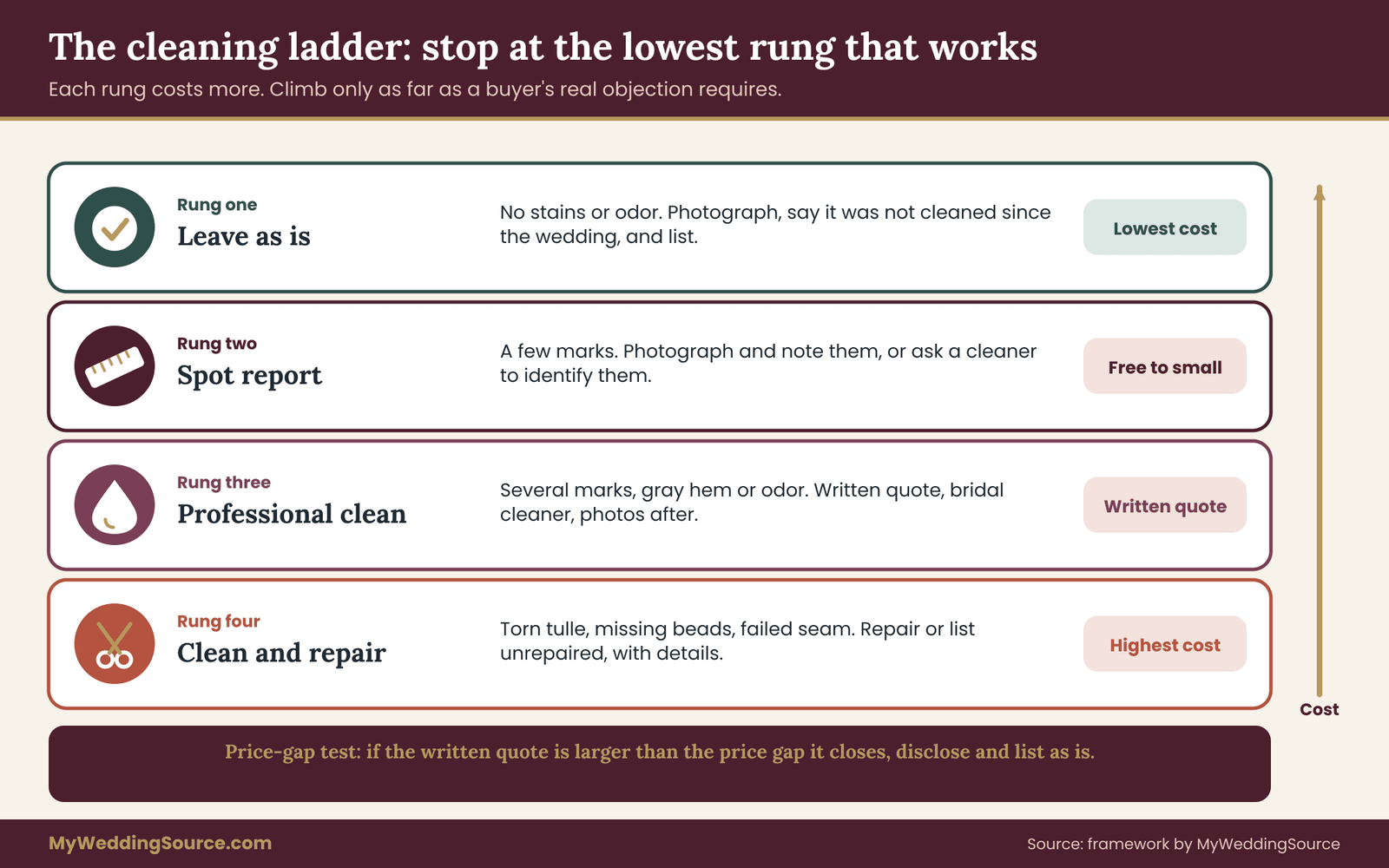
Every cleaning choice changes what goes into the wedding dress listing, so think of the decision as a ladder with four rungs. Each rung costs more and promises more, and you stop at the lowest rung that solves a problem a buyer would care about.
Rung one: leave as is. The dress has no visible stains, no odor and only the ordinary wear of a few hours of wearing, such as a slightly gray hem edge. You document it, say plainly that it has not been cleaned since the wedding, and list it. Some buyers prefer this because they plan to have the dress cleaned anyway by a person they trust, and they do not want to pay for your cleaning twice.
Rung two: spot report, not spot treatment. The dress has a few marks you can see. Instead of treating them, you photograph them, note them, and either list the dress with those notes or ask a professional to identify the stains. A cleaner can often tell you what the mark is and whether it will come out, which turns an unknown into a number.
Rung three: professional cleaning. The dress has several marks, a visible hem, an odor, or deposits that a buyer will notice, and cleaning will plausibly fix them. You choose a cleaner who works on bridal gowns, agree on what is included, and photograph the dress again afterward.
Rung four: cleaning with repair and disclosure. The dress has damage beyond dirt, such as torn tulle, missing beads, a failed seam or a broken zipper. You decide whether to repair and list as repaired, or list unrepaired at a lower price with specifics. Either way, the repair becomes part of the history of the dress and goes into the wedding dress listing.
The decision rule: the price-gap test
Here is a simple way to choose a rung. For any cleaning or repair, estimate three numbers using real quotes, not guesses: what it costs, how much more you could reasonably ask for the dress afterward, and how likely it is to work. Then compare.
Start with the cost, which you get by asking one or two cleaners for a written quote. Then estimate the price gap by looking at how comparable gowns with and without noted flaws are priced in the channel you plan to use. Look at listings of similar silhouettes and brands, with similar conditions, and note the spread between “light marks, as is” and “professionally cleaned, no marks.” Do not rely on one listing, and do not assume an asking price is a sale price.
If the cost is larger than the gap, clean nothing and disclose. If the gap is much larger than the cost, clean. If the two are close, the extra factors decide: how long you want to hold the dress, how much work the sale will be with marks, and whether a buyer is likely to want the choice.
This is not a precise formula, and it does not need to be. Its purpose is to make you write the numbers down before you spend money. People who skip that step often discover afterward that a four-figure restoration raised the asking price by less than the bill.
Questions to ask a cleaner
Before you hand the dress over, ask for answers in writing, or at least in an email you can save. A reputable bridal cleaner expects these questions.
- Do you inspect the gown with me or with a photo before you accept it, and do you record the existing condition?
- What do you do about beads, sequins, appliqué and trim, and what is your policy if they are damaged by the process?
- Which stains do you consider at risk of not coming out, and will you tell me before you start if you find any?
- What is the full price, including any surcharges for heavy beading, long trains or multiple layers?
- How long will it take, and what is your policy if the dress is late?
- Do you return the gown in a preservation box or a hanging bag, and is that included? If I plan to sell it, which do you recommend?
- What is your liability if the dress is damaged, and is there a written limit?
Some cleaners limit their liability to a fraction of the dress value or to the cleaning fee. If a limit appears on the receipt, you should know it before you drop off the dress, not after. The site’s guide to wedding vendor contracts explains how to read a liability or limitation clause in a service agreement, and the same reading skills apply here.
What about a cleaner’s “preservation” package?
Preservation, in which the dress is cleaned, then packed in a sealed box or chest for long-term storage, is aimed at people keeping the gown. If you plan to sell, a preservation box can work against you, because the buyer will likely open it and a sealed package may be unsealed and repacked. Ask whether the cleaner can return the dress cleaned but unboxed, or in a simple breathable bag, and whether the price changes.
Sometimes the preservation package is bundled and the price is the same, so the box is a convenience. Sometimes it is an add-on you do not need.
If the dress has already been boxed by a cleaner, do not assume it is sealed in a way that proves anything. A box does not show the condition of the dress inside. A buyer cannot rely on it, and your photographs still need to be taken from the dress itself.
Cleaning claims in a wedding dress listing
Because a cleaned dress is easier to sell, there is a pull toward claims such as “professionally cleaned and preserved.” Make only the claims you can back with a receipt. A good phrase says what was done and when: “Cleaned by a bridal cleaner two weeks after the wedding; receipt available.” A weak phrase says “like new” or “perfect condition,” and it is the kind of wording that causes disputes, because the buyer and the seller define it differently.
Cleaning claims belong in a specific place in the wedding dress listing: the condition block, next to the matching photos, not in the title. A title that says “professionally cleaned” sets a standard that every photo must then meet. A wedding dress listing that places the same fact in the condition notes lets the buyer judge it against the images.
If you cleaned the dress yourself, say so. Home spot cleaning is not a flaw to hide, but a buyer deserves to know. If you tried to remove a mark and left a ring, photograph the ring.
If the cleaner returns the dress with marks still present, treat that as new information for the wedding dress listing, not as a failure to hide. Photograph the marks again, add a line saying that professional cleaning was attempted and what remains, and keep the receipt. Buyers often accept a mark that a cleaner tried to remove more readily than one that no one tried to treat.
When not to clean
There are a few situations where leaving the dress alone is the more careful choice.
If the fabric is fragile or very old, such as silk that has already yellowed or a vintage gown, cleaning can cause damage. In that case, consult a textile conservator or a specialist who handles antique garments before anything else. Museums and conservation bodies publish general guidance on handling and storing textiles, and a number of them are listed in the sources of this article.
If the dress has significant beading or hand-applied trim that a cleaner will not guarantee, the risk to the beads may be larger than the benefit. A buyer who values the beadwork may prefer to see the marks and decide for themselves.
If you are selling to a buyer who has asked to have the dress cleaned by their own preferred specialist, cleaning first would only duplicate cost. Ask early.
And if the quote is a large share of the likely sale price, the price-gap test usually says no. Disclose the marks, photograph them well and let the price reflect them.
Working out what you can safely do at home
Home care is tempting because it is cheap, and a few things are low risk. You can shake out loose dust outdoors, hang the dress in a ventilated room to air it, and gently lint-roll a plain skirt. Steaming can relax wrinkles on many fabrics, though not all; check the fabric label and ask a professional before you point a steamer at an unfamiliar fabric.
The things to avoid are anything wet and anything chemical. Washing a gown, dabbing stain remover on silk, or using a household solvent can produce rings, color loss or fabric distortion. The Federal Trade Commission’s Care Labeling Rule requires manufacturers to give care instructions for garments, so your gown’s label should tell you what the maker recommends, and following it is a safer starting point than improvising. If the label says dry clean only, treat that as the maker’s instruction and leave wet methods alone.
A last point on timing: if the dress has visible stains, the quote request should go out this week. You do not have to commit, but a cleaner’s first read of the marks is free information, and it tells you which rung of the ladder you are on.
The photo inventory: the wedding dress listing starts here
A photo inventory is a numbered set of photographs and one-line notes that show the whole dress, panel by panel, before you write a word of the wedding dress listing. It is different from the pretty pictures you will publish. Its purpose is evidence, for you and for the buyer. It also becomes the raw material for the final photo set, the condition notes and the answers to buyer questions.
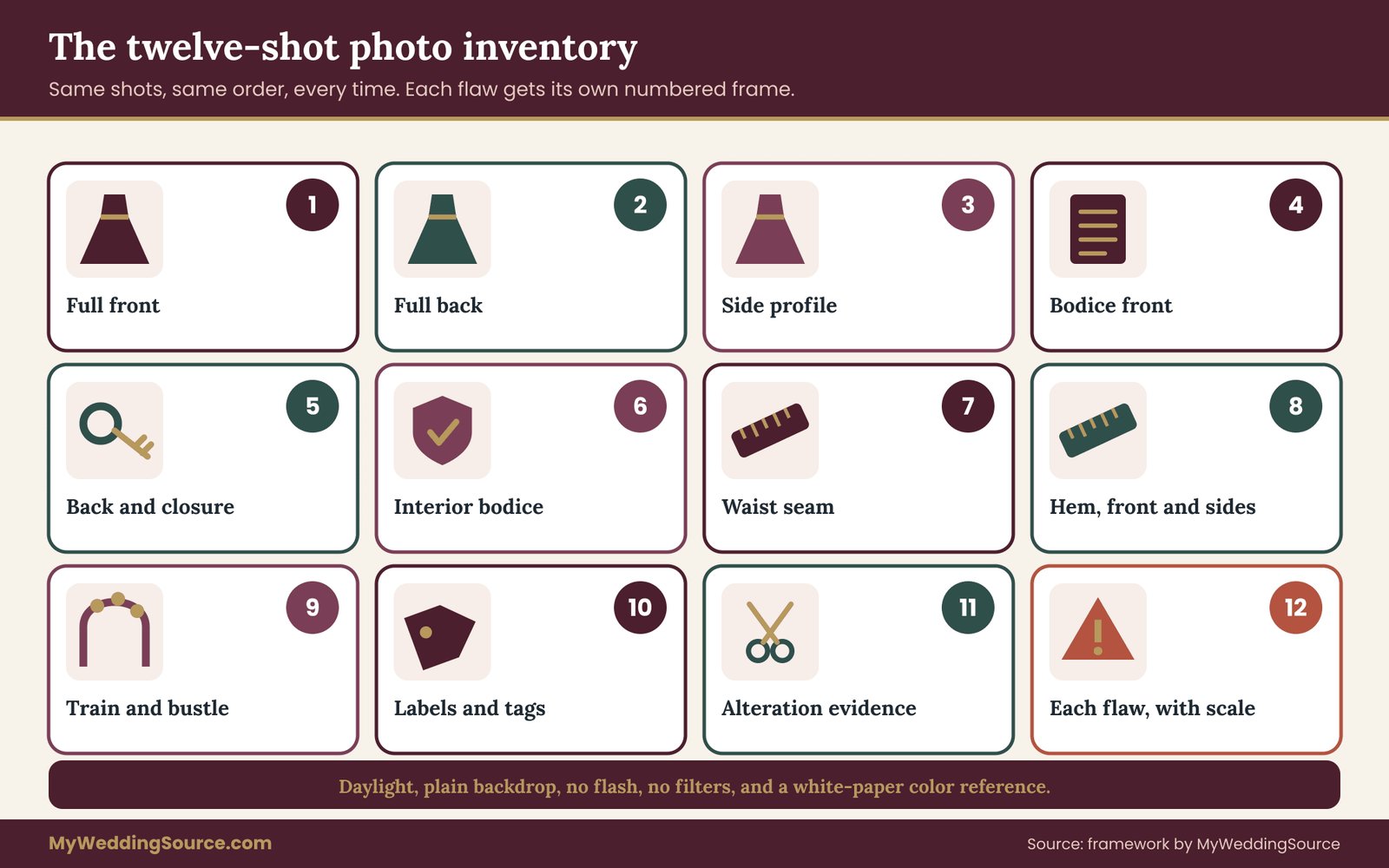
The inventory has a fixed structure, which is what makes it useful. You take the same set of shots every time, in the same order, so nothing is forgotten and every photo has a number you can refer to later. The set below has twelve shots. A simple gown may not need all of them, and a heavily beaded one may need more.
The twelve shots
Shot 1: full front, on a form or hanger. The whole dress, from above the neckline to below the hem, with a plain background. This is the first picture a buyer sees, so keep the background uncluttered.
Shot 2: full back. The same framing, showing closure style, buttons, zipper or lacing, and the shape of the train.
Shot 3: full side profile. This shows the silhouette, the depth of the skirt and how much structure sits under it.
Shot 4: bodice front, close. A frame that shows the lace, beading and seams across the bust. Buyers look here for pilling, snags and discoloration.
Shot 5: bodice back and closure, close. Zipper teeth and pull, hooks and eyes, buttons and loops, and the lining at the opening.
Shot 6: interior bodice. The inside of the bodice, with boning, cups, lining, seam allowances, and the label if it is stitched in. This is where deodorant marks and makeup tend to be visible, so it is the shot buyers care most about, even if they do not know it.
Shot 7: waistband and seam line. The place where the bodice meets the skirt, inside and out, since this seam carries a great deal of weight.
Shot 8: hem, front and sides. The edge of the skirt, on the floor or held out flat, with natural light across it. Gray, brown or frayed edges show here.
Shot 9: train and bustle. The end of the train, the bustle points and loops or buttons, with the bustle fastened and unfastened.
Shot 10: labels and tags. The brand label, size label, care label and any tag. These support the wedding dress listing’s size, fabric and maker details.
Shot 11: alteration evidence. Any visible alteration, such as a taken-up hem, an adjusted strap, added cups, a bustle or a taken-in seam. Include the inside where the new thread meets the original.
Shot 12: every flaw, one frame each. For each stain, snag, loose bead, hole or mark, take two photos, one close and one with a coin or ruler for scale. Number them 12a, 12b and so on.
A wedding dress listing built on a weak photo set is hard to repair with words. Buyers cannot ask the fabric questions, so the photographs answer them. That is why the setup below deserves more time than it seems to.
Lighting and setup
You do not need professional equipment. A phone and a window are enough. The goal is accurate color and visible texture.
Hang or place the dress by a large window in daylight, away from direct sun. Overcast daylight is ideal because it is even and soft. Avoid yellow indoor bulbs, which warm white and ivory fabrics and make them look creamier than they are. Avoid the flash, which flattens texture and can create glare on beads and satin.
Use a plain wall or sheet as the background. White fabric against a white wall loses its outline, so a mid-gray or soft neutral backdrop usually reads better. If you need to, place a dark cloth behind the skirt for shots that show its edge and the train.
Keep the camera level and at the same distance for the full-length shots, so proportions are consistent. For close-ups, hold the phone steady, tap to focus on the area, and check that the image is sharp when you zoom. A photo that looks fine on a small screen may be blurry on a monitor.
Color is the hardest part of dress photography. Ivory, ecru, champagne and white all shift under different light, and a phone camera may adjust the color automatically. Take one reference shot with a plain white sheet of paper beside the fabric, in the same light. That tells you and the buyer how the camera is treating whites. If you describe the shade as ivory, and the photos look nearly white, a buyer may feel misled. The same lighting effects are why shade names such as ivory, ecru and champagne mean little without a photo in daylight.
The inspection pass
While you take the photos, you are also inspecting. Hold the dress up, turn it, and move your fingers along seams. Look for specific problems in a fixed order.
Start at the top. Check the neckline, straps and sleeves for stretching, snags and discoloration. Check inside the armholes, where perspiration and deodorant often leave marks. Then check the bodice for loose hooks, bent boning, broken stitches, and loose or missing beads and sequins.
Move down to the zipper or lacing. Run the zipper fully up and down, and note any catch. Check hooks, eyes and loops. Check buttons and their loops for stretching.
Then check the skirt, layer by layer. Tulle and organza tear easily, so check along seams and near the hem. Look at lace for pulls. Check the lining, which is often where small tears hide.
Finish at the hem. Turn the dress over and look at the underside of the train, where dirt, grass and wine are most likely. If the dress was bustled, check the bustle points for strain.
Write a one-line note for every finding, with the photo number. For example: “12c, small snag in tulle, left side, about two centimeters” or “6, faint mark inside left cup, not removed.” These notes are the raw version of the condition section of the wedding dress listing.
The smell test and the stain test
Two things photographs cannot show are odor and stains that are invisible until later. For odor, smell the interior bodice and the underarm area, and note whether you notice perfume, smoke, mildew or perspiration. A dress stored in a closed bag can hold moisture and develop a musty smell. If you notice any odor, record it. A buyer will smell it the moment the box opens.
For invisible stains, the usual culprits are sugary drinks, cake, sweat and body oils. They can dry clear and turn yellow or brown over time. You cannot reliably find them by eye. One way to check is to look at the dress under a raking light from the side, which can make faint marks and textural changes visible. Another is simply to be honest in the wedding dress listing: “Dress has not been cleaned since the wedding; some faint discoloration may develop.” Some buyers see this as sensible, and others will move on, but nobody feels deceived.
One practical habit helps later: take the full-length shots again after any cleaning, in the same position and light, and keep both sets. The after set becomes the opening photos of the wedding dress listing, and the before set stays in the folder as your record. Mixing the two in one folder without dates is how sellers end up publishing a photo that no longer matches the dress.
Storing the inventory
Keep the photographs in a folder named for the dress and the date, with the numbered shots and the notes in a single document. Keep the original files, not just compressed copies, because a buyer or a platform may ask for detail. Keep the receipt and any correspondence with the cleaner in the same folder.
That folder is also the proof of what the dress looked like when it left your hands. If a buyer later says the dress arrived with a stain, you can compare. If a platform asks you to show that the condition was disclosed, you can show it. It is a form of seller evidence, and it protects you as much as it protects the buyer.
From inventory to published photo set
You will not publish all twelve shots in the same form. The published set is a selection, usually between ten and twenty images, ordered for a buyer’s decision. A common order is full front, full back, side, bodice details, closure, interior, hem and train, labels, then flaws. Put the flaw photos in the wedding dress listing, not just in the message thread, so that any buyer who reads only the wedding dress listing has seen them.
Use captions or numbered text so that each flaw photograph matches a line in the condition notes. A buyer who reads “see photo 14, small mark on the left side of the hem” and finds that photo has a reason to trust the rest.
Do not edit the photos to remove flaws, brighten color or sharpen texture beyond a light exposure adjustment. Heavy filters are a common source of disputes, because the dress that arrives does not match the dress that was shown. If you retouch, even slightly, say so.
Avoid including your face or personal details. Photos on a form, a hanger or a door frame work well, and they keep the focus on the dress. If you do model it, crop out the face and any background that shows your address or identifying details.
Finally, check each photo on a phone and on a larger screen before you publish. Look for the things buyers look for: sharpness, color accuracy and whether every flaw note has a matching image.
Measurements, labels and documents for the wedding dress listing
Size labels are the weakest information in a used-dress sale. A bridal size 10 is often not a street size 10, brands cut differently, and the dress may have been altered since the label was sewn in. Buyers who have been burned before look for measurements first. The measurements you provide in the wedding dress listing are among the most useful facts in it, and the ones most likely to prevent a return.
What to measure
Lay the dress flat or hang it on a form and measure with a soft tape. Record each measurement in inches or centimeters, say which, and say whether the dress was flat or on a form. A reasonable set of measurements includes the following.
Bust at the fullest point, measured around the garment, with a note on whether the bodice has stretch or boning. Measure as the garment sits, then state whether it laces or has a corset back that adjusts.
Waist at the narrowest point of the bodice. If the seam sits lower than a natural waist, note where, for example “dropped waist, seam about X inches below natural waist.”
Hips at the fullest point of the skirt’s fitted portion, if the dress has a fitted hip, such as a sheath or trumpet.
Bodice length from the top of the strap or neckline down to the waist seam. This helps a buyer judge torso fit.
Total length from the top of the strap to the hem, in the position the dress hangs. State the length with and without the heels it was hemmed for, because the shoe height used for the hemming matters a great deal.
Train length from the waist seam or the back opening to the end of the train.
Hem circumference where relevant, for the skirt volume, particularly with ball gowns and A-lines.
If you know the height of the heels the dress was hemmed for, state that. A gown hemmed for three-inch heels will drag on someone who wears flats. If the dress was altered, say how. A hem that has been taken up two inches may have no extra fabric left to let down, which affects a taller buyer.
The site’s guide to wedding dress fit and alterations explains how a gown is taken in or let out, and what limits exist, so it is a useful companion when you decide what to say about alterations. Specifically, tell buyers whether any seam allowance remains, and whether the dress has been taken in or let out anywhere in a way that cannot be reversed. A buyer who needs to size up should know that before paying.
Reading and recording labels
The label tells the buyer three facts: who made the dress, what size it was cut as, and what the fabric is. Photograph all of them. If the brand label has been cut out, which some salons do for sample dresses, say so and describe how you know the maker, with the receipt if you have it.
Be careful with names and style numbers. If you state that the dress is a particular designer’s style, be sure it is correct and can be matched to the receipt or the label. Authenticity claims are risky. A seller can say “purchased from an authorized retailer, receipt available,” which is a fact, but should avoid saying “authenticity assured” or “100 percent genuine” unless there is proof. If you cannot prove it, say what you know and what you do not.
If the care label lists fiber content, repeat it exactly. Fabric names are often used loosely in marketing, and a buyer may care whether the dress is silk, polyester or a blend because of cleaning and heat. If the label is missing, do not guess. Write “fabric content not confirmed” and describe how the fabric looks and feels, using simple terms like “matte satin-type fabric” or “fine net tulle,” and avoid claiming a fiber you cannot verify.
The documents worth having
Gather the items below, and decide which to mention in the wedding dress listing and which to hold back until a buyer asks.
- The original receipt or order confirmation, with personal details covered.
- The alteration invoice, which shows what was done and when.
- The cleaner’s receipt if the dress has been cleaned, with the date and what was done.
- Any manufacturer care sheet or tag.
- The numbered photo inventory and notes.
Cover personal information such as your full name, address, card digits and order numbers before sharing a receipt. A receipt with those details blurred still proves what you bought and when. Do not post it publicly in the wedding dress listing. Offer it on request, in a private message, once a buyer is serious.
If you bought the dress from a salon, the sale terms may have restricted resale or required that the salon do alterations. It is unusual, but if you signed something about resale or warranty, read it before you list. If there is a manufacturer’s warranty, check whether it transfers to a second owner. Most do not, and you should not imply a warranty that does not exist.
What to include and what to leave out
Say what comes with the dress, item by item. A buyer who expects a veil and receives none will feel deceived, even if the wedding dress listing never promised it. A short line works: “Included: dress, built-in petticoat, detachable sash. Not included: veil, shoes, garment bag.”
Leave out your wedding story beyond a line. Leave out the price you paid unless a comparison helps a buyer, in which case say “purchased new” and state the year. Leave out claims about the dress’s popularity or rarity, which are hard to prove.
Do not mention your wedding date, venue or full names. It is both a privacy concern and a safety one, since it tells strangers when and where your home may be empty during a trip.
Writing a wedding dress listing that matches the photo inventory
A wedding dress listing has a small number of jobs. It must be found, it must be believed, and it must let a buyer decide without a long exchange of messages. Most of the work is in the condition notes, so we will start there.
A condition vocabulary you can defend
Marketplace sites often offer broad condition categories such as new, like new, good and fair. Those categories are not defined the same way across platforms, so rely on your own plain description and use the platform label only as a filter. Here is a vocabulary that ties each term to something a buyer can check.
Unworn, tags attached. The dress has never been put on, and the tags are still on it. If you are selling an unworn gown, say how you came by it, for example a canceled wedding.
Worn once, not cleaned. The dress was worn at the wedding and has not been cleaned since. Describe visible marks and say plainly that cleaning has not been done.
Worn once, professionally cleaned. Give the date and the cleaner’s type of service. Say whether the dress is in a box or a bag.
Altered. List every alteration, such as hem, bustle, straps and added cups, and say whether it can be reversed.
Flaws. List each flaw, with the photo number. Use size and location terms a buyer can picture: “two small snags, each smaller than a dime, in the skirt tulle, left of the center back.”
Avoid soft words that mean nothing, such as “pristine,” “flawless” and “perfect.” They are claims, and a buyer can test them. Also avoid “minor” and “small” without any measurement, since those words mean different things to different people.

A structure that works
A wedding dress listing reads best in the order a buyer thinks. Start with a plain title that includes the brand or style, the size label, the color name and the year. For instance: “A-line lace wedding gown, size label 8, ivory, purchased new, worn once.” The title should help a buyer decide in a second whether to keep reading.
Then give the description in four short blocks. The first states what the dress is: silhouette, fabric, neckline, sleeves, closure, train length and any detail that sets it apart. The second gives measurements and fit notes, including the heel height used for the hem. The third is condition, from the inventory, with numbered photos. The fourth is logistics: what is included, how it ships, the returns policy and how long you will hold it for a buyer.
Keep each block short. Buyers scan, and a wall of text hides the line that matters. Use plain sentences instead of decorative language, and put the most important caveat near the top if it is likely to change the decision. A dress that has been taken in at the bust and cannot be let out belongs in the first or second block, not at the end.
A final read-through before you publish
Read the finished wedding dress listing once as if you were the buyer, with the inventory folder closed. Every claim should make sense without you there to explain it. If a sentence raises a question, answer the question in the text.
Then read it again against the inventory. Each flaw in the folder should appear in the wedding dress listing with its photo number. Each measurement should match the tape. Each included item should be named, and each excluded item should be named too.
Ask a friend who has never seen the dress to read the wedding dress listing and say what they think they are buying. If their description differs from yours, the text is unclear in a place you cannot see. This takes ten minutes, and it catches more problems than another round of editing by yourself.
Finally, save a copy of the published wedding dress listing, with the date, as a screenshot or a text file. Platforms let sellers edit a post after a sale begins, and a saved copy shows what you promised on the day the buyer agreed.
Words that cause disputes
Some phrases invite later disagreement. “Like new” is the best known. Others are “never worn out of the house,” “only worn for a few hours,” “no flaws that I know of” and “as seen.” The first two can be untrue if the dress was fitted, stored or tried on several times. “No flaws that I know of” can read as a shield. “As seen” does not release a seller from describing the item honestly, depending on the platform and the law, and may make buyers suspicious.
Replace each with a fact. Instead of “like new,” write “worn for one wedding day, spot cleaned by me on the hem only, no other known marks; see photos 8 and 12b.” That sentence is longer, and it is far more convincing.
What a buyer reads first
A buyer’s attention is short and ordered. In a typical wedding dress listing, the first photo and the title decide whether the second photo gets viewed. The size label and measurements decide whether the condition section gets read. The condition section decides whether a message gets sent.
That order tells you where to spend effort. The first photo should show the whole dress cleanly. The title should state the facts a buyer filters on. The measurements should sit high enough to be seen without scrolling much. A weak first photo can hide a strong wedding dress listing, and a beautiful photo cannot save a vague one.
Think also about the buyer who arrives from a search for a specific silhouette. They compare your wedding dress listing with a dozen others, so the details that separate yours, such as a real heel height or a described flaw, give them a reason to choose it.
Asking price and room for offers
Pricing is its own subject, and a separate guide on this site covers how to price a used gown. In the wedding dress listing itself, decide two things: your asking price and the lowest price you would accept. Write the second number down, privately, along with the net you would receive at that price, so you can answer an offer without hesitation. The net-proceeds worksheet in a later section shows how.
If you are open to offers, say so. If you are not, say “price is firm.” If you will bundle the veil or the petticoat at a lower price, say that too. Keep your commitments simple, so the buyer does not have to ask for each.
Honest scarcity and urgency
Avoid manufactured urgency such as “last chance” or “someone else is interested.” If a real deadline exists, such as a move or a seasonal date, you can mention it. Otherwise, a calm and complete listing sells to the right buyer without pressure.
The net-proceeds worksheet for your wedding dress listing
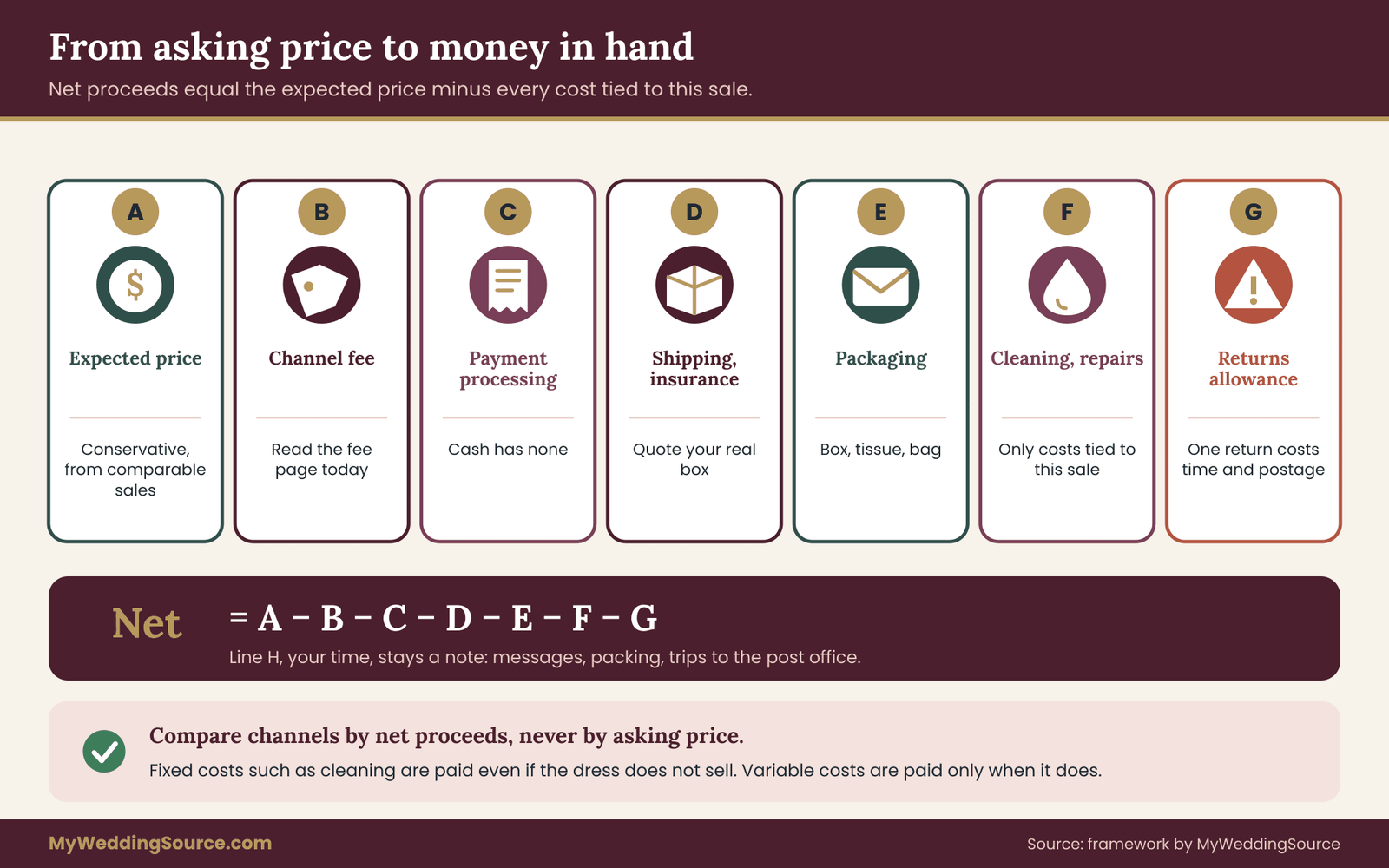
An asking price is not income. Between the price a buyer sees and the money that reaches you sit platform fees, payment processing, shipping, insurance, packaging, cleaning, repairs, and the cost of your own time. Some of these are visible at the moment you list, and some appear only when the sale closes. A net-proceeds worksheet puts them in one place, so you compare options by what you keep.
The worksheet has one column per option, and in this article it is written out in lines, because the point is the logic and not the layout. For each channel you want to consider, work through the lines below in order.
Line A: expected sale price. The price at which you realistically expect the dress to sell, not the price you hope for. If you are unsure, use the lower end of the range you found in comparable wedding dress listings.
Line B: platform or shop fee. The percentage or flat fee the channel takes, read from the channel’s current terms. Consignment shops usually take a share of the sale price, marketplaces take a selling fee and sometimes a separate payment fee, and local sales take nothing. Do not rely on memory or on a forum post. Read the fee page today.
Line C: payment processing. If the channel does not already include it in line B, add the cost of the payment method you will use. A sale in cash has none. A payment app may charge a percentage for certain kinds of payments, and the terms change, so check them.
Line D: shipping and insurance. The cost of sending the gown, packed in a box large enough for the volume, with tracking and insured for the sale price. A bridal gown is bulky and light, and the box often costs as much as the postage. Get a quote from the carrier for your actual box size and weight, and for the declared value.
Line E: packaging. The box, tissue, garment bag and tape, if you do not already have them. A wedding gown shipped in a thin envelope is an expensive mistake.
Line F: cleaning and repair. The cost of whatever rung of the cleaning ladder you chose, from the written quote. Add only the costs that are tied to this sale, and leave out cleaning you would have done anyway.
Line G: expected returns and refunds. If the channel allows returns, assume that some portion of sales may come back and that you will pay for return shipping or lose the sale fee. You do not need a statistic. Instead, consider what a single return would cost you in shipping, time and a cleaning to relist, and ask whether the channel’s returns terms make that likely.
Line H: your time. This one is harder to price. Decide whether it matters to you, and if so, estimate the hours of photography, messaging, packing and shipping. A channel that nets less money but takes almost no time may be better than one that nets a bit more and takes forty message threads.
Net proceeds. Start with line A, then subtract lines B through G. Line H stays a note, not a number, unless you want to attach a value to your hours.
Keep the finished worksheet with the dress folder and update it when anything changes. If you lower the price, change the channel or receive a quote you did not have, redo the sums before you edit the wedding dress listing. A price cut on paper is easier to reverse than one already posted.
What counts as a fixed cost and what is variable
It helps to separate costs you pay no matter what from costs that depend on the sale. Cleaning, if you do it, is a fixed cost. You pay it even if the dress takes months to sell, or does not sell. Shipping and fees are variable, because you pay them only when a sale closes.
This matters when you decide how much to pay in advance. A fixed cost raises the price at which you break even. If cleaning costs a meaningful share of what you expect to get, and the dress does not sell, you have lost that money. If the cost is modest compared with the price gap, you can accept that risk. The price-gap test from the cleaning section feeds directly into this worksheet.
Taxes and reporting
For most people, selling a personal item such as a wedding gown for less than they paid does not create a taxable gain, and the Internal Revenue Service says personal-use property generally does not allow a deductible loss. If you sell for more than you paid, which is rare for a gown, the gain may be taxable. The details depend on your situation, so check the IRS page on capital gains and losses and ask a qualified tax professional.
Separately, some payment platforms and marketplaces report seller payments to the IRS above certain thresholds, and those thresholds have changed over the years. The IRS explains how it treats Form 1099-K, and your platform will state its own policy. A one-time sale of a used dress below your purchase price is unlikely to produce income, but a form may still arrive, so keep your receipt and your sale record to show the original cost.
None of this is tax advice. The practical step is to keep the original receipt, the sale record and the date of sale in the same folder as the photo inventory.
Building the worksheet: an order that avoids mistakes
Fill it in this order. First, collect real quotes for cleaning and shipping, because they are the numbers people guess wrong. Second, read the fee pages for each channel you are considering, and write down the date you read them. Third, enter your expected price, using a conservative number. Fourth, calculate net proceeds for each channel and for each cleaning choice. Fifth, note any differences in time and risk.
Then compare. The result is often surprising. A higher asking price on a marketplace may net less than a lower price sold locally, once shipping, fees and cleaning are counted. A consignment shop that takes a large share of the price may still be worth it if it handles photography, shipping and returns. The worksheet does not choose for you, but it makes the trade-off visible.
Choosing where to sell: four channels compared in prose
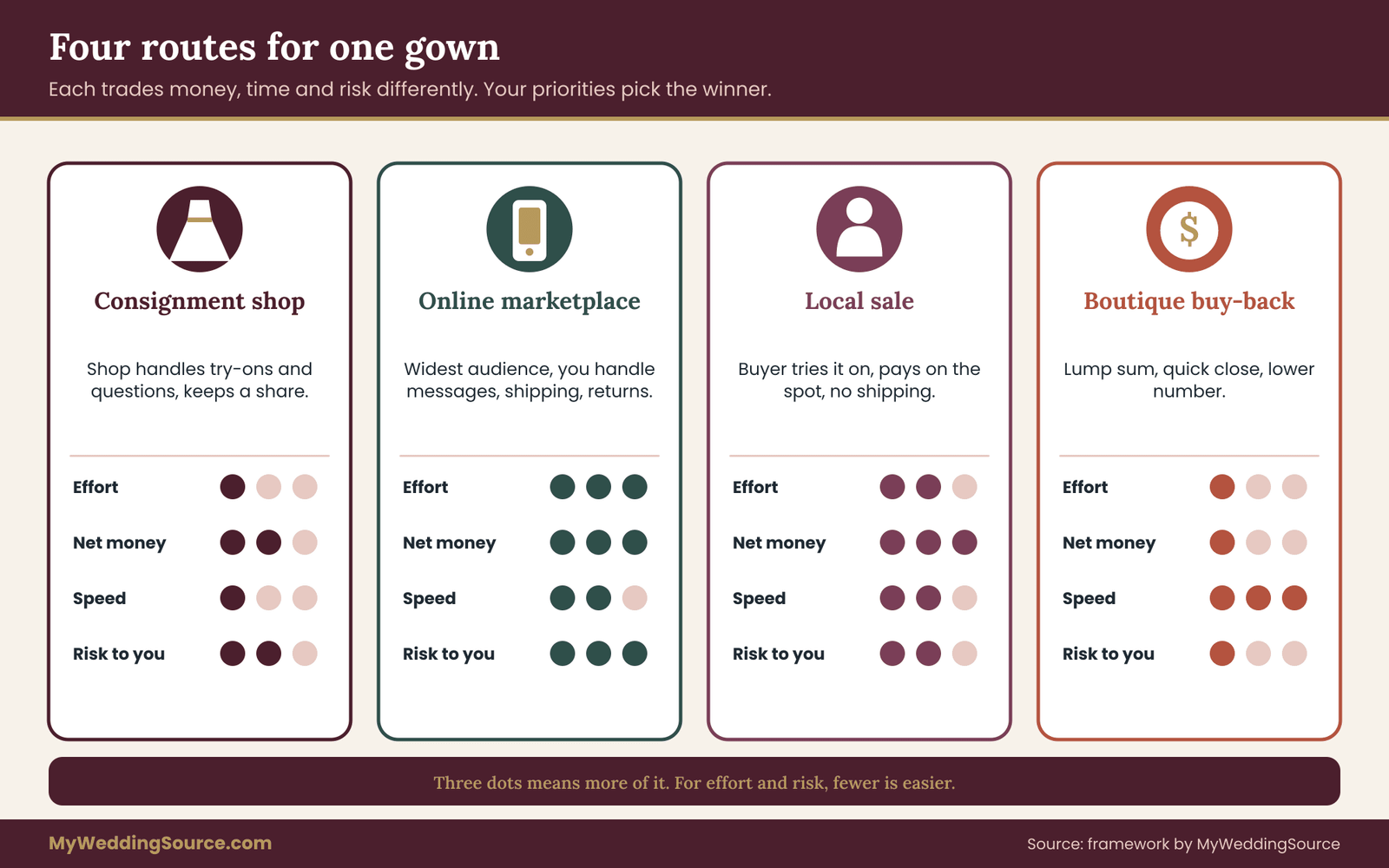
There are four common routes for a wedding gown. Each trades control, effort, fees and risk differently, and none is best for every dress.
Consignment with a bridal shop
A consignment shop displays or lists the gown and takes a share of the sale price. The seller often hands the dress over, signs an agreement, and waits. A good shop handles photography, answers buyer questions, and manages try-ons, which can raise the chance of a sale for a gown that benefits from being seen in person.
The trade-offs are the share the shop keeps, the time the dress may sit, and the terms of the agreement. Before you sign, ask what condition standard the shop requires, whether you must clean first, how long the dress stays on consignment, what happens to unsold gowns, who is responsible if the dress is damaged in the shop, and how and when you are paid. Read the agreement the way you would read any wedding vendor contract, paying attention to liability, storage and fees.
A consignment shop may write its own wedding dress listing from your dress, so ask to read it, check it against your inventory and correct any claim that does not match. Consignment tends to suit dresses from recognizable designers in good condition, in a city with a bridal market. It suits sellers who want little work and accept a lower net.
An online resale marketplace
A marketplace gives you the widest audience and the most control over presentation. You write the wedding dress listing, set the price, answer questions and ship the dress. Fees and rules vary by platform, and the platform’s terms govern payment, disputes and buyer protection.
The trade-offs are time and exposure to buyer questions, scams and returns. Marketplaces suit dresses that are easy to size from measurements, such as simple silhouettes, and sellers who are comfortable with messaging and shipping. They also suit unusual dresses, because a rare style can find the one buyer who wants it.
Read the platform’s current seller policies, including what it says about returns, shipping and how it handles disputes. Terms differ, and a policy that protects the buyer may not protect you.
A local sale
A local sale means a person comes to your home or meets you, tries the dress on and pays on the spot. There is no shipping, no platform fee and no returns process, and a buyer can see the dress in person. The pool of buyers is smaller, and safety matters.
If you sell locally, meet in a public place or have another adult at home, do not give out your full address in advance, and do not let someone leave with the dress before payment clears. For a large payment, a cashier’s check or an electronic payment that you can verify is safer than a personal check, and a cashier’s check can still be fake, so confirm with the issuing bank using a phone number you look up yourself.
A local wedding dress listing can be shorter, but the photo inventory still applies, because a buyer who drives to see the dress will notice anything the photos hid. Local sale suits simple, easily fitted dresses and sellers who want the highest net with the least paperwork. It works best when you are in or near a city with enough engaged couples.
A bridal boutique or buy-back
Some bridal shops or dress buyers purchase gowns outright, paying a lump sum, often lower than a sale price, in exchange for certainty and speed. This is less common for a single used gown, so ask whether any shop near you does it. The trade-off is plain: you accept a lower number in return for a closed sale, no time cost and no risk of disputes.
This route suits sellers who value speed, have a gown that is hard to list, or simply want the process over. Compare the offer to the net-proceeds worksheet for your other options, not to the asking price.
A single wedding dress listing can serve more than one channel if you write it once, carefully, and adapt only the logistics. The photo set, measurements and condition notes stay the same. The shipping, returns and payment lines change from one channel to another, so check each against that channel’s current rules before you copy the text over.
Putting the channels side by side
Rather than ranking the channels, rank your priorities. If you want the highest possible net and are willing to work, the marketplace and local sale usually lead. If you want little work and a professional handling of try-ons, consignment suits you. If you want certainty and speed, a buy-back is the cleanest. The worksheet gives each priority a number, and your own tolerance for time and risk gives the rest.
You can also combine channels over time. A common approach is to list locally for a few weeks, then move to a marketplace, then consider consignment or a buy-back if nothing sells. Write the dates on a calendar so that you do not let the dress sit unsold without a decision. A wedding dress listing that has sat for months may need a new photo set, a clearer price or a different channel, and it is worth checking whether the wedding dress listing still matches the dress as it is today.
Buyer questions, returns and scam checks after the wedding dress listing goes live
Once the wedding dress listing is public, the work changes from preparation to conversation. Most buyers are honest, and most messages are sensible questions. A few are not, and a seller who knows the patterns can handle both calmly. This section covers what buyers ask, how to answer, what to decide about returns, and which warning signs to take seriously.
The questions buyers ask, and how to answer them
Buyers tend to ask the same dozen things. If you answer them in the wedding dress listing, you will get fewer messages, but you should also prepare short, factual replies for the rest.
“Can you send more photos?” Yes, if the photo inventory covers it. Send the matching numbered shot, not a new photograph taken under different light. If the buyer asks for a specific area you did not photograph, take it and add it to the inventory.
“What is the exact color?” Describe it with a plain word, mention the reference shot with white paper, and say that screens differ. Offer a small fabric swatch only if you have a hidden seam allowance you can spare, and never cut the dress to provide one.
“Can you measure again?” Offer to remeasure a specific point, and send a photo of the tape in place. Buyers who ask this are usually trying to decide between two sizes.
“Has it been cleaned?” Answer with the date and the type of service from your records, or say it has not been cleaned since the wedding. Do not soften the answer.
“Why are you selling?” A brief, true answer is enough. Details about your life are not needed.
“Would you take less?” Check your private floor price and your net proceeds. If an offer is below the number you wrote down, you can decline or make a counter-offer. An offer you cannot afford to accept is not a reason to feel pressure.
“Can you ship to another country?” International shipping adds customs, taxes and a higher chance of loss, and the cost can change the whole worksheet. Decide in advance whether you will do it, and say so in the wedding dress listing.
“Can I pay outside the platform?” This one deserves caution, covered below.
If the same question comes up three times, the wedding dress listing has a gap. Add the answer to the text, and keep a short note of what you changed. Repeated questions about the hem usually mean the hem photo is unclear, and repeated questions about size usually mean the measurements are missing a point.
Reading a buyer’s questions as signals
Questions tell you something about the buyer. A buyer who asks about seam allowances, bust measurements and the weight of the skirt is probably serious and is already measuring a body. A buyer who asks whether the dress “is still available” and nothing else may be browsing. Neither is a problem. A buyer who asks for your phone number, your full address or a payment method you did not offer, before any discussion of the dress, is showing a different pattern.
Keep communication on the platform’s messaging system until you have a reason to move off it. That system creates a record and, depending on the platform, supports buyer and seller protection. Moving to text or email early removes both.
Returns: decide before the first message
Returns are the biggest source of stress in a dress sale, because a gown that has been tried on, shipped twice and returned is harder to sell the second time. You can decide how to handle them before anyone asks, and write the decision into the wedding dress listing.
There are three common positions. The first is no returns, with clear and complete condition notes and measurements, and a statement that the dress is sold as described. The second is returns only if the dress arrives materially different from the wedding dress listing, with the buyer paying return shipping unless the error was yours. The third is a general return window, which attracts buyers who are unsure of fit but exposes you to the most risk.
Whichever you choose, check the platform’s rules, since some marketplaces require returns for items that are not as described, whatever the wedding dress listing says. The Federal Trade Commission’s consumer pages describe how to handle shipping, returns and online purchases from the buyer’s side, and the same principles help a seller understand what a buyer expects. Never claim a policy you cannot honor, and do not write “all sales final” if the platform will override it.
If the dress is returned, inspect it against your photo inventory on the day it arrives, before you accept the return or issue a refund where the platform allows you that choice. Photograph the box, the packing and the dress. If something new is wrong with the gown, such as a stain, a missing bead or an odor, document it with matching shot numbers. That is when the inventory pays for itself.
A well-written wedding dress listing also works as a filter. A buyer who has read the measurements, the condition notes and the returns line asks specific questions. A scammer usually sends the same generic message to every wedding dress listing, without a word about the dress itself.
Common scam patterns and how to respond
Most buyers are honest, but a handful of scam types repeatedly target people selling high-value items. The Federal Trade Commission describes several of these, and the U.S. Postal Inspection Service publishes information on mail-related fraud. A short list follows.
The overpayment. A buyer sends a check or payment for more than the price and asks you to send back the difference, or to forward money to a shipper.
The original payment later proves to be fake or reversed, and you are out the money you sent. The FTC warns about fake check scams in detail. The rule is simple: never send money back to a buyer, and never give a buyer a refund for an overpayment until the funds have fully cleared with your bank, which can take longer than the bank first suggests. Ask your bank how it handles this.
The off-platform payment. A buyer says the platform fees are too high and asks you to take a payment app, gift cards or a wire. Once you do, you lose the platform’s seller and buyer protection. If you do accept a payment outside the platform, use a method you understand and that you can verify.
The shipping agent. A buyer says they will send their own shipper or “pickup agent.” Do not hand a dress to anyone you have not verified, and do not release it before payment is confirmed.
The fake payment confirmation. You receive an email that looks like it came from the platform or payment app, saying that payment has been sent and that you must ship at once. Do not use links in the email. Log in to your account directly and check the payment there.
The sudden urgency. A buyer says they must have the dress this week and pressures you to skip steps. Slow down. Real buyers can wait for a payment to clear.
If you suspect fraud, stop communicating, keep the messages, report the buyer to the platform, and consider reporting to the FTC. The site’s guide on checking a vendor before you pay a deposit lays out similar habits of verifying who you are dealing with, and they apply in reverse here.
Shipping terms belong in the wedding dress listing too, so no buyer has to ask who pays for postage or insurance.
Shipping a gown without damaging it
If you sell by mail, plan the packing as carefully as the photographs. A gown can be folded into a large box with acid-free tissue between the layers, padding at the beaded areas, and a protective bag. Roll or fold along soft curves, not sharp creases, and avoid tight packing that presses beads into fabric. If the dress has a stiff or structured skirt, use a larger box or consult the carrier.
Ask the carrier about declared value and insurance. The cost depends on the declared amount, and the claim process requires proof of packing and condition, which is another use for your photographs. Choose tracking and a delivery confirmation that requires a signature for a valuable item, and keep the receipt. The carrier’s official pages describe current options, so check them for the current service names, limits and prices instead of relying on this article.
Photograph the dress packed, the box sealed and the label. If you ship internationally, check customs and import rules with the carrier. Mark the package fragile, but do not rely on that alone.
Send the tracking number to the buyer, and keep the shipping receipt until the buyer confirms the dress arrived and the return window has passed.
A worked example: selling one gown, three ways
The following example is invented to show how the worksheet works. The names, prices, fees and quotes are illustrative, and your numbers will differ. The point is the method, not the amounts.
The dress. Imani wore an ivory lace A-line gown with a chapel train at her wedding. After the wedding, the hem is gray along the train, there is a faint mark inside the left cup, and two small snags appear in the skirt tulle. The zipper works, and the bustle is intact. She bought the dress new, and she wants to sell it.
The inventory. Imani follows the twelve-shot structure. She finds the gray hem (shots 8 and 9), the faint mark in the cup (shot 6 and flaw 12a), and two snags (flaws 12b and 12c). Measurements: bust, waist, hips and length are written down, with the heel height used for the hem. The care label says dry clean only, and the fabric is polyester lace over a satin-type lining.
The cleaning question. A bridal cleaner quotes a fixed price to clean the dress, including the hem and the cup mark, and says the gray hem will probably come out, though the cup mark is less certain. Imani looks at comparable wedding dress listings and sees that gowns described as cleaned with no marks list for more than gowns with disclosed light marks, but the gap is not large. She enters her numbers.
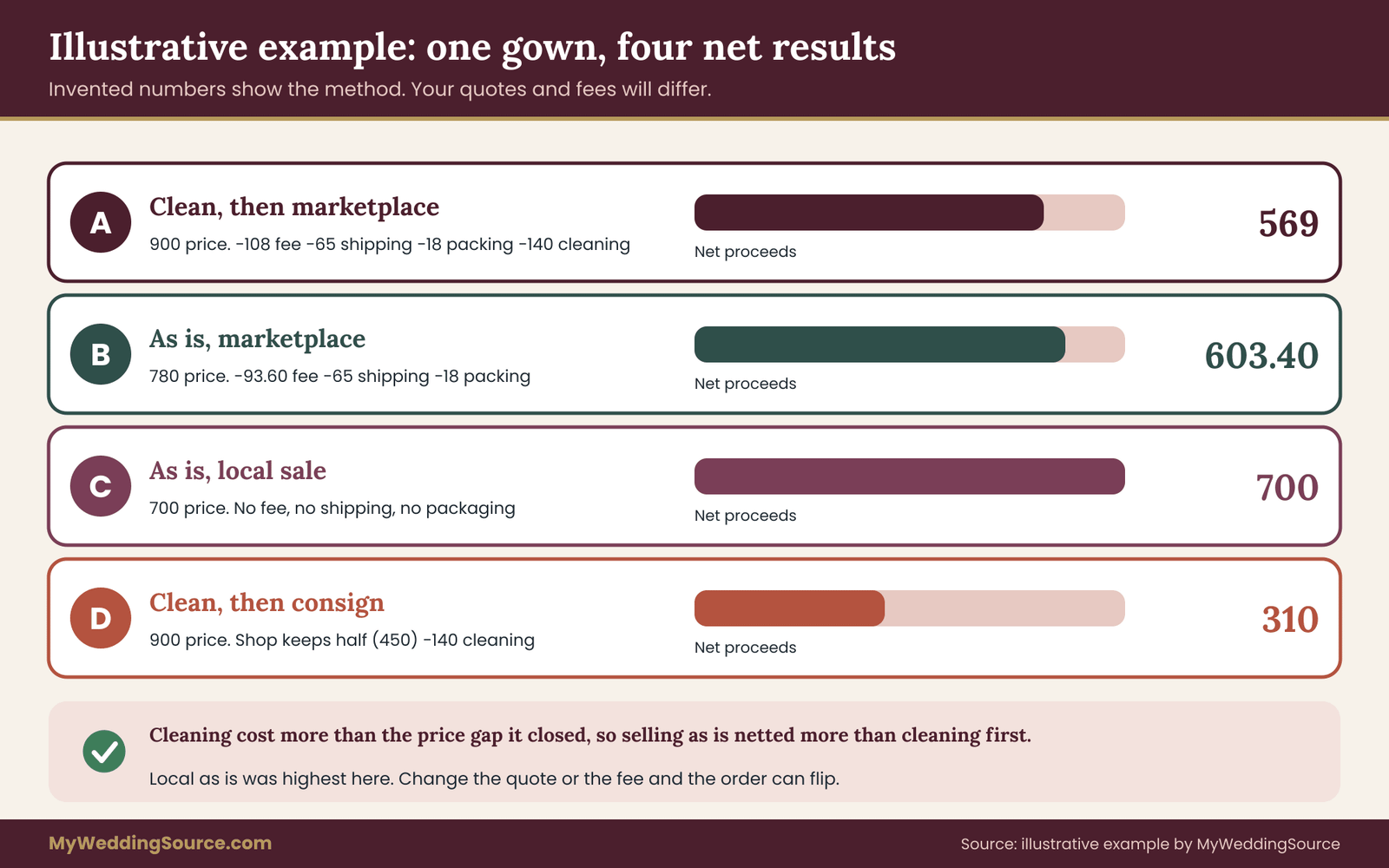
Scenario A: clean, then list on a marketplace. She expects to sell for 900. Assume a marketplace fee of 12 percent, which is 108. Shipping and insurance is 65, and packaging is 18. The cleaning quote is 140. Net proceeds: 900 minus 108, minus 65, minus 18, minus 140 equals 569.
Scenario B: list as is on a marketplace. With disclosed marks and a clear note that the dress has not been cleaned, she expects to sell for 780. The fee at 12 percent is 93.60. Shipping and insurance is 65, and packaging is 18. There is no cleaning cost. Net proceeds: 780 minus 93.60, minus 65, minus 18 equals 603.40.
Scenario C: sell locally as is. A local buyer can try the dress on, sees the hem in person and pays 700. There is no fee, no shipping and no packaging. Net proceeds: 700.
Scenario D: consignment after cleaning. A shop lists the dress at 900 after Imani pays the 140 to clean it, and keeps half the sale price. She receives 450, minus 140, which is 310.
What the worksheet shows. Listing as is on a marketplace nets more than cleaning first, because the cleaning cost is larger than the price gap. Selling locally nets the most and takes the least work. Consignment nets the least here, though it may still make sense if she values the shop’s try-ons and wants no shipping.
These results do not generalize to every dress, but they show why the worksheet is worth the hour. In another case, a stain that guarantees a lower price might make cleaning clearly worth it. The worksheet lets the numbers decide instead of the pressure to make the dress look perfect.
What the wedding dress listing says. Imani’s text states the cleaning status, the three flaws with photo numbers, the heel height and the included items. What she decides. Imani lists locally for three weeks, with the complete photo inventory and a firm floor price of 650. She sets a calendar reminder to move to a marketplace as is if nothing sells, and she does not clean the dress unless a buyer asks. She keeps the receipt, the inventory and the worksheet in one folder, with the date she read each fee page.
Edge cases and mistakes that change the wedding dress listing
The steps above fit a typical gown. Many gowns are not typical, and a few situations call for a different approach. Below are the cases that come up most often, followed by the mistakes that cost sellers the most money or goodwill.
A dress that was altered heavily
A gown that was taken in, shortened, re-bustled or fitted with new cups is made for one body. A buyer with different measurements may find the alterations impossible to undo. In your wedding dress listing, state exactly what was changed, whether any seam allowance remains, and whether an alterations professional could reverse it. Provide measurements after alteration, not the original label size. If you still have the alteration invoice, it is useful proof of what was done. The site’s guide to fit and alterations explains what a seamstress can usually change and what limits apply.
Heavily altered gowns often sell for less and sell to a narrower group, which is a reason to be accurate and patient. A buyer of similar height and build may be delighted to find a gown already hemmed to the right length.
A wedding dress listing for an altered gown works best when it reads like a fitting note: what was done, where, and what is left.
A custom or made-to-measure gown
A dress made for you has no standard size, so the label is almost meaningless. Provide measurements in detail, along with the heel height, the fabric and any design details that a general buyer will not understand. Say that the gown was custom made, by whom if it helps, and whether the maker’s patterns could be used again. Custom gowns can have strong appeal for the right buyer, and weak appeal for the wrong one, so set the asking price with that in mind and let the wedding dress listing run longer.
A vintage or heirloom gown
Older gowns are fragile and often cannot be cleaned by standard methods. Do not clean one before consulting a textile conservator or a specialist who handles antique garments. Documentation matters more, including who owned it and when, if known. Avoid claims about age, designer or authenticity that you cannot support. Say what you know and what you do not, and describe any repairs or replaced parts. If the gown has family or historical value, consider donating it to a museum or historical society, or keeping it, before selling.
A sample or showroom gown
If you bought a sample dress from a salon, it may have had many try-ons before you, and it may be labeled or tagged as a sample. A buyer will want to know that. Describe wear honestly. Keep in mind that some salons restrict resale of samples or require a note on the receipt, so check your sale terms.
A dress with a veil, slip and other pieces
Sell pieces separately only if the buyer is likely to want them separately. A veil can be a quick sale on its own, while a built-in petticoat cannot be removed from a dress. Accessories such as shoes, jewelry and headpieces are different items with their own condition issues. The site’s planning guide on wedding day accessories covers compatibility and backups, which can help you describe which pieces were worn together. Photograph each piece, number it in the inventory and list it with its own measurements and notes.
A veil or sash can be photographed against a neutral cloth and given its own short wedding dress listing section, so a buyer who wants only that piece can find it.
A dress with a family connection
If the dress has been worn by relatives, was a gift or was paid for by someone else, check whether anyone expects a say in the sale or a share of the money. A short conversation before you list avoids hurt feelings and, in some cases, awkward disputes about who owns the dress. Treat that as a family question, not a legal one, and consult a professional if it becomes complicated.
A sale that does not move
If a gown has not sold after a reasonable period, review it in order. Check the photos for color and clarity. Check the measurements and the description against the dress. Check the price against comparable wedding dress listings, and look at what actually sold, not just what is listed. Check the channel, since some gowns sell better locally and others online. Then adjust one thing at a time, and write the date and the change. Changing everything at once teaches you nothing.
If it still does not sell, reconsider the whole decision. Consignment, a buy-back or a donation may be more practical than another month of messages. Donating a gown to a charity that accepts wedding dresses may produce a tax receipt in some cases, and the IRS explains the rules for noncash donations, so ask a tax professional about your situation.
When a wedding dress listing is renewed, treat the renewal as a small project. Retake the front and back photos in the current light, check that the price still reflects the worksheet, and read the condition notes again for anything that changed in storage. A fresh date on an unchanged wedding dress listing helps less than a fresh look at what the buyer sees.
The dress you decide to keep
Some people go through the whole process and then keep the dress. That is a valid result. The inventory and photographs are still useful, and the same cleaning questions apply to long-term storage. In that case, the rungs of the ladder change, and a preservation box becomes a reasonable choice instead of a barrier to sale.
The mistakes that cost the most
Cleaning before photographing. It removes the evidence of condition, and it can remove the reason a buyer would trust you. Photograph first, always.
Spending more on cleaning than the price gap. A large bill for restoration feels like effort, but the sale price may not move. Use the price-gap test and get a written quote.
Listing with vague condition words. “Like new” and “perfect” invite disputes. Use measurements, numbered photos and plain statements.
Skipping the worksheet. Without net proceeds, a high asking price on a high-fee channel can look better than a modest local sale that actually puts more money in your hands.
Under-insuring the shipment. A gown shipped without insurance or tracking is a gamble. The carrier’s rules govern claims, and a claim usually requires proof of value and condition.
Moving off the platform too early. It removes protection and creates a record you cannot use if something goes wrong.
Accepting an overpayment. Never send money back to a buyer before the original funds have cleared completely.
Forgetting to update the wedding dress listing. If the dress is sold, unavailable or changed, take the wedding dress listing down or revise it. An outdated wedding dress listing wastes buyers’ time and invites messages you cannot answer.
Copying someone else’s wording. A borrowed description may promise features, fabrics or condition your dress does not have. Every line of your wedding dress listing should come from your own dress and your own inventory.
Losing the paperwork. Keep the receipt, the inventory, the worksheet, the cleaner’s receipt and the shipping receipt together, and file them with your other wedding records. If a question arises months later, you will want them.
Your next steps
Start with the dress, not the website. This week, take the dress out of its bag, photograph it as it is, and work through the twelve-shot inventory with a one-line note for each finding. Gather the receipt, the care label and the alteration invoice into one folder.
Keep the wedding dress listing as a living document until the dress is sold. Next, request a written quote from a bridal cleaner, and read the fee pages for two channels you might use. Fill in the net-proceeds worksheet with those real numbers and a conservative price.
Then decide which rung of the cleaning ladder you are on, write your floor price down, and build the wedding dress listing from your inventory. If you are working out the larger numbers of the wedding, the wedding budget page explains how to track what you spent and what you recover. When the sale is complete, file the paperwork and take a few minutes to note what you would do differently.
FAQ
Should I clean my wedding dress before selling it?
Not automatically. Clean when stains, odor or a gray hem would put buyers off and the cleaning quote is small next to the price difference it creates. Otherwise, photograph and disclose the marks and list as is. Photograph the dress before it is cleaned, and get a written quote first so you can compare the cost with the likely gain.
How soon after the wedding should I start selling?
Start the inventory right away, but publish the wedding dress listing only when the dress is photographed in its final state. You can start the assessment as soon as the dress is home, and photograph it within the first week. Selling can wait until the dress is cleaned or you have decided not to clean. Stains can darken the longer a worn gown sits, so decide on cleaning within a few weeks, and avoid leaving the dress in a sealed plastic bag for months.
What photos should a wedding dress listing include?
Include full front, back and side views, close-ups of the bodice and closure, the interior bodice, the waist seam, the hem, the train and bustle, the labels, any visible alterations, and every flaw with a scale reference. Use daylight, a plain background and no heavy filters. Number the photos so condition notes can refer to them.
What should I say about condition?
A wedding dress listing should state facts you can check: when the dress was worn, whether it has been cleaned and by whom, what was altered, and each flaw with its location and size. Avoid vague words such as “like new” or “perfect.” Match every condition note to a numbered photo, and say what is included with the dress and what is not.
How do I work out what I will really make?
Use a net-proceeds worksheet. Start with the expected sale price, then subtract the channel fee, payment processing, shipping and insurance, packaging, cleaning or repair, and an allowance for returns. Read each fee page on the day you do the sums, since terms change. Compare channels by the result, and note the time each one will take.
Is selling a used wedding dress taxable?
It depends on your situation. As general background, the Internal Revenue Service explains that personal-use property sold at a loss generally does not create a deductible loss, and that a gain may be taxable. Payment platforms may also report payments. Keep your original receipt and your sale record, and ask a qualified tax professional about your own case.
How do I avoid scams when selling a wedding dress?
Keep communication and payment on the platform, never send money back to a buyer, and wait until payment has fully cleared before shipping or handing over the dress. Be cautious with overpayments, requests to use a pickup agent, and emails about payments that push you to act quickly. Log in to your account directly to check any payment.
Should I sell locally, online or through a shop?
Compare the net-proceeds worksheet for each, and adapt the wedding dress listing to the channel. A local sale usually has no fees or shipping and lets the buyer try the dress on. A marketplace reaches more buyers but adds fees, shipping and message work. A consignment shop handles more of the work and keeps a share. A buy-back is quick and pays less. Choose by priorities: money, time or certainty.
Sources
- Consumer advice, Federal Trade Commission
- How to recognize and avoid fake check scams, Federal Trade Commission
- Clothes captioned: complying with the Care Labeling Rule, Federal Trade Commission
- Topic no. 409, capital gains and losses, Internal Revenue Service
- Understanding your Form 1099-K, Internal Revenue Service
- Conserve O Gram series on caring for museum collections, National Park Service
- Museum Conservation Institute, Smithsonian Institution
- Shipping, insurance and extra services, United States Postal Service
- Mail fraud and scams, United States Postal Inspection Service
- Disputing credit card charges, Consumer Financial Protection Bureau