

The bachelorette party ideas that actually get used are the ones matched to the honoree’s energy, the group’s real budget, and the calendar, so settle those three first and the activity list nearly writes itself.
Search for bachelorette party ideas and you will find lists of 50 or 70 options, which is helpful right up until you are the person responsible for choosing one that eight to twelve people can afford, attend, and enjoy. The real planning problem is rarely a shortage of ideas. It is that the honoree wants a low-key weekend, one friend can only travel for a single night, another is saving for the wedding trip, and nobody wants to be the person who asks what everything costs. This guide is built for that situation, whether you are the honoree, the friend who volunteered, or a mixed group of friends and family planning a celebration together.
It is also written for any kind of honoree and any kind of friend group. People of every gender and relationship type celebrate before a wedding, many couples hold a joint event, and plenty of honorees want something quieter than the stereotype. We keep everything family-friendly, treat alcohol as optional, and put accessibility and cost on the table from the first message instead of the last. If you are planning for a groom or a groomsmen-style group, our sibling guide to bachelor party ideas covers that side with its own cost trade-offs; here we focus on the full planning toolkit that works for any pre-wedding celebration.
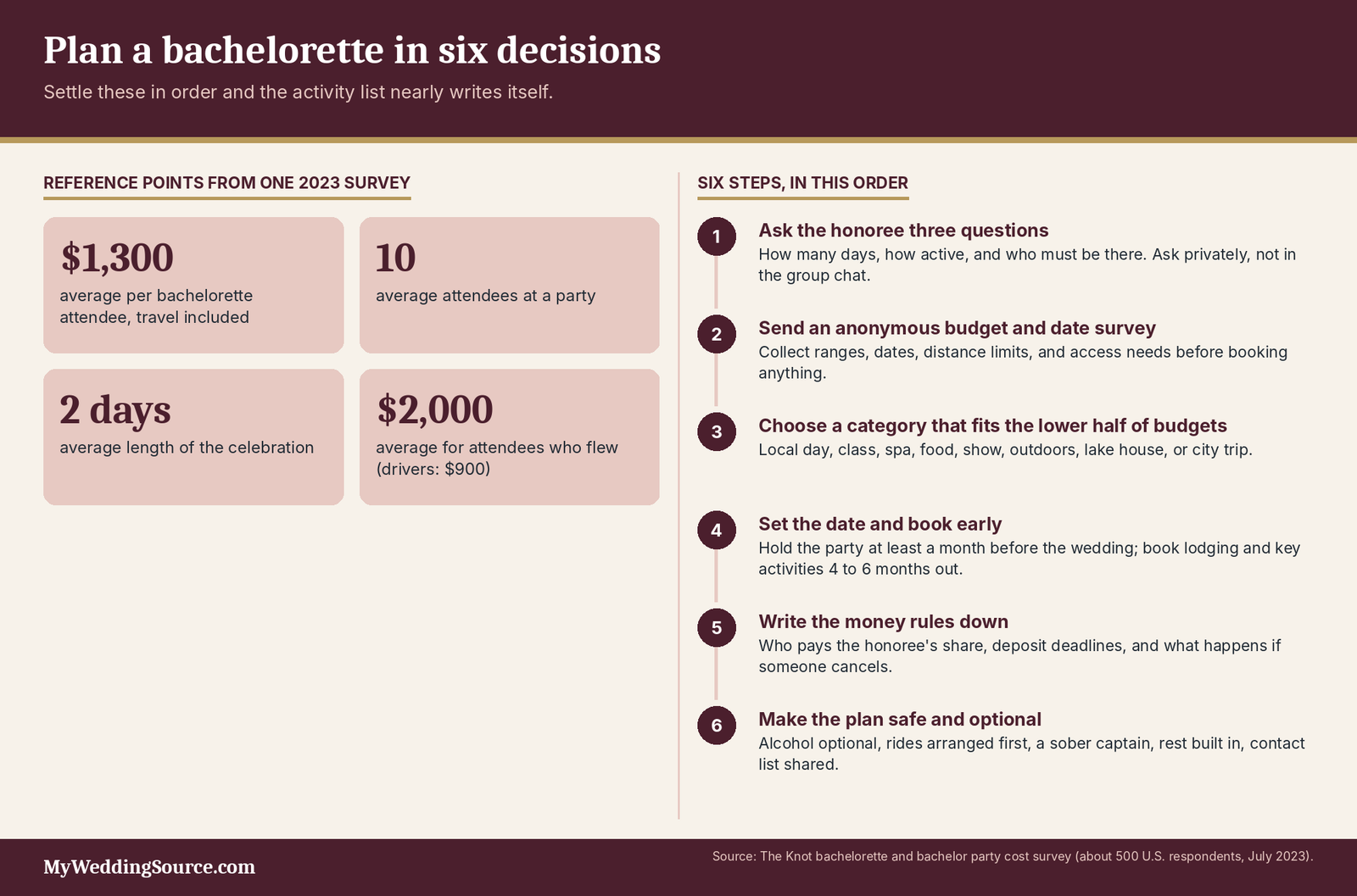
The numbers come from published surveys and official sources, and each one is labeled with its year and sample. The Knot’s 2023 survey of roughly 500 couples, for example, found that bachelorette attendees spent an average of $1,300 per person including travel, with a typical party of about 10 people lasting two days. That is a snapshot of what other groups spent, not a target, and a good plan can land far below it. Where we give ranges for individual activities, they are editorial planning estimates and are labeled that way, because local prices vary too much for any national figure to stand in for a quote.
Start with the honoree: what kind of celebration fits?
Ask the questions that shape everything else
How long, how active, and who is in the room
Three short questions settle more than any theme board: how many days does the honoree want, how active should it be, and who absolutely needs to be there. Length decides whether this is a dinner, a day, a weekend, or a trip with flights, and length is also the biggest driver of cost. Activity level separates a spa-and-reading weekend from a hiking-and-paddleboard weekend, and mixing the two without a plan is how half the group ends up bored and the other half exhausted. The guest question matters most of all, because a celebration with the people the honoree loves, even if that is only four of them, will feel better than a bigger event with obligation invites.
Ask these questions in a private message rather than the group chat, and listen for the honoree’s tone as much as the answers. “I just want to be with everyone, and I don’t care where” usually means keep it simple and affordable. “I have always wanted to go to the coast” means there is a real preference you should try to honor within budget. Write the answers down in a short note you can paste into the invitation, since the whole group will plan better when they can see what the honoree asked for.
What to do when the honoree says “surprise me”
Some honorees prefer to be surprised, and that can work as long as the surprise covers the activities and not the basics. The basics are the dates, rough budget, travel distance, and anything the honoree would never want, such as a long drive, a crowded club, a day on a boat, or a particular food. Ask for a “no list” and a “yes list” before you plan, and let the honoree name one person they trust as a check on the plan. That person can quietly veto anything that would turn a pleasant surprise into a stressful one.
A practical middle path is a “mystery itinerary,” where the honoree knows the dates, the packing list, and the vibe but not the specific stops. They can plan clothing, mobility needs, and dietary requirements ahead of time, and the group still gets the fun of a reveal. If the honoree has a disability, a medical need, or dietary restrictions, treat those as part of the basics rather than as spoilers. A surprise that works for the honoree’s body and budget is a better gift than one that looks impressive in photos.
Any honoree, any group, one workable plan
Joint, mixed-group, and friend-and-family celebrations
Pre-wedding celebrations no longer follow one template. Couples hold joint events with both partners’ friends, some honorees combine friends and relatives, and groups include people of every gender and age. Planning a mixed group is easier when you pick activities that do not depend on a single shared assumption, such as everyone drinking, everyone being comfortable at a late-night venue, or everyone wanting to dress up. A class, a food tour, a hike with a picnic, a game night, and a dinner with live music are all easy for a mixed crowd to enjoy at their own pace.
For joint events, decide early whose friends are invited and how costs are shared across the two groups. A simple rule is that each partner invites their own circle, the organizers share a single itinerary, and the cost per person is the same for everyone. If you are also weighing who stands up at the wedding, our guide to bridal party size explains how the number of attendants affects cost and logistics, which ties directly into who is on this list.
Solo and small-scale celebrations
A solo celebration is a legitimate option, not a consolation prize. The Knot describes a solo bachelorette as a pre-wedding celebration focused on personal time, with ideas such as a wellness retreat, a national park trip, a luxury staycation, a cooking class, or a city escape, and notes it suits people planning a wedding without a wedding party or anyone who wants to avoid coordinating group schedules. In that article, the honoree usually pays because it is a personal choice, though loved ones may add a treat such as a spa day or dinner. For friends, that opens a low-pressure way to contribute: offer to cover one meal, one activity, or a night’s stay instead of organizing a group trip.
Bachelorette party ideas by category, plus what the trends really say
Trips and getaways
City weekends
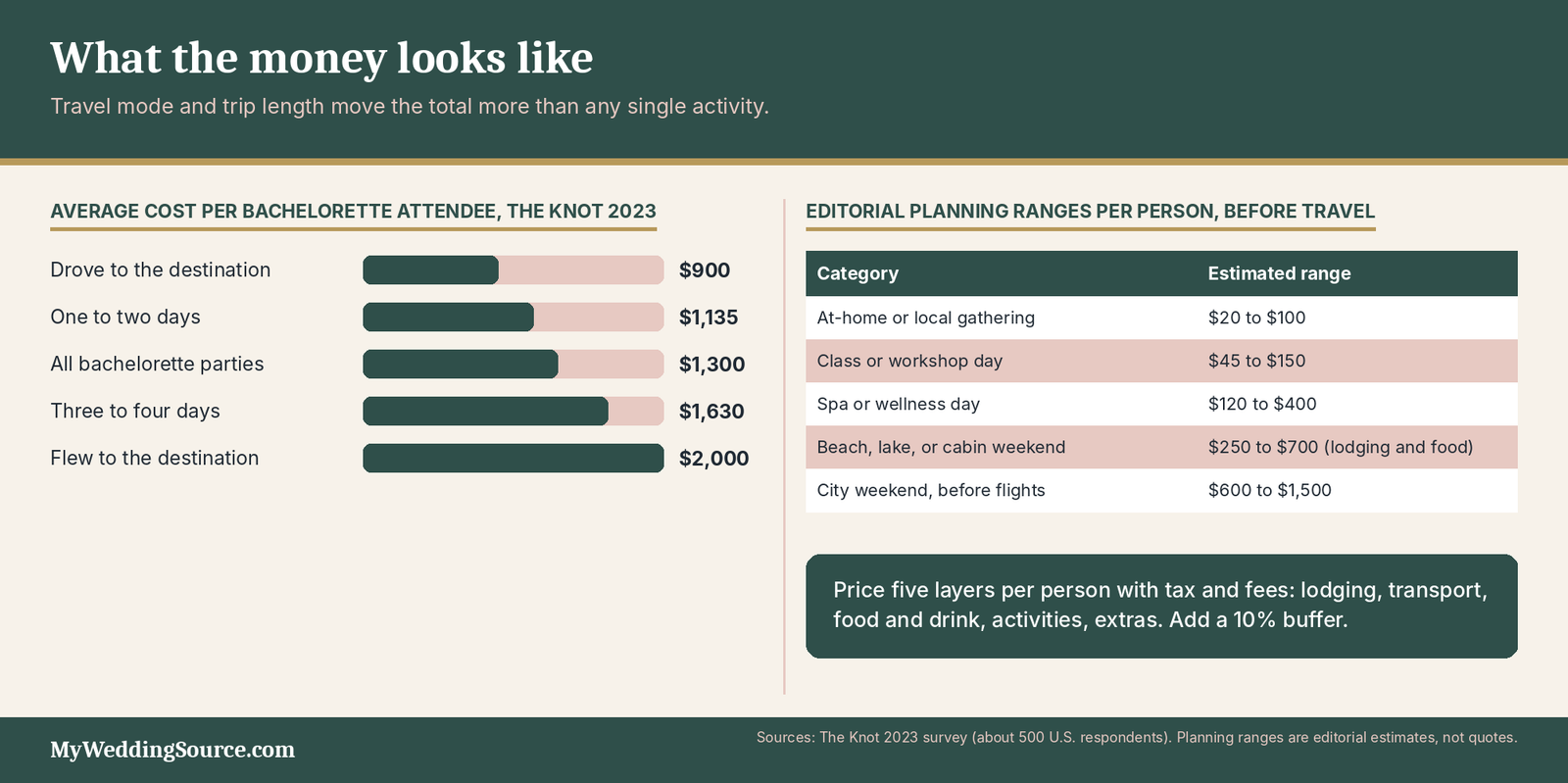
A city weekend works when the group wants variety without a lot of planning, since restaurants, museums, music, and neighborhoods are already there. Choose a city that most of the group can reach by car or a short flight, because travel is the cost that grows fastest. The Knot’s 2023 survey found bachelorette attendees who drove spent about $900 on average and those who flew about $2,000, a gap of more than a thousand dollars that dwarfs any difference between brunch spots. Book one anchor activity, such as a food tour, a show, or a class, then leave the rest of the day open for wandering.
Beach and lake house weekends
Renting a house at a beach or lake keeps the group together, lowers the per-night price compared with several hotel rooms, and gives people a place to rest, cook, and play games. It also lets you control food and drink costs by shopping together and cooking one or two meals. The tradeoffs are cleaning fees, minimum-night rules, bedroom and bathroom counts that may not suit everyone, and cancellation terms that are often strict. Read the listing’s cancellation policy before you collect money, and plan the water safety rules in the safety section below.
Active, restorative, and outdoor ideas
Nature and adventure
Hiking, paddling, camping, a ropes course, or a day on a ski hill can be good value, because many outdoor destinations charge by the vehicle or by the day instead of by the person. The National Park Service sells an America the Beautiful annual pass for $80 to U.S. citizens and residents, and an Access Pass is free for U.S. citizens and residents with a permanent disability, which can cover entrance fees for a car full of friends at federal sites that charge them. Match the trail difficulty to the least experienced hiker, not the most, and pick a route with a shorter loop option so people can turn back without anyone feeling left behind.
Wellness and spa days
A wellness day is one of the easiest ways to build an alcohol-free, low-pressure celebration. Options include a group spa package, a yoga or sound-bath class, a hot springs soak, a guided meditation, a massage swap, or a calm cabin weekend with good food and walks. Spa pricing varies widely and often includes service charges and gratuity, so ask for the per-person total with tips and taxes before you share the number with the group. Some spas have minimum group sizes, deposit requirements, or limits on private room bookings.
Food, creative, and culture
Food, wine, and brewery experiences
Food-centered celebrations are among the most flexible. A tasting menu, a chef’s table, a market tour, a dumpling-making class, a pizza night, a brunch crawl, or a picnic by a vineyard can all be adjusted for budget. Wineries, breweries, and distilleries often offer tastings with limited group sizes, so reserve early and ask if a non-alcoholic tasting, such as juice, tea, or coffee pairings, is available. Tours that include transportation carry a higher price but remove the driving question, which matters for safety.
For big dinners, check the restaurant’s large-party policy. The Knot’s planning guidance notes that large groups may need a deposit and may face an automatic gratuity, which it cites as 20 percent at some restaurants, and that check-splitting limits vary. A prix fixe menu keeps the cost predictable, and family-style shared plates spare guests from choosing among price points.
Classes and creative workshops
Hands-on classes give a group something to do together that is not just sitting at a table. Pottery painting, flower arranging, candle making, a pasta class, glassblowing, printmaking, a dance lesson, and a cocktail-or-mocktail workshop all appear on The Knot’s list of 56 ideas, and the product the group takes home doubles as a keepsake. Classes are often priced per person with materials included, which makes the cost easy to explain in an invitation.
Concerts, sports, and live events
A concert, a baseball game, a roller derby bout, a comedy show, or a local theater production gives the group a shared experience without a lot of planning. Tickets can be the biggest line item, and prices change as the date approaches, so decide early whether you will buy them as a group or ask each person to buy their own. The Federal Trade Commission’s rule on unfair or deceptive fees, codified at 16 CFR Part 464, covers live-event tickets and short-term lodging and requires the total price to be disclosed clearly, with mandatory fees included, wherever a price is advertised. That helps you compare, though it does not change refund policies, so read those separately.
Themed, local, and giving-back ideas
Themed and cultural celebrations
A theme can give a celebration shape without raising the cost much. The Knot’s theme guide groups 72 ideas into categories such as destination, food and drink, music, and TV and movies, including options like a high tea, a honey-tasting theme, a camp weekend, and an Amalfi-style dinner. Pick a theme that gives people an easy way to participate, such as a color, a playlist, or a dish, and avoid themes that require expensive outfits or that make fun of a group of people.
Cultural celebrations can also reflect the honoree’s own heritage and family customs, such as a henna evening, a tea ceremony, a traditional meal, or a music night. If you are not part of the culture, ask the honoree and their relatives how they would like it done and who should lead. Treat the traditions with respect, and keep the tone celebratory instead of costume-like.
At-home and local celebrations
Staying close to home is the most flexible and least expensive category, and it can be among the most memorable. Host a potluck with a recipe swap, a backyard picnic and lawn games, a movie marathon, a craft night, a progressive dinner across friends’ homes, or a hike followed by brunch. These formats let people join for the part they can attend, and they eliminate lodging, flights, and most deposits. The main task is hosting: provide seating, a quiet room, step-free access, and enough food and non-alcoholic drinks that nobody has to ask.
Charity and volunteer celebrations
A volunteer day, a donation drive, or a group fundraiser is a meaningful option for honorees who care about a cause. The Knot’s idea list includes a volunteer day, and many groups pair an hour of service with lunch together. Choose an organization the honoree already supports, contact them directly to ask whether a group can help and what tasks are available, and confirm any age, ability, or training requirements.
If the group raises money, vet the organization first. The IRS Tax Exempt Organization Search lets you confirm whether a group qualifies to receive tax-deductible donations, and a short email to the charity can clarify how gifts made in the honoree’s name will be recognized. For anything involving tax treatment, a tax professional is the right person to ask.
| Category | Works best when | Estimated cost per person | Watch for |
|---|---|---|---|
| At-home or local | Mixed ages, tight budgets, local guests | $20 to $100 | Hosting load, space, step-free access |
| Class or workshop day | Groups who want an activity, not just a meal | $45 to $150 | Deposits, minimum headcount, fixed start time |
| Wellness or spa day | Honoree wants calm, alcohol-free celebration | $120 to $400 | Service charges, tiering, scent and mobility needs |
| Food, wine, or brewery | Foodies, mixed-drinking groups | $50 to $250 | Large-party gratuity, transport, non-alcoholic options |
| Concert, sports, or show | Shared interests, easy conversation | $50 to $300 | Fast-changing ticket prices, seat location, accessibility |
| Nature or adventure | Active groups with a range of experience levels | $30 to $200 plus lodging | Weather backup, guide fees, ability range |
| Beach, lake, or cabin weekend | Groups who want time together | $250 to $700 lodging and food | Cleaning fees, strict cancellation terms, water safety |
| City weekend | Variety, food, nightlife, culture | $600 to $1,500 before flights | Hotel fees, parking, ride costs, dinner deposits |
What the trend reports say, and what to borrow
Pinterest, Zola, and The Knot: signals, not search volume
Pinterest’s 2026 wedding trend report, published April 28, 2026, reports platform search-trend increases of +720% for “unique wedding activities,” +1,140% for “button pictures,” and +940% for “matchbox inspo,” and describes guests returning to offline, tactile, participatory entertainment. The report does not cover bachelorette parties, and the percentages are Pinterest search-trend signals, not Google search volume or counts of parties held. The page also does not state the comparison period, markets, or sample, so treat the numbers as a direction of travel, not a measurement.
Zola’s 2026 First Look report, based on more than 11,500 couples marrying in 2026, notes that mocktail menus are joining the bar program as more couples choose to reflect their personal values, and The Knot’s idea guide describes a shift from one-night outings toward multiday, personalized affairs. These are descriptions of wedding-industry behavior, and none is a bachelorette-specific statistic. Together they suggest an appetite for activities that are hands-on, personal, and not built around a single drink, which fits the categories above.
Borrow the mechanics, not the aesthetic
The useful way to read a trend is to extract the mechanic that works for your group. A hands-on, analog trend translates into a craft class, a scavenger hunt, a card night, a polaroid-and-button keepsake table, or a recipe swap. A personalization trend translates into a playlist the honoree helped build or a dinner at a restaurant tied to their story. A mocktail trend translates into a tasting where everyone can order, whatever is in the glass.
Skip a trend when it adds cost without adding enjoyment, requires matching outfits that not everyone can afford, or depends on a venue that is hard for part of your group to reach. A trend is a prompt, not an obligation. If a trendy idea costs double and only half the group would choose it, choose the one they would.
What a bachelorette party costs per person
What the survey data shows
The Knot’s 2023 figures, and how to read them
The most detailed public figures we found come from The Knot’s bachelorette and bachelor party cost study, a survey fielded in July 2023 with roughly 500 U.S. respondents who attended or planned to attend a party that year. Across all celebrations the average was $1,400 per person, and the bachelorette average was $1,300 per person, up $600 from 2019. The article does not give a category-by-category breakdown, so the totals bundle travel, lodging, food, drinks, activities, and outfits together.
Treat these as a measure of what other groups reported, not as a standard you have to meet. The sample is small, it is now three years old, and it was drawn partly from The Knot’s own membership, which may lean toward couples who spend on weddings. Still, the pattern in the data is useful: trip length and travel mode matter more than any single activity choice.
| Trip type | Average cost per person |
|---|---|
| All bachelorette parties | $1,300 |
| One to two days | $1,135 |
| Three to four days | $1,630 |
| Attendees who drove to the destination | $900 |
| Attendees who flew to the destination | $2,000 |
Why the same plan costs different amounts
The same article reports that 37 percent of attendees across both party types spent more than $1,000, 64 percent spent more than $400, and about one in ten bachelorette attendees spent over $3,000. In major metro areas, the share spending more than $400 rose to 82 percent. The average party had about 10 attendees and lasted two days, with 15 percent of bachelorette parties stretching to four days or more.
Build your own per-person estimate
The five cost layers to price before you announce a plan
A reliable estimate has five layers. Lodging comes first, including cleaning fees, resort or destination fees, and taxes. Transportation covers flights, gas, parking, rideshares, and any shuttle. Food and drink includes groceries, restaurant meals, and any bar tabs or tastings. Activities covers tickets, classes, rentals, and guides. Extras and shared costs includes the honoree’s share if the group covers it, decorations or matching items, and tips.
Price every layer in the same way: per person, for the whole trip, with taxes and fees included. Pricing is complicated, and quoted nightly rates and class prices often leave out items that appear later, which is why the total-price rule mentioned earlier exists for lodging and tickets. Add a 10 percent buffer to the total for small surprises, and refund the unused part at the end if you did not need it.
A worked example with illustrative numbers
Here is an illustrative example, not a quote. Nine friends rent a lake house for three nights at a total of $2,700 after cleaning fee and taxes. The honoree is a guest of honor, so the eight other attendees split the house, which is $337.50 each, while a plan that splits equally among all nine would be $300 each. Add $90 per person for shared groceries, $60 for a pontoon or kayak rental split by the group, and $40 for gas and parking.
With the honoree covered, each attendee pays about $527.50. With a nine-way split, each person pays about $490. The $37.50 difference per attendee is small, but it is the sort of decision that should be made in the open, because it tells the honoree whether they are a guest or a contributor. Whichever approach you choose, list every cost line in the invitation so no one is surprised later.
Survey the group’s budget and dates, then build the timeline
Ask about budget and dates without making it awkward
What belongs in the survey
A short, anonymous survey is the fairest way to learn what people can spend, since few people will say “I can’t afford that” in a group chat. The Knot’s planning guidance recommends sending a Google Form or similar survey, with sample questions such as whether people are willing to spend money on travel and lodging and what their maximum personal budget is. It also notes that guests may be budgeting for attire, beauty appointments, and a wedding gift at the same time. Zola’s guide mentions using a scheduling tool such as Doodle to settle dates.
Keep the form under five minutes and send it before you book anything. A workable set of questions includes:
- Which weekends or dates in your window work for you, with “can’t do” marked as clearly as “can do”?
- What is the most you could comfortably spend in total, including travel, in ranges such as under $200, $200 to $500, $500 to $1,000, and over $1,000?
- Would you rather stay close to home, drive up to a few hours, or fly?
- Are there any food, access, health, or sobriety needs we should plan around? (Optional, private to the organizer.)
- How many nights can you be away?
Tell people who will see the answers, and keep the responses visible only to the organizer. That one promise increases honest replies more than any wording tweak.
How to read the results
Do not plan to the average answer or the highest budget. Plan to a number most respondents can meet, such as the 25th percentile of the budget answers, and offer optional add-ons for those who want more. If six people say “under $500” and two say “over $1,000,” a $450 weekend with an optional dinner upgrade serves everyone better than a $900 trip that three people decline.
For dates, pick the window that the honoree and the most essential guests can attend, and be willing to lose someone with a conflict instead of pushing the whole group around. When the survey shows the group split between a trip and a local day, consider a hybrid: one core local event everyone can attend plus an optional extended weekend. Share the results in a short message so people see their input shaped the plan, and then stick to the decision.
A timeline that works backward from the wedding
The planning schedule, from six months out to one week after
The Knot’s planning checklist lays out a timeline that begins about six months before the party, when you consult the honoree, finalize the guest list, set the budget by survey, and choose the date and place. At four to six months, it advises sending invitations, collecting RSVPs, booking travel and activities, and hiring vendors. Zola’s guide advises setting the date a few months ahead and at least a month before the wedding. The schedule below combines those outlines with editorial judgment about deposits and money.
| When | What to do | Who decides |
|---|---|---|
| 6+ months out | Talk with the honoree, draft the guest list, send the budget and date survey | Honoree and organizer |
| 4 to 6 months out | Set date and place, send invitations, book lodging and key activities, collect deposits | Organizer |
| 2 to 3 months out | Confirm headcount, book flights, finalize the budget, plan rides and access needs | Organizer and guests |
| 1 month out | Confirm reservations, send the itinerary and payment reminders, assign small tasks | Organizer |
| 1 week out | Share the final schedule, weather plan, emergency contacts, and ride plan | Organizer |
| 1 week after | Settle remaining payments, send thanks, return any unused funds | Organizer |
Short-notice plans and the right gap before the wedding
A celebration can come together in six to eight weeks if you simplify. Choose a local or drivable plan, book a house or class that can still be reserved, and keep the first message to a single date with a clear price. Short-notice planning works best when the first steps happen in a single week, because delays compound quickly when people need time to request leave and buy tickets.
Leave a gap before the wedding. Zola’s guide suggests holding the party at least a month before the wedding, and we would add that a gap of three to six weeks gives people room to recover, avoid illness or injury before the ceremony, and handle last-minute wedding errands. Avoid the last two weeks, when the honoree is dealing with seating charts, final payments, and fittings. If the wedding timeline is tight, our month-by-month wedding timeline guide shows where this event fits among other tasks.
Who pays, and how to split the bill without friction
Honoree, attendees, or both
Three common arrangements
Etiquette sources describe more than one acceptable arrangement. Zola’s guide to who pays lays out three scenarios: attendees split all costs, including the honoree’s; the honoree pays their own way when the group is on a tight budget, ideally agreed in advance, with friends treating them to a meal or drink; or the honoree pays for the whole weekend, which Zola calls very generous but not traditional or expected. The article’s advice is to talk about money early, and not to argue over small amounts.
Our editorial view is that the right arrangement is the one that everyone knows about before booking. The most common surprise is not the amount but the discovery, after the deposit, that the honoree was expected to pay or that attendees were expected to cover them. State the arrangement in the invitation in one sentence, and the question is settled.
| Cost item | Usual approach | Note |
|---|---|---|
| Honoree’s lodging and meals | Shared by attendees, or paid by the honoree if the group is on a tight budget | Zola describes both; state it up front |
| Attendee’s own travel | Paid by each attendee | Stays outside the shared pool |
| Shared house or room block | Split evenly, with deposits through one organizer | Include cleaning fees and taxes |
| Group activities | Split evenly or priced per person | Offer a lower-cost alternative |
| Personal extras (spa upgrades, drinks, shopping) | Paid by whoever wants them | Zola lists a spa upgrade or a morning latte as examples |
| Organizer’s own costs | Included in the shared total | Avoid the organizer absorbing hidden costs |
How this fits with the rest of the wedding budget
Attendees often pay for more than the party. They may also be buying an outfit, traveling to the wedding, paying for hair and makeup, and giving a gift, which is why The Knot’s guidance notes that guests are budgeting for several things at once. Our wedding budget guide helps the couple see the whole picture, and our look at guest travel costs shows how quickly a friend’s total can climb when a wedding is also out of town.
Bridal party size makes a difference too. A larger group lowers the per-person share of a house but raises the odds that someone cannot afford the plan, and a smaller group makes every person’s cost and schedule matter more. Our guide to bridal party size explains how to balance closeness, cost, and logistics. Remind yourself that being in the wedding party and attending the bachelorette party are separate commitments, and nobody should be pressured into spending beyond their means for either.
Deposits, payment apps, and non-refundable lodging
Collecting money through one organizer
Designate one person as the keeper of the budget, a role The Knot recommends, and have all shared costs flow through them or through a shared tracking tool. Zola’s guide suggests the party planner or maid of honor usually incurs a large share of the costs up front and that one person holding a group reservation makes reimbursement easier. The Knot describes setting up a payment-app account for the group, either by renaming an existing profile or by creating a separate account tied to its own bank account, to keep party money apart from personal finances.
If you use a payment app, check its privacy settings for transaction visibility before you post notes, and only send money to people you know and have verified. The Consumer Financial Protection Bureau has reported that funds stored in popular payment apps can be at risk of loss if the company runs into financial distress, and that such funds often lack individual deposit insurance. A practical takeaway is to transfer collected money to a bank account promptly and not leave a large balance in the app for months.
| Method | Works well when | Watch out for |
|---|---|---|
| Organizer pays by card, others reimburse | Small groups, trusting friends | Organizer carries the risk and the card limit |
| Payment app collection | Quick deposits and small shared costs | Visibility settings, wrong-recipient errors, stored balances |
| Expense-splitting app | Many shared purchases over a weekend | Everyone needs to log costs and settle up |
| Direct payment by each guest to the vendor | Hotel blocks and flights | Each person is responsible for their own booking terms |
| Cash envelope for small local costs | Day events and tips | Hard to track; collect it ahead of time |
Non-refundable lodging and deposits: who carries the risk
The most common point of friction is a nonrefundable deposit when someone cancels. Decide before collecting any money how you will handle that, and put the rule in the invitation, such as “deposits are non-refundable unless the organizer can fill your spot.” Read each rental’s cancellation policy line by line, because terms vary by property and platform, and consider whether a flexible-cancellation rate is worth a higher price for a larger group.
For flights, the U.S. Department of Transportation notes that for tickets bought at least seven days before departure, airlines must either let you cancel for a full refund within 24 hours or hold the fare at the quoted price for 24 hours, though the rule applies to tickets bought directly from the airline. Group travel insurance is a topic for an insurer or a licensed professional; we can only say that coverage terms differ, and many policies exclude cancellation for reasons like “changed my mind.” If you want a deeper look at how cancellation and deposit language works for the wedding itself, see our guide to canceling or postponing a wedding.
Who to invite, and how to handle distant friends and family
Build the guest list around the honoree
Start with the inner circle, then check it against the wedding
Begin with the people the honoree would be sad to leave out, and let them mark any who are essential. Zola’s planning steps include getting the invitee list from the honoree, marking the VIPs, and collecting everyone’s contact details. A common courtesy, which is editorial judgment and not a rule, is to avoid inviting someone to the pre-wedding celebration who is not invited to the wedding, since it can sting when the guest list becomes clear. If you are unsure, ask the honoree directly and keep that conversation private.
The size of the list sets the kind of celebration that works. The Knot’s survey found an average of about 10 attendees, and groups much larger than that become hard to seat, split bills for, and house together. Past 12 or so, consider a two-part plan, with a core group for a weekend and a larger circle for a single dinner or afternoon event. Our look at guest list problems covers the broader wedding list, and many of the same pressure points show up here.
Writing an invitation that answers the money questions
An invitation should do more than announce a date. It should state the dates, the location or region, the planned activities, a per-person estimate, the payment deadline, the RSVP deadline, and what is optional. Add a line that alcohol is optional and non-alcoholic choices will be available, and include a private way to share access or dietary needs. When people see the cost and the deadline in the first message, they can say yes or no without feeling put on the spot.
Here is illustrative wording, not a template to copy: “We are celebrating Jordan with a lake weekend, June 12 to 14. The estimated cost is $350 to $450 per person for lodging, groceries, and one group activity, not including travel. Please reply by April 1 so we can book the house; we will collect a $100 deposit by April 15. Day-trip guests are welcome for Saturday’s picnic at no cost. Message me privately about access, food, or budget needs.” Keep the tone warm and plain, and send the same message to everyone so no one feels like an afterthought.
Distant friends, family, and people who cannot come
Make room for people who live far away
Some of the people closest to the honoree will not be able to travel, and the plan should make that easy rather than awkward. Offer a low-cost way to take part, such as joining a video call during the dinner, recording a short toast or message for a keepsake, or sending a recipe or a playlist track. A shared album or a group note that guests add to is a thoughtful gift that costs almost nothing. Say plainly that skipping a trip is fine, and avoid language like “we really hope you can make it,” which can read as pressure.
Including relatives, different generations, and caregivers
Many honorees want a mother, grandmother, sibling, aunt, or future in-law to take part, and a late-night weekend may not suit every generation. The easiest fix is a separate event, such as a daytime brunch, tea, or garden walk, that overlaps with the main trip and is optional for everyone. This lets multigenerational guests choose the portion they enjoy, and it keeps the core group free to plan something more energetic.
Check the practical details for relatives: mobility, travel time, quiet time, and meal timing. Caregivers and parents of young children may need a shorter day or an option to bring a family member, and it is better to ask in the invitation than to find out at the deadline. If you are unsure about adding partners or friends to the list, our guide to plus-one etiquette explains how to set a clear, consistent policy.
Destination logistics: lodging, transportation, and accessibility
Lodging and getting around
Choosing between a house, a hotel, and a room block
A rental house keeps everyone together and can lower the cost per person, while a hotel offers daily housekeeping, front-desk help, and sometimes better access features. A hotel room block lets guests book their own rooms at a negotiated rate, which Zola recommends for larger groups: ask the hotel to hold a block of rooms under the organizer’s name so guests can reserve and pay for their own. A block also protects people with different budgets, since they can choose a room type and a bed arrangement that suits them.
The FTC’s rule at 16 CFR Part 464 requires businesses that advertise short-term lodging prices to disclose the total price clearly, including mandatory fees, while allowing exclusions such as government charges, shipping charges, and optional extras. In practice, that means you should compare the all-in total, not the nightly rate. It does not say how generous a refund policy must be, so read the cancellation terms and the house rules, including noise limits, occupancy caps, and any restrictions on gatherings.
Transportation: arrivals, rides, and parking
Transportation is the line most likely to be underestimated. Zola’s guide suggests organizing carpools to reduce parked cars, using a shared flight tracker, and booking a shuttle or van if several guests land at the same airport around the same time. Ask people to share arrival times in a simple chart, then decide whether a pickup is worth the cost or whether people should arrive on their own schedule.
Decide the rules for rides before the trip. If the group will be drinking, rides home should be arranged before the first drink, which the section on safety explains. Rideshare prices can spike at busy times, so build a ride estimate into the budget and agree whether shared rides are paid from the pool. For flights, book directly from the airline when you can, since the 24-hour cancellation rule from the Department of Transportation applies to direct bookings and not to tickets bought through travel agents or online agencies.
Accessibility and comfort
Ask about access needs privately, early, and without assumptions
Do not guess who needs what. Include a private line in the invitation and a follow-up form asking about mobility, sensory sensitivities, dietary restrictions, medical needs, religious observances, and anything else the organizer should know. Make clear that nobody has to explain or justify their answer, and that the answers go only to the organizer. Then use them: choose lodging with a step-free entry or a ground-floor bedroom, check bathroom layouts, and ask restaurants about quiet seating.
For hotels, federal rules give guests some protections. The Americans with Disabilities Act regulation at 28 CFR 36.302(e) requires lodging operators to let people with disabilities reserve accessible rooms in the same way as other guests, to describe accessibility features in enough detail for guests to judge for themselves, and to hold accessible rooms until other rooms of that type are taken. Parts of that provision do not apply to units the operator does not own or substantially control, so a privately owned vacation rental may not be covered the same way. Ask the host for photos, measurements, and written confirmation of the features that matter. Our guide to accessible venue red flags lists questions that also work for party venues.
Pace the trip so rest is part of the plan
A full itinerary with no margin tires everyone, and fatigue is a hidden cost for guests with chronic conditions, new babies, long drives, or early work shifts. Build in a two-hour rest period in the afternoon, leave mornings open, and mark which activities are optional. For outdoor days, the Centers for Disease Control and Prevention’s heat guidance advises carrying water and refilling it through the day, scheduling breaks, doing outdoor activities during the coolest parts of the day or evening when possible, and limiting sugary, salty, caffeinated, or alcoholic drinks. The CDC also lists muscle cramps, unusually heavy sweating, shortness of breath, dizziness, headache, weakness, and nausea as signs of overheating, so know when to stop an activity and where the nearest urgent care is.
Alcohol responsibility and safety: a general plan for any group
Make alcohol optional, not assumed
Why alcohol-optional plans work for more groups
Alcohol is a choice for guests, and many people choose not to drink for health, faith, family, recovery, medication, or personal reasons. A 2025 Gallup poll of 1,002 U.S. adults, conducted July 7 to 21, 2025, found that 54 percent of adults say they drink alcohol, a record low in the Gallup trend, and that 53 percent say moderate drinking is bad for health. Those are survey opinions, not medical findings, but they show that an alcohol-optional celebration reflects how many people live now. Zola’s 2026 report likewise notes that mocktail menus are joining the bar program as couples choose to reflect personal values.
The practical move is to make the plan work without alcohol and treat drinks as an add-on. Choose activities where the experience is the point, such as a class, a hike, or a show, and offer interesting non-alcoholic options at every stop, like tea pairings, shrubs, sparkling drinks, and mocktail menus. Do not single anyone out for what they are drinking, and do not collect money for a shared bar tab from people who do not drink. Splitting alcohol costs separately from shared food is fairer to everyone.
Standard drinks, pacing, and what this guide cannot tell you
The CDC states that a standard drink in the United States contains 0.6 ounces, or 14 grams, of pure alcohol, which corresponds to 12 ounces of beer at 5 percent alcohol by volume, 5 ounces of wine at 12 percent, or 1.5 ounces of 80-proof spirits. The agency’s page on alcohol use and your health also points out that a beverage may contain more than one standard drink, which matters for large cocktails and flights. It lists injuries, including motor vehicle crashes, falls, drownings, and burns, among the harms linked to drinking excessively on an occasion.
This guide offers general planning education and not medical advice. Individual effects of alcohol depend on health, medication, and many other factors, and anyone with a question about their own situation should ask a clinician. As a host, you can still make pacing easier: serve food early, keep water and non-alcoholic drinks visible and free, avoid drinking games that push people to drink faster, and make clear there is no obligation to match anyone else’s pace.
Plan the safety basics before the trip
Rides, a sober captain, and a plan for the unexpected
The National Highway Traffic Safety Administration reports that 11,904 people died in alcohol-impaired driving traffic deaths in 2024, and that it is illegal to drive with a blood alcohol concentration of .08 or higher in all 50 states (Utah’s limit is .05). NHTSA’s advice is simple: if you are drinking, do not drive, and plan a sober ride before drinking starts, such as a designated driver, a taxi, or a rideshare. Hosts should make sure every guest leaves with a sober driver.
Turn that advice into a group routine. Name a sober captain for each outing, rotating the role so it is shared, and have that person keep the address, the rental details, and everyone’s emergency contact. Agree on a check-in method, such as a buddy system or a shared location setting that people can opt into, and share the itinerary with one person who is not on the trip. Zola’s checklist also suggests packing an emergency kit and a printed contact list. If someone seems seriously unwell, call 911 and do not wait for them to sleep it off.
| Situation | Main concern | Group plan |
|---|---|---|
| Dinner or tasting with alcohol | Driving home, pacing | Book rides first; serve food; offer non-alcoholic choices |
| Boat, pool, lake, or beach | Drowning, sun, alcohol near water | Choose lifeguarded sites when possible; keep alcohol away from water time |
| Hike or outdoor day | Heat, dehydration, getting lost | Carry water, share the route, schedule breaks, pick the easiest shared trail |
| Late night out | Separation from the group, rides | Buddy system, shared meeting point, pre-booked rides |
| Rental house | Noise limits, occupancy, stairs | Read house rules, count beds, confirm step-free routes |
| Someone feels unwell | Delay in getting help | Know the address; call 911 for emergencies; keep contact list handy |
Water, heat, and outdoor safety
Lakes, beaches, and pools are great places for a celebration and also the settings where mistakes carry the highest consequences. The CDC’s drowning prevention guidance says alcohol impairs judgment, balance, and coordination, advises choosing swimming sites that have lifeguards when possible, and says life jackets reduce the risk of drowning while boating for people of all ages and swimming abilities. It also says not to rely on air-filled or foam toys, as they are not safety devices. A simple rule for the group is to keep alcohol for after the water time, not during it.
Itinerary templates you can adapt
Local and one-day templates
A sober-friendly local day
This template suits a group of six to twelve people who live within an hour of each other and want a celebration that costs well under a weekend trip. Start at 10:00 a.m. with coffee, tea, or a short walk at a nearby park, then move to a hands-on class at 11:30, such as pottery painting, flower arranging, or a cooking session. Take a two-hour lunch at a restaurant that has confirmed its large-party policy, and then leave 1:30 to 3:30 p.m. open for rest, shopping, or a museum visit. Finish with a relaxed dinner at someone’s home or a dessert tasting around 5:00 p.m., and let the day end while people still have energy.
As an editorial estimate, a day like this commonly runs $60 to $150 per person depending on the class and the restaurant, and it can come in lower if lunch is a potluck. Share a single printed or digital schedule, name a person to handle each reservation, and confirm the class or restaurant headcount a week before. The big advantage is that everyone sleeps in their own bed, which removes lodging, travel time, and most deposit risk.
A weekend lake-house template
A three-day house weekend works when you give each day an anchor activity and leave plenty of unscheduled time. Friday is arrival and a simple dinner cooked together, which gives people time to travel without pressure. Saturday has the day’s anchor, such as a hike, a paddle, or a class, with a long lunch and a quieter evening game or movie night. Sunday is brunch, a cleanup that everyone shares, and checkout in time to avoid late fees.
| Day | Morning | Afternoon | Evening |
|---|---|---|---|
| Friday | Travel at your own pace | Check in, settle rooms, grocery run | Easy shared dinner, relaxed games, early night |
| Saturday | Slow breakfast, optional walk | Anchor activity (paddle, hike, or class) with rest time after | Cook-together dinner, keepsake or craft table, music |
| Sunday | Brunch and a shared cleanup | Checkout, farewell photos, settle the shared costs | Travel home |
Trips with flights or longer drives
A three-day city trip
A three-day city trip needs more structure because people are paying for transportation and may not know the area. On the first day, schedule only arrival and a dinner reservation near the lodging. On the second day, include one anchor activity in the morning or afternoon, such as a food tour, a museum, a show, or a class, and keep the other half of the day open for wandering, shopping, or a rest. On the third day, plan a late brunch and a departure window that lets people reach flights without stress.
Book restaurants and tickets early, ask each venue about large-group policies, and consider splitting into smaller groups for dinner if the group is large. If the trip involves flights, the Department of Transportation’s 24-hour rule is a useful reason to book directly with the airline a week or more before departure. The trips in this category are where The Knot’s 2023 averages are most relevant: the survey’s flying group averaged about $2,000 and the driving group about $900 per person, so the choice of city should reflect the group’s budget.
Two tracks, one celebration
Groups often include people who want different things, and the simplest solution is two tracks within one plan. Track one might be an early hike or a morning market while track two sleeps in, reads, or gets a massage; then the groups meet for lunch. Evenings can include one shared dinner and then an optional second event, such as a show, a game night, or an early bedtime. Everyone gets what they want, and nobody feels they are holding the group back.
Handling disagreements, drop-outs, and cancellations
When the group disagrees
Budget disagreements and how to respond
Money disagreements are normal and usually come from different circumstances, not different loyalties. When someone says the plan costs too much, thank them for saying so and ask whether a lower-cost version would work, such as a day pass or a shorter stay. Avoid responding with arguments about what the honoree deserves, which turns a budget issue into a loyalty test. Remind the group that the survey exists so costs fit the people attending.
If the group is split, return to the survey data. If the lower half of the budget answers cannot afford the trip, choose the cheaper plan, and offer an optional add-on for the group that can spend more. A good rule of thumb, which is our editorial judgment, is that no one should be asked to spend more than they said they could in the survey. The Knot’s advice to let everyone share what they are comfortable spending applies as much to the planning stage as to the invitation.
Competing visions and the honoree’s final say
When two friends want different things, the honoree’s preferences should decide the shape of the celebration, and the survey should decide the price. If the honoree wants a quiet weekend and a friend wants a nightlife trip, the organizer can suggest the friend plan an optional evening outing instead of changing the whole event. If the honoree is torn, offer two finalists with costs and let them choose.
When someone drops out or the plan breaks
Drop-outs, deposits, and fairness
People drop out for reasons that range from illness to a job change to a family emergency, and the response should be kind and consistent. Apply the rule you stated in the invitation, such as “deposits are non-refundable unless the spot is filled,” and look for ways to soften the impact. You might offer to resell the spot to another friend, shift the person to a day-only role, or refund part of a payment from the group buffer.
| Situation | Fair first response | Money rule to state ahead of time |
|---|---|---|
| One guest cancels before the deposit deadline | Thank them, remove from the headcount, share updated cost | No cost to the guest if before the deadline |
| One guest cancels after a non-refundable deposit | Try to fill the spot; ask the provider about transfers | Guest loses the deposit unless the spot is filled |
| Several guests cannot afford the plan | Offer a lower-cost version or a day-only option | Shared costs recalculated before anyone pays again |
| A key person is ill or has an emergency | Reschedule if possible; keep the group informed | Check refund and rebooking rules first |
| Bad weather threatens the main activity | Move to the indoor backup; ask the outfitter about rescheduling | Confirm weather policy before paying |
| The honoree wants to change the plan | Acknowledge the change; price the new option | Keep the budget ceiling the group agreed on |
Weather, illness, and last-minute changes
Every plan needs a Plan B, and the best time to write it is when you write Plan A. For outdoor activities, identify an indoor alternative within the same area, such as a museum, a cooking class, or a games room, and tell the group how you will decide the day of. For travel, give people the contact numbers for the lodging and the main activities, and share a single message thread where changes are announced.
If the honoree becomes ill or the wedding itself shifts, pause bookings and check which ones allow changes. The same questions you would ask a wedding vendor about deposits and terms apply to a party. Stay flexible, and remember that the point is to celebrate together, not to execute a flawless schedule.
FAQ: Bachelorette party questions
Planning and etiquette
How far in advance should we plan a bachelorette party?
The Knot’s planning guidance starts about six months before the party, with invitations and bookings at four to six months, while Zola advises setting the date a few months ahead and holding the party at least one month before the wedding. A local day event can be planned in four to six weeks, and a trip with flights is easier with at least three to four months. The more people involved and the further they travel, the more lead time you need. If time is short, simplify the plan and pick a drivable location.
Who should be invited?
Start with the people the honoree wants there, which typically includes the wedding party, close friends, and sometimes relatives. As an editorial courtesy, avoid inviting people who are not invited to the wedding. Keep the guest list to a size that fits the activity, and offer optional parts for others. Ask the honoree to review the list before invitations go out.
Do we have to serve alcohol?
No. Alcohol is optional, and a good plan works without it. Gallup’s 2025 poll found that 54 percent of U.S. adults say they drink, a record low in its trend, so a plan that centers on activities, food, and conversation fits many groups. Offer non-alcoholic choices at every stop and avoid pressure or jokes about who is or is not drinking.
Money and logistics
How much should a bachelorette party cost per person?
It depends on the type and length. The Knot’s 2023 survey found an average of $1,300 per person for bachelorette attendees, with a $900 average for those who drove and $2,000 for those who flew. Local celebrations can cost far less, and our editorial estimates for local days start around $20 to $150. Pick a price your survey says the group can afford rather than aiming for an average.
What if someone cannot afford it?
Offer a lower-cost way to join, such as a day pass, a single meal, or a virtual toast, and keep the conversation private. Avoid requiring a minimum spend that makes people reveal their finances. Plan to the group’s lower-budget answers so fewer people have to opt out. If a friend declines, thank them and keep the door open for future gatherings.
Your next steps
This week
Talk to the honoree and draft the survey
Send the honoree a private message with three questions about length, activity level, and guests, and ask for a short list of “yes” and “no” ideas. While you wait, write a five-question survey for dates, budget range, distance, and access needs, and decide who will see the answers. Choose a deadline of one week for replies. Plan to share the results with the group in a brief summary.
Price two options per category
Pick two ideas from the categories above that fit the honoree’s answers, and write down the all-in cost per person for each, including taxes, fees, tips, and travel. Use the five cost layers and add a 10 percent buffer. Compare the totals with the survey’s lower-half budget answers. If both options exceed it, scale down the length or distance before you announce anything.
Before you pay a deposit
Check the cancellation and total-price terms
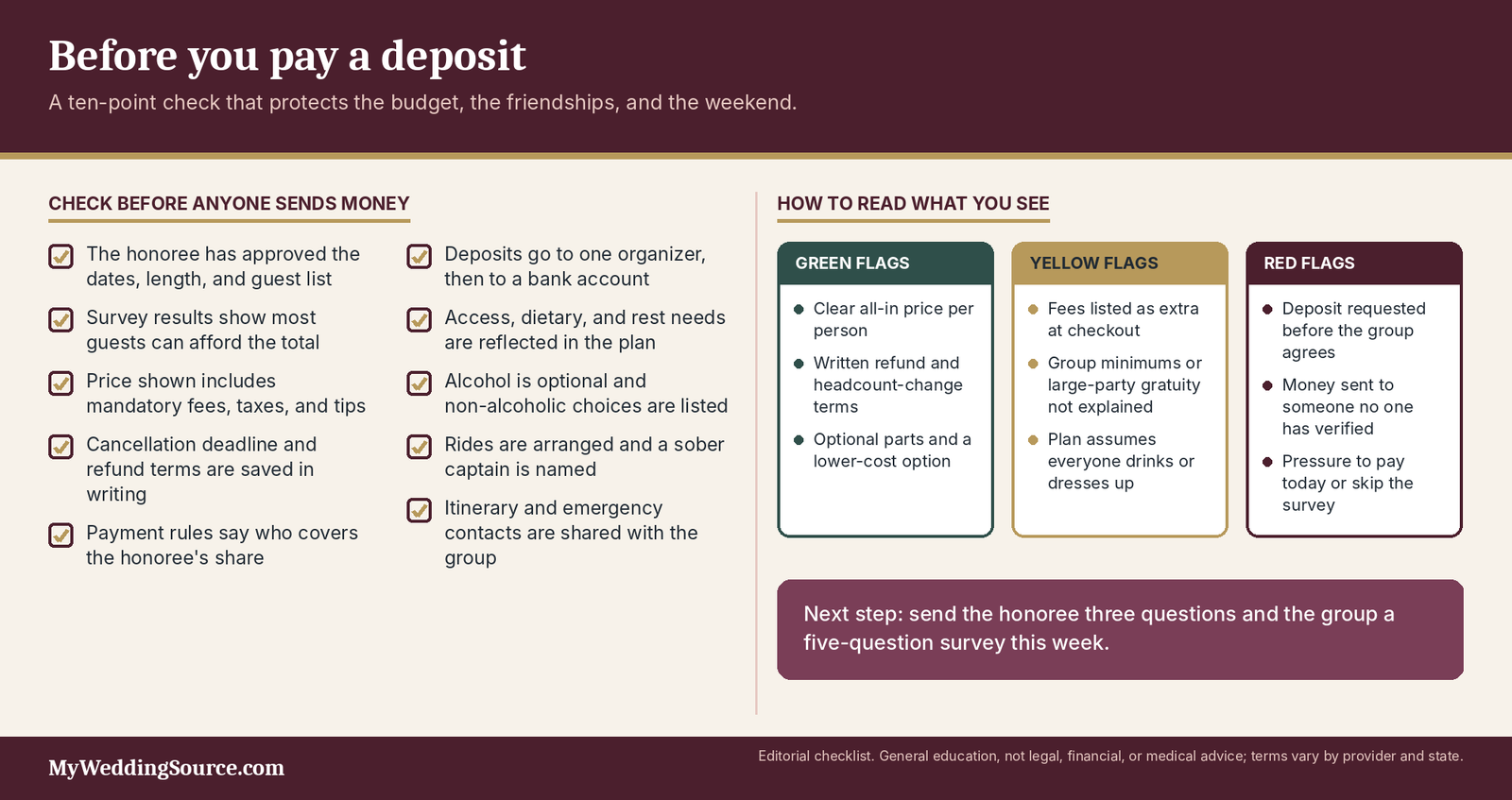
Read the cancellation policy for every lodging, class, and ticket booking, and write down the final deadline for a refund. Confirm that the price you were shown includes mandatory fees and taxes. Ask each provider what happens if the headcount changes, and get any exception in writing. If you cannot find a clear answer, choose the option with the most flexible terms.
Confirm money rules, access needs, and the ride plan
Write the payment rules in one message: who pays for what, when deposits are due, what happens if someone cancels, and who is the keeper of the budget. Confirm that the lodging and activities match the access needs people shared. Name a sober captain for each outing, share the itinerary and contact list, and book rides in advance. Then send the invitation and enjoy the planning.
Sources & methodology
- The Knot: The Average Bachelorette & Bachelor Party Cost — 2023 survey (about 500 respondents) behind the per-person averages, attendee counts, and trip-length figures.
- The Knot: How to Plan a Bachelorette Party — planning timeline, budget survey advice, and large-group restaurant policies.
- The Knot: 56 Bachelorette Party Ideas — idea categories, including classes, volunteer days, and low-alcohol options.
- The Knot: What Is a Solo Bachelorette? — solo celebration ideas and who usually pays.
- The Knot: 72 Bachelorette Party Themes — theme categories and examples.
- The Knot: How to Create a Venmo for Your Bachelorette — payment-app fund setup.
- Zola: Who Pays for the Bachelorette Party? — three payment arrangements and splitting advice.
- Zola: How to Plan a Bachelorette Party — 17-step planning outline, room blocks, and transport tips.
- Zola: 2026 First Look Report — more than 11,500 couples marrying in 2026; mocktail menu observation.
- Pinterest Newsroom: Wedding Trend Report 2026 — platform search-trend signals for analog and unique activities; not bachelorette-specific.
- Gallup: U.S. drinking rate at new low — July 2025 poll of 1,002 adults.
- CDC: Alcohol Use and Your Health — excessive drinking risks and standard-drink caution.
- CDC: Standard Drink Sizes — U.S. standard drink definitions.
- NHTSA: Drunk Driving — 2024 alcohol-impaired driving deaths, legal limits, and sober-ride advice.
- CDC: Preventing Drowning — alcohol, lifeguards, and life jackets.
- CDC: Heat and Your Health — hydration, scheduling, and signs of heat illness.
- eCFR: 16 CFR Part 464, Rule on Unfair or Deceptive Fees — total-price disclosure for live-event tickets and short-term lodging.
- eCFR: 28 CFR 36.302, Modifications in policies — ADA lodging reservation requirements for accessible rooms.
- U.S. Department of Transportation: Refunds — the 24-hour rule and airline refund rights.
- National Park Service: Passes — America the Beautiful and Access Pass details.
- CFPB: Deposit insurance coverage on funds stored through payment apps — risk of stored balances (June 2023).
- IRS: Tax Exempt Organization Search — verifying charities.
Methodology: Verified facts come from the official sources above (federal regulations, CDC, NHTSA, DOT, NPS, CFPB, IRS) and were read directly. Survey findings (The Knot’s 2023 cost survey, Gallup’s 2025 poll, Zola’s 2026 report) are labeled with their year and sample, and Pinterest figures are platform search-trend signals, not Google search volume or counts of parties. Per-activity cost ranges, the worked lake-house example, the sample invitation, and the itineraries are editorial estimates and illustrative examples, not quotes, and the courtesy guidance on guest lists and cost sharing is editorial judgment. This article is general education, not medical, legal, tax, insurance, or financial advice.
Freshness note: The Knot’s bachelorette cost data is from 2023 and no newer bachelorette-specific cost survey was found, so recheck for a 2026 or 2027 update each spring. Recheck local prices, lodging cancellation terms, and NPS pass prices before booking, and confirm current FTC fee-rule and ADA guidance if a regulation changes. Last researched October 12, 2026.