
An outfit change handoff is the short stretch in the middle of a wedding when one person leaves the party, steps into a different space, takes off one look, puts on another and comes back, and the gown, the rings, the phone and the keys all have to be somewhere safe the whole time. This guide gives you a plain protocol for choosing the room, naming who holds what, preparing the bustle and steaming, and packing a labeled hand-off bag.
Treat the outfit change handoff as six small steps: pick the space, name the people, stage the bag, swap the garments, seal the first outfit and sweep the room. Choose a room that locks, has a mirror, an outlet and a chair. Give the gown one named keeper and the valuables a different named keeper. Pack a labeled hand-off bag for each direction, and log what goes in and what comes out. Plan on about twenty to thirty minutes, and confirm the room and its rules with the venue in writing.
Most couples who plan a mid-event change spend their attention on the second garment. They choose it, fit it and pack it. What they plan less is the quarter hour in the middle: which door they walk through, who is already standing there, what happens to the first dress while it waits, and where the wedding rings and the car keys sit while two hands are busy with hooks and zippers.
That quarter hour is where small things go missing. A phone gets left on a vanity. A garment bag gets hung in a room that is later locked for the caterer. A bustle that took twenty minutes to pin in the morning needs to be undone in four. Nothing here is dramatic, and almost all of it is preventable with a plan that fits on one page.
This article is about one narrow task: moving a person and their property safely through a mid-event outfit change handoff. It is not about choosing the second outfit, and it is not about planning an after-party. If you are still deciding what the second outfit is and who stores it for the day, the guide on the second outfit handoff chart covers storage and carrying.
If you are deciding whether to host a late-night event at all, the guide to wedding after-party planning covers that. Here we start from the moment the outfit change handoff is already on the schedule.
A note on scope. This is general planning information, not legal, safety or insurance advice, and venue rules, fire codes and local regulations differ, so confirm anything that matters with the venue and the issuing authority.
What an outfit change handoff is and why it needs a plan
A handoff, in event work, is any moment when responsibility for a thing moves from one person to another. Most weddings contain dozens of them: the ring from the best man to the officiant, the bouquet from the bride to a friend before the first kiss, the cake knife from the caterer to the photographer. An outfit change handoff is the same idea applied to a person and everything they own at that moment.
It differs from other handoffs in three ways. First, the person being handed off is the one the whole event revolves around, so a delay is visible to everyone. Second, the property involved is unusually valuable and unusually fragile: a gown that cost more than a used car, rings, family jewelry, a veil, a watch, a phone that holds the evening’s contacts and photos. Third, the outfit change handoff happens in a space the couple does not control, usually somewhere borrowed from the venue, a hotel or a vendor.
Put those three together and you have a task that is short, high-stakes and easy to improvise badly. People improvise anyway, because nobody schedules a rehearsal for getting dressed. The result is the same few failures at weddings of every size.
The room is not ready. It is locked, occupied, cold, dark, full of someone else’s boxes, or three floors from the party.
The wrong person is in charge. A well-meaning friend is holding the gown and the rings and the phone, and has also been asked to find the photographer.
The garment is not prepared. The bustle is complicated, nobody has practiced it, and the steamer was left in the trunk.
The property has no home. Earrings go into a pocket, the phone goes on a chair, the first outfit goes over a door, and ten minutes later none of them can be found.
The timing is invented. A change that was meant to take fifteen minutes takes forty, and the dance floor empties.
None of these needs expensive help. They need a named space, named people, a prepared garment, a labeled bag and a timer.
Who changes at a wedding
The couple is the obvious case, and the examples in this guide lean on them. But the same protocol applies to anyone with a mid-event change: a parent who swaps a formal jacket for something lighter, a wedding party member changing into after-party clothes, or a guest of honor who changes into a ceremonial garment for one part of the day and a different one for another.
Cultural and religious celebrations often include more than one outfit by design, and several people may change at once. The protocol scales by adding keepers and spaces, not by changing the steps. Keep the scope of the outfit change handoff small and clear: one person, one room, one window of time.
What this guide does not cover
Choosing the garment, tailoring and fit are covered in the wedding dress fit and alterations guide. The long-term storage and transport of a gown, the first outfit’s cleaning and preservation, and the shopping decisions belong elsewhere. So does the choice of accessories; the wider hub on wedding day accessories planning covers compatibility and backups. This guide stays on the handoff: the space, the people, the property and the clock. To see how a change fits into the movement of the whole room, read the guest flow in a reception guide.
The six-step outfit change handoff protocol at a glance
The protocol has six steps, and each begins with the letter S so it is easy to remember when someone is asking you a question in a corridor. It is original to this guide, not an industry standard, and you should adjust it freely.
Step one: Space. Choose and confirm the room where the change happens, and a backup. Decide who has the key, who can open it and when it is free.
Step two: Staff. Name the people. One keeper holds the garments. One keeper holds the valuables. One dresser helps with the outfit change handoff. One door person keeps the room private. On a small day one person can hold two roles, but the gown keeper and the valuables keeper should not be the same person if you can avoid it.
Step three: Stage. Set the room up before the outfit change handoff begins: the second outfit hung and checked, the steamer plugged in, the shoes out, the hand-off bag open, a chair, a mirror, a trash bag, a small kit for repairs.
Step four: Swap. Make the outfit change handoff itself in a set order, with the first outfit coming off before the second goes on, and each item going into its labeled place as it comes off.
Step five: Seal. Close the hand-off bag, record what is inside, and give it to its keeper. The first outfit is now somebody’s responsibility with a name attached.
Step six: Sweep. Before anyone leaves the room, check every surface, pocket, hook and floor corner against the log. Then the person walks back to the party.
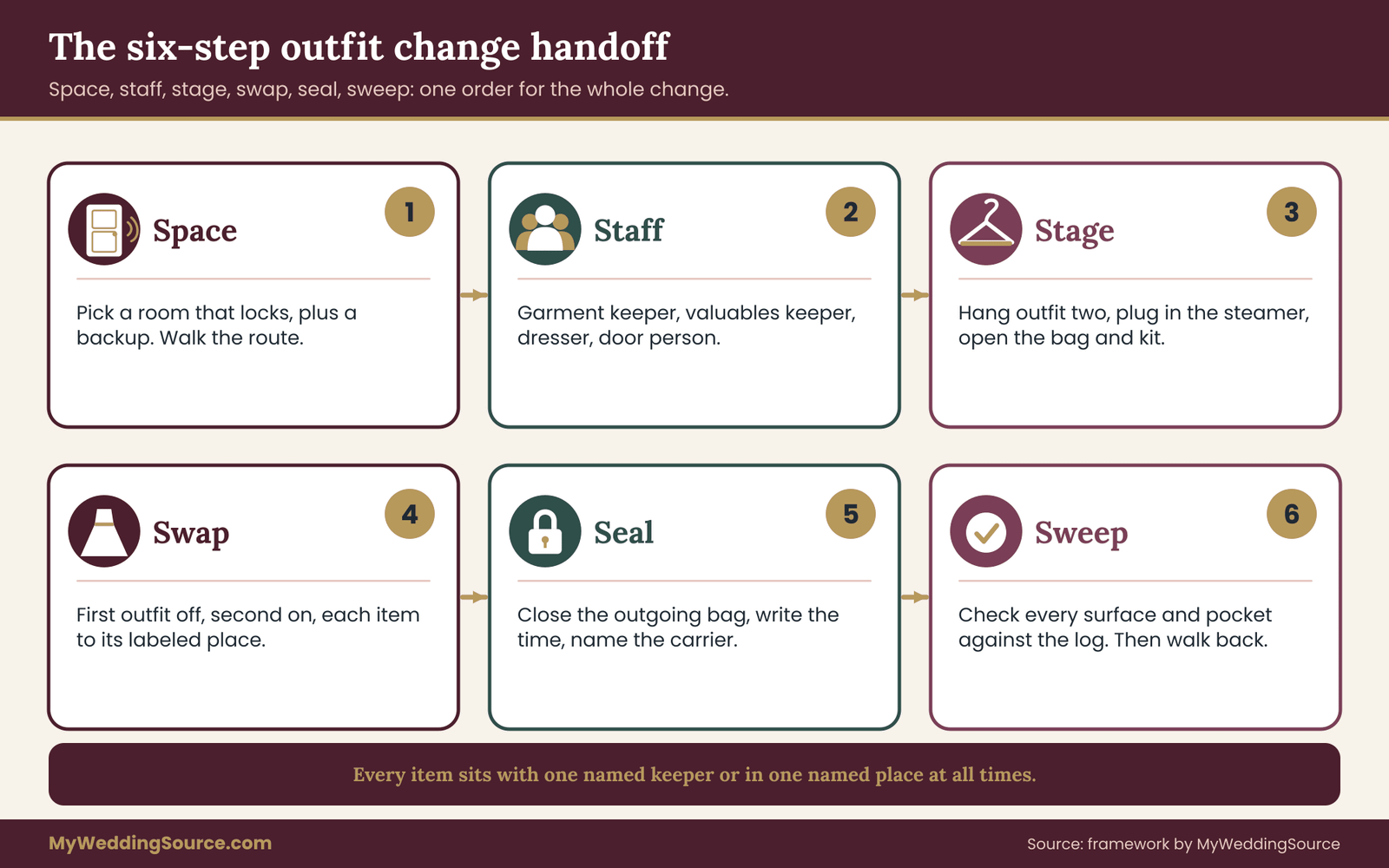
The rest of this guide goes through the steps in more detail, but the order matters more than the detail. Space first, because everything else depends on it. People second, because a room without people is just a room. Bag, swap, seal and sweep follow in the order the clock demands.
The idea behind the protocol
The protocol comes from a simple rule used in many kinds of logistics: every item must always be in exactly one named person’s care, or in one named place. A handoff is the moment that care moves. Wherever you cannot answer the question “who has this right now?” in five seconds, you have a gap, and gaps are where property disappears. Any outfit change handoff that follows the six steps can be explained to a helper in under a minute.
You do not need software for this. A one-page sheet, a pen and a phone camera are enough. The point is to decide in advance, not to build a system.
How long the change takes
Nobody can give you an honest universal number, because it depends on the garment, the helpers and the room. As a planning estimate, build in twenty to thirty minutes from the moment the person leaves the party to the moment they walk back in, and treat anything shorter as a bonus. Simple changes, such as a jacket and shoes, can be much quicker.
Complicated ones, with corsets, layers, a veil, jewelry and hair, can take longer. The only reliable answer comes from a timed practice with the real garments, which a later section describes. Seen this way, the outfit change handoff is less about speed than about never losing track of an item.
If your schedule shows five minutes, the schedule is wrong. Moving the outfit change handoff earlier or letting the party go on without you for longer is cheaper than rushing and tearing a seam.
Choosing a dressing space for the outfit change handoff
The room decides more of the outfit change handoff than any other single choice. A good room makes a clumsy plan work. A bad room defeats a careful one. Because the room is usually borrowed, the choice is really a set of questions you put to the venue, the hotel or the vendor, and then a decision about which answer you can live with.
What a workable room needs
Start with the short list. A room for a mid-event change should have, at minimum, a door that closes and preferably locks, enough floor space for the person and one helper to move without touching the walls, a mirror, a chair, a hook or rail for hanging, and light you can actually see color and hooks by.
Add an outlet if you plan to steam, and a nearby restroom if the person has been drinking water or champagne for six hours. A room that fails the basic tests will undermine the outfit change handoff before it starts.
Then the second list, which people forget until they are in the room. Is the room heated or cooled to a comfortable temperature, or is it a storage room that stays at whatever the building does? Is the floor clean enough for a hem? Is there a clear path from the room to the party that does not run through the kitchen, the loading dock or the ceremony site where guests are still lingering? Can a wide skirt or a train fit through the door, and does the door open outward?
Finally, the question of privacy. A room with a glass wall, an unlocked door or a window onto the parking lot is not private, however empty it looks. Ask who else has a key. Venue staff, caterers and cleaning crews often do, and they do not know that tonight the room is a dressing room.
The five common options, compared in plain words
A designated suite at the venue. Many venues have a bridal suite or a getting-ready room. If it exists and is available for the change, it is usually the best option: close to the party, set up with mirrors and outlets, and often lockable. The risk is that the room was booked for the morning only, and has since been used as a staging area for flowers or gifts. Confirm it is free at the time of the outfit change handoff and that it will be unlocked and cleared.
A hotel room. If the couple or the wedding party has a room at a nearby hotel, it can serve. A hotel room has a bathroom, a bed to lay things on, a closet and usually a steamer or iron. The cost is distance. Walking, driving or riding a shuttle to the room and back adds travel time to the outfit change handoff itself, and a person in a fragile garment is not an easy passenger.
A hotel in the same building, or across a short covered walk, is much better than one a car ride away.
A restroom or a family restroom. This is the fallback many couples end up with when no room is planned. A single-user family restroom with a lock, a counter and a hook can work for a simple change. A shared restroom is a poor choice: it is public, damp, and the floor and counters are not where a gown should wait. If a restroom is the only option, treat it as a last resort, bring a clean sheet to lay on the floor and a hanging hook, and have the door person keep the door.
A vehicle. A parked van, limousine or SUV is sometimes used for a quick change, especially outdoors. It is private only if the windows are covered, and cramped for anything with volume. Do not choose it for a full gown or a multilayer garment. It works better for a jacket, shoes and accessories.
A tent or a pop-up screen. At outdoor and tent weddings, a screened-off area behind the tent can serve. The risks are weather, dust, wind and visibility. If you go this way, rent or bring a real changing screen or small tent, a floor cover, a hanging rail and lighting, and plan for the evening temperature.
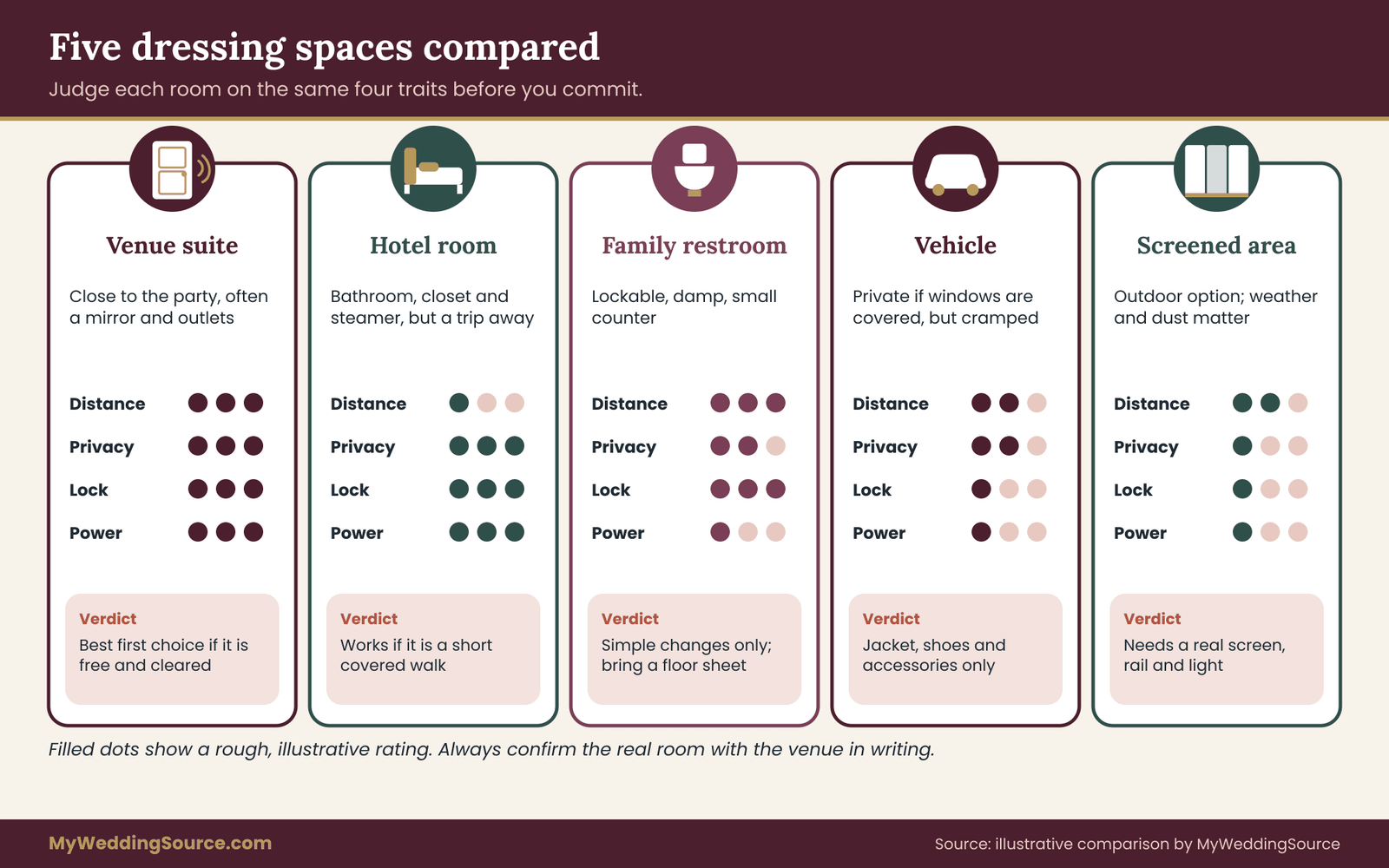
Compare the options by the same few traits: distance, privacy, lock, power, floor and comfort. A room that scores well on privacy and lock but poorly on distance can still work if the outfit change handoff is scheduled for a quiet stretch of the evening, such as while dinner is served. A room that is close but not private rarely works.
Distance and the walking route
Measure the route from the party to the room, and walk it in the shoes the person will be wearing. Count the steps, the stairs, the thresholds and the doors. A route that looks short on a floor plan can include a service corridor, a freight elevator or a flight of stairs that is difficult in a long skirt. If the route includes stairs or elevators, ask whether the elevator is reserved for guests or staff at that hour. A short, walked route keeps the outfit change handoff inside its time window.
Venue loading dock rules matter here only if the route runs through back-of-house areas. Many do. Back-of-house areas have rules about who can enter, what can be carried, and when, and they are a common reason a dressing route is refused on the night.
Write the route as four or five plain steps. “Leave the ballroom by the side door near the bar. Turn left. Take the elevator to the second floor. Room 204 is the third door on the right. The key card is at the front desk under the surname.” This is the version that a helper can follow while carrying a bag.
The backup room
Choose a second room. It does not need to be good, only different from the first in the way that matters. If the first is a hotel room across a street, the second might be a venue closet on the same floor as the party. If the first is a venue suite, the second might be a family restroom. If the first fails, the backup should require no new permission on the night. Every outfit change handoff should have a second room named before the day.
Tell the person at the venue who has the authority, usually the venue coordinator or the manager on duty, about both rooms in advance. That conversation saves the most time of any in this guide.
Questions to ask before you commit to a room
Put these in writing, and keep the answers with the rest of your contract documents.
- Is the room available at the planned change time, and for how long?
- Who has keys or key cards, and who will open it?
- Can the door be locked from the inside, and does the room have a sign for privacy?
- Is there an outlet, and are steamers allowed under the venue’s safety rules?
- What is the temperature, and is there a restroom close by?
- Is the route step-free, and can it carry a wide skirt?
- Is the room used by anyone else that evening, such as catering or a band?
- What happens to anything left in the room after the event?
The last question gets overlooked and causes real losses. Cleaning crews may move things, and items left in a room overnight may be treated as abandoned.
Accessibility and dressing space
If the person changing uses a wheelchair, a walker or a cane, or has a condition that makes standing for a long time hard, the room needs to be checked for access, not assumed. The doorway width, the turning space and the height of mirrors and hooks all matter. The Americans with Disabilities Act standards for accessible design set out dimensional guidance for doors, clear floor space and restrooms, and the U.S.
Access Board publishes them. A venue that is open to the public is generally expected to meet these standards for public areas, though a private bridal suite may not be covered in the same way, so ask the venue directly. An outfit change handoff that leaves out the person changing, because of access, is not a finished plan.
The same applies to helpers. A parent or grandparent who is helping a person with their jacket needs somewhere to sit.
Heat, cold and comfort
A dressing room that is hot with a hair dryer on, or cold because it is a converted storage room, makes everything slower. People rush when they are uncomfortable. Ask for a space heater or a fan if the venue allows them. Check whether portable heaters are permitted at all, because many venues prohibit them for fire reasons. Bring water, a small snack and tissue, and if the person is changing out of a heavy garment into a lighter one, a robe or wrap for the minutes in between.
Light and mirrors
Good light matters because it is hard to find a hidden hook in a dim corner. Overhead light alone casts shadows. A room lit by a window in daytime is easy; an evening room needs a lamp or a phone flashlight on a stand. A full-length mirror is useful but not essential; a helper’s eyes are better than a mirror for checking a bustle at the back. If there is only a small mirror, add a phone camera in selfie mode for a quick back view.
A short decision rule for the room
If you have a designated suite on the same floor or the same building as the party, and it is available and lockable, use it. If not, and a hotel room is within a short covered walk, use that. If you have neither, decide in advance whether a family restroom, a vehicle or a screened area is acceptable for your particular garments, and rehearse it.
If none of these is acceptable, change the plan: move the change to a different time, choose a simpler second outfit, or limit the change to the pieces that fit in the space you have.
Do not leave the room decision to the night. Chasing a key at nine in the evening, with a gown on and a crowd waiting, is the single most common way an outfit change handoff turns into a scramble.
Custody: who holds the gown and the valuables during an outfit change handoff
Custody is the center of the outfit change handoff. The garment, the jewelry and the electronics are the things that cost money or cannot be replaced, and during a change they spend several minutes out of anyone’s pocket or hands. The rule that solves most of the problem is short: every item has one named keeper at every minute, and the keepers change only at a moment someone says out loud.
Why two keepers, not one
It is tempting to give one trusted person the whole job: “Maya has everything.” It sounds efficient and it is a risk. A person holding a first outfit, a pair of shoes, a veil, a ring box, a phone and a wallet is carrying too much to keep eyes on all of it.
They also cannot hold both hands full and help with a zipper. When something goes missing, there is no way to know which part of the pile it left from. The outfit change handoff is the one moment where split responsibility is safer than a single trusted person.
Split the property into two groups and give each its own keeper.
The garment keeper holds everything that is clothing or worn on the body: the first outfit, the veil or headpiece, the shoes, the belt, the sash, a wrap. The garment keeper’s job is to keep these items clean, off the floor, dry and together.
The valuables keeper holds the small, expensive, easy-to-lose items: rings, earrings, a watch, a necklace, a phone, keys, cash, cards, a wallet, medication. The valuables keeper’s job is to keep them in one locked or zipped container and to hand them back one at a time against a list.
The two roles can be the same person on a very small day, but then that person should have nothing else to do for the duration of the outfit change handoff. A better choice is two different people who have met, who know each other’s role and who will both be in the room.
Choosing keepers
Good keepers are calm, sober, local to the venue and in no other role during the change. Avoid anyone who is also giving a toast, directing photographers, supervising children or making a speech within the next half hour. Avoid anyone who will have had several drinks. Avoid anyone who needs to leave early.
A close friend or sibling often suits the valuables role because the trust is personal. A planner, coordinator, a dresser employed by a bridal shop or a vendor assistant often suits the garment role because they are used to handling the fabric. If you have hired a day-of coordinator, ask whether property custody during a change is part of the service, and whether it is covered. Many are glad to take it on; some do not handle valuables at all, and it is better to know before the day.
Say the names aloud in advance. Put them on the one-page sheet. Tell each keeper exactly which items they are accountable for.
The written custody log
A custody log sounds formal, but it is just a list on one page with three columns: item, who has it, and a tick when it changes hands. For a typical change, it might have ten to fifteen lines. The log is the paper spine of the outfit change handoff.
Here is how it reads in prose rather than as a grid: ring box, valuables keeper. First dress, garment keeper. Veil, garment keeper. Shoes, garment keeper. Earrings, valuables keeper. Phone, valuables keeper. Car key, valuables keeper. Each line has a second tick for “returned to owner.”
The log does three things. It makes the keepers say each item out loud, which catches a missing item at the start. It gives the person changing a way to see at a glance that everything is accounted for. And it lets someone who was not there reconstruct what happened if something does go missing.
Take a photo of the log before the outfit change handoff begins, and another when it is finished. A photo of the valuables laid out on a clean cloth before the container is closed is also worth taking. These photos are for your own records only; do not post them.
Handing off a ring or a family piece
Wedding rings and family jewelry deserve a deliberate step. Hand them over one at a time, by hand, with the keeper saying the item back: “Wedding ring, left hand, going into the zip pouch.” Put them in a small container that closes, such as a ring box or a zipped pouch, and put that container inside a larger bag the keeper keeps on their body or in their hands.
Avoid leaving rings on a counter, a bathroom shelf or a windowsill, even for a minute. Avoid wrapping them in a tissue, which is easy to throw away. If a ring does not fit snugly and the person changing is worried about it slipping off during a dress change, the keeper holds it for the duration.
If the family piece is of significant value or has sentimental meaning, ask whether the family wants to hold it themselves. Handing a grandmother’s brooch to a friend can be fine, but it is a conversation, not an assumption.
Phones, keys and wallets
Phones are the most commonly lost item on a wedding day, because they are in constant use and constantly put down. The valuables keeper holds the phone of the person changing, face down in the zip pouch, with a note of the passcode situation: it is not necessary to tell the keeper the passcode, but the keeper should know whether to answer calls. Phones and keys are the items most likely to disrupt an outfit change handoff with a call or a search.
Decide in advance who takes calls from the vendors during the outfit change handoff. Photographers, planners and the caterer often need an answer. The easiest solution is to name a single contact for the outfit change handoff window, usually the day-of coordinator or a family member, and tell every vendor.
Keys and wallets go with the same pouch. If the person is leaving the venue after the party, make sure the keys come back to the right hand and are not left in a bag that goes to the hotel.
What belongs on the person, and what does not
Some items stay on the body through the outfit change handoff: a wedding ring that fits snugly, a medical alert bracelet, hearing aids, eyeglasses and a small religious or personal item they would not want to remove. Do not ask a person to part with medical devices for a change, and do not hold them unless they ask.
Other items come off and go to a keeper. Earrings come off before a garment is pulled over the head, because they catch. Necklaces come off before a high neckline goes on, or after, depending on the style; settle this in the practice session. Watches and bracelets come off if they snag on lace or beadwork.
What to do about insurance and vendor responsibility
Some couples carry event insurance, and policies differ widely about personal property, including jewelry and clothing. If the property includes valuable items, read the policy or ask the insurer which items are covered and under what conditions, and whether there are exclusions for items left unattended. Do not assume a policy covers a dropped phone or a lost earring.
Venues usually disclaim responsibility for property left on their premises, and the contract language to look for is a phrase such as “not responsible for lost or stolen items.” Vendors generally cover their own equipment, not yours. This does not mean something will go wrong; it means the custody log and the two keepers are your own protection.
The handback
The end of the change is as important as the start. When the person is dressed and ready, the valuables keeper hands back each item against the log, saying the item and watching it go on or into a pocket. Then the garment keeper hands over anything that goes with the second outfit. Then, and only then, the first outfit goes into its bag and the bag is sealed. Rushing the handback is how an earring ends up in the wrong bag. A calm handback is the clearest sign of a well-run outfit change handoff.
Custody in a short list
Pulling the section together, here is the short version in sentences you can read to your helpers: the garment keeper and the valuables keeper are different people. Each item is named aloud when it changes hands. Rings and family pieces go into a closed container held on the keeper’s body. Phones and keys go in the same container. The log is photographed before and after. The sealed first-outfit bag goes to a person who is named on the sheet and is not in the room when the outfit change handoff ends.
Applied consistently, these rules make the outfit change handoff dull, which is the goal. The best handoff is the one nobody remembers.

When custody changes hands again
After the outfit change handoff, the first outfit and the valuables bag may go to different places. The gown may go to a hotel room, a car, a closet or a family member. The valuables may go back to the person. Each of these is a second handoff.
Write the destination on the sheet: where the sealed bag goes, who carries it, and who confirms it arrived. A garment that is carried out of the venue with no word to the keeper is a common way to lose track of it. The later section on the hand-off bag covers the labels that make this step easy.
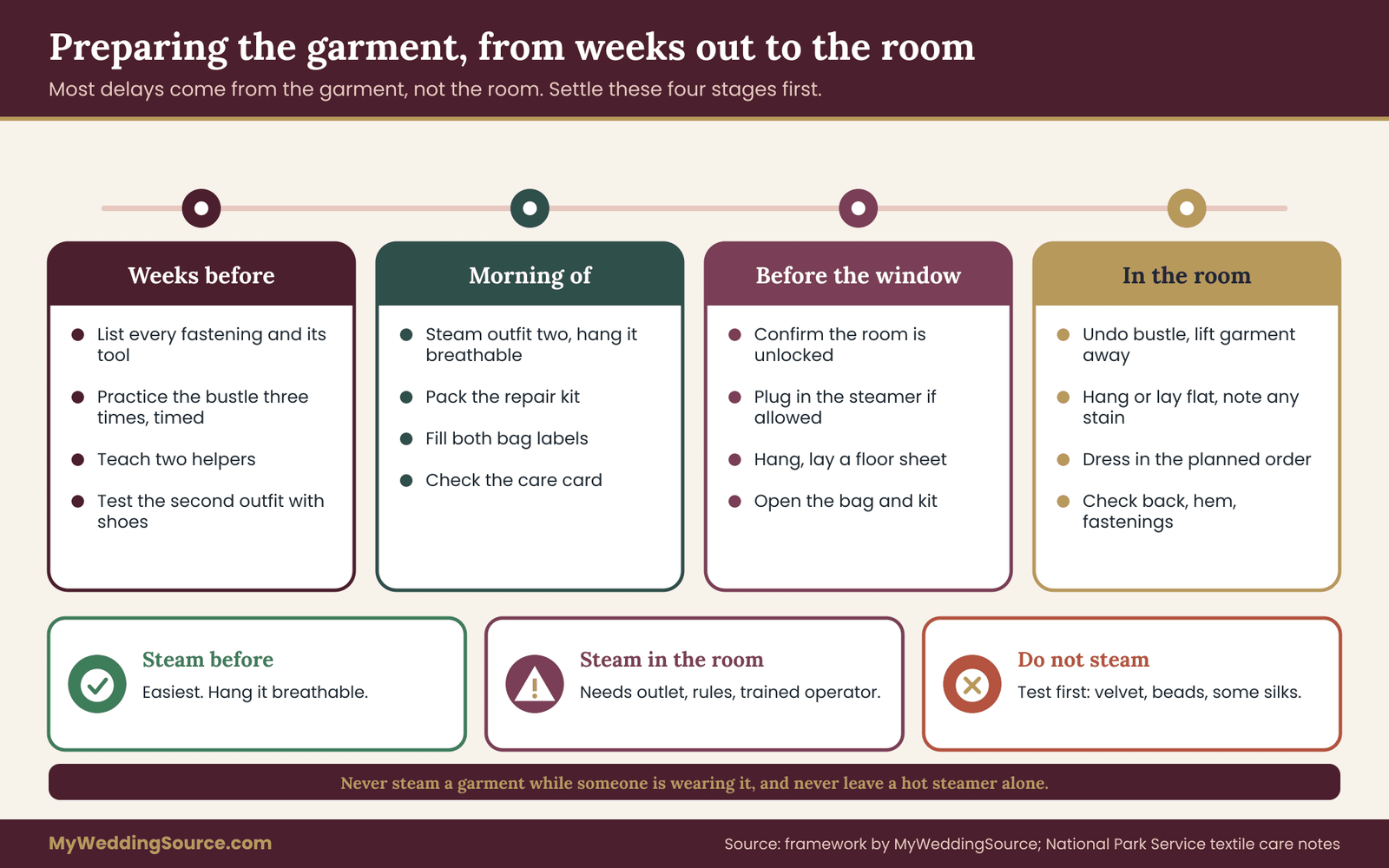
A garment that is ready for the outfit change handoff is one that can come off and go on in a known order, by people who have done it before, without a tool that is not in the room. Most delays in the outfit change handoff come from the garment, not the room or the people: a bustle nobody can undo, a row of buttons that needs a hook, a lining twisted in the zip, a hem that picked up grass.
This section is about getting the garment ready so the outfit change handoff itself is mechanical.
Know how each garment fastens
Write down, for each piece in both outfits, how it fastens and how long it takes. A zipper with a hook and eye at the top is quick. A corset back with lacing is slower and needs two hands. A row of small covered buttons with loops needs a button hook and a patient helper. A sash that wraps and ties needs someone who knows the knot.
A traditional garment with several layers may have a set order that is part of the custom, and the person who knows it should be named as the dresser. Fastening knowledge is what lets a helper take over an outfit change handoff at short notice.
For each fastening, write one line on the sheet: which piece, what fastens it, what tool it needs, and how long it takes. If the dress shop or tailor gave care or fastening instructions, copy them. If they showed a bustle technique at the final fitting, ask them to show it again and film it with permission. The wedding dress fit and alterations guide explains how bustles are designed and fitted; here the focus is on who can operate one on the night.
Bustles: the one thing to rehearse
A bustle lifts a long train so the wearer can walk, dance and sit. Bustles come in several styles, and they all have the same property: they are easy to do with practice and confusing without it. A bustle may use hooks and loops, buttons, ties, ribbons or a combination. Some are numbered or color-coded inside the dress, so a helper can match point to point.
Plan the bustle as a task for two people, with a script. The person who knows the bustle best, often the tailor or a bridal shop assistant, teaches two helpers in advance. One helper can do it alone, but the second is the backup if the first is absent or has gone home.
If the change involves undoing the bustle, taking the dress off and later putting the same dress on again, as when someone changes back into the first outfit for a send-off, rehearse that sequence, too. If the outfit change handoff goes from a long ceremony gown to a shorter reception outfit, the bustle is simply undone and the gown is taken off; make sure someone knows how to leave the dress with its structure intact, so that it can be hung without damage.
Ask the person who will bustle, on a practice day, to do it three times in a row with a timer. The first time is slow. The third time is the real time you should schedule.
Buttons, hooks and zips: the small kit
Fastening problems need small tools. A basic repair and dressing kit for the outfit change handoff might include a button hook, a few extra buttons or hooks that match, safety pins in two sizes, a needle and thread in the garment’s colors, a small pair of scissors, fabric tape, a lint roller, a stain pen suitable for the fabric, a soft cloth, a small mirror and some hair clips. Keep it in one pouch, and put the pouch in the hand-off bag or the dressing room.
Do not add tools you do not know how to use. Pins that are the wrong size can leave holes in delicate fabric. Tape on lace can damage it. If the fabric is silk, beaded or antique, a repair is better left to a professional, and the kit’s job is only to hold things together until one can look at it.
Steaming: when, where and by whom
Wrinkles come from packing, sitting and the first wear. A garment that has been worn for a ceremony and a dinner will have creases at the waist and seat, and a second outfit that waited in a garment bag in a car may have creases from folding. Steaming is the usual fix, and the choice is whether to steam in advance, in the room or not at all. Decide about steam early, because it is the step most likely to stall an outfit change handoff.
The guide to wedding dress steaming covers the technique and the people who do it. For the outfit change handoff, the practical questions are narrower.
Steam before. If the second outfit can be steamed in the morning and hung in a breathable bag, there is nothing to do in the room. This is the easiest option, and works for most garments if they are stored hanging.
Steam in the room. If the second outfit is steamed in the dressing room, you need an outlet, a steamer, water, a hanging point and a person who knows what they are doing. Ask the venue whether steamers are allowed, because some prohibit them for fire safety or because of the risk of burns and water damage. Steam burns are real, and a steamer is hot. Keep it away from the person wearing the garment, and never steam a garment that is being worn unless the operator is trained.
Do not steam. Some fabrics and trims should not be steamed at all: certain silks, velvet, beaded surfaces, some synthetics, anything with glue or interfacing that may soften. If you do not know, test a hidden spot first or ask the maker. A wrinkled garment is better than a damaged one.
The U.S. Consumer Product Safety Commission publishes safety information about household appliances and burns, which is a sensible background read before you let a steamer into a dressing room. Follow the manufacturer’s instructions, and do not leave a hot steamer unattended.
Lining, slips and the layers underneath
Many changes fail below the outer layer. A slip that rides up, a petticoat with a twisted waistband, shapewear that has to come off before a different neckline, a bra that suits the first dress but not the second. List the underlayers for each outfit, and note which stay and which change. If the second outfit needs different undergarments, put them in the hand-off bag in their own labeled pouch.
If the person uses a garment that must be pulled over the head, such as a fitted top or a wide-necked dress, decide whether hair and makeup need protecting. A silk scarf or a cover held over the face keeps lipstick off the fabric. Ask the hair stylist, who may have views, and see the bridal hair and makeup planning guide for how trial timelines and touch-up kits fit together.
Shoes and the floor
Shoes are part of the garment plan. A change of shoes is often the simplest part of the outfit change handoff, and it still needs a plan. Decide where the person sits to change them, and whether the second pair has been worn enough to be comfortable. If the person is changing from heels to flats or the reverse, the hem of the second outfit has to be right for the second pair. That is a hem decision made at the final fitting, not on the night.
Keep a clean cloth or a sheet for the floor. A gown laid on a venue floor picks up whatever is on it.
The first outfit after it comes off
The first outfit needs as much care as the second. It comes off warm, possibly damp, and may be stained or creased. Hang it on a padded hanger if it is light enough, or lay it flat on a clean sheet if it is heavy or beaded. Do not leave it over a chair or a door. Turn it so that any beading or lace does not rub against a rough surface.
If it has been stained, note where, and do not rub. Blot gently with a clean cloth and keep the stain still until a specialist can see it. Tell the cleaner about every spill: what it was, where, and when. If the gown is going to a cleaner for preservation, the details help.
Place the gown in a breathable garment bag, not a sealed plastic sleeve, for any long wait. The National Park Service’s conservation notes on textiles explain, in plain terms, why heat, moisture and light damage fabric. Beyond that, the dress is a sealed item in the hand-off bag, and its handling is custody, not repair. The next section describes the bag.
A practice session
Schedule one timed practice in the weeks before the wedding, with the real garments, the real helpers and a similar room. Practice the order: undo, remove, hang, dress, fasten, check. Time each stage. Write down what was awkward and what was missing. Take photos of the bustle points and the fastening order.
The practice often turns up something small, such as a missing hook or a helper who cannot manage a particular clasp, and it is much easier to fix in a living room than in a hallway. One timed run is the cheapest insurance an outfit change handoff can have.
If the practice is not possible, a shorter version still helps: a ten-minute walk-through of how every item fastens, with the helpers touching each one. And for the specific rehearsal of a bustle, the person who made it should be there.
The outfit change handoff depends on the garment being known. A prepared garment turns the change from a puzzle into a routine.
The labeled hand-off bag for an outfit change handoff
The hand-off bag is the physical tool of the outfit change handoff. It is a bag, a label and a list, and it does one job: it lets anyone pick it up, know whose it is, know what is inside and know where it goes next. Without it, property travels by memory, and memory at a wedding is unreliable.
One bag per direction
Use two bags, not one. The first is the incoming bag, which arrives in the dressing space before the outfit change handoff. It holds the second outfit, the second shoes, the second accessories, the underlayers and the small kit. The second is the outgoing bag, which is empty when it arrives and receives the first outfit, the first shoes, the veil and anything else that comes off.
Keeping them separate prevents the most common mix-up: the first outfit goes back into the bag the second outfit came in, and the next person who opens it expects the wrong thing. It also gives you a clear picture on the sheet: the incoming bag has a list of what should be in it, and the outgoing bag has a list of what should come out.
A garment bag with a zipper is the right choice for the dresses and jackets. A tote or duffel is right for shoes and small items. A zipped pouch inside either holds the valuables. If space is tight, a single large garment bag with a separate pouch can serve as both, as long as the labels distinguish them.
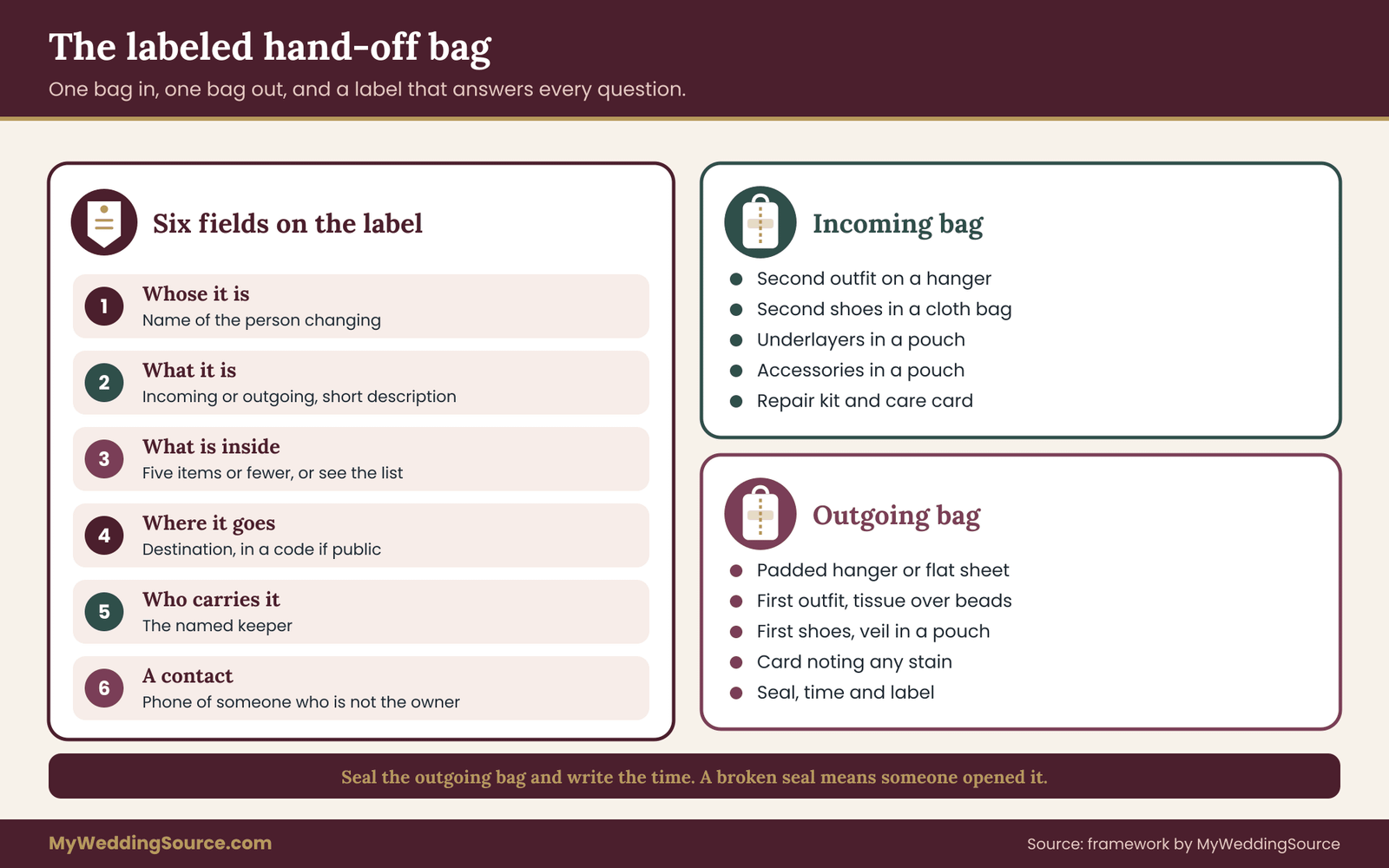
The six fields on the label
A label on the outside of each bag, readable at arm’s length, saves a conversation every time someone picks it up. Use a plain luggage tag, a paper card in a clear sleeve or a strip of masking tape with marker. Six fields are enough.
- Whose it is. The name of the person changing, as the helpers know them.
- What it is. Incoming or outgoing, and a short description such as “second outfit” or “first outfit.”
- What is inside. A short list, no more than five items, or a number and a note to see the list inside.
- Where it goes. The destination: the dressing room, the hotel room, the car, the coat room, the couple’s suite.
- Who carries it. The name of the keeper responsible for moving it.
- A contact. A phone number of a person who is not the owner, usually the coordinator or a family member. Do not put an email address on a label, and do not put a home address.
Keep the label free of anything sensitive. Do not write the value of the contents, the name of the hotel room number visible to passersby, or a passcode. If the destination is a room number, use a code the helpers know, or write it only on the inside list.
What goes inside the incoming bag
Pack the incoming bag in the order the items will be used. The outer layer of the bag holds what goes on last: the jacket, the veil, the wrap. The middle holds the main garment. The bottom holds the underlayers and shoes. A small pouch on top holds the kit and the accessories in their own labeled pouch.
A typical incoming bag, for a couple changing into after-party clothing, might hold the second garment on a hanger, a second pair of shoes in a cloth bag, underlayers in a pouch, jewelry in a small pouch, a hair accessory in a labeled container, the repair kit, a lint roller, a small bottle of water, tissue, and a copy of the sheet. Add a card inside with the care label wording and fiber content copied from the garment, so that a cleaner or steamer operator can read it.
Check the bag against the sheet twice: when it is packed, and when it arrives in the dressing space. The second check catches the bag that was packed correctly and left behind.
What goes inside the outgoing bag
The outgoing bag is mostly empty on arrival, and it should contain a clean sheet or a layer of tissue, a padded hanger or a flat-lay cloth, a bag for the shoes, a pouch for the veil or headpiece and a small zipped bag for any accessories that are not going to the valuables keeper. Add a card with a line for any stain or damage noticed: what, where, when.
When the first outfit goes in, the garment keeper does the packing, not the person who just changed. The person who just changed is hurried and has another job. The keeper lays the garment in, closes the bag and fills the “what is inside” field. The keeper then adds the destination and carrier. A good habit is to take a photo of the garment before it goes in, for condition: it shows how it looked on the night.
Sealing the bag
A seal is a physical sign that the bag has been checked and closed. A zip tie through the zipper pulls, a luggage seal, a piece of tape across the zipper or a clip with a small paper label all work. A seal is not about security against theft in the sense of a lock; it is a marker that says “this was checked, closed and recorded at this time.” If the seal is broken at the destination, someone opened it. A sealed, timed bag is the final record of an outfit change handoff.
Write the time of sealing on the tag. A bag sealed at nine-forty that arrives at ten-thirty with a broken seal has a gap in its story.
Moving the bag
Who carries the bag, and how, is part of the plan. A garment bag should be carried over the arm, held up off the ground, or hung on a hook in a vehicle, not folded onto a back seat. A heavy beaded gown may need two hands. A wide skirt may need a larger bag. A person carrying it should not be carrying anything else, and should not be walking through crowds, loading docks or stairs without a free hand for a rail.
Write the route and the carrier on the label. If the bag goes to a car, note which car, who has the key, and where it is parked. If it goes to a hotel, note the room and who has the key. If it goes to a coat room, ask the coat room staff whether they take garment bags and what they do with unclaimed items; see the guide to wedding coat check planning for how coat rooms work and what to ask them.
What goes wrong with bags
Four things go wrong more than others. The first is a label that is not on the bag, because it was written and left on the table. Fix this by tying it on before the bag leaves the packing space. The second is two bags that look alike. Use different colors or tags. The third is a bag stored with the wrong group.
Tell the person who receives it what it is, not just “put this over there.” The fourth is a bag that nobody claims at the end. Add a pickup line to the sheet: who collects each bag after the event and where it goes.
The one-page sheet
The label is the outside of the system and the sheet is the inside. A single page holds the room and the backup room, the names and phone numbers of the keepers and dresser, the incoming bag list, the outgoing bag list, the custody log and the destination of each bag. Print it twice. One copy goes in the incoming bag. One copy goes to the coordinator or the keeper of last resort. Take a photo of it and share it with the keepers so that each has a copy on a phone.
A sheet is not a bureaucratic exercise. It lets a substitute step in if a keeper is called away. At a wedding, someone always is.
Running the outfit change handoff: a minute-by-minute window
The protocol is easier to follow with a clock. The numbers below are planning estimates, not measurements, and your own practice session should replace them. They show the order of events and the points where a delay is most likely.
Before the window opens, ten minutes out. The door person confirms the room is unlocked and empty. The garment keeper arrives with the incoming bag and unpacks it: the second outfit goes on its hanger, shoes out, kit open, steamer on if allowed. The valuables keeper arrives with the pouch and the log. The dresser arrives. The person changing is told it is time, and a vendor contact is told they will be away for about thirty minutes.
Minutes zero to three, leaving the party. The person says goodbye in the way that works, which may be a quiet word to the nearest person and a nod to the coordinator, not an announcement. The door person walks them by the planned route. If a photographer wants a picture of the exit, they take it at the door.
Minutes three to six, the first handoff. In the room, the door closes. The valuables keeper reads the log. Rings, earrings, necklace, watch and phone go into the pouch, one at a time, aloud. The pouch is zipped and goes to the keeper’s hands or body.
Minutes six to twelve, the first outfit comes off. The bustle is undone, fastenings opened, the garment lifted away, not dragged. The garment keeper hangs it or lays it flat. Shoes come off, go into their bag, and the floor cloth goes down if needed. Any stain or damage is noted on the card and photographed.
Minutes twelve to twenty, the second outfit goes on. Underlayers first, then the main garment, then fastenings in the planned order. Shoes, then jewelry handed back one item at a time against the log. Hair and makeup touch-ups happen last, with the person seated.
Minutes twenty to twenty-four, the check. The dresser checks the back, the hem, the fastenings and the line of the garment. The person looks in the mirror. The valuables keeper reads the log back: everything out, everything returned or noted as staying.
Minutes twenty-four to twenty-eight, the seal and the sweep. The garment keeper seals the outgoing bag, fills the label and photographs it. Everyone looks at every surface, every pocket, every hook and the floor. The incoming bag is repacked with whatever is left.
Minutes twenty-eight to thirty, the return. The door person opens the door. The person walks back to the party. The sealed bag goes to its destination, and the carrier confirms its arrival to the coordinator by a short message.
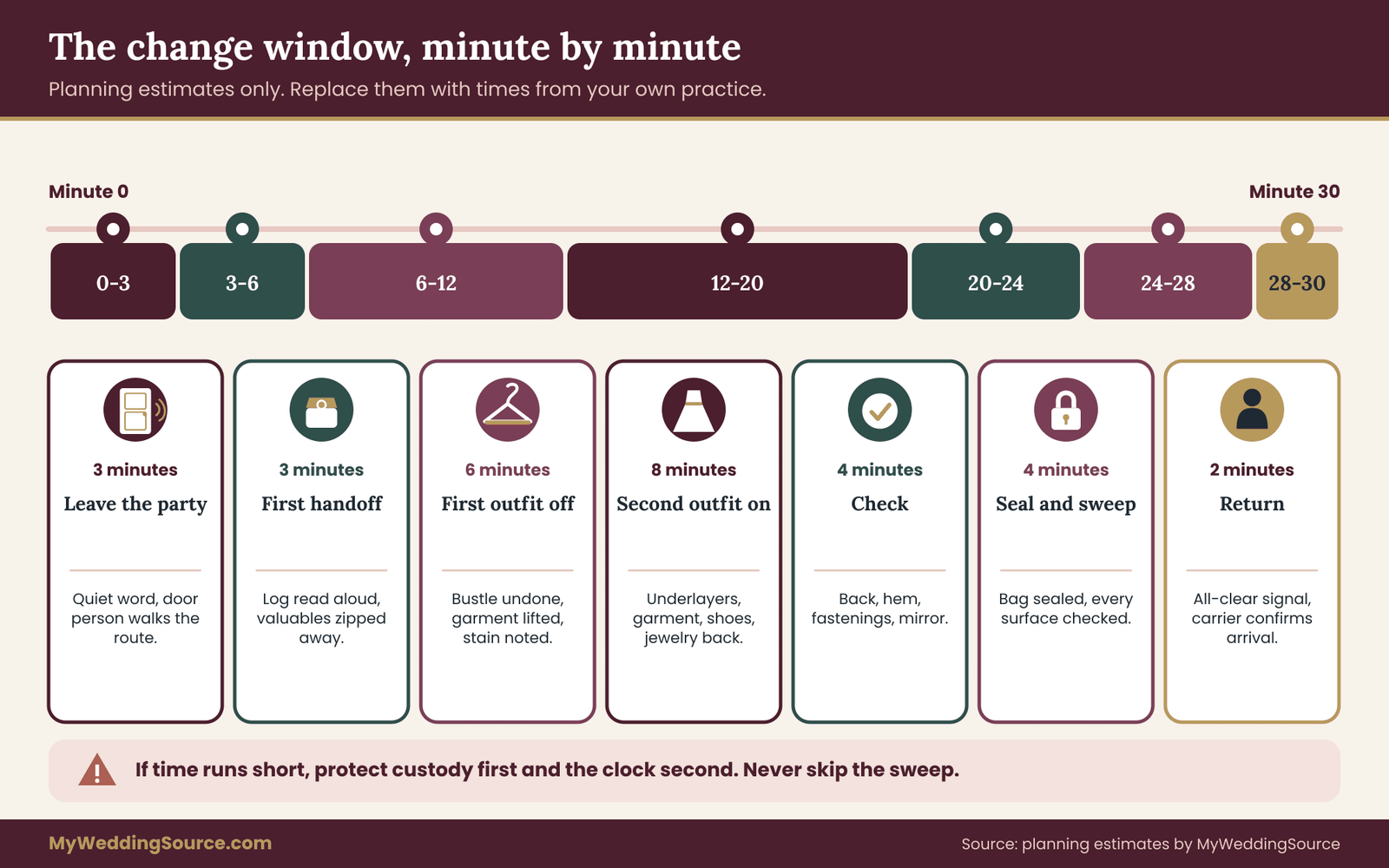
If a step runs long, the rule is to protect custody first and the clock second. A late return is a small embarrassment. A lost ring is not. Do not skip the sweep to make up time; it is the shortest step and prevents the most trouble.
Who tells the room when it is ready
Decide in advance who gives the signal that the person can return. Usually it is the dresser or the door person, never the person changing, who is the least able to judge their own back. The signal can be a text, a knock or a nod. Agree it beforehand, because a quiet room with five people who are each waiting for another to speak is common.
Edge cases that change the outfit change handoff
The protocol assumes one person, one room and a normal evening. Real weddings add complications. Each of the cases below changes one or two steps, not the whole plan.
Two or more people changing at once
When a couple changes together, or a wedding party changes in a group, the single-room plan stops working. Each person needs their own bag, label and keeper, and the room needs to be big enough or there need to be two rooms. A shared room is fine for people who are comfortable together; a second room is better for anyone who is not, or for anyone changing a complicated garment.
Keep the keepers separate for each person. One valuables keeper cannot hold two people’s rings and phones in one pouch without risk of mix-ups. Use two pouches with different labels. If helpers are short, stagger the changes so that the same dresser can do one after the other, and schedule the second person’s change to start when the first person’s is at the check stage.
For a couple, a common compromise is to change in adjacent rooms with a shared door person, so that both finish about the same time and walk back in together.
A change in a different building
If the dressing space is at a hotel or another venue, the handoff includes a trip. Add the transport to the plan: who drives, in what vehicle, and what happens to a wide skirt in the back seat. A vehicle with a high roof and a flat floor is easier than a low car. Seat belts matter: the person must be belted, and the garment arranged around them, not under the belt. Distance is the main thing that stretches an outfit change handoff.
Add a buffer to the clock for parking, doors, elevators and the walk. A change that takes thirty minutes in the next room can take fifty across town. Consider whether a shuttle or a driver is needed, and see the guide on wedding vendor timelines for how to fit a transport window between vendor start and end times.
If alcohol has been served, the person changing should not drive. Make sure the driver is sober and named on the sheet. Rules on alcohol and driving come from state law, and the National Highway Traffic Safety Administration publishes general guidance on impaired driving; treat the driver choice as a safety decision, not a logistics one.
Rain, heat, cold and mud
Weather changes both the route and the garment. In rain, the first outfit may arrive at the dressing room wet at the hem, and it should be hung to dry, not bagged. Carry a large towel and a plastic sheet for the floor. Umbrellas in the hand-off bag help the route, and a covered walkway or a vehicle at the door helps more.
In heat, the change may include sweat, and the second outfit should not touch a damp body without a dry layer. In cold, a wrap or coat for the walk between the party and the room is part of the bag. In mud or on grass, the shoes and hem need cleaning before the second outfit goes on. A soft brush and a damp cloth in the kit are enough for most surface mud; a heavily soiled hem goes in the bag for a cleaner.
Garments with a set order or a ritual meaning
Some garments have a meaning, or an order, that belongs to a family or a faith. A sash, a shawl, a turban, a veil, a set of jewelry or a layered robe may be put on in a particular sequence, by a particular person, with words or a pause. Ask the family who should dress the person, and what they need, before deciding on the room and the keepers.
In these cases the dresser is not a helper in the usual sense; they hold the ritual role. The room, the time and the privacy matter more, and the clock may be longer. Do not hurry something that is meant to be slow. Build it into the schedule and tell the vendors that this is a planned part of the evening.
A person with a medical device or mobility need
If the person wears a pump, a monitor, a brace or a hearing device, the outfit change handoff must not interrupt it. Ask the person, not a helper, how they want it handled: whether it stays on, who may touch it, where supplies are stored. A person who uses a mobility device needs a room and route that fit it, and a dresser who knows how to help with transfers if that is wanted. A seat with arms is easier to stand up from than a stool.
If medication is taken at set times, the outfit change handoff window should not collide with a dose. Put the medication in the valuables pouch with a note of the time it is due, and have the keeper remind the person.
A person who does not want a helper
Some people want to change alone, or with one person only. That is a legitimate choice. The protocol adapts: the person changes in a private room, the keepers wait outside, and the garment and valuables are handed in and out through the door. The door person still keeps the corridor, the bag still has a label and the sweep still happens, done by the person alone with a photo of the room before they leave. Consent and comfort come first in any outfit change handoff.
Do not push helpers on someone who does not want them, and do not assume that a person in a complicated garment can manage alone. Ask, and agree on a signal for help.
A change during photography
Some photographers ask for pictures during the outfit change handoff: the dress on a hanger, a hand fastening a button, a veil lifted. These are good photographs and also a privacy risk. Decide in advance what may be photographed, and who is in the room. The guide on wedding photography consent covers boundaries for who may photograph what; the same principle applies to a dressing room, where a person is partly undressed and the answer should be given before the camera comes in, not during.
Tell the photographer that the room is closed for the outfit change handoff itself, and that detail shots of the garments on their hangers, before or after, are welcome. Keep the valuables pouch out of detail shots.
When someone changes and then changes back
A send-off often brings a third look: the first outfit again, or a third garment. The protocol repeats, and the outgoing bag becomes the incoming bag for the return. Check that the first outfit has been steamed again if needed, that the first shoes are still comfortable and that the bustle is ready. Re-open the sheet and the log, and do not rely on the earlier check.
A worked example: one couple, two rooms, one evening
The couple below is invented, and the numbers are planning estimates, not measurements. It shows how the pieces fit together.
Dana and Priya are marrying at a venue with a ballroom, a garden terrace and a small suite on the second floor. Priya will change from a long ceremony gown with a full train and a bustle into a shorter cocktail dress for dancing. Dana will take off a suit jacket and put on a lighter vest and loafers. The reception dinner ends at eight, and dancing begins at eight-forty-five.
Step one, Space. The venue coordinator confirms that the second-floor suite is free from seven-forty-five to nine. It has a lock, a full-length mirror, two outlets, a clothes rail and a private restroom. The route from the ballroom is a side door, a short corridor, an elevator and a door, about three minutes. The backup is a family restroom on the ground floor, to be used only for Dana’s simple change if the suite is not free.
Step two, Staff. Priya’s sister Mira is the garment keeper. Dana’s college friend Jonas is the valuables keeper and holds both partners’ rings, earrings, phones and keys in two labeled pouches. The bridal shop’s assistant, who attends the wedding as a guest, is the dresser for the gown and has done the bustle before. The day-of coordinator is the door person and the vendor contact for the window. A named driver is not needed, since the suite is in the venue.
Step three, Stage. At seven-thirty, Mira takes the incoming bag to the suite. The cocktail dress is hung on the rail, steamed that morning and checked again, with shoes out. The kit, the steamer, a floor sheet, water and tissue are laid on the vanity. The outgoing bag, a roomy garment bag with a padded hanger and a card for notes, is hung on the door. Jonas arrives with the pouches and the log.
Step four, Swap. At eight-ten, as plates are cleared, Priya and Dana leave by the side door with the coordinator. In the suite, Jonas reads the log aloud and takes the rings, earrings and phones. The shop assistant undoes the bustle and takes the gown off over the arms, not the head, as practiced. Mira hangs it on the padded hanger. Priya steps into the cocktail dress, shoes go on, the assistant fastens the back and checks the hem. Dana changes at the same time behind a screen, with a short wait for the mirror.
Step five, Seal. Mira lays the gown in the outgoing bag with tissue over the beading, fills the card, notes a small mark on the hem near the train, and photographs it. She closes the bag with a zip tie and writes the time. The label gives the owner, “first outfit,” the destination “hotel closet, room code on the sheet” and Mira’s name as carrier, with the coordinator’s phone number. Jonas hands back the jewelry and phones against the log.
Step six, Sweep. The coordinator and Jonas check the vanity, the floor, the rail, the restroom counter and the pockets of the incoming bag. A hairpin is found under the chair. The incoming bag is repacked with the unused kit and the steamer is unplugged. At eight-thirty-five, Priya and Dana walk back in, ten minutes before dancing begins.
After. Mira walks the sealed bag to a car with the hotel driver, who has the room key, and sends a one-line message to the coordinator when it is hung in the closet. The coordinator ticks the line on the sheet. The hem mark goes on a note for the cleaner.
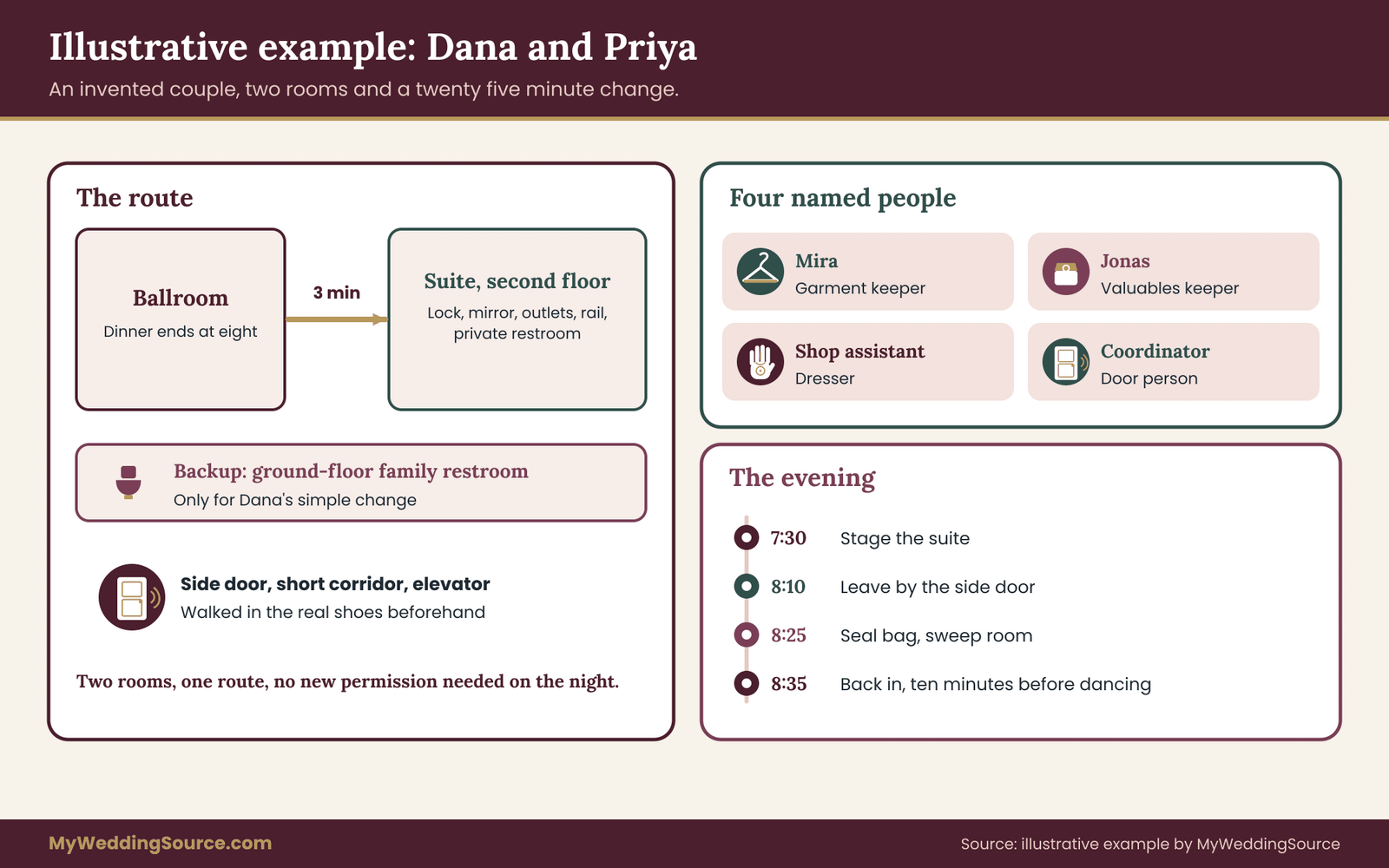
This example took about twenty-five minutes of change time and a ten-minute buffer. The exact figures are illustrative, but the structure is the point: a named room, a backup, four named people, a prepared garment, two labeled bags and a short log that was read aloud.
What the example shows
First, almost nothing in it is expensive. The sheet, the labels and the zip ties cost very little. Second, every step has a named owner, so nobody was guessing. Third, the preparation happened before the day: the steaming, the bustle practice, the venue confirmation. On the night, the outfit change handoff was routine, which is exactly what it should be. The couple’s outfit change handoff worked because each piece was small.
Questions for the venue and vendors before the outfit change handoff
Most of the outfit change handoff depends on other people’s rooms, schedules and rules, so the planning is partly a set of conversations. Have them early, ask in writing, and keep the replies with your contract documents. The general wedding vendor contract guide explains how to read what a vendor has promised; the questions below tell you what to look for in the change-specific parts.
The venue
The venue controls the room, the route, the keys and the rules. Ask which rooms can be used for a mid-event change and for how long, whether a room can be held and kept private, who can unlock it and whether the key can be left with the coordinator. Ask whether steamers, space heaters and hair tools are allowed, and what the policy is on items left overnight. Ask whether any part of your route is staff-only, and whether staff-only areas can be used with an escort.
Ask about the building rules that affect the day. Occupancy, exits and fire safety are set by the local fire authority, and a venue manager can tell you what applies. The National Fire Protection Association publishes the model codes that many jurisdictions build on, and the venue is the party that must follow the local version. Do not move furniture to block an exit, prop a fire door or run an extension cord across a corridor, even for a good reason.
If the venue says the room is not available, ask what it can offer instead. A coordinator who knows the building often has a spare office, a green room or a quiet corner that is not on the brochure.
The coordinator or planner
A day-of coordinator is the best person to run the door and keep the sheet, because they already hold the schedule and the vendor contacts. Ask whether they will hold the sheet, act as door person and field vendor calls during the window. Ask whether they handle guests’ valuables or only the couple’s. Ask whether their insurance covers property in their care, and what they do when a request is outside their scope. A clear no is more useful than a vague yes.
The photographer and videographer
Agree on what is photographed during the outfit change handoff, and what is not. Ask for the shot list for the dressing stage, and cross out anything you do not want. Ask whether a second shooter will be positioned outside the room, and where they will wait. Ask when they expect to resume, so that the first dance or the next formal moment does not start without them. Agree on what the camera may see before the outfit change handoff begins.
The band, DJ or caterer
The outfit change handoff window should line up with a quiet part of the evening. Ask the band or DJ whether they can fill a gap, play an extra set, or hold a song until you are back. Ask the caterer when dinner, toasts and cake are served, so that the window falls between them. The wedding reception guest flow guide explains how entry, seating, food and exit fit together; the outfit change handoff window is another part of that flow, and the guests should not have to wonder why the room has gone quiet.
The hotel, if the room is there
If the dressing space is a hotel room, ask the front desk about access: whether keys can be given to a third person, whether luggage storage or a closet is available, and whether early check-in or a late checkout can be arranged. Ask whether the room can be held for a short period of use before the night’s stay, and what the policy is on steamers.
Hotels differ on who may receive keys and packages, and the answer should come from the hotel, not a guess. A hotel room can serve an outfit change handoff well if the keys and the walk are settled.
Cost logic without invented numbers
Most of this plan costs little. Labels, zip ties, a garment bag, a steamer rental and a floor sheet are small items. The cost that matters is time and attention: a coordinator’s extra hour, a shuttle for a hotel change, a dresser’s fee if you hire one. Ask each vendor whether a change-related service is included, an add-on or unavailable, and get any price in writing. Do not assume that a free-sounding service is included in the contract; confirm it.
If the venue charges for an extra room or for a longer rental period, compare that cost with the alternatives in plain terms: a hotel room for the afternoon, a shorter second look, or no mid-event change at all. A simpler change, such as swapping shoes and removing a jacket, can be done in a corner with a screen and avoids the cost of a room.
When the outfit change handoff slips, and the limits of this guide
Plans slip. The aim is to know in advance what you will do, so that a slip is an inconvenience and not a loss.
The room is not available
If the room is locked, taken or unsuitable, go to the backup room named on the sheet. If both are unavailable, the coordinator speaks to the venue manager, and the outfit change handoff is delayed or shortened. A shortened change can mean keeping the first outfit’s underlayers, changing only the outer layer, or swapping shoes and wraps. Do not improvise a change in a public space.
A keeper is missing
If the valuables keeper or the garment keeper has been called away, the sheet allows a substitute to take over. The substitute reads the log aloud with the person changing and the other keeper before taking anything. If no suitable substitute is present, the coordinator holds the valuables, and the garment is laid flat in the room and the room is locked.
Something is missing after the sweep
If an item is not on the log’s return list, stop. Do not leave the room. Retrace in order: the pouch, the pockets, the bag, the floor, the restroom, the route. Ask the door person whether anyone came in. Check the photos taken before the change; they show where each item was.
If an item is still missing after a few minutes, decide whether the party can go on without it, and note it for a follow-up. Tell the venue and, if it is valuable, ask the coordinator to hold the room until it is searched in full.
If an item appears to have been stolen, contact the venue’s security and, where appropriate, local police. Keep the log and the photos. Report a lost or stolen phone to the carrier. The Federal Trade Commission publishes general guidance on what to do when personal information may be exposed, which is useful if a phone or wallet is gone, and the ID theft guidance covers the next steps.
The garment is damaged
A torn seam, a popped hook or a stain is common and usually fixable. Use the kit for a temporary fix, such as a safety pin on the inside, and leave the real repair to a tailor. Do not use glue or tape on delicate fabric. Photograph the damage and note the cause. If the garment was rented, tell the shop promptly and read the rental agreement about damage; many have fees and some have waivers, and the terms are the shop’s own.
The clock runs long
If the outfit change handoff is taking longer than planned, the coordinator tells the DJ or band and the caterer. A short extension is easier to cover than a silent room. If a delay may be longer than a quarter hour, think about what the guests can do: a toast, an extra song, a slideshow, a dessert. The plan is better when someone has already decided what to do about the wait.
Limits of this guide
This guide offers a planning method, not a guarantee. It does not know your venue, your garments, your helpers or your local rules. The room, the route and the steamer all depend on the building and the law where you are. Time estimates here are planning figures, not measured results, and a practice session with your own garments will give you better ones. The protocol is original to this guide and not an industry standard, so adapt it freely.
It also does not replace professional help. If a garment is valuable, delicate or complicated, a tailor, a bridal shop or a day-of coordinator may handle the outfit change handoff better than a friend. Where a dresser is hired, ask what they are trained to do and what they will not touch.
If an item is both valuable and sentimental, the safest plan may be not to take it off at all. A ring that stays on the hand is never lost in a dressing room. Choose accordingly.
Your next steps
- Decide whether the outfit change handoff is worth its cost. If a simpler second look would do, you may need only a jacket swap and a shoe change. If the outfit change handoff is complete, continue.
- Choose the room and a backup. Ask the venue the questions in this guide, in writing, and walk the route in the real shoes.
- Name four people. A garment keeper, a valuables keeper, a dresser and a door person. Tell each exactly what they are responsible for.
- Prepare the garments. List every fastening, practice the bustle with a timer, decide about steaming and pack the small kit.
- Pack and label two bags. Use the six fields, add the care card, seal the outgoing bag and write the destination.
- Write the one-page sheet. Room, backup, names, bag lists, custody log, destinations. Print two copies and share a photo.
- Run one timed practice. Replace the estimated times with your own.
- Brief the vendors. Tell the coordinator, photographer, band and caterer when the window is and who to contact.
- Sweep before you leave the room. Every surface, every pocket, every hook.
For help placing the change inside a wider late evening, the guide to wedding after-party planning covers the format question, and the accessories planning hub covers compatibility and emergency backups for the small items that travel with a second look.
FAQ
How long should an outfit change handoff take?
Plan on twenty to thirty minutes from leaving the party to walking back in, as a planning estimate rather than a measurement. A jacket and shoes can take far less, while a gown with a bustle, jewelry and hair can take longer. A timed practice with your real garments and helpers gives the only reliable number, so use that to set the schedule.
Who should hold the gown and the valuables during the change?
Use two different keepers if you can. One person holds the garments, shoes and veil, and keeps them clean and off the floor. The other holds rings, earrings, phone and keys in a closed pouch and hands them back one at a time against a written list. Choose calm, sober people with no other job during the window.
Where is the best place to change at a wedding?
A lockable room at the venue, on the same floor or in the same building as the party, is usually best. A nearby hotel room is the next choice. A single-user family restroom, a vehicle or a screened area can work for simple changes. Check privacy, lock, outlet, floor, temperature and route, and confirm the room with the venue in writing.
What should go in the labeled hand-off bag?
Use one incoming bag with the second outfit, shoes, underlayers, a small repair kit and a care card, and one outgoing bag for the first outfit. Label each with whose it is, what it is, what is inside, where it goes, who carries it and a contact number. Seal the outgoing bag and write the time.
Can a friend do the bustle, or do we need a professional?
A friend can do it if they have practiced with the real dress. Ask the tailor or bridal shop to teach two helpers, film the steps with permission, and have each helper do it several times with a timer. For delicate, beaded or antique gowns, or complex layered garments, consider asking the maker or a professional dresser to be present.
Is it safe to steam a gown in the dressing room?
Only if the venue allows steamers, there is a safe outlet and hanging point, and the operator knows the fabric. Steam can burn skin and can damage some silks, velvet, beading and trims. Test a hidden spot, follow the manufacturer’s instructions, never steam a garment someone is wearing, and consider steaming the second outfit in the morning instead.
What if something goes missing during the change?
Stop and keep everyone in the room. Check the pouch, pockets, bag, floor, restroom and route, and look at the photos taken before the change to see where each item was. Tell the coordinator and the venue. If something may have been stolen, ask for the venue’s security and consider police. Report a lost phone to your carrier.
Do we need a mid-event outfit change at all?
Not necessarily. A change adds time, cost, people and risk, and it takes the couple away from guests. Consider a simpler option, such as a removable overskirt, a jacket swap, a shoe change or a veil removal, which can be done in a corner with a screen. If the change adds something you value, plan it properly.
Sources
- Occupational Safety and Health Administration, U.S. Department of Labor
- Conserve O Gram series on caring for textiles, National Park Service Museum Management Program
- 2010 ADA Standards for Accessible Design, U.S. Department of Justice
- U.S. Access Board, accessibility guidelines and standards
- U.S. Consumer Product Safety Commission, product safety information
- National Fire Protection Association, codes and standards
- U.S. Fire Administration, fire safety information
- National Highway Traffic Safety Administration, impaired driving
- Federal Trade Commission, identity theft guidance
- Library of Congress, caring for your family treasures