
A suit rental costs less today and buying costs less over time, and the break-even point between them depends on two numbers most grooms never write down: how many times the suit will really be worn, and what tailoring will cost. This guide gives you a worksheet that turns both into a plain answer.
Price both paths all-in, including tailoring, shipping, care and the extras a quote leaves out. Subtract any resale value you can document. The difference is the extra money you pay up front to buy. Divide it by what each future wear saves compared with another suit rental, and round up. If your honest list of future events is shorter than that number, rent. If it is longer, buy. Then check that the fit, the schedule and the return terms support the path you chose.
Most advice on this topic stops at “rent if you will wear it once, buy if you will wear it often.” That is true and not very useful. It does not say how often is often, it ignores tailoring, and it treats a suit rental quote as if it were the whole price. A groom deciding between a suit rental and a purchase needs a method he can check, with his own numbers, in one evening.
This article is that method. It covers what a suit rental includes and leaves out, how to count wears honestly, how to price each side, what alteration can and cannot fix, and how to read the break-even result. It also covers timing, vendor questions, edge cases such as weight changes and destination weddings, and the records worth keeping.
A note on scope. This is general information, not legal, tax or financial advice. Return rules, damage terms and fees differ by shop and by state, and they change. Where a term matters, the article tells you what to ask so you can get the current version in writing from the seller or the rental shop.
One more point before the detail. Every dollar figure in the worked examples is invented to show the arithmetic. They are not market prices, averages or quotes. Your numbers will differ, and the worksheet exists so that you replace ours with yours.
Suit rental versus buying: what the groom is really deciding
The question sounds like it is about money. It is really about four things at once, and money is only the first.
Money. A suit rental is a smaller payment now with nothing to show for it afterward. A purchase is a larger payment now with an object that keeps some value, in wear if not in resale. The gap between those two payments is the figure the worksheet works on.
Fit. A bought suit can be altered to your body, within limits. A rented suit is altered less, sometimes only at the sleeve and trouser hem, and what you get depends on the shop. For some grooms the fit difference matters more than the price difference. The wedding dress fit and alterations guide explains how fittings and tailor schedules work for bridal gowns, and the same rhythm applies to a groom’s suit.
Future use. A suit has value only on the days it is worn. If the wedding is the only formal event you can name in the next several years, ownership mostly means storing a garment. If you have a steady run of weddings, interviews, funerals or dinners, ownership starts to pay for itself.
Hassle and risk. Renting hands some risks to the shop, such as cleaning and long-term storage, and adds others, such as a return deadline, damage charges and a garment you did not choose from a full range. Buying removes the deadline and adds the job of caring for the suit. Neither is free of effort.
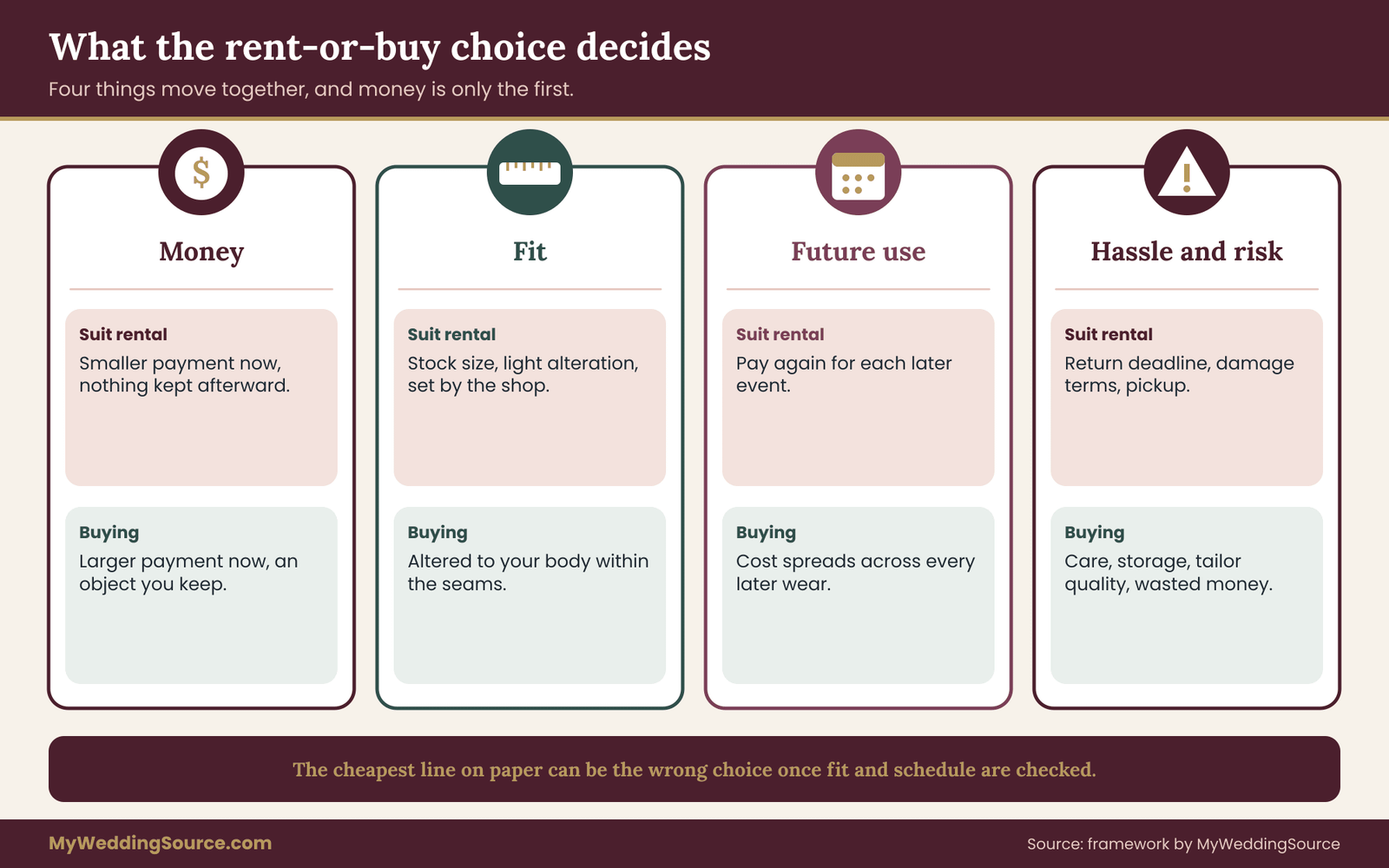
Because four things move together, the cheapest option on paper is sometimes the wrong one. A suit rental that fits badly and photographs badly has not saved money in any way you will value in the album. A purchase that sits in a closet for nine years has not saved money either. The worksheet keeps the dollars honest, and the fit and schedule checks keep the dollars from running the whole decision.
If you are weighing this choice for the whole wedding party, the same logic applies to each person, but their wear counts differ. A groomsman who has no other formal event gets a different answer than the groom. The wedding rental planning checklist covers the group side of renting, including returns, deposits and who is responsible for what.
What this guide does not decide
Two nearby questions are separate from this one. The first is whether the groom wears a suit or a tuxedo, which is a dress-code and style question and not a cost question. The second is the style and color of the outfit, which belongs with the overall look of the day. This guide assumes you have a rough idea of the garment and asks only whether you should rent it or own it.
It also does not rank shops or brands. Prices, policies and quality change from season to season, and any ranking written now would be out of date by the time you booked. The method works with any seller, because it asks you to collect the current terms yourself.
What a suit rental includes, and what it leaves out
A suit rental quote is a package, and packages differ. Before you can compare a suit rental with a purchase, you need to know exactly which items sit inside the number you were given.
The usual contents are the jacket and trousers, and often a vest, a shirt, a tie or bow tie, cufflinks and shoes, either bundled or priced one at a time. Some shops include basic alterations such as trouser hemming. Others charge for each adjustment. Some include a damage waiver, which is a fee that limits what you owe for stains, tears or burns, and others make it optional or leave it out.
Read the quote for what is absent as well as what is present. These are the usual gaps.
Shipping and pickup. If the garment comes by mail, there may be outbound shipping, a return label and a charge if the label is lost. If you collect it in person, you take on the travel to the shop twice, once to collect and once to return.
Late returns. Rental terms usually set a return date, and a late return can add daily charges. If your wedding is on a Saturday and the return is due Monday, you need to know who will carry the garment back and when.
Damage and loss. A rented suit is the shop’s property. Ask what counts as damage, what the waiver covers, and what you pay if the suit is lost or ruined beyond repair.
Deposits. A deposit is not a cost if it comes back, but it is cash tied up, and the conditions for getting it back should be written down.
Alterations. Ask what adjustments the shop will make, who makes them, and whether there is a fee. Ask whether the shop will take in a jacket or only adjust sleeves and hems. Do not assume.
Accessories. Shoes, belts, pocket squares and cufflinks may be separate. Compare like with like: if the purchase path includes your own shoes and the rental path includes rented shoes, put both on the sheet.
Fit and choice limits of a suit rental
The garment you receive comes from stock. Shops carry a range of sizes and, usually, a limited range of cuts. If you sit between sizes, or your shoulders and waist do not match the proportions the size chart assumes, you may be choosing the closest option and not the best one. That is not a flaw in renting. It is a trade for the lower price, and it is worth naming as a trade.
Rental suits are also worn by other people. They are cleaned and pressed between customers, and the quality of that process varies. If the finish of the fabric matters to you, ask to see the actual garment or a recent photo of one from stock, not only a catalog image.
Finally, ask about the trial. Some shops let you try a sample in the right size before you commit, and some offer a replacement if the first garment does not fit. Others do not. A shop that will swap a garment that fails the fit checks in the later part of this guide is worth more than its sticker price suggests, and a shop that will not should be priced with that risk in mind.
A first pass at the numbers
Do not try to finish the math yet. For now, write down the full contents of any suit rental quote you are considering, line by line, and add a note beside every item that is not included. You will need that list in the pricing section. A quote that looks cheap and leaves out shipping, shoes, a waiver and alterations may end up in the same range as one that looks expensive and includes all four.
The same discipline applies on the buying side, where the sticker price leaves out tailoring, tax and care. Treat every quote on either side as a starting point, and let the worksheet do the adding.
Count your wears before you count dollars
The wear count is the most important input in the worksheet, and the one people inflate. Everyone who buys a suit imagines a future full of occasions. The calendar usually has fewer.
The rule is simple: only count an event that is named, dated or very likely, and that would otherwise call for a suit rental. A vague plan to “wear it to things” is not an event. A cousin’s wedding in the spring, a job interview you have scheduled, and an annual dinner you attend every year are events.
Sort future wears into three groups
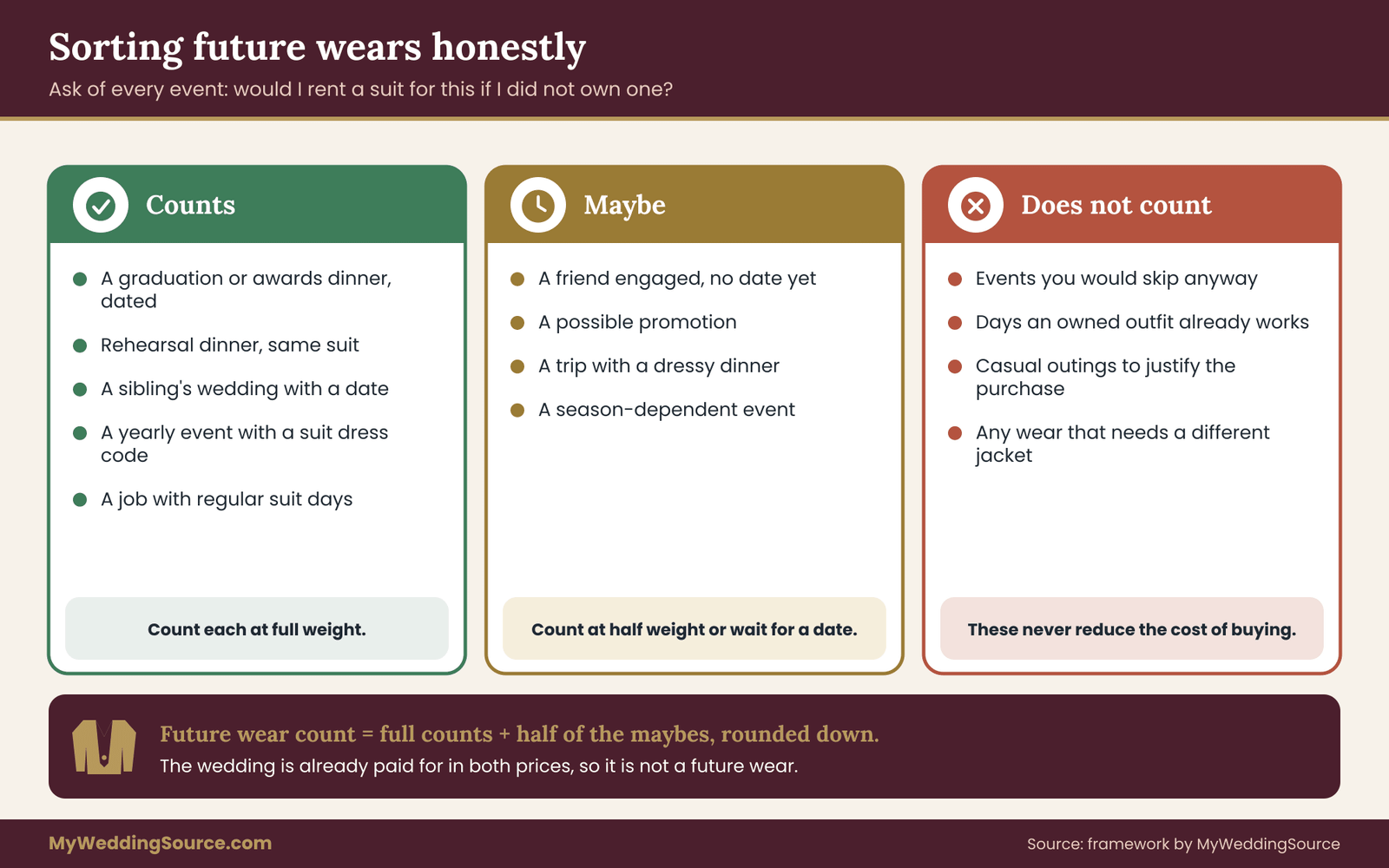
Write every possible wear on a page and put each one in a group.
Counts: named or recurring. The rehearsal dinner, if you would wear the same suit there and the rental fee would not already cover it. A sibling’s wedding on the calendar. A yearly event with a dress code that you have attended before. A job where you wear a suit weekly or monthly.
Maybe: plausible but not fixed. A friend who is engaged without a date. A possible promotion that would bring more formal days. A trip with a dressy dinner. Count these at half weight, or leave them out until you have a date.
Does not count: wishful. Occasions you would like to attend, events that would be fine in a different outfit you already own, and any day where a lighter jacket would do. Also leave out wears that would happen only because you own the suit, such as wearing it to a casual dinner to justify the purchase. That is real use, but it is not saving you a suit rental, because you would never have rented for it.
The test for any entry is the avoided-rental question: if you did not own this suit, would you rent one for this event? If the answer is no, the event does not reduce the cost of buying.
Count wear, not just occasions
One event can be more than one wear. A wedding weekend might include a rehearsal dinner and a day-after brunch, and you may wear the suit to the first and not the second. Count each wear that you would otherwise pay to rent for. On the other side, a rental often covers a multi-day period for a single fee, so a rehearsal dinner plus the wedding may be one suit rental fee and two wears of a bought suit. Ask the shop how its suit rental period works before you decide that the second day is free.
The fit-over-time check
The count also depends on whether the suit will fit when the wear arrives. If you expect your weight to change, if you are still growing, or if a suit tailored closely would not be wearable after a change, discount the later wears. A suit with enough seam allowance to be let out is more forgiving than one cut close with nothing in reserve. A tailor can tell you how much room the garment has.
Style is the other half of fit over time. A suit bought for a wedding in a bold color or a distinctive cut may be hard to wear anywhere else. A conservative, well-fitted garment in a dark solid color has far more future use than a statement outfit. This is a judgment, not a measurement, but it belongs in the count: a wear you would feel awkward doing in that suit is not a wear.
A short script for counting
If you are doing this with a partner, you can read the list aloud. For each future event, say its date or season, say whether the dress code calls for a suit, say whether you already own something that works, and say whether you would rent if you did not own the suit. Mark it counts, maybe or no. Add the counts, add half the maybes, and round down. That is your future wear number. Keep it honest, because the break-even result will be only as good as this one line.
Pricing the suit rental side line by line
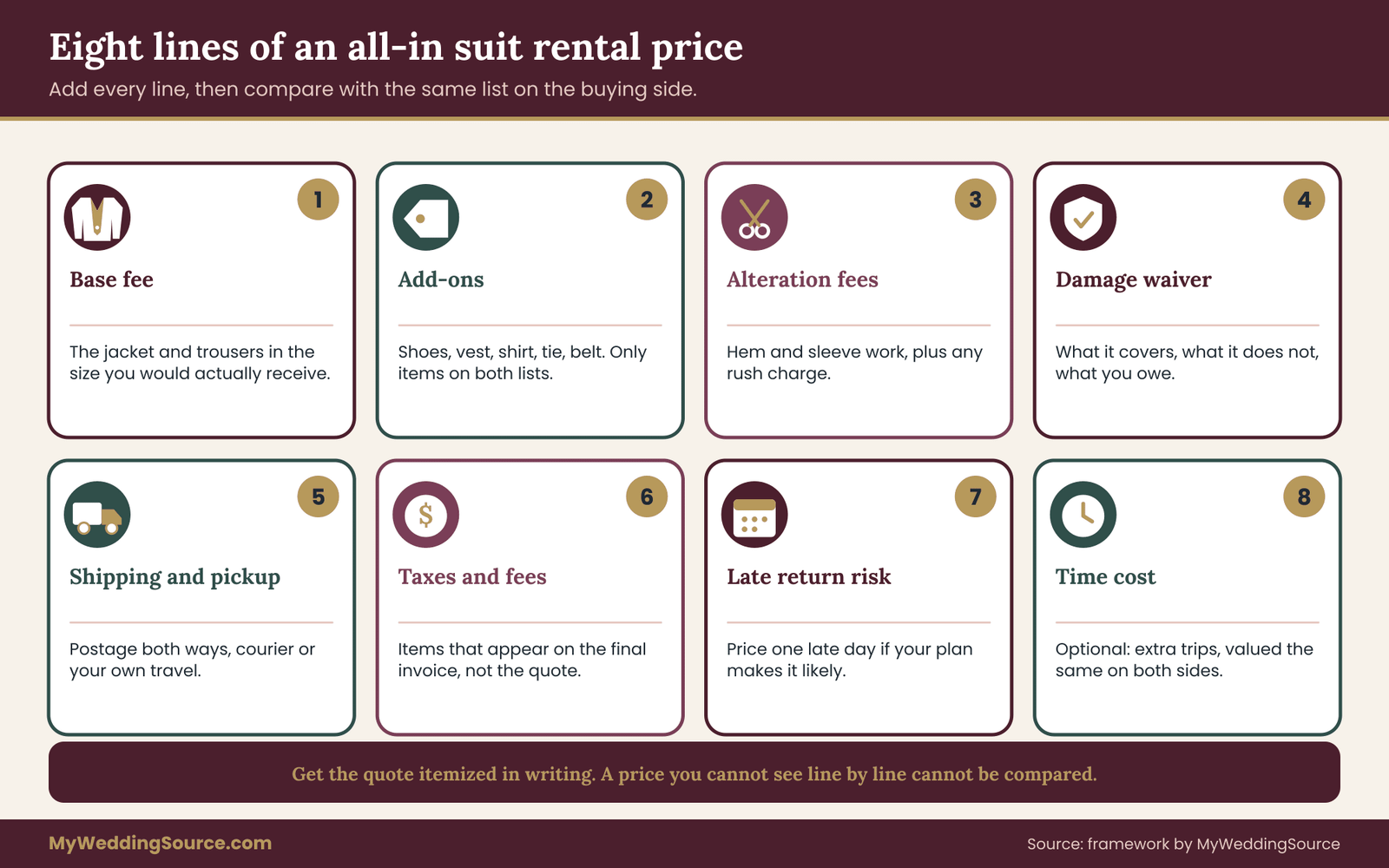
Now put dollars on the suit rental path. The goal is one all-in figure, which the worksheet calls R, for a rental covering everything you would need for the wedding day.
Work through these lines in order and write a number or a zero beside each.
One: the base rental fee. The price for the garments in the package, in the size and cut you would actually receive.
Two: items priced separately. Shoes, vest, shirt, tie, belt, cufflinks and anything else the quote lists as an add-on. Include only items you would otherwise buy or rent on the other path, so both sides cover the same list.
Three: alteration fees. Any charge for hemming, sleeve adjustment or other changes, including a rush fee if the schedule is tight.
Four: damage waiver or insurance. Whether optional or required, include it if you would take it. If you decline it, add a line for the risk you carry, in the form of the charges you could face.
Five: shipping, pickup and return. Postage both ways, a courier, or the cost of your own travel to the shop if it is distant.
Six: taxes and fees. Sales tax and any service charge that appears on the final invoice. Quotes often leave these out.
Seven: late or replacement risk. This one is a judgment. If the shop has a late return charge and you have a plan to return the suit on time, the line is zero. If your schedule makes a late return likely, price one day.
Eight: time cost. Optional, but real. An extra trip to a distant shop costs an afternoon. If the time matters to you, give it a figure you would accept, and be consistent on both sides.
What to leave out of R
Leave out anything that is the same on both paths. If you will wear your own dress shirt either way, it is not part of the comparison. If you will buy the same shoes either way, exclude them. The rule is that a cost goes on both sides or on neither. Mixing a rented shoe on one side with a shoe you already own on the other tilts the answer and makes the worksheet look more decisive than it is.
Deposits are excluded from R if they are fully refundable, but write them next to the sheet as a cash-flow note. If the deposit is partly or wholly non-refundable under the shop’s terms, include the non-refundable part.
Two rental figures, not one
You need R for the wedding. The break-even also needs a second figure, called R-future, which is the price of a suit rental for a later event. It is often lower than R because a later event does not carry wedding-day extras like a matching vest or rush alteration, and because you may choose a simpler package. Ask the shop for a quote for a plain suit rental for a normal event. Do not assume it equals the wedding figure, and do not assume it is much lower. Get a quote.
If you cannot picture ever renting for a later event, that tells you something too. A groom who would simply skip, borrow or use a different outfit for later occasions has an R-future that is effectively zero, and the break-even logic changes. That case appears in the edge cases section.
A word on comparing quotes
When you collect quotes, ask each shop for the same list: the garments, the accessories you want, the alteration terms, the damage terms, the return date and every fee. Put each quote on its own line of a page so you can compare totals. The wedding vendor purchase order checklist shows how to record what you were quoted, so that the final invoice can be checked against it later.
If a shop will not give you a written, itemized figure, treat that as information. A price you cannot see in writing is not a price you can compare, and the worksheet cannot be run on it.
Pricing the buying side: purchase, tailoring and care
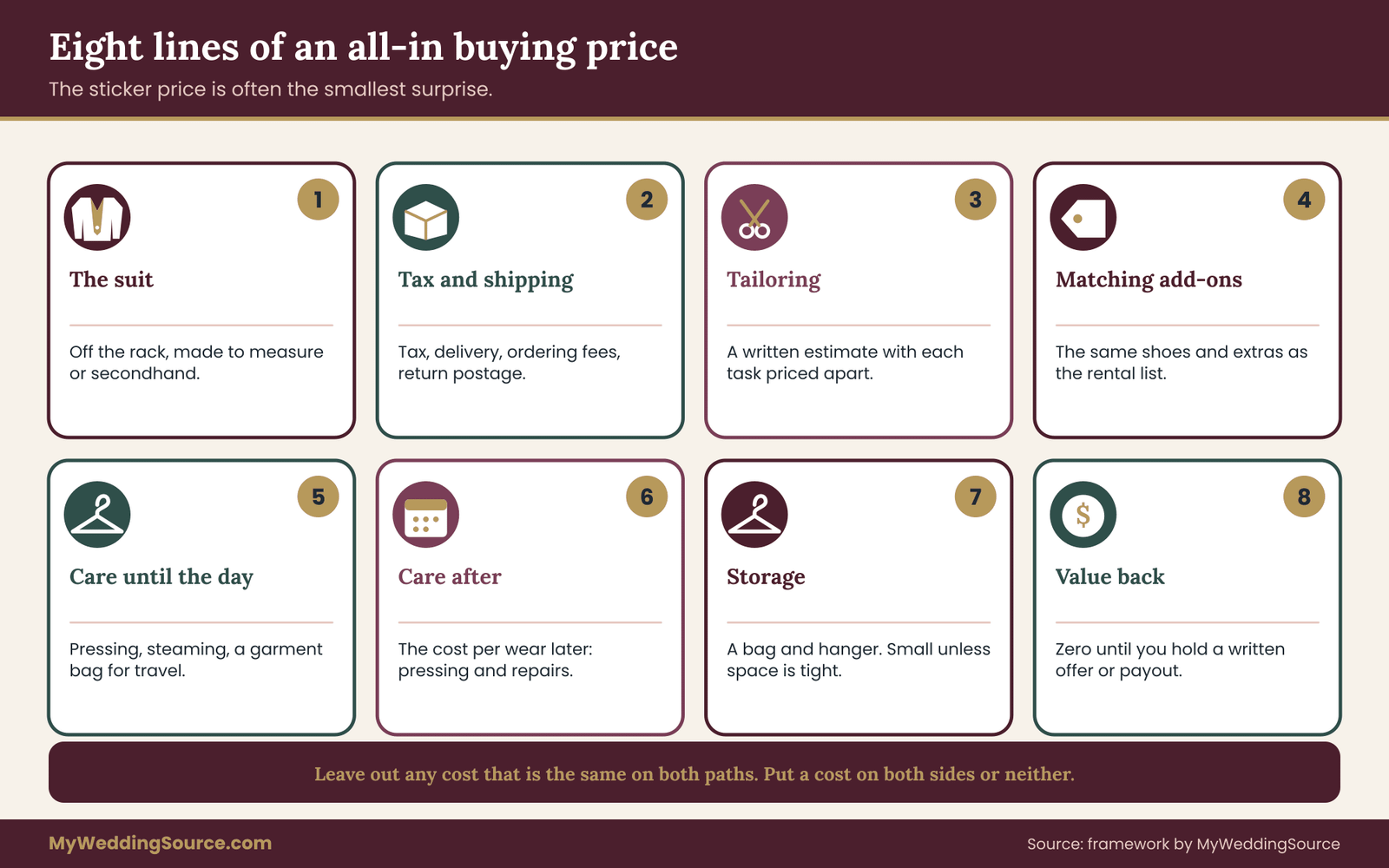
The buying side follows the same discipline as the suit rental side: one all-in figure, called B, with every line written down. The sticker price is the smallest part of B in many cases, and the one least likely to surprise you.
One: the suit itself. The price for the jacket and trousers, in whatever category you are considering: off the rack, a made-to-measure order, a secondhand garment, or an online purchase. Include a vest only if you want one.
Two: tax, shipping and fees. Sales tax, delivery, and any charge for ordering. If an online order ships from far away, include the cost of sending something back if it does not fit.
Three: tailoring. The amount a tailor would charge to bring the suit to a good fit. Do not guess this from a rule of thumb. Call a local tailor, describe the garment, and ask for a quote for the likely work: trouser hem, sleeve length, waist adjustment, jacket taper. Tailors price each task, so ask for each task separately.
Four: accessories matching the rental list. The same list you used on the rental side. If you priced shoes on the suit rental side, price shoes here.
Five: care until the wedding. Pressing, steaming or cleaning before the event. A suit that has been fitted and hung needs a final press, and the cost is small but real. If you plan to travel with it, add a garment bag.
Six: care after the wedding. This is the figure c in the worksheet, the cost per wear after the wedding. It is usually pressing or dry cleaning, and an occasional repair. If you wear the suit often, cleaning is less frequent than every wear, so spread it sensibly. Ask your cleaner what they recommend for the fabric.
Seven: storage. A garment bag, a proper hanger and some closet space. The cost is tiny unless you would need to rent space, which would be unusual. It matters only if the suit would crowd a small home.
Eight: value back. The V figure. This is what you could get by selling or donating the suit after use. It deserves its own section below, because it is the line people overstate most.
Value back: V is zero until it is proven
Resale value is real for some garments and imaginary for others. A well-kept suit in a classic cut from a recognizable maker may sell on a resale site or consignment shop. A suit tailored closely to one body, in a distinctive color, is much harder to sell, because the next owner has a different body and the alterations may not reverse.
The safe rule is to set V to zero unless you have a written offer, a consignment agreement with a stated payout, or a track record of selling similar items yourself. If you do sell, count only what you receive after the platform’s fees and after any shipping you pay.
Donation is different. A donated suit has real use to someone, and you may be entitled to a tax deduction for donated goods, but the rules on what is deductible and how to document it are set by the IRS. Treat any tax effect as a question for a tax professional and check the agency’s guidance on charitable contributions before counting it. For the worksheet, the safest course is to leave tax effects out entirely and treat donation as a good use, not a financial line.
The three ways to buy, in brief
Where you buy changes the numbers and the risks.
Off the rack. You pick a size and have it altered. The price is usually the lowest of the three buying routes, and the result depends on how close the stock size is to your body. A good tailor can do a lot with a decent base garment. Check the fit points described in the next section before you accept that the base is good enough.
Made to measure or custom. The maker uses your measurements, and sometimes a trial garment, to produce a suit that starts closer to your body. The price is higher and the lead time is longer. Ask for the full timeline in writing, including how long a remake takes if the first fit is wrong, and what the maker will fix without charge.
Secondhand. A suit that has already been worn costs less, and the savings can be large. The risks are condition and fit. Examine the lining, underarms, trouser seat and any areas of wear, and plan for tailoring on top of the purchase price. Secondhand suits can also be harder to alter if previous alterations have used up the seam allowance.
None of these is the best choice in general. They are different trades between price, fit and effort, and the worksheet will tell you whether any of them beats a suit rental for your wear count.
Alteration planning for a bought or rented suit
Alteration is where many cost comparisons fall apart, because both sides assume it will work. It works well for some adjustments, and not at all for others. Plan around what a tailor can change, and choose a garment whose problems fall in the easy group. For how many fittings to expect and how to prepare for them, the site’s fit and alterations guide is a useful companion.
Usually straightforward
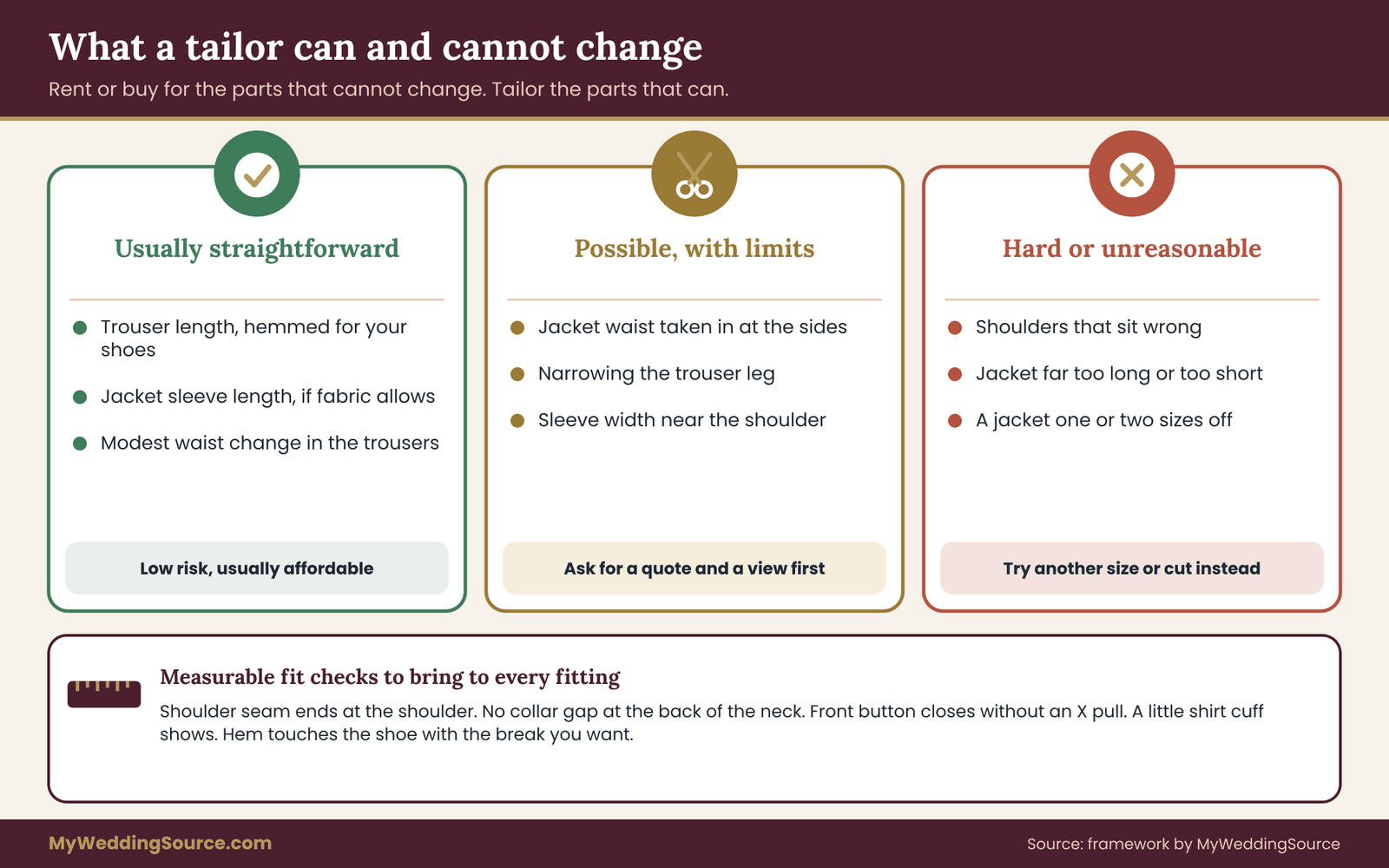
These are adjustments that tailors commonly handle, and that are generally affordable and low risk. Ask your tailor to confirm for your garment.
Trouser length. Hemming to the right length is routine. The finish matters: a hem that suits the shoes you will wear is better than one decided in a shop mirror in socks. Bring the wedding shoes, or shoes with the same heel height, to the fitting.
Sleeve length. Shortening the jacket sleeve from the cuff is common when the sleeve has fabric to give. A sleeve that sits at the wrist bone, with a little shirt cuff showing, is the usual goal. A common guideline is a small band of cuff visible, but your tailor will judge it against your shirt.
Waist of the trousers. Taking in or letting out a modest amount is routine, within the seam allowance the garment has.
Possible, but with limits and cost
Jacket waist. A tailor can often take in the sides of a jacket to reduce billowing, within limits set by the pocket positions and the design. Letting a jacket out depends on how much fabric is tucked into the seams.
Trouser taper. Narrowing the leg is possible, but changes the proportions, and too much changes the look of the suit.
Jacket sleeve at the shoulder. Adjusting the sleeve width or the sleeve head is more complex work. Ask for a quote and a view on whether it is worthwhile.
Hard or unreasonable
Shoulders. If the shoulder seam does not sit at the end of your shoulder, the jacket is the wrong jacket for your body. Rebuilding shoulders is expensive and risky. Treat poor shoulder fit as a reason to try a different size or cut, not as a tailoring job.
Jacket length. Shortening is limited and lengthening is usually impossible. A jacket that is far too long or short is a poor base.
Chest and overall size. A jacket one or two sizes off is rarely rescued by alteration. Start with the right size.
The principle is to buy or rent for the parts that cannot change, shoulders and overall size, and to tailor the parts that can. That rule applies to a suit rental as well, and it explains why trying a sample on matters more than comparing prices.
Measurable fit checks
Before you decide a garment is workable, check it against measurable points that you can describe to a tailor or a shop.
The shoulder seam ends where your shoulder ends.
The jacket collar lies against your shirt collar with no gap at the back of the neck when you stand straight. The jacket closes at the front button without pulling into an X shape. The jacket skirt covers the seat of the trousers or sits near the knuckles of your hand when your arm hangs. A small amount of shirt cuff shows past the jacket sleeve. The trouser waist sits where you intend to wear it without a belt doing all the work. The trouser hem touches the top of the shoe, with the break you want.
Take these checks to every fitting. They give you words for the conversation, such as “the collar gap at the back is about a finger wide,” rather than “it feels off.” A tailor can act on the first and has to guess at the second.
Who alters a suit rental
A suit rental shop may do alterations in-house, send them out, or limit changes to sleeves and hems. The rules on what you may change are the shop’s, since the garment goes back to stock. Ask what can be done, how long it takes, and whether the work is included. If a shop will not let you alter the garment at all, then fit depends entirely on the size you receive, which is another reason to try a sample.
If you rent and still want a better fit, one option is to pay your own tailor for permitted changes. Ask the shop in writing first, because unapproved changes could count as damage under the return terms.
What alteration costs and when it should stop
Tailoring is a fraction of the suit’s price in some cases and a large share in others. A discount suit that needs four changes may cost more than a better garment that needs one. Add the tailor’s quote to the purchase price before you compare, and stop if the total is close to a better base garment. The point of tailoring is to get a good result from a reasonable start, and not to rescue a poor one.
The break-even worksheet for suit rental versus buying
You now have the inputs. The worksheet joins them in five steps. It needs a pencil, one page and the quotes you collected.
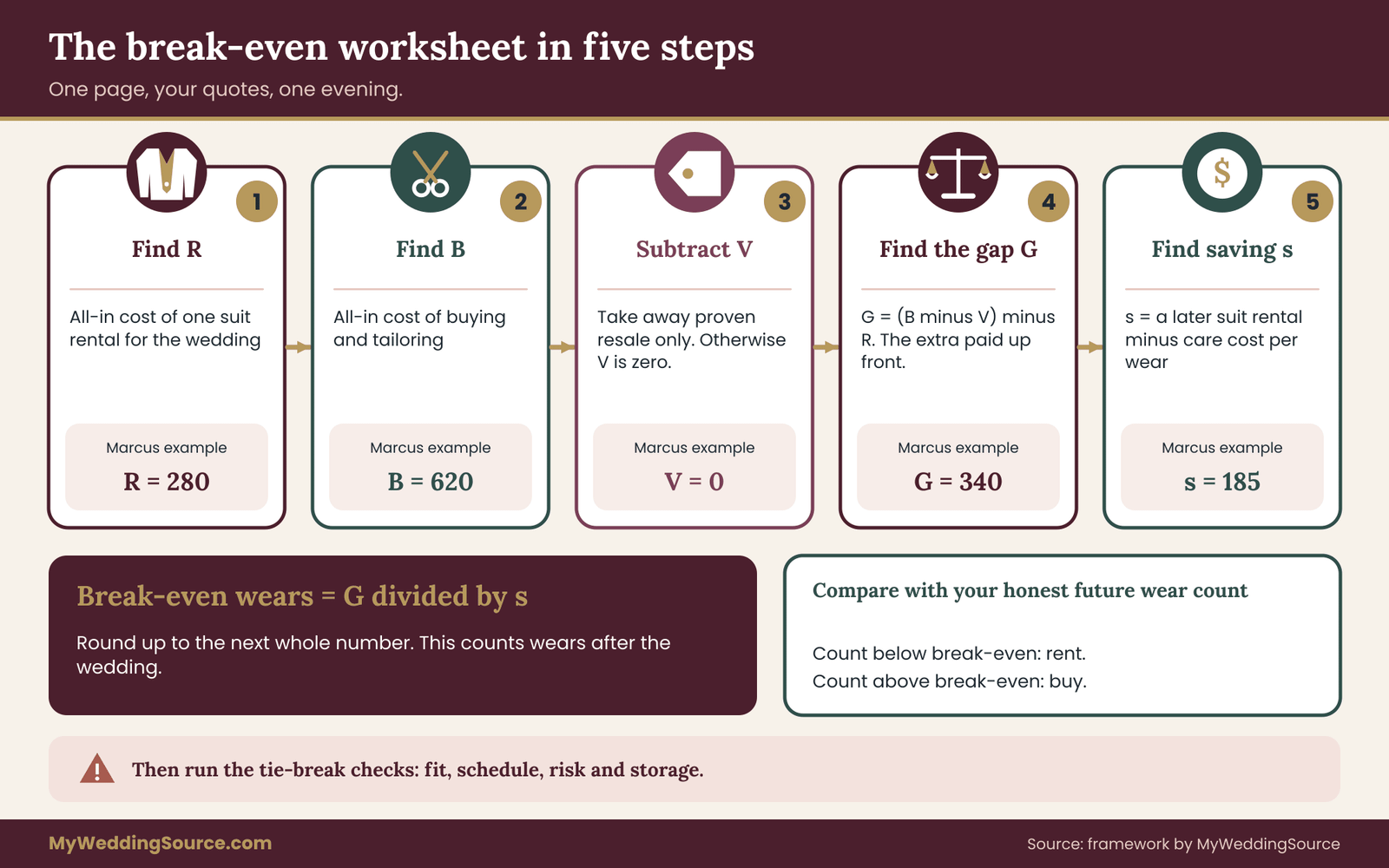
Step one: find R. The all-in cost of one suit rental for the wedding, from the eight lines in the rental pricing section. Include only items that also appear on the buying side.
Step two: find B. The all-in cost of buying and tailoring the suit, from the eight lines in the buying section.
Step three: subtract value back. Take V, the proven resale or consignment payout, and subtract it from B. If V is zero, B stays as it is. Call the result the net purchase cost.
Step four: find the gap, G. G equals the net purchase cost minus R. It is the extra money you pay up front by choosing to buy. If G is zero or negative, buying is already cheaper at the first wear, and you can skip to the fit checks. That is unusual but possible with a secondhand suit or a pricey rental package.
Step five: find the saving per future wear, s. Take R-future, the price of a later suit rental, and subtract c, the care cost per wear of the suit you own. The difference is what each later wear saves you.
The break-even is G divided by s, rounded up to the next whole number. That is the number of future wears needed, beyond the wedding, before buying has cost less than renting every time. Compare it with the honest future wear count you built earlier.
Reading the result
If your future wear count is lower than the break-even number, a suit rental is the cheaper path on the numbers. If it is equal, the paths are a tie, and the choice should turn on fit, convenience and what you value. If your count is higher, buying is cheaper, and the margin is the number of wears above break-even multiplied by s.
Notice what the formula does not include. It does not include the pleasure of owning a suit that fits you, nor the relief of not having a return deadline. It also does not include the risk that a rented suit will not fit well enough. Those are real, and the next section of the worksheet gives them a place.
A second view: cost per wear
Some people prefer to think in cost per wear. Take B minus V, add c for each wear beyond the first, and divide by total wears including the wedding. Compare that with R-future. If your cost per wear falls below what a suit rental would cost for an event, buying is working. The two views give the same verdict, because they use the same numbers. Use whichever is easier to explain to your partner.
The tie-break questions
When the numbers are close, ask four questions and write the answers beside the worksheet.
Does fit change the verdict? If a suit rental would leave you with a garment that fails the fit checks, and a purchase could be tailored to pass them, count that in favor of buying even when the numbers say rent. If the reverse is true, count it for renting.
Does the schedule change the verdict? If you do not have time for a purchase to be ordered and altered, renting may be the only path that works. If the rental must be picked up days before and returned right after, and your travel makes that hard, buying may be easier.
Does risk change the verdict? A suit rental carries damage and return risk. A purchase carries the risk of a poor result from a tailor and of wasted money if the wear count fails to appear. Which risk would bother you more?
Does storage or waste change the verdict? Some people dislike owning things they rarely use. Others dislike repeated rental trips. Neither is wrong. It simply belongs on the page.
Common errors in the arithmetic
A few mistakes appear again and again, and a quick scan will catch most of them.
Putting the wedding in the future wear count is the first one. The wedding is already covered by R and B. Future wears are the events after it.
Comparing a full-package suit rental with a bare purchase is the second. If the rental includes shoes and a vest and the purchase list does not, the comparison is unfair. Put both on the same list.
Forgetting tailoring on the buying side is the third, and it is the most common. A purchase that looks cheaper than a suit rental often loses its lead once a tailor’s quote is added.
Counting resale you have not confirmed is the fourth. Leave V at zero until it is real.
Using the wedding rental price as R-future is the fifth. Ask for a quote for an ordinary event.
Ignoring care cost is the last. A suit you own needs care, and c is not zero.
A worked example with invented numbers
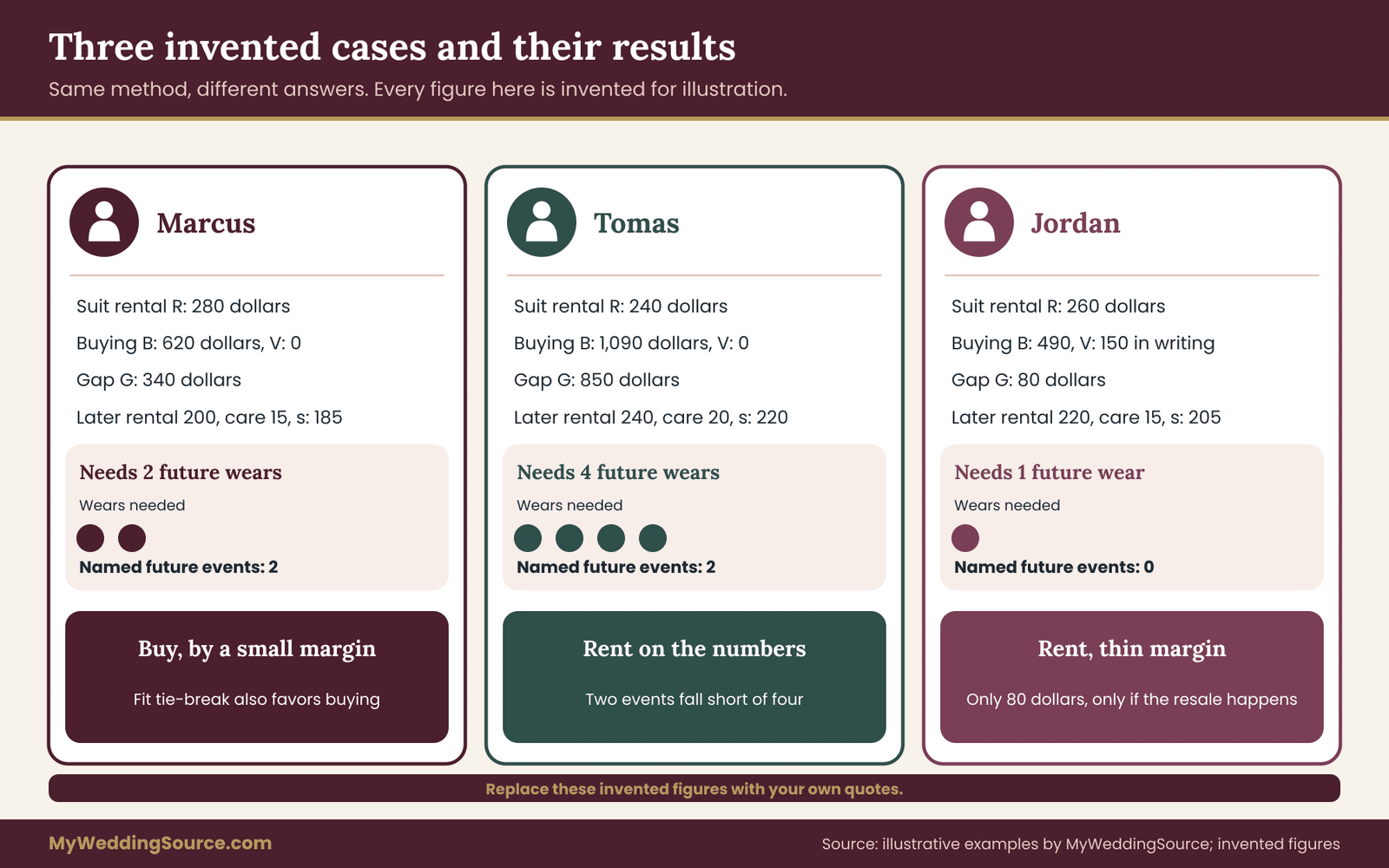
The following three cases use invented figures to show the arithmetic. They are not prices from any shop and should not be used as benchmarks. Replace them with your own quotes.
Case one: Marcus, who expects two more events
Marcus is getting married in the autumn. He has two named future events: his sister’s wedding next spring and an annual dinner with a dress code that he attends every year.
The suit rental quote, with everything he would need, comes to 280 dollars. That is R. He prices an off-the-rack suit at 450 dollars, 36 dollars of tax, 120 dollars for the tailor’s quote and 15 dollars for a garment bag, which makes B equal to 621 dollars. He rounds it to 620. He has no confirmed resale, so V is zero.
G is 620 minus 280, which is 340 dollars. A later suit rental, quoted for a plain event, would cost 200 dollars, so R-future is 200. His estimated care cost is 15 dollars per wear, so s is 185.
Break-even is 340 divided by 185, which is about 1.84. Rounded up, he needs two future wears. He has two named events, so buying is cheaper by a small margin. With a third future wear, the margin grows. If the sister’s wedding falls through, he would have one future wear, and the suit rental would have been cheaper. The result is a mild case for buying. His tie-break question is fit: he sits between sizes, and a suit rental would fit less well. That settles it for buying.
Case two: Tomás, who expects two events and a pricey suit
Tomás wants a made-to-measure suit. The quote, with tailoring, comes to 1,090 dollars all-in after care until the wedding. His suit rental quote is 240 dollars, and a later suit rental would also cost 240 dollars. He estimates care at 20 dollars per wear. He has no confirmed resale.
G is 1,090 minus 240, which is 850 dollars. The saving per future wear is 240 minus 20, which is 220 dollars. Break-even is 850 divided by 220, about 3.86, rounded up to four future wears.
Tomás names two future events: a cousin’s wedding and a work gala. That is below four, so on the numbers the suit rental wins. He should know what he is paying for if he buys anyway. The difference, in wears, is two events that would have to appear before ownership breaks even. If fit is why he wants the made-to-measure suit, he can test whether a suit rental with a good sample fit would meet the need, or whether a lower-priced purchase with tailoring would close the gap.
Case three: Jordan, who can document a resale
Jordan finds a secondhand suit in good condition for 380 dollars and a tailor quotes 110 dollars for adjustments, so B is 490 dollars. A consignment shop has given a written offer to take the suit after the wedding, with a payout of 150 dollars after its commission. V is 150. The suit rental quote is 260 dollars, a later suit rental would cost 220 dollars, and care is 15 dollars per wear.
The net purchase cost is 490 minus 150, which is 340 dollars. G is 340 minus 260, or 80 dollars. The saving per future wear is 220 minus 15, which is 205 dollars. Break-even is 80 divided by 205, about 0.39, rounded up to one future wear.
Jordan has no named future events at all. The numbers say that with zero future wears, a suit rental is cheaper, but only by 80 dollars, and only if the resale actually happens. The consignment offer is in writing, so Jordan is reasonably covered. The 80 dollars is a thin margin for the work of tailoring, selling and storing the suit in the meantime. Jordan might still choose to rent for convenience, and the decision is a fair one either way.
What the cases show
The three cases share a pattern. The wedding alone almost never justifies buying on cost, unless the suit is cheap, the resale is solid or the rental is expensive. A named second or third event usually tips a modest purchase into profit. A costly purchase needs many wears. Resale can move the answer a great deal, and for that reason it must be confirmed before it is counted.
The numbers are only a first filter. Marcus’s decision turned on fit, Tomás’s turns on what he really wants from the suit, and Jordan’s turns on effort. That is the intended use: the worksheet narrows the question, and your judgment finishes it.
Timeline: when to decide, measure and fit
Timing can force the answer before the math does. A purchase needs an order, a delivery and one or two rounds of tailoring. A suit rental needs a fitting window, a pickup and a return. Working backward from the wedding date shows which paths are still open.
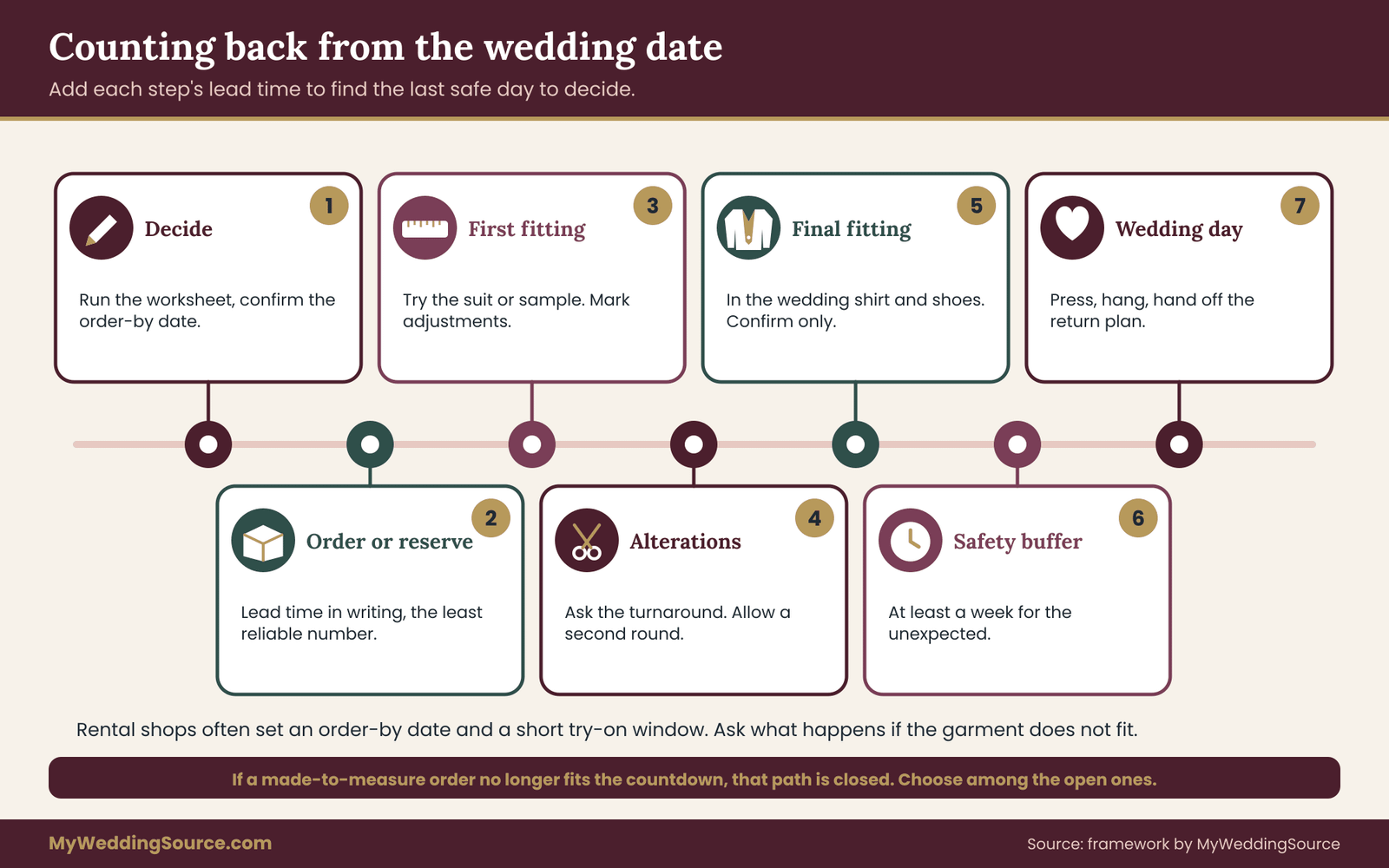
Count back from the wedding date
Start with the wedding date and subtract in this order.
The safety buffer. Leave a gap of at least a week between the last fitting and the wedding, longer if you are traveling. This is the room for a missed button, a hem that sits wrong, or a delivery that arrives late.
The final fitting. The last check, in the shoes and shirt you will wear on the day. It should confirm, not fix.
The alteration turnaround. Ask the tailor how long the work takes, and ask again at the first fitting, because a busy season lengthens it. Allow time for a second round if the first does not pass the fit checks.
The first fitting. The visit where the suit, or the rental sample, is tried and the adjustments are marked. For a purchase, this follows delivery.
The order or delivery lead time. For an off-the-rack suit, this is the time to get the garment into your hands. For made-to-measure, it is the maker’s production time, plus a margin. Get the figure in writing and treat it as the least reliable number on the page.
The decision date. The last day on which you can still start. For a suit rental, this is often the shop’s order-by date. For a purchase, it is the date by which you must place the order to meet everything above.
If the decision date has already passed for a made-to-measure order, you have learned something useful: that path is closed, and the choice is between a suit rental and an off-the-rack purchase with fast tailoring. Seeing that early is better than finding it out in the last month.
Rental timing differs from purchase timing
A suit rental has a different shape. Many shops ask for measurements and an order well before the date, then deliver or hold the garment close to the event. The fitting window may be a single try-on a few days before the wedding, which leaves little time to change a size. Ask the shop three things: the order-by date, when you can try the garment, and what happens if it does not fit when you try it.
That last answer matters more than the price. A shop that will swap the garment and can do so within a day or two removes most of the fit risk. A shop that offers no exchange, or an exchange that needs a week, leaves you with risk that belongs on the worksheet.
If you are renting and your wedding falls in a busy season, shops may run short of stock in popular sizes and colors. The earlier you reserve, the more choice you have. A reservation is often a commitment, so read its terms before you pay.
A schedule you can copy
Here is a plain pattern, to be adjusted to the quotes you collect.
Decide the path and gather quotes. Run the worksheet. Confirm the decision date with the seller or shop. Place the order or reserve the rental. Take measurements, and write them down with the date. Collect the garment, then try it on with the shirt and shoes. Mark the adjustments. Return for a second fitting if needed. Do a final check using the measurable fit points. Press and hang the suit, or confirm the rental pickup and return plan. Share the return details with whoever will handle them.
Weight and body changes
If your weight or build is likely to change before the wedding, tell the tailor or shop before you take final measurements. A suit that fits in the first fitting and not on the day is a common and avoidable problem. A tailor can leave room in the seams where possible, and a rental shop can note your size range. If you are in a training plan or expect any change, schedule the last fitting as late as the process allows, and ask whether last-minute adjustments are possible.
Questions to ask before you pay a suit rental shop or a seller
The worksheet is only as good as the answers you collect. These questions make the quotes comparable, and they put the shop’s promises on the record.
For a suit rental shop
Ask these, and write down the answers or ask the shop to confirm in writing.
What exactly is in the quoted price, item by item? What is not included? What alterations are included, and what do others cost? Who does the alterations, and how long do they take?
What is the order-by date, and when will the garment be available to try? If it does not fit, what are my options, and how quickly? Can I see a sample of the exact garment or a recent photo of one from stock?
What is the suit rental period, and what is the return deadline? What is the late charge? Can someone else return the suit for me, and what proof of return will you give?
What does the damage waiver cover, and what does it not cover? What do I owe for a stain, a tear or a loss? Is there a deposit, and under what conditions is it returned?
What is the cancellation and change policy if the wedding date or my size changes? Is there a fee, and by when?
For a seller or a maker
What is the full price, including tax, shipping and any ordering fee? What is the return or exchange policy for a suit that does not fit, and who pays for return shipping?
For made-to-measure, what measurements do you take, and who takes them? What is the production time, and how firm is that date? What do you fix without charge if the first fit is wrong, and how long does a remake take?
For secondhand, what is the condition of the lining, underarms and seat? Are there any previous alterations, and how much seam allowance is left? Can I return the suit if my tailor says it cannot be fixed?
For the tailor
Which adjustments do you recommend for this garment, and what does each cost? What can you not do? How long will it take, and when must I deliver the suit to you? Can you make two rounds of adjustment within that time? What is your policy if I am not satisfied with the result?
Ask for a written quote that lists each task. A single lump figure hides the information you need to compare a tailored purchase with a suit rental that comes pre-altered.
What to say
If a shop is vague, a calm, specific request usually works. Something like: “I am comparing two options, so I need the full price in writing, including every fee and the return terms. Can you send me an itemized quote?” You are not asking for a discount. You are asking for the facts.
If a shop pressures you to decide on the spot, you can say: “I will decide by the end of the week, and I would like the price held until then, in writing.” A reasonable seller can do that. If it cannot, you have learned how it treats customers who ask questions.
Records of what you were told
Keep every quote, every confirmation and every policy page. Screenshots with the date visible are enough. If a policy changes or a promise is not kept, these are what you will need. The wedding vendor contract guide explains what to look for in an agreement and how to read terms such as deposits and cancellations, which apply to a suit rental order as much as to a venue.
Edge cases that change the suit rental answer
The worksheet assumes a typical groom with a fixed wedding date, a stable body and a few possible future events. Real situations bend those assumptions. Here are the cases that most often change the answer, with a rule for each.
The destination wedding
If you are traveling, a suit rental can be picked up near the venue or shipped there, and either route adds a point of failure. Ask whether the shop has a location near the destination, and what happens if the garment is delayed in transit. A purchased suit travels with you, and that is both its advantage and its risk. It must be packed to arrive without creases, and a steamer or an iron may be needed at the other end.
Add the transport of the suit to both sides. Garment bags, checked-bag fees and steaming belong in the cost lines. If the destination is hot or humid, the fabric weight matters more than usual, and a lighter suit may have fewer future wears at home. That lowers the future wear count, and so it moves the answer toward renting.
Time zones and customs matter too. If the garment ships abroad, ask about duties and delivery windows, and look at the postal service’s guidance on international shipping. The wedding day accessories guide covers how to plan backups and repairs for a wedding far from home, and the same thinking applies to a suit.
A short engagement
When the wedding is a few weeks away, some paths close. Made-to-measure is often out of reach, and a purchase that needs two rounds of tailoring may be too tight. A suit rental from stock, or an off-the-rack suit that needs only a hem, may be the realistic options. In a short engagement, the decision date is usually the deciding factor, so work out the countdown first and let the worksheet cover only the paths that remain open.
A body that is changing
If you expect a significant change in weight, or you are still developing physically, a close-fitted purchase can lose its fit quickly. A suit rental chosen near the date avoids that risk, because it is sized for the day. If you still prefer to buy, ask the tailor how much allowance the suit has to be let out, and discount the future wear count for the chance that it will not fit later.
Unusual size or proportions
If you are very tall, very short, broad or slim in a way that stock sizes handle poorly, the fit gap between rental and purchase is wider. A suit rental shop may carry few options at your size. A purchase, especially made-to-measure, can address proportions that a stock garment cannot. In that case the fit tie-break often outweighs a modest cost difference.
Religious or cultural attire
If the wedding calls for a particular style or garment, the choice may not be between a suit and anything else. The question becomes whether the garment can be rented, borrowed or bought, and what each costs. The worksheet still works, but R and B must reflect the actual garment, and the future wear count may be higher if the attire is worn at family events. Ask relatives and the community, because borrowing within a family is common and often the best route.
The groom who would not rent again
Some grooms know they would never rent a suit for another event. They would skip the occasion, borrow, or wear something they already own. For them R-future is effectively zero, and the formula for break-even does not apply, because there is no future suit rental to save. The question becomes whether the groom wants to own the suit for its own sake. If not, rent. If yes, buy and accept the cost as the price of owning.
A wedding party in matching suits
If the whole party is dressing alike, a group suit rental can come with a package price, a shared return day and a single point of contact. A purchase for everyone is rarely realistic, and different people have different future wear counts. The groom may buy while the others rent, as long as the two garments match in color and finish. Ask the shop how matching works if one person owns a suit and the others rent. The wedding rental planning checklist covers group logistics, including a return plan that does not depend on one person.
A suit you already own
If you already own a suit that fits, the comparison changes. The cost of using it is c for care and any alteration, and the alternative is a suit rental or a new purchase. Often the best option is the one you own, as long as it meets the dress code and the photographs. Check it against the fit points and look for wear in the lining, hems and seat. A suit that has not been worn in years may need work.
If it almost fits, price the alteration and compare it with R. A tailored suit you already own is the cheapest path in many cases.
A rental that arrives wrong
If a suit rental arrives and fails the fit checks, act quickly. Photograph the problem, contact the shop in writing, and ask for the exchange or fix the terms promised. Do not alter the garment without the shop’s written permission. If the date is close, ask what the fastest remedy is and whether it can be delivered. Having a backup plan, such as a local tailor who can make a permitted adjustment or a second shop with stock, is better than depending on one answer.
Other routes: borrowing, secondhand and made to measure
The choice is not only between a suit rental and a new off-the-rack purchase. Other routes exist, and each has its own place in the worksheet.
Borrowing
Borrowing from a relative or friend costs little and can fit well if the sizes match. The risks are damage, the owner’s expectations and the lack of a return policy. If you borrow, agree in advance on cleaning, repairs and what happens if something goes wrong, and offer to pay for pressing. A borrowed suit also needs a tailor if it does not fit, and the owner must agree to any alteration. Put the tailoring cost in B, and set the suit price to zero.
Secondhand and consignment
Secondhand suits can be good value, especially from reputable consignment shops that inspect and clean what they sell. The risk is a garment that has been altered to someone else’s body. Check the seam allowance in the waist, the sleeve and the hem, and ask a tailor to look before you buy if possible. Return terms are often limited, so read them. Treat the purchase price plus tailoring as B, and treat resale as zero.
Made to measure
Made to measure starts closer to your body and gives you a say in fabric and detail. It costs more and takes longer, so it usually needs more future wears to break even. It makes sense when fit is the main problem, when you want a garment you will wear for many years, or when an off-the-rack suit cannot be altered into shape. Ask for the production and remake terms in writing, as described earlier.
Rental subscriptions and long-term rental
Some companies offer rental by the month or by the event. These arrangements can lower the cost of a series of future events, but they change the arithmetic. If you use one, R-future becomes the subscription cost spread over its events. Read the terms for cancellation and limits, since these arrangements vary and can be hard to leave.
Choosing between routes
When more than one route is possible, run the worksheet for each against a suit rental, and compare the break-even numbers. A route with a low break-even and a high fit score is a good candidate. A route with a high break-even and no fit advantage is hard to justify. The comparison is easier when each route is on one line of the page, with R, B, G, s and the break-even, and with a note on fit and schedule.
When the numbers and the preference disagree
Sometimes the worksheet says rent and you want to buy, or the reverse. That is fine. The worksheet tells you what the preference costs. If you want to own a well-fitted suit and the break-even is four wears, you can choose to buy and accept the cost of three wears you will not get. Knowing the price lets you choose it deliberately.
The reverse also holds. If the numbers say buy and you dislike owning clothes you rarely wear, rent and accept that you are paying a premium for convenience. Neither choice is a mistake once you can name the trade.
Protecting yourself and keeping records through a suit rental or purchase
Whichever path you choose, a few habits protect your money and your day. They cost little and matter most when something goes wrong.
Pay in a way that leaves a record
Pay a deposit or balance by a method that leaves a record, and keep the receipt. If a purchase goes wrong, a card payment may give you a way to dispute a charge, subject to the card issuer’s rules and time limits. The Consumer Financial Protection Bureau explains how credit card billing disputes work, including the usual written-notice requirement, so read it before you need it. Rules differ by payment method, and a cash or transfer payment may leave you with fewer options.
Do not pay the whole balance far ahead if the terms allow a later payment. A smaller deposit now and the balance at pickup keeps leverage with you if the garment is wrong.
Read the return and cancellation terms before paying
Return rights for clothing differ widely. Some sellers accept returns of unworn items within a set period, and others treat custom or altered garments as final sale. For online orders, the Federal Trade Commission publishes a rule on mail, internet and phone orders that covers shipping time promises, and the agency’s consumer pages explain what to do if an order does not arrive. It does not require sellers to offer returns. The seller’s own policy governs that, so find it, read it and keep a copy.
For a suit rental, the equivalent terms are the cancellation window, the fee for changing the date or the size, and the damage terms. These are in the rental agreement. If a term is unclear, ask the shop to explain it in writing.
Fiber content and care labels
A suit’s label lists the fiber content and the care instructions. Under rules the Federal Trade Commission enforces, many garments must carry permanent care instructions, and you can use them when deciding whether to dry clean, steam or spot clean. A wool suit and a polyester blend need different handling, and your cleaner can advise. Keep the label intact, and photograph it before you alter the garment, since a tailor sometimes removes or replaces it.
Keep one folder for the whole decision
Create a single folder, on paper or on your phone, with the worksheet, every quote, the shop’s policy pages, the tailor’s written estimate, measurements with dates, and the receipts. If a dispute arises, or you need to prove what was quoted, you will have it in one place. After the wedding, keep the folder until the return is confirmed, the deposit is back and any resale is complete. The wedding budget guide shows how to record planned and actual spending, and this folder gives the clothing line its real number.
Photograph the garment at pickup and at return
For a suit rental, take dated photos of the garment when you receive it, showing any existing marks, and again before you return it. Ask for a return receipt or a written confirmation that the shop has received the suit. If a damage charge appears later, these photos are the evidence that the condition was the same. The same habit helps with a purchased suit if a tailor returns it with a flaw.
Plan the money across dates
A suit rental is often paid in two parts and a purchase in one, with tailoring paid later. Place each payment on your calendar so it does not collide with other wedding bills. The wedding cash flow planning guide explains how to time deposits and balances so that a clothing payment does not arrive in the same week as a venue balance.
After the wedding
For a suit rental, do the return first. Check the deadline, return the suit on time, and collect the confirmation. Then check that the deposit comes back and that no extra charges appear.
For a purchase, clean and press the suit before it goes into storage, using a breathable garment bag and a sturdy hanger. If you plan to sell, do it soon, while the suit is clean and the photos are fresh. If you plan to donate, ask the organization what it accepts, and get a receipt if you may want it for your records.
Then go back to the worksheet and write down what actually happened: the final cost, the wears you really got, and whether the fit checks held. A short note now is useful to you at the next event, and to anyone you advise.
Your next steps
Pick one evening this week. First, write your honest future wear count, using the three groups. Second, collect one itemized suit rental quote, one purchase quote and one written tailor estimate. Third, fill in the worksheet and read the result against your count.
Then run the tie-break questions on fit, schedule, risk and storage, and check the timeline for the decision date. Choose the path, confirm the terms in writing, and put the pickup, fitting and return dates in your calendar. Whether you rent or buy, you will have chosen with the numbers in front of you, and that is a better position than guessing at the counter.
FAQ
Is it cheaper to rent or buy a groom’s suit?
It depends on how many times you will wear the suit and what tailoring costs. For a single wedding, a suit rental is usually cheaper. With several named future events, buying often becomes cheaper. Use the worksheet: find the extra money buying costs up front, divide by what each future wear saves, and compare the result with your honest wear count.
How many wears does it take to break even on a suit?
There is no fixed number. It equals the extra up-front cost of buying, after any proven resale value, divided by the saving each later wear gives compared with another suit rental, rounded up. A modest suit with a low tailoring bill can break even in two or three wears, while a costly made-to-measure suit may need far more.
Should I include tailoring in the comparison?
Yes. Tailoring is part of the price of buying, and a suit rental may include only basic hemming or charge for changes. Get a written tailor estimate, with each task priced separately, and add it to the purchase side. Many purchases that look cheaper than a suit rental lose their lead once tailoring is added.
Can a rented suit be altered?
That is the shop’s decision. Many allow adjustments to the sleeves and trouser hem, and some do little else, since the garment goes back to stock. Ask what is included, what costs extra and whether you may use your own tailor. Do not alter a rental without written permission, because changes could count as damage under the return terms.
Does resale value belong in the calculation?
Only if it is proven. Set resale to zero unless you have a written offer, a consignment agreement with a stated payout or your own record of selling similar items. A suit tailored closely to your body is harder to sell than one in a classic size and color. Count only what you would receive after fees and shipping.
When should I decide between buying and renting?
Work backward from the wedding date and include the order lead time, the tailor’s turnaround, two fittings and a buffer of at least a week. The latest safe start is the decision date. For a suit rental, ask for the shop’s order-by date. If a path no longer fits the schedule, the choice is made for you.
What if I might gain or lose weight before the wedding?
Tell the tailor or the shop before final measurements, and schedule the last fitting as late as the process allows. A suit rental sized close to the date lowers the risk of a change. If you buy, ask how much fabric the seams hold for letting out, and reduce your future wear count if later fit is uncertain.
What should I ask a suit rental shop before paying?
Ask for an itemized written quote, the alteration terms, the order-by date, what happens if the garment does not fit, the return deadline and late charge, what the damage waiver covers, the deposit conditions and the cancellation policy. Keep the answers. A shop that explains its terms clearly in writing is easier to trust than one that does not.
Sources
- Federal Trade Commission
- Consumer advice, Federal Trade Commission
- Clothes Captioning: Complying with the Care Labeling Rule, Federal Trade Commission
- Business Guide to the FTC’s Mail, Internet, or Telephone Order Merchandise Rule, Federal Trade Commission
- How do I dispute a charge on my credit card bill?, Consumer Financial Protection Bureau
- Charitable contributions, Publication 526, Internal Revenue Service
- Textiles: material-specific data, U.S. Environmental Protection Agency
- Consumer protection, USAGov
- National Association of Attorneys General
- ASTM International, standards for apparel sizing