
A wedding caregiver is a professional aide, companion or nurse who attends the wedding with a guest who needs ongoing help, and the day goes better when everyone knows in advance what that person will do, where they will sit, when they will eat and when they will rest. This guide gives you a one-page scope and break sheet, plus scripts, a worked example and a list of what to verify before the day.
::: {.mws-callout} Quick answer: Treat the wedding caregiver as a working guest with a defined job, not as an extra name on a list. Write a one-page sheet that covers six things: what the caregiver does, what the wedding caregiver does not do, the seat and route, meals and breaks, the medical and privacy boundaries, and the contact and handoff plan.
Agree the sheet with the guest’s family and the caregiver or agency at least three weeks ahead, tell the venue and caterer the same facts, and name one person on the day who checks in with the wedding caregiver at fixed times. :::
Most couples who invite a grandparent, parent or friend with significant care needs think about the invitation first and the logistics second. That order is understandable. But a guest who relies on an aide to move, eat, take medication or stay oriented cannot attend in any real sense unless the aide can do the job in the room you have chosen. The caregiver then becomes the most important person at that guest’s table, and often the person nobody planned for.
The usual failure is quiet. The aide arrives, there is no seat beside the guest, dinner is served to the table but not to the aide, the ceremony runs ninety minutes with no place to sit down or step out, and the aide spends the evening improvising. Nobody meant to be unkind. Nobody wrote it down. This guide is about writing it down, in a form short enough that people will actually read it.
A note on scope. This is general planning information, not legal, medical, tax or financial advice. Care arrangements, employment rules and venue policies differ by place and by agency, so the article points to the people and offices that can confirm the current rules for your situation.
What a wedding caregiver does and does not do
The phrase covers several different people, and the first job is to be clear which one you mean. A home health aide from an agency may help with walking, toileting, dressing and eating, and may be trained to follow a written care plan. A private-duty nurse has clinical training and may handle tasks an aide cannot.
A paid companion keeps someone company, watches for confusion or fatigue and offers an arm, without hands-on personal care. A family-hired private aide may fall anywhere between those poles. A relative who acts as the unpaid caregiver is a different case and is covered only briefly here.
For a wedding caregiver, the job on the day is usually narrower than the job at home. The aide is not there to run errands for the couple, to decorate, to supervise other guests or to act as an extra usher. The aide is there for one person. Keeping that line clear protects the guest, protects the wedding caregiver and avoids the awkward moment when a well-meaning bridesmaid asks the aide to fetch a chair for someone else.
The core tasks you can expect
Without writing a care plan for anyone, the common tasks at a wedding fall into a handful of groups. Mobility: getting in and out of a vehicle, walking from the entrance to the seat, using the restroom, moving between ceremony and reception spaces. Eating and drinking: setting up food, cutting or arranging it, watching for choking or fatigue, offering fluids on a schedule.
Medication and health routines: reminding the guest of doses that fall during the event and following the family’s written instructions. Orientation and comfort: keeping a guest with memory loss calm in a loud, unfamiliar room. Communication: speaking with the family if something changes.
Each group needs a decision from you or the family, not from the caregiver alone. Where will the guest sit so that the aide can reach them quickly? Where can food be set up away from the crush? Who holds the medication, and is there a place to store it? These decisions are the substance of the sheet later in this guide.
What a wedding caregiver does not do
Equally useful is a short list of things the wedding caregiver should not be expected to cover. The caregiver does not take on the couple’s emergency role, does not hold the rings, does not serve as the guest’s decision maker unless the family has formally arranged that and told you, and does not take responsibility for other guests with needs.
A caregiver also should not be asked to work through the entire event without a meal or a break because the schedule is tight. A person who has been on their feet for nine hours without food is not safe to be responsible for someone else.
Put the “does not” list in writing as plainly as the “does” list. It prevents drift. At a wedding the requests multiply as the day goes on, and a polite professional will often say yes to avoid friction.
Who is involved when a wedding caregiver attends
Several parties have a stake in the arrangement, and confusion usually comes from two of them assuming the third is handling something. Name each one and what they own.
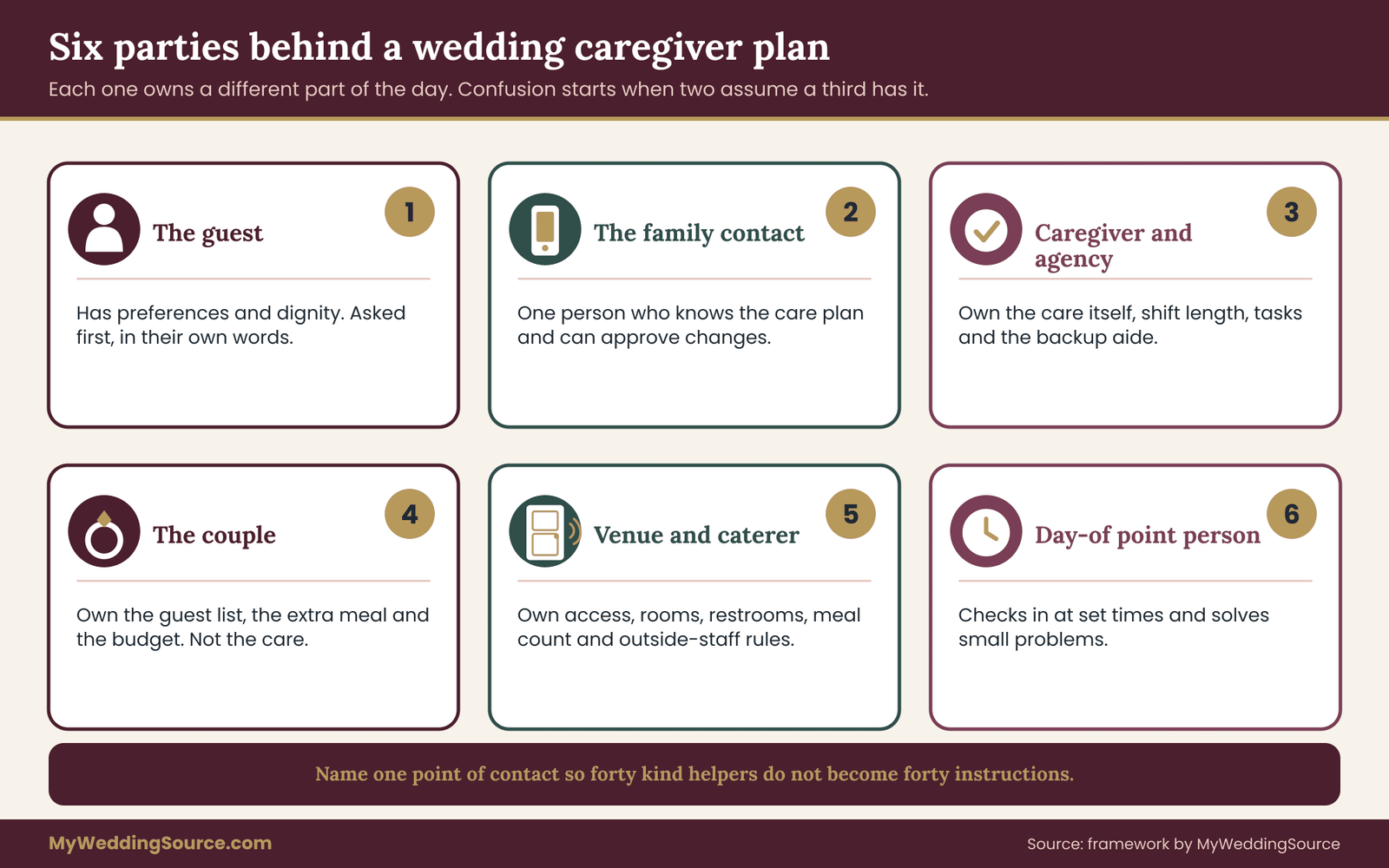
The guest. The person receiving care has preferences, dignity and, in most cases, a say. Ask them what would make the day comfortable before anyone else decides. A guest who is fully capable of speaking for themselves should be asked directly, not discussed in the third person.
The family contact. One relative or representative who knows the care plan and can authorize changes. This is often an adult child. If there are three siblings with different views, pick one and tell the others who it is. You do not want the aide receiving three sets of instructions from the cocktail hour.
The wedding caregiver and the agency. If the aide comes through an agency, the agency usually controls scheduling, pay rates, shift lengths, insurance and what tasks the aide may perform. Ask the agency directly rather than relying on the family’s recollection. If the aide is privately hired, the family is the employer and can decide most of this, subject to whatever local employment rules apply.
The couple. You own the event, the guest list, the budget for any extra meal and the decision about whether the caregiver is counted in the headcount. You do not own the care.
The venue and caterer. They control access, seating limits, restrooms, quiet rooms, meal counts and any rule about outside staff. They need the facts early because they cannot rearrange a room on the day.
The day-of point person. One named person, usually a coordinator, a family friend or a trusted sibling, whose only job is to check on the wedding caregiver at fixed times and solve small problems. Without this person, problems go to the couple, who are the least available people in the building.
Why one point of contact matters more than good intentions
At a typical wedding, forty people want to help the older relative. They bring cake, move chairs, ask the aide questions and offer to take over. All of that is kind and almost all of it is disruptive. A single point of contact turns scattered help into something the aide can use. If a guest wants to help, they speak to the point person, who decides whether the help is needed.
This connects to the broader question of looking after relatives of different ages on the day, which the guide to wedding guest care planning covers from the couple’s side. The focus here is narrower: the paid professional and the practical agreements around them.
Setting the scope before you invite
Before you send an invitation, or at least before you send the final details, work out whether the caregiver is a plus-one, a staff member or something in between. Each framing changes the budget, the headcount and the tone of the conversation.
If you treat the wedding caregiver as a plus-one, they are invited as a guest, counted at the per-head rate and expected to eat and sit like anyone else. That is simple, but it can mislead. A caregiver who is working is not at leisure, and may not be able to dance, drink, leave the table or give full attention to the toasts. Some caregivers appreciate being treated as a guest. Others prefer to be treated as staff so that their role is clear to the people around them.
If you treat the caregiver as a vendor or staff member, they usually receive a vendor meal, a designated seat and a defined arrival and departure time. Many venues and caterers have a lower rate for vendor meals, and some have none at all. Ask rather than assume. The relevant terms are usually in the catering agreement, so it helps to reread your wedding vendor contract notes before you tell the family what is included.
The third option is a hybrid: the wedding caregiver is welcomed as a guest, seated at the guest’s table, fed from the same menu, and understood to be working for the family. This is what most families end up with. It only works if you tell the caregiver clearly that the meal and seat are theirs, and that the family is paying for their time.
Who pays for what
Decide in advance who pays for the wedding caregiver’s hours, travel, parking and meal, and say so in writing. The usual pattern is that the family of the guest pays for the aide’s time, since it is part of the guest’s care, and the couple covers the meal as a courtesy. That is a custom, not a rule. If the couple is hosting an older relative on a tight budget, they might offer to cover part of the hours. If the family has the means, the couple might cover only the meal.
Whatever you decide, avoid leaving it ambiguous. Money surprises on the day embarrass everyone and tend to land on the caregiver. The cost section later in this article walks through the line items so that nothing is forgotten.
Deciding whether a wedding caregiver should attend
Not every guest with care needs requires a professional at the wedding, and not every professional needs to stay the whole day. The decision belongs mainly to the guest and the family. Your job as the couple is to make attendance possible and to be honest about what the venue and schedule demand. A few plain questions help the family decide without anyone feeling judged.
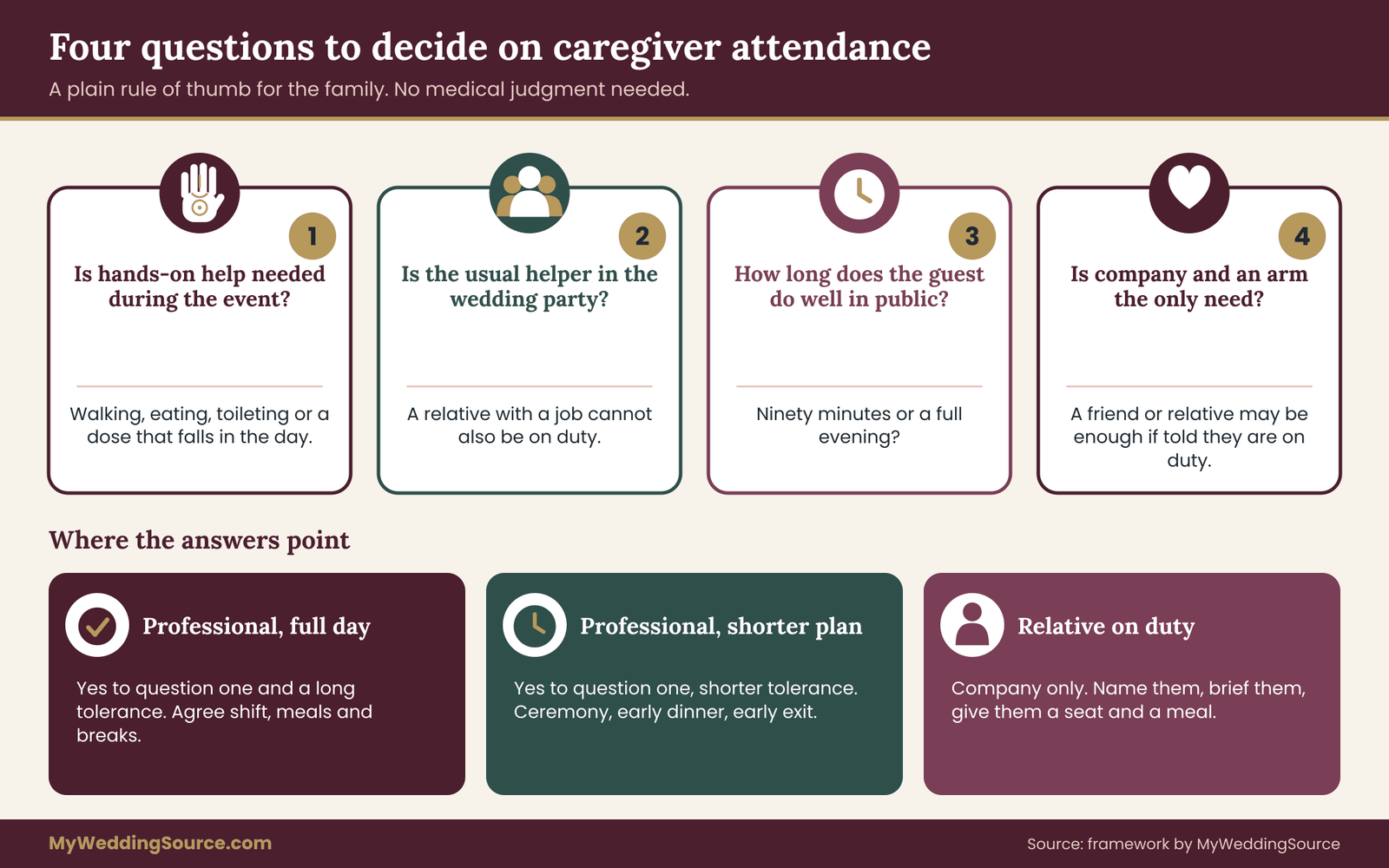
The first is about the guest’s own energy and tolerance. A wedding often involves a long day with unfamiliar rooms, loud music, heat or cold, and a meal served late. Some people with strong support at home find that a three-hour ceremony and reception is fine. Others do well for ninety minutes and then fade. The family usually knows the pattern and can say how long the guest does well in public settings.
The second is about care tasks that fall during the event. If a medication or feeding task lands in the middle of the reception, someone trained has to handle it. If the guest needs help with toileting, a person of the right relationship and skill has to be nearby. If the guest has a condition that can change quickly, someone must be able to recognize it.
The third is about the relationship between family and caregiver. Sometimes a relative can cover the day with no professional at all, and the guest is happier with someone they love. Sometimes the family wants a professional so that relatives can actually attend the wedding rather than monitor it.
A simple decision rule
You can give the family a rule of thumb that does not require medical judgment. If the guest needs hands-on help for any task that will happen during the event, and the family member who normally provides it is also a wedding participant with a job to do, hire or bring a professional. If the only need is company and an arm to lean on, a relative or friend may be enough, provided they are told they are on duty and are not simply a guest.
Another useful rule concerns stand-in coverage. If the family member who usually helps is in the wedding party, they cannot also be the wedding caregiver. A mother of the groom who also looks after her own mother cannot walk down the aisle, take photographs and monitor medication at once. If you notice a conflict like that, raise it early and kindly, and offer to help the family find a paid solution.
When the answer is a shorter attendance
Some caregivers and guests agree on a shortened plan. The guest attends the ceremony and the first hour of the reception, eats early, and leaves before the loudest part of the evening. The caregiver arrives at the start, stays through the early meal and takes the guest home. This approach often works better than a full day and is easier on the wedding caregiver’s hours. It also suits venues where the room becomes crowded after dinner.
If you want to support a shorter plan, look at the timeline with fresh eyes. Could dinner be served early enough for the guest to eat before the dancing begins? Could the toasts come before the cake rather than after? The wedding vendor timeline guide shows how vendor sequencing and those slots interact, and a small change often unlocks a comfortable exit for a guest who needs to leave early.
Talking with the agency, the family and the caregiver
The first conversations set the tone, so it is worth planning what to say and in what order. Start with the family, because they know the guest and have the authority. Then, with the family’s permission, speak to the agency or caregiver. Keep each conversation short and concrete.
Opening the conversation with the family
You are asking for information, not making a request. Something like this works in most families, whether by phone or by message:
“We would love for your mother to be there, and we want it to be comfortable for her and for whoever is helping her. Could we spend ten minutes on what she will need during the day, so we can plan seating, meals and rest?”
Listen for what the family is worried about. Often it is not the big thing you expect. It might be that the guest hates being seated near a speaker, or needs to be next to an aisle, or does not like cold rooms. Write those details down.
Then ask three direct questions. Will a professional be attending, and through which agency or arrangement? Is there a written care plan or instruction sheet, and may the wedding caregiver share the parts that matter for the event? Who is the one person we should contact about changes, and who covers if that person cannot be reached on the day?
Speaking with the agency
If an agency supplies the aide, call or write to the scheduling or care coordinator rather than to the aide directly, unless the family prefers otherwise. Agencies set rules for good reasons, and you want to understand them before you promise anything. Questions worth asking include the following.
What is the minimum and maximum shift length, and how are breaks handled in a long shift? Does the agency permit the aide to attend a social event outside the guest’s home? Are there tasks the aide may not perform away from the home, such as certain lifting or medication tasks? Does the agency charge differently for evening or weekend hours? What is the agency’s backup plan if the aide is ill on the wedding day? Who is the contact if something goes wrong during the event?
Ask the agency to confirm the answers in writing, even if only by email. A confirmed shift time, a named replacement process and a contact number are worth far more on the day than a friendly assurance on the phone.
“Could you confirm in writing the shift length, whether a meal break is built in, and who we call if the scheduled aide cannot attend?”
Speaking with the caregiver
Once the agency or family agrees, you or the family contact can speak with the wedding caregiver directly. The goal is respect and practical detail. The caregiver knows the guest far better than you do, and the best plans come from asking what they would want.
Share the venue address, arrival point and parking, and ask what time they plan to arrive. Describe the ceremony space and the seat you have in mind, and ask whether it suits the guest. Ask whether they would prefer a quiet place to sit during the ceremony or to stay close to the aisle. Ask about the guest’s meal needs, and whether the wedding caregiver has a preference for their own food, including any dietary needs. Ask what they would find hardest about the day, and then take the answer seriously.
A caregiver who feels welcomed and informed will help you solve problems. One who feels like an afterthought will quietly cope and say nothing, which is how small issues become large ones.
Employment and pay questions to leave with the family
You do not need to become an expert on home care employment. If the caregiver is privately hired, the family is the employer, and wage, overtime and time-recording rules can apply to paid care work. The U.S. Department of Labor’s Wage and Hour Division publishes information for home care workers and their employers, and the family can use it or ask an accountant or employment adviser.
The couple should not tell the family how to pay the aide, but you can mention that the long wedding day may create overtime or extra hours, and that it is worth checking before the day rather than after.
If the couple is paying part of the cost, keep a short note of what you agreed, the amount, who it goes to and the date. Informal notes avoid misunderstandings and give the family something to refer to when they settle with the agency.
Timing the conversations
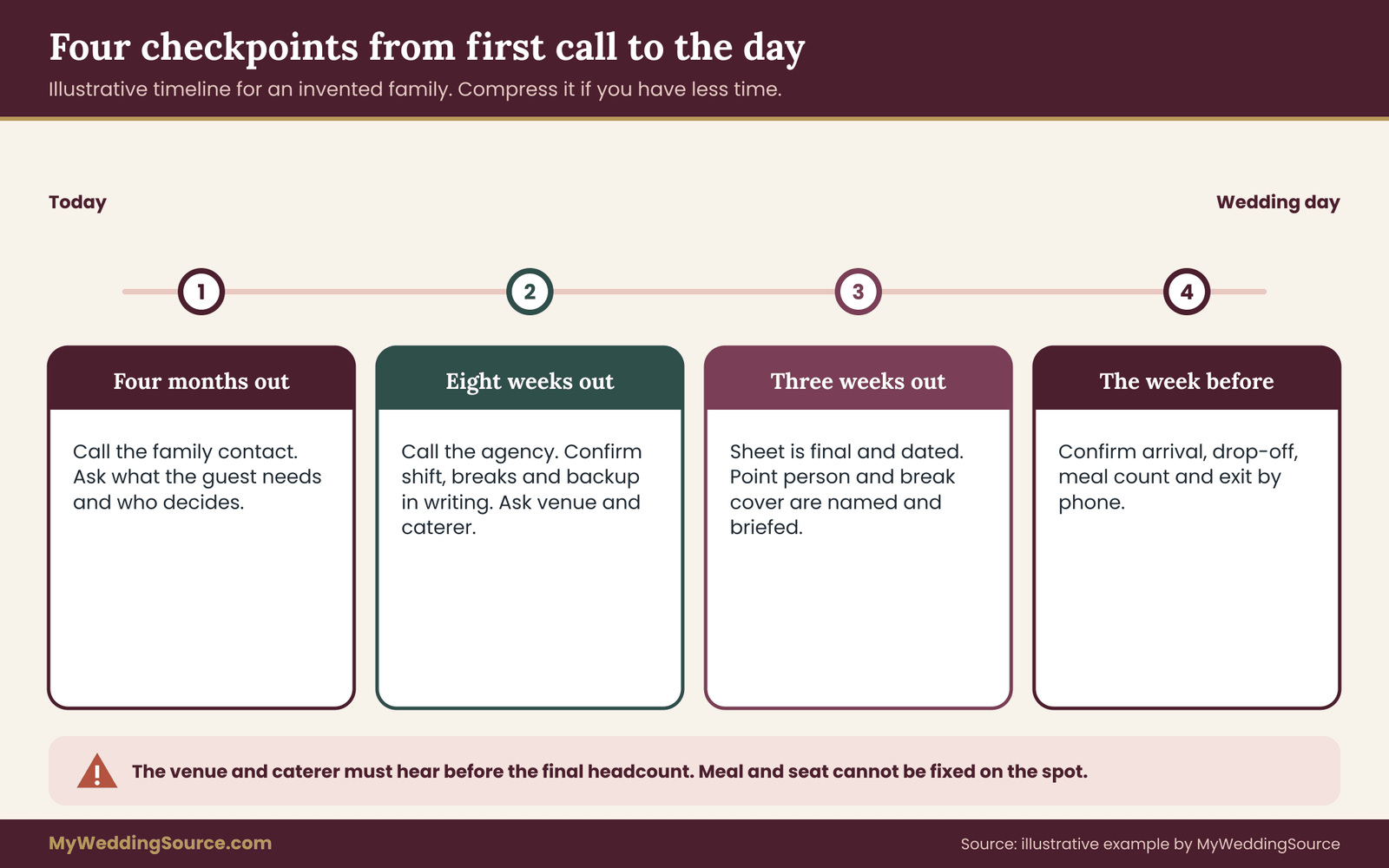
The timing of these conversations matters more than their length. Three to four months before the wedding is a good time to raise the topic with the family, once the venue and date are fixed. Six to eight weeks before is when you should speak with the agency and share the draft sheet. Three weeks before is the point where the sheet is final and the venue and caterer are told. One week before is when the day-of point person and the wedding caregiver speak by phone and confirm arrival.
If you have less time than that, compress it, but do not skip steps. If the family only tells you ten days before the wedding that an aide will attend, the sheet can still be written in an evening. What matters is that the venue and caterer hear about it before the final headcount, because the meal count and seat are the two items that cannot be fixed on the spot.
If you are working from a larger plan, the wedding planning checklist is a good place to add the caregiver conversations as dated tasks so they do not fall off the list in the final month.
What to do if the family disagrees about the plan
Occasionally family members disagree about whether a wedding caregiver should attend, who should pay or what the guest can manage. You are not the mediator and should not try to be. Say what the event can offer, say what you are able to cover, and ask the family to decide who speaks for the guest. If the guest is able to express their own wishes, ask them. A calm statement such as “we will support whatever the family decides, and we need to know by this date for the meal count” gives everyone a deadline without taking a side.
The wedding caregiver service scope sheet
This is the core document. It is one page, written in plain language, and shared with everyone who needs it: the family contact, the caregiver or agency, the venue contact, the caterer and the day-of point person. It is not a care plan and it does not replace the instructions the family and agency already use. It describes how those instructions fit into the wedding day.
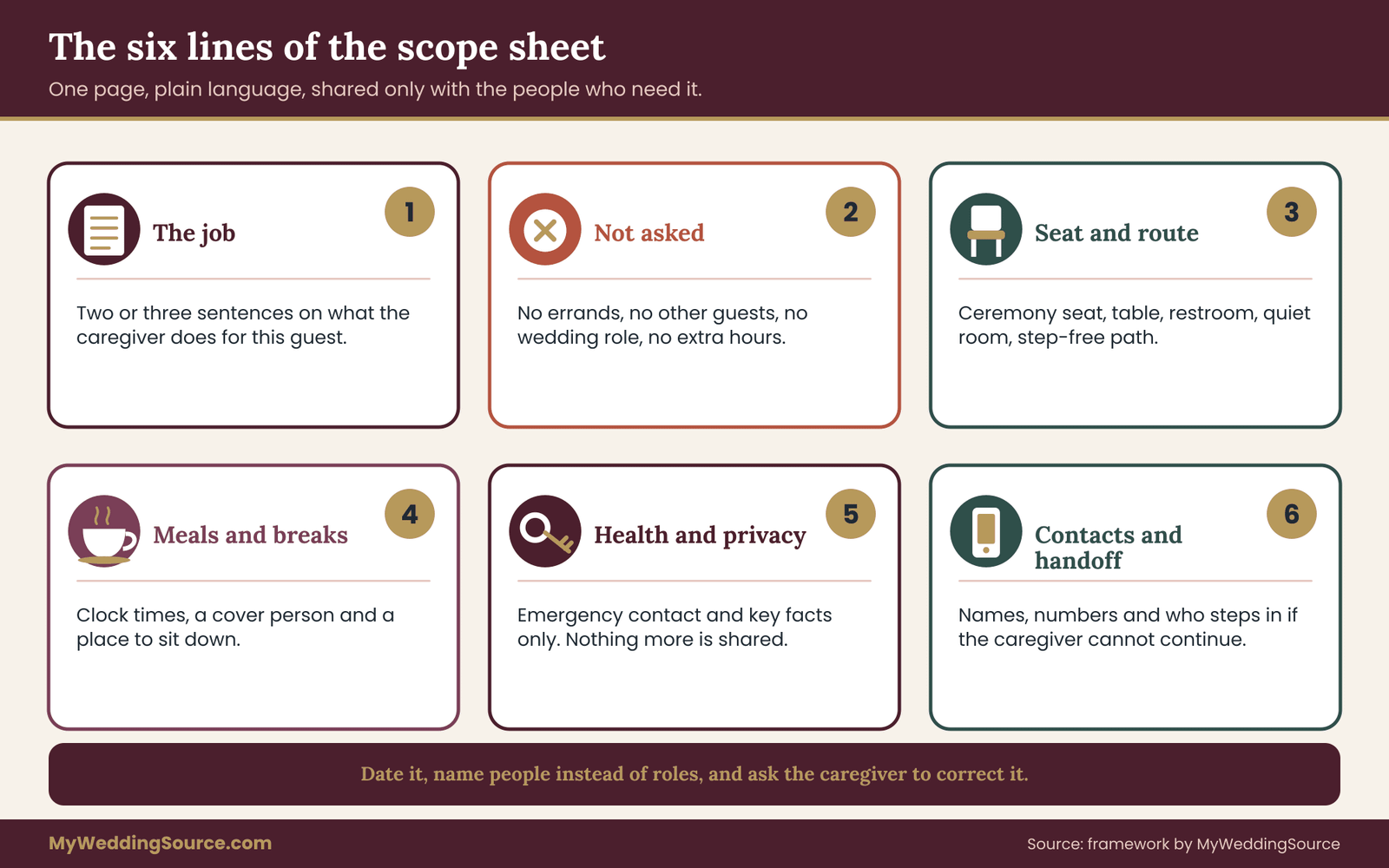
The sheet has six lines. Each one answers a question that, if left open, tends to become an argument on the day.
Line one: the wedding caregiver’s job on the day
Write two or three sentences describing what the caregiver does for this guest during the event. Use the family’s words where possible. For example, the wedding caregiver stays within arm’s reach of the guest, helps with walking and restroom visits, assists at meals, reminds the guest of the afternoon medication according to the family’s written instructions, and watches for tiredness.
Resist the urge to list every task. A long list invites the question of what is not on it. Instead describe the job in terms of the guest’s needs, and add the one or two tasks that are specific to the event, such as helping the guest into the ceremony seat and out again.
Line two: what the caregiver is not asked to do
Next, list the things the wedding caregiver is not expected to do. Typical entries: no duties for other guests, no vendor or couple errands, no photography duty, no role in the wedding party, no expectation to stay beyond the agreed hours. If the guest has needs that fall outside the agency’s allowed tasks away from home, note that the family has arranged separate help for those tasks. Having this line lets the caregiver say, “that is on the sheet” instead of making an individual decision each time someone asks.
Line three: seat, route and rooms
Describe where the guest and caregiver will sit at each stage of the day, how they will get there, and which rooms they may use. Include the ceremony seat, the cocktail hour spot if there is one, the reception table, the nearest accessible restroom, a quiet room if you have one, and a place to store a bag and medication. Mark the step-free route and the drop-off point. Keep it to a few lines; a small hand-drawn map helps more than paragraphs. A later section of this guide goes into the room layout in detail.
Line four: meals and breaks
Give the wedding caregiver’s meal and break plan in clock times. When does the guest eat, when does the caregiver eat, who watches the guest during the wedding caregiver’s meal, and where does the caregiver take a break? A line such as “caregiver eats at the same table at the same time as the guest, with a break of fifteen minutes at roughly three o’clock in the quiet room, covered by the point person” is far more useful than “caregiver will have a break.” The meal and break section below develops this line fully.
Line five: health, privacy and emergencies
Record what the family has agreed to share. Typically this includes the guest’s name for emergencies, one or two key health facts that a first responder or venue staff member should know, where the medication is, who the emergency contact is and what to do if the wedding caregiver cannot reach that person. It should not include more medical detail than needed. Keep the sheet to what the venue and point person must know, and let the caregiver carry the rest in their own materials.
A reminder on privacy. The guest’s health information belongs to the guest and family. Share the sheet only with the people who need it, do not post it in a group chat, and do not leave a printed copy on a table. The U.S. Department of Health and Human Services publishes background on health privacy rules, which mainly apply to healthcare providers and their partners rather than to a wedding, but the underlying habit of sharing the minimum is a good one.
Line six: contacts and handoff
List the names and phone numbers that matter: the family contact, the agency’s after-hours line, the day-of point person, the venue manager and the person who can drive the guest home. Add the handoff plan in one sentence. If the wedding caregiver has to leave early, becomes ill or reaches the end of their hours, who steps in and what do they do? For many weddings, the answer is a relative who has agreed in advance to take over for the last hour.
Writing the sheet so people use it
A sheet that is too long will not be read. Aim for a single page with plain headings, short lines and a readable font. Print two copies and keep a digital copy that does not require any login. On the day the caregiver, the point person and the venue manager each carry one.
A few habits improve how the sheet works.
Date it and put a version on it. If something changes, update it, send it to the same people and tell them what changed. People trust a document that says “updated Tuesday” more than one with no history.
Use names, not roles, wherever you can. “Priya will check in with the wedding caregiver at 5:30” is far clearer than “the coordinator will check in.”
Put times in the same format throughout. If the day is built on a twelve-hour clock, use that everywhere. Do not mix twenty-four-hour times into one line.
Ask the caregiver to read it and correct it. They will often spot something you missed, such as a seat that is too close to a speaker or a break that falls exactly when the guest needs help.
A worked version of the sheet
Here is an illustrative sheet, written for an invented guest so that you can see how little text it takes. The details are made up for the example and are not a template for any real care plan.
Guest: Mr. Alan Brooks, grandfather of the bride. Caregiver: Denise, from an agency, scheduled two to nine in the evening. Family contact: his daughter Karen.
Job. Denise stays beside Mr. Brooks, helps with walking and restroom visits, sets up his meal, and reminds him of his early-evening medication from the sealed organizer Karen supplies.
Not asked. Denise is not asked to help other guests, run errands or stay past nine. Karen has arranged a driver for the trip home.
Seat and route. Ceremony: aisle seat in the third row on the left, near the side door. Reception: table two, seat nearest the restroom corridor, Denise on his left. Step-free entrance is on the north side; the van drops off there.
Meals and breaks. Dinner is served at about six. Mr. Brooks eats at six with Denise beside him; Denise eats her own meal at six forty-five while Karen’s cousin Joel sits with him. Denise takes a fifteen minute break at about four in the garden room, covered by Joel.
Health and privacy. Karen holds the written care plan. The organizer is in Denise’s bag, kept under the table. Emergency contact is Karen. Venue manager is told only that a guest uses a walker and has a care aide.
Contacts and handoff. Karen, the agency’s after-hours line, Joel, the venue manager. If Denise cannot continue, Joel takes over and calls Karen.
The sheet fits on one page, and every line answers a real question. Notice what it leaves out: no diagnosis, no list of every task and no instructions about the party itself.
Sharing the sheet with the venue and caterer
Once the family and caregiver agree on the sheet, send the relevant parts to the venue and the caterer. They do not need all of it. The venue needs the access route, the seat locations, the quiet room request and the emergency contact. The caterer needs the meal count, the wedding caregiver’s meal choice and timing, and any dietary details for the guest and caregiver.
Be specific about what you are asking. “Please reserve a step-free route from the north entrance to the ceremony and reception” is a request they can act on. “Please make sure Grandpa is comfortable” is not. If the venue has accessibility information on file, ask them to confirm it for your guest rather than assuming. The ADA.gov site explains the general framework of accessibility rights and responsibilities in the United States, and it is a reasonable place to start if the venue pushes back on a request.
A venue’s own policies, and the specific rules that apply to a private event space, can vary, so ask the venue directly and ask for answers in writing.
If the venue is new to you and you have concerns, the checklist in the accessible wedding venue red flags guide covers what to look for in the building itself.
Meals and breaks for a wedding caregiver
Of the six lines on the sheet, meals and breaks are the most often neglected and the most often resented when neglected. A caregiver who works a nine-hour shift without a seated meal is tired, hungry and less able to notice changes in the guest. A guest who is left alone while the caregiver eats may be unsafe or distressed. The solution is not complicated. It requires a clock, a name and a place.
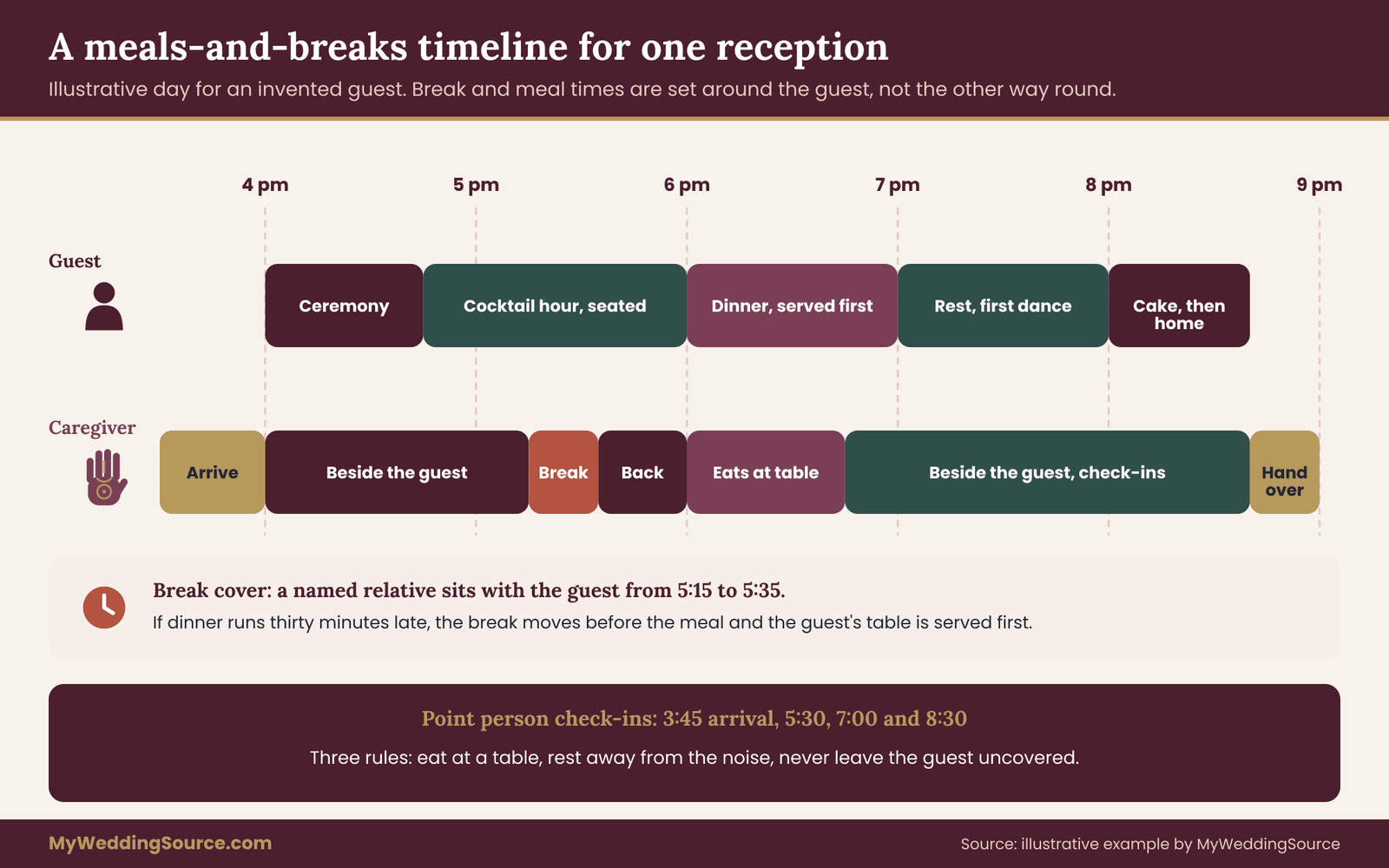
Think of the plan in two parts. One is the guest’s schedule: when they eat, drink, take medication and rest. The other is the wedding caregiver’s schedule: when they eat, take a break and hand over the guest. The two have to be built together, because every minute the caregiver is off duty, somebody else is on.
Start from the guest’s schedule
Ask the family for the guest’s usual times. Many older guests eat early and in smaller amounts, and a reception dinner that arrives at eight o’clock may arrive hours after they would normally eat. If the guest takes a medication with food, the meal time may be fixed. If the guest has swallowing difficulty, the food may need to be cut, softened or served separately. These facts determine when the plated meal, the buffet turn or the early tray should happen.
Share the guest’s schedule with the caterer and ask three things. Can this table be served first or early? Can the guest’s plate be prepared to the family’s description? Can drinks, including water, reach the table before the toasts? Most caterers can accommodate this when asked a few weeks ahead, and many cannot when asked at the door.
A plated dinner makes this easier than a buffet, since the guest does not need to stand in a line. If you have a buffet, the guide to wedding reception guest flow explains how table-by-table release can put your guest early in the line.
Then build the wedding caregiver’s meal
The caregiver should eat a proper meal at a table, not a cold plate balanced on a knee in the hallway. There are three workable patterns, and the right one depends on how independent the guest is at meals.
Together. If the guest eats on their own with light help, the wedding caregiver eats at the same time, sitting beside the guest and attending as needed. This is the simplest and works for many guests. The caregiver’s plate arrives with the guest’s, and the caterer counts it as a guest or vendor meal.
Staggered. If the guest needs close help throughout the meal, the wedding caregiver eats after the guest has finished, ideally within about half an hour. A relative or the point person sits with the guest while the caregiver eats. The wedding caregiver’s plate is held warm or served on request.
Separate. If the guest needs attention at all times and no replacement is available, the caregiver eats in a quiet room while the replacement sits at the table. This is the least social option and should be used only when the other two will not work.
Whichever pattern you choose, tell the caterer which meal the wedding caregiver receives and at what time. Servers can then deliver it without asking the table.
The meal question that causes the most trouble
The question that surfaces most often is whether the caregiver gets the same meal as other guests. In many cases the answer is yes, with the same menu choice. Where the catering contract offers a lower-cost vendor meal, a wedding caregiver may be offered that instead. Ask the family and the caregiver which they prefer, and tell the caterer in writing. Whatever you choose, make sure the wedding caregiver receives a real meal with the same hospitality as any guest. A packed sandwich handed over at ten at night is not the same thing.
Dietary needs apply to caregivers too. If the caregiver has allergies or religious or ethical dietary rules, they should be able to tell you directly. Add it to the meal count in the same way you would for any guest.
Breaks: the part everyone forgets
A break is not a luxury for a paid worker on a long shift. It is a basic requirement of a sustainable day, and the specific rules about paid and unpaid breaks depend on the employer, the place and the arrangement. The agency or family will know the terms. Your task is to make a break possible within the wedding timeline.
Ask the wedding caregiver or agency what break pattern they normally follow. A common pattern is a short break in the middle of a shift and a meal break of twenty to thirty minutes, but patterns differ, and it is not for the couple to set them. Once you know the pattern, build them into the schedule.
Choosing when the break happens
A good break window is a time when the guest is settled and little is happening. At many weddings this is the cocktail hour, when the guest has a seat and a drink, or the period after the main course and before the dancing. A poor break window is during the ceremony, during the first dance, or while the guest is eating. If the guest becomes anxious when the caregiver leaves, make the break short and have a familiar relative step in first.
Mark the break window on the sheet in clock times. A flexible window of about half an hour is better than a fixed minute, because things run late.
Choosing where the break happens
The wedding caregiver needs somewhere to sit down away from the noise. Ask the venue for a room, even a small one, with a chair, water and a door. A bridal suite that is empty during the reception, an office, a lounge, a garden room or a quiet corner can all work. Tell the caregiver where it is and who has the key.
If the venue has no space, a chair near a side door or in a hallway is better than nothing, but say so honestly and let the wedding caregiver decide whether it will do. At an outdoor wedding, shade, a seat and a cold drink might be the whole of it.
If there is a quiet room, it can also serve the guest. A guest with memory loss or sensory sensitivity may find a short rest away from the music more helpful than any other accommodation. A nursing room is set up for a different user, but the same logic of a private seat, a closing door and a clear sign applies.
Choosing who covers
Every break needs a cover person, named in advance, who knows the guest and has been told what to watch for. A relative who loves the guest but has never seen the care routine is not a safe cover for a medical task, though they can do a lot: sit with the guest, hold a hand, bring a drink, flag a problem. Ask the caregiver what the cover person should and should not do, and let the wedding caregiver brief them briefly before the break.
If no relative is available, the day-of point person can cover for a short window, but they should not be the only cover for long, because they have other jobs.
Worked example of a meal and break plan
To make this concrete, consider an invented guest, Mrs. Lopez, who is ninety years old, attends with an agency aide named Marcus and needs help cutting food and walking to the restroom. The reception runs from five to ten. The family wants Mrs. Lopez to stay through the cake cutting, at about eight thirty.
The plan reads like this. Marcus arrives at four thirty and walks the route with the point person, so he knows where the restroom and the quiet room are. The ceremony is at five, and Mrs. Lopez sits in an aisle seat in the second row with Marcus beside her. The cocktail hour starts at five forty. Mrs. Lopez sits at her table with a drink and Marcus sits with her. At about six fifteen, with the guest settled, Marcus takes a twenty minute break in the quiet room, while her grandson Daniel sits with her.
Dinner is served at six forty-five. Mrs. Lopez’s plate comes first, with the food cut in the kitchen according to the family’s note. Marcus eats at the same table at the same time, and a server brings his plate with hers. After dinner, Marcus escorts her to the restroom, then she watches the first dance from her seat. At eight thirty she stays for the cake. By nine she is tired, and Marcus and Daniel walk her to the north door where her daughter is waiting with the car. Marcus’s shift ends at nine thirty.
Several things worked here. The break fell in a quiet window. The meal was at the same time as the guest’s. The cover person was a relative who had agreed in advance. The exit was planned, and the caregiver had enough time to finish without rushing.
What to do when the day runs late
Weddings run late. The cocktail hour stretches, the photographs overrun, the dinner starts forty minutes behind. When that happens, the wedding caregiver’s break and meal windows move too. The point person’s job is to notice the delay early and adjust, rather than let the caregiver wait until the guest is hungry and the wedding caregiver is exhausted.
Build one rule into the sheet. If dinner is more than thirty minutes behind, the point person asks the caterer to serve the guest’s table first, and the caregiver takes the break before the meal rather than after it. A single rule like this avoids a debate during the busiest part of the day.
The same applies to the other end of the evening. If the reception runs later than planned and the wedding caregiver’s hours are ending, the point person checks whether the guest can leave on time or whether the family needs to extend the hours. Extending hours is a decision for the family and agency, not for the couple, and it should be possible to make by phone.
Hydration, heat and comfort
Small things matter more than they seem. A guest who is cold, thirsty or sitting in direct sun will not stay long. Put water on the table early and keep it there. Ask the caregiver what the guest drinks and how often. If the ceremony is outdoors, provide shade, and consider a cushion or a blanket if the temperature is likely to drop. For heat, a hand fan and a cold drink help. Tell the wedding caregiver where the ice and the cold water are.
If you are planning a wedding in a warm or cold season, a short note on the sheet about temperature will help the caregiver pack the right items: a shawl, a hat, spare clothing, wipes, a change of shoes. Do not tell the wedding caregiver what to bring. Ask them what would be helpful and offer to provide anything the venue can.
Meal and break checklist in prose
By three weeks before the wedding you should be able to say, without looking anything up, the following. The caregiver’s meal is on the catering count and has a time. A named person covers the guest during the wedding caregiver’s meal. A break window and place are written on the sheet. A named person covers during the break. The caterer knows the guest’s table is served early. Water is on the table. The venue has told you where the quiet room is. The caregiver has seen the plan and agreed to it.
If any of those answers is “not yet,” that is your next task. It is easier to fix three weeks ahead than at the venue, where every change needs the attention of someone who is already busy.
Seating, routes and rooms for a wedding caregiver
The physical layout of the day decides how hard the wedding caregiver’s job is. A short, step-free route and a seat with room to move turn a demanding task into a manageable one. A crowded aisle and a table wedged against a wall can make the same task nearly impossible. You can do a lot with a floor plan and one walk-through.

Ceremony seating
The ceremony seat should let the guest and caregiver sit side by side, with the guest on whichever side makes transfers easier. Ask the caregiver which side that is. Place them at the end of a row on an aisle, ideally near a side exit, so they can leave quietly if the guest needs to step out. Avoid the very front, where leaving mid-ceremony is conspicuous, and avoid the very back if the guest has trouble hearing. A seat in the second or third row near the side often works.
If the guest uses a wheelchair or walker, reserve an open space beside the seat rather than removing a chair at the last minute. Tell the ushers who will be sitting there and that the seats are held. The couple’s ceremony cue sheet should mention the reserved row so that the usher team does not fill it.
For outdoor ceremonies, add shade, firm ground and a smooth path. Grass, gravel and sand can all be hard going for a walker or wheelchair. If the path is uneven, ask the venue whether a temporary mat or a closer drop-off is possible.
Cocktail hour and transitions
Moving between spaces is when most trouble happens. A guest who walked comfortably into the ceremony may find the transition to the cocktail area tiring, particularly if it involves stairs, a long corridor or a crowd. Ask the venue how far apart the spaces are and whether a shorter route exists. Offer the guest the choice of skipping the standing portion: a seat near the ceremony space, a drink and a quiet half hour while the rest of the guests mingle, then a move to the reception when it opens.
Staff or ushers can help direct the wedding caregiver along the shortest route. This is one of those small tasks that costs nothing and saves a lot of effort. Brief them before the ceremony, and give them the name of the caregiver and the guest.
Reception table
Pick a table that is near the restroom corridor but not directly in the path of servers or the dance floor. Leave extra space around the chair so a walker or wheelchair can move. Place the wedding caregiver on the side where they can help the guest most easily. Avoid putting the table next to a speaker, a door that opens onto a cold or hot area, or the bar.
If the table is round, ask for an extra chair to be set aside so that a replacement, such as a cover relative, can sit in during the caregiver’s break without having to bring a chair across the room.
How you handle the place card for the wedding caregiver matters. A card with a name and a table number welcomes the caregiver as a guest. If you do not know the wedding caregiver’s name, ask the family or agency. The wedding seating chart guide covers how to place guests with different needs without singling anyone out.
The route sheet
Draw a simple sketch or list the route in steps. From the drop-off point to the ceremony seat, from the ceremony to the reception table, from the table to the restroom and from the table to the quiet room and to the exit. Mark any steps, thresholds, slopes or heavy doors. Walk the route with the caregiver or the family if you can, even by video if the venue is distant. If you cannot, ask the venue for photographs and measurements.
Restrooms and personal care
The restroom is the part of the plan most often left too late. If the guest needs help in the restroom, find out whether the venue has an accessible one with room for two people, a lockable door and a grab bar. A family or companion restroom is often better than a standard accessible stall because it allows a wedding caregiver of any gender to assist. Ask where it is and whether it is open to guests. If the closest one is far, consider asking the venue to unlock a closer staff or suite restroom for this purpose.
Tell the caregiver where the restroom is and how long the walk takes. For a guest who needs timely access, a table near it can matter more than any other detail.
Medical, privacy and emergency boundaries
A wedding is a social event, not a clinical setting, and the plan should respect that. The wedding caregiver is responsible for the care they are trained and authorized to give. The couple and the venue are responsible for making the environment workable and for responding sensibly if something goes wrong. The two roles should not blur.
Medication and supplies
Ask the family how medication is handled. Usually the aide follows the family’s written instructions or the agency’s protocol. The couple should not hold, administer or store medication. What you can offer is a secure place for the caregiver’s bag, such as under the table or in a locked room, and a clock that is visible so they can keep to the schedule. If refrigeration is needed, ask the venue for space in a staff area rather than putting anything in the guest fridge.
Offer an extra bottle of water and a cup with a lid if the guest uses one. Small supplies, such as wipes, a spare shirt or protective items, are the wedding caregiver’s to bring. If the guest needs something the venue can supply, such as a particular chair, a footstool or a pillow, ask in advance.
Privacy and the guest’s dignity
Help for personal care should happen away from the main room. Make sure the caregiver knows they can leave the table without explanation. Do not ask other guests to move away from the wedding caregiver in an obvious way. Do not discuss the guest’s condition with other guests, even to explain why they are being treated specially. If someone asks, a simple “she is here with her aide, and we are glad she came” is enough.
Photographs need a thought. Some guests do not want a photograph taken while they are being assisted, and some caregivers prefer not to appear in pictures. Tell the photographer quietly that the guest and caregiver are to be photographed only when they agree. If the guest is delighted to be in family photographs, the caregiver can step aside for the shot, or stay in the frame at the guest’s request. The principle is the same one covered in the guide to wedding photography consent: the person in the picture decides.
Emergencies
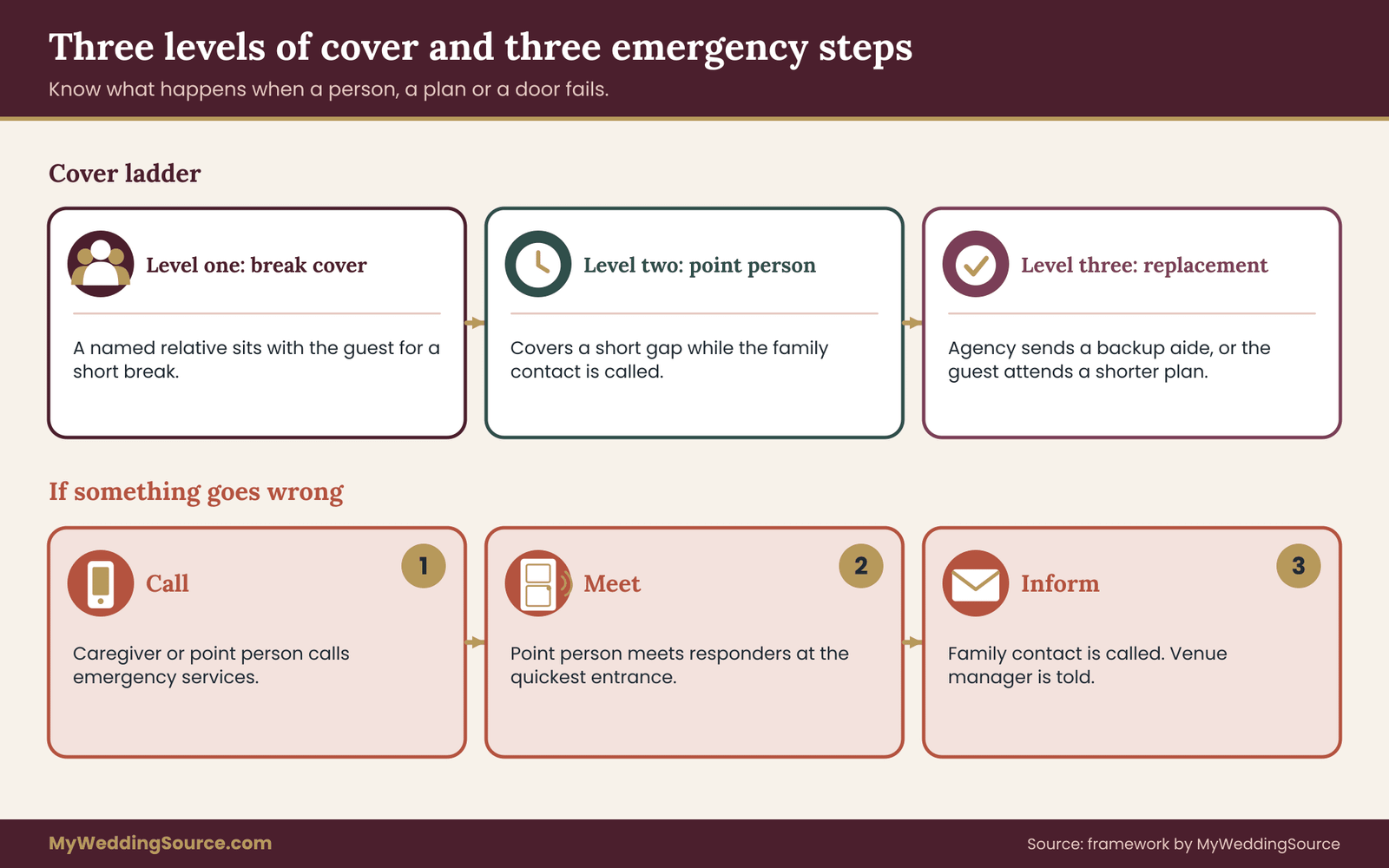
Plan for the unlikely so that nobody has to invent a plan under pressure. Write on the sheet who calls emergency services, who meets them at the door and who stays with the guest. Make sure the venue knows the address that responders will need and the entrance that is quickest to reach. Tell the point person where the guest’s family contact number and the key health facts are written. The wedding caregiver decides what clinical action to take, within their training, and the point person handles everything else: calling, clearing the way and informing the family.
If the venue has a first aid kit or defibrillator, ask where it is and note it. Staff at the venue may have emergency procedures of their own and can often tell you what they are. Ask whether the venue has any rule about outside medical staff, and whether a nurse or aide attending as a guest needs to be reported to the venue.
When the caregiver is also a witness to something else
Occasionally a wedding caregiver sees something at the wedding that concerns them, such as a guest in distress. They are not obliged to act, and they should not be expected to treat anyone but their client. If they are willing to help in an emergency, that is a bonus, not a part of their role. Do not put it on the sheet as a duty. Appreciate it if it happens, but do not plan around it.
Planning the arrival and the exit
The beginning and end of the day are the two moments when most plans meet reality. At arrival, a guest who has travelled has used some energy before the ceremony even begins. At the end, a tired guest wants to go home quickly, and the caregiver wants to complete the shift cleanly.
Arrival
Pick a drop-off point close to the entrance, with a step-free approach, and tell the family where it is. Ask the venue whether a car or van can stop there and whether a permit or staff member is needed. The question of loading zone permits, which usually concerns vendors, can be relevant when the family arrives in a medical transport vehicle; ask the venue early.
Plan to have the guest and caregiver arrive about thirty to forty-five minutes before the ceremony, so they can settle in, use the restroom and take their seats before the crowd. Have someone, ideally the point person, greet them by name, show them the seat and confirm the break and quiet room. A friendly face at the door sets the tone for the day.
Exit
Agree on the exit time and the person who handles it. A guest who leaves during a toast or the first dance may feel they are interrupting. A guest who leaves after the cake and before the dancing slips out without notice. Choose the moment with the family, and brief the driver. If the guest is being picked up by a relative or a driver, tell the venue where the car will wait, and who will walk the guest out.
The wedding caregiver completes the shift when the guest is home or handed over, according to the agency’s terms. Confirm this with the agency so that the hours are not misread.
Costs and agreements for a wedding caregiver
Money is the part of this topic that causes the most quiet friction, so it deserves a plain walk-through. The aim is not to produce a number, because rates vary by region, agency and level of care, and any figure here would be a guess. The aim is to list every line item so that nothing surprises anyone on the day, and to show how to divide the lines sensibly.
The line items
Think of the caregiver’s cost as six lines. The first is the hourly or shift rate for the hours on the day. The second is any extra the agency charges for evenings, weekends or holidays. The third is travel time, which some agencies charge from the moment the aide leaves the client’s home or from a set point. The fourth is the wedding caregiver’s own travel and parking cost. The fifth is the meal. The sixth is any extra time at the start or end, such as arriving early to walk the route or staying to help the guest home.
Ask the agency or family to describe each line in writing. Many agencies bill by the hour with a minimum block, which means that a three-hour event may be billed as four. If the aide is privately hired, the family decides, but it is still worth listing the lines so that the family can budget.
A fair, simple approach is to ask the family for an estimate once the plan is settled, to share the plan with them in advance, and to adjust if the event runs long. If the couple has decided to contribute, make the offer clearly: “we would like to cover the meal and the parking, and your family covers the hours,” or “we would like to contribute toward the evening rate.” Offers that are specific are easier to accept.
Who covers what: three common arrangements
The family covers care, the couple covers hospitality. The guest’s family pays for the aide’s time and travel, and the couple covers the meal and a seat as a courtesy. This is the most common arrangement and has the clearest logic. The aide’s time is part of the guest’s care. The meal is part of the couple’s hosting.
The couple covers more. If the guest is a close relative and the family has limited means, the couple may offer to pay for the aide’s hours or part of them. If you plan to do this, put it in your budget early. The wedding budget guide explains how to hold a line for guest-related costs without disrupting the larger plan. Make the offer privately and avoid framing it as charity. A sentence such as “we would love to have her there and we would like to help make it possible” keeps the dignity of the family intact.
The caregiver is treated as a guest. The aide is invited with a plus-one slot, seated and fed as a guest, and the family still pays for their hours. This keeps the paperwork simple and reads as a welcome. Check that the per-head rate for the extra guest is in the budget.
Cost logic for the meal
The wedding caregiver’s meal is typically counted in one of two ways. If the aide is a guest, the per-head rate applies. If the aide is staff, the caterer may have a reduced vendor meal or may charge the same rate as a guest. The difference per head can be small, but at a large event the number of vendors and staff adds up, so ask. Check the catering agreement for how vendor meals are defined, and confirm in writing that the caregiver’s meal qualifies. If it does not, treat it as a guest meal and budget for it.
Remember that the meal also has a service component. A caregiver who is working will probably eat quickly and at an odd time. Ask the caterer whether a plate can be set aside and delivered at a set time. That small courtesy is rarely expensive but often makes the day.
A short agreement in writing
You do not need a legal document. A short message that records what everyone agreed is enough, and it protects the relationship. It might say: the date and hours, the wedding caregiver’s name and agency, the seat and meal arrangements, who pays for the hours, what the couple covers, the contact on the day and the plan if the caregiver cannot attend. Send it to the family and, if appropriate, to the agency, and ask for a reply to confirm.
If the agency has its own service agreement or terms for off-site events, read them. The family signs these, not the couple, but you can ask what they say about shift length, cancellation and replacement. If a term seems to conflict with your timeline, speak to the family early.
Insurance and liability questions
Venues and some vendors have rules about outside staff, and a few ask for proof of insurance from anyone who works on their premises. A caregiver attending a guest is usually not a vendor to the venue, but a venue manager may ask about it. If so, the agency can supply whatever documentation it normally provides. Do not guess what the agency covers. The certificate of insurance question is a vendor matter, and a wedding caregiver is not a vendor in the usual sense, but if the venue raises it, send the question to the agency and let it answer.
If an incident occurs, such as a fall, the family and the agency handle the guest’s care and their own reporting. The couple’s role is to support, to inform the venue and to record what happened for their own file. Do not assign blame at the event. This is an area where legal or insurance advice is appropriate if a problem arises, and the couple’s own insurance policy or the venue’s policy may be relevant, so ask the issuers rather than assuming.
Worked example: a wedding caregiver for one grandparent
The following example is invented to show how the pieces fit together. Names and details are illustrative, and a real situation will differ.
Nadia and Chris are marrying on a Saturday in October at a lakeside venue with a ceremony lawn, a reception hall and a garden room. Nadia’s grandmother, Mrs. Haddad, is ninety-one, uses a walker, has early memory loss and lives with a daily home aide through an agency. The ceremony is at four, cocktail hour at four forty-five, dinner at six, cake at eight and the reception ends at ten.
Four months before
Nadia calls her aunt Rima, the grandmother’s primary contact, and asks what Mrs. Haddad will need. Rima says her mother is calm in the mornings and tired by seven, takes a pill with dinner and does not like loud rooms. She will attend with her aide, Joy, through the agency. Rima agrees to be the family contact. Nadia writes this down and starts a draft of the sheet.
Eight weeks before
Nadia calls the agency, with Rima’s permission. The agency confirms that Joy can work a six-hour shift from three to nine, that the agency bills a minimum block, that the aide may attend a private event and that a replacement is available if Joy is ill, with a day’s notice. They ask for the sheet in writing. Nadia sends the draft.
Nadia also asks the venue for a step-free route, a seat on the ceremony lawn near a path rather than on the grass, a table by the garden-room corridor and use of the garden room as a quiet space. The venue confirms the lawn has a paved path and the garden room is open. Nadia asks the caterer to add one aide’s meal to the count and to serve table two first.
Three weeks before
The sheet is final. Joy reads it and asks for one change: she would rather take her break at about five fifteen, after the cocktail hour starts, when Mrs. Haddad is seated and calm, rather than at six when dinner arrives. Nadia agrees and updates the sheet, noting the version and date. The sheet names Nadia’s cousin Samir as day-of point person and Rima’s son Tariq as the break cover. The family covers Joy’s hours. Nadia and Chris cover her meal and parking.
On the day
Joy and Mrs. Haddad arrive at three thirty. Samir greets them, walks the path with them and shows the garden room. Mrs. Haddad sits in the second row on the aisle with Joy on her left. At five fifteen Tariq sits with his grandmother while Joy takes a twenty minute break in the garden room. Dinner arrives at six, and Mrs.
Haddad’s plate comes first, with Joy’s beside it. She takes her pill at the table under Joy’s watch. At seven Mrs. Haddad is tired. Samir checks in, as scheduled, and Rima and Joy agree she will stay for the cake. At eight forty she goes home with Rima. Joy finishes at nine as planned, having handed over at the door.
What this example shows
Three things made it work. Everyone knew the plan in advance, because it was on one page. The people with the least time, Nadia and Chris, were not asked to manage the day, because Samir was. And nobody was surprised by a bill or a meal. The details changed as the plan was tested against what the agency, venue and caterer could do, and the sheet absorbed each change.
Verifying rules, policies and limits for a wedding caregiver
Much of what makes this planning work is checking facts with the people who own them. The couple is not expected to know home care regulations, accessibility law or an agency’s internal rules. The couple is expected to ask, write down the answer and not assume. This section lists what to verify, with whom, and what to do when the answer is “it depends.”
What to verify, and with whom
With the venue. Access route and entrances, restroom facilities, a quiet room, seating and table space, rules about outside staff or medical equipment, parking or drop-off, power for any medical equipment, and the emergency procedure. Ask for answers in writing, and ask about anything that seems unusual.
With the caterer. Meal count and timing for the caregiver, early service for the guest’s table, texture, size or dietary needs, and how a plate is held. Ask them to confirm that the wedding caregiver’s meal is counted.
With the agency. Shift length, break rules, permitted tasks away from the guest’s home, billing, backup, after-hours contact and any policy about attending social events. Ask for it in an email.
With the family. The care plan details they are willing to share, medication handling, emergency contact and the guest’s preferences. Ask them what the guest would like.
With the guest. Whether they want the caregiver beside them at all times, whether they would like to be photographed, whether there are moments they want to handle on their own.
Accessibility rules in general terms
In the United States, the Americans with Disabilities Act sets out obligations for many places open to the public, and the Department of Justice’s ADA.gov site explains the framework and how to ask questions. Whether and how those rules apply to a particular private event, a rented room or a religious venue depends on the facts, and this article does not interpret them.
A practical approach is to ask the venue what accessibility features exist, request what the guest needs, and note the answers. If a venue refuses a reasonable request or says something that seems wrong, the ADA information line and the venue’s own management are the places to go, not an article.
The same approach applies to service animals, mobility devices and other accommodations that are not about the wedding caregiver. The wider guide to caring for relatives of every age at your wedding places the caregiver within the wider set of arrangements for relatives of different ages, so use it alongside this one if you are also planning for children or for several older guests.
The limits of what a couple can do
It is worth saying plainly what the couple cannot do. You cannot judge whether a guest is well enough to attend. You cannot direct the wedding caregiver’s clinical work. You cannot guarantee that a venue’s older building will be fully accessible. You cannot make a family agree on the plan. You can make an invitation that says the guest is welcome, build a day that can accommodate care, ask clearly for what is needed and keep a calm backup.
Accepting those limits is a relief. The couple’s job is to host. The family and caregiver have the care, the venue has the building and the caterer has the food. The sheet is how those four sets of responsibilities line up.
When the plan changes at the last minute
Plans change. The aide is ill, the guest has a bad week, a venue door that was said to be step-free turns out to have a lip, a relative who was going to cover the break cannot come. A backup is the best answer. For each item on the sheet, know what you will do if it fails.
If the caregiver cannot attend, the family contacts the agency for a replacement or arranges a relative to cover, and the point person is told at once. A replacement should receive the sheet and a short briefing. If no replacement is available, the family decides whether the guest attends for a shorter period with a relative or stays home and joins by a video call or a small visit afterward. A livestream, if you have one, can help here, though the couple should ask the guest before arranging anything that records them.
If the venue cannot provide what you expected, ask for the next best thing and write it on the sheet. A chair in a hallway is better than nothing. A shorter route through a service corridor is better than stairs. A seat near the door is better than a seat in the crowd.
Reviewing after the event
After the wedding, a short check-in with the family and caregiver is courteous and useful. Thank them directly and say what worked. If something did not work, record it for your own future reference or, if you plan other family events, for next time. Send a thank-you note to the aide, and, if they were a guest, treat them as one. A written note takes five minutes and is often remembered.
Common pitfalls and how to avoid them
A handful of mistakes appear again and again in plans like this. Knowing them in advance is half the cure.
Treating the wedding caregiver as invisible. The aide gets no seat, no meal and no break because nobody thought of them. The fix is to put the caregiver on the guest list, the catering count and the sheet.
Over-sharing the guest’s health details. The couple tells half the wedding party about the guest’s condition in the name of helpfulness. The fix is to share only what each person needs and to let the family decide the rest.
Leaving the plan to the day. Someone is assumed to know where the restroom is, where the quiet room is and who covers the break. The fix is a named point person and a written sheet.
Giving the wedding caregiver extra jobs. Because the aide is a calm, capable adult, the wedding party hands over tasks. The fix is the “not asked” line, and a point person who politely redirects requests.
Ignoring the clock. Dinner runs late and the break window vanishes. The fix is one simple rule on the sheet for late service.
Assuming the venue is accessible. A venue says it is wheelchair accessible, and the “accessible” restroom is up three steps. The fix is to ask specific questions and, where possible, see photographs or visit.
Making money assumptions. The couple assumes the family pays, the family assumes the couple pays and the caregiver is left in the middle. The fix is a clear written arrangement weeks ahead.
Forgetting the exit. The guest is exhausted, the car is not there and the wedding caregiver’s hours have ended. The fix is an exit time, a driver and a person who handles it.
Your next steps
Work through these in order. Each one takes a short phone call or message, and most can be done within a week or two.
- Ask the family whether a wedding caregiver will attend, who the family contact is and how long the guest usually does well at events.
- With the family’s permission, speak to the agency or caregiver about shift length, breaks, tasks away from home and the backup plan.
- Decide how the caregiver is counted: guest, staff or hybrid, and who pays for what. Put the decision in writing.
- Draft the one-page scope sheet using the six lines: job, not asked, seat and route, meals and breaks, health and privacy, contacts and handoff.
- Ask the venue about the route, restrooms, quiet room and rules for outside staff, and the caterer about the wedding caregiver’s meal and early service for the guest’s table.
- Name a day-of point person and a cover for the caregiver’s break, and brief both.
- Finalize the sheet about three weeks ahead, and send the relevant parts to the venue, caterer, family and caregiver.
- The week before, confirm arrival, the drop-off point, the meal count and the exit plan by phone.
A calm, early start is the biggest single help, and most of these steps are easier in the first week than in the last.
FAQ
Should the wedding caregiver be counted in the guest headcount?
Yes, count the wedding caregiver in the catering and seating totals, even if you treat them as staff and not as a plus-one. They need a seat and a meal, and the caterer needs an accurate number. Ask your caterer whether staff or vendor meals are priced differently, and confirm the answer in writing so that the final invoice holds no surprises.
Who pays for a wedding caregiver at the reception?
There is no single rule. A common pattern is that the guest’s family pays for the aide’s time, since it is part of their care, and the couple covers the meal and a seat as hospitality. Some couples contribute more. Decide early, put it in writing and make any offer to help specific and private.
Does a wedding caregiver need to sit with the guest during dinner?
Usually yes, at least at first, because many guests need help with seating, cutting food or reminders. Once the guest is settled, a relative can cover while the caregiver eats. Ask the wedding caregiver which pattern works best, and tell the caterer so the aide’s plate arrives at the right moment.
How long should a caregiver stay at a wedding?
It depends on the guest and the agency. Many families choose a shorter plan covering the ceremony, dinner and cake, with an early exit before the loudest part of the evening. Ask the family how long the guest does well, ask the agency about shift terms, and agree an exit time before the day.
What if the venue says it cannot accommodate the wedding caregiver?
Ask what exactly cannot be done, and whether there is a close alternative, such as a different entrance, a nearby restroom or a quiet room. Get the answer in writing. If the venue’s response seems inconsistent with its stated accessibility, the ADA.gov site explains where to ask questions. Otherwise, adjust the plan with the family.
Should I tell guests that the older relative has a caregiver?
Generally no, beyond what is needed. The guest’s care is private, and guests do not need an explanation. If someone asks, a warm, short answer is enough. Tell ushers and the point person who will be sitting where, and the photographer if photos need to respect the guest’s wishes.
Can the wedding caregiver give medication at the wedding?
That depends on the caregiver’s training, the agency’s rules and the family’s instructions, not on the couple. The couple should not hold or give medication. Ask the family and agency how it will be handled, and offer a safe place for the wedding caregiver’s bag and a visible clock.
What should the day-of point person do?
Greet the caregiver and guest, confirm the seat and quiet room, check in at the times on the sheet, arrange the break cover and handle small problems such as a missing chair or a late meal. They do not give care. They keep the plan running, and they call the family contact if anything changes.
Sources
- ADA.gov, U.S. Department of Justice, Americans with Disabilities Act information
- Administration for Community Living, U.S. Department of Health and Human Services
- Eldercare Locator, Administration for Community Living
- HHS.gov, Health Information Privacy (HIPAA)
- U.S. Department of Labor, Wage and Hour Division
- National Institute on Aging, caregiving resources
- CDC, Centers for Disease Control and Prevention, older adult health
- FoodSafety.gov, food safety guidance
- Medicare.gov, official U.S. government Medicare site
- IRS, Internal Revenue Service, household employer information