
Wedding music licensing decides who is allowed to let a song be played in front of your guests, and who pays for that permission. This guide is about the live side of it: bands, solo musicians, ceremony players and DJs, and the exact questions to put to your venue and your performers so the answers are written down before you sign anything.
Treat wedding music licensing as a question of responsibility, not of legal theory. For every moment of music on the day, write down who is performing, who holds the public performance permission, and where that is confirmed in writing. Ask the venue which performing rights licenses it holds and what they cover. Ask each performer what they assume the venue covers, and whether they bring anything of their own. If the two answers do not match, you have found the gap while it is still cheap to fix.
Most couples never think about wedding music licensing, and for most weddings that turns out to be fine. A venue that hosts events every weekend usually has its music permissions in order, and the band or DJ plays in the room without anyone mentioning a license at all. The trouble starts at the edges: a barn that has never hosted live music, a backyard, a tent in a field, a performer who says “the venue handles that” while the venue says “the performer handles that.” Nobody is lying. Each side is repeating what is true for the weddings they usually work.
This guide gives you a way to close that gap without turning your planning into a legal project. You will get a plain explanation of how live music permissions work in the United States, a responsibility sheet you fill in moment by moment, scripts for the conversations with venues and performers, a closer look at the unusual situations that cause trouble, and contract wording you can ask for. There is a worked example with an invented couple, and a short list of the points where a lawyer is worth an hour of your time.
A note on scope. This is general information, not legal advice. Copyright and licensing rules are set by federal law and by contracts between private organizations, and the details change. Where a point matters, the article tells you whose website or whose staff can confirm the current rules, because they are the ones who answer for them.
If you are still working out what songs and what kind of performer you want, start with the broader guide to wedding reception music, which covers energy timelines, dance styles and briefing a DJ. This article assumes you have a rough idea of the music and focuses on the permission underneath it.
What wedding music licensing actually covers
A song is two things at once, and the distinction explains most of what follows. The first is the musical work: the melody and lyrics as written by the songwriter and published by a publisher. The second is a sound recording: one particular performer’s recorded version of that work. Copyright law protects both, and different people own them.
When a band plays a cover song live, it is performing someone else’s musical work. No recording is involved, because the band is making new sound. The right being exercised is the right to perform the work publicly. When a DJ plays a track from a laptop, a recording is being played, and the musical work inside it is still being performed publicly. In both cases the public performance of the musical work is the part that normally needs permission.
Under United States copyright law, the owner of a musical work has the exclusive right to perform it publicly, which means in a place open to the public or in front of a gathering outside a normal circle of family and social acquaintances. That wording matters for weddings, because a wedding can sit in a gray zone: a private event, but a large one, in a commercial space, with paid professionals on stage. Rather than argue about where the line falls, the music industry long ago built a system that makes the question mostly disappear.
How the permission usually reaches the dance floor
Songwriters and publishers do not negotiate with every restaurant, hotel and venue. They join performing rights organizations, often shortened to PROs. In the United States the four you will hear named are ASCAP, BMI, SESAC and GMR. Each one represents its own catalog of songs and sells licenses that let the license holder allow public performances of those songs. The money collected is then paid out to the writers and publishers.
The key point for a couple is who buys the license. Usually it is the business that operates the place where music is performed: a hotel, a restaurant, a banquet hall, an event venue. That license, commonly called a blanket license, lets the licensee have music from the organization’s catalog performed on the premises, within the terms of that license. Because each organization covers different songs, a venue may hold one license, several, or none, and the terms can differ by type of event and type of use.
So the practical chain looks like this. The venue holds licenses. The licenses cover performances at the venue. A band or DJ performs there. The couple never sees a form. When that chain is intact, nothing about wedding music licensing needs your attention. The whole purpose of the rest of this guide is to find out, early, whether the chain is intact for your date and your place.
What this guide does not try to do
This is not a guide to copyright law, and it does not tell you what any license says. It also does not cover choosing songs, which is a creative decision, or negotiating performer fees, which is covered in the general vendor contract guide. It stays on one question: for each place music is made at your wedding, can you point to a written answer saying who has the right to allow it?

Who can be responsible for wedding music licensing
Four parties can end up holding the responsibility for wedding music licensing, and part of the confusion comes from the fact that different weddings assign it to different ones. It helps to look at each in turn.
The venue. The venue is the most common license holder. A venue that advertises live music, DJ packages or an in-house sound system has usually arranged public performance licenses as part of running its business. Some venues state this in their policy documents. Others hold licenses but say nothing about them unless asked. A venue that has never hosted amplified music may hold none.
The performer or their company. A band, a DJ company or a booking agency sometimes carries its own coverage, or its own license arrangements, or works under an agency’s arrangement. Some performers are members of a PRO as writers and play their own compositions. Others have no license of any kind and rely entirely on the venue. A professional DJ may also hold licenses for the digital library the company uses, which covers one set of questions but not necessarily public performance at your venue.
The couple. You become the responsible party when you rent a space with no wedding music licensing arrangement and hire people who assume someone else has one. Hosting at a private home, a rented field or a family property is the standard example. The couple is also the one who chooses whether to livestream or record the music, and those uses carry separate permission questions.
The platform or service. When a playlist or a streaming account supplies the music, the service’s terms set what use is allowed. Personal subscriptions are generally written for private listening. Business music services exist for public use and carry their own terms. The service is not a license holder for your event, but its terms can restrict what you do with its content, and you are bound by them.
Why more than one party can be on the hook
You may wonder why this is a question at all if the venue usually has it covered. The reason is that the legal exposure is not always limited to one party. The person who performs a work publicly and the person who runs the place where it happens can both face a claim from a rights holder. That is one reason PROs focus their licensing on venues, and why wedding music licensing so often sits with the venue: it is simpler to license one operator than a thousand traveling performers. It is also why performers and venues each tend to assume the other has handled it.
For a couple, the useful reading of this is calm and practical. You are very unlikely to be the target of any claim. But you are the person who signs the contracts, and contracts are where responsibility gets assigned. An unclear contract leaves it unassigned, and unassigned responsibility is what causes the awkward conversation on the day, or the unexpected line on a final invoice.
The five music moments to map for wedding music licensing
Before you ask anyone anything, list the moments in the day where music will be heard. A single wedding often has five, and they do not always share the same answer. Mapping them first gives you a short, specific list of questions instead of a vague worry.
The ceremony. Live musicians, a vocalist, a recorded processional through a speaker, or an organ in a place of worship. The location often determines the answer here, because a ceremony in a place of worship and a ceremony on a rented lawn are different situations.
The cocktail hour. Often a trio, a solo guitarist, a pianist or a playlist. This is where small acts play, and small acts are the ones most likely to say “we have never been asked about licenses.”
The dinner. Background music, sometimes continuing from the cocktail hour, sometimes switched to a different source. Easy to overlook because nobody is performing.
The dance. The DJ or the band, the longest stretch and the loudest. This is the moment people mean when they say wedding music.
The send-off and the edges. Music at arrival, during photos, in the getaway, in the after-party, or at the hotel bar afterward. These often use a different source than the main event, and they are the moments most likely to be forgotten.

For each moment, three facts matter: whether the music is live or recorded, who is operating it, and which space it is happening in. A recorded playlist at a ceremony in a public park, for example, raises a different question than a live trio at a hotel ballroom. The responsibility sheet in the next section is built around exactly these three facts.
The responsibility sheet: a simple method for wedding music licensing
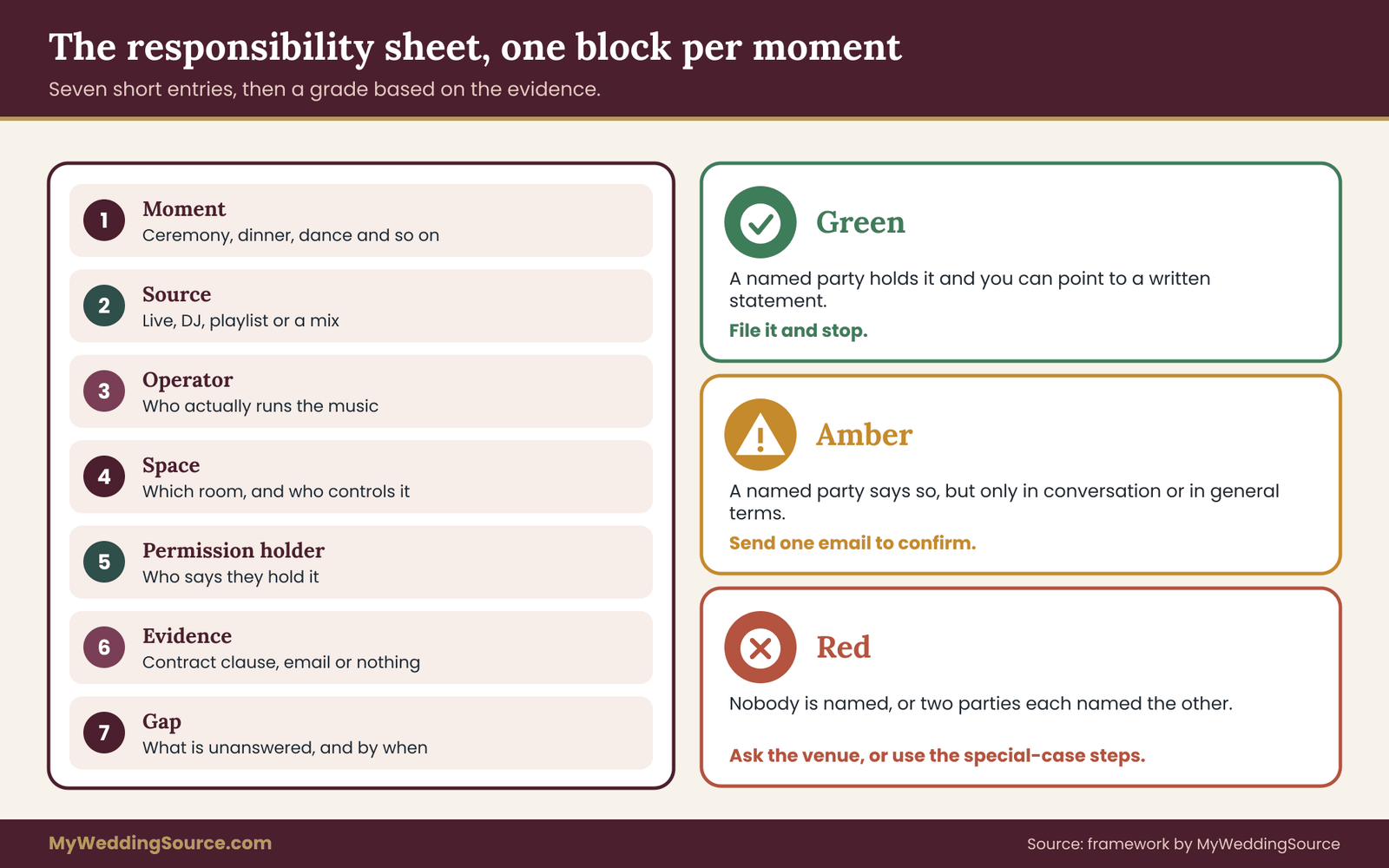
The method in this article is a one-page sheet. You fill in one block per music moment, and each block has seven short entries. It sounds clerical, and it is, but the clerical quality is the point. Vague worry about wedding music licensing turns into a short list of named people and named documents. You can keep the sheet in a note on your phone or in the shared folder where you keep your contracts.
For each moment, write these seven entries.
- Moment. Ceremony, cocktail hour, dinner, dance, send-off, or whatever else you have.
- Source. Live performer, DJ playing recordings, a streaming playlist, or a mix.
- Operator. The name of the person or company actually running the music at that moment.
- Space. The room or outdoor area, and who controls it: a venue, a place of worship, a public body, a private owner.
- Permission holder. The party who says they hold the public performance permission for that space and that use.
- Evidence. Where that statement is written: a contract clause, an email from a named person, a policy page, or nowhere.
- Gap. Anything left unanswered, and who will answer it by when.
Grading each block
Once a block is filled in, grade it by the quality of the evidence rather than by how reassuring the answer sounded. Three grades are enough.
Green means a named party holds the permission and you can point to a written statement of it, from the venue, from the performer or from a service’s own terms. A line in a contract is the strongest form. An email from a named staff member is acceptable.
Amber means a named party says they hold it, but only in conversation or only in general terms. “We always have that covered” is amber. So is a venue website that mentions entertainment but does not discuss wedding music licensing. Amber is not alarming. It means one more email.
Red means nobody has been named, or two parties each named the other. Red is common at private properties and with small acts, and it is the grade that matters most, because red blocks are the ones that turn into surprises.
The goal is not to turn every block green by force. A cocktail-hour guitarist on a private lawn may stay amber, and you may decide that is acceptable. The goal is that every amber or red is a decision you made on purpose, with the facts in front of you, rather than a gap you discovered at nine in the evening.
A decision rule for what to do with each grade
The grading is only useful if it triggers an action. Use these four rules.
If every block is green, file the sheet with your contracts and stop; your wedding music licensing is in order. You have done the work.
If a block is amber, send one written follow-up to the named party asking them to confirm in an email. Most will answer in a sentence. That converts amber to green.
If a block is red and the space is a professional venue, ask the venue’s event manager the wedding music licensing questions in the next section. Venues can usually settle it in one conversation, because they know what licenses they hold.
If a block is red and the space is private or unusual, go to the special situations section later in this guide. The fix may be a different performer, a different source of music, a small license you arrange yourself, or a short consultation with someone who knows the area. This is the only grade that sometimes justifies spending money on advice.
Questions for venues about wedding music licensing
The venue conversation about wedding music licensing is the most productive one, because the venue is the party most likely to hold licenses and the party best placed to explain what they cover. Do it early, ideally before you pay a non-refundable deposit, because an unhelpful answer might change your decision. The conversation usually takes ten minutes with the right person. That person is typically the event manager, not the front-desk staff who handles tours.
The six core questions
Ask these in order. Write the answers down as they are given, then send a short summary by email so you have a record.
One. Do you hold public performance licenses for music played at events here? This is a yes or no question. A confident yes is a good start. A hesitant answer tells you something. “I think so” is amber.
Two. Which organizations do your licenses come from? The venue might name ASCAP, BMI, SESAC, GMR, or a combination. You do not need to verify the answer, but a venue that knows its answer is usually a venue that has managed this properly. If the manager does not know, ask who does and when you can hear from them.
Three. Do the licenses cover live bands, DJs and recorded background music, or only some of these? Licenses can be scoped by use. A hotel with a license for background music in the lobby may not hold the same coverage for a live band in the ballroom. This single question catches more gaps than any other.
Four. Are there music uses your license does not cover? A venue may exclude concerts that charge admission, recorded or streamed events, or particular rooms. Ask about outdoor areas and tents, since they are sometimes treated differently from the main building.
Five. Who is responsible for wedding music licensing if a performer I hire brings their own arrangement? This question shows how the venue thinks about overlap. Some venues say their licenses are the only ones that matter. Others ask performers to carry a certificate of insurance and nothing more. Others state in their vendor policy that outside performers are responsible for their own rights. Any of these can be fine, but you need to know which.
Six. Can you confirm that in writing? The venue may point you to a policy page, a vendor manual or a clause in the rental agreement. Or they may send an email. Either is valuable.

Questions about the rest of the rules
Licensing is closely tied to other venue rules about music, and the same conversation is a good time to ask about them.
A venue may allow live music only until a stated time, restrict amplified sound outdoors, require its own sound technician, or limit which outside vendors may use the power supply. None of these is a wedding music licensing question, but all of them affect the performer you can hire and the equipment they bring. The guide to a venue technical walkthrough shows how to collect power, access and sound limits in one visit, which makes the wedding music licensing questions easier to ask because you already know the room.
If the venue uses an in-house DJ or a preferred list of entertainers, ask how wedding music licensing works for them. Often an in-house arrangement is the cleanest case, because the venue controls both the space and the performer. It may also come with a minimum spend or a package price, so it is worth reading the whole entertainment clause of the agreement, not only the wedding music licensing sentence.
Reading the answers
Venue answers about wedding music licensing fall into a few patterns, and each has a sensible response.
“We hold all the licenses you need.” Ask for the written version, and ask whether that covers your performer type. A venue with a blanket arrangement that covers live and recorded music has done what a couple would hope for. Ask for one line in the contract.
“The performer handles that.” This is not a problem by itself, but it moves the work to the performer. Mark the block amber and move to the performer questions in the next section. Ask the venue whether it requires proof from performers, and what proof.
“We have never been asked.” An honest answer, and a sign that the venue has not thought about it. Mark it red and ask whether the venue is willing to find out. If the answer is no, treat the venue like a private space.
“It is covered by the building’s general arrangements.” This phrase can mean many things. Ask which arrangements and who administers them. Property management companies, hotel groups and municipal parks sometimes hold licenses at the organizational level, and the staff you talk to may not know the details.
A short script for the first call
If you prefer to have the words ready, this version is brief and friendly.
“We are planning live music for our wedding and want to be sure the wedding music licensing is in order. Does the venue hold public performance licenses for events here, and do they cover a live band as well as a DJ? Could you send that to us in an email so we can share it with our performers?”
Notice that the request frames the email as something you will share with performers. That is accurate, and it makes the venue’s answer more precise, because they know it will be read by professionals. It also avoids any hint of suspicion. You are not testing the venue; you are collecting facts you need to brief your team.
When the venue is a place of worship or a public body
A place of worship, a city park or a municipal building has a different relationship with music, and with wedding music licensing, from a commercial venue.
A church may host a ceremony with live music as part of a service, and the legal treatment of music performed at a religious service is different from music at a reception. Public bodies may hold licenses, may rely on their own policies, or may not have any. Ask the same six questions, and expect that the person answering may need to check. For public spaces, the permit you need to use the space is often a separate document from any license, and the permit office can usually tell you what music rules apply.
Questions for performers about wedding music licensing
Once the venue’s answers are on the sheet, move to the performers. This conversation is different, because performers differ so much in how they work. A full-time wedding band with an agent, a part-time guitarist who plays three weddings a month, a ceremony string quartet from a local conservatory, and a DJ company with four crews all treat wedding music licensing differently. The same six-question approach applies to wedding music licensing, but the follow-ups depend on the kind of performer.
Start with the question that works for all of them: “What do you assume about wedding music licensing at the venues you play?” The answer is usually revealing. An experienced performer will describe their habit in a sentence (“we always confirm the venue has coverage,” or “we carry our own and send a certificate”). An inexperienced one will say they have never been asked. Both answers are useful, and neither is a reason to walk away. They tell you which parts of the sheet you will need to fill in yourself.
Live bands and solo musicians
For wedding music licensing, a live band performing cover songs is performing other writers’ musical works, which is exactly the use that public performance licenses exist for. The band does not need to say that its members wrote the songs, and covers are the heart of most wedding sets. Ask these questions.
Do you play at venues that already hold licenses, and do you check? A band that routinely asks venues about wedding music licensing is a band that has been through the conversation before. A band that says “the venue always has it” has been lucky, which is not the same thing.
Do you carry any license or membership of your own? Some performers are members of a PRO as writers, which means their own compositions are registered. That is not the same as holding a license that covers the covers they play, and the difference is easy to mix up in conversation. Ask the follow-up plainly: does this cover the songs you play that you did not write?
Do you play original material at weddings? If the band plays its own compositions, the question of permission for those works is simple, because the band owns them or controls them. If a guest or a family member wrote a song for the couple, that composer’s permission is the one that matters, and it is almost always given gladly.
Will you provide a setlist or a list of the kinds of songs you play? You do not need a legal analysis of the setlist. You want to know whether the band plays mainstream covers, which are the ordinary case, or something unusual, such as a full orchestral arrangement of a film score or a large theatrical piece. Theatrical works and some film music are handled differently, and a venue’s general license may not cover them.
DJs
A DJ plays recordings, so the DJ’s side of wedding music licensing has an additional layer. The DJ needs to have obtained the music legally, and the venue or the performer needs permission for the public performance. These are separate matters.
Ask how the DJ sources the library. A professional will usually say they use a paid service for DJs, or they buy tracks from stores, or they use a combination. A DJ who says they download whatever works from free sites is telling you something about how they treat other people’s work, and that is useful for hiring decisions beyond wedding music licensing.
Ask about the venue’s role. Many DJs work through venues and expect the venue to hold the public performance license, which is typical. Others carry a business license of their own from a PRO and can provide a statement. Ask what they have, and what they expect from you.
Ask about edits and mixes. A DJ’s remix or mashup is a new arrangement of existing works, and the rights are murkier than playing a straight track. For wedding use, the situation is usually uneventful, but a DJ who sells their own mixes commercially has a different situation from one who plays them privately. If your DJ plans to record the set and share it, ask what they intend to do with the recording.
Ceremony musicians and small acts
Ceremony musicians, such as a harpist, a string trio or a vocalist with an accompanist, often come from a local network of freelance players. They may have strong musical training and no business structure. Ask whether they carry liability insurance, since many venues require a certificate, and ask the wedding music licensing question as a separate point.
For classical repertoire, many pieces are old enough to be in the public domain. A composition by a nineteenth-century composer, played live, does not need a license for the work itself. Newer arrangements, however, may still be protected, as may popular songs rearranged for strings. A string quartet playing the music of a living pop artist is performing a protected work, and the same venue questions apply.
The small-act pattern to watch for is the performer who says “I do this all the time and nobody has ever asked.” That is probably true, and it also means the performer has never been the one who held the responsibility. The venue question is then the one that settles it.
Agencies and booking services
If you hire through an entertainment agency, ask the agency what its standard contract says about wedding music licensing. Many agency contracts include a clause stating that the client or the venue is responsible for obtaining any required licenses. That clause is common, and it is worth reading carefully, because it assigns the responsibility to you. You can respond in two ways: ask the venue to confirm coverage so the clause has no practical effect, or ask the agency to revise the clause.

A script for performers
This is a short version that works by email or phone.
“We want to be sure the music licensing is covered for the day. Can you tell us what you usually assume about wedding music licensing at venues, and whether you carry anything of your own? We are asking the venue the same question and will share their answer with you.”
The final sentence helps. It signals that you are working on both sides, and it invites a response that fits the venue’s answer rather than a generic one.
Matching the two sets of answers for wedding music licensing
After both conversations about wedding music licensing, put the venue’s answer and the performer’s answer side by side. A mismatch is not a failure; it is information.
Venue covers, performer assumes venue covers. This is the cleanest outcome. Both agree. Ask the venue for the written line and keep it.
Venue says performer covers, performer says venue covers. This is the classic mutual assumption. It is common, and it is the reason this guide exists. Neither party is wrong about their habit, and neither has looked at your event. Ask the venue event manager and the performer to speak, or to send emails to each other. A three-way email thread resolves it in a day.
Venue covers, performer carries their own too. Overlap is fine. You do not need to reduce it.
Neither has a clear answer. Treat it as red, and use the special situations section.
Who should talk to whom
You do not have to be the translator. After one round of questions, introduce the venue manager and the performer by email and ask them to confirm the arrangement with each other. Professionals generally prefer this, because they speak the same vocabulary and can settle it in a sentence. Copy yourself so the thread ends up in your records.
Keep the thread short. A message such as the following does the job.
“Introducing our venue’s event manager and our band’s leader. We would like to make sure wedding music licensing is covered for our wedding on the date in the contract. Could you each confirm who holds it, so we can note it in our records?”
If either party replies with more than a sentence or two, that is a sign the matter is less settled than it first appeared. Ask for a summary.
What to put in the contract about wedding music licensing
Conversations fade. Contracts remain, and wedding music licensing is no exception. The point of the sheet is to move the answers into writing, and the strongest place for that is the agreement with each party. You are not drafting a legal document. You are asking for a sentence or two, in plain words, that records who holds the permission.
Useful points to ask for are modest. In the venue agreement, a statement that the venue holds the public performance licenses applicable to music performed at the event, or a statement that it does not and the performer or client is responsible. In the performer agreement, a statement of who is responsible for any licenses required for the performance, and a line that the performer will provide any documentation the venue reasonably requests. Where a performer carries their own coverage, a line saying so.
Read the existing language too. Many standard performer contracts include an indemnity clause, a promise that one party will cover the other’s costs if a claim arises. Indemnity clauses can shift responsibility for wedding music licensing without ever using the word, and they often sit in a section that couples skim. If a contract asks you to indemnify the performer for rights-related claims, ask whether the venue’s coverage makes that clause unnecessary, and consider showing the clause to a lawyer.
Wording you can ask for
The following examples are plain-language starting points. They are not legal drafting, and a lawyer should review them if the stakes feel high.
“The Venue confirms that it holds, or that the Venue’s license arrangements include, public performance licenses covering live and recorded music performed at the Event within the Venue’s premises.”
“The Performer will be responsible for any public performance license required specifically for the Performer’s own activities that is not covered by the Venue’s license.”
“Each party will, on reasonable request, confirm the license arrangements in writing before the Event date.”
The third line is the one that costs the least and gives the most. It sets a duty to answer a question in writing before the day, which means any gap discovered later has a named person to ask.
What not to ask for
Do not ask a performer to guarantee that no claim will ever be made. Nobody can promise that, and the request makes the performer nervous without helping you. Ask for facts about coverage and a willingness to cooperate, which are things they can deliver.
Do not ask the venue to give you a copy of its license agreement. Those are commercial documents. A confirmation of coverage, a certificate, or a named organization is enough.
Special situations that change wedding music licensing
The standard venue and standard band make the whole subject nearly invisible, and wedding music licensing is rarely discussed. The situations below are where wedding music licensing stops being invisible. For each one, the useful question is the same: who is the equivalent of the venue here, the party who would normally hold the licenses, and have they?
Private homes, family land and rented fields
When the wedding is at a private home or a field, there is no venue business, and therefore no venue license behind your wedding music licensing. The usual chain is missing its first link. A band or DJ hired for the day may assume the space has coverage, and the space has none because it was never in the business of hosting music.
This does not mean you are doing something improper. A family gathering at a private home is a different thing from a commercial event, and the law treats the public in a public performance as a group beyond the normal circle of family and friends. Weddings with a large guest list, outside vendors and paid performers are not always clearly one or the other, and nobody can tell you where your event falls without knowing the details. What you can do is decide how much uncertainty you want to carry.
Three practical choices exist. First, hire performers who work independently and say plainly that they have handled this before. Many touring wedding bands work at private properties every weekend and know how they handle it. Second, ask the performer or the DJ company whether it holds its own license arrangement that travels with it, so the coverage does not depend on the place. Third, ask a lawyer or the relevant licensing organization for guidance. The performing rights organizations have staff who answer questions about events, and their websites explain what kinds of license exist.
The choice that tends to reduce stress is the second. A performer with coverage that travels removes the question from the property altogether.
Barns, tents and venues that have never hosted live music
A barn or farm venue that mainly rents space and lets couples bring their own vendors may not have thought about public performance licensing. That is not unusual. Such venues often have a short vendor policy and no entertainment license, because the owners are in the business of renting space, not running events. If you are touring one, the guide to barn wedding venues covers the other questions to ask on site, and the wedding music licensing questions fit naturally into the same visit.
If the venue has no license, you have two options for wedding music licensing. You can treat it as a private-space situation, as above. Or you can ask whether the venue is willing to obtain a license for events, which some do when asked, especially if they host many weddings. Do not assume the answer; ask.
Ceremonies in places of worship
Music at a religious service in a place of worship is treated in its own way under US copyright law, which includes a specific exemption for certain performances of nondramatic music during religious services.
Whether that exemption reaches a wedding ceremony, a particular piece, or a reception in the parish hall afterward is a question for the congregation’s own advisers and, if needed, for a lawyer. The practical point for you is narrower. Ask the clergy or the music director who handles music in the building and what they require of outside performers. Many places of worship have an in-house organist, a music policy and a list of approved pieces. Their arrangements usually settle the question for the ceremony itself.
Keep the ceremony and the reception on separate lines of your sheet. A ceremony in a sanctuary and a dance in a rented hall elsewhere are two spaces with two answers.
Public parks, beaches and municipal spaces
A permit to use a public space is usually separate from any music permission. A city park permit may state limits on amplified sound, hours and the number of guests. It may say nothing about public performance licensing. Ask the permitting office what it requires for amplified music, and whether the city holds any blanket arrangement. Written permit conditions are the evidence you need for the sheet, and they frequently include sound rules that affect which performer and equipment you can use.

Weddings outside the United States
Everything in this guide describes the United States. If you marry abroad, the rules, the organizations and the habits are different. Many countries have their own performing rights organizations, and each country’s law sets who must hold a license. A resort hotel that hosts weddings daily will have its own arrangements, and the event manager will know them. Ask the same questions, and expect the answer to refer to a local organization. For guests and performers traveling in, ask the venue rather than relying on what you know from the United States.
Guest performers, family bands and open microphones
A friend who plays guitar during cocktail hour, a cousin who sings, a groomsman who plays DJ from a laptop for an hour: these are the situations that make weddings feel personal, and they are not usually a wedding music licensing worry in practice. The underlying legal principle is the same as for a professional act, because the performance is public in the same way. The practical difference is that guest performers are not business operators, and no organization is chasing them.
The sensible move is to ask the venue whether guest performers are allowed and whether their license covers them. If the venue holds a blanket license for the premises, it usually covers anyone performing there. Ask about it in one sentence while you are discussing the main entertainment. If the venue has no license, a friend performing is in the same position as any other performer at a private property.
Karaoke, open microphones and guest-run playlists follow the same logic. A venue’s coverage for live music and DJs may or may not include karaoke tracks, which are a separate product with its own rights. If karaoke is part of your plan, ask the venue and the karaoke operator directly.
Self-run playlists on a personal account
Many couples plan a speaker, a phone and a playlist for the cocktail hour or even the whole night. It is affordable and it gives you control.
The wedding music licensing question here is about the service, not about the venue. Personal streaming subscriptions are generally licensed for private listening, and their terms often restrict public or commercial use. Commercial services designed for businesses exist, with different terms. If you plan to run your own wedding music from a personal account, read the service’s terms, ask the venue about its policy, and think about a service made for public use. The broader guide to programming a reception playlist and dance floor covers the practical side of self-run music, including transitions and volume.
A second point: a self-run playlist is often the quietest of the wedding music licensing issues because the venue’s blanket license usually covers recorded music played in the space, whatever the source. But the service’s own terms can still be a separate matter. Treat the two questions as separate on your sheet.
Recording, livestreaming and video: a different permission
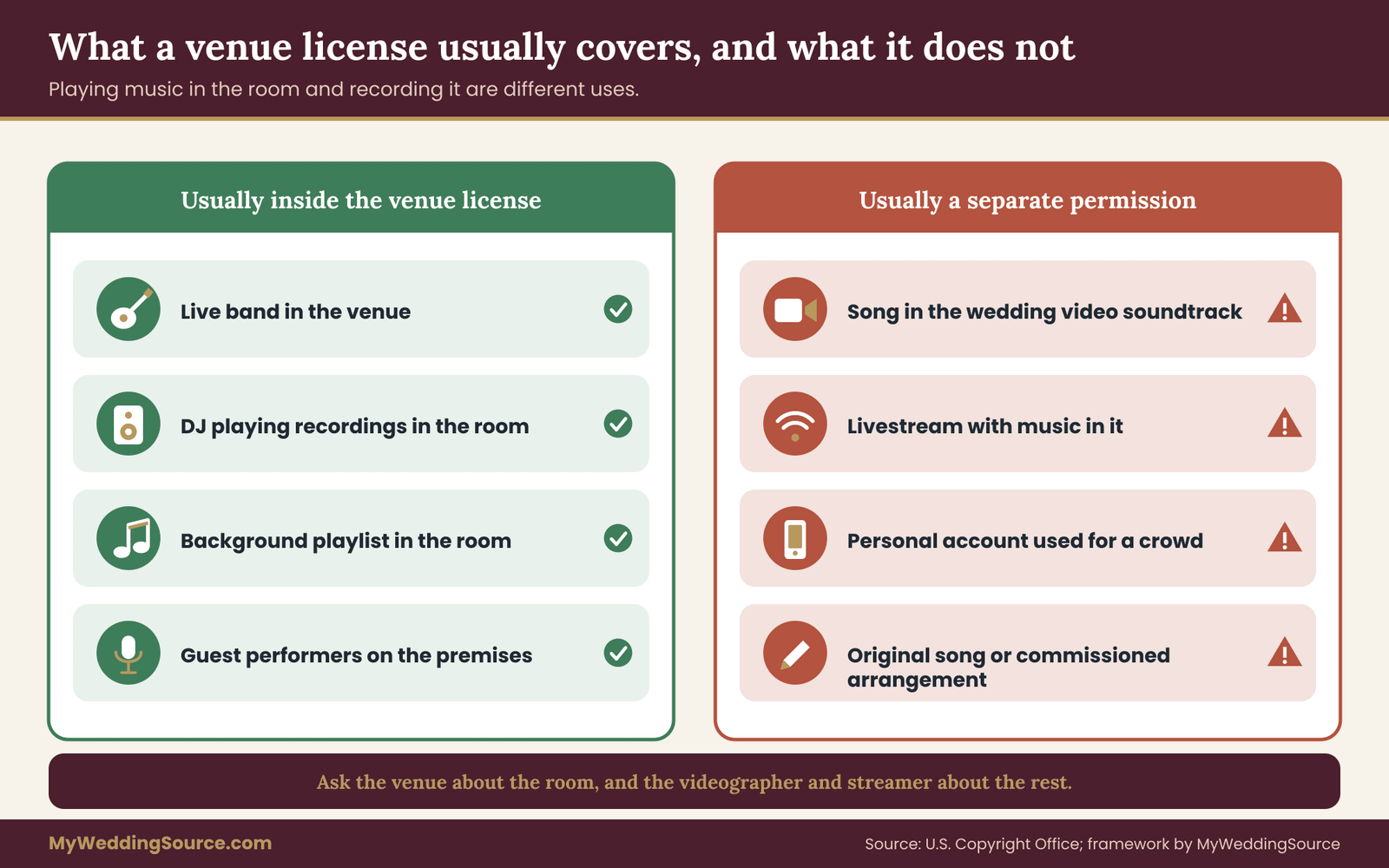
Playing music in a room and capturing music in a recording are two different uses, and wedding music licensing treats them separately. The first is a performance. The second is a reproduction, and when the recording is combined with moving images, a further kind of permission is involved, called a synchronization license.
The PRO license that a venue holds covers public performance on the premises. It does not usually cover putting a song into a video, posting a video online, or streaming the event with music in it. Each of those uses is a separate matter, with a separate rights holder, and the venue’s blanket license does not address them.
The wedding video and its soundtrack
If your videographer edits a highlight film and sets it to a popular song, that is a synchronization use. For a private viewing on a hard drive, nobody is going to raise it. For posting publicly, platforms may detect the song automatically, mute the audio, or block the video. Ask the videographer how music is handled in their packages. Many professionals use tracks from licensed libraries designed for exactly this, and some will let you choose from a catalog. Others will use your favorite song for the private copy and a library track for the public one.
Ask for this in the video contract: a line saying which music is used in delivered films and what the restrictions are on sharing them. It is a common part of a professional’s package, and it is more precise than “we will figure it out.”
Livestreaming the ceremony
A livestream sends the audio out to the internet. Live music at the ceremony, a recorded processional and a vocalist’s performance are all captured. Platforms have their own rules, and automated systems may mute the stream or remove the recording if they recognize a song. A short list of options exists: use music that the platform allows, use library tracks for the processional, ask the performers to play public-domain or original pieces, or accept that the stream may have gaps and offer the recording separately.
Tell your streaming provider about your music plan in advance, and ask what happens when a song is flagged. If your processional matters to you, ask the musicians whether they can play something that is safe to stream, or consider having the guests see the processional in the room and the stream begin afterward.
Posting clips from the dance floor
Guests will post clips of the dance on their own accounts, with the band or the DJ audible. That is outside your control and outside the venue’s license. You can mention a request in your wedding materials, but you cannot decide it for other people. If your music is performed by a band that wants to protect its work, it may have its own request about filming. Ask the band whether they have a policy on guest videos, and note it for your wedding website. The guide to wedding photography consent is useful for the guest-boundary side of this.
A worked example of wedding music licensing
The following couple is invented, and so are their vendors. The example shows wedding music licensing from the couple’s side. The example shows how the sheet works in practice, including the moments where it turns up something unexpected. Nothing about it is meant to represent typical outcomes; it is a way to see the method run once.
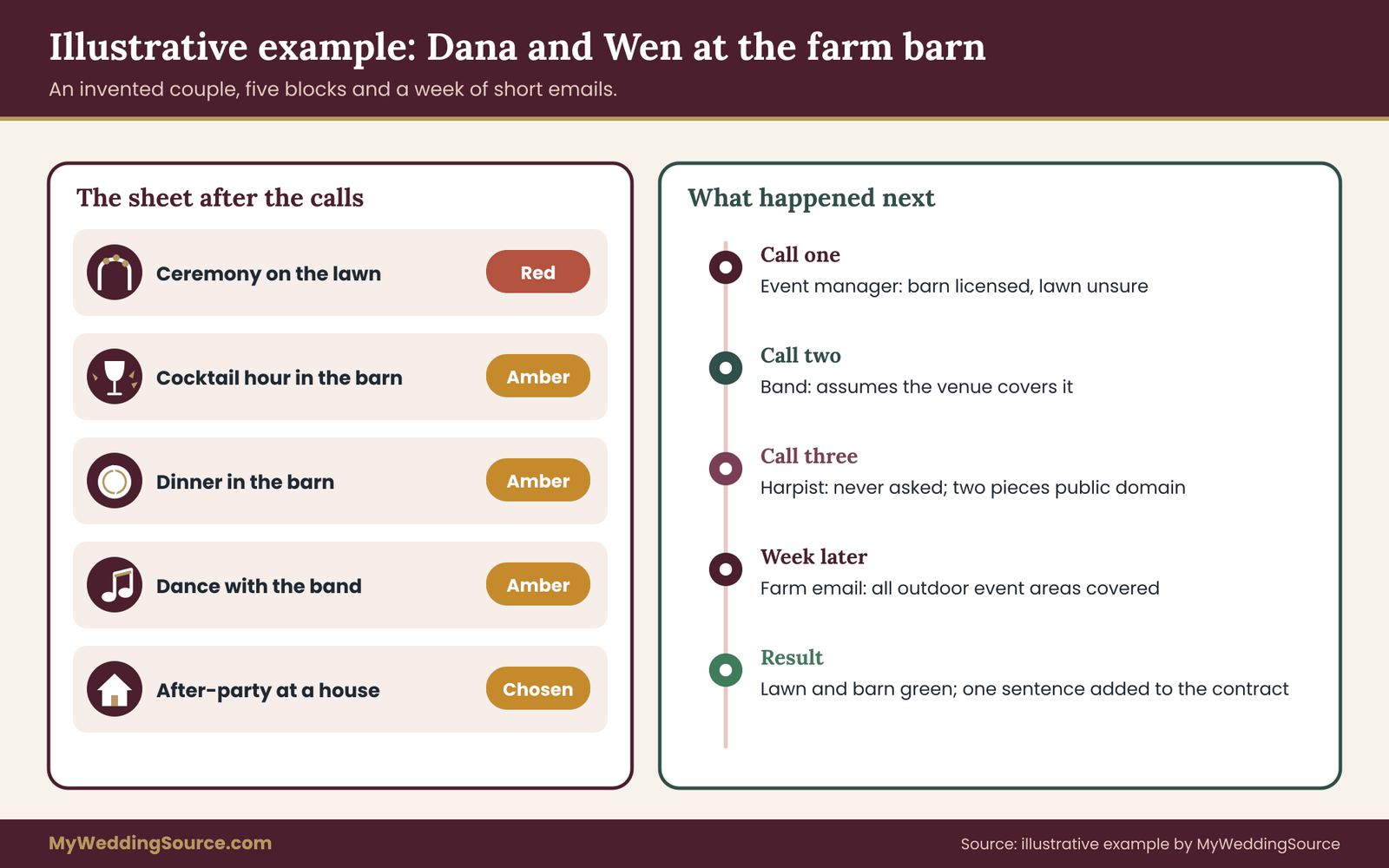
Dana Hartley and Wen Ng are planning a wedding for about ninety guests at a converted barn on a working farm, in a state neither of them has lived in before. The plan has a ceremony on the lawn with a harpist, a cocktail hour with a recorded playlist, dinner in the barn, and a dance with a six-piece band. A friend of Wen’s, who plays the cello, will perform one piece during the ceremony. A cousin will run a small after-party at a nearby house with a speaker and a phone.
Step one: list the moments and fill the first lines
Dana opens a note on her phone and writes five blocks: ceremony, cocktail hour, dinner, dance, after-party. For each she writes the source, the operator and the space.
The ceremony is live, with two operators, the harpist and the cellist, on the farm’s lawn. The cocktail hour is a playlist run by the farm’s coordinator through the barn’s speakers. Dinner is the same playlist. The dance is the band, live, in the barn. The after-party is a phone and a speaker at a rented house.
The last two lines of each block, permission holder and evidence, are empty. That is the starting position, and it is normal.
Step two: the venue call
Dana calls the farm’s event manager and asks the six core questions. The manager, Priya, says the farm does hold a license from one performing rights organization for the barn, because they have hosted bands for years. She is less certain about the lawn, since the farm has never been asked and thinks it may be covered but would need to check. She says the band should carry its own arrangements for anything outside the barn. When Dana asks for it in writing, Priya agrees to send an email after checking with the farm’s owner.
Dana updates the sheet. The barn blocks, dinner and dance, are amber: a named holder, a verbal answer. The cocktail hour is amber too, because it is in the barn. The lawn ceremony is red, since nobody has said yes.
Step three: the performer calls
Dana asks the band leader what the band assumes. He says the band plays at licensed venues all the time, checks when it is a new place, and carries a general liability certificate. He does not hold a license of his own and has never needed one. When she mentions the lawn, he says the band is not playing there, so it does not matter to them.
She asks the harpist. The harpist plays mostly classical pieces and a few arrangements of popular songs, is a freelancer, and says nobody has ever asked her about wedding music licensing. She would play whatever the couple wants. Dana asks which pieces they plan to use. Two are nineteenth-century compositions; one is a harp arrangement of a recent pop song.
The cellist friend is performing a piece Wen’s grandmother loved, which is old enough to be in the public domain.
Step four: the findings
The sheet now shows a pattern. Everyone is relaxed, and the single real gap is the lawn ceremony.
The harpist’s two classical pieces are in the public domain, so the work itself does not need permission. The pop arrangement is a protected work. The lawn may or may not be covered by the farm’s license. The farm’s answer will settle the lawn question for the harpist’s popular piece and also the cellist’s performance.
The after-party is the other red block. It is at a rented house, with a cousin’s phone and a speaker, and it is a small, informal gathering outside the wedding itself. Dana decides this block is acceptable to leave amber: the music is a personal playlist for a family group, and the stakes are low.
Step five: closing the lawn question
A week later Priya emails. The farm’s license covers all outdoor areas of the property used for events, and she attaches a short policy page describing it. She also confirms that outside performers are covered when playing on the farm’s premises. The lawn ceremony block turns green, and the barn blocks follow.
Dana asks the band leader for a one-line confirmation that the band expects the venue to hold public performance coverage, and he sends it in an email. She files both emails with the contracts.
She also asks the farm to add a sentence to the rental agreement. Priya says she can add it as an addendum. It reads, in the farm’s own words, that the property holds the licenses relevant to music performed at events on the premises.
What the example shows
Two things matter. First, the work took three calls, two short emails and about an hour in total. It found one real gap, and the gap resolved in a week. Second, the answer might have gone the other way. If Priya had said the farm held nothing, Dana would have faced a different choice, and the sheet would have shown her that choice early, with six months to decide rather than six days.
What wedding music licensing costs, and who pays
Wedding music licensing rarely appears as a line item, and the reason is that the cost is usually folded into something else. Understanding where it hides helps you compare wedding music licensing options sensibly, without inventing numbers.
Inside the venue’s fee. A venue that holds licenses pays for them as a business expense. The cost is part of the rental fee, the event package or the minimum spend, even though no line says so. This is the most common arrangement, and it is why couples who book established venues pay nothing separately.
Inside the performer’s fee. A performer or a DJ company that carries its own coverage pays for it as part of doing business, and the cost is reflected in what they charge. This is one reason a professional act can cost more than an informal one, and the extra is not waste.
As a separate charge. At a venue with no license, someone may need to buy a license for the event. Performing rights organizations offer licenses for particular events, and the amount depends on the organization, the size of the event and the type of music. Do not rely on any number you read in an article, including this one. Ask the organization for a current quote. The cost for one event may be modest or substantial depending on circumstances, and the point is that it is knowable.
As a risk you carry. If no one holds a license and you go ahead anyway, the cost is the possibility of a claim. For a small private wedding the chance is low, and for a larger event with paid professionals at a commercial site, it is higher. Neither is something you can price in wedding music licensing terms, and a sound planning approach is to avoid depending on it.
Comparing the options in plain terms
Consider a couple choosing between two venues. The first is a hotel ballroom with a higher rental fee and a clear policy stating that it holds licenses for live and recorded music. The second is a lower-cost private estate with no entertainment license and a vendor list the couple can ignore.
The hotel’s higher price includes, among many other things, the permission question already answered. The estate’s lower price leaves the question to the couple, which means asking performers about their own coverage, possibly buying an event license, and checking each source of music. Neither choice is wrong. The right comparison is the whole price of the plan, including the time and the risk, and not only the rental fee.
The same logic applies to the DJ versus the band decision. A DJ company with its own arrangement may cost more than a hobbyist and still cost less than a band, and the question of who holds public performance coverage may be answered in the DJ’s standard contract. A band may or may not carry anything. Ask each one, and weigh the answers alongside the musical fit.
Spending an hour on advice
A short consultation with a lawyer has a real price, and the decision to buy one should rest on the red blocks in your sheet. If every block is green or amber with low stakes, there is little a lawyer can add. If a red block affects the ceremony, a large reception or a plan to record and publish, an hour of advice is small compared with the rest of the wedding budget. Put a modest line for professional advice in your budget so the decision is easy when it comes.
When to bring in a lawyer for wedding music licensing
Most couples will never need legal advice on wedding music licensing. A short consultation, though, is a reasonable cost in a few cases. You are using an unusual space with no license and a large event. A contract with an indemnity clause that makes you responsible for rights-related claims and you are not sure what it means. A plan to record, stream or publish music in a way that goes beyond private use. A commissioned work, such as an original song or an arrangement, where ownership needs to be written down. A performer who disputes who is responsible, and neither will move.
A one-hour consultation with an entertainment or intellectual property lawyer is usually enough, and an event-focused lawyer will recognize the pattern immediately. Bring the sheet. The lawyer will want to see the contracts, the venue’s answers, and a description of the event. If you do not have a lawyer, your state or local bar association often runs a referral service, and some law schools run clinics. This is a sound use of an hour, and it is not an emergency.
A timeline for wedding music licensing questions
The sheet works best when each step of wedding music licensing happens at the right stage. A rough timeline follows, written for a wedding planned about a year ahead; compress it if your timeline is shorter.
At venue shortlisting. Add one line to your venue comparison list: does the venue hold public performance licenses, and do they cover live music? You are not asking for details yet. You are collecting a yes or no that helps you rank the options. The venues guide shows what else to compare at that stage.
Before signing the venue contract. Ask the six core questions and read the entertainment section of the agreement. If the venue is vague, ask for the written version before you sign. After signing, you have less leverage.
When booking performers. Ask the performer questions during the first conversation, not after the deposit. Request the wedding music licensing sentence in the performer contract.
Six to eight months before. Draft the sheet with all five moments, fill it with what you know, and mark the gaps. Introduce venue and performers if any block is amber or red.
Two months before. Check the sheet again. Confirm that all written answers are in your records. Share the final music plan with the venue, the performers and any videographer, so that everyone is working from the same list. The wedding-day checklist in the wedding planning checklist is a good place to add a line for this.
One week before. Confirm that the point of contact on the day knows who to call if a question comes up. Print or save the key emails on your phone.
On the day. Nothing. If the sheet is done, the day should not involve wedding music licensing at all.
Common mistakes with wedding music licensing, and what to do instead
Most problems with wedding music licensing come from a short list of habits. Each one is easy to fix once you see it.
Assuming the venue handles it because venues usually do. The assumption is right most of the time, which is exactly why it is dangerous. It is wrong in the places where you are least likely to check: new venues, private properties, outdoor areas. Fix: ask the six questions even when the venue looks professional.
Accepting a verbal yes. A friendly yes on a tour is real information, and it is also forgotten within a year, or answered by a staff member who later leaves. Fix: send a summary email the same day, and ask for one written sentence in the contract.
Treating all music as one source. A venue’s license for a live band does not automatically cover a streaming playlist run through a personal account, a livestream or a video. Fix: use the five-moment map, and ask about each source separately.
Asking the wrong person. The front-desk staff at a venue are often not the people who know about wedding music licensing. A performer’s booking assistant may not know what coverage the band carries. Fix: ask for the event manager, the owner or the band leader, and say what the question is about.
Leaving the ceremony out. Couples focus on the dance and forget that ceremony music, cocktail-hour acts and the playlist during dinner are part of the same picture. Fix: map every moment before you ask any question.
Signing a contract that shifts responsibility without noticing. Some standard agreements put wedding music licensing on the client, sometimes in a general clause about compliance with laws. Fix: read the entertainment, compliance and indemnity sections, and ask what a clause means before you sign it.
Over-correcting. Some couples, once they notice the topic, become anxious and ask performers to prove everything or cancel songs. This is rarely necessary. The aim is to know who holds what, not to reach certainty about every note. Fix: stop when every block is green or a deliberate amber.
Forgetting the after-party and the edges. The second venue, the hotel bar, the van with a speaker. These are usually harmless, and they also fall outside the venue’s license. Fix: note them on the sheet and make a conscious choice.
Mistakes performers and vendors make
Performers sometimes assume the couple has handled wedding music licensing because the couple signed the venue agreement. Planners sometimes assume the performer has it covered because the performer is experienced. Neither assumption is unreasonable, and neither helps you. If you work with a planner or day-of coordinator, give them the sheet. A coordinator can chase the venue and the performers for the written confirmations and keep the thread in order, and may already have a standard form. The guide to the wedding ceremony cue sheet is a natural companion, because it lists the music cues, and that list is a good starting point for your ceremony block.
Troubleshooting wedding music licensing before and on the day
Even a tidy wedding music licensing sheet can run into a surprise. The responses below are measured and practical.
A venue changes its answer
A venue manager changes jobs, or the venue is sold, or an earlier reassurance turns out to have been a general belief. Ask for the current answer in writing, referring to the earlier one. If the new answer is worse, treat it as a new red block and use the same rules: check with the performers, consider a different music source for the affected moment, and ask for a contract amendment if the change affects what you were promised.
A performer says they need a license that nobody has
Occasionally a performer, after reading the venue’s policy, tells you that they cannot perform without a license in place. That is a professional’s boundary, and a sensible one. Ask what they need: a letter from the venue, a one-event license from a performing rights organization, or a different arrangement. A solution is usually available in days. If it is a one-event license, the organization can tell you how it is issued and what the current charge is.
The venue asks for proof from performers
Some venues require a certificate of insurance, a copy of any license or a signed statement. Pass the request to the performers and ask them to reply directly to the venue. You do not need to be the messenger for documents you cannot judge. Keep a copy of whatever they send.
A guest asks to perform
A guest who wants to sing a song, play a set or run a karaoke segment is a pleasant request, and the answer depends on the sheet. If the venue’s license covers performance in the space, a guest performer is covered the same way as hired ones. If the space has no coverage, ask the performers and the venue. For a brief surprise, such as a toast with a song, the risk is small and can be a conscious decision. Tell the person managing the sound.
A platform flags the livestream
If the stream is muted or the recording is blocked, do not try to argue with an automated system during the ceremony. Continue with the event. Afterward, ask the streaming provider about the platform’s process, and consider offering guests a separate recording with different music. The provider should have an answer, since this is one of the most common problems they see.
A claim arrives after the wedding
It is rare, and when it happens the sender is typically a licensing organization writing to a venue or a performer, not to a couple. If you receive one, do not respond in haste and do not ignore it. Read it, note the date, find your sheet and the contracts, and call the party with whom you agreed responsibility. If the letter is addressed to you, a short consultation with a lawyer is appropriate. Your written records are the thing that makes that conversation quick.
Keeping the records for wedding music licensing
The sheet and the emails together make a small wedding music licensing file, and the file should live with your other wedding documents. A good set is the filled-in sheet, the venue’s written confirmation, the performers’ written confirmations, the relevant contract pages, and any certificates or permits. Name each file with the date and the party, so that you can find it in one search.
Keep the file for as long as you keep the other contracts. If a dispute arises about the evening’s music, a question about an invoice, or a request from a performer’s agent, the file answers it. A longer view on organizing contracts, receipts and photos is in the guide to wedding records after the event, and the sheet fits in the vendor folder it describes.
There is a second, quieter benefit. Having the wedding music licensing sheet complete lets you stop thinking about it. A couple who has asked, written and filed rarely lies awake wondering whether the band is allowed to play. They know who said what, when, and in which email.
How the questions change with the size of the wedding
A twenty-person backyard dinner with one guitarist and a two-hundred-person ballroom reception are very different events, and the effort should match. For the small one, ask the performer what they assume, note the answer and move on. For the large one, work through the full sheet, request contract language and put an introduction between the venue and the band. The questions are the same. The depth changes with the scale, the number of paid professionals and the amount of music that is public.
How the questions change with the type of performer
A full-time band with an agency usually answers in one email, since the agency has handled it before. A solo performer found through a friend may need a more patient conversation, and may be glad to be asked. A DJ company’s standard contract may already contain the answer, and you only need to read it. A ceremony ensemble from a conservatory may have an institutional policy. In every case, let the performer explain how they work, and fill in the sheet from what they say.
Your next steps
Pick the smallest wedding music licensing step that moves a block from red toward green, and do it this week.
- Write the five music moments on one page, with the source and the operator for each.
- Call or email the venue’s event manager with the six core questions, and send a same-day summary of what you hear.
- Ask each performer what they assume about wedding music licensing at venues and whether they carry anything of their own.
- Put any mismatch in front of both parties in one short email, and ask them to confirm with each other.
- Ask for one sentence in each contract that names who holds the public performance permission.
- Decide, on purpose, what you will do about the edges: the after-party, a guest performance, a livestream or a video.
- File the sheet, the emails and the contract pages with your other wedding records.
FAQ
Do we need a license to have a live band at our wedding?
Usually the venue holds the public performance licenses that cover live music played on its premises, so the couple does not buy anything. Whether that is true for your venue depends on its arrangements. Ask the event manager which licenses it holds and whether they cover live bands, then ask for the answer in writing before you sign.
Who is responsible for wedding music licensing, the venue or the performer?
It depends on the place and the contract. At an established venue it is commonly the venue. At a private property, nobody may hold a license unless the performer brings one. Neither side can be assumed, so ask both, compare the answers, and put the agreed responsibility in each contract in one plain sentence.
Does a personal streaming subscription cover music at our reception?
Personal subscriptions are generally written for private listening, and their terms often restrict public or business use. Playing a playlist for a crowd is a different kind of use. Read the service’s terms, ask the venue what it allows, and consider a service designed for public or business use if you plan to run the music yourselves.
Can a friend or relative perform without any license?
A guest performer is performing in public in the same way a hired musician is, so the same permission question applies. In practice, a venue’s blanket license usually covers anyone who performs on its premises. At a private property, a short performance by a guest is a small risk that you can accept on purpose. Ask the venue about guest performers in one sentence.
Are classical pieces and old songs free to play?
Compositions that have passed into the public domain do not need permission for the work itself, and many classical pieces qualify. Newer arrangements and recordings can still be protected, and a popular song arranged for harp or strings is still a protected work. Ask your performer which pieces are in the public domain, and check anything unclear with a lawyer.
Does the venue’s license cover our wedding video or livestream?
Usually not. A venue’s public performance license covers music performed on its premises. Putting a song into a video or streaming it online is a separate use with its own rights, and platforms may mute or block content that contains recognized songs. Ask your videographer and streaming provider how they handle music, and ask for licensed library tracks where needed.
What should we do if the venue has no music license?
Treat the space like a private property. Ask whether the venue is willing to obtain a license for events, hire performers who say plainly how they handle coverage, or ask a performing rights organization about a license for a single event. Ask for a current quote rather than relying on any number you have read. A short legal consultation can help if the event is large.
When should we talk to a lawyer about wedding music licensing?
Consider a short consultation if you are using a space with no license for a large event, if a contract makes you responsible for rights-related claims you do not understand, if you plan to record or publish music, or if a commissioned song needs its ownership written down. For a standard venue and a standard band, a lawyer is usually unnecessary.