

A black tie wedding is a promise about the evening: the hosts are signaling that the room, the clothes, and the schedule will all be formal, and the fairest way to keep that promise is to say it clearly, make the venue match it, and leave guests free to meet it in a way that fits their bodies, budgets, and closets.
Quick answer
Black tie means tuxedos and formal evening gowns, and it is an evening dress code. Guests are expected to wear a tuxedo or a floor-length gown, or an equally formal alternative that the hosts have said they welcome. Hosts are expected to state the dress code in every place guests will look, schedule the event for the evening, and choose a venue where formal clothes work. Nothing we found says hosts must supply or pay for guests’ attire. If you want to host a black tie wedding but worry about cost for your guests, “black tie optional” is the more flexible label. Details and sources are below.
What a black tie wedding asks of everyone
The phrase “black tie wedding” gets used loosely, so it helps to pin it down before assigning responsibilities. A dress code is a shared agreement: hosts name a level of formality, guests dress to it, and the venue, the lighting, and the timing support it. When any of those three pieces is missing, a black tie wedding feels uneven, with some guests in tuxedos and others in sundresses, or with everyone dressed up for an afternoon garden that has no shade.
Reading the label correctly
The label has a long history in evening dress, and the details still matter to guests who want to get it right. This section sticks to what the sources we read agree on, and flags where they differ.
The core look
Emily Post describes black tie as the most common formal dress code for events such as weddings, proms, formal dinners, and the theater, and places it just below white tie. For men, her list is a black tuxedo jacket with matching trousers, a formal white shirt with a pleated or piqué front, studs and cuff links, a black bow tie, a cummerbund or vest, and black patent shoes with dark dress socks. For women, the list is a floor-length formal evening gown, with a dressy cocktail dress or a very dressy little black dress named as alternatives. Those alternatives are worth noticing: even a traditional etiquette authority leaves women a range, so a gown is the clearest answer rather than the only one.
Why time of day matters
The Gentleman’s Gazette, a men’s style publication, treats black tie as evening wear meant for after 6 p.m. or after sundown, whichever comes first, and says a tuxedo generally should not appear in broad daylight. Emily Post’s guest-attire page points the same way by tying formality to the invitation and the hour of the wedding, and by separating “formal daytime” (a dark suit for men, a cocktail or dressy afternoon dress for women) from “formal evening” (a tuxedo or dark suit for men, a long or dressy cocktail dress for women). For hosts, the practical takeaway is simple: if the ceremony starts at 2 p.m., a black tie wedding is a mismatch no matter how elegant the venue is. The label belongs to a black tie wedding held in the evening and receptions, and a couple who wants a formal daytime wedding should consider a different word for it. The Knot makes a related point, that daytime events allow more flexibility with color and pattern while evening events call for the most formal options.
Where this dress code sits on the formality ladder
Guests read the code against the others they know. Seeing the neighbors on the ladder helps hosts choose and helps guests decide when a message is ambiguous.
White tie above, black tie below
White tie is the most formal evening code, and it is the one associated with tailcoats. The Gentleman’s Gazette notes that tailcoats today are mostly reserved for very formal evening events, and that a ceremony starting after 6 p.m. is where black tie is common and white tie is possible. Few American weddings ask for it. If you are not sure whether your guests own, or can easily rent, white tie, a black tie wedding is the more practical choice.
Optional, creative, and cocktail
Below black tie are looser versions. Emily Post defines “black tie optional” as a tuxedo or a dark suit for men, and a formal gown, cocktail dress, little black dress, or dressy separates for women. She also describes “creative black tie,” which keeps a black-tie foundation but allows color, texture, and personality in accessories. The Knot adds that “black-tie preferred,” “invited,” and “encouraged” generally signal that the couple would like tuxedos and long gowns but will accept formal suits and dresses. Cocktail attire sits a step lower still, and we cover it separately in our guide to cocktail attire. If you are choosing between two of these, the decision matrix later in this guide is built for that comparison.

What guests are expected to wear
If you are a guest at a black tie wedding, the safest assumption is that the hosts and wedding party will be in formal black tie, because the sources we read say so: The Knot notes that when a couple and their wedding party wear black tie, guests are expected to dress at a similar level, and The Black Tux, a rental retailer, says hosts usually dress in full black tie so matching that effort is the safer choice. The sections below break the look down by piece, and they include the exceptions that sources allow.
Men’s formal wear for a black tie wedding
For a black tie wedding, the traditional answer for men is a tuxedo, and most retailers and etiquette sources agree on the main elements. Where they disagree, it is usually about whether a dark suit is an acceptable substitute, and the answer depends on the exact words on the invitation.
The tuxedo and its parts
A tuxedo is more than a black suit, because the shirt is formal as well, with a pleated or piqué front, and the whole outfit is built around a bow tie. The Gentleman’s Gazette calls the classic dinner jacket the most formal choice for the most formal events and notes that velvet and other non-black jackets belong to less formal occasions. The Black Tux’s guidance for guests adds a practical note: jacket shoulder seams should line up with the natural shoulder, the jacket should close with about an inch of chest clearance, and trouser hems should break cleanly. That is a retailer’s rule of thumb, but it matches what most tailors check first.
The bow tie, waist covering, and shoes
Emily Post lists a black silk, satin, or twill bow tie, with a black cummerbund or a vest, and no gloves. Shoes are black patent or well-polished black leather, with black dress socks. The Gentleman’s Gazette, writing for guests who might wear a dark suit instead, suggests polished calfskin dress shoes as a reasonable fallback. A regular long necktie does not belong with a tuxedo, and Zola’s guide for guests lists suits, blazers, belts, and ordinary ties among the things to avoid at a black tie wedding.
When a dark suit is acceptable
A dark suit is a safe substitute only when the invitation says “black tie optional” or a similar phrase. The Knot says that for black-tie optional a tuxedo is not required, and that a structured dark suit with an understated tie works, with a three-piece suit adding formality. The Black Tux warns against mixing levels, such as pairing a black bow tie with a dark suit or wearing a tuxedo shirt with an ordinary suit, because it looks unintentional. For a strict “black tie” invitation, rent or borrow the tuxedo rather than gambling on the suit.
Hot weather and the white dinner jacket
Emily Post notes that in summer, tropical, or cruise settings, a white dinner jacket with black tuxedo trousers is an accepted variation, and the Gentleman’s Gazette agrees that white dinner jackets are appropriate in hot weather. It is a useful option for hosts to mention on the wedding website if the event is outdoors in a warm climate, because it keeps guests inside the dress code instead of forcing a choice between safety and style.
Women’s formal wear for a black tie wedding
For women, the formal tradition is a floor-length gown, but current guidance from wedding sites is more flexible than a strict reading of the rule, and the distinction between “black tie” and “black tie optional” matters even more here.
Gowns and alternatives
Zola’s guide for guests calls a floor-length gown the safest choice and says shorter cocktail dresses work only if they are glamorous and dressy, with embellishment or sparkle, with a well-tailored dark suit with some sheen also acceptable. Emily Post lists the long evening gown, the dressy cocktail dress, and the dressiest little black dress. The sources do not agree on hemlines. The Knot’s black-tie-optional article says midi-length dresses are acceptable in one place and says dresses should reach the floor or ankles in another, so treat midi as a judgment call that depends on how formal the other guests will be, and when in doubt choose longer.
Jumpsuits and tailored separates
The Knot calls jumpsuits a gray area that depends on the style, and The Black Tux lists a tailored pantsuit as a reasonable choice for black tie optional. For a strict black tie invitation, a formal jumpsuit in a luxe fabric with a structured cut is the version most likely to read as intended. Fabric matters more than the category: the Knot advises avoiding casual fabrics such as linen, denim, and crepe at this level.
Color and what to avoid
Zola and The Black Tux both say to avoid white, ivory, and cream, since those belong to the person getting married. Zola also advises against neon and very bright colors and against revealing outfits, and The Knot suggests dark colors such as black, navy, charcoal, emerald, or burgundy for black tie optional. Black itself is widely accepted: Zola calls it a reliable option, and The Black Tux lists it among the safest colors.
Dressing well when the binary does not fit
Not every guest fits a “men’s formal” or “women’s formal” column, and hosts should write the dress code so that nobody has to decode it.
Options in plain terms
Zola’s article names several formal options for nonbinary guests: a floor-length gown, a luxe suit or dinner jacket with or without a tie, or a dressy jumpsuit in a jewel tone. As a host, you can use that thinking directly by describing the code as a level of formality instead of as clothing for a gender: “formal evening wear, such as a tuxedo or floor-length gown.” That small wording choice invites guests to find their own version of it.
Fit beats formality
The Black Tux makes the point that a well-fitted outfit beats a more formal outfit that fits poorly. We agree as editors, and we would add that fit is easiest to fix well before the week of the wedding. If you are a guest who is borrowing, buying, or renting, try the full look on once, sit down in it, raise your arms, and dance a few steps, because a formal outfit you cannot move in will not read as formal by the end of the night.
What hosts need to provide at a black tie wedding
The brief for this article asks what hosts “need to provide.” Here is the honest answer: the sources we read describe what guests should wear, and none of them describes a host duty to supply guests’ clothing. Emily Post’s pages on black tie and wedding guest attire speak to guests and do not address host obligations. So this section separates three things: what hosts need to communicate, what hosts need to arrange so the code works, and what hosts do not need to provide. The first two are our editorial recommendations, built from the sources on dress-code communication and venue conditions, and we label them that way.
Say it clearly, in more than one place
A dress code only works if guests can find it before they shop. The most frequent reason guests under- or over-dress is that the signal was vague, late, or inconsistent.
On the invitation
A wedding-planning article on sayi.do recommends mentioning the dress code on the invitation itself and using widely recognized names such as “black tie optional” or “cocktail attire” rather than invented labels like “garden chic,” because guests may not know what an invented label means. Emily Post says that a “black tie” invitation requires a tuxedo for men. If you write “black tie,” you are making a specific request, so choose it on purpose. If you want tuxedos and gowns to be the clear expectation of your black tie wedding, say “black tie.” If you want a formal look without insisting on a tuxedo, “black tie optional” is the standard way to say it.
On the wedding website
The same article suggests treating the website as the main information hub, with fuller detail than an invitation has room for, and with dress codes for any other events, such as a rehearsal dinner or a farewell brunch, spelled out separately. For a black tie wedding, that could include a sentence on the hour, the venue’s ground surface, the weather outlook as the date approaches, and whether a white dinner jacket or a formal suit is welcome. Keep the invitation and the website consistent, since mixed signals produce the “what should I wear?” texts the website is meant to prevent.
One term, defined once
Pick one phrase and use it everywhere. If the invitation says “black tie” and the website says “formal attire,” guests will not know which one is the real instruction. If you add a clarifying sentence, make it concrete: “Tuxedos and floor-length gowns are welcome; formal suits and dressy cocktail dresses are also fine.” That sentence tells guests where the floor is, and it is the kind of detail the sayi.do article recommends adding to guide guests gently instead of dictating outfits.
Make the evening match the clothes
Clothes are only one half of a black tie wedding. Hosts who ask for black tie are also setting expectations for the hour, the room, and how comfortable guests will be in formal clothing. These items are our recommendations, not rules from the sources.
Schedule it as an evening event
Because a black tie wedding is traditionally an evening event, the simplest way to make the code feel natural is a ceremony that starts late in the afternoon or in the evening, with the reception following. If your ceremony must be at noon, consider using “formal attire” or “cocktail attire,” and explain why on the website. Our wedding timeline guide can help you work backward from a start time that supports the code.
Check the ground, the shade, and the coat situation
A floor-length gown on gravel, or patent leather shoes on a damp lawn, can undo the look. The sayi.do article recommends telling guests about venue conditions such as grass, gravel, or uneven ground, so they can choose footwear. We would extend that to coats and wraps for cool evenings, a place to put them, and seating for older guests during long cocktail hours. These are small provisions that make formal clothing livable, and they cost far less than renting a tent after the fact.
Plan for photography early
Formal wear is a major reason couples choose a black tie wedding, and it shows up in portraits. Ask your photographer where family and wedding party portraits will happen, and whether the light will still be good by then. Our wedding photographer shot list lists the groups and details to request.
What hosts do not have to provide
The strongest reason to be clear about this is that it protects guests from assumptions in both directions: guests should not expect hosts to supply clothing, and hosts should not feel obliged to.
Guests’ attire
We found no source that says hosts must provide or pay for guests’ formal wear. Zola’s guest guide says that a guest who does not own a tuxedo can rent one with standard accessories. If your black tie wedding guest list includes people for whom formal wear would be a hardship, the kindest tools are early notice, a clear “optional” or “welcome” clause, and, if you choose to, a quiet offer to help. Whether to offer financial help is a personal decision, and we do not treat it as an etiquette requirement.
Wedding party attire
Couples sometimes also ask whether they should pay for the wedding party’s formal wear. The sources we read do not set a rule, and practice varies, so decide it early and say so plainly to the people involved. If you ask attendants to rent tuxedos, give them the retailer’s timeline and tell them who pays for what before they place orders.
What you do owe your guests
In the end, the host’s job is a good event. Guests who dressed for your black tie wedding should find a room that works for it: seating, shade or heat, food and drink, and a schedule that does not leave them in uncomfortable shoes for hours with no chance to sit. That is a standard we hold as editors, and it is the thread running through the rest of this guide.
What it can cost
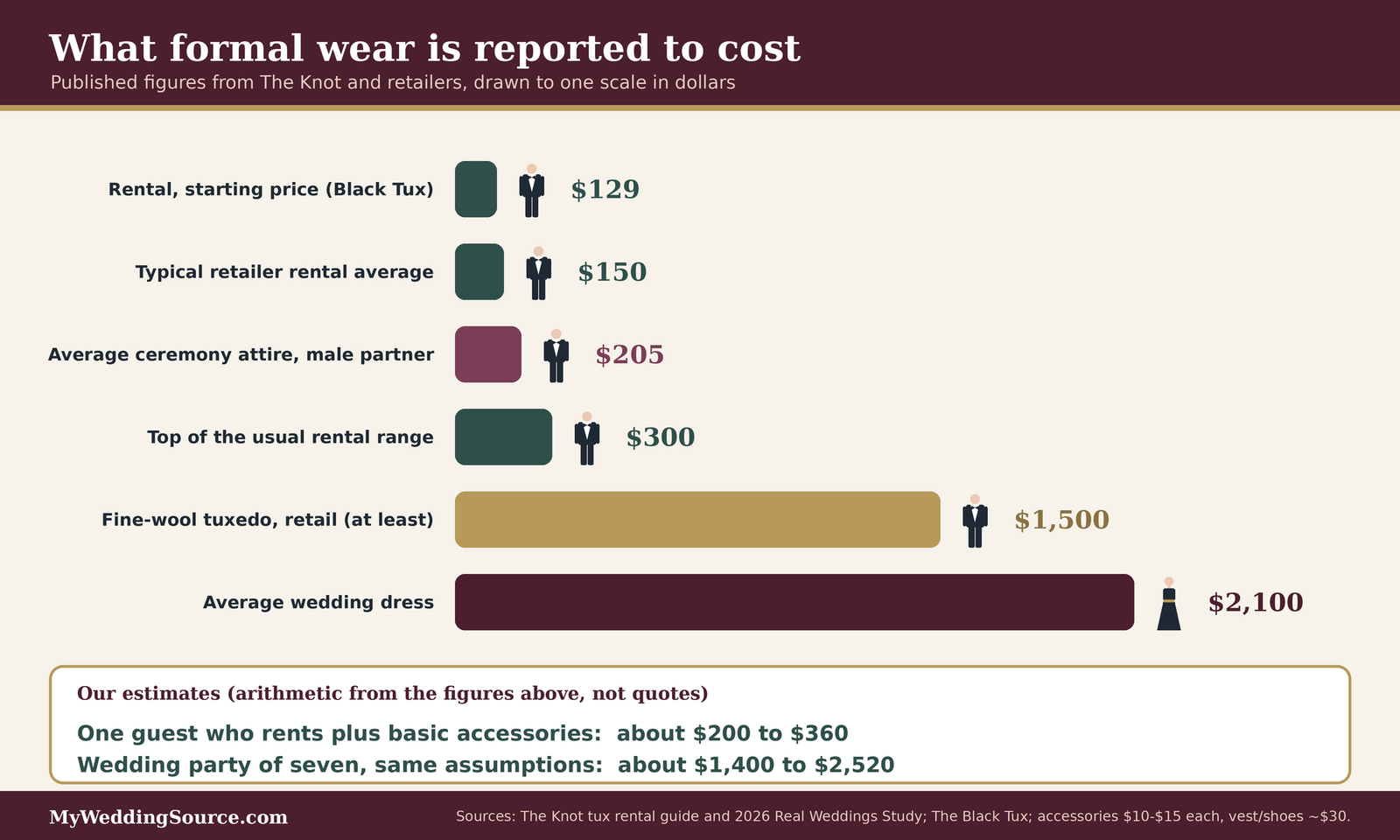
The Knot’s 2026 Real Weddings Study, which surveyed 10,474 U.S. couples married in 2025, reports an average wedding cost of about $34,000, an average of 117 guests, and about $292 per guest. The Knot’s tuxedo rental guide says major rental retailers average about $150 per tux and gives an overall range of roughly $150 to $300. Those are survey and retailer figures, not predictions for your event. Our own arithmetic later in this guide applies them to a sample wedding party and is labeled as an estimate. For your own numbers, start with our wedding budget calculator.
Matching a black tie wedding to venue, season, and movement
A formal outfit has to survive the actual event: an outdoor ceremony in July, a December reception in a drafty hall, a long dance floor. This section turns the dress code into tests that hosts and guests can run before the week of the wedding.
Heat, cold, and layers
The clothes at a black tie wedding are not designed for weather. They are designed for a climate-controlled room, so the weather is a variable the hosts should account for.
Heat and humidity
The National Weather Service explains that the heat index combines air temperature and humidity to estimate how hot it feels, and that full sun can raise heat index values by up to 15 degrees Fahrenheit. As an example, the NWS notes that 96 degrees Fahrenheit air at 65 percent humidity yields a heat index of 121 degrees. A black wool tuxedo in full sun adds its own load. That is an argument for shade during the ceremony, water available during cocktail hour, and permission to remove jackets after the first dance. It is also why a white dinner jacket is an accepted option for summer, as Emily Post notes. This is general information, not medical advice; people with heat sensitivity should ask their own clinician.
Cold evenings and outerwear
Formal evening dress rarely includes a coat, and guests who arrive in a parka will carry it all night. Tell guests in the website notes if the venue is outdoors and the date is in colder months, and arrange coat storage. The Knot suggests richer fabrics such as velvet for fall and winter events, which is a gentle way of suggesting that formal clothing can also be warm.
Ground, light, and movement
The second set of tests is physical: can people walk, sit, and dance in what the code asks for?
Footwear and terrain
Patent leather shoes and heels are traditional, but gravel, grass, and cobblestones are not. If the ceremony is on a lawn or a beach, hosts should say so on the website, and guests can choose block heels, flats with a formal finish, or dressy boots. The sayi.do article lists grass and gravel as venue conditions worth flagging, and we would add stairs and long walks from parking.
Photographs and lighting
Black and dark clothes can lose detail in low light, and white shirts can glow. Ask your photographer to see sample photographs from similar venues, and ask about lighting for the reception. If you or your wedding party are choosing between black and midnight blue, test both in a photo under the same lighting before committing. Our photographer shot list guide can help you plan which portraits to take while the light is best.
Sitting, dancing, and eating
Try the outfit seated, because a rented jacket that fits when you stand can pull across the shoulders when you reach for a glass. Try dancing for a minute in the shoes you plan to wear. These are simple tests, and The Black Tux makes the underlying point that fit matters more than formality level.
What a black tie wedding costs, and who carries it
Cost is where a black tie wedding stops being abstract. A black tie wedding request is easiest to defend when hosts understand what it adds to guests’ budgets and to their own.
Reported numbers and what they cover
Three kinds of figures appear in this section: survey averages, retailer prices, and our own arithmetic. We label each one.
Survey averages
The Knot’s 2026 Real Weddings Study, drawn from 10,474 U.S. couples married between January 1 and December 31, 2025 and recruited by email through The Knot and WeddingWire members, reports an average wedding cost of about $34,000, an average guest count of 117, and an average cost of $292 per guest. It also reports an average wedding dress cost of $2,100. The survey does not report how many couples chose black tie, so we cannot say how common the dress code is, and we will not guess. Because the sample is members of those two sites, it describes the couples who responded, not every wedding in the country.
Retailer prices
The Knot’s tuxedo rental guide, updated in April 2025, says the average ceremony attire cost for a male partner was about $205 in its earlier study of couples married in 2024, and that major retailers such as The Black Tux and Men’s Wearhouse average about $150 per rental, with an overall range of about $150 to $300. It lists starting prices from $129 at The Black Tux up to $180 at Jim’s Formal Wear, and says accessories such as cufflinks, studs, and cummerbunds add about $10 to $15 each, while vests and shoes run about $30 each. Prices change, so confirm the current price with the retailer before you plan around any of these numbers.
A worked estimate for hosts and wedding parties
This is editorial arithmetic, not a quote. Its purpose is to show how to set up the calculation for your own wedding party, using the retailer price range above.
The assumptions
Assume a wedding party of seven people renting tuxedos, such as a partner, a best man, and five attendants, with each person paying a base rental of $150 to $300. Add a modest set of accessories for each person: studs and cufflinks at $10 to $15 each, and shoes at about $30, which is about $50 to $60 per person.
The result
At seven people, the base rental is about $1,050 to $2,100, and the accessories add about $350 to $420, for a total of roughly $1,400 to $2,520. Against the $34,000 average wedding cost reported by The Knot, that is about 4 percent to 7 percent, though your budget will differ. Taxes, shipping, and damage waivers vary by retailer. The Knot notes that Men’s Wearhouse includes taxes and a $12 damage and handling fee and that The Black Tux charges a flat $12 fee, while other retailers may add waiver or insurance fees.
What the arithmetic does not include
The estimate leaves out gowns, alterations, hair and makeup, transportation, and anything the host chooses to cover for others. It also leaves out venue and catering decisions that tend to come with a formal evening, such as seated dinner service, coat check, or extra lighting. Those choices are separate from the dress code, but they often travel together, and our wedding budget calculator is a good place to give them lines of their own.
What black tie asks of a guest’s budget
Hosts of a black tie wedding rarely see the guest side of the ledger, so it helps to estimate it.
A guest who rents
A guest renting a tuxedo with the same accessories as in the estimate above faces about $200 to $360 (a $150 to $300 base plus $50 to $60 in accessories, our arithmetic using The Knot’s figures). That is before travel, a gift, and any hotel stay, so the dress code is one of several costs for guests. The Knot’s guide also notes that accessories can be purchased rather than rented if you want to keep them.
A guest who owns or borrows
Guests who already own formal wear pay close to nothing, and borrowing a gown or jacket from a friend is a legitimate option. This is why we recommend writing the invitation so that “formal” clothing in a guest’s closet, such as a long dress or a dark suit, is welcome when the hosts truly mean it. A rigid code is easier to defend when the hosts have thought about who will find it hard.
Choosing whether to host a black tie wedding
Hosts who like the idea of a black tie wedding but are unsure it fits their guests can use a structured comparison rather than a feeling. The matrix below is our own editorial framework, built from the sources in this guide. It is a way to think, not a measured result.
The decision matrix
The rows are factors that genuinely change the answer. Each column is a dress code the sources define.
| Factor | Black tie | Black tie optional | Cocktail attire |
|---|---|---|---|
| Start time | After about 6 p.m. | Evening, or late afternoon | Any time |
| Venue formality | Ballroom, hotel, estate, museum | Formal venues, plus some elegant outdoor spaces | Wide range of venues |
| Guest budget | Works if most guests own or will rent formal wear | Gives guests two paths, formal or a dark suit or dress | Easiest on budgets |
| Photography goal | Uniform, classic portraits | Formal look with variety | Relaxed, dressy |
| Weather risk | Needs plan for heat, cold, ground | Same, with more clothing choices | Fewest constraints |
| Clarity of message | Very clear, nearly one answer | Clear, with a choice | Needs examples for some guests |
How to read the matrix
Count where your event lands in each row. If most rows point to the left column, a black tie wedding is a good fit. If your rows scatter, such as a formal venue, an afternoon start, and many guests traveling from far away, the dress code is probably “black tie optional” or “formal attire,” and you will be happier saying so up front.
Which factor should break a tie
When rows disagree, we would weigh start time and guest budget most heavily. A black tie request at 1 p.m. will feel off no matter how elegant the room is, and a rigid code that creates real hardship for a large share of guests costs goodwill. These are our judgments as editors.
Contrasting scenarios
The scenarios below use assumptions we invented for illustration. They are not case studies or reported outcomes.
| Scenario | Assumptions | Recommendation | What would flip it |
|---|---|---|---|
| Hotel ballroom, 7 p.m. | Indoor, seated dinner, guests mostly local | Black tie | If many guests say formal wear is a hardship, move to black tie optional |
| Historic estate, 4 p.m. ceremony | Outdoor ceremony, indoor reception, late-summer heat | Black tie optional, with a note on white dinner jackets | If the ceremony moves indoors and starts after 6 p.m., black tie works |
| Vineyard, 5 p.m. | Gravel paths, warm evening | Formal attire or cocktail attire, with footwear guidance | If a paved or indoor option exists for the whole event, consider black tie optional |
| Museum or gallery, 8 p.m. | Indoor, controlled temperature, adult-only | Black tie | If guests travel from out of town with little luggage space, black tie optional |
Using the scenario table
Match your event to the closest row, then change one assumption at a time to see what flips. If your own answer flips on a small change, choose the more flexible code.
Reading the thresholds
A threshold is a point at which you would change your mind. Naming it ahead of time helps hosts avoid changing the dress code in the last month, which is when guests have already bought their outfits.
Buying, renting, and testing the look for a black tie wedding
Whether you are in the wedding party or are a guest at a black tie wedding, the practical steps are similar. The retailer information in this section comes from The Black Tux and The Knot, and retailer policies differ, so verify them directly with whichever company you use.
Timelines for rental
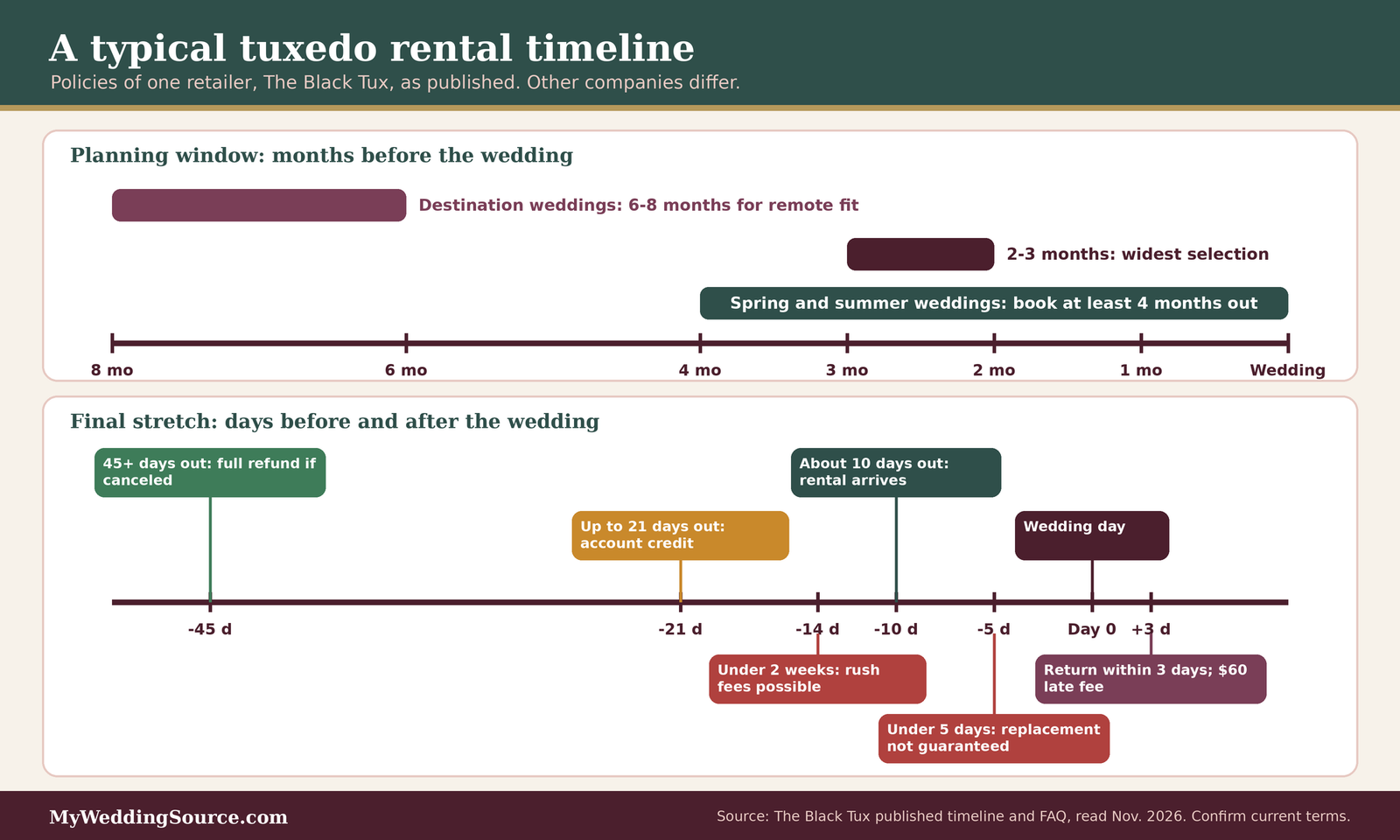
The Black Tux, an online rental company, publishes a rental timeline that is useful as an example of how a typical rental works. It is a retailer’s schedule, not an industry standard.
When to book
The Black Tux recommends booking two to three months ahead for the widest selection of styles and sizes, at least four months ahead for spring and summer weddings, and six to eight months ahead for destination weddings where out-of-town members need remote measurements. It says orders placed within about two weeks may incur rush fees.
Delivery, fit, and return
The same retailer says its rental arrives about 10 days before the event, that customers should try on every piece within 48 hours of delivery, and that fit issues reported within that window get a free replacement. It says to return the rental within three calendar days after the event, with a $60 late fee if the deadline is missed, and that it lists extension options of $15 for one extra day, $40 for three extra days, and $80 for seven extra days. It also states that orders placed within five days of the event cannot be guaranteed a replacement in time. Its cancellation terms, as stated in its FAQ, include a full refund 45 or more days out and account credit up to 21 days before the event. Confirm the current terms before you order.
Rent or buy
For a black tie wedding or any later event, the right answer depends on how often you expect to wear formal clothes, not on a rule.
When renting makes sense
If you expect to wear a tuxedo once, renting is usually cheaper than buying. The Knot’s guide says a fully canvassed fine-wool tuxedo that would retail for at least $1,500 can be rented at prices comparable to fused-construction or synthetic rentals. That is a claim from The Knot’s article, and rental quality varies by retailer.
When buying makes sense
If you expect to attend several black tie events over the next few years, or you want a tuxedo tailored to your body, buying may cost less over time. We have no survey data on how often guests wear formal wear, so run your own count of events and compare it to the rental price. The Knot adds that accessories such as cufflinks and studs can be bought rather than rented, which is a cheap way to own the pieces that matter.
The full-look test
Do a complete trial before the final week. It is the cheapest insurance in the process.
Test in similar light and conditions
Put on every piece, including shoes, jewelry, and any outerwear, and take photographs in light similar to the event. Check that the colors read the way you expect, that the hems clear the ground, and that you can sit and move.
Keep backups and records
Keep the order confirmation, the return deadline, and a photo of the fitted look. Keep spare studs or cufflinks, safety pins, and a stain pen, and know which tailor or retailer can help if a problem arises within the return window. Our wedding planning checklist can hold these items alongside the rest of your tasks.
Mistakes and risks at a black tie wedding, from both sides
Most problems at a black tie wedding are communication problems. The risks below are our own list, assembled from the sources and from the logic of the dress code.
Risks for guests
Guests at a black tie wedding are most likely to stumble when they guess instead of asking.
Dressing below the code
The most common error at a black tie wedding is dressing below the level the hosts expect, such as a cocktail dress or a dark suit when the invitation says black tie. Zola lists short or mini dresses and casual cocktail dresses among the things to avoid. If you are unsure, ask the hosts or the wedding party, and go more formal if you cannot get an answer, as The Black Tux advises.
Mixing levels
The Black Tux warns against combinations such as a tuxedo jacket with casual trousers, which look unintentional. Pick one formal path and complete it.
Risks for hosts
Hosts are most likely to stumble when the label and the event do not match.
Label and event mismatch
A black tie wedding label on an afternoon event, or on a venue with no shade and a long walk over gravel, sets guests up to be uncomfortable. If a mismatch is unavoidable, explain it on the website, and choose a more flexible label if the explanation is long.
Changing the code late
Changing a dress code in the last month is hard on guests who have already bought or rented. If you must change it, tell everyone at once, through every channel you used to announce it, and say what is acceptable under the new wording.
Questions to ask before you commit to a black tie wedding
Questions to ask
- Does our start time support a black tie dress code, or should we say “formal attire”?
- Will our guests find formal wear easy to rent or borrow, and have we asked a few of them?
- Which exact words will we use on the invitation and the website, and are they identical?
- Does the venue have shade, heat, or coat storage that fits the code?
- What are the rental retailer’s booking, fit, return, and cancellation terms in writing?
Questions for your venue and vendors
These questions turn the dress code into logistics. Ask them early, while changes are still easy.
Venue questions
Ask whether the ceremony site has shade or heat, whether the surface is paved or loose, and whether there is coat storage and seating. Ask what happens if the weather forces a move indoors, because the dress code should survive the backup plan.
Photographer and planner questions
Ask your photographer how they handle low light and dark clothing, and ask your planner whether the schedule leaves time for portraits before the light fades. Our guide to planning a wedding and our wedding planning guide explain how these decisions fit together.
Questions for the people you invite
You do not need a formal survey. A few conversations will tell you whether the dress code will work.
Ask a sample of guests
Talk to a handful of guests from different age groups and budgets. Ask, without pressure, whether they own formal wear and whether a black tie dress code would be easy or hard for them.
Offer a graceful exit
If you hear that the code would be difficult for many guests, you can soften it to “black tie optional” and keep the formal tone. That is a reasonable compromise, and the sources define it as a code where a dark suit or formal dress is welcome.
FAQ: black tie wedding questions
The dress code itself
What does a black tie wedding mean for guests?
A black tie wedding invitation asks guests to dress in formal evening wear: a tuxedo for men and a floor-length gown or equally formal outfit for women. Emily Post describes it as a formal code just below white tie. Hosts who want more flexibility usually write “black tie optional,” which also welcomes a dark suit or formal dress.
Do I have to wear a tuxedo to a black tie wedding?
For a strict black tie invitation, a tuxedo is the expected choice, and Emily Post says a black tie invitation requires one for men. If you do not own one, Zola says renting with standard accessories is fine. A dark suit is generally reserved for invitations that say black tie optional.
Can women wear a short dress or a pantsuit?
Zola’s guide says short or mini dresses are not formal enough for black tie, and advises a floor-length gown as the safest choice. The Knot and The Black Tux both list a tailored suit or pantsuit as an option at black tie optional. When the invitation says black tie, a long gown or luxe formal jumpsuit is the safer reading.
Hosts and planning
Do hosts have to pay for guests’ formal wear?
We found no source that says so. The sources we read describe attire as something guests arrange for themselves, including renting. Hosts who know that formal wear would be a hardship for someone can offer help privately, but that is a personal choice, not a rule. Decide early whether you will cover wedding party attire, and say so clearly.
What time should a black tie wedding start?
Men’s style sources such as the Gentleman’s Gazette treat black tie as evening wear, meant for after 6 p.m. or after sundown, whichever comes first. If your ceremony starts earlier in the afternoon, “formal attire” or “black tie optional” may fit the schedule better. Whichever you choose, say it clearly on the invitation and website.
Where should I put the dress code?
For a black tie wedding, put it on the invitation and repeat it, with more detail, on the wedding website. One wedding-planning article recommends using familiar terms such as black tie optional and adding a sentence of clarification. Keep both identical so guests do not have to guess which one is correct, and mention venue conditions such as grass or gravel.
Costs and logistics
How much does it cost to rent a tuxedo?
The Knot’s guide says major retailers average about $150 per rental, with an overall range of roughly $150 to $300, and accessories adding about $10 to $15 each. Starting prices vary by company, so confirm current pricing with the retailer. Our own estimate for a guest who rents and buys basic accessories is $200 to $360.
When should I book a rental?
The Black Tux recommends two to three months ahead, four months for spring and summer weddings, and six to eight months for destination weddings with remote measurements. Other retailers may use different timelines, so check theirs. If your date is close, book promptly, since the retailer warns that styles narrow and rush fees can apply within about two weeks.
Your next steps
Decide the label
Test your event against the matrix
Use the decision matrix and scenario table above to decide whether a black tie wedding fits, or whether to choose between black tie, black tie optional, and a more flexible label. If your answer flips on one small assumption, choose the flexible option instead of a strict black tie wedding. Then confirm the start time, since black tie is an evening code. For help setting dates, see our wedding timeline guide.
Write one clear sentence
Draft the sentence you will use on every channel and keep it identical. If you want guests to feel welcome in formal suits and dresses, say so in the sentence. If you need the broader picture first, our wedding planning guide shows where dress code decisions fit.
Put the details in place
Build the cost and rental plan
Add attire lines to your budget with the wedding budget calculator, and choose a rental or purchase timeline that leaves a buffer before the event. Put the dates in your wedding planning checklist.
Plan the day around the clothes
For a black tie wedding, check shade, heat, coats, seating, and ground conditions at the venue, and ask your photographer about the light. If guests are also planning for the engagement party, rehearsal dinner, or other events, tell them the dress code for each. If you are still choosing the evening’s style, our guide to cocktail attire explains the next level down.
Sources & methodology
How we built this guide
What we relied on
This guide combines published dress-code guidance from Emily Post, The Knot, and Zola, a men’s style publication, a wedding-planning article on communicating dress codes, a rental retailer’s timeline and guest guidance, The Knot’s published 2026 Real Weddings Study figures and rental cost article, and National Weather Service heat-index information. Where a statement comes from a retailer, we say so, since retailers sell the products they describe. The cost estimates for a sample wedding party and for a renting guest are our own arithmetic from the retailer and survey figures, and they are estimates. The decision matrix and scenario table are editorial frameworks with invented assumptions, and they are not research findings.
What we did not do
We did not survey couples or guests, test rental services, or verify retailer terms beyond what each retailer’s published page says on the date we read it. We could not confirm host-side etiquette guidance from a second authority, so statements about what hosts should arrange are labeled as our recommendations. Etiquette varies by region and community, and retailer policies and prices change, so confirm them directly. This guide is general information, not legal, medical, or financial advice.
Source list
Etiquette and dress-code guidance
- Emily Post Institute, Black Tie Dress Code: https://emilypost.com/advice/black-tie-dress-code
- Emily Post Institute, Wedding Guest Attire: https://emilypost.com/advice/wedding-guest-attire
- The Knot, What to Wear to Formal, Black-Tie Optional, and Black-Tie Invited Weddings: https://www.theknot.com/content/what-to-wear-formal-black-tie-optional-black-tie-invited
- Zola, What to Wear (and Not Wear) to a Black Tie Wedding: https://www.zola.com/expert-advice/what-to-wear-and-not-wear-to-a-black-tie-wedding
- Gentleman’s Gazette, When to Wear a Tuxedo or Tails: https://www.gentlemansgazette.com/when-to-wear-a-tuxedo-or-tails/
- Gentleman’s Gazette, Black Tie Dress Code Explained: https://www.gentlemansgazette.com/tuxedo-black-tie-guide/etiquette/black-tie-dress-code/
- Sayi.do, How to Communicate Your Wedding Dress Code Clearly: https://sayi.do/articles/communicate-wedding-dress-code-clearly
Cost data, retailers, and government
- The Knot, Average Wedding Cost (2026 Real Weddings Study): https://www.theknot.com/content/average-wedding-cost
- The Knot Worldwide, 2026 Real Weddings Study press release: https://www.businesswire.com/news/home/20260218045442/en
- The Knot, Average Tux Rental Cost: https://www.theknot.com/content/tux-rental-cost
- The Black Tux, Wedding Tux Rental Timeline (retailer): https://theblacktux.com/blogs/resources/wedding-tux-rental-timeline-book-fit-return
- The Black Tux, Black Tie Optional: What to Wear as a Guest (retailer): https://theblacktux.com/blogs/resources/black-tie-optional-what-to-wear-as-a-guest
- National Weather Service, Heat Index: https://weather.gov/safety/heat-index