
A wedding gift inventory spreadsheet is a simple record that ties every gift you receive to a giver, a date, a condition, a thank-you status and a final outcome. This guide shows how to build the gift inventory so that no thank-you note goes unsent, no card gets separated from its box, and leftover favors and surplus items end up somewhere useful instead of in a closet.
Use one row per gift, not one row per guest. Give every gift a short ID and write it on a sticky label on the item and on the card. Track five stamps for each row: received, identified, logged, thanked and closed. Keep a second sheet for givers and a third for leftovers and surplus. Log gifts the day they arrive, write notes in small daily batches, and treat any row without a name as an open problem until someone solves it. A gift inventory that follows those rules stays accurate with about ten minutes of work a day.
Gifts arrive in a messy way. Some are wrapped and carried to a table by a guest who disappears into the crowd. Some are mailed to a parent’s house three weeks early. Some come as a card with a check, some as a card with nothing in it, and some as a box with no card at all. A few arrive through a registry site, a few through a store that ships on its own schedule, and a few through a relative who bought something on behalf of three people and mentioned it to nobody.
A careful gift inventory is the tool that keeps all of those separate threads in one place. It is not complicated. Most couples can build a working version in an evening using any spreadsheet program. What makes it work is a handful of design decisions made before the first gift arrives, and a few habits that keep it current once the gifts start coming in.
A note on scope. This is general information, not legal, tax or financial advice. Gift tax treatment, charitable donation rules and consumer return rights vary by situation and can change, so where a rule matters this guide points you to the agency or organization that issues it.
Why a wedding gift inventory spreadsheet matters
It is fair to ask whether a spreadsheet is overkill. Plenty of people have sent thank-you notes from a pile of envelopes and a good memory. The trouble is that memory fails at exactly the point where volume rises, and a wedding is a short burst of high volume.
Think about what the pile contains after the reception. There may be fifty or a hundred separate items, depending on the guest count and whether a shower came first. Many are small and look alike. Several guests share a last name. A few gifts were bought by one person and signed by a household. Some cards say “from all of us” and list nobody. When two people open gifts together on a sofa two days later, they are working from fatigue, not from clarity.
A gift inventory solves four practical problems.
It protects the thank-you note. The thank-you note is the main reason most couples keep any record at all. A guest who gave a gift and never heard back usually does not say anything. They just wonder. A record that shows who has been thanked and who has not lets you finish the job without guessing.
It catches the mismatch between gift and giver. If a card and a gift are separated, the thank-you note often names the wrong item or the wrong person. A good record makes the mismatch visible early, while a guest can still be asked quietly.
It supports returns, exchanges and warranties. Duplicate gifts, wrong sizes and damaged items all have deadlines. A gift inventory with a date received and a place purchased turns a vague return into a simple one. The registry planning guide covers how to build a registry in the first place, and this guide picks up when the packages start arriving.
It leaves a clean record for later. Some gifts matter beyond the thank-you. A set of china that gets chipped in a move, a vacation rental certificate with an expiry date, a piece of jewelry that needs insuring. When the question comes up years later, a row in a sheet with a date and a description is far more useful than a hunch.
None of this requires a special template or a paid tool. A basic spreadsheet is enough, and the choice of program matters less than the structure inside it.
What the gift inventory does not try to do
It helps to be clear about the edges. The gift inventory tracks physical gifts, gift cards, certificates and promised experiences. It does not replace a ledger for cash and checks, which carries its own handling rules. It does not decide who deserves a thank-you note, because everyone who gave anything gets one. And it does not rank or judge gifts. A column that rates how much you liked an item has no place in a sheet that someone else might open.
If you prefer to track cash and checks in the same file, give them a separate sheet. Cash behaves differently. It is deposited, not stored. It has a different privacy risk. And it usually creates a different kind of thank-you note, one that mentions the plan for the money in general terms instead of naming an amount.
When to start
Start before the wedding. The best moment to create the gift inventory is when the first shower invitation goes out or when the registry opens, whichever comes first. Early gifts are real gifts, and they have been known to vanish from memory by the time the wedding arrives. If you are already past the wedding and facing a pile, do not worry. Everything in this guide still applies. You will just be doing intake in one long session instead of in small ones.
Where thank-you tracking goes wrong
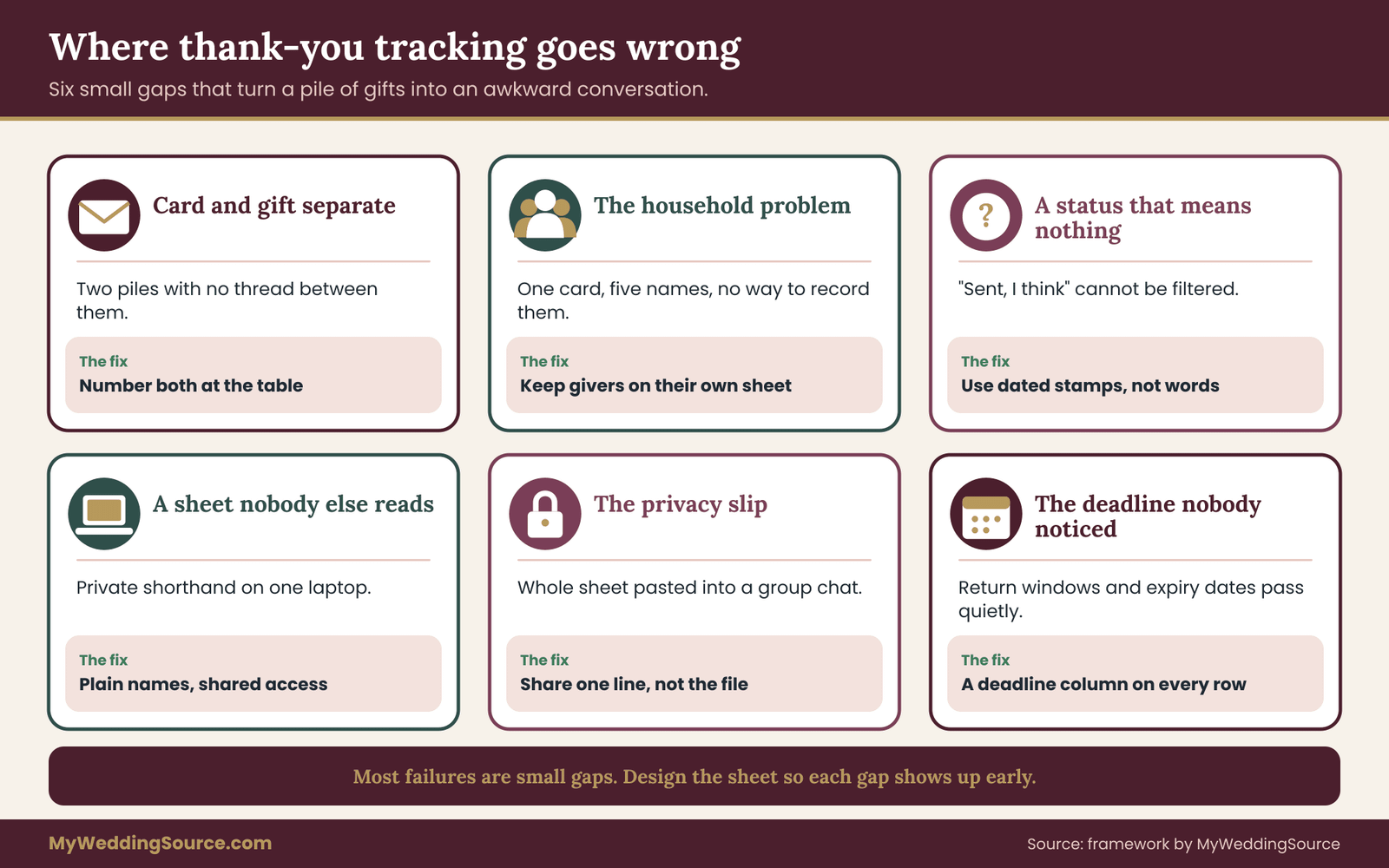
Most gift tracking failures are not dramatic. They are small gaps that add up to an uncomfortable conversation. Seeing the common failure patterns first makes the design choices later in the guide easier to understand.
The card and the gift travel separately
At the reception, guests drop a gift on a table and a card in a box, sometimes minutes apart, sometimes through different hands. A parent might carry the gifts to a car while a friend carries the card box to the hotel. By morning there are two piles with no thread between them.
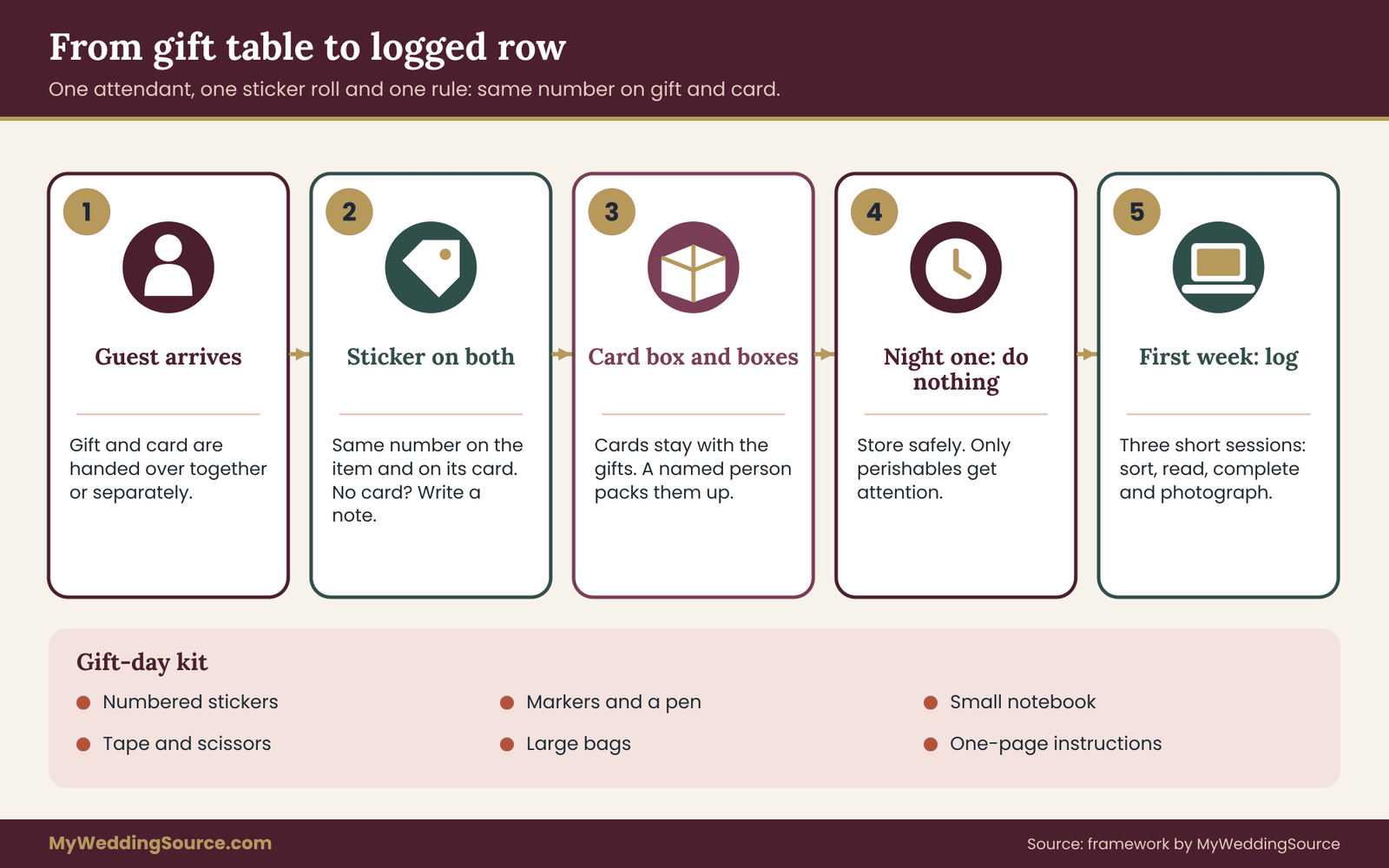
The fix is not elaborate. A gift table attendant with a pack of numbered stickers can stick a number on every item and a matching number on its card. That single step removes most of the later detective work. The section on setting up for the wedding day explains how to run it.
The household problem
Many gifts come from households, couples, families or workplace groups. A card signed “The Hendersons” could cover two adults and three children. A workplace gift could come from twelve coworkers whose names sit on a card you will want to scan. If your record stores one name per row, you will end up with awkward workarounds. If it separates the gift from the giver and lets one giver link to many gifts, or one gift link to many givers, the workarounds disappear.
The status column that means nothing
A common beginner mistake is a single column called “Thank you sent?” with free text entries like “yes,” “I think so,” “mom did it,” “not sure.” Free text cannot be sorted or filtered with confidence. A status column works only when the possible values are fixed and few. The framework in the next part of the guide uses five stamps, each of which is a simple yes or no with a date.
The spreadsheet nobody else can read
If one partner builds the gift inventory, names columns by private shorthand and keeps it on one laptop, the other partner cannot use it. Gifts keep arriving when the partner who built the gift inventory is traveling. Someone else opens a package and has nowhere to put the details. Shared access, plain column names and a short instruction line at the top solve that.
The privacy slip
A gift sheet contains names, addresses, gift values and sometimes opinions. It should not be shared more widely than it needs to be. People often paste it into a group chat to ask a relative who a particular card came from, and the whole sheet goes with it. The section on access and archiving later in the guide covers how to share only what is needed.
The deadline nobody noticed
Some gifts carry dates. A store credit might expire. A return window might be thirty days from delivery. A gift certificate for a spa or a vacation rental might have a use-by date. A gift inventory without a date column treats a perishable gift like an ordinary one, and the date passes in silence. Giving every gift row a “deadline” field costs nothing, and most rows leave it blank.
Waiting for a quiet weekend
The biggest failure is delay. A sheet that is updated once a month from memory loses accuracy quickly, and the thank-you notes slide with it. The habits section later in the guide builds a rhythm of short daily sessions in place of one long, dreaded one.
If you want a broader view of what to keep and where after the event, the guide to organizing wedding records after the event covers contracts, receipts, photos and certificates. The gift inventory is one thread in that larger archive, and this guide goes deep on that one thread. ## The five-stamp method for a gift inventory
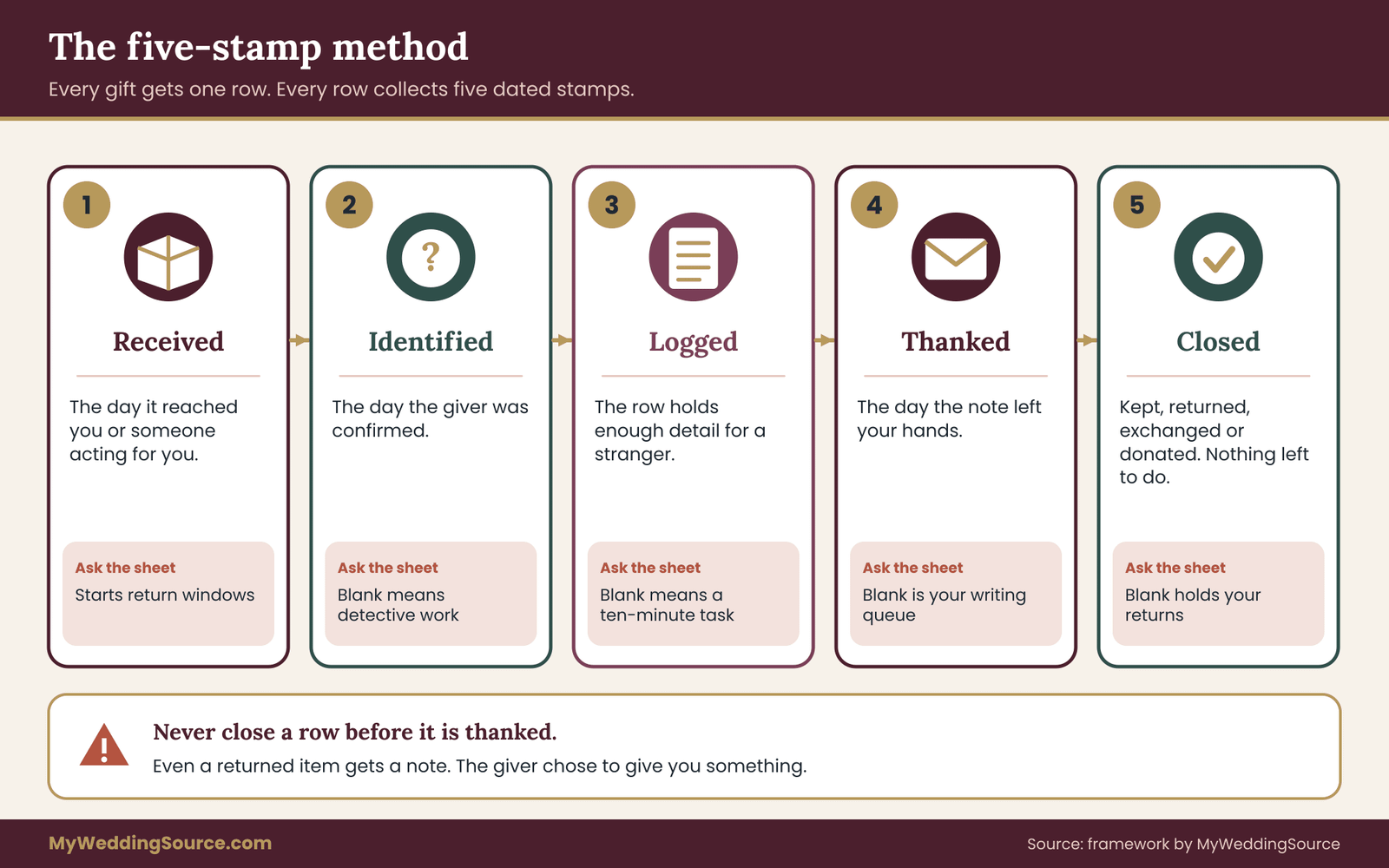
Here is the decision framework this guide is built around. In this gift inventory, every gift gets one row, and every row collects five stamps over its life. A stamp is a date in a cell. No date means the stamp has not happened yet. Nothing else about the row is allowed to substitute for it.
Stamp one: received. The date the item or card physically or electronically reached you or someone acting for you. For a gift that arrives at the reception, that is the wedding date. For a mailed gift, it is the delivery date, which matters for return windows.
Stamp two: identified. The date you were confident about who gave it. A gift with a card that names the giver is identified at once. A gift with no card, or a card with an unclear signature, stays unidentified until someone confirms it. Many couples skip this stamp and pay for it later.
Stamp three: logged. The date the row was complete: description, giver, condition, place of purchase if known, and any deadline. Logging is more than typing the name. It means the row holds enough detail that a stranger could find the item.
Stamp four: thanked. The date the thank-you note was sent, or the call was made, or the message delivered. A draft sitting in a folder is not a stamp. The stamp is for the moment the message left your hands.
Stamp five: closed. The date nothing more is needed on this gift. The item is kept and stored, or returned, or exchanged, or donated. The warranty was registered if that mattered. The giver was not left with an open question. Closed rows can be hidden. Open rows stay on the main view.
Why five stamps and not one
A single “done” checkbox hides which part is unfinished. A gift can be logged and thanked but not closed because the duplicate has not been returned. A gift can be received and thanked, with no log, because the thank-you was written from memory. Five stamps give you five different questions to ask the gift inventory.
Which gifts are received but not identified? Those need detective work. Which are identified but not logged? Those need a quiet ten minutes. Which are logged but not thanked? Those are your writing queue. Which are thanked but not closed? Those hold your returns, exchanges and storage decisions.
Each question about the gift inventory is a simple filter on a date column that is blank. That is what makes the method easy to run even when you are tired.
The rule for the order of stamps
Stamps can happen out of order, but only in a few ways. A gift can be thanked before it is logged if you wrote the note on the spot. A gift can be identified before it is received if a giver emails to say a parcel is on its way. What cannot happen is closing a gift before it is thanked. If a gift is returned before a note goes out, the note still goes out, because the giver chose to give you something and deserves to hear you noticed.
The note can honestly say that you are exchanging an item that did not fit, or it can simply thank them for the thought. That sentence is easier to write when the record shows both stamps open.
Building the gift inventory spreadsheet: three sheets
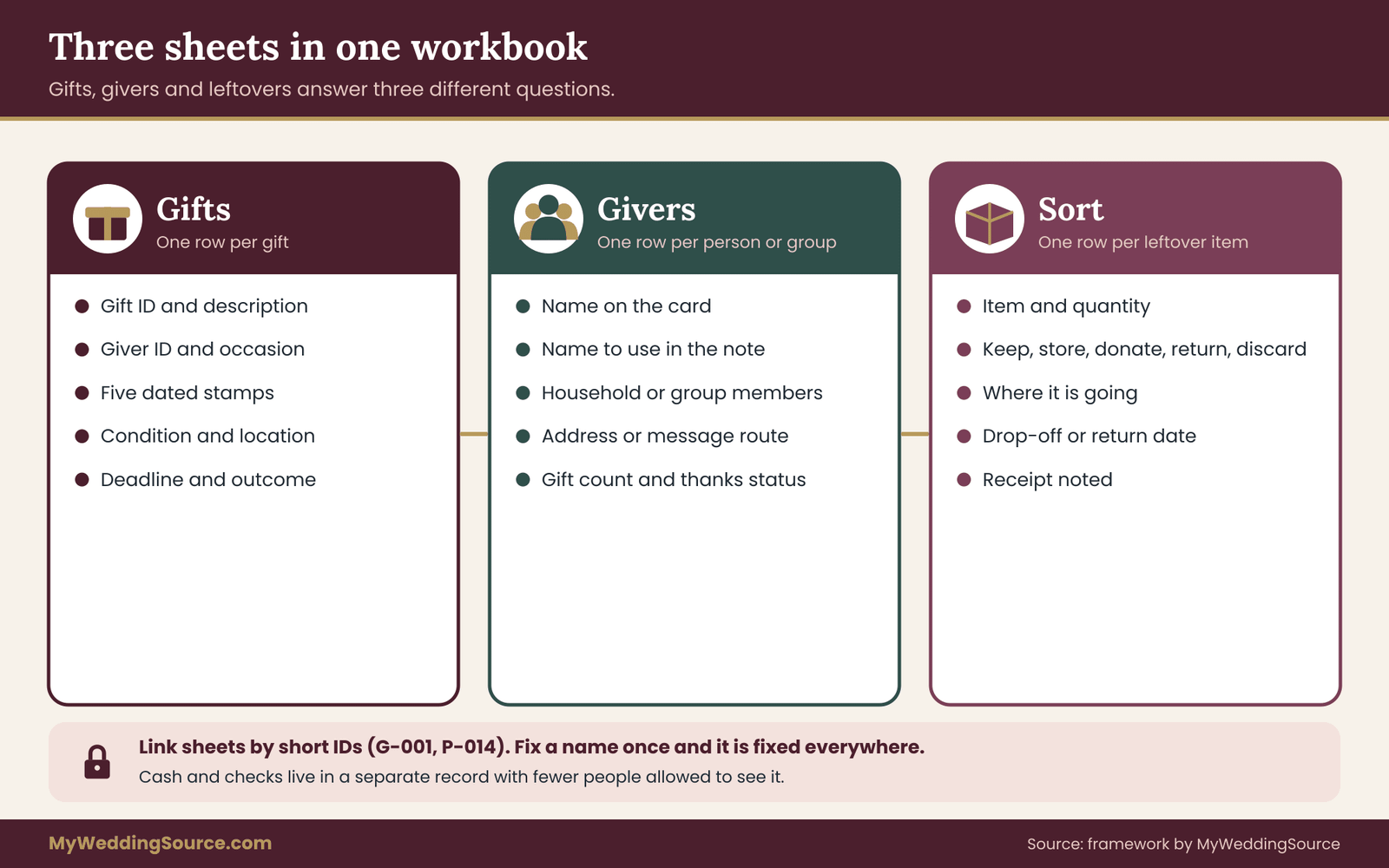
Use one workbook with three sheets, or tabs. The three sheets answer three different questions and keep the data from tangling.
Sheet one: Gifts
This is the main sheet of the gift inventory, one row per gift. Use these columns, in this order, and keep the names plain.
- Gift ID. A short code such as G-001, G-002. Never reuse or renumber an ID once it has been written on an item.
- Description. A few plain words: “blue ceramic serving bowl, large” or “gift card, kitchen store.”
- Giver ID. A short code that points to the Givers sheet, such as P-014.
- Occasion. Shower, engagement, wedding day, mailed, or after.
- Source. Registry order, store, handmade, cash-like, experience, or unknown.
- Received date. Stamp one.
- Identified date. Stamp two.
- Logged date. Stamp three.
- Thanked date. Stamp four.
- Closed date. Stamp five.
- Condition. Good, damaged, or missing parts.
- Where it is. The room, box or shelf.
- Deadline. A return, use-by or warranty date, if any.
- Outcome. Kept, stored, returned, exchanged, donated or regifted.
- Notes. One line only.
Resist the urge to add more. A gift inventory with thirty columns stops being used. If you find yourself wanting an extra column, ask whether the information belongs on a different sheet or whether you will honestly look at it again.
Sheet two: Givers
This is a short list of people and groups. One row per giver, with these columns.
- Giver ID. P-001 and so on.
- Name as it appears on the card. Exactly as written.
- Name to use in the thank-you. The way you would greet them.
- Household or group members. Anyone else the note should include.
- Mailing address or message route. Where the thank-you goes. If you already keep a household address list, link to it instead of copying it.
- Relationship. Family, friend, coworker, neighbor, or other. Useful when you sit down to write.
- Gift count. A formula that counts rows on the Gifts sheet for this ID.
- Thank-you status. A formula that checks whether every gift for this giver has a thanked date.
Splitting givers from gifts removes the duplication that causes errors. If you fix a misspelled name once, it is fixed for every gift that giver sent. If someone gave a shower gift and a wedding gift, you write one note and mention both. The Givers sheet is how you notice that.
Sheet three: Sort
This is the leftover and surplus sheet, covered in its own section later. It holds the favors that were not taken, the extra decor and the opened-but-unused supplies, along with what happens to each. Keeping it separate matters because those items were not gifts and do not need thank-you notes. Mixing them into the Gifts sheet breaks every filter.
Make the gift inventory hard to break
A few habits protect the structure, whatever program you use.
Use dropdown lists. For Occasion, Source, Condition and Outcome, set a fixed list of allowed values. This keeps the gift inventory sortable. It is also faster than typing.
Format dates as dates. Plain text in a date column breaks sorting and filtering. If your program lets you, add a rule that rejects text in those columns.
Freeze the header row and the Gift ID column. On a phone or a small laptop, you want to see which column you are in as you scroll sideways.
Add one instruction line. At the top of the Gifts sheet, write a single sentence such as “One row per gift. Fill all five stamps with dates. Do not delete rows.” The next person who opens the file will thank you.
Do not delete rows. If a gift was a mistake, mark the outcome as “voided” and explain in notes. Deleting rows scrambles IDs and removes the history you may need.
Keep a copy. Download a copy of the gift inventory weekly during the busiest period and keep it somewhere other than the program’s own cloud. If the account is locked or a sync goes wrong, you still have last week’s version. The guide to wedding day digital operations covers file backups and permissions in more depth.
Choosing a program for the gift inventory
Any of the common spreadsheet programs will do for a wedding gift inventory spreadsheet. Pick the one you both already know. A shared online sheet is convenient for two partners editing from different places, but a desktop file works if you are disciplined about who edits it and when. If you choose an online sheet, check the sharing setting before you send the link anywhere. A link that anyone can open is a link that anyone can open.
If you prefer paper, the same three sheets work in a notebook, with a sticker-numbered envelope for each gift ID. The logic is identical. Paper is slower to search and harder to back up, but it is easy to carry to a gift table.
Formulas worth adding
You do not need advanced formulas. Three are useful.
The first counts how many rows are missing a thanked date. Put it at the top of the Gifts sheet so the number is the first thing you see. When it reaches zero, you are done with thank-yous.
The second flags any row with a deadline in the next fourteen days. A conditional format that shades the row works fine. It turns the return window from something you remember into something you can see.
The third counts rows where the identified date is blank. That number is your detective queue. It should drop quickly in the first week and then stay at zero.
Those three numbers, thanks left, deadlines near and unknowns open, make a small dashboard. Looking at them for ten seconds each morning is usually enough to know whether you are on track. ## Setting up the gift inventory before the wedding
The easiest gift inventory to run is the one built before the first parcel arrives. A few hours of setup in the weeks before the wedding saves far more time afterward. This section covers the practical preparation, from the registry to the gift table.
Connect the registry to the gift inventory
If you have a registry, export or copy the list of items into a scratch sheet. When an order is placed, the registry site usually shows who bought what, though some sites hide the buyer’s name until shipping. Each time you see a new purchase, create a row. Put the registry as the source, and note whether it will ship to you, to a store or to a parent.
Registry orders are the easiest gifts to lose track of because they never touch your hands in a gift box. They arrive at a door with a shipping label and no card. A giver may think the registry site already told you who they are, and the site may have, but the package will not. Entering the row when the order is placed, and adding the received date when the parcel is opened, is the whole trick.
Set a rhythm. Check the registry once a week for new purchases. Match each shipment confirmation email to a row. If a delivery shows as complete in the carrier’s tracking but you did not receive it, the row’s deadline column is where you note the date to follow up. Consumer protection agencies generally advise raising delivery problems with the seller promptly, so a note with a date helps. The Federal Trade Commission publishes guidance on rules for merchandise ordered by mail, phone or internet, and that is the place to confirm what applies.
Decide the receiving address
Gifts can reach you at three different addresses. Many couples forget this until a package for them lands in a parent’s hallway. Decide where gifts should go and tell the registry, the guests and the family.
For couples living together, the home address is usually fine unless nobody is there during the day. For couples who are moving, a trusted family member’s address may be safer for the month around the wedding. Whichever you choose, tell the person receiving packages how you want them logged, even if the answer is just “photograph the label, open nothing, and text me the picture.”
If gifts will be mailed to someone else, give that person a copy of a tiny version of the gift inventory. Two columns are enough: date arrived and what the label says. They will not use the full inventory, and they should not need to.
Choose a gift table plan for the gift inventory
At the reception, the gift table is where the card and the gift can separate. A simple plan prevents it.
Pick one location. The gift table should be visible to a staff member or a trusted person throughout the event. An unattended table in a corner is an invitation for misplaced or lost items. Ask the venue about their practice for security and for storage of items overnight, because policies differ.
Choose a card box. A box with a slot and a lid keeps cards from falling out and keeps envelopes in one place. If you expect many cards with checks, a box that locks or is attended is better still.
Assign an attendant. One person, not “whoever is nearby,” is responsible for the table. That could be a family member, a friend who has agreed in advance or a member of the wedding party. The attendant has one job during cocktail hour and dinner: apply stickers and keep the area tidy.
Prepare numbered stickers. Print or buy a roll of stickers numbered G-001 onward, or use labeled sticky notes if stickers are not easy to find. When a gift arrives, the attendant sticks a number on the gift and the same number on its envelope or card. Items without a card get a number and a brief note: “bag, tissue, blue, no card.”
Give the attendant a pen and a small notebook. If a guest hands over a gift in person and says, “This is from the Garcia family, please make sure the cards go together,” the attendant writes that down next to the sticker number. That sentence saves a thank-you-note headache later.
Plan the end of the night. Someone needs to pack the gifts and cards into boxes and take them to a safe place. Decide who is responsible and where the boxes go before the reception starts. A short note in the wedding day contingency plan helps, and the wedding planning checklist is a good home for it.
What to pack in a gift-day kit
Put together a small kit for the gift inventory, ideally in one bag with a labeled handle. It should hold the sticker roll, a few markers, a notebook, a roll of tape, a few large paper or cloth bags, a pair of scissors and a pack of tissues. Add a printed one-page instruction sheet for the attendant. It can read like this.
“Welcome, and thank you. Please put a numbered sticker on every gift and the same number on its card. If a gift has no card, write what it looks like on the sticker note. Keep the card box with the gifts. At the end of the night, put everything in the marked boxes.”
The instruction sheet does not need to be fancier than that. People follow short instructions better than long ones.
Handling gifts that cannot be carried
Some gifts are too large, too fragile or too valuable to leave on a table. A guest may announce a gift that is not physically at the reception, such as a delivery set for later or a donation in your name. Create a separate note on the card box that says “to be logged: delivered later.” Then create the row when the gift arrives, using the card’s information. If the gift was a donation, ask what the giver would like you to record. A note naming the charity is usually enough.
Logging gifts at the event and in the first week
The actual work on the gift inventory happens mostly after the wedding, in a short window. This section shows a calm way to run it.
The first night: do not open anything
After a long day, the temptation to look through the gifts is strong. Resist it. Pack the gifts and the card box, put them in a secure spot and go to sleep. The one exception is anything perishable, such as a food or flower gift, which may need to go into a refrigerator or a vase. For those, a quick photo and a sticker number is enough.
The first week: three sessions
Plan three short sessions in the first week, each about forty minutes. Do them at a table with good light and a laptop.
Session one: sort and number. Spread the gifts out. If the gift table attendant used numbered stickers, group each item with its card. If not, number everything now, attaching a sticker to the item and another to the card. Do not open cards yet. Just sort and number.
Session two: read and match. Open the cards one at a time, reading the signature and note aloud. Create the row for each gift as you go: ID, description, giver, occasion, received date. Mark the identified stamp as soon as the giver is clear. If the giver is not clear, mark the row “unknown” and move on. Do not stop to puzzle over it.
Session three: complete and photograph. Return to each row and fill the remaining columns: condition, where it is, deadline. Photograph each gift with its sticker visible, for your own records and for insurance purposes later. Keep the photos in a folder named after the gift ID range.
Reading a card carefully
The card is a record in its own right. Before you move on, check three things.
The signature. Does it name one person or a household? If it names only first names, make a note of how you know them. A signature of “Aunt Dee” may not match the name on your guest list, so cross-check.
The note. Some cards say something specific, such as “for your new kitchen” or “we hope this reminds you of the trip.” Add a short phrase to the notes column. It will help you write something warmer than a form letter. Keep it to a phrase, not a paragraph.
The enclosure. Some cards contain a gift card, a check or a receipt. Record the existence of the enclosure on the Gifts row, and send cash and checks to the separate cash record. Do not keep both kinds in the same sheet unless you have a plan for who can see what.
Gift receipts and where purchased
A gift receipt makes an exchange simple, and a note of the store tells you where to go. Add the store name and any gift receipt to the notes column. If the gift came with a receipt that shows the price, think about whether you want to keep it. Many couples tear off or hide the price information to avoid awkwardness. That is a courtesy and a choice for each of you. Keep the receipt itself, because it may be needed for a return, and store it with the item or photograph it and keep the photo.
Unboxing and checking
Opening boxes is where condition problems turn up. Break and chip damage is easier to document in the first days than three months on. Open every box that could contain breakable goods, check it against the packing slip if there is one and photograph any damage. If the item came by mail, keep the original packaging until you are sure there is no problem. The shipping company and the seller may both need to see it.
If something is damaged, put it on the Gifts sheet with a condition of “damaged,” a clear note and a deadline for contacting the seller or carrier. Handle it quietly. Telling a guest that their gift broke in the post is awkward and rarely necessary. The seller or the carrier is the right party for that conversation. Whether you tell the giver at all is a personal choice; most people prefer to handle it themselves without turning a gift into a worry.
Keeping the gift inventory current as new gifts arrive
Gifts keep arriving for weeks. Late guests mail presents. Registry orders trickle in. Someone you invited to a shower sends something three months after the wedding. Create the row when the gift arrives, not when you remember it. A stack of unlogged parcels in a hallway is just the pile all over again.
A short ritual helps. Put a labeled basket or box by the door for incoming parcels and open it once a day. Log each item, then clear the basket. After a week, the daily habit takes about five minutes. ## Gifts that break the rules: edge cases in a gift inventory
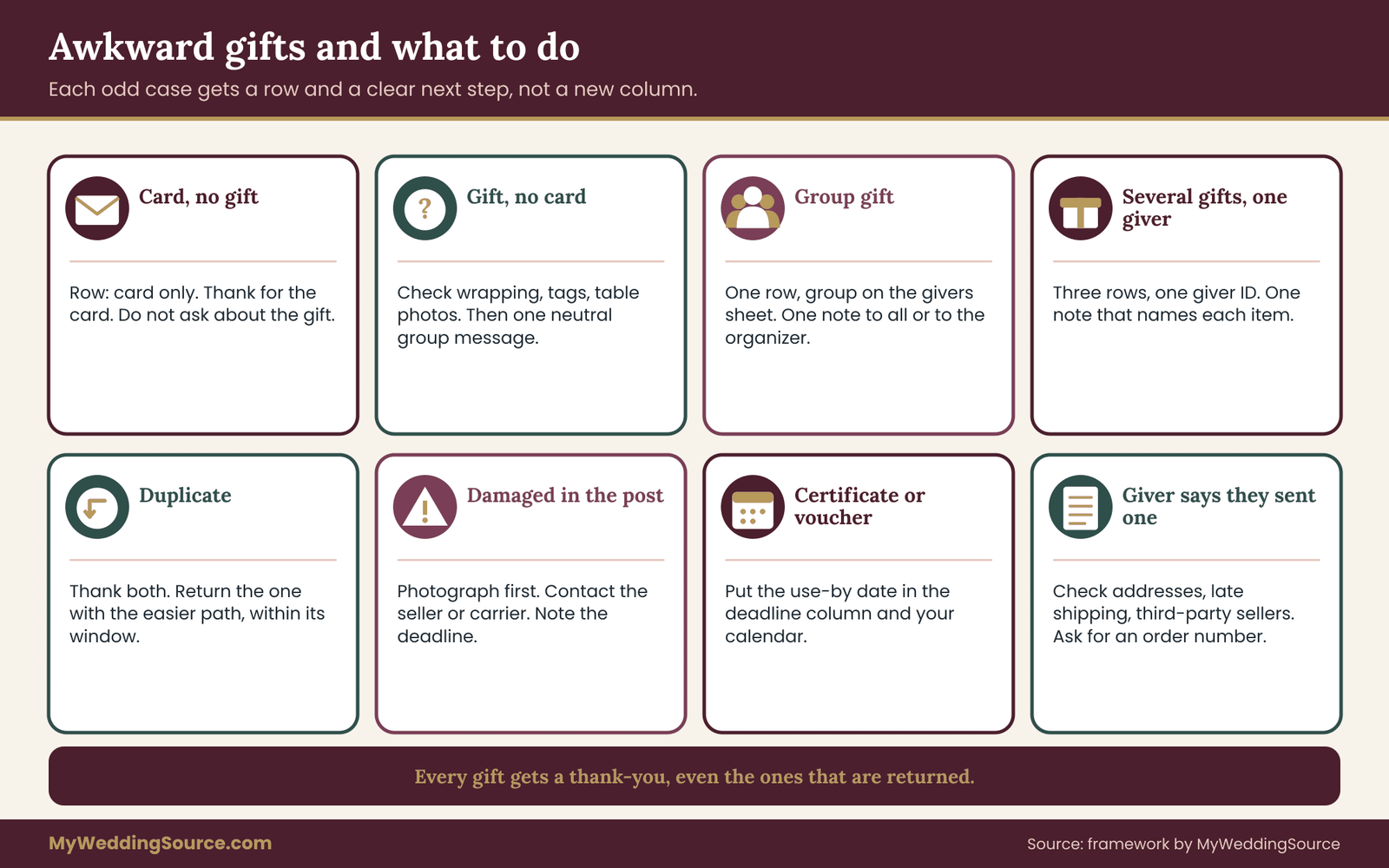
A gift inventory that handles the easy cases is useful. One that survives the awkward cases is what stops the thank-you list from stalling. Here are the situations that most often confuse a wedding gift inventory spreadsheet, and how to handle each one without inventing new columns.
A card with no gift
You open an envelope and find a card but nothing inside, no check, no certificate, nothing. It happens. The giver may have left the gift at home, planned to mail it, or put it in a different guest’s bag. Create a row anyway, with the description “card only, gift not received.” Set the received date and identified stamp, leave the logged stamp for later, and add a note saying you will watch for a parcel.
Do not ask the guest about it. Asking where the gift is can feel like a demand, and the card alone deserves a thank-you note. Write the note for the card and the warm words in it. If a gift does arrive later, add a second row, and send a second short note or fold it into a later message. If nothing arrives, the first note is still the right one.
A gift with no card
This is the more common puzzle. A wrapped box sits on the table with no name. Start with what is within reach.
Check the box itself. Look for a store tag, a gift receipt, a handwritten name on the wrapping paper or a tag on the ribbon. Check the card box for an unmatched envelope. Look at the table photos from the reception, which sometimes show who set down what. Ask the gift table attendant, who may remember a name from the moment of handover.
If those do not work, ask quietly. A neutral group message such as the one below avoids singling out anybody.
“We are working through our thank-you notes and want to be sure every gift reaches the right name. If you brought a wrapped gift to the reception and have not yet heard from us, would you let us know a few words about it? Thank you.”
Send it to the guests you think might have been involved, or post it where your guests can read it, such as the wedding website, rather than to all of them. Keep the row in the unidentified state until someone claims it. If nobody does, write a general thank-you to those who came, mention that a gift arrived unlabeled, and keep the item clearly marked on your gift inventory. Some couples hold unclaimed items for a few months before deciding what to do.
One gift from several people
A group of coworkers, a bridal party, or siblings may pool money for one gift. The card lists several names or simply says “from the team.” Create one row on the Gifts sheet and use the group’s name on the Givers sheet, with member names in the household or group column. Then decide how you will thank them.
For a small group of three to five, one note addressed to all of them works well. For a larger group, a note to the person who organized it plus a message to the whole group, such as an email, is usually enough. Ask the organizer, if you know them, how they would like to be thanked. Many are happy with one note sent to the group’s shared address or a printed card pinned up at the office.
Several gifts from one giver
A guest might give a shower gift, a wedding gift and a mailed card with a certificate. Three rows, one giver ID. The thank-you status formula on the Givers sheet will show whether every row for that person has a thanked date, so you write one note covering all three. Mention each item briefly. This is much better than three separate notes that read as if you had forgotten the earlier ones.
Duplicates
Two people bought the same blender. Even with a registry it happens, because registries update on a delay. A duplicate is a gift like any other and gets a normal thank-you note. Do not mention that you have another. Mark the row so you remember that one of the two is a candidate for return, but make the decision only after both are logged and you know which came with a gift receipt.
Return the one with the easiest return path, and keep the one given by the person whose taste or relationship makes it more meaningful, if that matters to you. The note to the giver of the returned item can thank them for the thought, and you do not need to explain more.
Gifts that are not what you wanted
Not every gift fits your home or your taste. The gift inventory is a good place to be honest in private. Mark the outcome as “exchange,” “return” or “regift,” and give yourself a deadline. Handle exchanges quickly because return windows are short. If you are considering regifting, add a note about who gave the original, so you never pass it back to the same circle of friends.
Regifting can be fine when it is done with care. The risks are mixing up the giver, giving it to someone in the same social group, or forgetting that the item carries a card or a personal inscription.
Experience and certificate gifts
A gift of dinner, a spa day, tickets or a stay is often a certificate with a date or an obligation. These need two extra pieces of attention. First, record the expiry or booking requirement in the deadline column. Second, decide whether to use it before the next anniversary or to share it. A certificate that expires quietly is a small loss for you and an awkward one for the giver if they ask how it was.
If you are still shaping a registry, the registry ideas page covers experience gifts. For gifts you have already received, the practical step is to put the use-by date in your calendar.
Gift cards and store credit
Gift cards deserve a short note of their own. Record the store, the stated value if shown, and the date. Treat them like cash in terms of care. Keep the card in a safe place, and avoid photographing the full number and security code and leaving the picture in a shared folder. The Consumer Financial Protection Bureau offers consumer guidance about gift cards and about reporting problems with cards, which is a good place to check the current picture.
For a card you do not expect to use soon, a note with the balance and the expiry, if there is one, goes in the deadline column.
Gifts that arrive damaged or missing parts
Document before anything else. Photograph the item, the box and the shipping label. Contact the seller or the carrier promptly, using the order information. For gifts that were bought in person and carried, the store may have its own policy for damage. Keep the deadline in your gift inventory and the outcome (“replaced,” “refunded,” “kept as is”) once it is resolved.
Gifts from people who did not attend
Some guests who could not come send a gift or a card. They get a thank-you note on the same footing as everyone else. Add them to the Givers sheet and mark the occasion as wedding day or mailed. The note can mention that they were missed, which is warmer than a form letter. Do not add them to the guest list for a later event simply because they sent a gift. Those are separate decisions.
Gifts from vendors, venues and coworkers’ employers
Sometimes a vendor sends a small gift, such as a sample dessert or a bottle. A coworker’s employer may send flowers. These count as gifts, and you should thank the sender. Add a row with the source as “vendor” or “employer” so you can tell them apart in a filter.
A sensitive gift
Some gifts carry a story or a risk. A family heirloom passed down is more than an object. A very expensive item may call for insurance or special storage. Put a plain note in the gift inventory, mark the outcome as “keep,” and keep the description light on detail if the gift inventory is shared. The note can say “family piece, see separate note” and the details can live somewhere private.
When the giver and the recipient disagree about the facts
Occasionally a guest says they sent a gift and your record shows nothing. Before assuming the worst, check the possibilities in order. Was the gift sent to a different address? Is there an unmatched parcel or an unlabeled card? Did a registry order ship late? Did they pay a third party who shipped for them?
Ask them for the order number or a screenshot, politely, and trace it with the seller. Most such cases end as a delivery delay or a mislabeled shipment. Keep the exchange in the notes column of the gift inventory and the correspondence in your records folder.
If a gift really is missing, the seller or the carrier is the one to contact. The guest, who has done nothing wrong, should hear a warm thanks and a simple line that you are following it up. ## Writing thank-yous from the gift inventory spreadsheet
Once the gift inventory rows are logged, the thank-you notes become a writing job instead of a research job. The gift inventory gives you the name, the item, the occasion and a detail from the card. What it cannot do is write the note for you, and it should not try.
What etiquette says about timing
There is no legal deadline for thank-you notes. Etiquette guidance varies, and common advice ranges from sending notes within a few weeks of receiving a gift to finishing them within a few months of the wedding. Different families and circles hold different expectations. A sensible approach is to treat the first two weeks as the ideal window for gifts received before the wedding, and the first two to three months as a reasonable outer limit for everything else. For gifts that arrive after the wedding, write within a couple of weeks of arrival.
The site’s wedding etiquette guide covers the broader social side of the wedding. For notes, the practical point is simple. Sooner is easier, because the details are fresh and the pile is small. Late is still far better than never. If you are behind, send the note and skip the apology paragraph. A single sentence of acknowledgment is enough.
Set a daily quota instead of a deadline
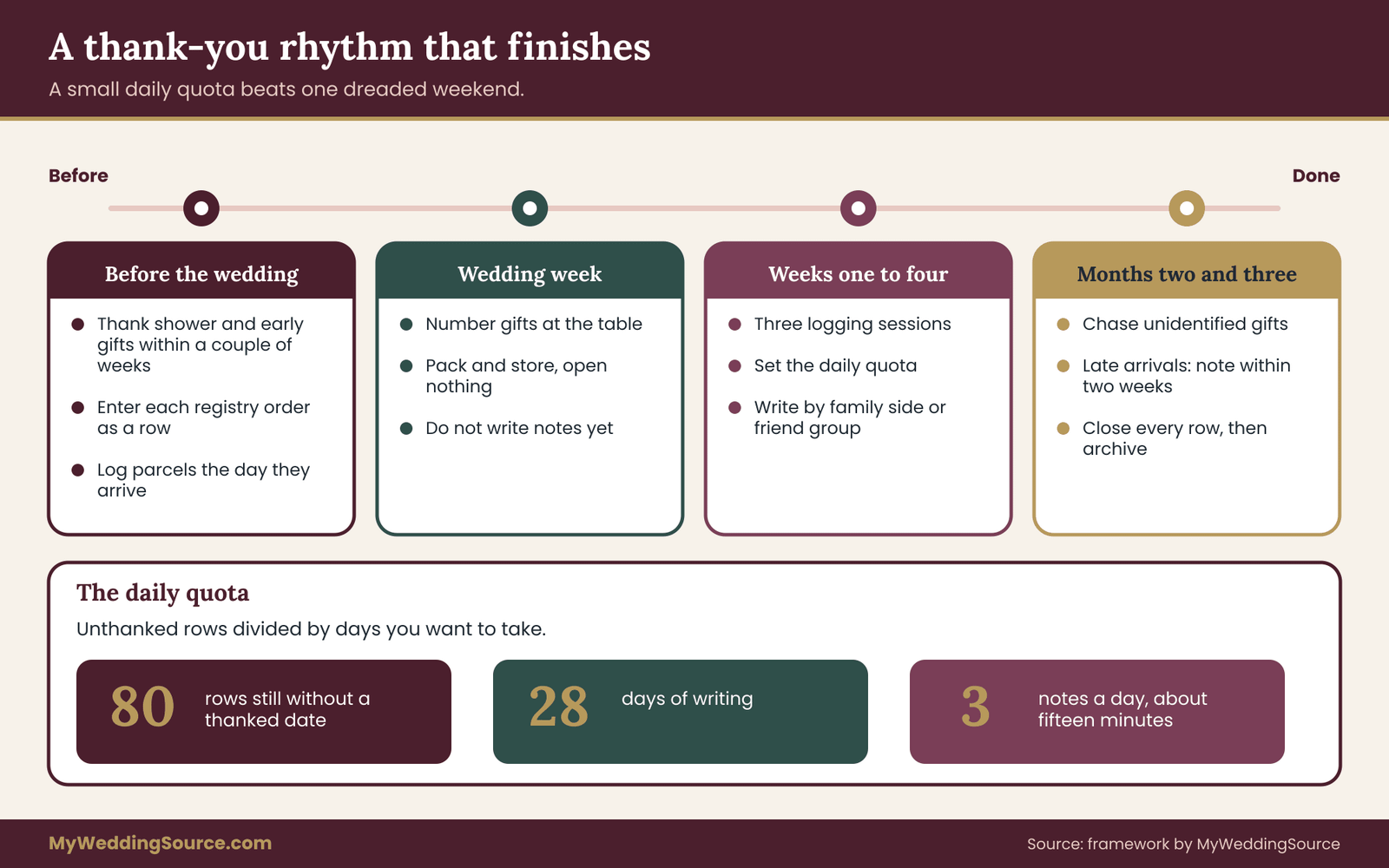
Most couples fail at thank-yous by aiming to finish them all in one weekend. That plan collapses on the first tired afternoon. A better rule is a daily quota based on the count in your gift inventory.
Divide the number of unthanked rows by the number of days you want to take. If you have eighty rows and want to finish in four weeks of writing, that is about three notes a day. Three notes take perhaps fifteen minutes. A quota that small feels possible, and keeping it brings you to the end without a marathon.
Share the work on the gift inventory if you want to. Each partner can take half of the Givers sheet, split by whose side of the family or friend group it is. The gift inventory’s relationship column lets you filter fast. Both of you write notes, and the totals show progress in one place.
The anatomy of a short note
A good thank-you note is short, specific and sincere. It does not need a paragraph of praise. Five sentences usually do the job.
Greet them by the name in the gift inventory. The Givers sheet has a field for the name to use. This is where it pays off.
Name the gift specifically. “Thank you for the blue serving bowl” is better than “thank you for your generous gift.” Specifics prove that you opened it and noticed.
Say how you will use it, or what it means. “We used it for the first dinner we hosted” works. If you have not used it yet, a plan works equally well: “it will be on the table at our first family dinner.”
Mention the person, not only the thing. If they traveled to attend, helped with something or said something kind at the reception, mention it in a line.
Close with warmth. Something simple, such as “thank you for being part of the day,” is enough.
A note for a gift you did not like can still be sincere. Thank the person for the thought and the effort, and mention something true, such as how glad you were that they came. You do not need to claim you love a gift you intend to exchange.
Notes for different gift types
For a gift card or a cash-like gift, you can mention how you plan to use it in general terms, such as toward a new couch or a trip, without stating an amount. For a group gift, address the group and, if possible, mention one detail about the gift. For an experience, say you are looking forward to it and mention when you plan to use it.
For a handmade gift, name the effort and the skill, because those are what the giver gave you. For a donation made in your honor, thank them for supporting the cause and, if you know a detail about it, say so.
For gifts from people who did not attend, add a line that you missed them. For gifts from people you barely know, such as a parent’s friend, mention the parent in the note.
Handwritten, printed or digital
Handwritten notes are the most common expectation, especially for older relatives and for formal gifts. For close friends who communicate by text, a heartfelt message or a short video can be as warm. A card with a printed photo from the wedding is a nice option, but add a handwritten line. For corporate gifts or group gifts, a shared email is acceptable. Choose the form that fits the giver, not the form that is quickest for you. The Givers sheet’s relationship column is a reminder here.
If you work from printed cards, a few things save time. Buy more envelopes than you think you need, because mistakes happen. Check postage before you mail a heavy or oversized envelope. The United States Postal Service publishes current stamp prices and sizes, and it is the best place to confirm what a given card needs.
Mark the stamp when the note leaves your hands
Update the thanked date when you place the note in the mailbox or hit send, not when you finish writing it. A note on a desk is not a thank-you yet. A weekly look at the “thanks left” number tells you whether the quota is working. If it stalls, check whether you are waiting for an address or a decision about a duplicate, and clear that first.
The leftover favor donation and storage sorting worksheet
The other half of the post-wedding pile is not gifts at all. It is the leftover favors, the extra programs, the unopened welcome-bag items, the spare decor and the supplies bought in bulk. These objects do not need thank-yous, but they do need decisions, and they pile up in the same boxes. The Sort sheet of the gift inventory is where those decisions live.
The five bins
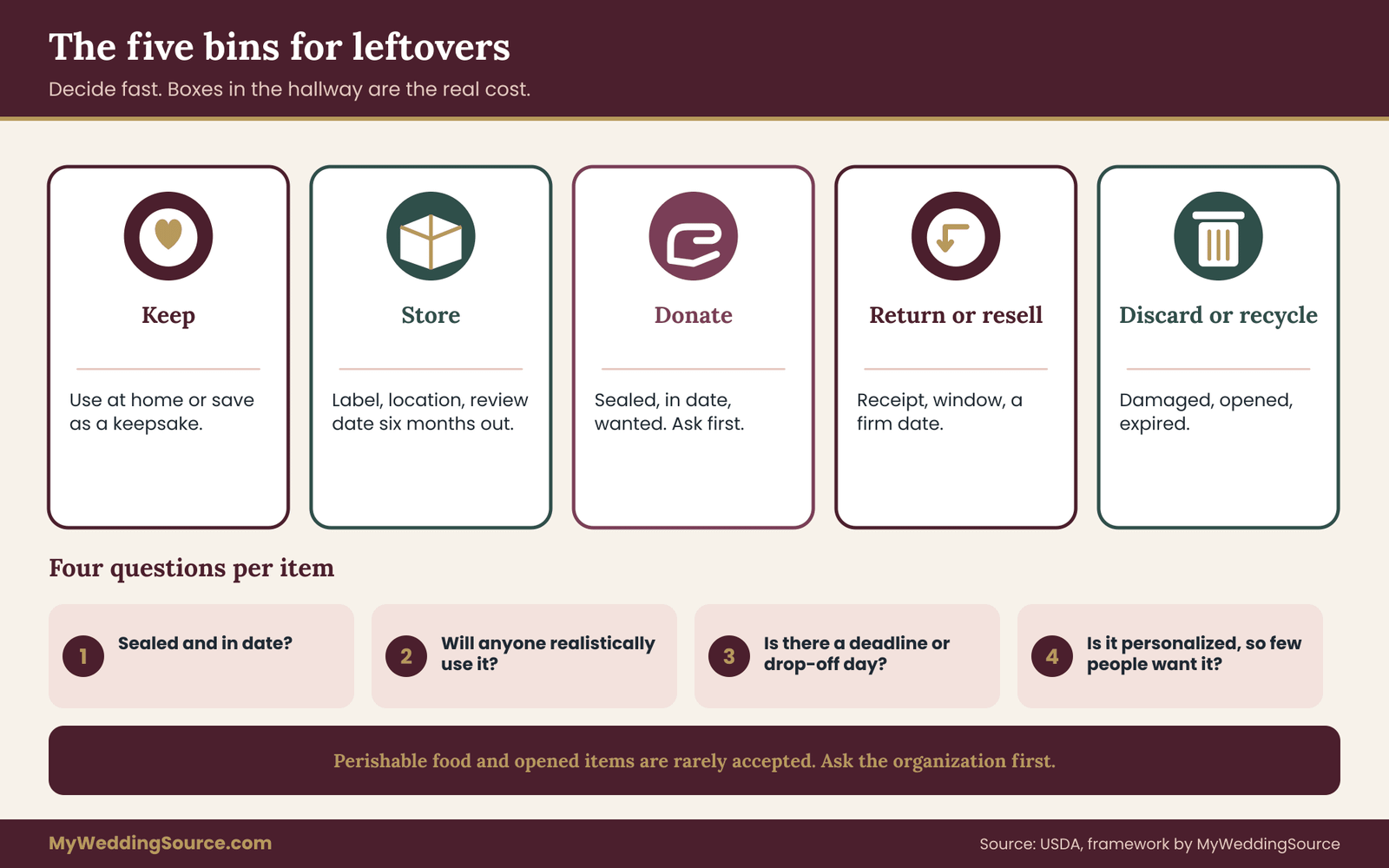
Every leftover item goes into one of five bins. Decide quickly, because second-guessing is what keeps the boxes in the hall.
Keep. Items you will use in your own home or save as keepsakes. A few favors, a sign you love, a candle.
Store. Items you will need later and have a place for, such as decor you might use at an anniversary, or spare stationery. Storage needs a label, a location and a review date, so it does not become permanent clutter.
Donate. Items another person or organization can use. Unopened, unexpired, sealed goods may suit some groups. Reusable decor, vases, frames and baskets may suit others.
Return or resell. Unopened items with a receipt, or decor that has resale value. Return windows are short, so this bin has the most urgent deadlines.
Discard or recycle. Anything damaged, opened, expired or not worth the space. Check local recycling rules for paper, glass and plastic.
Questions to ask for each item
Four plain questions sort most items in under a minute.
Is it sealed and in date? If not, it probably cannot be donated.
Will anyone realistically use it? If not, move on.
Is there a deadline, such as a return window or a donation drop-off day? If so, put the date in the Sort sheet.
Does it carry names or dates that make it awkward to pass on? Personalized napkins and monogrammed favors are lovely, but not many donation centers want them. Decide whether to keep a few and recycle the rest.
Food and drink need extra care
Leftover food has its own rules. Cake, perishable favors and catered dishes can raise food-safety questions, and donation organizations differ in what they accept. In the United States, federal law offers some liability protection to people who donate food in good faith to nonprofit organizations, and the U.S. Department of Agriculture explains how that works. Whether a given organization will accept your items is a matter for that organization, so ask first.
Sealed, shelf-stable items, such as wrapped candy, packaged cookies and jars of honey, are easiest to place. Open or perishable items usually are not. Your caterer or venue may have their own rules about taking food away, so check the contract before you plan a pickup.
For a closer look at the wider question of unused food from the event, see the guide to reducing wedding waste, which covers catering and cleanup. The Sort sheet here keeps the focus on favors and surplus items you hold in your own hands.
Alcohol, candles and special items
Opened alcohol is usually not accepted for donation. Sealed bottles are subject to local rules, so check with the venue or the seller. Candles with burn marks can go to a crafter or a recycling bin, depending on the wax. Fresh flowers can often go to a care home or a hospital, though many places have their own rules about accepting them, so ask before you drive over.
Donation receipts and records
If you donate items to a registered charity and want a receipt, ask the organization at the time of drop-off. Keep it with your records and note the date and general description in the Sort sheet. Tax treatment depends on your circumstances, so ask a qualified tax professional or consult the Internal Revenue Service about charitable contributions. This guide does not take a position on whether a particular donation is deductible.
A storage rule that prevents clutter
Every stored box gets a label with contents, the date it was packed and a review date set for six months or a year ahead. When the review date comes, decide again. Anything you did not touch in that time is a candidate for the donate or discard bin. This simple rule keeps a wedding’s worth of extras from becoming a permanent shelf. ## Returns, exchanges and warranties in the gift inventory
The fifth stamp, closed, is where most of the practical value of a gift inventory shows up, and a wedding gift inventory spreadsheet earns its keep here. It is also where deadlines bite, because a gift that was received in June and returned in September may no longer qualify for a refund. This section walks through the closing work.
Sort the gift inventory by deadline first
Filter the Gifts sheet to rows where the closed date is blank and the outcome is exchange, return, damaged or under review. Sort by the deadline column, soonest first. This is your return queue. Work down it in order. A deadline that passed last week cannot be recovered, so it is better to look at the list too often than too rarely.
Stores set their own return windows, and registry retailers often have different policies for registry gifts than for ordinary purchases. Some give extended periods to couples with a registry, and some require the gift receipt or the original order number. Check the store’s current policy on its own website before you plan a trip, and record what you found in the notes column. Nothing about a policy should be assumed from memory.
Exchange or return
Think about what you actually want. A store credit is less flexible than a refund, but a refund to the original purchaser is not something most stores will offer without a gift receipt, and in many cases the refund comes as store credit or on a card. A gift receipt is usually the cleanest path. If there is none, the store may be able to look up the registry order. Bring the item, any packaging and the order information.
Write down the outcome with a short phrase: “returned for store credit, kitchen store” or “exchanged for larger size.” The phrase matters because credits get lost. Record any credit balance and expiry date in the deadline column and treat the credit as a new row so it does not vanish. A gift-card-like credit can be tracked the same way as any other card, and the records guide shows how credits fit with the rest of your paperwork.
Warranty and registration
Some gifts have warranties that begin at the date of purchase or delivery. Small appliances, electronics, luggage and cookware are common examples. A warranty often needs the receipt or order number, so it helps to keep the gift receipt or a photograph of it. If the giver included a gift receipt, scan it. If the gift came from a registry, the order email usually holds the information you need.
Registration, where the manufacturer asks for it, is usually optional but sometimes useful. If you decide to register, do so when you first set up the item, record the date in your notes and keep the registration confirmation. Be careful about what you share. A manufacturer needs a product serial number and your contact information, and nothing about the giver.
Product recalls are another reason to keep a clear description and a model number. The Consumer Product Safety Commission publishes recall notices, and a quick look at its list for items such as small appliances or baby gifts is sensible. If you hold a record with the model number and the date, you can check it quickly in the future.
Insurance and high-value gifts
Some gifts are valuable enough to raise a question about insurance. Jewelry, art, silver and electronics are common examples. A homeowner’s or renter’s policy often covers personal property up to a limit, with separate limits or riders for certain categories. Ask your insurer how it treats new items and what documentation it needs. A photograph, a description, a gift receipt and an appraisal, where one exists, can all help. The Gifts sheet already records a description, a photograph reference and the date received, so you are halfway there.
Regifting and passing along
If you plan to pass an item along, record it on the gift inventory. Add the new owner in the notes and mark the outcome as “regifted.” Keep a note of the original giver so that nothing returns to the same social circle. The rule is easy: if you cannot say where an item came from, do not give it away.
Closing a row cleanly
A row is closed when you can answer five questions without hunting. Where is the item? Was the giver thanked? Is any deadline passed or done? Is there anything the giver might ask about? Is the record complete enough for someone else to understand? When the answers are yes, enter the closed date and move on. The point of closing is that you stop thinking about the row.
A worked example: one couple’s gift inventory
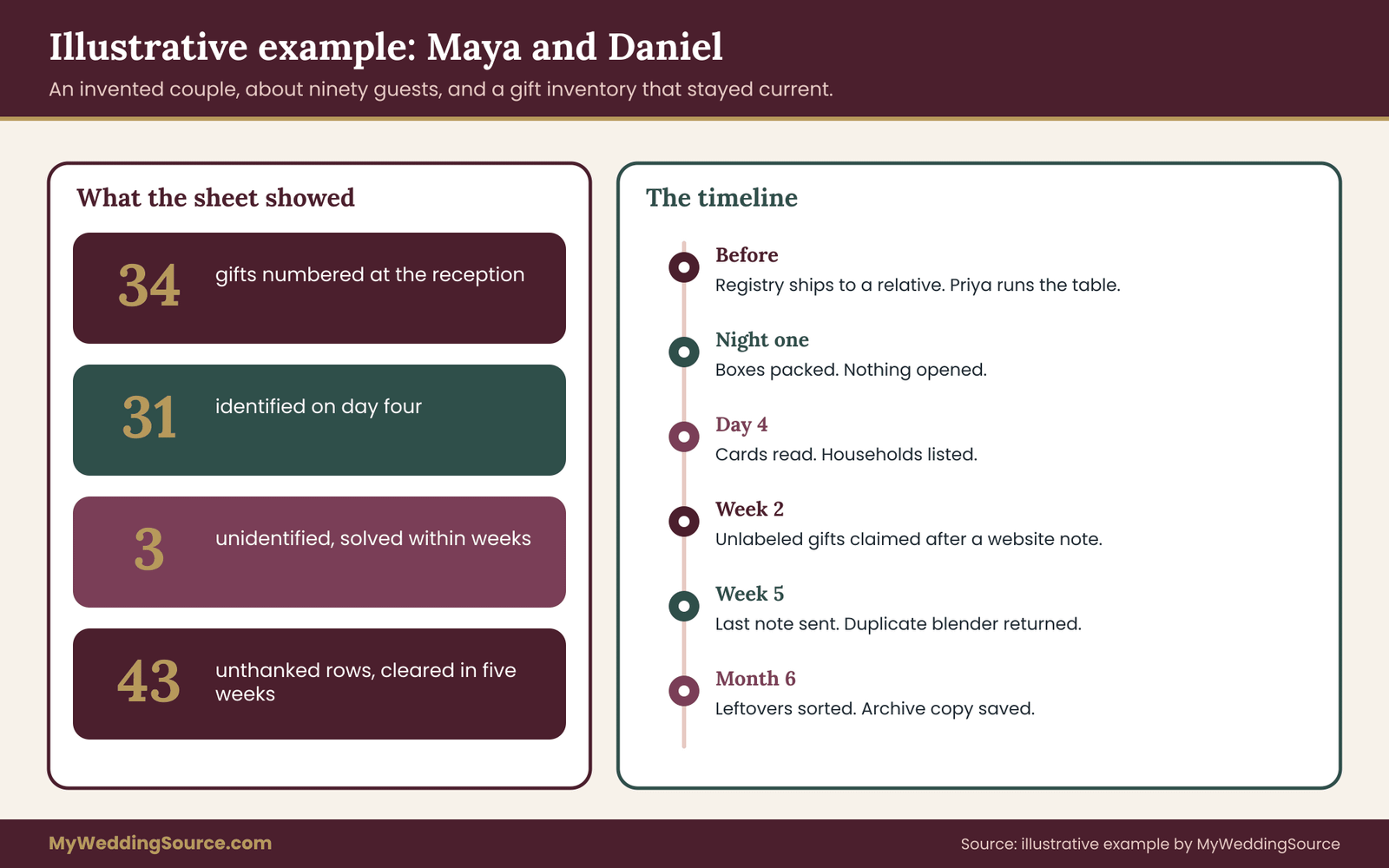
An invented couple, Maya and Daniel, kept a gift inventory and had about ninety guests and a registry. The details below are illustrative and not drawn from any real case, but they show how the method plays out in practice.
Before the wedding
Maya built the gift inventory workbook with three sheets in an evening. She made Daniel a shared editor, and he added a short instruction line at the top. They set the registry to ship to a family member who worked from home, and that family member agreed to photograph every label and text it to Maya. A friend, Priya, volunteered to be the gift table attendant. Maya gave her a roll of numbered stickers, a notebook and a one-page instruction sheet.
By the time of the wedding, eleven gifts had already arrived from the shower and from registry orders. Maya had created a row for each and thanked six of them. The Thanked column for the other five was blank, and she kept those on her list.
Wedding night and the first week
Priya numbered thirty-four gifts at the reception, G-012 to G-045. Two gifts had no cards, and she wrote “silver bag, no card” and “square box, brown paper, no card” in her notebook. One guest, Daniel’s aunt, told Priya that the green envelope went with the large box. Priya wrote that down next to the sticker number.
That night the couple did nothing but pack the boxes. On day two, they did session one: sorting and checking numbers. On day four, session two: opening cards. Four gifts were from households, and Maya used the Givers sheet to list all members. One card was from a group of seven coworkers. The identified column was filled for thirty-one of thirty-four gifts at once.
The three unidentified rows were the two with no cards and a card with an illegible signature. Maya posted a short, general message on the wedding website, which asked people to tell the couple about any unlabeled gifts. One guest wrote to say the silver bag was from her. The brown box turned out to belong to Daniel’s cousin, whose name matched a store receipt tucked inside. The illegible signature was cleared up when Daniel recognized the handwriting as his grandmother’s.
The thank-you queue
On the Gifts sheet, a count of rows without a thanked date showed forty-three. Maya and Daniel divided the Givers sheet by family side and set a quota of three notes each per day. They finished the last note about five weeks after the wedding, with a few gifts that arrived late handled as they came.
Two duplicate blenders were logged within a day of each other. Maya kept the one with a gift receipt and returned the other within the store’s window, recording “returned for store credit” and the credit’s expiry in the deadline column. A cracked glass bowl got a “damaged” condition, three photographs and a note to the seller. The seller replaced it.
The sorting worksheet
Leftover favors were a different story. About thirty favor jars were unclaimed. Maya and Daniel sorted them into the five bins. Twelve jars went to the keep and give-away pile, handed to family. Eighteen sealed jars were offered to a local community pantry after a phone call confirmed they were acceptable. Spare programs were recycled. A box of vases went to a florist who accepted donations, and the receipt went into the Sort sheet. Unused welcome-bag water bottles went into storage, labeled with a review date of six months.
What the example shows
Nothing in the example was dramatic. The method worked because the numbering happened at the table, the givers were separated from the gifts, the thank-you work was split into daily quotas, and the sorting decisions were written down instead of left in a hallway. Your numbers will differ. The shape will not. ## Closing, sharing and archiving the gift inventory
A gift inventory has a natural end. When every row has a closed date, the gift inventory shifts from a working tool to a small archive. How you handle that moment decides whether the record helps you in five years or becomes a liability on a shared drive.
Know when you are finished
You are finished when three numbers read zero: rows without a thanked date, rows with an open deadline, and rows with an unknown giver. Look at them together. If thanks left is zero but unknowns is two, you still owe two people a note, even if you do not yet know who they are. Say so in the notes column and decide on a cutoff date for holding the items. Many couples choose three to six months, then write a general thank-you to all guests, mention that an unlabeled gift arrived, and move on.
Resist the urge to declare victory early. A sheet that is ninety-five percent done tends to stay there, and the last five percent are the people most likely to wonder.
Decide who sees what
A gift sheet carries more personal information than it looks like. Names, addresses, items, values, notes and opinions all sit in one file. Give each person only the level they need.
Both partners: full access to all three sheets.
A helper who writes notes or receives parcels: a copy of the Givers sheet limited to names and addresses, or a two-column list of dates and labels. Not the full Gifts sheet.
Family members who ask who gave what: a short answer in a message, not the gift inventory. If a relative asks for the whole list, a polite no is fine. A line such as “we are keeping the details between us, but we are glad to tell you about anything that came from your side” works.
Anyone else: nothing. Cards, gift values and notes about whether you liked an item are private.
Before you share a link, check the permission setting. Choose “specific people” instead of “anyone with the link,” and review the list of people who have access once the thank-you phase is over. Remove helpers when their job is done. The Federal Trade Commission and other consumer protection agencies publish general guidance on protecting personal information online, and it is worth a read before you store addresses in a shared file.
Trim before you archive
Once the gift inventory is complete, make a clean archive copy. Keep gift IDs, descriptions, giver names, dates and outcomes. Remove anything that is no longer needed, such as full mailing addresses for people you will not mail again, or notes written in haste. Remove card numbers, security codes and anything resembling a password. If a gift card still has a balance, keep the card itself in a safe place and note only the store and the amount.
Name the archive plainly, for example “Gift inventory, archive copy,” with the year. Store one copy in your main records folder and another in a second place, following the same copy rule you would use for photos. The Library of Congress publishes personal archiving guidance that explains why more than one copy matters, and the guide to wedding records shows where this sheet fits among your contracts, receipts and certificates.
How long to keep it
There is no fixed rule. For most couples, the thank-you list is useful for about a year, until you have been through your first anniversary and any exchanges are settled. After that, the gift inventory is mainly a reference for warranties, insurance and the occasional question about who gave a particular piece. A reasonable approach is to keep the archive copy for as long as you own the larger gifts it describes, and to review it on your first anniversary and again after a move.
Records that support a tax or insurance position are a separate matter, so check the guidance from the Internal Revenue Service or your insurer for those.
If your gift inventory includes cash and checks, keep that in a separate record with its own handling and retention. Separating them makes it easy to delete or lock the part that carries sensitive financial details.
A one-evening build plan
If you are starting from nothing, here is a sequence that takes about two hours.
First, create the gift inventory workbook and name the three sheets. Second, type the column names exactly as they appear in this guide, set the dropdown lists and freeze the header row. Third, add the three counting formulas at the top of the Gifts sheet. Fourth, enter any gifts that have already arrived, even if the information is incomplete. Fifth, set a daily alarm for a five-minute check. Sixth, invite your partner with the right sharing level.
That is the whole build. You can improve the gift inventory later, but you do not have to. A plain version that you use daily beats an elegant one that sits unopened.
When to ask for help
If the pile is large and the time is short, ask for help early. A trusted friend can sort, number and photograph while you read cards. A relative can address envelopes from the Givers sheet. Someone who likes spreadsheets can build the formulas. Give each helper a specific task and a limited view of the data, and thank them in the same way you would any other gift.
If a gift raises a legal or tax question, such as a very large cash gift, a gift of property or an item with a complicated history, a qualified professional is the right person to ask. This guide does not replace that advice.
Your next steps
Tonight, create the gift inventory workbook with three sheets and add the instruction line. This week, enter every gift that has already arrived, give each one an ID and put the stickers on the items. Before the wedding, hand the gift table attendant a roll of stickers and a one-page instruction sheet. After the wedding, run the three first-week sessions and set a daily quota for the notes.
Then keep going in small pieces. Check the three numbers each morning, clear the parcel basket each evening and sort the leftover items into the five bins before the boxes become permanent furniture. When the last row has a closed date, make a clean archive copy and put it with the rest of your records. A calm wedding gift inventory is mostly a habit, and the habit is small.
FAQ
What should a wedding gift inventory spreadsheet include?
Keep one row per gift with a short ID, a plain description, the giver, the occasion, five dates (received, identified, logged, thanked and closed), the condition, the location, any deadline and the outcome. Add a second sheet for givers and a third for leftovers. Plain column names and dropdown lists keep the gift inventory easy to sort and easy for your partner to use.
When should we start tracking gifts?
Start when the first shower invitation goes out or the registry opens. Early gifts are real gifts, and they are easy to forget by the wedding date. If the wedding has already happened, start anyway. Number everything, do the sorting in three short sessions during the first week, and set a daily quota for notes so the pile shrinks steadily.
How do we track a gift when there is no card?
Give it an ID and write what it looks like in the notes. Check the wrapping, any store tag, the card box and your reception photos, and ask the gift table attendant. If that fails, post a general, neutral message asking guests to tell you about unlabeled gifts. Leave the row unidentified until someone claims it, and set a review date.
How soon should thank-you notes go out?
There is no legal deadline, and etiquette advice varies. A practical target is within a couple of weeks for gifts received before the wedding and within two to three months for the rest. For gifts that arrive later, write within a couple of weeks. A late note is better than none, so skip the long apology and just say thank you.
Should cash and checks go in the same spreadsheet?
It is cleaner to keep them in a separate record. Cash and checks are deposited, not stored, they carry more sensitive financial details and they usually lead to a different kind of note. If you do want one workbook, use a separate sheet and share it with fewer people. Never put account numbers or full card details in either sheet.
What do we do with duplicate gifts?
Log both, send each giver a normal thank-you and decide on the return afterward. Keep the one with the easier return path or the one that matters more to you, and return the other within the store’s window. Check the retailer’s current return policy on its website, and record the credit and its expiry date in the gift inventory.
Can we donate leftover favors?
Often yes, if they are sealed, in date and useful to someone. Ask the receiving organization before you bring anything, because each group sets its own rules. Perishable or opened food is usually not accepted. The U.S. Department of Agriculture explains how food donation and liability protection work, and your caterer or venue may have rules about taking food away.
How long should we keep the gift inventory?
Keep the working sheet until every row is closed, usually within a year. Then make a trimmed archive copy and keep it for as long as you own the larger gifts it describes, reviewing it on your first anniversary. Remove extra addresses and anything sensitive. Tax and insurance records follow separate rules, so check with the IRS or your insurer.
Sources
- Frequently asked questions on gift taxes, Internal Revenue Service
- Charitable contributions, Internal Revenue Service
- Ask CFPB, Consumer Financial Protection Bureau
- Business guide to the Mail, Internet, or Telephone Order Merchandise Rule, Federal Trade Commission
- Consumer information, Federal Trade Commission
- Recalls, U.S. Consumer Product Safety Commission
- Food loss and waste, U.S. Department of Agriculture
- Postage prices and mailing standards, United States Postal Service
- Personal archiving: preserving your digital memories, Library of Congress
- Back up business data, Cybersecurity and Infrastructure Security Agency