Second wedding gifts raise a question that first-wedding etiquette never had to answer: what do you say to guests when both of you already own a toaster, a sofa and a good set of towels? This guide gives you a four-line guest-facing gift statement, a ladder of registry options to compare, and a worked case, so the answer is decided once and said kindly.
Start by taking a household gap inventory so you know what you actually lack, what you will have two of, and what you would rather not receive. Then write a four-line gift statement for guests: your presence is the gift, here is one direction if people want one, no gift is expected, and here is where the details live. Choose the lightest registry option that fits your gaps, say it the same way everywhere, and plan for the gifts that arrive anyway.
Most couples planning a second marriage, or a first marriage for one partner and a later one for the other, have the same quiet worry about presents. Nobody wants to look greedy. Nobody wants a closet full of duplicates either. And guests, many of whom gave generously the first time around, are wondering whether they are expected to do it again.
Second wedding gifts sit in an awkward spot because the usual script assumes two people starting from empty cupboards. You are probably not. Between you there may be two kitchens, two sets of dishes, a mortgage or a lease with furniture already in it, and years of accumulated things you chose carefully. A standard registry built for a pair of new graduates would be mostly noise, and a flat “no gifts” line can feel cold to the people who love you.
This guide stays with that one problem. It does not repeat how to word invitations for a second marriage or how to plan the ceremony, and it does not rebuild a general registry guide. For those, the site has separate pages, including the general wedding invitation etiquette guide and the broader wedding registry ideas page. Here the subject is the second wedding gifts message itself and the choices behind it.
A note on scope. This is general etiquette information, not legal, tax or financial advice. Where a rule about money matters, the article points you to the agency that issues it so you can confirm the current version yourself.
Why second wedding gifts need their own etiquette
The first reason second wedding gifts need care is simple: the households are not empty. Traditional registries exist to fill a gap, and when the gap is small, a registry full of kitchen basics invites exactly the duplicates you are trying to avoid. The second reason is history. Some guests have already given you a wedding gift once, or have given your partner one. They may feel they have “done their part,” or they may feel a fresh obligation. You cannot tell which without asking, and you should not ask.
The third reason is that second weddings often involve different hosts. Parents may not be paying. Adult children may be hosting a shower. Friends may organize something on their own. When several people are handling guest questions, the message about gifts can drift, and a drifting message is where hurt feelings start.
Fourth, the scale of the event often changes. Many second weddings are smaller, which means the guest list is closer people and the question of second wedding gifts is more personal. A coworker at a hundred-person wedding can send a card. A sibling at a twenty-person dinner may feel the weight of choosing.
Etiquette authorities generally agree on a few basics for second wedding gifts that still apply. A gift is a gesture of goodwill, not a fee for attending. A couple should not demand a particular gift or amount. Guests are not required to give. Where authorities differ is on the details: whether registry information belongs near the invitation, whether it is acceptable to mention cash, and how to respond to “what do you need?” The rest of this guide works inside the basics and gives you a way to settle the details on purpose.
The three jobs a gift message has to do
A good message about second wedding gifts does three jobs at once. It relieves guests of pressure, because anxious guests give worse gifts and sometimes stay home. It gives people who want direction something usable. And it protects you from the particular awkwardness of receiving things you cannot use.
Most failed messages about second wedding gifts do one job and break another. “No gifts, please” relieves pressure and gives no direction, so loving guests give anyway and guess. A long registry gives direction and adds pressure. A vague “your presence is enough” does neither well when a guest is standing in a store with a card in hand.
The four-line statement in this guide is built to do all three jobs in a few sentences. Before you write it, though, you need to know what you are actually asking for, and that starts with your own homes.
Start with a household gap inventory
The most common mistake with second wedding gifts is writing the message before knowing the need. Couples say “we have everything” because it feels true, and then discover in the first year that the good frying pan is at the other partner’s place, the guest room has no sheets, and the patio has nothing to sit on.
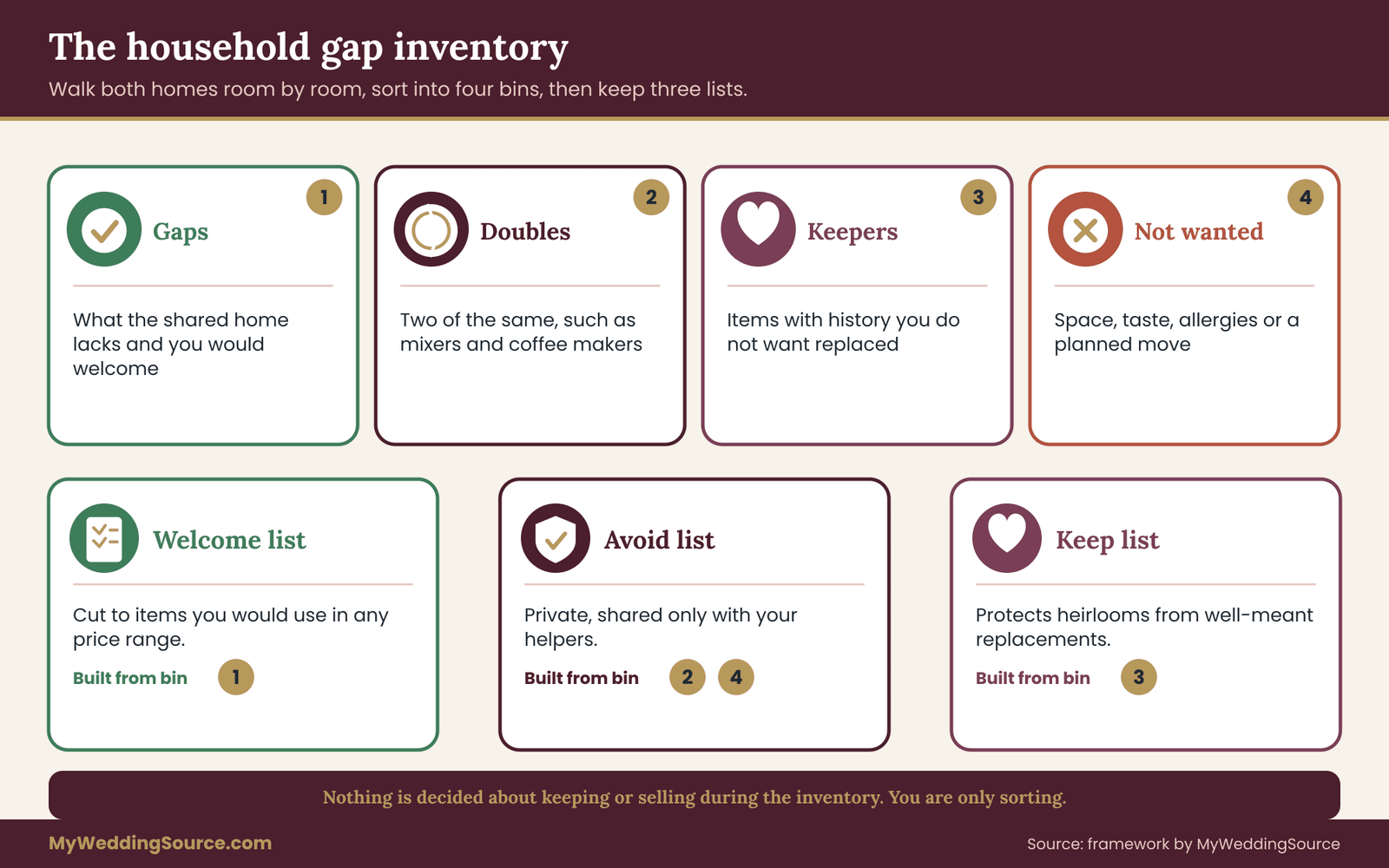
A household gap inventory is a one-evening exercise. You each walk through your own home and the home you will share, room by room, and sort what you find into four bins. It takes about two hours and it replaces a lot of guessing.
Bin one: gaps. Things the shared household lacks and you would be glad to receive. A larger bed’s linens after two people move into one room. Outdoor seating for a house that never needed it. Serving pieces for the first holiday you host together.
Bin two: doubles. Things you each own that will now exist twice. Two stand mixers, two sets of everyday plates, two coffee makers. Doubles are where unwanted second wedding gifts come from, because they are exactly the items that feel like safe wedding presents.
Bin three: keepers with history. Items that carry memory from an earlier marriage, from a parent, or from a long single life, and that you do not want replaced or duplicated. These matter for your message because well-meaning guests sometimes give a “better version” of something you treasure.
Bin four: not wanted. Things you would actively rather not receive, whether because of space, taste, allergies, a move on the horizon, or a deliberate decision to own less.
The inventory does not need to be long. Ten items in the first bin is plenty. What matters is that the answer to “what would we welcome?” comes from your actual rooms and not from a registry template.
How to run the inventory without it becoming a fight
Two people with full households can find this exercise sensitive. One partner may hear “double” as “your stuff is redundant.” Set one rule at the start: nothing gets decided about keeping or selling during the inventory. You are only sorting for the purpose of the second wedding gifts message. Decisions about what to donate, sell or store belong to a different conversation.
Work in the same order each time. Kitchen first, because it holds the most doubles. Then bedrooms and bath, then living spaces, then outdoor and storage. In each room, one partner reads out what they own and the other says gap, double, keeper or not wanted. Swap the speaking role in the next room. Write the answers on a single shared page, not two, since second wedding gifts are a joint decision.
Expect disagreement about keepers. One partner may love the inherited china and the other may find it fussy. That is fine for this purpose: if either of you wants an item left alone, it goes in the keeper bin, and the second wedding gifts statement will quietly avoid steering guests toward replacing it.
Turning the inventory into three working lists
When the sort is finished you have four bins, and the message only needs three lists from them.
The welcome list is bin one. Cut it to the items you would be happy to receive in any quality range, because guests give at very different budgets. If a gap can only be filled by something expensive, such as a sofa, it is not a registry item, it is a group-gift or a self-purchase decision, and it belongs in a later section of this guide.
The avoid list combines bins two and four. You will not publish it. It is for you, and for the one or two trusted people who field questions. When a cousin asks “do you need a blender?”, the person answering should know the honest answer is no.
The keep list is bin three. Its job is protective. If a guest wants to give something in the same family as a keeper, a short, warm answer from your helper keeps the peace: “They are all set on that, but they would love a new set of linens.”
An example of how the lists shift the message
Imagine two partners who are each in their late forties. One owns a house with a full kitchen, a guest room and a yard. The other rents a small apartment and travels often. They will live in the house. The inventory shows almost no kitchen gaps, a guest room with old bedding, no outdoor seating, and a long list of the renter’s duplicate small appliances that are about to go to a donation center.
The welcome list is short: bed linens for the larger mattress, outdoor chairs, a good set of serving dishes for hosting, and a framed print for a blank wall. The avoid list is long: anything electric for the kitchen, glassware, towels they replaced last year. Their second wedding gifts message will not be “no gifts.” It will be a short pointer toward four ideas and a clear permission to give nothing at all.
That is the output of the inventory: a small, honest list that can feed any of the registry options compared later in this guide, and a longer private list that keeps duplicates away.
Know your guest groups before you write the statement
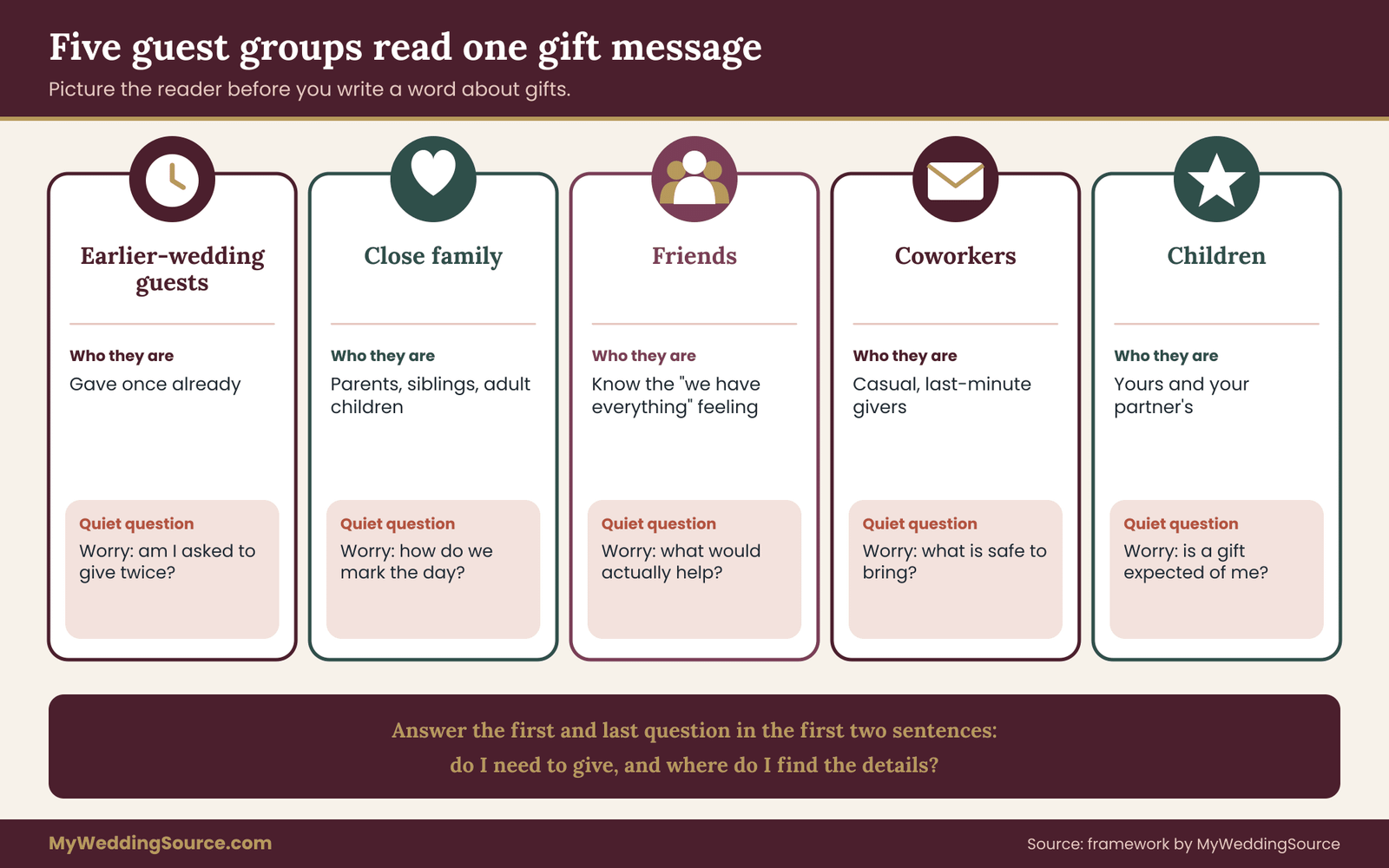
A single message about second wedding gifts is read by very different people. Second wedding gifts work better when you picture the reader. Five groups come up again and again, and each reads the same sentence differently.
Guests who attended an earlier wedding of yours or your partner’s. These are often the most anxious. Some worry they are being asked to give twice. A line that says plainly that no one is expected to give again takes that weight off. It should not name the earlier wedding, since nobody enjoys being reminded of a comparison.
Close family. Siblings, parents and adult children may want to mark the day in a lasting way, and they are the group most likely to ask directly. They are also the group most likely to hand your message to others. They need the exact wording you want repeated, not a summary.
Friends who have been through their own second marriages or long single households. They understand the “we have everything” feeling. They will usually respect a short list or a consumable idea and be relieved not to guess.
Coworkers and acquaintances. For this group the safest outcome is a card and a pleasant day. They are the guests most likely to give cash or a gift card in a store at the last minute, so a clear route that does not require a long registry search matters.
Your children and your partner’s children. Adult children may give a gift, and young children may want to. The statement should not be addressed to them as guests in the same way, and any gift from a child is best treated as a family matter. The guide to wedding decision rights covers how couples and families share input, and the same logic applies here: decide as a couple, tell the children before the guests, and keep their gifts out of any ledger comparison.
What guests are really asking themselves
Guests rarely say it aloud, but each of them runs through a few quiet questions. Do I need to bring something? Should it be big or small? Will it be awkward if I give nothing? Do they want money? Is there a list? The second wedding gifts statement should answer the first and last questions in the first two sentences, because a guest who finds those answers stops guessing.
Guests who are also past a first marriage themselves often have an extra layer. They may remember what it felt like to receive unwanted things. They may hold strong opinions about registries. Treat these as welcome and do not argue. The statement is a gentle direction, not a debate.
One more point belongs here. Be careful about assuming roles. A guest who is a former in-law, a step-parent or an ex-partner’s relative may or may not be invited, and may or may not be someone you want to receive a gift from. The second wedding gifts statement should be neutral enough that it can reach every invited guest without presuming their relationship to you. Do not write “family and friends who have known us for years” if some invitees are new in your lives.
The four-line gift statement for second wedding gifts
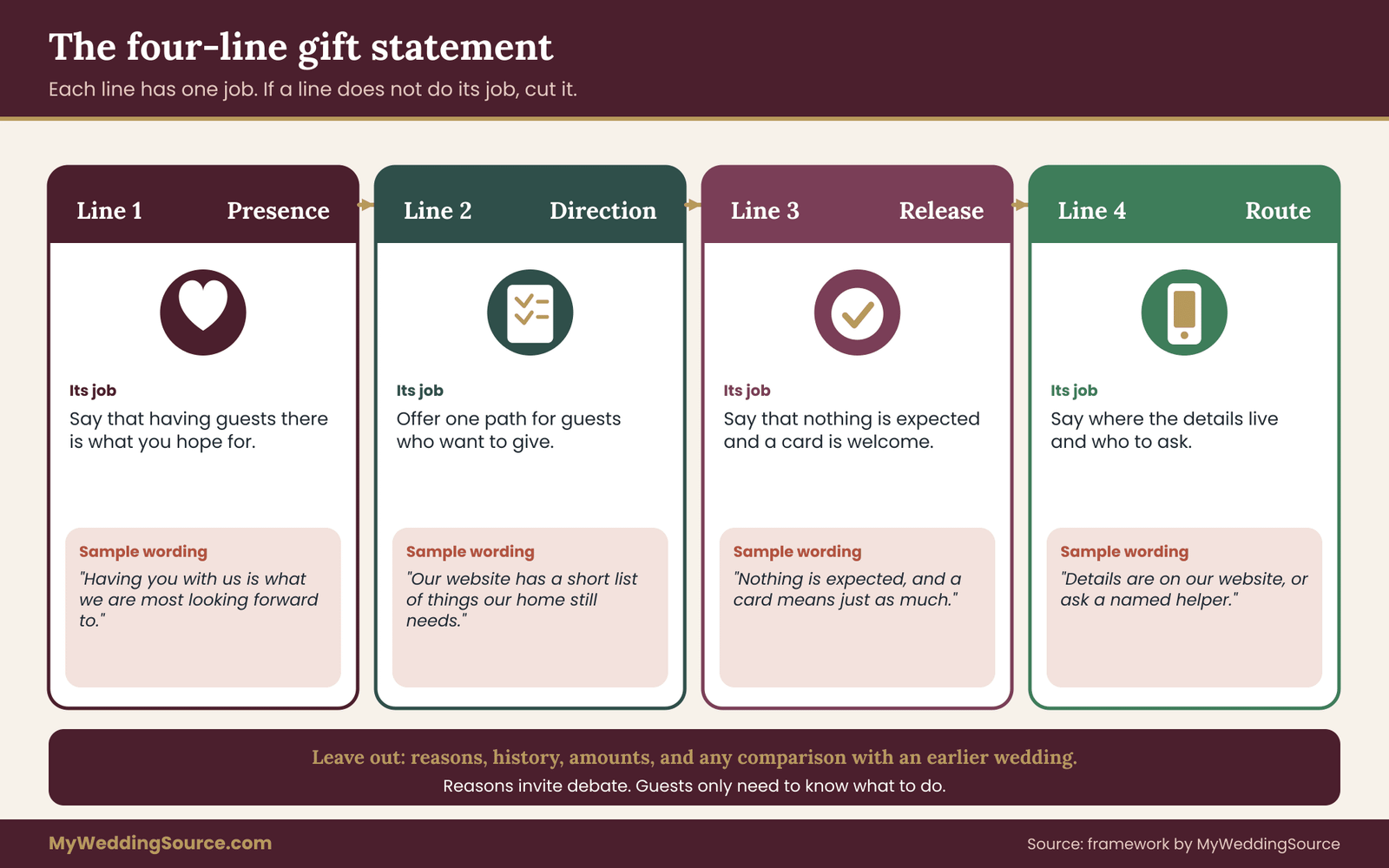
Here is the original piece of this guide. The four-line statement is a short block of words that you can place on a wedding website, repeat on the phone, and hand to a host who is answering questions for you. Each line has one job. If a line does not do its job, cut it.
Line one, presence. Say that having guests there is what you are hoping for. This is not decoration. It tells the anxious guest, before anything else, that attendance does not depend on giving.
Line two, direction. Offer one path for guests who want to give. Not a menu of five. One path: a short list, a fund, a charity, or “something consumable.” If you have more than one path, the statement points to a page where they are laid out.
Line three, release. Say clearly that no gift is expected at any second wedding and that any kind gesture, including a card, is welcome. This line is what turns direction into an offer and not a request.
Line four, route. Tell guests where the details live and who to ask. A website address, a named helper, or simply “ask us.” Without this line, the second wedding gifts statement relies on guests guessing where to look.
Four sample statements for different situations
These are patterns, not scripts to copy word for word. Change the wording until it sounds like you.
For a couple with almost no gaps who prefer no gifts: “The best part of the day is having you there. If you would like to mark it, we would be glad of a note or a favorite memory. Please do not feel any need to bring or send anything. The details are on our website, and you can always ask us.”
For a couple with a short list of real gaps: “Having you with us is the gift, and second wedding gifts are optional. If you would like to give something, we have a short list of things our new home still needs on our website. Nothing is expected, and a card means just as much.”
For a couple who would rather receive a contribution: “Your company means the most to us. If you would like to give, we are putting together a fund toward a project for our home, and the details are on our website. Please give only what feels right, and know that a card is entirely welcome.”
For a couple supporting a cause: “We are so glad you will be with us. We have everything we need, so if you would like to mark the day, we would be moved by a donation to a cause we both care about, listed on our website. There is no expectation at all.”
Why each line fails when it is moved or merged
The statement is short enough that people want to improve it, and most improvements break it.
If you move the release line to the top, as in “No gifts expected, but if you want to…” you bury the warmth and open with a rule. It starts to sound like a notice. If you merge direction and release into one sentence, guests hear a mixed message and sometimes take it as a test. If you drop the route line, you invite the cousin who texts you at eleven at night.
Do not add a fifth line that explains your reasons, such as how long you have lived on your own or how many dishes you already own. Reasons invite debate. Guests do not need to agree with your inventory, they just need to know what to do.
Wording to leave out
A few phrases cause trouble in second wedding gifts messages, even when meant warmly.
“No gifts, please” as the only line often reads as a refusal of care. Pair it with an alternative, such as a note or a donation.
“We have everything we need” can sound like a boast to a guest who is struggling, and it is rarely fully true. Say “our home is well supplied” if you want, or skip the claim entirely.
“Money is welcome” or “cash only” is considered blunt by many etiquette sources and is better handled through a fund page or by answering when asked. If cash is your real preference, the section on options below shows ways to say it gracefully.
Any phrase comparing this wedding to an earlier one, such as “this time we want to keep it simple,” can sting guests who gave the first time. Leave history out of the wording.
Where the gift statement goes and who repeats it
Writing the statement is the easy part. The harder part is making sure that the same words reach guests through every route, since second wedding gifts messages usually travel by more than one mouth.
The three places guests actually look
The first place is your wedding website. This is where most guests will look, and it is the right place for the full statement and any registry or fund details. A short page titled “Gifts” or “Details” works. Avoid hiding it under a headline that sounds like a demand.
The second place is the invitation or an enclosure. Etiquette sources have long advised against printing registry details on the invitation itself, and many couples place a small separate card or simply a website address. The wedding invitation etiquette guide on this site goes through the options for printed wording. For second weddings, a website address alone is often enough, because the second wedding gifts statement lives there.
The third place is a person. Whoever answers the question “what can I get them?” is delivering your message. Pick that person on purpose. Two or three trusted helpers is plenty, and they each need the statement, the welcome list and the avoid list.
Briefing your helpers
A helper is only useful if they say the same thing you would. Give each one a half-page: the four lines, the single path you chose, and a short script for the three most likely questions.
A guest asks, “Are they registered?” The helper says, “They have a short page on their website with ideas, and honestly the most important thing is that you are there.”
A guest asks, “Do they want money?” The helper says, “They have set up a way to contribute toward something for their home, and the details are on their website. A card is lovely too.”
A guest asks, “I already gave them something years ago. Should I do it again?” The helper says, “Please do not feel you need to. They are just glad you are coming.”
Notice what these scripts avoid. They do not volunteer the earlier wedding, they do not contrast this wedding with that one, and they do not push a specific amount.
Showers and parties thrown by other people
At a second wedding, showers are often hosted by friends or adult children, and the host will write their own gift wording. You cannot control that, but you can help. Send the host the second wedding gifts statement and ask them to use it. Ask them not to add specific amounts or to mention an earlier registry.
Some couples decline a shower entirely, which simplifies second wedding gifts. That is a legitimate choice and often cleaner. If you do accept one, the main point is simple: the host should know the gift statement before the guests do.
Scripts for the hard conversations about second wedding gifts
Even with a good statement, a few conversations will test it. Decide your answers ahead of time, as a couple, so neither of you improvises at a family dinner. Here are the five that come up most often when second wedding gifts are on the table.
A parent offers to buy something large. A parent who did not pay for the first wedding may want to give a major item this time, or a parent who gave a great deal before may feel unsure. Thank them first. Then ask, “What would you most enjoy giving?” and let the answer lead. If the offer matches a real gap, accept it with pleasure. If it overlaps a keeper or a double, say so gently: “That is generous. We are set on that, but we could really use outdoor chairs.” Keep the exchange private and warm.
A friend asks directly what you want. Answer from your welcome list, in one sentence, and point to the website for the rest. Do not read out the avoid list. “A set of linens for the bigger bed would be wonderful, and there is a short list on our site” is complete.
A guest insists on giving despite your release line. Some people feel strongly that giving is how they show love. Let them. Say thank you, and mention one thing you would truly use if they ask. Insisting that they stop is more hurtful than receiving the gift.
A relative pushes for a traditional registry. Older relatives sometimes feel that second wedding gifts should follow the first-wedding script, and that a registry is part of the ritual. You can honor that with a short list while keeping the statement. Explain it as a choice: “We kept it short because we have most of what we need.”
An adult child wants to host a shower. This is a loving offer and worth accepting if it fits your comfort. Send the host the statement and the welcome list, and ask them to use your wording. Agree in advance on guests, on whether the event is gift-focused or simply a gathering, and on who is invited from each side.
In each case the rule is the same: warm first, specific second, and never a comparison with an earlier wedding.
Keep the message the same in every place
Check your wording across the website, any printed enclosure, and the brief you give helpers. Small differences in second wedding gifts wording turn into confusion. If the website says “a card is welcome” and a family member tells guests “they only want cash,” guests will believe the person they trust more. Put the statement and the helper brief side by side once, read both aloud, and fix the differences.
Registry options for second wedding gifts, compared in plain words
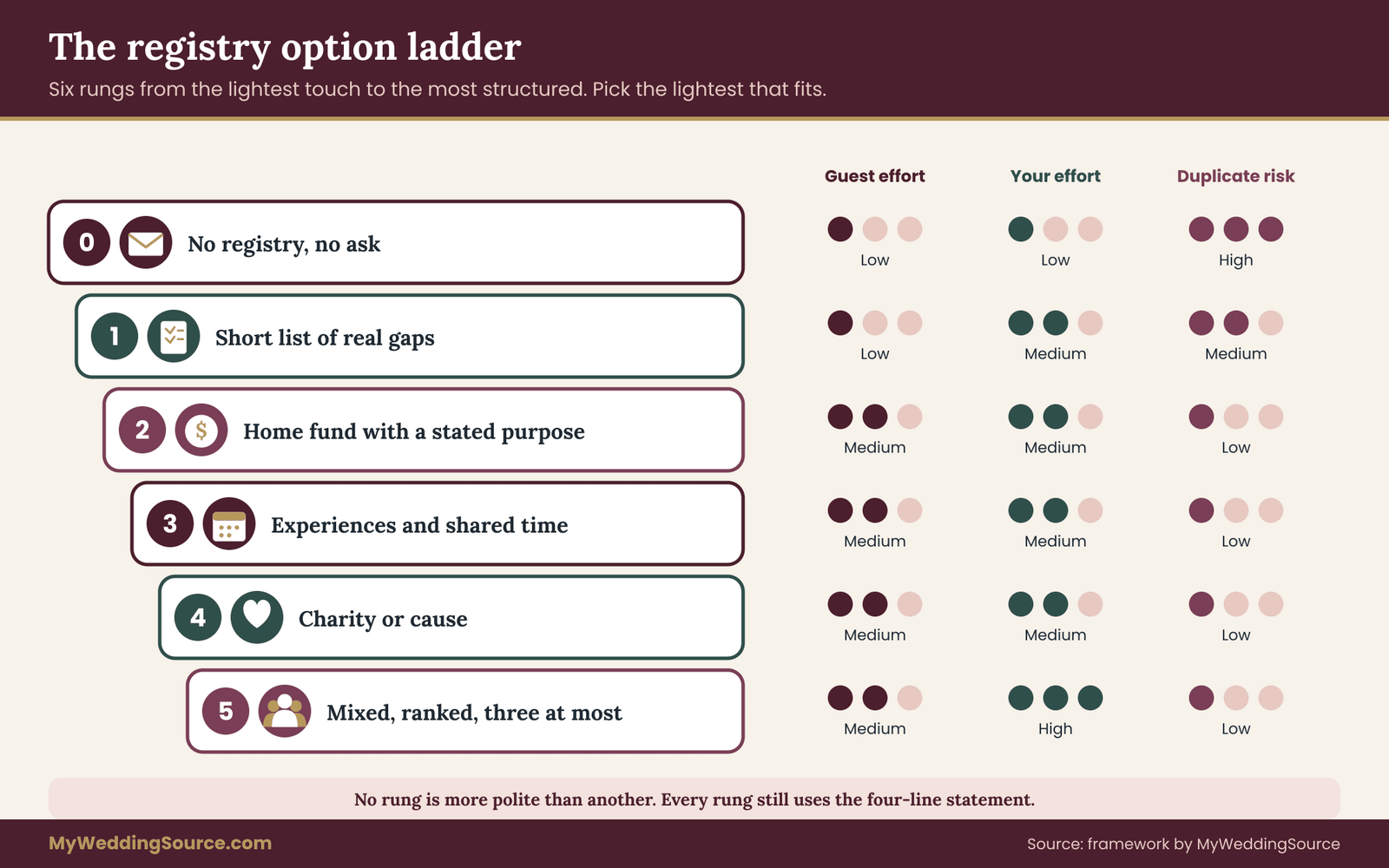
Now the practical question: what, if anything, do you point guests toward? There is no single right answer, so this section lays out six options side by side in prose. Think of them as rungs on a ladder from the lightest touch to the most structured. The right rung is the lightest one that still covers your real gaps.
For the wider picture of registry formats, including how stores handle them, the wedding registry ideas guide covers the general landscape. What follows is specific to couples who both already have a household.
Rung zero: no registry and no ask
You publish the first and third lines of the second wedding gifts statement and leave direction out. Guests give what they choose, or nothing.
This works when your gaps really are small, your guest list is mostly people who give modest cards, and you are comfortable receiving whatever arrives. It costs you the least effort and creates the lowest risk of seeming to ask. The tradeoff is duplicates. Without direction, the most predictable gifts, such as kitchen items, are the ones guests pick, and you must be ready to return or pass them on.
It also fails when a loving, practical guest really wants to be told what to buy. For those guests, silence feels like a closed door.
Rung one: a short list of real gaps
You publish the welcome list from your inventory, trimmed to roughly ten items across a range of prices. This is a small registry, not a full one.
It works well because it gives direction without hundreds of choices. Guests who want certainty can buy from it, and guests who prefer to choose can ignore it. The effort is moderate: you choose items, add them to a store or a simple page, and keep it updated.
Its risk is shortness. If ten items sell out, late guests may feel stranded. Add a few lower-priced options and one open-ended line, such as “or a note of your choice.”
Rung two: a home fund or contribution page
You set up a way for guests to contribute toward a specific, non-duplicating purpose, such as outdoor furniture, a bathroom renovation or a shared project. The purpose should be real, because guests dislike vague “fund” language.
This suits couples whose real gap is a large item. It avoids duplicates entirely. The tradeoffs are fees and policy details, since some platforms charge a service fee and some hold funds on rules you should read before choosing. Read each platform’s own terms before you publish a link to guests.
It can also feel awkward to guests who think of money gifts as impersonal. A line that explains the purpose helps, such as naming the item.
Rung three: experiences and shared time
You point toward things like a dinner, a class or a weekend away rather than objects. Guests give a voucher or simply plan the experience with you.
This works for couples who own too much and want memories instead of things. It reduces the clutter risk, and it can be offered at many price points. The tradeoffs are logistics: vouchers expire, dates must be coordinated, and a guest in another city may not be able to give in this form.
Rung four: a charity or cause
You name a cause or two and invite donations in your honor. Many couples with full households find this the most natural fit because it removes the duplicate problem and expresses values.
The cautions are real. Choose organizations that you have confirmed are legitimate, since the Federal Trade Commission and other agencies warn about charity scams. Make donation routes official and direct, and do not collect money on a guest’s behalf unless you are ready to account for it. The Internal Revenue Service explains how charitable giving is treated for donors, so guests who care about deductions should be sent to the agency and not to you for answers.
Rung five: a mixed approach
You offer two or three of the above in a single sentence, usually a short list, a fund and a charity, each described in a line. This is the most flexible rung and the most common in practice. Its weakness is complexity: guests facing a menu of options sometimes freeze. Keep it to three choices at most, and rank them in the order you prefer.
Reading the ladder honestly
No rung is more polite than another. A couple who chooses rung zero is not rude, and a couple who chooses rung five is not greedy. The ladder is a tool to match your needs to the effort you are willing to spend. A common error is climbing higher than needed: a full registry for a couple with two kitchens, or a charity drive for a couple who simply need bed linens.
Notice, too, that rungs combine with the statement the same way. Every rung still uses the four lines. What changes is what line two says.
Comparing the options on five questions
A ladder shows order, but it does not show fit. To compare the six options for your own second wedding gifts plan, put each one through the same five questions. Answer them out loud as a couple, and write the answers next to each rung.
How much work does this create for guests? Rung zero asks nothing of them but a decision. A short list asks them to visit a page. A fund asks for a payment step they may not know. A charity asks them to research an organization. A guest in their seventies who does not shop online will find the fund and the charity harder than a card with a check in it. Think about your actual oldest guests when you weigh second wedding gifts.
How much work does this create for you? A short list means choosing items and updating them. A fund means setting up a page, reading terms and tracking contributions. A charity means vetting organizations and perhaps answering questions about them. A mixed approach adds all of that. If you are already stretched by wedding planning, the lightest rung that fits your gaps saves real time.
How likely is it to produce duplicates? Rung zero produces the most, and the charity and experience rungs produce the least. A short list falls in between, and the quality of your avoid list decides how well it holds.
How well does it handle a range of budgets? Guests give at very different levels. Rung one handles this if you include low and high prices. A fund handles it by letting guests choose an amount. A charity does so as well. Experiences often have a minimum, which can embarrass a guest on a tight budget.
What rules or fees apply? Stores set their own return windows, and platforms set their own fees and payout rules. These are issued by the companies, not by etiquette, so read them. If a platform will not state its fee clearly before you publish, pick another.
What to do with cash and gift cards.
Many couples with full households would, if honest, prefer money. Cash is the most flexible of all second wedding gifts and the least likely to duplicate anything. Etiquette sources are divided on whether to say so. A common middle path is not to state a preference in print, to answer honestly when asked, and to make a fund available for those who want to contribute.
When cash and gift cards arrive anyway among your second wedding gifts, treat them like any other gift. Keep a record of who gave what, and thank each giver specifically for the way you used or plan to use it. For gift cards, note the expiry date and the issuer’s rules. The Federal Trade Commission publishes guidance on gift cards and on common gift card scams, and it is worth a look before you accept a bundle of cards from strangers or sell any.
Money among second wedding gifts also raises a tax question for some people. In general terms, the Internal Revenue Service treats gifts as the giver’s concern when they are large, and not as income to the person who receives them, but the details depend on amounts and circumstances. Send any guest who asks to the agency rather than answering for them.
Why a mixed approach usually needs a ranking.
If you choose rung five, rank the options in the order you prefer and say so lightly: “Our first idea is a short list, and a fund is there too if that is easier.” Guests facing three equal choices often delay and then give the safest thing, which is exactly what you were trying to avoid. A ranking turns the menu into a recommendation, and recommendations get followed.
A decision path for choosing among second wedding gifts options
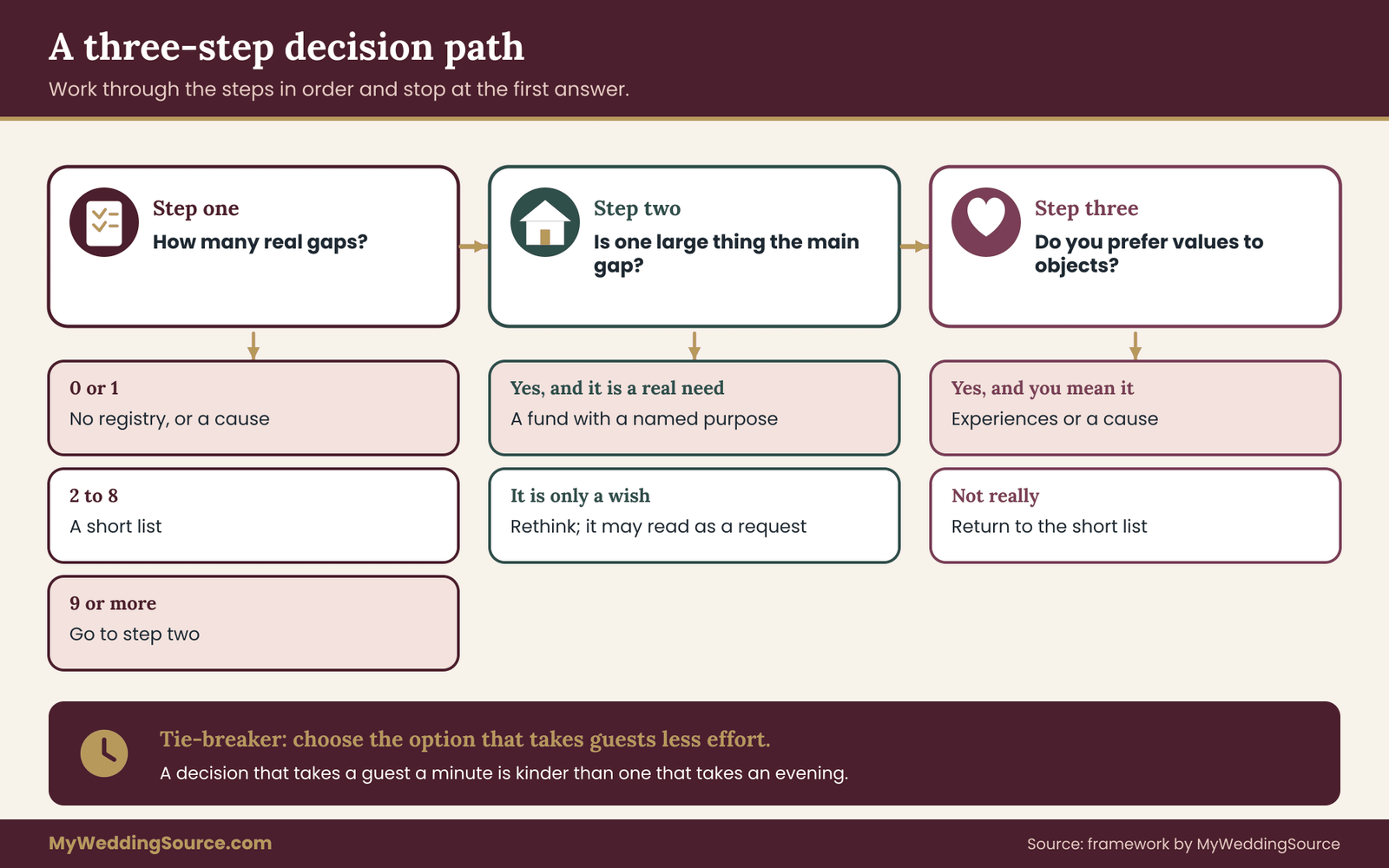
Comparing options is useful, but at some point you need to pick one. This decision path turns the inventory and the five questions into three plain steps. Work through them in order, and stop at the first step that gives you an answer.
Step one: how many real gaps do you have?
Count the items in your welcome list that you would genuinely use within a year. If the count is zero or one, choose rung zero or rung four. You do not need a registry, and building one would only invite the duplicates you wish to avoid. If the count is two to eight, rung one, a short list, is almost always the right answer. If the count is nine or more, or the list contains items too large for a single guest to buy, move to step two.
The reason for counting honestly is that couples tend to inflate lists to make a registry feel worthwhile. A list padded to look complete sends guests to items you do not want. If the real number is three, publish three.
Step two: is the main gap one large thing?
If your biggest need is a single costly item or project, such as furniture, a renovation, a car repair or a down payment on a shared project, a fund is the natural fit. Guests contribute small pieces, and nobody has to buy the whole thing. The purpose must be specific and honest. A guest who gives toward “a new porch” expects a porch, and a vague “household fund” invites suspicion.
If the large item is not really a need but a wish, think twice. A fund for something you would like but do not need can read as a request for money, and guests are quick to sense it.
Step three: do you prefer values to objects?
If your gaps are small and your values are strong, rung three or rung four, experiences or a cause, match your taste. These options only work if you mean them. A cause chosen to look generous but unconnected to your lives will feel hollow to the people who know you best.
The tie-breaker rule
If two options seem equal, choose the one that creates less work for guests. A guest decision that takes a minute is kinder than one that takes an evening, and kind choices tend to produce kind responses.
When to publish the statement: a simple timeline
Timing matters as much as wording for second wedding gifts. Guests who learn your plans late tend to act on guesses, and guests who learn them early have time to choose well.
Do the inventory as soon as the date is set, because it shapes everything else. Write the statement and choose the option within a few weeks after that, while the idea of second wedding gifts is still a small decision and not a source of stress. Brief your helpers before invitations go out, since the first questions arrive the day guests see the date.
Publish the website page when the invitations are sent, not before. A gift page that appears before guests know the details of the day can look presumptuous. Update it once, about a month before the wedding, to remove sold-out items and to add a few low-cost choices. Then leave it alone. Frequent edits confuse guests and make the plan for second wedding gifts feel like a moving target.
After the wedding, keep the page up for a few weeks, since some guests send second wedding gifts late and some send them from far away. When the thank-you notes are finished, take it down or replace it with a short thank-you message. A page that asks for gifts months later looks like a request that never ended.
Checking your choice against the money
Second wedding gifts also interact with your budget. If you expect a few large group gifts, a fund can help you plan a project. If you expect a handful of cards, you may not want to count on gifts to fund anything.
The wedding budget guide on this site walks through how to build a budget that does not depend on gifts arriving. As a general planning habit, treat any gift income as a bonus rather than as a line in your plan. Guests may give less than you hope or nothing at all, and nothing about etiquette entitles you to expect more.
A worked case: Renata and Walt
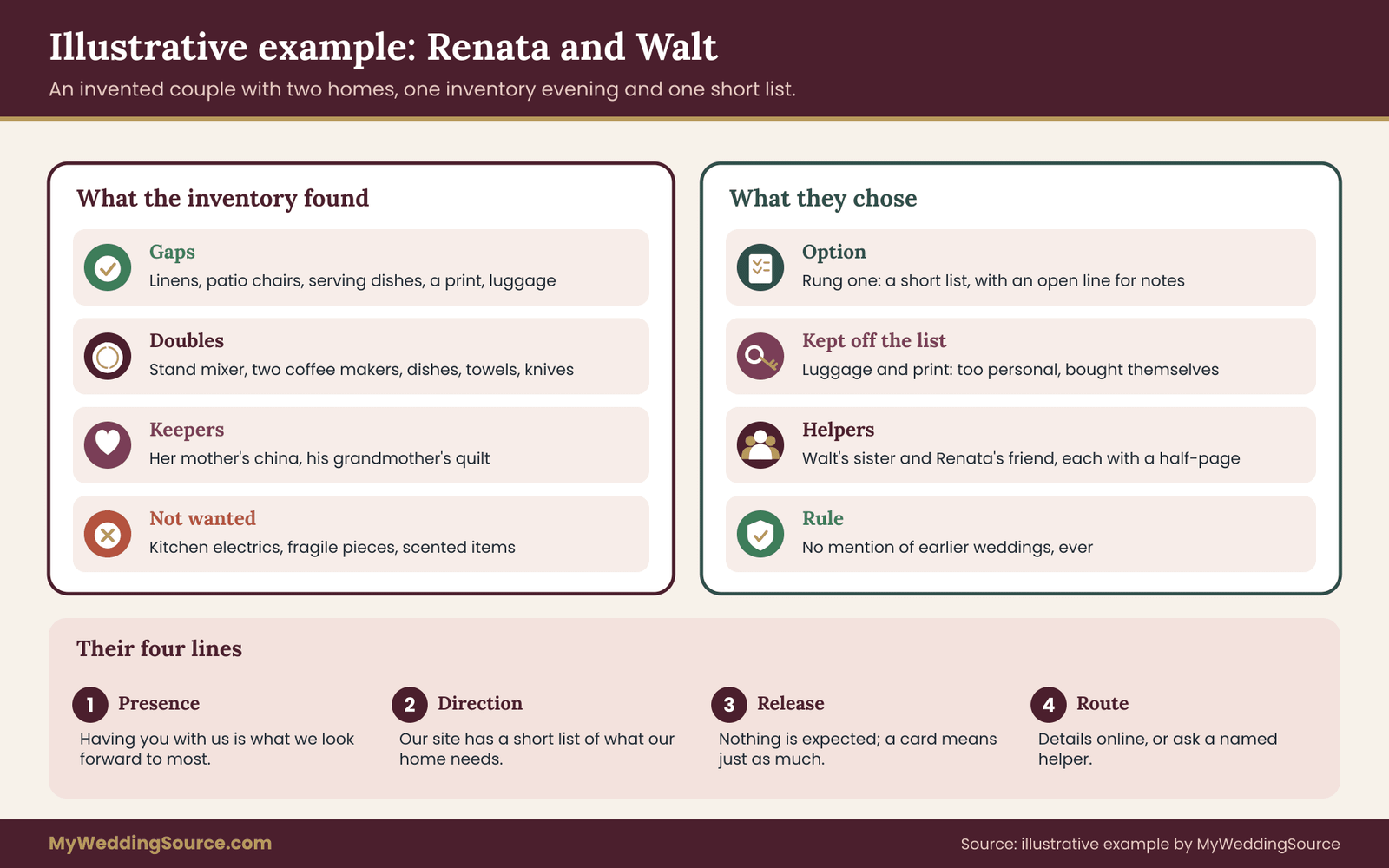
The following example is invented to show the process. The couple, the numbers of items, and the outcomes are illustrative, not drawn from a real wedding or a study. It is useful because it shows how the inventory, the second wedding gifts statement and the option choice connect, and where the process could have gone wrong.
The situation
Renata is fifty-one and owns a house with a full kitchen, two spare bedrooms and a patio. Walt is fifty-four and has lived in a rented apartment for years. They will live in Renata’s house. Both have adult children from earlier marriages. Walt’s sister and Renata’s closest friend will help with guest questions. The wedding is a dinner for thirty-five, held on a Saturday in spring.
Both have been married before, and several of the invited guests gave gifts at one or both earlier weddings, so second wedding gifts feel delicate to them. Renata is not comfortable asking for anything. Walt would not mind a modest list. Neither wants things piling up in the house.
The inventory
Renata and Walt spend one evening walking through Renata’s house and Walt’s apartment. The sort produces these results.
In the gap bin: linens for a larger bed in the main bedroom, outdoor seating for the patio, a set of serving dishes sized for hosting a dozen people, a framed print to replace a bare wall in the hallway, and a good set of luggage for the honeymoon trip.
In the doubles bin: a stand mixer, two coffee makers, two sets of everyday dishes, two sets of towels, and three sets of kitchen knives.
In the keeper bin: Renata’s mother’s china and a quilt that belonged to Walt’s grandmother.
In the not-wanted bin: anything electric for the kitchen, anything breakable that needs special storage, and anything scented.
The option choice
They run the decision path. Step one: five real gaps, so a short list is the likely answer. Step two: no single large item dominates, so a fund is not needed. Step three: they like objects that last and are not drawn to a cause. They choose rung one, a short list, with a mild mixed approach: a small number of items, and an open line for anyone who would prefer to write a note.
They also decide that two items on the gap list, the luggage and the framed print, are too personal to put on a public list. They keep them off and plan to buy them themselves.
The statement
They write the four lines. Line one: “Having you with us is what we are most looking forward to.” Line two: “If you would like to give something, our website has a short list of things our home still needs.” Line three: “Nothing is expected, and a card or a note means just as much.” Line four: “The details are on our website, and you are always welcome to ask Walt’s sister or Renata’s friend.”
They give their two helpers a half-page each, with the avoid list and three sample answers. The helpers agree not to mention earlier weddings.
The result, and what could still go wrong
In this invented case, the day works out well: most guests give cards, a few buy from the list, and two give something unplanned. A friend brings a second coffee maker, and Renata thanks her warmly and, later, quietly donates it. The case is useful because of the things that could still have gone wrong, which the next sections turn into failure conditions.
Two points are worth drawing out. First, the statement and the list matched, because both came from the inventory. Second, the helpers prevented a problem: when Walt’s cousin asked whether they wanted cash, the sister gave the same answer the website did, and the cousin sent a card.
When second wedding gifts arrive anyway
Even a careful statement will not stop every unplanned present. That is not a failure. People give because they care, and some will never read a website. A good plan for second wedding gifts includes what you do when something unexpected lands on the table, because the way you handle the first duplicate sets the tone for the rest.
The duplicate you cannot use
A guest gives you a stand mixer and you own one. Start with the thank-you, which is the same whether you keep the gift or not. Thank the person for thinking of you and mention something true: that it was kind of them to remember you like to bake, for example. Never mention that you already have one.
Then decide what to do with it.
You have three honest paths. Return it, if the store allows and the giver included a gift receipt. Keep it and pass the older one on. Or donate it. Which path you take is your private decision. For second wedding gifts, etiquette sources broadly agree that regifting is acceptable when the item is new and the giver is unlikely to see it again, but opinions differ, and you should weigh how close the giver is to your circle. Do not regift something to a mutual friend of the giver.
If you decide to return, do it quietly and without commentary. A returned gift does not need to be mentioned to the giver. If the giver asks, be gentle and honest: “We loved it, and we ended up exchanging it for something we needed right away.”
The heirloom that overlaps a keeper
Among second wedding gifts, a guest, usually a relative, sometimes gives something meaningful that overlaps a keeper from your inventory. A second set of china when you already have your mother’s is the usual example. Treat the gift as a gesture of welcome, thank them warmly, and keep it if you can, even if it sits in storage. Returning a family gift carries a cost that a store gift does not.
If the item truly cannot stay, tell the giver gently and ask whether they would like it back or passed to someone else in the family. Gifts with family history are different from store gifts, and a conversation is usually kinder than a quiet exchange.
The large gift that feels like too much
Occasionally one of the second wedding gifts is large, such as a significant sum or an expensive item. Parents, close relatives and old friends are the most likely givers. You may feel uncomfortable. Resist the urge to refuse in the moment, because refusal can feel like rejection.
Thank the giver sincerely and then take a day. If the gift seems out of line with the giver’s means, you may want to speak privately. If it is simply generous, accept it with gratitude. The Internal Revenue Service publishes information on gift tax rules, which fall on the giver in most cases rather than the receiver. A giver with a question about that should ask the agency or a tax professional.
Gifts from children
Both partners may have children, and the children may add to the second wedding gifts, whether adult or young. A child’s gift is often the most emotionally loaded item you will receive. Accept it with warmth and a specific thank-you, and do not compare it to what other children gave. If a child gives you something to share between the two households, make sure both of you say thank you, in each other’s hearing.
Do not assign gift expectations to children. They are family members first and guests second, and the second wedding gifts statement does not apply to them in the same way.
Cash and checks
When cash and checks arrive, record the amount and the giver on the day. Two people should be present for this if possible, and the record should live somewhere both partners can reach. The guide to organizing wedding records describes how to keep gift records alongside receipts and certificates, and the same ledger can hold the thank-you status. Deposit checks promptly, and keep an eye on any check made out to only one partner’s name, which can complicate deposits into a joint account.
The Consumer Financial Protection Bureau and the FDIC publish plain-language guidance on handling deposits and on peer-to-peer payment apps. If guests send money through an app, it helps to know that some payments are hard to reverse. Give guests an exact name and handle, and confirm receipt.
Group gifts and gifts that need arranging
Some presents are bigger than one person’s budget, and friends or relatives may pool their money.
A group gift is a lovely gesture, and it brings a few small tasks. Ask who organized it so that you can thank the right person on behalf of everyone. Write one note to the organizer and, if you can, a short line to each contributor. Never ask who gave how much. If the gift is large, such as a piece of furniture, confirm delivery details with the organizer directly, because deliveries to a home that two people are still merging can go wrong.
Items that need installation, assembly or storage deserve a plan before the day.
A heavy chair or a boxed set of outdoor furniture may arrive at the venue, at one partner’s old address or at the new home. Choose one delivery address in advance and tell the guests who ask. A trusted friend can carry gifts from the venue at the end of the night so that nothing is left behind or opened by mistake. Label cards with tape on the box so that notes and presents stay together, and photograph each card before you separate it from its box.
Storage, shipping and the first month
Gifts that arrive before the wedding need a safe place, preferably out of sight of your daily routine. A spare closet works. Open them when you are ready to record them, not as they arrive on a busy day. Record each one the same evening, while you remember who sent what, and keep the shipping label or the order number until you are sure the item is right.
After the wedding, give yourself a quiet first month. Many couples feel pressure to put everything into use at once. You do not have to. Keep a short list of what you need first and let the rest wait. If a gift needs to be returned, do it in the first few weeks, since windows close. If something is damaged, take a photo before you throw anything away. Small habits like these protect both the gift and the giver’s feelings, and they make the work of recording the rest feel manageable.
Thank-you notes, records and returns for second wedding gifts
Thank-you etiquette is the same for second wedding gifts as for any other wedding, with a few wrinkles. The wrinkles come from having two households, which affects both the record you keep and the voice you write in.
A thank-you that fits both of you
Write a note for each of your second wedding gifts, even when the giver was at the wedding and you thanked them in person. Name the gift, say something true about how you will use it, and mention the giver by name. Keep it short: three to five sentences is plenty.
For a gift you plan to exchange, thank the giver for the thought. For cash, say what you plan to do with it in general terms, for example toward the new patio. For a donation in your honor, thank the giver and, if you have a way, mention the organization by name.
Decide in advance who writes to whom. Many couples split by who knows the giver better. A signed note from both of you is warm, but a note in one voice about a friend of the other can ring false. Either approach is acceptable if the note is sincere.
Timing
There is no legal deadline for thank-you notes, but etiquette guidance generally treats a few weeks as a reasonable target and a few months as the outer limit. Gifts that arrive before the wedding are traditionally thanked soon after they arrive. Plan a short, regular session in your calendar rather than a single marathon. Twenty minutes twice a week is easier to keep than an evening that never comes.
A shared ledger for two households
Keep one ledger of second wedding gifts for both of you. Each row needs only five things: the giver, the gift, the date received, the date you wrote the thank-you, and what you did with the gift. The last field is where two households matter. A gift can go to the shared home, to one partner’s home, to storage, to a child, or back to the store, and you will want to remember which, particularly if you separate gifts for any reason later.
The ledger of second wedding gifts also protects relationships. If a guest asks months later whether you liked their gift, you can answer accurately. If you receive the same item twice from different givers, you will see it in the log before you write the second note.
For cash and check gifts, a separate section of the same ledger is helpful. The site’s wedding budget page explains how to separate gift money from planned income, and doing so keeps the wedding accounts clean.
Returns, exchanges and warranties
Check each store’s return policy the week second wedding gifts arrive. Return windows are set by the retailer, and many are short. Keep gift receipts in the same folder as the ledger. If an item is a small appliance, the Consumer Product Safety Commission maintains a recall database that is worth checking for any used or older item before you keep it. Register warranties for gifts you keep, since the paper insert often goes missing.
When a gift is damaged in shipping, report it to the sender or the seller quickly. The United States Postal Service explains how claims work for items sent through the mail, and other carriers publish their own rules. Keep the packaging until the claim is settled.
Gifts that stay in one household
Among second wedding gifts, one is sometimes clearly meant for one partner, such as a tool or a hobby item. Record it as that partner’s, and say so in the ledger. It avoids confusion later and treats the gift as the giver intended.
Failure conditions: when the plan for second wedding gifts breaks
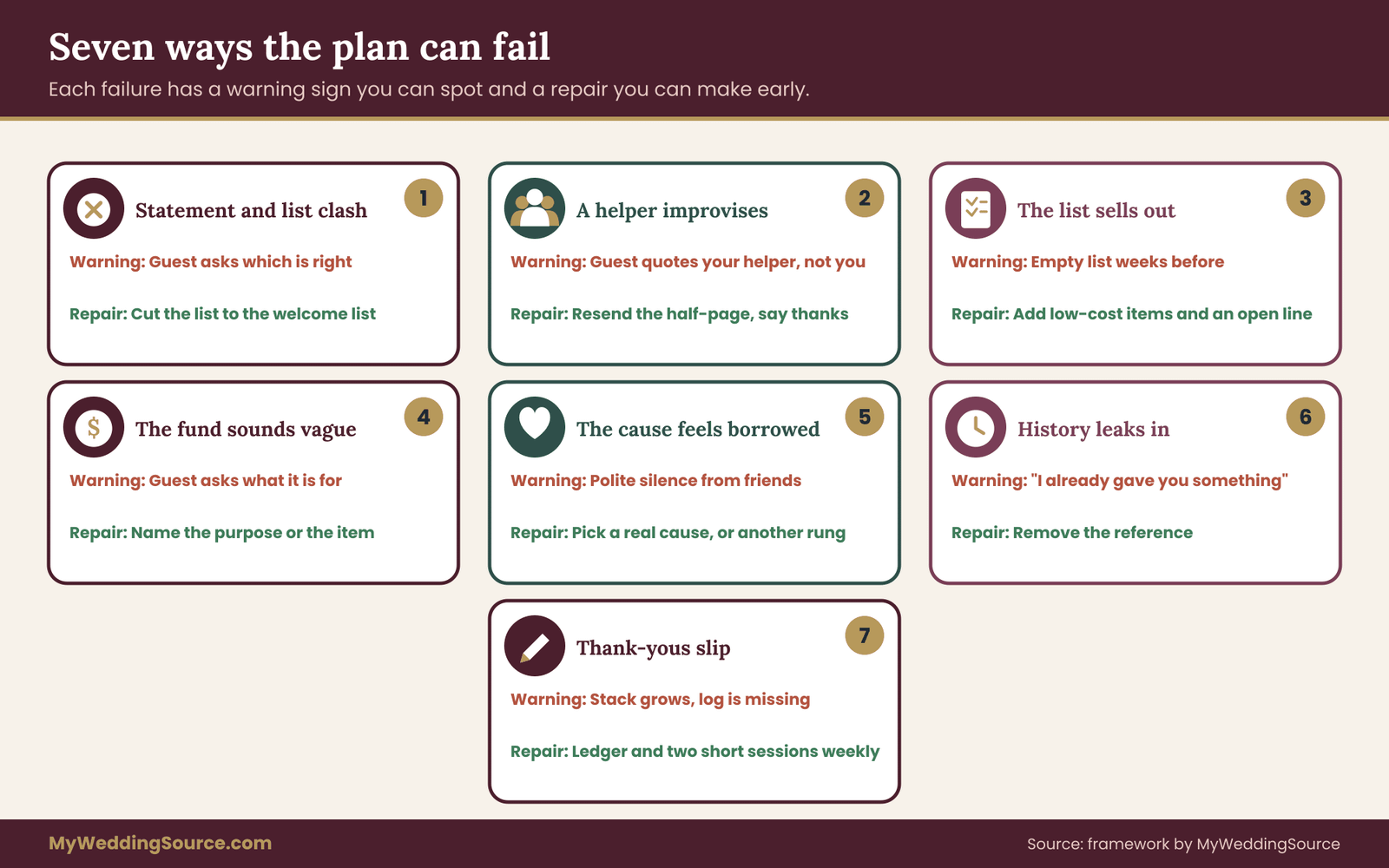
A plan is only as good as its failure conditions. Second wedding gifts messages tend to fail in seven predictable ways. Each one is easier to repair early than late, so this section lists the warning sign and the repair for each.
Failure one: the statement and the list disagree. The website says nothing is expected, while the registry shows forty items. Guests believe the registry. Repair by cutting the registry down to the welcome list and rewording line two so it matches. The warning sign is any guest asking, “Which one is right?”
Failure two: a helper improvises. A parent or friend tells guests what you “really” want, and it is not what the second wedding gifts statement says. Repair by sending the helper the half-page again and thanking them for helping. Do not scold. The warning sign is a guest quoting something you never wrote.
Failure three: the list sells out. Ten items go quickly and late guests find nothing. Repair by adding a few low-cost items or an open line. The warning sign is an empty list three weeks before the wedding.
Failure four: the fund sounds vague. Guests do not understand what the money is for and give less or ask questions. Repair by naming the purpose and, if possible, the item. The warning sign is a guest asking, “What is it for?”
Failure five: the cause feels borrowed. A charity chosen for appearances draws a polite silence from people who know you. Repair by choosing a cause that matches your lives, or by dropping the cause and using a different rung. The warning sign is that no one mentions it.
Failure six: the history leaks in. Someone mentions an earlier wedding, a comparison creeps into the wording, or a guest feels they are being asked to give twice. Repair by removing the reference and apologizing only if someone was actually hurt. The warning sign is a guest saying, “I already gave you something.”
Failure seven: the thank-yous slip. Second wedding gifts arrive faster than notes. Repair with the ledger and two short sessions a week. The warning sign is a growing stack and a missing log.
The test before you publish
Before the statement goes live, run a quick test. Hand it to someone who is not in your family and ask them to answer three questions in their own words. Do I have to give something? If I want to, what do I do? Where do I find more? If they hesitate on any answer, the statement needs work. This takes five minutes and prevents most of the failures above.
Edge cases and the guest side of second wedding gifts
A few situations bend the usual guidance, and it helps to think them through before they arrive. The first is the view from the other side of the table, because guests ask themselves hard questions about second wedding gifts too.
If you are a guest at a second wedding
This guide is written for couples, but the same ideas help guests. If you are invited and unsure what to give, a few rules of thumb apply.
Read the couple’s statement before anything else. If they have written one, follow it. If they point you to a list, a fund or a cause, any of those is a safe choice. If they say nothing is expected, a card with a specific, warm note is a complete and welcome gift.
If you gave at an earlier wedding, you are not obligated to give again. Many people choose to give something smaller or something different, such as a consumable or a note, and many give nothing beyond a card. Neither choice is wrong. If you want to give but are unsure, ask a helper, not the couple.
If you are close to the couple and want to give something meaningful, think about what a household with two of everything would actually value. Time, a meal, help with a move, a framed photograph from the day, a plant or a well-chosen bottle all avoid duplication. Check allergies and preferences if you can.
Keep your second wedding gifts proportionate to your own budget. Etiquette sources agree that cost is not the measure of a good gift. If you cannot attend, you may still send a card or a gift, and it is also fine to send only your good wishes. Finally, do not ask the couple whether they want cash. Ask a helper, or look at the website, and if there is no information, a card with a thoughtful small item and a gift receipt is acceptable.
Situations that change the advice
Some situations bend the usual guidance, so think them through before they arrive.
A very small wedding or elopement. When only a few people attend, the conversation about second wedding gifts is personal and quick. A statement may feel too formal. You can usually say it in a sentence to each guest. Still decide the answer in advance so that you give the same one to everyone.
A wedding announced after the fact. If you marry first and tell people afterward, those who were not invited may want to send something. Your statement can be shorter: a thank-you for the kind words, and a line that a card is plenty. Do not post registry details in an announcement.
A destination wedding. Guests have already spent money on travel, so second wedding gifts weigh more. A strong release line matters more here, and a gift request of any size can feel like a second bill. The site’s guide on wedding etiquette covers general guest expectations, and the travel cost is a good reason to choose rung zero.
A wedding where one partner is marrying for the first time. The first-time partner may expect a traditional registry, and their family may expect the same. Talk it through early. A short list can serve both: some items for a first household, in the part of the home that is still empty, and a clear release line for guests who gave before.
A guest list that includes former in-laws or an ex-partner’s family. Do not assume how they will want to give or whether they will give at all. Use the same neutral statement as for everyone, and do not route any special message through other relatives.
Two partners with different comfort levels. One may feel strongly about asking for nothing, the other about a modest list. Treat it as a decision for both of you, and pick the lighter rung if you cannot agree. The wedding decision rights guide describes how to settle disagreements without a winner and loser.
A tight budget on the guest side. Some guests will want to give and cannot afford much. An option at every price helps, and so does a sincere line about cards.
Fairness between partners when gifts come from two families
Second wedding gifts often arrive unevenly. One partner has a large family and many friends, and the other has few. Gifts from one side may be larger, more numerous or more personal. This is normal, and it can quietly create resentment if it is never discussed.
Agree early that second wedding gifts belong to the marriage unless the giver clearly meant them for one person. Agree that the ledger records everything the same way, without ranking either side. And agree on a simple rule for items that belong to one person, such as a hobby tool: it stays that partner’s, and the ledger says so.
Talk, too, about the emotional side. A partner who receives fewer gifts may feel measured against the other. Say aloud that the count of second wedding gifts is not a measure of how loved either of you is. People give according to their habits, their budgets and their ideas of etiquette, not according to affection.
Your next steps
Here is a sequence you can complete over a few weeks.
First, hold the household gap inventory in one evening, with the four bins, and write down the welcome list and the avoid list. Second, pick the lightest rung that covers your real gaps using the decision path. Third, write the four-line statement in your own voice and test it on someone outside your family.
Fourth, decide who will repeat the second wedding gifts statement and give them a half-page with the avoid list and three scripts. Fifth, put the statement on your website and, if you use one, a short note with your invitation. Sixth, set up the ledger before the first gift arrives, and schedule two short thank-you sessions each week. Seventh, check return windows and warranty details the week gifts arrive.
Finally, revisit the statement a month before the wedding. If a helper has begun to improvise, send the half-page again. If your list has sold out, add a few items. Small corrections at that stage keep second wedding gifts simple for everyone.
FAQ
Is it rude to say we do not want gifts at a second wedding?
Asking for no second wedding gifts is not rude, but the wording matters. A bare “no gifts” can read as a refusal of care. Pair it with a warm alternative, such as a note, a favorite memory or a donation, and say clearly that nothing is expected. The aim is to relieve guests of pressure while still giving loving people a way to mark the day.
Should we register at all if we both own a full household?
Not necessarily. If your inventory shows few real gaps, skipping a registry and publishing only the statement is a reasonable choice. If you have a handful of real needs, a short list of around ten items works better than a full registry. Choose the lightest option that covers what you will actually use.
Do guests who gave a gift at our first weddings need to give again?
No. Second wedding gifts are never a fee for attending, and many guests will feel relieved to hear that no one is expected to give twice. Your statement and your helpers can say so without mentioning earlier weddings. Guests who want to give again may do so, and a card is a complete gift.
Is it acceptable to ask for cash or a contribution?
Etiquette sources are divided. Many suggest not stating a preference for cash in print, and instead offering a fund with a clear purpose or answering honestly when asked. If you set up a fund, name what it is for, read the platform’s fees and terms, and keep the language light and optional.
How do we handle duplicate gifts without hurting anyone?
Thank the giver for the thought without mentioning the duplicate. Then decide privately whether to return it, keep it, pass the older item on or donate it. Return windows are set by the store, so check them early. Do not give a gift back to someone in the giver’s circle.
Who should answer guests who ask what we want?
Two or three trusted people, such as a sibling, an attendant or a close friend. Give each of them the same half-page: your four-line statement, the single path you chose and short answers to likely questions. They should repeat your wording, not improvise, and they should never mention earlier weddings or specific amounts.
What if our children want to give us something?
Accept it warmly and thank the child specifically. A child’s gift among second wedding gifts is a family matter and should not be compared with the gifts of guests or of other children. Keep it out of any comparison, and if it is meant for both households, make sure each partner thanks the child in front of the other.
How long do we have to send thank-you notes?
There is no legal deadline, and etiquette guidance generally treats a few weeks as a good target and a few months as the outer limit. Keep a shared ledger of givers, gifts and note dates, and schedule short sessions twice a week. A late note is still better than none, and a sincere one is welcome at any time.
Sources
- Internal Revenue Service: federal information on gift tax, charitable giving and how gifts are treated for tax purposes.
- Federal Trade Commission: consumer guidance on gift cards, charity solicitations and scams.
- FTC Consumer Advice: plain-language articles on charity fraud and payment scams.
- Consumer Financial Protection Bureau: guidance on deposits, payment apps and disputed charges.
- Federal Deposit Insurance Corporation: consumer information on deposits and checks.
- United States Postal Service: rules for shipping, insurance and damage claims for mailed gifts.
- Consumer Product Safety Commission: product recall database for small appliances and household goods.
- USA.gov: federal consumer information and links to agency resources.
- The Knot: wedding etiquette and registry guidance from a major wedding publisher.
- The Emily Post Institute: etiquette guidance on gifts, thank-you notes and registries.