
How many wedding servers are needed is a question that guest count alone cannot answer. The number depends on the service style, the walking distance, the length of each peak window, and the other jobs the same people have to cover. This guide gives you a task-time worksheet, a worked case, and a list of failure conditions, so you can test any quote for wedding servers against your own room.
There is no honest universal ratio for wedding servers. Instead, list the service moments of your reception, count the tasks in each one, estimate the minutes each task takes including the walk, and divide by the length of the window you want. Add the work that is not table service, apply a friction allowance you can defend, and let the busiest window set the headcount. Then compare your result with the caterer’s number and ask about any gap.
Couples are usually told a number early. A venue coordinator says a certain number of guests per server is “standard,” a caterer’s quote lists a staff count, or a forum post claims one rule fits everything. The number may be reasonable for the event it came from. It may also be wrong for yours, and you will not know until the entrées are going cold at table nine. Few people ask how the number for wedding servers was built.
The problem is not that the caterer is guessing. A good catering team has a feel for its own work, built on many events. The problem is that the number has lost its reasons by the time it reaches you. A figure that quietly assumes a short walk from the kitchen, a flat floor, one entrée, and a calm bar will not stay true in a room with a step-up, three entrée choices, and a four-minute toast pour. The same is true of the number of wedding servers on a quote.
This article is for the person who has to approve, question, or compare those numbers. That might be a couple, a parent who is paying, a coordinator, or a venue manager. You do not need hospitality experience. You need a method that turns the questions into arithmetic you can check. Whoever it is, the question is the same: how many wedding servers does this room and this menu need?
A short scope note. This is general planning information, not legal, tax, or financial advice, and wage, tip, and worker-classification rules differ by state and by situation, so confirm current rules with the agencies listed in the sources.
How wedding servers are counted, and why a ratio hides the work
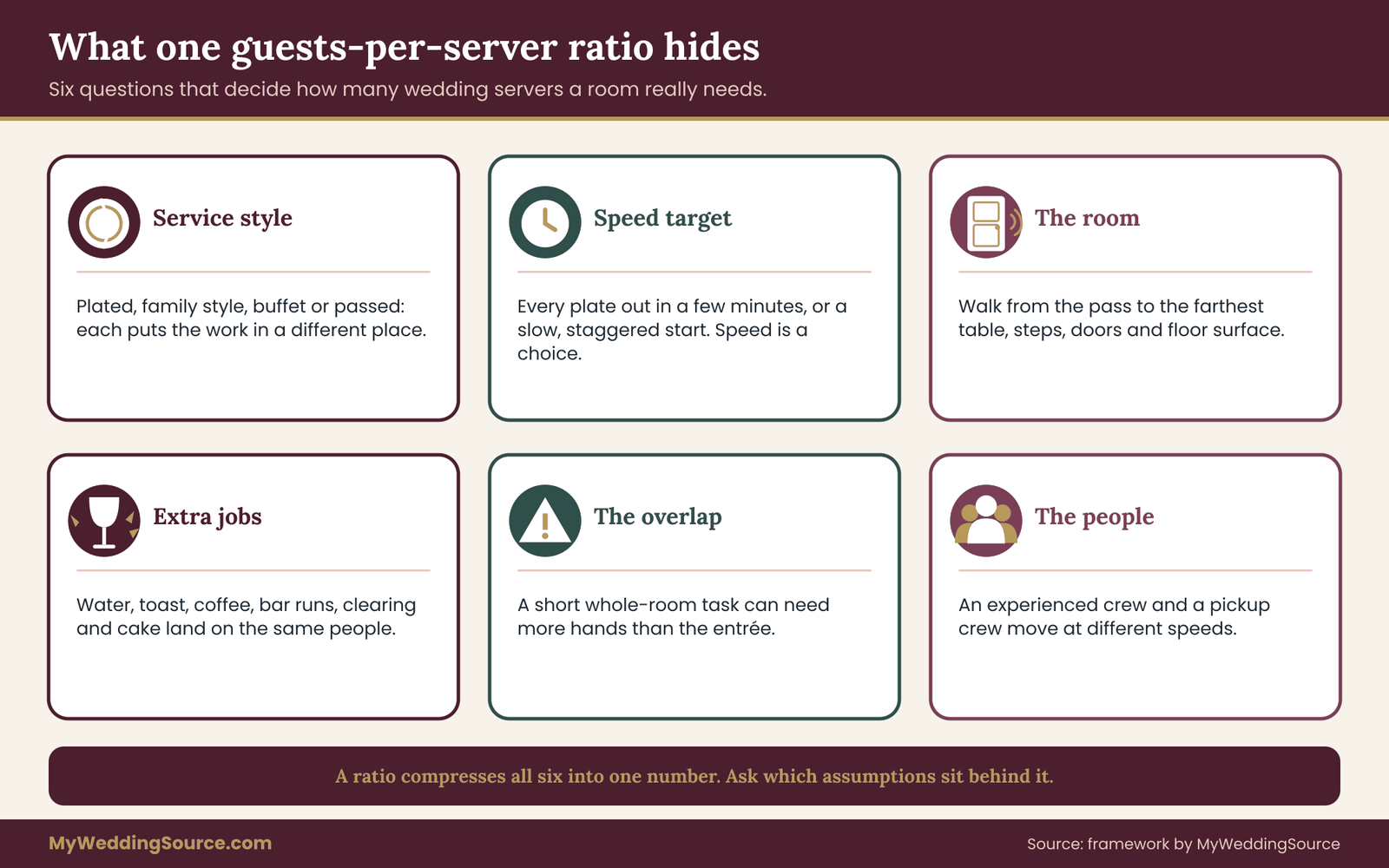
Most published rules of thumb describe a ratio: some number of guests for each server. Ratios are popular because they are easy to say and easy to put in a quote. They are weak because they compress at least six different questions into one number, and they never tell you which of those questions they assumed.
Here is what a single ratio quietly decides for you.
The service style. Carrying two plates to a seated guest is a different job from setting a platter on a table, and both differ from standing behind a buffet pan. The same number of wedding servers can be generous in one style and thin in another. Ratios for wedding servers rarely say which style they assume.
The speed target. Do you want every plate in front of a guest within a few minutes of the first plate, or are you comfortable with a slow, staggered start? Speed is a choice. A ratio does not say which one it protects.
The room. Distance from the kitchen or the warming area to the farthest table, the floor surface, steps, doors, and the width of the paths between chairs all change how long a trip takes.
The extra jobs. Water, coffee, a champagne toast, bar runs, clearing, resetting for dessert, and cake cutting all land on the same people. Some quotes count only the staff who carry food.
The overlap. The peak is rarely where people expect. A short window with a large task, such as pouring a toast for every guest in six minutes, can demand more hands than the whole entrée service.
The people. A team that works together weekly moves differently from a staff assembled from several agencies for one night. Experience changes minutes per task, and that is a number you can ask about.
When a ratio ignores those six items, it is not wrong so much as unreadable. You cannot tell whether it is a floor, a target, or a sales number. A ratio for wedding servers that hides its assumptions is a number you have to take on trust.
What this guide does not do
It does not tell you that a particular number of wedding servers is correct for a particular number of guests. It does not set wages, tips, or break rules. It does not rank caterers or staffing companies. It gives you a way to estimate the work, to see where the estimate is most uncertain, and to turn the uncertain parts into questions with answers a vendor can give you in writing. It also does not claim that a larger team of wedding servers is always better.
It also does not replace the caterer’s experience. A worksheet built from your assumptions is a way to start a conversation, not a way to win one. If your result and the caterer’s number differ, the useful move is to find the assumption that differs.
Who should do the worksheet
The worksheet works best when two people do it separately and then compare. One should be the person who knows the room, usually a coordinator or the venue contact. The other should be someone who knows the guests and the plan, usually one of the couple. If you have no coordinator, a patient friend with a stopwatch app can do the timing steps described later. Wedding servers rarely see the worksheet, so the people planning for them should.
If you are hiring a full-service caterer who provides the servers, you may never run the worksheet on your own. You can still use the questions it produces. A caterer who answers “how long do you expect the entrée pass to take, and how did you get that” is giving you the assumptions behind the ratio, which is the real value.
Where servers sit in the larger staffing picture
Wedding servers are one part of event staffing. Setup crews, coordinators, ushers, bartenders, and breakdown teams all have their own logic, and the wider question of who handles guests, setup, service, and breakdown is a different planning task. This guide stays with the people who carry food and drink to seated or standing guests, and the tasks that go with that work.
When the same person is meant to do two jobs, the worksheet will show it. A server who is also supposed to run the cake cutting, reset the dance floor edge, and refill the water pitchers is one person on three clocks. That is not automatically a mistake, but it should be a decision, not a surprise.
Where the guest count still matters
Guest count is not irrelevant. It sets the number of plates, glasses, and table touches, and it sets the number of seats a server has to reach. It simply does not set the minutes per plate or the length of the window. Two receptions with the same guest count can need very different teams. Guest count shapes the task list for wedding servers, but it does not set the pace.
Treat the guest count as one input among several. In the worksheet it appears as the number of tasks in each window, and the other inputs are minutes per task, window length, and friction. If you change the guest count by ten, the arithmetic updates. If you change the service style, the whole sheet changes.
A useful habit is to write your guest count as a range with a final-count date. Caterers usually need a final guarantee some days before the event, and the worksheet should be re-run once at that point. A small shift in the guest count rarely changes the answer, but a shift in the table layout or the number of entrée choices often does. The reception guest flow guide on this site covers how entry, seating, food, and exit connect, and it is a good companion when you re-run the numbers: see designing wedding reception guest flow. Re-running the sheet at the final count keeps the plan for wedding servers honest.
Three misreadings to avoid
First, “more servers is always safer.” Extra staff cost money, take space, and can crowd a narrow path, which slows everyone. The goal is the number that protects your service target at the peak, not the biggest number.
Second, “fewer servers is a harmless saving.” A thin team shows up as cold food, long waits for drinks, a late toast, and guests who start serving themselves. Those are visible costs even when no invoice line reflects them. A short team of wedding servers shows up in the room, not on the invoice.
Third, “the caterer has done this before, so the number must be right.” Experience helps, and the point of the worksheet is to make the experience visible. If the caterer’s assumptions match your room, you will see it in a few minutes. If they do not, you will see that too, while there is still time to change the plan.
The vocabulary the worksheet uses
A few terms keep the later sections short. None of them are official standards. They are working definitions for this article, so you can use them in a conversation with a vendor without confusion.
Service moment. A stretch of the reception with its own tasks, such as arrival drinks, seating, first course, entrée, clearing, toast, dessert, and late-night service.
Task. One unit of work, such as placing two plates, pouring one table’s water, or clearing one table. Choose a unit you can count and time.
Touch time. The minutes the server spends doing the task itself, at the table or at the pass, without walking.
Trip time. The minutes spent walking out and back for the task. It depends on the room, not on the server’s skill alone.
Window. The number of minutes you want the whole task set to take for all guests.
Friction allowance. A percentage added for the things that make real service slower than the clean estimate, such as crowded paths, a delayed kitchen, or guests who stand up at the wrong moment.
Peak. The service moment where the required number of servers is highest. The peak, not the average, sets your headcount.
Server-minutes. Tasks multiplied by minutes per task. It is the total work, before you divide by the window.
With those eight terms, a quote can be questioned in plain language. “What window did you assume for the entrée, and what trip time?” is a question a catering manager can answer in one sentence. Those terms are what let you talk about wedding servers without arguing about a ratio. ## How service style changes what wedding servers actually do
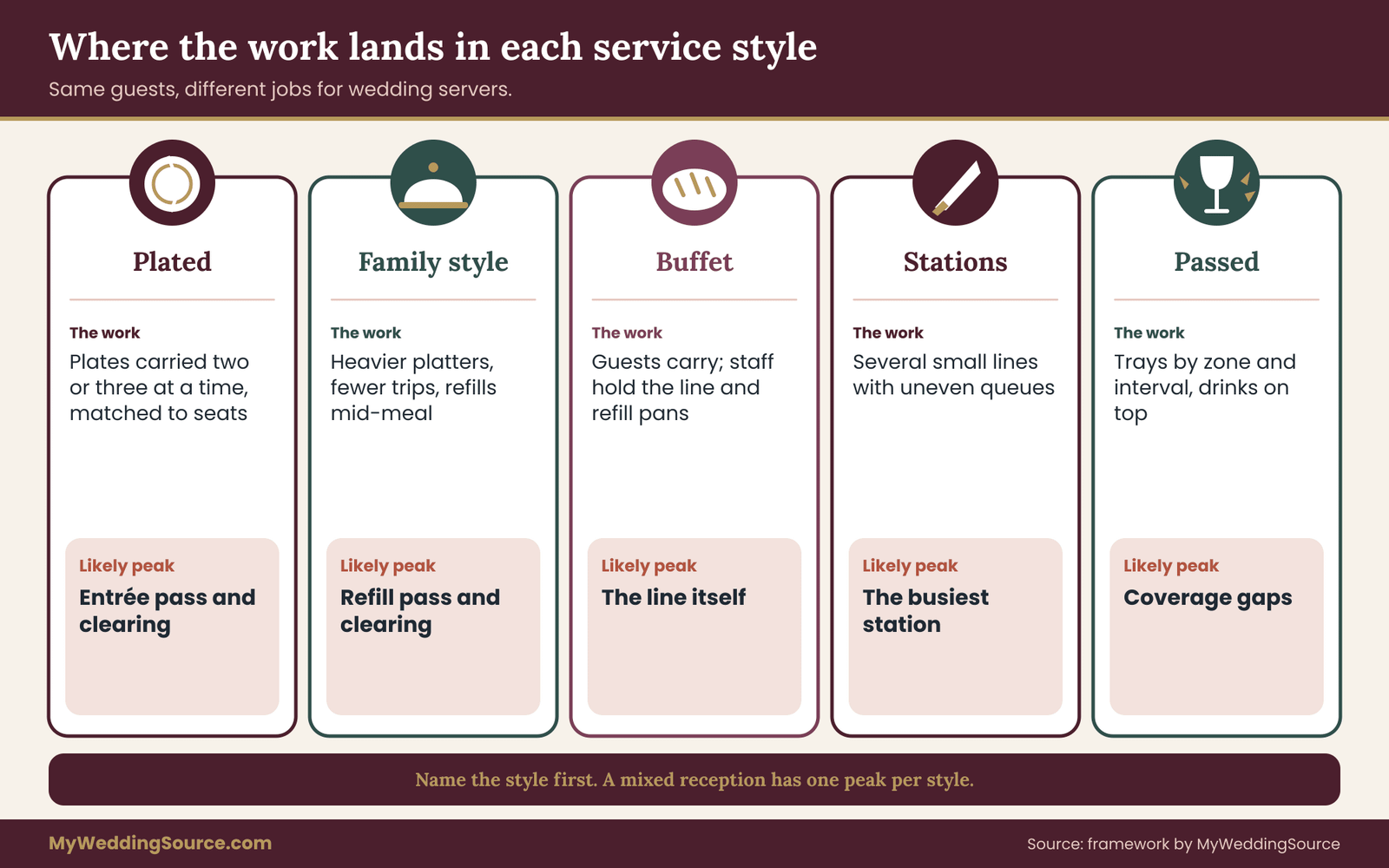
The biggest lever on staffing is not the guest count. It is the way food reaches the guest. Before you count anything, name your style, because each one moves the work to a different place. Wedding servers do very different work in each style.
Plated service
In plated service each guest receives an individual plate at the table. The work is concentrated in a short, high-intensity window: plates leave the kitchen pass together, travel in groups, and arrive at a table so that guests are served close to the same time. Wedding servers in this style carry a fixed number of plates per trip, usually two or three depending on skill, plate weight, and the caterer’s rules, and they need the plates to be matched to the right guest.
Plated service makes the entrée pass the likely peak, and the choice of entrées multiplies the care needed. A single entrée is a fast, simple pass. Three entrée choices mean plate-to-seat matching, which adds touch time and creates a need for a person who checks plates against a seating record before they leave the pass. That person may or may not be counted in a ratio. In plated service, wedding servers also carry the matching risk for every plate.
Plated service also tends to include pre-set courses, bread and butter, water service, and a clearing step with its own window. Each of those is a separate service moment on the worksheet, and a short, sharp one tends to be the clearing step, because guests expect tables to be clear before toasts or the next course.
Family-style service
Family-style service puts shared platters or bowls on each table. The team carries heavier items, but fewer trips are needed per guest, and there is no seat-by-seat matching. The cost moves to the middle of the meal: platters run out, need refilling, and have to be cleared as a set.
Because the first pass is quicker per guest, a worksheet for family style often shows fewer wedding servers at the first peak than plated service for the same room. It also shows a second, quieter work stream, the refill pass, that does not exist in a plated meal. If you save on the first pass and forget the second, the savings disappear. Family style can lower the first peak for wedding servers and raise the second.
Table size matters in this style. A long table with many seats makes the platter walk harder for guests and slower for the team, so the food menu and table layout should be planned together. The menu planning guide covers how dishes work across different guests and dietary needs: building a wedding menu that works across ages and diets.
Buffet service
A buffet shifts most of the carrying from the team to the guests. The key variable is not wedding servers per guest but the throughput of the line: how many guests per minute can take food, and how many serving positions the caterer staffs behind it. If the line is slow, guests wait and the whole timeline stretches. With a buffet, wedding servers spend more time at the line than at the table.
The worksheet for a buffet therefore starts with line capacity, then adds table work: clearing, water, coffee, bar, and replenishing pans. Buffets reduce the pressure of one big carrying window and increase the need for people who watch the line, keep pans full, and keep the area safe and clean. Their server count often shows up as a mix of line staff, runners, and table clearers rather than one group.
Stations
Stations spread the food across several points in the room, such as a carving station, a pasta station, and a salad area. Guests move to the food in smaller groups. The risk is not one long queue but several uneven ones. A popular station can back up while another sits idle.
For stations, treat each one as a small buffet with its own serving position, then add the floor team that clears tables and keeps drinks moving. The caterer should be able to tell you how many servers are assigned to each station and how many are on the floor. If the answer is a single combined number, ask for the split. Ask how many wedding servers stand at each station and how many work the floor.
Cocktail-style and passed service
In a cocktail-style reception, wedding servers carry trays of small bites and drinks to guests who are standing or sitting at lounge seating. Here the work is not tied to a clock window, but to coverage: how often does a tray reach each part of the room, and how long does a guest wait for a drink?
Coverage is hard to estimate with one formula, so the worksheet uses zones. You divide the room into zones, set a target interval for each, and count how many trays it takes to hit that interval. The guest count still matters, but so do the room shape and the number of items on the menu. In passed service, wedding servers are counted by zone and interval, not by plate.
Mixed styles
Many weddings combine styles. A cocktail hour with passed bites and a bar leads into a plated dinner, then dessert stations and late-night snacks. This is the norm, not an edge case, and it is exactly why a single ratio fails. A reception with four service moments in four different styles has four different workloads, and the peak could land in any of them.
For a mixed plan, run the worksheet once per style and compare the peaks. The cocktail-hour specifics are covered in planning a wedding cocktail hour, and you can use that guide to decide how much of the hour should depend on passed items versus stationary food. The number of wedding servers can change at every transition between styles.
Wedding servers and the jobs that sit outside the food
Counting only the people who carry plates is a common way to end up short. Every reception has a layer of work that does not depend on the entrée, and it often falls on the same wedding servers. Wedding servers usually carry the extra jobs below, whether or not the quote says so.
Beverages. Water, wine pours, coffee, tea, and soft drinks. If the bar is a separate vendor, find out whether bartenders also deliver drinks to tables or only hand them across the bar. The bar planning guide covers the bar side of that question: wedding bar service planning.
The toast. Pouring or distributing a drink for every guest within a few minutes is a task that surprises many plans. Section by section, it can demand more hands than the dinner itself, as the worked case later shows.
Cake service. Cutting, plating, and delivering cake or another dessert to every guest is another peak. Who cuts, who plates, and who delivers are three separate tasks, and the production side belongs to the bakery. Here, treat it as a service moment with its own count.
Clearing and resetting. Clearing plates, glassware, and bread dishes, then resetting for the next course. If dancing is about to begin, the team may also have to move tables or chairs, which can be a different crew entirely.
Special requests. Late guests, children’s meals, replacement plates, spilled drinks, and guests who change their entrée. These are small tasks, but in a room of a hundred guests they happen. A friction allowance exists to cover them in the arithmetic.
Setup and breakdown. Not table service, but often scheduled under the same staffing line. Setting tables, folding napkins, polishing glassware, and breaking down at the end are paid hours that belong in the cost, even if they do not matter to the guest experience in the middle of the night.
The captain or lead
Many teams include a lead who directs servers, watches pace, and talks to the kitchen. This person may carry nothing. A ratio that counts only people with trays can overstate the number of hands and understate the cost, or the reverse. Ask whether the quote lists a captain, a manager, or a supervisor, and whether that person is counted in the server number or in addition to it. A lead may or may not appear in the count of wedding servers.
Bussers and runners
Some teams separate the job of bringing plates from the job of clearing and resetting. A busser clears and resets, a runner carries food from the kitchen to a staging point, and a server handles the table. If your caterer works this way, the number of wedding servers on the quote may be smaller than the total floor team. Again, the question is not which structure is better but whether the quote makes the structure visible. Quotes for wedding servers that hide this structure are hard to compare.
What decides the speed of one trip
Trip time is the least visible input and one of the largest. Even a skilled team moves at the speed of the room. Five features of the space decide it. Wedding servers move at the speed of the room, however skilled they are.
Distance from the pass to the farthest table. A long walk adds seconds per trip, and seconds add up across dozens of trips. A venue walkthrough should include the actual path wedding servers will use, not the shortest line on a floor plan. The venue technical walkthrough guide includes measuring routes and checking access: wedding venue technical walkthrough. Ask the venue where wedding servers will actually walk, not where the plan shows a line.
Obstacles on the path. Doors that need to be held, ramps, steps, tight corners, and any place where guests and servers share a narrow aisle.
Floor surface. Grass, gravel, a temporary dance floor, a carpet edge, and polished stone each change how fast and how safely a person can carry a full tray. Wet or uneven ground slows a careful server and should slow the plan.
Table spacing. Chairs pushed back, centerpieces that block the aisle, and tables set so tightly that a server has to turn sideways all add touch time. The seating guide covers layout from the guest’s side: planning a wedding seating chart.
Where the food is plated or staged. If food travels from an off-site kitchen or a separate building, the warming equipment and the staging point decide whether the first plate waits for the last one.
The sections that follow turn these five features into numbers you can use. The numbers will be rough at first. The worksheet is designed so that a rough number is clearly marked as rough, and so that you know which ones to measure before the event. ## The task-time worksheet for wedding servers, step by step
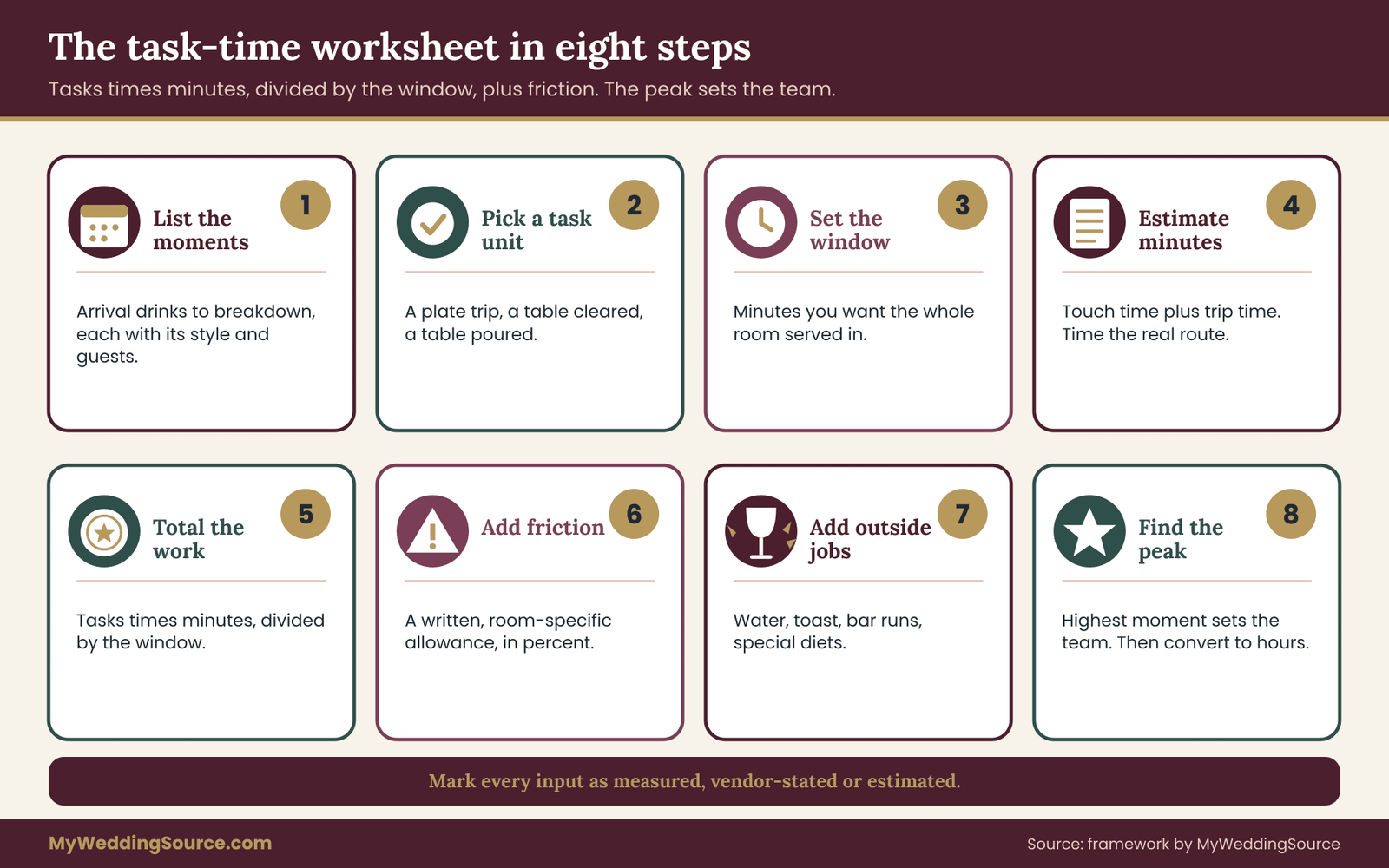
The worksheet has eight steps. Each one produces a number or a decision, and each one can be written on a single sheet of paper or in a simple spreadsheet. The steps are not clever. Their value is that they are explicit, so a mistake shows up where it was made. Each step turns a vague question about wedding servers into a number.
Step one: list the service moments
Write the reception as a list of moments, from the first guest arrival to the last breakdown task. A typical list might include arrival drinks, seating, bread and water, first course, entrée, clearing, toast, cake, coffee, late-night food, and breakdown. Use your own timeline. Include only moments where food or drink is carried, poured, cleared, or replenished by staff.
For each moment, write the start time, the style, and the number of guests it touches. A late-night snack may touch only half the guests, and a toast touches all of them. Do not combine moments that have different peak shapes. A cocktail hour and a plated dinner should be separate lines, even if the same people work both. Note which wedding servers or other vendors are expected to work each moment.
Step two: choose the task unit
For each moment, pick the unit of work you will count. Good units are easy to count and easy to time: a plate placed, a table of water poured, a table cleared, a tray of drinks delivered, a platter replenished. A weak unit is something vague like “serve dinner.”
For plated service, the natural unit is a trip carrying a set number of plates, and the number of trips equals the plates divided by plates per trip. For family style, it is a platter delivered. For clearing, it is a table cleared. For a toast, it is a table poured or a tray distributed. The unit decides how you count, and the count is the first input to the arithmetic.
Step three: set the window
Decide how long you want the task set to take for the whole room. This is a service target, and it is yours to choose with the caterer’s advice. For the entrée, it may be the time between the first plate and the last plate at the tables. For the toast, it may be the time between the first glass handed out and the moment the best man starts speaking.
A shorter window protects food quality and guest patience and requires more people. A longer window is cheaper and gives you a slower, more relaxed room. Neither is wrong. What matters is that the window is written down, because a ratio that does not state the window cannot be tested. Wedding servers are the only variable that moves when the window changes.
Step four: estimate minutes per task
For each unit, estimate touch time and trip time, then add them. Touch time is what happens at the pass and at the table. Trip time is the walk out and back. If you have no measurement yet, use a rough estimate and mark it with a question mark so you remember to replace it.
The best way to replace an estimate is to time it. Ask the venue or caterer if a trained person can carry two empty plates from the pass to the farthest table and back, with a stopwatch running, during the walkthrough. Do it three times and use the average. The result will include the real floor, the real doors, and the real distance. It will not include a crowd, which is why the friction allowance exists. A trained person, not a guest, should carry the plates, since wedding servers are the ones who will do it.
Step five: compute the server-minutes and the headcount
Multiply the number of tasks by the minutes per task. That is the server-minutes for the moment. Divide by the window in minutes, and you have the number of servers needed if everything goes perfectly. This is the clean number.
For example, a moment that needs two hundred server-minutes in a window of twenty minutes needs ten servers working continuously with no friction. Rounding at this stage can mislead, so keep one decimal place until the end.
Step six: add the friction allowance
Real service is slower than the clean number. Paths are crowded, a plate is wrong, a guest asks a question, the kitchen releases food in uneven waves. Add a friction allowance as a percentage, applied to the server-minutes before you divide by the window.
This is where “no universal ratios” matters most. The allowance has to be set for your room and your team. A clear, short path with an experienced team may deserve a small allowance. A crowded room, an unfamiliar team, a ramp, or a delayed kitchen deserves more. Choose a number, write the reason beside it, and treat it as an assumption to review, not a fact.
A reasonable way to set the allowance is to list the friction sources in your room and give each a small, labeled amount. If you cannot justify an item, leave it out. If a vendor says they have a standard allowance, ask what it covers. Friction is a judgment about wedding servers in your room, not a property of the guest list.
Step seven: add the work outside the main task
Return to the list of non-food jobs: water, coffee, bar runs, special-diet plates, replacement requests, and so on. For each moment, add the server-minutes those jobs consume in the same window. A moment that looked light on its own may become the peak once the extra jobs overlap with it.
If a task belongs to another vendor, such as a bartender who delivers drinks, remove it from the server tally but write the assumption. If it is meant to be shared, note the split. The goal is a sheet where every job has an owner, even if that owner is another vendor. Write down which jobs wedding servers are not expected to do.
Step eight: find the peak and convert to people and hours
Look at the headcount for each moment. The highest number is the peak, and it sets the minimum floor team for the event. Then ask whether the team has to be the same size all night. A team can often be staggered: more people for the entrée and toast, fewer for the long, quiet stretch of dancing.
Then convert to paid hours. Wedding servers are not paid only for the minutes the guests see. Setup, a pre-service briefing, a meal, breakdown, and any minimum shift length all matter. Do not guess the rates. Ask the caterer to put the staff count, the shift start and end, and any minimum or overtime terms in the written quote. The contract guide on this site covers what to look for in the wording: wedding vendor contracts. Wedding servers are paid for setup and breakdown as well as the hours guests see.
A short explanation of why the peak, not the average, decides
It is tempting to average the workload across the evening and conclude that a modest team can handle it. That arithmetic is wrong for a simple reason. Guests do not experience the average. They experience the entrée pass, and the toast, and the moment when everyone wants coffee. Wedding servers cannot spread their work evenly across a night that is full of peaks.
A team that is comfortable at the average and overwhelmed at the peak produces exactly the failures guests remember: lukewarm plates, empty glasses at the toast, and a long wait for coffee. The remaining hours of the evening may be slow and the team may look overstaffed, but that is the price of a short, sharp peak.
There are three honest responses to a peak that is more expensive than you want.
Move the peak. Change the task so the window gets longer or the task gets smaller. Pre-pour toast drinks and place them on a tray at the pass. Put the dessert on the table rather than plating it to order. Start the entrée in two waves.
Stagger the team. Schedule a short, higher-staffed shift for the peak and a smaller team for the rest. This is cheaper than a full team all night, but only if the staffing company will schedule it that way and the contract allows split shifts. Wedding servers can sometimes be scheduled in two shifts, if the contract allows it.
Accept a slower service. Choose a longer window on purpose, tell guests what to expect, and let the room relax. A slow entrée pass in a lively room can be fine, as long as the food stays at temperature and the plan accounts for it.
Why the peak can hide in a short moment
The toast is the classic example. It is brief, it affects everyone, and it often appears on the timeline as a single line item with no staffing note. A plate pass for a hundred guests is visibly large, and everyone plans for it. A toast pour for the same hundred guests is invisible until it happens. Wedding servers are often assigned to the toast without anyone counting the minutes.
Check every short, whole-room moment this way: toast, cake, a welcome drink handed to guests at the door, a sparkler or send-off item, a coffee round. Each one has a task count equal to the guests, and a window that may be a few minutes. If the window is short and the minutes per task are not small, the peak may be right there.
Getting honest minutes per task
The worksheet is only as good as its minutes. Estimates from memory are the weakest input, and they tend to be optimistic because people remember the smooth parts of service. Here are practical ways to get better numbers without inventing data. Memory flatters the work of wedding servers, because smooth moments are easier to recall.
Time the route during the walkthrough
During the venue walkthrough, walk the real path from the pass or staging area to the nearest table, a middle table, and the farthest table. Time the walk at a normal, careful pace, then time the return. Note any obstacles. If a loaded tray is involved, ask a team member to carry a realistic weight over the same path.
Record the numbers on the worksheet next to the table distances. If the venue does not allow a trial, use the floor plan and a measuring tape, then ask the caterer for their own timing of a similar path.
Ask the caterer for their assumptions, not their verdict
A caterer who says “we staff this style with this many people” has given you a verdict. A caterer who says “we assume this many plates per trip, this window, and this walking time” has given you assumptions you can check. Ask for the second. Many catering managers can give it in one email, and the way they respond tells you something about how closely they have studied your room.
Useful questions include how many plates each server carries per trip, how long the team expects the entrée pass to take from first plate to last, whether the kitchen releases plates in waves, how the team handles special-diet plates, and who runs the toast pour. Write the answers on the worksheet beside your own estimates. Each answer tells you what wedding servers will really be doing.
Use a pilot table if the tasting allows it
Some tastings include a plated course served at a table. If the team will do it, ask them to serve a single table of guests while you time the plate pass from pass to seat. You are not testing the kitchen. You are testing touch time and trip time. A tasting is also a chance to see how the team handles matching a plate to a person.
Mark every number with its source
Next to each input, write where it came from: measured, vendor-stated, or estimated. At the end of the exercise, count how many of your inputs are still estimates. If the peak moment depends mostly on estimates, you know where to spend your effort before the final headcount date. ## A worked case: one reception, four moments, and a surprise
The case below is invented for illustration. It is not a record of a real event, and the numbers are assumptions chosen to be easy to follow. Replace every one of them with your own measured or vendor-stated figures. The point is to see the method run from start to finish, including the step where the answer changes. The question it answers is how many wedding servers this one room needs.
The setup
A reception for one hundred twenty guests at twelve round tables of ten. Dinner is plated with three entrée choices. The kitchen pass is at one end of the room. The team will serve a pre-set salad, the entrée, a sparkling-wine toast, and a wedding cake that staff cut and plate. The couple wants entrées out in a tight window so food stays hot, and they want the toast to start soon after the plates are cleared.
During the walkthrough, a coordinator timed an empty two-plate carry. The round trip to the nearest table took about forty seconds, to a middle table about seventy, and to the farthest about one hundred. The average is seventy seconds, or roughly 1.17 minutes of trip time. Loading at the pass takes about twenty seconds, and placing two plates with a quick check takes about thirty. Touch time is therefore about 0.83 minutes, and one two-plate trip costs two minutes.
Moment one: the entrée pass
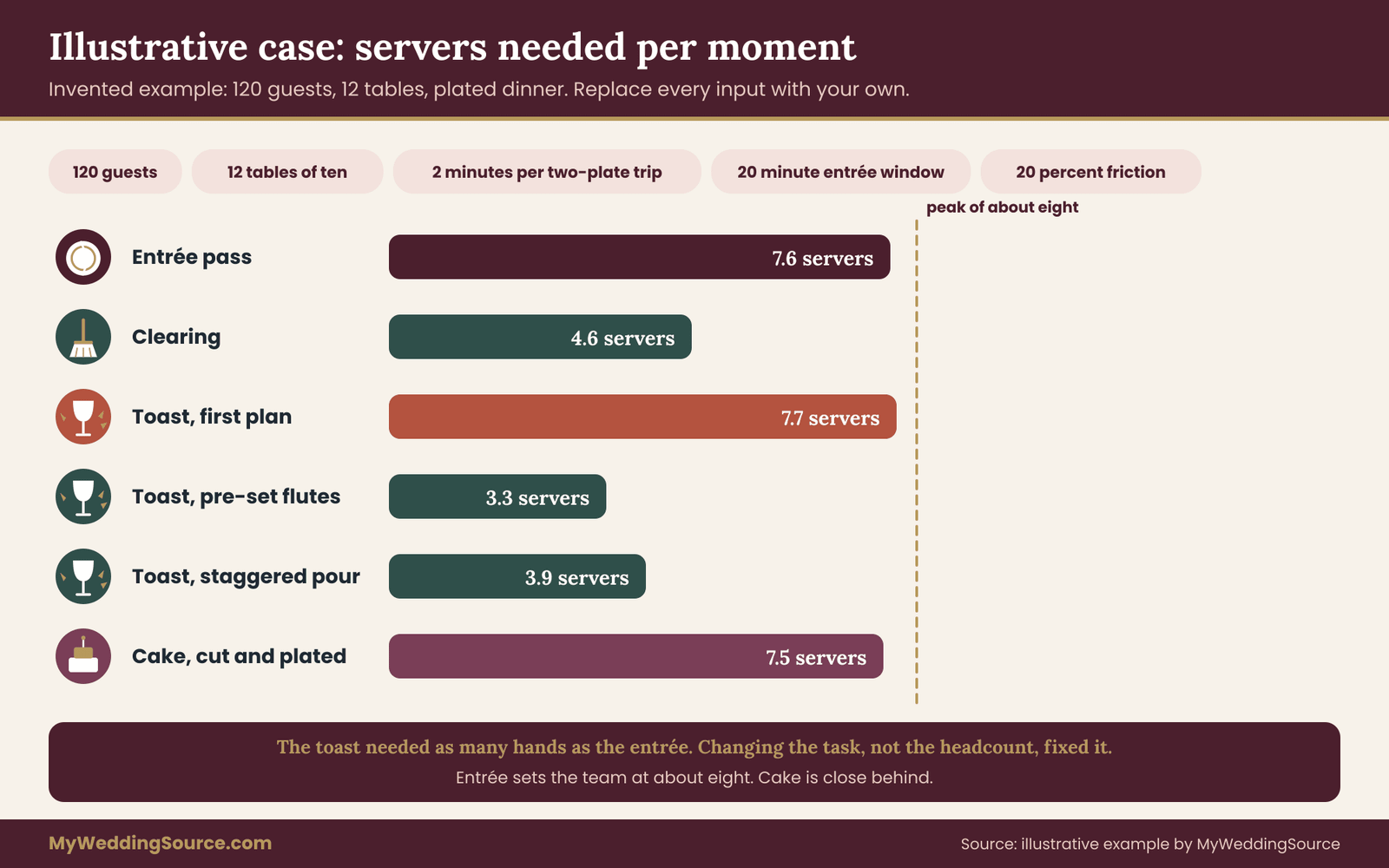
The tasks are sixty two-plate trips for one hundred twenty plates. Sixty trips at two minutes is one hundred twenty server-minutes. The team also expects about six extra small tasks, such as a replacement plate or a special-diet check, at roughly one minute each. That brings the total to one hundred twenty-six.
The couple’s window is twenty minutes from the first plate to the last. The friction allowance is twenty percent, chosen because the room has a step-up at one door and three entrée choices need matching. So one hundred twenty-six times 1.2 is about 151 server-minutes. Divide by twenty minutes and the entrée needs about 7.6 servers working continuously. Rounded up, that is eight. So the entrée alone sets the headcount of wedding servers at about eight.
If you divide one hundred twenty guests by eight servers, you get fifteen guests per server. But notice that the fifteen is an output of the worksheet, not an input. A different room or a different window would give a different figure, and the worksheet would show why.
Moment two: clearing
Twelve tables must be cleared. A table of ten takes about three minutes of touch time plus about one minute carrying a stack to the cart, four minutes in all. Twelve tables at four minutes is forty-eight server-minutes. The allowance is fifteen percent, because guests are still lingering at some tables, which is 55.2. The window is twelve minutes, so clearing needs about 4.6 servers. The same eight people can do this, with three free for water and coffee.
Moment three: the toast
Here is the surprise. The team plans to hand a filled flute to each guest. The unit is a table of ten: load a tray at the pass, walk to the table, and distribute. Loading takes about half a minute, the average walk is about 1.2 minutes, and handing out ten glasses takes about two minutes, so one table costs roughly 3.7 minutes. To keep the arithmetic simple, call it 3.5 minutes. Twelve tables is forty-two server-minutes.
The window is short, because the host wants the toast to begin six minutes after clearing ends. With a ten percent allowance, 42 times 1.1 is 46.2. Divided by six, the toast needs about 7.7 servers. That is as many hands as the entrée pass, for six minutes of work.
If the planning had stopped at the entrée, the toast would have caught the team short. A thin team at the toast looks like this: half the room has no glass when the best man stands, and the speech begins with guests waiting. The toast would have needed as many wedding servers as the entrée, for a fraction of the time.
Fixing the toast without adding people
There are two honest fixes. The first is to change the task. Set empty flutes at each place before dinner, and have the bar team pour from bottles at the table. Touch time falls to about 1.5 minutes per table. Twelve tables is eighteen server-minutes, plus ten percent is 19.8, and over six minutes that is 3.3 servers.
The second is to change the window. Start pouring for tables that are already cleared, so the toast window stretches from six to twelve minutes. At the original task size, 46.2 over twelve minutes is about 3.9 servers.
Either choice brings the toast well under the entrée peak. The decision is the couple’s: pre-set flutes change the look of the table and add a glass to clear, and a staggered pour means some guests hold a glass before others. Neither is better in the abstract. The worksheet only shows that the toast needed a decision. Neither change added a single one of the wedding servers.
Moment four: the cake
Staff will cut and plate. A plating pair at the cake table can do a slice in about fifteen seconds each, so one person needs 120 times 0.25, or thirty minutes, to plate everything. Two platers take about fifteen. Delivery is three plates per trip at about 2.4 minutes per trip. Forty trips is ninety-six server-minutes, and a fifteen percent allowance makes about 110. Over a twenty-minute window, delivery needs about 5.5 servers, and the two platers add up to about 7.5 hands total.
That is close to the entrée peak. If the couple shortens the cake window to ten minutes, the number doubles. The worksheet makes the trade visible: a quick cake service is expensive at the table, and a slow one is cheap but keeps the room waiting. The cake can therefore set the headcount of wedding servers as firmly as dinner.
Reading the result
The peak across the four moments is about eight servers, set by the entrée, with the toast and cake close behind. That is the floor team the caterer needs at its busiest. The quote can now be tested. If the caterer proposes six servers, the next question is which assumption differs: window, plates per trip, friction, or something about the kitchen. Eight wedding servers at the peak is the answer to this room, not a rule for others.
Sensitivity: how much do the assumptions matter
A worksheet is only useful if you know which assumptions move the answer. Take the entrée pass and change one input at a time.
Window. At twenty minutes the answer is 7.6. At twenty-five minutes it is about 6.0, which would require seven servers because six is just short. Five more minutes for the last table to be served saves one person. That is a real trade: a longer wait for some guests against a smaller team. A longer window directly reduces the number of wedding servers.
Friction. At twenty percent it is 7.6. At thirty percent, 126 times 1.3 is 163.8, over twenty minutes is 8.2, and the team needs nine. A single judgment call, ten percentage points, costs one person. This is why the friction allowance should have a written reason.
Plates per trip. Suppose experienced servers carry three plates per trip, with about 1.17 minutes of touch time and the same trip time, which is 2.33 minutes. Forty trips is 93 server-minutes, plus six is 99, times 1.2 is about 119, over twenty minutes is about 6.0. That is six servers instead of eight, a large change that depends on a skill and a house rule. Some teams do not carry three plates. Ask. The skill of wedding servers can change the answer by two people.
Entrée choices. With a single entrée, the matching task disappears and the allowance may fall. With three choices and several special diets, it may rise. This is one reason a menu change late in planning can change a staffing quote.
Walking distance. If the farthest table were twice as far, the average trip time would rise. Adding thirty seconds to trip time raises each trip to 2.5 minutes, so 60 trips become 150 server-minutes, and the entrée needs about 9.4 servers, so ten. The room layout is a staffing decision. A longer path is paid for in wedding servers.
What the sensitivity tells you
No single input is the villain. The result moves most with window, friction, and plates per trip, and those are the three things to ask the caterer about. The guest count itself, within a range of ten or so, barely changes the answer. That runs against what the ratio suggests, and it is a good reason to stop leading with a ratio. It also tells you which questions about wedding servers are worth asking first.
From server-minutes to people and paid hours
The peak says how many people are needed at the busiest moment. It does not say how many are needed all evening, and it does not say what they will be paid for. Wedding servers are not all needed for the same hours.
Continue the case. Cocktail hour, seating, and the salad need fewer people. Suppose the sheet shows that four servers can cover those moments. The entrée, clearing, toast, and cake need eight. The dancing, with a bar and some late-night food, needs three or four.
An illustrative schedule: four servers arrive for setup and cocktail hour and stay seven hours. Four more arrive an hour before dinner and stay four and a half hours. The total is about 28 plus 18, which is 46 server-hours, against 56 if all eight worked the full seven. The difference is real, but it depends on the staffing company offering staggered shifts and on any minimum shift length in the contract. Write the shift times and minimums into the quote, and do not assume.
For the written agreement itself, the vendor contract guide on this site covers what to confirm before signing: what a wedding vendor contract should state.
What the case does not prove
It does not prove that eight is the right answer for one hundred twenty guests. It proves that, given these assumptions, the entrée needs about eight, and that the toast and cake are close behind. A different room, menu, or window would give a different answer. The worksheet is a way to ask better questions, not a table of answers. Another room would need a different number of wedding servers. ## The same room in family style: where the peak moves
A good test of the worksheet is to change one thing and see whether the answer moves the way you would expect. Keep the same room, the same one hundred twenty guests, and the same two-minute handling assumptions from the worked case. Change only the style from plated to family style, and see what happens to wedding servers across the evening. The test is how the number of wedding servers responds.
Assume four platters per table: two entrée platters, a vegetable, and a starch. Twelve tables means forty-eight platters. The team carries two platters per trip. Touch time is longer per trip, about one minute, because platters are heavier and the server often names the dish. Trip time stays at 1.17 minutes, so one trip costs about 2.17 minutes. Twenty-four trips is about 52 server-minutes.
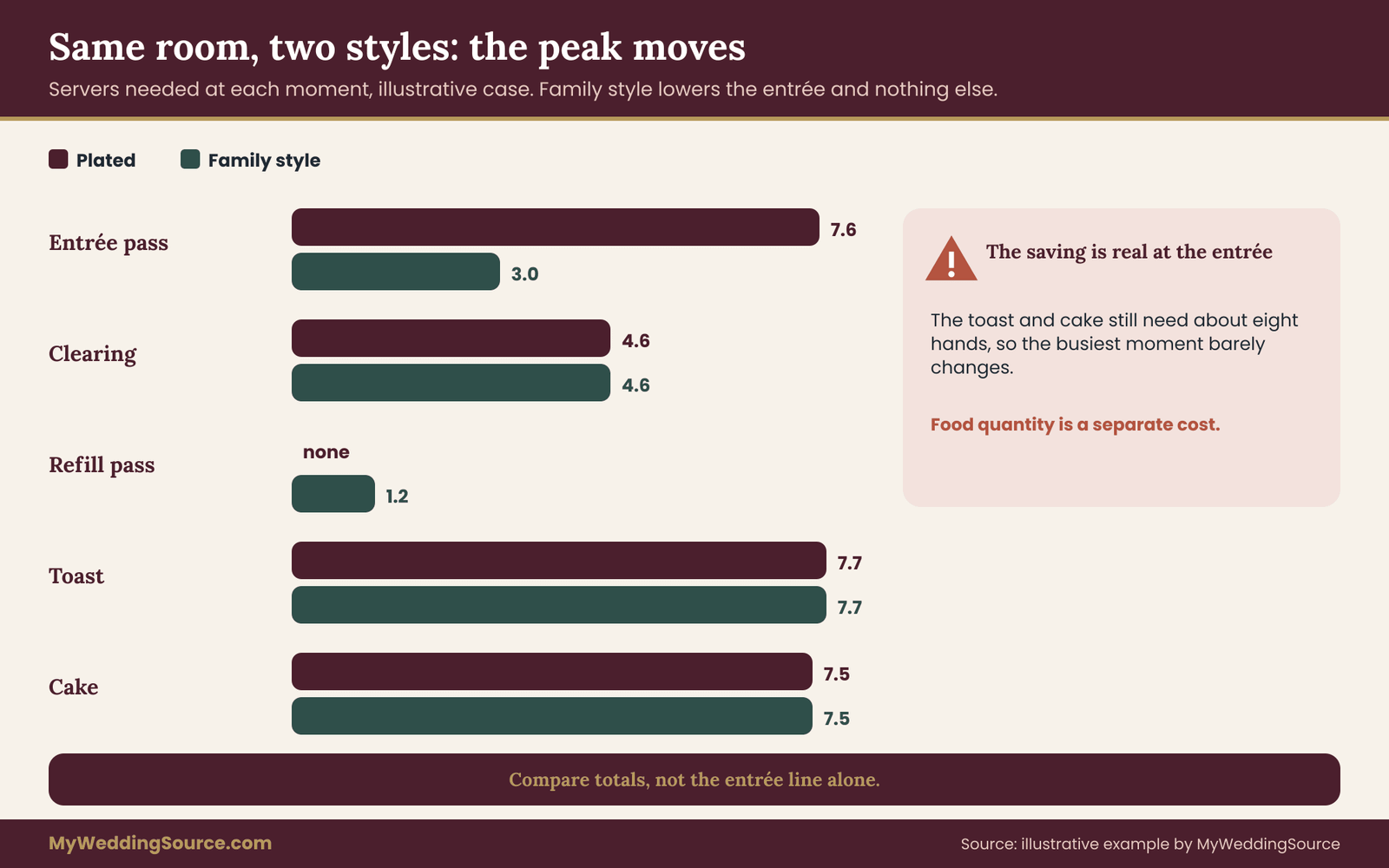
Use a twenty-minute window and a fifteen percent allowance. Fifty-two times 1.15 is about 60, and divided by twenty it is 3.0. The entrée pass that needed eight servers in the plated version needs about three in the family-style version.
What the savings hide
Do not stop there. Family style creates work that plated service does not. Wedding servers in family style face a different mix of tasks.
The refill pass. If tables run out of one platter, the team brings more. Suppose half the tables want a second entrée platter and a second starch: twenty-four more platters, twelve trips. The kitchen may be slower to refill than it was to plate the first time, so call a refill trip 2.2 minutes. That is about 26 server-minutes, and over a twenty-five-minute mid-meal window with the same allowance it needs about 1.2 servers.
Clearing a heavier table. Platters, serving utensils, plates, and extra glassware make clearing slower. If a table now takes five minutes instead of four, twelve tables is sixty server-minutes, about 69 with the allowance, and over a fifteen-minute window it needs about 4.6 servers.
The same toast and the same cake. Those moments did not change, so the toast and cake peaks from the worked case remain, near eight.
The result: the peak moves from the entrée to the toast and cake, and the overall floor team is about the same size at the busiest moment. The saving is real at the entrée and invisible at the peak. If you want a smaller team, you have to change the toast and cake plans too. Family style may still be the right choice for the atmosphere or the menu. It is just not an automatic way to buy fewer servers. So the team of wedding servers is about the same size at the busiest moment.
Food quantity is a separate cost
Family style often needs more food on the table so no platter looks empty, and that is a catering cost, not a staffing one. The worksheet only counts people. If a family-style quote has lower staffing and higher food cost, compare the totals, and read the menu planning discussion on this site for how portions work across a mixed group.
Buffets, stations, and zones: counting without a plate
When food is not carried to each guest, the worksheet counts something else. The unit changes from a plate to a position or a zone, and the window is often longer. The number of wedding servers then follows positions and zones.
A buffet is a throughput question
For a buffet, the number that matters is how many guests per minute can pass through the line and how long the first and last tables wait. The staff question is how many serving positions are behind the line, how many people replenish, and how many clear tables.
Do not guess the throughput. At a tasting or a walkthrough, time five people moving through the line the way guests will, with plates, and record how long each takes. Divide the guests by the number of line sides to see how many wait. If the average guest takes four minutes and there are two double-sided lines, you can compute the release schedule: groups of tables are invited to the line in an order that keeps every side busy.
Then count the positions. A line where every item is dished by a staff member needs many more people than a line where guests serve themselves and an attendant refills and tidies. That is a design decision with a clear staffing effect, and it deserves a deliberate choice, not a default. Wedding servers behind a served line are a much larger group than attendants at a self-serve line.
Stations are several small buffets
Treat each station as its own line with its own throughput and staff. The most useful question is the split between station staff and floor staff. A quote that lists one combined number for a station dinner hides the question of who clears tables while the stations are busy. Wedding servers at stations should be counted station by station.
At stations, the unevenness of demand is the main risk. A carving station often draws a queue when a pasta station does not. Plan a flex person who can move to the busiest station, and ask whether the caterer includes one.
Zones for cocktail-style service
For a passed reception, divide the room into zones that one server can cover, and decide how often a tray should reach each zone. A zone with sixty guests that should see a tray every four minutes needs a tray trip about fifteen times an hour from a fixed point. The trip time and the staging distance decide how many servers that takes.
Then count drinks separately. If a bar handles all drinks, the zone servers carry only food. If drinks are carried, the zone count rises. Because passed service has no fixed window, the zone interval is the target you write on the worksheet, in place of the window. Count how many wedding servers carry drinks and how many only carry food.
A common mistake in passed service is to count only the trays in the room and forget the loading time at the pass. A server who spends half the time in the kitchen is not in the room. Include the return trip and the reload in the minutes per task.
The kitchen bottleneck: when more wedding servers do not help
Every plan so far assumed that the kitchen can release plates as fast as the team can carry them. That is not always true, and it is one of the most useful failure conditions to check.
A pass has a maximum release rate. If the kitchen can only finish a certain number of plates per minute, then the entrée window cannot be shorter than the number of plates divided by that rate, no matter how many wedding servers are waiting. Extra staff in that case stand and wait, or worse, crowd the pass. Wedding servers cannot work faster than the kitchen feeds them.
Ask the caterer three questions. How many plates per minute can the pass release? Does the kitchen fire all entrées at once or in waves by table? Where do plates sit while they wait, and for how long? The answers tell you whether the window in your worksheet is realistic. A window shorter than the pass allows is a number on paper.
Off-site and remote kitchens
When food travels from a commissary, a food truck, or a tent kitchen, the release pattern changes. Plates may be assembled in a staging area with limited counter space, and there may be a long distance from staging to the first table. Add the staging walk to the trip time, and ask who does the plating. A remote kitchen can cap the window as strictly as a small pass.
The expeditor
Many teams have an expeditor, a person who checks plates, calls the pace, and keeps the pass moving. This role is easy to overlook because the person carries nothing. For a plated meal with several entrées, an expeditor is part of the throughput, so ask whether the quote includes one and whether that person is counted among the wedding servers. Ask whether the expeditor is counted among the wedding servers.
Edge cases: small, large, outdoor, and long
The worksheet scales to unusual events, but a few cases deserve their own notes.
A small wedding. With thirty or forty guests, the arithmetic may show less than two servers at the peak. Round up with care. A team of two is fragile: one illness or one delay halves the capacity. Many small receptions are better served by simplifying the style, for example family style or a single plated entrée, than by hunting for the exact minimum. For a small wedding, wedding servers are easy to undercount and hard to replace.
A large wedding. At several hundred guests, the room size dominates. Trip times grow, and the window may stretch even with many servers. Consider splitting the room into service sections, each with its own pass or staging area, so the trip time stays low. Large rooms often need sections of wedding servers, each with its own staging.
Outdoor receptions. Grass, gravel, wind, heat, and distance from the kitchen tent all slow a trip. Add the real surface to the trip time and consider covered staging. A server walking on soft ground with two full plates is slower than the same server on a hard floor, and safer when slower. Wedding servers outdoors need covered staging and a realistic walking time.
Multi-level venues. A reception that moves guests across floors needs a plan for the stairs or the elevator. A shared freight elevator is a shared resource, and a team waiting for it is a team not serving.
Accessible service. Guests with mobility needs may need plates delivered to a seat that is not on the main path, or a table moved for a wheelchair. These are small tasks, and they belong in the friction allowance or on a line of their own. They also belong in the seating plan from the start.
Long evenings. If service runs for many hours, plan for staff meals and breaks. A team that has no scheduled meal will take one at a moment of its own choosing, and that moment may be inconvenient. The worksheet cannot decide break rules, which depend on state law and employer policy, but it can show when the lowest-demand windows are. Wedding servers on a long evening need scheduled meals.
A rule for choosing among these cases
When in doubt, run the worksheet for the busiest style in your plan and then ask whether a simpler style would produce a lower peak at an acceptable cost to the atmosphere. The cheapest peak is the one you design away, and the most expensive is the one you discover during the toast. ## Questions to ask about wedding servers on a quote
Once you have a worksheet result, the quote becomes a document you can read for assumptions. A quote usually lists a staff count, a shift length, and sometimes a rate. Your goal is to find out what sits behind the count. The quote tells you how many wedding servers the caterer plans, not why.
Start with what the number includes
Ask the caterer or staffing company, in writing, to state what the staff line includes. Who is counted among the wedding servers: servers only, or also captains, bussers, runners, bartenders, and an expeditor? Are setup, breakdown, and a pre-service briefing included in the hours? Is a lead or manager listed separately?
A short message works well, and every reply about wedding servers should come back in writing:
“Thank you for the quote. To compare it with our own timing worksheet, could you tell us how many of the listed staff carry food or drinks to guests, how many plates each carries per trip, and what window you plan for the entrée from first plate to last?”
The reply tells you whether the caterer’s number and yours are using the same definitions. Many apparent gaps vanish once a bartender or an expeditor is placed in the right column.
Then compare assumptions, not totals
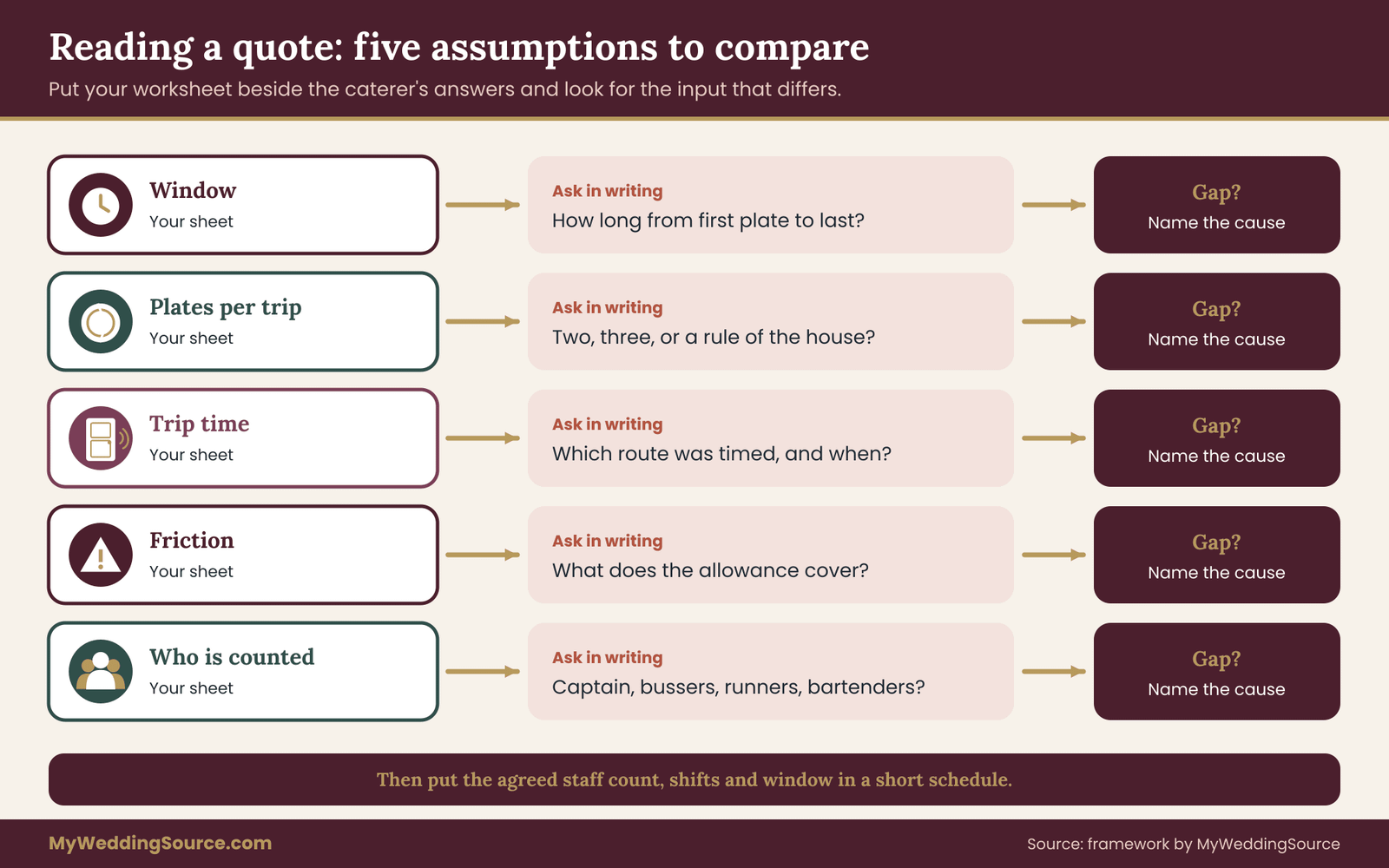
Put your worksheet beside the caterer’s answers and look at five inputs: the window, plates per trip, trip time, friction, and the non-food jobs. Where they match, the numbers will match. Where they differ, you have a specific question: why does the caterer assume a longer window, or a higher allowance, or three plates per trip?
If the caterer’s team is smaller than your worksheet and the explanation is credible, such as a trained team that carries three plates and a kitchen that releases in waves, your worksheet may be too cautious. If the explanation is vague, ask for the assumption in writing, or consider asking for a trial service at the tasting.
If the number is higher than yours
A quote with more staff than your worksheet suggests is not automatically padded. The caterer may know of a constraint you do not, such as a slow service elevator or a venue rule that requires an additional person. Ask what drove the number. Then check whether any of the extra people could be staggered, so they work only the peak. More wedding servers than your sheet suggests may be a real response to a constraint.
Ask about substitution and no-shows
What happens if a team member does not arrive? Does the company hold a backup, and how quickly can it send one? A team that is one person short at the entrée is far more exposed than the average suggests. The purchase order guide on this site shows how to document the scope and the acceptance steps for a vendor’s work: wedding vendor purchase orders. A late or missing pair of wedding servers changes the peak more than the average.
Put the agreed assumptions in the contract
You do not need a long document. A short schedule attached to the contract can state the staff count, the shift times, the service style, and the entrée window the caterer is planning for. If the window slips because of the kitchen, the schedule shows whose assumption failed. If the day goes well, the schedule is never needed.
Labor and compliance questions that sit beside the worksheet
This section lists questions, not conclusions. Labor rules for event staff depend on the state, the employer, and the facts, and they change. The U.S. Department of Labor Wage and Hour Division is the federal reference, and your state labor department may add stricter rules. Treat the points below as prompts for the vendor, not as legal advice.
Who employs the servers? The caterer, a staffing agency, the venue, or the servers as independent contractors. The answer affects who is responsible for wages, insurance, and supervision. Ask the vendor to say who employs the team, and ask for proof of the insurance they carry. Ask the vendor to name the employer of the wedding servers.
How are wages and overtime handled? A long event with setup and breakdown can cross overtime thresholds for some workers. Ask whether the quote includes any overtime assumptions and what happens if the event runs late. The federal minimum wage and overtime rules are on the Department of Labor website, and some states set higher floors.
What about tips and service charges? A service charge and a tip are not the same thing, and the way each is handled can differ in pay and in tax treatment. Ask the caterer how any charge on the quote is distributed, and whether a gratuity is optional or included. The Department of Labor and the IRS both publish guidance on tipped employees and on reporting. The service charge and gratuity discussion on this site covers the guest-facing side.
What do the servers need to hold? Some places require food handler cards, and many require alcohol-service certification for people who pour. Rules vary by state and by county. Ask the caterer to confirm what the local health department or alcohol authority requires for the event. Certification rules for wedding servers who pour alcohol differ by place.
How are breaks handled? The worksheet shows low-demand windows, but it does not set break rules. Ask the caterer how meals and rest periods are scheduled, because a break in the wrong place can reduce the floor team at the peak.
Are there child-labor limits? If a family member under eighteen wants to help serve, rules about hours and tasks apply. Many couples assume a teenage cousin can carry trays and pour. Check the federal and state rules before accepting a volunteer who is a minor.
If you are hiring servers directly
Some couples hire servers directly, for example for a backyard event. That makes the couple an employer or a client of a contractor, depending on the facts, and the rules above start to apply to you. The IRS has guidance on how to tell an employee from an independent contractor. If you are in that position, speak with a qualified professional in your state before the event, and consider hiring through a licensed catering or staffing company instead. Hiring wedding servers directly changes who carries the legal responsibility.
Volunteers and friends
Friends who offer to serve are generous, and a volunteer team can work for a small, informal gathering. The worksheet applies to volunteers as well, with one change: the friction allowance should be higher, because volunteers are not trained and are usually also guests. If you rely on volunteers, name a lead, set a short briefing, and give them a fixed window of duty, so they can still attend the toast. Friends are not a free supply of wedding servers, since they are also guests.
When wedding servers’ numbers fail: conditions to check
A worksheet can mislead, and a ratio can mislead more. These are the situations where a staffing plan most often breaks, with the signal to look for and the first response.
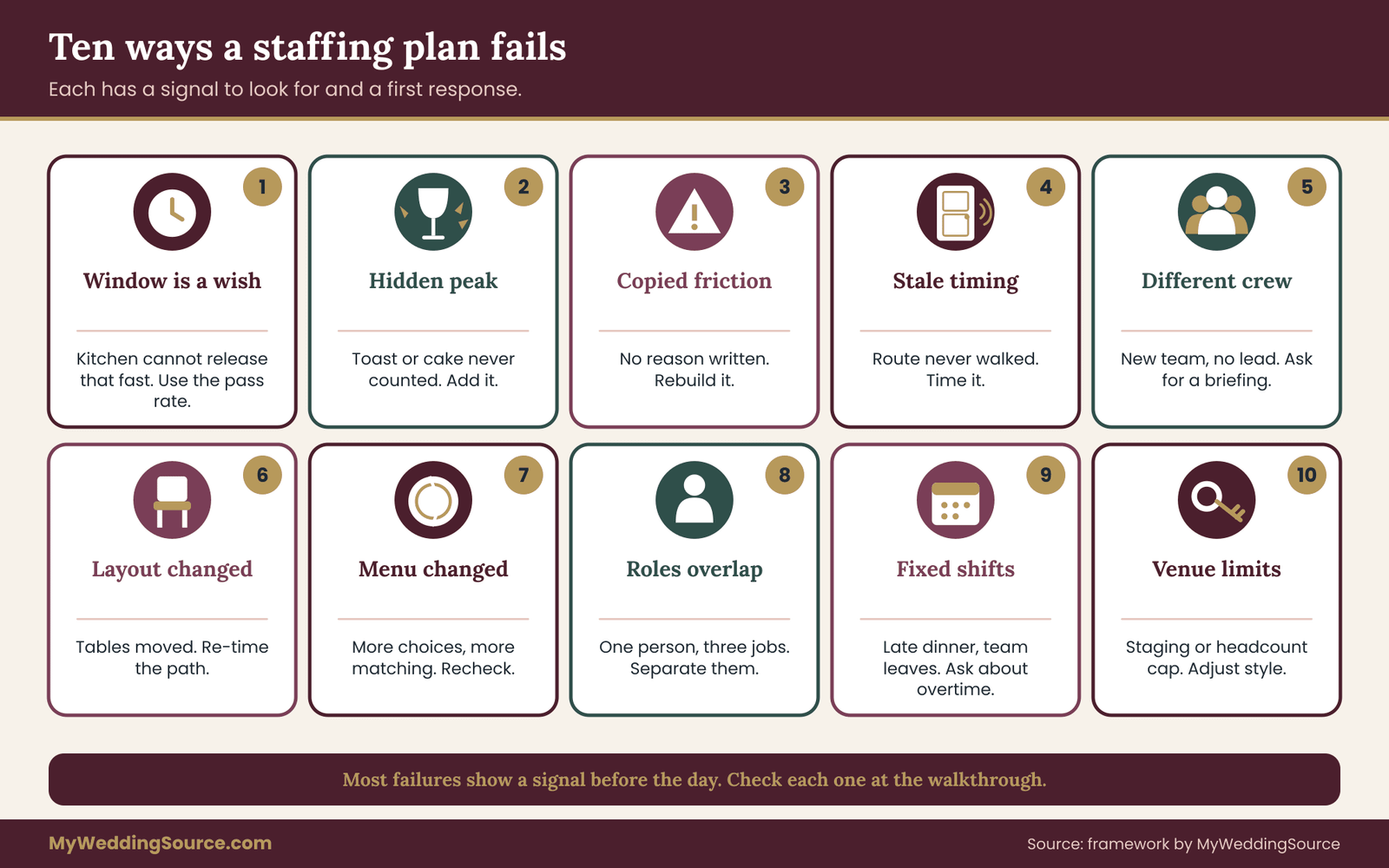
The window is a wish. The target is shorter than the kitchen can release. Signal: the caterer cannot state a pass rate. Response: use the pass rate as the real window and recompute.
The peak is hidden. The toast, cake, or coffee round was not counted. Signal: a short, whole-room task with no staffing note. Response: add it to the sheet and check its window.
Friction was copied, not chosen. The allowance came from a template. Signal: no written reason. Response: list the actual friction sources in the room and rebuild the number.
Measurements are stale. The trip time came from a different venue or a floor plan. Signal: no timing on site. Response: time the route at the walkthrough.
The team is not the team. The quote assumes an experienced crew, but the staffing company assembles a new one. Signal: no named lead, no briefing. Response: ask for the lead’s name and a pre-service briefing. The quote assumes experienced wedding servers, but the agency assembles a new group.
The layout changed. The tables moved after the worksheet was done. Signal: a revised floor plan. Response: re-time the longest path and recompute.
The menu changed. A new entrée or a special-diet increase raised the matching work. Signal: a revised menu after the quote. Response: ask whether the staffing assumptions still hold.
Roles overlap. The same person is expected to bartend, serve, and cut cake. Signal: a role appears twice. Response: separate the tasks by time and check for overlap.
The count is fixed but the day is not. An unexpected delay, such as a late ceremony, pushes dinner into the time when part of the team has a scheduled end. Signal: shifts end at a fixed time. Response: ask about overtime terms and who decides to extend.
The venue limits the team. A room that restricts how many staff can be on the floor, or where they can stage. Signal: a venue rule about service access. Response: check it in the walkthrough and adjust the style. Some venues cap the number of wedding servers on the floor.
What a failure looks like in the room
A failure does not usually look like a disaster. It looks like a plate that arrives lukewarm, a toast that starts with empty glasses, a line that backs into the dance floor, or a team member who is clearly doing three jobs. Most guests forgive these things. The couple remembers them. The worksheet cannot guarantee that nothing goes wrong, but it can ensure that the predictable problems are not caused by arithmetic that nobody did. Short-staffed wedding servers produce small, visible failures. ## Alternatives when the full worksheet is too much
Not every reception needs eight steps and a stopwatch. If the worksheet feels heavy for your event, there are lighter routes. Each one gives up some precision, and each has a condition under which it stops being enough. Lighter methods for counting wedding servers exist, and each has limits.
Ask for the assumptions and skip the arithmetic
If you hire a full-service caterer who provides the servers, the cheapest check is three written questions: the window, the plates per trip, and what the staff count includes. A catering manager who answers them clearly has probably done the worksheet in their head. Your job is to confirm that the answers fit your room, not to redo their math. Their answers describe how wedding servers will work in your room.
This route stops working when the answers are vague, or when your room has a feature the caterer has not seen, such as a long path from the pass to the tables. In that case, return to the timing step and measure the route.
Simplify the style
The easiest way to reduce wedding servers is to reduce the peak. A single plated entrée instead of three, family style instead of plated, or a buffet with a self-serve line each removes a different kind of work. The trade is in the atmosphere and in the food, and some couples prefer a plated dinner even at a higher cost. Simplifying the style is a design choice, not a cut to wedding servers.
Simplifying works best when you do it on purpose and early. Changing the style a month before the date may force a new quote, a new kitchen plan, and new rentals. The worksheet is a good place to compare options on paper before anyone signs.
Use a captain and a flexible team
Some caterers staff a lead and a smaller set of servers, then add runners at the peak. If your worksheet shows a sharp peak and a long, quiet stretch, ask whether the company can supply a peak-only crew. The price may be better than a full team all night, and the plan is stronger than a thin team all night. A peak-only crew is one way to stagger wedding servers.
Shift the work to guests, carefully
A drink station, a coffee bar, or a self-serve dessert table moves part of the load to guests. This is a real option for a relaxed reception. It is not a good fit when guests include older relatives, small children, or people who cannot stand in a line. Check the guest list before choosing a self-serve element, and offer a table-service route for guests who need one.
Run a small test event
If the stakes are high, such as a large formal dinner, ask whether the team can run a mock service for a handful of tables, or rehearse at a tasting. A test of a single table can show touch time and matching problems that no worksheet predicts.
Re-running the worksheet: a simple schedule
The worksheet is not a one-time document. Inputs change, and the answer changes with them. A light schedule keeps it current without becoming a chore. The count of wedding servers is a living number until the final guest count.
At the first quote. Build a rough sheet with estimated inputs and mark each estimate. Use it to write your questions for the caterer.
After the venue walkthrough. Replace estimated trip times with measured ones. Update the friction sources. If the venue has rules about service access, add them.
After the menu is set. Count entrée choices and special diets. Update the touch time and the matching work.
After the floor plan is final. Re-check table spacing and distances. A change of a few tables can shift the farthest-table time.
At the final guest count. Update the task counts. A change of ten guests rarely moves the answer, but confirm.
One week before. Share a one-page summary with the caterer and the coordinator: the service moments, the windows, the staff count, and the shift times. Ask them to confirm or correct it. This is the moment to find a misunderstanding, not on the day.
A one-page handoff for the day
The best output of the worksheet is a single page that a coordinator or a lead can use. It lists the moments in order with their start times and windows, the number of servers assigned to each, the owner of every non-food task, and the point at which the team size changes. It also names who decides if the plan changes, such as extending a window because the toast is delayed. It tells wedding servers where to be and when the team changes size.
The reception flow guide on this site is a useful companion for the timing of those moments, since it ties entry, seating, food, and exit together: how a reception moves from entry to exit.
A second illustration: a small backyard dinner
A second invented case shows the method at a different size. Thirty-two guests, four tables, a buffet with a self-serve line, and three friends who have offered to help. The couple has a hired caterer for the food but not for service.
The line is the main task. A timing test with five volunteers at a trial dinner shows about three minutes per guest through a single-sided line with two items dished by a helper. With thirty-two guests and two line sides, the line takes roughly fifty minutes without any staggering, which is too long. Adding a second line, which makes four sides, and moving to a self-serve format brings it near twenty-five minutes.
The three friends are then assigned: one at each line as a refiller, one for drinks. That uses all three before any clearing, so the couple hires a local hospitality student through a licensed agency for the clearing window, and the friends are told they are off duty at the toast. The point is not the numbers, which are invented, but the process: measure, find the long task, change the design, then assign the people. The three friends act as wedding servers for only the first part of the evening.
Your next steps
- Write your service moments in order, from arrival to breakdown, with the style and the guest count for each.
- Choose a task unit and a window for each moment, and write down who chose the window.
- Ask the caterer, in writing, for plates per trip, the planned entrée window, the pass release rate, and what the staff line includes.
- At the venue walkthrough, time the route from the pass to the nearest, middle, and farthest table.
- Compute server-minutes, add a friction allowance with a written reason, and find the peak.
- Check every short, whole-room moment, such as the toast and the cake, for a hidden peak.
- Compare your result with the quote and ask about each assumption that differs.
- Put the agreed staff count, shift times, style, and window in a short schedule attached to the contract.
- Confirm the labor, insurance, and certification questions with the vendor and with the relevant agencies.
- Re-run the sheet after the menu, the floor plan, and the final guest count.
FAQ
Is there a standard number of guests per server?
There is no single standard that fits every wedding. Published ratios usually assume a service style, a walking distance, and a window that they do not state. A figure that works for a short plated entrée pass in a small room may be too low for a three-entrée dinner in a long room. Use a ratio only as a starting question, then test it with the task-time worksheet.
Does a bigger guest count always mean more servers?
Not by a fixed amount. More guests mean more plates, glasses, and table touches, so the workload grows, but the window, the walking distance, and the style also decide the headcount. A change of ten guests often leaves the answer unchanged, while a change in the table layout or the number of entrée choices can move it by a full person.
Are bartenders and bussers counted as servers?
It depends on the quote, which is why you should ask. Some caterers count only people who carry food, others include bartenders, bussers, runners, or a captain. The same staff line can mean very different floor coverage. Ask the vendor to list the roles behind the count and to say which ones deliver drinks or clear tables.
What is the busiest moment of a reception?
It varies by plan. In a plated dinner it is often the entrée pass, but a short whole-room task such as the toast pour or cake service can demand just as many hands because the window is so brief. Check every short moment on the worksheet. The peak, not the average, decides how many servers you need.
Can I lower the staff count without hurting service?
Often, yes, by changing the task or the window rather than cutting people. Pre-setting toast glasses, starting a pour in stages, simplifying the entrée choices, or staggering shifts can reduce the peak. Cutting the count while keeping the same tasks and the same window usually shifts the cost to the guests as cold food or long waits.
Do I need to tip or add a service charge on top of the quote?
That depends on the contract. Some quotes include a mandatory service charge, some leave gratuity to the guests or the couple, and the two are treated differently for pay and for tax. Ask the caterer exactly what any charge covers and how it is distributed, and check the Department of Labor and IRS pages for current guidance.
Can friends or family serve instead of hired staff?
They can, especially at a small, informal reception, but plan for a higher friction allowance because volunteers are untrained and also want to be guests. Name a lead, give a short briefing, and set a fixed duty window. Check the rules on minors helping, and consider hiring through a licensed company if alcohol is served.
What if my caterer’s number and my worksheet disagree?
Find the input that differs. Compare the window, plates per trip, trip time, friction allowance, and the jobs counted outside food service. Ask the caterer to explain their assumption in writing. If the explanation is specific and fits your room, your estimate may be too cautious. If it is vague, ask for a trial service or a written schedule.
Sources
- U.S. Department of Labor, Wage and Hour Division: https://www.dol.gov/agencies/whd/
- U.S. Department of Labor, Fair Labor Standards Act overview: https://www.dol.gov/agencies/whd/flsa
- U.S. Department of Labor, tipped employees: https://www.dol.gov/agencies/whd/tipped
- U.S. Department of Labor, minimum wage: https://www.dol.gov/agencies/whd/minimum-wage
- U.S. Department of Labor, child labor: https://www.dol.gov/agencies/whd/youthworker
- Internal Revenue Service, employee or independent contractor: https://www.irs.gov/businesses/small-businesses-self-employed/independent-contractor-self-employed-or-employee
- Internal Revenue Service, tip recordkeeping and reporting: https://www.irs.gov/
- U.S. Food and Drug Administration, Food Code: https://www.fda.gov/food/retail-food-protection/fda-food-code
- Occupational Safety and Health Administration: https://www.osha.gov/
- ADA.gov, Americans with Disabilities Act information: https://www.ada.gov/