
A cabin rooming list is the working document that decides who sleeps where when your wedding guests share group cabins, and it is also the document most likely to embarrass someone if it is built carelessly. This guide shows how to assign beds fairly, protect private details, and keep a calm fallback ready when the plan changes.
Build the cabin rooming list in three passes. First, lock every non-negotiable need, such as step-free access, a bed near a bathroom, an infant, a medical device or a very early shift. Second, link households and required pairings. Third, loosen: fill the remaining beds by comfort and preference. Collect needs as short codes instead of stories, and share three different versions of the list, one for you, one for each cabin and one for each guest. Keep two spare beds and a written swap rule.
Shared cabins sound simple until you try to assign them. Somebody’s grandfather cannot manage a top bunk. A new parent needs a cabin that is quiet at night and has an outlet near the crib. Two friends who have not spoken since last year are both on the guest list. A groomsman snores, a bridesmaid goes to bed at nine, and a cousin would rather not explain to six strangers why she needs a particular bed. The cabin rooming list is where all of that gets resolved, usually by one tired person with a spreadsheet.
This article is about the cabin rooming list and about the privacy habits around it. It is not a guide to choosing a camp or retreat site; the wedding venues guide covers venue selection, and the broader question of hotels versus on-site lodging is handled in the guide to coordinating wedding guest hotels. Here the cabins are already booked or very likely booked, and the job is to fill them well.
A note on scope. This is general planning information, not legal, tax or financial advice, and every camp, park and retreat center sets its own rules for capacity, supervision and fire safety. Where a rule matters, the article tells you what to ask and who issues the answer.
What a cabin rooming list has to do
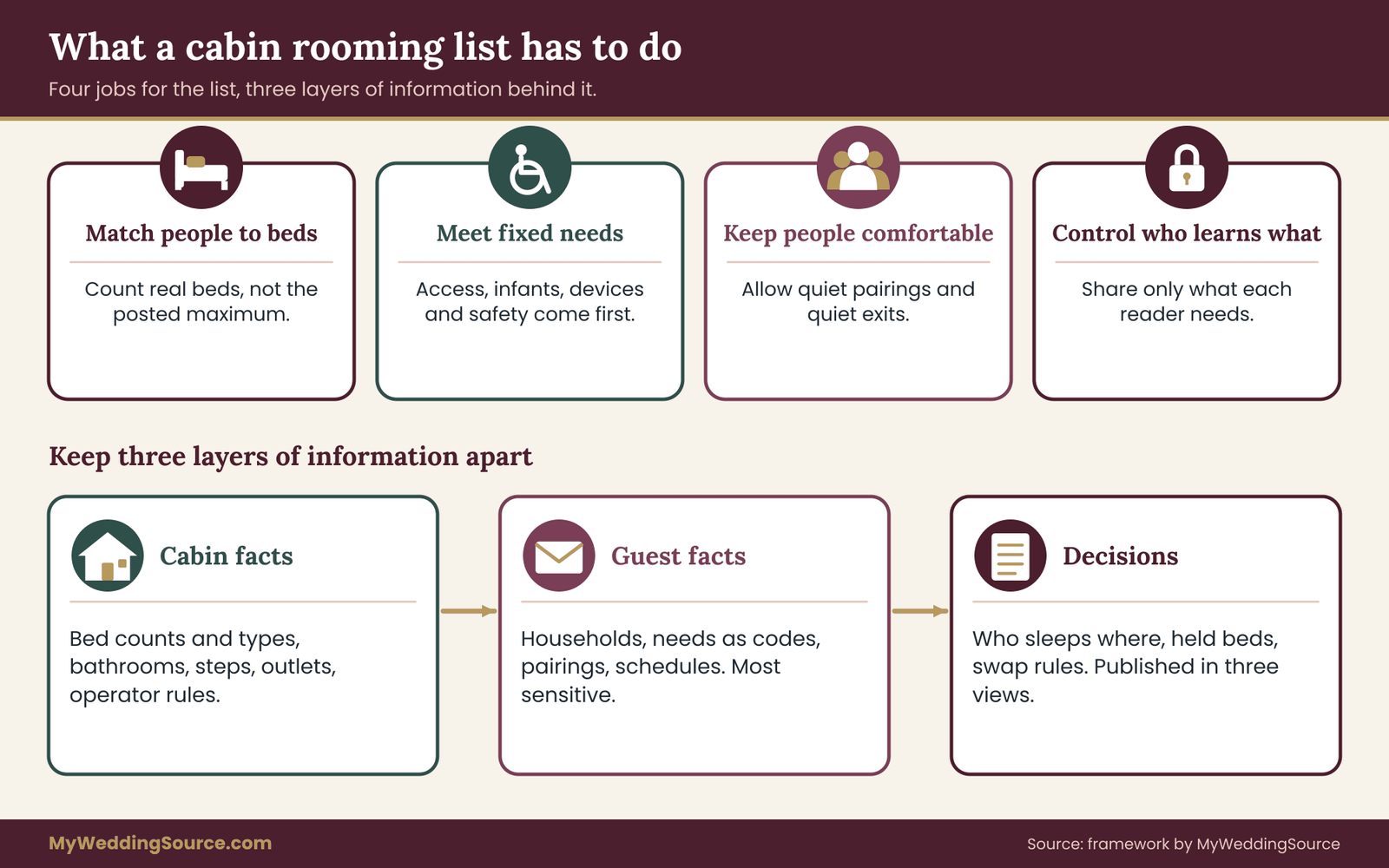
A cabin rooming list looks like a table of names and bunk numbers. In practice it has to do four different jobs at once, and most lists that go wrong fail at one of them because the author only thought about the first.
Job one: match people to real beds. The cabin rooming list must respect what each cabin physically offers. That means counting beds, not “sleeps up to” marketing numbers, and knowing which beds are bottom bunks, which are twin singles, which are full-size and which room has a private bathroom.
Job two: respect needs that are not up for negotiation. Mobility, medical equipment, infants, religious or cultural observance, and safety concerns are not preferences. They get placed first, and everything else flexes around them.
Job three: keep people comfortable with each other. Most guests can sleep beside nearly anyone for two nights. A small number cannot, for reasons that are theirs to keep private. A good cabin rooming list lets them avoid a pairing without having to announce why.
Job four: control who learns what. A cabin rooming list that gets pinned on a lodge door, forwarded to a group chat or pasted into a shared document can disclose a medical need, a relationship, a conflict or a family secret. Privacy is part of the design, not a footnote.
What a cabin rooming list is not
It is not the seating chart, although the two documents share some data. A seating chart handles who sits with whom for a few hours, while a cabin rooming list covers sleeping, dressing and bathroom routines. A cabin assignment lasts two or three nights and includes sleeping, dressing and bathroom routines, so the tolerance for a bad pairing is much lower.
The cabin rooming list is also not a contract with the camp. The operator has its own bed records and may require you to submit a roster in its own format. Your cabin rooming list is the planning layer that sits upstream of that submission. Keep the two consistent, but do not assume that the operator’s form can hold the nuance of yours.
The three layers of information
A useful way to keep the document clean is to separate three layers of information, and to store each one separately.
The first layer is facts about the cabins: bed counts, bed types, bathroom arrangements, distance to the dining hall, steps, lighting, heat, outlets. These come from the operator and from your own visit or photos. They change only if the booking changes.
The second layer is facts about the guests: who is traveling together, who needs what, who should not share. These come from guests, are sensitive, and should be held by as few people as possible.
The third layer is decisions: who is assigned to which bed, which beds are held back, and what the swap rules are. This is the layer you publish in different versions to different audiences.
Keeping the layers of a cabin rooming list apart means you can change a decision without rewriting a guest’s private information, and you can share a decision without exposing a guest’s private information. Later sections show how to do both.
Why group cabins change the privacy math
At a hotel, privacy is built in. Each room has a door, a bathroom and a lock, and a guest’s needs are mostly between that guest and the front desk. In a group cabin, the room itself is shared, so assignments reveal things that a hotel booking never would.
Consider what a cabin assignment can disclose without anyone intending it. Placing a guest in the step-free cabin tells everyone who looks at the cabin rooming list that the guest has a mobility need. Placing a couple in the small cabin with a private bath tells everyone about the couple. Putting one adult with the children’s cabin tells the group about a custody arrangement. Leaving someone off a list that includes everyone else tells them something, too.
None of this means you should avoid assigning people sensibly. It means the system should reveal only what each person needs to know. A cabin leader needs to know who is in the cabin and how many beds are free. A guest needs to know their own bed and who else is in the cabin. Neither needs to know why a neighbor was placed where they were.
Three kinds of sensitive information
It helps to name what you are protecting, because the protections differ.
Health and mobility details. Anything about a diagnosis, a device, a medication or a disability. Guests may share this with you because they want to be placed well, but they did not agree to share it with the whole group. Collect the minimum: what the guest needs from the room, not why.
Relationship and family details. Who is a couple, who is separated, who is estranged, who is a stepparent, who has a custody schedule. A cabin plan often exposes these. Seating charts teach the same lesson: ask what arrangement works, and avoid labeling the relationship.
Safety-related requests. A guest may need to avoid sharing a cabin with a particular person for reasons of safety. This is the most delicate category. Do not ask for an explanation, do not put the request in writing anywhere shared, and do not make the person justify it.
The minimum necessary rule
The rule that keeps most of this under control is borrowed from how careful organizations handle personal data: collect and share only what you need to do the task. For a cabin plan, that means a guest tells you what they need in the room, you record it as a short code, and the code is visible only to the person who does the assignment.
You do not need a diagnosis to place someone near a bathroom. You do not need a reason to keep two guests apart. You need the instruction and the confidence that you will carry it out quietly. Guests are far more willing to share a need when they can see that the form asks for little and that the answer will not travel.
Why the cabin rooming list needs privacy rules early
Privacy mistakes in a cabin rooming list are easy to make late, when you are tired and trying to get the cabin rooming list to the camp. A name on a door, a screenshot in a group chat, a spreadsheet shared with edit access to the entire wedding party. Setting the rules at the beginning, before the first guest answers a question, is much easier than repairing a leak on the first night.
The rest of this guide builds the cabin rooming list in order: gather the facts, check the cabins, run the three passes, protect the information, test the method on a worked case, and plan for the day it breaks.
Gather the facts before you build the cabin rooming list
You cannot assign beds well from a guest list alone. A guest list tells you names and RSVPs. A cabin rooming list needs a little more, and it needs it from every household, collected the same way, by a date that leaves you time to work.
The Sleep Profile card
The simplest tool is a short form, which this guide calls a Sleep Profile. One is completed per household, not per person, because most of the facts belong to the group traveling together. It can live in your RSVP, on your wedding website or in a separate message, and it should take a guest about two minutes.
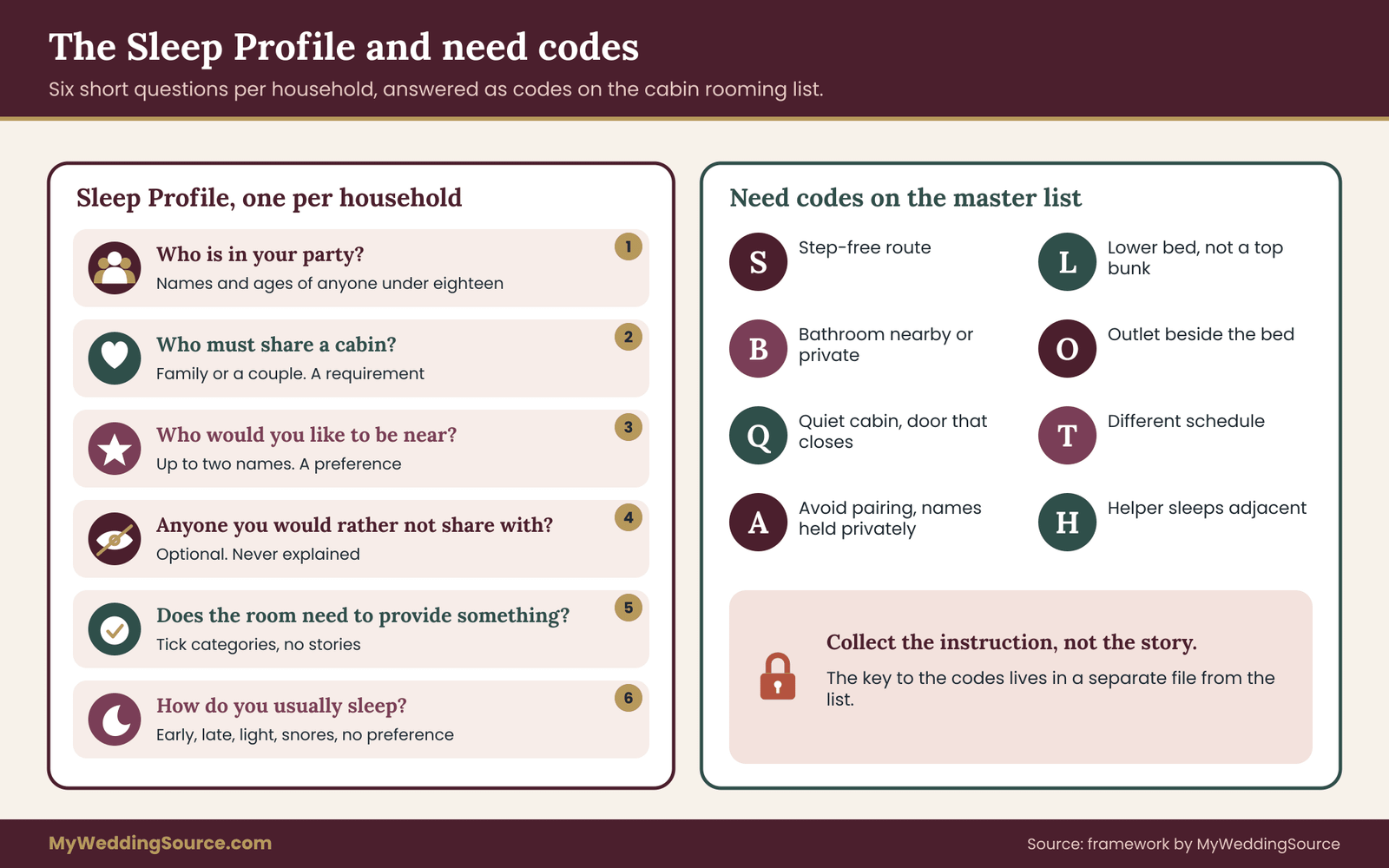
A Sleep Profile asks six things.
Who is in your party? Names as they should appear on the cabin rooming list, and the ages of anyone under eighteen. Children’s ages matter because many camps have rules about minors and supervision.
Who must be in the same cabin? Usually a family or a couple. This is a requirement, not a preference, so it is separate from the next question.
Who would you like to be near? Up to two names. These are preferences that the third pass will honor if it can.
Is there anyone you would prefer not to share with? Optional, never required, and never explained. The form says so in plain words.
Does anyone in your party need something from the room? Pick any that apply from a short list of need categories, with a free-text box that says “tell us only what we need to know.”
How do you usually sleep? Early riser, night owl, light sleeper, snores, no strong preference. This one is lighthearted and surprisingly useful, because most of the friction in shared cabins is about rhythm, not need.
Need categories, not diagnoses
The need question is where privacy is won or lost. Offer a list of room needs instead of asking guests to describe their situation. A workable set is short.
- Step-free route or ground-floor bed.
- Bed near a bathroom, or a private bathroom.
- Lower bunk or a regular bed, not a top bunk.
- An outlet beside the bed for a device or a baby monitor.
- A quiet cabin, or a room with a door that closes.
- Earlier or later schedule than the group.
- Another need, described in a few words.
Each category becomes a code on your master cabin rooming list, which you will see in the protocol section. A guest who ticks “lower bunk” has told you everything you need. A guest who writes three paragraphs has told you more than you should be holding, and you can thank them and keep only the instruction.
For guests who need more than a bed assignment, such as a wheelchair-accessible bathroom with specific dimensions, the conversation moves from a form to a direct message with the guest and the operator. The guide on accessible wedding venue red flags explains how to judge whether a site can truly meet an access request, and that judgment should happen before you promise anything.
When to send it and how to chase it
Send the Sleep Profile at the same time as your lodging details, which for most weddings is when invitations or a lodging page go out. A reasonable deadline is several weeks before the cabin submission date that the operator gives you. Work backward: if the camp needs a roster a month before the wedding, your guests need to answer well before that, so you have time to chase and to adjust.
Chase in two rounds. The first reminder goes to everyone. The second is a short personal message to households that have not answered, with an easy way out: “Reply with just the number of people and anything the room has to have, and we will take care of the rest.”
Do not guess. A missing profile is not a missing need. If a guest does not respond, place their household in the last pass, give them a flexible bed, and tell them where they are as soon as you know.
Collect a few operational facts for the cabin rooming list
The profile is about sleeping, and the cabin rooming list is built from it. A few other facts shape the cabin rooming list and are easy to collect at the same time.
Arrival and departure times. A guest arriving at midnight should not share a cabin with a light sleeper if you can help it. Early departures may also lead you to group people who are leaving together.
Any role in the wedding. People in the wedding party often need to be near each other on the morning of the ceremony, and the cabin plan should know that.
Whether they will bring their own bedding or sleeping bags, if the camp expects it.
Know the cabin before you assign anyone
The second half of the fact-gathering is about the cabins, and it is where optimism does the most damage. A listing that says a cabin “sleeps ten” tells you the maximum the operator will accept, not how comfortably ten adults fit, and not whether the ten includes a child on a trundle or a foldout.
Questions to put to the operator
Ask the operator for each cabin, in writing, and keep the answers in your master file. The goal for the cabin rooming list is not to audit them. The goal is to know the real facts before a guest relies on them.
Beds. How many beds are in each cabin, of what type: single, bunk, double, full, foldout? Which are lower and which are upper? Is the posted capacity based on adults, or does it count children and cots? Are linens included, or must guests bring their own?
Capacity and safety rules. What is the maximum number of people allowed overnight in each cabin, and who sets that limit: the operator, the county, or the fire authority? Are there restrictions on adding cots or air mattresses? Fire and occupancy rules are set locally and vary, so this is a question for the operator, and for the local fire authority if the answer is unclear. The U.S. Fire Administration and the National Fire Protection Association publish general fire-safety information, and the operator should be able to tell you what applies at their site.
Bathrooms. Is the bathroom inside the cabin, shared with a neighbor, or in a separate building? How far is it, on what surface, and is it lit at night? Are there showers, and is hot water reliable for the number of guests?
Access. Are there steps? How many, and is there a handrail? Is there a ramp or a step-free route from parking or the lodge? How wide are the doors? The venue technical walkthrough guide explains how to measure and record these details so that they are facts instead of impressions.
Comfort. Is there heating or cooling? Window screens? Outlets, and how many, and where? What does the night look like: is there lighting at the door, and is the path safe after dark?
Rules about who may share. Some camps and retreat centers have rules about adults and minors sharing a cabin, about unrelated adults of different genders sharing a room, or about supervision. Ask directly and get the answer in writing, because it can change which assignments are even allowed.
Fill in a cabin fact sheet
Make one half-page sheet per cabin. Include the cabin name, true bed count by type, bathroom arrangement, steps and distance, outlets, heat and cooling, and any operator rule that affects assignment. This sheet is the first of the three information layers described earlier, and it will be the reference for every decision on the cabin rooming list that follows.
If you can visit before the wedding, walk each cabin with the sheet and correct it. If you cannot, ask the operator for current photos and check the answers against them. A photograph of the stairs tells you more than a sentence describing them.
Count beds the way a guest will experience them
One practical habit saves a lot of grief: write down not just how many beds exist but how many are good beds for a particular kind of guest. A cabin with ten bunk-bed spaces may have only five lower bunks. If three older guests and a pregnant guest need lower bunks, the cabin’s real capacity for your group is not ten; it is whatever the lower bunks can hold.
Count lower bunks, step-free beds and beds near the bathroom as separate scarce resources. They are the beds the first pass will allocate, and running out of them is the most common reason a cabin rooming list fails.
The three-pass method for a cabin rooming list
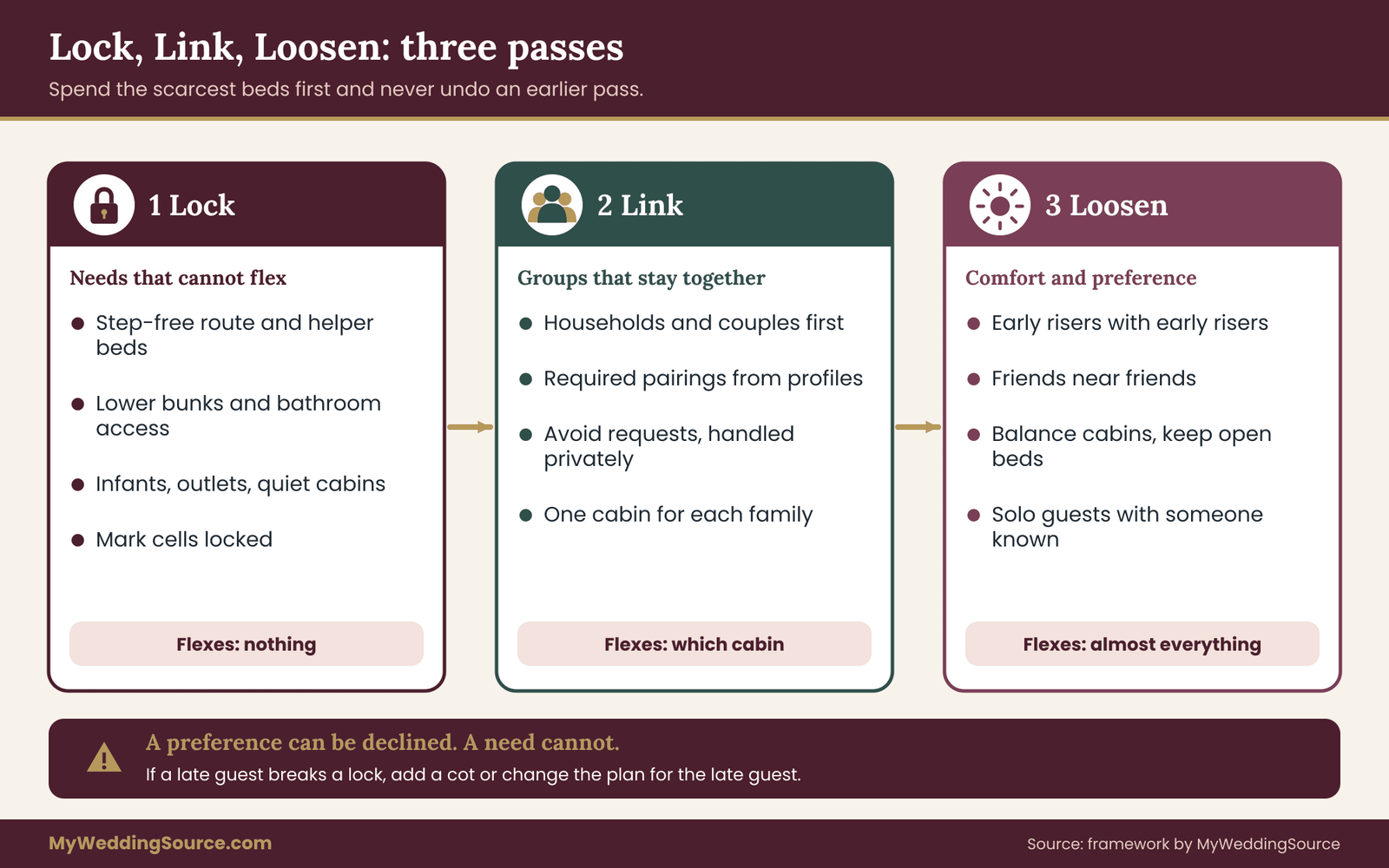
With cabin facts and Sleep Profiles in hand, you can build the cabin rooming list. The method below has three passes, called Lock, Link and Loosen. The order matters, because each pass uses up a different kind of flexibility, and the scarce beds should be spent first on the people who cannot sleep anywhere else.
Work on a draft cabin rooming list, a copy of the cabin fact sheets and a master sheet of households. Pencil or a spreadsheet with a duplicate tab is better than typing straight into the final version, because you will move people around.
Pass one of the cabin rooming list: Lock
Lock means placing every household that has a need the room has to meet. These are not negotiable and they are not traded for convenience.
Start with the scarcest beds. List the households that need a step-free route, then those that need a lower bunk or regular bed, then those that need a bathroom nearby or a private bathroom, then any that need an outlet, a quiet room or a different schedule. A household may appear in more than one list.
Then match. Put the step-free households in the step-free cabin first, and check that the cabin has enough step-free beds for all of them plus any helper who needs to be close. A caregiver is part of the household for planning purposes, even if they are not family, and should sleep near the guest they help.
When two needs pull in different directions, resolve by the harder constraint. A guest who needs step-free access and a guest who wants quiet might both prefer the same cabin; the step-free need goes first, and the quiet request is honored in the next pass if possible.
Mark each locked household clearly in the master sheet, using the need code, so that nobody later moves them for convenience. A good habit is to shade locked cells and add a note: “Locked. Do not move without asking the guest.”
Pass two of the cabin rooming list: Link
Link means placing the groups that must stay together and the pairings guests have asked for.
Households come first. Parents sleep with their young children, couples with each other, and any guest under eighteen with a parent or a guardian the parents have named, within whatever the operator permits. Place whole households before individuals, because splitting a household is the mistake guests notice most.
Then handle required pairings from the Sleep Profile, which are rare but real: two friends who share a mobility need, a wedding party member who needs to be near the person they are helping to get ready, or a guest who has asked to share with a particular cousin.
Then consider the avoid requests. These are the delicate ones. Handle each by placing the two households in different cabins and noting the instruction in the master sheet only. Do not discuss the reason with anyone, including the person’s friends. If the avoid request also affects who may be in the same dining table or shuttle, make a private note for your point person and no one else.
Pass three of the cabin rooming list: Loosen
Loosen is where the remaining beds are filled by comfort and preference. This is the most flexible pass and the most social one.
Use the sleep rhythm answers first. Early risers together, night owls together, and the person who said they snore in a cabin with someone who said they sleep deeply or in a cabin with a door to the outdoors. These small matches affect how rested your guests feel on the day of the wedding.
Then use the “who would you like to be near” answers. A group of college friends is likely to be happier in one cabin than scattered across four. Try to give each household at least one person they know in the cabin, which matters especially for guests who are traveling alone.
Finally, balance the cabins. Avoid ending with one full cabin and one half-empty cabin unless the half-empty one is a deliberate choice, such as holding beds for late changes. Aim for each cabin to have one or two open beds, and keep the open beds in cabins that can absorb a late addition without disrupting a locked household.
A decision rule for conflicts between passes
Sooner or later a request in pass three will clash with a placement in pass one or two. The rule for any cabin rooming list is simple: never undo an earlier pass to satisfy a later one. A preference can be declined. A need cannot. If you find that a late arrival breaks a lock, add a cot or change the plan for the late arrival, not for the locked household.
Keep a one-line reason for each cabin rooming list placement
For every placement that someone might ask about, keep a harmless reason you can say aloud without revealing anything. “The cabin has the most space for a group of five” or “this one is nearest the lodge” are true and neutral. The reason in your head may be a mobility need or a safety request; the reason you say aloud should be the one that is safe to share. Rehearse a few so they come naturally when a guest asks why they were not placed with their friends.
Special cases inside a cabin rooming list
Most guests slot into a cabin rooming list easily. A small set of situations repeats from wedding to wedding, and it is worth deciding in advance how you will handle each.
Couples and the couple’s own bed on the cabin rooming list
Decide early where you and your partner will sleep, and say so, because guests will ask. A private room in the lodge, a separate cabin or a nearby rental are common choices. If you will sleep in a cabin with others, such as a bridal party cabin before the ceremony, be clear about when it changes.
Do not use the best private cabin as a reward or as a place to settle a dispute. Treat it as a scarce resource like any other: who has a need, who is traveling the farthest, who has a newborn. If the allocation of a prized cabin raises friction between the families, settle it by need and distance traveled, not by who asked first.
Families with babies and young children
Infants change the quiet-hours math for a whole cabin. A baby who wakes at four in the morning is a need for the family and a cost for the neighbors. The best arrangement is usually the infant’s family in a cabin with other households who have chosen it, or in a cabin with few beds and a door that closes.
Ask about portable cribs, sound machines and outlets, and ask whether the cabin has room for a crib at all. The guidance in the wedding guest care guide covers how to plan around babies, children and older relatives across the whole weekend, and the cabin plan should match it.
For children, many camps require that a minor sleep with a parent or a named adult. Confirm the rule and write it on the cabin sheet. Do not place a child in a cabin with adults who are not part of their household unless the parents have asked for it and the operator permits it.
Older guests and guests with limited mobility
Prioritize bed height, steps, distance to the bathroom and distance to the dining hall. A lower bunk is not enough if the cabin is a long walk on uneven ground. If the step-free cabin is full, consider alternatives for the guest rather than a worse bed: a nearby motel, a rental house or a room in the lodge. The decision should be made with the guest, not for them.
Wedding party members
Members of the wedding party often want to be together, and for good reason: getting ready, early call times and shared tasks. The risk is that the wedding party cabin becomes a cabin of people who all stay up late. If you can, mix in a few people with quieter rhythms elsewhere, and keep a morning plan so the bridal party does not wake the whole camp.
Solo travelers
Guests who arrive alone are the easiest to forget and the most likely to feel left out. Place each solo traveler in a cabin with at least one person they know, or with a host-type guest who is likely to be welcoming. If you cannot, say a few words to the cabin’s lead before arrival.
Exes, estranged relatives and complicated pairings
Do not seat these guests near each other and do not place them in the same cabin, even if both said yes to a shared setup in a form. Assume that what the form recorded is not what each person would choose with full information. A quiet check with each person is a kindness. If you are unsure, separate them.
Gender and cabin norms
Some groups assign cabins by gender and others do not. Do not impose a default. Ask the operator what the rules are, then ask your guests. A cabin plan that assumes everyone is comfortable in a cabin labeled one way can embarrass or exclude guests. Where possible, offer a neutral option such as a cabin organized by sleep rhythm or by household, and let guests who prefer a specific arrangement say so.
Privacy boundaries: who sees the cabin rooming list
Once the assignments exist, the question changes from “who goes where” to “who learns what”. This section is the privacy protocol. It has four parts: need codes, three views of the cabin rooming list, handling rules, and a short script for guests who ask questions.
Need codes keep reasons out of the cabin rooming list
On the master sheet, never write the reason for a placement. Write a code. The codes are simple letters that you define once and keep in a separate key.
For example: S for step-free route, L for lower bed, B for bathroom nearby, O for outlet at bed, Q for quiet cabin, T for different schedule, A for avoid pairing, and H for helper must be adjacent. A household entry might read “Okafor, 3 people, L B” and nothing more.
The key that explains the codes lives in a different file from the cabin rooming list, so a stray screenshot of it does not explain itself. The point is not secrecy for its own sake. It is that a code on a screen discloses less than a sentence, and a code with no key discloses almost nothing.
The avoid code deserves extra care. Do not record who the pair is on the master cabin rooming list. Keep that pairing on a private note held by one person, and apply it when placing households. A column that says “avoid: Smith” can end up in the wrong hands in a way that “A” cannot.
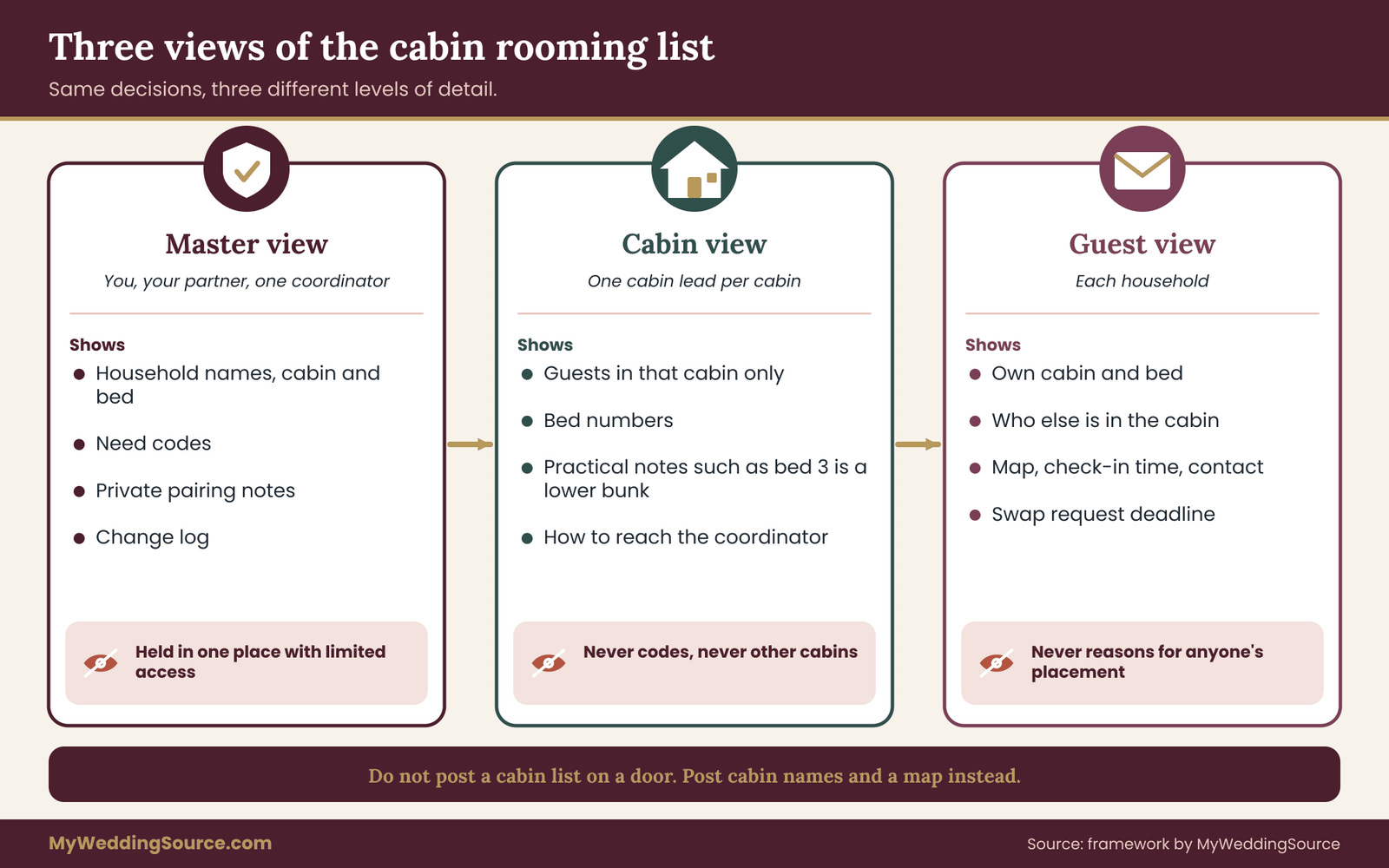
Three views of the same cabin rooming list
The cleanest way to protect information is to stop treating the cabin rooming list as a single document. Produce three versions, each with the least detail that its readers need.
The master view is for you, your partner and one trusted coordinator. It contains household names, cabin and bed, need codes and private notes. It is the only version that records the reasons behind a placement, and even then in code.
The cabin view is for each cabin lead, a person you ask to welcome guests and handle small problems in the cabin. It lists only the guests in that cabin, their bed, and any practical instruction the lead needs, such as “bed near the door, please do not move.” It does not list codes, avoid notes, or anything about other cabins.
The guest view is for each household. It says which cabin and bed they have, who else is in it, how to reach the cabin lead, where the cabin is on the map and what time they can check in. It does not list other cabins. It does not mention why anyone is placed where they are.
Producing three views of a cabin rooming list is a little more work than printing one sheet, but it can be done in minutes if the master sheet is organized well. The three-view habit is the single most effective privacy measure in the protocol.
Handling rules for the master cabin rooming list
A few simple rules keep the master file from becoming a liability.
Store it in one place with controlled access, not in an open group chat or a document with a public link. Give edit access to as few people as possible, and view access to one or two. If your coordinator needs to see it, share it with their account directly instead of by a forwarded link.
Do not email the master file in the body of a message. Do not paste it into a messaging app. Do not post it in a social group, even a private one, and do not print it for a wall.
Keep a log of changes: who moved whom, when, and why in code. A simple dated list is enough. This helps if a guest later asks why a change happened and also helps you reverse a mistake.
When the wedding is over, delete the master view and any guest Sleep Profiles that contain need information, or move them to a private archive with a clear retention date. The guide to wedding records after the event covers how long to keep what, and the same logic applies here: the less sensitive data you hold, the less there is to leak.
What not to post on a door
A printed cabin rooming list on the lodge door is tempting, because it feels efficient. It also exposes every name and every cabin to every reader. If you want something posted, post cabin names and a map only, and hand individual assignments to guests in a welcome card at check-in. If you do need a visible list for staff, keep it behind the desk and cover it when you are not using it.
A short script for guests who ask
Guests will ask questions that touch the private layers. A few calm scripts help.
When a guest asks why they were not placed with a friend: “We worked through the cabins by space and by who needed particular beds, and this was the arrangement that fit everyone. If something about this cabin does not work for you, tell me and I will look at it.”
When a guest asks who else is in a cabin they were not placed in: “I only share the cabin lists with the people in each cabin. If you want to be near someone, I am happy to ask them.”
When someone asks you to disclose a reason: “I would rather keep those details private. I can tell you that the plan works for everyone.”
None of these require a lie. They decline to answer, politely and confidently, and confidence is what keeps the question from becoming a conversation.
When a guest wants to share more
Some guests are happy to talk about their needs and want others to know, perhaps because it helps them feel welcome. That is their choice. The protocol does not forbid it; it simply ensures that you are never the one who made the decision for them. Let guests share their own stories, and keep yours limited to the arrangement.
Privacy risks in a cabin rooming list that are easy to miss
The protocol above covers the obvious paths. A few quieter ones are worth knowing about.
Spreadsheet metadata and sharing defaults
Shared documents often keep version history, comment threads and list of viewers. A helper who was added for a day may keep access long after. A comment that says “avoid pairing: Smith” may be visible in a revision history even after you delete it. Use a clean copy for any version that goes to someone new, and review who has access before and after the wedding.
Group chats and the cabin rooming list
Group chats are where cabin plans leak. A well-meaning guest posts a photo of their welcome card, which has the names of their cabin mates. A cabin lead posts “Cabin C, everyone confirm bed numbers” and in doing so tells every member of a larger chat which cabin each guest is in. Set a rule for cabin leads: use direct messages or a chat limited to the cabin, and never name guests with needs.
Name tags and welcome cards
Welcome cards that list names, bed numbers and a note such as “ground floor” tell any passer-by something about the guest. Use a plain cabin name and a bed number. Put particular instructions in a sealed note or in a conversation. If you also use wristbands or colored tags for access, never let a color stand for a need.
Photography and cabin interiors
Guests change, nap and recover in cabins, and a casual photo can capture someone in a state they would not choose to share. Make a simple rule that cabins are photo-free spaces unless everyone in the room agrees, and let your photographer know that cabin interiors are off limits. This ties in to the broader consent practices in the wedding photography consent guide.
Children and the people who care for them
If any child is sleeping in a cabin without the household that traveled with them, the operator, the cabin lead and the child’s parents all need clear, written arrangements. That information is sensitive, and it should be given only to those who need it. Do not widely announce who is supervising whom.
Worked case: a cabin rooming list for thirty-eight guests
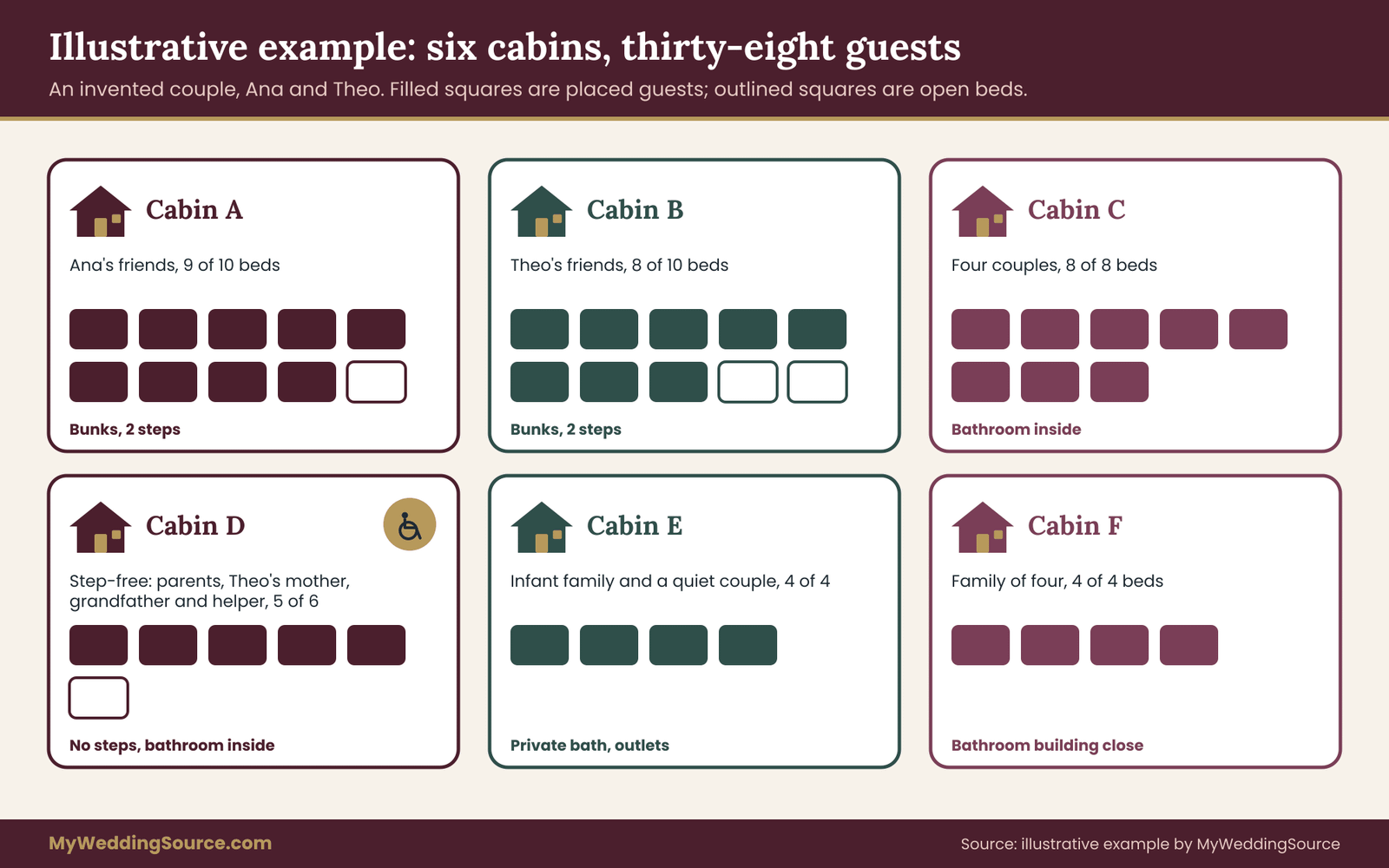
The following case is invented to show the method. The names, cabins and numbers are illustrative, and your own site will look different. It follows a couple, Ana and Theo, who have booked a small camp for a Friday-to-Sunday wedding weekend and invited thirty-eight overnight guests. They will sleep in a private room in the lodge.
The cabins
The camp lists six cabins, and Ana asks for a written fact sheet on each.
Cabin A has ten beds in five bunk pairs, a shared bathroom building thirty steps away and two steps at the door. Cabin B is the same layout. Cabin C has eight beds in four bunk pairs with a bathroom inside. Cabin D has six single beds, a bathroom inside, no steps and a short paved path to the lodge. Cabin E has four beds, a private bathroom and two steps. Cabin F has four beds in two bunk pairs and a bathroom building close by.
That is forty-two beds for thirty-eight guests, which leaves four open beds. Ana notes that the real count of good beds is smaller than it looks. Cabin D is the only step-free option and has six beds. The lower bunks across A, B, C and F number sixteen.
The Sleep Profiles behind the cabin rooming list
By the deadline, every household has answered. The summary, in code, looks like this.
Ana’s parents ask for no steps and a bathroom in the cabin (S, B). Theo’s mother uses a cane and prefers a bathroom nearby (S, B). Ana’s grandfather uses a wheelchair for longer distances and travels with his daughter, who helps him (S, B, H). That is five people who need the step-free cabin, counting the helper, and one spare bed there is worth holding.
A couple with a seven-month-old ask for a quiet cabin with an outlet (Q, O). Another couple asks for a quiet cabin because they sleep early (Q). A family of four with children aged eight and eleven needs a cabin where the family stays together. Eight friends of Ana and eight friends of Theo are happy anywhere. Four couples are traveling without children, two of them in the wedding party.
One note arrives privately from a guest asking not to share a cabin with a particular person. Ana records only an A on the guest’s household and puts the name pair on a private note held by her sister, who is the coordinator.
Pass one: Lock
Ana locks Cabin D first. Her parents take two beds, Theo’s mother one, and the grandfather and his daughter take two more. That is five of six beds. She holds the sixth open, because a step-free bed is the scarcest bed in the camp and she does not want to give it away.
Then she handles the quiet and outlet requests. Cabin E has four beds, a private bathroom and outlets by the beds. The family with the infant takes two beds. The other quiet couple takes the remaining two. Cabin E is full, and both households chose it knowing who is in it.
Pass two: Link
The family of four goes into Cabin F, which fills all four beds. Their cabin has a nearby bathroom building and they asked only to stay together.
The four couples without children go into Cabin C, which has eight beds and an inside bathroom. This seems a natural group, since couples tend to prefer shared bathroom access and a bit of privacy. Ana checks the two wedding party couples: they will be near each other and near the lodge on the morning of the wedding.
The avoid request affects the two friend groups. Ana’s coordinator checks the pair and finds that one guest is Ana’s side and the other is Theo’s side. She places them in different cabins without comment.
Pass three: Loosen
Cabins A and B take the friend groups. Ana’s nine friends go to Cabin A with one open bed. Theo’s eight friends go to Cabin B with two open beds. The sleep-rhythm question moves two early risers from Cabin B to Cabin A, where more early risers already sleep, and moves one night owl to B for the same reason. The snorer, who volunteered the information on the profile, goes to the cabin with the most open space around his bunk.
The result: Cabin A holds nine of ten beds, Cabin B eight of ten, Cabin C eight of eight, Cabin D five of six, Cabin E four of four, Cabin F four of four. Thirty-eight guests are placed and four beds are open.
The three views of the cabin rooming list
Ana produces the master view with household names, cabin, bed and codes. She gives the key to her sister. Each cabin lead receives a short list of the guests in that cabin and a note: “Bed 3 is a lower bunk, please do not move.” Each household gets a welcome card with a cabin name, a bed number and the other households in the cabin.
The step-free cabin lead is told only that Cabin D is the cabin nearest the lodge, and that the guests were placed there for access. The cabin lead for Cabin A has no idea who sleeps in Cabin D or why.
What changed afterward
Two weeks before the wedding, a household of two drops out and a late RSVP adds three. The coordinator checks the open beds. The three late guests are placed in Cabin B, which has two open beds and room for a cot, once the operator confirms that a cot is permitted. The dropped-out household was in Cabin C, leaving two open beds there. Because the third pass was flexible, nobody locked is touched.
A week before, Ana’s grandfather’s daughter has to cancel. The grandfather now needs another helper. Ana asks a cousin, who moves into the sixth bed in Cabin D, the one she held open. The held bed did exactly the job it was meant to do.
What the case shows about the cabin rooming list
Three details are worth carrying away. First, the scarcest bed, the step-free one, was spent first and the sixth bed was held. Second, the avoid request cost nothing because it was handled in one step, in one private place. Third, the changes later required no rework, because the passes were done in the right order and because the cabin rooming list was built to absorb change. A cabin rooming list that bends without breaking is worth more than a perfect one.
This is an invented example, and your numbers will differ. The method does not depend on the numbers.
Communicating assignments, swaps and late changes
Communicating assignments without creating new problems
A good cabin rooming list can still produce complaints if it arrives badly. The message that delivers it is part of the system.
Timing
Send assignments after the operator confirms the bed counts and after your RSVP deadline, but early enough that guests can ask for adjustments. For most weddings this is a few weeks before the weekend. Sending too early invites reassignment requests before the final guest count is known. Sending too late leaves guests with no time to arrange travel or ask for changes.
Wording
Write assignments as plain information, not as a favor. “You are in Cabin C, bed 4, with these three households” is better than “We put you in a lovely cabin.” Include the practical details: where the cabin is, how to find it after dark, what time check-in opens, whether bedding is provided, and who to contact for a problem.
Invite requests once, near the top, and say how you will handle them. For example: “If something about your cabin does not work, reply to this message by the date below. We will do our best, but a few beds are fixed because of access needs.”
That last sentence does quiet work. It tells guests that some placements are not up for discussion without saying who or why.
Individual messages for sensitive cases
For a guest with a need, send the assignment in a direct message that confirms the arrangement and asks if it works, using the same wording you would use for any guest. Do not mention the need in a group message. Do not copy anyone else.
What not to put in writing
Avoid sentences like “We put you with the couple with the baby so you will not be disturbed” or “We kept you away from your cousin.” If a sentence explains a placement by reference to another guest’s situation, it discloses that situation. Keep to the facts about the guest’s own bed.
Swaps, late changes and the rules that keep them calm
No cabin rooming list survives contact with a real weekend unchanged. Someone gets sick, a flight is canceled, a couple has an argument, a child will not sleep away from a parent. The question is not whether the list changes. It is whether the change is orderly.
A written swap rule for the cabin rooming list
Decide before the first assignment goes out how swaps will work, and put it in a short sentence that you can send to anyone who asks. A workable version has four parts.
First, locked placements do not move without the guest’s agreement. Second, a guest may ask for a swap with another guest only if both agree and both ask you, so that nobody is moved by a third party. Third, all swaps go through one person, the coordinator, so that the master sheet and the cabin leads stay in step. Fourth, swaps close at a stated time on the first day, after which the plan is fixed unless there is a real problem.
A swap rule on the cabin rooming list protects guests who do not want to be moved as much as it protects you. It also gives you something kind to say when two guests try to trade beds without telling anyone: “Please send it through us so the cabin lead and the camp have the same list.”
The open-bed reserve in a cabin rooming list
Hold back at least two beds, in different cabins if possible, and do not announce them. They are your slack. They absorb a late RSVP, a guest who needs to move away from a snorer, a sick guest who needs to be alone, or a cot-dependent child who does not settle.
Where should the reserve sit? Not in the step-free cabin unless step-free beds are plentiful, because that bed is likely to be needed for a late access request. A good reserve is a bed in a cabin that has a door to the outside, a window and some space, so that a person can be moved without disturbing a locked household.
Counting late arrivals and no-shows
Update your bed count whenever the operator gives you a new roster deadline. Many camps want a final headcount a week or two before the event, and some charge for beds that are reserved but unused. Check the terms in your agreement, and use the wedding vendor contract guide to read the clauses on minimums, changes and cancellations before you promise guests anything.
If a late guest arrives and there is no bed, you have three honest options: a cot if the operator allows it, a bed in another cabin with consent, or a nearby motel or rental. A guest who is told early and offered a real option is rarely upset. A guest who learns on arrival that there is no bed for them is.
Mid-weekend changes
During the weekend, someone will want to move. A guest who barely slept because of a snorer, a family whose child did not settle, a pair who are no longer speaking. Treat these as information, not complaints. Offer a swap to an open bed or a cot, make it quietly, and update the master sheet at the end of the day. Do not discuss the reason with the rest of the cabin.
If a guest wants to leave the cabin entirely, for example to sleep in a car or a nearby hotel, do not argue. Make sure they know the schedule, tell the cabin lead, and offer a ride at the end of the night if you have transportation arranged. The guidance in the guide to wedding guest hotels is useful as a model for how to handle off-site lodging for a handful of guests without making them feel like a problem.
Shared cabins are often cheaper than hotel rooms, but they are not equally comfortable for everyone. The way a couple handles fairness decides whether guests feel looked after or sorted.
What fairness means here
Fairness does not mean everyone gets an identical bed. It means that needs are met first, that the same rules are applied to everyone, and that nobody is told their comfort matters less because they did not ask loudly. A few practical tests help.
Is the best cabin going to the guest with the most need, or to the guest who asked first? Are people who travel farthest given a reasonable bed? Are the wedding party and family not quietly given the best spots without a reason that you could say aloud?
If an answer is uncomfortable, change the cabin rooming list. The cost of fixing it before the weekend is small. The cost after is the memory of a guest who felt like an afterthought.
Who pays for what
Costs at a camp or retreat vary a great deal. Some charge per person per night, some per cabin, some a flat site fee with a minimum. Read the agreement for the model, because it affects whether an empty bed costs you anything. In a per-cabin model, a half-empty cabin costs the same as a full one. In a per-person model, an open bed is a saving.
Decide in advance whether you are covering lodging, asking guests to pay, or splitting. If guests pay, say how much and when. If you cover some guests and not others, such as the wedding party or older relatives who need a particular cabin, tell the guests who are covered in private, not in a group message, and think about how it will look to the others. The general cost-planning approach is in the wedding budget guide if you need to see how lodging fits into the whole.
No invented figures belong in this planning, so the cost logic is comparative. A premium cabin, a private bathroom or a step-free route may be priced differently from a standard bunk. Ask the operator to quantify the difference in writing, and decide whether the extra is a need you are meeting, in which case it is a cost of the wedding, or a comfort a guest might choose to pay for.
Alternatives for guests who will not or cannot share
Some guests will not be comfortable in a group cabin, and that is a legitimate answer, not a problem to be solved with persuasion. Offer a real alternative in advance.
A nearby hotel or motel, with a ride at the end of the night. A rental house or cabin for a small group, which gives them a door and a bathroom of their own. A private room in the lodge if the operator has one. A day-visitor option for guests who can attend the wedding but not the overnight.
Treat the alternative as a normal choice. Put it in the lodging information with equal prominence, give the booking details, and avoid wording that suggests the cabin is the “real” experience. The same approach works for presenting several options at different price points without ranking guests, as long as each option is described with the same care.
When the cabin is the wrong tool
A group cabin is a good answer for a group of friends and relatives who are comfortable with each other and with the setting.
It is a poor answer for a guest list with many strangers, many older relatives or many who need privacy. If the Sleep Profiles come back with a long list of needs that the cabins cannot meet, that is a signal to change the lodging plan, not to push harder on the cabin rooming list. Admit it early and add a hotel or rental, rather than making the cabins carry a load they were not built for.
When the cabin rooming list fails: conditions and fallbacks
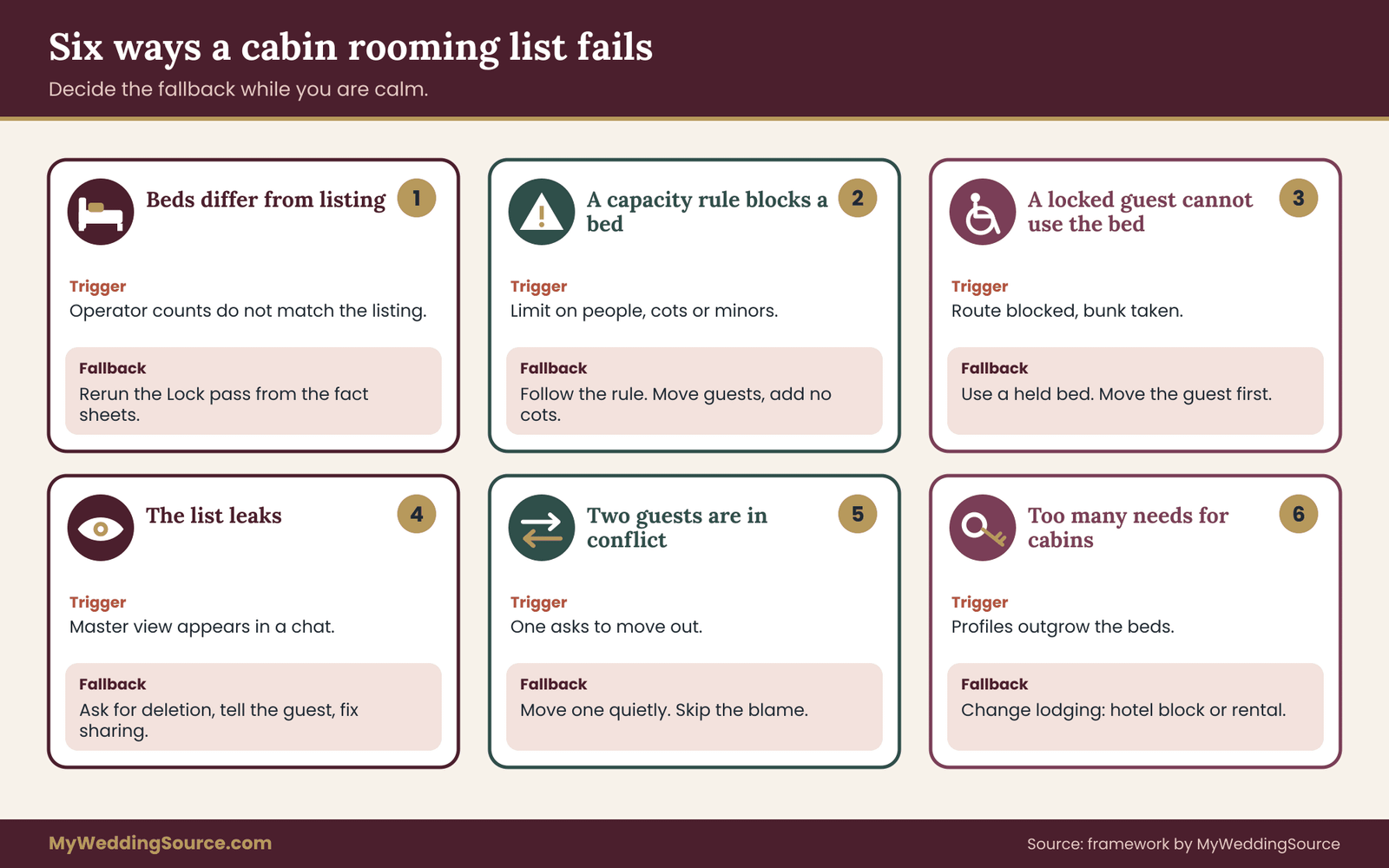
A plan is only trustworthy if you know what would break it. Here are the failure conditions worth watching, each with a trigger and a fallback. The idea is to decide in advance, when you are calm, what you will do.
Failure one: the beds are not what the listing said
Trigger: the operator’s written bed counts differ from the listing, or the cabin has fewer usable beds than posted, or a cabin is out of service. Fallback: go back to the cabin fact sheets and rerun pass one. Locked guests keep their cabin if the access features still fit. If not, you may need a replacement cabin, a lodge room or an off-site option for the affected guests. Ask the operator for a written statement of what they can provide.
Failure two: a capacity or safety limit blocks a placement
Trigger: an operator, fire authority or county rule limits the number of people in a cabin, bans cots or air mattresses, or restricts how minors and adults may share.
Fallback: do not work around the rule. The limit is there for people’s safety, and overnight capacity in particular is set by someone with the authority to set it. Move the extra guests to another cabin or lodging. The National Park Service and other land managers publish their own camping and group-use rules, and a site on public land may carry rules of its own. Ask the operator which authority sets the limit and get the answer in writing.
Failure three: a locked guest cannot use the bed
Trigger: a guest arrives and the arrangement does not work: the step-free route is blocked, the lower bunk is taken, the bathroom is out of order. Fallback: the open-bed reserve and the coordinator. Move the guest first and ask questions afterward. Never ask a guest with a need to try again later or to make do. If no suitable bed exists, a motel with a ride may be a better answer than a poor night in the wrong bed.
Failure four: the cabin rooming list leaks
Trigger: the master view appears in a group chat, a guest sees another guest’s need code or someone posts a photo of the door list. Fallback: contact the person who shared it, ask them to delete it, and check who else saw it. Tell the affected guest directly and plainly, apologize without excuses and ask what they would like done. Fix the process: change the sharing settings, remove extra viewers and reissue the guest views. A leak handled quickly and honestly is usually forgiven. A leak that is ignored is not.
Failure five: two guests in conflict share a cabin
Trigger: a guest tells you they cannot share with someone they did not know would be there, or a dispute breaks out. Fallback: move one of them, quietly, to an open bed. Do not ask who is at fault. If the conflict involves safety, take it seriously, involve the camp’s staff if appropriate, and put the guest’s safety ahead of convenience.
Failure six: too many needs for the cabins
Trigger: the Sleep Profiles reveal more access, privacy or medical needs than the cabins can serve. Fallback: change the lodging, not the guests. Add a hotel block, a rental or a split plan. Comparing options by cost, route and access works for guests who cannot be housed on site.
A pre-mortem for the cabin rooming list in twenty minutes
One useful habit is to run a short pre-mortem a few weeks before the wedding. Sit with your coordinator and imagine it is Saturday morning and the cabin plan has gone wrong. What happened? Write three likely causes, and for each one write the first thing you would do. You will usually find that the answers are the same few: a bed that was not what it seemed, a late change with no slack, and a piece of private information in the wrong place. Then check that your cabin rooming list already covers them.
Weekend-of operations for your cabin rooming list
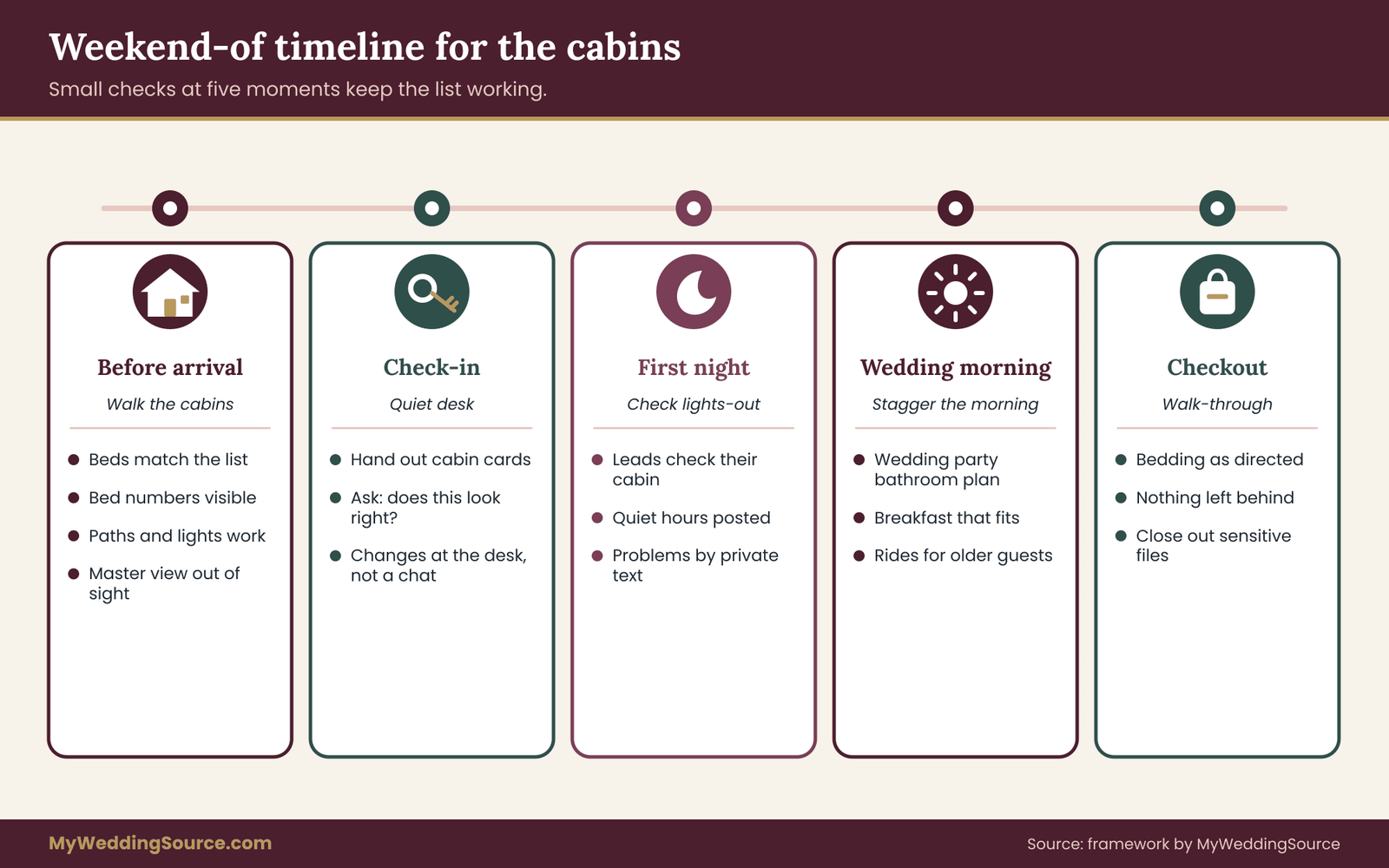
The rest of the work takes place on arrival day. A few small steps turn a good cabin rooming list into a good experience.
Before guests arrive
Walk the cabins with the operator or the lead. Check that beds match the cabin rooming list, that bed numbers are visible, that lights work, that paths are clear and that any accessibility feature is where it should be. Make sure that each cabin has a copy of the cabin view, face down or in an envelope, and that the master view is not in a place where guests will see it.
Set up a simple welcome: a card for each household, a map, the schedule, a number to call for problems and the name of the cabin lead. A site walkthrough with a tape measure and a checklist applies to cabins as much as to ballrooms.
Check-in
Have a person at the lodge who knows the plan and can answer questions quietly. A guest who needs a change should be able to ask at a desk, not in a group. If you can, hand out the cabin card in person and ask: “Does everything look right?” That question catches problems before bedtime.
The first night
The first night decides whether the arrangement works. Ask the cabin leads to check in with their cabins before lights-out, and to tell the coordinator if anyone has a problem. A quiet text rather than a group message keeps it private. Quiet hours should be agreed and posted, and neighbors should know which cabins are quiet cabins.
The morning of the wedding
Plan a staggered use of bathrooms and a schedule for the wedding party. The cabin plan can help here: the bridal party cabin should have a quiet start, a bathroom that is free early and a plan for breakfast that does not depend on the lodge opening late. Remind guests where the shuttles or paths are and when the ceremony starts, and make sure older guests have a ride.
The last night and checkout
Ask each cabin lead to do a simple walk-through at checkout: bedding as directed, nothing left behind, damage reported. Check the operator’s checkout time, and do not assume that guests will read it. When the weekend is over, close out the master view as described earlier, and keep only what you need.
Your next steps
Start with the facts. This week, ask the operator for a written fact sheet on every cabin: true beds by type, bathrooms, steps, outlets, maximum occupancy and any rule about minors or mixed groups. Next, write your Sleep Profile with six questions and a short list of need categories, and add it to the lodging section of your website or your RSVP.
Then set your codes, your three views and your swap rule. Decide who your coordinator is and give them the key. When responses come in, run Lock, Link and Loosen in that order, hold at least two beds in reserve and send assignments with a clear deadline for requests.
Finally, run the twenty-minute pre-mortem, walk the cabins before guests arrive, and delete sensitive information after the wedding. A calm cabin rooming list is mostly the result of a few decisions made early and kept private.
FAQ
What is a cabin rooming list and who needs one?
A cabin rooming list is a document that assigns each guest or household to a specific cabin and bed, with notes on needs and pairings. Anyone hosting a wedding where guests sleep in shared cabins at a camp, retreat or lodge benefits from one. It helps you match people to real beds, meet access needs and show the operator a clear roster.
How far ahead should I build the cabin rooming list?
Start collecting Sleep Profiles as soon as lodging details go out, and build the cabin rooming list after your RSVP deadline and the operator’s confirmation of bed counts. Most operators want a roster some weeks before arrival, so work backward from that date and leave time to chase answers and handle late changes.
Should the cabin rooming list be shared with all guests?
No. Share the least that each reader needs. Guests see their own cabin, bed and cabin mates. Cabin leads see their cabin only. Only you, your partner and one coordinator see the full list. A single shared list exposes needs and relationships that guests did not agree to share.
How do I ask about medical or mobility needs without prying?
Offer a short list of room needs, such as step-free access, a lower bunk, a nearby bathroom, an outlet or a quiet cabin, and let guests tick what applies. Say plainly that you only need to know what the room must provide, not why. Record the need as a code and delete the details after the weekend.
What if a guest asks not to share with someone?
Say yes without asking why, and keep the request out of any shared document. Note it as a single code on the master cabin rooming list and hold the names of the pair in a private note with one person. Place the two in different cabins and give neutral reasons if anyone asks.
Is it fine to put couples and families in separate cabins from singles?
It is usually practical, and many guests prefer it, but ask first and check the operator’s rules about who may share. Do not assume that every adult wants a particular arrangement. Offer a cabin organized by sleep rhythm or by household as a neutral option, and let guests tell you what they prefer.
How many beds should I keep open?
Hold at least two beds in different cabins if the camp allows. They absorb late RSVPs, cancellations, sleep problems and a guest who needs to move. Place them where a person can move without disturbing a locked household, and do not announce them. If your agreement charges for unused beds, weigh that cost against the flexibility.
What should I do if the operator’s capacity rules limit my list?
Follow them. Capacity, cot and minor-sharing rules exist for safety and are set by the operator or a local authority. Ask for the rule in writing, then move the extra guests to another cabin, a lodge room, a nearby rental or a motel with a ride. Do not add beds or cots that the operator has not approved.
Sources
- National Park Service
- U.S. Forest Service
- U.S. Fire Administration, Federal Emergency Management Agency
- National Fire Protection Association
- ADA.gov, U.S. Department of Justice Civil Rights Division
- U.S. Access Board
- American Camp Association
- Centers for Disease Control and Prevention
- Federal Trade Commission, protecting personal information
- American Red Cross