
A boat charter for a wedding is a rental of a vessel, a captain and a crew, and the contract is the only place where you find out what you really bought. This guide walks through the crew, insurance and contract questions to settle before you pay a deposit, with a document checklist, a worked example and a clear list of conditions that should end the conversation.
Treat the boat charter as three separate questions. Who is legally in charge of the vessel and its passengers (the captain’s credentials and the operator’s licensing)? What is the vessel allowed to carry and do (its capacity, inspection status and route)? And who pays if the day goes wrong (insurance, weather and cancellation terms)? Ask for the documents that answer each one, check them against the contract line by line, and use a simple test for every promise: a written line, a named proof and a stated remedy. If any of the three is missing, the promise is only a hope.
A boat feels like a venue, but legally and practically it is closer to a small transport company that happens to serve cake. The deck moves, the guest count has a hard ceiling set by the vessel rather than by the fire marshal’s room chart, and the person at the helm can end the trip for safety reasons no matter what you paid. Those facts shape every clause in a boat charter contract, and they are why a standard venue agreement does not fit.
Most couples meet the boat charter through a friendly sales call and a PDF proposal. The proposal usually lists the hours, the route, the price and a few attractive extras. What it often does not list is the operator’s legal status, the vessel’s rated capacity, the insurance behind the boat charter, or what happens when the wind decides the schedule. This article is about those gaps.
The aim is not to turn you into a maritime lawyer. It is to give you a method that works on any boat charter, from a small harbor cruiser to a larger event vessel, so you can read a contract with a clear idea of what should be in it and what is missing. You will see a document packet, a three-column scope test, a worked case with an invented couple, and a short list of failure conditions.
A note on scope. This is general information, not legal, insurance or financial advice. Vessel rules, alcohol law and liability differ by state, waterway and vessel, so confirm the details with the Coast Guard, your state agency and a qualified professional before you sign.
What a boat charter contract has to settle
Every boat charter contract, however it is formatted, has to answer the same set of questions. If you keep them in mind, a thirty-page agreement and a two-page agreement become easier to compare, because you are looking for the same answers in different places.
Who the parties are. The legal name of the company that owns or operates the vessel, which may differ from the brand name on the website. A booking agent or broker may sit between you and the operator, and the contract should say which one you are paying and which one is responsible for the trip.
What vessel and what service. The vessel’s name and identifying details, the departure and return points, the route or area, the hours, and the number of passengers the vessel may carry. A contract that says “a yacht” without naming one leaves the boat charter operator free to substitute a different boat.
Who is aboard. The captain, the crew, any bartender or event staff, and who supplies each of them. This is where crew questions belong, and a later section covers them in detail.
What it costs and when. The base rate, what drives the rate up, deposits, the payment schedule, taxes, fuel, dockage, gratuity and any overtime. The wedding cash-flow planning guide explains how to place these dates on a calendar so a final balance does not arrive as a surprise.
What happens when plans change. Weather, mechanical failure, a late boarding, a guest count change, a date change by you or a cancellation by the operator.
Who is responsible for harm. Insurance, indemnity, waivers, damage to the vessel and rules for guest conduct.
Why the contract matters more than the proposal
A proposal is a sales document. It is written to make the boat charter appealing, and it is usually not part of the legal agreement unless the contract says so. Many contracts include a clause stating that the written agreement is the whole deal and that earlier emails, calls and brochures do not count. That clause is common and reasonable, but it has a consequence: anything you were promised verbally or in a proposal has to be copied into the contract or it may disappear.
A useful habit is to read the proposal first, list every promise you care about, and then check whether each one appears in the boat charter contract. If the proposal says the trip includes a sunset loop, a bartender and ten minutes of dock time for photos, but the contract only says “three-hour charter,” you have found three promises that need a line each.
The boat is not the whole product
Couples sometimes compare charters by looking at pictures of the boat. The boat matters, but the service around it matters more: the quality of the crew, the clarity of the safety briefing, the operator’s habits about arrival time and the way the staff handle a missed boarding or a seasick guest. None of that appears in a photo gallery, and most of it should be visible, in some form, in the documents you request.
This is also why the wedding vendor contract guide is a useful companion. It covers the general clauses that apply to every vendor, such as deposits, force majeure and change orders. The charter version adds the vessel-specific layer on top: capacity, credentials, inspection, insurance and weather.
Three kinds of boat charter and who is in charge
The word “charter” covers several different arrangements, and the differences change who is legally responsible for the boat charter. Before comparing prices, find out which kind you are being offered.

Captained boat charter
In a captained boat charter, the operator supplies the vessel, the licensed captain and usually at least one crew member. You rent the use of the boat for a set period. The captain is in command, and the boat charter operator is responsible for operating and maintaining the vessel. This is the arrangement most weddings use, and it is the one this guide assumes unless it says otherwise.
The practical effect is that you are a customer, not a skipper. You decide the guest list and the program, within limits, and the captain decides everything that touches safety: when to leave the dock, where to go, how many people may be on deck and when to turn back.
Bareboat charter
A bareboat charter hands you the vessel without a crew, and you or someone you appoint takes responsibility for operating it. That is common for leisure sailing and almost never right for a wedding with guests, because the person in command becomes personally responsible for the passengers, and a wedding is a poor time to learn a new vessel. The Coast Guard publishes information on how bareboat arrangements are treated, and the rules for carrying passengers differ from those for a captained trip.
If anyone proposes one for a wedding, ask them to explain the rule in writing and check it with the Coast Guard.
Ticketed or shared trip with a private block
Some operators run scheduled cruises and sell part of a trip to a private group. A wedding on such a trip may share a deck with other passengers, follow a fixed route and have no say over the schedule. That can work for a small ceremony or an after-party, but the contract will read more like a group booking than a private charter, and the privacy, music and alcohol terms often differ.
Venue vessel with an event team
A third kind of arrangement is a vessel that is moored or docked and used mainly as a floating venue, with an in-house catering and events team. It may leave the dock only briefly or not at all. Moored vessels bring a different mix of rules, including dock access, mooring permissions and occupancy, and they sometimes fall outside the passenger-vessel framework that applies to a vessel under way. Ask the operator exactly which rules they say apply and who inspects them.
A quick decision rule
Use this rule before you invest time in a quote. If the vessel will be under way with guests, you want a captained charter from an operator who can show current credentials and inspection papers. If it will stay at the dock, you want the venue’s written statement of occupancy and its permission to host events. If you are being asked to sign as the person in charge of the boat, step back and ask why.
Who is in charge of what
Put plainly, there are three authorities aboard a chartered boat. The captain controls navigation and safety. The operator controls the vessel, the staff and the commercial terms. You control the event program, within the limits the other two set. Disagreements usually arise when a couple assumes they control more than they do, for example by assuming they can add ten guests on the day, extend the trip by an hour or move the route to catch a better sunset.
A well-written boat charter contract names these boundaries. It says the captain has final authority over safety decisions, it describes what the couple can change and by when, and it explains how fees apply when the couple asks for a change. Contracts that leave the boundaries vague are not necessarily bad, but they leave you guessing at the worst possible moment, which is on the water with forty guests and a deadline.
The sections that follow take each authority in turn: the crew first, then the vessel’s papers, then insurance, money, weather and the rest. If you are still choosing between a boat and a land venue, the wedding venues guide covers the wider comparison, and this guide picks up once a boat charter is on the table. ## Crew questions for a wedding boat charter
Crew is the part of a boat charter couples understand least and ask about last. It is also where small gaps cause the most trouble on the day, because the people aboard are the only safety system between your guests and the water.
The captain
Ask for the captain’s name or, if the boat charter operator rotates captains, for the operator’s written statement that every captain who may be assigned holds the credential the boat charter requires. In the United States, the Coast Guard issues the Merchant Mariner Credential that licensed captains carry, and the type of credential depends on the vessel and the number of passengers. You do not need to memorize the categories. You need a document, or an operator statement, that says what credential the captain holds and that it is current.
A good boat charter contract says that the vessel will be operated by a captain holding the credential required for the vessel and route. A weak one says only “licensed and insured,” which tells you almost nothing because it does not say licensed for what.
Ask a second question about relief. On long evening charters the captain may be limited in the hours they can work, and the operator may need a second licensed person. If your trip runs past the normal length, the contract should say who staffs it and whether the extra cost is yours.
The rest of the crew
Besides the captain, a vessel usually carries deckhands or mates who handle lines, boarding and the safety equipment. The number is set by the vessel’s inspection papers or by the boat charter operator’s own rules, and it can rise with the number of guests. Ask three things: how many crew will be aboard, what their role is in an emergency, and whether the crew count is fixed in the contract or left to the operator’s discretion.
This matters because crew members are not event staff. A deckhand who spends the evening helping guests step across a gap or watching a loose railing cannot also carry trays. If you are expecting a hosted experience, you need separate people for it, and the contract should say whether the operator supplies them.
Event staff, bartenders and servers
Many operators offer a bartender and a server as part of a package. Others require you to bring a licensed caterer. The contract should say who they are, who employs them, who carries their insurance and what authority they have to refuse service. The wedding bar service planning guide covers the questions to ask about bar staff in general, and a boat adds a few, such as whether bar staff are trained to deal with guests who are unsteady on a moving deck.
A particular point to settle is who counts as crew and who counts as a passenger. A photographer, a musician or a coordinator aboard for the day is generally a person on the vessel. Whether they count against your guest limit depends on the vessel’s papers and the operator’s rules, so ask the boat charter operator to say it in writing instead of assuming.
The safety briefing
Passenger vessels commonly give a safety briefing before departure. Ask whether the operator gives one, who delivers it, how long it takes and where it falls in your timeline. Couples sometimes plan a boarding at the minute the music starts and then discover that the briefing needs five or ten minutes while guests are holding drinks and talking. Build the time in, and tell your guests the boat will start with a brief safety talk so they do not read it as a delay.
You can also ask where life jackets are stored, how many there are, whether child sizes are carried and who shows guests how to put them on. Coast Guard requirements for life-saving equipment depend on the vessel, and the operator should be able to tell you what applies to theirs.
Alcohol, drugs and the crew
Commercial crews on passenger vessels are generally subject to drug and alcohol rules, and the operator should be able to explain how it handles them. This is not an accusation. It is a normal question, and a professional operator will answer it without discomfort. Be wary of an boat charter operator who jokes that the crew will happily have a drink with your guests. A crew that drinks on duty is a risk to everyone aboard.
What to say when you ask
Many couples feel awkward questioning a captain’s credentials. A calm script helps. You might write: “We are putting our guests in your care for an evening, so we would like to understand the crew side. Could you confirm in writing the captain’s credential, the number of crew aboard and who handles the safety briefing?” That sounds ordinary, and a reputable operator will have an answer ready, often in a standard document.
Vessel documents: capacity, inspection and safety gear
If crew is who is aboard, the vessel’s documents say what the boat is permitted to do. These are the papers that most clearly separate a well-run charter from a risky one, and they are easy to request.

Passenger capacity
The most important number in any boat charter is the maximum number of passengers the vessel may carry. For an inspected passenger vessel, that figure is set by the Coast Guard and appears on the vessel’s Certificate of Inspection. The number is not a marketing figure and it is not negotiable. It may also differ by route, season or conditions, so a boat rated for a larger number on a protected harbor route may carry fewer on open water.
Do not accept “it fits sixty for dinner” as a substitute. Ask for the passenger limit for your route and date, and ask how the operator counts infants, children, crew, staff and vendors. A common problem is a guest list of exactly the maximum plus a photographer and a DJ, leaving the captain to turn someone away at the dock. Land venues have the same split between a legal ceiling and a comfortable layout, and it applies on a boat too: the legal limit sets the top, and deck space, seating and restrooms set the comfortable number, often lower.
The certificate of inspection
Vessels that carry more than a small number of paying passengers are generally required to be inspected by the Coast Guard and to hold a Certificate of Inspection, which is normally posted on board. It states, among other things, the number of passengers allowed, the routes or waters covered and the minimum crew. Smaller operations may carry only a few passengers under different rules, and those boats may be uninspected, which is not the same as unsafe but does mean the capacity ceiling is lower and different rules apply.
Ask the operator for a copy or photo of the current certificate and check three details: that the vessel name matches the boat charter contract, that the date is current and that the passenger count covers your guest list. Then ask which route the certificate allows, because a route limit can quietly rule out the open-water sunset you were promised.
If the operator says the vessel is not required to hold the certificate, ask them to explain why, and check with the Coast Guard or the agency that handles passenger vessels in your area. The Coast Guard site lists local offices and general guidance, and it is the right place for a neutral answer.
Vessel identification and substitutions
The contract should name the vessel and say what happens if it is unavailable. A substitution clause that lets the boat charter operator provide “a similar vessel” is common, but it can swap a boat with a covered dining deck for an open one, or a larger boat for a smaller one. If the vessel matters to you, ask for a clause that limits substitution to a vessel of equal or greater capacity with similar features, with your approval, and with the right to cancel and receive a refund if you decline.
Safety equipment and accessibility of the vessel
Ask what safety gear is on board and how it is organized: life jackets by size, life rings, a first aid kit, fire equipment and a working radio. You are not inspecting the boat, and you cannot judge the equipment from a brochure. You are listening to how the operator answers. A confident answer with specifics suggests a prepared operation. A vague answer suggests the opposite.
Also ask how the vessel handles guests with limited mobility. Boarding often means a gangway, a step and a gap, and interior spaces may include narrow stairs between decks. The accessible wedding venue red flags guide lists what to look for in any venue, and a later section here covers boarding and accessibility for boats in particular.
The documents you should hold before signing
A short list of papers makes the rest of the review easier. You will see it again later as a checklist, but it helps to meet it here.
- The operator’s legal business name and the vessel name.
- A current certificate of inspection, or the operator’s written explanation of why none is required.
- A statement or copy of the captain’s credential.
- A certificate of insurance that names you, covered in the next section.
- The written cancellation, weather and substitution terms.
- The boat charter operator’s alcohol policy and any permit that applies to it.
- The route, the departure and return points and the written schedule.
Gathering these takes a few emails. Operators who run a clean business usually have them in a folder and send them the same day. An operator who is reluctant or slow is giving you information too, and it belongs in your decision.
What the documents cannot tell you
Papers show that a vessel meets its legal minimums on the day they were issued. They do not show how the operator behaves when a guest is ill or the weather changes. Reading recent customer reviews, asking for references from event clients, and visiting the vessel at the dock are all useful. A short visit lets you check boarding, deck space, restrooms and how the crew treats visitors. The wedding vendor due diligence checklist explains how to run those checks without becoming an investigator. ## Insurance questions in a boat charter
Insurance is the most misunderstood part of a boat charter, partly because the word covers several different policies and partly because couples assume the operator’s insurance protects them in ways it may not. A few precise questions clear most of the confusion.
Who is insured, and for what
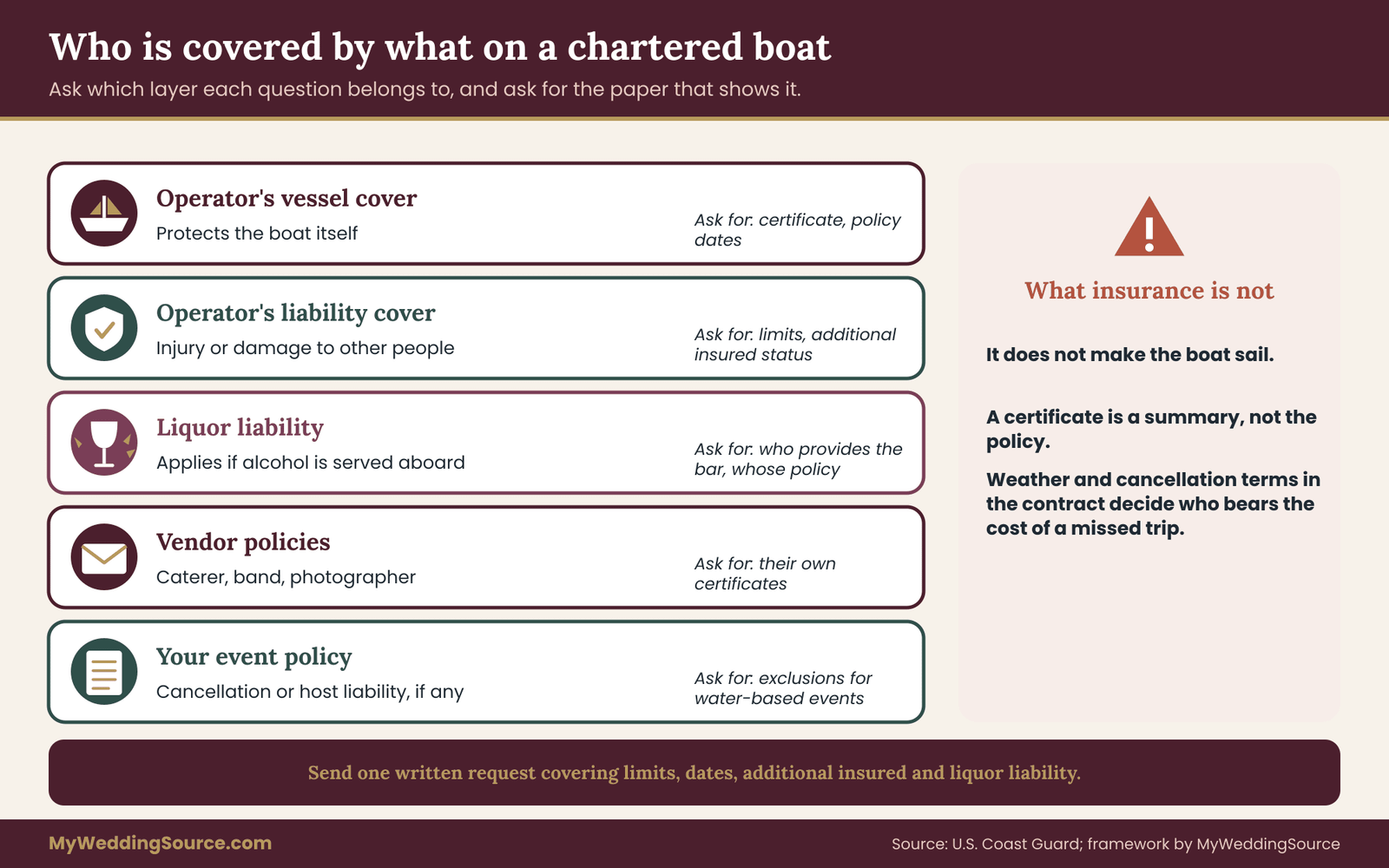
A commercial operator generally carries insurance on the vessel itself (often called hull coverage) and liability coverage for injuries or damage to other people. Marine liability policies are written differently from ordinary property and general liability policies, and the terms vary a great deal. You do not need to understand the policy form. You need to know what the boat charter operator will show you and whether you are protected as the party hosting the event.
Ask the operator for a certificate of insurance, a standard summary document that the operator’s insurer or broker issues. It names the insurer, the type of coverage, the policy period and the limits. A certificate is a summary, not the policy, and it does not change what the policy covers. It does show that the coverage exists on the date of your trip, and that is the first thing to verify.
Additional insured and why couples ask for it
Many contracts and venues ask that the host be named as an additional insured on the operator’s liability policy for the event, which can extend some protection to the host if a guest is injured and a claim names the host. Whether an boat charter operator can add you, and whether the policy responds the way you expect, depends on the policy. Ask whether the operator will name you, ask for the certificate showing it, and then keep the document with your contract.
You can also ask whether the operator’s policy includes liquor liability, which matters if alcohol is served aboard. If the operator provides the bar, the question is whether the boat charter operator’s insurance covers it. If you bring alcohol or a caterer does, the question moves to the caterer’s policy and your own. Host-liability questions deserve their own read of the bar and caterer contracts.
What your own insurance may and may not do
Event insurance for couples is a separate product. Some policies cover cancellation for specified reasons, some cover liability for the host, and some exclude water-based events or specific activities. Read the exclusions before relying on a policy for a boat charter, and ask the insurer in writing whether a boat charter vessel is covered. Do not buy a policy based on a salesperson’s assurance in a phone call.
It is worth remembering what insurance is not. It does not guarantee that the boat will sail, and it generally does not cover a cancellation because the weather was uncomfortable or a guest changed their mind. The contract’s weather and cancellation clauses, covered later, decide that. Insurance is a backstop for specified losses, not a replacement for a clear contract.
Waivers, releases and indemnity clauses
Charter contracts often include a release that asks you and your guests to accept some risk, and an indemnity clause that asks you to cover the operator’s losses arising from your guests’ behavior. These clauses are common. Read them carefully, because they can shift cost to you in ways that are easy to miss.
Look for three things. First, whether the indemnity is limited to losses caused by you or your guests, or whether it also covers losses caused by the operator’s own negligence. Clauses that try to shift the operator’s own negligence to the customer may not be enforceable in every place, but you should not rely on that, and you should ask for them to be narrowed. Second, whether guests are required to sign a waiver before boarding, and how that is handled for guests who arrive late or refuse.
Third, whether damage to the vessel caused by a guest is billed to you.
A qualified attorney can review these clauses for a modest fee, and for a boat charter that costs a meaningful amount it is often worth doing. This guide cannot tell you whether a clause is enforceable in your state.
A scripted way to ask
Insurance conversations get awkward quickly. A short written request keeps it factual:
“Please send a current certificate of insurance for the vessel and the trip, including the liability limits and policy dates. Could you also tell us whether we can be named as an additional insured for the event, whether liquor liability applies if alcohol is served, and who is responsible for damage caused by guests?”
That message asks four things in plain language and leaves a written record. An boat charter operator who answers it clearly is showing the kind of transparency you want.
Insurance red flags
Some answers should slow you down. An operator who says insurance is “taken care of” without sending a certificate is asking you to take it on faith. An operator whose certificate shows a policy period that ends before your date has an expired policy for your event. A certificate that names a different company than the one on your contract may mean that the boat charter runs through an affiliate or a separate vessel owner, and you should ask how the coverage connects.
Finally, a very low price can reflect low coverage. You cannot see the policy from the price, but you can see whether the operator will answer questions about it. When they will not, pay attention.
The money clauses of a boat charter
The next block of clauses is financial, and it rewards a slow read. Most disputes between couples and charter operators involve money: a fee that was not expected, a balance due earlier than planned or a deposit that was not returned.
Rate structure
Ask what drives the rate. Some operators charge a flat price for a fixed block of time, others charge by the hour, and others use a minimum charge with additional hours billed on top. Peak dates, holidays, evening departures and longer routes may raise the price. Ask whether the quote already includes the crew, fuel, cleaning, docking fees and taxes, because any of these can be billed on top.
A written quote that lists “all-in” in the proposal but “plus fuel and gratuity” in the contract should send you back to the boat charter operator for a corrected total. You want a single number that you could pay if nothing unexpected happens, and a clear list of what could add to it.
Deposits and the payment schedule
Most charters take a deposit to hold the date and set a schedule for the balance. Ask for the exact amounts and dates in the contract, and place them on your calendar. Ask which parts are refundable, and under what conditions. A retainer and a deposit can be treated differently, and the idea applies here: some operators label the first payment a non-refundable booking fee, and others call it a deposit that is returned in specific cases. The label matters less than the written conditions.
Pay with a method that leaves a record. A credit card gives you a dispute process through the card issuer, and the Consumer Financial Protection Bureau explains how billing disputes work and the deadlines that apply. A debit transfer or a cash payment offers fewer protections and gives you less to point to later.
Overtime, delays and the clock
The charter clock is a frequent source of disagreement. Ask when the clock starts and stops: at boarding, at departure or at the first line cast off. Ask what happens if guests are late, and who decides when to cast off. Ask for the overtime rate and who authorizes it. On a moving vessel, extra time can be limited by the crew’s working hours, fuel, the tide or a prior booking.
A calm way to avoid conflict is to build slack into the plan rather than trusting the clock. If the contract gives you a three-hour charter and the ceremony, dinner and photos need two and a half hours, you have no room for a late guest. The timeline article on this site, the wedding vendor timeline guide, explains how to give each vendor a buffer, and the same logic applies on the water.
Gratuity, service charge and extras
Gratuity practice varies. Some operators add a service charge, some suggest a percentage and some leave it to you. A service charge is typically part of the price and may or may not go to the crew, while a gratuity is discretionary. If the contract uses either word, ask which it is and how it is distributed.
Refunds and credits
Spell out how money returns if something goes wrong. If the operator cancels for weather or mechanical reasons, do you get a refund, a credit or a new date? If a credit, does it expire, and is it transferable? A refund in full within a stated number of days is clearer than a promise to “work with you.” If the operator offers a credit, ask for the expiration date and whether it can be used for a different kind of event.
A tracker helps. Keep a one-page sheet listing each payment, its date, its method, the amount, whether it is refundable and the contract clause that says so. The same sheet makes a dispute much simpler if you ever need one and is easy to keep inside your budget file. ## Weather, delay and cancellation in a boat charter
Weather clauses decide who carries the cost when the sky does not cooperate, and on a boat they work differently from a land venue. A tent can be rented for rain. A vessel cannot sail through conditions the captain judges unsafe, and the decision belongs to the captain.

The captain’s authority
Nearly every charter contract says that the captain has final authority over whether the vessel leaves the dock, changes route or returns early. That is correct, and you should not try to negotiate it away. A captain who can be pressured into sailing is a captain you do not want. What you can negotiate is what happens to your money and your event once the captain makes the call.
Read the clause for three things: who decides, by what time, and what each outcome costs. Some operators decide a set number of hours before departure, others decide at the dock. A decision at the dock leaves you with guests in formal clothes and a cake in a van, so ask for an earlier decision point, and for a fixed time when the operator will tell you whether the trip is likely to go.
The four outcomes to define
A useful boat charter contract names what happens in each of four situations, and you can use these as a test of any draft.
- Go as planned. The trip runs on the boat charter contract terms.
- Modify. The trip runs with changes, such as a shorter route, a protected harbor loop or a dockside event, with a defined effect on the price.
- Delay. The departure moves later, within a window, with an agreed limit on how long the boat charter operator will wait.
- Cancel. The trip does not run, with a defined refund, credit or reschedule.
Many contracts handle only the first and last. The middle two are where most real situations land. Ask the operator what the modified version of your trip looks like, whether it is available, and how it affects the cost and the catering.
What weather actually means
Contracts often use phrases such as “unsafe weather” or “adverse conditions” without defining them. The National Weather Service publishes marine forecasts and advisories, including small craft advisories, and the captain will usually rely on those and on local conditions. You cannot predict the call, but you can ask how the operator makes it and which sources they use.
Be careful with a clause that lets the operator cancel for weather but keeps your deposit and does not offer a new date. It may be lawful, and many are written that way, but it puts all the weather risk on you, so you should see it before signing, not after a forecast changes. Ask for at least a reschedule right with no new deposit, or a refund of everything but the actual costs the boat charter operator has already incurred.
Fog, wind, heat, and things that are not storms
Weather is not only storms. Fog can delay or cancel a trip, strong wind can make a deck uncomfortable without making the boat charter unsafe, and heat can make a long outdoor deck hard on older guests. The contract may treat these differently, and your plan should too.
A forecast of choppy water is a reason to think about seasickness and footwear, and a forecast of heat is a reason to plan shade and water. Choosing between a ceremony under way and one at the dock is a separate decision, but a ceremony can often move to the dock when the water is rough, and the contract should allow for that option.
Mechanical failure and other operator problems
A boat can fail for reasons that have nothing to do with weather: an engine problem, a damaged hull, a missing crew member or a scheduling error. Ask what the operator does in these cases. Strong contracts commit the operator to provide a substitute vessel of equivalent capacity or a full refund, and to cover reasonable costs. Weak contracts say only that the operator is not liable for delays.
Also ask about the boat charter operator’s own cancellation rights outside weather. If the operator can cancel for any reason with a refund of your deposit only, then your florist, caterer and photographer have been paid and you have not been compensated for their cost. You may not win that clause, but you should know it exists, and it is worth asking whether the operator carries a backup vessel.
Your own cancellation
Your rights should be written too. Look for a schedule that shows how much you owe if you cancel at various points before the trip. A typical structure gives you more back the earlier you cancel. If the schedule exists only in an email, ask for it to be added to the contract. If the date of the wedding might change, ask what a date change costs and whether it counts as a cancellation.
A weather plan outside the contract
The contract settles money. A plan settles the day. Write one page that lists the forecast check dates, who talks to the captain and when, the fallback for the ceremony and meal, the message to guests and the call times for vendors. A boat plan needs the usual contact list plus the operator’s dock number, the captain’s call time and the dock address with parking and boarding details.
Alcohol, catering and vendors on a boat charter
Food, drink, music and decor all work differently once they have to fit on a vessel. The contract should treat them as part of the boat charter, not as add-ons you sort out later.
Who supplies and serves alcohol
Alcohol rules depend on the state, the waterway and the boat charter operator’s license, and they differ widely. Some operators hold a license and provide the bar. Some allow you to bring your own beer and wine. Some prohibit outside alcohol entirely. Ask which applies, and ask for the policy in writing, including what happens if guests bring flasks or the bar runs out.
Ask who is allowed to serve, and whether they can refuse service. A bartender who can stop serving a guest who has had enough is part of your safety plan, not a nuisance. On a moving boat, someone who falls or goes overboard is a more serious problem than on a dance floor, and operators know it. The contract should say that the operator or crew can refuse alcohol to anyone, and you should agree to it in advance so it is not a surprise.
Also consider timing. Some operators stop serving a set time before the boat returns to the dock. That makes sense, and you can plan for it by scheduling the last toast and the cake before the final stretch.
Catering and kitchen limits
A vessel’s galley, if it has one, is small. Many charter operators allow outside caterers but limit what they can do on board. Ask whether cooking is permitted, whether there is refrigeration, what power is available and where staff can stage food. A plated dinner for fifty may be impossible on a boat where a buffet or stations are workable, so match the menu to the vessel, not the other way.
Ask about loading. Food comes aboard at a dock, often by hand, often by gangway. Sauces, cake and hot items all travel poorly across a moving gap. The same logic applies as with any rental: measure the route, find out who carries what, and give each vendor a time. Ask whether your caterer needs to give proof of insurance to the operator, and who cleans up.
Music, sound and neighbors
Many harbors have noise rules, and a boat that carries amplified music past homes or other vessels can draw complaints. Ask what sound equipment is allowed, whether you may bring a speaker or a DJ, and whether there is a volume limit. Also ask whether music must stop at a set time, which can matter on routes near residential waterfronts.
Power is another limit. Boats vary in how much electricity they supply, and a DJ rig or a bank of lights may need a generator or a battery. The contract should say what is provided and who is responsible for any equipment you bring.
Decor, candles and what stays off the boat
Operators usually restrict what you can attach to the vessel. Open flames are commonly prohibited, confetti and loose petals can end up in the water, and tape or tacks on finished surfaces can damage them. Ask for the decor rules in writing, and ask whether you can come early to set up, since the boat may have a prior booking. Decorations that blow away become marine debris, so plan for weights and enclosed arrangements.
Photographers, officiants and other vendors
Each person who comes aboard needs to be counted, boarded and briefed. Ask whether your photographer may move freely on deck, whether a drone is permitted and whether the officiant needs a place to stand that is out of the crew’s way. Whoever officiates needs a spot out of the crew’s way, and a boat adds the question of whether the ceremony can happen while the vessel is under way or only at the dock.
Keep vendors from becoming the weak point
A single contract with a boat operator does not govern your other vendors. Each one needs its own agreement that mentions the vessel, the access time and the loading route. The wedding vendor purchase order checklist is a good way to confirm that every vendor has the same version of the boat details, and it helps you spot a vendor who has priced for a land venue. ## Guests, accessibility and boarding on a boat charter
Once the operator side is clear, the next question is what the boat charter is like for your guests. A boat charter asks more of guests than a ballroom does, and the contract and the plan should reflect that.
Boarding is the hardest minute
Boarding usually happens over a gangway or a gap between the dock and the deck, sometimes at a floating dock whose height changes with the tide. Guests in heels, guests with canes or walkers, and guests carrying children or gifts face real risk at this point. Ask the boat charter operator how boarding works, whether crew assist, whether a ramp is available and whether the slope changes with the tide.
Plan the boarding as a process, not an event. A short line, a named person at the dock with a guest list, an order of boarding that puts guests who need more time first, and a clear pickup point for late arrivals all reduce stress. Tell guests in advance what to wear on their feet. A short note on the wedding website, such as “soft-soled shoes recommended for the deck,” saves a lot of trouble and some twisted ankles.
Accessibility and the law
Passenger vessels may have accessibility obligations under federal law, and the Department of Justice and the U.S. Access Board publish guidance. The details depend on the type of vessel and its use, so do not assume that a boat is accessible, or that it is not. Ask the operator to describe, in specific terms, the route a wheelchair user would take from the dock to the main deck, whether there is an accessible restroom and whether the upper deck can be reached without stairs.
A good answer is concrete: widths, ramps, a lift, a seating area at deck level. A vague answer, such as “we have accommodated guests before,” is not enough. Written answers help, because you can share them with guests who need to plan. The usual accessibility questions for any space still apply, and a boat adds the gangway and the moving deck.
If the vessel cannot accommodate a guest who matters to you, consider a plan that keeps them part of the day: a dockside ceremony with the boat trip afterward, a shorter route, or a land-based welcome event before boarding. Those choices are easier before the contract is signed than after.
Children, older guests and anyone who may feel unwell
Children need life jackets that fit, and operators vary in how many child sizes they carry. Ask what is available, and tell parents whether to bring their own. Older guests may need a seat near the main deck and a clear route to the restroom. Guests who are prone to motion sickness benefit from a note about medication timing, which they should discuss with their own clinician, and from a seat near the center of the vessel, where motion is usually less noticeable.
Ask what the vessel does when a guest becomes ill. Is there a first aid kit, is any crew member trained in first aid, how fast can the boat return and what is the dock procedure for calling an ambulance? You are not planning for disaster, you are checking that the operator has thought about it. The wedding guest care planning guide offers a general approach to care for babies, children and older guests, and it fits a vessel with some adjustments for the water.
Restrooms and comfort
Vessel restrooms, called heads, can be small and limited in number. Ask how many there are, whether they are accessible, and whether the vessel has a holding tank limit that affects a long trip. Plan around them: a stop before boarding, a clear note about restrooms in the guest communication and a short break in the program so lines do not form at the worst moment.
Think about shade, wind and temperature. A deck in the evening can be cooler than expected, and a wrap, a jacket basket or a few blankets help. In summer, plan water and shade. These details are small, and they are what guests remember.
The guest list and the passenger count
You will need a final headcount well before the trip, and the operator will usually want it earlier than a land venue does. Ask when the final count is due, whether it can go down or up and what a change costs. Ask how plus-ones, children and vendors are counted. A late addition on the day may simply be impossible if the vessel is at its limit.
For seating, ask whether there is enough fixed seating for every guest at once. A vessel with room for sixty to stand may seat thirty at tables. If you want a seated dinner, the usable number is the seats, not the deck capacity. Plan a flow in which some guests stand and others sit while the bar and the buffet are open, and let the crew’s layout drive the plan.
Guest communication
A single, clear message does more than any clause. It should include the dock address, the boarding time and the cast-off time, which should be different and stated plainly; parking and shuttle details; what to wear on the deck; whether children are welcome; what the weather plan is and how guests will hear about it; and the return time. A boat benefits from a simple day-of text update plan more than most events do.
Photographs, privacy and the water
Open water brings its own photo rules. Drones may be restricted near harbors and other vessels, and some waterways have rules for aircraft. Ask whether any of these apply on your route. Also ask about phones and cameras on deck: the boat charter operator may ask guests to secure them near the rails. Anything dropped into the water is gone, and a ring, a phone or a camera can go with it. A short instruction to the wedding party about rings, and a pocket or lanyard for the person who carries them, costs nothing.
Putting guests first in the contract
Everything in this section can become a contract line. A boarding assist, an accessible route, a defined number of child life jackets, an agreed headcount deadline and a restroom count are all specific and checkable. When the operator agrees to them, ask for them in writing, either in the contract or in a signed addendum, so that the crew on the day knows what was promised. ## The operator documentation and scope checklist for a boat charter
Everything so far can be folded into one working tool. It has two parts: a packet of documents you ask for, and a scope test that you apply to each promise in the boat charter contract. Used together, they take an afternoon and turn a sales conversation into a decision you can defend.
The document packet
Ask the operator for seven items. A well-run business keeps these on file and can send them quickly.
- Business identity. The legal name of the operator, its address and the name of the vessel, so the contract, the insurance and the inspection papers all match.
- Inspection status. A current Certificate of Inspection, or a written explanation of the vessel’s status and the rules the boat charter operator says apply.
- Captain credential. A statement or copy showing that the captain or captains hold the credential required for the vessel and route.
- Certificate of insurance. A current certificate with liability limits, policy dates and, if available, your name as additional insured.
- Terms. The full written terms for cancellation, weather, substitution and refunds, including any schedule of fees.
- Alcohol and conduct policy. What may be served or brought aboard, who serves it and what the crew may refuse.
- Trip plan. The route, the departure and return points, the cast-off and return times and the planned boarding process.
Put the packet in one folder with the signed contract. If a document is missing, note the date you asked and what you were told. That note is as valuable as the document, because it records the operator’s answer.
The scope test: promise, proof, remedy
The scope test is a way to read the contract line by line. For every promise that matters to you, check three things.
Promise. Is there a written line that says it, in specific terms? “A bartender” is a weak promise. “One bartender supplied by the operator for the full charter period” is a specific one.
Proof. Is there a document or a named person that shows it will be true? A promise about capacity is backed by the Certificate of Inspection. A promise about insurance is backed by the certificate. A promise about a captain is backed by the credential. A promise about a sunset loop is backed by the route in the boat charter plan.
Remedy. What happens if the promise is broken? A refund, a credit, a price reduction, a replacement vessel or the right to cancel. If the contract is silent, the remedy is whatever the law would give you, and you would need to argue for it.
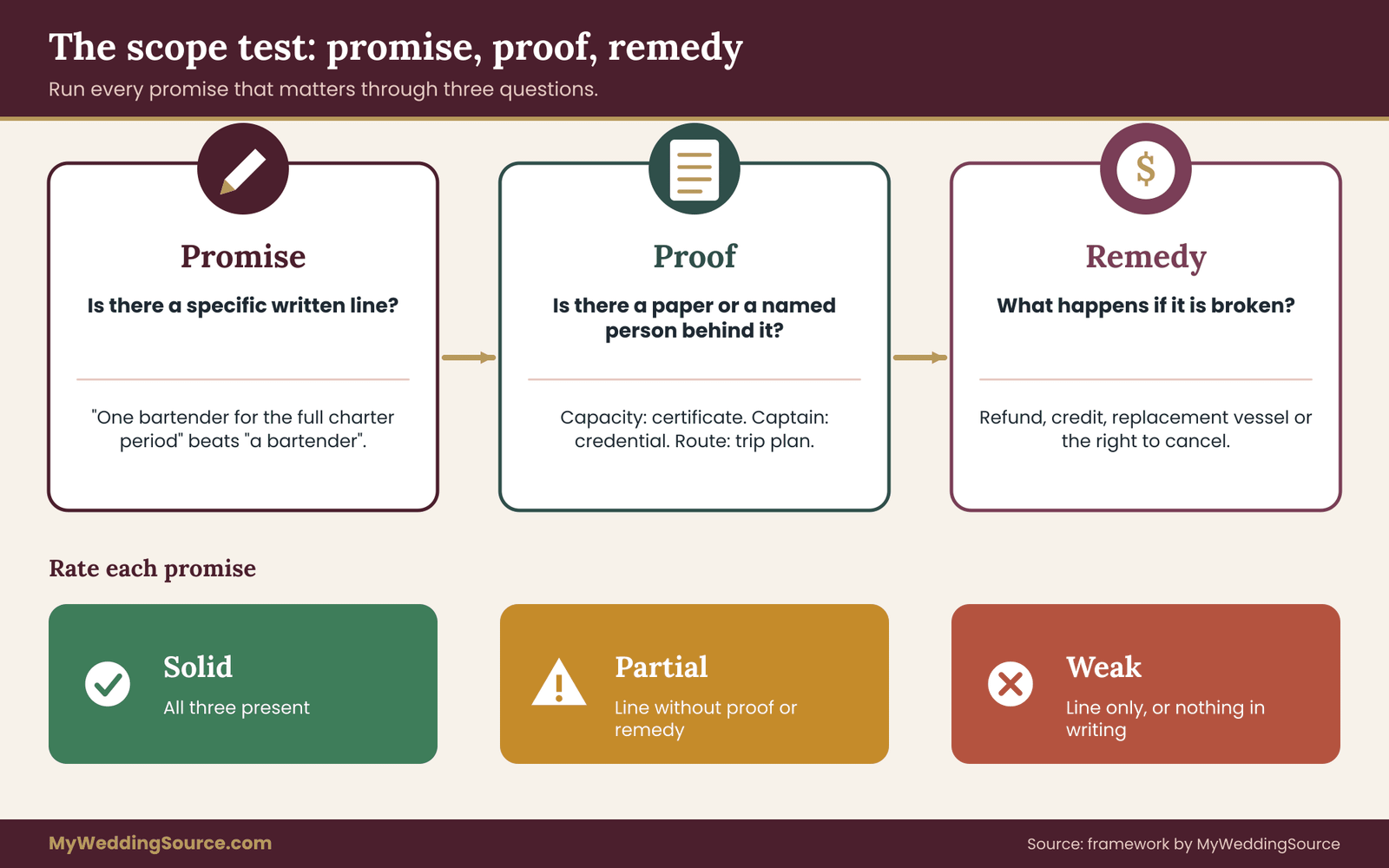
A promise with all three is solid. A promise with a line and no proof is a claim you cannot check. A promise with a line and proof but no remedy is one you cannot enforce cheaply. A promise with none of the three is only an expectation. Mark each of your key promises as solid, partial or weak, and ask the operator to fix the partial and weak ones before you sign.
Which promises to test
You do not need to test every line. Start with the ten that cost the most when they fail.
- The vessel, by name, and the limits on substituting it.
- The passenger limit for your route and date, and how everyone is counted.
- The captain’s credential and the crew count.
- The hours, including when the clock starts and stops.
- The route and the dock times for photos or boarding.
- The price, with every add-on and tax named.
- The deposit and payment schedule, with refund conditions.
- The weather, delay and cancellation terms, including a modified trip.
- Alcohol and catering rules, including who serves.
- Insurance, including additional insured status and liquor liability.
A negotiation order that works
Operators do not agree to everything, and the order in which you ask matters. Begin with clarity, then move to fairness, and finish with extras. Clarity means getting specifics into writing, which costs the boat charter operator nothing: vessel name, passenger limit, route, crew count. Fairness means asking for balanced terms: an earlier weather decision, a reschedule option, a refund schedule. Extras are added time, a better price or a dock photo stop.
Most operators say yes to clarity, some to fairness and a few to extras. If an operator refuses clarity, that tells you the most. A reluctant answer to a simple question about the vessel’s papers is rarely worth the time of a longer negotiation.
A timeline from first call to sailing
Boats are booked earlier than many couples expect, especially on peak dates, but the review should not be rushed. A workable order is to request the packet when you ask for a quote, schedule a dock visit before signing, hold the contract for a few days while you read it against the scope test, sign with a written addendum for anything that was agreed by email, and put every payment date on the calendar.
Then set a check-in with the operator a few weeks before the trip to confirm the headcount, the route and the weather decision time, and a final call the day before.
Once you have chosen a boat, the timeline above keeps the paperwork moving without pressure.
A worked case: reading one boat charter contract line by line
The example below is invented for illustration. The couple, the operator and the clauses are made up, and no real company is described. It shows how the packet and the scope test change a decision.
The situation
Dana and Luis are planning an evening wedding for fifty-two guests, with a short ceremony at the dock and a dinner cruise afterward. They receive a proposal from a harbor operator for a three-hour evening charter on a vessel the proposal describes as “our event yacht, holds sixty.” The proposal mentions a captain, a deckhand, a bartender, a sunset loop and a dock photo stop. The contract is four pages.
They request the packet. Within two days the boat charter operator sends a business name, the Certificate of Inspection, a certificate of insurance and a written cancellation policy. The captain’s credential comes after a reminder. The alcohol policy and trip plan are not sent.
What the documents show
The certificate lists a passenger limit of sixty for the protected harbor route, but a lower number for open water, which is where the proposal placed the sunset loop. Dana and Luis count fifty-two guests, a photographer, a DJ and a coordinator, which is fifty-six people. The operator has not said whether those four count toward the limit, and the contract does not say that crew are separate from passengers.
The insurance certificate shows liability coverage and a policy period that ends two weeks before their date. The operator says it renews each year and will send the new certificate. The cancellation policy says the operator may cancel for weather “in its sole discretion” and keep the deposit.
Applying the scope test
They write each key promise down and mark it.
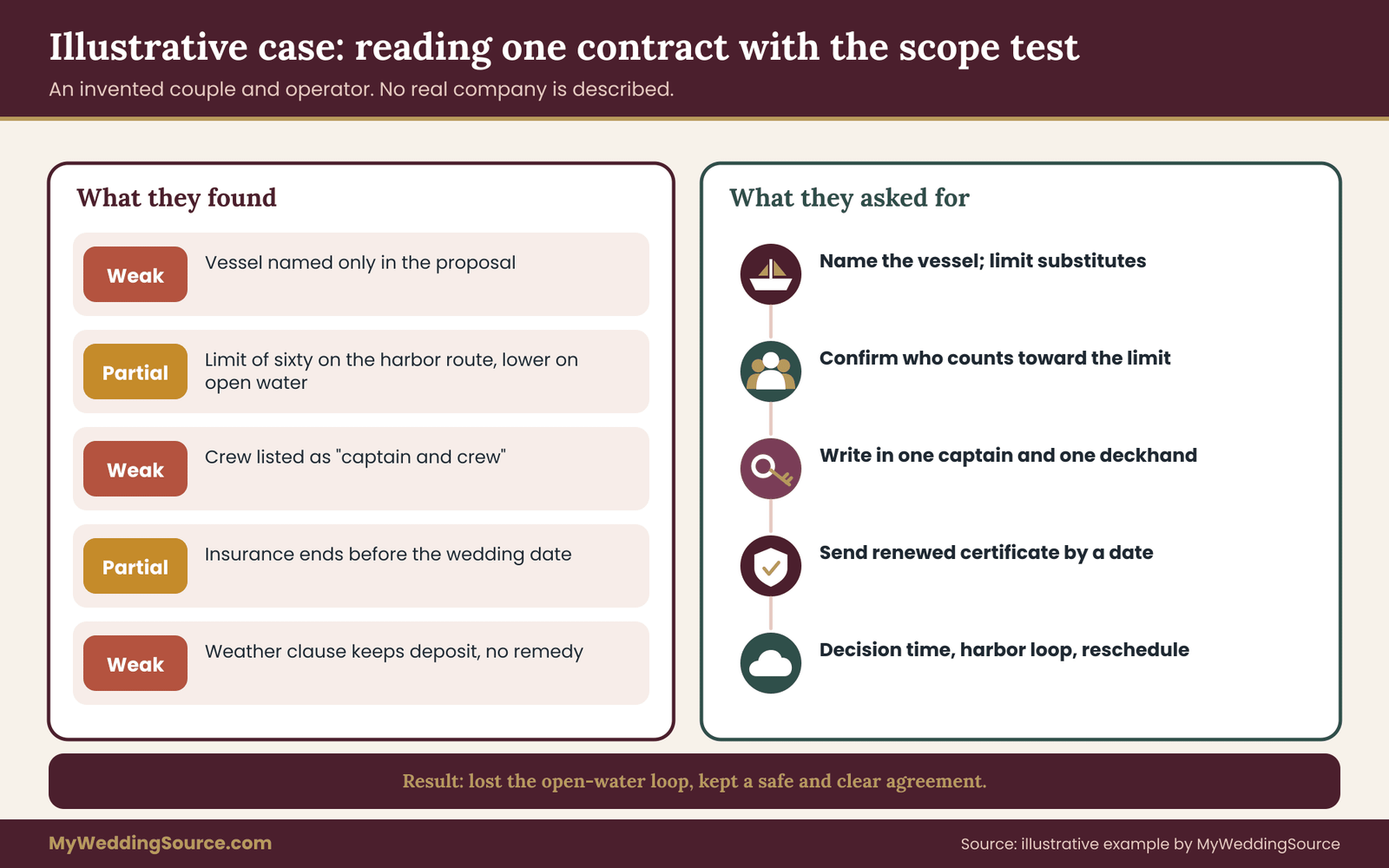
The vessel is named in the proposal but not the boat charter contract, so the promise is weak. They ask for the name to be inserted, with a substitution limit.
The capacity is backed by the certificate for the harbor route, so it is partial. The sunset loop on open water is outside what the certificate allows for the full guest count, so the promise in the proposal cannot be kept as described. They ask the boat charter operator to confirm the route in the boat charter plan and to say who counts toward the limit.
The captain and crew count are written as “captain and crew,” and the credential has arrived, so the captain is partial and the crew count is weak. They ask for “one captain and one deckhand” to be written in.
The insurance is partial because the certificate expires before the date. They ask for the renewed certificate by a set date, with the contract allowing them to cancel with a refund if it is not provided.
The weather clause has a line and no remedy for them, so it is weak. They ask for a defined decision time, a harbor-loop alternative, and a reschedule with no new deposit or a refund beyond actual costs.
What the operator does
The operator agrees to name the vessel, writes in the crew and sends a trip plan with a harbor loop and a dock photo stop. It confirms that the photographer, DJ and coordinator count toward the limit, which still leaves room under sixty for the harbor route. It agrees to a decision time on the morning of the trip and offers a reschedule. It declines to refund the deposit if the date is not rebooked, and offers a longer rebooking window instead.
The decision
Dana and Luis lose the open-water sunset loop, accept the harbor loop and sign. They would have missed all of this if they had signed the proposal. They also keep a record: the packet, the addendum, the dated emails and the payment schedule. When the final certificate arrives, they file it with the contract.
The point of the example is not that the operator was bad. The operator was ordinary, and the gaps were ordinary. The scope test simply made them visible while there was still time to ask for changes, which is when asking is cheap. ## When a boat charter should fail your review, and the alternatives
A review is only useful if it can end in a no. The conditions below are the ones that should stop a boat charter, or at least pause it until they are fixed. Some are hard stops and some are amber lights, and the distinction matters because a few can be repaired with a phone call.

Hard stops
These are conditions where the sensible response is to walk away unless they change in writing.
- No answer about the vessel’s legal status. If the boat charter operator cannot or will not say whether the vessel is inspected, what its passenger limit is or what rules it says apply, you cannot check the most basic safety fact.
- No evidence of insurance. An operator who will not send a certificate, or whose policy has lapsed with no plan to renew, is asking you to carry risk you cannot see.
- A promise that the captain cannot legally keep. A route outside the vessel’s allowed area, or a guest count above the passenger limit, means the boat charter you are buying cannot run as sold.
- Pressure to sign or pay fast. Urgency that prevents you from reading the contract is a warning in any vendor relationship. The usual vendor red flags apply here too.
- A request to pay in a way that leaves no record. Cash only, or a transfer to an unrelated account, makes disputes hard.
- An operator that cannot be identified. The name on the contract, the insurance and the vessel do not match, and nobody can explain why.
Amber lights
These are conditions you can often fix by asking.
- Vague crew terms. Ask for the captain’s credential and the crew count in writing.
- One-sided weather terms. Ask for a decision time, a modified trip and a reschedule or refund.
- Open-ended substitution. Ask for a limit on what a substitute vessel can be.
- Unclear counting. Ask how vendors, children and crew are counted.
- Hidden extras. Ask for a single total and a list of what could add to it.
- Missing alcohol policy. Ask for it in writing before you plan the bar.
- Heavy indemnity. Ask a qualified attorney to review the clause.
How to respond to a refusal
If an operator declines a reasonable request, ask why, and listen to the reason. Some terms are fixed for good reasons: an insurer may not allow an additional insured, or a captain may not extend a trip past a legal limit. In those cases ask whether another route to the same outcome exists. If the answer is simply “that is our policy” with no reason, weigh it against how much you want the vessel. A beautiful boat on terms you cannot accept is still a bad deal.
Alternatives when a boat charter does not fit
Sometimes the review ends with the conclusion that a full boat charter is more than the wedding needs or more risk than you want to take. There are several ways to keep the water in the day without carrying the whole charter.
A dock ceremony with a short cruise
Hold the ceremony and dinner on land or at a dockside space and add a short harbor trip for the photos or the send-off. This reduces the time guests spend aboard, limits the effect of weather and lets guests who cannot board stay part of the day. The contract is shorter, and a cancellation costs less.
A scheduled public cruise
Some operators run public sunset or dinner cruises with private tables or a private deck section. This works for a rehearsal dinner, a welcome party or a small after-party. The terms are set by the boat charter operator, with little room to change them, but the vessel, the crew and the insurance are already in place and the price is usually simpler.
A moored or dockside vessel as a venue
A vessel that stays at the dock brings the look of a boat without the movement. Ask the operator about occupancy, the dock’s rules and the facility’s event permissions, and treat it as a venue contract with a marine layer. The wedding venues guide explains the general checks for any venue, and the questions in this guide about insurance, alcohol and accessibility still apply.
A waterfront venue with a boat photo moment
Choose a waterfront venue and book a short boat ride for the couple and the photographer only. This keeps most guests on land and gives you the photographs. It also reduces your guest liability, since the people aboard are few and known. Check the rules about permits and who may operate the boat.
Keeping the decision fair
None of these alternatives is better than a boat charter in every case. The best choice depends on your guest count, mobility needs, budget and tolerance for weather risk. A useful question to ask yourself is what you would regret more: not having the boat, or having a boat day that went badly for the guests who matter most. Your answer usually points the way.
Your next steps
Start with the packet. Email the operator you like best and ask for the seven documents: business identity, inspection status, captain credential, certificate of insurance, written terms, alcohol policy and trip plan. While you wait, read the contract against the proposal and list every promise that matters to you. Mark each one solid, partial or weak using the promise, proof and remedy test.
Then send one message with your questions, ask for the changes you need in writing and place the payment dates on your calendar. If something stays on the hard-stop list, be willing to walk away. Once the boat charter contract is signed, keep the packet, the addendum and the emails in a single folder, and confirm the headcount, route and weather decision time a few weeks before the trip. A calm review of the boat charter now is what lets you enjoy the water later.
FAQ
What should a wedding boat charter contract include?
It should name the operator and the vessel, state the passenger limit for your route, the hours, the route and the crew. It should set out the price with every add-on, the deposit and payment dates, and clear weather, delay, cancellation and refund terms. It should also cover alcohol rules, insurance, damage responsibility and what happens if the vessel is substituted or unavailable.
How do I check that a captain is qualified?
Ask the boat charter operator for a written statement or a copy of the captain’s credential, and confirm that it fits the vessel and the number of passengers. In the United States the Coast Guard issues Merchant Mariner Credentials, and its website explains the types. Also ask who the relief captain is if the boat charter runs long, and whether the crew count is written into the contract.
Does the operator’s insurance protect us as the hosts?
Not automatically. The operator’s policy mainly protects the operator, and what it does for a host depends on the policy. Ask for a certificate of insurance, ask whether you can be named as an additional insured, and ask about liquor liability if alcohol is served. Check your own event policy for exclusions on water-based events, and consider a review by an insurance professional.
What is the vessel’s passenger limit, and who counts toward it?
The limit is set by the vessel’s inspection status and often appears on its Certificate of Inspection, and it can differ by route. Ask whether the photographer, DJ, coordinator, children and crew count. Do not rely on a marketing number. Get the limit for your route and date in writing, and keep a margin so that one late addition does not break it.
What happens if the weather is bad on the wedding day?
The captain makes the safety decision, and the contract should say what follows. Look for a decision time, a modified trip such as a harbor loop, a delay window, and a refund, credit or reschedule if the trip is cancelled. Ask whether a new deposit is needed. A clause that lets the operator cancel and keep your deposit with no rebooking is worth negotiating.
Can we bring our own alcohol or caterer on a chartered boat?
It depends on the boat charter operator, the vessel and local law. Some operators provide a bar, some allow outside beer and wine, and some forbid outside alcohol altogether. Many allow outside caterers with limits on cooking and storage. Ask for the policy in writing, ask who serves, and confirm that the crew can refuse service to any guest.
Is a boat wedding accessible for guests with limited mobility?
It can be, but it depends on the vessel. Boarding often involves a gangway or a step, and interior spaces may have stairs. Ask for a specific description of the route from the dock to the main deck, restroom access and seating at deck level. The Department of Justice and U.S. Access Board publish accessibility guidance, and the operator should explain how it applies.
When should we sign a boat charter contract?
Sign after you have the document packet, have read the contract against the proposal and have written changes added in an addendum. Popular dates book early, so do not delay without reason, but do not sign under pressure either. A few days with the contract is a normal request, and an operator who refuses it is telling you something.
Sources
- United States Coast Guard
- Coast Guard Commercial Vessel Compliance and Prevention resources
- Electronic Code of Federal Regulations, Title 46, Shipping
- Office of Auxiliary and Boating Safety, U.S. Coast Guard
- Marine forecasts and advisories, National Weather Service
- Navigation Center, U.S. Coast Guard
- ADA information, U.S. Department of Justice
- Consumer Financial Protection Bureau
- Federal Trade Commission consumer advice
- USAGov consumer protection