
Online dance lessons and private in-person lessons teach the same steps in very different ways. The real difference is not video versus a studio; it is how quickly and how precisely someone can tell you what you are doing wrong. This guide gives you a simple way to measure that gap for your own first dance and choose the format, or the mix, that fits.
Online dance lessons are strong at showing you a routine and letting you repeat it at your own pace. Private lessons are strong at correcting posture, partner connection and timing in the moment. Score four gaps (memory, mechanics, connection and showtime) from zero to two. A low total points to online dance lessons, a middle total points to a hybrid of recorded review plus a few live sessions, and a high total points to private instruction. Always check the refund terms and the room you will practice in before you pay.
Most couples who search for dance help are not asking a dance question. They are asking a budget and schedule question wearing a dance costume. One partner wants a studio and a patient teacher. The other wants to learn in the living room after dinner with the lights low and nobody watching.
Both are reasonable, and both can work, but they work for different couples and for different songs. If you have not yet chosen the music, start with our guide to wedding reception music planning, because the song’s length and tempo shape every decision below.
This article is built around one idea: compare formats by their feedback, not by their price tag or their marketing. A lesson is a loop. You try something, someone sees it, someone tells you what to change, and you try again. Everything that separates online dance lessons from private lessons comes down to how long that loop takes, how much detail travels through it, and who is responsible for closing it.
A note on scope. This is general planning information, not medical, legal or financial advice. Prices, refund rules and instructor qualifications vary, so confirm the current terms with each provider, and ask a qualified instructor or your own clinician about anything physical. Where a rule matters, the sources at the end point to the agency or organization that issues it. That point holds whether you are weighing online dance lessons or a studio package.
Online dance lessons and private lessons: what actually differs
Strip away the branding and there are only a few things that change when you move from a private lesson to a recorded or streamed one. It helps to name them, because most comparison articles blur them together.
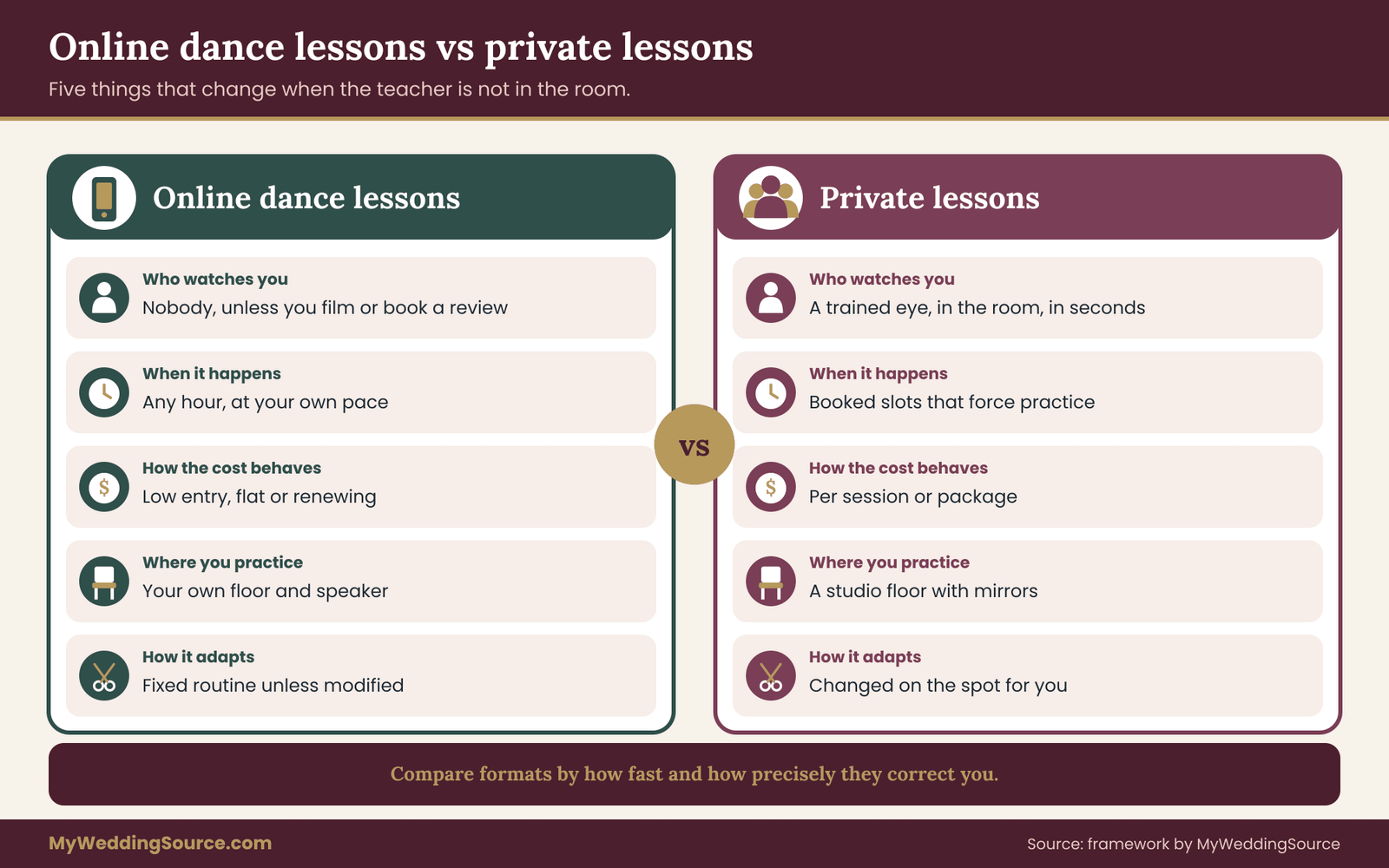
Who watches you. In a private lesson, a trained person watches your actual movement, in your actual body, with your actual partner, and reacts within seconds. In a recorded program, nobody watches you at all. You watch a demonstration and you judge yourself. In a live video lesson, someone watches, but through a camera that flattens depth and crops the edges of the room.
What is being shown. A good recording shows a clean demonstration at a patient pace, often from several angles, and it can be paused, slowed and replayed. A private instructor shows the same thing, but can also change the demonstration on the spot when you do not understand it, and can use hands, spoken counts or small cues that a recording cannot adapt.
When it happens. Recorded lessons have no schedule. You can practice for twenty minutes at lunch or at eleven at night. Private lessons need an appointment, a commute or a booked slot, which both limits and structures your practice. For some couples the appointment is the entire value. It is the one fixed time when practice actually occurs.
How the cost behaves. Online options tend to have a low entry price and a flat or subscription shape. Private lessons are charged per session or per package. We are not going to quote prices, because they vary widely by city, instructor and season, and invented numbers would not help you. What matters is the shape of the cost: how much you spend before you know whether the format is working, and what you can recover if it is not.
What it asks of you. Online dance lessons ask you to be your own coach. You have to notice your own errors, find a place to practice, set up a camera if you want feedback, and keep going without anyone expecting you. Private lessons ask less self-direction but more logistics: finding the right instructor, matching two calendars, and paying for the room time.
None of these differences is good or bad by itself. A couple who loves the routine and has a disciplined practice habit may get everything they need from a recording. A couple who argues every time they try to dance together may find that an hour with a neutral third person changes the whole project. The rest of this article helps you tell which situation you are in.
The three things nobody can learn from a video alone
It is worth being direct about the limits, because they matter for planning. Three parts of a first dance are hard to learn from a recording.
The first is partner connection. Dancing as a pair means each person reads the other’s weight, timing and intent. A recording can describe the idea, but it cannot feel your partner’s hesitation or tell you that you are both waiting for the other to start. Someone in the room can. Keep it in mind when you compare online dance lessons with a booked instructor.
The second is correction of habits you cannot see. Most people cannot see their own posture, their own rushed steps or the moment their smile drops because they are counting. A camera helps, and we cover filming later, but you still need a trained eye to know which of the five things in the footage actually matters.
The third is adaptation. Real couples differ in height, shoe choice, comfort with being watched and the way each person moves. A program built for a general audience cannot adapt to the two people in your kitchen. An instructor can, and a good one will change the choreography rather than ask you to change your bodies. With online dance lessons, the job of noticing a problem stays with you.
The three things a private lesson cannot give you
The opposite list is just as honest. A private lesson, however good, cannot make you practice between sessions, cannot replay itself at midnight, and cannot be repeated for free. Couples who book three private lessons and then do not touch the choreography in the weeks between often arrive at the wedding knowing what they learned on the day of the last lesson and little else.
A private lesson also cannot guarantee a good fit. The instructor may be excellent and still teach in a style that does not match your song, your comfort level or your humor. Online programs let you sample before you commit more easily. With private instruction, a poor fit costs a session before you learn it. Private time costs more per hour than online dance lessons, so it should go where it changes the most.
And a private lesson happens in the studio’s room, on the studio’s floor, in the shoes you chose for the lesson. Your wedding happens in a different room, on a different floor, often in different shoes and in front of people. We return to that gap in the section on space and floors.
A feedback ladder for comparing formats
To compare formats fairly, think of five rungs of feedback, from weakest to strongest. Each rung adds something the one below it lacks. This ladder is the core tool in this guide, so it is worth learning it before you look at any specific program or instructor. The same logic applies if your plan rests mainly on online dance lessons.
Rung one: demonstration. You watch someone else do the steps. This is what a recorded tutorial gives you, and it is genuinely useful for learning the pattern of a routine: what comes after what.
Rung two: self-check. You record yourself, watch the footage and compare it with the demonstration. Nobody else is involved. This is the cheapest way to see your own errors, and it takes honesty, because the first footage is rarely flattering.
Rung three: delayed review. Someone qualified watches your footage later and sends comments. Some online programs and some instructors offer this as a service. The comments arrive hours or days after the practice, which slows the loop but adds a trained eye.
Rung four: live remote. An instructor watches you on a video call and speaks to you in real time. The loop is fast, but the picture is limited. Depth is hard to judge, the instructor may see only part of the floor, and partner contact is invisible.
Rung five: in the room. An instructor stands with you and your partner, sees all of it, hears the music at the same volume you do, and can demonstrate on the spot. This is the strongest loop, and the most expensive per hour.
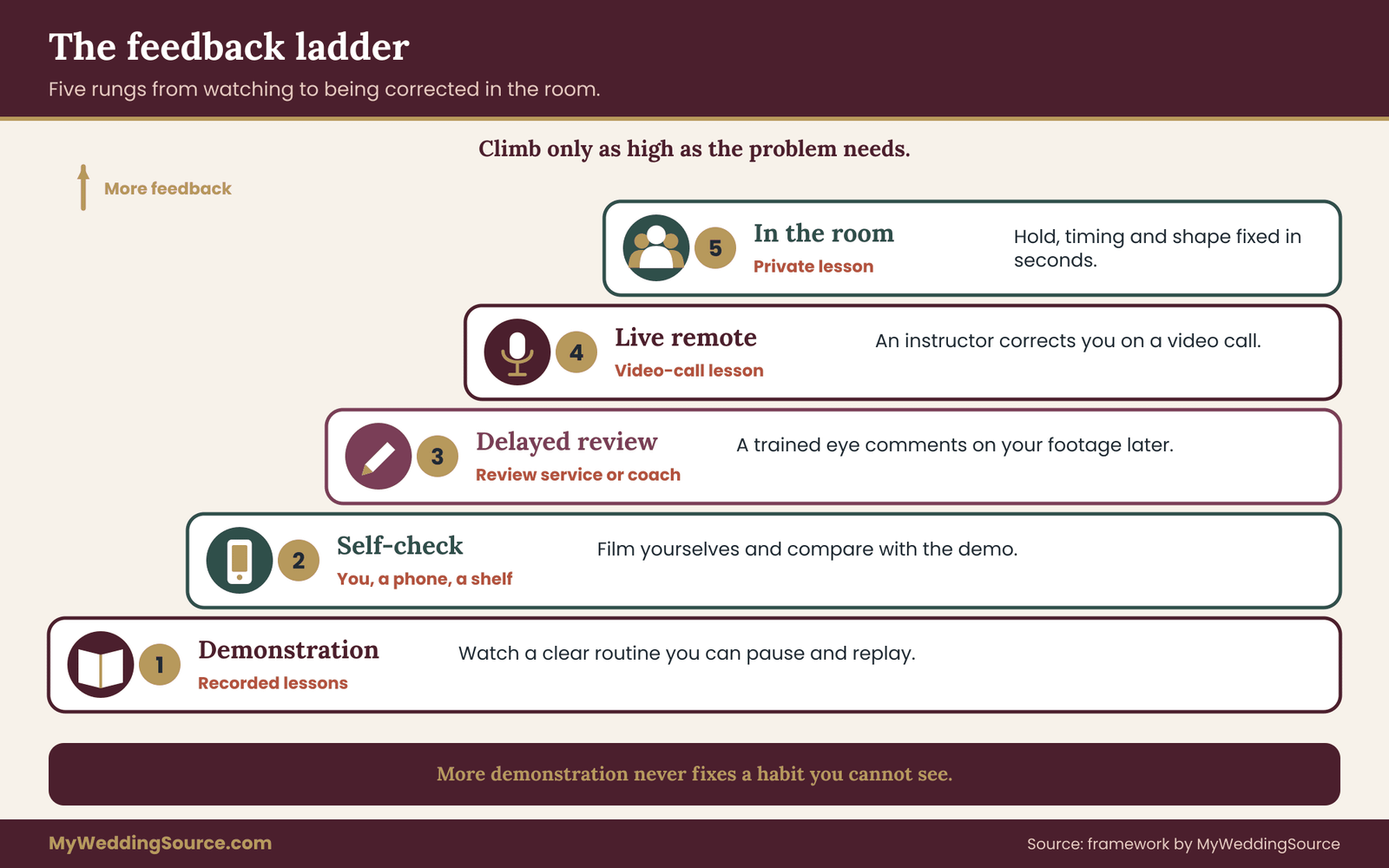
Notice that the ladder is not a ranking of quality. A person can learn a simple routine thoroughly on rungs one and two and never need a higher rung. Another person might climb to rung five for one specific problem and then climb back down for the rest of the practice. The question is not “which rung is best?” but “which rung does this particular problem need, and how often?”
How online dance lessons and private lessons map onto the ladder
A typical recorded program lives on rungs one and two. It gives you demonstration, and it may encourage you to film yourself, but the review is yours. Some programs add rung three through a feedback upload, a coach or a community review. That feature is worth asking about directly, because it changes what you are buying. This is one reason online dance lessons suit some couples and not others.
A typical private lesson lives on rung five. Many instructors also offer rung four, a video call, as a cheaper or more convenient option, and some will review footage between lessons, which is rung three. The mixed formats are where a lot of couples end up, and we give them their own section.
Once you see the formats as bundles of rungs, comparing online dance lessons with private lessons stops being a contest. You are really asking which rungs you need, and whether a single provider offers them at a price and schedule you can keep.
A quick test for which rung you need
Try this before you spend anything. Pick the first thirty seconds of your song and a simple step pattern, such as a basic box step or a slow sway with a turn. Put on the music and dance it with your partner for two minutes. Then answer four questions in writing, separately, and compare. Online dance lessons can cover this part of the work, as long as you film yourselves.
Did we keep the beat together? Did either of us feel unsure about what came next? Did the hold feel comfortable, or did one of us feel awkward or stiff? Did we want to stop, laugh or bail out at any point?
If both of you remembered the pattern, kept time and felt fine, you probably need little beyond rungs one and two. If the pattern collapsed, you need either repetition or a coach on memory. If the timing drifted, you need a coach on rhythm. If the hold felt wrong, you need a person in the room. The next sections turn this into a scoring method.
Why the ladder beats a feature list
Program pages and studio pages list features: number of videos, length of sessions, certificates, bonus content. Those lists are designed to look similar. The ladder strips them back to what the lesson does for your progress. When you read any offer, ask which rung it provides, how often, and how you would know whether it is working. If a page cannot answer, treat the vagueness as information. If you are leaning toward online dance lessons, treat this as a checkpoint.
It also protects against a common trap. Couples sometimes buy more rung-one content, such as another series of tutorials, when what they need is rung three or five. More demonstration does not fix a habit you cannot see. Adding another video to a problem that needs a human eye is a polite way of postponing the problem.
Where private lessons earn their cost
Private instruction is not always worth the money, but in certain situations it is clearly the better fit. The pattern is consistent: private lessons pay off when the problem is something you cannot see or feel yourselves.
Partner connection and the hold
The hold is the shape of how two people stand and move together: where hands go, how much weight each person shares, how the frame responds when one person steps. Couples often assume the hold is automatic. It is not. A stiff hold looks stiff on camera and feels stiff to the person inside it, and neither partner can usually diagnose it alone. None of this makes online dance lessons a poor choice; it only tells you what to add to them.
A teacher in the room can change one small thing, such as how close you stand or where your eyes are directed, and the whole dance relaxes. That kind of fix is almost impossible to deliver through a pre-recorded program, because the program does not know what your hold looks like. If your self-check shows that the hold is the weak spot, a private session or two is the most direct answer.
Timing and musicality under pressure
Counting steps to a song is one skill. Staying on the beat while someone is watching, with a slightly different mix of the song and a room echoing, is another. A teacher can hold a steady pulse for you, change the tempo in small steps and correct a drift as soon as it starts. Plan for this early, whichever way you lean on online dance lessons.
For couples who learned the choreography well from video but panic at the moment of dancing, private rehearsal in a realistic setting often solves the problem. The teacher plays the song from speakers rather than a phone, stands where the guests will stand, and makes you run it from the walk-in. That is rehearsal for the event, not tuition in steps.
Turns, dips and anything with a risk of a bad landing
Many couples want a turn, a dip, a lift-looking pose or a dramatic ending. These are the moments where a mistake looks worst, and where a misjudged movement can cause a stumble. We will not make physical claims here, and we will not tell you which moves are safe for your bodies, because we cannot see them. What we can say is that anything involving weight shifts, spins in wedding footwear or a dramatic finish deserves a trained person watching the first runs in person.
If the choreography includes such a moment, treat in-room review as the default, and ask the instructor to simplify it if it looks risky for either of you. A couple who relies on online dance lessons should expect to handle this step themselves.
One partner is anxious
When one partner dreads the whole idea, the format matters more than the content. Some anxious partners relax with an instructor present, because a neutral adult takes the pressure off the other partner as the one who “knows how.” Others find a stranger watching to be worse and prefer the privacy of home. Neither is wrong.
A reasonable compromise is a single trial private lesson framed as a short consultation. Ask the instructor to teach the first sixteen counts of your song and to talk through how the rest of the lessons could run. If the anxious partner leaves feeling better, you have your answer. If not, you have lost one session instead of a package. This is where online dance lessons and in-room help tend to divide the work.
A short time line
When the wedding is close, the loop speed matters more. A few weeks is not enough time to discover, through trial and error with recordings, that your timing drifts or that your turn needs a different hand position. A private instructor compresses that discovery into one or two sessions. Couples who start late and still want to look comfortable usually benefit from at least some in-room time.
Cultural, religious or family dance expectations
If your first dance has to carry a tradition, a specific style or a family expectation, the instructor’s knowledge matters, not only the steps. A teacher who understands the tradition can advise on timing, on who joins when and on how to adapt the dance for the room. Recordings rarely cover the tradition you need, and when they do, they do not know your family.
If the dance includes relatives joining in or a ceremonial element, this is a good moment to book someone who can talk it through, and to coordinate with whoever runs your reception music and timing. Treat online dance lessons as one tool among several, not as the whole plan.
Where online dance lessons work well
Online dance lessons are not a lesser version of the real thing. For a lot of couples, and for a lot of choreography, they are the right tool. The mistake is using them for the wrong job.
Learning a pattern and remembering it
If your first dance is a simple sequence, such as a slow sway, a few steps and a turn, the hardest part is remembering what comes next. A recorded tutorial can be paused, slowed and repeated until the pattern sticks, with no waiting for the next appointment. Couples who like to practice in short bursts, in a hallway or kitchen, often get further this way than with weekly in-person lessons, because they can fit it into the cracks of a busy week.
The memory gap is the one most suited to online dance lessons. If your biggest worry is “I will forget the sequence”, recordings are an excellent answer, and you can improve them by making your own cue card and recording a version of the routine with your own voice counting.
Privacy and pacing
Some people learn better when nobody is watching. Online dance lessons let you try, fail, laugh and retry without an audience. For a couple who feel self-conscious, that freedom can be the difference between practicing and avoiding practice. Pacing matters too. You can run a section ten times in a row if you need it, then stop, without worrying that you are costing a teacher’s time.
Scheduling around shifts, travel and kids
If one partner works nights, travels, or cares for children, shared free time may be rare. Online options let each person practice alone on the parts that do not need a partner, such as footwork, and then come together for short joint runs. A recorded lesson cannot replace joint practice, but it can make sure that when you do have fifteen minutes together, you use them well. Many couples find that online dance lessons handle this well and in-room help handles the rest.
Testing whether you even like it
Online dance lessons are a low-risk way to sample. If you are not sure whether you want a choreographed first dance at all, or whether the two of you will enjoy dancing together, a short course at home tells you cheaply. If you hate it, you learn that for a small cost. If you enjoy it, you can add live help afterward. That order, cheap trial first and teacher second, is often more efficient than the reverse.
Long-distance couples and mixed locations
Couples who live in different cities, or who cannot practice together for weeks at a time, may be unable to take private lessons together at all. They can still learn the same routine from the same recording and meet for in-person practice when the schedule allows. Live video lessons sometimes let both partners join from different places, though they cannot rehearse contact. For a couple in this situation, online dance lessons are not a compromise, they are the practical route.
Fixed budgets with no slack
A person with a very tight budget may have no choice, and that is fine. The honest approach is to use the ladder to put your limited money where it matters most. A free or low-cost recording may supply rung one. A phone on a shelf supplies rung two. A single paid review of your footage or one short live call supplies rung three or four. That mix, thoughtfully used, can beat a package of private lessons that you cannot finish.
What a good recorded program looks like
Not all online dance lessons are equal, and you can judge them without trying them. Look for lessons that break a routine into short sections, show each from the front and the side, repeat at slow speed and with counted beats, and provide the music in a form you can practice with.
Look for clear information about the instructor’s background, a plain refund policy and some way to ask questions. Be wary of pages that promise a specific result in a specific number of days, or that hide the price until you enter your details.
Ask also whether the choreography can be adapted. A fixed routine built for one body type, one hold and one pace may not fit you. A program that explains why each step is there, and offers simpler variations, lets you change things without breaking the dance. It is easy to overlook this when you choose online dance lessons for convenience.
A caution on following along with your phone
Many couples practice by propping a phone against a wall and following the video. This works, but it can hide a problem. When your eyes are on the screen, they are not on your partner, and the habit carries into the real dance as looking down. Try to learn each section from the video and then dance it with the screen off. If you can only do the dance while watching the video, you have not yet learned it.
Scoring your four gaps
Now put numbers on it. The scoring method below is a planning aid, not a test, and it is only as honest as your answers. Do it separately first, then compare, because partners often disagree and the disagreement is useful.
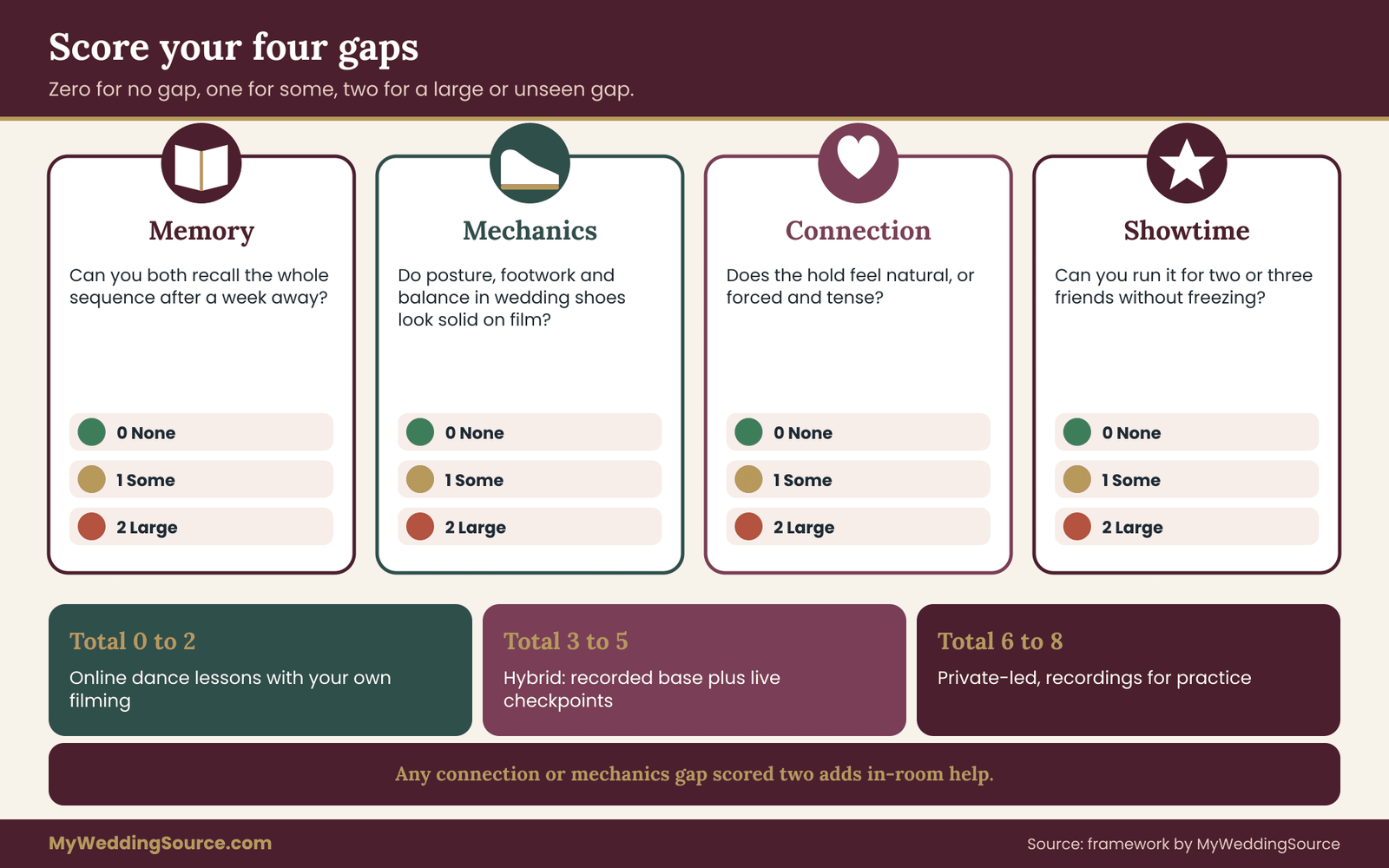
Give each of four gaps a score of zero, one or two. Zero means no real gap. One means some gap, but a few practice sessions would likely close it. Two means a large gap, or one that you cannot judge for yourselves.
The memory gap. Can you both recall the sequence from beginning to end after a week away from it? Score zero if yes, one if you need a reminder partway, two if the sequence falls apart.
The mechanics gap. Do you know, from video or feedback, that your posture, footwork and balance in wedding shoes look and feel solid? Score zero if you have checked on footage and are happy, one if you are unsure, two if you know there is a problem you cannot pinpoint.
The connection gap. When you dance together, do you move as one, or does one of you lead too hard, or hesitate, or step on the other? Zero if it feels natural, one if it feels mostly fine, two if it feels forced or tense.
The showtime gap. Can you run the whole dance in front of two or three friends, with the real song, without freezing? Zero if yes, one if you manage with effort, two if you have never tried.
Add the four numbers. A total of zero to two points to online dance lessons with your own filming. A total of three to five points to a hybrid, with recorded lessons for memory and a few live or in-room sessions aimed at the gaps that scored two. A total of six to eight points to private instruction as the main method, with recordings used only for between-lesson practice.
Treat the totals as a starting point. If any single gap scores two and it is connection or mechanics, add in-room help even if your total is low. If the only two-point gap is memory, a stronger recorded routine will usually do.
The middle path: hybrid formats and how to build one
Most couples will not land on either extreme. The most useful formats sit between a fully recorded course and a full package of studio sessions. They are worth describing in detail, because they are where the ladder pays off.
Recorded base plus review
In this format you learn the routine from recordings, film yourselves, and send the footage to an instructor for written or spoken comments. The loop is slow, but it gets a trained eye on your actual movement at a modest price. It works best when you can name two or three questions for the reviewer, such as “Does our hold look tense?” or “Where do we lose the beat?” Vague footage gets vague comments. Pointed questions get pointed answers. Be honest about it before you commit to online dance lessons.
Ask any instructor who offers this how fast they respond, how many minutes of footage they will review, whether you can send a second round and whether comments are written or recorded. Without those details, you cannot tell whether the review will arrive before your next practice or after the wedding.
Live video sessions for fixes
A live video call gives you rung four. It is a good fit for specific problems and for couples who live far from a good studio. To get value from it, set up the camera so the instructor can see both of you from head to foot, and point it at the floor you will actually use, not the corner of a bedroom.
Use speakers, not earbuds, so the instructor can hear the music and you can hear them over it. Test the connection before the session, since a frozen screen at the key moment costs minutes. Think about how online dance lessons would handle this for the two of you.
Be realistic about what the call cannot do. The instructor cannot feel your hold or see that one of you is leaning away from the other when the camera is at the wrong angle. They cannot step in and demonstrate with you. If the problem is connection, a live call is a partial fix at best.
A few in-room sessions as checkpoints
The most efficient use of private time is often at specific checkpoints rather than weekly. A common pattern is one session near the start, to choose the routine and fix the hold, and one session near the end, to rehearse the whole dance with the real song and the real shoes. The weeks between are filled by online dance lessons, your own filming and short practice sessions.
This pattern reflects a simple fact. The start and the end of a project are where the highest-value corrections happen. At the start, a small correction prevents months of bad habits. At the end, a run-through under conditions close to the real thing reveals the problems that matter. The middle is mostly repetition, and repetition is cheap. A private instructor handles this differently from online dance lessons, and the difference is worth weighing.
A studio that also offers recordings
Some studios and instructors sell a package that includes private sessions plus a recording of the choreography taught in them. If you consider such a package, ask whether the recording is of your exact routine and whether you can keep it afterward. A recording of your own choreography, made with the instructor, is a good memory aid, since it shows the version you will actually dance. Ask about the instructor’s policy on filming during lessons, as some prefer to share their own recording instead.
When one partner learns online and the other learns in person
Sometimes the practical solution is asymmetrical. One partner is confident and simply needs the sequence. The other needs reassurance and a teacher. Splitting the formats can work if you bring them together early and often. The risk is that each partner learns a slightly different version, with a different count or a different hand position.
Whenever you split, bring the two versions together in a joint session as early as possible, ideally with an instructor present, and fix mismatches before they harden. This is a fair question to put to any provider of online dance lessons.
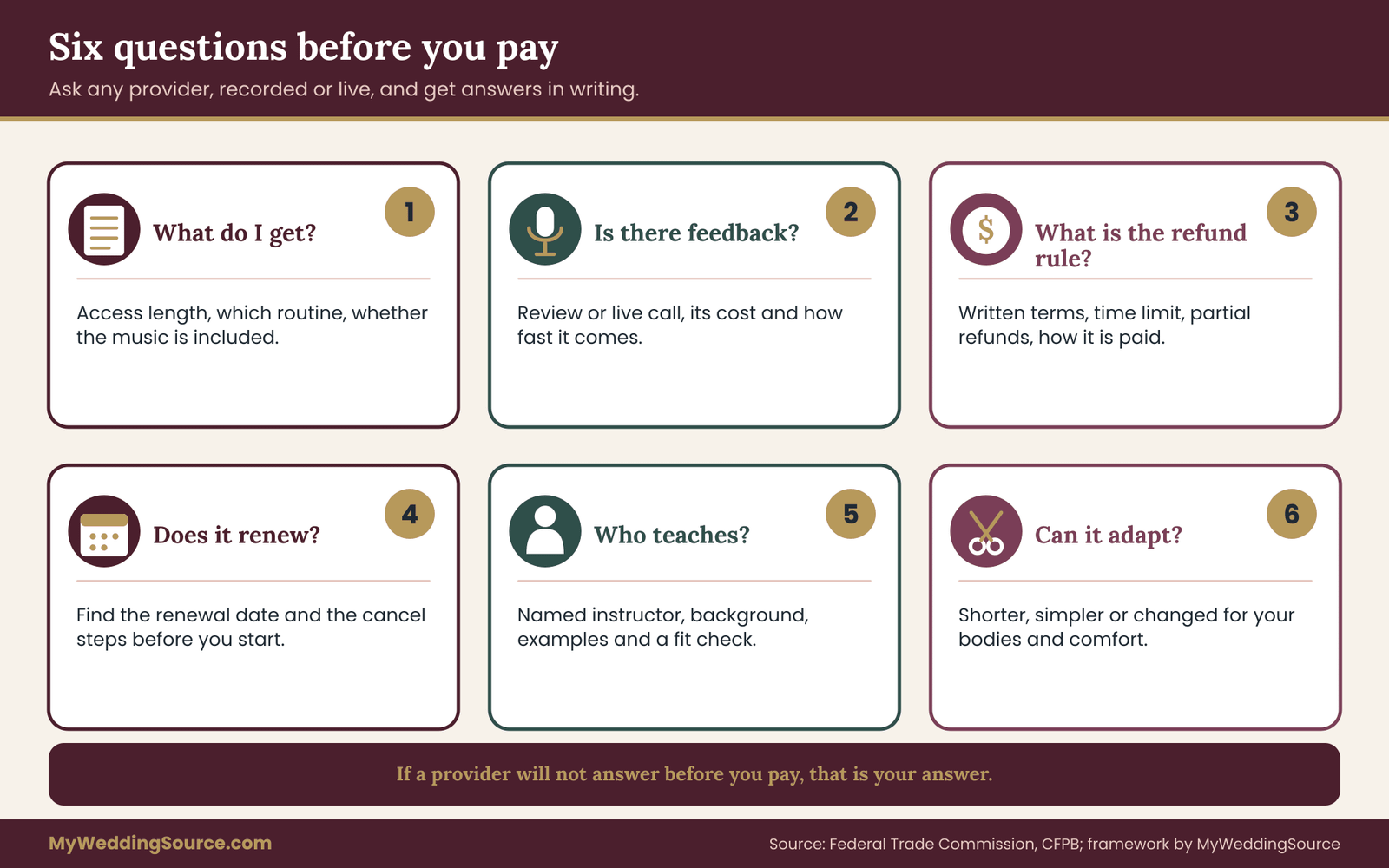
Questions to ask before you pay for online dance lessons
Because online dance lessons are sold in many forms, from single videos to memberships with live classes, the terms matter as much as the content. The questions below apply to any provider, recorded or live, and they protect you from the most common frustrations.
What exactly do I get, and for how long? Find out whether you are buying lifetime access, a fixed access period or a subscription that renews. Check whether the choreography you want is included or sold separately, and whether the music is included, linked or left to you to find.
Is there a way to get feedback? If the program includes review, ask how it works, what it costs and how quickly it comes. If it does not, plan to supply your own rung two with filming.
What is the refund policy, in writing? A plain policy should state whether you can cancel, how long you have, how a refund is paid and whether a partial refund is possible if you used part of the content. The Federal Trade Commission publishes consumer guidance on refunds, subscriptions and online purchases, and it is a good place to learn what is normal and what is a warning sign. If a provider will not state the policy before you pay, treat that as an answer.
Will it renew automatically? Many memberships renew unless you cancel. Put the renewal date on your calendar the day you sign up, and find out how to cancel before you need to. If you pay by card and a charge looks wrong, the Consumer Financial Protection Bureau explains how to dispute it, and the time limits are short.
Who is the instructor, and how do I check? Look for a named instructor, a clear description of their training or experience, and examples of past work. There is no single license for dance teachers in the way there is for some professions, so judge by clarity, references and whether their approach suits you. Professional organizations in ballroom and social dance publish information on instructor standards, such as USA Dance, and a teacher’s membership or certification in a recognized body can be one data point among several.
Can the routine be adapted? Ask whether the choreography can be simplified, shortened or changed for different heights, shoes, comfort with partner contact or physical needs. A provider who has never been asked this will answer vaguely. One who has will describe how.
How will my information be used? If you upload video of yourselves, ask who sees it, how long it is kept and whether it may be used for marketing. If you are not comfortable, say so, and ask for a written answer. Treat your wedding footage as personal data.
Reading reviews and promises with care
Testimonials on a sales page are selected by the seller. They tell you what the seller wants to show, not what the typical customer experienced. Look instead for reviews on independent sites, for descriptions of specific problems and how they were solved, and for any pattern in complaints, such as billing or refund difficulty. The FTC has published guidance about fake and misleading reviews and about what honest endorsements should look like, and it is worth skimming before you rely on star ratings.
Be careful with promises that sound like outcomes: “dance like a professional in a weekend” or “never feel awkward again.” Dance progress depends on your starting point, your practice and your partner. Anyone who promises a fixed result is selling a feeling, not a method.
The cost logic: what you pay before you know it works
Instead of comparing sticker prices, compare the shape of the spending. Two questions do most of the work: how much do I spend before I find out whether this format fits, and how much can I recover if it does not?
Low entry, flat cost. Most online dance lessons require a small or modest payment up front, with no further cost. If the format does not suit you, the loss is small. The risk is hidden: you may spend weeks of practice time on a method that is not fixing your real problem. That is a cost in hours, and hours before a wedding are scarce.
Subscription cost. Memberships look cheap per month but add up if you forget to cancel. They make sense if you want live classes or ongoing feedback, and not if you wanted a single routine. Use a calendar reminder for the end of the planning period, and cancel as soon as you have what you need.
Per-session cost. Private lessons are paid per session or in packages. Per-session is flexible, so you can stop if it is not working. Packages usually lower the per-session price but commit you. Before buying a package, take one single session as a trial, and ask whether the unused portion of a package can be refunded or transferred. Ask about cancellation windows too, because a missed session may be charged in full.
Travel and room costs. Private lessons may involve travel time, parking or studio rental if the instructor does not have their own space. Online dance lessons involve none of that, but they can involve a practice space, a speaker and a camera stand, which you may already have.
The cost of redoing. A badly learned routine costs more to fix than a well-learned one costs to build. If you suspect you will need correction anyway, buying a little in-room time early can be cheaper than un-learning later. This is the most common reason couples end up spending on both formats.
You can bring the lesson spend into your overall plan by treating it as one line in the budget, alongside your other wedding costs, rather than a surprise. Our guide to building a wedding budget shows how to allocate and track those lines, and the guide on wedding cash-flow planning helps with the timing of deposits and package payments so that lesson fees do not collide with larger vendor balances.
A simple spending rule
A useful rule of thumb that does not depend on prices: put the first money into whichever rung addresses your highest-scoring gap, and put the second money into repetition. If your memory gap is the problem, spend on a good recorded routine and then on practice time. If connection is the problem, spend on one in-room session before anything else.
This avoids the common mistake of buying the most comprehensive package first and discovering later that you needed something specific. Online dance lessons make this easy to start and easy to drop, so build in a check.
What to do with a package you no longer need
Sometimes you buy a package and then decide the choreography is too complicated, or that you prefer a simpler dance. Read the terms before you buy, so you already know whether unused sessions can be refunded, credited or transferred. If you did not, ask politely and early. Providers are more flexible when you ask well before the deadline than after.
Space, floors, shoes and the room where you will actually dance
A lesson happens somewhere other than your wedding. That gap is where many well-learned routines come apart, and it is the part of the comparison that people most often skip. The two formats handle the gap differently, and each needs a plan.
What a private studio does for you, and does not
A studio has a floor made for dancing, mirrors, a decent sound system and enough clear space to move. Those conditions help you learn. They are also easier than your reception will be. The dance floor at a venue may be a different surface, a different size and a different distance from the first row of guests.
A studio session does not tell you how your shoes will behave on it, or how the dance will feel when it is half the width you practiced in. For couples using online dance lessons, this is worth a note on the calendar.
If you work with a private instructor, ask them to simulate the constraint. Mark out the footprint of the actual dance floor with tape or cones, based on measurements from your venue, and rehearse inside it. If the instructor can visit your venue, or you can arrange access to it, even better.
Many venues allow a short walk-through, and the coordinator will often know the floor size and surface. Our guide to wedding reception guest flow covers how the floor, seating and entrances relate, and it helps you picture where the first dance sits in the room.
Practicing at home when you take online dance lessons
When you rely on online dance lessons, your living room becomes your studio, and you need to set it up with care. You need a clear area with nothing to trip over, a surface that is not too slippery or too sticky for the shoes you will wear, and enough space to travel through the pattern. Move furniture, take up loose rugs and check that pets and children are somewhere else.
You cannot judge the safety of a particular floor from an article, and we will not claim to. If you are unsure about a surface, use common sense, start slowly and consider asking a qualified instructor about floor and footwear choices for your routine. The Occupational Safety and Health Administration publishes general information about walking and working surfaces, and although it is written for workplaces, it is a reminder that slip and trip hazards are ordinary and worth checking.
Shoes and the first-dance footwear question
Wedding shoes are usually not practice shoes. Heels, new soles, stiff leather and slick bottoms all change how you move. The cleanest approach is to practice in the shoes you will wear, at least for the later part of your preparation, so that the routine you learned in socks or sneakers does not change under you. Online dance lessons rarely cover this, so plan a separate answer.
Whichever format you use, switch to wedding footwear early enough to adjust. If the shoes are the problem, you want to know weeks ahead, not the night before. A private instructor can help you judge whether a shoe suits the dance. With online dance lessons, you must judge for yourselves, so film a run-through in the shoes and look for slipping, wobbling or a change in your step size.
The room acoustics and the real song
Practicing to a phone speaker teaches you the beat of the song, not how the song feels at event volume in a large room. The recorded version you practiced with may also differ from the version your band or DJ will play, since live performance, edits and different mixes can change tempo and length. Our guide on wedding reception music planning explains how to coordinate the dance with your music, and it is worth reading before you finalize the routine.
Confirm which version of the song will play, how it will start and where the cut or fade will fall. Practice with that exact file. If the DJ will fade the song after a minute and a half, you do not need a three-minute choreography. A short dance well done looks better than a long one barely held together.
Filming yourselves properly
Filming is the single most useful habit for couples using online dance lessons, and it also helps private students. A few practical points make the footage useful.
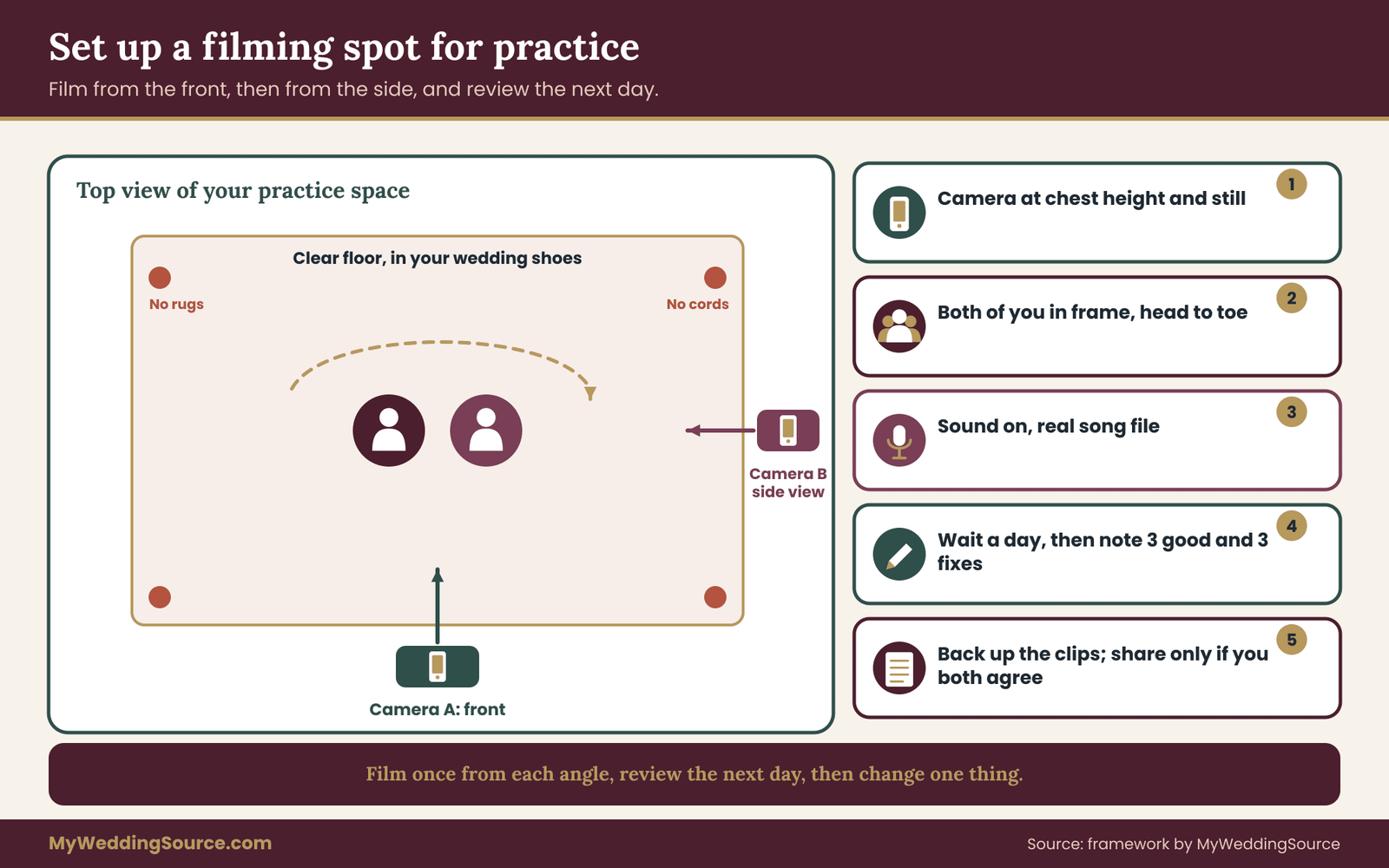
Put the camera at roughly waist or chest height, far enough away to show both of you from head to toe, and keep it still. Film once from the front and once from the side, if you can. Include sound, so you can hear whether you are on the beat.
Do not review the footage immediately while you are tired; watch it the next day with a notepad and note three things that look good and three that you want to change. Whether you pick online dance lessons or private time, write this down.
Keep your wedding footage in a safe place. The Library of Congress offers plain guidance on personal digital archiving, which is useful if you plan to keep the footage as a keepsake. Do not share practice clips publicly without agreeing as a couple, since some people feel exposed.
Music rights when you share or post
If you plan to post practice or performance clips online, be aware that the music is usually protected by copyright, and the rules on posting vary by platform. The U.S. Copyright Office explains the basics. For private practice, this is not an issue. For public posting, check the platform’s rules and consider whether you want a clip with the song attached. Couples who start with online dance lessons often discover this a few weeks in.
Accessibility and adaptive instruction
A good first dance is one that the two of you can dance comfortably. That sentence matters more than any technique. Couples have different bodies, abilities, comfort levels and histories, and the choreography should fit them. Both formats can serve this need, but in different ways.
Adaptation is a teaching skill, not an extra
A competent instructor can adapt a routine for a partner who uses a mobility aid, who tires quickly, who has low vision, who is deaf or hard of hearing, who is neurodivergent or who simply cannot do a particular movement. Adapting does not mean a lesser dance. It means a dance built around how you actually move. The Americans with Disabilities Act sets standards for businesses that serve the public, and the ADA website explains concepts such as effective communication and reasonable modification.
Those rules apply to many businesses, and they are a useful frame for the conversation you have with a studio or a venue, even though the details depend on the setting. This matters more with online dance lessons, since no one else is watching.
In a private lesson, you can tell the instructor in the first minutes what works and what does not, and they can adjust in the moment. You do not need to explain a medical history. You can say what you want to be able to do and what you would rather avoid. That directness saves time.
Online dance lessons and access
Online dance lessons can be more accessible in some ways and less in others. They can remove travel and stairs, allow rest breaks on your terms and let you repeat sections without pressure. For people who find studios overwhelming, home practice may be a relief. Captions, transcripts and adjustable playback speed help people who are deaf or hard of hearing, or who process information more slowly.
The Web Content Accessibility Guidelines from the W3C set common standards for captions and text alternatives on the web, and you can use them as a checklist when you look at a program.
On the other hand, a recorded course is written for a general audience, and it may not show any variation. If the routine assumes standing for several minutes, or a specific kind of turn, you cannot ask it to change. Ask the provider whether they offer modifications or live support.
If they do not, a single private or live session with an adaptive-minded instructor can adjust the routine, after which recordings of that adjusted version can serve as your practice material. Even with online dance lessons, you can borrow a trained eye for this once or twice.
Questions that protect you
When you contact a private instructor, say early that you want a routine that fits your bodies and comfort. Ask whether they have adapted routines before, and how they approach it. Ask what they would change if a particular movement did not work. Listen for flexibility. A teacher who says “we will find something that works” and then offers a specific example is a better sign than one who says “no problem” without detail.
Do the same for venues. Ask the venue whether the dance floor is level, how large it is, whether it can be reached without steps and whether lighting can be adjusted. Our guide on wedding vendor contracts covers how to get such answers into writing so that they hold on the day.
Comfort with being watched
Not all discomfort is physical. Many couples dread being the center of attention. A format that reduces the pressure helps you practice more and enjoy the result more. Decide together how much of the dance is a performance. A first dance can be a few quiet minutes of swaying with a single turn.
It can also be a full choreography. Both are legitimate. The format you choose should serve the version you actually want, not the version you think the guests expect. Online dance lessons can support this if the routine is simple enough.
Neurodivergent couples and sensory needs
Some people find unpredictable touch, loud music or a stranger’s instructions hard to process. If this applies to either of you, say so at the start, and ask the provider how they handle it. Written step lists, predictable structure, volume control and advance notice of what each session will involve all help.
Online dance lessons give you control over volume and pace, which can be a real advantage. A private instructor who is willing to plan with you can offer similar control with the added value of a live person who can pause when you need it.
When physical limits are real
If either of you has a health condition, an injury or a doubt about physical activity, speak with your own clinician before starting a dance program, and tell the instructor what they recommend. The Centers for Disease Control and Prevention publishes general information about physical activity. It is not a substitute for personal advice. No lesson format should push you past what your clinician has said is appropriate, and a good instructor will respect that without argument.
A worked example: two couples, one song, two different answers
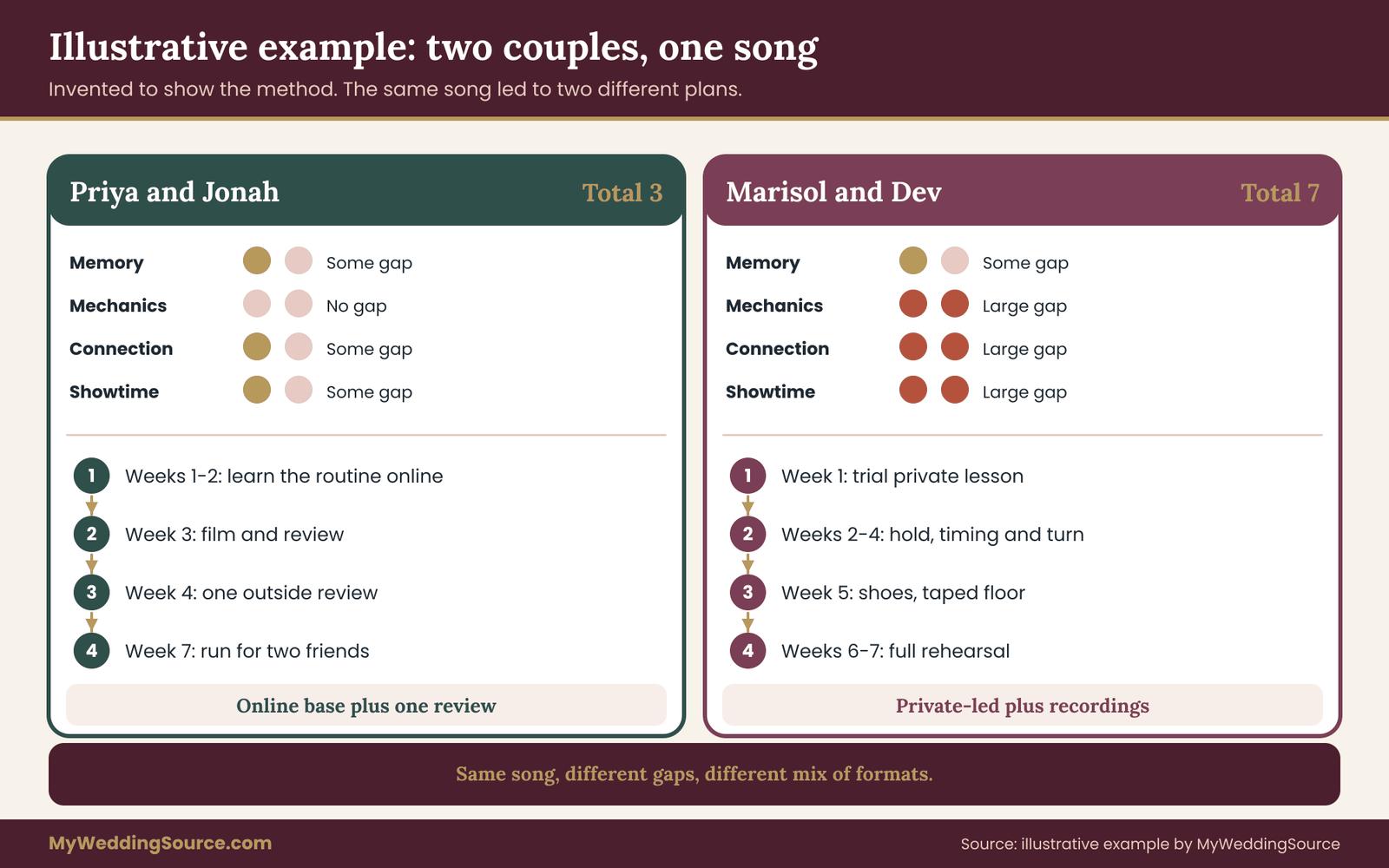
The example below is invented to illustrate the scoring method. The couples, the song and the numbers are made up, and they are not a case study or a result anyone achieved. The point is to show how the same choice, between online dance lessons and private lessons, can reasonably come out differently.
The setup
Both couples chose the same slow song with a steady tempo and a simple structure: an opening verse, a build, a chorus and a quiet ending. Both want about ninety seconds on the floor, followed by an invitation to the guests to join. Both have about three months before the wedding. Neither has taken a dance class. Call the first couple Priya and Jonah, and the second Marisol and Dev. That is a cheap fix, and it works alongside online dance lessons without extra cost.
Priya and Jonah: low score, mostly online
Priya and Jonah both work regular hours, live in a small apartment and have a spare corner of the living room. They tried the two-minute test from earlier. They kept the beat, remembered a simple sway, and laughed at the same moments. Priya felt the hold was a bit awkward, but not tense.
Their scores: memory one, because they forgot the order once; mechanics zero; connection one; showtime one, since they had never run it for anyone. Total three. That is the low edge of the hybrid range, but with no two-point gap, they chose online dance lessons as the base.
Their plan was simple. They picked a recorded beginner routine that matched their song’s tempo, practiced three short sessions each week, filmed themselves on the weekends and noted three things to fix. After four weeks they sent one clip to an instructor for a written review. The reviewer commented on their hold and suggested a small change to hand placement.
They made it, and kept practicing. In the last two weeks they invited two friends to watch a full run in their living room, which closed the showtime gap. This helps whichever mix of online dance lessons and live help you settle on.
What made this work was not the video. It was the cheap, regular loop of practice, filming and a single outside review. Had the review found a bigger problem, they would have added a live call.
Marisol and Dev: high score, private-led
Marisol and Dev have different schedules, a bigger room in a rented house and a very different mood. Dev dislikes being watched and was anxious about the whole thing. Marisol wanted a dance with a turn and an ending pose. When they tried the test, they stopped partway, because they could not agree on who should lead and when.
Their scores: memory one; mechanics two, since Marisol wore heels and they kept slipping; connection two, because they bickered; showtime two. Total seven. They also had a risky element, the ending pose. With a score that high and a wedding approaching, they chose private instruction as the primary method. Remember that online dance lessons teach the routine, not the room.
Their plan started with a single trial lesson. The instructor taught the opening and observed how they communicated. Dev relaxed with a neutral person in the room. They booked a short series of sessions, with the first aimed at the hold and the lead, the second at timing and the turn, and the third at a run-through with the real song, in Marisol’s wedding shoes, in a taped-out space the size of the venue’s dance floor.
The instructor simplified the ending pose to something both were comfortable with. Between sessions, they used a recording of the instructor teaching the routine, so they could practice at home.
In this case, the format that fit them was private lessons plus recorded practice. They still used online dance lessons, but only as a support for what they were taught in person.
What the example shows
Both couples ended up using both formats. The difference was the proportion and the order. Priya and Jonah started with online dance lessons and added one outside review. Marisol and Dev started with in-person help and added recordings. Neither choice was wrong, and neither was a matter of taste alone. Each was driven by where the feedback gap was widest.
Notice also what the couples did not do. They did not buy the largest package first. They did not choose by price. They did not assume the more expensive option was better, or the cheaper one was enough. They tested, scored and chose.
The same example with the other choice
It helps to ask what would have happened if each couple had chosen the other path. Had Priya and Jonah booked a long series of private lessons, they might have learned a little faster, but at a higher cost for a problem they could mostly solve alone. Had Marisol and Dev tried to learn from recordings alone, they would likely have repeated their argument at home, with no one to settle it, and they might have practiced the slipping problem into a habit.
For them, the in-room time was the efficient route. You can adjust this at any point, even after weeks of online dance lessons.
The decision framework step by step
Here is the method from the beginning to the end, in the order to use it. You can complete it in one evening.
Step one: test. Dance two minutes of your song’s opening with a basic pattern. Each of you writes brief notes on four questions: memory, mechanics, connection and showtime.
Step two: score. Rate each gap from zero to two. Compare scores and discuss differences. If one partner scores a gap at two and the other at zero, talk about why before you decide.
Step three: apply overrides. Some situations override the total. If a risky move is planned, add in-room review. If either partner is anxious or has specific access needs, add an instructor conversation early. If one gap, connection or mechanics, scores two, add in-room time even if the total is low. If you have fewer than a few weeks, add in-room time.
Step four: choose the starting rung. A low total starts with recordings and filming. A middle total starts with recordings plus a scheduled review or a live call. A high total starts with a private trial lesson.
Step five: set a review date. Pick a date about a third of the way through your preparation to re-score. If the scores fall, stay the course. If they do not, move up a rung. If they fall fast, you may be able to drop a planned session.
Step six: put the dates in a calendar. Include practice sessions, any bookings, the renewal dates of subscriptions and the date you will run the dance for friends. If you are managing the dance alongside other vendor tasks, the wedding vendor timeline can help you see where this fits among bookings and deadlines.
Why the review date matters
Most couples choose a format once and never revisit it. That is a mistake, because your gaps change as you practice. Someone who started with a memory problem may find that memory is solved and connection is now the issue. The format that served you in week one may not serve you in week six. A scheduled re-score is a small habit that catches this early.
Disagreements about the score
Partners often score differently. One may think the hold is fine while the other finds it awkward. Do not average and move on. Treat the higher gap score as the real one for planning, because the person who feels the problem is the person who will tense up on the day.
If the disagreement is about whether to spend money at all, set a small test, such as a single trial lesson or a single footage review, and let that settle it with evidence. Decide this before you sign up for online dance lessons rather than after.
Alternatives worth knowing about
The choice is not only between online dance lessons and one-to-one instruction. Other options fill different needs, and they may fit your situation better.
Group classes. A short course at a local studio or community center gives you in-room feedback at a lower cost per hour, along with other couples who share the same nerves. The trade-off is that the instructor has less time for you, the routine is generic and the schedule is fixed. Group classes work well for building general comfort and basic steps, and less well for a specific choreography to a specific song.
A single choreographer session. Some professionals will create a routine for your song in one or two sessions and send you home with a recording. It is a mix of private lessons and recorded practice, aimed at couples who want a custom routine without a long series.
Friends and family. A friend with dance experience can help, and sometimes it works well. The risks are that goodwill is not training, that the friend may not know how to teach and that disagreements can strain a friendship. If you go this route, agree on a limit, and consider paying for one professional check at the end.
No choreography at all. A first dance can be a slow, simple sway with a planned moment to invite others. If neither of you wants to rehearse a routine, you can skip formal lessons. Some couples spend one hour with an instructor to learn a comfortable hold and a basic pattern, and that is all they need. The way the dance sits among entrances, dinner and toasts decides how much floor time it deserves, and our guide to designing reception guest flow is a good place to settle that.
An eight-week plan for online dance lessons or private lessons
A format is only as good as the practice around it. The plans below assume about eight weeks before the wedding, and you can stretch or squeeze them. They give you a rhythm to follow, and they describe what each week is for, so that you are not guessing.
Plan A: online dance lessons as the base
Weeks one and two: learn the pattern. Choose a recorded routine that matches your song’s tempo and length. Watch each section through before trying it. Then learn one section at a time, with the screen on, and finish each session by dancing that section once with the screen off. Do short sessions, a few times a week, rather than one long one.
Week three: film and review. Record the first complete run from the front and the side. Watch it the next day, and write down three good things and three fixes. Do not skip the good things. They keep the habit alive.
Week four: get one outside look. Send a clip for review, book a short live call or ask a dance-experienced friend for honest comments. Prepare two or three specific questions. Re-score your four gaps.
Weeks five and six: fix and move to wedding conditions. Apply the changes, practice in your wedding shoes and dance in a space the size of your venue’s floor. Switch from the phone speaker to something closer to event volume.
Week seven: run for an audience. Dance the whole routine for two or three people you trust. Expect it to be worse than at home. That is the point of the exercise, and it removes much of the surprise from the real day.
Week eight: light practice and rest. Dance it a few times, with the real song file, and stop. Do not learn anything new. Confirm the song version and the start cue with your DJ or band.
Plan B: private lessons as the base
Week one: trial and choice. Book one session, not a package. Tell the instructor your song, your wedding date, your comfort level and your concerns. See whether you like the way they teach. Ask for a simple routine to start with.
Weeks two to four: build and record. Take a small number of sessions, spaced out so you can practice between them. Ask the instructor whether you may film key sections, or whether they can provide a recording. Practice what you learned in short sessions, because skills fade if you leave them for a week.
Week five: adapt to conditions. Ask for a session in your wedding shoes and in a space marked to the size of the venue floor. Ask the instructor to simplify anything that is shaky.
Weeks six and seven: rehearse the whole thing. Run the dance from the walk-in to the ending, with the music at event volume. Ask the instructor to play the role of an audience, and to interrupt as little as possible. Invite a friend to watch.
Week eight: maintain. Dance it lightly a few times, and no more lessons. Rest is useful. Confirm the music cues.
Plan C: the hybrid
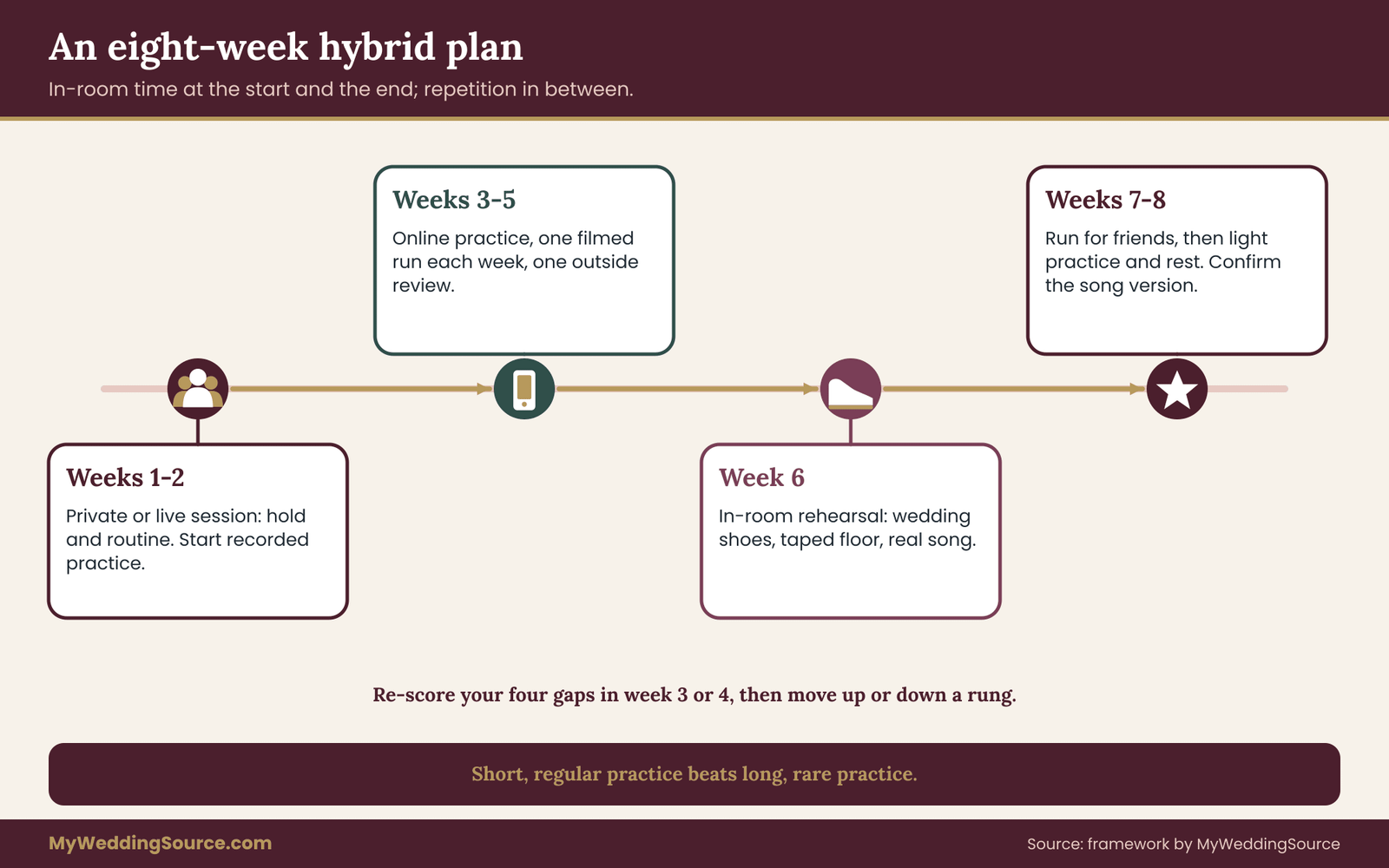
Weeks one and two: a private or live session to fix the hold and choose the routine, followed by recorded practice. Weeks three to five: online dance lessons, filming and a single review. Week six: a second in-room session for a full rehearsal in the shoes and in the space. Weeks seven and eight: friends as an audience, light practice and rest.
This plan uses the highest-value moments for in-room time, and it puts the repetitive work at home. For many couples, it is the best balance of cost and results.
How long should a practice session be?
Short and regular beats long and rare. Fifteen to thirty minutes a few times a week is a reasonable rhythm for most couples, and you can shorten it if you are tired. When either partner is frustrated, stop. A session that ends in an argument does more harm than skipping a day. Use a simple end-of-session ritual: dance the best section one more time, and say one thing you liked. A short review at this point keeps online dance lessons from drifting off course.
If you are starting late
When there are only a few weeks, shrink the routine instead of rushing it. Choose a shorter section of the song. Cut anything risky. Use in-room help early, since fast feedback matters more when time is short. Keep the dance simple and well rehearsed rather than ambitious and shaky.
Failure conditions: when your choice is wrong
Every format fails in predictable ways. Knowing the warning signs lets you change course before the wedding rather than after. The list below is as important as the decision itself.
You keep buying more of the same. If you have finished a recorded course and you still feel stuck, another course is unlikely to help. The gap is probably one that needs a human eye. Move up a rung.
You never film. If you use online dance lessons and never record yourselves, you have only rung one, and you are learning from a demonstration, not from your own movement. Without rung two, you may be practicing mistakes. Film this week.
Practice has stopped. If weeks go by with no practice, the format is not the problem. The routine may be too hard, the time may be wrong or the project may carry conflict. Talk about it, then simplify, reschedule or add an appointment. For some couples, a booked lesson is the only way practice happens, and that is a legitimate reason to pay for private time.
The same argument repeats. If every session ends in the same disagreement, such as who leads, who is counting or who is wrong, a third person is useful. A single in-room session can break the pattern.
The instructor is a poor fit. If you dread lessons, feel talked down to or leave more anxious than you arrived, the instructor may not suit you, however skilled. It is acceptable to stop after a trial and look elsewhere. Do not stay for the sake of a prepaid package if the terms allow a refund or transfer.
The program does not deliver what it promised. If a recorded course or a live class is missing content, is hard to access or does not match its description, keep copies of the page, your receipt and your messages. Ask the provider in writing to fix it or refund you. If that does not work and you paid by card, the Consumer Financial Protection Bureau explains how to dispute a charge, and the Federal Trade Commission accepts reports about deceptive practices.
The choreography does not fit the room. If you learned a routine that needs more space than your venue’s floor, adapt it. This is common, and it is much cheaper to fix three weeks before than the night before. Check the real measurements, and ask the venue or your vendors if you are unsure. A well-run venue knows the floor size.
Injury or discomfort. If either of you feels pain or strain, stop and seek advice from a qualified professional. No routine is worth an injury before a wedding. A good instructor will redesign the dance rather than push through.
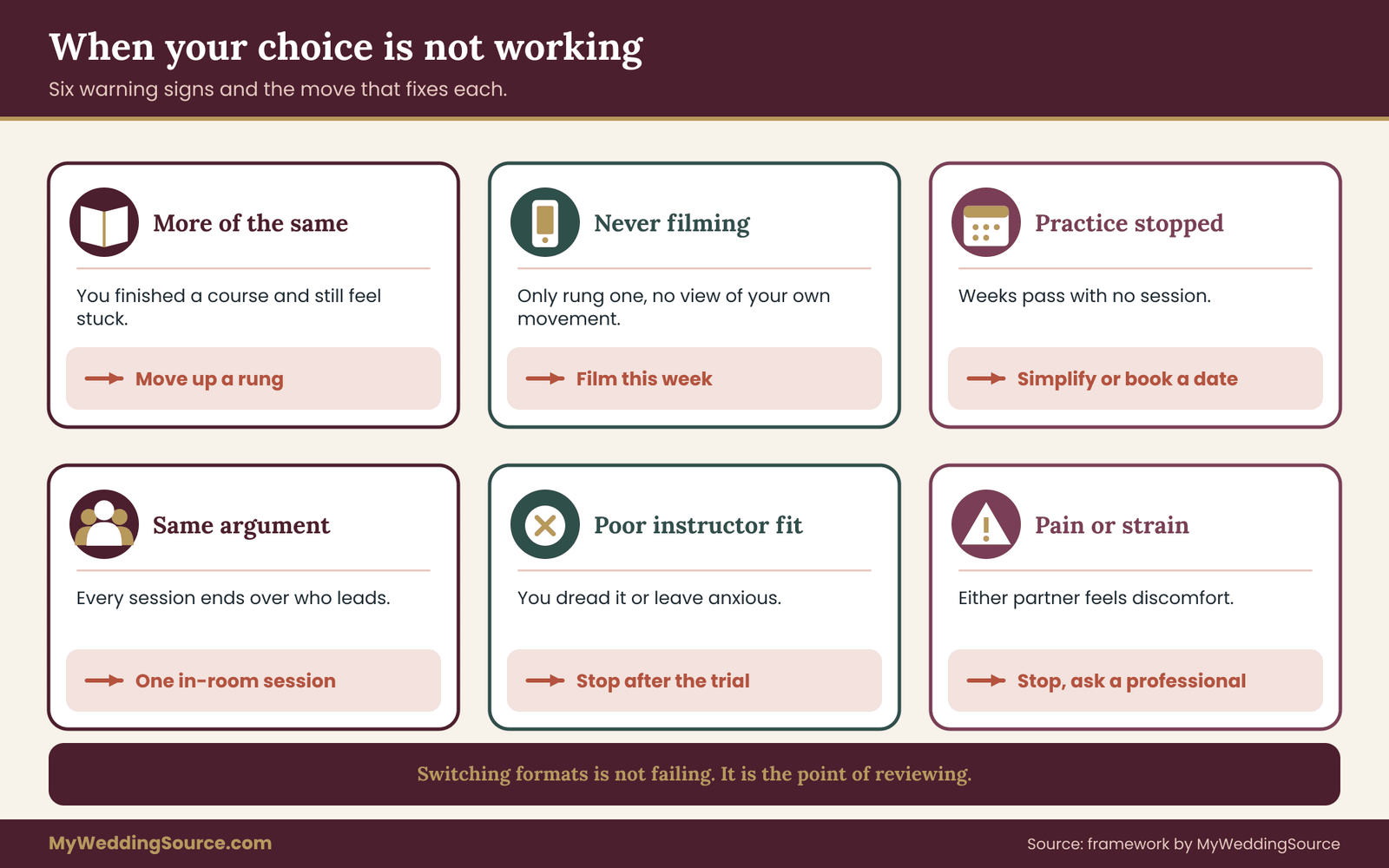
A short rule for switching formats
If two consecutive reviews, a self-review and an outside one, show the same unsolved problem, move up one rung. If both show good progress and the remaining gaps are small, you may move down one rung and save money. Switching is not failing. It is the point of reviewing. This is the moment to ask whether online dance lessons are still serving you.
Keeping the dance in proportion
The first dance is a few minutes of a long day. Guests remember the feeling in the room more than the technique. A couple who look comfortable and happy, in a simple dance, tend to be remembered better than a couple who perform a complicated routine nervously. Your choice of format should serve that comfort. If a lesson plan is making you miserable, it has failed regardless of how much it costs or how professional it looks.
What to say: scripts for instructors, providers and each other
Many couples know what they want and still struggle to say it. The scripts below are starting points in plain language. Change the wording so it sounds like you.
Asking a private instructor about a trial
“We are planning a first dance in about two months. Could we book one trial session before committing to a package? We would like to talk about our song, how you adapt routines, and what happens if we need to cancel.”
A good instructor will answer directly. Listen for how they describe their method, whether they ask about your comfort and your goals, and whether they state their cancellation terms without being pressed.
Asking a provider of online dance lessons about feedback
“Does your program include any way to get feedback on our own footage, such as a review or a live call? If so, how fast is the response and what does it cost?”
If the answer is no, you know to plan your own review. If the answer is yes, you can compare the rate and the speed against the private options.
Asking about refunds and renewals
“Before we sign up, could you tell us in writing how refunds work, whether the membership renews automatically, and how we cancel?”
A clear answer is a good sign. Slow or evasive replies before you pay are a warning about how the provider will treat you afterward.
Asking about adaptation
“One of us would rather avoid certain movements. Can you adapt the routine, and can you give an example of a change you have made for another couple?”
You do not have to explain why. A confident instructor will describe the change and move on.
Talking to your partner when scores differ
“I rated our hold a two and you rated it a zero. Instead of deciding who is right, can we try one trial session and see what a third person says?”
This framing turns a disagreement into a small experiment, which is easier on both of you. Avoid phrasing that assigns blame, such as “you always step on me.” Describe what you felt, not what the other person did wrong.
Talking to your DJ or band about the dance
“We are dancing to this version of the song. Could you confirm the length, the start cue and where you would fade it, so we can practice to the same file?”
Practicing to the same version you will hear on the day removes a surprise. If your first dance has a transition, such as an invitation for guests to join, agree who gives the cue.
Telling a friend or relative you have chosen a different plan
“Thank you for offering to teach us. We have decided to work with an instructor so that we can focus on the parts that need an outside eye, but we would love you to watch a run-through.”
This keeps the relationship intact and gives the person a role that is not the teacher.
Common mistakes with online dance lessons and private lessons
Most problems fall into a small set of patterns. Seeing them in advance saves time.
Choosing by price alone. A cheap option that does not close your largest gap is expensive. A costly option that you do not use is also expensive. Match the format to the gap.
Treating all online dance lessons as the same. The range runs from a single clip to a structured program with live support. Look at the rungs each provides.
Overestimating what you will do alone. People are generous with themselves when they sign up. Be honest about whether you have a practice habit. If not, build in appointments.
Underestimating the room. The difference between studio, living room and venue is large. Plan for it, with tape, shoes and music at the right volume.
Skipping the real song. Learn the dance to the exact version the DJ or band will play. A one-second difference at the start can throw a whole routine.
Starting too late. Late starters need faster feedback. If time is short, use in-room help sooner.
Leaving one partner out. A dance is two people. If one partner does all the learning, the other will feel like a prop. Practice together, and share the decisions.
Ignoring comfort. If the format makes either of you miserable, change it. Comfort is not a luxury here. It is the thing the guests can see.
How to use what you have already learned
If you took classes years ago, or one partner has danced before, you do not start from zero. Use the four-gap score to decide where to spend, and be careful that the experienced partner does not become the instructor, which tends to strain things. If you want to use that experience, agree on rules: the experienced partner demonstrates, and an outside person gives corrections.
Keeping records of your choices
Keep the receipts, the policy pages, the confirmation emails and any recording you paid for in one folder. If you need a refund, or want to dispute a charge, the paperwork matters. Note the dates you can cancel, and when a subscription renews. If you are tracking vendors and bookings in a checklist, add the dance as one line item. The vendor due diligence checklist offers a good pattern for checking any provider before you pay.
Your next steps
This week, do three things. First, run the two-minute test with your song and score the four gaps separately, then compare. Second, apply the overrides, and write down the starting rung: online dance lessons with filming, a hybrid, or a private trial. Third, put dates on a calendar for a review about a third of the way through, for any renewal or cancellation deadline and for a run-through in front of friends.
Then ask the questions in this guide before you pay anyone. Confirm the version of your song with whoever will play it, measure or confirm your dance floor and switch to your wedding shoes early. If it helps to see the dance in the context of the whole planning schedule, our wedding planning checklist shows where such tasks usually sit. Keep the dance simple enough that you can enjoy it. The best format is the one that leaves you comfortable, practiced and still speaking to each other.
FAQ
Are online dance lessons enough for a wedding first dance?
For many couples, yes, especially when the routine is simple and the main challenge is memory. Online dance lessons give you demonstration and repetition, but no one sees your movement unless you film yourselves or buy a review. If your hold feels stiff, your timing drifts or the routine includes a risky move, add at least one session with a person in the room.
How many private lessons does a first dance usually need?
It varies with the routine, your starting point and how much you practice between sessions, so no honest number fits everyone. Many couples use a trial session, a few lessons spaced out for practice and a final rehearsal. Ask the instructor for an estimate after the trial, and avoid buying a large package before you know the method suits you.
Can we mix online dance lessons with private lessons?
Yes, and it is a common and efficient approach. Use recordings for memory and repetition, and spend private time where a person is needed, such as the hold, timing under pressure and a final rehearsal in your shoes. Make sure both partners learn the same version of the routine, and bring any separate learning together early in a joint session.
What should we ask before paying for online dance lessons?
Ask what access you get and for how long, whether the program renews automatically, how refunds work, whether feedback is available and how quickly it comes, and who the instructor is. Ask whether the routine can be adapted. Get answers in writing, and keep your receipt and the policy page in case you need them later.
Are online dance lessons good for people who are shy?
They can be, because you practice without an audience and at your own pace. That privacy helps many shy couples build confidence. Some shy people, however, relax more with a patient instructor than alone. Try a short trial of each if you are unsure. Whatever you choose, plan a run-through for one or two trusted people before the wedding.
How do we know whether a dance instructor is qualified?
There is no single license for dance teachers, so judge by clear information about their training and experience, examples of past work, references and how well their approach suits you. Membership in a recognized professional organization is one data point. A trial session tells you a lot: notice whether they listen, explain clearly and adapt the routine to your bodies.
What if one of us cannot do certain movements?
Tell the instructor or provider early, and ask for a routine built around what you can and want to do. A skilled teacher adapts, and an adapted routine can look and feel excellent. If you have a health concern, ask your own clinician first and share their guidance. Look for a provider who offers modifications or a live session to adjust the routine.
When should we start learning our first dance?
Starting a couple of months ahead gives time to learn, film, review and rehearse in your shoes, but shorter timelines work with a simpler dance. If you have only a few weeks, shorten the routine, skip risky moves and use in-room help early, since fast feedback matters most when time is short. Leave the final week for light practice.
Sources
- Americans with Disabilities Act, U.S. Department of Justice
- Effective communication, ADA.gov, U.S. Department of Justice
- Consumer advice and refund guidance, Federal Trade Commission
- Fake reviews and endorsements guidance, Federal Trade Commission
- How do I dispute a charge on my credit card bill?, Consumer Financial Protection Bureau
- Walking-working surfaces, Occupational Safety and Health Administration
- Physical activity basics, Centers for Disease Control and Prevention
- Copyright basics, U.S. Copyright Office
- Web Content Accessibility Guidelines, World Wide Web Consortium
- Personal archiving: preserving your digital memories, Library of Congress