

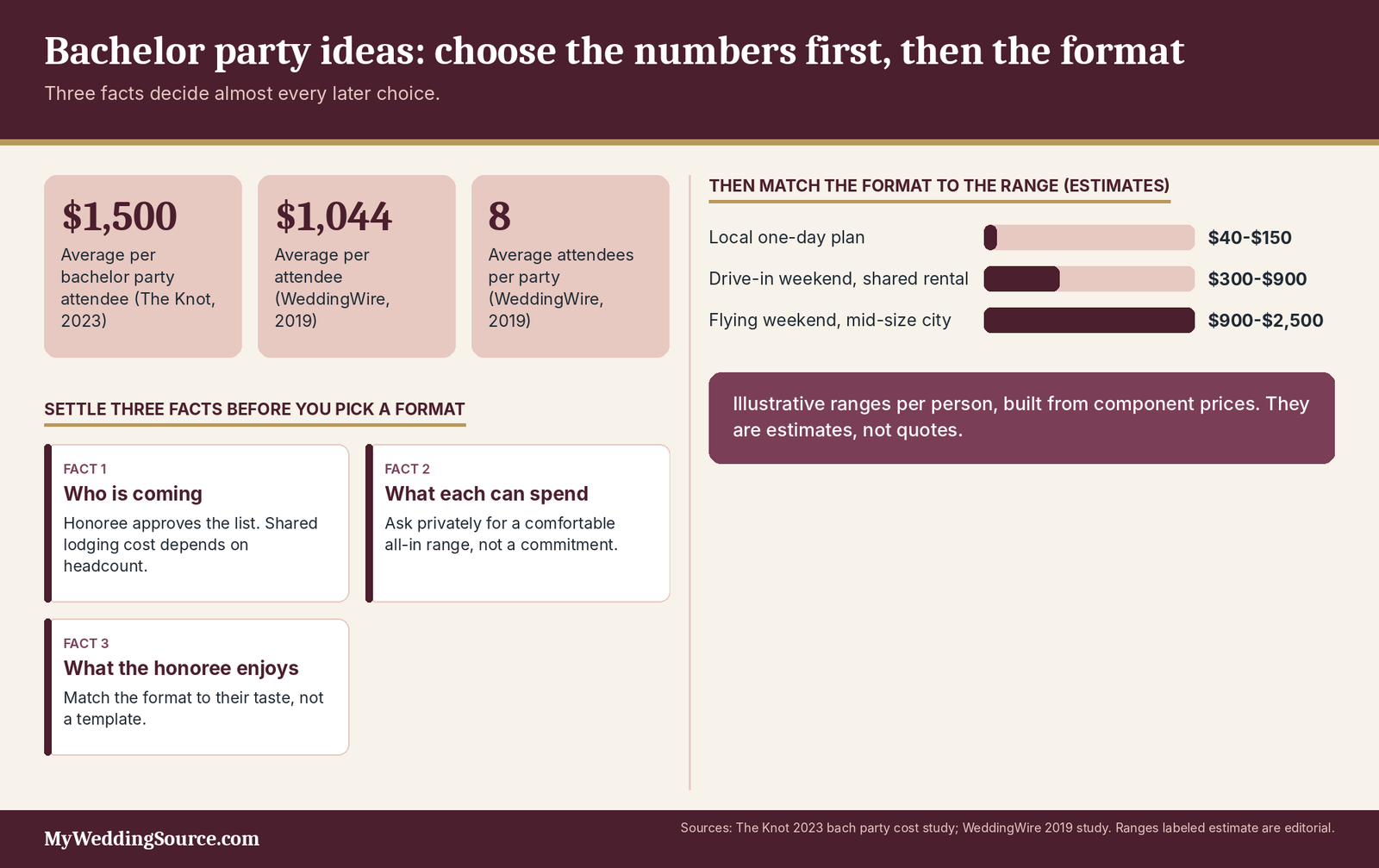
Good bachelor party ideas start with three facts, not a destination: how many people are coming, what each of them can comfortably spend, and what the person being celebrated actually enjoys.
Most planning stress comes from picking the format first and discovering the numbers later. A rental house in a mountain town looks wonderful on a screenshot until the group chat finds out it means $700 per person before anyone buys a meal, and half the friends quietly stop replying. The reverse order works better: settle the guest list and a spending range, then choose from the formats below that fit inside it. This guide covers ten kinds of celebration, what each one tends to cost, how to split the bill without friction, and how to handle the awkward moments that come up in almost every group.
“Bachelor party” is also a looser term than it used to be. Plenty of couples celebrate together, plenty of honorees are not grooms, and plenty of friend groups include people who do not drink, cannot travel, or would rather spend a Saturday at a ballpark than in a nightclub. Everything here assumes any partner or friend group can plan one, that mixed groups are normal, and that the plan should work for the least flexible person in the room. Costs are shown as ranges because they swing widely by city, season, and group size, and every estimate is labeled so you can tell a survey figure from an editorial ballpark.
Who plans a bachelor party, and what is it actually for?
Before comparing activities, it helps to settle two quieter questions: whose party this is and what it is supposed to accomplish. Groups that skip these questions tend to argue about logistics when the real disagreement is about purpose. Spending ten minutes here makes every later decision, from the budget to the destination, easier to defend.
Who can plan one, and who gets invited?
Any partner, friend, or family member can take the lead
There is no rule that a best man or a particular title owns the planning. The person who has the time, the organizing instinct, and the patience to collect payments is the right planner, and that may be a sibling, a coworker, a roommate, or the honoree’s partner. In some friend groups two or three people co-plan, with one handling lodging and another handling activities. The key is that one person is clearly named as the keeper of the budget, a role The Knot’s guidance recommends so that money questions have a single destination rather than a dozen. If you are also deciding how many attendants the couple will have, the bridal party size guide covers that separate decision, which often shapes the core invite list.
The guest list can be wider than the wedding party, within limits
Bachelor parties often draw a broader crowd than the formal wedding party. In WeddingWire’s 2019 bachelor and bachelorette study, which surveyed more than 1,000 people who had attended one in the prior 24 months, 60 percent of parties invited guests beyond the wedding party and 12 percent included people who were not invited to the wedding at all. The average party had eight attendees. A wider list can be warm, but it also raises the per-person lodging math and the odds that someone is stretched financially. A sensible default is to invite the people the honoree would be sad to leave out, and to ask the honoree to approve the list before anything is sent.
What is the party for, and who decides?
The honoree sets the tone, even when it is a surprise
A celebration planned around someone else’s idea of fun can leave the honoree smiling politely through a weekend they did not want. Even for a surprise, the planner can quietly ask a trusted friend or partner three questions: what the honoree would love, what they would dislike, and whether there is anything off the table. Some people want one big trip; others want a single good dinner with six friends. A short, honest conversation or a quiet check with a close friend prevents expensive misses, and it protects friendships when an activity turns out to be a poor fit for a particular guest.
Joint celebrations and mixed groups are common
About 10 percent of couples in the same WeddingWire study held a joint celebration rather than separate parties. Mixed groups bring a wider range of preferences, which is a good reason to pick formats with several ways to participate, such as a cabin weekend with a hike, a cooking project, and a game night. They also change the planning math, because lodging needs, privacy, and comfort levels differ. If you are planning for friends of several genders or none, build the schedule around shared activities rather than segregated ones, and let the evening plans be loose enough that people can step out. The sibling guide to bachelorette party ideas covers the parallel questions for that tradition, and many of its formats work for mixed groups too.
Which trip and active formats are worth planning?
The headline formats are the ones people search for first: a weekend away, a day of outdoor adventure, a golf outing, or a trip to a big city. They are also the formats where costs vary most, because lodging, transportation, and timing can each double the price of the same activity. Choosing among them is easier when you compare what they demand from guests rather than how they look in photos.
Which overnight formats work for most groups?
A weekend in a rental house or cabin
A shared rental gives the group a home base, a kitchen, and room to relax, and it spreads the largest cost across everyone. The trade-offs are real: you are committing to a date and a headcount early, cleaning and service fees can add several hundred dollars, and a house that sleeps ten is expensive if only six show up. Many rental platforms apply their own cancellation schedule, which means a deposit may be tied up for weeks. Drive-in locations within two to three hours keep transportation costs low and make it easier for guests with limited time off to join for part of the weekend. Check house rules on occupancy and noise before booking, since a rental that forbids gatherings can cancel a reservation on short notice.
A city getaway, with or without a flight
A big-city weekend packs in restaurants, sports, music, and museums, and it suits groups who want variety over seclusion. It is also the format most likely to push a budget past comfortable limits: lodging in popular cities is expensive, nightlife and ride costs add up, and flying brings airfare and bags. For context, the U.S. Bureau of Transportation Statistics reported a 2025 annual average domestic itinerary fare of $387, and CoStar reported a 2025 U.S. hotel average daily rate of $160.54 per room. Those national averages are not quotes for any specific trip, but they show why a flying weekend for a group can quickly cross $1,000 per person. If part of the group lives in the city, a one-day version with a shared dinner and a game or show captures most of the fun at a fraction of the cost.
Which active formats fit different comfort levels?
Outdoors and adventure: hiking, paddling, fishing, and rafting
Outdoor days are among the most flexible formats because intensity can be dialed up or down. A group can split into a longer hike and a shorter walk, or rent kayaks for those who want to paddle and keep a picnic spot for those who do not. Guided trips such as whitewater rafting or fishing charters often have fixed group prices, age and weight limits, and waivers, so ask about them before collecting money. Weather matters more here than anywhere else, so find out the operator’s policy on cancellations for water levels, storms, or smoke before you pay a deposit. Public lands often carry entrance fees, and recent changes at National Park Service sites mean pricing differs for residents and nonresidents, so check the agency’s current fee page.
Golf and sports outings
A round of golf, a ballgame, a hockey night, or a day at the track gives the group a built-in structure and natural conversation. Cost swings enormously: the National Golf Foundation has reported an average public green fee of just over $37 for daily-fee courses in early 2024, while destination courses can charge several hundred dollars per round. Add carts, caddies, club rentals, and a meal, and a modest outing still runs $50 to $150 per person on an ordinary public course, an editorial estimate. For spectator events, ticket prices on resale markets can be very different from face value, so price the seats before announcing the plan. Sports outings also need a plan B for guests who do not golf or follow the team, such as a clubhouse lunch, a driving range for beginners, or a separate lower-cost activity.
Ten formats are easy to compare once you line up who each one suits and what it asks of guests. The estimates below cover the activity day itself and exclude flights and overnight lodging, which are priced separately later in this guide.
| Format | Suits groups that want | Main trade-off | Editorial estimate per person |
|---|---|---|---|
| Weekend rental house | Downtime and a shared home base | Early commitment, cleaning and service fees | $250 to $700 for lodging and food |
| City getaway | Variety, food, sports, music | Lodging and ride costs climb fast | $500 to $1,500 with a flight |
| Outdoors and adventure | Activity with flexible intensity | Weather, waivers, fitness differences | $25 to $200 |
| Golf and sports | A structured day with built-in talk | Non-players need a plan B | $50 to $150 |
| Brewery or distillery day | A social, low-prep day | Transportation and alcohol planning | $60 to $150 |
| Games and arcade | Low-pressure laughs | Venue age rules and waivers | $30 to $90 |
| Casino-adjacent | A night out with shows and food | Legal age and spending limits | $50 to $200 plus any gambling budget |
| Spa and wellness | Rest and alcohol-free time | Group booking terms, higher unit price | $120 to $350 |
| Cookout or at-home | Low cost and full control | Volunteers do the work | $25 to $75 |
| Charity or local day | Meaning and low cost | Needs advance notice and a headcount | $0 to $60 |
The ranges overlap on purpose, because a modest version of an expensive format can cost less than a lavish version of a cheap one. A spa day at a local studio and a hot springs resort share a category and not a price. Use the table to narrow the shortlist, then get real quotes before you share a number with the group.
What about food, games, wellness, and low-key formats?
Not every celebration needs a trip. Some of the most successful parties are built around a long dinner, a shared activity, or a quiet day that leaves everyone rested. These formats also tend to be the most inclusive for guests who do not drink, cannot travel far, or have limited budgets, which is a strong reason to consider them even if a bigger trip is possible.
How do food and drink formats work?
Brewery, distillery, and tasting days
Tasting-based days are popular because they combine a tour, a tasting, and a social setting without requiring much structure. They also raise the alcohol questions covered later in this guide, so plan transportation first: a booked shuttle, a rideshare plan, or a designated driver should be settled before the first stop. Many venues offer non-alcoholic options such as house sodas, coffee roasters, or cider-free tastings, and some distilleries and breweries run food pairings that appeal to guests who do not drink. Tour and tasting prices vary by region, and group bookings often require deposits and headcount minimums. Ask whether tastings are sized as standard pours, since the number of small pours adds up faster than most people expect.
Cookouts, tasting dinners, and cooking projects
A dinner at a restaurant, a backyard cookout, or a hands-on cooking class can be the center of a bachelor party at a low per-person cost. Restaurants often require a set menu or a minimum spend for large parties, so ask about gratuity, which is frequently added automatically for groups. A home cookout shifts the work to a few volunteers but can run $25 to $75 per person for generous food and drinks, an editorial estimate that depends on the menu. Cooking projects such as a whole-hog roast, a taco bar, or a grill competition give people something to do with their hands and make conversation easy. Remember to ask about dietary needs and allergies when you collect RSVPs, and label dishes clearly at the table.
How do games, arcades, and casino-adjacent options work?
Arcades, bowling, escape rooms, and other group games
Group games are one of the lowest-pressure formats, because they give the group a shared objective and a built-in reason to laugh together. Arcade bars, bowling alleys, trampoline parks, escape rooms, mini golf, and go-karts typically price by the hour, by the game, or by the lane, and group packages can reduce the per-person cost. Prices vary widely by market, so treat a range of $30 to $90 per person for the activity itself as an editorial estimate and confirm it with the venue. Check age policies in advance, since some entertainment venues restrict evening hours to guests 21 and older and others require every participant to sign a waiver. Look for activities where skill matters less than teamwork, which keeps the competition friendly.
Casinos and gambling: the age rules and the guardrails
Casino outings are the one category where legal age requirements decide who can attend. Nevada sets the minimum gambling age at 21, and one industry guide notes that roughly nine other states allow gambling at 18 in some settings, which is why you should confirm the rules at each specific property rather than assuming. Some casinos also let guests under 21 walk through but not play, and rules differ by property. Set a firm loss limit before the group arrives, decide whether gambling is optional, and make sure at least one other activity is available to guests who do not wish to play. If anyone in the group is worried about their own gambling, the National Problem Gambling Helpline offers free, confidential support by call, text, or chat at 1-800-MY-RESET (1-800-697-3738).
How do wellness, charity, and travel-light formats work?
Spa days and wellness weekends
A spa day, a hot springs soak, a massage, or a hike followed by a sauna can be a welcome reset for a group that wants rest rather than noise. Treatment prices vary by market and by service, and a reasonable editorial range is $120 to $350 per person for a day with a couple of services, with resort day-passes sometimes costing more. Ask about group booking terms, minimum spend, gratuity policies, and how far ahead appointments must be confirmed. Spas often have age minimums or require booking specific treatments, so confirm that everyone in the group can participate. A wellness format is also one of the easiest to make fully alcohol-free, which broadens who can enjoy it.
Charity and volunteer days
A volunteer morning followed by a shared lunch can be a meaningful way to mark a transition, especially for honorees who would rather give than spend. Food banks, park cleanups, trail work, habitat projects, and community gardens often welcome groups, but they usually need advance notice and a headcount. The costs are low, often just lunch and transportation, and some groups add a donation in the honoree’s name in place of favors or swag. Ask the organization about age limits, closed-toe shoe requirements, and what to wear, since some sites have safety rules that apply to every volunteer. Pair the service with a relaxed meal or game so the day feels like a celebration as well as an obligation.
Travel-light local ideas
A local party built on neighborhood favorites keeps costs predictable and lets friends with young children, demanding jobs, or tight budgets participate. Examples include a baseball game and dinner, a day at a lake, a tour of a local museum or distillery, a progressive dinner, a live music night, or a game afternoon at a friend’s home. Local formats also make it easier to spread the celebration across several shorter events, which can help guests who cannot take a full weekend. A single day often costs $40 to $120 per person, an editorial estimate that depends on the city. If you are weighing a local day against a flight, remember the savings are not only financial: no airport delays, no lost vacation days, and an easier path for guests with caregiving responsibilities.
What does a bachelor party cost per person?
Published figures for bachelor parties are higher than most people expect, and they are also less consistent than headlines suggest. Different surveys define costs differently, sample different groups, and were collected in different years. The useful move is to read the numbers as a range of outcomes and then build your own estimate from the ground up, layer by layer.
What do surveys say bachelor parties cost?
The Knot’s 2023 figures
The Knot’s 2023 study of bach party spending, based on roughly 500 U.S. respondents, put the average bachelor party at $1,500 per person, up $440 from 2019, with 15 percent of attendees spending more than $3,000. Length and travel mode moved the total sharply: attendees reported $1,300 on average for a one- or two-day party and $1,650 for three or four days. Flying parties averaged about $2,000 per person, while driving parties averaged about $1,000. In major metro areas, 82 percent of attendees spent more than $400, compared with 64 percent overall, and hotels were the most common lodging choice at 40 percent. These are self-reported spending figures from a modest sample, so they are best used as a sanity check, not a target.
WeddingWire’s 2019 study and why the numbers differ
WeddingWire’s 2019 study reported an average of $1,044 per bachelor party attendee, covering transportation, accommodations, personalized swag, gifts, and group activities, with costs ranging from about $100 to more than $5,000 and 19 percent of attendees spending $200 or less. The gap between the 2019 and 2023 averages reflects inflation, longer trips, and different survey questions, not just changing habits. Older figures also circulate: a 2019 CNBC roundup cited a 2018 Knot average of $537 per person for bachelor and bachelorette parties combined, which shows how quickly the numbers have moved. A Credit Karma poll cited in that same piece found 35 percent of millennials had gone into debt to attend a bachelor or bachelorette party, a dated but telling reminder that cost pressure is real for guests.
| Measure | The Knot (2023) | WeddingWire (2019) |
|---|---|---|
| Average per bachelor party attendee | $1,500 | $1,044 |
| Share spending more than $3,000 | 15% | Not reported on the source page |
| One- or two-day party | $1,300 average | Over 60% of parties lasted two or more days |
| Three- or four-day party | $1,650 average | About 1 in 3 lasted three or more days |
| Flying versus driving | About $2,000 versus $1,000 | Not reported on the source page |
| Sample | About 500 U.S. respondents | 1,000+ attendees, both party types |
Reading the table, the main lesson is that the spread within each survey is bigger than the gap between surveys. A party that costs $200 per person and a party that costs $3,000 are both normal, and the group’s own tolerance should decide where yours falls.
How do you build your own per-person estimate?
Start with layers, not a single number
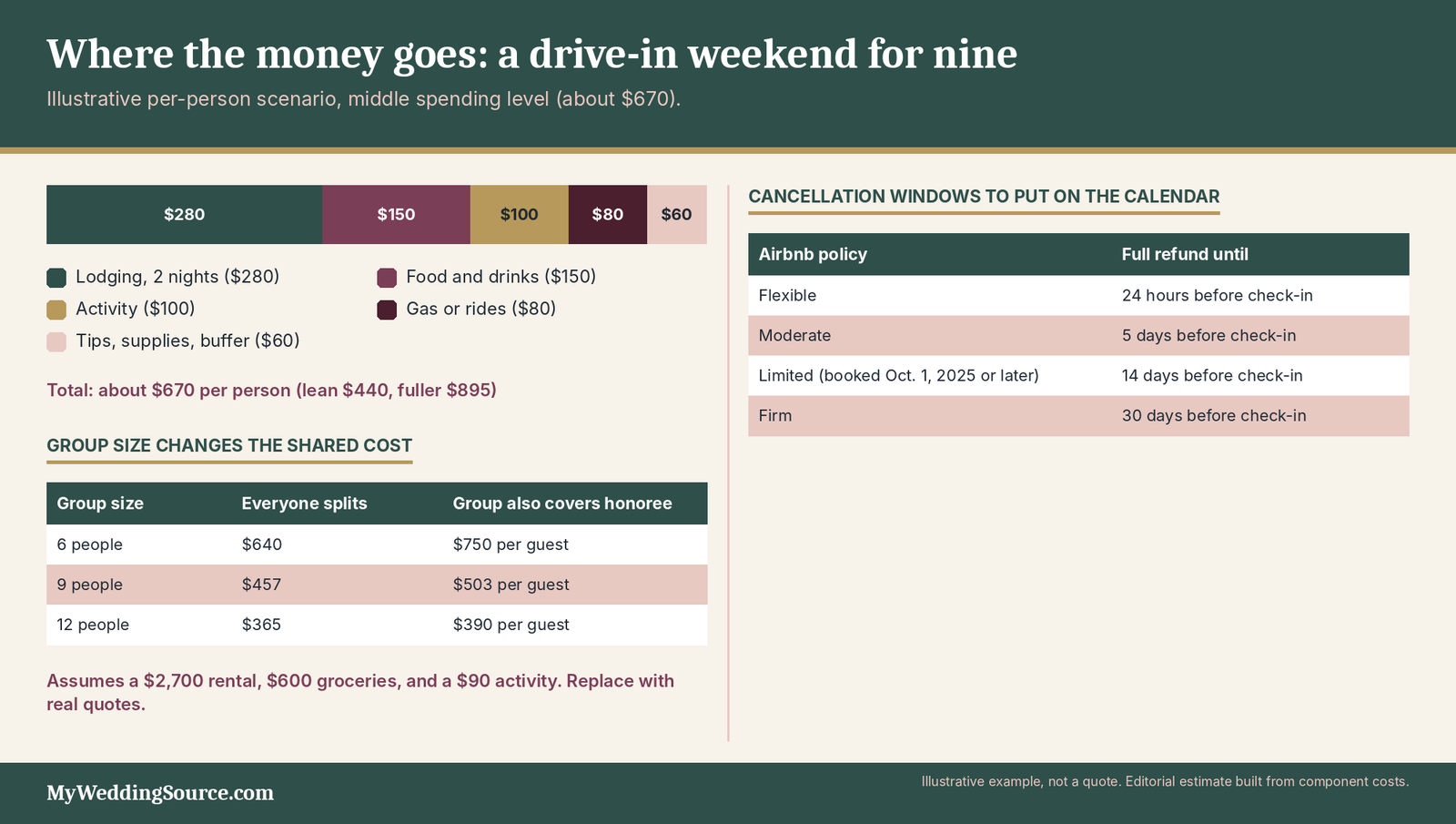
A reliable estimate adds the layers one at a time: lodging, transportation, food and drink, activities, fees and tips, and any shared extras such as shirts or decorations. Add a contingency of roughly 10 percent for the small surprises that appear in nearly every group trip, such as a rideshare surge, a forgotten grocery run, or a tip on a tour. Then decide whether the honoree’s share is included in the total, because that decision changes the per-person figure for everyone else. The comparison below shows an illustrative drive-in weekend for nine people, built from component estimates rather than a real quote.
| Cost layer (per person, 9 people) | Lean | Middle | Fuller |
|---|---|---|---|
| Lodging, 2 nights, including fees | $200 | $280 | $355 |
| Shared groceries and drinks | $100 | $150 | $180 |
| Activity or tickets | $60 | $100 | $150 |
| Gas, parking, or rides | $40 | $80 | $120 |
| Tips, supplies, and contingency | $40 | $60 | $90 |
| Total per person | $440 | $670 | $895 |
The point is not the exact total but the shape: lodging and food drive most of the cost, while activities are often the easiest layer to adjust. A group that wants to save can pick a lower-cost activity, share more meals at the house, or choose a smaller rental, and still keep the weekend feeling special. The low column is realistic only when meals are shared and the activity is modest, so confirm those assumptions with the group.
Where budgets leak
Most overruns come from items nobody listed. Cleaning fees, service fees, and resort or destination fees can add hundreds of dollars to a lodging price, which is why the U.S. Federal Trade Commission’s rule on unfair or deceptive fees, effective May 12, 2025, requires businesses that advertise short-term lodging to show the total price including mandatory fees up front. Restaurants may add an automatic gratuity for large parties, bars may raise prices after a certain hour, and cars and shuttles may charge by the hour. Matching shirts, gifts, and favors are optional, but they add $20 to $60 per person quickly when they are bought for everyone. Build a short list of these leak points into the budget, and ask the group which extras they actually want.
| Scenario | Editorial estimate per person | What drives the number |
|---|---|---|
| Local one-day plan | $40 to $150 | Activity choice, meal, rides home |
| Local plan across two shorter events | $80 to $250 | Number of events, venue minimums |
| Drive-in weekend, shared rental | $300 to $900 | Group size, season, house fees |
| Hotel weekend within driving distance | $450 to $1,200 | Room count, city, nightlife and ride costs |
| Flying weekend, mid-size destination | $900 to $2,500 | Airfare, bags, lodging, peak dates |
| Flying weekend, major metro or resort | $1,500 to $3,500 and up | Hotel rates, event tickets, dining |
The table gives you a quick reasonableness test: if your estimate falls far outside the range for your scenario, check which layer is out of proportion. The ranges are lower at the bottom than the survey averages because they assume a deliberate budget, and they are higher at the top because peak-season destinations and flights can easily exceed them.
How do you handle group size, the budget conversation, and splitting costs?
Money is the part of a bachelor party that tests friendships, so it deserves its own plan. The goal is to give everyone enough information to say yes or no early, without anyone having to explain their finances to a group chat. Done well, the conversation protects both the guest who can spend freely and the guest who cannot.
How does group size change the math?
Larger groups lower the shared cost, but only to a point
Shared costs such as lodging, groceries, and a chartered vehicle scale with headcount, while individual costs such as flights and meals out do not. Adding guests lowers the per-person share of a rental house until you hit its sleeping capacity or the group becomes hard to coordinate, and it is worth comparing your invite list with the numbers in the bridal party size guide so the two groups do not drift apart without anyone deciding they should. The illustration below uses a $2,700 weekend rental, $600 in shared groceries, and a $90 per-person activity to show how headcount and the honoree’s share change the number. The figures are invented for illustration and should be replaced with real quotes.
| Group size (including honoree) | Everyone splits equally | Group also covers honoree |
|---|---|---|
| 6 people | $640 per person | $750 per guest |
| 9 people | $457 per person | $503 per guest |
| 12 people | $365 per person | $390 per guest |
Two things stand out. Moving from six to twelve people cuts the per-person cost by more than 40 percent in this scenario, but the larger group needs a bigger house, more bedrooms, and more coordination. Covering the honoree’s share adds a modest amount per person, between about 7 and 17 percent here, which is easier to absorb when the group is large.
Separate fixed costs from flexible ones
A useful habit is to sort every expense into two lists. Fixed costs are the ones everyone shares and that must be paid in advance: lodging, a booked activity, a chartered ride. Flexible costs are the ones each person controls: their own meals out, drinks, souvenirs, and extra activities. Announcing only the fixed total, plus a rough range for flexible spending, lets guests make their own choices and prevents the quiet resentment that appears when one person buys rounds for everyone. Zola’s planning advice recommends agreeing on a few big splurges in advance and letting each person choose their own spending on smaller items such as meals and drinks.
How do you ask about budget without making it awkward?
Ask for a comfortable range before you name a destination
The easiest moment to talk about money is before there is a plan to be disappointed about. Open with a short note saying you are starting to plan, you want the weekend to work for everyone, and you would like to know a comfortable per-person range. The Knot’s guidance suggests asking what people are willing, or able, to spend and letting the guest of honor have input. A private form or direct message works better than a group-chat poll, since people can answer honestly without being compared with each other. Share the median or lowest comfortable number back with the group, never individual answers.
Scripts that make it easy to say no
Guests need an easy way to decline or propose a cheaper option, and the planner can offer it. Wording like “We are aiming for about $400 to $600 per person including lodging, and we will build the plan around what works for most people” sets expectations without pressure. A follow-up like “If that range is tight, tell me privately and we will find a way to include you for part of the weekend” signals that a partial attendance is welcome. The same goes for the honoree, who should feel free to say a destination is more than they want people to spend. Include a sentence about the deadline for committing so the group has a clear decision date.
How do you split costs, and who pays?
Who pays: the honoree, the hosts, and the guests
Conventions vary by group, and there is no single correct answer. Zola describes a common practice in which the group covers the groom’s share, sometimes called “groom goes free,” and The Knot says the honoree’s costs are often covered but that this should be treated as a bonus rather than an expectation or a demand. A middle path is for the honoree to pay their own travel and lodging while the group covers shared meals and activities. If a couple is hosting its own party, or if parents or a partner are covering costs, say so clearly at the start. Whichever approach you choose, state it in the first message so nobody discovers it at checkout.
| Cost item | Common arrangement | Alternative worth considering |
|---|---|---|
| Honoree’s travel and lodging | Group covers it, as a gift | Honoree pays their own; group covers the rest |
| Shared meals and activities | Split evenly among guests | Honoree contributes a set amount |
| Matching shirts, favors, gifts | Planner proposes, guests opt in | Honoree covers small gifts for guests |
| Deposits and holds | Budget keeper fronts, guests repay by a date | Guests pay a small commitment fee up front |
| Cancellation losses | Group absorbs a documented share | Guest who cancels covers their own non-refundable part |
The matrix is a conversation starter, not a rulebook. Groups should adopt the arrangement that suits their friendships and finances, and the honoree’s comfort should carry weight, since some people feel awkward about others paying for them. Decide the policy before the first payment is requested, and apply it consistently so that nobody feels singled out.
Collecting money: payment apps and the deposit trap
Payment apps are the usual way to collect money, and they work well among friends who know each other. The U.S. Federal Trade Commission notes that sending money through a payment app is like sending cash, so it is very hard to get back, and advises confirming who you are paying before you send. Ask guests to pay the named budget keeper directly, double-check usernames, and keep a shared spreadsheet or a splitting app so everyone can see what has been paid. If one person is fronting a large deposit on a personal credit card, agree in writing how and when they will be repaid. Avoid paying strangers or unfamiliar vendors through an app, and use a credit card for deposits where the vendor accepts one, since card payments can offer more dispute options than app transfers.
Non-refundable lodging and cancellation windows
The largest single payment is usually lodging, and it is often the least flexible. Airbnb’s help center lists standard cancellation policies for stays under 28 nights that range from Flexible, with a full refund until 24 hours before check-in, to Firm, with a full refund until 30 days before check-in, plus stricter options and a discounted non-refundable rate; each listing sets its own policy, so read the one attached to your booking. Hotels and other platforms have different rules, so the principle is to read the cancellation terms before you pay and put the deadline on the group calendar. If the group is not yet firm, choose a flexible rate even if it costs a little more, then book the cheaper option once the headcount is confirmed.
| Airbnb policy (stays under 28 nights) | Full refund until | Later cancellation | Planning implication |
|---|---|---|---|
| Flexible | 24 hours before check-in | Pro-rated tax refund; host paid for nights stayed plus one night | Safest while headcount is uncertain |
| Moderate | 5 days before check-in | Tax refund; host paid one night plus 50% of unused nights | Needs firm RSVPs within a week of arrival |
| Limited (bookings on or after Oct 1, 2025) | 14 days before check-in | 50% refund 7 to 14 days out; taxes only under 7 days | Set the guest deadline at three weeks |
| Firm | 30 days before check-in | 50% refund 7 to 30 days out; taxes only under 7 days | Collect commitments a month out |
| Non-refundable rate | Not refundable after the 24-hour window | No refund | Book only with a confirmed group |
The takeaway from the table is simple: the stricter the policy, the earlier you need confirmed commitments from guests. If you must book early to get a date, consider asking guests for a small non-refundable commitment, such as $50 to $100, so that the group is not left covering a cancelled share. Whatever you choose, tell guests the cancellation terms in plain language when you collect the first payment.
How should the timeline, lodging, and transportation work?
The best timing balances two pressures: booking early enough to get good prices and dates, and keeping the celebration far enough from the wedding that nobody is stressed, hungover, or traveling during the final push. Logistics matter more than activities in determining whether a weekend feels smooth. A group that has solved sleeping, driving, and food can handle almost any itinerary.
When should you plan it relative to the wedding date?
A working timeline, counting back from the wedding
There is no official schedule, so the timeline below is editorial guidance built around the practical limits of rentals, flights, and guests’ time off. Many groups celebrate between one and three months before the wedding, which leaves room for recovery and for last-minute changes to the main event. Start earlier if the plan involves flights or a popular rental, since good dates in peak season can be booked months ahead. The table assumes an eight- to twelve-month runway, which can be compressed for a local, one-day plan. If the wedding itself is part of a bigger plan, the wedding budget guide can help you see how this party fits alongside other costs.
| When | What to settle | Output |
|---|---|---|
| 9 to 12 months out | Honoree’s wishes, rough guest list, planner roles | Named budget keeper and a short list of formats |
| 6 to 8 months out | Budget range ask, date holds, first trip estimate | Per-person range and two or three date options |
| 4 to 6 months out | Book lodging and big activities, set cancellation dates | Confirmed headcount and written payment schedule |
| 3 months out | Flights, shuttle, restaurant reservations | Travel deadline and shared itinerary draft |
| 6 weeks out | Final itinerary, dietary and access needs, rides | One-page plan in the group chat |
| 2 weeks out | Final payments, weather check, backup plan | Everyone paid; refunds or credits noted |
| Week of the party | Confirm reservations, drivers, check-in details | Short reminder with addresses and times |
| After the party | Settle any difference, thank hosts and the honoree | Shared spreadsheet closed out |
Notice that money questions come early and logistics come late. Asking about budget while plans are loose is easier and more respectful than asking after a deposit is paid. Use the last month for confirmations, not decisions.
How close to the wedding is too close?
The final two weeks before a wedding are a busy and emotional stretch for the couple and for many of the people attending the party. Travel delays, illness, or injuries have a bigger effect when they happen close to the ceremony, and honorees may be dealing with fittings, vendor calls, and family visits. Keeping the party at least three to four weeks before the wedding, and preferably earlier, is an editorial recommendation rather than a rule, but it protects the wedding from avoidable risk. Avoid activities with a higher chance of injury, severe sunburn, or lost voices in the weeks before the ceremony. If the schedule forces a short gap, pick a calm format such as a dinner or a spa day rather than a trip.
How do lodging and transportation work for a group?
Choosing lodging and reading the total price
Lodging choices fall into hotels, shared rentals, cabins, and a mix of friends’ homes. Hotels offer service and flexibility but can cost more per person; rentals often cost less per person but come with cleaning fees, house rules, and deposits. Compare the total price including taxes and fees, not the nightly rate, and check bed counts: a house that sleeps ten may mean four people on couches or air mattresses. Ask about parking, check-in and check-out times, quiet hours, occupancy limits, and whether outside guests are allowed. Make sure at least one bedroom is available for anyone who needs privacy, an early night, or a step-free entrance.
Getting around: driving, shuttles, and rides
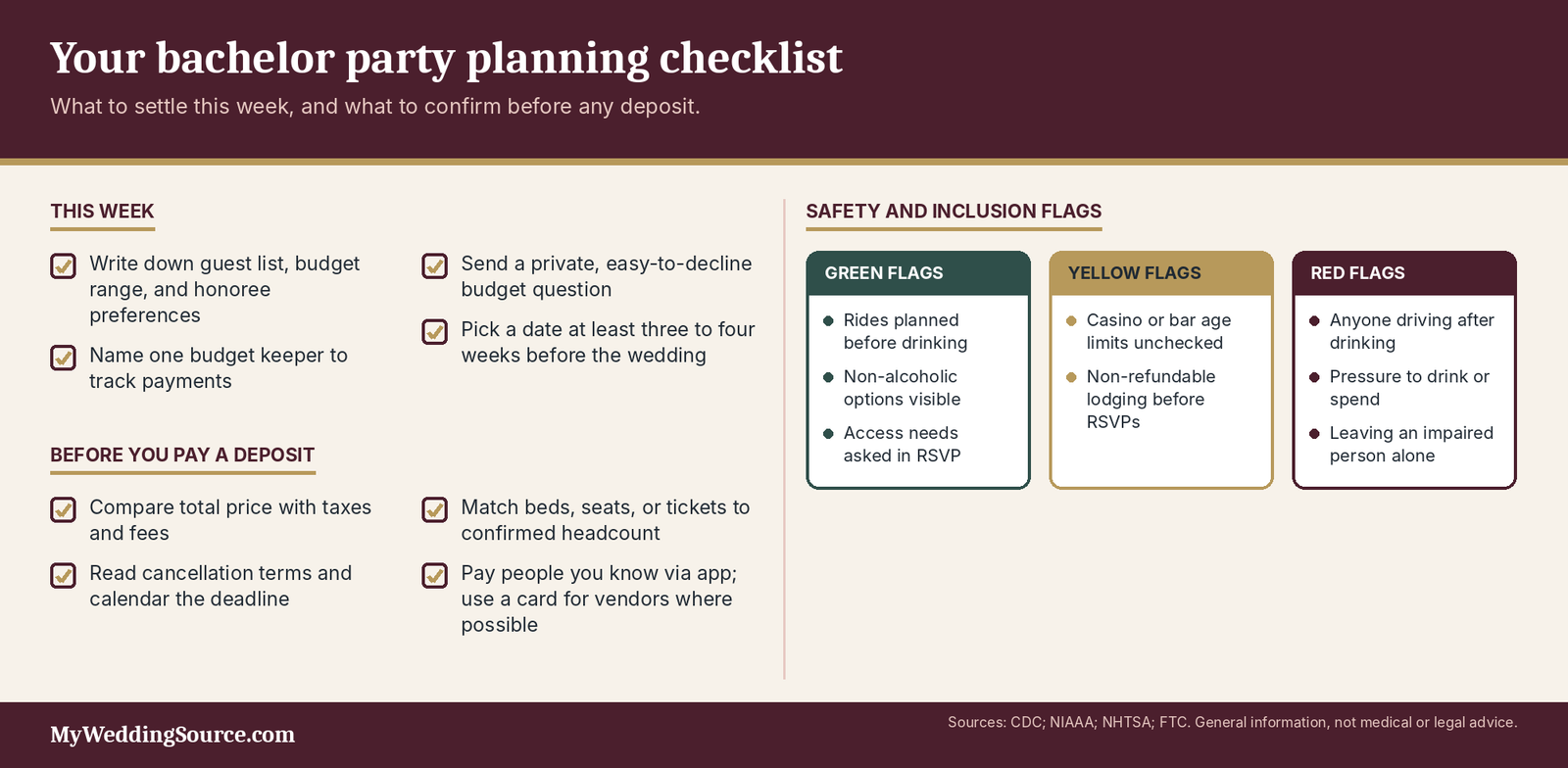
Transportation is where cost and safety meet. Carpooling reduces cost, but every driver needs a plan for the end of the night, and hiring a shuttle or car service for a tasting day often costs less than one serious mistake. NHTSA’s guidance is blunt on the point: plan a safe ride home before you start drinking, choose a non-drinking driver, and make sure everyone leaves with a sober driver. Rideshare prices rise with demand, so check the cost of a last-ride-home on a Saturday night before assuming it will be cheap. For flying trips, give guests a deadline to book flights, and share arrival windows so the group can coordinate airport pickups.
What do sample itineraries look like?
An itinerary should be loose enough to survive a late arrival and tight enough that nobody is left wondering where to be. The templates below are starting points built from the formats described earlier, and they assume a group of six to twelve people. Swap in your own activities, shorten anything that feels crowded, and leave at least one unscheduled block every day.
Which weekend templates work for most groups?
A drive-in rental weekend with a mix of activity and downtime
This template fits a group that wants one big shared experience without airports. Friday is for arrivals, groceries, and a relaxed dinner, which keeps the first night low pressure and lets people with later work shifts catch up. Saturday holds the main activity, such as a golf outing, a hike and paddle, or a tasting day with a booked ride, followed by a group meal. Sunday is for a slow breakfast, a short walk or game, and an early check-out so travelers can get home before the workweek. A schedule with only one scheduled activity per day lets the house itself do the entertaining.
| Day and time | Plan | Notes |
|---|---|---|
| Friday, 5:00 to 7:00 p.m. | Arrivals, room assignments, grocery run | Share the address and a parking plan in advance |
| Friday, 7:30 p.m. | Easy dinner at the house or a nearby casual spot | Keep it low-key for late arrivals |
| Saturday, 9:00 a.m. | Slow breakfast and coffee | Offer a short optional walk |
| Saturday, 11:00 a.m. to 3:00 p.m. | Main activity: golf, hike and paddle, or a tasting with a booked ride | Pre-pay in one group payment; have a plan B for non-players |
| Saturday, 3:00 to 6:00 p.m. | Free time, naps, a pool or game session | Protects energy for the evening |
| Saturday, 7:00 p.m. | Group dinner, restaurant booking or house cookout | Confirm dietary needs and a final headcount |
| Sunday, 9:30 a.m. | Pancake breakfast and a toast to the honoree | Start packing and settle shared costs |
| Sunday, 11:00 a.m. | Check-out and departures | Confirm cleaning and trash rules |
The structure matters more than the specific plans. Two meals are anchored in the house, which keeps costs predictable, and the one paid activity is placed in the middle of the weekend, when the group is fresh. If the weekend runs on a tight budget, replace the Saturday activity with a local hike and a cookout and you remove most of the variable cost.
An alcohol-free outdoors weekend
A weekend built around movement, food, and shared projects works well for groups where several people do not drink, are training for something, or simply prefer mornings to late nights. Plan a Friday arrival and campfire or porch dinner, a Saturday hike, bike ride, or paddle, a long lunch, an afternoon game tournament, and a cooking project for dinner. Sunday can include a sunrise walk, a pancake breakfast, and a swim or a short hike before check-out. Offer interesting drinks such as sparkling water bars, mocktail ingredients, and cold-brew coffee so that nobody feels left out. This version tends to cost less per person, and it avoids the transportation risks that come with drinking.
What shorter formats are available?
A one-day local plan
A single day can carry a full celebration if the pieces connect easily. A sample day runs like this: meet at 10:00 a.m. for brunch, spend the late morning and early afternoon on one activity such as golf, bowling, or a hike, take a rest break at 3:00 p.m., then gather for dinner at 6:30 p.m. with a reservation for the whole group. End the night with something optional, such as a game, a music venue, or dessert, and leave a clear end time so guests with early obligations can plan. The day usually costs $40 to $150 per person as an editorial estimate, depending on the city and activity. Confirm group reservations at least a week ahead, because restaurants may require a headcount, a set menu, or a deposit.
A dinner-and-games evening at home
An evening at someone’s home with a long dinner and a game tournament is the cheapest format and often the most relaxed. Pick a host with enough space and a kitchen, divide the menu among volunteers, and keep a short list of games that work for different group sizes, such as card games, trivia, board games, or a video game bracket. A budget keeper can collect a modest amount, often $20 to $50 per person, to cover groceries and supplies so that the host is not left paying. Invite guests who live far away to join by video for a toast or a short game so that the celebration includes them. If someone offers to host, thank them with a small gift or by handling cleanup.
How do you handle alcohol, safety, and inclusive planning?
Alcohol is part of many bachelor parties and absent from many others, and either approach can be a good one. The responsible way to plan is to treat alcohol as optional, to plan for the worst night rather than the best one, and to make sure the people who do not drink are not treated as an afterthought. The information below is general and drawn from public-health agencies; it is not medical advice, and anyone with a health condition or medication concerns should follow their own clinician’s guidance.
What should groups know about drinking and safety?
What public-health sources say
The National Institute on Alcohol Abuse and Alcoholism (NIAAA) defines a U.S. standard drink as any beverage containing 0.6 fluid ounces, or 14 grams, of pure alcohol, and the CDC lists the common equivalents as 12 ounces of 5 percent beer, 5 ounces of 12 percent wine, or 1.5 ounces of 80-proof spirits. Craft beers, cocktails, and large pours often contain more than one standard drink, which is why counting rounds is unreliable. The CDC defines binge drinking as four or more drinks for women or five or more for men during an occasion, and NIAAA describes it as a pattern that brings blood alcohol concentration to 0.08 percent or higher. The CDC reports about 178,000 deaths a year in the United States from excessive alcohol use, and lists injuries such as motor-vehicle crashes, falls, drownings, and burns among the short-term risks.
Practical guardrails any group can use
Guardrails work best when they are agreed on before anyone drinks. Plan every ride home in advance, as NHTSA advises, and choose a driver who will not drink; NHTSA reports that 11,904 people died in drunk-driving crashes in 2024. Offer water and food throughout the day, set a start time that is not too early, and build in activities that do not revolve around drinks. Agree that anyone can step out without explanation and that nobody pressures another person to drink more. The NIAAA lists confusion, difficulty staying conscious, vomiting, seizures, slow or irregular breathing, and clammy or pale skin as signs of alcohol overdose, and advises calling 911 immediately rather than waiting for all symptoms, never leaving the person alone, and not relying on cold showers or coffee. Because someone may not recognize their own limits, look out for each other.
How do you plan for sober, accessible, and mixed groups?
Sober-friendly planning is mainstream
Planning for guests who do not drink is not a special accommodation anymore. Gallup’s July 2025 survey of 1,002 U.S. adults found that 54 percent said they drink alcohol, a record low in its long-running series, and 53 percent said moderate drinking is bad for health. Guests may not drink for health, religious, recovery, medication, pregnancy, driving, or personal reasons, and they should not have to explain. Choose formats where the activity is the main event, make non-alcoholic drinks look good and be easy to find, and avoid language that frames drinking as the measure of a good time. Ask for dietary and drink preferences in the RSVP, and remember that some people in recovery prefer to avoid bars, breweries, and casinos entirely.
Accessibility and comfort
An accessible plan begins with asking, not assuming. Businesses that serve the public, including restaurants, hotels, and many recreation providers, must give people with disabilities an equal opportunity to use their goods and services under Title III of the Americans with Disabilities Act, according to ADA.gov, but accessibility in practice varies widely, so call ahead. Ask about step-free entrances, seating, bathrooms, parking, stairs at rentals, trail difficulty, and sensory considerations such as noise and lighting. Choose at least one activity every guest can join at their own pace, and share the plan early enough for people to ask for changes. Budget-aware planning is part of inclusion too, so offer a version of the weekend that people can join for part of the time.
What if people disagree or cancel?
Even a well-planned bachelor party meets friction, and most of it is predictable. People disagree about money, a close friend drops out, the weather turns, or the honoree has second thoughts. Having a plan for these moments turns them from crises into logistics, and it keeps the friendships intact long after the party is over.
How do you handle disagreement?
When the group splits over budget
If some guests want a big trip and others cannot afford it, avoid forcing a vote that makes a minority feel exposed. Offer a core plan at a modest price with optional add-ons, such as an extra dinner or a premium activity, that people can choose individually. Another approach is to split the weekend into a core day that everyone can attend and a second day for those who want to extend. The planner should aim for the plan the least flexible guest can comfortably join, because a gathering without that friend rarely feels complete. Keep conversations about money private, and never ask someone to justify their budget in the group chat.
When the honoree wants something different
Sometimes the honoree says they would rather skip the big party, cut the trip short, or avoid a particular activity. Take the signal seriously and offer smaller alternatives, such as a single dinner, a day trip, or a game night. Check with the honoree about any off-limits topics, activities, or people before anything is booked, and respect the answer even if it disappoints the group. Remember that a celebration succeeds when the honoree feels cared for, not when the itinerary looks impressive. A short private conversation from a trusted friend is usually enough to find a version everyone can support.
What happens when someone cancels or plans change?
A guest drops out after money has been paid
State the policy when you collect the first payment so nobody is surprised later. A common approach is that the group covers shared costs already committed, such as lodging, but guests are asked to find a replacement or accept a partial refund when the vendor allows one. If the lodging has a refund window, honor it, and share any refund promptly with the people who paid. If the departure is due to an emergency, a flexible response, such as covering a partial share as a group, preserves goodwill. Write the policy in the first message and apply it equally to everyone.
Weather, illness, or other disruptions
For outdoor events, have a rain plan that does not require canceling the whole day, such as an indoor activity or a long lunch. Ask the activity operator about cancellation, refund, and rescheduling policies before paying, and note any weather thresholds. If a key person gets sick or the trip becomes unsafe because of storms or road conditions, choose to postpone rather than push through. The planner should keep a short list of nearby alternative venues and a contact for the rental host. For flights, consider that airline changes may be handled by the airline, so each traveler may need to manage their own booking, and ask whether personal travel insurance suits their situation.
Frequently asked questions about bachelor party ideas
Planning and money questions
How much should a bachelor party cost per person?
There is no single right number. Published surveys put the average between roughly $1,000 and $1,500 per attendee, but a local day or a drive-in weekend can run far less, from about $40 to $900 depending on length and lodging. The most useful figure is the range your group agrees on before booking, which is why a private budget check is the first step. If most guests land below the average, plan to that, not to the survey.
How far in advance should you plan?
For a local one-day plan, four to eight weeks is enough. For a weekend rental or anything involving flights, start six to twelve months before the wedding so you can lock in dates, compare cancellation terms, and give guests time to save. Aim to hold the party at least a few weeks before the wedding. These are editorial recommendations, not rules, and busy seasons may require more lead time.
Does the honoree pay?
Practices vary. Some groups cover the honoree’s share, sometimes called “groom goes free,” while others have the honoree pay for their own travel and lodging and the group cover shared meals and activities. Either approach is acceptable if it is communicated clearly before anyone pays. The honoree’s comfort and the group’s budget should both carry weight.
Safety and group questions
Can a bachelor party be alcohol-free?
Yes, and it is increasingly common. Gallup found that 54 percent of U.S. adults said they drink, so a significant minority of any group may prefer not to. Outdoor days, game nights, cooking projects, spa visits, and sports outings work without alcohol, and guests who do drink can still enjoy them. Make non-alcoholic options appealing and visible rather than a leftover.
What if a friend cannot afford it?
Invite them anyway, and offer ways to join that cost less, such as one day, one dinner, or a local alternative. The Knot suggests choosing a lower-cost option rather than excluding anyone, and including friends who cannot attend through a video call or a group gift. Keep the conversation private and do not ask for reasons. A friend who feels welcome at any price level will remember it.
Can people of any gender attend?
Yes. Zola notes that the groom decides the invite list and that women can attend if the groom wants them there. More broadly, the guest list is up to the honoree, and mixed groups often work best with shared activities and no pressure on anyone to participate in anything. Check with the honoree and plan the itinerary around what everyone can enjoy.
Your next steps
The first week is about decisions, not deposits. By the end of it, you should know who is coming, what they can spend, what the honoree wants, and who is tracking the money. Everything else can wait until those four facts are on paper.
This week
Write down the three facts
Make a short list: the likely guest list, a rough per-person budget range, and the honoree’s top three preferences and top three dislikes. If you are guessing at the budget, use the cost table in this guide to pick a starting range and mark it as provisional. Look at your wedding calendar and mark dates at least three to four weeks before the wedding that avoid major holidays. If your overall spending plan needs a check, the wedding budget guide shows how this party fits among other costs.
Name the budget keeper and send the first message
Pick one person to collect money and keep the spreadsheet. Send guests a short note with the budget range, a decision date, and a reminder that anyone can reply privately. Include a few questions from the callout earlier in this guide. Keep the tone warm, give people a way to say no, and avoid booking anything until responses come in.
Before you pay a deposit
Confirm headcount and read the cancellation terms
Compare the total price including taxes and fees, not just the nightly rate or the activity price. Read the cancellation policy and put the refund deadline on a shared calendar, and ask the host or venue about occupancy limits and house rules. Make sure the number of commitments matches the number of beds, seats, or tickets. If the group is not firm, choose the more flexible option even at a slightly higher price.
Lock in rides, a backup plan, and the payment method
Confirm who is driving, who is booking a shuttle, and what happens if a driver decides to drink. Write down a backup plan for weather, a late arrival, or a canceled reservation. Pay with a method that offers a record and some protection, and only send app payments to people you know. Share the one-page itinerary with the group, then relax: a plan with clear money, clear rides, and one anchor activity per day leaves plenty of room for the weekend to be fun.
Sources & methodology
- The Knot: bach party cost study (2023) — average bachelor party cost per person, length, travel mode, and lodging data.
- WeddingWire 2019 Bachelor & Bachelorette Study — attendee spending, party length, guest counts, joint celebrations, and invitation practices.
- The Knot: who pays for bachelor and bachelorette parties — cost-splitting conventions, honoree’s share, and budget-conversation tips.
- Zola: bachelor party planning guide — “groom goes free” convention, guest list notes, and splurge-versus-flexible spending advice.
- CNBC: how much women spend on bachelorette parties (2019) — earlier cost figures and the cited Credit Karma debt poll.
- CDC: standard drink sizes — U.S. standard drink equivalents.
- CDC: about alcohol use — binge drinking definition, annual deaths, and short-term risks.
- NIAAA: what is a standard drink? — standard drink definition and equivalents.
- NIAAA: understanding binge drinking — binge drinking definition and associated risks.
- NIAAA: dangers of alcohol overdose — warning signs and when to call 911.
- NHTSA: drunk driving — 2024 fatality figure and ride-planning guidance.
- Gallup: U.S. drinking rate at new low (2025) — share of adults who drink and views of moderate drinking.
- FTC consumer alert on payment apps — payment-app cautions and confirming recipients.
- FTC: rule on unfair or deceptive fees FAQ — total-price disclosure for short-term lodging, effective May 12, 2025.
- Airbnb Help: cancellation policies — standard cancellation policy structure for stays under 28 nights.
- ADA.gov: introduction to the ADA — public accommodations obligations under Title III.
- Bureau of Transportation Statistics: 2025 annual average domestic air fare — 2025 average domestic itinerary fare.
- Hotel Management: CoStar 2025 U.S. hotel performance — 2025 average daily rate.
- GOLF.com on National Golf Foundation fee data (2024) — average public green fee.
- National Park Service: passes — pass prices and 2026 nonresident fee changes.
- Casino.org: gambling age in Las Vegas — Nevada age rules and state variation.
- National Council on Problem Gambling: national helpline — free, confidential helpline details.
Methodology. Survey figures (The Knot 2023, WeddingWire 2019, Gallup 2025) are self-reported and come from the sample sizes stated in the text; fee, fare, and rate figures are published industry or government statistics. Every per-person range labeled “editorial estimate” and every itinerary table is an illustrative planning aid built from component costs and checked against those averages, not a quote or a survey result. Timing advice and etiquette suggestions are editorial judgment informed by published planning guides. Alcohol and safety content is general information drawn from federal health and safety agencies and is not medical advice; rules on lodging, gambling age, and cancellations vary by provider and state.
Freshness note. Recheck the cost surveys when The Knot or Zola publish new bach-party data (typically every one to two years), the lodging cancellation policies and fee rules before each booking, gambling-age rules for the specific property and state, and National Park Service fees at the start of each year. This article reflects sources reviewed in October 2026.