

Child free wedding etiquette comes down to one policy you can state in a sentence, written where guests will see it before they RSVP, and applied the same way to every family on both sides.
You have decided that the reception will be adults only, and then the guest list gets real. Your sister has three kids under seven, your college roommate is nursing a four-month-old, your partner’s cousin is flying in with a toddler, and your flower girl has a baby brother who goes wherever she goes. None of these people are villains, and none of them are wrong to wonder what the policy means for them. They are simply about to ask you a question, and what you say in the next few conversations will shape how the policy lands far more than the decision itself.
This guide starts after the decision. If you are still weighing whether a child free wedding is the right call, our child free wedding etiquette overview covers that question, the family history that makes it feel loaded, and the general case for and against. Here we stay practical: how to define the policy so it is enforceable, where the words go on the envelope, details card, RSVP and website, how to handle infants, wedding-party kids and close relatives, what to say when someone pushes back, which childcare options are worth offering, and what the policy really does to your budget. Every script is written to be adapted, not recited.
A word on tone before the tactics. The couples who get through this with their relationships intact usually decide early, tell the most affected people personally before any paper arrives, and treat a “no, we can’t come” as a reasonable answer instead of a rejection. Parents of young children are often glad to have a night off, and just as often they are stretched thin and genuinely unable to make the logistics work.
One limit worth stating plainly: etiquette sources disagree on some details here, especially on whether the policy may appear in print on the invitation itself. Where the experts split, we say so and explain how we would choose. Costs, sitter rates and venue rules vary by city and vendor, so every number below is a prompt to ask your own caterer, venue and sitter, and to get the answer in writing.
What Policy Are You Actually Announcing?
“No kids” sounds like a policy, but it is really a headline. The first time a guest asks “does that include my 15-year-old?” or “what about the baby?” you will discover whether you have a policy or only a feeling. This section turns the feeling into a rule you can say aloud, print on a card, and apply to the hundredth question as calmly as the first.
Which policy shape fits your wedding?
Four shapes cover almost every real-world situation. Each is easy to explain and each has a predictable weak point, which is the useful thing to know before you commit. The table below compares them, and the paragraphs that follow explain how couples tend to land on one.
| Policy shape | What you tell guests | Main weak point | Typical fit |
|---|---|---|---|
| Adults only, no exceptions | “Our wedding is for guests 18 and older.” | Infant and wedding-party questions arrive immediately | Evening, formal or capped venue |
| Adults only plus named exceptions | “Adults only, with babes in arms welcome.” | Needs a precise definition of each exception | Many young families on the list |
| Age cutoff | “Guests 16 and older.” | Teens near the line; siblings of the cutoff | A few teens and many small children |
| Ceremony-only kids | “Children are welcome at the ceremony.” | Requires sitters or a handoff before the reception | Daytime ceremony, evening party |
What does a fully adults-only policy look like in practice?
A fully adults-only policy is the cleanest to explain and the hardest to hold, because the exceptions people want are sympathetic ones. Danielle Rothweiler of Rothweiler Event Design and etiquette writer Thomas Farley, both quoted in WeddingWire’s guide to no-kids weddings, advise an all-or-nothing approach, noting that trouble usually starts when a couple invites some close relatives’ children or flower girls and ring bearers and leaves others out. The strength of the full policy is that “it applies to everyone” is a complete answer. The cost is that you will give up the photo of your niece in her dress, so decide now whether that trade feels right.
When does an adults-only policy with a short exception list make more sense?
Most couples with young relatives end up here, and it works when the exceptions are few, defined by a rule, and decided before invitations go out. “Adults only, except for infants who are not yet walking and the children in our wedding party” can be explained in one breath and applied without judgment calls. The mistake to avoid is an exception list that grows by conversation, because every added child makes the next “no” harder to defend. Write the list down, show it to your partner, and treat any later addition as a decision that needs both of you.
How do age cutoffs work, and what about teenagers?
A cutoff such as “16 and older” or “18 and older” gives you an objective line, and it also raises the question of who sits just below it. If your cutoff is 18, a 17-year-old cousin will be excluded while an 18-year-old friend of the family is welcome, and her parents may reasonably ask why. Decide whether the cutoff is by age on the wedding date, and whether teens in the wedding party get a different answer. Nothing in etiquette requires a particular number; consistency is what guests read as fairness.
Can children come to the ceremony but not the reception?
Ceremony-only works well when the ceremony is in the late afternoon and the reception is a distinct evening event, because families can bring children to the first and hand them off before the second. It works poorly when the same venue, the same timeline and the same seats flow straight from vows to dinner, because someone has to physically take the kids out. If you choose this shape, plan the handoff as part of the schedule: a named adult for each family, a sitter waiting at a nearby hotel room, and an announcement in the program. Without a handoff plan, “ceremony only” quietly becomes “all night” by about the second course.
How do you write the policy as one sentence?
What is the one-sentence test?
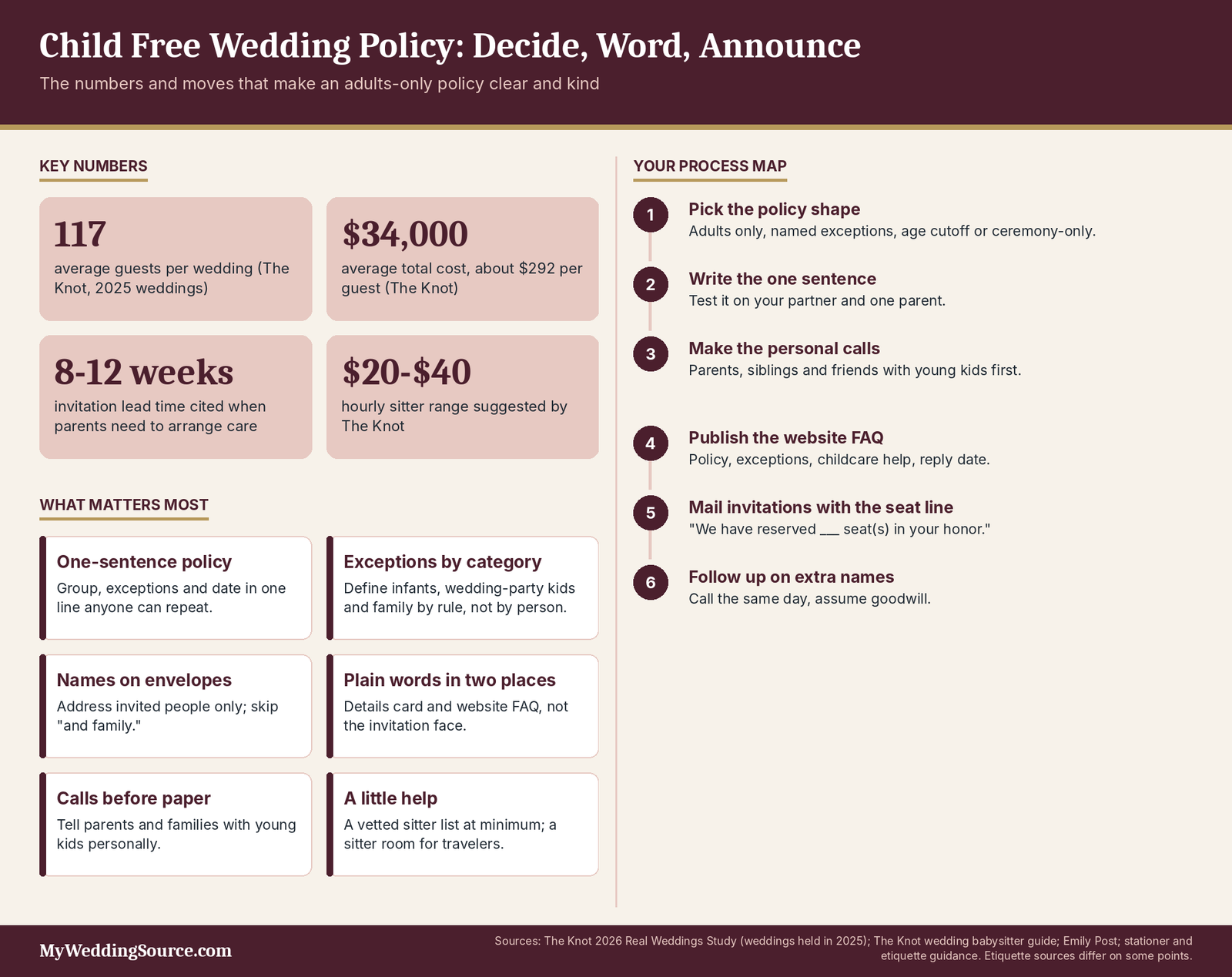
Try to say the policy in one sentence that contains the group, the exceptions and the date: “Our reception is for guests 18 and older, with babes in arms and our wedding party’s children welcome.” If you need a second sentence or a “well, except,” the rule is not finished yet. Read it to your partner and to one parent, and ask each to name the child they think of first; if they name different children, your rule leaves a gap. The test prevents the most common problem, which is a policy that means something different to each of the six people who explain it to guests.
Do you owe guests a reason?
You do not owe a reason, and printed explanations tend to invite debate. The sources reviewed for this article agree on the principle even where they differ on wording: Emily Post says guests should not assume children are included when an envelope names only the parents, and a stationer’s guide advises that no explanation is needed on the invitation itself. It still helps to have a reason ready in conversation, because “budget” or “the venue has a hard cap” or “we wanted an evening where parents can also relax” gives people something to nod at. Choose the true one, keep it short, and avoid reasons that criticize children or parents, such as “kids ruin receptions.”
Who else needs to agree before you announce it?
Anyone hosting or paying, and anyone whose family will be affected, should hear the plan before the wider list does. If parents are contributing, they may have grandchildren in mind and should not learn the policy from the details card. If you are part of a blended family, decide that stepchildren and your own children are treated identically, and say so to the adults involved. The goal of this early round is not permission; it is to remove surprise.
How Do You Word the Policy on the Invitation, Details Card and Website?
Wording is where most couples spend their energy, and it is also where the etiquette sources disagree. The traditional rule is that the envelope tells guests who is invited, and that nothing about children appears in print on the invitation. Modern practice uses the wedding website and a separate card to say it plainly, because guests plan travel and childcare weeks ahead and are poorly served by hints. For fuller templates covering the whole suite, see our guide to wedding invitation wording; this section focuses on the child free language.
Where does the policy go, and where does it not?
Think in layers. The envelope and RSVP card are the quiet layer, which signal who is invited by name. The details card and website FAQ are the plain-language layer, which says it out loud, and a personal call is the human layer, which catches the people who will miss the first two. Relying on only one is why guests show up with a baby carrier.
| Layer | What it does | Sample content | Risk if used alone |
|---|---|---|---|
| Envelope and inner envelope | Names invited guests | “Mr. Alex Rivera and Ms. Dana Cole” | Some guests assume kids are included |
| RSVP card | Shows seats reserved | “We have reserved ___ seat(s) in your honor.” | Guests write in extra names anyway |
| Details card or website FAQ | States the policy in plain words | “We’re celebrating with adult guests only.” | Missed if guests do not read it |
| Personal call or text | Prevents surprises and hurt feelings | “We wanted you to hear this from us.” | Time-consuming; uneven reach |
How should you address envelopes and inner envelopes?
Name every invited adult on the outer envelope and on the inner envelope if you use one, and leave children’s names off. Emily Post’s guidance is that an envelope reading “Mr. and Mrs. Hayward” does not invite their children, while “The Hayward Family” or a list of each person’s name does. Avoid “and family” and avoid “and Guest” for parents of young children, since either gives them a reason to read the invitation as open. If you are unsure whether a household understood, a short call beats a silent assumption. Single parents are easy to overlook here; address them by name only, and consider a gentle personal note, since their childcare options are often thinner than a couple’s.
What goes on the RSVP card and details card?
The RSVP seat line is the most quietly effective tool in the suite: “We have reserved ___ seat(s) in your honor,” with the number pre-filled by hand or in print. It puts the invited headcount in front of guests at the moment they respond. The stationer guidance we reviewed recommends the details card as the main home for a short, warm sentence, and the wedding website for the longer explanation. Keep the card to one or two sentences, such as “We love your little ones, and we’ve planned an adults-only reception. We hope this gives you a night out too.” Pair it with the pre-filled seat line, and note the RSVP date so guests know when to finalize childcare. Our wedding RSVP etiquette guide covers what to do when responses arrive with extra names.
What belongs in the wedding website FAQ?
The website is where you can be warmest and most specific, because space is free and readers are looking for answers. Create a question that guests will actually search for, like “Can I bring my children?”, and answer it in three or four sentences: the policy, the exception if any, the childcare help you are offering, and the date by which guests should let you know if they need to change plans. Link to your sitter list from the same page. Put a short version of the FAQ on the home page or the RSVP page as well, since not everyone clicks to the FAQ before responding. Update it if the policy ever changes, and tell the people who were previously told no.
Should “adults only” be printed on the invitation itself?
This is the genuine split. Emily Post’s guidance is not to print “no children” or “adults only” on the invitation, treating the envelope as the signal and word of mouth as the reinforcement. Other sources we reviewed accept a short line on a separate enclosure, and several put the plain statement on the wedding website and details card instead. Our editorial view: keep the invitation face clean, use the envelope and RSVP seat line, and print one plain sentence on the details card. That respects the traditional rule about the invitation proper, and it gives guests the clarity they need to book a sitter. If your community or family would never read a website, add a call or a short handwritten note.
What wording works, by tone?
The samples below are starting points. Edit them so they sound like you, keep them short, and avoid anything that reads as a scolding. The two things to protect are clarity (who is invited) and warmth (we like your children).
What is a formal version?
Formal wording works best on a details card or in a formal website FAQ: “We kindly request that our celebration be limited to guests 18 and older. We thank you for your understanding and look forward to celebrating with you.” The structure is a request, a boundary and a thank-you, with no explanation. If you need an exception, add it in the same breath: “with the exception of infants in arms.”
What is a warm, conversational version?
For a relaxed wedding the tone can be friendly without being cute: “We adore the little ones in our lives, and we’ve planned an adults-only evening so every guest, including parents, can relax and enjoy the night. We’ll share a list of local sitters on our website and hope you can still join us.” Notice that it names the benefit to parents, offers help and does not apologize. Apologies tend to invite negotiation. Avoid jokes at the expense of children, such as “we love your kids, just not at our wedding,” which can land as dismissive to the very people you are asking for patience.
What short line works for a details card or program?
When space is tight, the short line is enough: “Adult reception to follow,” placed under the reception details, or “Our celebration is for guests 18 and older.” The short form works best when ceremony and reception differ, since it tells guests which part children may attend. Avoid the bare “No children” on its own, which reads as curt.
What should you say in a text or email to parents of young children?
The personal heads-up is the one most couples skip, and it is the one parents remember. Send it before invitations arrive, to the families you are closest to: “We wanted you to hear this from us first. Our wedding will be adults only. We love Mia and Theo, and we know that makes it harder for you to travel, so we’re putting together a list of vetted sitters and would be glad to help however we can. Whatever you decide, we’re grateful you’re in our lives.” That message states the policy, shows care, and gives them an easy way to say “we’ll try” or “we may not make it.” Follow up with a phone call for anyone who goes quiet.
What Does a Child Free Policy Really Do to Your Budget?
Many couples assume leaving children off the list will trim the budget by a clean percentage. Sometimes it does, and often the savings are smaller than expected, because most wedding costs are either fixed or priced per adult, and the childcare you offer adds a new line. Pricing is complicated here, not shady: caterers and venues set child rates in very different ways, and the only reliable number is the one in your own proposal.
How much can leaving children off the list save?
Start with the right baseline. The Knot’s 2026 Real Weddings Study, covering 10,474 couples who married in 2025, reports an average of 117 guests and an average cost of about $34,000, which works out to roughly $292 per guest in the study’s data read-out. That is an average of everything, including the venue, photographer and attire, so it overstates what one more seat adds.
Why is the average cost per guest the wrong number to use?
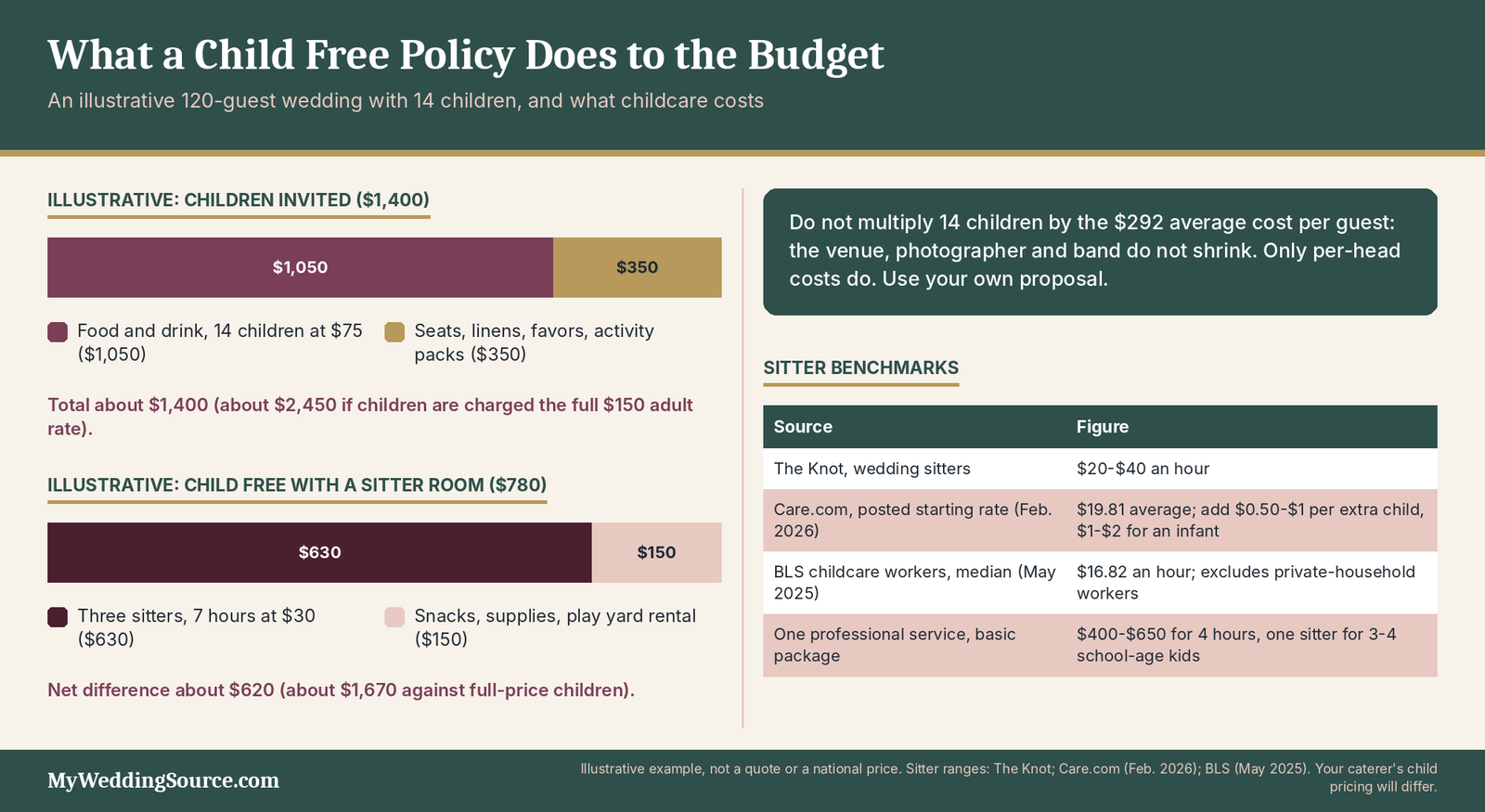
Multiplying 14 children by $292 gives about $4,088, and that is almost certainly too high. The venue rental, photographer, band or DJ, flowers and attire do not change when 14 children are removed from a list, so the true saving is only the per-head portion: food, drink, rentals, place settings and favors. For a related breakdown of which costs scale with headcount and which do not, see our guide to wedding cost per guest. Use the average for context and your own proposal for arithmetic.
How do caterers price children?
Practices vary widely, so ask. Reader reports in an Offbeat Bride discussion describe a caterer charging a little under one-fifth of the adult rate because children do not use the bar, another charging half for children under 12 and nothing under 4, and venues that price food and drink by age. Those are anecdotes, not benchmarks, and they show the range you might meet. Ask whether the child rate covers food only or includes service charges, and whether children over a certain age are charged as adults.
What does the math look like in a scenario?
The table below is an illustration, not a quote. It assumes 120 invited guests including 14 children, an all-in food and beverage cost of $150 per adult, children at half price, and a sitter room used by eight of the fourteen children. Sitter rates use the midpoint of The Knot’s $20 to $40 hourly range.
| Line item (illustrative) | Children invited | Child free with sitter room |
|---|---|---|
| Food and drink, 14 children at $75 | $1,050 | $0 |
| Seats, linens, favors and activity packs at $25 each | $350 | $0 |
| Three sitters, 7 hours at $30 an hour | $0 | $630 |
| Snacks, quiet-room supplies and a play yard rental | $0 | $150 |
| Total | $1,400 | $780 |
| Net difference | About $620 |
If the caterer charged full adult price for children, the left column would rise to about $2,450 and the net difference to about $1,670. The message is that a child free policy usually saves money, though less than the headline per-guest figure suggests, and offering care narrows the gap further. Choose the policy for the evening you want, and treat the budget effect as a modest tailwind.
What does childcare cost you and your guests?
A policy also shifts costs onto guests, and being aware of that is part of treating them kindly. A local parent pays for a sitter at home, and an out-of-town family may pay for a sitter, a longer trip or a second hotel room.
What should you budget if you offer childcare?
Use ranges, then ask for quotes. The Knot suggests about $20 to $40 an hour for a wedding sitter, Care.com reports a national average posted starting rate of $19.81 an hour as of February 2026, adding roughly $0.50 to $1 for each additional child and $1 to $2 for an infant, and the Bureau of Labor Statistics lists a median wage for childcare workers of $16.82 an hour (May 2025), a figure that excludes private-household workers. Professional wedding services charge more because they bring insurance, screening and staff. Budget a range, not a single point.
What does it cost guests to comply?
A local couple with two children might pay $20 to $30 an hour for a sitter for a seven-hour evening, which is a few hundred dollars once travel and tips are included, and that is before outfits and gifts. Out-of-town families add transportation, and the FAA allows children under two to fly as lap children but strongly recommends a separate seat with an approved restraint, which means buying a ticket. Our guide to destination wedding guest costs shows how those layers add up. Seeing those costs is a good reason to give notice early and to offer help to families traveling a long way.
How do you weigh goodwill against savings?
Treat declines as a cost you can estimate. If three of your closest friends cannot attend because they cannot arrange care, that is not a budget line, though it may be the most important number in your decision. Before you commit, list the households you would be sad to lose and ask what each would need. Often a sitter room or an earlier heads-up changes the answer, and sometimes nothing does. Knowing which is better than finding out at the RSVP deadline.
How Do You Handle Infants, Wedding-Party Kids and Close Relatives?
Exceptions are where a clear policy either holds or quietly dissolves. The way to keep it intact is to decide each exception as a category, in advance, with a definition you can state in a sentence. When you decide by category, “no” to a cousin’s two-year-old and “yes” to a nursing newborn are both answers to the same rule; when you decide by person, every answer feels like a ranking of how much you like each family.
What should you decide about infants and nursing babies?
Infants are the exception most couples end up making, and the one that causes the most arguments when it is left vague. They are also the group where an absolute “no” has real consequences, since a nursing baby cannot simply be left with a sitter for six hours. Public-health guidance is relevant here: the CDC says infants should be exclusively breastfed for about the first six months, and the American Academy of Pediatrics recommends continuing breastfeeding alongside solid foods for two years or beyond for as long as parent and child wish. That does not oblige you to allow infants, and it does mean a parent of a nursing baby may be choosing between attending and not attending, not between attending and a sitter.
How do you define “infant” so the rule is enforceable?
Pick a definition a guest can check without asking you. “Babes in arms” is traditional, “children under 12 months” is more precise, and “infants who are not yet walking” ties the exception to the moment a baby becomes mobile. Whichever you choose, write it once and use it everywhere. A vague “small babies are fine” will be read as “my eighteen-month-old is small,” and you will be negotiating by Tuesday.
What do infants actually need at a wedding?
A baby at a reception needs a seat for a parent near an exit, a quiet place to feed or change, and a safe spot for sleep. The Consumer Product Safety Commission advises a bare sleep surface, back-sleeping, and moving a baby who falls asleep elsewhere to a crib, bassinet or play yard, and it warns against inclined products for sleep. A baby asleep in a car seat on a banquet chair is the situation that advice is aimed at, so it is kind to tell parents where a play yard could go if you have a quiet room. Ask your venue whether a bridal suite or lounge could double as a nursing and nap room. Seat infant families near a side door, away from the speakers, and tell your DJ not to spring a surprise sparkler send-off on a sleeping baby.
What if you decide to say no to infants too?
A no-infants policy is legitimate, and it needs a plan for the guests it affects. Say it early, ideally in the personal call, because a nursing parent will need to decide whether to travel, whether a partner or relative can hold the baby in a nearby room, or whether to decline. Offer a concrete accommodation, such as a hotel room with a sitter close enough that a parent can step out between courses. Dear Wendy’s advice, in her column on telling guests kids are not invited, is to make an exception for breastfeeding babies and to avoid assuming grandparents will be able to help.
How do you treat children in the wedding party?
Flower girls, ring bearers and junior ushers are usually the first exception couples consider, and the one that most often surprises guests. A child in the processional is not automatically a guest at dinner, and being clear about that protects you from the “but your flower girl is there” objection.
Can a flower girl or ring bearer attend the ceremony but not the reception?
Yes, and many families prefer it. Ceremony-only participation lets a four-year-old walk down the aisle, enjoy the attention, and go home to bed before the speeches. Talk to the child’s parents directly, agree on who collects the child after the processional, and decide whether wedding-party children stay for dinner. Whichever you pick, tell every parent of a wedding-party child personally.
What about your own children or stepchildren?
Your own children and your partner’s children are not exceptions in the way a niece is; they are family members at their own parents’ wedding. State the policy as “guests” and treat your own household as part of the hosts. If you are blending a family, think through where children will sit and who is responsible for them during portraits and the first dance. A sitter or trusted relative assigned to your children is practical insurance, since you will be unavailable for large parts of the day.
What about siblings of the wedding-party kids?
This is the quiet trap. If the flower girl is invited to the ceremony, her three-year-old brother will probably come with her family, and the guest who was told “no kids” will notice. Decide in advance whether wedding-party siblings are included, and tell their parents specifically. A common solution is to let the child in the processional attend with a parent and ask the family to arrange a sitter for any sibling.
Where do you draw the line for immediate family?
The “just my niece” request is the hardest to refuse, so draw the line by relationship, not by affection. A rule such as “children of siblings are included; cousins’ children are not” can be defended; “the children of the people I talk to most” cannot.
Should a rule favor your family or your partner’s?
Neither. Apply the same relationship rule to both sides, in the same form, and write it down. If your partner has three nieces and you have none, the rule is still the rule, and the difference in outcome is a coincidence of family size. Being able to say “we use the same rule for both families” is the strongest sentence in your pushback vocabulary.
What about teenagers and the 16-to-17 gap?
Teenagers are the group that most often falls between the policy’s lines. If your cutoff is 18, a 17-year-old is a child by your rule, and her parents may point out that she is more mature than some adults on the list. If teens matter to your family, set the cutoff at 16 and say so, or list teens by relationship as an exception, rather than letting individual maturity decide.
What if a relative has a child who needs care for a different reason?
Distinguish a child from a person who relies on a caregiver. An adult guest with a disability may bring a personal care attendant, and a teenager with a developmental disability may need a parent nearby; these are access questions, not child policy questions, and they deserve a conversation, not a rule. Ask the guest what they need, and make a decision that keeps the guest able to attend. Nothing in a child free policy should make a guest feel their access needs are an imposition.
What Do You Say When Someone Pushes Back?
Pushback is not a sign that the policy is wrong. It usually means a person you care about is disappointed, worried about logistics, or feeling excluded, and the right response addresses the feeling and holds the line. The scripts below are built on one principle: acknowledge, restate the policy as a rule that applies to everyone, and offer help where you can.
What should you say before invitations go out?
The best pushback script is the conversation that happens before the invitation. Parents and siblings who hear the policy from you, in a calm moment, are far likelier to defend it to others than those who discover it from a card.
How do you tell your parents and your partner’s parents?
Do it in person or by phone, with your partner, and lead with the plan, not an apology: “We’ve decided our wedding will be adults only, and we wanted to tell you before anyone else. We know that affects your grandchildren, and we want to talk about how to make it work.” Then listen. Parents often fear that grandchildren will miss the day, so tell them what the grandchildren will be part of: the ceremony if that is your plan, a photo session, or a family brunch the next morning. If a parent is paying for part of the wedding, be especially careful to frame this as the couple’s decision made with their feelings in mind, not as a request for permission.
How do you tell the sibling or best friend with young kids?
These are the people most affected and the most likely to feel personally rejected, so call each one. Say the policy, then say what you are doing about it: “Our wedding will be adults only, and I know that’s a lot with three kids under seven. I’d like to help with a sitter at the hotel, and I want you to tell me honestly what would make it possible for you to come.” If the answer is “I’m not sure we can,” accept it without pressure. Siblings sometimes decline, then come around once they see the sitter plan; either way, the relationship survives better when you do not bargain.
Who should be your designated messenger?
Choose one close person, such as a parent or member of the wedding party, to field questions and repeat the policy accurately. Give them the one-sentence policy, the exception list and the childcare offer, and tell them what not to say, such as guessing at reasons or promising exceptions. Emily Post’s advice is to ask close friends and relatives to help spread the word, which suits a policy that people hear sideways.
How do you answer the common objections?
After invitations go out, the same five or six objections arrive in different words. A short script for each saves you from improvising when you are tired, and keeps the answer consistent across conversations.
| What you hear | What is underneath | A calm response | What to avoid |
|---|---|---|---|
| “My kids are well behaved.” | Wanting to be trusted | “I don’t doubt that; the policy is the same for every family.” | Debating behavior |
| “We can’t find a sitter.” | Real logistics | “Here is our sitter list; can we help set one up?” | “Figure it out” |
| “Why is her child invited?” | Fairness | “We’re using one rule for both families: wedding party only.” | Defending individual cases |
| “We’ll just bring them.” | Testing the boundary | “We can’t accommodate children; we hope you can still come.” | Silence or a hint |
| “Then we won’t come.” | Hurt or logistics | “We’ll miss you, and we understand.” | Guilt or bargaining |
What do you say to “my kids are really well behaved”?
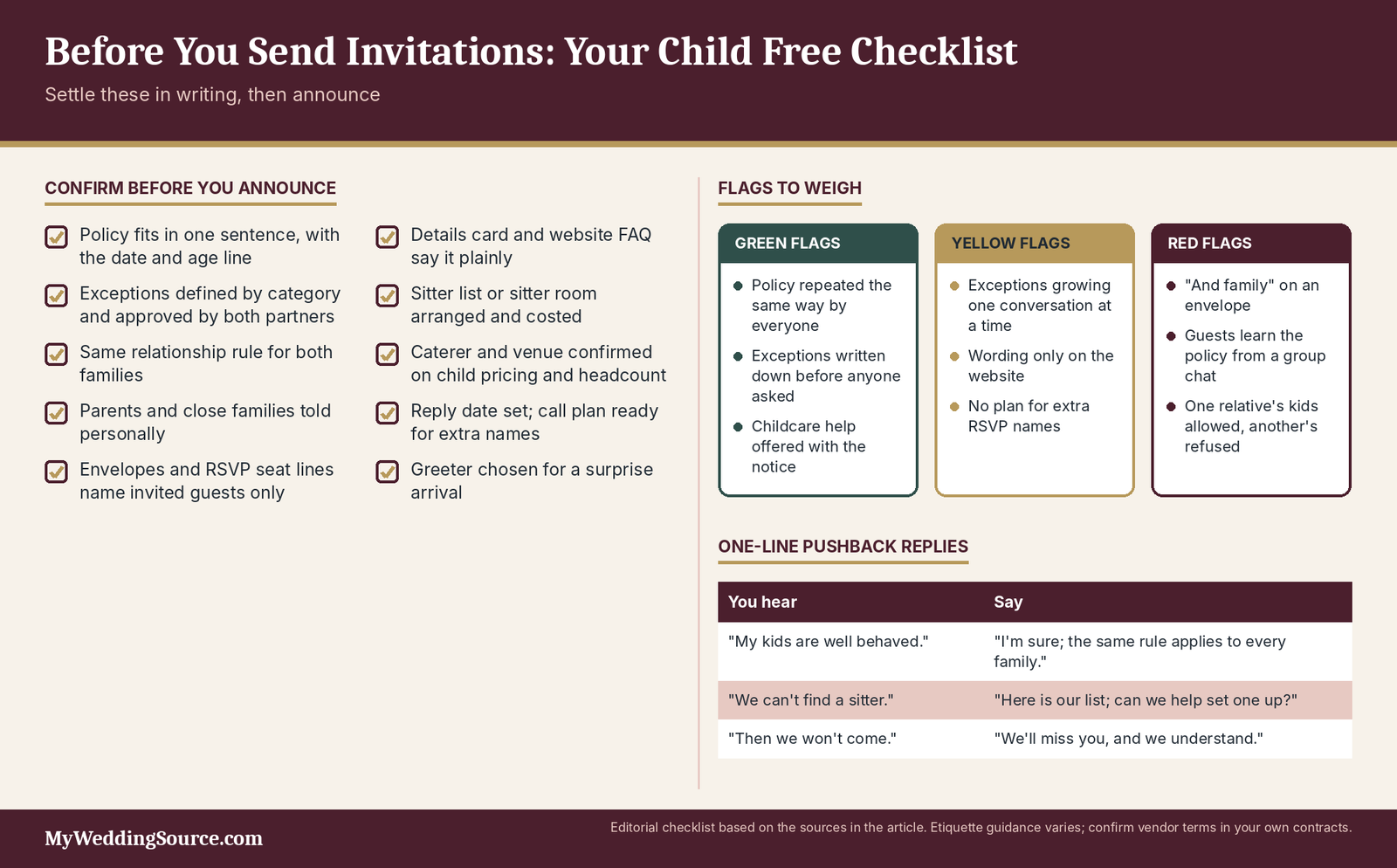
The reflex is to defend the policy by describing bad behavior at other weddings, and that is the wrong move because it turns the conversation into a debate about the parent’s child. The better answer is: “I’m sure they are. This isn’t about behavior; we’re applying the same rule to everyone.” The sentence works because it grants the claim, removes the personal element and returns to the rule. If the parent pushes, repeat it once in different words and move to what you can help with.
What do you say to “we can’t get a sitter” or “we’re traveling”?
This is a practical problem, not a challenge, and it should be answered practically. Offer the sitter list, a hotel-based sitter option if you have one, or an introduction to a local relative who may help. Tell them the RSVP date so they can plan, and say you understand if it does not work out. The guest who is traveling from out of town is the most legitimately affected, and the place to be most flexible: see the childcare section below for options that make travel workable.
What do you say to “but you invited their kids”?
If your rule is consistent, this has a one-sentence answer: “We’re including only the children in our wedding party, and that applies to both families.” If your rule is not consistent, the objection is a signal to fix it, not to argue. Do not make the answer about the other family; say what the rule is and what it covers. If the objection comes from someone whose child falls just outside the rule, acknowledge the disappointment, and avoid ranking.
What if guests RSVP with their children included anyway?
Call promptly, assume an honest mistake, and keep the focus on who is invited. Emily Post suggests wording along the lines of “I’m sorry if there was any confusion, but the invitation was only for you and Henry. We hope you can still attend.” If the guest pushes back, stay firm and kind. Making an exception for one family is unfair to every guest who followed the invitation and arranged care, and if a guest decides not to attend, that decision is theirs and not a sign of your failure.
What do you say to “then we won’t come”?
Say “We’ll miss you, and we understand,” and mean it. Resist the urge to bargain or to explain further, because the second attempt almost always weakens your position without changing the decision. Parents of small children sometimes decline for reasons of cost, nursing, a child’s separation anxiety or simple exhaustion, and you do not need to read the decline as a verdict on the relationship. Send a warm note after the wedding with a photo, and keep the door open.
Which Childcare Options Are Worth Offering?
You are not required to provide childcare, and nearly every source we reviewed says so. Still, a policy that comes with help lands very differently from one that arrives alone, and it costs far less than most couples fear. Think of childcare as a menu: free, low-cost and full-service options that you can mix according to your budget and your guest list.
What can couples offer, from simplest to most involved?
Begin with the cheapest option and add only if the guest list demands it. Many couples find that a good sitter list and a clear RSVP date solve most problems for local families, and that a hotel sitter or kids’ room matters mainly for out-of-town ones.
Is a vetted sitter list enough?
For local guests, usually yes. Collect names, phone numbers and rates from two or three sitters you or a family member have used or can verify, and post them on the website with a note that you have not hired them and guests should confirm availability. Dear Wendy’s advice is to gather “names and numbers of trusted sitters” at minimum, and to avoid assuming relatives can fill the gap. It costs nothing and signals care. The limit is that a list does not help a parent who is flying in and does not know the city.
What does a hotel sitter or kids’ room look like?
A hotel sitter option lets parents of out-of-town children attend the ceremony and reception while the children stay in a room at the guest hotel. The Knot’s guide to wedding babysitters suggests booking roughly three months ahead and having sitters arrive at least an hour before an adults-only ceremony and stay at least an hour after the reception ends. Professional wedding childcare companies, profiled in an article on specialized wedding nannies, described one basic package of about $400 to $650 for one sitter with three or four school-age children for four hours, with infants needing one-to-one care. That is one provider’s quoted price; yours will vary by city.
Is a family-friendly side event a good compromise?
Hosting a casual brunch, backyard lunch or welcome picnic the day before or after the wedding gives children a place in the celebration without changing the evening. Say clearly on the website that the event is open to children. The drawback is the added workload in the busiest weekend of your life, so ask a friend or family member to host it for you.
Should you offer a childcare stipend instead?
Some couples contribute a flat amount toward a sitter instead of organizing care themselves. It avoids the vetting burden and lets parents choose a sitter they trust, and it requires a clear statement of who qualifies, which can raise fairness questions. Set the rule before you offer, for example only for families traveling more than a set distance, and state it plainly to those families.
How do you vet childcare safely?
If you hire or recommend childcare, you are lending your name to the arrangement, so a short vetting routine is worth the time. The aim is to ask the right questions and to be honest about what you know.
What is the difference between a professional service and a local sitter?
A professional wedding childcare service typically carries liability insurance, runs background checks, trains staff in CPR and brings age-appropriate activities, according to the providers quoted in the article above; a local sitter is cheaper and may be a neighbor’s teenager with no training. Neither is automatically better. The pro is a safer choice for hotel-room care of unfamiliar children, and a known local sitter may be right for a handful of nearby relatives. Ask any provider for references, a copy of their insurance if they carry it, and a clear emergency plan. A call or video interview, as the Knot suggests, covers experience, emergency procedures and how they handle a child who is upset.
How many sitters do you need?
It depends on children’s ages. The professional package above assumes one sitter for three or four school-age children and one-to-one care for infants, and mixed ages require more sitters. Ask guests to tell you the number and ages of children who would use the service by a set date. Overestimating slightly is cheaper than a sitter who is outnumbered.
What about food, allergies and sleep?
Ask parents about allergies and dietary needs on the same form that collects names and ages. The FDA lists nine major food allergens: milk, eggs, fish, crustacean shellfish, tree nuts, peanuts, wheat, soybeans and sesame. Make sure the sitter knows which child has which allergy and where any emergency medication is kept, and have parents give written instructions. For babies, the CPSC’s safe-sleep guidance applies, with a bare play yard or crib and back-sleeping; ask parents to bring their own portable crib if one is not provided.
Do licensing rules affect you?
They might, and they vary. Child care licensing is set by states and territories, and Childcare.gov points families to state-by-state resources for understanding how care is regulated. A temporary event sitter arrangement may fall outside what a state defines as a child care program, or it may not; this is a question for the sitter or service, not something we can answer for your state. Ask the provider how they operate in your state, and keep the arrangement informal and parent-directed: parents choose to use the service, you facilitate, and the sitter and parents agree directly on responsibilities.
How Do You Keep the Policy Kind and Inclusive?
A child free wedding can be warm, and it is easier to make it so when you remember that the policy touches real families in very different situations. Some guests are single parents, some are nursing, some come from traditions in which every generation attends every celebration, and some are close to the couple precisely because they have children. The aim is to hold the boundary without making any guest feel their family is the problem.
How do you keep the wording and delivery respectful?
Respect shows up in small choices: whom you tell first, which words you use, and whether you offer help or only restrictions.
How do you avoid assumptions about families?
Do not assume that guests have a partner who can watch the children, that grandparents live nearby, or that a sitter is affordable. Single parents, blended families, foster and adoptive parents, and families whose children have medical needs all face different constraints. Use “guests” and “adult guests” instead of “parents” in public wording, and let the personal call do the work of understanding each family’s circumstances. Where a guest explains a real difficulty, a flexible response, such as an introduction to a vetted sitter, is the kind option.
How do you respect traditions where children attend every event?
In many families and cultures weddings are intergenerational by definition, with children dancing and grandparents dozing at the same table. An adults-only policy can feel like a rejection of that tradition, and you can acknowledge this honestly: “We know that in your family kids are part of every celebration, and we’re sorry this one is different.” Consider a ceremony-inclusive or brunch-inclusive version so those families still share part of the day. If the tradition is central for your own families, take that seriously before choosing the shape of the policy.
What do real-life situations look like?
The scenarios below are composites written for illustration, not reports of specific couples. They show how the rules above behave when real constraints appear. For plus-one questions that overlap with child questions, see our guide to plus-one etiquette.
The sibling with three young children and a hard venue cap
A couple has a 100-person room with a fire-code limit and 98 adults they want to invite, their sister and her spouse included. Their sister’s three children would push them over the venue’s limit, so the couple chooses a fully adults-only policy with no exceptions. They call the sister first, offer a hotel-room sitter for the family at their own expense, and give every other guest the same rule. The sister attends for the ceremony and dinner, and the couple keeps the sitter room open until midnight.
The college roommate with a nursing four-month-old
The couple’s policy is adults only with “babes in arms,” defined as infants not yet walking. The roommate attends with her baby, sits near a side door and uses the bridal suite for feeding and naps. Because the exception was written into the website FAQ, no one else asks for a special case. The couple notes in their own planning that the exception only worked because they defined it by a developmental stage and not by a name.
The ring bearer’s baby brother
A couple asks their four-year-old nephew to be the ring bearer, then realize his one-year-old brother will come too. They talk to the parents, who agree that one parent will take the older child home after the processional while the other watches the baby at the hotel. The couple pays for a sitter for those two hours. The lesson is that a wedding-party role is a detail with logistics attached, and the logistics deserve a conversation before the invitation to participate.
When Should You Decide, Tell, and Follow Up?
A child free policy succeeds or fails on timing more than on wording. Guests who hear early can arrange care and travel, and guests who hear late feel ambushed. The timeline below runs from the decision to the wedding night.
What does the planning timeline look like?
Treat this as a template and adjust it to your own wedding date, especially if guests are traveling.
| When | What to do | Why it matters |
|---|---|---|
| 6 to 9 months out | Decide the policy and exception list; tell parents | Avoids surprises and gives time to adjust |
| 4 to 6 months out | Launch website FAQ; call families with young children; compile sitter list | Early notice helps travelers and parents |
| 8 to 12 weeks out | Mail invitations with the details card and seat line | Gives parents time to arrange care |
| At RSVP deadline | Call anyone who wrote in extra names; confirm sitter headcount | Fixes problems while there is time |
| 1 to 2 weeks out | Send sitters the schedule, ages and allergy notes | Prevents day-of confusion |
When should you tell guests?
As early as you can. Save-the-dates should carry only the basics, and the website can carry the policy from the day it goes live. The stationer and etiquette guidance we reviewed recommends invitations about 8 to 12 weeks ahead when childcare is involved, which is a little earlier than some traditional invitation timelines. If guests are traveling, give more notice. Holiday weekends add pressure because sitters are scarcer and travel costs rise, a pattern covered in our guide to Thanksgiving weekend wedding guest etiquette, and our look at real guest list problems covers what else shifts when a list changes.
What do you do when RSVPs arrive with extra names?
Call the same day if you can, and assume goodwill. Use the Emily Post script above, offer the sitter list again and set a short date for a final answer. Keep a simple log of whom you called and what was agreed, so you can answer consistently if another guest asks. The consistency is the policy.
What should happen on the wedding day?
Most of the work is done by now. A few small arrangements prevent small problems from becoming scenes.
What if a child arrives who was not invited?
Greet the family warmly, and have a designated person, not you or your partner, speak to them privately. A short, kind script works: “We’re so glad you’re here. We weren’t able to have children at the reception, and we’ve arranged a sitter in the lounge if you’d like to use her.” If the family has no alternative, decide in advance whether you would rather accommodate one night or lose the relationship, and tell your designee what you decided. Avoid making the decision in the moment with a crowd watching.
How should the sitter room run?
Have sitters arrive at least an hour before the ceremony and stay at least an hour after the reception, as The Knot suggests. Give them a printed sheet with children’s names, ages, parent phone numbers, allergies and the schedule. Keep the room close enough that parents can check in and far enough that the music does not wake a sleeping child. Agree in advance who collects each child and when, so no one is left waiting.
FAQ: Child Free Wedding Policy Questions
Questions about the policy
Is a child free wedding rude?
No. It is a host’s choice about a private event, and etiquette sources including Emily Post treat adults-only receptions as acceptable when handled with advance notice and warmth. What causes offense is not the policy but short notice, inconsistent enforcement, or dismissing a parent’s difficulty. Give early notice, apply one rule to everyone and offer some help, and the policy is a boundary instead of an insult.
Can we make exceptions for family only?
You can, if the rule is defined by relationship and applied equally to both sides, such as “children of siblings.” The risk is that every exception raises the pressure on the next, so decide the list before you announce. Tell excepted families personally rather than printing the exception. If you cannot state the rule in a sentence, simplify it.
Questions about guests and logistics
What do we do if a guest brings children anyway?
Call before the day if the RSVP includes them, using the script above. If the family appears unannounced, a designated person can offer the sitter room or discuss options privately. Decide your response in advance so you are not improvising under pressure.
Do we have to provide childcare?
No, and the sources we reviewed treat it as a kindness. A sitter list is the minimum most advisers suggest, and a hotel sitter or kids’ room matters most for out-of-town families. Scale the offer to your budget and your guest list, and state clearly what you are and are not providing.
Should we tell guests why we chose a child free wedding?
You do not have to, and printed reasons tend to invite debate. Keep a brief true reason ready for conversation, such as venue capacity, budget or the wish for an evening where parents can relax too. Avoid reasons that criticize children or parents.
Your Next Steps
The work is more manageable than it sounds, because most of it happens in two or three short conversations and a handful of lines of text. If you are building the rest of your plan around these decisions, our wedding planning hub collects the related guides.
This week
Start with the decisions only you and your partner can make, then move on to the writing.
Write the policy and the exception list
Write the one-sentence policy, decide each exception as a category with a definition, and ask your partner to find the gaps. Show it to one parent. Then write the answers to the three questions you expect most often.
Plan the first conversations
List the five to ten households most affected, and decide who will call each one. Draft the personal message for parents of young children. Choose your designated messenger.
Before you pay a deposit or mail invitations
Check these in writing before they become expensive.
Ask your caterer and venue about children
Ask how the caterer prices children by age, whether a venue per-head fee applies to children, and whether the fire-code or contractual headcount includes infants. Ask whether a room is available for a sitter. Get answers in the proposal or contract.
Confirm the childcare plan and the paper
Collect sitter names or a service quote, set the RSVP date and print the seat line. Review the envelope names, details card and website FAQ against the same one-sentence policy. If a guest says “I didn’t know,” your wording should be able to show that they did.
Sources & methodology
- The Knot Real Weddings Study 2026 — study scope (U.S. couples married in 2025; 10,474 respondents per the data read-out).
- The Knot Real Weddings Study 2026 data read-out (PDF) — average guest count (117), average cost (about $34,000) and cost per guest ($292).
- Emily Post: How to signal no children at your wedding — envelope addressing and the advice not to print “adults only” on the invitation.
- Emily Post: When a guest’s RSVP includes uninvited children — the call-promptly script and the advice not to make a one-off exception.
- WeddingWire: No kids at wedding — expert views (Farley, Rothweiler, Weinberg) on addressing, the all-or-nothing approach and early notice.
- Paperlust: Adults-only wedding wording — stationer guidance on the details card, RSVP seat line and website FAQ.
- Dear Wendy: Telling guests their kids are not invited — nursing-baby exception and sitter-list advice.
- The Knot: Hiring a wedding babysitter — hourly range, booking window and sitter arrival and departure times.
- AOL: Specialized wedding nanny services — one provider’s package price and staffing ratios.
- Care.com: How much does a babysitter cost — average posted hourly rate (updated February 2026).
- U.S. Bureau of Labor Statistics: Childcare workers — median wage (May 2025) and its exclusion of private-household workers.
- CDC: Breastfeeding and American Academy of Pediatrics: Breastfeeding — breastfeeding recommendations behind the infant exception.
- CPSC: Cribs and safe sleep — bare sleep surface and back-sleeping guidance.
- FDA: Food allergies — the nine major food allergens.
- FAA: Flying with children — lap-child rules and the recommendation for a separate seat and approved restraint.
- Childcare.gov — state and territory child care resources.
- Offbeat Bride: Saving money on catering — reader-reported children’s meal pricing (anecdotal).
Method: government and agency pages (CDC, CPSC, FDA, FAA, BLS) support the health, safety and wage statements, and The Knot’s study supports the average guest count and cost. Etiquette positions come from named etiquette and industry sources, which disagree on some points, and where they do we say so and label our own recommendation as editorial judgment. The cost table, the three scenarios and all sample scripts are illustrative, built from the cited ranges, and are not quotes, national prices or accounts of real couples; sitter and caterer rates are posted or quoted figures and vary by city.
Freshness: this article reflects research completed in October 2026. Recheck The Knot study figures when the next edition publishes (typically early each year), sitter rates before booking, and your venue’s contract and your caterer’s proposal for how children are counted and priced. Etiquette sources and state child care rules can change, so confirm with your own vendors and, for care licensing, your state agency. We could not verify a widely repeated “percent of couples going adults-only” figure to a primary source, so we do not cite one.