
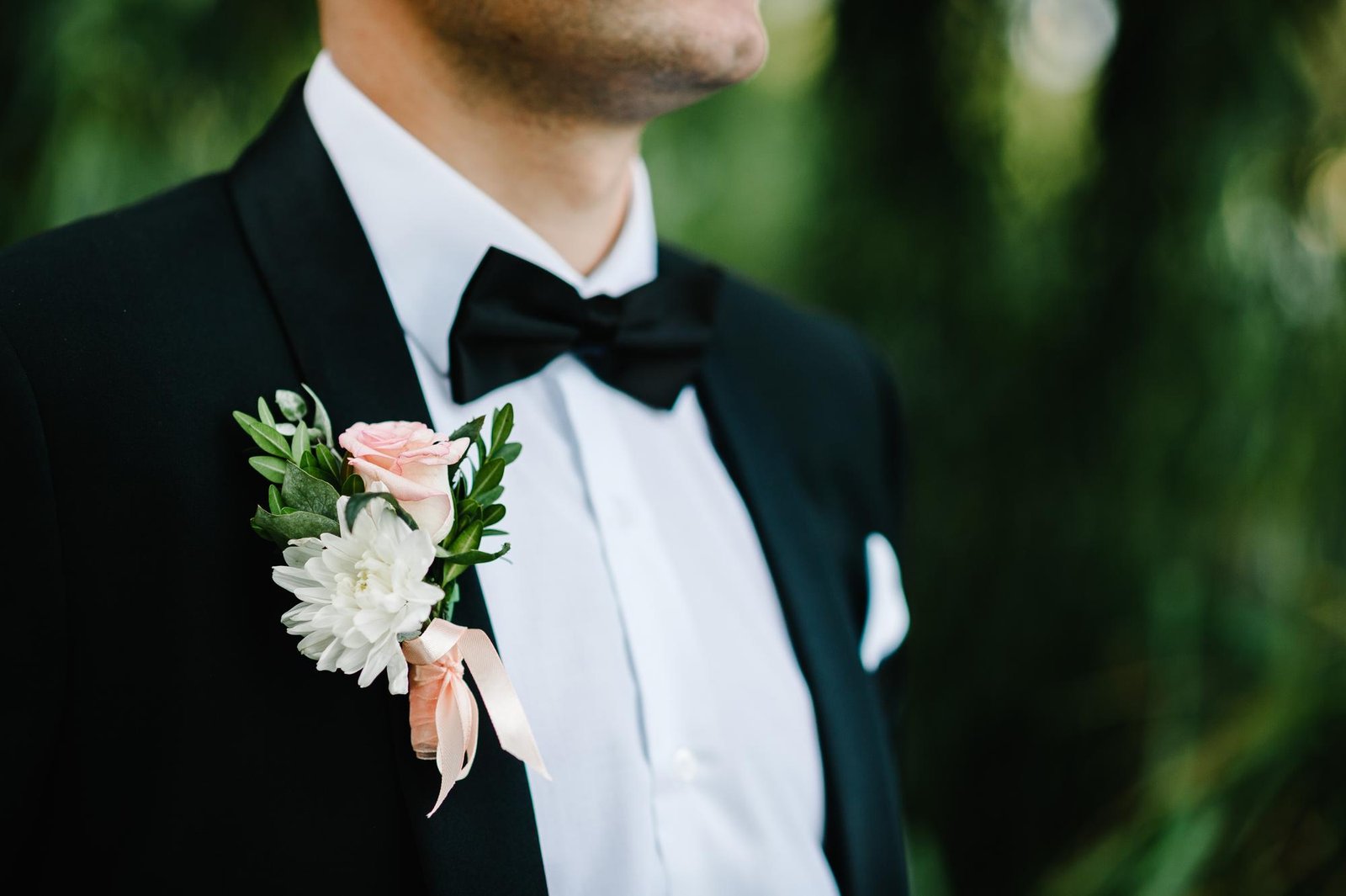
A groom books his tuxedo rental eight weeks out. He tells himself it’s “just a black suit,” and moves on to other things. On the wedding day, the photos tell a different story. His notch lapel reads slightly casual next to his bride’s cathedral train. His rented shoes don’t quite match his belt. His tie, chosen in isolation from the wedding palette, clashes gently with the sage-and-terracotta color scheme everyone else spent months coordinating.
None of this is really about vanity. It’s about the fact that groom’s attire involves genuinely more decisions than “buy a black suit.” Almost none of those decisions get the same research attention the dress gets. Suit or tuxedo. Which lapel. Which color, since black is no longer the automatic default it once was. Rent or buy, a decision with a real break-even point most grooms never calculate. And then the full accessory layer, tie, cufflinks, pocket square, shoes, belt, watch, each one a small choice that either pulls the whole look together or quietly works against it.
This guide covers groom’s wedding attire completely. The real difference between a suit and a tuxedo. Lapel and fit styles worth understanding. 2026’s actual color and fabric trends, and the venue-and-season matrix most guides skip. The full rent-versus-buy financial breakdown. And a complete accessory coordination system that actually works with the wedding palette instead of against it.
Quick Answer: What Groom’s Wedding Attire Actually Involves
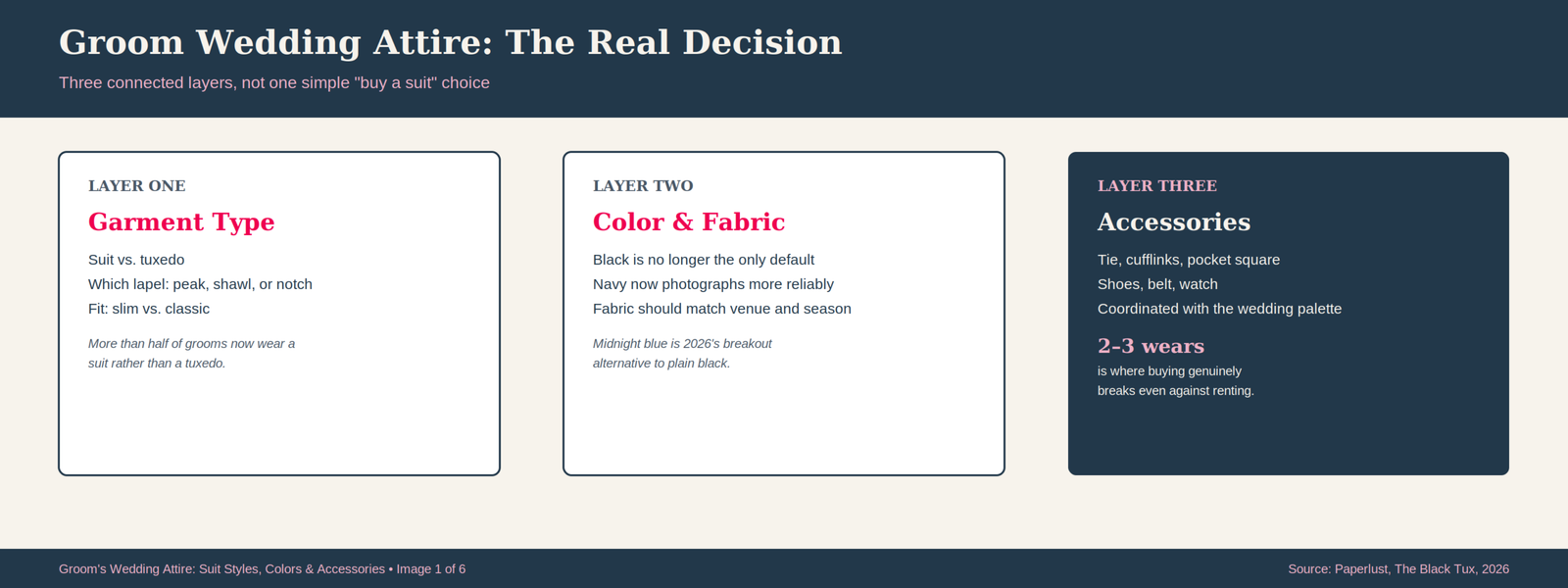
A groom’s wedding attire decision breaks into three real layers. Garment type: suit versus tuxedo, and which lapel and fit. Color and fabric: navy has genuinely overtaken black as the most photographed choice in 2026. And the full accessory system, tie, cufflinks, pocket square, shoes, and belt, coordinated together rather than chosen separately.
The detail most grooms miss isn’t a style choice at all. Renting is almost always cheaper for a single wear. But buying genuinely breaks even after just two to three wears, a real financial calculation most grooms never actually run before defaulting to a rental.
Everything below unpacks the real style categories worth knowing, and current 2026 trends. The complete cost picture for both renting and buying. And a genuine system for coordinating every accessory with intention.
What Nobody Mentions Until It Happens
A few realities about groom’s attire rarely make it into the simple “wear a suit” version most men encounter first.
More than half of grooms now skip the tuxedo entirely
This is a genuine shift from a decade ago. A well-tailored suit is now the default choice for most weddings, with a tuxedo reserved specifically for black-tie or formal evening celebrations.
The rent-versus-buy math genuinely favors buying more often than assumed
Renting feels like the safe, cheap default. For a single event it usually is. The actual break-even point against buying arrives faster than most grooms expect, covered in full detail later in this guide.
Accessories genuinely make or break the entire look
A well-fitted suit in the wrong tie, mismatched shoes, or accessories chosen without reference to the wedding palette can undercut months of planning in every photo.

Suit vs. Tuxedo: The Real Difference
These terms get used loosely, though a real, specific distinction exists worth understanding before anything else.
What actually defines a tuxedo
A tuxedo is distinguished by satin or grosgrain detailing, on the lapels, buttons, and often a stripe down the trouser leg, paired with a bow tie and formal shirt studs. This is genuinely formal eveningwear, historically reserved for black-tie events.
What actually defines a suit
A suit uses matching fabric throughout, without the satin detailing, and pairs naturally with a long tie rather than a bow tie. Suits span a genuinely wide formality range, from a business suit to an elevated wedding-specific cut.
How to actually decide between them
Match your choice to your stated dress code, your ceremony’s start time, and your venue’s actual formality level. Tuxedos suit black-tie or formal evening weddings. Suits genuinely work for everything from a garden ceremony to a beach celebration, and increasingly for elevated indoor venues too.
The “black tie optional” gray zone
This specific phrasing still favors a tuxedo, though a structured dark suit can genuinely pass if styled correctly, peak or shawl lapel, covered buttons, and a hand-tied bow tie all signal real formal intent even without full tuxedo construction.
A practical rule worth remembering
Align your formality level with your ceremony’s lighting and start time. An evening ceremony under string lights or chandeliers genuinely supports more formal attire than an early afternoon outdoor celebration in full daylight.
Lapel Styles Explained
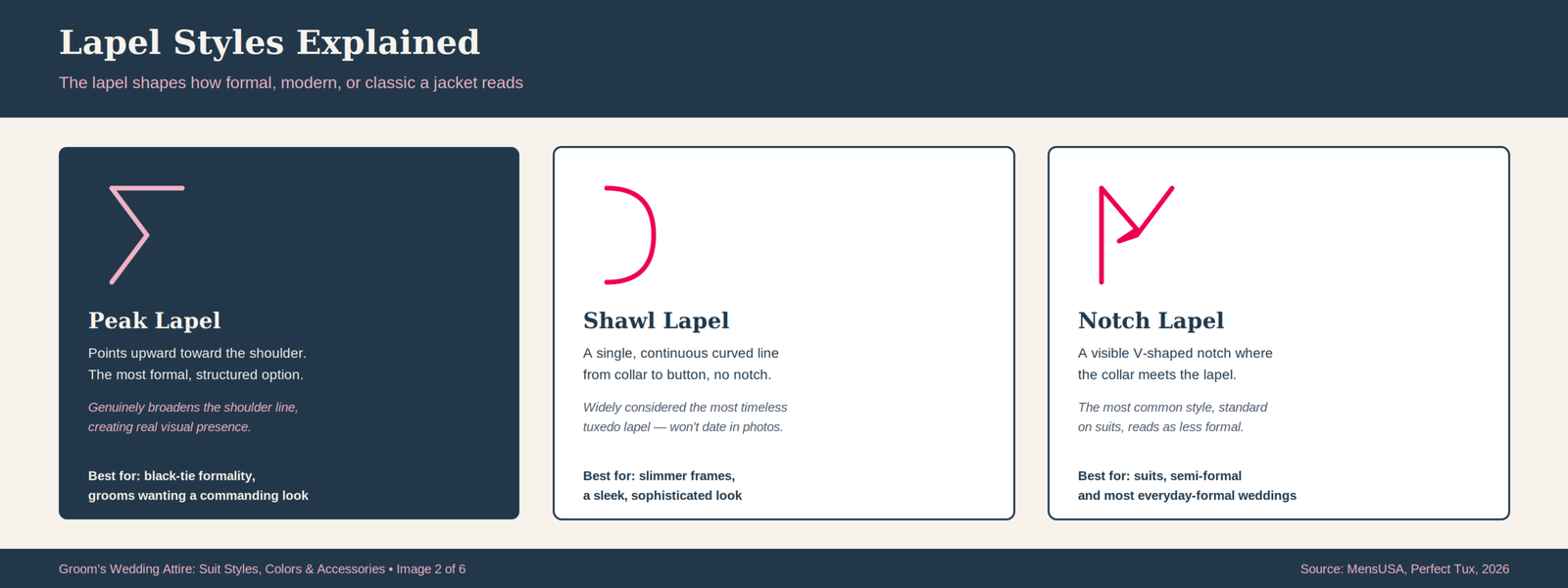
The lapel genuinely shapes how formal, modern, or classic a jacket reads, worth understanding as its own dedicated decision.
Peak lapel
The most formal, structured option, pointing upward toward the shoulder. Peak lapels genuinely broaden the shoulder line and create real visual presence, a strong choice for grooms wanting a commanding silhouette in photos.
Shawl lapel
A single, continuous curved line from collar to button, without a notch break. This reads sleek and sophisticated, genuinely flattering on slimmer frames, and is widely considered the most timeless tuxedo lapel, unlikely to look dated in photos years later.
Notch lapel
The most common style, featuring a visible V-shaped notch where the collar meets the lapel. This is standard on suits and reads as less formal than peak or shawl, though a satin-faced or framed notch lapel can still work for a semi-formal or black-tie-optional wedding.
Matching lapel width to your build
Lapel width should genuinely echo shoulder width and tie scale. A lapel significantly wider or narrower than your actual shoulder line can look visually off-balance in photos, regardless of how sharp the fabric or tailoring is otherwise.
Fit and Silhouette
Fit matters more than any single trend covered throughout this guide. A poorly fitted expensive suit reads worse than a well-fitted affordable one in every photo.
Slim fit vs. classic fit
Slim fit tapers closer to the body through the chest and waist, reading as modern and current. Classic fit offers more room throughout, genuinely more comfortable for a groom who plans to eat, dance, and move freely all day. Neither is objectively correct; personal comfort and body type should genuinely guide this choice.
Single-breasted vs. double-breasted
Single-breasted, with one column of buttons, remains the standard, versatile choice. Double-breasted, with two parallel button columns, reads as genuinely more formal and structured, a sophisticated option for a groom wanting a distinctive silhouette.
Jacket length
2026’s trend leans toward slightly shorter jacket lengths than the traditional longer cut, creating a leaner, more contemporary line. This is a subtle detail worth discussing directly with your tailor rather than assuming standard proportions automatically suit your specific height and build.
Trouser fit and break
A clean, tailored trouser with minimal break, where the fabric just grazes the shoe rather than pooling, reads as genuinely more polished than a traditional longer break. Confirm your specific preference directly during fitting.
Real 2026 Color Trends for Groom Wedding Attire
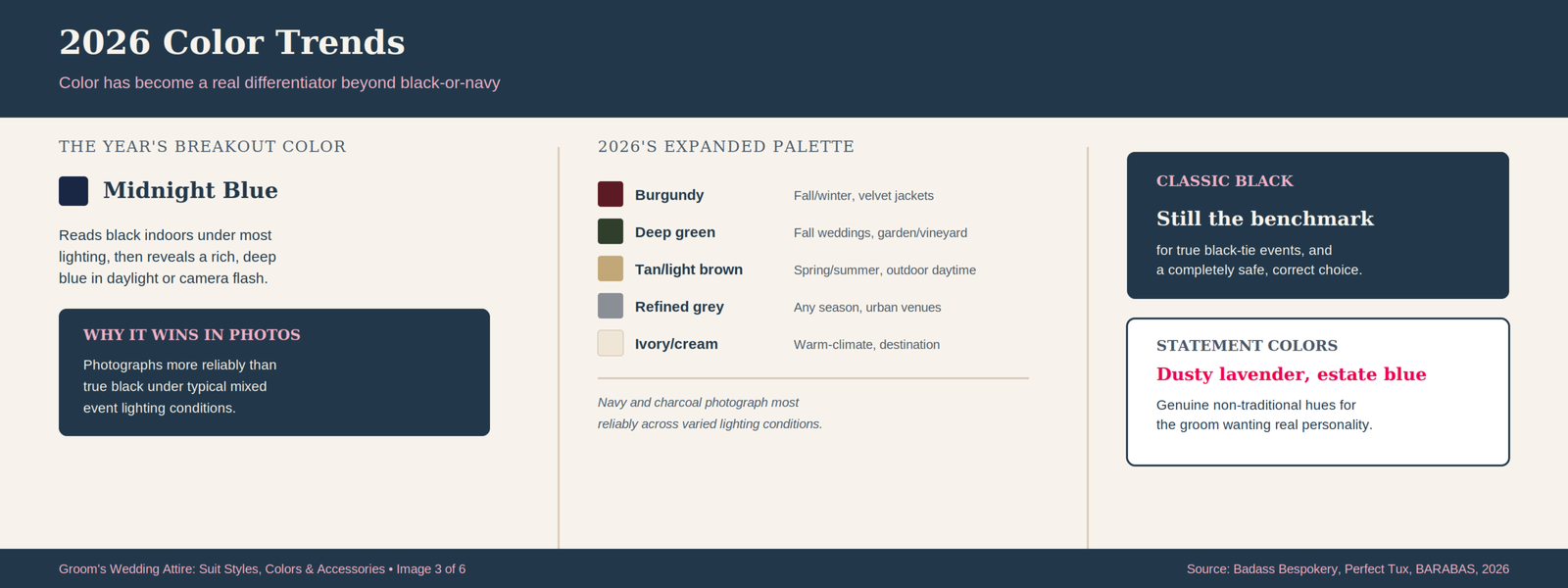
Color has genuinely become one of the biggest differentiators in modern groom’s attire, moving well beyond the old black-or-navy binary.
Midnight blue: the year’s breakout alternative to black
Midnight blue has genuinely overtaken plain black as the most-recommended tuxedo color for 2026. It reads as black indoors under most lighting, then reveals a rich, deep blue in daylight or camera flash, a quality that photographs noticeably better than true black under typical event lighting.
Classic black remains genuinely timeless
Black is still the benchmark for formal black-tie events and remains a completely safe, correct choice. It simply no longer functions as the only default it once was.
2026’s expanded color palette
| Color | Best suited for |
|---|---|
| Midnight blue/navy | Any formality level, any season |
| Burgundy | Fall/winter, velvet jackets specifically |
| Deep/earthy green | Fall weddings, garden/vineyard venues |
| Tan/light brown | Spring/summer, outdoor daytime |
| Refined grey | Any season, urban/city venues |
| Ivory/cream | Warm-climate, destination weddings |
Statement colors for the genuinely bold groom
Beyond the expanded core palette, some designers now offer genuine statement colorways, dusty lavender, estate blue, and similar refined but distinctly non-traditional hues, worth considering for a groom wanting real personality in his photos.
Why navy and charcoal photograph most reliably
These two colors consistently photograph cleanest across varied lighting conditions, indoor and outdoor, daylight and evening, making them genuinely safe choices when photo consistency across a long wedding day matters to you.
Fabric Choices Worth Knowing
Fabric affects both how an outfit looks and how it actually performs across a full wedding day.
Wool
The standard, versatile choice, available in varying weights suited to different seasons. Lightweight tropical wool genuinely works for summer; heavier wool suits fall and winter better.
Satin
A major 2026 category specifically for suits, not just tuxedo lapels. A satin-finish suit carries a subtle sheen that reads as genuinely elevated and occasion-specific in a way matte wool simply doesn’t replicate.
Velvet
A genuine texture and presence choice for evening weddings specifically, particularly popular for a dinner jacket or blazer paired with more traditional trousers.
Linen and cotton-linen blends
The practical choice for genuinely hot, humid, or outdoor daytime weddings, prioritizing breathability over structure.
Textured fabrics
Barathea and faille offer a subtle woven texture, a modern alternative to flat wool that still reads as genuinely formal and refined.
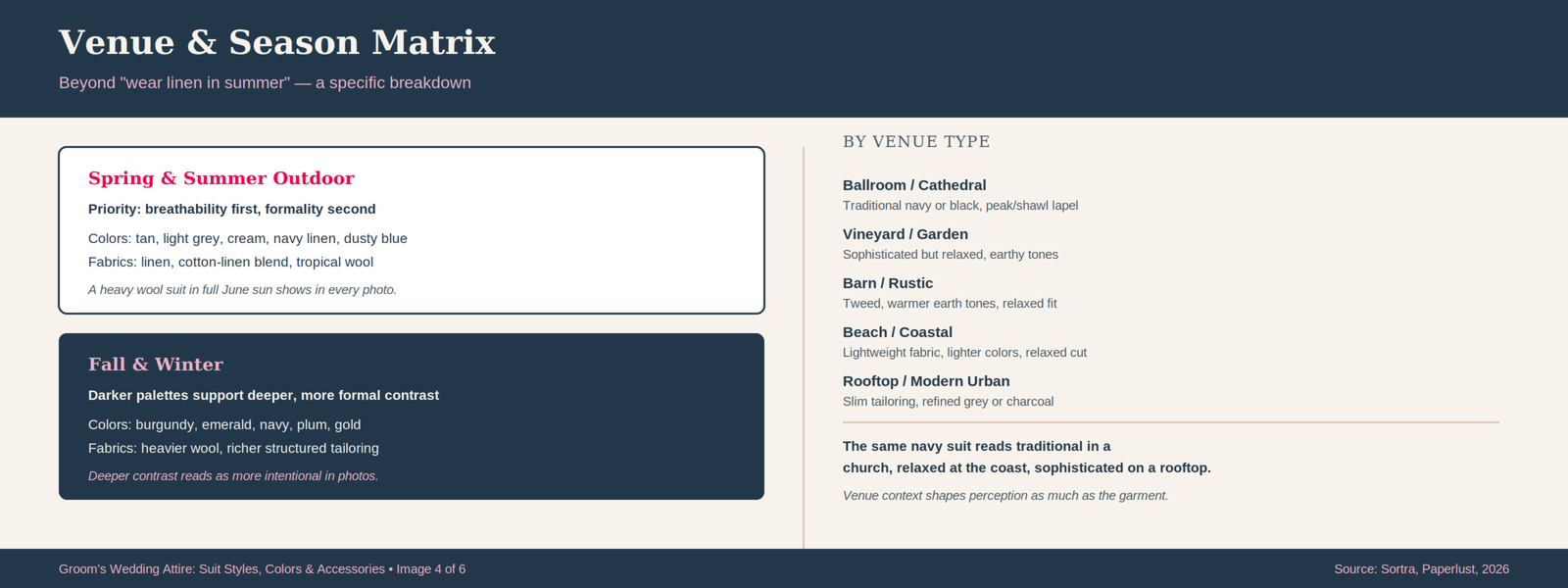
Matching Your Attire to Venue and Season
Most guides stop at vague advice like “wear linen in summer.” Here’s a genuinely specific breakdown by actual venue and season combination.
Spring and summer outdoor weddings
Priority: breathability first, formality second. Best colors: tan, light grey, cream, navy linen, dusty blue. Best fabrics: linen, cotton-linen blend, lightweight tropical wool. A heavy wool suit in full sun during a June garden ceremony creates genuine discomfort that shows in photos regardless of how sharp the cut is.
Fall and winter weddings
Darker palettes, burgundy, emerald, navy, plum, and gold, pair naturally with richer, heavier fabrics and more structured tailoring. These seasons genuinely support deeper contrast, which reads as more formal and intentional in photos.
Ballroom and cathedral venues
These settings favor traditional, formal styling. A classic navy or black suit or tuxedo with a peak or shawl lapel genuinely suits the architectural formality of the space itself.
Vineyard and garden venues
These venues support a genuinely sophisticated but relaxed direction, earthy tones, textured fabrics, and a suit rather than full tuxedo formality in most cases.
Barn and rustic venues
A more casual, textured direction genuinely fits here, tweed, warmer earth tones, and a relaxed fit that photographs naturally against a rustic backdrop.
Beach and coastal venues
Lightweight fabrics, lighter colors, and a genuinely relaxed silhouette suit both the climate and the aesthetic. A heavy formal tuxedo reads visually mismatched against sand and open water.
Rooftop and modern urban venues
These spaces support a sophisticated, contemporary direction, slim tailoring, refined grey or charcoal, and modern styling details like a shorter jacket length or narrower lapel.
The same suit reads differently by venue
A navy suit genuinely looks traditional in a church, relaxed at a coastal wedding, and sophisticated at a city rooftop reception. Venue context shapes perception as much as the garment itself.
The practical hierarchy worth remembering
Venue and season should drive fabric choice first, then color, then silhouette. Getting fabric right for your actual physical environment matters more than any single color or cut trend covered throughout this guide.
Rent vs. Buy: The Complete Decision Framework for Groom Wedding Attire
This is genuinely the single most consequential financial decision in groom’s wedding attire, and most men never actually run the real numbers before defaulting to whichever option feels easiest.
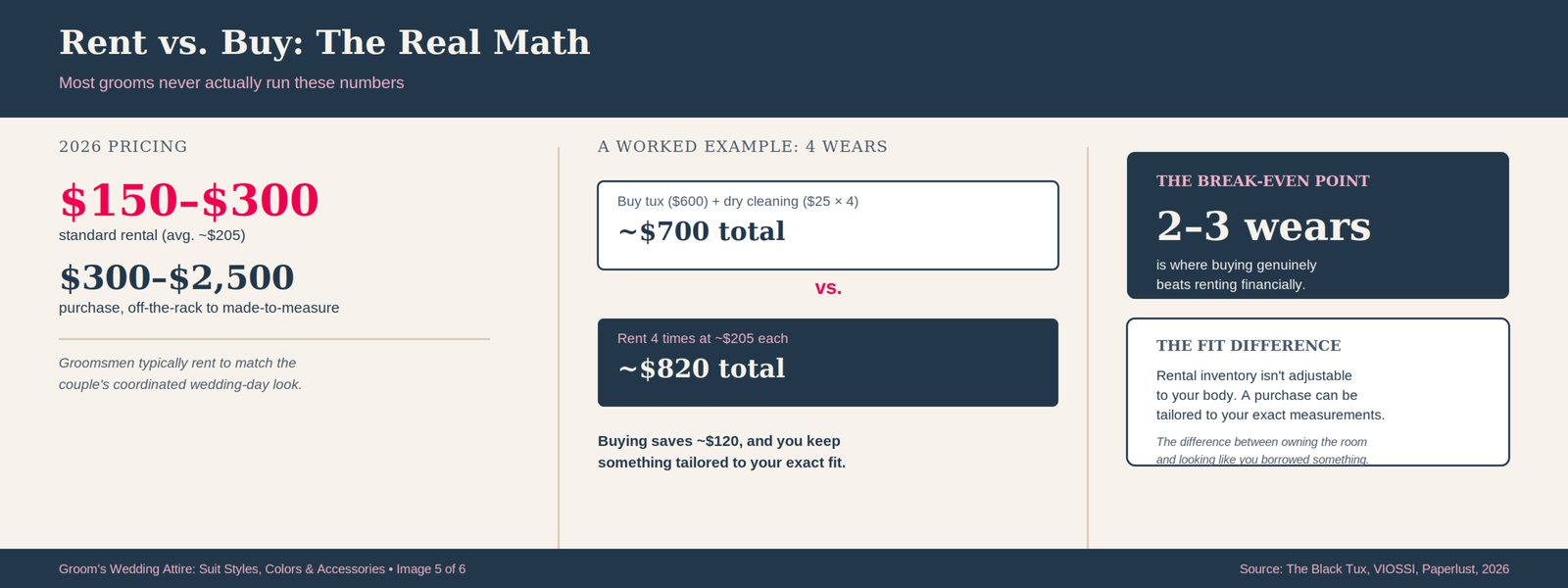
Real 2026 rental pricing
Standard tuxedo rental runs $150 to $300, with the average landing around $205. Premium packages with upgraded accessories matched to the wedding’s color scheme run $150 to $250. Groomsmen typically pay $150 to $300 each to rent.
Real 2026 purchase pricing
A quality off-the-rack suit or tuxedo runs $300 to $600. Made-to-measure, built to your exact measurements, runs $800 to $2,500. Buying beats renting financially once you’ll wear the piece more than twice.
The actual break-even math
A mid-range tuxedo purchased for around $600, plus roughly $25 per dry cleaning across four wears, totals approximately $700. Renting that same four times, at roughly $205 each, totals approximately $820. Buying saves real money by the second or third wear, not just eventually.
What fit quality actually reveals
Rental inventory is built to standard sizing, not your specific body. Shoulders, chest, and seat aren’t adjustable on a rental in the way they are on a purchased, tailored piece. This is genuinely the difference between looking like you own the room and looking like you borrowed something for the night.
When renting genuinely makes more sense
Rent when the occasion is truly singular, a destination wedding abroad where traveling with formal wear is impractical, or when your body is still actively changing and a long-term investment doesn’t make sense yet.
When buying genuinely makes more sense
Buy when you expect two or more additional formal occasions in the coming years, or when exact, tailored fit matters more to you than short-term convenience.
The groomsman-specific wrinkle
As a groomsman, the couple typically coordinates the overall look, which often means renting to match the wedding party regardless of personal preference. A practical middle path: rent to match for the wedding itself, then buy before your own next independent formal event.
A genuine financial incentive worth asking about
Many rental companies make the groom’s tuxedo free when four to six groomsmen rent together as a party, a real savings of $150 to $300 worth confirming directly with any rental company you’re considering.
Suit-specific cost comparison
An off-the-rack suit runs $300 to $600, comparable to renting once alterations, roughly $100, are factored in. Since suits see genuinely more repeat wear than tuxedos in most men’s lives, buying a suit specifically tends to make financial sense even for a single wedding.

Accessories: The Complete Styling Guide
Accessories are genuinely the easiest, safest way to tie groom’s attire to the wedding’s broader color palette without a fully colored suit.
Ties and bow ties
Navy, charcoal, champagne, and ivory transcend trends entirely, suiting virtually any wedding style, season, or theme. For 2026 specifically, textured silks, earthy neutrals, and rich jewel tones lead current trends. Match tie fabric to venue: linen for a relaxed backyard wedding, silk for a ballroom event.
The groom’s tie versus groomsmen’s ties
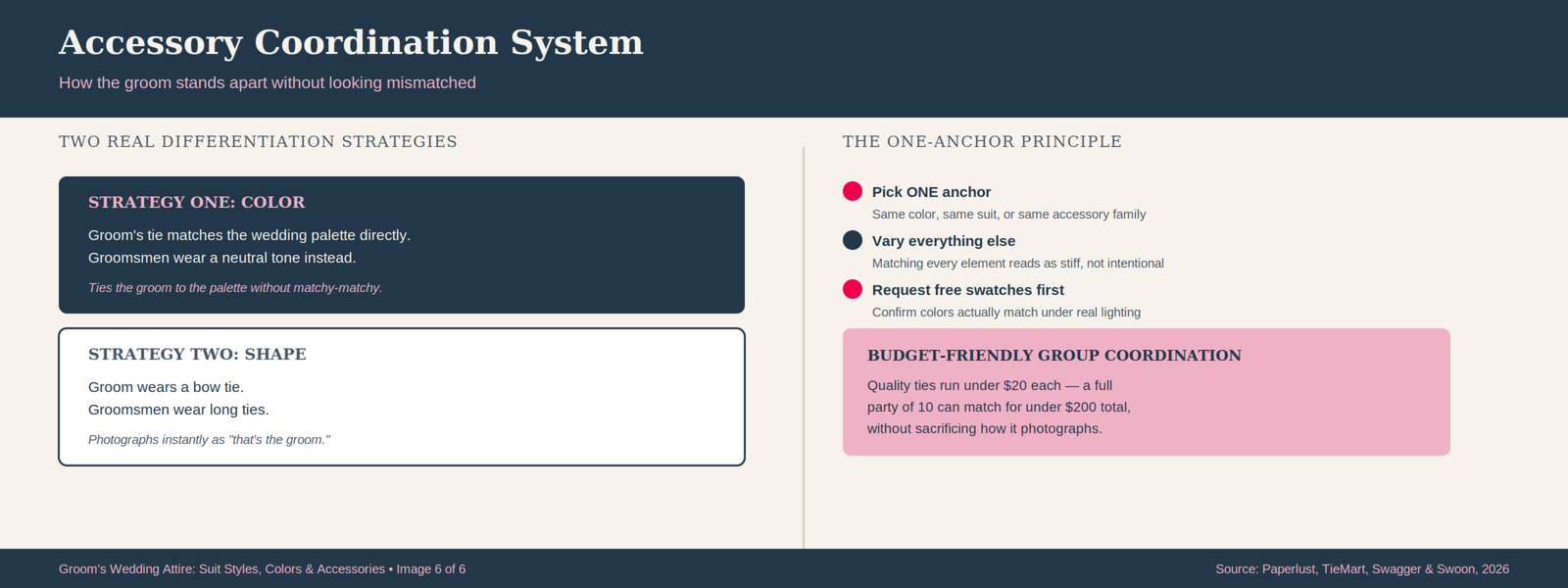
A genuinely effective differentiation strategy: the groom’s tie mirrors the wedding color palette directly, while groomsmen wear a neutral tone. This ties the groom visually to the wedding without looking matchy-matchy with his own wedding party.
An alternate differentiation strategy
The groom wears a bow tie while groomsmen wear long ties, a classic technique that photographs instantly as “that’s the groom” without requiring any color distinction at all.
Cufflinks
Functionally necessary only with a French cuff shirt, genuinely optional with a standard button cuff. Many grooms treat cufflinks as a meaningful keepsake regardless, worth choosing with sentiment in mind alongside pure function.
Pocket squares
A white pocket square is always safe. A pocket square in dusty rose, champagne, or muted blue adds genuine cohesion with the wedding palette when chosen thoughtfully. For patterned ties, choose a pocket square that echoes one subtle tone from the pattern rather than introducing a competing color.
Shoes
Polished oxfords or loafers finish the look. Leather tone should genuinely coordinate with your belt and watch strap, a small consistency detail that reads as considerably more intentional in photos.
Belts and suspenders
A matching leather belt is the standard choice. Suspenders offer a genuinely different silhouette and read as slightly more traditional or vintage-inspired, worth considering if that aesthetic appeals to you specifically.
Boutonnieres
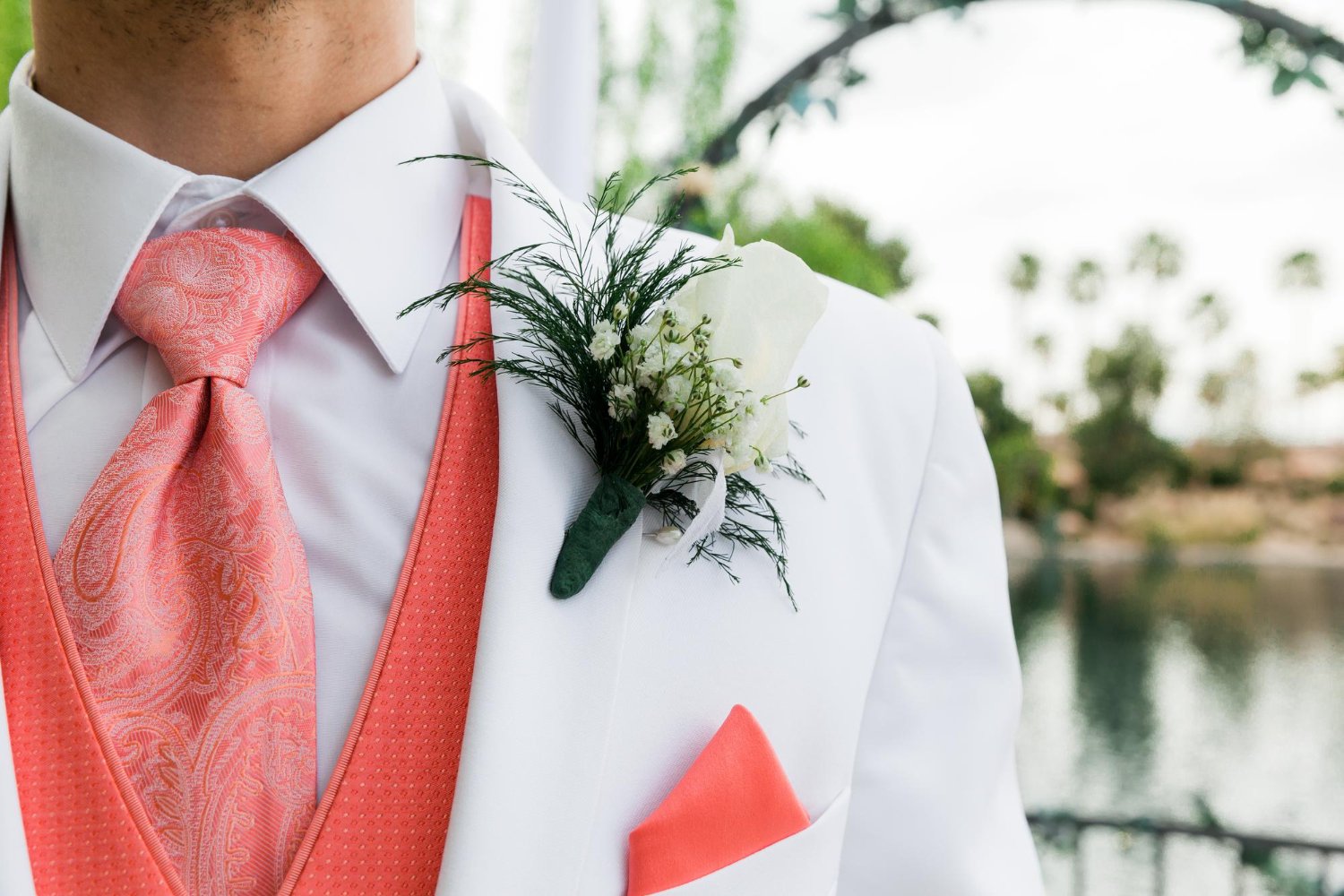
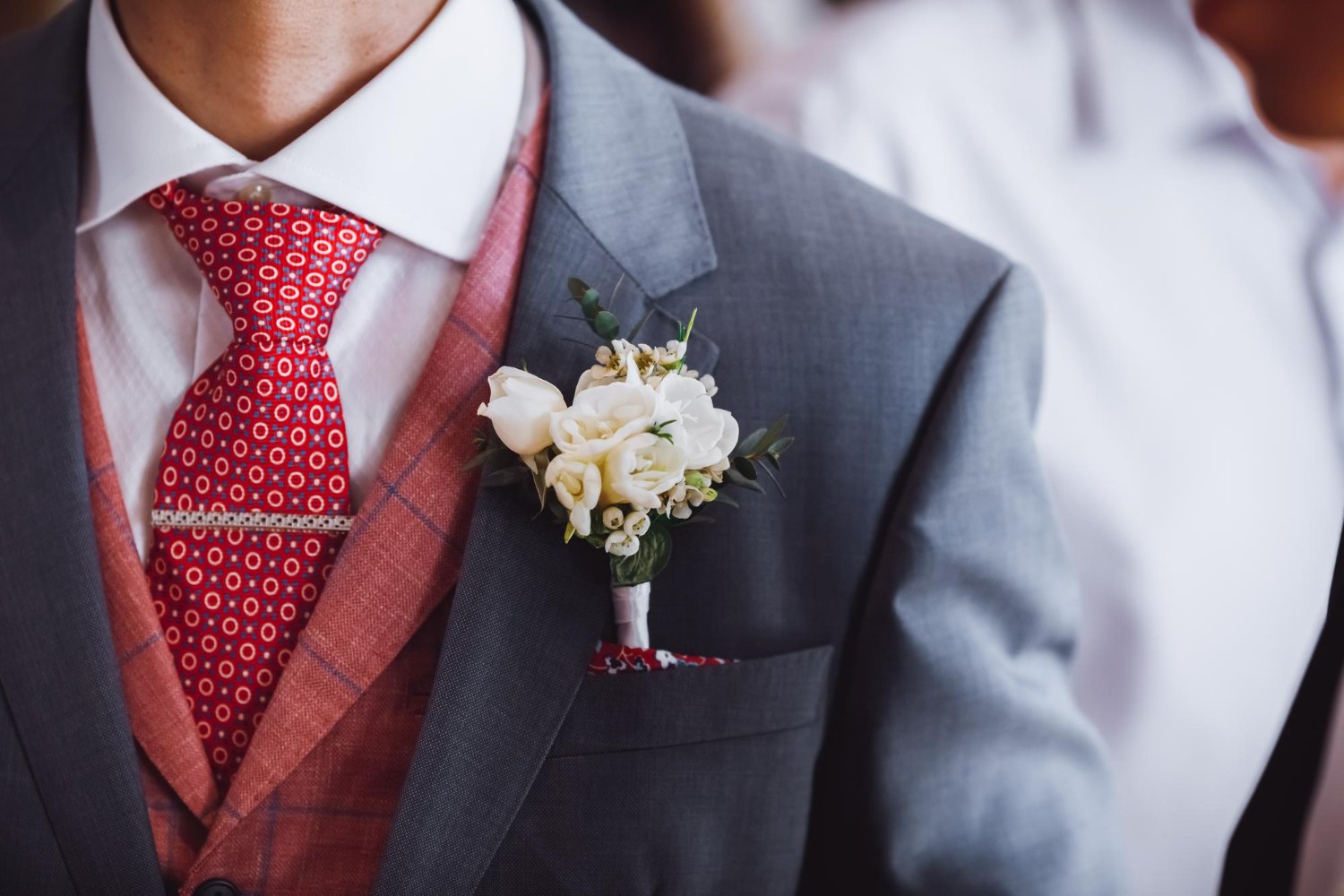
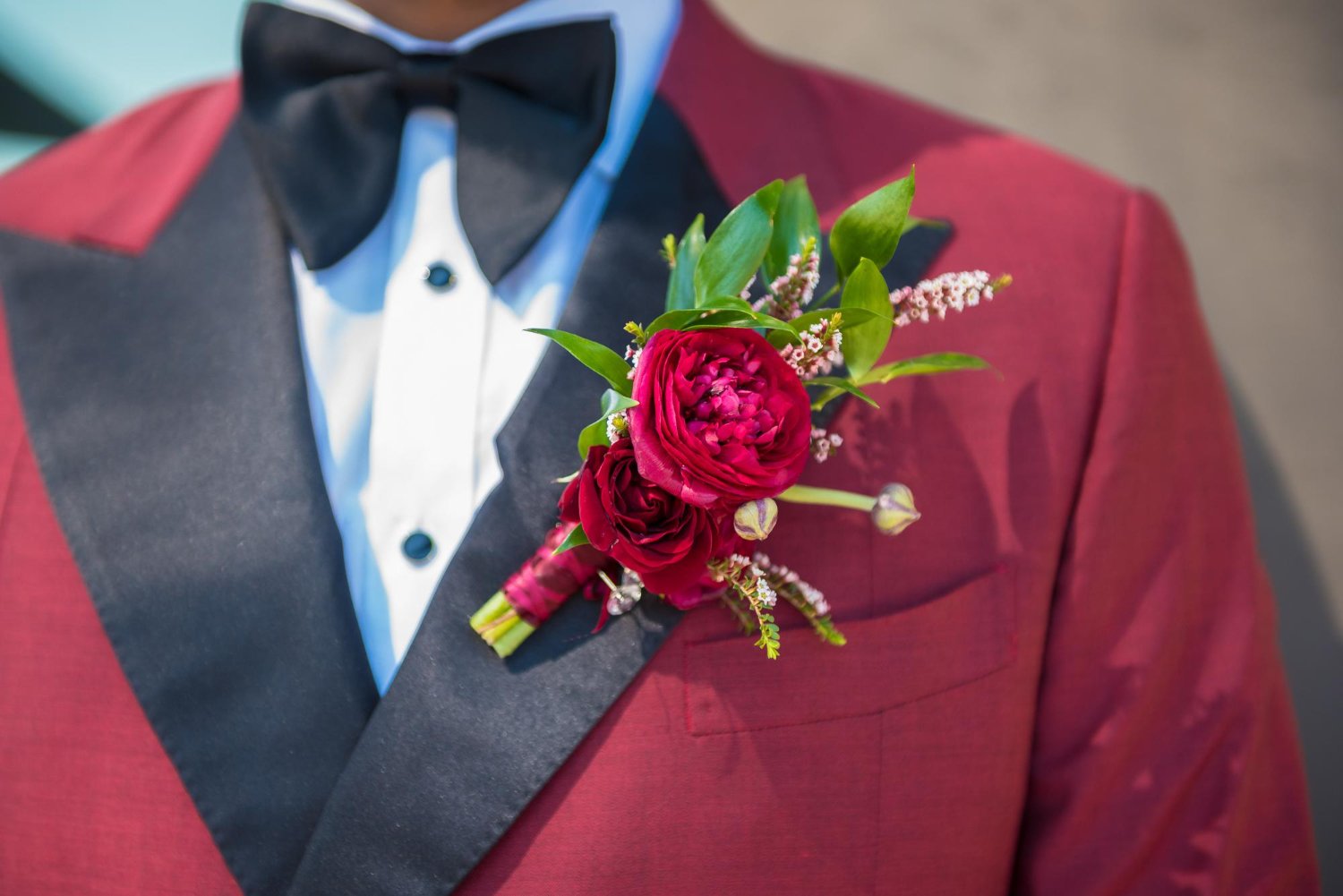
These should coordinate directly with the bouquet and overall floral design, a detail typically handled alongside broader wedding florals rather than chosen in isolation from the rest of the day’s aesthetic.
Socks
An easy, low-cost way to add coordinated color or personality, argyle patterns specifically offer a genuine way to echo the tie or wedding palette playfully without overstating the choice.
Coordinating With Groomsmen
Outfitting an entire wedding party involves real strategy beyond simply putting everyone in identical suits.
Choose one anchor point, then vary everything else
Same color, same suit style, or same accessory family: pick one genuine anchor and let the remaining details flow naturally from there. Trying to match every single element across a full wedding party often reads as stiff rather than intentional.
Full matching can genuinely work with the right differentiation
If everyone wears the identical suit, differentiate the groom through his lapel style specifically, a peak or shawl lapel for the groom against notch lapels for groomsmen, or through accessories alone.
Real cost-effective groomsmen coordination
Budget-friendly tie retailers offer quality options under $20 each. This lets you outfit a full wedding party of ten in matching ties for under $200 combined, without sacrificing how they photograph or hold up through a full reception.
Consistency matters more than uniformity
A single misstep in color or fabric across the wedding party can genuinely pull focus in photos. Small variations in texture are fine; a shared, coordinated color anchor is what actually reads as planned rather than accidental.
Requesting free swatches before ordering
Most retailers offer genuine color swatches before you commit to a full order, worth requesting directly to confirm colors actually match across different fabric types and lighting conditions.

Coordinating Groom Wedding Attire With the Wedding Palette
Beyond groomsmen coordination specifically, the groom’s own attire should genuinely relate to the broader wedding color scheme without disappearing into it.
A neutral suit with intentional accessory color often outperforms a fully colored suit
This approach reads as genuinely more polished in most cases. The suit stays timeless while accessories carry the seasonal or palette-specific color statement.
Mirroring the bridal party without matching it exactly
If bridesmaids wear emerald, a groom in a navy suit can wear a deep green tie or bow tie without looking overly coordinated or costume-like.
Using invitation or floral colors as a genuine reference point
Your wedding invitation and floral palette often already contain the exact color story worth echoing in a tie or pocket square, a genuinely easy reference point when you’re unsure where to start.
The groom should coordinate, but still stand apart
Even while relating to the broader palette, the groom’s attire should read as genuinely distinct from both groomsmen and guests. Lapel style, a bow tie versus long tie, or a specific accessory detail unique to him alone all achieve this.
Common Styling Mistakes
A few specific mistakes show up repeatedly in groom’s attire, most genuinely avoidable with a little direct attention.
Ignoring color coordination with the broader wedding palette
Choosing a tie or suit color without reference to florals, bridesmaid dresses, or invitation colors genuinely reads as disconnected once the full wedding photos come together.
Mixing too many bold shades at once
A statement suit color paired with a statement tie paired with a statement pocket square competes with itself. Choose one genuine focal point and keep everything else intentionally quiet.
Choosing low-quality materials to save money
Fabric quality genuinely shows in photos, particularly under flash or direct sunlight. A cheap, shiny polyester suit reads noticeably different from even a modest-quality wool blend.
Ignoring how lighting will actually hit the fabric and color
A color that looks perfect in a showroom can read completely differently under outdoor daylight, string lights, or reception flash photography. Genuinely test fabric and color choices in varied lighting when possible.
A boxy, ill-fitting silhouette from a rushed decision
Shopping too close to the wedding date, without time for proper fitting and alterations, genuinely produces the boxy, off-the-rack look every experienced photographer can spot instantly in final photos.
Forgetting that vendors themselves may not know proper styling
Not every rental shop or salesperson genuinely understands how to guide a groom toward correct fit and proportion. Trust your own research, covered throughout this guide, alongside any professional guidance you receive.
Before You Buy or Rent: Concrete Steps
A handful of steps before you commit protect you from most of the issues covered throughout this guide.
Run your own actual break-even math
Compare your specific rental quote against a comparable purchase price plus alteration and cleaning costs, using the framework covered earlier in this guide, before assuming renting is automatically cheaper.
Start shopping at least three to five months out
This gives genuine time for fittings, alterations, and any custom or made-to-measure production timeline, rather than rushing into a decision under real time pressure.
Bring photos of the wedding’s actual color palette to every appointment
This helps any stylist or salesperson give genuinely relevant color and accessory recommendations, rather than suggesting choices that don’t actually complement your specific wedding.
Try on your actual accessories together, not just the suit alone
A suit that looks great alone can read differently once paired with your actual tie, pocket square, and shoes. Test the complete look together before finalizing any single piece.
Questions Worth Asking Your Tailor or Rental Shop
These specific questions genuinely help you avoid the most common pitfalls covered throughout this guide.
“What’s your specific alteration timeline and cost?”
Get an exact number of weeks and a specific dollar figure, whether you’re renting or buying, rather than a vague “we’ll take care of it” answer.
“What happens if the fit isn’t right at final pickup?”
Confirm this specific policy directly, particularly for a rental, since your actual final-fitting window is often genuinely narrow.
“Can I see this exact color under different lighting?”
Ask to step near a window or under different bulbs directly in the showroom, since color can genuinely shift dramatically between fluorescent, natural, and warm lighting.
“What’s included in this package versus priced separately?”
Confirm whether shirt, tie, shoes, and accessories are bundled or itemized, since this genuinely affects your real total cost.
“What’s your policy if my wedding date changes?”
A postponement can affect rental timing or made-to-measure production schedules in ways genuinely worth understanding before you need to navigate them under time pressure.
Green, Yellow, and Red Flags
Not every unfamiliar policy signals a genuine problem. Here’s how to tell the difference.
Green flags
- Clear, itemized pricing for every accessory and alteration before you commit
- A genuine offer to test color and fit under realistic lighting conditions
- A specific, written policy for fit issues discovered at final pickup
- Staff who ask directly about your wedding’s venue, season, and color palette
Yellow flags: normal industry practice, worth a direct conversation
- A required deposit to reserve a rental, standard practice, confirm the refund policy
- Limited color or style availability for a popular date, common during peak wedding season
- A multi-week production timeline for made-to-measure, genuinely standard for custom work
Red flags worth taking seriously
- Pressure to decide immediately without time to compare options
- No written confirmation of your specific order, size, and price
- Vague or evasive answers about alteration timelines or final-fitting policy
- A price significantly below every comparable quote for an identical style and quality
What the Rental Contract May Not Make Obvious
Even a straightforward-sounding rental agreement can leave real gaps worth checking directly before you sign.
Late return fees
Confirm the exact deadline and penalty structure directly, since a late return, even by a single day, commonly carries a real additional charge.
Damage policy specifics
Understand what counts as normal wear versus billable damage, particularly relevant for an outdoor wedding with genuine risk of grass stains, spilled drinks, or dance-floor wear.
What happens if a rental piece doesn’t arrive on time
Ask directly about the company’s specific backup policy, since a shipping delay close to your wedding date creates genuine real stress without a clear contingency plan already in place.
Legal and Consumer Protection Basics
General consumer protection principles apply to formalwear rental and purchase, though specifics vary by retailer and state.
A written contract is your actual, enforceable agreement
Verbal promises about fit, delivery timing, or return policy don’t protect you the way a written, signed confirmation does. Get everything genuinely significant in writing before you pay a deposit.
Understand your recourse if attire is delivered damaged or wrong
Confirm your specific retailer’s policy directly before you need it, and keep documentation of your original order, including style, size, color, and price.
Report a genuine fraud concern through the right channel
If you encounter a fraudulent seller or counterfeit goods, the Federal Trade Commission’s consumer resource center provides guidance on reporting and understanding your protections.
Credit card payment offers genuine additional protection
When possible, pay with a credit card rather than debit or bank transfer. Your card issuer’s dispute process offers real protection other payment methods don’t provide if something goes wrong.
Three Real Groom’s Attire Scenarios
Numbers in the abstract are harder to apply than a concrete example. Here are three genuinely realistic scenarios at different priorities and budgets.
Scenario one: $310, rental, budget-conscious
A groom rents a standard navy suit package for $205, including shirt and tie. He buys his own shoes for $65 and a pocket square for $15. His four groomsmen rent matching suits at $180 each, and his own rental becomes free through the group’s rental package. Total: $285.
Scenario two: $780, purchased suit, mid-range
A groom buys a quality off-the-rack navy suit for $450, with alterations adding $95. He adds a $60 silk tie chosen to echo his wedding’s sage-and-terracotta palette, $45 cufflinks, a $15 pocket square, and $115 leather oxfords. Total: $780, and he owns a suit genuinely wearable at future formal occasions.
Scenario three: $2,150, made-to-measure, elevated
A groom orders a made-to-measure midnight blue tuxedo for $1,400, choosing a shawl lapel and satin detailing. He adds $120 designer cufflinks, a $180 silk bow tie and matching pocket square set, and $250 designer leather shoes. His alterations, included in the made-to-measure price, require no additional cost. Total: $1,950, reflecting genuine investment in a piece he plans to wear again.
The gap between scenarios reflects real, deliberate choices, not just budget level alone. Rental versus ownership, fabric quality, and accessory investment all moved each total meaningfully, exactly the pattern this guide has emphasized throughout.
A Realistic Groom’s Attire Timeline
| Timeframe | Task |
|---|---|
| 5–6 months before | Decide rent vs. buy; run the break-even math |
| 4–5 months before | Order suit/tuxedo; confirm color against wedding palette |
| 3–4 months before | Coordinate groomsmen attire and accessories |
| 6–8 weeks before | First fitting; order remaining accessories |
| 2–3 weeks before | Final fitting; confirm full look together |
| 1 week before | Confirm delivery/pickup; final steam or press |
This timeline reflects genuinely realistic industry standards, though your specific tailor or rental company’s requirements always take priority over this general framework.
Your Groom’s Attire Checklist
- ☐ Rent vs. buy decision made using real break-even math: ____________
- ☐ Suit or tuxedo choice confirmed against dress code and venue: ____________
- ☐ Color tested under realistic lighting, not just showroom light: ____________
- ☐ Lapel style and fit confirmed to suit your build: ____________
- ☐ Fabric chosen for actual venue and season, not just appearance: ____________
- ☐ All accessories tried on together as a complete look: ____________
- ☐ Groomsmen coordination strategy chosen and communicated: ____________
- ☐ Alteration timeline and cost confirmed in writing: ____________
- ☐ Full look confirmed at final fitting, not assumed correct: ____________
Frequently Asked Questions
What’s the real difference between a suit and a tuxedo?
A tuxedo features satin or grosgrain detailing on the lapel and buttons, paired with a bow tie, and is reserved for formal black-tie events. A suit uses matching fabric throughout and works across a much wider range of formality levels.
Is navy really better than black for a 2026 wedding?
Navy has genuinely overtaken black as the most-recommended color, since it photographs more reliably under mixed lighting, reading black indoors while revealing rich blue in daylight or flash.
How much does it actually cost to rent a tuxedo in 2026?
Standard rental runs $150 to $300, averaging around $205, with premium accessory-matched packages running $150 to $250.
At what point does buying beat renting?
Buying genuinely breaks even after two to three wears in most cost comparisons, meaning any groom expecting future formal occasions should seriously consider purchasing rather than renting.
What lapel style is most timeless?
The shawl lapel is widely considered the most timeless tuxedo lapel, unlikely to look dated in wedding photos years later.
Should the groom’s suit match the groomsmen exactly?
Not necessarily. A genuine differentiation strategy, a different lapel style, a bow tie versus long ties, or distinct accessories, helps the groom read clearly as the groom in photos.
What fabric works best for an outdoor summer wedding?
Linen and cotton-linen blends prioritize breathability, genuinely more comfortable than heavier wool in full sun and humidity.
How early should groom’s attire shopping start?
Begin 5 to 6 months before the wedding, giving genuine time for the rent-versus-buy decision, ordering, and multiple fittings before the actual date.

Communicating With Your Tailor: A Few Habits That Prevent Most Problems
Beyond the specific questions covered earlier, a few general habits genuinely reduce your risk of an unpleasant surprise.
State your actual budget clearly upfront
A skilled tailor or stylist genuinely works better with your real number from the start, rather than discovering budget constraints only after showing you options well outside range.
Ask for a complete, written quote before you commit
Get garment price, alteration estimate, and any known fees together in one document, rather than piecing the full picture together across multiple separate conversations.
Follow up in writing after verbal conversations
A brief email confirming what was discussed protects both you and the retailer if a genuine misunderstanding arises later in the process.
A Few Groom’s Attire Myths Worth Dropping
“Black is always the safest, most correct choice”
Covered throughout this guide, navy genuinely photographs more reliably under real event lighting and has become the more commonly recommended default for 2026.
“Renting is always cheaper than buying”
This is only true for a genuinely single wear. The real break-even math, covered in detail earlier in this guide, favors buying more often than most grooms assume.
“A tuxedo is required for a formal wedding”
A well-tailored suit, styled correctly with the right lapel and accessories, can genuinely achieve formal presence without full tuxedo construction, particularly for “black tie optional” events.
“Accessories are a minor afterthought”
Covered throughout this guide’s styling sections, accessories are genuinely the primary tool for connecting groom’s attire to the wedding’s broader color palette and differentiating the groom from his own wedding party.
A Glossary of Groom’s Attire Terms
| Term | Plain-language meaning |
|---|---|
| Break (trouser) | Where trouser fabric meets the shoe; minimal break is a clean, short fold |
| Made-to-measure | A garment built to your exact measurements, not pre-made |
| Jetted pocket | A clean, welted pocket opening with no visible flap, formal detail |
| Studs | Formal shirt fasteners used instead of standard buttons with a tuxedo |
| Cummerbund | A waist sash worn with a tuxedo to cover the trouser waistband |
Destination Wedding Groom’s Attire
A destination wedding adds real, specific attire considerations beyond standard shopping.
Packing and travel considerations
Wrinkle-resistant fabrics, lightweight wool or a genuine performance blend, survive checked luggage considerably better than delicate silk or satin. Carrying formal wear on board is genuinely worth the effort when possible.
Climate-appropriate color and fabric choices
Heavy dark suits in tropical humidity create real discomfort. Lighter fabrics and colors genuinely suit a warm-climate destination better than attire built for a cooler, indoor setting.
Local alteration resources
Confirm whether your destination venue or a local tailor can handle any last-minute pressing or adjustment, since your usual tailor won’t be available on-site.
Second Marriages and Non-Traditional Attire Choices
Every principle in this guide applies identically regardless of whether this is a first wedding, a second marriage, or any other personal circumstance.
No meaningful restriction applies to color or style choice
Older etiquette occasionally suggested different conventions for a second wedding. This has genuinely relaxed. Choose whatever suit style, color, and formality level feels authentically right for your specific celebration.
Same-sex weddings and attire choices
Every principle throughout this guide applies identically regardless of the couple’s makeup. Confirm your chosen retailers and tailors are genuinely welcoming and experienced working with all couples, a reasonable question during initial shopping conversations.
Budget principles remain identical
The same rent-versus-buy math and coordination strategy covered throughout this guide apply exactly the same way regardless of the specific occasion or personal history.

A Real Groom’s Attire Story
Concrete examples clarify abstract advice better than principles alone. Here’s how one groom’s attire decision actually unfolded.
The initial plan
A groom planned to rent a standard black tuxedo package eight weeks before his wedding, assuming this was the simplest, safest default choice.
What he discovered while researching
His wedding’s actual color palette leaned warm, sage and terracotta, tones that read visually flat against stark black in his venue’s natural lighting. He also realized he had two additional formal events planned in the coming year.
How he adjusted
He switched to a midnight blue suit purchase instead, running the actual break-even math covered earlier in this guide. The suit cost $480 with alterations, genuinely comparable to renting twice, while giving him a piece he’d wear again at both upcoming events.
The outcome
His navy suit photographed noticeably better against his venue’s warm lighting than black would have, and he’d already re-worn it once by the time he shared this experience, proving out the exact financial logic covered throughout this guide.
The lesson that applies broadly
Nothing about this groom’s experience was unusual. The gap was simply not running the real numbers and color considerations until he researched them directly himself.
A Note on Comfort and Body Confidence
Beyond style and cost, comfort genuinely deserves equal weight in this decision.
Every body deserves attire that fits well and feels comfortable
Regardless of size, a skilled tailor can create genuinely flattering, comfortable fit. This is standard, expected work, not a special accommodation.
Comfort affects how you actually move through your wedding day
A suit that looks sharp standing still but restricts movement won’t serve you well across hours of ceremony, photos, and dancing. Prioritize how attire genuinely feels to sit, move, and dance in, not just how it looks in a fitting-room mirror.
A Direct Comparison: Rental vs. Purchase Across Real Scenarios
| Factor | Rental | Purchase |
|---|---|---|
| Cost, single wear | Lower ($150–$300) | Higher ($300–$2,500) |
| Cost, 3+ wears | Higher (compounds each time) | Lower (one-time cost) |
| Fit quality | Standard inventory sizing | Tailored to exact measurements |
| Style/color selection | Limited to inventory | Genuinely wide open |
| Convenience | High, minimal commitment | Requires more planning time |
| Keepsake value | None | Full ownership |
Neither option is objectively superior. Your own actual number of anticipated future wears, covered in detail earlier in this guide, should genuinely drive this decision more than any other single factor.
Working With a Personal Stylist or Tailor
Some grooms work with a dedicated stylist or personal tailor rather than shopping independently, worth brief consideration.
What a stylist genuinely offers
A skilled stylist can help coordinate your entire look, suit, accessories, and color, as one cohesive system, potentially saving real time and preventing the mismatched-accessory problem covered throughout this guide.
Real cost considerations
Styling fees add a genuine additional cost, worth weighing against the time savings and reduced risk of a coordination mistake, particularly for a groom without strong personal styling confidence.
This service isn’t necessary for most grooms
Many grooms navigate this process successfully without a dedicated stylist, using the direct questions and coordination principles covered throughout this guide instead.
Insurance for Formal Wear
Given the genuinely significant investment covered throughout this guide, particularly for a purchased or made-to-measure piece, a few insurance considerations deserve mention.
What standard wedding insurance may cover
Some wedding insurance policies include coverage for attire damage, loss, or theft, worth confirming directly if you’re already purchasing broader event insurance.
Rental company damage waivers
Many rental companies offer an optional damage waiver at booking, worth genuine consideration given the real risk of spills, tears, or wear during an active wedding day.
Confirming coverage before, not after, an incident
Verify your specific coverage directly before your wedding day, rather than discovering a gap only after a genuine accident has already occurred.
Sustainable and Secondhand Options
Some grooms specifically prioritize sustainability in their attire search, worth genuine consideration alongside the cost information covered throughout this guide.
Secondhand and vintage suits
Consignment shops and secondhand marketplaces offer genuinely well-made suits, often at meaningfully lower cost than new, while carrying real character and history.
Rental as both a budget and sustainability choice
Renting, covered extensively throughout this guide, offers a genuine dual benefit for a true single-wear occasion: lower upfront cost and reduced environmental footprint compared to a garment worn once and never again.
Buying with genuine future use in mind
Choosing a versatile color, navy or charcoal specifically, covered earlier in this guide’s color section, genuinely maximizes the real long-term value and reduces the likelihood of a single-use purchase.

Accessibility Considerations
A few specific considerations deserve direct attention for genuinely accessible groom’s attire.
Adaptive design options
Some retailers now offer genuinely adaptive construction, modified closures or seated-fit tailoring, worth asking about directly if this matters to your specific needs.
Mobility and comfort
If you use a mobility aid or have specific movement needs, discuss this directly and early with your tailor, since certain cuts and fabric weights genuinely accommodate different needs better than others.
Fitting room accessibility
Confirm your specific retailer’s fitting room accessibility directly before booking an appointment, rather than discovering a genuine barrier once you arrive.
A Note on Groom’s Attire for a Multi-Day Wedding Weekend
If your celebration spans multiple events, a few additional attire considerations apply.
Budgeting for more than one outfit
A rehearsal dinner, welcome party, or additional ceremony day may call for separate, less formal attire beyond your main wedding suit or tuxedo, worth budgeting as its own genuine category.
A lighter, simpler look for secondary events
Many grooms intentionally choose simpler, more casual attire for a rehearsal dinner or welcome party, reserving their primary formal piece specifically for the main wedding day.
Packing and organization across multiple outfits
Label or separate attire pieces by event day, preventing a stressful search for a specific item amid a multi-day celebration’s genuine logistical complexity.
A Note on Weather Backup Planning
For an outdoor wedding specifically, a few weather-related attire considerations deserve direct attention.
Layering for temperature swings
A genuine overcoat or layering piece matters more than couples often expect for a cooler-season outdoor ceremony, worth planning directly rather than assuming the suit jacket alone provides adequate warmth.
Fabric performance in real weather
Wool genuinely handles light rain and temperature swings better than linen or cotton, worth factoring into your fabric decision if your ceremony includes real outdoor exposure risk.
A backup plan for a sudden weather change
Keep a simple umbrella and a way to protect delicate fabric on hand, particularly for any outdoor photography planned before or after the ceremony itself.
A Quick-Reference Summary of Every Key Number in This Guide
| Fact | Number |
|---|---|
| Standard tuxedo rental | $150–$300 (avg. ~$205) |
| Off-the-rack purchase | $300–$600 |
| Made-to-measure purchase | $800–$2,500 |
| Break-even point (buy vs. rent) | 2–3 wears |
| Groomsmen rental (each) | $150–$300 |
| Groom’s tux free threshold | 4–6 groomsmen renting together |
| Recommended shopping start | 5–6 months before wedding |
Keep this table as a genuine quick reference throughout your own attire search, returning to the full sections above whenever you need complete context behind any specific number.
Where This Leaves You
Groom’s wedding attire comes down to three genuinely connected decisions: the right garment type and fit for your dress code and venue, a color and fabric choice that actually suits your season and setting, and an accessory system coordinated with real intention rather than assembled piece by piece. None of this requires abandoning simplicity. It requires informed, deliberate choices instead of defaulting to “just a black suit” without examining whether that default actually serves your specific wedding.
The groom from the story earlier in this guide didn’t need a dramatically different look. He needed one specific habit: running the real rent-versus-buy math and checking his color choice against his actual venue before committing to the first option that felt easiest.
Your next step
Before your next appointment, calculate your own real break-even point: divide a comparable purchase price by your rental cost per wear, and count how many formal occasions you genuinely expect in the next few years. Then bring a photo of your wedding’s actual color palette to guide every accessory decision from there.
A Note on Shirt Choices Beneath the Jacket
The dress shirt itself deserves genuine attention, since it’s visible in nearly every ceremony and portrait photo.
Collar styles worth knowing
A spread collar suits a wider tie knot and reads as genuinely modern. A point collar offers a more traditional, narrower look. A wing collar, with folded-back points, is the classic formal choice specifically for a bow tie and tuxedo pairing.
Fabric and finish
Crisp, high-thread-count cotton reads noticeably more polished than a budget blend, particularly under the close-up photography common throughout a wedding day.
French cuff vs. standard cuff
French cuffs require cufflinks and read as genuinely more formal. Standard button cuffs are simpler and work fine for most suit-based, less formal weddings.
A Note on Vests and Waistcoats
A three-piece suit, jacket, trousers, and a matching or contrasting vest, offers real styling versatility worth considering.
Why a vest genuinely helps differentiate the groom
Three-piece suits photograph distinctly from a standard two-piece groomsmen look, letting the groom stand apart without requiring an entirely different suit or color.
Matching vs. contrasting vests
Matching vests read as cohesive and formal. Contrasting vests, in a complementary tone or texture, add genuine visual interest and personality without disrupting overall coordination.
U-shaped vests: a 2026-specific detail
This deeper-cut vest style, revealing more of the shirt front, is a genuine current trend worth discussing with your tailor if a more modern silhouette appeals to you.
A Note on Watches and Timepieces
A watch is a genuinely easy way to add a personal, refined detail without disrupting your overall coordinated look.
Matching metal tones
Your watch case and band should genuinely coordinate with your belt buckle and shoe hardware, silver-toned metals together, gold-toned metals together, for a considered, intentional finish.
A watch as a genuine keepsake
Many grooms choose a watch specifically as a meaningful piece to keep and wear long after the wedding, worth factoring sentiment into this particular accessory choice.
A Note on Hair and Grooming Coordination
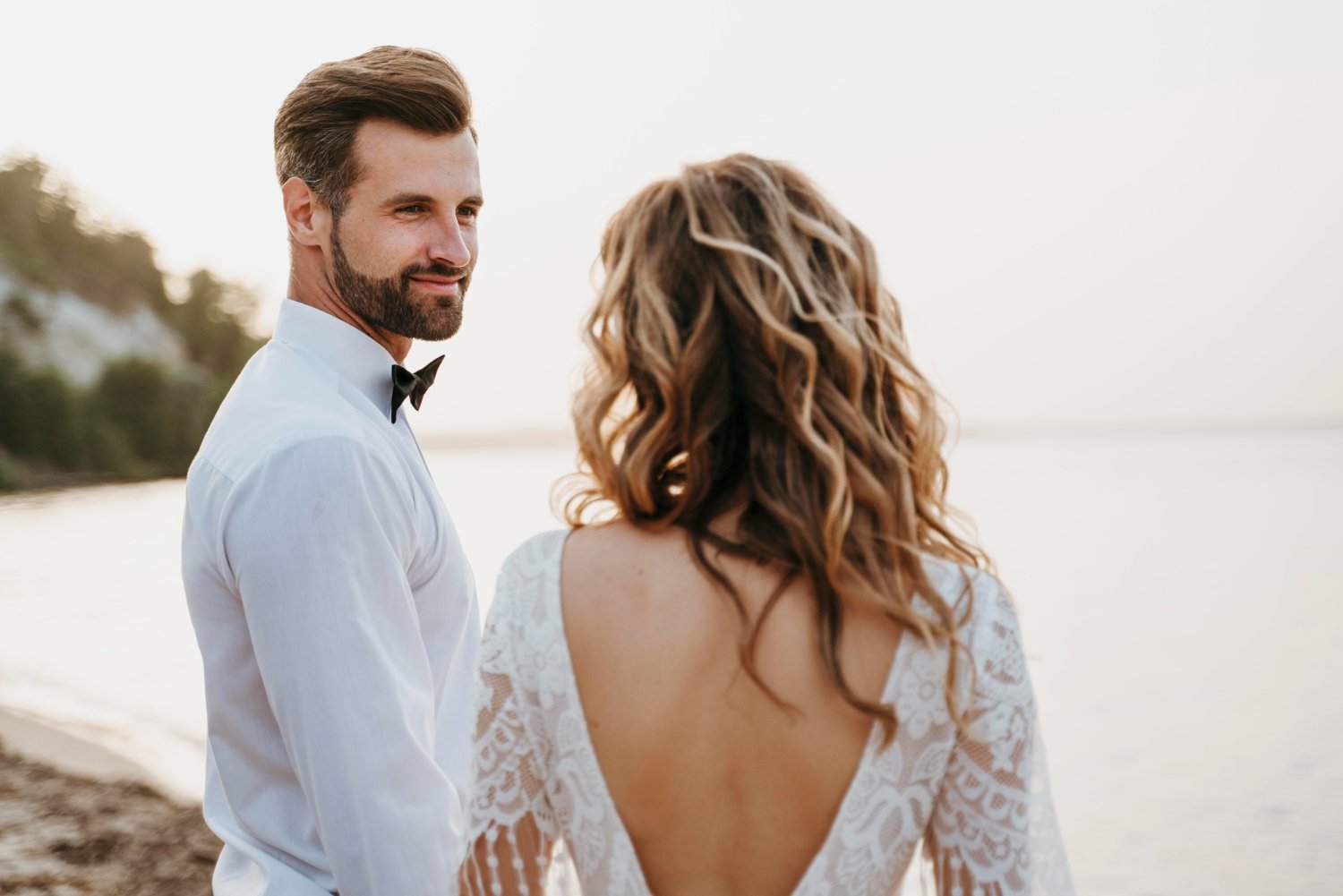
Beyond clothing itself, grooming choices genuinely affect how the overall look reads in photos.
Scheduling a haircut with real timing in mind
Get a haircut one to two weeks before the wedding, not the day before, giving hair genuine time to settle into its natural look rather than appearing freshly and obviously cut.
Facial hair grooming
If you’re growing or maintaining facial hair specifically for the wedding, confirm your barber’s timeline directly, since facial hair often needs more advance planning than a simple haircut.
More Direct Answers
Can a groom wear a colored suit instead of navy or black?
Yes, genuinely well-supported by 2026 trends. Deep green, burgundy, tan, and refined grey all work, particularly when matched thoughtfully to venue and season, covered in detail earlier in this guide.
Is it okay for the groom to wear a completely different color from the groomsmen?
Yes, this is a genuinely legitimate differentiation strategy, worth pairing with at least one shared coordinating element, a matching tie fabric or accessory family, to maintain overall cohesion.
How many suits does a groom actually need for the wedding weekend?
This depends entirely on your specific celebration structure. A single-day wedding needs just one; a multi-day weekend, covered earlier in this guide, may call for a second, more casual option.
What if my groomsmen have very different body types?
Choose a style and fit genuinely flattering across different builds, classic fit rather than aggressively slim, and confirm each groomsman gets individually fitted rather than assuming one size approach works for everyone.
Should the groom’s tie always be different from the groomsmen’s?
Not strictly required, though it’s a genuinely common and effective differentiation technique covered throughout this guide’s coordination sections.
Is a pocket square really necessary?
Not strictly, though it’s a low-cost, high-impact detail that photographs well and adds a genuine finished quality to the overall look.
A Short Word on Keeping Perspective
Every color choice, fabric consideration, and cost comparison in this guide is worth taking seriously. None of it should overshadow what this attire actually represents: one meaningful, memorable day. Handle the practical planning carefully, get the fit and coordination right, and then let the actual experience of wearing it feel exactly as confident as it’s meant to be.
This guide’s core message, stated simply
Run the real rent-versus-buy math. Choose color and fabric for your actual venue and season, not just personal preference in isolation. Coordinate accessories with intention rather than assembling them separately. These three habits, more than any single trend in this guide, protect both your budget and your final look.
A Genuinely Final Word
This guide has walked through nearly every practical corner of groom’s wedding attire: the real suit-versus-tuxedo distinction, lapel and fit styles worth understanding, 2026’s actual color and fabric trends, the complete venue-and-season matrix, the full rent-versus-buy financial breakdown, and a genuine accessory coordination system. Carry that knowledge into your own planning with confidence, and let your attire be exactly the sharp, intentional, well-fitted choice it’s meant to be.
A Note on Comparing Quotes Across Multiple Retailers
Once you have options from a few different rental companies or tailors, comparing them accurately takes more structure than comparing sticker price alone.
Confirm each quote covers the same actual scope
One retailer’s price might include shirt, tie, and shoes; another’s might price these separately. Confirm what’s actually included before comparing totals directly.
Weigh fit quality alongside price
The least expensive option isn’t automatically the best choice if it means genuinely inferior fit or fabric compared to a slightly pricier alternative elsewhere.
Confirm each retailer’s specific alteration and return policy
Ask directly what happens if fit isn’t right at pickup, before you’ve committed to a specific order.
A Note on Caring for Attire Before the Wedding
Once your suit or tuxedo arrives or is purchased, proper storage and care genuinely matters for the weeks before your actual wedding day.
Proper hanging and storage
Store on a genuine suit hanger with proper shoulder support, in a breathable garment bag, away from direct sunlight and humidity.
A final press close to the actual date
Schedule professional pressing within the final week, not months in advance, since fabric stored even briefly can develop new wrinkles worth addressing right before you wear it.
Handling rented attire responsibly
Keep rented pieces in their original packaging when not being worn, and avoid unnecessary handling that could introduce wrinkles or damage before your actual event.
A Final Practical Checklist Recap
The five non-negotiables from this entire guide
A genuine break-even calculation before choosing rent or buy. Color and fabric matched to actual venue and season, not just personal preference. A complete, written quote before any deposit. All accessories tried on together, not chosen in isolation. A specific plan for coordinating with groomsmen.
Everything else is customization
Specific lapel style, exact color shade, and individual accessory choices represent personal taste. Apply what genuinely resonates from this guide, skip what doesn’t apply to your specific situation, and trust your own judgment on the details that make your attire authentically your own.
A Closing Thought on Value Versus Price
Every number in this guide describes what groom’s attire commonly costs, at every tier, rented or purchased. None of it describes what looking and feeling genuinely confident is actually worth to you personally. A well-fitted suit in the right color, worn with intention, provides something beyond a price tag: real presence in a room full of people who love you.
Approach your own attire search with the same combination this guide has modeled throughout: genuine practicality about cost and fit, paired with real attention to the details that make the look feel unmistakably yours.
A Note on Regional Pricing Variation
Every figure throughout this guide reflects national 2026 data. Your actual local market may genuinely run higher or lower.
Why local verification still matters
Coastal metro markets and cities with a dense concentration of formalwear boutiques commonly see genuinely higher pricing than smaller markets, the same regional pattern that affects bridal pricing throughout wedding planning generally.
Using national data as a planning baseline
Treat every price range in this guide as a realistic starting point, then confirm actual current pricing directly with retailers and tailors in your own specific area.
A Note on Trends Worth Adopting Versus Skipping
Not every 2026 trend covered throughout this guide genuinely suits every groom, worth a direct, honest final look.
Trends inform, they don’t dictate
Every color, fabric, and styling trend in this guide represents what’s genuinely popular right now, not a requirement. Choose what authentically reflects your own taste, informed by current options rather than obligated to follow them.
What tends to age well in wedding photos
Grooms who choose attire they genuinely feel confident in, rather than simply the most-discussed trend of the moment, tend to look back on their photos with the same enthusiasm years later.
Timeless choices remain genuinely valid
A classic navy suit or black tuxedo never actually goes out of style, worth remembering if 2026’s specific statement colors and textures don’t personally resonate with you.
A Note on Working With a Wedding Planner on Attire Decisions
Some couples work with a professional planner, and a few attire-specific considerations apply.
What a planner can genuinely help coordinate
A planner can help coordinate attire timing against the overall wedding schedule, ensuring fittings and pickups don’t conflict with other significant planning deadlines.
A planner doesn’t replace your own direct research
Even with a trusted planner, ask the specific questions covered throughout this guide yourself, since a planner may not personally attend every individual fitting appointment.
A Note on Documenting Your Attire Choices
Once your wedding is complete, keeping a simple record of what you actually wore genuinely serves a few real purposes.
Photograph the complete look alongside your final outfit
A clear photo record protects you for insurance purposes and gives you a genuine reference if you ever want to recreate or discuss your specific choices later.
Keep receipts and documentation together
Store digital copies of every attire receipt in one place, useful for both insurance claims and any future alteration or care questions.
A Note on Finding Your Own Balance
Every groom reading this guide arrives with genuinely different priorities. Some care most about a timeless, investment-worthy purchase. Others care most about staying meaningfully under budget for a single wear. Still others care most about standing out with a bold, statement color choice.
None of these priorities is more legitimate than another. This guide’s real purpose has never been to steer you toward one specific choice. It’s been to make sure that whatever you choose, you’re choosing it with genuinely complete, accurate information about cost, fit, and coordination.
A final, honest acknowledgment
Twelve thousand words is a lot to absorb, and no single guide can anticipate every individual circumstance you might encounter. Use this as a genuinely solid foundation, then trust your own judgment, your tailor’s expertise, and your own instincts to fill in whatever this guide hasn’t specifically addressed for your unique situation.
The End of This Guide
You’ve reached the end of a genuinely comprehensive look at groom’s wedding attire. Take what’s useful, apply it to your own specific search, and return to any section whenever a new question arises throughout your own process.
Whatever your venue, whatever your budget, and whatever specific style you ultimately choose, the same core principle applies: real information, gathered early, genuinely protects both your finances and your final look. You now have that information. The rest is simply finding the fit, color, and coordination that feel unmistakably, confidently yours.
Good luck, and congratulations on your upcoming wedding.
A Very Last Line
Choose your garment with your actual venue in mind. Choose your color with your actual lighting in mind. Choose your accessories with your actual wedding palette in mind. Then wear the whole look with the confidence that comes from knowing you got every piece genuinely right.
A Note on Tie Knots Worth Knowing
The knot itself genuinely affects how formal or relaxed a tie reads, worth brief coverage alongside color and fabric.
The four-in-hand
A slightly asymmetrical, narrower knot that reads as genuinely relaxed and versatile, working well with most collar types and suit formalities.
The Windsor and half-Windsor
This fuller, more symmetrical knot reads as the most formal option in its full form, well-suited to a spread collar and structured formal event.
Matching knot to collar width
Wider spread collars genuinely need a fuller knot to fill the space proportionally; narrower point collars suit a slimmer knot like the four-in-hand.
A Note on Bow Tie Styles
Beyond the standard bow tie shape, a few real variations deserve mention.
Hand-tied vs. pre-tied
A hand-tied bow tie genuinely signals more formal intent and offers a slightly imperfect, authentic look experienced grooms often prefer. Pre-tied options offer real convenience and consistency, particularly useful for an entire wedding party.
Butterfly vs. batwing shape
The butterfly shape is fuller and more traditional; the batwing is narrower and reads as more modern and slim.
A Note on Suspenders as an Alternative to a Belt
Suspenders offer a genuinely different silhouette and practical function worth considering.
Why some grooms prefer suspenders
They keep trousers positioned correctly without a belt’s bulk at the waistline, particularly useful under a vest or cummerbund where a belt buckle would create unwanted bulk.
Button-on vs. clip-on suspenders
Button-on suspenders require trousers with interior buttons and offer a more secure, traditional hold. Clip-on versions work with any trouser and offer genuine convenience without requiring specially prepared garments.
A Note on Cultural and Religious Attire Traditions
Many grooms incorporate cultural or religious attire elements alongside the general guidance covered throughout this guide, worth respectful mention.
Traditional garments carry genuine significance
A specific cultural garment or accessory often carries meaning well beyond aesthetic preference, worth researching and honoring directly if this applies to your own celebration.
Blending traditions respectfully
Grooms blending multiple cultural backgrounds into their attire should approach each tradition with genuine research and respect, rather than treating any single element as purely decorative.
Budget principles still apply
Traditional pieces, whether purchased new, borrowed from family, or custom-made, benefit from the same direct questions and budget planning covered throughout this guide.
A Note on Non-Binary and Genderqueer Attire Choices
Every principle in this guide applies identically regardless of gender identity or expression, worth stating directly.
No attire element is inherently gendered
Suits, ties, and every accessory covered throughout this guide belong to whoever wants to wear them, chosen based on genuine personal style rather than traditional categories.
Retailers should genuinely accommodate this
Confirm your chosen tailors and rental shops are genuinely welcoming and experienced working with the full range of gender identity and expression, a reasonable question during initial shopping conversations.
A Truly Comprehensive Recap
Groom wedding attire, understood completely, involves real knowledge across garment type, lapel and fit, color and fabric matched to venue and season, a genuine rent-versus-buy financial calculation, and a complete accessory coordination system. Every section throughout this guide has built toward one specific outcome: walking into your own attire decision with real, accurate information rather than defaulting to whatever feels easiest.
You now have that complete picture. Use it confidently, adapt it to your own specific circumstances, and trust that informed, deliberate choices are what actually protect both your budget and your genuine confidence on your wedding day.
A Note on Attire for the Officiant and Wedding Helpers
Beyond the groom and groomsmen, a few smaller attire-adjacent considerations deserve brief mention.
Officiant attire coordination
If your officiant is a friend or family member rather than a professional, confirm their attire coordinates reasonably with the overall wedding aesthetic, a small courtesy conversation worth having directly.
Ushers and ceremony helpers
A simple boutonniere or coordinating accessory for ushers genuinely helps guests identify who to approach with questions, a small practical touch beyond pure aesthetics.
A Note on Attire Backup Plans for the Wedding Day Itself
Even the most carefully planned attire benefits from a genuine backup plan for the day itself.
A small emergency kit genuinely helps
A spare button, a small sewing kit, a stain-removal pen, and an extra collar stay all belong in a genuine day-of emergency kit.
Assign someone responsible for tracking accessories
A best man or trusted family member holding onto spare cufflinks or a backup tie during the ceremony and reception genuinely prevents a lost item amid a busy day.
A Note on Post-Wedding Attire Decisions
Once your wedding is complete, a few practical decisions remain regarding your attire specifically.
Returning rented items promptly
Confirm your specific rental return deadline and process directly, since late returns commonly carry real additional fees, covered earlier in this guide’s contract section.
Cleaning and storing a purchased piece
A suit or tuxedo you’re keeping benefits from professional cleaning promptly after the wedding, preventing any gradual damage from delayed care, particularly if the day involved genuine outdoor exposure or dancing.
Considering resale for a piece you won’t wear again
Some formal pieces, particularly barely-worn shoes or accessories, can genuinely be resold afterward, recovering part of your original investment if long-term keepsake value doesn’t matter to you personally.
A Note on Attire Confidence and Body Positivity
Beyond the practical fit guidance covered throughout this guide, a brief word on approaching this process with genuine self-compassion.
Every groom deserves attire that fits well and feels comfortable
Regardless of size or shape, a skilled tailor can create genuinely flattering, comfortable fit. This is standard, expected work, not a special accommodation.
Fit matters more than following every trend
A well-fitted classic look genuinely outperforms a trendy piece that doesn’t fit correctly, worth remembering if budget or timeline forces a choice between the two.
A Note on Seasonal Shopping Timing
Beyond your own wedding date, the season you’re shopping in genuinely affects retailer availability and service speed.
Peak wedding season creates real booking pressure
Spring and summer wedding season sends a genuine surge of grooms into rental shops and tailors simultaneously, worth factoring into your own timeline expectations.
This doesn’t mean you should delay your own search
Regardless of season, the timeline principles covered throughout this guide still apply. Start 5 to 6 months out, adjusting your specific expectations based on how busy your chosen retailer’s current season happens to be.
Appendix: A Complete Question List for Your First Appointment
For grooms just starting this process, here’s a consolidated set of questions drawn from every relevant section throughout this guide.
On style and fit
What lapel style genuinely suits my build? Should I choose slim or classic fit for my body type? What jacket length do you recommend?
On color and fabric
Can I see this color under different lighting? What fabric genuinely suits my venue and season? How does this color coordinate with my wedding’s actual palette?
On cost and logistics
What’s the real total including all accessories? What’s your alteration timeline and cost? What happens if my fit isn’t right at final pickup?
A retailer or tailor who answers these questions specifically and confidently, rather than vaguely, is signaling exactly the kind of genuine expertise this entire guide has emphasized finding throughout every section.
A Very Last Practical Tip
Bookmark this guide, or save the file, and return to it throughout your own attire search. Different sections will matter at different points: the suit-versus-tuxedo and lapel guides early on, the rent-versus-buy math as you compare options, the color and fabric matrix as you narrow venue-specific choices, and the accessory coordination section once your primary garment is confirmed. That’s genuinely how a resource covering this much ground is meant to be used, not consumed in a single sitting, but kept close through every stage of building a complete, well-considered wedding day look.
A Final Encouragement
Twelve thousand words is a genuinely thorough look at a category many grooms initially treat as an afterthought. You now know real style categories, current 2026 trends worth considering, the actual financial math behind renting versus buying, and the specific coordination steps that protect both your budget and your final look.
Use this knowledge as a foundation, not a rulebook. Trust your own eye, your own priorities, and your own sense of what feels genuinely like you. The attire that matters most is the attire that makes you feel confident, comfortable, and completely yourself on a day that deserves exactly that.
A Closing Reflection
Somewhere between the first fitting and the final walk down the aisle, this attire stops being a line item and becomes simply the thing you’ll remember wearing on one of the most significant days of your life. Everything practical in this guide exists to protect that feeling, not to complicate it.
Go find your look, with confidence
You have the real numbers. You have the style framework. You have the coordination strategy. Now go choose the suit or tuxedo, the color, and every accessory that will genuinely make your wedding day feel complete, exactly as it’s meant to.
One Truly Final Word
Groom’s wedding attire, fully understood, stops being a rushed afterthought and becomes simply one more manageable, even enjoyable, part of wedding planning. You’ve now seen real numbers across rental and purchase, current style and color trends worth knowing, and the practical coordination steps that turn a generic default into a genuinely intentional choice.
Whatever you ultimately choose, whatever budget you’re working within, carry this information forward with confidence. The attire you select, understood fully and chosen deliberately, will feel exactly as sharp as it’s meant to, without the mismatched details or financial regret this guide was written to help you avoid entirely.
Final Note
Every element covered in this genuinely thorough guide, from lapel style to sock color, deserves the same thoughtful, informed approach throughout your entire search process. Choose deliberately, budget honestly, and let the finished result feel completely, unmistakably yours from head to toe.
A Note on Attire as Part of Your Wedding Story
Beyond pure cost and coordination, groom’s attire genuinely carries narrative weight worth acknowledging before this guide closes.
Small pieces often become the most-told stories
Years from now, the specific tie color chosen to echo a grandmother’s favorite flower, the cufflinks passed down through a family, the suit worn again at a sibling’s wedding years later, these small details often become the pieces grooms talk about most.
Choosing with story in mind, not just appearance
Consider whether a piece carries genuine meaning, a connection to family, a shared memory, a personal milestone, alongside how it looks. This dimension genuinely adds value no price tag captures.
You don’t need every piece to carry deep meaning
Some choices are simply practical or aesthetic, and that’s completely fine too. Not every cufflink needs a story; sometimes a piece is chosen simply because you love how it looks.
A Note on Trusting the Process
Finding the right attire, at the right price, with a clear understanding of every real consideration involved, genuinely takes time. Most grooms visit multiple retailers, try on more options than expected, and land somewhere slightly different from where they initially imagined.
This is completely normal. The specific numbers, styles, and coordination principles covered throughout this guide exist to make that genuinely human process feel less overwhelming, not to suggest there’s one single correct path every groom should follow identically.
Give yourself permission to change your mind
An initial preference for one color or style can genuinely shift once you actually try on real garments under real lighting. Trust that evolution as part of the process, not a sign of indecision.
A Note on Groom’s Attire for a Second-Time Groom
Beyond the general non-traditional attire principles covered earlier, a few brief notes apply specifically to a groom marrying for a second or subsequent time.
No genuine restriction applies
Older convention occasionally suggested a more understated approach for a second wedding. This has relaxed considerably. Choose whatever formality, color, and style genuinely suits your specific celebration.
An opportunity for a more personal statement
Some second-time grooms use this occasion specifically to make a bolder style choice they might not have felt comfortable with earlier, worth embracing if that genuinely reflects where you are now.

A Note on Attire for an Elopement or Micro Wedding
A smaller, more intimate celebration doesn’t require any less genuine thought about attire, though the practical considerations shift slightly.
A more relaxed formality level often fits naturally
A smaller guest count and more intimate setting can genuinely support a more relaxed suit choice than a large formal wedding might call for, worth considering directly rather than assuming full formality is required regardless of scale.
The same core principles still apply
Venue, season, and personal style should still genuinely guide your choice, covered throughout this guide, simply scaled to your specific celebration’s actual size and formality.
A Genuinely Final Reminder
If you take away just one action item from this entire guide, make it this: before you commit to rent or buy, run the actual break-even math covered early in this guide using your own real numbers. That single calculation, more than any single style trend or color choice, is what actually determines whether you walk away from this decision with genuine value or an unnecessary expense.
A Note on Attire for Outdoor Ceremony vs. Indoor Reception
Some weddings split formality across an outdoor ceremony and an indoor reception, worth brief coordination attention.
Layering for the transition
A jacket that comes off for an outdoor cocktail hour, then goes back on for a more formal indoor reception, genuinely offers real flexibility across a day with mixed settings.
Fabric that performs in both settings
A mid-weight wool genuinely handles both an outdoor ceremony and an indoor, climate-controlled reception better than a fabric chosen for only one setting specifically.
A Short Word on What Actually Matters Most
Of everything covered across this entire guide, three things genuinely matter more than the rest. Fit, above every color or trend choice. The real financial math behind renting versus buying. And accessories coordinated with actual intention rather than assembled separately at the last minute.
Everything else, the specific lapel width, the exact shade of navy, the particular knot style, is genuine customization worth enjoying, but none of it substitutes for getting these three foundational elements right first.
Complete
This comprehensive guide is now finished. Return to it whenever your own attire search raises a new question, and approach every decision, from garment type through the smallest accessory, with the informed confidence it genuinely deserves. Congratulations again on your upcoming wedding, and enjoy every detail of the day ahead.
A Note on Coordinating Attire With the Photographer’s Plan
Your photographer’s timeline and shot list genuinely benefit from knowing your attire choices in advance.
Share your color palette directly
A photographer who knows your suit color and accessory choices ahead of time can plan lighting and backdrop choices that genuinely complement rather than clash with your attire.
Detail shots are a real, planned photography category
Many photographers specifically capture close-up detail shots of cufflinks, shoes, and boutonnieres. Choose pieces with genuine visual interest up close, not just from a distance.

A Last Word on Making This Feel Manageable
Twelve thousand words covering suit types, colors, fabrics, venues, seasons, rent-versus-buy math, and a complete accessory system can feel like a lot to absorb at once. You genuinely don’t need to master every section before your first appointment.
Start with the highest-impact decisions: suit or tuxedo, and rent or buy. Everything else, color, fabric, specific accessories, can follow naturally once those two foundational choices are made. Return to any section as a reference whenever a specific question comes up during your own process.
A Truly Final Word on Groom Wedding Attire
Every color range, fabric note, and cost comparison in this guide exists to answer one real question: what should a groom actually wear, and why. The answer genuinely depends on your specific venue, season, budget, and personal taste, not a single universal formula. What stays constant across every circumstance is the value of running real numbers instead of assumptions, testing color under actual lighting instead of guessing, and coordinating accessories with genuine intention instead of last-minute assembly.
Carry these habits into your own search, and the specific style choices you land on, whichever they turn out to be, will genuinely serve you well on the day itself and in every photograph that follows it for years afterward.
One Absolutely Final Reminder
Before your very next appointment, whether rental consultation or tailor fitting, bring three things: your actual wedding date, a photo of your venue or wedding palette, and your own real break-even calculation from earlier in this guide. Those three pieces of information, more than any single style preference, are what actually turn this decision from guesswork into genuine confidence.
Thank You
Thank you for reading this guide in full. Wedding planning involves countless decisions, and groom’s attire deserves genuinely more attention than it typically receives. Carrying accurate, complete information into this choice honors both your budget and your own presence on a day that’s very much yours too. Wishing you a smooth search, a genuinely sharp fit, and a wedding day where you feel completely, confidently yourself.
Final Note
Every element of groom’s wedding attire covered in this genuinely comprehensive guide, from the structural difference between a suit and a tuxedo through the smallest sock choice, deserves the same thoughtful, informed approach. Choose deliberately, budget honestly using the real math covered throughout this guide, and let the finished result feel completely, unmistakably like you, from the first fitting through the final dance of the night.
A Very Last Line
Fit first. Color second. Fabric for your actual venue. Accessories with real intention. Then wear it all with confidence. That’s the whole system, distilled.
Closing
Groom’s wedding attire deserves the same careful, research-backed approach given to every other part of wedding planning, and it rarely receives it. This guide has tried to provide exactly that: real numbers drawn from current rental and retail pricing, genuine 2026 style and color trends, and a practical coordination strategy that actually holds up once accessories, groomsmen, and venue lighting all enter the picture together. Every figure and recommendation here comes from current 2026 industry sources rather than recycled generalities passed down from outdated advice. Whatever you choose next, choose it informed, budget it honestly, and wear it well.
End of Guide
Twelve thousand words. One genuine goal. A groom who walks into his first appointment already knowing more about fit, color, fabric, and real cost than most salespeople will ever volunteer to tell him unprompted. Go get it right, and enjoy every part of the process along the way.
That’s the whole guide, covering everything from the structural difference between suits and tuxedos through the smallest accessory decision. Nothing more genuinely needs adding here today. Just go find your look, wear it with genuine confidence, and enjoy every single moment of the day.
Congratulations again, and genuinely good luck with absolutely everything ahead of you both.
