
Lace restoration is the work of stabilizing, repairing or partly rebuilding old lace so a vintage gown can be worn, displayed or kept safely, and the smartest time to ask about it is before you buy the dress. This guide gives you a one-page conservator briefing sheet, five repair feasibility gates and the exact questions to put to a seller and a restorer.
Before you pay for a vintage lace gown, decide whether lace restoration is realistic. Identify the lace (handmade or machine-made, silk, cotton or synthetic), name each kind of damage, and fill in a one-page briefing sheet that a textile conservator or lace repair specialist can answer in writing. Then run the repair through five gates: identity, stability, reversibility, access and fit. If the gown fails a gate, either price the problem into the offer or walk away. A gown that needs more lace restoration than you can afford is not a bargain.
Lace is the reason many people fall for a vintage wedding dress. The patterns are finer, the edges are scalloped by hand or by an old machine that no longer exists, and the net ground has a softness that new tulle rarely matches. Lace is also the first thing to fail. It is a structure made mostly of air, held together by thread that may be seventy or a hundred years old.
That is also why careful lace restoration starts with questions, not with a needle. Minor to a seller can mean a hole the size of a coin in the net, a loose motif or a mended patch that someone glued. Each of those is a different kind of lace restoration, and the last may not be possible.
This article stays on one narrow question: what should you ask, and what should you hand over, so that lace restoration is a decision you make with facts instead of a hope you carry to the checkout page. It does not teach you to repair lace yourself, and it does not walk through every inspection step for an old dress.
If you are still working out how the whole gown will fit and when fittings should happen, the wedding dress fit and alterations guide covers that side. Here the gown is already in front of you, or in a seller’s photos, and the lace is the open question. For checking the credentials and written terms of whoever you hire, the wedding vendor due diligence checklist is a useful companion.
A note on scope. This is general information, not legal, tax or financial advice. Return rights, payment protections and consumer rules vary by seller and by state, so confirm the current terms with the seller and with the agencies named in the sources.
What lace restoration means, and what it does not
People use several words for work on old textiles as if they meant the same thing. They do not, and a restorer will hear the difference immediately. Getting the vocabulary right makes your first email shorter and your quote more accurate.
Conservation aims to slow damage and keep the object as it is. A conservator may clean it gently, support a weak area with a hidden backing and write down everything done. The gown stays recognizably original, and the work is meant to be undoable later.
Restoration aims to bring the object closer to how it looked when new. That can mean replacing missing lace, rebuilding net ground or re-attaching motifs. It changes the gown, so it needs a decision about how much change you accept.
Repair is narrower. It fixes one problem, such as a torn seam or a broken strap, and leaves everything else alone.
Alteration changes the garment so it fits a living person. Taking in a bodice, shortening a hem or adding a bustle are alterations. On lace, an alteration can cause more damage than years of storage did.
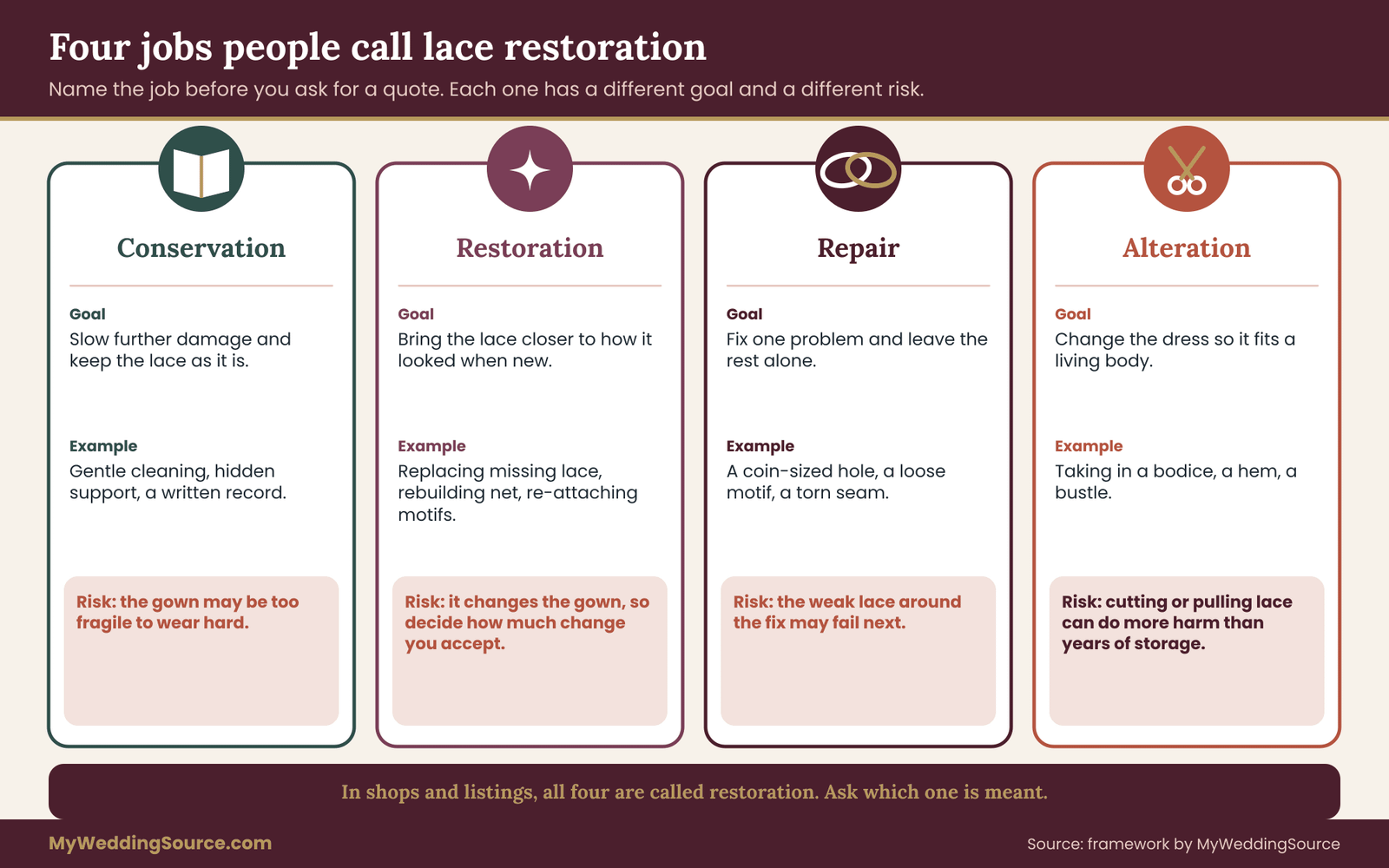
In everyday shopping all four jobs get called lace restoration. That is fine as long as you are clear about which one you want. A gown you plan to wear for eight hours needs a different outcome from a gown you plan to frame, and the difference decides who you hire for lace restoration and what you should accept.
Why the goal comes before the quote
Ask yourself one question before you contact anyone: what is this lace for? There are four honest answers, and each leads somewhere different.
If the answer is “to wear on the wedding day,” the lace has to survive pulling, sitting, hugging and being stepped on. That sets a high bar and often means supporting the lace with a lining or a hidden net layer.
If the answer is “to wear once and then preserve,” the plan includes stress that is acceptable for a day, plus a clean-and-store step afterward. Lace restoration for a single day of wear can be lighter than lace restoration meant to last for a second wedding.
If the answer is “to keep it as a family piece,” the goal is stability and reversibility. A wearable gown is not the point, and heavy repair may reduce what makes the piece valuable to the family.
If the answer is “to reuse the lace in something new,” such as a veil, sleeves or a panel, the lace may be taken off the dress entirely. That is a different project, and it changes what you should ask the seller.
What this guide leaves to other articles
General checks for old fabric, such as daylight yellowing, seam strain and fiber strength across the whole dress, belong in a general inspection. Pricing a used dress against a new one belongs in a buying budget. This guide assumes you have done a basic look and now need the lace-specific answers. Where those wider topics matter, the text says so in a sentence and moves on.
Reading the lace before you ask lace restoration questions
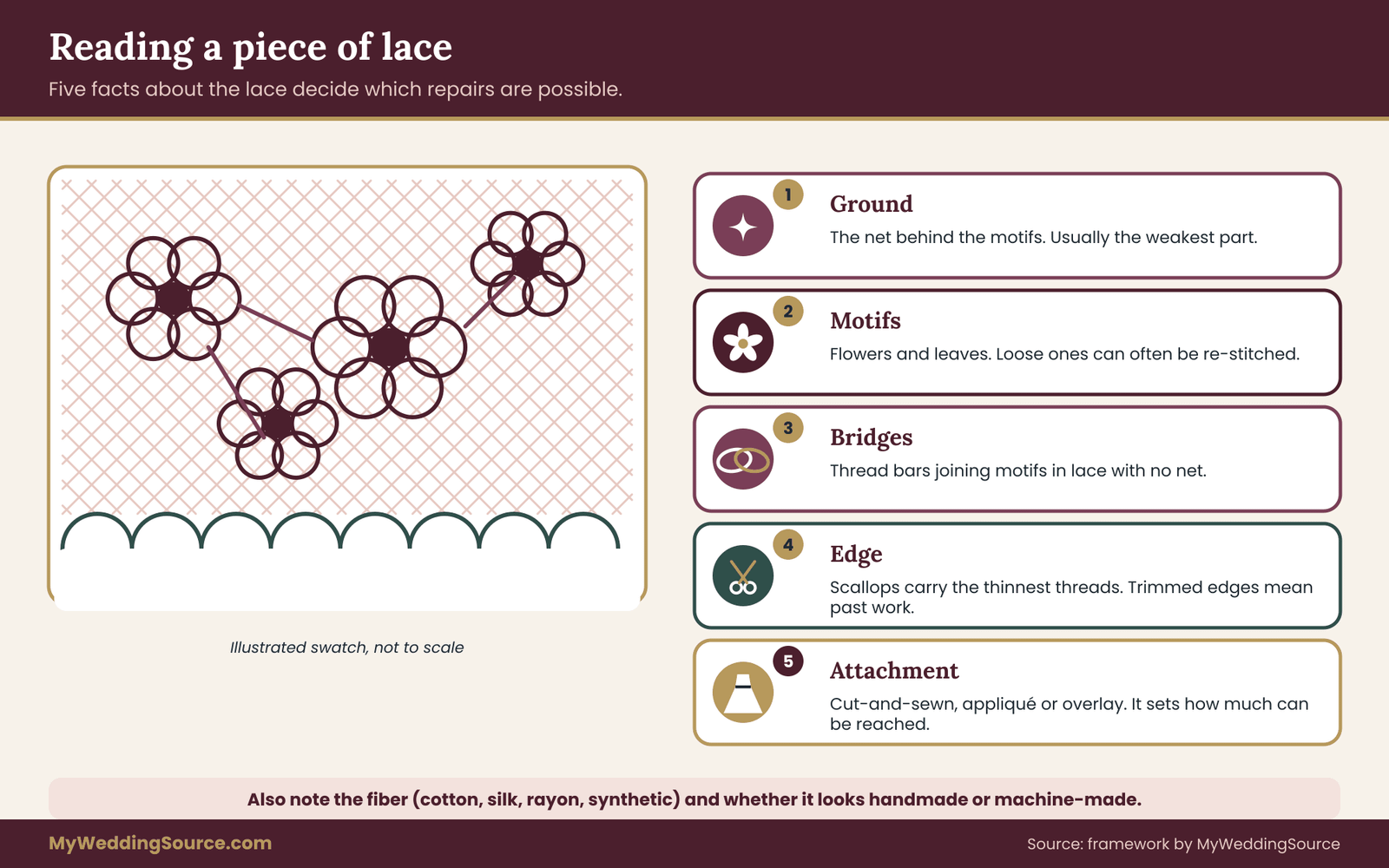
A restorer cannot quote lace restoration they cannot picture. Most of the picture comes from five facts about the lace, and you can gather them from photos or a shop visit without any special skill. Each fact changes the answer to the same question: can this be repaired, and how?
Handmade, machine-made or something in between
Handmade lace is built thread by thread. Needle lace is stitched with a needle over a pattern, and bobbin lace is made by twisting and crossing threads wound on bobbins. Both leave tiny irregularities, and a repair has to be done by hand with similar technique.
Machine-made lace came in many forms across the twentieth century. Some copies of handmade patterns are very good. Some are chemical lace, where a pattern is embroidered onto a base that is then dissolved, leaving only the embroidery. Some is embroidery stitched onto net. The difference matters for lace restoration because a machine-made lace can sometimes be matched with similar new or salvaged lace, while handmade lace usually cannot.
You do not have to be certain. A fair description for your briefing sheet is “looks machine-made, regular repeat, uniform thread” or “irregular, probably handmade, no two flowers identical.” Say what you see and mark it as your own impression, because honest uncertainty is welcome in lace restoration.
The ground: net, mesh or open work
The ground is the background the motifs sit on. Net grounds are usually the most fragile part. A hexagonal mesh can run, almost like a stocking, when one thread breaks. A heavier ground in old cotton may be sturdy but yellowed. Some lace has no net ground at all, and the motifs connect through bars of thread called bridges.
Ask whether the net is original to the lace or a later replacement. A replaced ground is common in older dresses and tells you somebody has already worked on the piece.
The fiber
Common fibers are cotton, linen, silk, rayon and nylon or polyester. Silk lace can be weakened by age and by finishes used decades ago. Cotton tends to hold up well and takes washing better, though it yellows. Synthetic lace resists age but cannot always be matched or reshaped the way natural fibers can.
If the seller does not know the fiber, that is useful information too. Ask for a care label or a tag, and photograph any maker’s mark. The absence of both is a reason to ask a conservator before you buy.
How the lace is attached
Lace on a gown is attached in one of three ways. It may be a full lace fabric cut and sewn like any other cloth, so the seams run through it. It may be appliqué, where separate motifs are stitched onto a net or onto the dress itself. Or it may be an overlay, a lace layer worn over a foundation of satin or crepe.
How it is attached tells you how much of a repair you can reach. A loose appliqué can often be re-stitched. A cut-and-sewn lace seam under strain is a different matter, because mending it means working inside a seam in a delicate material.
Edges and finishing
Look at the scalloped hem, the sleeve edges and the neckline. Scalloped lace edges frequently carry the thinnest threads and the most wear. A cut edge that has been trimmed with scissors, where the scallop was originally intact, suggests an earlier alteration and a probable loss of material.
Write these five facts at the top of your notes before you look at a single flaw. They give the restorer the vocabulary for lace restoration, and they stop you from describing the same lace in four different ways to four different people.
How old lace fails: a damage vocabulary for lace restoration
When you write to a restorer, “the lace looks bad” tells them nothing. A short, specific word for each problem tells them almost everything. There are about eight kinds of damage worth learning before any lace restoration quote, and each has a different meaning for lace restoration.
A hole in the net ground. The mesh has broken and left an opening. Small holes can often be closed with matching thread worked over the gap. Large holes may need a patch of similar net laid underneath, which is a support and not a repair.
A run or ladder. One broken thread lets neighbors open in a line. This is a warning sign, because the cause (age, tension, a snagged hook) is usually still present nearby.
Loose or detached motifs. An appliqué flower or leaf has come away from its ground. If the lace itself is sound, re-attaching it is one of the most routine jobs. If the thread holding it was the only sound part, the motif may be fragile too.
Shattering. Fibers break into short pieces and the lace feels dry, crackly or powdery. Some silk that was treated with metal salts to add weight and body in earlier decades is known to deteriorate this way. Shattered lace usually cannot be rebuilt in place. It can sometimes be supported, but the support does the work and the lace does not.
Yellowing or browning. Cream and ivory laces change color with age, light and old cleaning residues. Color change alone is not structural, but brown patches can mark acid or iron damage and may mean weaker fiber underneath.
Rust marks and metal staining. Old hooks, pins and wire can leave orange-brown stains where moisture met metal. The stain may be removable. The thread under it may already be weakened.
Old repairs. Someone darned, patched, glued or taped the lace. Careful old stitching can be a plus. Tape, glue and iron-on mending products are a problem because they may be hard to remove and can stain.
Distortion. Stretched scallops, puckered net or a hem that has been pulled out of shape by weight. This often traces to how the gown was hung or stored.
Reading the pattern of damage
A single flaw is information. A pattern is a diagnosis. Damage clustered at the shoulders and underarms suggests that the gown was stored on a hanger and the lace took the weight. Damage along the hem suggests dragging or damp. Damage in one tidy stripe suggests folds that were never refolded, with the fibers breaking at the crease lines.
Scattered tiny holes across the whole bodice may be insect damage or general fiber loss, and either one raises the question of whether the lace is worth repairing at all. If the same condition is found everywhere, the lace is aging as a whole, not failing in one spot.
Ask yourself two things about every flaw you find. Is it stable, meaning it will not get worse if the gown is handled gently? And is it local, meaning limited to one area? Stable and local flaws are the ones where lace restoration is often realistic. Unstable and widespread flaws are the ones that end purchases.
Why a backlit photo changes everything
Lace looks full on a hanger because the dress behind it fills the gaps. Hold the same lace against a window or a lamp and you see every hole, thin patch and mended spot, because the light passes through where the fiber has gone. That is the single most informative photo a seller can take for lace restoration, and any seller who refuses it is withholding the best evidence.
A backlit photo should show the lace flat or draped over a plain hand or a white board, not stretched. Stretching can hide holes by pulling the mesh tight and can damage fragile areas. If you are in a shop, ask permission to hold a hand behind the lace rather than lifting it.
The conservator briefing sheet for lace restoration
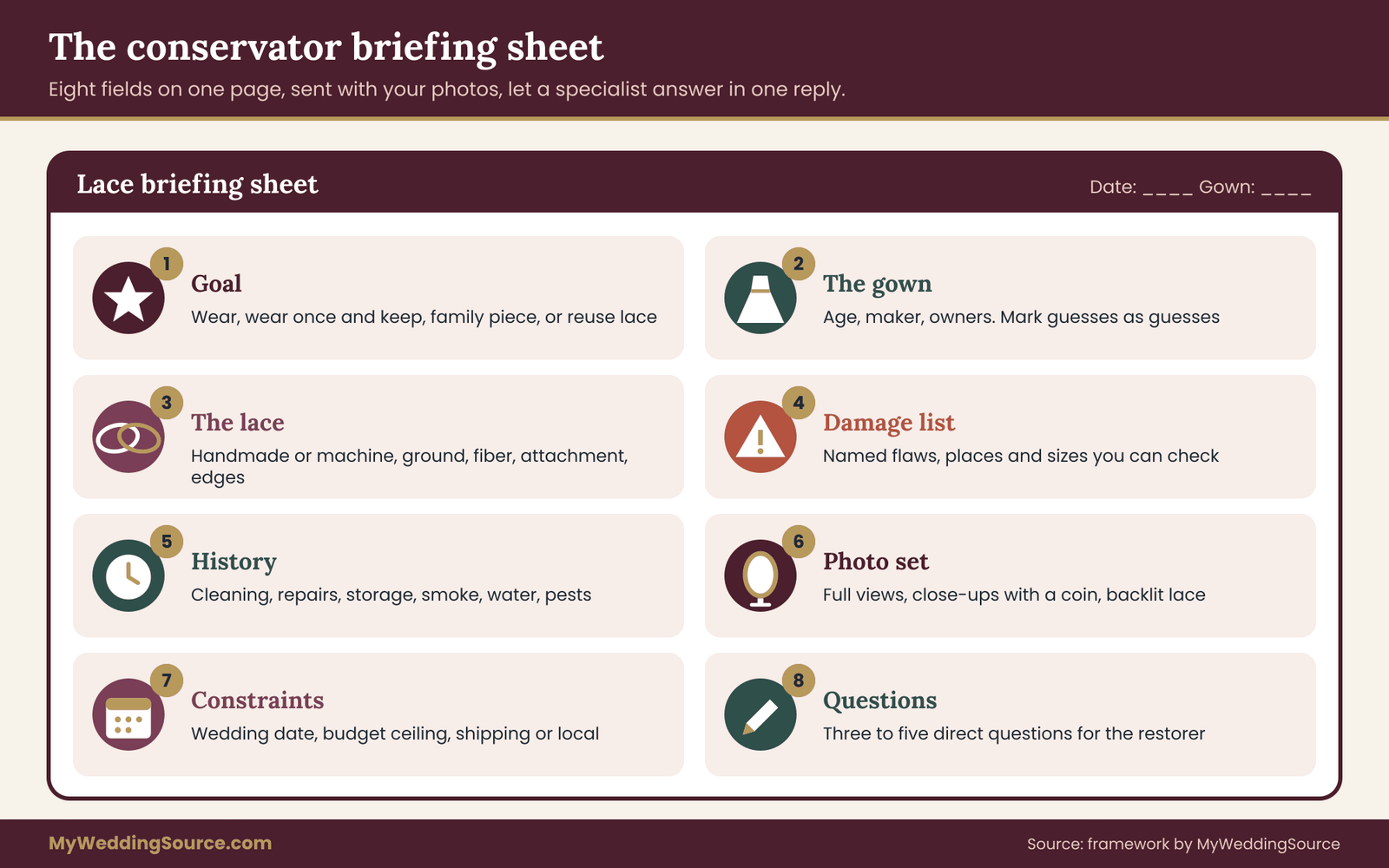
The briefing sheet is the core tool of this guide. It is a single page you fill in before you contact any restorer, and you send it with your photos. Its purpose is to let a specialist give you a useful first answer about lace restoration in one reply, with no back-and-forth over basics.
The sheet works because lace restoration quotes go wrong when the question is vague. If you send “can you fix this?” with one photo, you will get either a refusal or a guess. A sheet with eight clear fields gets a real opinion on lace restoration and often a rough range, plus a list of what the restorer would need to see in person.
The eight fields
One: the goal. Write one of the four answers from earlier: wear on the day, wear once and preserve, keep as a family piece, or reuse the lace. A restorer cannot choose lace restoration techniques without it.
Two: what you know about the gown. Approximate age and origin, maker if known, how you came to find it, and who owned it, if the seller will say. Keep to what is documented, and mark guesses as guesses.
Three: the lace description. Your five facts: handmade or machine-made, the ground, the fiber, how it is attached and the edge finishing. Use plain words.
Four: the damage list. Each flaw named with the vocabulary above, its location on the gown (for example “left sleeve, lower third”) and its approximate size, measured in a way anyone can check, such as “about the width of a thumb.”
Five: the history. Known cleaning, previous repairs, storage method, smoke, water or pest exposure, and any alterations. “Unknown” is a valid answer and is more useful than a confident guess.
Six: the photo set. A list of what is attached: front, back, close-ups of each flaw with a ruler or coin in frame, backlit lace, interior seams, and the care label or maker’s mark.
Seven: the constraints. Wedding date, budget ceiling, and whether the gown can be shipped or must be examined locally. Be honest about the date, because a conservator who needs weeks is a different answer from one who needs months.
Eight: the questions. Three to five direct questions, such as “Is the net ground stable enough to support a bustle?” or “Which areas would you stabilize first?”
Filling in the sheet without exaggerating
It is tempting to make a gown sound better so the restorer takes it seriously, or worse so the estimate comes in low. Do neither. The sheet is only useful if it is accurate, and a restorer who finds a damage you left out will trust you less and quote higher.
If you are buying from a seller, send them the sheet as a request. Ask them to fill in fields two, five and six, since only they know the history, and to say so plainly if they do not. A seller who happily completes the sheet is giving you good evidence. A seller who answers every question with “it’s fine” is not.
One practical habit for any lace restoration project: keep the sheet as one file, dated, with the photos beside it. If the gown changes hands, the sheet goes with it. If the restorer later disagrees with something in it, you will both be looking at the same record.
What a restorer can and cannot tell from a sheet
A good sheet lets a specialist say a lot. They can often tell you whether the lace sounds like a candidate for stabilization, whether the damage pattern suggests wider fiber loss and what they would need to see in person. They can usually give a broad cost logic, such as “priced by the hour” or “priced by the area.”
They cannot tell you with certainty how the lace will behave under tension, whether a stain will lift, or whether hidden weak areas lie behind a lining. Anyone who promises a firm outcome from photographs alone is promising more than photographs can show. That is not a reason to skip the sheet. It is a reason to treat the first answer as a screening opinion and to book a hands-on examination before large money moves.
Five repair feasibility gates for lace restoration
The briefing sheet describes the problem. The gates decide whether to go ahead. Each gate is a plain question with a pass, a conditional pass and a stop. Run them in order, because a stop at an early gate saves you from spending time and money on later ones.
The point of gates is to remove wishful thinking. Without them, buyers tend to evaluate lace restoration as one big feeling, either “it can be saved” or “it is hopeless.” Real gowns sit in between, and the gates show you exactly where lace restoration is easy, hard or not worth attempting.
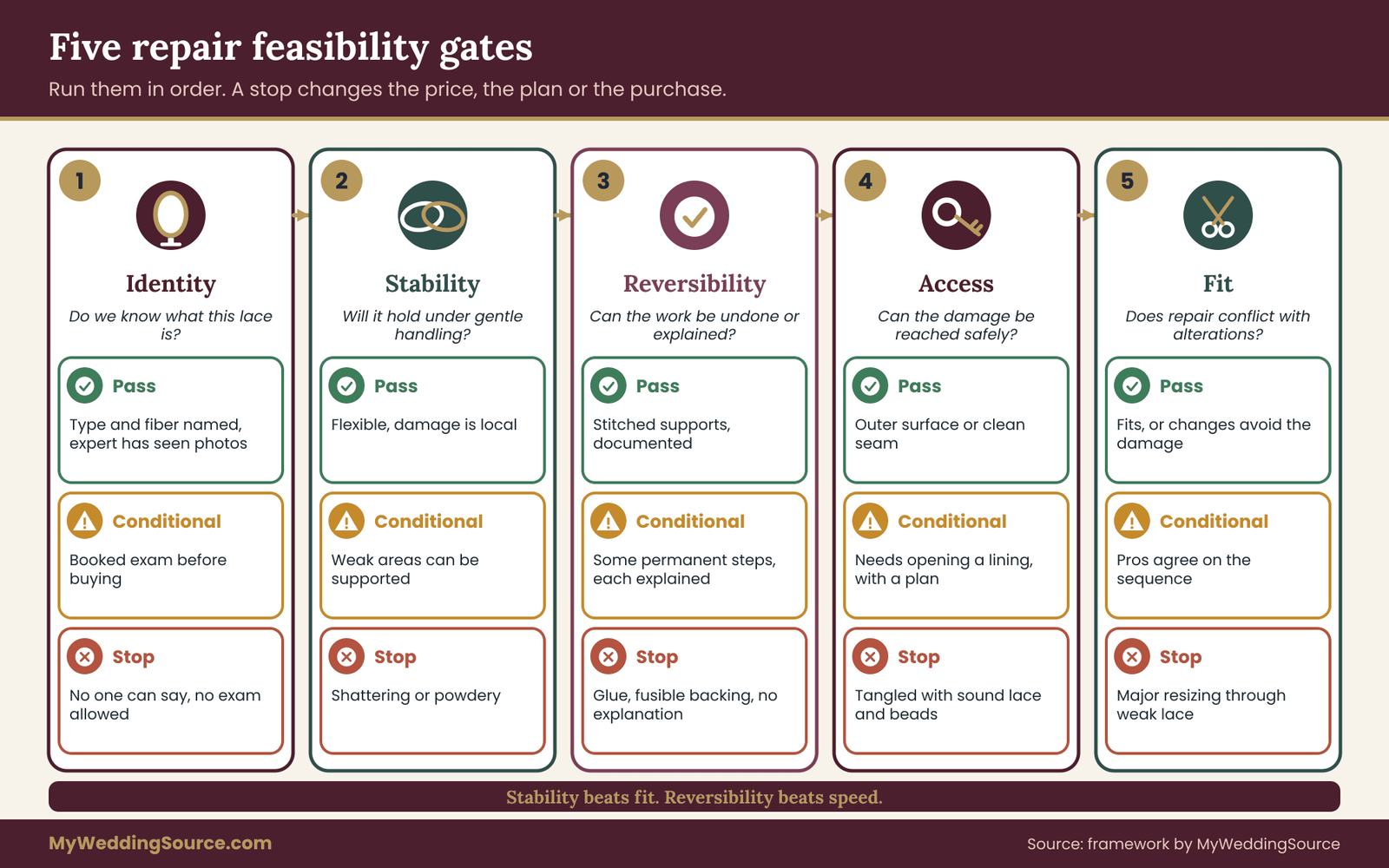
Gate one: identity
Question: do we know enough about this lace to choose a method?
Pass: the lace is described in the five facts, a restorer has looked at the photos and can name the likely type. Conditional pass: some facts are unknown, but a hands-on examination is booked before you commit. Stop: nobody can say what the lace is made of, and the seller will not allow an examination.
Identity matters because lace restoration follows the material. Cotton net, silk bobbin lace and polyester chemical lace take different threads, different stitches and different cleaning. Guessing wrong can damage the piece.
Gate two: stability
Question: will the lace hold together under gentle handling today, before any work begins?
Pass: the lace feels flexible, holds its shape when lifted by the supporting garment and shows only local damage. Conditional pass: some areas are weak but contained, and a restorer says they can be supported. Stop: the lace is shattering, powdery or tearing under its own weight.
A practical test within the seller’s rules: ask them to lift the gown gently from the waist seam and describe whether any lace shifts, sags or sheds fibers. Do not pull, stretch or rub the lace yourself. If a seller will not allow even this, the stability question stays open, and an open stability question is a stop for a purchase you cannot reverse.
Gate three: reversibility
Question: can the proposed work be undone, or at least be explained, later?
Pass: the restorer uses stitched supports and compatible thread, documents each step and tells you what could be removed. Conditional pass: some steps are permanent, but each one is explained and you accept it. Stop: the plan involves adhesives, fusible backings, heavy starching or anything the restorer cannot describe in plain words.
Reversibility is a conservator’s habit, and it should be a buyer’s habit too when lace restoration is on the table. A repair done today with materials that age badly can make the next repair harder in thirty years. If the gown is a family piece, this gate carries the most weight. If you intend to wear the gown and then sell it, it still matters, because buyers and appraisers ask what has been done.
Gate four: access
Question: can the damaged lace physically be reached without damaging the gown?
Pass: the damaged area lies on an outer surface or a seam that can be opened cleanly. Conditional pass: reaching the damage means opening a lining or a seam, and the restorer explains how it will be closed again. Stop: the lace is sewn into a structure where any work would disturb sound lace, boning or beading nearby.
Heavily beaded areas, layered petticoats and bodices where lace, lining and corsetry are stitched together are classic access problems. Beads on lace add weight, hide damage and make every stitch near them harder, so the question of access deserves extra time.
Gate five: fit
Question: does the repair plan conflict with the changes the gown needs to fit your body?
Pass: the gown fits or needs only minor adjustments away from the damaged lace. Conditional pass: alterations touch lace, but the alterations specialist and the restorer have agreed on a sequence. Stop: the dress needs major resizing through damaged lace, and the work would weaken the same area twice.
Fit is the gate buyers forget. A beautiful dress in the wrong size may need its side seams moved, and in lace that is seldom a simple stitch. The wedding dress fit and alterations guide explains how fittings and timing work, and the same ideas apply to lace restoration with extra caution.
Reading the gate results together
Count what you have. Five passes mean a straightforward job. A mix of passes and conditional passes is typical, and each conditional pass becomes a question for the restorer or a clause in the purchase agreement. Any single stop is a decision point. It does not always end the purchase, but it changes the price, the timeline or your plans for the dress.
Some stops are tolerable if you change the goal. A gown that fails the fit gate may still be a lovely family piece to keep. A gown that fails the stability gate may become a source of lace for a veil if the best pieces are intact. The gates are not a verdict on the dress or on lace restoration as an idea. They test whether this dress can meet this particular goal.
A short rule for when two gates conflict
Stability wins over fit, and reversibility wins over speed. If stabilizing the lace means the dress cannot be taken in at the bodice, you either accept a different fit or you choose a different dress. If a quick fix would be permanent and a slower fix would not, choose the slower fix unless the wedding date makes it impossible, and in that case say so in writing so the choice is on the record.
Who does lace restoration: conservator, lace specialist or alterations seamstress
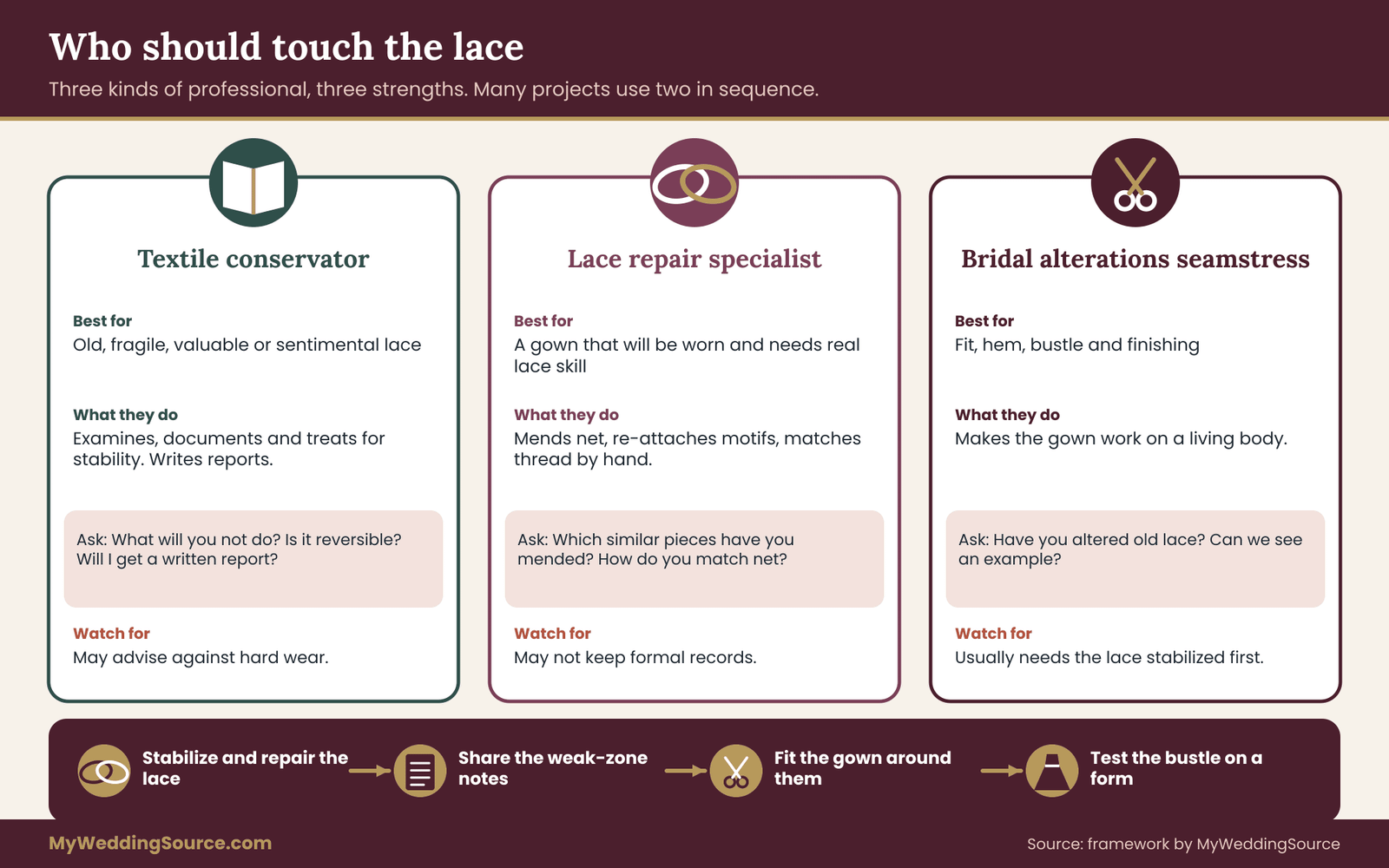
Three different kinds of professional touch old lace, and they are not interchangeable. Choosing the wrong one is the most common avoidable error in lace restoration, so it deserves its own thought, and it usually comes from a good intention: the buyer picked the most convenient person instead of the most suitable one.
The textile conservator
A textile conservator is trained to examine, document and treat historic fabrics, with an emphasis on stability and reversibility. They will usually write a condition report, propose a treatment and explain what they will and will not do. In the United States, professional conservators commonly belong to the American Institute for Conservation, which maintains a directory that helps you search by specialty and region.
Conservators are the right choice when the gown is old, valuable, fragile or sentimental, and when you want a record of the work. They are not always the right choice for a dress you plan to wear hard for a day, because their priority is preservation and they may advise against stress the gown cannot take.
The lace repair specialist
Some craftspeople work specifically in lace, often in handmade lace techniques, mending net and re-attaching motifs by hand. They may not hold a conservation qualification, but their skill with the material can be exceptional. They are often the best answer for a gown that will be worn and needs real repairs done with real lace skill.
Ask a lace specialist what they have done on comparable pieces, how they match thread and net, and whether they document their work. The best ones welcome these questions.
The bridal alterations specialist
A bridal alterations seamstress knows fit, bustles, hems and how to make a dress work for a living body. Many are excellent. Few have extensive experience with fragile antique lace, and that is not a criticism. The material is simply a specialty.
Use an alterations specialist for fit work, and bring in a conservator or lace specialist first when the lace is old or damaged in the area to be altered. A good alterations professional will say so themselves. If one says “lace is lace, I can do anything,” treat that as a signal to ask for an example of similar work.
Combining the three
Many successful projects use two professionals in sequence. A conservator or lace specialist stabilizes and repairs the lace, and an alterations specialist then fits the gown with guidance about where the lace can and cannot be touched. The sequence matters, and so does having both of them know the plan.
The briefing sheet is what ties this together. Send the same sheet to each professional, and ask the restorer to annotate the gown’s weak zones so the alterations specialist can see them. If you are comparing several providers, the wedding vendor due diligence checklist gives a general way to check credentials, references and written terms, and it applies to anyone offering lace restoration as much as to caterers.
Finding a qualified person
Start with professional directories rather than an advertisement. The American Institute for Conservation lists conservators, and museums with textile collections can sometimes suggest people who do private work. Local historical societies and costume collections often know who in the region mends old lace.
Ask any candidate for three things in writing: their experience with lace of this kind, how they document and quote the work, and what happens if they find more damage than expected. An honest professional will answer clearly about lace restoration and will not promise results the material cannot support.
If you cannot find anyone nearby, many restorers work remotely for the first screening and ship only when needed. Shipping a fragile gown for lace restoration carries its own risk, so ask how they want it packed and insured before you send it. Rules and costs for shipping change, so check them with the carrier you use.
Questions to ask the seller before you buy a vintage lace gown
Everything so far prepares you for this moment: the conversation with the person selling the gown. These questions are written for lace restoration decisions specifically, so they differ from a general condition check. Send them in writing, because written answers are evidence and spoken answers are memories.
A seller may be a boutique, a consignment shop, an online marketplace listing or a private person. The same questions work for all of them, though the responses will differ. A shop owner may know the gown’s history, while a private seller may only know what a relative told them.
Questions about the lace itself
Ask what the lace is made of, and whether that is a label, a document or a guess. Ask whether the lace is original to the gown or has been replaced, added or trimmed. Ask whether any lace has been removed, and whether the seller kept it, because spare motifs are valuable when lace restoration needs matching material.
Ask whether the lace has ever been cleaned, how, and when. “Dry cleaned once” is an answer that needs follow-up. Which cleaner, which process and how long ago matter, because older solvent methods and wet methods affect lace differently.
Questions about damage and repairs
Ask the seller to list every hole, tear, loose motif, stain and repair they know of. Ask which repairs are original to the gown and which were done by the seller or a previous owner. Ask specifically whether any glue, tape, fusible product or fabric adhesive was used anywhere on the lace.
Ask what the lace looked like when the seller received it and what has changed since. Lace that has been handled, steamed or spot-cleaned by a seller may be in a different state from the photographs of a year ago.
Questions about storage and history
Ask how the gown has been stored: hung, folded, boxed, bagged in plastic or sealed in a preservation box. Ask where, and whether that place has had damp, heat, smoke or pests. Ask whether any of the owners wore it, and if so how often.
If the answer is “I don’t know,” record it as “unknown.” Do not let a polite non-answer turn into an assumption that everything is fine.
Questions about evidence
Ask for photographs that match the briefing sheet: close-ups of each flaw with a coin or ruler, backlit lace, interior seams and any label. Ask for a short video, if the seller is willing, of the lace moving as the gown is gently lifted. Ask whether the seller will allow an independent restorer to examine the gown before the sale closes.
That last question is the most revealing. A seller with nothing to hide usually agrees to an inspection, at the buyer’s cost, within a reasonable window. A seller who refuses a neutral examination of a high-value vintage gown is signalling that the risk is yours.
A photo protocol for lace evidence
Good photographs make a restorer’s first answer on lace restoration much better, and they cost nothing. Ask the seller, or take yourself if you are in a shop, the following set. Use daylight from a window, not a flash, and keep the gown unstretched.
Take one full-length view of the front and one of the back, so the restorer sees the whole structure. Then take a close-up of every flaw with a coin or ruler beside it, so size is not a matter of opinion. Take a backlit shot of each lace area, held against a window with a hand or a board behind it. Take photos of the inside of the seams where lace meets lining, and of any label, tag or maker’s mark.
Add one photo of the lace edge, such as the hem scallops or sleeve ends, because edges show trimming and wear. Add one of any repair, so the restorer can judge the stitching and the thread. Keep the files in order and name them by location, for example “left-sleeve-hole-closeup.” A restorer who receives twenty clear photographs can often answer questions about lace restoration in a single reply.
Questions about return and payment
Ask in writing what the return terms are for a vintage gown, who pays shipping both ways, what counts as “as described,” and how long you have to inspect. Many sellers treat vintage pieces as final sale. If that is the policy, the risk in the lace is entirely yours, and you should price it that way.
For payment, use a method that gives you a dispute option, and read the platform’s current buyer protection terms before you pay. Rules differ by platform and card issuer and change over time. The Federal Trade Commission and the Consumer Financial Protection Bureau publish general consumer information, and they are the places to confirm what protections exist today. A seller who pushes you toward an untraceable payment is a reason to stop.
A script that keeps things friendly
Sellers respond better to a calm, specific note than to a list of demands. Something like this works:
“I love this gown and I’m considering it seriously. Before I decide, could you help me with a few lace questions? I’d like to know the fiber if you have it, any repairs or cleaning, and whether you can send backlit photos of the lace. I’d also like to have a restorer look at it. Would you allow that before purchase?”
That note signals that you are a serious buyer, not a bargain hunter. It makes cooperation the easy path, and it gives you a clear record if the answers later turn out to be wrong.
Questions to ask the restorer before any lace restoration begins
Once you have a candidate gown and a briefing sheet, the next conversation is with the restorer, and it should be about lace restoration scope before it is about price. These questions apply to a conservator, a lace specialist or an alterations seamstress who will work on the lace. They turn a vague promise into a written scope.
About their experience
Ask how many gowns with this type of lace they have worked on, and whether they can show before-and-after photographs with the owner’s permission. Ask what training or professional affiliation they hold. Ask whether anything about this gown is outside their normal work, and what they would do about that.
A restorer who says “I’d recommend someone else for this part” is not weak. They are being honest, and that is the person to trust with the rest.
About the plan
Ask them to describe in plain words what they would do, in what order and with what materials. Ask which steps are reversible. Ask whether they would use thread, net or lace salvaged from the gown or from other sources, and how they decide on a match. Ask what they will not do, and why.
Ask how they will protect the gown during the work: handling, supports, a clean workspace and the method for flat surfaces. You do not need to supervise, but their answer shows how seriously they take the work.
About documentation
Ask whether they will photograph the gown before, during and after lace restoration, and whether you receive those photos. Ask for a written condition report and a written treatment report. These records matter later, for insurance, for resale and for the next restorer.
If a professional says they do not document, that does not make them dishonest, but it does mean you must take your own photos at drop-off and pick-up. Put the date and time on them.
About the quote
Ask whether the quote is a fixed fee, an hourly estimate or a range, and what could change it. Ask what the deposit is, what it covers, and what is refundable if the gown turns out to be unsuitable. Ask what happens if they find more damage than the photographs showed. The best answer is that they will stop, tell you, and agree to the extra scope in writing before continuing.
The wedding side of this, such as deposits, cancellations and written terms, is covered more generally in the wedding vendor contract guide, and the same habits apply to a lace restoration work order.
About timeline and handling
Ask for a timeline with the start date, the expected finish and what could delay it. Old lace restoration often runs longer than people expect, because the work is slow and because some restorers are booked for months. Ask what the latest date is by which you must decide, and whether rush work is possible and at what trade-off.
Ask how the gown should travel to them and back, who insures it in transit, and what condition you must document at handover. If you are local, ask whether you can bring it in person, which avoids shipping risk entirely.
About what you will receive back
Ask what the finished gown should look like and what flaws will remain. A lace gown after skilled lace restoration will often still show its age, and that can be a feature. Ask what care they advise afterward: how to hang it, how to wear it, how to clean it and how to store it. Ask whether they will write this down.
Red flags in a restorer’s answers
Be cautious if a restorer promises a result before examining the gown. Be cautious if they will not put the scope and price in writing, or if they want the full payment before starting. Be cautious if they say lace restoration is quick and easy for lace they have not seen, or if they refuse to explain methods.
None of these is proof of a bad actor, but together they describe a person who is selling confidence rather than skill. Skilled restorers are usually cautious people, because they know how much can go wrong with fragile material.
The cost logic of lace restoration
Nobody can responsibly publish a single price for lace restoration. The work depends on the lace, the damage and the person doing it, and rates differ by region and by specialty. What you can do is understand how a quote is built, so you can compare two quotes on the same basis and spot a number that does not fit.
This section uses no market averages. Where a figure appears in a worked example later, it is invented for illustration and labeled that way. For real numbers, get written estimates from the professionals you are considering.
How restorers usually price the work
Most quotes combine some of four parts. The first is an examination or assessment fee, which covers looking at the gown and writing a condition report. The second is labor, often by the hour or by the area treated. The third is materials, such as matching net, thread or lace. The fourth is handling costs, such as supports, packing and insurance.
A quote that lists these parts separately is easier to compare than a single total. If a quote arrives as one number, ask for it to be broken down. A reasonable professional will do so.
The three numbers to add up
Before you commit to a gown, add three numbers for lace restoration and the rest of the dress on one page.
The purchase price. What you pay the seller, plus shipping and any fees.
The lace restoration estimate. The written quote or range from the restorer, plus the examination fee if you paid one.
The fit and finishing estimate. The cost of alterations, a bustle, cleaning and any lining or support the restorer recommends.
Add them and compare the total with your real alternatives. The alternative may be a new gown, a different preowned gown in better condition, or a replica made with new lace. The wedding budget guide shows how to place a dress inside the whole budget, and the same discipline applies here: decide the ceiling before you fall in love.
Why the cheap gown is often the expensive one
A gown priced low because of lace damage may cost more than a sound gown once lace restoration, fit work and delay are counted. The seller’s discount reflects their uncertainty, not your costs. If the discount is smaller than the restoration estimate, you are paying a premium for the risk.
The opposite also happens. A damaged but rare piece may be worth the work because there is no sound equivalent. That is a real reason to proceed, as long as you decide it deliberately and not because the listing made the dress feel urgent.
The budget buffer for old lace
Old lace tends to reveal more once lace restoration begins. A hole turns out to have thin fibers around it, or a lining hides a second weak area. Build a buffer into your plan. How large it should be depends on how stable the lace looks and how much your budget can absorb. Some couples hold a separate buffer line for exactly this, labeled and kept apart from the main dress budget.
If the buffer would hurt, that is information. A gown you can only afford if nothing surprises you is a risky choice.
Comparing the alternatives
There are five realistic paths, and a clear comparison helps more than a feeling.
Buy the vintage gown and restore it: highest emotional value, highest uncertainty. Buy a vintage gown that has already been restored and documented: more expensive up front, much less risk. Buy a new gown with vintage-style lace: predictable, wearable, no history. Commission a replica or reuse lace from an heirloom on a new foundation: flexible, and often the best way to wear family lace without stressing it. Keep the vintage gown for display or as a keepsake and wear something else: protects the piece, costs the least stress.
None of these is the right answer for everyone. The briefing sheet and the gates tell you which one fits your goal.
The deposit and the stop point
Agree on a stop point before lace restoration begins. A stop point is an amount or a finding that triggers a pause: “if the estimate rises above this figure, or if the lace turns out to be shattering, call me before continuing.” Write it into the work order. It protects you, and it protects the restorer from guessing what you want.
Wearing restored lace: stress, alterations and the wedding day
Lace restoration is not the end of the plan. A gown can be beautifully stabilized and still be damaged on the day if nobody thought about how it would be worn. This section covers what changes once the lace is repaired and a living person is inside the dress.
What stresses lace on the day
Restored lace is still stressed by pulling, rubbing, snagging and weight. Pulling happens when you sit, reach, hug or dance. Rubbing happens at underarms, at the hips against a belt or at the back where a seat rubs. Snagging comes from jewelry, hooks, a ring, a bouquet wrapping or a guest’s watch. Weight comes from a heavy skirt, a train that is not bustled, or beads stitched onto the lace.
Walk through the day with the lace restoration notes and the list of weak zones and mark where each stress might occur. A weak left shoulder seam and a bouquet carried in the left arm, for example, call for a conversation.
The supportive layers
Many restorers recommend an underlayer to share the load: a lining, a net backing or a foundation garment that takes the strain so the lace does not. This is where an overlay can be a gift to old lace. The overlay carries the beauty, and the foundation carries the stress.
Ask whether a support layer is recommended, how it will be attached and whether it can be removed later. Also ask what it changes visually. A well-chosen support is nearly invisible. A poor one flattens the lace or changes its color.
Alterations through lace
Altering lace is slow, careful work. Taking in a side seam through a lace panel can mean unpicking a motif, trimming and re-stitching it so the pattern still reads correctly. Shortening a scalloped hem raises a hard choice between cutting the lace, which loses the scallop, and folding it up inside, which adds bulk.
Plan alterations before lace restoration is finished, not after. Share the restorer’s notes with the person doing the fitting, and agree who does what. If both professionals are working on the same panel, agree the order in writing. The wedding vendor timeline guide helps place fittings and handovers so nothing lands in the final week.
Working backward from the wedding date
Lace restoration is slow, so the date should drive the order of decisions, not the other way round. Start at the wedding day and count back.
The final fitting needs a finished gown, and a bustle test comes just before it. The alterations specialist needs the restorer’s work to be done and cured, so allow a gap between the two. The restorer needs a written scope, which needs an examination, which needs the gown in hand. Before all of that, you need a purchase decision, and before that the sheet, the gates and the seller’s answers.
If any one of these steps takes longer than expected, there should be slack to absorb it. A common mistake is to schedule lace work so tightly that a single delay means the gown is worn unfinished. Build in extra weeks for old lace, and agree with the restorer on a date by which you will switch to a plan B, such as a different gown or a simpler version of the repair. Naming the plan B in advance makes it easier to use without panic.
The bustle and the train
A bustle adds stress to the points where it attaches. On a lace train, ask the specialist to choose bustle points on sound areas, preferably on a stable seam or a supported panel, and not on a fragile motif. Test the bustle with a gentle lift while the gown is on a form, not on a person for the first time at the venue.
Dressing, undressing and moving
Even a perfect repair can fail in a rushed moment. Plan how the gown goes on: a helper who knows the lace is fragile, no rings or bracelets until the dress is on, and a lift over the head only if the structure allows. Plan how it comes off, which is often when the damage happens because people are tired and quick.
For the day itself, brief the helpers in two sentences: where the weak zones are, and what not to pull. A small card in the emergency kit with the zones marked is enough. The wedding day accessories planning guide covers a general emergency kit, and a spare needle and matching thread belong in it.
After the wedding
Clean and store the gown only after you have asked the restorer what they recommend. Ask whether it should be professionally cleaned, how soon, and by whom. Lace does not always tolerate a standard cleaning process, and a cleaner who does not know the lace can undo careful work. Ask about storage materials too: acid-free tissue, a breathable box and a stable, dry place are common recommendations, but follow the advice of the person who knows your gown.
If you plan to pass the gown on, keep the briefing sheet, the condition report and the treatment report with it. They are the gown’s medical history, and they make the next owner’s decisions easier.
Worked example: a lace gown walked through the sheet and the gates
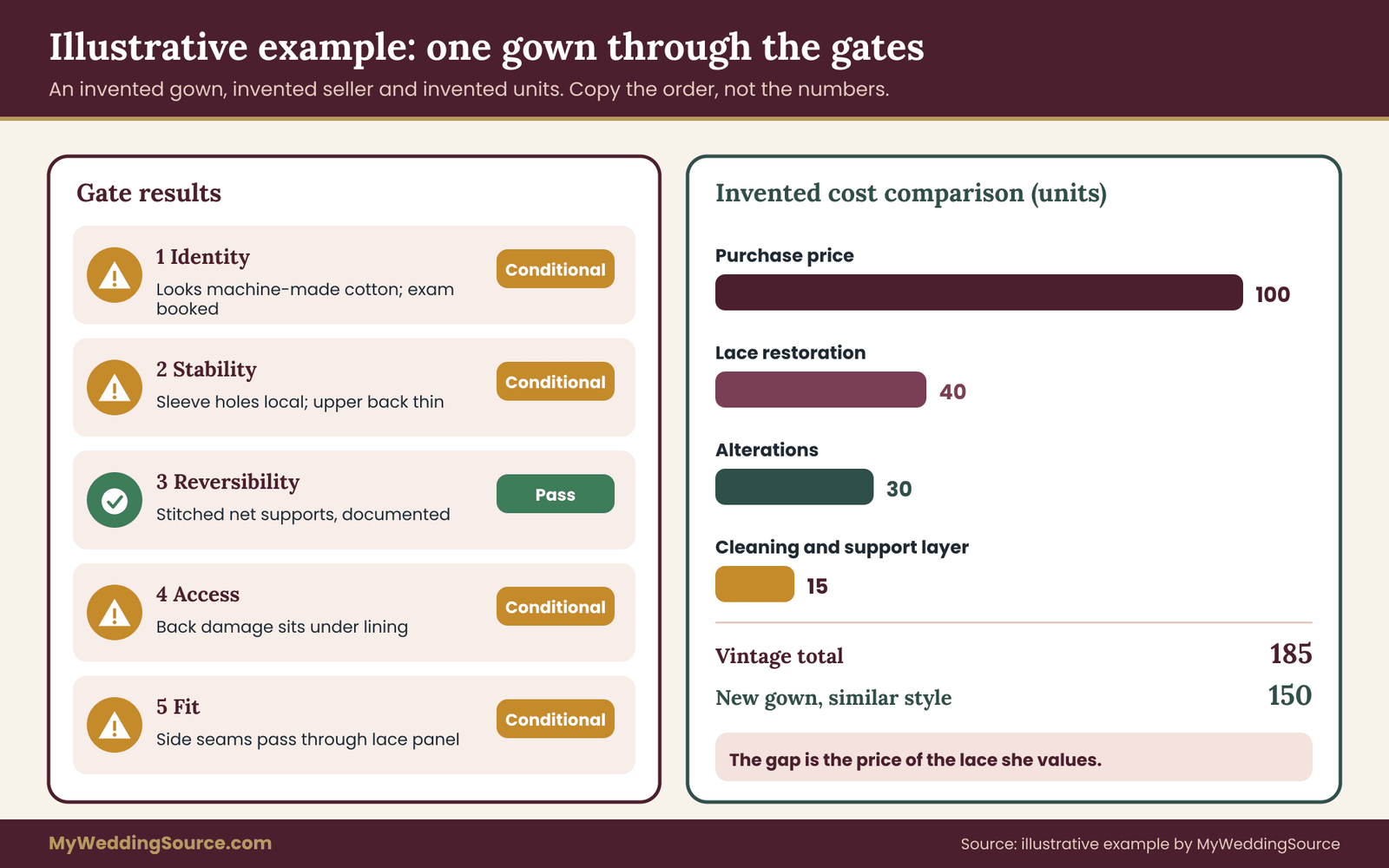
The following example is invented to show the method. The gown, the seller, the restorer and every figure are made up for illustration, and nothing here is a real price or a real result. Use it as a pattern for your own notes.
The situation
Maya finds a long-sleeved gown listed online by a private seller. The listing says “1940s style, cotton lace, minor damage, final sale.” Her wedding is in nine months. She would like to wear it, then keep it. The asking price is a figure she can afford, and the listing photos are bright and flattering.
She does not buy. She fills in a briefing sheet for lace restoration instead.
Filling in the sheet
Goal: wear on the day, then preserve. Gown: unknown maker, said to come from the seller’s grandmother, no label found. Lace: looks machine-made, regular repeat, cotton or cotton blend, net ground, appliqué motifs on the sleeves and a cut-and-sewn lace panel on the skirt. Edges: scalloped hem, one section where the scallops look trimmed.
Damage list, from the seller’s follow-up photos: two small holes in the net at the left sleeve, a loose motif at the neckline, light yellowing at the underarms, and an orange mark near a hook. History: stored in a cedar chest, never professionally cleaned as far as the seller knows. Constraints: nine months, a budget ceiling, and a restorer within driving distance.
The backlit photo, which the seller takes after a polite request, shows more than the listing did: a thin, patchy area across the upper back where light passes through easily.
Running the gates
Gate one, identity: a conservator Maya contacts looks at the sheet and says the lace sounds like machine-made cotton, but wants to see it. Conditional pass.
Gate two, stability: the sleeve holes look local and stable. The upper back is the concern. Without touching it, nobody can say. Conditional pass, with a clear condition.
Gate three, reversibility: the restorer proposes stitched net supports and re-attaching the loose motif with matching thread. Pass.
Gate four, access: the sleeve work is reachable. The upper back thin area lies under a lining. Conditional pass.
Gate five, fit: the gown looks about one size larger than Maya. Taking it in at the side seams would pass through the lace panel, so lace restoration and fitting collide. Conditional pass, and a flag.
So: no stops, but four conditional passes. Every one of them is a question about lace restoration, and each question has a price attached.
The conversation and the numbers
Maya asks the seller whether a restorer may examine the gown at Maya’s cost before the sale closes. The seller agrees to a one-week hold. The examination fee in this invented example is a modest amount she pays out of pocket, which is part of the cost of knowing.
The restorer finds that the upper back is thin but sound with a net support, that the sleeve holes need a small net patch and that the orange mark is a stain with no fiber damage. Estimates in this example: a purchase price of 100 units, restoration at 40 units, alterations at 30 units and cleaning and a support layer at 15 units. The total comes to 185 units, set against a new gown with similar style at 150 units.
Maya now sees that lace restoration makes the vintage gown cost more, with more uncertainty. She also sees what she values: the lace and the family-sounding history. She can decide with the figures in front of her.
The decision
She asks the seller to reduce the price to reflect the support layer. The seller declines. Maya buys anyway, with the written one-week inspection result in hand, and books the restorer for the work. She also books the alterations specialist, and the two professionals agree that the side seams will be taken in at one panel only, on a supported area.
What would have changed her decision? If the backlit photo had shown shattering across the entire back, she would have stopped at gate two. If the seller had refused the examination, she would have stopped at gate one. The method did not tell her to buy. It told her what she was buying.
What to copy from this example
When you plan your own lace restoration, copy the order, not the numbers. Sheet first, gates second, examination third, price comparison fourth, decision last. Notice also that the most useful step cost the least: asking for a backlit photo. And notice that the seller’s cooperation was information, as was the restorer’s willingness to say what they could not know from photographs.
Edge cases and common mistakes in vintage lace restoration
Real gowns do not follow tidy examples, and lace restoration plans have to bend. These situations come up often enough to be worth planning for, and each one changes a gate or a question.
Family heirloom lace
If the lace belongs to your family, the emotional stakes are higher and the reversibility gate matters most. Talk to relatives before any work, since someone may know the lace’s history. Photograph everything first. Consider whether the lace should be worn at all, or whether a copy, a small detail or a keepsake would honor it better. Ask a conservator to advise on lace restoration, not only a seamstress.
A lace veil
Veils are long, light and constantly in motion, so they snag. Ask the restorer how the veil should be attached after lace restoration, how the comb or clip may stress the lace, and what the plan is for outdoor wind. A long edge of fragile scalloped lace is vulnerable at the point where it meets hair accessories.
Beaded, sequined or metallic lace
Beads and sequins add weight and hide thread damage. They also complicate cleaning, because some metallic threads tarnish and some beads loosen with moisture. Ask the restorer whether the decoration can be treated at all, and whether missing beads can be matched. If not, the gown may need to be retired from active wear.
Synthetic lace added to old lace
Some gowns have been “refreshed” with newer polyester lace over older material. That can stabilize the look and hide damage beneath. Ask the seller what is original. If the old lace is still underneath, a restorer should know, because the plan changes.
Water, smoke or pest history
A gown stored in a damp basement, exposed to smoke or touched by insects needs specific advice. Odor in particular can be persistent. Do not treat it with home remedies, because chemicals and moisture can harm old lace. Ask a conservator, and expect the answer may be that some damage is permanent.
International and cross-border purchases
When the gown comes from another country, ask about shipping risk, customs and what happens if the gown is damaged in transit. Insurance, duties and return costs may be greater than expected, and the rules change. The U.S. Postal Service and the carrier you choose publish current shipping and insurance terms, so confirm them before you pay.
Common mistakes
Letting the dress be urgent. Listings create pressure with phrases like “only one.” The gown has waited decades. It can wait for a restorer’s reply.
Hiring on convenience. The nearest seamstress is not always the right person for fragile lace.
Skipping the written scope of lace restoration. An oral promise to “fix the lace” can mean ten different things.
Treating a stain as a minor issue. Stains can mark weakened fiber. Ask, do not scrub.
Using home fixes. Fabric glue, iron-on tape, bleach and steam can all do lasting harm to old lace. A professional’s advice is a safer source than a quick fix video.
Forgetting to photograph. Take dated photos before and after every handover. They protect you and the professional.
When to walk away
Walk away if the lace is shattering across large areas, if the seller refuses a neutral examination, if no professional will take the job, or if the total cost exceeds what a comparable sound gown would cost without a reason you can name. Walking away from lace restoration is not failure. It is the whole purpose of asking questions first.
When to say yes with eyes open
Say yes to lace restoration when the gates pass or pass conditionally, when the written scope and price are clear, when the buffer is real and when you can explain, in one sentence, why this particular gown is worth this particular work. If that sentence comes easily, you are probably making a good decision. If you have to argue yourself into it, listen to that.
Your next steps
You do not have to do everything at once. A sensible order takes a few evenings and keeps the money for later, after the facts are in.
- Decide the goal for lace restoration: wear on the day, wear once and preserve, keep as a family piece, or reuse the lace.
- Write down the five facts about the lace: handmade or machine-made, ground, fiber, attachment and edges.
- Request the photo set from the seller, including backlit shots of the lace, and ask the history questions in writing.
- Fill in the conservator briefing sheet with what you know, and mark every unknown as unknown.
- Run the five gates for lace restoration and note each pass, conditional pass or stop.
- Ask a textile conservator or lace specialist to review the sheet, and ask the seller to allow an examination before the sale closes.
- Add purchase price, restoration estimate and fit and finishing estimate on one page, with a buffer, and compare the total with your real alternatives.
- Write down your stop point and your plan B before any work begins.
Keep the paperwork together
Save everything about the lace restoration: the sheet, the photographs, the seller’s written answers, the restorer’s condition and treatment reports and every receipt in one folder. If you later sell the gown, hand it down or insure it, that folder is what lets the next person understand the gown. The wedding vendor due diligence checklist can help you keep a similar file for every vendor, not only the person who repairs the lace.
FAQ
Can any vintage lace be repaired?
No. Lace restoration has limits. Lace that is stable and has local damage, such as a few holes or loose motifs, can often be repaired or supported. Lace that is shattering, powdery or failing across large areas usually cannot be rebuilt in place. A conservator or lace specialist can tell you which group your lace falls into, ideally after an examination in person rather than from photographs.
What is the difference between lace restoration and lace conservation?
Conservation aims to stabilize the lace and keep it as original as possible, with reversible methods and records. Restoration aims to bring the lace closer to how it looked when new, which can mean replacing or rebuilding parts. Many lace restoration projects blend both, so ask the professional which approach they are proposing and why it suits your goal for the gown.
Should I hire a conservator or a bridal seamstress?
It depends on the gown and the goal. For old, valuable, fragile or sentimental lace, start with a textile conservator or a lace specialist. For fit work, an alterations seamstress is the right person, ideally once the lace has been stabilized. Many successful lace restoration projects use both in sequence, with each one told the plan and the weak zones.
How do I know if the lace is handmade or machine-made?
Handmade lace tends to show small irregularities, with motifs that are not identical and thread that varies slightly. Machine-made lace usually repeats exactly and has uniform thread. Some machine lace imitates handmade patterns closely, so a restorer’s opinion is better than a guess. On your briefing sheet, describe what you see and label it as your impression.
Can I wear a restored lace gown for the whole wedding?
Often yes, with planning. Ask the restorer where the weak zones are and whether a support layer is advised. Plan how you will sit, dance and be helped in and out of the gown, and brief your helpers. If the restorer advises against heavy wear, take that seriously, and consider a different gown or a wear-once plan.
What should I ask a seller who says the lace has minor damage?
Start from what lace restoration would involve. Ask them to list every hole, loose motif, stain and repair, and to say whether any glue, tape or fusible product was used. Ask for backlit photographs, close-ups with a ruler and storage details. Ask whether an independent restorer may examine the gown before the sale closes. Get all of the answers in writing.
How much does lace restoration cost?
There is no single figure for lace restoration. Quotes depend on the lace, the extent of the damage, the method, the specialist and the region. Many professionals price by the hour or by area treated, plus materials and handling. Ask for a written breakdown, including an assessment fee, and compare it with the cost of a sound gown. Confirm every figure directly with the professional.
What if the seller will not allow an inspection?
Treat it as a risk signal. A seller confident in the gown usually agrees to a reasonable inspection, even at your cost. If they refuse, you are accepting unknown condition, often with a final-sale policy. You can still decide to proceed, but price the unknown into your offer or walk away. Use a payment method that offers dispute options.
Sources
- Federal Trade Commission: consumer advice and online purchase rules
- Consumer Financial Protection Bureau: payments, disputes and consumer protections
- American Institute for Conservation: find a conservator and conservation basics
- National Park Service: museum collections care and preservation guidance
- Smithsonian Institution: textile collections and conservation
- Canadian Conservation Institute: care of textiles and heritage objects
- Library of Congress: preservation of collections
- U.S. Postal Service: shipping, insurance and claims
- Getty Conservation Institute: conservation research and resources
- ICCROM: international guidance on heritage conservation