

A hotel block feels like a solved problem the moment you book one. You pick a property, the sales manager quotes a discounted rate, you get a booking link to send out, and the travel question seems to close itself. Then the details arrive: an attrition clause you have to read twice, a cutoff date that is earlier than you expected, a two-night minimum over New Year’s, and a room rate that only applies if guests book through a portal nobody has tested. None of that was visible in the friendly first phone call.
Understanding the holiday wedding hotel block can significantly ease your planning process.
Holiday wedding travel is expensive and complicated for reasons that have nothing to do with your wedding, especially when considering your holiday wedding hotel block. Airlines and hotels raise prices around Thanksgiving, Christmas, and New Year’s because millions of people are traveling for reasons unrelated to you, and your guests are competing with all of them for the same seats and rooms. Your family and friends are also, in the same weeks, negotiating their own holiday commitments — a partner’s family, a child’s school break, an employer’s blackout dates — before they even get to yours.
The financial stakes are real on both sides. A discounted room rate does not help anyone if the block requires a two-night minimum, adds a resort fee, or sits forty minutes from the venue with no shuttle. And on your side, a hotel contract with an attrition clause can leave you personally owing money for rooms that were never booked, at exactly the time of year when your own budget is already stretched by holiday spending.
This guide works through what a room block actually is and which type fits your guest list, how attrition risk works and how to limit it, why your internal cutoff date should be earlier than the hotel’s, how to choose between one hotel and several, airport and flight timing, shuttle scheduling, weather contingency communication, the family conflicts specific to a holiday date, accessibility, and the guest communication templates and contract questions that prevent most of this from becoming a problem in the first place. The goal is a travel plan your guests can understand and act on before they have spent any money — not just a discount code.
By effectively managing your holiday wedding hotel block, you can help your guests navigate the complexities of travel during peak seasons.

Why Holiday Wedding Travel Is a Different Problem
The calendar is already full
A wedding in April competes with very little. A wedding during Thanksgiving week or between Christmas and New Year’s competes with a fixed, culturally loaded set of obligations that most guests already had before your invitation arrived: a partner’s family gathering, a child’s only week off school, a long-standing tradition someone hosts every year. You are not asking guests to find room in an empty week. You are asking them to find room in one that was already spoken for.
Prices move for reasons that have nothing to do with your wedding
Airfare and hotel rates rise around major holidays because demand from the entire traveling public increases, not because your guest list grew. That means the normal advice about booking flights months in advance for the best price applies with more force, and it also means a “great group rate” from a hotel may still be higher than what that same room cost in October. Judge every price against the holiday market, not against an ordinary weekend.
Everyone’s calculation includes more than your wedding
A guest deciding whether to attend a June wedding is mostly weighing cost and distance. A guest deciding whether to attend a wedding on December 27th is also weighing whose family they disappointed last year, whether their children will forgive missing a ski trip, and whether taking two extra vacation days now means none left in the spring. None of this is about how much they love you, and it is worth remembering when the RSVPs come back lower than you hoped.
Room Block Types, Explained
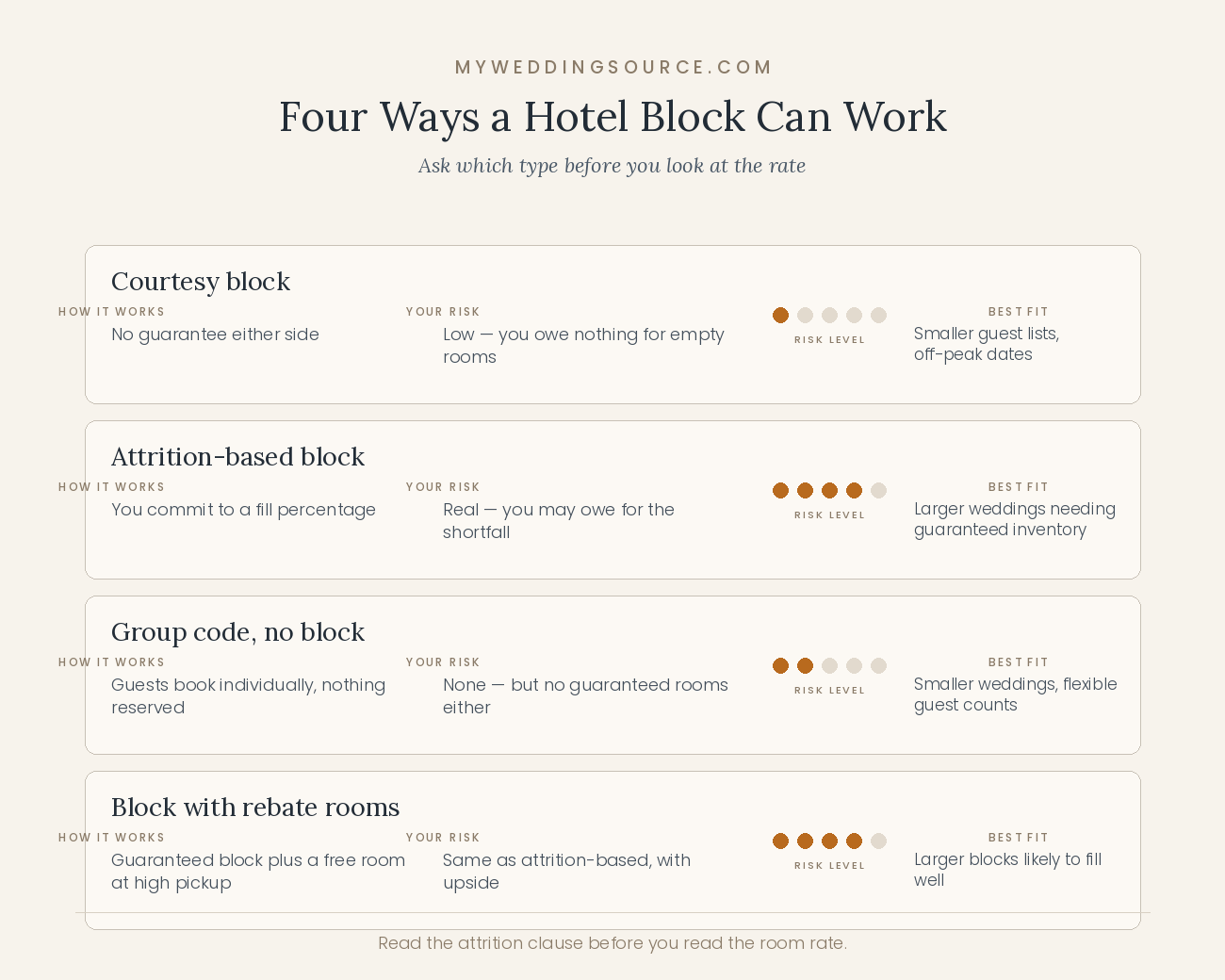
Hotels offer a few structurally different kinds of group arrangements, and the difference between them determines how much financial risk sits on your side of the contract. Ask the sales manager which type they are proposing before you look at the rate at all.
| Block type | How it works | Your financial exposure |
|---|---|---|
| Courtesy block | A set of rooms held at a discounted rate, with no guarantee on either side | Low. The hotel can release unbooked rooms, but you owe nothing for empty ones |
| Attrition-based (guaranteed) block | You commit to filling a percentage of the block; the hotel guarantees availability at the rate | Real. You may owe the difference for unfilled rooms below the threshold |
| Group code, no formal block | Guests book individually using a discount code; no room count is reserved | None. But no guaranteed inventory either — rooms can sell out |
| Block with rebate rooms | A guaranteed block that also earns you a free or discounted room after a booking threshold | Same as attrition-based, with a benefit attached at higher pickup |
Courtesy blocks: lower risk, less certainty
A courtesy block is the friendliest arrangement for the couple. You are not on the hook if guests do not book, but the trade-off is that the hotel can release the rooms back into general inventory if they are not picked up by a certain point, sometimes without much notice. This is usually the right choice for a smaller guest list, an off-peak date, or any hotel with plenty of general availability — which, notably, is less common the closer your date sits to Christmas or New Year’s, when a property’s total inventory is also under holiday pressure.
Attrition-based blocks: real commitment, real leverage
An attrition-based block is what most people mean when they talk about a “room block” for a larger wedding. The hotel guarantees you a set number of rooms at a fixed rate, and in exchange you commit to a minimum pickup — commonly somewhere in the 70 to 80 percent range, though this varies by property and season and should never be assumed. If guests book below that threshold, you are typically responsible for the difference, calculated at the group rate.
The advantage is certainty: your guests have guaranteed rooms at a fixed price during a season when availability can vanish. The cost is that the risk shifts onto you specifically during the season when guests are statistically more likely to decline or book elsewhere. Both of those things are true at once, which is why the sizing of the block matters more here than in any other season.
Group codes without a formal block
Some hotels, particularly larger chains, will offer a discount code tied to your event without reserving a specific room count. Guests book directly and get the rate, but nothing is held for you. This removes your financial exposure entirely and is worth asking about directly, especially for a smaller wedding where a formal block’s minimums do not make sense. The trade-off is that rooms are not guaranteed to be available, which is a real risk in a market where the whole hotel may be near capacity for the holiday regardless of your wedding.
Attrition Risk, in Plain Terms
What the number actually means
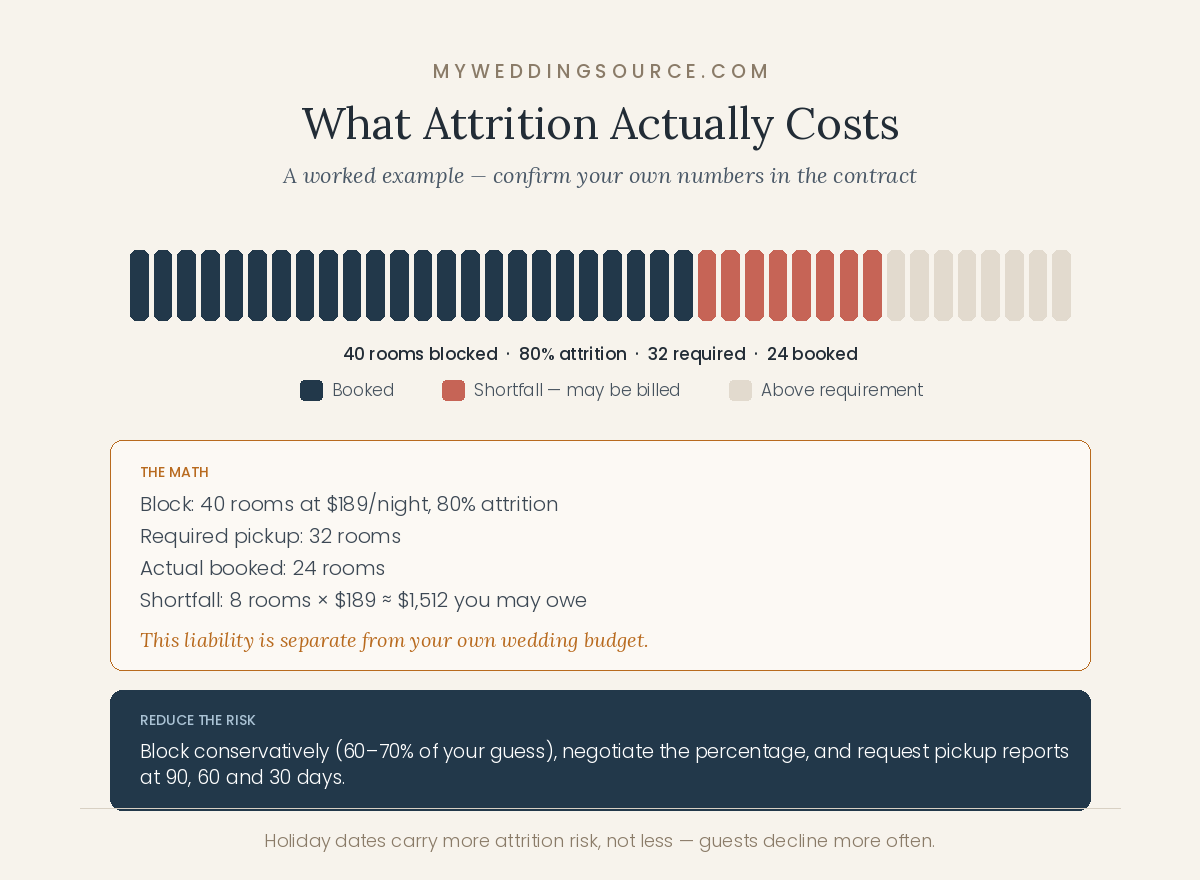
Attrition is the percentage of your blocked rooms the hotel expects you to fill. If you block 40 rooms with an 80 percent attrition clause, you are contractually responsible for 32 room-nights being booked or paid for, regardless of who actually stays. If only 25 rooms get booked, you may be billed for the 7-room shortfall at the group rate, sometimes with additional fees layered on.
A worked example
Block: 40 rooms at $189/night, 80% attrition, single-night stay assumed. Minimum required pickup: 32 rooms. If only 24 rooms are booked by the wedding date, you may owe the hotel for the 8-room shortfall — roughly $1,512 — on top of anything guests already paid for their own rooms. This liability is separate from and in addition to your own wedding budget.
Why holiday dates carry more attrition risk, not less
It is tempting to assume a popular season means guests will book eagerly and attrition will not be an issue. The opposite is often true. Guests are statistically more likely to decline a holiday-adjacent wedding, book outside the block to combine trips, stay with family instead of at a hotel, or cancel late when a competing commitment wins out. A block sized the way you would size one for a June wedding can be genuinely oversized for a Christmas-week date.
How to reduce it
- Block conservatively, then add. Most hotels will let you increase a block if it fills, and it is much easier to add ten rooms than to explain why you cannot fill forty. Start at roughly 60 to 70 percent of your best guess for out-of-town headcount.
- Negotiate the attrition percentage down, particularly for a lower-demand date within the holiday season. A weekday or a date before December 15 gives you leverage a December 28 Saturday will not.
- Ask for a lower penalty rate on unfilled rooms rather than the full group rate, which some properties will agree to.
- Request pickup reports at 90, 60, and 30 days out, so you can see the trend early and either promote the block harder or ask to reduce it before the cutoff, which is sometimes possible.
- Consider two smaller blocks at two hotels rather than one large block, which spreads the risk and gives guests a price choice, at the cost of more coordination.
Read the attrition clause before you read the room rate. A slightly higher nightly rate with a courtesy arrangement or a low attrition percentage is frequently the better deal once the holiday decline rate is factored in.
Cutoff Dates: Earlier Is Safer in Holiday Season
A room block’s cutoff date is when unbooked rooms release back to the hotel’s general inventory, after which your group rate is no longer guaranteed. In an ordinary season, a cutoff 30 days before the wedding is standard and usually fine. In holiday season, that same 30-day window collides with two problems at once.
The problem with a standard cutoff during the holidays
First, hotel demand around Thanksgiving, Christmas, and New Year’s fills earlier than usual because of unrelated holiday travelers, so “released back to general inventory” may functionally mean sold out rather than merely more expensive. Second, guests often wait to book flights and hotels until they have resolved competing holiday plans, which pushes their decision later than your cutoff — right when their guaranteed rate is disappearing.
| Milestone | Ordinary-season wedding | Holiday-season wedding |
|---|---|---|
| Save-the-date sent | 6–8 months out | 8–12 months out |
| Hotel block booked | 6 months out | 9–12 months out |
| Hotel’s official cutoff | 30 days before | 45–60 days before, if negotiable |
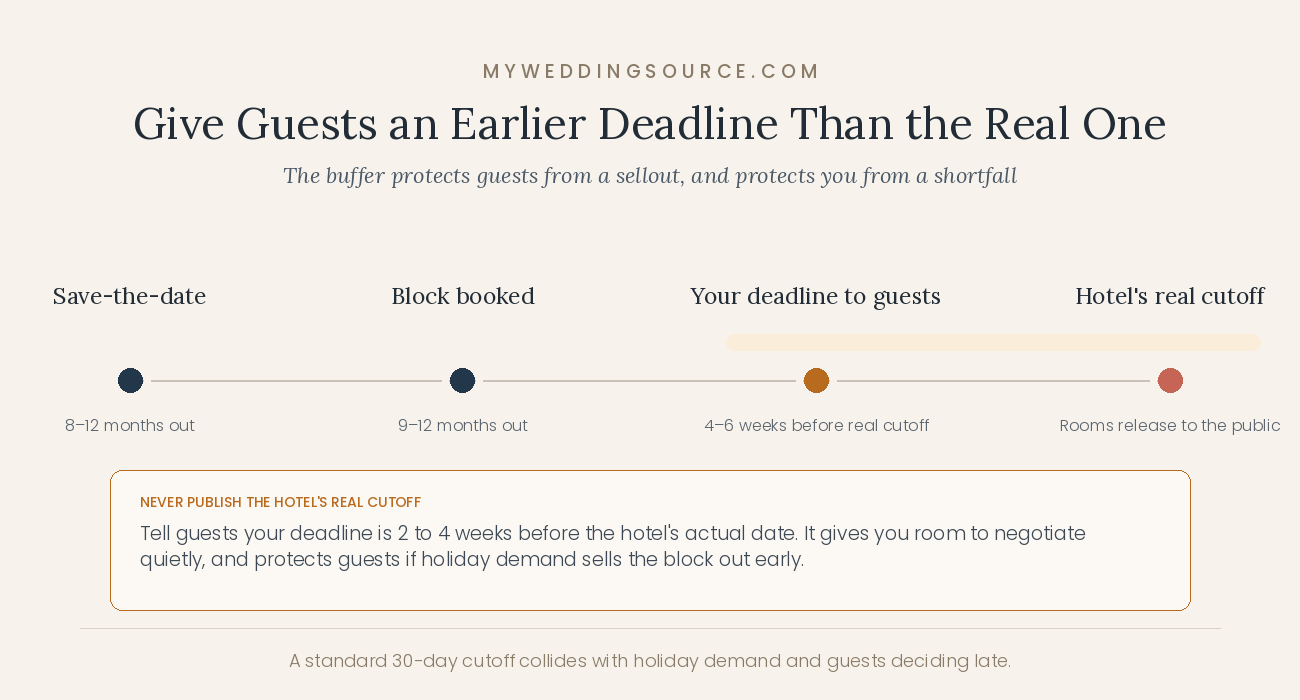
| Your internal “soft” deadline to guests | 2 weeks before hotel cutoff | 4–6 weeks before hotel cutoff |
| Reminder to non-responders | 1 reminder | 2 reminders, spaced further apart |
Give guests a deadline earlier than the real one
Tell guests your booking deadline is two to four weeks before the hotel’s actual cutoff, and never mention the real date publicly. This buffer does two things: it gives you room to negotiate an extension quietly if pickup is slow, and it protects guests from the scenario where they intend to book “next week” and the block sells out from holiday demand before your cutoff ever arrives.
What happens after the cutoff
After the cutoff, the hotel is no longer obligated to honor the group rate or hold the block’s remaining inventory. In a slow season, sales staff will often still extend the rate informally if rooms remain. In holiday season, with the property’s total inventory under separate pressure from unrelated travelers, this informal flexibility is far less reliable. Ask specifically what happens at cutoff, and get the answer in writing rather than assuming it will work out the way it might have at a June wedding.
Choosing the Right Hotel, or Hotels
One hotel versus a tiered approach
A single hotel block is simpler to manage, easier to coordinate a shuttle around, and creates a natural gathering point for a Friday-night mixer or a Sunday farewell breakfast. Its downside is that one price point rarely suits every guest’s budget, particularly during a season when even the “discounted” rate may feel steep.
A tiered approach — one upscale option and one budget-friendly option, ideally within a short distance of each other — gives guests genuine choice without you managing four separate contracts. For a holiday wedding specifically, a budget tier matters more than usual, because guests are already absorbing higher-than-normal travel costs elsewhere in the season.
Distance to venue versus price
A hotel forty minutes from the venue is sometimes forty dollars cheaper a night, and that math rarely favors the guest once a shuttle, a rideshare, or a rental car is factored in — and doubly so if roads are unfamiliar, dark, or icy. As a general guideline, prioritize hotels within a fifteen to twenty-minute drive of the venue, and treat anything farther as a last resort rather than a primary option.
Holiday-specific hotel terms to check
- Minimum-night stays. Many properties impose a two- or three-night minimum around Christmas and New Year’s regardless of your event, which can catch guests who only planned to stay one night.
- Resort or destination fees, which are increasingly common and are not always disclosed until checkout unless you ask directly.
- Parking costs, especially at urban and airport-adjacent hotels, which can add a meaningful daily charge that guests do not expect.
- Existing holiday events at the property. Ask whether the hotel is hosting its own New Year’s Eve party or a corporate holiday event the same weekend, since that changes noise levels, elevator wait times, and staff availability.
- Whether the group rate holds for extra nights guests may want to add, since many holiday travelers extend a trip into a longer visit with family.
Should you let guests book outside the block?
Yes, always mention this is an option, particularly around the holidays. Some guests will find a better rate through a rewards program, a bundled flight-and-hotel deal, or a stay with relatives who happen to live nearby. Booking outside the block does not affect your attrition numbers positively, but preventing it does not help you either — a guest who was never going to book in your block is not attrition risk you can recover by insisting.
Airports and Flight Timing
Choosing the right airport, if there is a choice
In markets with more than one commercial airport, compare not just fares but drive time to the venue, holiday parking availability, and whether guests are more likely to already hold miles or status with a specific airline that serves one airport over another. A slightly more expensive airport that is thirty minutes closer to the venue is frequently the better recommendation once ground transportation is included.
When to tell guests to book
For a holiday wedding, encourage flight booking as early as the save-the-date allows — ideally the moment a guest RSVPs, and certainly the moment your invitations go out. Airfare around major holidays tends to rise steadily as the date approaches and can spike sharply in the final weeks, more so than for an ordinary weekend. Waiting for a formal invitation before booking a holiday flight can cost a guest considerably more than the same flight booked three months earlier.
General patterns worth passing on
Guests do not need you to be a travel expert, but a few general patterns are worth including in your wedding website’s travel section: midweek flights are typically cheaper than weekend flights, the days immediately before and after a major holiday are usually the most expensive to fly, and setting a fare alert as soon as a date is confirmed can catch a price drop. For authoritative, regularly updated guidance beyond general folklore, the U.S. Department of Transportation publishes practical tips on getting the best airline fares, which is a reasonable link to include directly on your wedding website’s travel page.
Should you negotiate a group flight rate?
For most weddings, no. Airline group rates typically require a minimum number of passengers flying the identical route on the identical flight, which is a poor fit for guests traveling from many different cities. It is usually more useful to point guests toward fare-alert tools and to give them your dates as early as possible than to chase an airline group discount that rarely beats a well-timed individual booking.
Shuttles and Ground Transportation
Two different shuttle problems
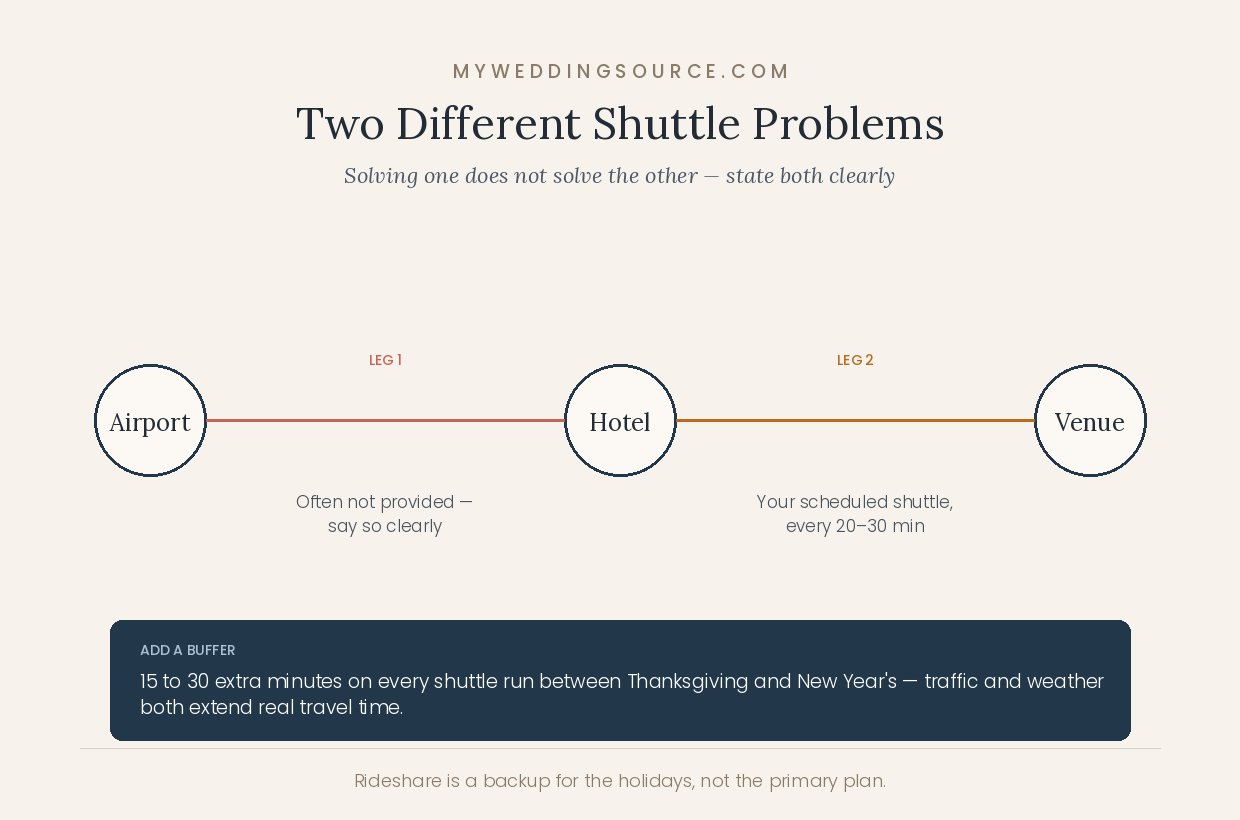
Airport-to-hotel transportation and hotel-to-venue transportation are separate logistical problems and are often handled by different vendors. Do not assume one solves the other. If you are not providing airport transportation, say so plainly on your wedding website so guests plan for a rideshare or rental car rather than discovering the gap at baggage claim.
Scheduling a hotel-to-venue shuttle
Run shuttles on a schedule generous enough to survive holiday traffic and winter weather, not the schedule that would work on a clear June evening. A reasonable starting point is a shuttle every 20 to 30 minutes during the main arrival and departure windows, with an early option for guests who want to help set up or take photos, and — importantly — a late-night return option that runs later than you think you will need it.
Build in a weather and traffic buffer
Add 15 to 30 minutes of buffer to every shuttle run scheduled between Thanksgiving and New Year’s, since holiday traffic patterns and any winter weather both extend real travel time beyond what a map application estimates in clear conditions. Share the shuttle schedule with a note that it may run behind in poor weather, so guests do not assume a problem when the bus is simply late.
Rideshare as a backup, not a plan
Rideshare availability and pricing both become unpredictable during holiday weeks in many markets, particularly late at night after a wedding reception when demand spikes across an entire city simultaneously. Mention rideshare as a backup option on your website, but do not rely on it as your primary transportation plan for a holiday date the way you reasonably could for an ordinary weekend.
Weather Delays and Contingency Communication
Build a communication plan before you need one
Winter weather can delay or cancel flights with little warning, and a holiday wedding compounds the problem because airlines are already operating near capacity with less slack to rebook affected passengers quickly. Decide in advance who monitors the forecast, who has authority to adjust the shuttle schedule on the day, and how guests will be reached if plans change.
What to prepare
- A group text list or app-based guest list you can message quickly with real-time updates.
- The hotel’s and shuttle company’s direct phone numbers, shared with your wedding party and family in case guests call them instead of you.
- A simple, calm message template ready to send if flights are delayed: what is changing, what guests should do, and who to contact.
- A point of contact — not you or your partner — who fields travel questions on the wedding day itself.
Travel insurance, mentioned without advice
Some guests, and some couples, choose to purchase travel insurance for a holiday-season trip given the higher likelihood of weather disruption. Whether that makes sense depends on each traveler’s own itinerary, budget, and existing coverage, and is a personal financial decision rather than something this guide can advise on. It is reasonable to mention on your wedding website that guests may want to look into it, without recommending a specific provider or amount.
Family Travel Conflicts
The specific pressure of a holiday date
A holiday wedding asks guests to choose, in a way an ordinary-season wedding rarely does. A guest with divorced parents may already alternate holidays between two households. A guest with young children may be balancing a school break that both sets of grandparents want. A guest who normally hosts a family gathering may need to cancel or relocate it. None of these conflicts are about your wedding specifically, and none of them are yours to resolve — but understanding they exist changes how you communicate and how you interpret a lower-than-expected acceptance rate.
What helps
- Early notice, more than for any other season. Eight to twelve months of lead time on a holiday save-the-date gives guests a real chance to negotiate their other commitments rather than choosing under pressure.
- Clarity about what is and is not included, so guests can decide with real numbers rather than assumptions: is there a hosted meal the night before, is childcare available, is there a hospitality suite.
- Permission to decline gracefully. A line in your communication acknowledging the season is a lot to ask makes it easier for a guest to say no without feeling they have failed you.
Should you help pay for travel?
Some couples choose to cover or subsidize travel costs for immediate family or the wedding party, particularly for a holiday date that asks more of people than usual. This is entirely optional and depends on your own budget and relationships — there is no obligation and no standard amount. If you do offer it, be specific and direct about what is covered rather than leaving it as a vague, easily-forgotten promise.
Accessibility
Book accessible rooms early, and specifically
Hotels hold a limited number of ADA-compliant rooms — roll-in showers, grab bars, accessible door hardware, sufficient turning radius — and these rooms do not automatically fall inside a general room block. If any guest needs an accessible room, request it by name at the time the block is created, not after guests start booking, since these rooms are the first to be claimed by the general public during high-demand holiday weeks.
Transportation and the venue itself
Confirm whether shuttle vehicles have a lift or step-free boarding, and ask specifically rather than assuming a “shuttle” means an accessible one. At the venue, confirm step-free routes from parking and drop-off, and check that any outdoor or transitional space guests must cross is treated for ice and snow, not just the main entrance.
Ask directly, and make it easy to ask back
Include a simple line on your RSVP or wedding website inviting guests to share any accessibility needs directly with you or your planner, rather than assuming everyone will feel comfortable raising it unprompted. A short, specific question — “Do you need an accessible room, transportation, or seating?” — gets a much more useful answer than a general offer to help.
Welcome Information and Guest Communication Templates
What belongs on your wedding website’s travel page
- Hotel block details: name, group rate, booking link or phone number, and your internal booking deadline.
- Whether airport transportation is provided, and if not, a note recommending rideshare or rental car.
- The shuttle schedule between hotel and venue, once finalized.
- Nearby airport options, if more than one exists, with a brief note on trade-offs.
- What to expect weather-wise for your date and location.
- A note about accessibility requests and who to contact.
- Anything you are hosting informally — a welcome gathering, a farewell brunch — with time and location.
Sample: save-the-date travel note
We’re getting married on December 28th, and we know that’s a big ask during an already busy season — thank you in advance for considering it. We’ve arranged a discounted room block at [Hotel Name] and recommend booking flights as early as you can, since holiday fares climb quickly. Full travel details will follow with our invitation, and everything will also live on our wedding website at [URL].
Sample: details card or website travel section
Hotel block: [Hotel Name], group rate $[XXX]/night, book by [date — two to four weeks before the real cutoff]. Reserve online at [link] or call [phone] and mention the [Couple’s Name] wedding.
Getting here: The nearest airport is [Airport], about [X] minutes from the hotel. We are not providing airport transportation, so we recommend rideshare or a rental car.
Hotel to venue: A shuttle will run every 30 minutes starting at [time]. A return shuttle will run until [time].
Questions or accessibility needs: Please reach out to [name/contact] — we’re glad to help.
Sample: reminder to non-responders, three weeks before your internal deadline
Quick note as we head into the holidays: our hotel block at [Hotel Name] is filling up, and rooms at our group rate are limited after [your internal deadline]. If you’re planning to join us, we’d love for you to book soon so you’re not stuck paying holiday rates later. Details and the booking link are on our website: [URL]. No pressure if your plans are still up in the air — just wanted to make sure you had the information in time.
Sample: weather-delay update, sent the day of travel
We know a few of you are dealing with flight delays because of the weather today — we’re so sorry, and please don’t stress about the timeline. If you’re going to miss the welcome dinner, no problem at all; just let [contact name] know at [phone] and we’ll make sure you’re taken care of when you arrive. Travel safely, and we can’t wait to see you whenever you get here.
Welcome bags, kept in proportion
A welcome bag is a nice gesture and never a requirement. If you choose to put one together, seasonal, useful items travel better than elaborate ones: hand warmers, a local map, aspirin, water, a printed weekend itinerary, and a few local snacks cover most of what a tired traveler actually wants after a holiday flight. Coordinate delivery timing with the hotel’s front desk in advance, since December is also their busiest season for holiday guests and packages can be misplaced without clear instructions.
Contract Questions to Ask the Hotel
Bring this list to your first call with the sales manager, and ask for written answers before signing.
- What type of block is this — courtesy, attrition-based, or a code without a reserved block?
- If attrition-based, what percentage, and what is the penalty calculation for unfilled rooms?
- Can the block size be adjusted upward or downward before the cutoff, and by when?
- What is the cutoff date, and what happens to the rate and availability immediately after it?
- Is there a minimum-night stay requirement for this specific weekend?
- Are there resort fees, parking fees, or other charges not included in the quoted room rate?
- Does the group rate apply if a guest wants to extend their stay by extra nights?
- How many complimentary or upgraded rooms, if any, come with a block of this size?
- Are ADA-accessible rooms included in the block, and how many?
- Is the hotel hosting any other large events — a holiday party, a New Year’s Eve event — on the same weekend?
- What is the cancellation and postponement policy if the wedding date changes?
- Will we receive pickup reports before the cutoff, and how often?
- Who is our point of contact on the wedding weekend itself if an issue comes up?
Cost-Saving Strategies
Understanding the Holiday Wedding Hotel Block
For the couple
- Negotiate what you actually value. If the rate itself will not move, ask for a complimentary suite for every certain number of rooms booked, waived parking, a discounted meeting space for a welcome gathering, or an upgraded room for the wedding night instead.
- Consider a slightly lower-demand date within the season — the first two weeks of December instead of the week of Christmas — which gives you real negotiating leverage on both the room rate and the attrition terms.
- Size the block conservatively and plan to add rooms rather than absorb an attrition penalty on an oversized one.
For guests
- Book both flights and the hotel block as early as your dates are confirmed, rather than waiting for the formal invitation.
- Compare nearby airports if more than one serves the area, including the cost of ground transportation from each.
- Ask whether booking outside the block, through a rewards program or a bundled deal, comes out cheaper — it sometimes does, and it does not offend anyone.
- Consider combining the trip with other holiday travel, if family lives nearby, which can meaningfully offset the cost of the trip.
- Set a fare alert the moment the date is public, rather than checking prices manually and inconsistently.
Common Mistakes
Booking a block sized for a normal season
Holiday decline rates run higher, not lower. A block sized optimistically is where most attrition penalties come from.
Publishing the hotel’s real cutoff date
Give yourself and your guests a buffer. The internal deadline protects both sides.
Assuming one hotel suits every guest’s budget
A holiday season is already expensive for guests. A single high price point can quietly push people to decline rather than ask for a cheaper alternative.
Forgetting the airport-to-hotel leg entirely
A shuttle from hotel to venue does not solve how guests get from the airport in the first place. State clearly what is and is not provided.
Ignoring minimum-night stays and resort fees
These can add real cost that guests did not budget for, and they are easy to miss in a quick contract read.
Not requesting accessible rooms up front
These rooms are limited and go first during high-demand weeks. Ask when the block is created, not after guests start booking.
No weather contingency plan
Winter travel disruption is a realistic scenario, not a remote one. A same-day communication plan costs nothing to prepare and saves real stress if it is needed.
Treating a low RSVP count as a personal rejection
A holiday date competes with real, pre-existing family obligations. A lower acceptance rate reflects the season’s demands more than it reflects how guests feel about you.
Travel-Planning Checklist
Booking the block
- ☐ Block type confirmed: courtesy, attrition-based, or code-only
- ☐ If attrition-based, percentage and penalty terms understood and negotiated where possible
- ☐ Block sized conservatively, with a plan to add rooms if needed
- ☐ Internal cutoff set 2–4 weeks before the hotel’s real deadline
- ☐ Pickup reports requested at set intervals
- ☐ Accessible rooms requested by name at booking
- ☐ Minimum-night stays, resort fees, and parking costs confirmed
- ☐ Second, lower-cost hotel considered for guests on a tighter budget
Transportation
- ☐ Airport-to-hotel transportation plan decided and communicated clearly
- ☐ Hotel-to-venue shuttle scheduled with a weather and traffic buffer
- ☐ Late-night return shuttle confirmed
- ☐ Accessible vehicle availability confirmed
- ☐ Rideshare mentioned as a backup, not the primary plan
Guest communication
- ☐ Save-the-date sent 8–12 months out, mentioning the hotel block
- ☐ Full travel details on the wedding website: hotel, flights, shuttle, weather notes
- ☐ Accessibility question included on the RSVP or website
- ☐ Reminder sent to non-responders ahead of the internal deadline
- ☐ Weather-delay message template drafted and ready before the wedding weekend
- ☐ A day-of travel contact named, who is not the couple
Frequently Asked Questions
How many rooms should we block for a holiday wedding?
Start conservatively, at roughly 60 to 70 percent of your best estimate of out-of-town guests who will need a room, since holiday-season decline rates tend to run higher than for an ordinary weekend. Most hotels will let you add rooms to a block that is filling well, and doing that is far easier than negotiating your way out of an attrition penalty on a block that was too large from the start. If you are unsure, ask the sales manager how flexible upward adjustments are before you commit to a number.
What is attrition, and how worried should we be about it?
Attrition is the minimum percentage of your blocked rooms you are contractually responsible for filling, commonly in the range of 70 to 80 percent, though this varies and should always be confirmed in your specific contract. If pickup falls short, you may owe the hotel for the difference at the group rate. It is worth genuine attention rather than worry: read the clause carefully, size your block conservatively, ask for pickup reports along the way, and you can manage the risk rather than be surprised by it near the wedding date.
When should our hotel block cutoff date be?
Ask the hotel for their real cutoff, then tell guests a date two to four weeks earlier than that. This buffer protects guests from the block selling out to unrelated holiday travelers before your public deadline arrives, and it gives you quiet room to negotiate an extension if pickup is running behind. Never publish the hotel’s actual cutoff date as your guest-facing deadline.
Should we provide airport transportation?
It depends on your budget, your guest count, and how many guests are flying versus driving. If you are not providing it, say so clearly and early on your wedding website so guests can plan for a rideshare or rental car rather than assuming a shuttle exists. If you are providing hotel-to-venue transportation but not airport transfers, be explicit that these are two separate legs of the trip, since guests commonly conflate the two and are caught off guard at baggage claim.
How early should guests book flights for a holiday wedding?
As early as your date is confirmed — ideally the moment they RSVP, and no later than when your formal invitations go out. Airfare around major holidays tends to climb steadily and can spike sharply in the final weeks before the date, more aggressively than for an ordinary weekend. Mentioning this directly in your save-the-date, rather than assuming guests know it, can meaningfully reduce what they end up paying.
What if a guest’s flight is delayed by weather?
Have a simple plan ready before the wedding weekend: a way to reach guests quickly with updates, a named contact who is not you or your partner to field travel questions on the day, and a calm, prepared message reassuring delayed guests that missing part of the schedule is not a problem. Winter weather disruption is realistic enough during a holiday-season wedding that preparing for it costs little and prevents real stress if it happens.
Do we have to help pay for guests’ travel?
No, there is no obligation and no standard amount, though some couples choose to cover or subsidize travel for immediate family or the wedding party, particularly given how demanding a holiday date can be on people’s time and money. If you decide to offer help, be specific about what it covers and communicate it clearly and early rather than leaving it as a vague, forgettable gesture. Whether to offer it at all is entirely a personal and financial decision.
How do we handle guests who decline because of the holiday timing?
With as much grace as you can manage, and without taking it personally. A holiday date asks guests to weigh your wedding against pre-existing family obligations, travel costs, and limited time off that have nothing to do with how they feel about you. Giving as much notice as possible — eight to twelve months for a holiday save-the-date — is the single most effective thing you can do to reduce the number of guests forced into that choice, but some declines are simply the nature of the date you chose.
What accessibility questions should we ask the hotel?
Ask directly whether ADA-compliant rooms are included in your block and how many, since these rooms are limited hotel-wide and are claimed quickly during high-demand holiday weeks. Confirm separately whether your shuttle vehicles have a lift or step-free boarding, and check with the venue that outdoor routes from parking and drop-off are treated for ice and snow. On your own RSVP or website, include a simple, direct question inviting guests to share any accessibility needs, since a specific prompt gets a far more useful answer than a general offer to help.
Build a Plan Guests Can Act On
A holiday wedding travel plan works when it removes decisions from your guests rather than adding new ones. A hotel block with a clear rate and a realistic deadline, a shuttle schedule that survives a delay, an honest answer about the airport leg, and one calm message ready for a weather disruption together do more for your guests’ experience than any welcome bag could.
The sequence that keeps this manageable: choose the block type that matches your real financial appetite for risk, size it conservatively, set your own deadline ahead of the hotel’s real one, confirm the holiday-specific contract terms before you sign anything, and put the full picture on your wedding website early enough that guests can actually use it to plan. None of this prevents every guest from facing a hard choice about a busy season — but it ensures the choice is theirs to make with real information, not a surprise they discover at the airport.
Your next step
Before you sign a hotel contract, ask for the block type, the attrition percentage and penalty terms, and the real cutoff date — in writing. Those three answers tell you almost everything about your financial exposure, and they take one phone call to get.
