
A non-religious wedding ceremony script keeps everything that makes a ceremony legal and moving, such as the welcome, the declaration of intent, the vows, the rings and the pronouncement, and replaces prayers and scripture with your own words, readings and rituals that mean something to the two of you.
Quick answer
A good non-religious wedding ceremony script runs about 10 to 20 minutes and follows a familiar order: welcome, a few words about the couple, a reading, a short address on marriage, the declaration of intent, vows, rings, an optional ritual, the pronouncement and the kiss. The only parts the law usually insists on are the declaration of intent and the pronouncement, so everything else is yours to write. Swap religious language for plain, warm wording, choose readings that guests of every belief can enjoy, and ask your officiant to read the script aloud with you at least twice before the day.
Many couples start planning a ceremony and realize that every template they find assumes a church. The welcome asks everyone to bow their heads. The address quotes a verse. The pronouncement mentions a blessing. If you do not share those beliefs, or you do and you want to include guests who do not, you need a different starting point. You need a non-religious wedding ceremony script that sounds natural, honors the seriousness of the moment and does not feel like a church service with the God-words crossed out.
This guide gives you that starting point. You will find a clear definition of what a non-religious ceremony is, a map of what to keep, replace and drop from a traditional script, a beat-by-beat breakdown with realistic timing, and six complete, original templates in different tones. You will also find advice on vows, readings, rituals, music, working with an officiant and handling relatives who would have preferred a more traditional service.
If you want the general mechanics of any ceremony script, including the legal checklist and the writing schedule, our wedding ceremony script guide covers them in depth. This article goes further into the secular side of the question, with more wording options and more full scripts than a general guide can hold.
What a non-religious wedding ceremony script is, and what it is not
A non-religious wedding ceremony script is the spoken plan for a wedding that contains no faith content. The ceremony is still a real wedding. It is legally binding when it is performed by an authorized officiant and followed by a signed marriage license. It simply does not rely on prayer, scripture, a deity or the rituals of a particular tradition to give the moment its meaning.
The words people use for these ceremonies overlap, and it helps to separate them, because the label you choose influences the officiant you hire and the template you pick.
Secular means without religious content. It is the broadest term and the one most couples mean when they ask for a non-religious ceremony.
Civil usually describes a ceremony performed by a government official, such as a judge or clerk, often in a short, standard form. A civil ceremony is secular, but a secular ceremony is not always civil, because you may have a longer, more personal one led by a friend or a professional celebrant.
Humanist describes a ceremony built around human values such as love, kindness, honesty, reason and responsibility, without reference to the supernatural. A humanist ceremony is a deliberate philosophy, not only an absence of religion.
Nondenominational means not tied to a particular denomination. It can still be spiritual or include a general reference to God, so it is not the same thing as non-religious. Some couples choose it as a middle path.
Spiritual but not religious describes couples who value reflection, nature, gratitude or a sense of something larger than themselves but do not follow an organized faith. A script for this group can include a moment of silence or a reading about the natural world without naming any deity.
The Knot’s guidance makes the same point: a non-religious ceremony is legally binding but does not follow a religious format, and it may still be spiritual, so it is worth being clear with your officiant about what you and your partner actually believe. That clarity matters more than the label. When you know which of these words fits you, the rest of the script becomes much easier to write.
Why couples choose a non-religious wedding ceremony script
There is no single reason, and you do not need to justify yours to anyone. But the common ones are worth naming, because each points toward a slightly different kind of script.
You and your partner do not practice a religion. This is the simplest case. A ceremony that borrows religious language would feel false, so you want wording that matches how you actually live.
You come from different faiths or from none. A script that favors one tradition can leave half the room feeling like guests at someone else’s wedding. A non-religious wedding ceremony script gives both families a neutral stage, and you can add a short tribute to each tradition without making either the center.
Your guests are a mix. Friends and relatives may include people of several faiths and people of none. Plain language lets everyone take part in the same moment.
You want the focus on your story. Many couples find that without scripture to anchor it, the ceremony becomes more specific to them, with real memories, real jokes and real promises.
The venue or officiant is secular. A courthouse, a garden, a brewery or a city hall may call for a short non-religious script by default.
You want something brief. Religious services can be long. A secular ceremony can be as short as five to seven minutes, or as long as half an hour with readings and rituals.
Whatever your reason, the key to a good non-religious wedding ceremony script is the same: let it sound like you. Every template in this guide is a starting point for your own non-religious wedding ceremony script, and the section on writing your own shows how to turn them into something that could not belong to any other couple.
What to keep, replace and drop in a non-religious wedding ceremony script
A traditional religious ceremony has a recognizable skeleton, and most of it survives the move to a non-religious wedding ceremony script. The trick is to see each religious element as the answer to a human need and then meet that need in a different way.
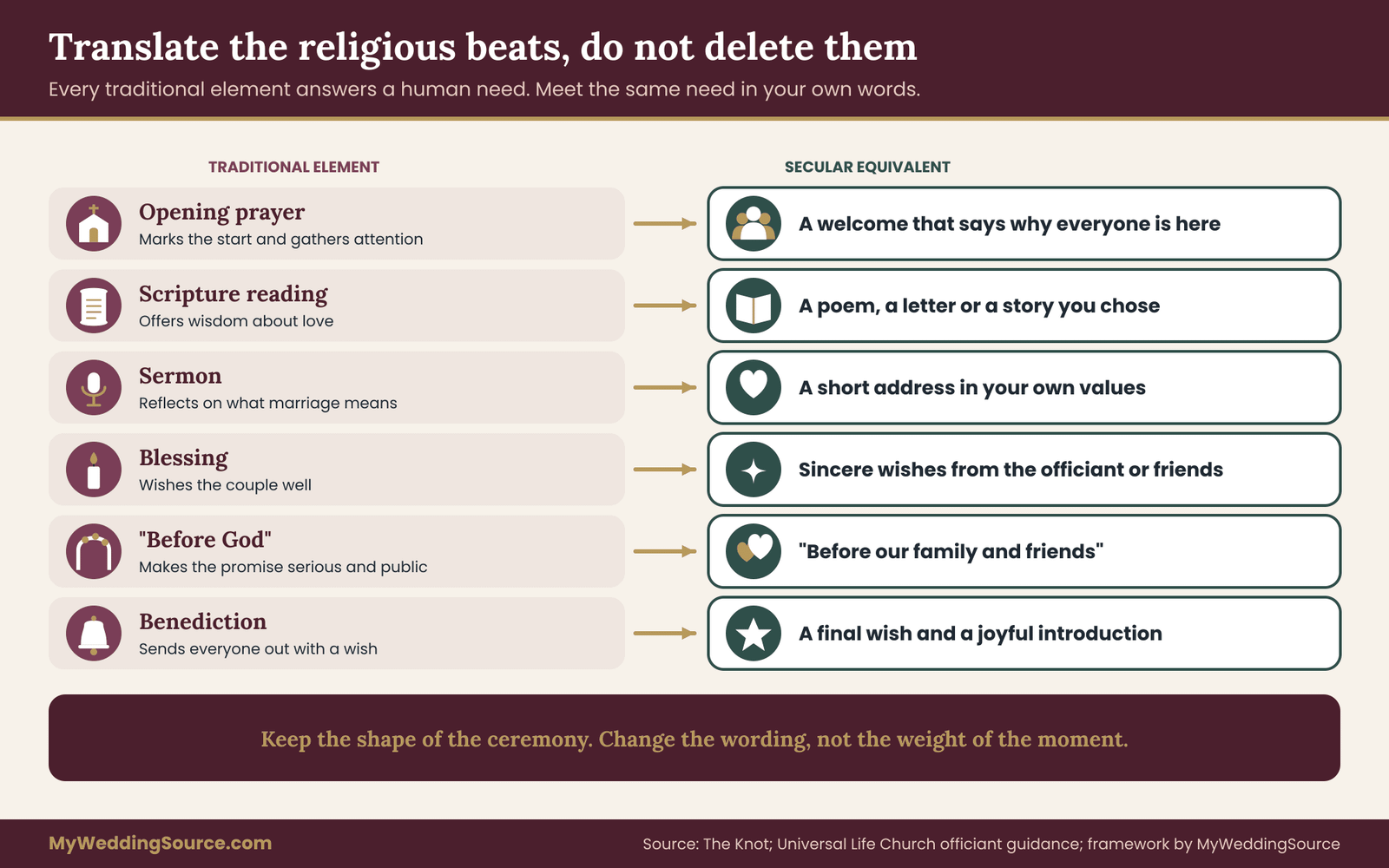
The invocation, for example, exists to mark the start and ask everyone to focus. In a non-religious ceremony, a warm welcome does the same job. The blessing exists to wish the couple well. A few sincere wishes from the officiant or from loved ones can do that. The scripture reading exists to say something wise about love, and a poem, a passage from a novel or a personal letter can say it just as well. The prayer exists to create a quiet, reflective pause. A moment of silence, a song or a brief shared breath can create it without any words at all.
The table below shows common religious elements and the secular equivalents most couples use. Use it as a quick reference when you adapt a template you found online or one a relative has offered.
| Traditional element | What it does | Secular equivalent |
|---|---|---|
| Invocation or opening prayer | Marks the start and gathers attention | A welcome that thanks guests and says why everyone is here |
| Scripture reading | Offers wisdom about love and commitment | A poem, a passage from a book, a letter or a personal story |
| Sermon or homily | Reflects on the meaning of marriage | A short address on what marriage means to this couple |
| Blessing of the rings | Gives the rings meaning | Words about what the rings represent, read by the officiant |
| “Before God” in the declaration | Makes the promise public and serious | “Before our family and friends” or “in front of everyone here” |
| “Holy matrimony” | Names the institution | “Marriage,” “this union” or “your life together” |
| Prayer for the couple | Asks for care and protection | Wishes spoken by the officiant or by close friends |
| “Who gives this woman” | Marks the transfer of care | “Who presents this couple?” or a walk down the aisle together |
| Benediction | Sends everyone out with a blessing | A final wish and an introduction of the newly married couple |
None of these swaps are required. Plenty of secular couples keep the aisle walk, the ring exchange and the kiss exactly as they are, because those moments belong to the culture of weddings and not to any single faith. The goal is not to strip the ceremony down to nothing. It is to keep what is meaningful and rewrite what is not.
The legal minimum your non-religious wedding ceremony script must keep
Before you write a word, it helps to know what the law asks of the ceremony itself. The details differ by state and country, and you should confirm them with the clerk’s office where you plan to marry. In broad terms, though, the same few pieces appear again and again in every non-religious wedding ceremony script.
A marriage license is typically required, and in most places an authorized officiant must oversee the ceremony and sign it afterward. Official guidance and wedding-industry sources agree that the declaration of intent and the pronouncement of marriage are the two spoken elements most commonly required. The declaration of intent is a short exchange in which each partner confirms that they are entering the marriage freely, usually as a question that is answered with “I do.” The pronouncement is the moment the officiant declares the couple married.
Some states require an officiant to register with the county before the wedding, and rules for who can officiate differ widely. Some places accept ordained friends and family, others require a judge, clerk or registered celebrant, and a few allow couples to marry without an officiant at all. These rules change, so do not rely on a template alone. Check your local requirements early, and read the legal checklist in our wedding officiant guide before you ask a friend to take on the role.
Everything else in your non-religious wedding ceremony script is optional in the legal sense. You can include a story, a poem, a ritual and personal vows, or you can leave them out. That freedom is the main advantage of a secular ceremony, and it is also the reason this article exists: when almost nothing is required, you need good guidance about what is worth including.
The anatomy of a non-religious wedding ceremony script, beat by beat
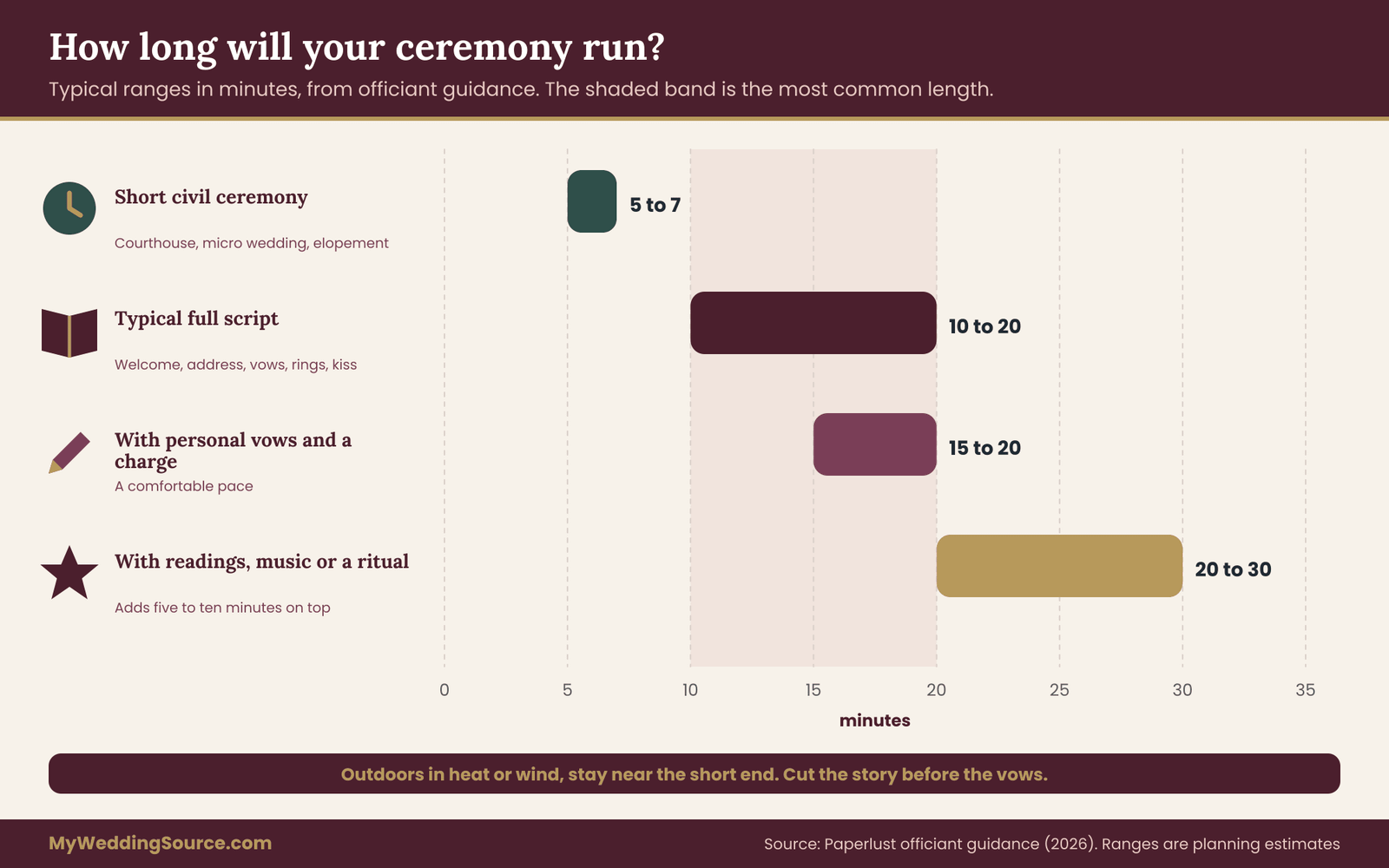
Every wedding ceremony is a sequence of moments, and a non-religious wedding ceremony script is easiest to write when you treat each moment as a separate small task. Below is the usual order, with realistic timing, what each part is for, and a few lines you can adapt. The timing is a planning guide. A full non-religious wedding ceremony script with personal vows and a ring exchange typically runs about 15 to 20 minutes at a comfortable pace, and a short civil script can be done in five to seven minutes. Adding readings, music or a unity ritual can stretch the total to 20 or 30 minutes.
The processional and the first words (about 3 to 5 minutes, including walking)
The ceremony begins before anyone speaks. Guests are seated, the officiant and the couple take their places, and music marks the shift from chatting to listening. In a secular ceremony, the processional is entirely your choice. Some couples keep the classic order, with grandparents, parents, the wedding party and then the couple. Others walk in together, or enter from opposite sides, or skip the aisle entirely. Our wedding processional order guide covers the variations for blended families and modern wedding parties.
When everyone is in place, the officiant says the first words. This is the job the invocation used to do. It should do three things quickly: welcome people, tell them why they are here and give them permission to be moved. It does not need to be long.
Good afternoon, everyone, and welcome. We are here today because two people who love each other have decided to say so in front of the people they love most. Thank you for traveling, for waiting and for being part of this.
Keep the opening under a minute and a half. If you open with a joke, make it a gentle one and make it about the couple, not about the officiant’s nerves.
A few words about the couple in a non-religious wedding ceremony script (about 2 to 3 minutes)
Religious ceremonies often skip straight from the invocation to the sermon, because the congregation already knows the structure. A secular ceremony has more room to tell the story of the couple, and guests usually enjoy it. This is where a non-religious wedding ceremony script becomes personal. The officiant can describe how you met, what made each of you notice the other, a moment when you knew, and what friends and family say about you as a pair.
Two rules keep this part from dragging. Tell one or two specific stories and not a full biography, and choose details that reveal character, such as how one partner reads maps and the other refuses to, instead of a list of dates. Specific beats general every time.
A reading or two (about 1 to 3 minutes each)
A reading gives the ceremony a second voice and a pause in the officiant’s speech. In a secular wedding it takes the place of scripture, and it can be a poem, a passage from a novel, song lyrics read as text, a letter or an original piece written by a friend. Choose something that speaks about love, partnership or commitment without religious language, and ask the reader to practice aloud. Our wedding readings guide has advice on choosing a text that does not sound generic, and a later section of this article explains how to match a reading to your tone.
Place the reading after the welcome or after the address on marriage. If you have two readings, put one on each side of the officiant’s remarks so the ceremony does not feel like a single long monologue.
The address on marriage (about 3 to 5 minutes)
This is the heart of a non-religious wedding ceremony script, and it replaces the sermon. The officiant speaks briefly about what marriage means, using the values you care about, such as honesty, curiosity, humor, kindness, patience and loyalty. A humanist address talks about the choice to commit, about the work of building a shared life and about the way a community holds a couple up.
The best addresses are short and concrete. They include one idea, one image and one piece of advice, and then they stop. A useful test is to ask whether the guests could repeat the central idea to someone after the ceremony. If they could not, the address is too long or too scattered.
The declaration of intent (about 1 minute)
This is the legally essential question, and it is worth treating as a real moment. The officiant asks each partner whether they are entering the marriage freely, and each answers aloud. The classic phrasing works well in secular ceremonies, with a small change from “before God” to “before your family and friends.”
[Name], do you come here freely to marry [Name]? Will you love them, support them and be honest with them through everything the years bring?
The response is typically “I do,” and the pause before it is often the most emotional few seconds of the whole ceremony. Do not rush it, and do not interrupt it with music. An expert quoted by The Knot calls this exchange the most critical moment of a secular script, because it is the spoken consent that makes the marriage legally real.
The vows (about 2 to 5 minutes)
The vows are the promises you make to each other. You can repeat lines after the officiant, read prepared vows from cards, say a mix of both or promise the same words together. Personal vows are common in secular ceremonies, and our wedding vows guide goes into structure, length and what to keep private. A later section in this article gives you several formats and original example lines.
The ring exchange (about 1 to 3 minutes)
Rings are not a religious object, and the exchange survives intact in almost every secular ceremony. The officiant says a line about what the rings represent, each partner places a ring and says a short promise, and the moment is over. If you do not wear rings, you can exchange another token, such as a bracelet, a coin or a handwritten note.
An optional ritual (about 2 to 5 minutes)
A ritual gives the ceremony a visible action, which is useful when there are no prayers or hymns to add movement. Sand ceremonies, tree plantings, handfasting, wine boxes and stone exchanges are the most common. A later section compares them and explains how to choose one that fits the space and the guests.
The pronouncement and the kiss (about 1 minute)
The pronouncement is the second legally essential moment. The officiant declares the couple married, often using the phrase “by the power vested in me by the State of,” followed by an invitation to kiss. You can keep that wording or use a simpler line that does not mention the state, as long as your officiant confirms that the legal language is covered somewhere in the ceremony.
The recessional (about 1 to 2 minutes)
The officiant introduces the newly married couple, the music begins and everyone follows the couple out or cheers them on. A last line from the officiant can send everyone into the celebration with energy, for example by announcing the cocktail hour.
Putting the timing of a non-religious wedding ceremony script together
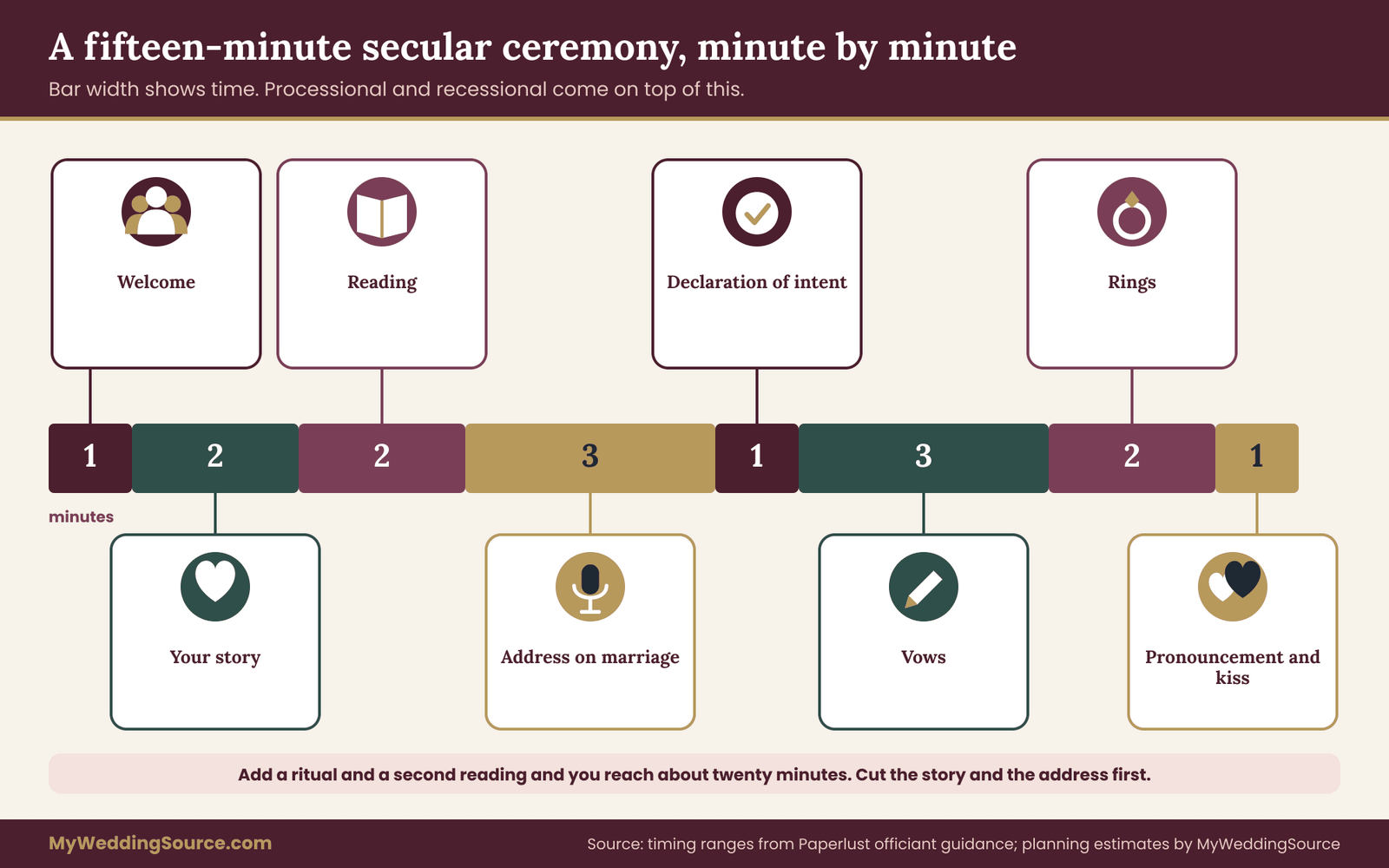
It is easy to underestimate how long each part takes, because most people picture the ceremony as a few short lines and forget the walking, the pauses and the applause. Use the plan below as a sanity check for a typical fifteen-minute secular ceremony with one reading, personal vows and a ring exchange. The processional and recessional are extra, because they depend on the size of the room.
A one-minute welcome, two minutes of story, two minutes for a reading, three minutes for the address, one minute for the declaration of intent, three minutes for vows, two minutes for the rings and one minute for the pronouncement and kiss add up to about fifteen minutes. Add a three-minute ritual and a second reading and you reach twenty or twenty-two minutes. If you want to stay under fifteen minutes, shorten the story and the address first, because those are the parts the guests will miss least.
A good rule when you build a non-religious wedding ceremony script is to write long and cut hard. Most first drafts run about a third too long, and the cuts almost always improve the result. Read the script aloud with a timer, mark where you slow down for emotion, and add those pauses to the total.
How tone changes each beat of a non-religious wedding ceremony script
The same skeleton can sound very different depending on the tone you choose, and every non-religious wedding ceremony script has one whether you pick it or not. A formal humanist ceremony uses full sentences, measured pacing and quiet music. A playful ceremony uses short lines, jokes and a quick pace. A nature-led ceremony pauses often and uses imagery of seasons, weather and landscape. The tone shapes every beat, so decide it before you write.
Here is a quick way to hear the difference. The same welcome might be delivered in three ways. A formal version says, “We have gathered to witness the marriage of two people who have chosen one another.” A warm version says, “Thank you all for being here, because you are the reason this day feels as good as it does.” A playful version says, “Welcome, everyone. Please silence your phones and prepare your tissues.”
When you read the templates later in this article, notice how each non-religious wedding ceremony script sets its tone in the first two lines and keeps it to the end. Mixing tones is fine, but switch on purpose, not by accident.

Gender-neutral and inclusive wording in a non-religious wedding ceremony script
A non-religious wedding ceremony script is also a chance to use language that works for every couple in the room. Start with neutral terms, such as “partner,” “spouse” and “the two of you,” and then add the specific terms the couple prefers. Planning guidance for officiants suggests asking about pronouns, titles, new or hyphenated surnames and any words the couple wants to avoid, and doing it before the script is drafted, not after.
A few small habits go a long way. Use “I now pronounce you married” instead of a gendered pair of nouns, unless the couple prefers the traditional words. Introduce the couple by names, or by the title they have chosen, instead of assuming a title. Avoid assumptions about who walks first, who stands where and who holds which ring. Most guests will not notice careful neutral wording, but the couple and their families will feel it.
Template one: a classic non-religious wedding ceremony script (about 15 minutes)
This template is for couples who want a ceremony that feels traditional in shape but secular in language. It keeps the familiar order, uses formal but warm wording and fits a church-style room, a garden or a hall. Replace the bracketed items with your own details, and cut freely. Everything below is original and free to adapt.
Welcome
Good afternoon, everyone, and welcome. We are here to celebrate the marriage of [Partner A] and [Partner B]. Thank you for coming, some of you from very far away, to stand with them today. Please take a breath, settle in and enjoy what is about to happen.
Words about the couple
[Partner A] and [Partner B] met in [place and year]. By their own account, one of them noticed the other first and has been unbearably smug about it ever since. What began as [a shared habit, class, mutual friend] became a friendship, and then a partnership that makes the people around them better. They have learned how to disagree kindly, how to celebrate small things and how to stay steady when life gets loud.
Reading
[Reader’s name] will now share a reading that [Partner A] and [Partner B] chose because it says what they hope for their marriage.
Address on marriage
A wedding is a single day. A marriage is everything after. It is made of ordinary mornings, shared chores, long conversations and the small decision, again and again, to choose each other. [Partner A] and [Partner B], the people here today are not only your audience. They are your community, and they will help you keep these promises. Lean on them, and let them lean on you.
Declaration of intent
[Partner A], do you come here freely to marry [Partner B]? Will you love them, support them and be honest with them through all the seasons of your life together?
[Partner A: “I do.”]
[Partner B], do you come here freely to marry [Partner A]? Will you love them, support them and be honest with them through all the seasons of your life together?
[Partner B: “I do.”]
Vows
[Partner A] and [Partner B] have written their promises to each other. [Partner A], please begin.
[Vows are read.]
Ring exchange
These rings are circles, and a circle has no end. They are a visible sign of a promise made today and kept every day after. [Partner A], please place the ring on [Partner B]’s finger and repeat after me: “I give you this ring as a sign of my love and my promise.”
[Repeat for the other partner.]
Pronouncement and kiss
[Partner A] and [Partner B], you have promised yourselves to each other in front of everyone you love. By the power vested in me by the State of [State], I now pronounce you married. You may kiss.
Introduction and recessional
Friends and family, it is my great joy to introduce, for the first time, [names as they wish to be introduced]. Please join me in celebrating them.
Notice what this non-religious wedding ceremony script leaves out: no prayer, no scripture, no mention of a deity. It still feels formal, because the sentences are complete, the pacing is slow and each moment has a clear job. If you want it warmer, add a personal story in the “Words about the couple” section. If you want it shorter, drop the reading and trim the address.
Template two: a humanist non-religious wedding ceremony script (about 20 minutes)
A humanist ceremony is built on values instead of beliefs, and it often includes more reflection than a traditional script. It suits couples who want their ceremony to say something about how they plan to live, not only whom they plan to marry.
Welcome and gathering words
Welcome, everyone. We have come together to witness something simple and remarkable: two people deciding, with their eyes open, to build a life together. No one here is required to believe anything in particular. All we ask is that you bring your attention, your kindness and your good wishes.
The couple’s story
[Partner A] and [Partner B] did not meet in a dramatic way. They met [setting], and what they remember most is [small detail]. Over time, they discovered that they shared a way of looking at the world: curious, honest, a little stubborn and generous with the people they love. Their friends say that when they are together, the room gets warmer.
First reading
[Reader] will read a short passage about love that [Partner A] and [Partner B] chose because it reflects the kind of partnership they want.
A reflection on commitment
Humans have been making promises to each other for as long as we have been telling stories. A promise is a bridge between who we are today and who we will be tomorrow. When [Partner A] and [Partner B] make their promises, they are not predicting the future. They are choosing it. They are saying: whatever comes, I will meet it with you.
Their marriage will be shaped by four ordinary things. The first is honesty, which keeps trust alive. The second is curiosity, which keeps people interesting to each other. The third is generosity, which turns daily life into care. The fourth is humor, which makes the hard parts easier to carry.
The community’s role
Every marriage is held up by a community. Today, [Partner A] and [Partner B] are surrounded by the people who have shaped them. I would like to ask all of you a question, and you may answer with a nod or a word: will you support [Partner A] and [Partner B] in the life they are about to build?
[Guests respond.]
Declaration of intent
[Partner A], do you choose to marry [Partner B], freely and joyfully? Do you promise to listen to them, stand beside them and grow with them?
[Partner A: “I do.”]
[Partner B], do you choose to marry [Partner A], freely and joyfully? Do you promise to listen to them, stand beside them and grow with them?
[Partner B: “I do.”]
Vows
[Partner A] and [Partner B] will now say their vows to each other. Please turn toward one another and hold hands.
Rings and a ritual
These rings are small, simple and strong, like the commitment they stand for. Please exchange them now.
[Partner A] and [Partner B] have chosen to plant a young [tree species] as a symbol of their marriage. Each of them will add a scoop of soil. The tree will be planted at [location] after the celebration, and we hope it will outlive all of us.
Pronouncement
You have each said yes, you have each made your promises and you have done it in front of the people who love you. By the power vested in me by the State of [State], I now pronounce you married. You may kiss.
A humanist non-religious wedding ceremony script usually reads more slowly than a traditional one, with more pauses and a little less humor. If you want a lighter version, shorten the reflection on commitment and open with a story that makes people laugh.
Template three: a short civil non-religious wedding ceremony script (about 8 minutes)
This template is for a courthouse wedding, a micro wedding, an elopement with a few witnesses or any ceremony where brevity matters. It keeps the legally important moments and adds just enough warmth to feel personal. Short civil scripts can run as brief as five to seven minutes, and this version leaves a little room for emotion.
Opening
Thank you all for being here. We are here to marry [Partner A] and [Partner B], who have chosen each other and asked us to witness it.
One idea
Marriage is a promise that grows with use. It is made on one day and kept on all the others. [Partner A] and [Partner B] have made this promise with their eyes open, and they are ready to keep it.
Declaration of intent
[Partner A], do you take [Partner B] to be your spouse, to love and respect them and to share your life with them?
[Response.]
[Partner B], do you take [Partner A] to be your spouse, to love and respect them and to share your life with them?
[Response.]
Rings
These rings are a sign of the promise you have made. Please place them on each other’s hands.
Pronouncement
By the power vested in me by the State of [State], I now pronounce you married. You may kiss.
Close
Congratulations, [names].
Most of the work in a short non-religious wedding ceremony script happens before the day, in the choice of one idea that you want people to remember. If you have time for one personal touch, add a ten-second story in the opening or a single sentence of vows before the rings.
Template four: a spiritual-but-not-religious non-religious wedding ceremony script (about 12 minutes)
Some couples want a ceremony that feels reflective and rooted in the natural world, without naming a deity or following a faith. This template uses imagery from nature, a moment of silence and a ritual that includes the guests.
Gathering
Welcome. Look around for a moment: the sky, the trees, the faces. We have come to this place on this day to witness a marriage. Let us begin with a breath. Breathe in together, and let it out slowly.
[Pause for a moment of quiet.]
The setting
[Partner A] and [Partner B] chose to marry here because [reason, such as the place where they hiked on their first trip]. They feel most like themselves outdoors, in the company of the people they love.
Reading
[Reader] will read a passage about love and nature that [Partner A] and [Partner B] have loved for years.
Reflection
The seasons change, and so do we. A good marriage is one that welcomes the weather: the bright mornings and the long winters, the steady growth and the surprising storms. [Partner A] and [Partner B], your task is not to prevent the weather, but to stand in it together.
Declaration of intent and vows
[Partner A], do you come here freely to marry [Partner B]? Do you promise to love them, honor them and walk beside them through every season?
[Response.]
[Partner B], do you come here freely to marry [Partner A]? Do you promise to love them, honor them and walk beside them through every season?
[Response.]
Ritual with the guests
I would like to invite each of you to take a small stone from the basket near you. Hold it for a moment and silently offer a wish for [Partner A] and [Partner B]. When the ceremony ends, please place your stone in the bowl by the exit. They will keep these stones as a reminder that they are held by all of you.
Rings and pronouncement
Please exchange your rings as a sign of your promise. By the power vested in me by the State of [State], I now pronounce you married. You may kiss.
The moment of quiet in this script is deliberate. It creates the pause that a prayer would have provided without asking guests to join in any belief. If you do not want a silent moment, replace it with a short instrumental piece.
Template five: a lighthearted non-religious wedding ceremony script (about 12 minutes)
Humor can be a beautiful way to welcome people into a ceremony, as long as it is kind and the serious moments remain serious. This template keeps the declaration of intent and pronouncement in a straight tone and lets the rest breathe.
Welcome
Welcome, everyone. Before we start, a few housekeeping notes. Please silence your phones. Please note the exits. And please prepare your tissues, because [Partner A] has been practicing and will absolutely cry.
The couple
[Partner A] and [Partner B] have a complete set of agreements that guide their relationship. One: the person who cooks does not clean. Two: all decisions about the thermostat are final. Three: any argument that begins hungry ends with snacks. These are the foundations of a lasting marriage, and I wish more couples would adopt them.
Reading
[Reader] will share a passage about love that is funnier than it looks and truer than it sounds.
Address
Underneath the jokes is something serious. [Partner A] and [Partner B] love each other and have decided to build a life together. They are making a promise today that will be tested by moves, jobs, illnesses, holidays and long car rides. They are ready, because they know how to laugh when things go wrong.
Declaration of intent
[Partner A], do you come here freely to marry [Partner B]? Do you promise to love them, to support them and to keep laughing with them for as long as you both shall live?
[Response.]
[Partner B], do you come here freely to marry [Partner A]? Do you promise to love them, to support them and to keep laughing with them for as long as you both shall live?
[Response.]
Vows, rings and pronouncement
Please exchange your vows and your rings. By the power vested in me by the State of [State], I now pronounce you married. You may kiss, and everyone else may cheer.
Funny ceremonies work best when one or two good jokes appear early and the rest of the script relies on warmth. If every line is a joke, the serious moments will feel hollow. If you want guidance on getting humor right in front of a crowd, our wedding speeches guide covers timing, mic technique and how to avoid jokes that land badly.
Template six: a non-religious wedding ceremony script for a mixed-belief family (about 15 minutes)
Many couples are secular themselves but love relatives who are not. This template honors both without turning the ceremony into a debate. It includes a short, optional moment for reflection that guests can use however they wish, and it gives each family a way to feel recognized.
Welcome
Welcome, everyone. We have among us people of many beliefs and people of none, and everyone here is welcome. [Partner A] and [Partner B] wanted a ceremony that every guest could share, whatever you believe, because what we all share today is love for these two people.
Honoring family
[Partner A] and [Partner B] would like to thank their parents, [names], who taught them what a marriage can look like. They also want to honor the traditions that shaped them, including [tradition one] and [tradition two]. Those traditions live in their families, and they are part of the story this ceremony continues.
A moment of reflection
I invite everyone to take a moment to reflect on the couple, in whatever way is meaningful to you. Some of you may wish to pray, some may wish to meditate and some may simply wish to wish them well. Take a breath, and when you are ready, look up.
[Pause for about thirty seconds.]
Declaration of intent
[Partner A], do you come here freely to marry [Partner B]? Do you promise to love them, to be honest with them and to build a life with them?
[Response.]
[Partner B], do you come here freely to marry [Partner A]? Do you promise to love them, to be honest with them and to build a life with them?
[Response.]
Vows and rings
Now [Partner A] and [Partner B] will make their promises to each other and exchange their rings.
Pronouncement
By the power vested in me by the State of [State], I now pronounce you married. You may kiss.
The moment of reflection in this script is optional, and it is the key to the whole design. It gives religious relatives room to pray quietly while giving everyone else room to think, and it asks nothing of anyone who would rather stay still. Because no one is asked to say or sign anything, you do not have to negotiate who prays or to whom.
Mix and match: swap-in lines for any non-religious wedding ceremony script
A non-religious wedding ceremony script is most useful when you can pull pieces from one template to another. Here are interchangeable lines grouped by purpose. Use them as they are or rewrite them in your own voice.
Alternative welcomes
We are here today to celebrate the marriage of two people who make each other better, and to wish them well.
Welcome. In a moment, [Partner A] and [Partner B] will make promises to each other. Our job is to listen, to cheer and to remember.
Alternative bridges into the vows
[Partner A] and [Partner B], you have chosen to say your promises out loud. Please turn toward each other and speak from the heart.
The words you are about to say are old and new at the same time. Say them as if no one else were in the room.
Alternative closings before the kiss
You have said yes in front of everyone you love. May you say it again every day.
May your home be full of laughter, your table full of friends and your years together long.
Alternative closings for the recessional
Please stand and join me in celebrating [names], who are now married. Cocktails await.
Go and enjoy your first moments as a married couple. We will join you shortly.
You can also borrow structure from one template and wording from another. A short civil ceremony with the community question from the humanist script, for example, feels warmer than a bare bones version and adds under a minute. A traditional script with the stone ritual from the nature-led template gains a memorable moment with almost no extra writing. Treat these scripts as a kit, not as a choice of one.
Writing vows for a non-religious wedding ceremony script
Vows are where a secular ceremony most often shines, because there is no required text and no set of formal promises to repeat. That freedom can be a gift or a trap. Without a form to follow, many couples write something that is either too long, too vague or too private for a room full of relatives. A few simple structures remove most of that risk.
Four formats that work
Repeat-after-me vows. The officiant says a short line, and each partner repeats it. This is the easiest option, it removes the fear of forgetting words and it still feels intimate. A typical set might be: “I choose you. I will listen to you. I will tell you the truth. I will stay beside you when it is hard, and celebrate with you when it is good.”
Matching vows. Both partners agree on one set of promises and say the same words, either together or in turn. This format is tidy, it avoids comparison and it fits couples who would rather not compete over whose vows are more moving.
Personal vows, read aloud. Each partner writes their own promises and reads them from a card. This is the most personal choice and the most work. Aim for 60 to 120 words each, about 30 to 60 seconds aloud, and agree on a rough length so that one set does not run far longer than the other.
A hybrid. Partners exchange short repeated vows and then add one or two personal sentences. It gives you a safety net and a moment of your own, and it works well for people who dislike public speaking.
A simple structure for personal vows
A reliable shape for personal vows has four parts. Start with a short address, such as the partner’s name or a nickname only you use. Add one specific memory or quality that shows why you chose them. Then make two or three concrete promises, such as to tell the truth, to share the load or to keep saying thank you. Finish with a closing line that returns to the present moment.
Here is an original example that follows that shape.
[Name], from the first week I knew you, I felt more like myself. You taught me that it is possible to be serious and silly in the same hour. Today I promise to listen before I answer, to share the work of our life and to say the hard things kindly. I promise to keep learning you, and to let you learn me. I choose you today, and I will keep choosing you.
That version runs about sixty words, and it could be read in under half a minute. If you add one more memory, it is still short enough for a ceremony.
What to keep out of the vows
A few topics reliably backfire in public. Skip private jokes that only the two of you understand, because the room will not laugh. Skip references to exes or past mistakes. Skip long lists of promises, because after four or five they lose their weight. And skip anything you would be embarrassed to hear read aloud at the reception, since cameras, phones and microphones will carry it further than you expect. Our wedding vows guide covers privacy, length and tone in more detail.
If one of you dislikes public speaking
It is common for one partner to love the idea of vows and the other to dread them. A non-religious wedding ceremony script can solve this kindly. Let the more nervous partner use repeat-after-me vows, or share vows privately in a letter that is read earlier that day, or exchange vows in a quiet moment before the ceremony and keep the public version short. A short line said with feeling does more than a long speech read in a trembling voice.
Ring exchange wording for a non-religious wedding ceremony script
The ring exchange is mostly secular already, and the usual words need little change. The classic line, “With this ring, I thee wed,” works in any ceremony, though some couples prefer a more modern phrase. Here are options in a range of tones.
I give you this ring as a sign of my love and my promise.
Wear this ring as a reminder that you are loved, today and every day.
With this ring, I choose you, and I promise to keep choosing you.
For an officiant’s words about the rings, try something short and concrete. A circle has no beginning and no end, so a ring can represent a promise that does not stop. Metal that is shaped, tested and polished is a good image for a marriage that is built, not found. And an object worn every day is a good image for a commitment that is lived, not performed. Pick one idea, say it in two sentences and move on.
If you do not wear rings, the exchange can be a different token. Some couples give each other a bracelet, a watch, a small carved object or a letter. Others skip the exchange and place their hands together while the officiant describes what the gesture means. Anything that works as a clear, visible moment will do.
Choosing readings for a non-religious wedding ceremony script
Readings fill the space that scripture usually occupies, and every non-religious wedding ceremony script benefits from at least one, and they are one of the easiest ways to add depth to a secular ceremony. The key is to choose something that fits your tone and your guests, and to give it a reader who can deliver it well.
Where to look
Poems are the obvious choice, and love poems from many centuries and cultures can work well. Passages from novels, children’s books, essays, speeches, letters, song lyrics read as text and even recipes or instruction manuals read with a straight face can be moving, funny or both. A personal piece, such as a letter from a parent or a short passage written by a close friend, often lands harder than anything published.
Avoid text with a religious tone or basis if you want the ceremony to stay secular. Officiant guidance for non-religious scripts makes the same point, and it is easy to overlook when a lovely poem includes a line about a deity in the final stanza. Read the full text, not only the excerpt, before you commit.
Mind copyright as well. Poems and books published in the last century are often still under copyright. Reading a short excerpt aloud at a private ceremony is generally low risk, but printing a full text in a program or posting a recording online can raise questions. If you want to print a reading, choose a work in the public domain or ask the rights holder, and when in doubt, print only the title and author.
Match the reading to the tone
A formal humanist ceremony pairs well with a reflective poem or an essay about commitment. A playful ceremony can handle a funny passage from a children’s book or a comic list. A nature-led ceremony suits a poem about seasons, landscapes or the sea. A short civil ceremony may only have room for a single paragraph.
Our wedding readings guide walks through how to pick a text that fits without sounding generic, with advice on length, reader choice and what to do when two relatives both want to read.
Choose the right reader
A reader does not need to be a performer. They need to be calm, clear and willing to practice. Ask them to read the text aloud at least twice, to mark where to pause and to hold the page low enough that their voice carries. Give them a printed copy, because phones are awkward on a stage and screens can freeze. If you have a sound system, let them test the microphone.
Unity rituals for a non-religious wedding ceremony script, without prayer
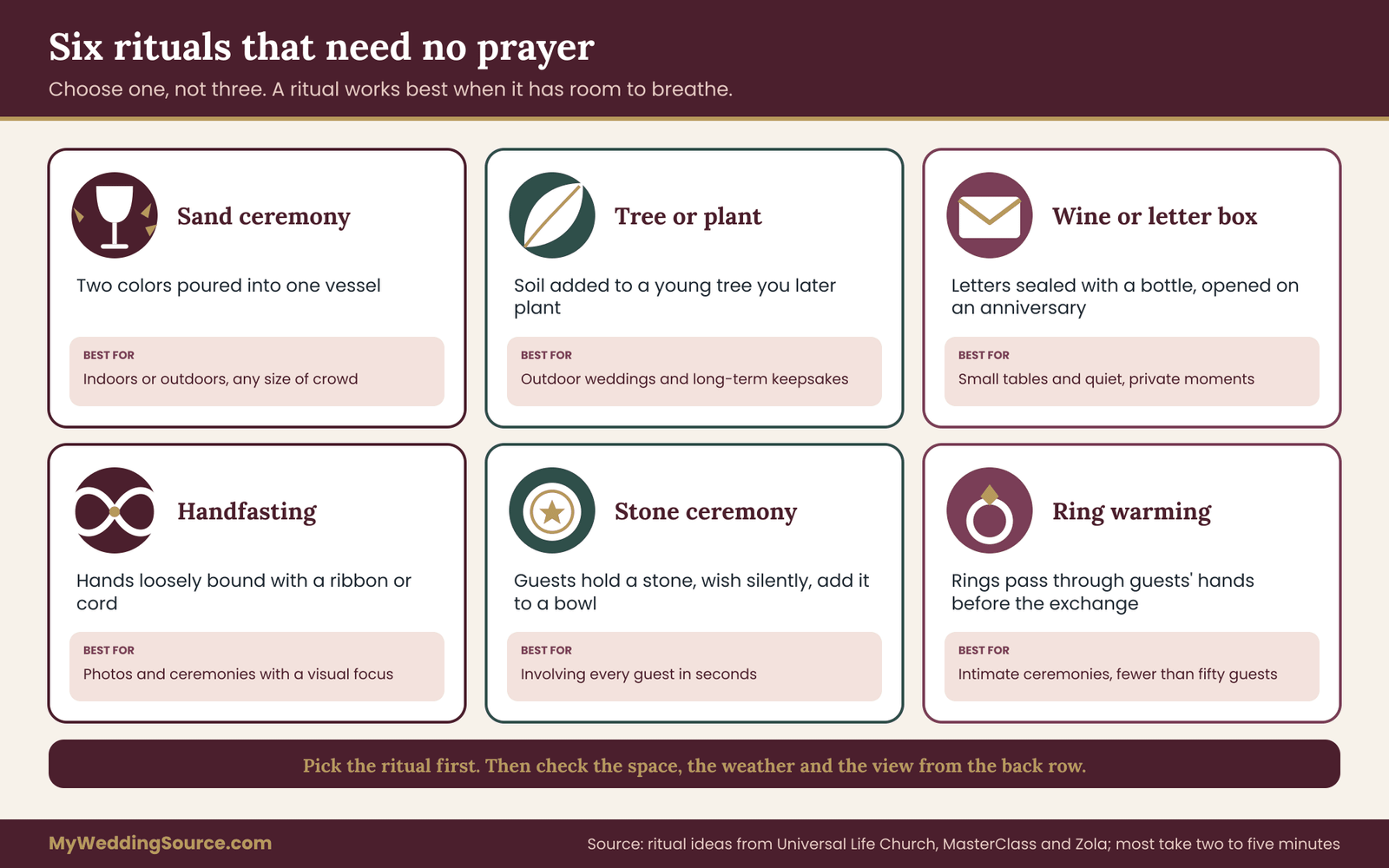
A ritual gives guests something to watch and gives the couple something to do with their hands. In a religious service, the sacraments and hymns do this work. In a non-religious wedding ceremony script, a well-chosen ritual can add the same sense of weight without any faith content. Choose one, not three, because a ritual works best when it has room to breathe.
Sand ceremony. Each partner pours sand of a different color into a single vessel. The mixed layers cannot be separated, which is the point. It suits indoor or outdoor ceremonies and takes two to three minutes. Practice the pour, because the first attempt often spills.
Tree or plant ceremony. The couple adds soil to a young tree or a potted plant, which they later plant at home. It is meaningful, it lasts and it works well outdoors. Check that the species suits your climate and that you can transport the pot after the reception.
Wine or letter box. The couple writes each other letters, seals them in a box with a bottle of wine, and agrees to open the box on an anniversary or in a hard moment. It is quiet, personal and easy to stage on a small table.
Handfasting or ribbon binding. The officiant loosely wraps the couple’s joined hands with a cord or ribbon while describing the promises they have made. It looks beautiful, it works in photographs and it can be done with ribbons in your wedding colors. If you choose it, tell guests that it is a symbolic gesture and agree with your officiant on what the cords represent.
Stone ceremony. Guests or the couple hold a small stone, silently offer a wish and place it in a bowl or a jar. The stones become a keepsake. It involves everyone and takes very little time.
Ring warming. The rings are passed through the guests’ hands before the exchange, with each person wishing the couple well. It is a lovely way to include a small crowd and is best for ceremonies under fifty guests.
How to choose a ritual
Ask three questions. Does the ritual fit the space and the weather? Does it involve the guests, or only the couple, and which do you prefer? And does it have a visible, simple action, so that guests who are far from the aisle can see what is happening? A ritual that cannot be seen from the back row is a ritual only for the front row.
Then decide where it goes. Rituals are usually placed after the welcome, after the vows or just before the pronouncement. Placing it after the vows lets it reinforce the promises, while placing it after the welcome lets it set a warm tone early. Whatever you choose, tell the officiant exactly what will happen and rehearse once with the real objects.
Music and silence in a non-religious wedding ceremony script
Without hymns, a non-religious wedding ceremony script depends on music and on silence to shape the mood. Instrumental pieces work well for the processional, the recessional and the background of a ritual. Vocals can be lovely for a reading or a moment of reflection, but lyrics that carry religious references can cut against the tone you are building, so listen to the whole song, not only the chorus.
Silence is a tool in its own right. A thirty-second pause before the declaration of intent, or after a reading, lets emotion settle in a way that no music can. Tell your officiant that you want those pauses, and ask them to count slowly in their head so that the moments do not get hurried. If silence feels uncomfortable, fill it with a single sustained instrument, such as a cello or a guitar, instead of a full song.
A practical tip: give your music person a printed copy of the run sheet, with cues marked in the margins. Most timing mistakes at ceremonies come from a missed cue, not from the script.
How to write your own non-religious wedding ceremony script, step by step
The templates above will get you most of the way, but a script that you shape yourselves is the one people remember. This process works whether you have three months or three weeks. It assumes that you and your partner will do the writing, with your officiant as an editor and voice. If your officiant is a professional celebrant, they may do the drafting and ask you to approve it, and these steps still tell you what to tell them.
Step one: agree on what you believe and what you do not
Start with a short conversation, not a document. What do each of you believe about marriage? Is there anything you want the ceremony to avoid, such as religious language, gendered words or jokes about the institution? Is there anything you want it to include, such as a nod to a grandparent’s faith or a moment of quiet? The Knot’s advice for secular scripts includes clarifying what you and your partner believe, since a non-religious ceremony may still be spiritual. Ten minutes of honest talk now saves hours of rewriting later.
Step two: pick a tone and a length
Choose one of the tones from the templates, such as classic, humanist, nature-led, playful or minimal, and agree on a target length. Fifteen minutes is a good default. If you cannot decide, pick the tone that best matches your wedding invitations. A formal invitation suggests a formal ceremony, and a hand-lettered one suggests something looser.
Step three: collect raw material
Spend a week gathering material. Write down three stories about how you met and grew together. Collect five qualities you admire in each other. List the promises you want to make. Find three readings that appeal. Ask a few close friends and relatives for one sentence about each of you. You will use perhaps a fifth of this, and the rest will make the chosen parts richer.
Step four: draft each beat of the non-religious wedding ceremony script in order
Work through the beats in the same order as the ceremony. Write the welcome first, because it sets the tone for everything else. Then write the story, the address, the declaration of intent, the vows and the ring exchange. Keep each draft short, since you can always add. Resist the urge to polish before you have a complete draft. A rough version of every part is more useful than one beautiful paragraph and nothing else.
Step five: add the legal language
Check the clerk’s office or an official source for the required language in your state. Make sure the declaration of intent and pronouncement are present and phrased in a way your officiant has confirmed. Add the signing of the license to your run sheet, with the names of the witnesses if your state requires them.
Step six: read your non-religious wedding ceremony script aloud and time it
Read the full script aloud with a timer, at the pace you would use in front of people. Mark spots where you stumble, because those are the sentences to rewrite. Cut anything that sounds like a greeting card. Cut a third of the story if the total runs long. Keep the lines that make you smile or tear up, because those are the ones the guests will remember.
Step seven: test your non-religious wedding ceremony script with one outside reader
Give the draft of your non-religious wedding ceremony script to someone who is not close to the planning, such as a friend who will tell you the truth. Ask what they remember, what felt long and whether anything sounded false. If you have relatives of different beliefs, ask one of them to read it and tell you whether any line would make them uncomfortable. A short outside read is the cheapest way to catch a line that does not land.
Working with your officiant on a non-religious wedding ceremony script
A non-religious wedding ceremony script is only as good as the person who delivers it. Your officiant sets the pace, handles surprises and makes the guests feel looked after, so choose them with care. Our wedding officiant guide covers how to choose one, what to ask and what to verify legally. Here are the points that matter most for a secular ceremony.
A friend or family member. An ordained friend can make the ceremony feel intimate, and officiant guidance notes that secular language is the style most often requested for ceremonies led by ordained friends and relatives. The risks are nerves and legal paperwork. Confirm that your state accepts the ordination, that the officiant has registered if required and that they have practiced.
A professional celebrant. A celebrant writes and delivers ceremonies for a living. They bring structure, timing and calm, and they can write much of the script after an interview with you. This is a good choice when you want a polished humanist ceremony and do not want to write much.
A judge or clerk. A civil official will usually deliver a short standard script. You may be able to add a reading, personal vows or a few sentences of your own. Ask what customization is allowed before you book.
What to give your officiant. Share the full draft at least two weeks before the wedding, along with a list of names and pronunciations, the music cues and any special instructions about humor, pauses or readers. Ask them to rehearse aloud at least twice, print the script in large type, and mark the pauses. A little preparation turns a decent script into a calm, confident delivery.
Handling relatives who expect more than a non-religious wedding ceremony script offers
For many couples, the hardest part of a non-religious wedding is not the script. It is the conversation with a parent or grandparent who hoped for a service with a blessing. These conversations are usually about love and fear, not about the ceremony itself. The relative may worry that the marriage will lack depth, or that the family tradition will end with you. Meeting that worry with warmth is more effective than defending your choice.
Start by telling them early and in person. Explain what you are including, not just what you are leaving out. Mention the readings, the personal vows, the ritual and the people who will take part. If a relative would value a prayer or blessing, offer a way to include it outside the ceremony, such as a family blessing at the rehearsal dinner, a toast with a prayer, or a private moment before the wedding. Keep the non-religious wedding ceremony script itself consistent with your beliefs.
If you want to honor a tradition without making it central, add a short mention in the script. A line such as “We also honor the faith that shaped [family member] and brought [Partner A] to this day” costs nothing, includes the relative and does not require the rest of the room to believe. Template six earlier in this article is built around that approach, including a short moment of reflection that guests can use as they wish.
If someone refuses to attend, that is a hard moment, and no script will fix it. Give them time, keep the invitation open and do not make the ceremony an argument. Over the years, most people find their way back.
For guests who are simply curious, a short note in the program can help. A line such as “This ceremony is non-religious and will last about fifteen minutes” tells people what to expect and prevents confusion about when to stand or bow. Our wedding programs guide explains what to include and what to skip.
How long should a non-religious wedding ceremony script be?
Length is a creative decision and a practical one. The ceremony is the shortest part of the day, and guests tend to remember it by how it felt, not how long it lasted. Source guidance gives a useful range. A full script with personal vows, a ring exchange and a short address runs about 10 to 20 minutes, a short civil ceremony takes about five to seven, and adding readings, music or a unity ritual adds five to ten minutes, for a total of about 20 to 30 minutes.
Match the length to the setting. Outdoors in the heat, in the cold or on a windy hillside, keep it short, because guests are uncomfortable and the sound is poor. Indoors in a comfortable room, you can stretch to twenty minutes. For a micro wedding with a dozen guests, a longer, more personal ceremony may feel natural. For a large wedding with a long program afterward, keep the ceremony tight so that guests have energy for the party.
A helpful test is the “wiggle check.” Imagine the wedding as a guest and ask yourself at what point you would start to shift in your seat. Everyone’s limit differs, but if you would fidget, your guests probably will too. If your non-religious wedding ceremony script runs past that point, cut the story or the address, not the vows.
Delivering a non-religious wedding ceremony script on the day
A non-religious wedding ceremony script is only half the work. The other half is how it is delivered, and a few habits make a large difference.
Rehearse out loud, with the real people. Run through the ceremony once, ideally in the space, with the officiant, the readers and the couple. Check the microphone, practice the pauses and make sure the readers know where to stand.
Print it large. The officiant should have the script in at least sixteen-point type, in a folder or on cards, with pauses marked. Phones glare, run out of battery and sometimes ring.
Slow down. Nerves speed everyone up. Remind the officiant and the readers to breathe between sentences, and to pause for a beat after the declaration of intent and the pronouncement.
Plan for the microphone. A soft-spoken reader will vanish in an open space without amplification. Test the sound before guests arrive and give readers a short lesson in how close to hold the microphone.
Assign a cue person. Someone, ideally the coordinator or a friend, should hold the run sheet and cue the music, the readers and the ritual items. When the officiant is not also managing logistics, the whole ceremony flows better.
Three worked examples of a non-religious wedding ceremony script
These short examples show how couples use the pieces of a non-religious wedding ceremony script differently. They are composites, not case studies of real couples.
A courthouse wedding with a personal touch. Maya and Daniel marry at city hall on a Friday morning with eight guests. The clerk delivers the standard script, and the couple asks to add two things: a one-minute reading by Maya’s sister and a short set of repeat-after-me vows. The ceremony lasts about nine minutes, and they host a lunch afterward. They keep the legal language exactly as the clerk provides it and add the personal touches around it.
A backyard wedding with a friend as officiant. Priya and Sam marry at home in front of sixty guests, with Priya’s brother serving as the ordained officiant. They choose Template one, shorten the address and add a stone ritual in which guests place a pebble in a jar. Her brother practices three times, prints the script in large type and keeps a copy for the couple. The ceremony takes seventeen minutes.
A blended-family ceremony with a quiet moment. Elena and Jordan each have relatives who are deeply religious and friends who are not. They use Template six, including a short honoring of both families and a thirty-second moment of reflection. A grandmother prays silently, a few friends smile and the ceremony moves on without incident. Afterward, the grandmother says it was the most inclusive wedding she had attended.
Common mistakes in a non-religious wedding ceremony script
A few errors show up again and again in secular ceremonies. Most are easy to prevent if you know about them.
- Treating a non-religious wedding ceremony script as “no structure.” Without a clear order, ceremonies drift. Even a short script needs a beginning, a middle and an end.
- Writing for yourselves and forgetting the guests. Inside jokes and long stories can leave most of the room behind. Add enough context that a stranger could follow.
- Overlooking the legal language. A beautiful script that skips the declaration of intent can cause trouble with the paperwork. Confirm the requirements before you finalize the script.
- Letting the ceremony run too long. More is not better. Cut early and cut hard.
- Choosing readings you have not read in full. A single religious line at the end of a poem can undermine the tone you built.
- Skipping the rehearsal. A ceremony that has never been spoken aloud is a ceremony that will surprise everyone.
- Forgetting the quiet moments. Pauses are part of the script. Mark them, and trust them.
- Ignoring the people who matter most. A short, sincere thank-you to parents and grandparents can heal many worries.
FAQ
What is a non-religious wedding ceremony script?
It is the written plan for a wedding ceremony that contains no prayer, scripture or religious ritual. It follows the same basic order as any ceremony, with a welcome, readings, vows, rings and a pronouncement, but it uses secular language and often adds personal stories and values-based reflections. It is legally valid as long as the legal elements, such as the declaration of intent and the pronouncement, are included and the officiant is authorized.
What parts of a non-religious wedding ceremony script are legally required?
Requirements vary by location, so check with the local clerk. In most places the declaration of intent, in which each partner confirms they are marrying freely, and the pronouncement by an authorized officiant are the spoken parts that matter. A signed marriage license is also needed. Everything else, including readings, vows, rituals and music, is optional.
How long should a non-religious wedding ceremony script be?
A typical script runs about 10 to 20 minutes. A short civil ceremony can take as little as five to seven minutes, and adding readings, music or a unity ritual can bring the total to 20 or 30 minutes. Choose the length that fits your guests, your venue and the weather, and read the script aloud with a timer before you finalize it.
Can a friend officiate a non-religious ceremony?
In many places, yes, if the friend is authorized under local law, which may mean ordination through an online ministry and, in some places, registration with the county. Rules differ widely, and some jurisdictions do not accept online ordination. Check with the clerk’s office early, and give your friend the script at least two weeks before the wedding so that they can practice.
What can replace a prayer in a non-religious wedding ceremony script?
A moment of silence, a short instrumental piece, a reading about love or a set of wishes spoken by the officiant can all serve the same purpose. Many couples use a brief moment of reflection that guests can fill however they like, which includes religious relatives without requiring anyone to join.
How do I include family traditions in a non-religious wedding ceremony script?
Add a short line in the script that honors the tradition, invite a relative to read a non-religious passage or incorporate a cultural ritual that carries meaning without faith content. You can also hold a family blessing at the rehearsal dinner or before the ceremony. The goal is to recognize the people and the history, without asking the room to share a belief.
Should we write our own vows in a non-religious wedding ceremony script?
Only if you want to. Personal vows can be very moving, but they take time and some people find them stressful. Repeat-after-me vows or matching vows are easier and still feel sincere. A hybrid, with a short repeated vow followed by one or two personal sentences, offers a good balance.
Where can I find non-religious readings for a wedding ceremony script?
Look to poems, novels, essays, letters, song lyrics and children’s books. Choose something that speaks about love, partnership or commitment and read the full text to make sure it has no religious references. If you plan to print a reading in your program, pick a public domain work or check the copyright. For more ideas, see our guide to wedding readings.
Your next steps
- Decide your label and your tone. Choose secular, humanist, civil or spiritual-but-not-religious, and pick one of the six templates as a starting point.
- Confirm the legal basics. Call the clerk’s office about the license, the officiant and the required wording.
- Choose your officiant. Decide between a friend, a celebrant or a civil official, and send them the draft at least two weeks ahead.
- Write the beats in order. Draft the welcome, story, address, declaration of intent, vows and rings, and keep each part short.
- Pick one reading and one ritual. Read the full text of the reading and rehearse the ritual with the real objects.
- Read it aloud and time it. Cut a third of the first draft and mark the pauses.
- Rehearse once in the space. Include the officiant, the readers and the music cues.
For the wider mechanics of a ceremony script, see our wedding ceremony script guide, and for the full order and timing of the day, our wedding ceremony guide is a good next stop. If you are planning the rest of your timeline, our wedding planning timeline helps you place the ceremony and every other deadline.
Sources
This guide draws on published wedding-industry and officiant guidance. Legal requirements differ by state and country, so confirm yours with the local clerk before you finalize a ceremony. All scripts and examples are original.
- The Knot: Secular and Nondenominational Wedding Ceremony Scripts – definition, legal basics, order of a secular script and tips for writing.
- Universal Life Church: Non-Religious Wedding Ceremony Script – required elements, rituals, music and gender-neutral drafting.
- Paperlust: Wedding Officiant Script Examples – ceremony lengths, legal notes and officiant delivery tips.
- Paperlust: Order of Service for a Wedding – standard order, timings and where unity rituals fit.
- Zola: A Guide to the Wedding Ceremony Order of Events – ceremony structure and cultural variations.
- Joy: Wedding Ceremony Order of Events – order of events and unity ceremony options.
- Joy: Wedding Ceremony Script – declaration of intent and pronouncement.
- MasterClass: Wedding Ceremony Outline – ceremony outline and unity rituals in nonreligious weddings.
- Offbeat Wed: Non-Religious Wedding Ceremony Script – a couple’s own secular script with music and readings.
- Offbeat Wed: Wedding Ceremony Order and Ritual Structure – ordering ceremony elements and placing unity rituals.
- Yeah Weddings: Secular Wedding Ceremony Script Ideas – vow, reading and ring ideas for non-religious ceremonies.
- Minted: A Sample Wedding Ceremony – a traditional secular order of events.
- The Monastery: Secular Wedding Ceremony Script – guidance on non-religious scripts that include guests of different beliefs.