
A wedding guest list is the first real decision of your planning, because the number of names on it quietly sets your venue, your budget, your tone and, more often than anyone admits, the temperature of your family group chat.
Quick answer
Build your wedding guest list in this order. First fix the three hard limits (venue capacity, per-guest budget and who is contributing). Then write a no-filter wish list, sort it into priority tiers, apply one consistent rule for plus-ones and children, and send invitations in rounds only if you have a plan for the second round.
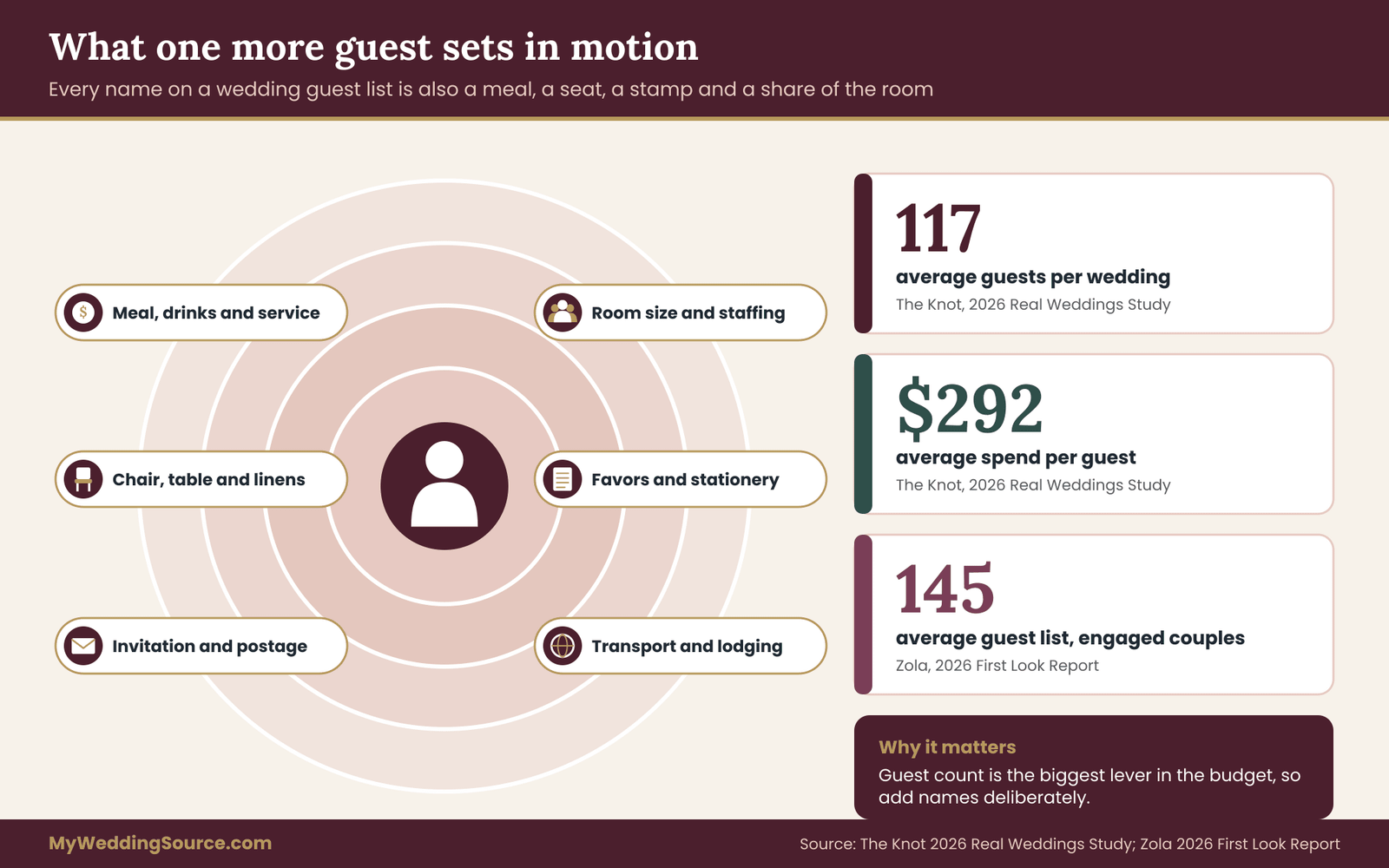
Expect roughly 15 to 20 percent of invited guests to decline, more if many people must travel. The Knot’s 2026 Real Weddings Study put the average guest count at 117 and the average spend at $292 per guest, so every name you add or remove is a real budget decision, not just a social one.
If you are reading this, there is a good chance you have a half-finished spreadsheet, a few names you are unsure about and at least one relative who has already asked whether their new boyfriend is invited. That is normal. The guest list is the part of planning where logistics and feelings collide, and most of the stress comes from making decisions in the wrong order. This guide gives you the right order, the reasoning behind each step, the exact wording for the awkward conversations and a set of worked examples you can copy.
It is written for couples planning a wedding in the United States, so the money figures use U.S. data, but the method works anywhere. If you want the shorter, problem-focused companion piece, our look at real wedding guest list problems covers the situations that go wrong most often. This article is the full process from the first blank page to the final headcount you give your caterer.
What a wedding guest list actually decides
It is tempting to treat the guest list as a courtesy list: who do we want there? In practice it is a planning document that drives nearly every other choice. Before you write a single name, it helps to see how many decisions hang on it.
Venue and layout. Every venue has a capacity, and that capacity depends on how you use the room. A ballroom that holds 200 people in a theater-style ceremony holds far fewer at round tables with a dance floor. Fire codes, aisle widths and the need for a buffet line or bar all reduce the number. Our guide to wedding venue capacity explains how to read those numbers, and it is worth reading before you fall in love with a space that cannot hold your wedding guest list.
Budget. The Knot’s 2026 Real Weddings Study, which surveyed couples married in 2025, reported an average of about $292 spent per guest and an average guest count of 117. Zola’s 2026 First Look Report puts the average guest list a little higher, at around 145 people, and the average total cost at $36,000. Different surveys sample different couples, so treat all of these as benchmarks rather than targets. The consistent message across every dataset is that guest count is the biggest single lever in a wedding budget, because catering, bar service, rentals, stationery, favors, transportation and sometimes the venue fee all scale with it.
Atmosphere. Forty people at a long table feel different from 160 people on a dance floor. Neither is better, but your wedding guest list should match the experience you want. A couple who dreams of a quiet dinner with real conversation will be unhappy with a 200-person list, however generous it feels.
Relationships. Who is invited, and who is not, becomes part of how your families and friend groups remember your wedding. This is the part no spreadsheet captures, and it is the reason this article spends so much time on scripts, rules and conversations.
Timeline. You cannot book a venue with confidence, send a save-the-date or choose a caterer without at least an estimated headcount. Delaying the wedding guest list does not make it easier. It simply pushes the hard decisions into a period when deposits are already paid.
The honest reason a wedding guest list gets out of control
A wedding guest list rarely balloons because couples are careless. They grow because each individual addition looks small. One coworker, one cousin, one old roommate, one plus-one. Each name costs, on average, a few hundred dollars, but no single name feels like a budget decision. Then the total arrives. The fix is not willpower. It is a process that makes every addition visible before it happens, which is exactly what the steps below do.
Fix the three hard limits before you write a single name
Most guides start with a brainstorm. Start instead with limits, because a list built without limits always has to be cut later, and cutting is far more painful than building to a boundary.
Limit one: venue capacity
If you have a venue, ask for the maximum capacity for your actual layout: ceremony seating, dinner seating with dance floor, and any cocktail hour space. Ask for the number in writing. If you do not have a venue yet, decide on a rough ceiling and shop for venues that fit it. Our wedding venues guide walks through how to compare spaces, and the wedding venue questions article lists what to ask on a tour.
A small trick that prevents a painful surprise: ask the venue whether capacity is the number of seats or the number of people. Some venues count staff, the band and the photographer. Others do not. The difference can be ten to fifteen spots.
Limit two: a per-guest budget
Take the portion of your budget that scales with headcount and divide it by a number of guests. Those costs normally include food, drinks, rentals, invitations and postage, favors, and any guest transportation or welcome bags. They do not include fixed costs such as the photographer, the officiant or your attire. If you want a deeper look at how the pieces fit together, our wedding cost per guest breakdown and the average wedding cost overview show typical figures category by category.
Here is a simple way to do the math, using a worked example that is ours, not survey data:
- Total wedding budget: $30,000
- Fixed costs that do not change with guest count (photography, music, flowers, attire, officiant and similar): $13,000
- Money left for guest-dependent costs: $17,000
- Estimated guest-dependent cost per head at your venue and menu: $170
- Comfortable guest count: 17,000 divided by 170, which is 100 guests
That is the number to build toward. It is a ceiling, not a goal. If it feels too small, you now have a clear choice: raise the budget, lower the per-guest cost by simplifying the menu or bar, or accept a shorter list. All three are legitimate, and none is a failure.
Limit three: who is contributing, and what they expect
Money and invitations are linked in most families, spoken or not. If parents or relatives are contributing, find out early whether their contribution comes with an expectation about guests. Many families give generously with no strings. Others quietly expect that a large gift means a say in the wedding guest list. You do not need to refuse help to protect your wedding guest list, but you do need to know what you are agreeing to. We cover that conversation in the next section.
Cost-range note
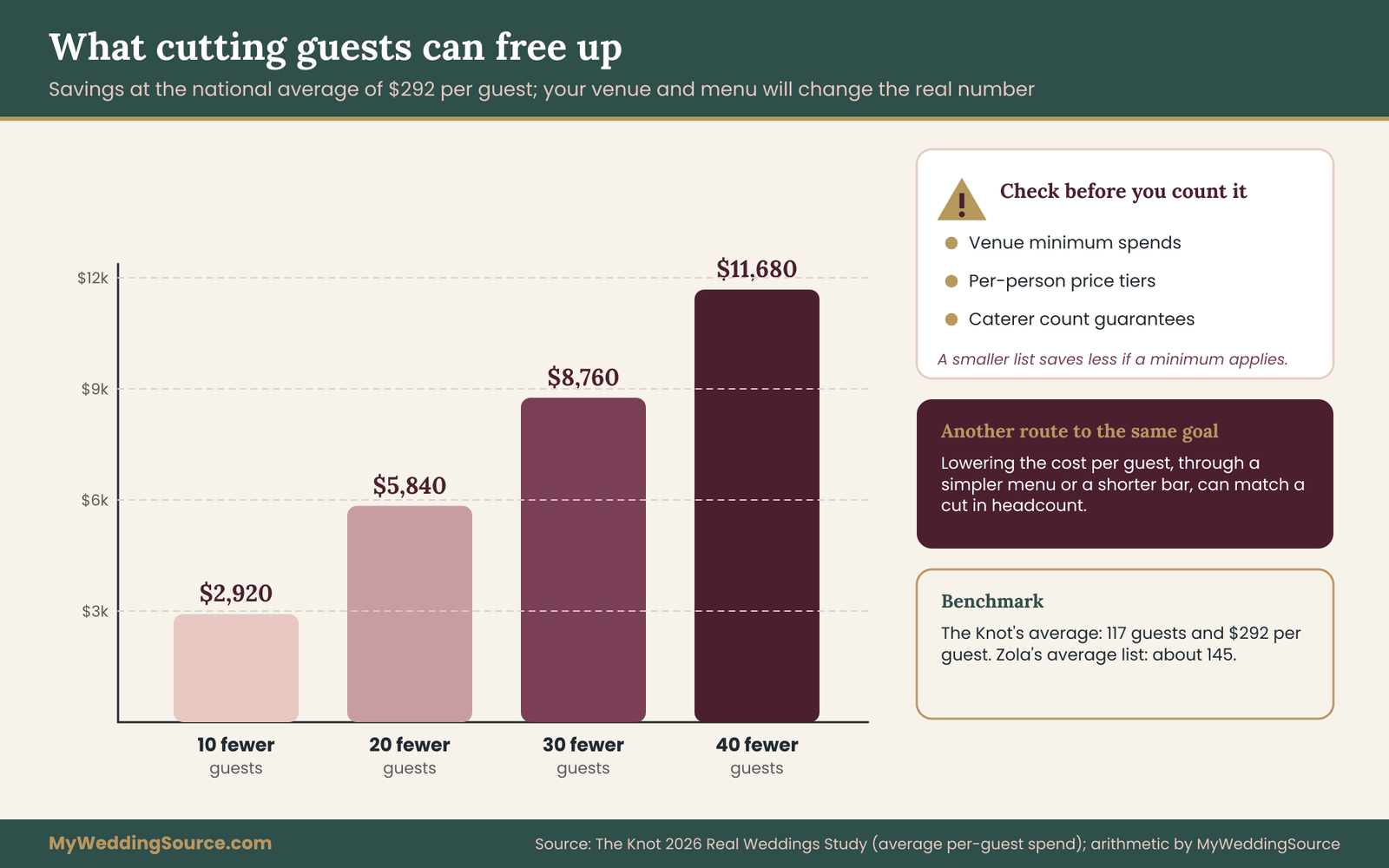
At the national average of $292 per guest from The Knot’s 2026 study, cutting 10 guests frees up about $2,920, cutting 20 guests about $5,840 and cutting 30 guests about $8,760. Your own figure will differ, and some venues have minimum spends that make the saving smaller, so check your contract before counting on it.
Decide who has a say in your wedding guest list
The question of whose list this is deserves an answer before the brainstorm, not after. The answer shapes who writes names down, how many slots each person gets and who has the final word when two people want the same last seat.
The common ways couples divide the wedding guest list
There is no right split, only a clear one. These are the arrangements couples use most often.
| Model | How it works | Best for | Watch out for |
|---|---|---|---|
| Couple-led | The two of you build the whole list, then share the headcount with parents | Couples paying for most of the wedding | Parents who feel surprised by the result |
| Thirds | One third for each partner’s family, one third for friends and shared circles | Families contributing evenly | Large families on one side squeezing the friend third |
| Parent quotas | Each set of parents receives a fixed number of invitations | Parents contributing a large share | Parents filling slots with their own friends and business contacts |
| Veto-based | Either partner can veto any name, with no explanation needed | Couples with complicated family histories | Vetoes used too freely and unevenly |
| Priority-based | Everyone submits a list, the couple ranks by closeness, and a single cutoff applies | Large families with many opinions | Takes more effort and requires a calm, transparent process |
Put the number in writing before anyone brings names
Whichever model you choose, agree on a number before names appear. A conversation that starts with “we can host about 110 people in total, and we would like to give each side about 25 spots” is a negotiation about numbers. A conversation that starts with “who do you want to invite?” turns into a negotiation about people, which is far harder to end.
Have the conversation in person or on a call, not by text, and tie it to the venue limit and budget you already fixed. Blaming the room is more graceful than blaming a person. “The venue holds 120, and we are trying to keep room for everyone’s closest people” is a statement nobody can argue with.
Speak to parents separately from each other
If both sets of parents are involved, talk to them separately before you bring them together. Parents compare quotas. If one side feels they received fewer slots, the conversation becomes about fairness instead of numbers. Hearing the same message separately, in the same words, avoids that. Give both families the same information on the same day.
Who should not be on the decision team
A wedding guest list is not a group project. Your maid of honor, your best friend and your coworker can be wonderful sounding boards, but they should not be adding names. Keep the decision circle small: the two of you, plus any financial contributors who have a legitimate stake.
How to build the first draft of your wedding guest list
The first draft is a wish list. This is the one stage where you should not edit, cut or worry about cost. Its job is to capture every person who could belong, so that you decide deliberately rather than forgetting someone and feeling guilty later.
Where to find names
Most people forget someone important if they rely on memory alone. These sources fill in the gaps:
- Your phone contacts and messaging apps, scrolled all the way down
- Holiday card lists from either family
- Social media friends and followers, filtered for people you have actually spoken to
- Old address books, school alumni lists and previous workplaces
- Your parents’ and siblings’ lists, including the relatives you rarely see
- Your wedding party’s partners and children, which are easy to overlook
- The couples in your life who invited you to their weddings
Capture the right details from the start
A spreadsheet is easier to sort later if you collect the right columns now. At minimum, record the name, the side (yours, your partner’s, shared), the relationship, the priority tier (you will assign these in the next section), whether they have a partner and whether they have children. Add a column for out-of-town versus local, because travel is one of the biggest predictors of whether someone attends.
Add notes on accessibility or dietary needs when you know them. Our article on wedding guest spreadsheet permissions explains how to share the sheet with a partner or a planner without exposing everyone’s addresses to the wrong people, and the wedding RSVP data export guide covers what to do with the information once answers come in.
Write the whole wedding guest list first, then stop
Set a timer, write every name and do not cut anything yet. Both of you should do this separately and then merge the lists. Seeing the combined, unfiltered total is useful information. If your wish list has 240 names and your limit is 110, you know exactly how much sorting lies ahead.
Sort every name on your wedding guest list into priority tiers
This is the step that turns an overwhelming wedding guest list into a manageable one. Instead of asking “do I want to invite this person?”, which is nearly always yes, you ask “how close are we, and where does this person fall?” Tiers let you cut in groups, apply one rule per group and explain your reasoning consistently.
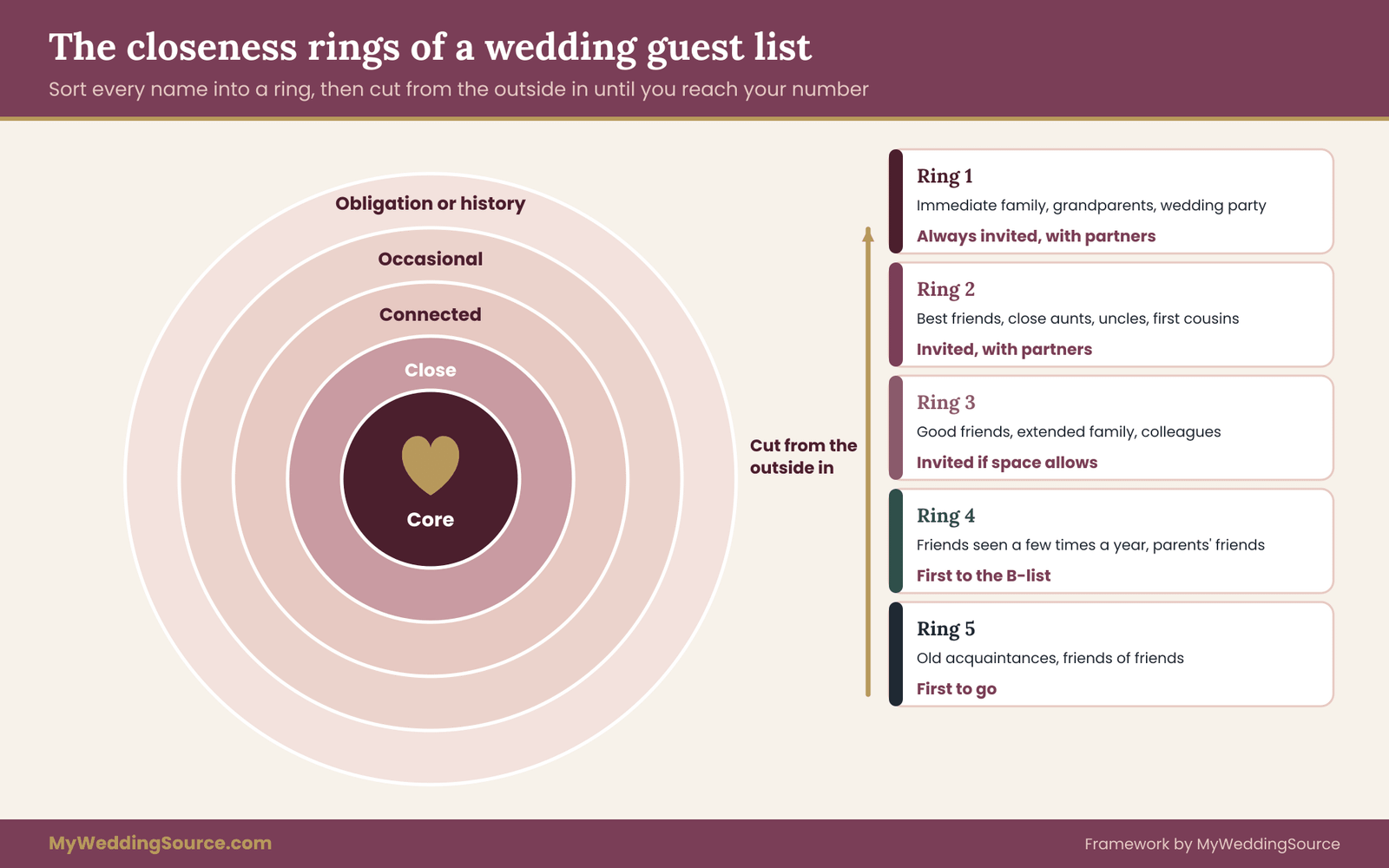
A five-tier system you can copy
| Tier | Who belongs here | Typical decision |
|---|---|---|
| Tier 1: Core | Immediate family, grandparents, your wedding party and the people you cannot imagine the day without | Always invited, with partners |
| Tier 2: Close | Best friends, aunts, uncles and first cousins you see regularly | Invited, with partners |
| Tier 3: Connected | Good friends, extended family you stay in touch with, current close colleagues | Invited if space allows |
| Tier 4: Occasional | Friends you see a few times a year, distant relatives, friends of your parents | First to be considered for the B-list |
| Tier 5: Obligation or history | People you feel you should invite, old acquaintances, friends of friends | Usually first to go |
Questions that make the sorting honest
When you are unsure where someone belongs, these questions cut through guilt:
- Would I invite this person to a dinner for 12 at my house? If yes, they are probably Tier 2 or 3. If you would have to think about it, they are Tier 4 or lower.
- Have we spoken, in person or by phone, in the last year? A simple relationship test that planners use often. If neither of you has been in meaningful contact in two years, the relationship may be more nostalgic than current.
- Would this person invite me to theirs? Reciprocity is not a rule, but it is a useful signal about closeness.
- Would their absence leave a visible gap on the day? Some people matter to you in ways that do not show on paper. Trust that.
- Is this invitation for me, for my partner, or for someone else’s expectation? Guests added for other people’s sakes belong in the quota conversation, not on your priority list.
Wedding sites such as Greenvelope suggest a version of the time test, a two-year window of contact, and note that you can shorten it to one year if you need to make deeper cuts. Treat that as a convenient filter rather than a law. Some people matter even after years of silence, and some people you see weekly are not people you want at your wedding.
Assign tiers separately, then compare
Each of you should assign tiers to your own contacts and shared friends independently, then compare. Disagreements are useful. If one of you rates someone Tier 2 and the other Tier 4, that is a conversation worth having in private, long before it reaches either family.
Family politics on a wedding guest list
Most of the genuinely difficult guest list moments are not about strangers. They are about families, and each family has its own unspoken rules. A few situations come up so often that they deserve a plan.
When parents want to invite their own friends
Parents often feel that a wedding is also a milestone for them, and that they should be able to celebrate with their own community. That is reasonable, but it collides with limited space. The cleanest approach is a quota. Give each set of parents a number of spots, explain that they can fill them with relatives, friends or colleagues as they see fit, and ask them to rank their list so that you can fit as many of their top choices as possible if the numbers change.
If parents are paying a large share, the quota may be larger. That is a business-like arrangement, and it works best when you state it kindly and in numbers: “We can give you 20 spots, and we would love your help deciding who matters most to you.”
If parents insist on an unlimited list and you cannot agree, the honest route is to return to the budget. “Each extra guest costs us about this much. If you would like to cover those costs, we can add people to that level.” Some families respond well to this, others do not, but it moves the conversation away from emotion and toward a shared fact.
Estranged relatives, ex-spouses and complicated histories
Weddings often force families to confront relationships that have been quietly avoided. Whether to invite an estranged parent, a stepparent, a half sibling or a former in-law is a personal decision, and nobody else should make it for you. A few practical points help:
- Decide for yourselves first, together, with no outside pressure
- If you invite a person with tension in the family, tell the people most affected before invitations arrive, not at the door
- If you do not invite someone, a short private message from you or a close relative is kinder than silence
- Ask yourselves whether you will be able to enjoy the day if this person is present, and equally whether you will regret their absence
Our guide on organizing family photo combinations when parents are divorced is a useful companion if your family structure is complicated, since the guest list and the photo list tend to raise the same sensitivities.
Blended families and step-relatives
When someone has stepparents, stepsiblings and half siblings, the simplest rule is to treat them as family unless there is a strong reason not to. Guests rarely expect precise differences between full and step relatives, and a wedding is a poor moment to draw fine lines. If budget forces a limit, apply it to groups, not individuals: for example, “first cousins and closer” is a rule people can understand, while “some cousins but not others” invites questions.
Grandparents, godparents and family elders
Elders sometimes hold an unspoken seniority that outweighs closeness. A great-aunt you see once a decade may be the person whose absence would hurt your grandmother. In families where respect for elders is central, it is worth asking a trusted relative whether anyone would be offended by being left out. The answer may surprise you.
A simple rule for wedding guest list politics
Across all these situations, one rule solves most arguments: make the rule about categories, not people. “We are inviting aunts, uncles and first cousins” is a category. “We are inviting your sister’s husband but not your brother’s wife” is a judgment call that will be debated for years. Categories are easier to defend, easier to explain and fairer in practice.
Plus-ones and partners: a rule you can defend
Few topics cause more heat per square inch than plus-ones. The good news is that a simple rule, applied consistently, resolves almost every case. The Emily Post Institute’s wedding guidance is a widely used reference in the United States, and its core position is that spouses, fiancés and live-in partners should be invited along with their guest, while single guests are not automatically entitled to bring someone.
The tiered plus-one rule
Most couples settle on something close to this:
- Married, engaged or living together: the partner is invited by name. Doing otherwise treats a real relationship as less important than it is.
- Wedding party members: each member gets a guest, even if the guest is a new partner, because they are giving the couple a great deal of time and money.
- Long-term relationships: partners who have been together for a significant period, often six months to a year, are generally invited, even if the couple does not live together.
- Single guests who will not know anyone: a plus-one is a kindness, especially for out-of-town guests, and it often improves their experience of the day.
- Casual dating or new relationships: the plus-one is at the couple’s discretion.
Whichever line you draw, draw it once, apply it everywhere and be ready to explain it in a sentence. A partner who is excluded while a friend’s new date is included will notice. Consistency matters more than generosity.
The decision flow

Wording that makes the rule clear
Invitations carry the message for you. Address the envelope and the inner invitation to exactly the people invited, by name. “Alex Rivera and Guest” invites a plus-one. “Alex Rivera” alone does not. If a guest writes asking to bring someone, you can answer warmly and consistently:
“We would love to include everyone’s partners, but we are keeping the list to a size our venue allows, so we are only able to offer plus-ones to guests in established relationships and members of the wedding party. We hope you can still join us.”
Keep the message short, friendly and identical for everyone. Our full article on plus-one wedding etiquette has more wording options, and the wedding RSVP wording guide shows how to phrase the response card so that guests understand exactly who is included.
Plus-ones and budget
If your budget is tight, plus-ones are one of the easiest places to protect it, because a guest of a guest is, by definition, someone you have not chosen. But refusing plus-ones too widely can hurt attendance, especially for out-of-town guests who may be reluctant to travel and attend alone. If you must limit them, consider offering plus-ones only to guests traveling a long distance and to anyone who will know nobody else.
Children and your wedding guest list
The children question is a real fork in the road for any wedding guest list. It changes the budget, the atmosphere and the sleeping arrangements of your guests, so it deserves a decision made on purpose.
The three common policies
| Policy | What it means | Pros | Cons |
|---|---|---|---|
| Adults only | No children except those in the wedding party and possibly infants | Lower cost, more adult atmosphere, easier alcohol service | Some parents may not attend, especially travelers or nursing parents |
| Immediate family children only | Nieces, nephews and cousins’ children in the closest circle are invited, others are not | Keeps family close | Others may feel the line is arbitrary |
| Children welcome | All guests may bring their children | Family-friendly and relaxed | Higher cost, noise, extra seating and meal planning |
If you go adults only, make the policy clear early, ideally on the wedding website and in the save-the-date. Parents need time to arrange childcare, and some will ask whether you can make exceptions. A calm, consistent answer protects relationships. For children who are attending, our guide to wedding kids’ meals covers how to price and plan for them.
Exceptions that do not cause trouble
Common sensible exceptions include infants who are nursing, children who are part of the wedding party and the couple’s own children. If you make an exception for one family, you should be prepared to explain it to others in a sentence. “We made exceptions for babies who are still nursing” is a rule people accept, as is “We made exceptions for children in the wedding party.”
Address the childcare problem when you can
If you want parents to attend without worry, consider offering information about local childcare options. Some couples arrange a supervised room or hire a sitter service at the venue or hotel. It is an extra cost, but it can also increase attendance and enjoyment from parents.
Coworkers, bosses and friend groups
Work relationships sit in an awkward category: not quite friends, not quite acquaintances, and often caught up in office politics.
The simplest approach to coworkers
Planners often suggest one of two clean rules. Invite no one from work, or invite close colleagues who are also friends outside the office. A third option, inviting an entire team, scales poorly. If you invite one person from a team of eight, others may notice. If you invite all eight, the cost increases significantly.
Whichever you choose, apply it evenly across departments. If you work in a small company where everyone is close, an all-or-nothing approach is often the safest. If you are the only one in a large department who is close with a particular colleague, a single invitation is easier to justify.
Your boss
Bosses fall into two categories. If you have a genuinely warm relationship, invite them. If the relationship is professional, you do not have to, and most bosses understand. If a colleague asks why they were not invited, a short, friendly answer works: “We kept it to family and our closest friends.”
Friend groups, “package deals” and the group chat
The hardest friend list decisions involve groups, where inviting some members feels like excluding others. A reliable principle: invite the whole group or none of it, unless you have a clear and kind reason. Friends talk to each other, and a rule that treats everyone alike is easier to defend than a selection that has to be explained.
Social media and the invitation surprise
Many modern couples find that the most difficult part is not the people they forget but the people who find out through social media, through a mutual friend or through someone’s story. If you have a large online presence, assume that anyone who follows you might see your wedding photos. That does not mean you owe them an invitation, but it does mean you should avoid pretending the wedding did not happen. Kindness helps. Tell the people closest to the edge of your wedding guest list before they see it online.
Out-of-town guests, distance and attendance
Distance is the strongest predictor of who will actually attend. When someone has to book flights, find a hotel and take time off work, they decline far more often than a friend who lives ten minutes away.
How attendance on a wedding guest list really works
Wedding industry surveys give a rough sense of the average. RSVPify, an RSVP software company that analyzed responses from its own users, reported an average acceptance rate of about 83 percent and an average decline rate of about 17 percent. The Knot’s own guidance also mentions the 83 percent figure from studies it cites, and adds a rule of thumb many wedding professionals use: plan for about 20 percent of invited guests to decline.
These are averages across all kinds of weddings. Your own number will depend heavily on how many of your invitees must travel, when your wedding takes place and how close you are to the people on your wedding guest list.
A planning model that adapts to your guests
A more useful approach than a single national average is to estimate attendance by group, then add the results. The percentages below are planning assumptions for illustration, not survey data, and you should adjust them based on what you know about your own guests.
| Guest group | Planning assumption for attendance | Why |
|---|---|---|
| Immediate family | Very high | Strong obligation and emotional pull |
| Local close friends | High | Easy to attend, personally invested |
| Local extended family and colleagues | Moderate to high | Convenient, but lower urgency |
| Out-of-town close friends and family | Moderate | Want to attend, but travel cost and time are real barriers |
| Distant relatives and acquaintances | Lower | Travel plus lower closeness |
Why this matters for your budget and your wedding guest list
If you plan only for the average, you can end up with an empty-looking room or an overrun budget. If you invite a lot of out-of-town guests, assume a higher decline rate and build your headcount accordingly. If you invite mostly local people, assume a lower decline rate and be more careful about the venue capacity. The safest approach is to design your venue, caterer and budget so that you can comfortably handle full attendance, then enjoy any gaps as a bonus.
Making it easier for guests to say yes
If you want a high attendance rate from distant guests, give them time. Send a save-the-date early, set up a wedding website with travel information and, for a destination wedding, send the save-the-date well before the invitation. Our destination wedding guide covers lead times in detail, and our save-the-date cards article explains when to send them.
The A-list and B-list approach, done properly
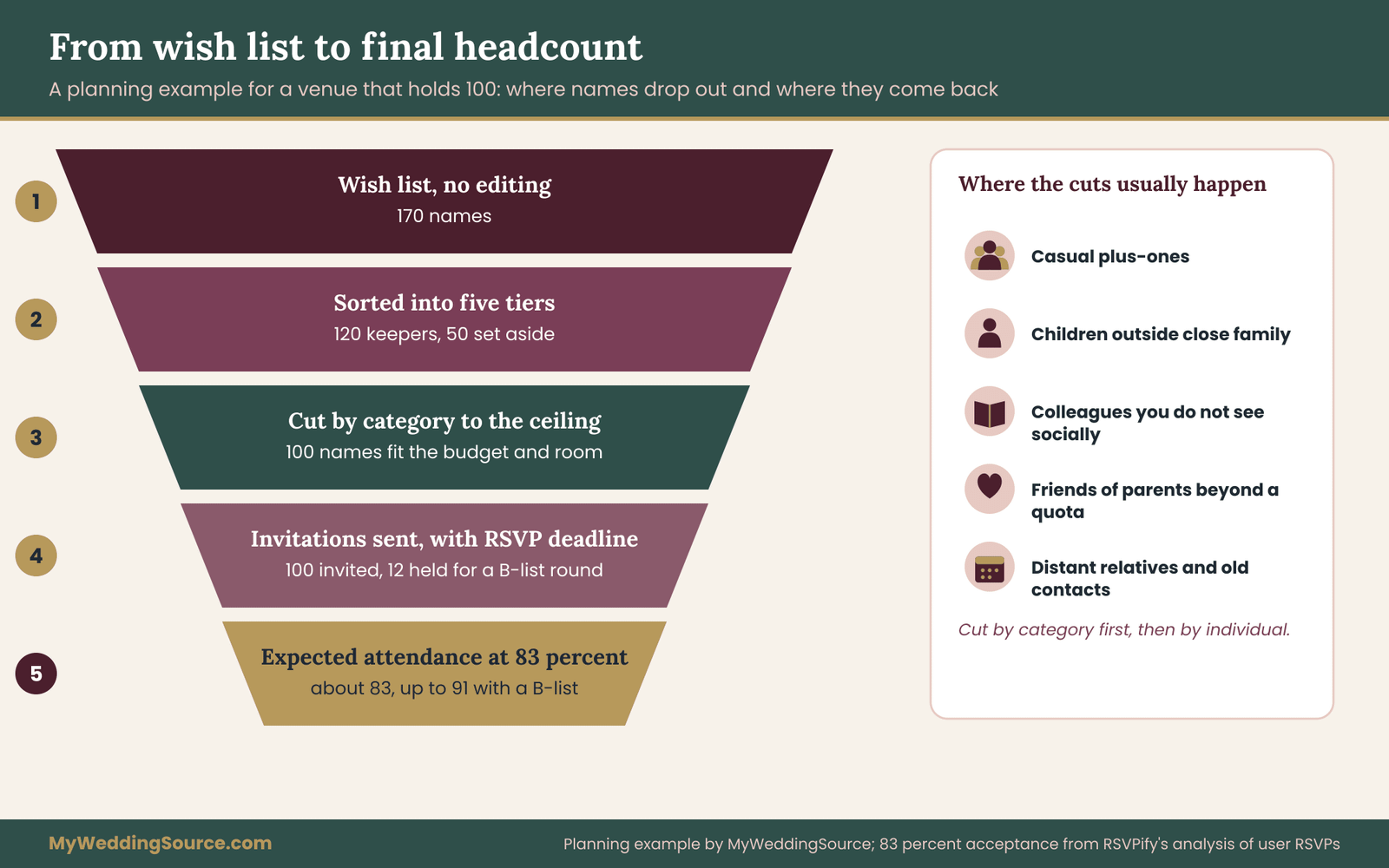
Many couples use an A-list and a B-list. The A-list is everyone you are certain about. The B-list is a second tier of people you would like to invite if space opens up. It is a common tool, and when it is done well, it works.
How the method works
- Build your full list with priority tiers as described above.
- Choose a headcount that includes an allowance for declines. If your venue holds 120 and you expect about 15 to 20 percent to decline, you can send about 140 invitations.
- Send A-list invitations first, with an RSVP deadline.
- As declines come in, send B-list invitations in rounds.
- Close the process by a firm date so that the last invitations do not arrive too close to the wedding.
The honest downside
The Emily Post Institute generally recommends inviting everyone at the same time when possible, rather than waiting to see how many people accept before sending a second round, because late invitations can make recipients feel like second choices. That is a valid concern. A B-list works best when the timing is invisible: the later invitations reach guests with enough notice, and nothing about the wording makes them feel like an afterthought.
Making the timing work
If you will send invitations in two waves, build the calendar backward from the wedding date. Many etiquette guides suggest that guests receive invitations six to eight weeks before the wedding, and that RSVP deadlines fall about three to four weeks before the event, which Lizzie Post of the Emily Post Institute has described as a typical window.
To leave room for a B-list round, send the first wave on the early side, set the first RSVP deadline early and send the second wave quickly once answers arrive. If your wedding is a destination event or falls on a major holiday weekend, start earlier.
A rule for keeping the B-list gracious
- Never tell anyone they were on the B-list
- Do not use different invitation designs for the two waves
- Send the second wave as soon as the first set of declines is in, not weeks later
- If you cannot send a second wave in time, do not try to squeeze in people at the last minute
- Keep the B-list short, ideally limited to people you genuinely hope will come
When not to use a B-list
If your guest list is small, say under 50 people, the B-list approach adds complexity without a lot of benefit. If many of your guests are traveling and need long lead times, it can also create problems. In those situations it is better to decide the wedding guest list in advance and invite everyone at once.
How to trim a wedding guest list that is too long
Almost every couple has to cut. A wish list of 200 and a ceiling of 110 is an ordinary situation, not a sign of poor planning. The goal is to cut in a way that is fair, explainable and kind, so that you finish with a list you feel good about rather than one you spent months defending.
Start with categories, not individuals
Cutting person by person is exhausting and emotionally loaded. Cutting by category is faster and easier to explain. Work through the categories below in order, stopping as soon as you reach your number.
| Cut | What it removes | Typical savings in headcount | What to expect |
|---|---|---|---|
| Plus-ones for casual relationships | Guests of guests you have never met | Often a substantial share of the list | Some pushback, but easy to justify by rule |
| Children of guests | Kids outside your close family | Varies with family size | Parents may decline, so communicate early |
| Colleagues you do not see outside work | Office invitations | Varies | Easy to explain if applied evenly |
| Friends of your parents | Their own social circle | Varies | Needs a quota conversation |
| Distant relatives | Second cousins and beyond | Varies | Family elders may object |
| Acquaintances and old friends | People you have not spoken to in a year or two | Varies | Largely painless if you were not in contact |
Use the one-year or two-year contact test
If you still need to cut, apply a contact test to the remaining Tier 4 and Tier 5 names. Have either of you spoken to this person, in person or by voice or video call, in the last year or two? If not, the invitation is likely driven by history rather than a current relationship. Some people remain in your life despite long silences, so use the test as a filter, not a verdict.
Consider changing the shape of the wedding, not just the wedding guest list
Some couples solve a list that is too long by changing the event rather than cutting people. Options include a smaller ceremony with a larger, more casual reception afterwards, a separate celebration later in the year, or a post-wedding open house or brunch. The Emily Post Institute notes that a post-wedding brunch usually includes everyone who was invited to the wedding, so if you add a brunch, keep that expectation in mind. For couples who want a very small day, our guides to small wedding planning and micro wedding planning are worth reading before you decide.
When the budget is the real problem
If the wedding guest list is fine but the budget is not, you may be able to reduce cost per guest instead of guest count. Options include a more affordable venue, a shorter reception, a simpler menu or a reduced bar. Doing the math on both sides gives you a clearer picture: sometimes cutting 10 guests saves less than moving to a different food style.
Four mistakes to avoid when trimming
- Cutting people to please one relative. A concession made once tends to expand.
- Cutting at random. If you remove one person from a group and not another, the choice will be noticed.
- Pretending the wedding is not happening. Silence hurts more than a clear, kind message.
- Using the venue as a shield and then expanding anyway. If you say the room is full and then add friends later, you lose trust.
Scripts for the hard conversations
Knowing what to say makes these moments much easier. These scripts are short on purpose. A long explanation invites negotiation, while a short, warm, consistent one closes the topic.
A parent who wants to add more names
“We are so grateful for your help, and we know there are people you would love to share this with. Our venue limits us to a total of [number], so we have set aside [number] spots for you. Would you like to list the people who matter most, in order, so we can fit as many as possible?”
A friend who asks whether they are invited
“We are keeping the wedding very small because of our venue and budget, and it has been really hard to draw a line. I hope you know how much you mean to us, and I would love to celebrate with you after the wedding.”
A guest who asks to bring a plus-one
“We would love to say yes, but we are only able to include partners in established relationships and members of the wedding party. We hope you can still join us, and we can introduce you to some of our other friends.”
A coworker who learns about the wedding
“We kept it to family and close friends because of our venue size. We appreciate you thinking of us, and we would love to catch up over lunch when we are back.”
Someone you did not invite learns about the wedding from a mutual friend
“I wanted to tell you before you heard it elsewhere. We are having a very small wedding with just family and a few close friends, and we are sorry we could not include everyone we love. We hope we can celebrate together after the wedding.”
What these scripts have in common
Each one acknowledges the relationship, names a reason that is not personal (space, budget or policy), avoids apologizing for the decision itself and offers a way to connect in the future. You do not owe a detailed explanation, and you do not need to justify every line. A kind, firm tone is enough.
Special situations that change the guest list math
Micro weddings and elopements with a reception
If you plan a very small ceremony, the list may be limited to a handful of people, and the reception afterwards may include more. That works well when you are open about it. Decide in advance who sees the ceremony, who joins the reception and who receives an announcement. Our micro wedding ideas and small wedding ideas articles offer more detail.
Destination weddings
At a destination wedding, expect lower attendance and plan your wedding guest list accordingly. You may invite more people than you expect to attend, knowing that many will decline because of travel cost. Be generous with plus-ones, because asking someone to travel alone is a larger request. Our destination wedding etiquette guide covers how to word invitations and handle questions about cost.
Second weddings
For second marriages, the guest list often leans toward a smaller circle of close friends and family. Children from earlier marriages are central to the list, and including them is almost always the right call. Combine lists from both families early, and talk to everyone in advance about expectations.
Cultures with large community weddings
In many cultures, a wedding is a community event, and the guest list may include several hundred people, including family friends, neighbors and community members. In these traditions the question is often not whom to invite but how to honor the expectations of multiple generations. If that is your situation, involve elders early, build your list with category rules and plan your venue and budget around the actual size rather than trying to shrink it unnaturally.
Weddings with multiple events
If your wedding includes a rehearsal dinner, a welcome party or a farewell brunch, build separate lists for each event. The wedding is often the largest, but the others have their own rules. Our guide to wedding weekend event invitations explains how to word invitations so that guests understand which events they are invited to.
Track your wedding guest list in a way that survives real life
By the time your wedding guest list reaches 100 names, you need a system. A spreadsheet is enough, but only if it is designed well.
The columns that matter
| Column | Why it matters |
|---|---|
| Full name and household | For invitation addressing and headcount |
| Side (yours, partner’s, shared) | Keeps balance between families |
| Relationship | Helps with tiers and seating |
| Priority tier | Drives cut and B-list decisions |
| Partner or plus-one status | Prevents confusion about who is invited |
| Children included (yes or no) | Controls the child policy |
| Local or out of town | Predicts attendance |
| Address, email, phone | For invitations and updates |
| Invitation wave (A or B) | Tracks the sending schedule |
| Save-the-date sent | Confirms notice for travelers |
| RSVP status and date | Core tracking |
| Meal choice and dietary needs | For the caterer |
| Accessibility needs | For the venue and seating |
| Notes | Anything else you need to remember |
Keep the sheet private and current
A guest list holds addresses and personal details, so be thoughtful about who has access. Share the sheet only with people who need it, and use view-only access where possible. Our article on wedding guest spreadsheet permissions walks through the choices. If you use a wedding website or a planning platform, learn how to export your data so that you are not locked into one tool, which is the focus of our wedding RSVP data export guide.
Update the sheet the same day
The most common spreadsheet failure is that updates happen in someone’s head, a text message or a conversation at a family dinner. Make one person the owner of the master list, and update it immediately after every change. Version confusion is a surprisingly common cause of invitation errors.
From RSVPs to a final headcount
Once invitations are out, your wedding guest list becomes a living document. The aim now is to move from a list of invitees to a number you can give your caterer with confidence.
Set the RSVP deadline with the caterer in mind
Ask your caterer when they need the final count, and set your RSVP deadline at least a week or two before that date, so that you have time to chase late responses. If the caterer needs a final number three weeks before the wedding, your RSVP deadline may need to be four to five weeks before.
Chasing the missing answers
Some guests do not respond. That is normal, and chasing them is your job, not their failing. After the deadline, send a short message to anyone who has not replied. A phone call or text works better than a second email for older relatives. A friendly, plain message is enough.
“Hi, we are finalizing our headcount this week and have not seen your RSVP. Are you able to join us on [date]? We would love to know either way by [date].”
Count with a safety margin
Even after RSVPs, a few guests cancel or fail to show. Many couples ask the caterer how much flexibility they have, for example whether the final count can drop by a few percent without penalty, and whether extra meals can be added at short notice. Understanding those rules protects you from paying for empty seats. Our wedding seating chart guide covers how to turn the final count into a seating plan, and the wedding cost per guest article shows how last-minute changes affect the bill.
Three worked examples
The examples below are illustrative scenarios built from the method above. They are not real couples, and the figures are examples rather than survey data.
Example one: a budget-led list
Priya and Marcus have a total budget of $28,000. After fixed costs, they have $15,000 for guest-dependent costs, and their estimated cost per head is $150. That gives them a ceiling of 100 guests. Their wish list has 170 names.
They sort into tiers: 38 in Tier 1 and Tier 2 combined, 52 in Tier 3, 45 in Tier 4 and 35 in Tier 5. With the Tier 1 and 2 names, plus the Tier 3 names, they reach 90. They then add 10 names from Tier 4 using the contact test and a single plus-one rule. They send invitations to 100 people, expecting about 85 to attend, and have a short B-list of 12 names for a second round. They end up with 91 guests.
Example two: a family-led list
Dana and Chris are paying for most of their wedding, but both sets of parents are contributing. They agree on 120 guests. They allocate 35 spots to each set of parents and keep 50 for themselves. Each set of parents submits a ranked list of 45 names, and Dana and Chris tell them to expect that the top 30 will fit with five buffer slots to rearrange.
One parent protests that the quota is too small. Dana and Chris explain the venue limit and the budget, and offer to move three more spots if that parent covers the per-guest cost of those three. The parent declines and the quota stays. The conversation is uncomfortable, but it takes 20 minutes, not three months.
Example three: a destination wedding
Sam and Lee are marrying abroad. They invite 85 people, knowing that distance will reduce attendance. They send save-the-dates ten months ahead and offer a plus-one to every guest in a relationship. About 52 guests accept. They are not upset by the 39 percent decline rate because they planned for it, and they chose a venue with a comfortable capacity for 60. They had not planned a B-list, because adding guests at short notice would have been unfair to anyone who needed to book travel.
Common wedding guest list mistakes
| Mistake | Why it hurts | Better approach |
|---|---|---|
| Starting with names instead of limits | Leads to a list that must be cut later | Fix capacity, budget and contributors first |
| Inconsistent plus-one rules | Hurts feelings and creates comparisons | One rule, applied everywhere |
| Forgetting that children count | Surprise cost and seating issues | Decide the child policy early |
| Treating the B-list as a secret second chance | Late invitations feel like second choices | Send early and keep wording identical |
| Letting one relative expand the list | Opens the door to more requests | Use quotas and categories |
| Sharing the sheet too widely | Privacy risk and version confusion | One owner, limited access |
| Not asking the caterer about final count rules | Paying for guests who do not come | Confirm guarantee and flexibility |
| Ignoring travel when estimating attendance | Under or overbooking | Estimate by group, not just by average |
Questions worth asking before you finalize your wedding guest list
- What is the venue’s maximum capacity for our layout, and is that number in writing?
- What is our per-guest budget, and does it match our menu and bar?
- Who is contributing, and do they expect a say in the wedding guest list?
- What is our rule for plus-ones, and have we applied it to every guest?
- What is our policy on children, and have we told guests early enough?
- Which guests will need to travel, and have we given them enough notice?
- When does the caterer need the final count, and when is our RSVP deadline?
- If we send a second round of invitations, do we have time and a plan?
Stress-test your wedding guest list before you mail anything
A wedding guest list on paper is a hypothesis. Before invitations go out, test it against three questions: what if everyone says yes, what if the average number say yes and what if far fewer come than you hoped? A list that survives all three is a list you can trust.
Run the three scenarios
Take the number of people you plan to invite and multiply it by three different acceptance rates. The example below uses 140 invited guests and a venue that holds 125. The rates are planning scenarios, not predictions.
| Scenario | Acceptance rate | Guests attending | Fits a 125-person venue? |
|---|---|---|---|
| Everyone accepts | 100 percent | 140 | No, over by 15 |
| Close to the published average | About 83 percent | About 116 | Yes, with some room |
| Travel-heavy list | About 65 percent | About 91 | Yes, with a lot of room |
The first row is the one most couples avoid looking at. If a full yes would overrun your venue or your budget, you either need a smaller initial list, a plan for what you will do if everyone accepts or a written understanding with the venue about flexibility. Sending 140 invitations to a 125-person room only works if you are comfortable with the risk. Many couples are, particularly when a large share of the list is traveling. Others prefer to keep the risk close to zero, and that is equally sensible.
Check the balance of your wedding guest list
Once the numbers work, look at who the wedding guest list contains. A few quick checks can reveal imbalances that are easy to fix now and awkward to fix later:
- Sides: Is one family much larger on paper than the other? That is not a problem in itself, but it is useful to know before a guest counts the tables.
- Ages: Is there a generation missing? A list with no older relatives or no children can feel different from what you imagine.
- Singles: Are there guests who will know only you and nobody else? A few introductions or a thoughtful seating plan can help.
- Groups: Are there friend groups where only some members are invited? If so, make sure the reason is one you can state kindly.
- Distance: How many guests are traveling, and have they all been given enough notice?
Plan for the invited guest who cannot come
Some of the people on your wedding guest list will not attend, and that is not a rejection. A thoughtful note, a phone call after the wedding or a photo sent later keeps the relationship warm. It also helps to remember that a “no” is information, not a verdict. People decline because of money, time off, health, family obligations or distance, and most of those reasons have nothing to do with how they feel about you.
Pre-wedding events and your wedding guest list
Your wedding guest list does not stand alone. Engagement parties, showers, bachelor and bachelorette weekends and rehearsal dinners each carry their own lists, and the links between them are a common source of hurt feelings.
The shower rule most families expect
Etiquette writers commonly advise that anyone invited to a bridal shower or a similar pre-wedding celebration should also be invited to the wedding, because inviting someone to celebrate and then leaving them out of the main event feels pointed. The usual exception is a coworker shower hosted by colleagues, where the guests may not expect a wedding invitation. If you are not hosting the event, share the guideline with the host early so that a well-meaning friend does not create a mismatch.
Rehearsal dinners and welcome events
The rehearsal dinner is traditionally for the wedding party, immediate family and anyone who has traveled, though the exact rule varies by family. Decide who is included before you finalize the wedding list so that you do not accidentally invite someone to the dinner but not the wedding. Our guide to wedding weekend event invitations and the wedding rehearsal article explain how to word invitations for each event.
Bachelor and bachelorette plans
These events are usually organized by friends, and they should be planned with the couple’s wishes in mind. If you are limiting your own wedding guest list for budget reasons, tell the organizers so that they can plan accordingly. A friend invited to a bachelorette weekend who learns later that they are not invited to the wedding may feel confused, and a quick conversation beforehand prevents it.
Keep a separate tab for each event
The simplest way to avoid mistakes is to add a column for each event in your master spreadsheet and mark every name yes or no. That way, a single filter shows you the guest list for each event, and you can see at a glance who is invited to what.
A wedding guest list timeline from first draft to final headcount
The guest list is not a one-day task. It moves through stages, and each stage has a natural moment. Working backward from the wedding date is the most reliable way to avoid rushed decisions.
| When | What happens to the list | Why it matters |
|---|---|---|
| About 12 to 14 months out | Agree on the budget, the rough size and who is contributing | Venue and caterer shopping depend on a size estimate |
| About 10 to 12 months out | Write the wish list and sort it into tiers | Gives you a realistic number before booking |
| About 9 to 10 months out | Choose the venue with capacity for the working number | Avoids rebooking if the list grows |
| About 8 to 10 months out | Send save-the-dates to destination guests and anyone traveling far | Travelers need the longest notice |
| About 6 to 8 months out | Send save-the-dates to everyone else and launch the wedding website | Locks in the A-list |
| About 3 to 4 months out | Finalize addresses, plus-one decisions and child policy | Needed for invitation printing |
| About 6 to 8 weeks out | Send invitations, with a clear RSVP deadline | Standard etiquette window for most weddings |
| About 4 to 5 weeks out | RSVP deadline, followed by a round of chasing | Leaves time for the caterer’s count |
| About 3 to 4 weeks out | Send any B-list invitations, if used, only if there is still time | Late invitations need to be rare and quick |
| About 1 to 2 weeks out | Give the caterer and venue the final headcount | Most contracts set a guarantee date |
These windows are guidelines, not rules. A smaller or more flexible wedding can shorten them, and a destination or holiday-weekend wedding should lengthen them. Our wedding invitations guide covers printing and mailing schedules, and our save-the-date cards article explains who needs one and when.
Why the early months matter most for a wedding guest list
The most expensive mistakes on a wedding guest list happen in the first third of the timeline, long before anything is mailed. A venue booked for the wrong size, a caterer contracted for a headcount that later doubles and a budget built on a list that was never checked are all very hard to undo. Spending a few hours in the first month on the limits and tiers described above prevents most of them.
Accessibility, dietary needs and the details behind each name
A wedding guest list is not just names. Every name carries needs that shape the day, and collecting them early saves scrambling later.
Ask about access when you send the save-the-date
Some guests use wheelchairs or walkers, some cannot stand for long periods, some are hard of hearing and some cannot attend an event without a service animal. Ask on the wedding website or the RSVP card whether anyone needs accommodations, and do it with a neutral, welcoming line rather than a clinical one. A line such as “Please let us know if there is anything that would help you feel comfortable at our wedding” does the job.
Knowing early lets you choose seating, aisle widths and transportation sensibly. For ideas, see our guides on accessible wedding guest experience and seating for guests who cannot stand for long periods.
Collect dietary needs in the same pass
Food allergies, medical diets and religious or ethical restrictions should be collected on the RSVP, not discovered on the day. Ask for specifics and for the severity of any allergy, because a caterer treats a mild preference very differently from an anaphylactic risk. Keep that information in the same spreadsheet as the guest list, in a column that is easy to export for the caterer.
Note relationships that affect seating
While you are building the wedding guest list, note the relationships that will matter for seating later: estranged relatives, divorced parents, friends who do not get along and guests who know nobody. A short note beside each name is cheap now and valuable when you start building the chart.
Think about guests who need extra support to attend
An elderly relative may need a ride. A friend with a newborn may need a quiet space. A guest from out of town may need help finding a hotel. Offering a small amount of help early, such as a hotel block or a transportation plan, makes it more likely that the people you most want to attend will be able to.
Spreadsheet, wedding website or planner software
Most couples use some mix of tools. Each has strengths, and none is required.
| Tool | Strengths | Weaknesses | Best for |
|---|---|---|---|
| Spreadsheet | Fully flexible, easy to export, free | Manual updating, version confusion | Couples who like control |
| Wedding website with RSVP tools | Guests respond online, data updates automatically | Platform lock-in, privacy settings to check | Larger lists and busy couples |
| Planner software or app | Integrated checklist, budget and seating | Cost, learning curve | Couples managing many vendors |
| Paper and index cards | Tactile, good for early brainstorming | Hard to sort or share | Early drafts and seating experiments |
A good habit is to keep one master wedding guest list spreadsheet even if you also use a website. That way you own your data, you can switch tools and you can hand a clean list to a caterer, a planner or a stationer without relying on a platform’s export button. If you choose a website, review its privacy settings and consider how the information will be stored and shared.
FAQ: wedding guest list questions
How do I start a wedding guest list?
Begin with limits rather than names. Find out your venue’s capacity, work out how much you can spend per guest and learn whether anyone contributing expects a say. Then write a complete wish list without editing, sort it into priority tiers and cut by category until you reach your number. Doing it in that order prevents the most common problem, which is falling in love with a list that you later have to shrink.
How many people should be on a wedding guest list?
There is no ideal number. The Knot’s 2026 Real Weddings Study found an average of 117 guests, and Zola’s 2026 First Look Report found an average around 145, but averages hide enormous variety. The right number is the one that fits your venue, your budget and the kind of day you want. A useful test is whether you can have a real conversation with each person on the wedding guest list, and whether the per-guest cost fits your plan.
Do I have to invite coworkers?
No. Many couples invite no one from work, or only colleagues who are also friends outside the office. The key is to apply the same rule everywhere. If you invite one person from a close team, others may notice. Invite the whole team, or keep work out of it entirely. A short, friendly note that you kept the wedding to family and close friends is usually all that is needed.
Do I have to give everyone a plus-one?
You do not have to give a plus-one to every guest. Etiquette guidance from the Emily Post Institute holds that spouses, fiancés and live-in partners should be invited, while single guests are not automatically entitled to bring a date. Many couples also give plus-ones to wedding party members and to guests who would otherwise know nobody. Choose a rule, write it down and apply it to everyone.
Is it rude to have an adults-only wedding?
No, as long as you communicate the policy clearly and early. Adults-only weddings are common, and many guests are glad to have a child-free evening. The main courtesy is notice: parents need time to arrange care, especially travelers. Making limited exceptions, for example for nursing infants or children in the wedding party, is also common, as long as you can explain the rule in a sentence.
How many invited guests will decline?
It depends on distance, timing and closeness. RSVPify’s analysis of its users’ RSVPs found about 83 percent of invitees accepting and about 17 percent declining, and The Knot reports that many wedding professionals use 20 percent as a rule of thumb. Weddings with many out-of-town guests, holiday weekends and destination events see more declines. Plan your venue and budget so that you can handle full attendance, then treat any gaps as a bonus.
Is it okay to send a second round of invitations?
It is common, but it needs care. The Emily Post Institute generally favors inviting everyone at once when possible, because late invitations can feel like second choices. If you do use a B-list, send the first wave early, set an early RSVP deadline, send the second wave promptly and keep the wording identical. Never tell a recipient they were on the B-list.
What do I say to someone who was not invited?
Keep it short, kind and consistent. Acknowledge the relationship, give a non-personal reason such as space or budget, avoid over-apologizing and, if it feels right, offer another way to celebrate together. You do not owe a long explanation, and a long one usually invites negotiation. Our guide to wedding etiquette has more guidance for awkward moments.
Your next steps
You do not need to finish your wedding guest list in one sitting. Work through it in small, ordered steps.
- Fix the limits this week. Write down your venue capacity, your per-guest budget and who is contributing.
- Agree on a number with anyone contributing. Put the number in writing before names appear.
- Write the wish list separately, then merge. Do not edit yet.
- Sort every name into a tier. Use the questions in this guide to settle the unsure ones.
- Choose a plus-one rule and a child policy. Apply both everywhere.
- Cut by category until you reach your number. Resist cutting individuals one at a time.
- Decide whether you will use a B-list. If so, build the calendar backward from the wedding date.
- Set up one master spreadsheet. Name an owner and keep it current.
When you are ready for the next piece of planning, our wedding venues guide helps you match a space to your final number, and the wedding planning checklist shows where the guest list fits into the larger plan.
Sources & methodology
This guide combines published wedding industry research, etiquette guidance and our own planning frameworks. Statistics are attributed in the text and linked below. Where we use illustrative figures, such as the worked budget example, the three scenarios and the attendance planning assumptions, they are labeled as examples and are not survey data. Surveys differ in who they sample and when, so averages from different sources should be read as benchmarks and not as targets. Costs and policies change, so confirm figures with your own venue and vendors.
- The Knot: The Average Wedding Cost, According to The Knot Data (2026 Real Weddings Study) – average guest count, average cost per guest and guest-count cost context.
- The Knot Worldwide: 2026 Real Weddings Study press release – study scope and headline averages.
- Zola: Average Cost of Weddings in 2026 – First Look Report average cost.
- Zola: Wedding Food and Mocktail Ideas, 2026 Trends and Costs – average guest list from the 2026 First Look Report.
- Zola: How to Make a Wedding Guest List – decision-makers, wish list and trimming methods.
- Minted: How To Create Your Wedding Guest List – capacity, budget and list-building steps.
- Paperless Post: Tips for Building Your Wedding Guest List – cost-per-guest math and refining the list.
- Greenvelope: A Guide to Creating Your Wedding Guest List – B-list, trimming tips and the contact-window test.
- RSVPify: What Percent of Guests Should You Expect to Attend Your Wedding? – average acceptance and decline rates from user RSVPs.
- The Knot: What Percentage of Wedding Guests RSVP Yes – decline-rate rule of thumb and influencing factors.
- Emily Post Institute: Who to Invite – guidance on who belongs at related events such as a post-wedding brunch.
- Emily Post Institute: Wedding Invitation Dos and Don’ts – guidance on inviting everyone at the same time.
- WRAL: Frequently Asked Wedding Etiquette Questions (Lizzie Post) – typical RSVP window and plus-one guidance.