
Paying for a honeymoon using points can save real money, or it can quietly cost more than a cash ticket, and the difference comes down to a few numbers you can check yourselves before you transfer a single point.
Quick answer
To judge a honeymoon using points, divide the cash fare you would otherwise pay (minus any cash the award still charges) by the points required, then multiply by 100 to get cents per point. Compare that number with a yardstick, such as the third-party valuations in this guide, and with what the same points could do on another trip. Before you move transferable points, confirm two seats on the same flights, the total cash still due, and the change and cancellation terms in writing. Transfers are final, and nothing here is financial advice.
What a honeymoon using points really involves
Most guides to a honeymoon using points start with a card recommendation or a list of “sweet spots.” This one starts later in the process, with the moment you are looking at two screens, one showing a cash fare and one showing an award price, and trying to decide which to buy. That moment is where honeymoon budgets are won or lost, and it is where a short, honest calculation helps more than any list of programs.
The calculation is not complicated, but it has several moving parts: how points are valued, what cash an award still requires, whether two seats exist on the flights you want, what happens when a date moves, and which consumer protections apply. We take them one at a time, build a worksheet at the end, and flag the places where the rules differ by program and you need to ask.
Points, miles, and cash back are different currencies
People use “points” loosely, and the differences matter because they change both the math and the risk. A little vocabulary prevents most confusion later.
Airline miles are earned with one program
An airline program such as a frequent-flyer account issues miles that are spent on that airline and its partners. The program sets the price of each award, and in some programs that price follows the cash fare closely. AwardWallet, a loyalty-tracking service, describes Southwest Rapid Rewards as revenue-based, meaning the award cost follows what the ticket would cost in cash. When the award tracks the cash fare, the cents-per-point figure tends to stay in a narrow band, so there is less to gain from searching for unusual deals and less to lose from a bad one.
Bank points can move to several programs
Credit card points from a bank, often called transferable points, can usually be moved to a set of airline and hotel partners. NerdWallet’s guide to Chase transfers says most Chase transfer partners move at a one-to-one ratio, with Hyatt as an exception for some cards, and that transfers go in 1,000-point increments. That flexibility is why bank points often get higher valuations than airline miles, and it is also why the order of operations matters: you search first, you transfer last.
Cash back is the simplest comparison
If your card earns a flat cash-back rate, the “points” are just money, and a honeymoon using points reduces to a plain discount. Nothing in this guide is meant to push you toward changing cards, opening accounts, or spending more to earn rewards. The goal is to help you decide whether a honeymoon using points is the right use of the rewards you already have, or already plan to earn from ordinary spending, are worth more as an award or as something else.
When using points is worth considering
A honeymoon using points makes the most sense when it solves a problem that cash does not. It makes less sense when it is just a way to feel that the trip is free.
When the math may favor points
A honeymoon using points may be a good fit when the cash fare is high relative to the points price, when you already hold a balance you will not otherwise use, when the dates are flexible enough to find award space, or when the cash portion of the award is small. A cash fare that looks high for your dates is the usual trigger for checking an award, and the next sections show how to test whether the award is actually cheaper once everything is counted.
When cash may be the better choice
Cash is usually the better tool, even for a honeymoon using points, when the fare is cheap, when the award leaves you paying a large amount in taxes and surcharges, when your dates are fixed and award space is thin, or when you want the flexibility and consumer protections attached to a cash ticket. It can also be the better choice when you would be tempted to overspend on the rest of the trip to feel good about “free” flights. Our honeymoon budget guide covers how to set the number that all of these choices should serve.
What this guide does and does not cover
The scope is deliberately narrow so it stays accurate and useful.
What it covers
We cover the arithmetic of award versus cash pricing, the cash that awards still charge, how to transfer bank points without stranding them, what change and cancellation terms look like at a handful of programs, which consumer rules apply, and edge cases specific to newlyweds, such as name changes and passports. The novel piece is a decision worksheet you can fill in for your own flights.
What it leaves out
We do not recommend specific credit cards, sign-up offers, or spending strategies, and we are not giving financial, tax, or legal advice. Program rules, award prices, and valuations change often, and several of our sources are dated in the text so you can see how fresh each figure is. Where the rules vary by program, we say so and point you to the question to ask.
The award-versus-cash math in one formula
Everything in a honeymoon using points rests on one calculation. Once you can do it on the back of an envelope, program names and marketing language matter much less.
The cents-per-point formula
The formula compares what you save in cash against how many points you spend. Because the award may still charge you some cash, the formula subtracts that cash first, which is the step people most often skip.
Step one: find the real cash saved
Take the cash fare for the same flights, dates, cabin, and fare type, then subtract the cash the award charges in taxes and fees. The result is the cash you avoid spending. If a cash fare is $620 and the award still charges $11.20, the cash you avoid is $608.80. The comparison only works if both options describe the same trip, so a refundable cash fare should be compared with a refundable award, not with a basic fare that cannot be changed.
Step two: divide by points, then multiply by 100
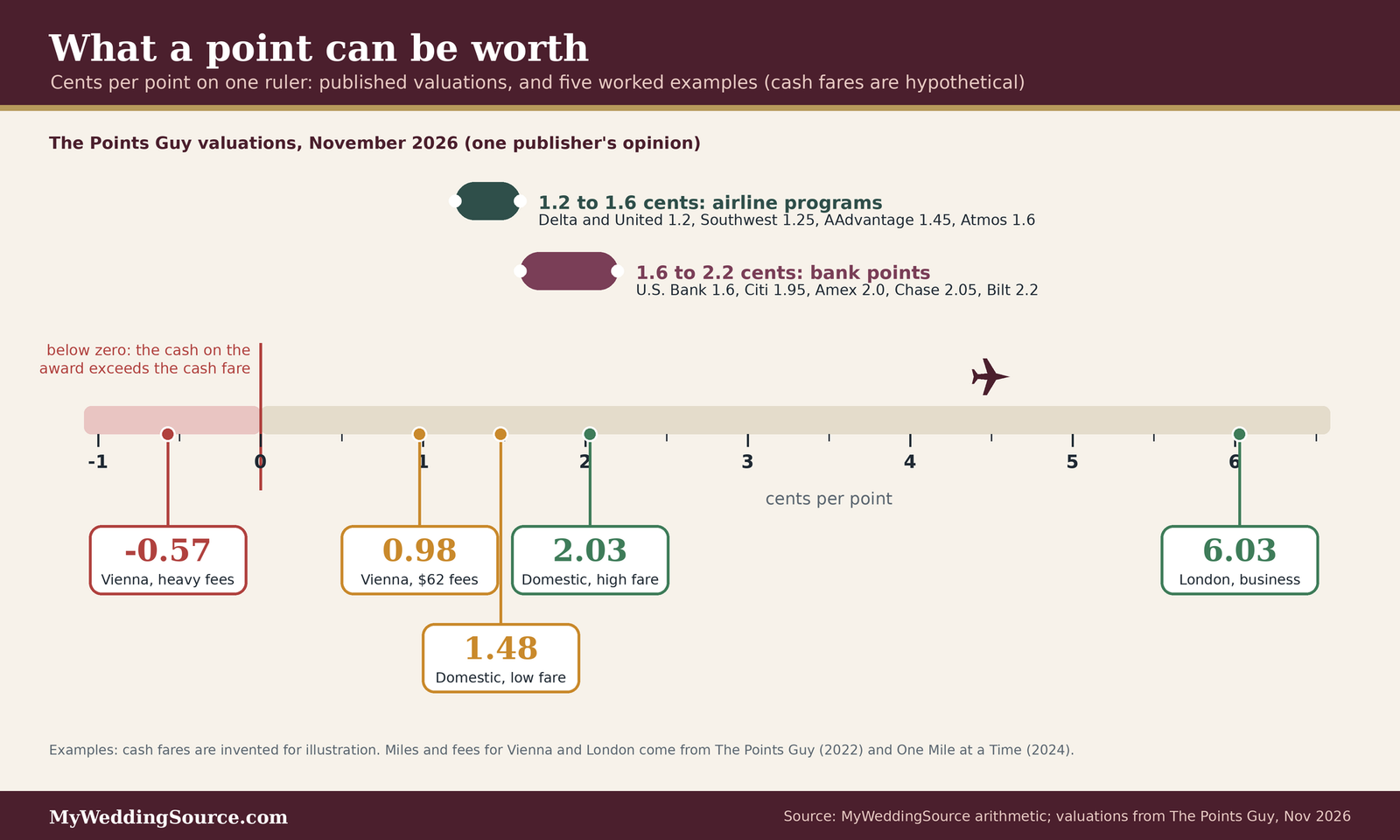
To price a honeymoon using points, divide the cash saved by the points required and multiply by 100 to express the answer in cents. Using the example above, if the award costs 30,000 points, then 608.80 divided by 30,000 is about 0.0203, or roughly 2.03 cents per point. The calculation is our own arithmetic, not a figure from any program, and every cash price in our examples is hypothetical.
| Example | Cash fare | Award price | Cash still paid on award | Cents per point |
|---|---|---|---|---|
| Domestic one-way, high fare | $620 | 30,000 points | $11.20 | about 2.03 |
| Domestic one-way, low fare | $380 | 25,000 points | $11.20 | about 1.48 |
| New York to London, business class | $4,200 | 57,500 miles | $732.30 | about 6.03 |
| New York to Vienna, via a program that passes on surcharges | $1,500 | 88,000 miles | about $2,000 | below zero |
The last two examples use real award prices reported by travel publishers, paired with cash fares we invented for illustration. Treat them as demonstrations of how the formula behaves, not as prices you will see.
What the examples teach
Reading across the four rows shows three patterns that hold regardless of the exact numbers.
A cheap cash fare lowers the value of points
In the first two rows the fee is identical, but the cash fares differ by $240, and the value per point falls from about 2.03 cents to about 1.48 cents. The same points buy less when the cash fare is low. That is why the answer to “should we use points?” can change for the outbound and return legs of the same trip, and why it helps to run the formula separately for each leg.
A large cash portion can erase the savings
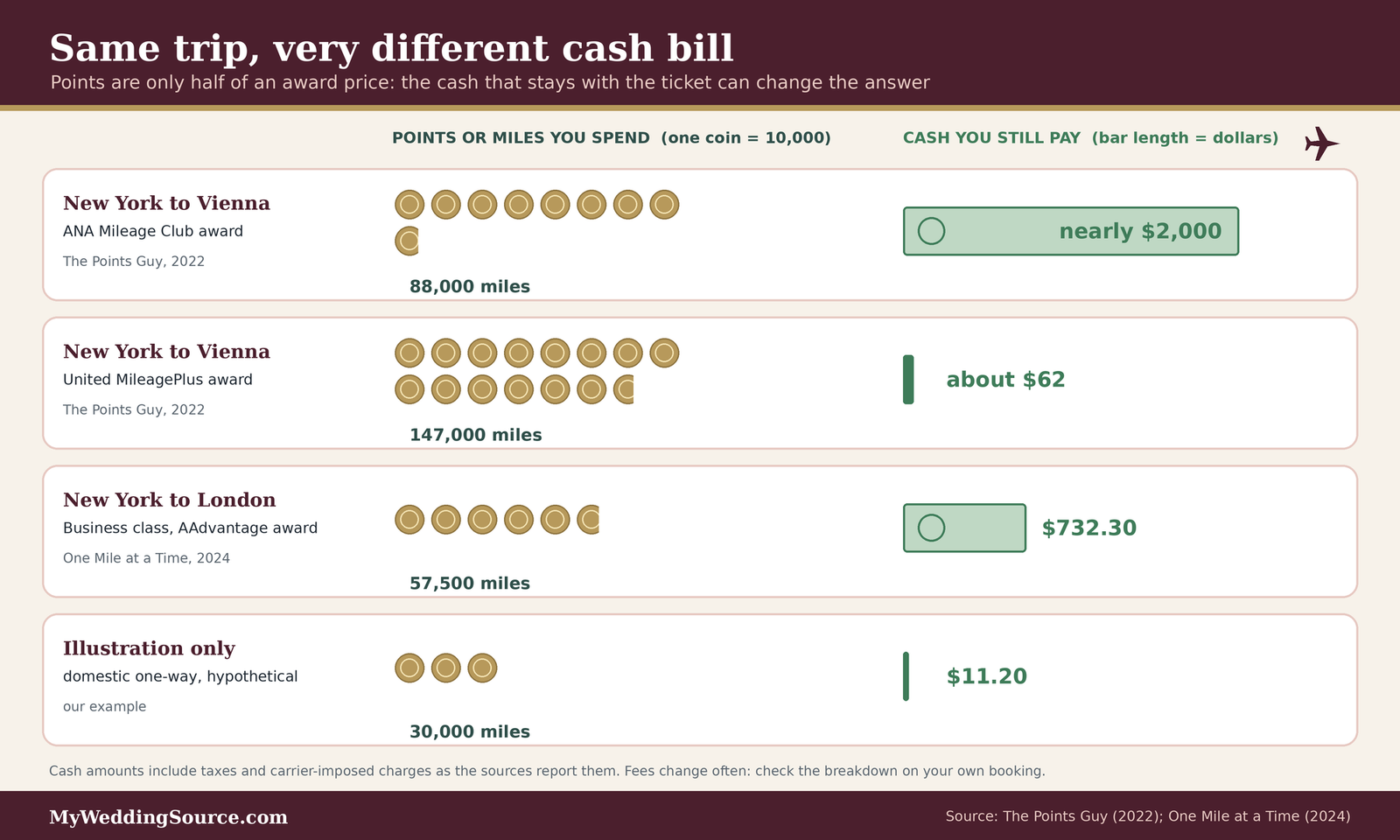
In the last row, the award charges about $2,000 in cash, more than the $1,500 cash fare we assumed. The formula returns a negative number, which means paying cash would cost less than the cash portion of the award alone, before counting a single point. The Points Guy’s 2022 explainer on award taxes describes a New York to Vienna award on ANA’s program at 88,000 miles with nearly $2,000 in surcharges, while the same route on United’s program cost 147,000 miles and about $62 in taxes and fees. Same flights, very different cash bill. That is the strongest argument for comparing programs, and for looking at the whole price rather than the miles.
A very high number deserves a second look
A result like 6 cents per point in a premium cabin is the kind of figure that makes award travel attractive in stories. It deserves a check on two points: whether the cash fare you compared against is one you would genuinely have paid, and whether you need the points for something else. A business-class cash fare you would never buy is not a saving. Our hypothetical $4,200 fare is only worth comparing if you would really have bought a business-class ticket with cash.
A yardstick: what points are typically worth
A number from the formula has no meaning until you compare it with something. Three comparisons help: a published valuation, your own alternative use, and your tolerance for risk.
Published valuations are opinions, not prices
For anyone planning a honeymoon using points, The Points Guy publishes monthly valuations that serve as a rough yardstick. For November 2026, it lists Chase Ultimate Rewards at 2.05 cents, American Express Membership Rewards at 2.0, Citi ThankYou at 1.95, Capital One at 1.85, American AAdvantage at 1.45, Delta SkyMiles and United MileagePlus both at 1.2, and Southwest Rapid Rewards at 1.25. The page says these reflect typical redemption scenarios rather than best-case or minimum values, rounds to the nearest 0.05 cents, and is not provided by card issuers. They are one publisher’s estimates, and the page discloses that its founder is an advisor to and investor in Bilt, one of the programs it values.
Your own best alternative is the real benchmark
The more useful yardstick is what else the same points could do. If you could use the points for a trip you value more, or if cash back would give you a fixed amount, the honeymoon redemption has to beat that. A published valuation says what points are worth to a typical traveler, but your next-best use says what they are worth to you. Writing that number down before you start prevents the common mistake of treating any positive result as a win.
Treat the average as a floor for caution, not a target
If the value you calculate for your honeymoon using points falls well below a published valuation, ask why before you book. It may be that the cash fare is unusually low, that the award is priced high for your dates, or that taxes and surcharges are eating the savings. If your value is far above the valuation, check that the comparison is fair. Either result is a prompt to look again, not a verdict.
Two seats, same flights: award availability for a honeymoon using points
The formula assumes you can actually book the award, and a honeymoon using points has to work for two people at once. For a couple, that is a separate question, because you need two seats on the same flights, not one seat that looks good in a search result. Availability is where many plans for a honeymoon using points quietly fall apart.
Search for two before you plan around anything
Searching for one traveler can show space that does not exist for two. The sources we read do not publish how many seats airlines release, so we cannot say how common or rare space is, but the practical advice from award-travel publishers is consistent: find a bookable seat first and build the plan around it.
Search for the exact number of travelers
For a honeymoon using points, run every search for two passengers, on the exact dates and in the cabin you want, and confirm that both seats appear on every flight of the itinerary. A connection that shows space for one passenger but not two is not a booking. If your honeymoon fares are close to a peak week, try the days on either side to see how much the availability and the price move.
Confirm the program can ticket what you found
Point.me’s guide to Chase transfers tells readers to find a bookable seat, confirm the airline program can ticket it, and transfer only the points that award needs. The program that would issue the ticket is the final word, so if you find space through a third-party search tool, check it again on that program’s own website before you do anything irreversible.
Ask about holds
Point.me also recommends placing a hold on the seat first when the program allows it, because transfers can occasionally be delayed. Holds are not offered by every program, and their length varies, so ask the program directly rather than assuming. A hold, where available, buys time between finding space and committing points.
Flexibility changes the odds, and the cost
The more flexible your dates, airports, and routing, the more award options you can compare. A honeymoon using points often constrains that flexibility, because the wedding date fixes the start and work leave fixes the end.
Which parts of the trip can move
List what is fixed and what is not. The departure day may be fixed by the wedding weekend, but the return day, the cabin on one leg, or the departure airport may be adjustable. A one-way award out and a cash return, or the reverse, can be sensible when only one direction has good award space. Our honeymoon planning guide and honeymoon destinations guide help you decide which parts of the trip matter most before you start searching.
The mini-moon option
If award space on your preferred honeymoon dates is poor, a shorter trip first and a larger one later can change the picture, because a later trip may offer more flexibility. Our mini-moon versus honeymoon guide explains how couples split the trip, and the same logic applies to splitting the points: use some now and keep some for later if that suits you.
Do not let award space drive the whole trip
There is a common trap in a honeymoon using points: you pick the destination because the award seats exist, rather than because you want to go. That can be a fine way to travel, but it should be a choice.
Match the trip to your priorities
Decide first what your honeymoon using points is for: rest, adventure, a specific place, a specific season. Then use points to serve that plan. If a seat is available but the destination is not one you want, the “savings” are not savings. Honeymoon trips are often built around a single memory, and the points should serve that memory.
Watch for pressure to transfer quickly
If a search result, a social post, or a salesperson suggests that space will vanish, treat that as a reason to slow down and verify, not to rush. Because transfers cannot be reversed, speed is the enemy of a good honeymoon using points. The calm sequence is search, verify, hold if possible, calculate, then transfer.
The cash you still pay on a honeymoon using points: taxes, fees, and surcharges
An “award” is rarely free. Almost every ticket carries some cash, and on some routes and programs that cash is large enough to change the answer.
Government taxes and fees
Government-imposed charges apply to nearly every ticket, whether paid in cash or points. They are usually modest on domestic flights and can be larger on international itineraries.
What the usual charges look like
The Points Guy’s explainer, based on August 2022 bookings, says nearly all flights carry taxes and fees from the departure country, the arrival country, or both. It lists a TSA security fee of $5.60 per one-way segment on flights from the United States, capped at $11.20 round trip, plus a federal segment fee and a passenger facility charge of up to $18 set by the departure airport. It also notes that the U.K. Air Passenger Duty ranged from about $16.50 to $218 depending on distance and fare type. Those figures are from 2022, so treat them as examples of the kinds of charges, and check current amounts on your own booking.
Layovers can add charges
The same explainer says each country you depart from can add its own taxes and fees. A honeymoon routed through another country may therefore carry more government charges than a nonstop, on top of any airline surcharges. The itinerary’s fee breakdown shows this, which is why you compare the total and not just the points.
Carrier-imposed surcharges
Carrier-imposed charges are the part that varies the most by program, and they are the part that most often turns a good-looking award into a poor one.
Whether you pay depends on the program, not the flight
One Mile at a Time, a travel publisher, explains that carrier-imposed surcharges, often called fuel surcharges, can be passed on to award redemptions, and that whether they are passed on depends on the program you book through. It reported in September 2024 that American AAdvantage passes on British Airways surcharges, with a New York to London business-class award costing 57,500 miles plus $732.30 in taxes and carrier fees. It said Air Canada Aeroplan does not impose fuel surcharges on any award tickets, and that British Airways and Qatar Airways charge redemption fees instead, with British Airways’ Reward Flight Saver at $375 on the same route. These are 2024 figures, so check current ones.
How to see the surcharge before you commit
One Mile at a Time says to look for the “carrier imposed fees” line in the price breakdown on a booking, and notes that the ITA Matrix flight search tool shows the breakdown, usually labeled YQ or YR. The Points Guy recommends reviewing the fee breakdown the carrier provides for each ticket and comparing the same route and cabin across several programs, since surcharges differ.
Booking fees that are easy to miss
Some programs add small fees for booking channels, and they apply per person, so they double for a couple.
Phone and partner fees
The Points Guy’s 2022 explainer reported that United charged $25 for most members to book an award by phone, that Alaska charged a $15 call-center fee plus a $12.50 booking fee per segment for partner awards, and that Air Canada Aeroplan charged about $30 per partner ticket. One Mile at a Time’s September 2026 comparison lists a $20 partner booking fee per direction for Alaska’s program, and says it is non-refundable. Fee amounts clearly move over time, so confirm them when you book.
Add the fees for both travelers
When you compute the cents-per-point formula for a honeymoon using points, include the cash for both seats. A fee that looks trivial for one traveler is still small for two, but the point of the exercise is the total. Write each fee on the worksheet at the end of this guide so none are forgotten when you compare the award with the cash fare.
What this actually costs
The true price of an award is points plus cash plus the value of what else those points could have done. The cash is easy to see on the booking page. The third part, the opportunity cost, is invisible unless you write it down. A result that looks good against a published valuation can still be a poor choice if the same points would have covered a bigger expense, such as a hotel stay, or if paying cash keeps more flexibility. Count all three before you decide, and keep your honeymoon fund separate from your wedding budget. Our wedding budget guide and guide to paying for a wedding show how couples track both.
Moving bank points for a honeymoon using points without stranding them
If your points live with a bank rather than an airline, a transfer is the step that turns a search result into a booking. It is also the step that cannot be undone, so it deserves its own rules.
What transfers actually do
A transfer converts bank points into airline miles at a ratio set by the bank. The mechanics are simple, and the consequences are what matter.
Ratios, increments, and timing
According to NerdWallet’s guide, last updated in August 2026, most Chase transfer partners move points at a 1:1 ratio, Hyatt is the exception for some cards at 4:3, and transfers are made in 1,000-point increments. Timing varies, with some transfers posting instantly and others taking hours or days. Other banks have their own ratios and partners, so check your own bank’s current terms.
Transfers are final
NerdWallet states that point transfers are final and cannot be reversed. Point.me says the same and adds that transfers “can sometimes be delayed at random.” If you transfer 30,000 points for a seat that then disappears, those miles are in the airline’s program and may not be useful anywhere else. This is the single most important fact in a honeymoon using points, and the reason the sequence below puts the transfer last.
A safe order of operations
A short sequence removes most of the avoidable risk in a honeymoon using points. None of it is complicated, but skipping a step is how people end up with stranded miles.
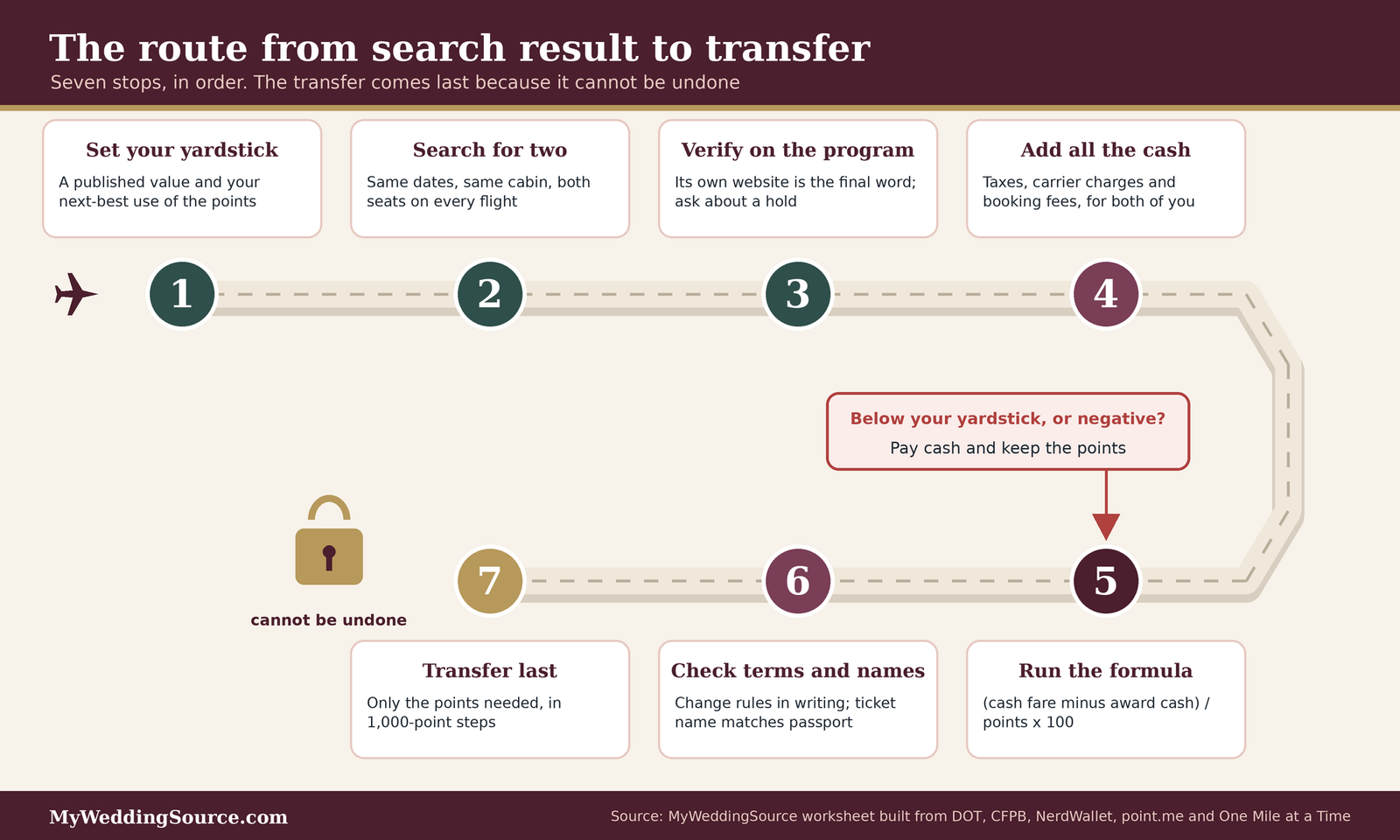
Search, verify, hold, calculate, transfer
Search for two seats, verify them on the airline program’s own site, place a hold if the program offers one, run the cents-per-point formula including all cash, and only then transfer. Point.me also notes that the airline account must be open and the holder name must match the bank profile, so set up the airline account and confirm names well before you need them. For couples who recently changed or are about to change a name, this is worth checking early, and our name mismatch guide explains how to avoid problems.
Transfer only what you need
Because transfers are in 1,000-point increments and cannot be reversed, calculate the exact points the award needs and transfer that amount, rounded up to the next increment. Moving a larger balance “just in case” locks it into one program. If the award turns out not to be bookable, you want the remaining points to still be flexible.
Compare the portal and the partner
Banks often let you spend points directly on travel through their own portal, usually at a fixed value per point. That option is simpler and sometimes better.
When the portal can win
NerdWallet suggests comparing transfer value with booking through the bank’s travel portal, because the portal may require fewer points for some trips. Portal terms vary by bank and by ticket, so read them before you decide. Run both numbers through the formula, and add the portal’s change and cancellation terms to your comparison.
When the partner can win
A transfer can come out ahead when the award price is low relative to the cash fare, as in the high-fare example, or when the cash fare is out of reach in a premium cabin. It can also lose when the award is priced high or carries heavy surcharges, as in the last example. The right answer comes from the numbers for your dates, not from a general rule.
When plans change on a honeymoon using points: cancellation and change terms
A honeymoon using points is booked around a wedding, and weddings move. Illness, venue problems, and work schedules can shift a date, so the terms that apply when you change an award matter as much as the price.
What programs charge to change or cancel
Change and cancellation terms differ a lot by program, and AwardWallet’s article says U.S. carriers are generally more consumer-friendly on these policies than many international programs. They are still not uniform.
A snapshot from two 2026 sources
The table below summarizes two publishers’ comparisons: One Mile at a Time (September 10, 2026) and AwardWallet (October 4, 2026). Both warn that programs have exclusions and elite-status exceptions, and the two do not always agree, which is itself a reason to confirm with the program. For example, they describe JetBlue’s terms differently.
| Program | Change | Cancel or redeposit | Notes from the sources |
|---|---|---|---|
| American AAdvantage | None | None | AwardWallet: changes are not possible, cancel before departure |
| United MileagePlus | None | None | AwardWallet: a no-show redeposit costs $125 |
| Delta SkyMiles | Free for most flights from North America | Free for most flights | Basic Economy awards carry a penalty |
| Southwest Rapid Rewards | None | None | Revenue-based, so you pay any cost difference when rebooking |
| JetBlue TrueBlue | Sources differ | Sources differ | AwardWallet lists $150 for Base awards; One Mile at a Time lists $100 to $200 only for Blue Basic |
| Alaska Atmos Rewards | Free, with limits | Free, with limits | Saver fares cannot be changed; partner booking fee is non-refundable |
| Air Canada Aeroplan | Up to 100 CAD | Up to 150 CAD | One Mile at a Time |
What the table does not tell you
The table covers only a few programs and says nothing about partner awards. One Mile at a Time advises following the policy of the program you book through, not the airline operating the flight, for partner awards. The same publisher says award bookings within the United States can usually be cancelled free within 24 hours, which is a general observation and not a guarantee. Always confirm the terms that apply to your specific ticket.
A wedding date that moves
A date change affects the award, the hotel, and the insurance at once, so it helps to know the order in which to check them.
Check the award first
If the wedding or honeymoon date shifts on a honeymoon using points, look at the award terms before anything else, because an award can often be cancelled or changed for free before departure at some programs but cannot be changed at others. Where changes are not possible, the cancellation and rebooking path matters, and the new award may price differently. AwardWallet notes that a lower-value new itinerary can leave no residual value at some programs, so ask how the difference is handled.
Then the hotel and the insurance
Hotels and insurance have their own deadlines. Our honeymoon booking checklist lists what to confirm in writing, and our honeymoon travel insurance guide explains how to read a policy before you rely on it. Check whether a policy covers the points portion of a trip, because coverage language varies and we did not verify it for any specific product.
Weather and disruptions
Seasonal risk is part of the cost of any honeymoon, and it interacts with how flexible your ticket is.
Flexible terms are worth more in risky seasons
If your destination has a stormy season, free change and cancellation terms are more valuable than a slightly better cents-per-point figure. Our guide to honeymoon travel during hurricane season lists the flexibility questions to ask before you book.
Keep a cash fallback in mind
Before you commit to a honeymoon using points, consider what you would do if the award had to be abandoned. If the answer is “buy a last-minute cash fare,” that is a cost to account for in your plan, not a reason to avoid points.
Consumer rules for a honeymoon using points: what protects you and what does not
Points exist in a gray area between money and a loyalty perk, and consumer rules treat them unevenly. A few government sources help you separate what is clear from what is not.
Refund rules from the Department of Transportation
The U.S. Department of Transportation has refund rules for airline tickets, and they matter if an airline changes your flight. The pages we read describe cash tickets and do not address award tickets specifically.
When a refund is owed
DOT says an airline owes a refund if it cancels your flight and you do not take a rebooking or other compensation, or if the flight changes significantly and you decline the alternative. For a domestic flight, DOT defines a significant change as a departure at least three hours earlier or an arrival at least three hours later. For an international flight it is six hours. A different origin or destination airport, more connections, or a move to a lower class of service also count.
How and when refunds arrive
DOT says refunds must be issued automatically, within seven business days for credit-card payments and within 20 days for other payment methods, and that they must be paid in cash or the original form of payment, such as a credit card or airline miles. It also says airlines may offer a voucher, which must be valid for at least five years, instead of cash only if you choose it. Because the pages do not address award tickets, ask the program how an airline-caused change on an award is handled, and get the answer in writing.
The 24-hour rule and booking channels
Another DOT rule can matter for a honeymoon booked weeks ahead, and it depends on how you buy.
What the 24-hour rule says
DOT says that for tickets bought at least seven days before departure, airlines must either allow a full refund without penalty within 24 hours of booking or hold the reservation at the quoted price for 24 hours. Airlines need not offer both. DOT also notes the rule does not apply to tickets bought through travel agencies, so those may follow other policies. The page does not say whether the rule covers award tickets.
Who is responsible when you book through an agent
DOT says the merchant of record, the company that appears on your card statement, is responsible for refunding airfare when a flight is cancelled or significantly changed. For portal bookings, ask who the merchant of record is, and read the portal terms. This is another reason to compare a portal booking with a transfer on more than price.
What can happen to your points
A honeymoon using points depends on a balance in someone else’s program, and consumer regulators have noted some recurring problems.
Complaints the CFPB has summarized
The Consumer Financial Protection Bureau published an issue spotlight on credit card rewards on May 9, 2024. It reviewed several hundred consumer complaints and identified recurring themes: consumers not receiving promised rewards, redemption problems, devaluation, unexpected promotional conditions, and revocation of rewards. The spotlight summarizes complaints and does not say how common these problems are.
A circular about devaluation and redemption
In December 2024 the CFPB issued Circular 2024-07 on the design, marketing, and administration of credit card rewards programs, published in the Federal Register on December 30, 2024. Among other points, it says that reducing the value of rewards a consumer has already earned may resemble a bait-and-switch, and that an issuer may remain responsible if points are lost during a redemption or transfer. The notice also says circulars are general policy statements that do not create enforceable rights. We did not verify whether the circular has since been changed, and we do not give legal advice, so treat it as context rather than as protection you can count on.
Names, passports, and the marriage certificate
Newlyweds face a particular problem that has nothing to do with points but can sink a honeymoon using points: the name on the ticket.
The name on the ticket must match your ID
DOT’s archived Fly Rights page says the name on your ticket must match the government-issued photo ID you show at the airport, and that if your name recently changed or will change before your trip you should bring documentation such as a marriage certificate. Ask the program whether a name on an award can be corrected and what that costs, because we did not find a general rule. Our name mismatch guide and passport name change guide cover the timing. The DOT page is archived and cautions against continued reliance on it, so confirm current rules with the airline.
Passport validity and blank pages
The State Department says many countries require at least six months of passport validity to enter, that six months beyond your return is a good rule of thumb, and that some countries require two or more blank pages. Check your passport before you spend points, since an award is not worth much if you cannot enter the country.
A worksheet for your honeymoon using points
This worksheet for a honeymoon using points is our own tool, assembled from the sources above. It turns a search result into a decision and records the facts you will want if something changes. Fill it in once per leg, or once per round trip if the fares are priced that way.
Fill in the numbers
Each line has a source. Use the booking page for the first four, and the program’s terms for the rest.
The numbers for the formula
Write down the following for each option:
- Cash fare for two travelers, same dates, cabin, and fare type.
- Points required for two travelers.
- Cash still due on the award for two travelers, including taxes, carrier-imposed charges, and booking fees.
- Cents per point: (cash fare minus award cash) divided by points, times 100.
- Your yardstick: a published valuation and your next-best use of the same points.
The facts that decide close calls
Then record the terms that matter if something changes:
- Whether both seats show on every flight, confirmed on the program’s own site.
- Whether a hold is available and for how long.
- Change and cancellation terms, with the date you checked them.
- Whether the name on each ticket matches the passport.
- Passport expiration dates relative to your return.
Read the result
The decision rule is deliberately simple, and you can adjust it to your own tolerance for risk.
Three outcomes
If your cents-per-point figure beats your yardstick, both seats are confirmed, the cash due is small, and the terms are acceptable, the award is worth considering. If your figure is close to your yardstick, prefer the option with better change terms, which is often cash. If the figure is below your yardstick or negative, pay cash and keep the points for something better. Our honeymoon rental car insurance guide and honeymoon resort room upgrades guide show where the rest of your budget tends to go.
Mixing is allowed
A honeymoon using points does not have to use one method for the whole trip. Outbound on points and return on cash, one traveler on points and one on cash if the program allows it, or flights on cash and hotel on points are all possible. Because each leg has its own cash fare and award price, each has its own number, and the best answer is often a mix.
Ask before you transfer
These questions pull the whole guide into one list you can take to a program or a travel advisor.
Questions worth asking before you transfer
- Are two seats available on every flight, and can you confirm that on the program’s own website?
- What is the total cash due for both travelers, itemized by taxes, carrier-imposed charges, and booking fees?
- Is there a hold, and how long does it last?
- What are the change and cancellation fees for this exact ticket, and are they in writing?
- If the airline changes the schedule, how does the program handle the refund of points and fees?
- Does the name on each ticket match each passport, and are the passports valid long enough?
- If the transfer is delayed, what happens to the seat?
- What else could these points do for us, and is this the better use?
Edge cases for a honeymoon using points
A few situations come up often enough in a honeymoon using points that they deserve a plan.
Accounts and ownership
Couples often combine finances after the wedding, and the way points are held can complicate a plan.
Whose points are they
Programs generally tie points to the account holder, so ask how yours works. Bank transfers typically go to an account in the holder’s name. Point.me says the airline account holder’s name must match the bank profile for Chase transfers. If one of you holds most of the points, check whether the program lets you book for another traveler and what name and relationship rules apply. We did not find a general rule, so ask the program.
Sharing logins
Do not share passwords or login credentials to move points or book flights. Our password sharing guide explains safer ways to share access for wedding planning, and the same cautions apply to travel accounts.
Registries and gifts
Some couples ask guests to contribute toward a honeymoon, and others receive gift cards or cash.
Honeymoon funds and points together
If you have a honeymoon fund, decide whether guest contributions will pay for the cash portion of an award or for other costs, and keep a record. Our wedding registry guide and wedding gifts guide explain how couples handle gift expectations and thank-yous.
Tax and financial questions
We have not researched the tax treatment of points or gifts, and we are not giving tax advice. If you have questions, ask a qualified tax professional or consult the IRS directly.
Special needs and arrival plans
A flight is only one part of the day you arrive, and the cheapest honeymoon using points is not always the easiest.
Long connections and arrival time
An award with a long layover or a red-eye can cost less in points and more in energy. Our sibling guide on a honeymoon jet lag plan for a short trip looks at how arrival time affects the first day, and it is worth reading before you choose between a cheaper itinerary and a gentler one.
Mobility and access needs
If either of you has a mobility need, confirm the airline’s accessibility arrangements and the hotel’s features before you spend points. Our guide to a honeymoon with mobility needs covers hotel accessibility verification, and DOT notes that connections that become less accessible for passengers with disabilities count as a significant change.
FAQ: honeymoon using points questions
Value and math
How do I know if points are a good deal for our honeymoon?
Subtract the cash the award still charges from the cash fare, divide by the points, and multiply by 100. Compare the result with a published valuation and with your next-best use of the same points. If it is below both, cash is probably better. All cash prices should describe the same flights, dates, cabin, and fare type.
What is a typical value per point?
It depends on the program and the publisher. The Points Guy’s November 2026 valuations range from about 1.2 cents for United and Delta miles to about 2.05 cents for Chase points, and they describe typical redemptions rather than best cases. These are one publisher’s opinions, so treat them as a rough yardstick, not a promise.
Do taxes and fees really matter on an award?
Yes, because they can be a large share of the cost on some routes. One example published by The Points Guy in 2022 showed an award with nearly $2,000 in surcharges, while the same route through another program cost about $62. Always compare the total of points plus cash, not the points alone.
Booking and transfers
Should we transfer points before we find seats?
No. Transfers are final, according to NerdWallet and point.me, so search for two seats first, confirm them on the program’s website, and use a hold if the program offers one. Transfer only the points the award needs, in 1,000-point increments, and only after you have run the numbers.
Can we book an award for both of us from one account?
It depends on the program, and we did not find a general rule. Some programs let an account holder book for another traveler, but the terms vary, and bank transfers generally must go to an account in the holder’s name. Ask the program before you transfer anything, and have both passports ready.
Changes and protections
What if we have to change the date?
Terms vary. Some large programs charge no change or cancellation fee, as reported by One Mile at a Time and AwardWallet in autumn 2026, while others charge fees or limit changes on certain fares. Check the terms for your exact ticket and get them in writing before you book.
Do airline refund rules apply to award tickets?
The DOT pages we read describe cash tickets and mention miles only as a possible original form of payment or alternative compensation. They do not address award tickets directly. Ask the program how it treats cancellations, schedule changes, and fees on awards, and keep the answer in writing.
Do we need to worry about name changes?
Yes, if your name will change before you fly. DOT’s archived page says the ticket name must match your government photo ID and suggests carrying a marriage certificate if the name recently changed. Book in the name on your passport, and check our name mismatch guide for timing.
Your next steps
Set the numbers
Decide what points are worth to you
For your honeymoon using points, write down your yardstick: a published valuation and the next-best use of your points. Then set a budget for the cash portion of the flights. Our honeymoon budget guide helps you set the overall number.
Gather the documents
Check both passports for expiration dates and blank pages. If a name change is coming, read our passport name change guide and decide which name to book under.
Search and verify
Search for two seats on your dates
Run searches for two travelers, note which flights show space, and confirm on the program’s own site. Compare the cash fare for the same flights and record the cash due on each award.
Fill in the worksheet
Use the worksheet to compute cents per point for each leg of your honeymoon using points, then choose all cash, all points, or a mix. For the rest of the planning, use our honeymoon booking checklist and honeymoon planning guide.
Commit with a safety net
Transfer last
Hold the seat if you can, transfer only what the award needs, and save confirmations. Then add the trip to your insurance review with our honeymoon travel insurance guide.
Recheck before you travel
Recheck the schedule after booking and again before departure. If the airline changes your flight, compare the change against DOT’s definition of a significant change, and ask the program in writing what it offers.
Sources & methodology
How we built this guide
What we relied on
This guide combines U.S. Department of Transportation refund and consumer pages, a State Department passport-validity page, two Consumer Financial Protection Bureau documents on credit card rewards, and published comparisons from award-travel and personal-finance publishers. We fetched and read each source listed below between November 11 and November 12, 2026. Where a figure comes from a publisher, we name it and give its date, because award prices, fees, and valuations change often. The cents-per-point examples are our own arithmetic; every cash fare in them is hypothetical, and the miles and fees in the last two rows come from the publishers named in the text.
What we did not do
We did not book awards, test any program’s website, or verify current award availability or prices. We did not review specific credit cards or sign-up offers, and we did not research tax treatment. Some DOT pages we read do not address award tickets, so we say so rather than assume. This guide is general information, not financial, tax, or legal advice.
Source list
Government sources
- U.S. Department of Transportation, Airline ticket refunds: https://www.transportation.gov/individuals/aviation-consumer-protection/refunds
- U.S. Department of Transportation, What airline passengers need to know about DOT’s automatic refund rule: https://www.transportation.gov/briefing-room/what-airline-passengers-need-know-about-dots-automatic-refund-rule
- U.S. Department of Transportation, Fly Rights (archived page): https://www.transportation.gov/airconsumer/fly-rights
- U.S. Department of State, travel industry guidance on passport validity: https://travel.state.gov/en/international-travel/planning/guidance/travel-industry.html
- Consumer Financial Protection Bureau, Issue spotlight: Credit card rewards (May 9, 2024): https://consumerfinance.gov/data-research/research-reports/issue-spotlight-credit-card-rewards
- Federal Register, CFPB Circular 2024-07, credit card rewards programs (December 30, 2024): https://www.govinfo.gov/content/pkg/FR-2024-12-30/html/2024-30988.htm
Award-travel and personal-finance publishers
- The Points Guy, Monthly valuations (November 2026): https://thepointsguy.com/loyalty-programs/monthly-valuations/
- The Points Guy, Taxes and fees on airline award tickets (September 2022): https://thepointsguy.com/loyalty-programs/taxes-and-fees-airline-award-tickets/
- One Mile at a Time, Airline award ticket changes and cancellation fees (September 10, 2026): https://onemileatatime.com/award-ticket-change-cancelation-fees
- One Mile at a Time, Airline fuel surcharges (September 17, 2024): https://onemileatatime.com/guides/airline-fuel-surcharges/
- AwardWallet, Award ticket change and cancellation policies (October 4, 2026): https://awardwallet.com/airlines/award-ticket-change-and-cancellation-policies/
- NerdWallet, How to transfer Chase points to travel partners (updated August 6, 2026): https://www.nerdwallet.com/travel/learn/how-to-transfer-chase-points-to-travel-partners
- point.me, How to transfer Chase Ultimate Rewards points to airlines (September 2026): https://www.point.me/insights/how-to-transfer-chase-ultimate-rewards-points-to-airlines